Ray Dalio, the founder of hedge fund giant Bridgewater Associates, has stated that he would rather hold Bitcoin than bonds in an inflationary environment. Dalio made these remarks during an interview at Consensus by CoinDesk Convention, where he also confirmed that he had some Bitcoin holdings but did not reveal the exact amount.
From the interview, it is clear that Ray Dalio prefers Bitcoin as an investment vehicle because of the following reasons.
1. Looming Inflation
Dalio said there is a looming global debt crisis in which the US dollar is at risk of devaluation, a condition last witnessed in 1971. If the debt crisis happens, then Bitcoin would be a more viable savings tool, given that it has gold-like features.
Dalio said that in the event of serious inflation, “Personally, I’d rather have bitcoin than a bond.”
Dalio will not be the first billionaire to make remarks about the dollar’s possible devaluation and how Bitcoin could help the situation. Stanley Druckenmiller has also made similar remarks.
3. BTC as a store of value
Bitcoin is also being increasingly opted for as a store of value, despite its volatility. While other people only seek Bitcoin to enjoy profits from trading, others are using it to protect their wealth from inflation.
Dalio was a Bitcoin critic up until towards the end of last year, but he has changed heart this year and believes that Bitcoin could be the best solution to solve the problem of storing assets during a period of inflation.
4. Bitcoin could go up
Dalio has been studying the debt cycle in the US for a while. He says that the current situation is similar to what happened in 1971 when the US abolished the gold standard and the dollar was made a fiat currency due to growing debt.
According to Dalio, a clear evaluation of the US budget shows that debts will increase, and more money will be needed. When the 1971 situation happened, stock values shot up. If this happens now, the value of Bitcoin will also increase compared to the US dollar, giving Bitcoin holders good returns.
5. Bitcoin is a neutral reserve currency
A rising number of countries have reservations about using the US dollar as a reserve currency. Against this background, Bitcoin is being seen as a possible neutral reserve currency that is not affiliated with any jurisdiction.
This makes Bitcoin similar in feature set to gold, and this may protect the token’s future value.
6. Bitcoin is tech-savvy
The world is changing, and everything is now leaning towards technology. Bitcoin is a great technological innovation, and this means that the country that realises Bitcoin and digital currencies ultimate potential most effectively will have an edge.
“The world is going to change at an incredibly fast pace,” Dalio said. “Whoever wins the technology race, wins it all, economically, and militarily. … That’s what the next five years looks like” Dalia said.
It looks like you have got to know about the secret of changing Monero into new Ethereum for disappearing in cyberspace with your money.
For those of you who don’t know what I am talking about, here is the thing:
Monero is completely anonymous when you own it, but we all need to transact with it. In comes Ethereum. To supplement this lack of anonymity, many XMR users convert their Monero into Ethereum because it breaks the chain and makes them completely anonymous.
However, I understand, your reason for exchanging or converting XMR to ETH might be something else. But whatever it is, you need to do this exchange with extreme caution because crypto transactions are irreversible.
So to help you out precisely with that we have come up with this step by step guide on converting your XMR into ETH in the least possible time with safety.
We have chosen, Cryptmixer cryptocurrency swap service for this tutorial because it is one of the most user-friendly services to exchange one currency to another.
Let’s jump right into the step by step process:
How & Where To Exchange Monero (XMR) To Ethereum (ETH)?
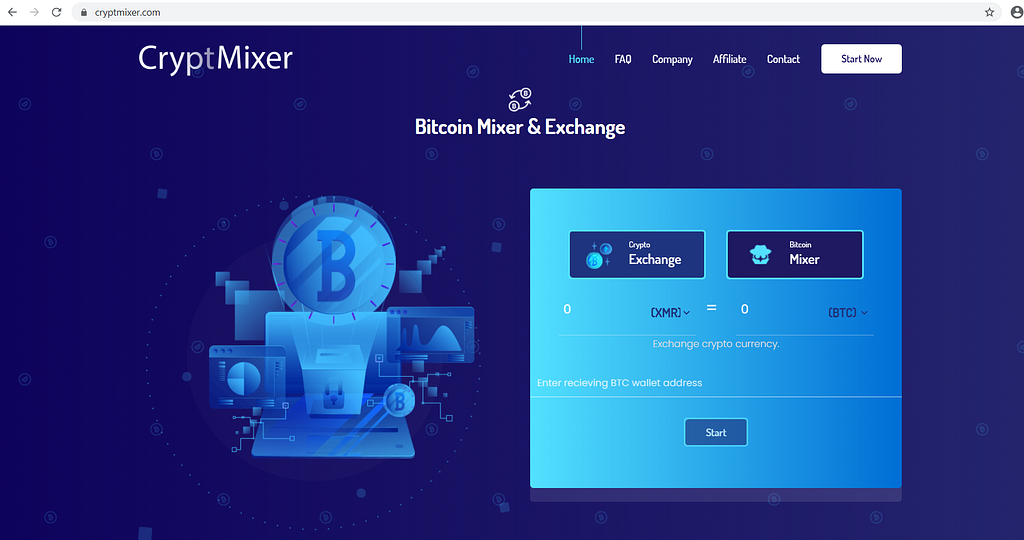
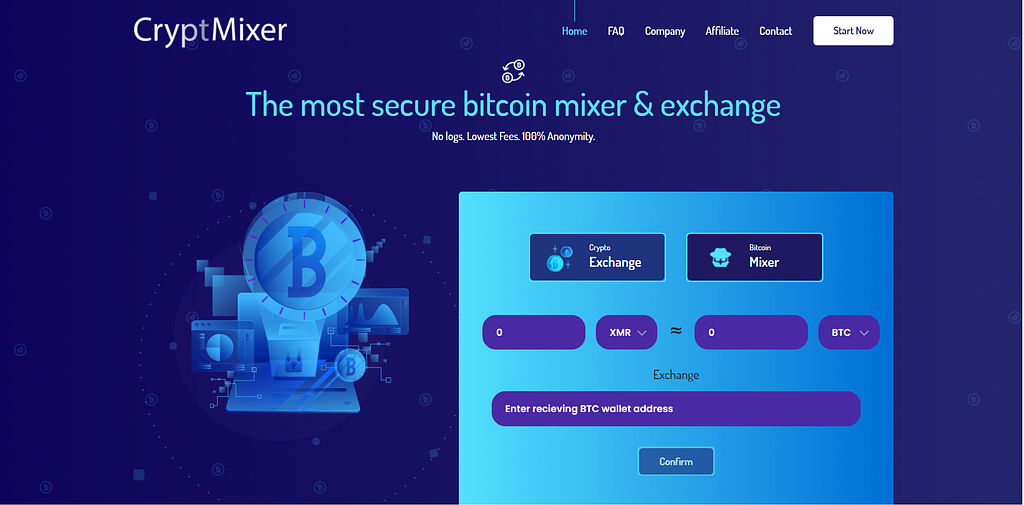
Step #1. Go to Cryptmixer [No KYC & No Sign-up]
You should see this screen where you can select Ethereum Exchange. Do mention the correct amount of XMR you want to exchange. Doing this will automatically show you the amount of ETH you will be receiving after the conversion is complete.
Step #2. Here click on the ‘Start’ option shown in the above image to see the below-shown screen. You can even change the amount of XMR you wish to exchange here too. The exchange fee is set to 0.05% of the transaction.
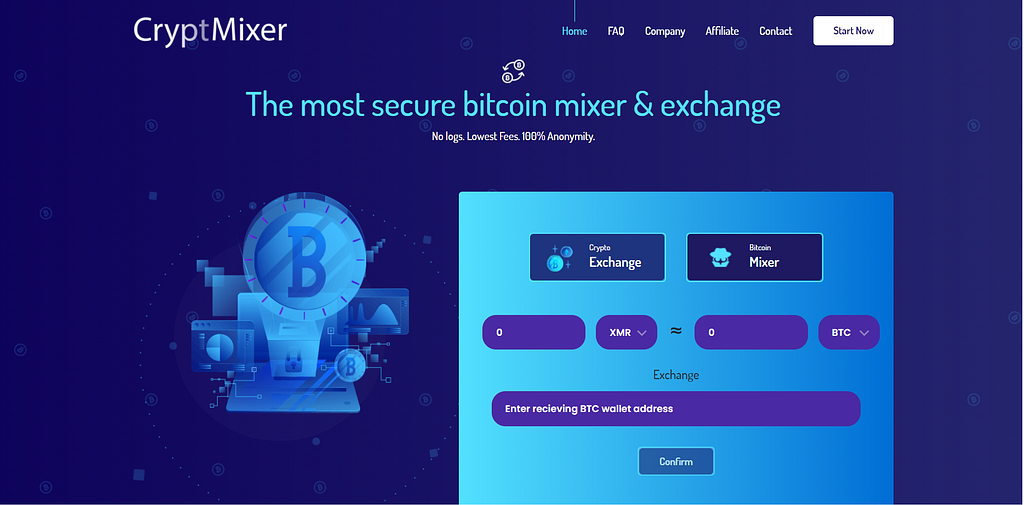
Here they will ask you for your Ethereum address. If you don’t have the Ethereum address, we suggest you choose a wallet from some of the best Ethereum wallets and get an address for yourself. This is the ETH address on which you will get your Ethereum once the exchange has been completed.
Step #3. After adding the Ethereum address, click on “Confirm” asshown in the above image. Once you do that you will be shown details of your conversion such as ETH address, fees, time for conversion, etc. Verify the details intently on this page before moving forward for the actual exchange.
Step #4. Once you have checked all the details, click on ‘Start’ shown in the above screen.
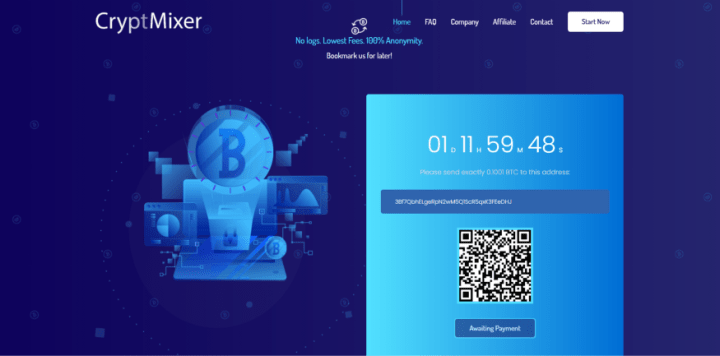
You should now see a screen asking you to send the XMR first on a given address. Don’t worry; this is how it is supposed to work when you use Cryptmixer. You need to provide the relevant currency first after which you receive the other currency. Take out your Monero wallet and put the shown address to send your Monero on it.
Note: You have 24 hours to send funds otherwise the transaction will be canceled automatically, but I suggest you send it ASAP before the exchange rate of XMR changes.
Step #5. As soon as you send your Ethereum to the shown address, you will start seeing this screen ‘transaction is being confirmed.’ It means your transaction is processing and will be confirmed by the Monero blockchain soon. Usually, it takes 10 confirmations for depositing Monero which can take up to an hour in case of congestion on the blockchain.
The swapping process itself happens almost instantaneously, but the blockchain network takes the rest of the time. Typically, the exchange comprises of these three stages:
Getting confirmations
Exchanging XMR to ETH
Sending Ethereum to your wallet
Step #6. Wait with patience, and as soon as your conversion from XMR to ETH is completed, you will see this screen showing you all the details of the transaction.
You can check your transaction details on the respective blockchain also.
Congratulations, Tada….!!! You have done it
Is It like Exchanging Ethereum?
Some people mistake this for sending Monero to the network and think that its Monero’s blockchain that is doing the conversion for them.
But that’s far from reality.
In this conversion powered by Cryptmixer, it acts like a mediator who facilitates the conversion of XMR to ETH. Moreover, Cryptmixer is worth relying on such exchanges because it has made a name for itself doing the same for last 5 years in this industry
So what are you thinking?
Check Out Cryptmixer for free now
Note: We have used the example of XMR to ETH in this tutorial, but the process of converting any other currency to another one is the same, so feel free to try out Cryptmixer for that too !!
If you liked this guide, please share it with your friends & family member who wishes to exchange XMR to ETH or vice versa !!
How To Instantly Convert Monero(XMR) To Ethereum(ETH)? was originally published in The Bullish on Medium, where people are continuing the conversation by highlighting and responding to this story.
Bitcoin tumbling, also referred to as mixing or laundering, is the process of using a third-party service to break the connection between a Bitcoin sending address and the receiving address(es). So, stated quite simply: What is the best Bitcoin Tumbler? We made our own investigation and here is what our research showed on the 4 most popular Bitcoin tumbler services.
Is Bitcoin Tumbling Necessary?
You’re practically anonymous, the fees are extremely low, transactions get confirmed within just a few minutes, and you don’t need to trust any single person or corporation. That awesomeness, however, comes at a price. Namely, everyone with a copy of the full blockchain (which is freely available) can look into everyone’s transaction history, including yours. Based on this, and some external information, others can deduce the owner of an arbitrary Bitcoin address. You could send all your money to a new address and forget about the old one, but it’s a really thin cover; such an operation wouldn’t fool the potential person spying on you. A good example is illustrated in a recently leaked memo where the U.S. Army and the National Security Agency sought to track cryptocurrency users by analyzing transactions. And that’s where a Bitcoin tumbler service shows up to save the day.
But it’s not just the authorities that are on the lookout for illegal crypto transactions. There are also exchange platforms that are keen to observe transactions from specific sources such as gambling sites and darknet markets.
For instance, Coinbase states that it does not accept funds from gambling sites because of reasons best known to them. But a good and justifiable reason is that gambling sites are well known to be hubs for laundering money, where some of the proceeds are obtained from the dark web.
Bitcoin mixing helps you to disassociate any BTC you purchased from your identity. You send your coins to a Bitcoin mixing service; they take a small mixing fee, and after a random delay they send you an equivalent amount of other people’s bitcoins to your new address. In other words, coin mixing services take your cash and give you new cash to your secret identity so that it remains secret.
So, to avoid the inconveniences brought about by using funds from sources not regarded as “clean,” cryptocurrency tumbler services offer a solution.
4 Most Popular Bitcoin Mixing Services
There are different Bitcoin shufflers currently in use. And a user should take into consideration several factors before choosing one. First of all, the obvious factor is the type of coin you are using and the source of funds.
When the funds are clean, then there is no point in mixing up the Bitcoin since suspicions are not likely to be raised.
But, if you are a darknet market user who operates using specific sites, you should find out if the market you are using has a built-in tumbling service. You can also check if the site recommends any outside coin mixing services. If not, then it’s up to you to research in order to stay safe in the future.
We performed our own research using Google, Bitcointalk, Reddit, and other communities this bitcoin mixer review we have tried to cover the most popular services.
1. Cryptmixer.com
Cryptmixer has a Bitcoin reserve of its own, consider it a chain of Bitcoins, when you send your BTC to cryptmixer.com it sends your coins to the end of the chain and sends you fresh, new, unlinked coins from the beginning of the chain.
Hence there’s no link between the coins going in, and the coins coming out. Hence the public ledger would only be able to track the coins going from your wallet to the address of cryptmixer.com but no further.
Cryptmixer.com doesn’t require you to signup, register, or provide any kind of detail except the “receiving address”! That’s the only thing it needs, there can’t be a better form of anonymity if you ask me.
Since you provide no personal details, there’s no way your identity can be compromised. Nor can it be linked back to you, since cryptmixer.com doesn’t know who you are.
Cryptmixer.com is one of the most accommodating tumblers in this sense as well, most other tumblers offer 1–4% fees, Cryptmixer.com has a flat rate of 0.05% for all services on their platform.
With Cryptmixer.com you will get:
Fully Anonymity After your order is invalid, Cryptmixer.com will remove any information about your transactions. Absolutely no logs or personality identifying information is kept regarding your use of the Cryptmixer.com service.
Instant Transfer Money is instantly transferred to your address after your transaction is confirmed.
Partner Program Cryptmixer.com pays users when they refer others to the platform. They’ll pay for every transaction made by an invited user.
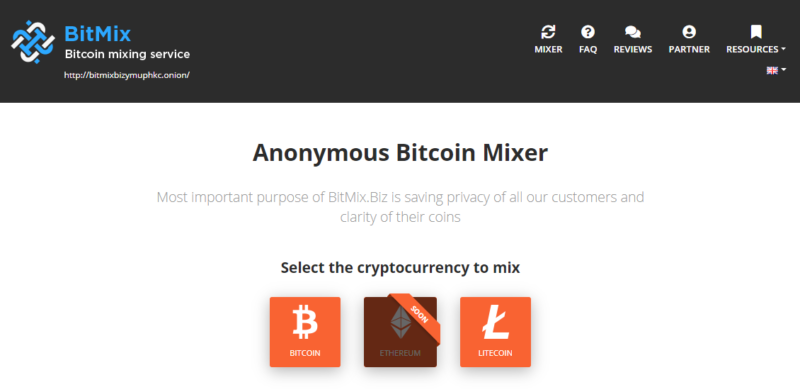
2. BitMix.Biz
BitMix.Biz is one of those mixing services that keep your crypto safe. The platform will take your bitcoin, mix it with other deposits, and give you the same amount of bitcoin in return. It’s designed to reduce bitcoin tracking, “clean” your coins, and help ensure anonymity on the transparent bitcoin network.
A bitcoin mixer service like BitMix.Biz will take your bitcoin, then give you different bitcoin in return. The platform collects everyone’s bitcoin deposits, mixes them up into one central account, and then returns the bitcoins to users. You get the same amount of bitcoin (minus a fee), but different bitcoin from different parts of the blockchain.
With BitMix.Biz, you get a letter of guarantee. That letter of guarantee is proof of BitMix.Biz’s obligations. When they give you their bitcoin address, they’ll provide a digitally-signed confirmation that this address has genuinely been generated by the server. That letter is always signed from the BitMix.Biz main bitcoin account (that account is publicly available on BitMix.Biz).
The platform charges a mining fee of 0.4 to 4%. You can set the fee manually when you’re mixing your bitcoins. The address fee is 0.0005 BTC per output address to cover any transaction fees charged by miners.
BitMix.Biz’s mixing process takes up to 24 hours, although it’s usually “almost instant” depending on the current service load.
You’re required to mix a minimum of 0.007 BTC and a maximum of 1000 BTC. Transactions outside this range will not be accepted.
3. MixTum.io
MixTum.io is a Bitcoin mixing service that provides privacy by using the ‘Bitcoin Mixer 2.0’ algorithm to shuffle bitcoins. Unlike other similar tumbling services that mix your coins with the coins of other users, this platform mixes your crypto with the crypto bought by them directly from the cryptocurrency stock exchanges.
MixTum.io verifies the newly purchased coins with a scoring system with the help of innovative algorithms and outfoxes such technologies as blockchain volume analysis, cluster analysis, taint analysis, etc.
It means that you will receive your BTC back split into random parts, and even at the different addresses if needed. Consequently, your privacy is protected as there is no connection to you. And it takes up to 6 hours to complete your request.
Another privacy feature of this mixer service is that it does not require registration and it does not store logs. All the transactions are digitally signed with letters of guarantee that you can check on the website at any moment. They also provide 24/7 technical support.
MixTum.io will charge you a 5% Fee from your transaction as well as a network fee of 0.00015 BTC.
The platform provides two versions — for Clearnet and Tor browsers.
4. CryptoMixer
CryptoMixer is another simple yet trustworthy Bitcoin Tumbler service. And one of the primary differences it has compared to the other platforms on this list is that it can accommodate really “large volume transactions”.
There is no maximum transaction limit as such, considering how their reserve is really huge and you’ll need to be a millionaire before you can run them out of funds. If any limit is breached, you are notified before you make the payment.
The minimum transaction 0.001BTC, any amount lower than this is is considered a donation, like in the case of PriveCoin, and isn’t sent back to the customer.
The minimum fee is 0.5%, with an additional 0.0005BTC for every deposited transaction.
You can set a custom fee for added anonymity and they also provide a letter or guarantee like all the mentionable Bitcoin Tumblers out there.
Conclusions
Any Bitcoin Tumbler works anonymously and effectively. It’s important that they be trusted. There’s no authority or government you can complain to if they run off with your coins. So if you like privacy and also want to protect your cryptocurrency from government tracking or tracing, Bitcoin mixer services are a good option. Just remember that it is hardly possible to find a free bitcoin tumbler as all of them would charge you a small fee between 0.05–4%.
4 Best Bitcoin Tumbler (Mixer) Services F was originally published in The Bullish on Medium, where people are continuing the conversation by highlighting and responding to this story.
Decentralized exchanges (DEXes) are changing finance for the better. DEXes are a next-generation technology and they make the legacy financial system look like a bunch of people with fax machines and gargantuan computer monitors.
Just like anything else though, there is competition. Ethereum has the best, most liquid decentralized exchanges and in this article we’ll look at UniSwap and SushiSwap to see what the two DEXes have in common, and how they’re different.
We’ll also study the use cases for their respective currencies, the Uniswap token and Sushi coin.
All About Decentralized Exchanges
A decentralized exchange is unique because it’s controlled by code, not a centralized authority. In the traditional financial system there is one company, like the New York Stock Exchange, which handles all of the trading.
The NYSE can shut down the exchange or kick traders and organizations off the platform. A decentralized exchange is different. A DEX is governed by a smart contract, where no single person or organization has complete control. For example, the Uniswap developers can’t kick everyone from Iran off the exchange.
On a decentralized exchange, if you’ve got the money you can make the trade. That level of freedom is revolutionary and it all started with Uniswap.
The History of Uniswap
Uniswap was released on November 2nd of 2018, roughly a year into the last crypto bear market. For 18 months Uniswap had almost no traction and few people used the platform. The exchange didn’t even reach $50 million of value locked until June of 2020.
However, from there on out, the growth was exponential. By the end of 2020 Uniswap reached about $1.5 billion of value locked. As of March, 2021, there is $4 billion worth of assets locked up in Uniswap by liquidity providers. A complete history of Uniswap is available on their website.
September 16th, 2020, was one of the biggest days in Uniswap’s history. On that day Uniswap airdropped their UNI governance token to every Ethereum address that had previously interacted with the decentralized exchange. It was a massive token giveaway and tens of thousands of users benefited from the airdrop.
To this day Uniswap continues to dominate the decentralized exchange landscape. Uniswap regularly clears $1 billion per day in trading volume, making it one of the world’s most popular exchanges, decentralized or otherwise.
What Is Uniswap and How Does It Work?
Uniswap is the most popular decentralized exchange in the world. It’s built on top of Ethereum and clears roughly $25 to $30 billion in trade volume every month. Anyone can list a token on Uniswap, so there is theoretically no limit to how many assets can be traded on the exchange. The only limit is liquidity.
The Uniswap exchange takes a novel approach to liquidity. Traditional exchanges work by matching a buyer and a seller, but Uniswap is different. On Uniswap, a “liquidity provider” can deposit coins into the protocol. For example, $100 worth of DAI and $100 worth of ETH.
These coins are pooled with coins from other liquidity providers and that’s how the exchange generates liquidity. Uniswap users can swap their assets and the liquidity providers receive a portion of the trading fee as a reward for depositing their coins.
This is only a simplified explanation of how trading works on Uniswap. An in-depth explanation of the exchange is available in this guide: What is Uniswap?
Uniswap vs SushiSwap
Does the Uniswap & SushiSwap name sound familiar? That’s because the two protocols are based on the same code. In fact, SushiSwap is just a fork of the Uniswap exchange with a few modifications made to the code.
Both protocols charge 0.3% transaction fees, which is average for a crypto exchange. Coinbase Pro charges a 0.5% transaction fee while the ever popular Binance only charges a 0.1% fee. If you want to compare Uniswap vs SushiSwap you have to look at how those transaction fees are distributed.
On Uniswap the transaction fees are distributed to the liquidity providers. On the SushiSwap exchange, 0.25% goes to the liquidity providers while 0.05% goes to Sushi coin holders.
Sushi coin, or the Sushi token, is the governance token for the SushiSwap exchange.
How Sushiswap overtook Uniswap in total value locked (DeFi Pulse)
Distributing the Sushi token was one of the critical ways that SushiSwap was able to get more value locked in its platform. Not only do Sushi holders receive 0.05% of the total trade volume from SushiSwap, there is an ongoing distribution of the SushiSwap token to liquidity providers.
SushiSwap uses its token to incentivize people to participate on SushiSwap. This has helped the Sushi DEX to catch up with the project that it imitated.
In terms of total value locked, sometimes SushiSwap has more value locked and sometimes Uniswap has more. The two are very close and often switch places.
SushiSwap branching out to Binance Smart Chain
The SushiSwap development team has set up a contract on the Binance Smart Chain (BSC). Having the exchange running on another blockchain could help to bring in a new cohort of users. One of the key advantages of BSC is that transactions are faster and far less expensive than they are on Ethereum. SushiSwap has also expanded onto the Avalanche, Polygon and Fantom blockchains, showing that they are quite aggressive in their expansion strategy.
How to trade Your Uniswap and SushiSwap Tokens
Buying the Uniswap & SushiSwap tokens can be a great long-term play for crypto investors. The only question is, how can you safely trade these assets for years to come?
The easiest way to trade the Uniswap & SushiSwap tokens is with the Cryptmixer crypto wallet. Cryptmixer supports both UNI and SUSHI, along with more than a 35 other cryptocurrencies. What’s so cool about Cryptmixer is that the wallet works on your computer.
Investing in both tokens is a smart move since it’s still unclear which exchange will win in the long term. Uniswap & SushiSwap offer a similar service and have nearly the same amount of liquidity locked up, so it’s hard to tell which one has an advantage.
Whichever decentralized exchange wins, it’s pretty cool to get into this market so early and participate as talented developers continue to build out a brand new financial system.
Will cryptocurrencies ever take over the world?
Cryptocurrency users who have questions about Uniswap and SushiSwap often ask; will cryptocurrencies ever take over the world?
The only answer we can give with 100% certainty is: we don’t know… It’s impossible to predict how cryptocurrencies are going to be integrated into the financial system. That being said, we can still speculate about how things might go in the future.
Bitcoin is the most popular cryptocurrency but it’s also got the largest target on its back. Bitcoin is trying to be money and if there is one thing governments don’t like, it’s when something interferes with their monetary sovereignty. Bitcoin could still be around in 50 years, but it may be optimistic to assume that countries the world over will run on a Bitcoin standard.
Ethereum is arguably more likely to take over the world, since it’s a smart contract platform. Although Ethereum users claim ETH is money, the primary function of Ethereum is to host smart contracts like Uniswap & SushiSwap. Because Ethereum is not trying to replace the Dollar or the Euro, there is (arguably) a better chance that it will take over the world.
Of course, the most likely outcome is that Central Bank Digital Currencies (CBDCs) are going to take over the world. This is an outcome that we can be pretty confident about. In ten years we probably won’t be arguing about Uniswap vs SushiSwap but we will be talking about the Digital Euro and the Digital Dollar.
Uniswap (UNI) vs Sushiswap (SUSHI). How To Buy [2021] was originally published in The Bullish on Medium, where people are continuing the conversation by highlighting and responding to this story.
Looking for a safe and secure environment to exchange cryptocurrencies, or a place to mix your valuable Bitcoins in order to preserve and guarantee your full anonymity? At Crypt Mixer, we exchange a range of commonly traded cryptocurrencies, these of which include: the popular Bitcoin (BTC), Ethereum (ETH), Litecoin (LTC), Monero (XMR) and Ripple (XRP) as well as also providing Bitcoin mixing services, both of which are in a risk-free encrypted environment to confidently warrant your utmost digital privacy.
We aim to ensure your anonymity and conceal your identity by masking any connection, ties or records relating to the Bitcoin or cryptocurrency by obscuring the transaction pathway associated with the cryptocurrency — commonly referred to as a blockchain. By shuffling cryptocurrencies and coins belonging to you alongside those belonging to other users of this platform, it allows any transaction trails resulting from previous payments or purchases tied to the currency to be obscured to such a degree where it is no longer traceable, this as a result diminishing the risk of identity theft from scammers, fraudsters or cyber attackers — even with their specialised high-tech software.
At Crypt Mixer, we pride ourselves on utilising encrypted servers to further mitigate risk of blockchain analysis in order to guarantee users of our platform a safe and private environment when utilising our services. In addition to this, any logged information is retained only for 48 hours after mixing to provide some traceability to resolve any potential issues you may encounter — however users are given the option to have this be deleted instantly after being in receipt of the mixed coins.
Offering an extremely quick turnaround, a reliable service and a user-friendly interface — an exchange is made only within 30 minutes of receiving your desired output cryptocurrency wallet address. Our platform is made to be straightforward to navigate, practical and simple to use — it requires just 3 steps to get you started. Simply select the cryptocurrency you’re looking to exchange to and from, enter the desired amount you’re looking to exchange or mix and finally input your crypto wallet address that you would like the coins to be sent to once they’re fully mixed and shuffled. Whilst you wait for your newly assigned coins, you can also remain updated and track the progress of the exchange or mix by keeping an eye on the status of the progress.
Offering competitive rates for cryptocurrency exchange and bitcoin mixing, we charge extremely affordable services fees from a rate of only 0.05% — furthermore, there are no additional hidden costs associated for utilising multiple crypto output addresses.
If you have any questions relating to mixing cryptocurrencies or would like further information on the safety of our platform, please feel free to get in touch with us at support@cryptmixer.com and a valuable member of our highly trained team will aim to get back to you as soon as possible.
CryptMixer Best Bitcoin Mixer for the Privacy Conscious | Privacy Bitcoin News was originally published in The Bullish on Medium, where people are continuing the conversation by highlighting and responding to this story.
Stablecoins, IOU tokens, and future incentive programs are coming down the pipe for jilted investors.
After a devastating hack, a cross-chain decentralized finance (DeFi) protocol has revealed today a temporary compensation plan for token holders and investors impacted by one of the largest exploits in DeFi history.
In a Tweet today, EasyFi announced their “Interim Compensation Plan,” a multi-stage process that includes immediate payments, IOU tokens, and incentive programs aimed at victims of the attack.
1/ #EasyFi is releasing a carefully thought out compensation plan for the protocol users on @0xPolygon.
We would also like to inform you that we have onboarded new strategic investors & strong backers to help expand the protocol operations & business. https://t.co/Gu7FtLcsnc
— @easyfi.network (@EasyfiNetwork) May 7, 2021
The hack, which took place 19 April, is considered to be among the largest in DeFi history, with $6 million in stablecoins and 2.98 million EZ tokens worth upwards of $120 million lost at the time of the attack. The hacker was in a complicated position, however, as after exploiting the protocol they owned upwards of 30% of the supply of EZ tokens and there was limited liquidity with which to unload them. The token “hardforked” to EZ 2.0 a week later, rendering the attacker’s remaining tokens effectively worthless.
In a Tweet from his personal account, EasyFi founder Ankitt Gaur confirmed that the hack was the result of a “targeted attack on the founder’s machine/metamask to access admin keys and execute the well-planned hack.” This attack vector bears similarities to a 2020 hack on the personal computer of Hugh Karp, the founder of Nexus Mutual, who lost $8 million.
An expert from hack and exploit publication Rekt noted that the theft may have been the result of lax security practices, in that a single individual was in possession of the keys to the treasury, as opposed to being secured in a wallet with precautions against this type of hack such as a multisignature scheme or timelocked transactions.
In their compensation plan blog post, EasyFi characterizes the attack as “well-planned” and “sophisticated.”
Regardless of the cause, the efforts to compensate victims is multifaceted. Per their post, 25% of lost funds will be distributed to users “immediately” in the form of stablecoins, while the remaining 75% will be distributed as “IOU” tokens. The IOU tokens will have “25% discount on spot price of EZ at the time of distribution,” and be redeemable for EZ v2 tokens on a 1-to-1 basis. Hack victims will also reportedly be the recipients of future airdrops from unspecified partners and have access to other incentivized programs still in development.
The post also noted that the protocol has worked to attract new venture capital via an “accelerated” fundraising round following the hack — a round that is still ongoing.
The token is down 4.7% today to $11.30, and down 33.8% on the week — still reeling from both the hack, as well as from compensated investors possibly cashing in their IOUs.
Compensation methods are an increasingly hot topic as hacks and exploits continue to plague DeFi. EasyFi’s multifaceted approach mirrors that of Origin Dollar’s, while other protocols have opted for creative cross-platform treasury magic to mitigate attacks in recent months.
A series of protocol upgrades and new liquidity integrations prove that 1INCH is aiming to increase its DeFi and DEX aggregator market share.
As the decentralized finance (DeFi) ecosystem evolves and expands to encompass the whole of the cryptocurrency sector, the race to become the top decentralized exchange (DEX) aggregator is heating up as new entrants to the field seem to emerge on a weekly basis.
One of the top DEX aggregators that has recently seen its price reach a new record high is 1INCH, a protocol that offers “access to the most liquidity, lowest slippage and best exchange rates across Ethereum and Binance Smart Chain” according to the projet’s website.
1INCH/USDT 4-hour chart. Source: TradingView
Data from Cointelegraph Markets Pro and TradingView shows that after hitting a low near $5.15 on May 5, the price of 1INCH catapulted 47% higher to reach a new all-time high at $7.55 on May 6.
New liquidity integrations spark the rally
The recent price growth experienced by 1INCH was sparked by the May 6 announcement that the protocol had aggregated the liquidity available from the rapidly rising MDEX DeFi ecosystem which operates on the Binance Smart Chain (BSC).
#MDEX x #1INCH
We are happy to announce that @1inchNetwork aggregated liquidity of #MDEX on #BSC #1inch: A distributed network for decentralized protocols enabling the most lucrative, fastest, and protected operations in #DeFi pic.twitter.com/Z3keYCxvcQ
— Mdex.com (@Mdextech) May 6, 2021
This new integration helped to further expand the reach of 1Inch and solidify its position as the most widely integrated DeFi aggregator to date.
The announced integration of MDEX liquidity was quickly followed by the release of the 1INCH Wallet which offers a “user-friendly entry point to DeFi.”
#1inchWallet launches on @ProductHunt
⤵️ Feel free to leave your #feedback and ask any questions to the developers!#DeFi #1inch #iOS #cryptotradinghttps://t.co/h5np5T4EkX
— 1inch Network (@1inchNetwork) May 6, 2021
At the same time as the wallet was revealed, the team also announced that it would be partnering with the WireX (WXT) digital payment platform to help migrate 20% of the WXT token supply from the Stellar (XLM) network to the Ethereum (ETH) network.
Together, these developments helped 1INCH rally to a new record high at $7.55 on May 6 before profit-taking dropped the price as low as $6.30 in the early trading hours on May 7.
Following the price pullback, and as a testament to how quickly the protocol works to integrate new upgrades, the team at 1INCH announced that it had integrated Uniswap (UNI) V3 which was launched on May 5. As a result, 1INCH price rallied 13% following the announcement to an intraday high at $7.13.
While the 1INCH price chart was trading sideways headed into the first week of May, VORTECS™ data from Cointelegraph Markets Pro began to detect a bullish outlook for the altcoin on May 1, prior to the recent price rise.
The VORTECS™ Score, exclusive to Cointelegraph, is an algorithmic comparison of historic and current market conditions derived from a combination of data points including market sentiment, trading volume, recent price movements and Twitter activity.
VORTECS™ Score (green) vs. 1INCH price. Source: Cointelegraph Markets Pro
As seen in the chart above, the VORTECS™ Score was flat heading into May and then began to rise on May 1, reaching a peak at 77, roughly 3 days before the price surged 47% over the next 24-hours.
The project’s recent integrations to the Binance Smart Chain, the release of its own native wallet, and the fact that it is one of the most used DEXs on the Ethereum network are all signals that the project is leading the way for automated market-making and DeFi yield opportunities in the crypto space. Each of these developments suggests the token is well positioned for further upside.
The views and opinions expressed here are solely those of the author and do not necessarily reflect the views of Cointelegraph.com. Every investment and trading move involves risk, you should conduct your own research when making a decision.
The New York Digital Investment Group, or NYDIG, tapped Jon Dalby as its new CFO.
Departing his position as the chief financial officer of Bridgewater Associates, John Dalby will assume the post of chief financial officer for Bitcoin-focused tech and finance company NYDIG.
“The NYDIG team and I are extremely excited to welcome John,” NYDIG CEO and co-founder Robert Gutmann said in a public statement released on Friday. He added:
“His kindness, curiosity, and humility, combined with his deep financial services experience, are a perfect match for NYDIG as we continue to build institutional Bitcoin solutions. Working on Bitcoin is increasingly what many of the best and brightest employees seek – including industry leaders like John – and NYDIG is uniquely positioned to offer them the platform, resources, and culture to shine, in pursuit of our collective mission to bring Bitcoin safely to everyone.”
Founded in 1975 by famous investor Ray Dalio, Bridgewater Associates operates as a mainstream powerhouse investment management entity. NYDIG, a younger company focused on Bitcoin, has made a number of headlines this year, including garnering funding to the tune of $100 million.
Dalby formerly held high positions at UBS and D.E. Shaw Renewables Investments, giving him vast expertise, based on the public statement. “The growth of NYDIG has been incredible,” Dalby said in the statement. “Every day, more industries come to understand Bitcoin’s potential and more clients seek ways to safely access it,” he added. Further comments in the statement from the new NYDIG chief financial officer showed his positivity toward Bitcoin’s potential.
QTUM price hit a 3-year high above $35 as the team’s focus on DeFi and staking attracts new users.
After rallying 1.510% in 2021, QTUM price hit a $35.70 all-time high on May 7. This relatively obscure altcoin launched in September 2017 is a fork of the Bitcoin Core 0.13 version, but it also integrates the Ethereum virtual machine (EVM) and smart contract execution capability.
Following Bitcoin’s (BTC) April 23 crash down to $47,500, QTUM faced a 52% correction in 4 days before bottoming at $10. However, the situation for the altcoin improved on May 5 as QTUM initiated a 160% rally in two days, reaching the $35.70 peak.
QTUM price at Binance, USDT. Source: TradingView
Qtum combines Bitcoin’s transaction model with Ethereum smart contracts
The open-source platform’s primary goal is to provide simple tools that anyone can use to create decentralized applications (dApps) while maintaining a high level of network security. The project opted for a slightly different Proof of Stake (POS) version to prevent malicious nodes, and a certain number of blocks are needed for the staking tokens to become valid.
Qtum blockchain supports smart contract programming languages beyond Solidity, besides having an on-chain decentralized governance protocol. Token holders vote on network parameters such as block size and base gas fee.
While Qtum blockchain features an on-chain governance system, it also has an off-chain process for approving and handling more significant protocol changes. The protocol has recently identified decentralized finance (DeFi) as a focus area and steps to attract new projects.
This strategy seems to be finally paying off, as the number of daily network transactions peaked on May 6.
Qtum blockchain transactions per day. Source: qtum.info
Staking improvements and DeFi pivot send Qtum price higher
Offline staking was implemented in August 2020, and it has grown to more than half the staking activity on the Qtum blockchain. Investors who don’t want to handle their own nodes can make a non-custodial delegation for their coins.
On March 17, Value Network announced plans to migrate away from Ethereum due to network congestion and high costs. It is now moving to the Qtum smart contract and DApp platform and has received a development grant to accelerate the transition.
On March 31, Qtum founder Patrick Dai said that the protocol was working to enable smart contracts for Filecoin (FIL) through the Qtum network.
The network transitioned from a 128-second block average to a 32-second block average via a hard fork on April 30. The average four weeks that it took for an average-size staker to become valid now has been reduced to a single week.
Ethereum compatibility means increased interoperability
Interoperability is another reason for QTUM’s recent rally. The team is developing Neutron, an agnostic interface that allows virtual machines to run on multiple blockchains. Moreover, its own DEX called QiSwap enables users to build DeFi applications and provide liquidity on top of the Qtum blockchain.
VORTECS™ data from Cointelegraph Markets Pro began to detect a bullish outlook for QTUM on May 5, before the recent price rise.
The VORTECS™ Score, exclusive to Cointelegraph, is an algorithmic comparison of historical and current market conditions derived from a combination of data points, including market sentiment, trading volume, recent price movements, and Twitter activity.
VORTECS™ Score vs. QTUM price (white). Source: Cointelegraph Markets Pro
As seen in the chart above, the VORTECS™ Score began to climb on May 5 and reached a high of 71. It’s worth noting that the VORTECS™ Score peaked roughly 24 hours before the price spiked 100% to a new all-time high at $35.70.
Qtum is aiming to compete with some serious smart contract contenders like Cardano (ADA), Polkadot (DOT), VeChain (VET), and Solana (SOL) and the project has an impressive $2.74 billion market capitalization.
However, for QTUM to increase its valuation, investors will likely want to see more decentralized applications and total value locked (TVL) on the network.
The views and opinions expressed here are solely those of the author and do not necessarily reflect the views of Cointelegraph. Every investment and trading move involves risk. You should conduct your own research when making a decision.
Amazon has announced plans for its own digital currency, according to various news reports. Though the project is not a blockchain-based cryptocurrency, the decision could potentially lead the way to crypto adoption in the future. Here’s why.
Amazon Has Hired a Regulatory Team
According to the U.K. newspaper The Telegraph, Amazon has recently recruited six regulatory specialists form the the Financial Conduct Authority (FCA).
Based on recent job postings from Amazon, those experts were hired to lead a new division called Digital and Emerging Payments (DEP). That division has been tasked with creating a system that will alow users to “convert cash into digital currency” for spending on services like Amazon’s retail service and Amazon Prime Video.
The Telegraph noted that Amazon already has a digital currency, “Amazon Coins,” for its app store on Kindle and Android. However, the supposed upcoming digital currency would presumably have a wider variety of uses than the system that curretly exist.
The job postings that revealed this information have been taken down, but it seems the project is still underway given that Amazon has hired for the relevant roles.
New CEO Is Interested In Blockchain
In addition to these hires, Amazon has appointed a new CEO, Andy Jassy, who will replace the company’s current CEO Jeff Bezos.
Jassy previously was the CEO of Amazon Web Services, a division which handled Amazon’s enterprise blockchain offerings. The most notable service from the division was 2018’s Amazon Managed Blockchain, which allowed companies to quickly deplyo popular blockchains like Hyperledger Fabric and Ethereum.
However, clients largely use Amazon Web Services and other enterprise blockchain services for data management purposes, not to carry out cryptocurrency transactions. As such, Jassy’s participation in Amazons’s AWS blockchain efforts is not necessarily a sign that the company will embrace cryptocof urrency.
Nevertheless, jassy has alluded to the possibility that Amazon’s clients could take blockchain services beyond their current applications. In a 2017 conference, he stated “We are very intrigued by what customers are ultimately going to do there.”
Will Amazon Make Use of Bitcoin?
Amazon’s upcoming digital currency is not necessarily a cryptocurrency. However, if it does decide to move into cryptocurrency, it has a few options.
Amazon’s first option is to use blockchain technology to manage transactions and user wallets. This strategy could look similar to the Facebook-backed Diem stablecoin, which uses Bitcoin-like blockchain, but with greater capacity for regulatory control.
The company also has the option to accept existing cryptocurrencies like Bitcoin. In that case, it could integrate with services like BitPay or Coinbase Commerce.
Finally, Amazon could buy Bitcoin as an investment without initially accepting it, similar to the course of action taken by companies like Microstrategy and Tesla. That would help the company gauge interest in Bitcoin before making further moves into crypto.
However, these options are all ultimately speculation, and Amazon’s first option may not be directly rated to cryptocurrency to begin with.
Other Factors for Amazon Crypto Adoption
Even though Amazon has not directly acknowledged cryptocurrency, it has good reason to adopt it, as some of its competitors are already doing so.
E-commerce platform Shopify has historically allowed its users to accept Bitcoin and other cryptocurrencies in their storefronts. It has also joined Libra’s Diem crypto project, and its CEO has recently expressed interest in Ethereum and DeFi.
Likewise, the tech retailer Newegg has supported Bitcoin since 2014. This year it began to accept Dogecoin alongside the more famous cryptocurrency.
Meanwhile, Dogecoin fans are petitionining Amazon to accept their cryptocurrency. The group’s Change.org petition has accumulated over 200,000 signatures. When it reaches 300,000, it will become one of the site’s most popular petitions.
In Summary
Overall, Amazon is one of the most likely companies to engage with cryptocurrency. Its plans for a digital currency, combined with its decision to promote a blockchain leader to CEO are both signs that it has some interest in the area.
Furthermore, Amazon will need to create a cryptocurrency initiative to compete with big tech companies like Facebook and PayPay, which are rapidly advancing their crypto efforts. To a lesser extent, Amazon may want to pursue cryptocurrency to compete with smaller retail companies such as Newegg and Shopify.
However, it does not seem that there will be any definitive news in the near future, and it could some time before Amazon announces a formal crypto initiative.
Bitcoin was founded in early 2009 by an anonymous individual or group of individuals using the pseudonym Satoshi Nakamoto. It was initially mostly used for online gambling and received little coverage. However, now we see the increased popularity of virtual currency and the financial sector is trying to implement it in many different services and the growing demand actually works at its advantage.
Advantages of Using Bitcoin
Bitcoin is a decentralized digital asset, which means that it is not governed by any national laws. As a consequence, bitcoin is not subject to federal oversight or controls. Money is exchanged using so-called digital wallets, which ensure that all senders and recipients remain anonymous. Only non-identifiable digital wallet IDs are presented, preserving the platform’s unobtrusive nature. In addition, despite its anonymity, all transaction documents are saved, making it very straightforward. Individuals, i.e. aspects of the financial exchange, are still untraceable, but archives make bitcoin more reliable. Apart from the aforementioned advantages, bitcoin transactions have a number of other advantages, such as being fast, easy, completely digital, more convenient, and so on.
Availability is another aspect that has contributed to bitcoin’s popularity. When the number of internet users grows, so does the popularity of digital payment services and virtual currencies. Bitcoins can be bought or sold to other sovereign currencies on the internet in a matter of seconds. As a result, Bitcoin FX brokers, such as Hotforex Forex broker can now be seen in a variety of countries, improving the crypto industry’s operation. Many young, particularly technical businesses choose to use bitcoin over conventional currency because of the ease with which they can be exchanged, purchased, or sold.
Bitcoin isn’t the only cryptocurrency that has gained popularity throughout recent years. Every year, more and more digital payment mechanisms emerge on the global web. When Bitcoin, which is now regarded as the most popular cryptocurrency on the planet, rose to prominence, many expected it to cause a significant change in the way the finance sector works. Then, in 2017, bitcoin’s price plummeted, raising new concerns about the currency’s value and reliability. The markets were rocked by events that year, owing to extensive media reports of the bitcoin market price change. However, whether it affected conventional equity markets in major financial capitals such as London, Tokyo, and New York remains to be seen.
Skepticism towards Bitcoin
Many economists and financial market experts agree that cryptocurrencies’ rising influence and current conditions are unsustainable. Many countries and their respective legislations continue to refuse to accept virtual currencies as a part of their financial realms, causing them to fall behind in meeting demand. They are either totally unrestricted and allowed to float free, or they are strictly supervised.
As a result, companies that lack their own visibility are gradually turning to cryptocurrencies like bitcoin and others. It allows them to conduct financial transactions without having to rely on conventional banking and money transfer services. This is what led to a series of booms along bitcoin’s journey to where it is now. Despite its advantages, it still faces several obstacles and lacks adoption in conventional economic sectors, reducing its relevance and presence on the global capital system.
Influence on Traditional Financial Market
As previously said, bitcoin and blockchain stock market hysteria sometimes make their way into the mass media. More notably, the 2017 financial crisis sparked a global outcry and had a marginal impact on related financial sectors. However, also after more than a decade since its inception, bitcoin is still considered a niche currency. Many people could be surprised by this, given that the article begins with a mention of the company’s significant market capitalization. However, its ceiling of nearly $1 trillion USD pales in contrast to the overall large money in the United States, which stands at more than $18 trillion.
With such numbers, bitcoin cannot compete with them in any way on conventional markets, limiting its position and overall influence. Gaining traction in more constrained markets, such as those in Europe and major economies around the world, is much more daunting as bitcoin fails to incorporate itself into its ecosystems.
Summing It Up
Finally, to sum up, without a doubt, the future will bring us more technical progress and creativity. As a result, digitalized financial institutions and cryptocurrencies have a good chance of succeeding and influencing existing economies. However, given the current state of affairs, sovereign currencies will continue to dominate conventional markets for some time. One of the main reasons for that might be mentioned to be the fact that there is no shared agreement or idea of what does bitcoin represents, is it a way for exchanging goods and services, a valuable asset, or investment for the future. As a lot of countries are trying to find the best purpose of its use, it is expected to gain momentum and use it to reach higher levels.
Bitcoin price gains have continued over the last week as the coin cements the support around the $50k level. There was a risk of further selling, but the bulls have kept the uptrend intact for now.
One reason for the recent gains in BTC was another options expiration on Friday and this one was for $4.2 billion. Bearish options traders have obviously been moving along the expiry dates with large bets and when the expiration comes, BTC has room to move higher.
The bellwether of the cryptocurrency market will now seek to move back to the $60k level, which capped the upside in recent weeks.
Bitcoin has also begun its ‘Taproot’ update, which is the coin’s biggest upgrade in years. The move will see Bitcoin multi-signature transactions cheaper, more private, and easier to deploy. Miners can include special data in their blocks from now and the upgrade will activate in November.
Binance CEO Changpeng Zhao has said that the volatility of BTC is probably less than that of stock prices of companies with similar market caps, such as Apple and Tesla.
Volatility is everywhere. It is not unique to crypto
The crypto exchange CEO also said that speculators are a driver, saying:
There’s always a large number of people having the herd mentality than the guys who actually do serious research. Whenever there is some negative news, they run away, whenever there’s positive news, they try to rush in and so they do cause more volatility.
BTC Price Index
BTC saw a slump to $47,500 as traders bailed out on longs, but the recovery now sees the coin above the 50-day moving average. A push through the $60k level has the all-time highs at $65,000 within reach once more. Previous fears over a crackdown on financial institutions have failed to emerge, but that would be a headwind, along with a US dollar rally after the greenback saw a strong week. Rising virus cases in the likes of India are a threat to the recovery story in the overcooked stock market.
LTC
Crypto trader and analyst Michael van de Poppe has predicted a potential 65% move in LTC/BTC in the coming weeks. “Litecoin looks great for a bullish impulse wave,” he said.
Van de Poppe told his 70k+ Youtube followers that the coin could power higher and a move of that magnitude would see the coin likely testing its all-time high versus BTC, which was $375 in late-2017.
Litecoin has seen ETF investment products set up recently which will draw institutional investors, while Grayscale Asset Management suggested that large investors had been moving outside of BTC to invest in other coins. That explains the Ethereum move above $3,000 this week and LTC has also been strong. Grayscale reported in a Tweet last week that the company is approaching $50bn of assets under management.
LTC Price Index
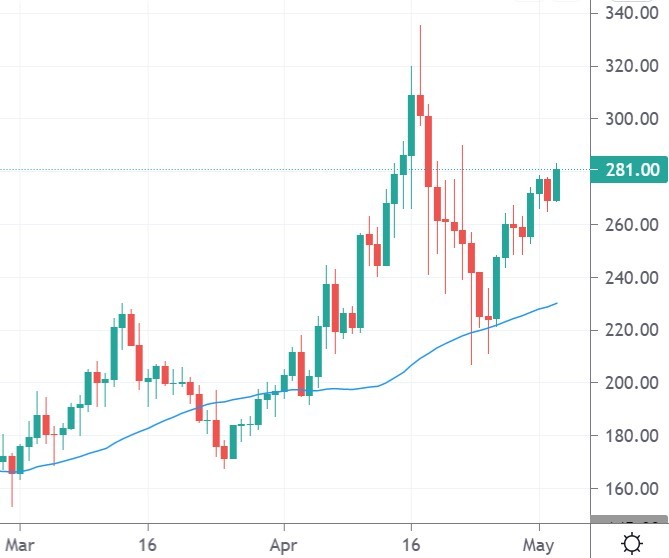
LTC is trying to make a play for the $300 level and the yearly highs were at $335.
BAKE
BakerySwap had a big week with the decentralized exchange up 400%. Similar to Pancake Swap, the platform allows the swapping of tokens on the Binance Smart Chain (BSC). There is also a marketplace for swapping non-fungible tokens (NFTs).
Liquidity providers on the Bakery exchange are rewarded with BAKE tokens, which can also be staked for NFTs.
Bakery is now ranked at number 86 in the list of coins by market cap with a valuation of $1.3bn, while the CAKE project has a valuation above $6.8bn. The BakerySwap project’s Twitter account urges fans to: “$BAKE it, till you make it!”
BAKE Price Index
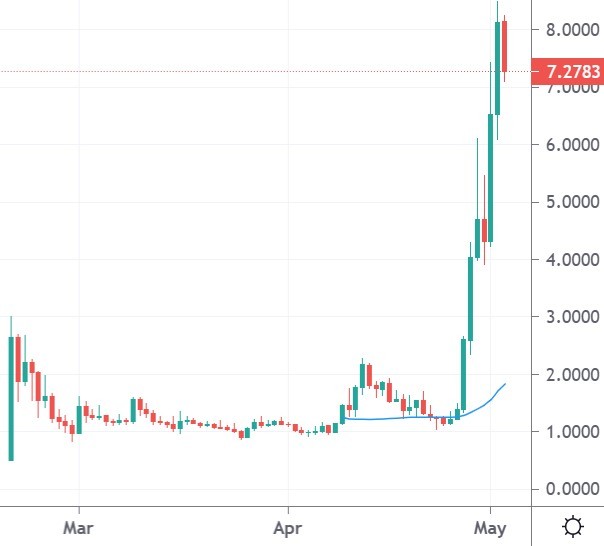
The BAKE token has soared since April with a move from $1.00 to $8.00 as traders see it catching up to PancakeSwap.
FTM
Fantom announced last week that HyperChain Capital, a digital assets manager, has invested $15 million in the project’s ecosystem via the FTM token. HyperChain added to an earlier investment of $2.5 million in 2018.
The Fantom project also released an upgrade called Go-Opera on Thursday. The team claims that the upgrade will improve network performance and reliability with the transaction time reducing to only one second.
Alongside this, there were also partnerships announced with SuperFarm, Clover, and Orion Protocol, which could strengthen the FTM capabilities in decentralized finance and non-fungible token space.
FTM Price Index
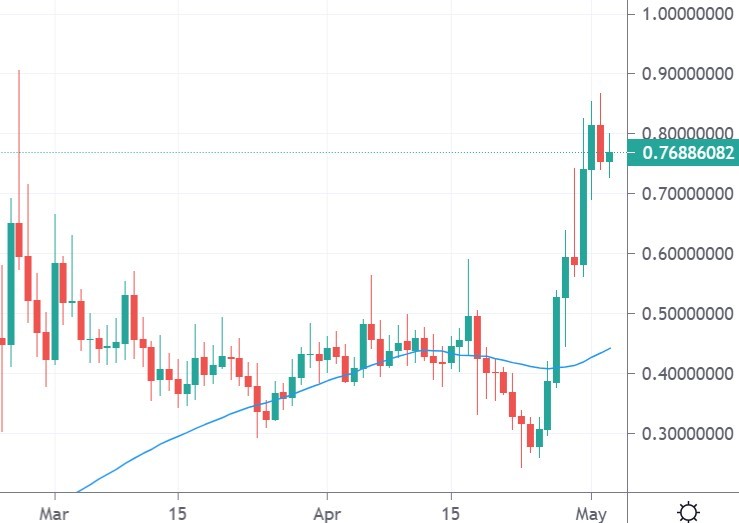
The FTM token has now more than doubled from the mid-May lows near the $0.30 level and the highs at $0.90 are now in reach. FTM has a market cap of $1.8bn and is ranked at number 72 in the list of coins. Billionaire Mark Cuban recently said he was a fan of Fantom and that started the bounce from the recent lows.
April 2021 marks the tenth anniversary of Bitcoin creator Satoshi Nakamoto’s disappearance, an event that passed control of the blockchain to its community.
Nakamoto sent his last message to other developers in 2011. Among those is a note that reads: “I’ve moved on to other things. It’s in good hands with Gavin and everyone.” That message refers to Gavin Andresen, one of the earliest Bitcoin developers.
In the ten years that followed, the crypto community has engaged in widespread speculation on Nakamoto’s true identity—but it has reached no definite conclusion.
Was Hal Finney Satoshi Nakamoto?
One of the most popular candidates for Nakamoto’s true identity is Hal Finney. This theory is largely based on a Forbes article dating back to 2014.
Finney was a cryptographer who was involved in Bitcoin’s development from a very early date. He also communicated with Satoshi Nakamoto directly. An analysis between Finney and Nakamoto’s writing styles seemingly confirmed shared writing styles.
Additionally, Finney had a neighbor named Dorian Satoshi Nakamoto. Finney may have used Dorian Nakamoto’s name in order to direct attention away from himself.
However, the author of the original Forbes article, Andy Greenberg, ultimately discounted the theory upon hearing a denial from Finney himself.
Was Dorian Nakamoto the Creator?
Some have speculated that Dorian Nakamoto himself may have been Satoshi. That theory was investigated by Leah McGrath Goodman for Newsweek in 2014.
During that interview, Dorian Nakamoto stated: “I am no longer involved in that… It’s been turned over to other people… I no longer have any connection.” Those statements were seemingly taken as a confession to past involvement with Bitcoin, but Nakamoto later clarified that he was referring to past work for military contractors.
Soon, Satoshi Nakamoto’s account on the P2P Foundation website posted a message stating that he was not Dorian Nakamoto. However, Satoshi Nakamoto’s account was previously hacked, meaning that the statement means very little.
Despite Dorian Nakamoto’s denial, his image has been widely used, making him the face of Bitcoin regardless of his actual role in the cryptocurrency’s creation.
Other Candidates for Satoshi
Another candidate for Satoshi Nakamoto is Nick Szabo (above center), a cryptographer who designed a Bitcoin precursor called “Bit gold” in 1998. Researcher Skye Grey used writing style analysis to connect the two identities in 2013.
Despite this, Szabo has outright denied that he is Nakamoto: “I’m afraid you got it wrong doxing me as Satoshi, but I’m used to it,” he stated in 2014.
Hashcash creator Adam Back (above left) and b-money creator Wei Dai (not pictured) are sometimes believed to be Nakamoto as well. Both monetary technologies are precursors to Bitcoin, and both are cited in the Bitcoin whitepaper.
Finally, Craig Wright (above right) has claimed to be Satoshi Nakamoto repeatedly. He has motives for doing so: Wright has created a Bitcoin competitor called Bitcoin SV and is involved in numerous lawsuits that attempt to collect early Bitcoin address balances. This has led the majority of the crypto community to denounce his claims.
Was Satoshi Nakamoto a Group of People?
Some have speculated that Bitcoin was not created by a single person, but rather a group of collaborators. Variations on the theory have been endorsed by individuals such as the infamous tech entrepreneur John McAfee, who recently suggested that Bitcoin was created by a “team of eleven people over a period of five years.”
On the question of who authored the orignal Bitcoin whitepaper, McAfee commented: “How they decided who would write the paper, I don’t know.”
Others have speculated that Bitcoin is actually a government project. The CIA or NSA could have created Bitcoin as a “honeypot” trap: while Bitcoin provides a basic level of privacy that appeals to criminal users, it is also a system that is ultimately traceable.
Those who advance this theory claim that the Japanese words “Satoshi Nakamoto” can be translated to “central intelligence agency.” However, that is very loose translation. Even assuming that translation is correct, it is equally plausible that Satoshi Nakamoto was formerly involved with the CIA and used the term ironically.
Will Nakamoto’s Identity Be Discovered?
It seems unlikely that Satoshi Nakamoto will ever reveal his true identity. Some information can be glimpsed from online messages, such as time stamps, IP addresses, and mining patterns. Yet that has data has largely been exhausted.
All that remains are Nakamoto’s known Bitcoin addresses. Currently, there are over 1 million BTC ($57 billion) in those addresses. If any of those coins move, analysts would be able to observe Nakamoto’s spending patterns and potentially deduce his identity.
However, after more than ten years, it is unlikely that Nakamoto will ever return to move his Bitcoin, leaving his identity a mystery—possibly forever.
EEA Member Spotlight with Mark Fitzgibbon, DAO Member – Operations at API3
As an EEA member, API3 is part of the EEA community of organizations working to advance Ethereum and drive industry adoption. In the Q&A below, the EEA interviewed Mark Fitzgibbon on the ways API3 helps the ecosystem achieve the potential impact of Ethereum.
Please introduce your company and yourself briefly.
API3 seeks to create powerful decentralized applications by providing decentrally governed and quantifiably secure data feeds directly to data consumers on the Ethereum blockchain. I’m an IT professional with more than 20 years of experience and currently working with API3 in operations and the Enterprise business development team.
What first brought you to the EEA, and why did you decide to become a member?
Joining the EEA seemed a natural course of action due to our B2B focus, particularly in the Enterprise sector. We hope to contribute to the development of standards for enterprises, grow our network, and add value where we can.
What are you currently working on with regards to Ethereum? How will end-users benefit from your work?
API3 is currently working on launching our Airnode product, as well as our DAO governance portal. After that, we will be integrating numerous API data feeds onto Ethereum. Later in the year, we plan to provide an automation and integration platform for data consumers to use to build customized/aggregated data feeds on their own Airnodes.
We also recently obtained GDPR compliance certification via code audit for the Airnode oracle, a blockchain industry first. This is something we pushed hard to achieve as part of our focus on B2B and the Enterprise space specifically, to remove a significant barrier to adoption from the compliance area for Ethereum as a public blockchain. We’re also working hard to engage with Enterprises and develop strong partnerships to drive adoption and expansion of the enterprise Ethereum space, and we hope to secure opportunities and partnerships in this area in the near future.
Our most recent development was a 10 year exclusive partnership with the Open Bank Project, to bring CeFi APIs for banking onto the Ethereum chain, over 400 of them to start with.
How will the EEA enhance your organization’s current efforts?
EEA will enable us to network with other members and look for ways to add value to their operations. We’d be happy to contribute to membership education in areas based on our expertise and project focus, adding value and knowledge. We look forward to exploring the challenges and opportunities involved in bringing more varieties and quantities of real-world, API-driven off-chain data to blockchain data consumers on Ethereum. This, we hope, will lead to new applications and use case-driven projects utilizing these new types of data and helping to grow the blockchain space as a whole over time.
What EEA programs are you most excited about?
We are most excited about the EEA’s working groups and learning from other members. The Ethereum Mainnet, Financial Services and EEA Supply Chain Interest Groups cover areas we are exploring at present, and where we hope API3 can be a valuable contributor. We also plan to participate in the soon-to-be-launched DeFi Interest Group. This is something that we hope to explore further as we spend more time engaging with EEA, learning, growing the relationship with the EEA and our fellow members. Workshop and conference opportunities for greater engagement would also help us to contribute and learn.
To learn more about API3, visit https://api3.org/, read the blog and follow along on Twitter.
Learn More and Connect with the EEA
The EEA enables organizations to adopt and use Ethereum technology in their daily business operations. We empower the Ethereum ecosystem to develop new business opportunities, drive industry adoption, and learn and collaborate. Join us and contribute to our work!
Learn more about EEA membership, sign up for the latest updates and contact membership@entethalliance.org.
The post EEA Member Spotlight with Mark Fitzgibbon, </br> DAO Member – Operations at API3 appeared first on Enterprise Ethereum Alliance.
The Enterprise Ethereum Alliance Mainnet Working Group created a survey to solicit input from enterprise developers working on Ethereum applications. The survey was promoted by email to EEA mailing lists, and on Twitter, from November 2020 to January 2021. Here is a summary of the results and responses to key questions.
There were 42 respondents.
73% of the respondents identify as an enterprise software developer or architect working on Ethereum applications. Presumably the others are developers who do not associate with the term “enterprise.”
72% of the respondents are working with Ethereum Mainnet; 74% are working with private chains; 51% are working with both.
Notable responses to “Which of these do you think are most in need of improvement, and in what ways?”
Solidity should have ready-made examples of supply chain and DeFi and other applications
Solidity: bring on-chain identity, ZKP and Homomorphic Encryption to be useful for regulatory compliant security assets
Solidity: We should have a webflow like software
Transaction tracing and Solidity debugger
[Bring] Web3js up to date with solidity features
Something like webflow
Stability [of] Truffle Ganache
Truffle, to compile each file with different compiler version, VSCode better debugger plugin.
Network setup, e.g., start N nodes with basic setup for privacy, permissioning – Besu is working on it but needs improving to be awesome for enterprises
Remix, so widely used and yet has so little resources dedicated to it
Smart contract coding for kids (similar to Scratch Studio)
Web3j, not well maintained
My current pain point is complete abi2 support in Web3j
[Support for] Rust
#tx/sec
None, but optimistic rollups to execute contracts on L2 are essential
Support of nodejs wrappers for quorum-based evms
The documentation tools need improvement. Integration in one of the major documentation-generating tools would be nice
IPFS browser integration
IPFS, or any other enterprise-grade, production ready storage solution
IPFS: Protected access; all the other is REST…
Interoperability between different Blockchains
Kaleido
Notable responses to “What tools or libraries or services do you think are missing and should exist?”
Ease/automate building API on top of smart contracts
Good debug facilities across java application and solidity would be great
A good visual debugger
Signer libraries for key stores like Key Vault, KMS and HSMs
Webflow, 2nd layers tools for development
web3j or any web3 should have separate APIs to manage a) create a transaction, b) sign a transaction by web3 or independently and c) submit the transaction to the desired network.
Deployment libraries and hybrid development (public testnet/local – proxied which survives recompiles).
MetaMask … is useful but could do with more support for developers, i.e., local RPC networks
JS libraries for evm’s on quorum
UI components
Interoperability libraries to perform connections another blockchain networks
Central open-source library of smart contracts and their detailed documentation.
Handling decentralized organizations
Rust based client
TokenScript
Notable responses to “What standards do you think are missing or should be improved?”
Shielded/confidential tokens, e.g., Aztec and Anonymous Zether.
Interoperability between off-chain sources
Best practices for: non-pegged Stablecoin and Utility token economics, handling real software products based on Ethereum (business and development aspects)
Privacy
Security standards
on-chain encryption
Ipfs alternatives, interoperability
Documented commitments of cash bounties for security disclosures
REST-API first
Messaging
KYC
DID/SSI support as base layer for application integrations for human, company and machine identities
Notable responses to “What other Ethereum-related challenges do you face as a developer?”
High gas fees
Gas price
Gas price
Changing – high gas cost on public blockchain
Ethereum 1 scalability
Scalability
Privacy
Security testing
KYC
CI/CD-Automation – not platform bound (e.g., Infura etc.)
Nonce management for resilient architectures
Solidity version changes
Solidity has many improvements to offer in the future for date and structure management
Slow testnet deploy/ debug standard
Poor documentation, Products that don’t work as expected
Learning resources that are up to date
There just isn’t the maturity that there is with Java tools. there is still a lot of copying and pasting to deploy contracts once you are doing non-simple things, e.g., deploying a solidity contract IN the genesis file WITH storage
Reliability: RPCs are not that reliable from an enterprise point of view. Need more features to strengthen RPC or use open source MQs for messaging
Communications with other developers. Need a network.
Bft, private transactions
Issues with interactions in open Ethereum
Building an economic system around a decentralized application that maximizes network effects in order to prevent someone forking the project and decreasing protocol revenue or needing to develop closed-source projects
Conclusions
Several suggestions for improvements to the development tool ecosystem were made. Due to the relatively small sample size, there are no major clusters or trends identified (aside from gas price/scalability). It may be useful to repeat the survey in a few months.
High transaction fees and scalability were mentioned as challenges by several respondents. This suggests a need to educate developers about Layer 2 technologies which are intended to address these problems.
The post EEA Ethereum Developer Tool Survey Results appeared first on Enterprise Ethereum Alliance.
We use cookies on our website to give you the most relevant experience by remembering your preferences and repeat visits. By clicking “Accept”, you consent to the use of ALL the cookies.
This website uses cookies to improve your experience while you navigate through the website. Out of these, the cookies that are categorized as necessary are stored on your browser as they are essential for the working of basic functionalities of the website. We also use third-party cookies that help us analyze and understand how you use this website. These cookies will be stored in your browser only with your consent. You also have the option to opt-out of these cookies. But opting out of some of these cookies may affect your browsing experience.
Necessary cookies are absolutely essential for the website to function properly. These cookies ensure basic functionalities and security features of the website, anonymously.
Cookie
Duration
Description
cookielawinfo-checkbox-analytics
11 months
This cookie is set by GDPR Cookie Consent plugin. The cookie is used to store the user consent for the cookies in the category "Analytics".
cookielawinfo-checkbox-functional
11 months
The cookie is set by GDPR cookie consent to record the user consent for the cookies in the category "Functional".
cookielawinfo-checkbox-necessary
11 months
This cookie is set by GDPR Cookie Consent plugin. The cookies is used to store the user consent for the cookies in the category "Necessary".
cookielawinfo-checkbox-others
11 months
This cookie is set by GDPR Cookie Consent plugin. The cookie is used to store the user consent for the cookies in the category "Other.
cookielawinfo-checkbox-performance
11 months
This cookie is set by GDPR Cookie Consent plugin. The cookie is used to store the user consent for the cookies in the category "Performance".
viewed_cookie_policy
11 months
The cookie is set by the GDPR Cookie Consent plugin and is used to store whether or not user has consented to the use of cookies. It does not store any personal data.
Functional cookies help to perform certain functionalities like sharing the content of the website on social media platforms, collect feedbacks, and other third-party features.
Performance cookies are used to understand and analyze the key performance indexes of the website which helps in delivering a better user experience for the visitors.
Analytical cookies are used to understand how visitors interact with the website. These cookies help provide information on metrics the number of visitors, bounce rate, traffic source, etc.
Advertisement cookies are used to provide visitors with relevant ads and marketing campaigns. These cookies track visitors across websites and collect information to provide customized ads.