EEA Member Spotlight with Jonas Simanavicius, Co-founder and CTO at Syntropy

EEA Member Spotlight with Jonas Simanavicius, Co-founder and CTO at Syntropy

As an EEA member, Syntropy is part of the EEA community of organizations working to advance Ethereum and drive industry adoption. In the Q&A below, the EEA interviewed Jonas Simanavicius about how Syntropy is helping the ecosystem achieve the potential impact of Ethereum.

Please introduce your company and yourself briefly

Syntropy transforms the public internet into a secure and user-centric internet, where encryption and optimized performance are built-in and automatically enabled for anything and everything connected to it. Through our internet unification layer, we are connecting all cloud and bare-metal locations from 200+ providers and 550+ unique regions, leveraging all underutilized network capacity found across the web.

Anything built on the current internet can also be built on Syntropy using the Syntropy Stack. It allows anyone to create and deploy applications on Syntropy, with connections automatically optimized-for-performance and encrypted-by-default. The stack is also compatible with millions of devices and services, including cloud, on-premise and edge infrastructure. We are giving developers the power and control to build on our unifying layer.

Before starting Syntropy, I was part of the engineering and application development teams at Royal Bank of Scotland and JPMorgan Chase. It was there where I learned about Bitcoin and the potential impact that decentralized technologies could have on the world. Connecting the utility of blockchain with my expertise in networking software was a clear opportunity that I could not pass up. Teaming up with other successful tech entrepreneurs (including a co-founder of Equinix) set the rest in motion.

What first brought you to the Enterprise Ethereum Alliance, and why did you decide to become a member?

Joining the alliance made perfect sense for us given the utility of Ethereum and its obvious place in the enterprise market. We developed our technology with direct input from many enterprises, so being able to learn from even more EEA members made this an ideal match. The alliance also helps us stay up to date on business trends related to developer tools, tokenomic models, smart contract security, blockchain adoption, etc. It’s not only a great opportunity to engage with potential new users, but also collaborate with some of the most promising Ethereum-based projects and organizations.

What are you currently working on with regards to Ethereum? How will end-users benefit from your work?

Syntropy already utilizes Ethereum smart contracts, but right now we are adding the final pieces to our tokenomic model, which puts our ERC-20 token, NOIA, at the core of our protocol. In addition to this, we recently launched the Syntropy Stack, which helps developers and network teams to easily create secure optimized connections between any of their devices or services running on cloud, on-premise, or edge locations.

We think it’s a big deal for the blockchain industry as the stack can make decentralized infrastructure faster, more secure, and highly reliable. This positions Syntropy to become the go-to technology for building blockchain infrastructure, ensuring that all connections become formalized, encrypted and streamlined. Syntropy facilitates networks at its core so we realized early on that we could equip the average node runner with the right tools and remove the complexity that comes with setting up nodes.

How will the EEA enhance your organization’s current efforts?

The Syntropy tech stack has already launched. It’s tailor-made for enterprise applications. It solves real needs enterprises face every day, including the cost and hassle of setting up and managing vast networks, handling security breaches, and dealing with suboptimal internet performance.

By aggregating enterprise users and technologies like ours, we hope to bridge the gap between next-gen services and large potential users to solve real business needs.

As mentioned, our technology is also ideal to simplify and augment blockchain infrastructure setups. We’ve already done pilot tests with decentralized services like Chainlink and Polkadot — including an official integration with Elrond — and believe most Ethereum-based applications (including Ethereum itself) could benefit from our technology. We want to work with every project and network to strengthen the decentralized Ethereum ecosystem.

What EEA programs are you most excited about?

For me, it is the working groups within the alliance. Specifically, the Trusted Execution Task Force and the EthTrust Security Levels Working Group, both of which cover topics that could greatly improve our network and keep us up to date on best security practices. The blockchain-based payments interest group also looks interesting as we are seeing a lot of attention placed on token adoption and crypto regulations.

Our team and technology can be strong contributors to these areas. Learning and working with fellow members on these issues would be equally as valuable.

Learn More and Connect with the EEA
The EEA enables organizations to adopt and use Ethereum technology in their daily business operations. We empower the Ethereum ecosystem to develop new business opportunities, drive industry adoption, and learn and collaborate. Our global community of members is made up of leaders, adopters, innovators, developers, and businesses that collaborate to create an open, decentralized web for the benefit of everyone. Join us and contribute to our work!

Learn more about EEA membership, sign up for the latest updates and contact membership@entethalliance.org.

The post EEA Member Spotlight with Jonas Simanavicius, Co-founder and CTO at Syntropy appeared first on Enterprise Ethereum Alliance.

Go to Source

EEA Member Spotlight with Alexandre Bourget, StreamingFast’s Co-founder and CTO

EEA Member Spotlight with Alexandre Bourget, StreamingFast’s Co-founder and CTO
As an EEA member, StreamingFast will be part of the EEA community of organizations working to advance Ethereum and drive industry adoption. In the Q&A below, the EEA interviewed Alexandre Bourget on the ways StreamingFast helps the ecosystem achieve the potential impact of Ethereum.

Please introduce your company and yourself briefly.
StreamingFast is a radically different infrastructure product for Ethereum and for empowering developers with better queries and streaming semantics than blockchain nodes. The founding team is made up of serial entrepreneurs, with deep expertise in big data, cybersecurity, dev ops and blockchain. Combined, we have built and sold 6 companies, with the last one being sold to Intel. We have a passion for blockchain technology, and our goal is to help developers build performant applications by organizing the world’s decentralized data.

Having built big data solutions at Intel, my team and I understand the data engineering challenges of maintaining large swaths of data like blockchain data, but very few people are working on how to quickly and reliably read from this data. That’s where StreamingFast comes in, with a radically different streaming-first approach. The StreamingFast core value proposition: it’s the simplest, fastest, and most reliable blockchain data stream in the industry, for real-time as well as historical data.

What first brought you to the EEA, and why did you decide to become a member?
Enterprises that are working within the blockchain space will be helping to drive technology for the next decade to come. While core protocols tend to focus on the best write speeds to the underlying blockchain databases, it often creates a lot of compromises when it comes to reading that data. We’ve devoted ourselves to working on those solutions, and we believe that the EEA – as the first stop for those Enterprises seeking out guidance – is the perfect fit to help us share our knowledge, tooling, and expertise to save these companies months of engineering time.

What are you currently working on with regards to Ethereum? How will end-users benefit from your work?
We recently publicly released StreamingFast, a radically different infrastructure product for Ethereum. By empowering developers with better queries and streaming semantics, blockchain nodes can be optimized for a different role than they could ever natively provide. Well-known companies have been utilizing our APIs for some time and the feedback we’ve received so far has been incredibly positive. Many of the development teams we speak with utilized multiple service providers for redundancy, occasional latency issues, and feature completeness. After trying out StreamingFast, some of our users have been able to drop all of their other providers, as we were able to provide a single solution that just simply worked when they needed it. The main value propositions of StreamingFast include:

Simpler: use 90% less code. Single integration for accessing a low-latency stream of Ethereum data, from block 0 to the tip of the chain. No need for complex retry logic.
Cheaper: cut down on 99% of your Web3 calls. Avoid out-of-sync calls. Use in-stream updates to ERC-20 balances, Uniswap reserves, or any other contract’s state update.
More reliable: read linearly, no more polling. Paradigm-shifting use of a cursor for reliable linearity of the stream, guaranteed across disconnections and in fork situations. Something native nodes with WebSockets can only dream about.
Faster access to real-time blocks: Get data earlier than any other traditional node provider. Our nodes race to push out data, instead of you hitting one load-balanced node out of 1000, most of which are lagging because of propagation delays.
Complete: full history at your fingertip. Stream data and state changes from genesis. Let go of your archive nodes.
Data-rich, industry-wide. EVM-call level introspection: full call graph, all state changes, logs, keccak data, gas costs, Ether balance changes, internal transactions, input data & return data plus some decoded events and state changes.

StreamingFast is available for both Ethereum mainnet and private Ethereum deployments.

How will the EEA enhance your organization’s current efforts?
One comment we have received multiple times in the past was “How come we didn’t have StreamingFast when we started building?” We want to meet Enterprises before they start building. We know that we can save them time and money, and make sure Ethereum remains their first choice of protocol. By removing a lot of the added blockchain complexity around things like fork resolution, Enterprises will be able to get to production faster and simplify the experience for their developers. Our relationship with the EEA will provide Enterprises with exposure to the solutions they need, at the time they need them.

What EEA programs are you most excited about?
We are excited to participate in the Interest Groups as well as the Working Groups. We have been involved with blockchain enterprise deployments for multiple years. As such, we are looking forward to sharing use cases, discussing industry requirements and collaborating to develop open, standards based-specifications to accelerate the adoption of Ethereum-based enterprise solutions.

Learn More and Connect with the EEA
The EEA enables organizations to adopt and use Ethereum technology in their daily business operations. We empower the Ethereum ecosystem to develop new business opportunities, drive industry adoption, and learn and collaborate. Our global community of members is made up of leaders, adopters, innovators, developers, and businesses that collaborate to create an open, decentralized web for the benefit of everyone. Join us and contribute to our work!
Learn more about EEA membership, sign up for the latest updates and contact membership@entethalliance.org.

The post EEA Member Spotlight with Alexandre Bourget, StreamingFast’s Co-founder and CTO appeared first on Enterprise Ethereum Alliance.

Go to Source

Chainlink’s Next Level of Support Below $32 is Around $27 – Weiss

  • Chainlink is currently battling to maintain the $32 price area as a support
  • According to Weiss, $27 is the next level of support should $32 fail for Chainlink
  • On a fundamental level, the team at Chainlink has awarded a community grant to ChainSafe
  • The grant is aimed at expanding the Chainlink Oracle pallet on Polkadot

The digital asset of Chainlink (LINK) is currently undergoing a fierce battle in defense of the $32 price area. This is after the digital asset dropped to a local low of $30.02 – Binance rate – during yesterday’s crypto-wide sell-off that saw Bitcoin drop to $47,500.

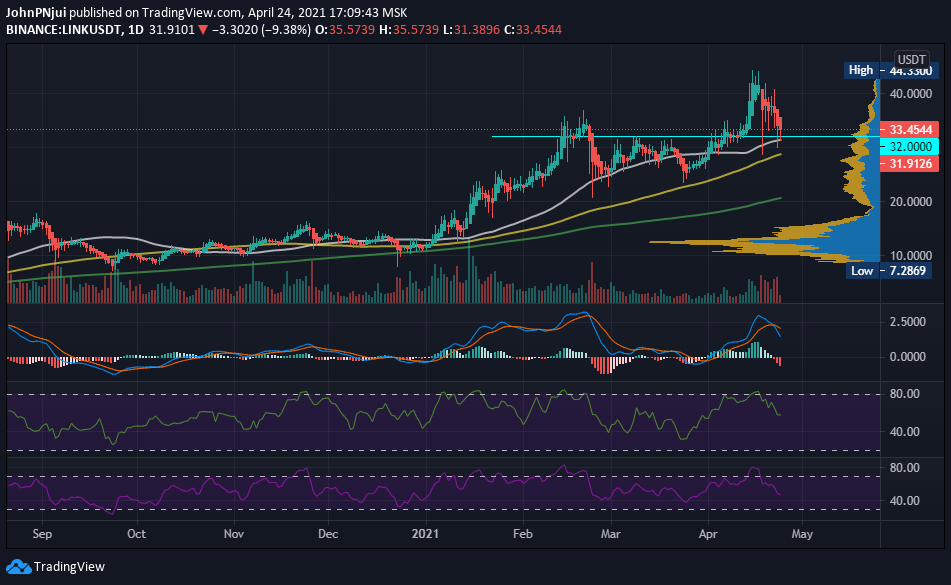
At the time of writing, Chainlink is trading at $31.866 with the team at Weiss Ratings identifying $27 as the next level of support should the $32 price area fail. Weiss used Chainlink’s volume profile to derive the $27 support, as showcased through the following tweet.

Chainlink Could Thrive in The Month of May

A quick glance at the daily LINK/USDT chart reveals that the $32 support is currently where the 50-day moving average lies. A breakdown of this level will ultimately lead to more losses with the identified $27 price zone being the next area of interest.

Also from the chart, it can be observed that the daily MACD has crossed in a bearish manner above the baseline thus confirming the possibility of LINK falling further. The daily trade volume is also in the red highlighting ongoing selling by traders. The daily MFI and RSI are also pointing towards an ongoing correction for Chainlink that should last till the beginning of next month.

Chainlink Awards Community Grant to ChainSafe

Despite the current market uncertainty surrounding Chainlink, the fundamentals surrounding LINK remain strong.

Yesterday, the team at Chainlink awarded a community grant to ChainSafe to expand and improve the on-going support of the Chainlink Oracle Pallet on Polkadot (DOT).

The grant is aimed at improving the way developers build applications on ‘Polkadot parachains, Kusama parachains, and Substrate-based blockchains to integrate a highly secure and reliable source of external data feeds’.

Go to Source

Bitcoin (BTC) has Strong On-Chain Support at $47k

  • Bitcoin has adequate on-chain support at $47k
  • A drop below this level opens the doors to $45k and below
  • If Bitcoin fails to hold the $50k price area during the weekly close, chances are that BTC goes lower to $44k or even $43k

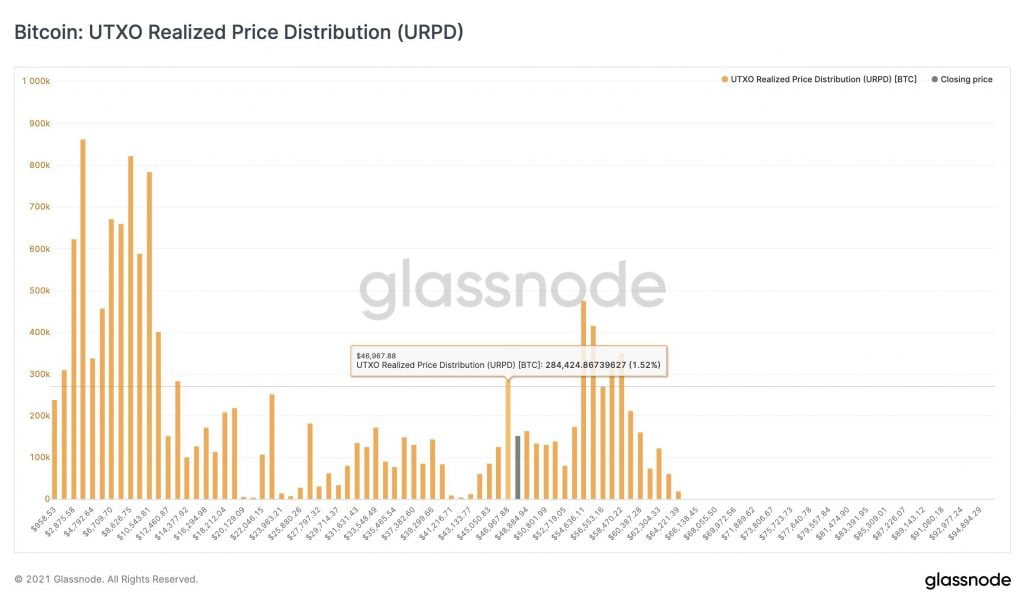
Bitcoin has strong on-chain support at $47k. This support zone was identified by the Co-founder and CTO of Glassnode, Rafael Schultze-Kraft, who shared his observation through the following statement and accompanying chart.

…ideally we hold the strong support at $47,000. It starts becoming pretty much on-chain wasteland for a while below $45k.

Bitcoin losing $50k Will Open the Doors to $43k – $44k

As mentioned by the Co-founder and CTO of Glassnode, Bitcoin’s $47k support is strong but a breakdown of this defense will open the doors to a potential wasteland below $45k.

This theory was also explored by the team at Crypterium analytics who pointed out that Bitcoin failing to hold $50k will lead to a potential breakdown to lower levels as explained below.

Bitcoin fell from $55,500 to $48,500 in a day. However, buyers quickly bought back the fall and returned the price above $50,000. This is a pretty strong drop considering that literally last week we saw $10 billion in liquidations. At the $50,000 mark, it can be seen that buyers practically do not hold positions.

Indicators do not add optimism…All of these signs indicate that Bitcoin’s decline will continue, with the next major resistance in the $43,000 — $44,000 range. If the Bitcoin price fixes below $50,000 on the 4-hour timeframe, it will be a clear signal to sell Bitcoin.

Kimchi Premium Collapses from 26% to 0%

Also worth mentioning is that the South Korean premium on Bitcoin, also known as Kimchi Premium, dropped from 26% to 0% in the recent Bitcoin meltdown. The team at CryptoQuant captured the decline through the tweet below.

The Kimchi premium is used by BTC traders to gauge the mood in the crypto markets with a high positive value indicating bullishness. Therefore, a zero value indicates a neutral or potentially bearish Bitcoin market environment moving forward.

Go to Source

Ethereum (ETH) Active Addresses Hit an All-time High of 771k

  • Ethereum active addresses have hit an all-time high of 771k
  • This milestone eclipses previous all-time highs set in November 2020 and January 2018
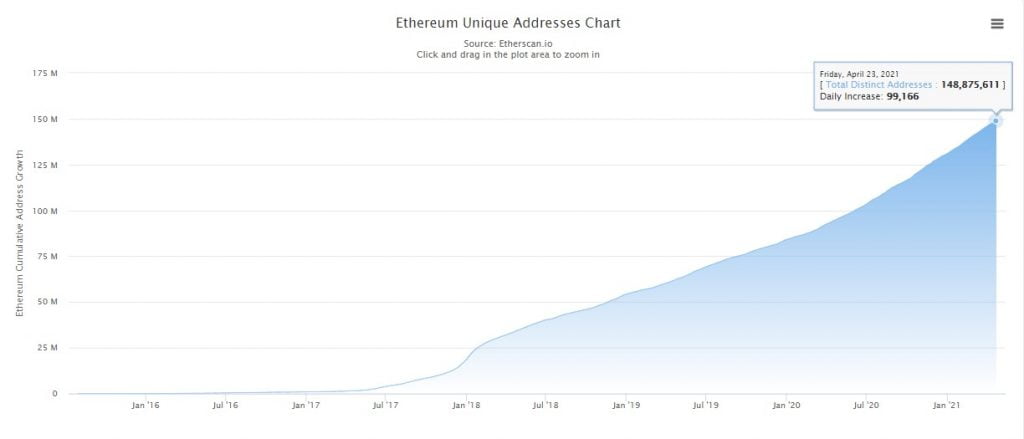
  • Unique Ethereum addresses also continue to grow, hitting a new high of 148.8 million
  • The increased network activity points towards a bullish future for Ethereum
  • EIP1559 implementation is also around the corner making $3k possible for Ethereum

The number of active addresses on the Ethereum (ETH) blockchain has just hit an all-time high of 771k. This milestone has exceeded previous all-time highs of active Ethereum addresses witnessed in November 2020 (739k) and January 2018 (735k). The aforementioned 771k active Ethereum addresses was identified and shared by the team at Coinmetrics through the following tweet.

Unique Ethereum Addresses Continue to Grow

The high network activity on the Ethereum blockchain is also evident in the total number of unique addresses to date.

According to EtherScan.io, the Ethereum network currently hosts over 148.8 million unique user addresses as illustrated through the following chart. From the chart, it can also be concluded that the growth and use of the Ethereum network has been steady since the blockchain was launched in mid-2015.

High Network Activity Points to a Bullish Future for Ethereum

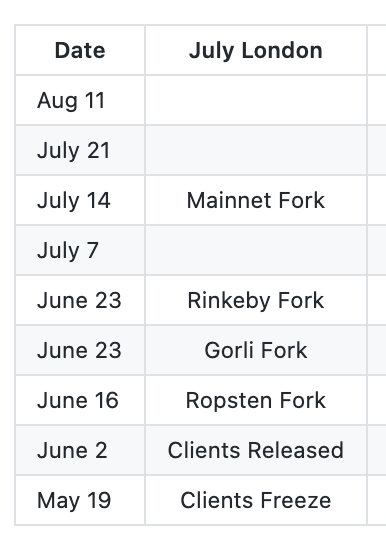
The continuous network activity on Ethereum is one reason to remain bullish on the value of ETH. This is despite Ethereum gas fees constantly increasing due to the activities on the network causes congestion. However, the implementation of the London upgrade will include EIP-1559 that is meant to ease the issue of gas costs.

At the time of writing, an exact date has not been provided for the London upgrade but core Ethereum developer, Tim Beiko, gave a July estimate through the following roadmap via Twitter.

Chances are, that the excitement and hype surrounding the implementation of EIP1559, will provide bullish momentum for Ethereum to confidently break past the $2,500 price ceiling and possibly to $3k. The possibility of an Ethereum bullish environment due to the upgrade was explored by the team at Market Meditations who had this to say.

Yesterday’s highs [of $2,644] can likely be attributed to a coming upgrade that is expected to reduce the supply of Ether, which could help boost the price. Known as EIP 1559, the change solves a current problem…

After bitcoin finds a steady floor, Ethereum having shown strength, is primed to extend to $3000.

Go to Source

Ethereum (ETH) Breaking out to All-time Highs Will Fuel Alt-Season

  • According to Rekt Capital, Ethereum hitting new ATHs will fuel the next phase of altseason
  • Weiss Ratings concludes that Ethereum thriving will usher in an alt-season greater than 2017’s
  • The premium on Grayscale’s Ethereum Trust has flipped back to positive
  • However, Bitcoin’s recent dip to $47k has paused the continuation of altseason
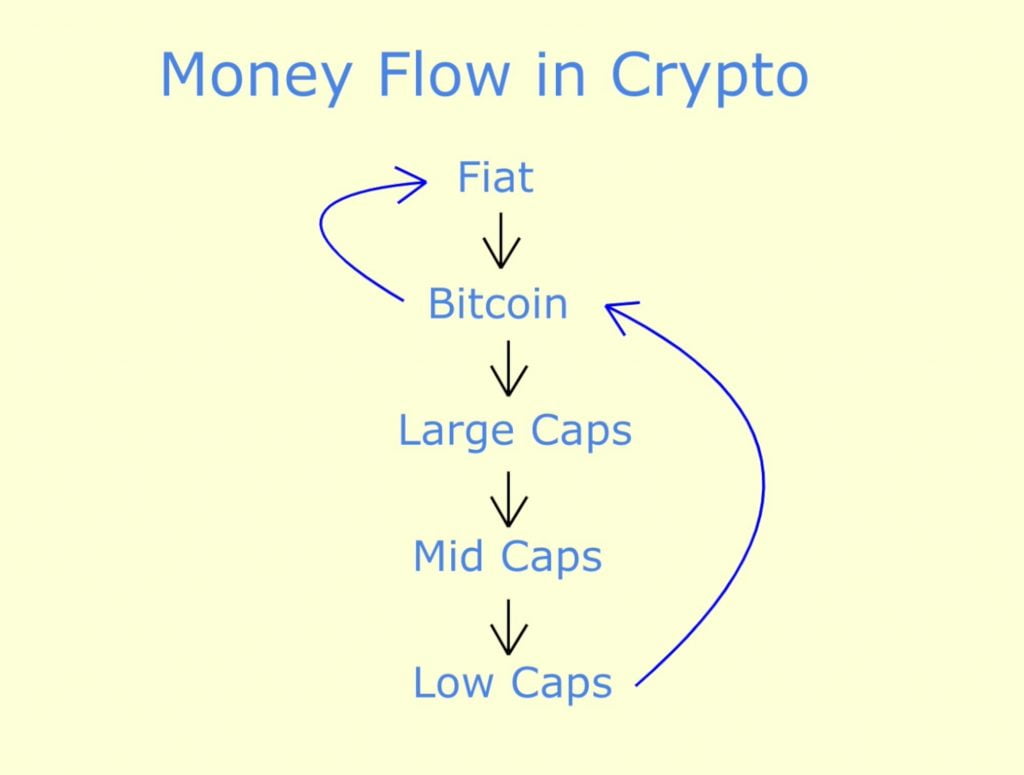
  • Bitcoin gaining a footing will be necessary for providing the stability needed for alts to thrive

Ethereum’s recent push to an all-time high of $2,644 is the fuel needed to drive the next phase of alt-season. This theory was highlighted and shared by crypto analyst @RektCapital, through the following tweet.

Current Altseason Might be Wilder than 2017’s

The team at Weiss Ratings went on to add to the theory of a new phase of alt-season through the following statement and accompanying chart.

This altcoin season looks like it might be significantly wilder than 2017. If the traditional altcoin cycle is true this time around, then we are just getting started with this move in ETH (chart by @rektcapital)

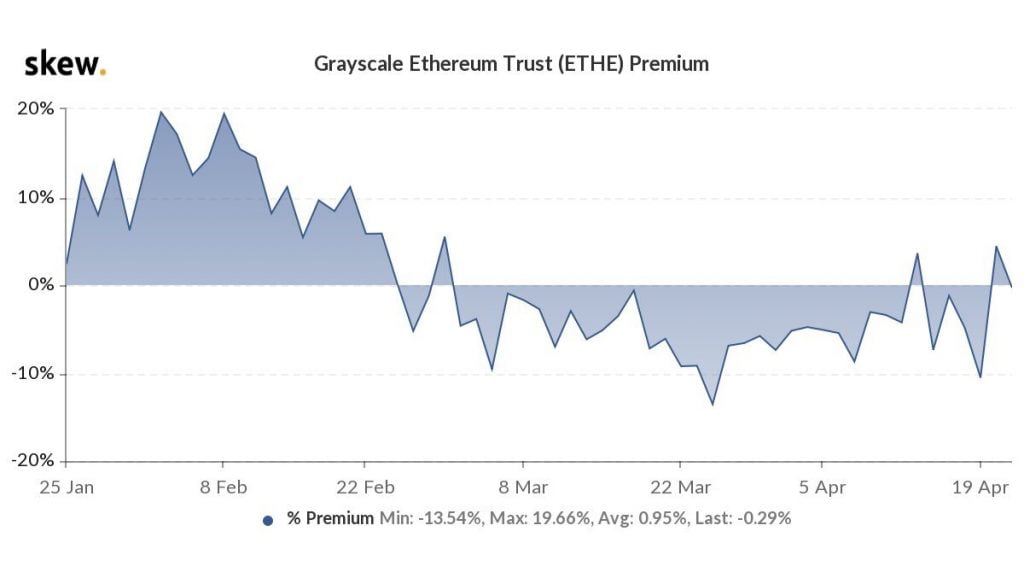
Premium on Grayscale’s Ethereum Trust Flips Back to Positive

The demand and bullishness surrounding ETH is evident in the premium of the Grayscale Ethereum Trust (ETHE) flipping back to positive. For the last two months or so, the premium had dropped into negative territory thus leading many traders to believe that institutions were no longer bullish on Ethereum.

The chart below, courtesy of Skew, provides a visual cue of the ETHE premium since January.

Bitcoin Needs to Stabilize For ETH and Alts to Thrive

As has always been the case, the key to Ethereum and altcoins thriving is Bitcoin providing the ideal environment necessary. At the time of writing, the crypto markets are a sea of red after Bitcoin fell hard from $55k levels to a local low of $47,500.

Many crypto traders are of the opinion that the dip was the result of a new proposal by President Biden’s administration to increase capital gains tax for wealthy individuals earning more than $1 Million a year. The proposal seeks to increase capital gains tax from the current 20% to 39.6%.

Bitcoin is yet to stabilize from the effects of the news. However, Ethereum has maintained a value above the crucial $2k price area and is currently trading at $2,240. Therefore, ETH still has the potential of reigniting the next phase of altseason. Caution is also advised when trading Bitcoin and altcoins using high leverage in the current market conditions.

Go to Source

The Ternoa Blockchain (CAPS) Unveils SecretNFT, Its NFT Platform

The Ternoa Blockchain has just unveiled the alpha version of its SecretNFT Marketplace, a platform entirely dedicated to non-fungible tokens (NFTs). The platform, which uses Ternoa’s own CAPS token, comes with many features to promote its adoption among artists and lovers of NFTs.

Ternoa launches its NFT platform, SecretNFT

The Ternoa Blockchain has just unveiled the first version of its SecretNFT Marketplace, a new platform entirely dedicated to NFTs.

The NFT marketplace allows artists to issue authenticated digital artworks in a single edition. Ternoa’s platform boasts a number of innovations, not least the so-called SecretNFT, a feature that makes artists’ works even more unique.

This platform represents the first full-scale test of the Ternoa Blockchain, with all NFTs present on SecretNFT Marketplace hosted on the Chaos Net, a Ternoa testnet. All works hosted on the SecretNFT Marketplace are therefore certified on the Ternoa blockchain to avoid any falsification.

Since the SecretNFT Marketplace ecosystem is powered by CAPS, Ternoa’s native cryptocurrency, users will be able to purchase NFTs with CAPS as soon as the platform is open to the public.

To deploy this alpha version of the SecretNFT Marketplace, Ternoa partnered with 12 different artists, who forged a total of 26 NFTs on the platform. At the moment, the SecretNFT Marketplace is still in an experimental phase and many planned features yet to be added.

In total, the Ternoa team is working with 30 artists to continue enhancing the SecretNFT catalogue. New works of art will be added every 2 or 3 weeks on the platform. In the not too distant future, however, SecretNFT will be fully open to the public and any user will have the opportunity to forge their own NFTs there.

Lots of customization options

The SecretNFT Marketplace allows NFT-creators to customize their digital works using several features: “Protect”, “Secret” and “Blur”. Of course, these features are optional, but they provide an opportunity for artists to personalize their work..

The Protect feature

With the “Protect” function, each NFT can be accompanied by a watermark in order to protect its uniqueness. In this respect, only the owner of the NFT has access to the work as a whole, without a watermark. This feature offers SecretNFT Marketplace NFTs a new dimension dear to holders of unique non-fungible tokens.

The feature can be used in multiple ways. For one, it demonstrates in public that an NFT is genuinely unique and establishes who its owner is. For example, many museums plan in the near future to create exhibitions entirely dedicated to NFTs. They could present NFTs without watermarks to their visitors, which would bring a certain value to the exhibition, since the complete digital work would only be visible during the exhibition.

Some of the first NFTs from the SecretNFT Marketplace, with watermarks included

The Secret feature

By adding the “Secret” option to their NFT, an artist can hide most or all of their work from view. Only the holder of the NFT will be able to see what is hidden under the proverbial hood of their work.

The Blur feature

Last but not least is the platform’s “Blur” function. Unsurprisingly, this feature allows the creator of an NFT to blur it from view . As with the other options, only the owner of the NFT will be able to see the work in its entirety.

Interactive with Ternoa’s mobile wallet

To promote mass adoption of SecretNFT, Ternoa intends to develop an interaction between the platform and its mobile app. Today, very few if any NFT platform has its own smartphone app, even though this is a significant adoption vector that could allow many people to discover the exciting world of non-fungible tokens.

In a few weeks, the Ternoa ecosystem will launch its own mobile app, which will act as a hub for all Ternoa products, including the SecretNFT Marketplace. This application will also have its own wallet for CAPS, Ternoa’s native token.

In this respect, CAPS token holders can directly interact with Ternoa’s many applications through the app. In addition, a staking feature will be implemented once the final version of the wallet is deployed, allowing CAPS token holders to generate passive income on the funds they hold.

The app will also integrate features related to sending and receiving CAPS tokens, as Mickaël Canu, CEO of Ternoa explains:

In conclusion, Ternoa’s SecretNFT Marketplace has a lot to offer compared to existing NFT marketplaces. SecretNFT not only offers artists a chance to protect their works prior to purchase, but also to make the content of their NFTs exclusive to future owners. This could represent a great leap forward for the whole space.

SecretNFT innovation opens the doors to massive adoption of NFTs, whether for content creators, their fans, or even for businesses and collectors keen to take part in this new world that is still very much in its infancy.


The Ternoa project has a growing social media presence, with +11,500 followers on Twitter, +10,000 followers split between its English and French Telegram channels, and 5,000 followers in both English and French on Instagram.

This article is based on a translation from a French article originally published here


This is a sponsored post. Learn how to reach our audience here. Read disclaimer below.

Go to Source

Hegic Protocol announces ‘gradual’ governance launch for long-term users

Hegic will reward long-term traders, LPs, hodlers, and Discord users with its forthcoming governance token.

Decentralized finance protocol Hegic has announced a soft governance launch designed to reward its long-term users.

According to an April 19 announcement, Hegic intends to reward its most loyal users with its new gHEGIC governance token, straying from the public airdrops and yield farming campaigns that have become a popular means to distribute governance in the DeFi sector.

Users hodling gHEGIC will be able to vote in future Hegic Improvement Proposals.

Hegic is a decentralized on-chain derivatives protocol that allows users to purchase call and put options to speculate on Ethereum and Wrapped Bitcoin (wBTC). Users can provide liquidity to the protocol by selling options to buyers, earning a share of premiums paid to the pools.

“With the soft launch of Hegic governance, the most active and long-term oriented users of Hegic will own the protocol in terms of their influence on its future.”

Users who meet specific criteria will be able to participate in Hegic governance, including traders who purchase four or more options contracts acquired since the launch of Hegic v888, and liquidity providers who have provided at least 1 ETH or 0.05 wBTC to pools for more than 100 days without withdrawing.

Additionally, Hegic initial bonding curve offering, or ICBO, participants who have not sold a single HEGIC token since the incentive was launched in September 2020 will receive the governance tokens, as will the project’s most active members on Discord.

In addition to being eligible to receive the protocol’s forthcoming governance tokens, traders and LPs who qualify for governance will have the opportunity to receive $500 worth of HEGIC in exchange for providing feedback about the platform.

Minting and distribution of the governance token is currently slated to begin on May 1.

The beta version of the protocol, dubbed Hegic v888, was launched in October 2020, and has since gained significant traction.

The first quarter of 2021 saw 1,368 individual traders purchase 3,200 ETH options and 1,500 wBTC options worth a cumulative volume of $291 million. The total value locked at the end of the quarter was $59 million, though it has since fallen to $57 million according to DeFi Llama.

At the time of writing, HEGIC tokens were trading up 3.2% over the past 24 hours at $0.175, according to Coingecko.

Go to Source

Bitcoin (BTC) Price Prediction: BTC/USD Fluctuates Between $54,000 And $58,000,unable To Push Above $58,000 Resistance

Bitcoin (BTC) Price Prediction – April 20, 2021
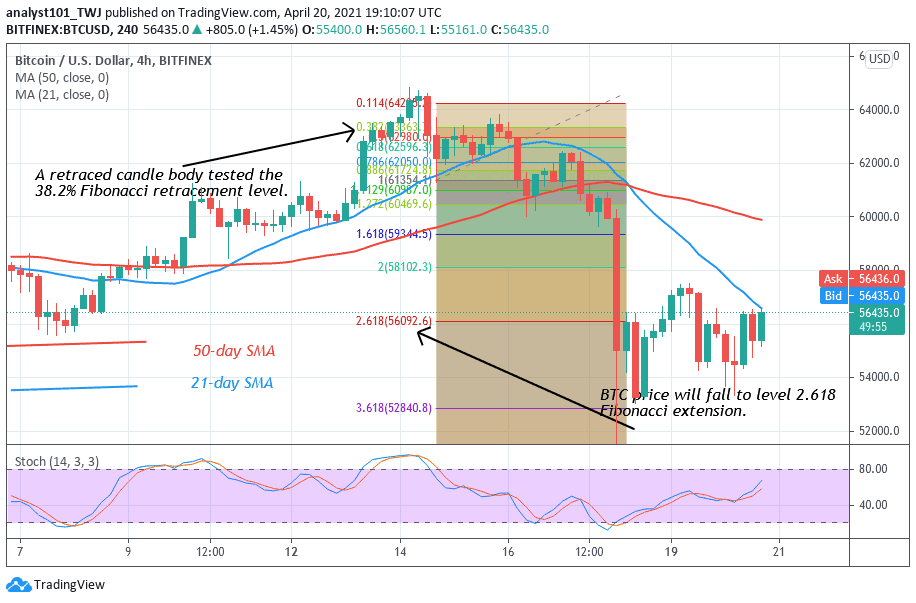
Bitcoin has been in a downward correction after the breakdown on April 18. For the past three days, BTC/USD is confined between $54,000 and $58,000 price levels. The candlesticks are displacing long tails at the support levels of the market.

Resistance Levels: $65,000, $70,000, $75,000
Support Levels: $50,000, $45,000, $40,000

BTC/USD – Daily Chart
 

For the past three days, buyers have been unable to push Bitcoin above the $57,000 resistance. On April 19, the bulls push the BTC price to the high of $57,476 and were subsequently repelled. The rejection compelled the king coin to decline to the low of $54,000. Subsequent upward moves have been restricted below the $57,000 resistance level. Nonetheless, the price action contains some candlesticks with long tails above the current support. These long tails indicate that there is strong buying pressure above the current support level. Because of this, the market is fluctuating between $54,000 and $58,000. On the upside, if the bulls break the resistances at $57,000 and $58,000, Bitcoin will face stiffer resistance at $60,000 and $61,825. Bitcoin can equally decline if the bears break below the current support.

South Korea Plans To Crackdown On Illegal Crypto Transactions
Last week South Korea’s top financial regulator has established committed crypto investigation teams across the country. The financial authorities are planning to join forces to combat illegal operations involving cryptocurrencies like Bitcoin. According to Koo Yun-Cheol, head of the Office for Government Policy Coordination, he said: “There is a need to pay special attention to the occurrence of illegal activities using virtual assets,”. The crackdown is expected to continue until June. The Financial Services Commission will require local financial institutions to strengthen the monitoring of cryptocurrency withdrawals. Any doubtful activity should be reported to the state-run Financial Intelligence Unit, an agency responsible for investigating financial crimes.

BTC/USD – 4 Hour Chartr

Bitcoin is fluctuating between $54,000 and $58,000 as bulls fail to break the resistance level. Meanwhile, on April 14 downtrend; a retraced candle body tested the 38.2% Fibonacci retracement level. The retracement implies that Bitcoin will fall to level 2.618 Fibonacci extension or the low of $56,092.60. From the price action, BTC price fell beyond the Fibonacci level and pulled back.

Go to Source

MakerDAO moves to expand collateral assets and upgrade liquidation engine

The new liquidation engine has been designed to offer Maker’s users greater predictability and security.

Decentralized lending and stablecoin protocol MakerDAO has opened governance voting to allow new tokens as collateral.

A number of new collateral types have been proposed for MakerDAO, potentially increasing the number of digital assets that can now be used to mint its stablecoin, DAI. Voting began on April 19 and will run for fourteen days.

Seven tokens have been suggested as collateral for the Maker, including Moss Carbon Credit (MCO2), Rocket Pool’s staked Ethereum (rETH), the 1inch decentralized exchange token (1INCH), and the BadgerDAO Sett token (bBADGER).

Three liquidity provider, or LP, tokens are also being voted on as prospective collateral, including SushiSwap’s DAI/USDC LP token, Uniswap’s DAI-PAX LP token, and Uniswap’s GUSD-DAI LP token.

If approved, these assets will be able to be deposited as collateral to back the creation of new DAI.

The MakerDAO community is also conducting a governance vote on a proposed upgrade to its liquidation system, dubbed MIP-45. Liquidations are executed by Maker to maintain DAI’s peg to the U.S. dollar by ensuring that all stable tokens generated using Maker’s vaults are sufficiently backed by collateral, the ratio of which varies depending on the asset.

The protocol has been working on an upgrade for the past year in response to the ‘Black Thursday crash in March 2020 that saw millions worth of users’ collateral liquidated after the price of Ethereum crashed by roughly 50% in 30 hours.

Maker describes the new liquidation engine as increasing the predictability and security of the protocol:

“Functionally, the new Liquidations system will provide greater security, predictability, and decentralization, facilitating wider participation by the Maker community and DeFi sector as a whole.”

Several modifications will be made to its smart contracts should the proposal pass, including an increase of the ‘Emergency Shutdown Threshold’ from 50K to 75K MKR. The mechanism is a crucial security feature that allows the system to shut down and make underlying collateral available for redemption by Dai and vault owners.

Other proposed modifications include improvements to the auction model for the liquidation of vault collateral, DeFi aggregator integration to allow greater competition between bidders, and access to more of the market’s liquidity and flash loan support.

At the time of writing, almost 26,000 MKR had been pledged in support of the proposal. As reported by Cointepegraph, MKR prices topped $4,000 in mid-April.

According to CoinGecko, the amount of Dai in circulation has surged almost 200% since the beginning of the year to 3.4 billion.

Go to Source

Crypto Fraud Reports in South Korea Surged Over 41% in 2020, Says Financial Watchdog

Although bitcoin prices plummeted over the weekend, the overall bull-run remains alive, as well as the crypto-related fraud cases in South Korea. The latest figures by the domestic financial watchdog show that such incidents are still on the rise.

Police to Dedicate a Special Unit to Investigate Crypto Frauds

According to Asia Kyungjae, the Financial Supervisory Service (FSS) revealed that crypto fraud reports skyrocketed by over 41.6% yearly.

The statistics from the FSS from January to October 2020 show that the 41,6% increase belongs to 555 cases of suspicious transactions.

Due to the significant surge of cases, the police promised to increase its efforts in cracking down crypto-related fraud rings across the nation. In fact, authorities launched a dedicated investigation team at the financial crime unit in provincial offices.

Among the bureaus involved in the crypto fraud’s investigations include the Financial Services Commission, the Financial Supervisory Service, the State Affairs Coordination Office, the Ministry of Justice, the Prosecutors’ Office, and the National Police Agency.

South Korean Fraudster Found Guilty of Scamming $16 Million

Furthermore, Yonhap reported another millionaire crypto fraud case in South Korea as a fraudster named by the court just as Lee was given a six-year jail term. He was found guilty of having built a scheme that scammed around 1,300 people in just seven months.

Prosecutors said he took from victims around $16 million worth in crypto and fiat. Judge Cho Sang-min revealed details of the case:

The defendant tricked the victims, saying that they could get big profits in a short time, and sold virtual currency issued by an intangible Chinese company.

Lee ran its fraud scheme between October 2018 and May 2019, attracting investors by telling them, “if you buy cryptocurrency sold by a Chinese parent group, you can make enormous profits.”

However, the fraudster became even more suspicious after claiming that the Chinese company he was promoting is “a solid business with a 30-year history of 500 trillion won and plans to enter the electric vehicle industry with an investment of 4 trillion won.”

Also, the court handed 18-month and eight-month sentences to two of Lee’s accomplices for their participation in the crypto fraud ring.

What do you think about the bullish trend in the reported cases of crypto fraud in South Korea? Let us know in the comments section below.

Go to Source

Digital Subscribers on TIME Magazine can now pay with crypto

TIME magazine has allowed its subscribers to make payments using their crypto assets. This move will be possible after its partnership with cryptp.com.

TIME Magazine has collaborated with crypto.com in a bid to start accepting payments in crypto. Crypto.com is a popular digital currency platform whose users will now use their crypto holdings to pay for their subscriptions to TIME Magazine. Users can now make a one-time payment for the 18-month digital subscription for the magazine.

To motivate its users to adopt this new payment option, TIME Magazine will issue 10% cashback to users who use crypto.com to make a purchase. TIME Magazine’s subscription goes for $49. However, this payment option is only available to users in Canada, and the U.S. Global access is expected to commence in July this year.

TIME Magazine leading in Crypto Adoption

A statement issued by the company’s president, Keith Grossman, stated that through its partnership with crypto.com, they would be a step ahead in embracing innovation. It will also help its growing community of subscribers to become part of the change. This magazine has at least 2.3 million subscribers who will now have access to an alternative payment method.

The chief technology officer for the magazine, Bharat Krish, stated that using cryptocurrencies in payments would boost the company’s digital transformation. It will also show how the company embraces technology to create innovative products and services for its community.

TIME Magazine has been very adaptive towards crypto. Recently, the company collaborated with Grayscale and accepted payments in Bitcoin. It also stated that for the first time, the firm would hold Bitcoin in its balance sheet. The magazine also offered three nonfungible token covers on their design titled ‘Is God Dead?’

Crypto.com paving the way for crypto payments

Crypto.com is one of the leading platforms enabling payments using digital currencies. Users on this platform even benefit from incredible discounts by using the native CRO token. Besides, the firm issued cash backs to users who recharge their Visa cards using the CRO token.

Crypto adoption has been rising, and TIME Magazine is among the leading publications heading this adoption. Many institutions are now accepting Bitcoin and other cryptocurrencies as a form of payment. This adoption has positively impacted cryptocurrencies’ value, and traditional investors are now changing their stand on the crypto market. Besides, cryptocurrency adoption also gives investors a way to derive value from their crypto holdings.

Go to Source

Online Retailer Newegg Adds Dogecoin To Payment Options Amid Ongoing Surge

California-based retailer Newegg Inc has joined the Dogecoin sensation as it just announced that customers can now pay with the cryptocurrency. 

Newegg Adds Dogecoin To Payment Options

In an announcement on Tuesday, Newegg confirmed that it had enabled payments in the meme-based digital currency through a partnership with crypto payment platform BitPay.

Speaking on the news, Newegg’s senior brand manager Andrew Choi expressed his excitement on the growth of cryptocurrency and the impact of the recent surge in Dogecoin value.

“We’re committed to making it easy for our customers to shop however works best for them, and that means letting them complete transactions with the payment method that suits them best. To that end, we’re happy to give Dogecoin fans an easy way to shop online for tech.” Choi said.

The company added the feature on Doge Day, a community crypto holiday pushed by DOGE supporters and celebrated on April 20. 

Customers who want to use the altcoin to pay for their purchases can do so by clicking “Edit” in the payment section on the checkout page and select BitPay. The transactions would then be completed using the customer’s Dogecoin held in their digital wallet.

The new Dogecoin feature to Newegg’s payment option makes it the second cryptocurrency that the company would add to its platform. Newegg previously added Bitcoin in 2014, making it one of the first major online shopping stores to accept the cryptocurrency back then.

Newegg is a leading retailer in North America with a global reach into more than 80 countries. Their products include computer hardware, software, peripherals, gaming, electronics, accessories, DVDs, housewares, appliances, tools, furniture, office products, and more. 

Founded in 2011, the retailer has a customer base of over 40.2 million members.

The Recent Dogecoin Craze

Newegg’s move comes amid the ongoing surge of Dogecoin. The digital asset is said to have skyrocketed, gaining more than 480% over the past seven days, with the market capitalization hitting $50 billion for the first time.

Retailers seem to pick up cryptocurrency when they see how well it is doing. This happened some years back with Bitcoin, and now it appears to be Dogecoin’s time with companies using it for marketing and accepting it as a mode of payment.

Dogecoin’s rise has been a surprising one when compared to how it started. It was created in 2013 just for fun to challenge Bitcoin’s dominance. Fast forward to now, the coin is a legitimate investment.

A few weeks ago, billionaire investor and owner of Dallas Mavericks, Mark Cuban, announced that his team would accept Dogecoin as payment for tickets and merchandise.

Canadian web provider easyDN also recently began accepting Dogecoin, having already started accepting Bitcoin, Ethereum, and Litecoin on its platform.

Many other companies have towed the same line as they all continue to move towards embracing Dogecoin.

Go to Source

Institutional XRP inflows surge as AUM nearly doubles

Institutional investors have rallied around XRP and other altcoins this past week, with nearly $33 million being injected in XRP investment products.

Institutional investors have rallied around XRP this past week, with the assets under management, or AUM, or XRP investment products nearly doubling.

According to CoinShares’ weekly digital asset fund flows report, roughly $33 million flowed into XRP products this week, pushing the sector’s AUM up to $83 million.

The report describes the week as the most bullish for institutional crypto products since early March, with $233 million injected in institutional funds.

Altcoins saw renewed market action overall, with $65 million allocated to Ethereum products, while Binance Coin funds took in $3 million, Bitcoin Cash saw $4 million, Polkadot received $5 million, and Tezos attracted $7 million worth of in flows. Roughly $6 million was invested into multi-asset products.

Bitcoin products represent nearly 78% of institutional AUM with $50 billion, followed by Ether with $10.7 billion or 16.8% crypto product exposure. All other crypto assets represent less than 1% of capital locked in the sector, with Binance Coin representing $571 million, Polkadot representing $45 million, and Bitcoin Cash representing $16 million.

In addition to large inflows, institutional trade volume surged, gaining 59% week-over-week to tag $4.8 billion. All-time price highs also pushed the AUM of crypto investment products into record highs above $64 billion.

Grayscale represents 77% of institutional crypto AUM with nearly $50 billion, followed by CoinShares with $5.7 billion or almost 9% of the sector’s total, and 3iQ with $1.9 billion or roughly 3%.

North American demand for institutional crypto products appears to be surging, with Canadian regulators approving three Ether exchange-traded funds, or ETF, last week, following the success of several recently launched Bitcoin ETFs in Canada.

Go to Source

Bitcoin and the Crypto Markets are Yet to Hit a Top – BTC Analyst

  • Bitcoin and Crypto analyst MagicPoopCannon, has forecasted that the top is not in
  • He cites that the Bitcoin 200 week MA divergence heat map, is yet to show exhaustion
  • However, a top is near with Magic seeing a possible Bitcoin top at $80k – $90k

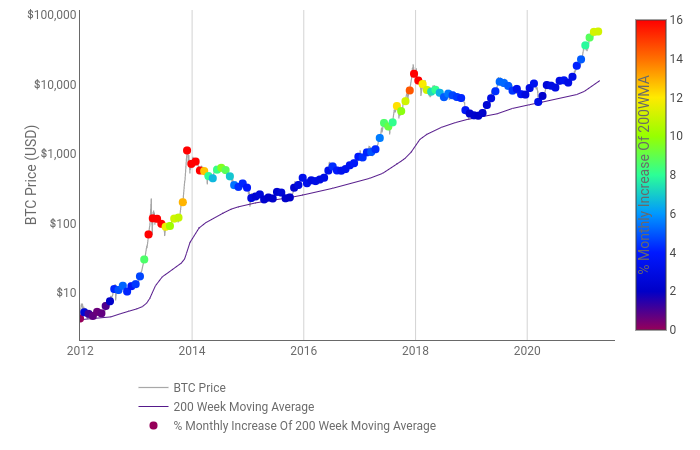
Popular Bitcoin and Crypto Analyst, MagicPoopCannon, has forecasted that Bitcoin and the crypto markets are yet to hit a top for this cycle. According to Magic, the Bitcoin 200 week MA divergence heat map is yet to show signs of exhaustion as explained through the following statement and accompanying chart.

Among other reasons, our location the BTC 200 week MA divergence heat map suggests that the crypto market has not topped yet. The heat map is only greenish yellow right now, and historically reaches red at the top. Therefore, this pullback is likely a great buying opportunity.

Bitcoin’s Top is Near And Could Be at the $80k to $90k

In a November 2020 analysis, Magic had postulated that Bitcoin would hit a top sometime mid-2021 at a level of between $80k and $90k. Magic reiterated this prediction in a tweet on the 16th of April and after Bitcoin dropped to a local low of $50,900 – Binance rate.

According to Magic, Bitcoin’s top is near and the ongoing pullback might be the last before the final push of this BTC bull cycle. Below is his tweet explaining the potential of a Bitcoin top mid this year.

Bitcoin Attempts to Regain $55k as Support

At the time of writing, Bitcoin is defending the $55k support zone after a nervous dip to $53,300 earlier today. The last few days of price action have resulted in King of Crypto once again printing a rising wedge on the one-hour chart as highlighted below.

The current rising wedge is not as ominous looking as the last one that led to the loss of several support zones between $60k and $52k. However, it does point to the possibility of Bitcoin dipping to the $52k to $50k range in the next few hours or days.

Therefore, caution is advised when going long on Bitcoin using leverage. Additionally, now might be a good time to buy the dip on the spot market based on Magic’s analysis of a top in the $80k to $90k range.

Go to Source

Please enter CoinGecko Free Api Key to get this plugin works.
Exit mobile version