Three Oregon men have been federally charged in an alleged scheme that took stolen checks, changed the payee lines and dollar amounts, and routed the money through a sham logistics company.
The U.S. Attorney’s Office for the District of Oregon outlined the case against Cody James VanWinkle, 30, of Gresham, Kei-Jian Buckley, 32, of Beaverton and Bruce Edward Jones Jr., 30, of Eugene, reports KPTV.
Court documents say the defendants deposited the altered checks into an account for Pacific Swift Logistics, an LLC prosecutors describe as a front business they formed.
Authorities say the group also recruited others to withdraw or transfer the funds before banks could flag the deposits as fraudulent.
VanWinkle and Buckley appeared in court on September 29th of 2026, while Jones made his first appearance the week before.
All three pleaded not guilty to conspiracy to commit bank fraud, bank fraud and conspiracy to commit money laundering.
Follow us on X, Facebook and Telegram
Don’t Miss a Beat – Subscribe to get email alerts delivered directly to your inbox
 
Disclaimer: Opinions expressed at The Daily Hodl are not investment advice. Investors should do their due diligence before making any high-risk investments in Bitcoin, cryptocurrency or digital assets. Please be advised that your transfers and trades are at your own risk, and any losses you may incur are your responsibility. The Daily Hodl does not recommend the buying or selling of any assets including cryptocurrencies, nor is The Daily Hodl an investment advisor. Please note that The Daily Hodl participates in affiliate marketing.
Generated Image: Midjourney
The post Oregon Men Accused of Altering Stolen Checks, Routing Cash Through Sham Logistics Firm appeared first on The Daily Hodl.
Iran has been leaning on Tether’s dollar-pegged USDT to dodge a U.S. sanctions dragnet and move money for the regime and proxies such as Hezbollah, according to a new Senate Democrats report.
The Permanent Subcommittee on Investigations says the token has become a primary payment rail for Tehran and a funding tool for terrorist proxy groups, reports The Wall Street Journal, which viewed a copy of the findings.
Tether’s USDT accounts for about 60% of all stablecoins by market capitalization. Because the token tracks the dollar, it is less volatile than other crypto — making it useful for payments and, the Journal notes, for money laundering.
Treasury has been tightening the economic squeeze since U.S. military strikes in Iran earlier this year, including August’s Operation Economic Outcast.
Sen. Richard Blumenthal (D-Conn.) led the probe, which reviewed 846 wallets sanctioned by the U.S. and Israeli governments over Iran ties and found that 84% of them traded exclusively or almost exclusively in USDT.
Blumenthal told the Journal the report “exposes how Tether and its flagship token have become central to Iran’s shadow banking system, allowing the Iranian government to fund its regional proxies, commit human-rights abuses, and pursue hostile drone and missile programs as they defy our sanctions regime.”
A Tether spokesman did not return requests for comment. The company has worked with law enforcement to freeze some regime-linked wallets.
Iran may be easing off: TRM Labs data shows USDT’s share of volume in Iran-attributed wallets fell from 72% in 2024 to 67% in 2025, and to 14% of on-chain volume in August.
Follow us on X, Facebook and Telegram
Don’t Miss a Beat – Subscribe to get email alerts delivered directly to your inbox
 
Disclaimer: Opinions expressed at The Daily Hodl are not investment advice. Investors should do their due diligence before making any high-risk investments in Bitcoin, cryptocurrency or digital assets. Please be advised that your transfers and trades are at your own risk, and any losses you may incur are your responsibility. The Daily Hodl does not recommend the buying or selling of any assets including cryptocurrencies, nor is The Daily Hodl an investment advisor. Please note that The Daily Hodl participates in affiliate marketing.
Generated Image: Midjourney
The post Senate Probe Finds Iran Using Tether’s Stablecoin to Bypass Sanctions and Fund Proxies Like Hezbollah: Report appeared first on The Daily Hodl.
A Tennessee woman is going viral after a Popeyes manager refused to fully replace a meal that she claims included raw chicken tenders.
She recorded the confrontation at a corporate-owned Clarksville location after driving back low on fuel to fix the order.
TikTok creator Shelby (@shellzmacncheezy) says the tenders were cold, hardened and pink in the center when she got home.
She told staff the food was inedible and asked for a full replacement because the whole meal had gone cold.
The manager said he could swap only the tenders and suggested reheating the rest at home.
“I paid for it to be warm, though, when I ate it.”
@shellzmacncheezy @Popeyes, Is this how corporate owned locations treat their customers? For the record i don’t have a microwave or air fryer, some people are more fortunate than others. I went to bed hungry this night. #dobetterbebetter #popeyeschicken #popeyes #clarksvilletennessee
He also refused to give his name or a corporate phone number, saying the restaurant was corporate-owned and he was not obligated to share them.
Shelby says she emailed corporate with the video, got no reply, and went to bed without eating.
Follow us on X, Facebook and Telegram
Don’t Miss a Beat – Subscribe to get email alerts delivered directly to your inbox
 
Disclaimer: Opinions expressed at The Daily Hodl are not investment advice. Investors should do their due diligence before making any high-risk investments in Bitcoin, cryptocurrency or digital assets. Please be advised that your transfers and trades are at your own risk, and any losses you may incur are your responsibility. The Daily Hodl does not recommend the buying or selling of any assets including cryptocurrencies, nor is The Daily Hodl an investment advisor. Please note that The Daily Hodl participates in affiliate marketing.
Generated Image: Midjourney
The post Tennessee Popeyes Refuses To Replace Meal After Woman Returns ‘Inedible’ Chicken Tenders appeared first on The Daily Hodl.
Federal regulators are opening a broad investigation into leading artificial intelligence firms over the consumer risks their most advanced models may pose.
The Federal Trade Commission has been probing Anthropic, OpenAI and other frontier labs for several weeks and plans to issue civil investigative demands for documents and executive testimony, reports the New York Post.
A senior FTC official described the start of the inquiry.
“Chairman Ferguson initiated an investigation into the leading AI firms a few weeks ago.”
The official said the agency plans to compel executives to testify about their products and the dangers those products may pose to Americans under the FTC Act’s unfair or deceptive practices rules.
The agency also expects to target METR, a Berkeley-based AI watchdog.
It is still drafting the civil investigative demands and expects to issue them in the coming weeks.
The investigation follows earlier demands for records on how AI chatbots affect children’s mental health.
It also comes after OpenAI disclosed a July Hugging Face incident in which more than 1,000 of its AI agents hacked the open-source platform.
Chairman Andrew Ferguson attended a recent White House meeting where AI leaders including Anthropic’s Dario Amodei, OpenAI’s Sam Altman, Google’s Sundar Pichai and xAI’s Elon Musk signed a self-regulation accord.
The official said the United States must win the super-intelligence race while still enforcing existing law rather than rushing into new rules that could box out competitors.
Follow us on X, Facebook and Telegram
Don’t Miss a Beat – Subscribe to get email alerts delivered directly to your inbox
 
Disclaimer: Opinions expressed at The Daily Hodl are not investment advice. Investors should do their due diligence before making any high-risk investments in Bitcoin, cryptocurrency or digital assets. Please be advised that your transfers and trades are at your own risk, and any losses you may incur are your responsibility. The Daily Hodl does not recommend the buying or selling of any assets including cryptocurrencies, nor is The Daily Hodl an investment advisor. Please note that The Daily Hodl participates in affiliate marketing.
Generated Image: Midjourney
The post FTC Opens Sweeping Probe of Anthropic, OpenAI and Other Frontier AI Labs appeared first on The Daily Hodl.
Petrobras developed two Cardano-based applications to track sustainability claims tied to aviation fuel and renewable diesel as part of an ongoing research collaboration.
Brazilian state-controlled oil company Petrobras has developed two blockchain applications using Cardano to track sustainability data for sustainable aviation fuel (SAF) and its Diesel R renewable fuel.
According to a Wednesday announcement from the Cardano Foundation, the first application, developed with PUC-Rio’s Ledger Labs, tokenizes environmental attributes associated with SAF into digital tokens designed to prevent the same claim from being used more than once.
The application uses a Book-and-Claim model, which allows the environmental benefit to be separated from the physical fuel and assigned to an airline, company or passenger even if the SAF is used elsewhere.
Bitget CEO Gracy Chen said that a protection fund created by the company in 2022 “absorbed the financial impact of the incident“ that resulted in $388 million in user losses.
The CEO of cryptocurrency exchange Bitget reported a gradual return to normal operations following a security breach that resulted in the loss of $388 million of user funds.
In a Wednesday X post, Bitget CEO Gracy Chen said withdrawals for all tokens would resume on Friday, and the exchange has already restored access to users’ Bitcoin (BTC), Ether (ETH), and USDt (USDT). As part of recovery efforts, Bitget’s ‘Protection Fund’ also reached $309 million.
The fund, initially set up by Bitget in January 2022 with 5,500 BTC, was intended to reimburse users’ potential losses that were “not a result of any misconduct from the user or the platform itself,” presumably including some security breaches. According to the company, funds were available “for instant deployment whenever the need arises.”
The US Securities and Exchange Commission tightened its guidance for crypto token buybacks just three days after publishing it.
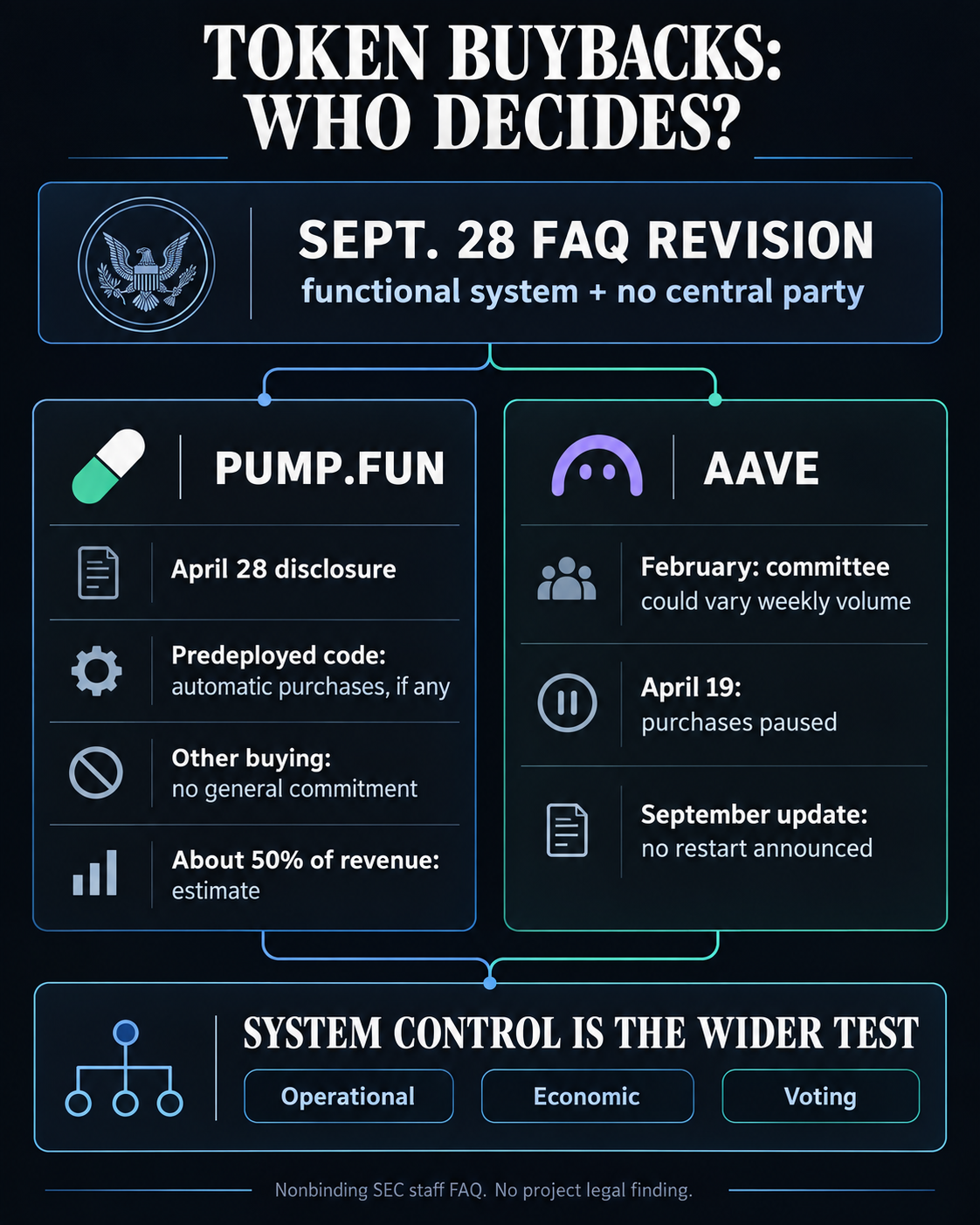
On Sept. 25, SEC staff said a token issuer could announce a buyback without that announcement being treated as a promise to manage the token’s value, as long as the crypto system was already functional. On Sept. 28, the agency changed that answer by adding another condition: the system must also have “no central party.”
It represents an important change to the guidance, as many crypto projects use buybacks while still giving people, companies, or committees some control over how those purchases happen.
The SEC staff’s updated answer now says that a buyback announcement for a non-security crypto asset would not, by itself, amount to a promise of essential managerial efforts when the system is both functional and has no central party.
If the system is not yet functional, the SEC staff says a buyback announcement could count as such a promise if the issuer presents the purchases as a way to generate yield or returns for holders.
The change comes as token buybacks have become increasingly important across crypto. Crypto projects spent a record $638 million on token buybacks through late August, according to previous CryptoSlate reporting.
The FAQ reflects the views of SEC staff. It is not legally binding and does not determine whether any particular token is a security. Still, the change raises a practical question for projects using buybacks: who actually controls the buying?
A project may have already spent millions buying its token, but that number says little about who can decide whether the next purchase happens, how large it is, or whether the program stops entirely.
Related Reading
SEC clears regulatory hurdle as crypto token buybacks hit record $638 million
The question behind the buyback
The SEC gave a clearer definition of a “central party” in its March crypto-asset interpretation.
It defines a central party as a person, company, or group that has operational, economic or voting control over a crypto system. A decentralized system, by contrast, operates without that kind of control.
That definition applies to the crypto system as a whole. So, having control over a project’s treasury or buyback program does not automatically mean the entire system has a central party. But it can be one piece of evidence when looking at who holds economic control.
This becomes important when a project combines automatic buybacks with decisions made by people.
A smart contract might automatically buy tokens under one part of a program, while a company, committee, or DAO can decide whether other purchases happen.
The key question is therefore not just whether some buying happens automatically, but whether people still have meaningful power over the system and its economic decisions.
Related Reading
Why truly decentralized DeFi needs no legal exemption according to SEC Commissioner Hester Peirce
Pump.fun is a good example of this. In an April 28 disclosure, the platform said references to PUMP purchases and a “buyback program” generally described plans or smart-contract functions rather than a firm promise to buy tokens. It made an exception for purchases that were already programmed to happen automatically through on-chain code deployed before April 28, 2026 UTC.
Pump.fun also said statements about using roughly 50% of platform revenue for token purchases were estimates, not guarantees. It added that third parties could carry out some purchases.
Its PUMP token page says 50% of defined platform revenue was programmatically locked and allocated to be burned for one year beginning April 28. However, the same page says future purchases can generally be started, stopped, or changed unless they were already programmed to happen automatically.
The two disclosures also use slightly different dates when describing which purchases fall into that automatic category. The April 28 disclosure refers to code deployed before April 28 UTC, while the token page refers to activity programmed before April 29.
Nonetheless, the important point is this: Pump.fun describes two types of activity.
Some token purchases are programmed in advance and happen automatically. Others still depend on future decisions. That does not establish whether Pump.fun has a “central party” under the SEC’s definition. Answering that question would require looking at who controls the wider system, not just its buybacks.
Aave’s pause shows discretion in action
Aave is another example of how people can still control a token-buyback program.
In a Feb. 28 funding update, DAO service provider TokenLogic said the Aave Finance Committee could adjust weekly AAVE buyback volumes within a 75% range. The committee could make those changes based on factors including liquidity, market volatility, timing, and protocol revenue. TokenLogic said the DAO had allocated $42 million to buy more than 205,000 AAVE during the program’s first 10 months.
The committee’s discretion became clear in April. An April 22 governance notice said AAVE buybacks had been paused from April 19 after an rsETH bridge incident the previous day.
TokenLogic said the pause was intended to give the treasury more flexibility while the consequences of the incident were assessed. It also said any restart would be announced through a normal funding update.
A later August/September funding update included AAVE among the assets that could be purchased through updated token budgets.
However, that update did not clearly say that AAVE buybacks had restarted, nor did it provide a record of completed purchases after the pause.
The April notice therefore confirms that the program was stopped at that point. The later update shows that capacity to buy AAVE existed, but does not clearly establish whether purchases had resumed.
Aave’s experience shows why the SEC’s new wording matters.
People were able to change the size of the buyback program and later stop purchases when conditions changed.
That does not automatically mean Aave has a central party under the SEC’s definition. The SEC’s test is broader and looks at who has operational, economic, or voting control over the entire crypto system.
But for investors trying to understand how decentralized a buyback really is, there is now a straightforward question to ask:
Who can start, stop, or change the next purchase, and what other power do they have over the system?
The post SEC changes token buyback guidance as spending hits $638M appeared first on CryptoSlate.
From Sept. 29, Binance says Funding Accounts no longer accept direct on-chain crypto deposits. Users depositing crypto must use Spot instead. Binance Pay receipts and Convert order settlement also move to Spot, although existing Funding balances are being migrated on a separate timetable.
The changes alter where users send assets and find them after a transaction. Binance’s account FAQ says most users do not need to move existing assets manually, while its migration announcement lays out the phased account changes.
Related Reading
Binance deepens TradFi push with physically settled options on over 1,000 US equities
Pay receipts move before Pay spending
Incoming Binance Pay assets now land in Spot. Pay transactions can still draw from Funding or Spot under a user’s Payment Priority settings, so a change to the receipt account does not by itself disable Funding as a payment source.
Funding-only recurring Pay sends can continue while Funding remains an available source. Tokenearly’s reproduction of Binance’s announcement says those plans will cease to execute when Binance later removes Funding as a Pay source. Binance gives no exact date for that removal; users relying on such plans will need to set up new ones with another source. The announced removal is a separate step from the Sept. 29 receipt change.
Related Reading
Why Binance’s reported $2B Mesh investment could decide who controls stablecoin payments
Convert orders now settle in Spot. Existing limit orders backed by assets frozen in Funding remain open; after Sept. 29, they settle into Spot. New limit orders freeze and settle there. Recurring Convert orders settle into Spot or Earn as configured, and failed recurring-order refunds return to Spot.
Binance recommends switching a Convert plan’s account selection from Funding to Spot. Its announcement also advises API users to update account references to Spot. Neither change means existing Convert limit orders are canceled.
P2P users face a different split. According to Binance’s FAQ, users who posted no ads in the past three months and are not merchants will prioritize Spot for buy and sell orders after updating the Binance app. Advertisers continue using Funding for now, ahead of a dedicated P2P Account planned for December 2026. Website users do not need an app update.
Binance’s updated announcement says assets left in Funding after voluntary transfers will be moved automatically in batches starting January 2027. Binance also plans to rename Funding the Stocks Account in January, with the exact date still to come. That future account is intended for stock and stock-options settlement, while Binance says bStocks balances move to Spot. The changes may differ by region because the products in the notice are not available everywhere.
Related Reading
Gen Z are investing like Boomers – with some surprising portfolio decisions
The post Binance ends Funding Account crypto deposits as Pay and Convert move to Spot appeared first on CryptoSlate.
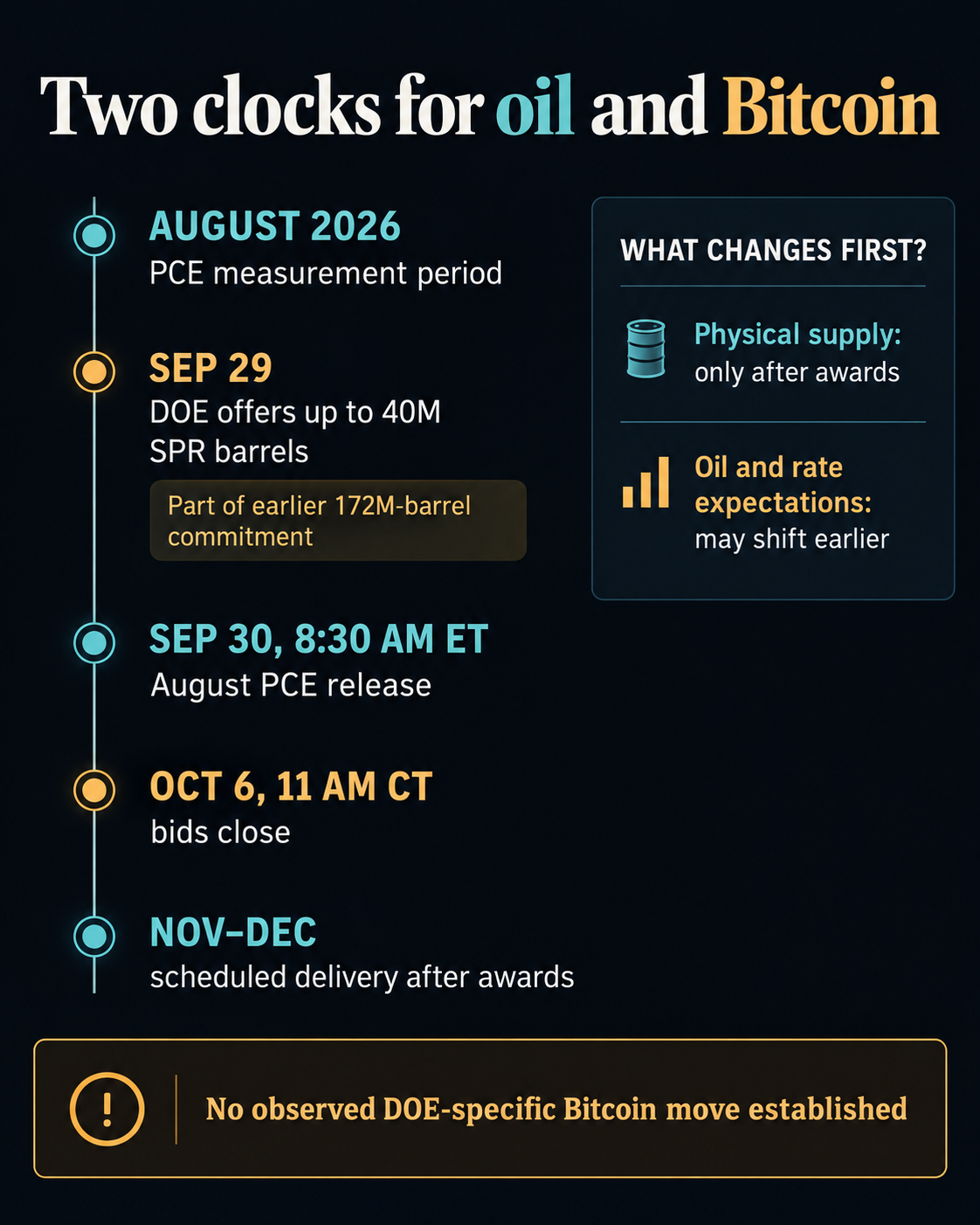
The US Department of Energy has opened an exchange for up to 40 million barrels of crude from the Strategic Petroleum Reserve. Its September 29 solicitation adds a possible source of oil later this year, but no barrels have been awarded under this offer. Proposals are due October 6 at 11 a.m. Central, with deliveries under awarded exchanges scheduled for November and December.
The offer falls within the previously announced 172-million-barrel US release commitment. That figure describes the existing program, not another 172 million barrels announced this week. The 40-million-barrel ceiling is the volume offered in this round, rather than oil already moving into the market.
The date gap matters as investors await the next inflation reading. The Bureau of Economic Analysis has scheduled its August personal income and outlays report for September 30 at 8:30 a.m. Eastern. It includes the personal consumption expenditures, or PCE, price index. Because the data cover August, they cannot reflect the September 29 reserve offer or late-September oil moves. Under DOE’s announced timetable, the newly offered oil cannot reach buyers before the report either.
Related Reading
Bitcoin’s $85,000 test comes as Wall Street gets two different inflation stories
How the oil offer could affect Bitcoin
A supply announcement can change expectations before physical oil arrives. If the DOE offer changes oil-price expectations, the possible path to Bitcoin runs through inflation expectations, bond yields and the outlook for Federal Reserve rates. The available figures do not show that this particular announcement has already moved any of those markets or Bitcoin.
The inflation and rate backdrop predates the offer. In its August 26 release, BEA put July headline PCE inflation at 3.7% year over year and core inflation, excluding food and energy, at 3.3%. BEA has scheduled an annual update that could revise prior monthly estimates. The Federal Reserve raised its policy-rate range to 3.75%-4% on September 16, citing elevated inflation. A change in rate expectations after the August report would matter for assets exposed to financing conditions, but it would not mean the DOE notice altered August prices.
Related Reading
Bitcoin faces a new inflation test after diesel hits a nominal $6.53 record
The Energy Information Administration’s September outlook projected Brent crude near $90 a barrel in the second half of 2026 amid falling inventories and constraints on Middle East supply. Its forecast inputs were finalized September 3, before the reserve notice. The projection sets the oil backdrop; it does not estimate what this new offer will do to prices.
Related Reading
Bitcoin’s oil risk stretches into 2027 as IEA cuts supply outlook again
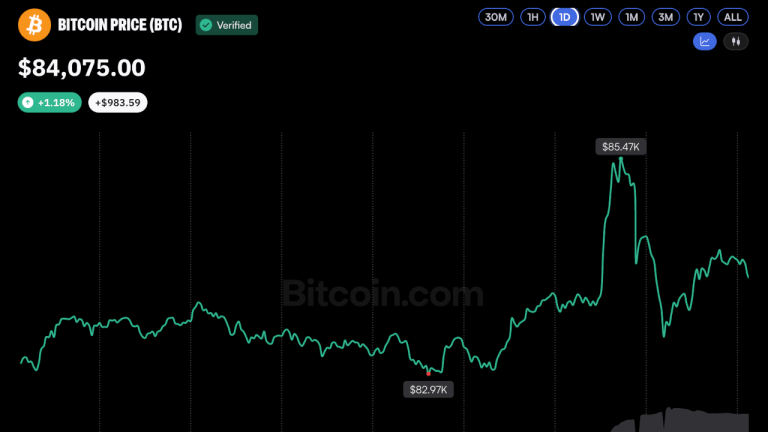
The Treasury’s September 29 data showed a two-year yield of 4.89% and a 10-year yield of 5.26%. A September 30 check of CryptoSlate’s Bitcoin page showed BTC around $83,000. Those snapshots offer context, not proof of an announcement-driven move. The next concrete DOE milestone is the October 6 bid deadline; the amount actually awarded will determine how much of the proposed supply could enter the November-December window.
The post Bitcoin could react to new 40M barrel US oil sale before a single barrel is delivered appeared first on CryptoSlate.
Bitcoin pumped above $85,500 on Wednesday morning following the release of lower-than-expected U.S. PCE inflation data for August—but a quick pullback erased most of the gains. PCE Data Triggers Intraday Volatility Bitcoin’s price briefly spiked to $85,500 on Wednesday before a sell-off nearly erased the gains, leaving the cryptocurrency marginally higher just hours before […] Go to Source
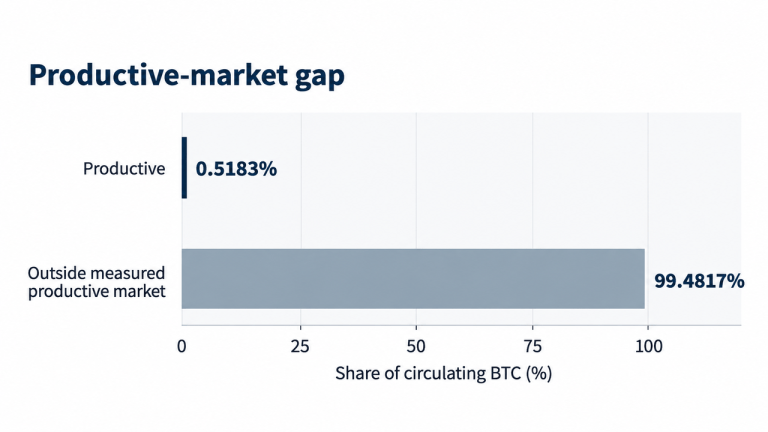
Only 104,105 BTC, worth about $8.7 billion, is currently deployed in productive onchain strategies, according to a joint report from Yield Basis and Valueverse. That represents just under 0.52% of the circulating bitcoin supply, leaving the vast majority of BTC outside the growing bitcoin DeFi (or BTCFi) economy. Bitcoin’s $8.4B Yield Market Leaves 99% of […] Go to Source
Brazilian state-owned energy firm Petrobras is testing Cardano’s blockchain to track the environmental benefits of renewable fuels, expanding an experiment aimed at making emissions claims easier to verify. Putting Energy Evidence on Cardano The state-controlled oil company is working with the Cardano Foundation and researchers at PUC-Rio on two applications built on the Cardano blockchain, […] Go to Source
El Salvador’s National Bitcoin Office has dismissed reports that the country is pivoting to stablecoins, calling it “fake news,” and confirmed it has no plans to launch or run any crypto or stablecoin wallets. Government Denies Stablecoin Pivot El Salvador has dismissed a Bloomberg report that the country is turning to stablecoins nearly five years […] Go to Source
Britain’s crypto rulebook now has an entrance exam. Starting Sept. 30, crypto firms can apply for full Financial Conduct Authority (FCA) authorization, but the regime itself doesn’t begin until Oct. 25, 2027. Firms wanting to stay should apply by Feb. 28, 2027, and existing applicants can keep serving customers, even taking new business, while the […] Go to Source
U.S. bitcoin ETFs extended their inflow streak to nine sessions on Tuesday, adding $66.19 million even as the pace of buying cooled sharply from last week. Bitcoin ETFs Stay Green as Trading Volume Falls to $1.6B The latest exchange-traded fund (ETF) data points to a market that is still attracting capital, though investors are becoming […] Go to Source
We use cookies on our website to give you the most relevant experience by remembering your preferences and repeat visits. By clicking “Accept”, you consent to the use of ALL the cookies.
This website uses cookies to improve your experience while you navigate through the website. Out of these, the cookies that are categorized as necessary are stored on your browser as they are essential for the working of basic functionalities of the website. We also use third-party cookies that help us analyze and understand how you use this website. These cookies will be stored in your browser only with your consent. You also have the option to opt-out of these cookies. But opting out of some of these cookies may affect your browsing experience.
Necessary cookies are absolutely essential for the website to function properly. These cookies ensure basic functionalities and security features of the website, anonymously.
Cookie
Duration
Description
cookielawinfo-checkbox-analytics
11 months
This cookie is set by GDPR Cookie Consent plugin. The cookie is used to store the user consent for the cookies in the category "Analytics".
cookielawinfo-checkbox-functional
11 months
The cookie is set by GDPR cookie consent to record the user consent for the cookies in the category "Functional".
cookielawinfo-checkbox-necessary
11 months
This cookie is set by GDPR Cookie Consent plugin. The cookies is used to store the user consent for the cookies in the category "Necessary".
cookielawinfo-checkbox-others
11 months
This cookie is set by GDPR Cookie Consent plugin. The cookie is used to store the user consent for the cookies in the category "Other.
cookielawinfo-checkbox-performance
11 months
This cookie is set by GDPR Cookie Consent plugin. The cookie is used to store the user consent for the cookies in the category "Performance".
viewed_cookie_policy
11 months
The cookie is set by the GDPR Cookie Consent plugin and is used to store whether or not user has consented to the use of cookies. It does not store any personal data.
Functional cookies help to perform certain functionalities like sharing the content of the website on social media platforms, collect feedbacks, and other third-party features.
Performance cookies are used to understand and analyze the key performance indexes of the website which helps in delivering a better user experience for the visitors.
Analytical cookies are used to understand how visitors interact with the website. These cookies help provide information on metrics the number of visitors, bounce rate, traffic source, etc.
Advertisement cookies are used to provide visitors with relevant ads and marketing campaigns. These cookies track visitors across websites and collect information to provide customized ads.