Ren launches bridge to Polygon for seven top crypto assets

The new bridge will allow Ren’s ERC-20 representations of BTC, BCH, DOGE, FIL, LUNA, ZEC, and DGB can now be transferred onto the Polygon network.

The launch of the new Polygon x RenVM Bridge was announced to Twitter by Polygon on May 28, who emphasized the bridge will allow Bitcoin and other assets to be used on the high-speed and low-cost layer-two.

Ren and Polygon have teamed up to launch a bridge allowing BTC and other assets to be transferred between Bitcoin and the Ethereum scaling solution.

Ren’s ERC-20 representations of Bitcoin, Bitcoin Cash, Dogecoin, Filecoin, Terra, Zcash, and DigiByte can now be used on the Polygon network. The assets can already be traded and pooled on top Polygon-based DEX, QuickSwap, with the team also hinting at future yield opportunities for the tokens on Polygon deployments of Curve Finance and BadgerDAO.

Speaking to Cointelegraph, a Ren representative indicated the team plans to launch more bridges to high-speed scalable networks in the near future.

Since launching the RenVM one year ago, Ren has emerged as a leading portal allowing wrapped versions of Bitcoin, Bitcoin Cash, Zcash, and other layer-one assets to be traded on the Ethereum mainnet. Roughly $246.3 million worth of assets were bridged using RenVM over the past seven days.

According to DeFi Llama, the RenVM is currently the 30th-largest decentralized finance protocol with a total value locked, or TVL, of $573 million.

Polygon has recently emerged as the leading layer-two scaling solution by TVL and the second-largest DeFi protocol overall with roughly $10.3 billion worth of assets currently held on the network. On May 25, it was announced that famed billionaire investor Mark Cuban had invested in Polygon.

However, competition among layer-twos is heating up, with Arbitrum targeting its mainnet launch for May 28, and Optimism aiming to go live in July.

Go to Source

Crypto couple tells court the IRS has no right to tax newly mined coins

Coins earned by staking have been “created” and are not taxable until sold according to one couple in the U.S.

A couple investing in crypto have claimed that coins gained by mining or staking are not taxable until sold, in a complaint filed to federal court. 

The Tennessee couple are seeking a refund from the Internal Revenue Service (IRS) and filed a complaint with the U.S. District Court for the Middle District of Tennessee on Tuesday, May 25.

Joshua and Jessica Jarrett claim that earnings from staking are not taxable transactions because they constitute the creation of property. They compared this to a baker making a cake or an author writing a novel.

Law360 reported that the court heard Jarrett used his resources to create 8,876 new units of Tezos (XTZ) tokens in 2019, and he has yet to sell any of them. The case is based on the premise that the crypto assets were “created” and have not been sold, so no income or profit has been realized from them.

In their complaint, the Jarretts stated that the U.S. seeks to use federal income tax law to do something unprecedented, which is tax creative activity rather than income, adding:

“Taxing newly created cakes, books or tokens as income would have far-reaching and detrimental effects on taxpayers and the U.S. economy, and is without support in the Internal Revenue Code, regulations, case law or the Constitution.”

The couple cited a 1920 Supreme Court case which held that income must involve a “coming in”. Property made by a taxpayer does not “come in”, but rather goes out, they stated. Another 1955 ruling where the court characterized income as “instances of undeniable accessions to wealth, clearly realized, and over which the taxpayers have complete dominion”, was used to back up the claim.

The couple reported the tokens as “other income” on their tax returns resulting in a payment of $9,407 to the IRS. A refund of $3,293 paid in federal income tax and a $500 increase in tax credits resulting from a reduction in their income has been requested.

The couple’s lawyer, David L. Forst, stated that there is “100 years of tax law” as a legal precedent that newly created property is not taxed.

In early March, Cointelegraph reported that the IRS clarified that crypto investors who only purchased digital assets using fiat and did not sell during 2020 do not need to report said activities.

On May 20, it was reported that the U.S. Department of the Treasury called for exchanges and custodians to report crypto transactions greater than $10,000 to the IRS.

Go to Source

Uniswap v3 looks set for layer-two scaling on both Arbitrum and Optimism

Uniswap is now planning layer-two deployments on both Arbitrum and Optimism.

The Uniswap community has voted in favor of launching the leading decentralized exchange’s v3 iteration on layer-two scaling solution, Arbitrum.

Uniswap’s creator, Hayden Adams, announced the vote on May 27, revealing the proposal’s governance vote received 41.35 million votes in favor and zero opposing votes from UNI token holders.

He noted that work is already underway to plan the deployment and design its interface.

Arbitrum raised $3.7 million in 2019 to explore smart contract scalability, and launched the first Rollup system for Ethereum in early 2020. Arbitrum claims to have achieved a reduction in gas costs of 55 times for its testnet port of Uniswap v2 in November 2020, supporting 390 swaps per second compared to jusseven on the Ethereum mainnet.

Adams said that the Uniswap team remains “incredibly excited” for the launch of rival layer-two scaling solution, Optimism. Adams noted Uniswap is still targeting a deployment on Optimism for “the near future.”

Optimism, which raised $25 million in a February funding round led by A16z, announced in March its launch would be delayed, offering July as a “rough estimate” for mainnet launch.

Optimism’s delay has provided opportunities for other second-layer scaling solutions to secure market share, with Polygon taking an early lead after Aave quickly attracted a 10-figure TVL on the network.

Arbitrum has also emerged as a major layer-two contender, with the project currently targeting May 28 for its mainnet launch. Developers will initially have exclusive access to Arbitrum after launch, allowing time for the network’s initial cohort of projects to establish infrastructure and conduct testing.

In early May, OKEx became the first major centralized exchange to enable deposit and withdrawal functionality with the protocol. Arbitrum has also secured notable partnerships with The Graph, Bancor, and Biconomy.

In March, Ethereum co-founder Vitalik Buterin praised Arbitrum for its progress on Ethereum Virtual Machine-compatible rollups.

Since launching earlier this month, Uniswap v3 has lived up to its promise of delivering superior capital efficiency than its previous incarnations, with v3 surpassing v2 by daily volume despite currently representing 26% of v2’s total value locked.

Go to Source

Spain Based Custodial Services to Report Ownership of Crypto Assets, According to New Law Draft

A new law draft approved just today by the Finance Commission of the Spanish Congress would make Spain-based custody services report the ownership of the cryptocurrencies under management. The law, which was stuck in Congress for some time, aims to close a gap in the legislation that allowed some users to bypass the requirements and avoid paying taxes in the process.

Spain Based Custody Services Would Have to Report Ownership of Assets

Third-Party custodial services based in Spain would have to report the holdings of its customers, as well as all the operations made with them, according to a new law draft approved on Wednesday by the Finance Commission of the Spanish Congress. The law, titled “Prevention and fight against tax fraud,” would make mandatory the report of any cryptocurrency funds in these institutions, and also includes individuals or institutions related to initial coin offerings in the mix.

Until now, these institutions didn’t have to report any of their activities to the tax authorities, and the responsibility of doing this went to the actual owners of cryptocurrency. The current law makes it mandatory for users to report holdings of more than 50,000 euros in cryptocurrency, as well as all of the earnings coming from the trading of these.

Also, the law includes cryptocurrency exchanges in this area, so all Spain-based cryptocurrency exchanges would have to also report the identity of their customers and the operations of each one of them to the tax authorities. The law draft, which was approved with 21 votes for it and 14 against it, now will go to the Senate to be approved or tossed.

But the changes don’t only go to regulate cryptocurrencies. The tax authority also is establishing new limits on the amount that Spain residents can obtain as payments in cash, lowering it to 1,000 euros for entrepreneurs and professionals, and to 2,500 euros for others.

Tough Stance on Crypto

This is another new rule that comes to compliment the already tough stance that the Spanish governments and its lawmakers have applied for cryptocurrency-related matters. Earlier this month, the Spanish government also signed a royal decree that mandated exchanges and crypto custody firms to establish a report of all of their cryptocurrency transactions to share its data with the European Union bloc of countries. This decree also includes making reports of any “suspicious” transactions to the authorities.

What do you think about the law draft approved in Spain? Tell us in the comments section below.

Go to Source

Mark Cuban Reveals Stake in Ethereum Layer 2 Scaling Solution Polygon

Famed American entrepreneur and investor Mark Cuban has divulged a strategic investment in Polygon, highlighting his own use and embrace of the protocol’s multi-chain approach to Ethereum.

Investment Accompanies Release of the Polygon SDK

As major names line up behind Ethereum, notably Goldman Sachs, which presented a thesis highlighting the network’s potential to overtake Bitcoin in terms of crypto dominance, Mark Cuban is among the latest high-profile figures to throw his support behind the network via an investment in Polygon.

Polygon, formerly known as Matic, aims to help tackle the scaling constraints that have plagued Ethereum by delivering the interoperability needed to construct and connect Ethereum-compatible chains.

The layer 2 scaling solution pioneered by the company will effectively benefit from Ethereum’s core features while building upon the network’s existing capacity. For projects like decentralized finance (defi) that want to avoid the throughput bottlenecks and high fees that currently impact the Ethereum mainnet, this new solution is designed to overcome these obstacles.

Cuban withheld the terms and size of his investment in Polygon but did note, “I was a Polygon user and find myself using it more and more.” Already, he plans to integrate Polygon into Lazy.com, another blockchain business in his portfolio, to help users seamlessly display NFTs.

This investment dovetails important advances for Polygon, namely the rollout of the Polygon SDK. The SDK will empower developers to build customized standalone chains that will be compatible with Ethereum with its growing set of modules. Besides helping deliver on its promise to cultivate a multi-chain ecosystem, Polygon’s high throughput and PoS consensus model support “zero-gas” transactions and near-instant confirmations.

Future iterations of the Polygon SDK, set for eventual implementation, will support more layer 2 platforms, including Rollups and Plasma, each of which will also promote greater scalability and throughput over time.

Are the billionaires lining up behind their favorite blockchains – Musk vs Cuban? Let us know what you think in the comments section below.

Go to Source

Guggenheim CIO Scott Minerd Predicts More Bitcoin Sell-Off but Remains Bullish Long Term

The chief investment officer of Guggenheim, Scott Minerd, has predicted more sell-off for bitcoin. He also warned that it will take a while for the cryptocurrency to return to its previous highs. However, in the long term, Minerd has predicted that bitcoin’s price could rise to $600K.

Bitcoin Sell-Off to Continue, Minerd Says

The chief investment officer (CIO) of Guggenheim Partners, Scott Minerd, has made another bearish prediction for bitcoin’s price in the short term. Minerd is also the chairman of Guggenheim Investments, the global asset management and investment advisory division of Guggenheim Partners. Guggenheim Investments has about $270 billion in total assets under management across fixed income, equity, and alternative strategies.

He told CNBC on Tuesday that bitcoin has not hit its bottom just yet, emphasizing:

You can afford to be patient here. There’s more to go.

He explained that bitcoin had gone “exponential” and it will take some time for the cryptocurrency to return to its previous highs. He believes that an obstacle to bitcoin will be that some investors are now moving capital away from BTC into competing cryptocurrencies.

Furthermore, “Any market that goes exponential is automatically unsustainable. I just looked at it and realized that given the size of the move, which was essentially a mania or a bubble, that traditionally you get 50% to 75%, declines coming out of the top of the bubble,” the CIO opined.

Minerd has been predicting a decline in the price of bitcoin for months. In April, he warned of a major correction in the cryptocurrency that could send its price down 50% to the $20K-$30K level. He said the BTC price at the time looked “very frothy.” Soon after his prediction, bitcoin’s price fell to the $30K level.

In the long term, however, the CIO has predicted that the price of bitcoin could reach $600K. “If you consider the supply of bitcoin relative, let’s say, to the supply of gold in the world … You’ll be talking about $400K to $600K per bitcoin,” he said in February. “That’s an indication of what might be a fair value. That gives you a lot of room to run.” He ultimately sees bitcoin and ether as “winners” in the cryptocurrency market.

What do you think about Guggenheim CIO Scott Minerd’s bitcoin prediction? Let us know in the comments section below.

Go to Source

Federal Reserve Bank President Says Most Cryptocurrencies Are Worthless

The president of the Federal Reserve Bank of St. Louis, James Bullard, says that most cryptocurrencies are “worthless.” He noted that if “cryptocurrency can facilitate transactions that are difficult to make in conventional currencies, then they will have a purpose and might circulate alongside the nation-backed currencies.”

Fed’s Bullard Says Most Cryptocurrencies Are Worthless

Jim Bullard, President of the Federal Reserve Bank of St. Louis, talked about inflation risks and what lies ahead for Fed policy in an interview with Yahoo Finance on Monday.

He also talked about cryptocurrency, given the high volatility in crypto prices observed over the past weeks. He was asked, “What are your views on cryptocurrency, its use case right now, and … how closely have you been watching a lot of the volatility in crypto markets?”

Bullard replied: “I have a slide deck on this that’s called ‘non-uniform currency and exchange rate chaos’ and a couple of things that are in there. One is that currency competition is nothing new. Private currency issuance has been addressed historically in monetary theory.”

He continued, “Milton Friedman said if you allow private currency issuance, you’ll get all kinds of private currencies being issued. And that’s exactly what has happened,” adding:

We have a couple of thousand of these around, most of them are worthless.

“I think if the cryptocurrency can facilitate transactions that are difficult to make in conventional currencies, then they will have a purpose and might circulate alongside of the nation-backed currencies,” he noted.

Bullard proceeded to discuss the volatility in the crypto market. He said cryptocurrencies are “also quite volatile, as it’s been very apparent here in recent days.” However, he emphasized: “But the fact that different currencies have volatile exchange rates, that’s a fundamental problem in the international monetary order and it’s just that much bigger of a problem for privately issued currencies.”

He added that “it’s even a problem for nation-state type currencies where they trade in a volatile way against each other that seems to be distant from actual movements and fundamentals,” elaborating:

So lots of interesting things going on in this space and of course the Fed is also looking at a Fed coin. So we’ve got a lot going on, watching this very carefully. And I guess … in a nutshell that’s where I’m at on this.

Following his comment that most cryptocurrencies out there are worthless, Bullard was asked whether it presents a financial stability risk.

He replied: “We hope that those that are involved know the risks. Of course, any investment that you do can go up but it can go down as well. And so anybody that’s putting a portfolio together has to balance the risk and reward as always in finance.” The president of the Federal Reserve Bank of St. Louis concluded: “I think, for the most part, people like going into this with eyes wide open, they’re certainly not blind to the idea that this is a volatile area.”

Bullard recently said that he is confident that bitcoin is not a threat to the U.S. dollar. Last week, he said that the recent cryptocurrency sell-off was not a systematic concern for the Fed and did not affect the central bank’s policies.

What do you think about Bullard’s comments on cryptocurrencies? Let us know in the comments section below.

Go to Source

Nvidia reports record earnings, claims it’s ‘hard to determine’ impact of crypto miners

Despite the surging crypto market rally, Nvidia believes its record first-quarter earnings are the result of high demand from the gaming industry.

Nvidia, a leading manufacturer of graphics processing units, or GPUs, has announced record earnings for Q1 2021. However, the firm has downplayed the role of the crypto bull market in driving its impressive performance, primarily attributing demand for its products to gamers.

The firm reported an 84% increase in sales overall, with the impressive performance owing to a period of sustained growth despite global shortages of semiconductors.

Nvidia’s sales and earnings both surpassed the expectations with Wall Street, reporting revenue of $5.66 billion and earnings of $3.66 per share after pundits had predicted earnings of $3.28 per share and revenue of $5.41 billion.

Nvidia claims demand from the video game sector more than doubled in the past 12 months, producing annual growth of 106% to drive $2.76 billion in sales. CFO Colette Kress, emphasized surging demand for its consumer GeForce GPUs from gamers and students.

Its graphics segment represented $3.45 billion in revenue with an 81% increase. However, Nvidia estimates demand from crypto miners represented just $155 million worth of its sales.

The company recently took action to deter crypto miners from purchasing its GPUs earlier this year by adding software that limits the hashing capabilities of its GTX RTX 3060 units.

While the firm noted that cryptocurrency miners had a positive impact on demand for GPUs, Nvidia determined “it is hard to determine to what extent” revenues could be attributed to the sector.

Despite its impressive performance, Nvidia expects its recent supply woes will continue for the coming months, predicting GPUs will be in short supply during the second half of the year.

Nvidia chief executive, Jensen Huang, predicted the firm’s forthcoming CMP chips — specialized units dedicated to mining cryptocurrency — will help ease the problem as miner demand for its regular GPUs falls. He said:

“CMP yields better, and producing those doesn’t take away from the supply of GeForce. So it protects supply for the gamers.”

Previous efforts to launch specialized mining hardware — notably the Crypto SKU units — have landed Nvidia in hot water, with shareholders claiming the firm misrepresented to investors that half of its GPU sales were made to crypto miners during 2017 and 2018, resulting in inaccurate forecasts regarding demand for GPUs from gamers amid the crypto bear trend. Nvidia won the case in March of this year.

Go to Source

Billionaire Carl Icahn says he may drop up to $1.5B into crypto

Billionaire Carl Icahn may invest up to $1.5 billion into crypto while noting that “much of the cryptocurrency issued today will not survive.”

Former crypto skeptic Carl Icahn, the founder of Icahn Enterprises, told Bloomberg he’s set to enter the crypto market in a “big way” — teasing an investment of around $1.5 billion.

Icahn is an investor and former advisor to the Trump administration who has a net worth of $15.6 billion according to Forbes. In 2018 Icahn told CNBC that crypto is “ridiculous” and added “maybe I’m too old for them, but I wouldn’t touch that stuff.”

But speaking on May 26, Icahn explained he’s now considering a large investment and that entering the market in such a manner would “not be to buy a few coins or something”:

“I mean, a big way for us would be a billion dollars, billion-and-a-half dollars … I’m not going to say exactly.”

Icahn joins a growing list of fellow billionaires who have changed their tune over crypto in the past 12 months. When asked about what cryptocurrencies he has his eyes on, the billionaire kept his cards close to his chest and emphasized that:

“Much of the cryptocurrency issued today will not survive, but we believe cryptocurrency in one form or another might be here to stay. To be clear, we have never bought any cryptocurrency, but we are studying it.”

Icahn believes that cryptocurrencies that don’t at least serve as a store of value will be flushed out of the market as “there’s gotta be some form of safety of value there” to survive.

Icahn Enterprises is a $14.5 billion American conglomerate with investments in CVR, Pep Boys, and Trump Entertainment Resorts.

Ryan Adams, Ether proponent and founder of crypto investment firm Mythos Capital and Bankless, speculated on Twitter that Icahn’s recent kite flying in the media, may indicate he has already entered the market:

“If Carl Icahn hasn’t already bought a billion dollars worth of ETH and BTC why would he announce he’s about to buy a billion dollars worth of ETH and BTC.”

The billionaire expanded further on his views about crypto to Bloomberg, saying he now thinks that skepticism over the value of crypto is a “little wrong-headed,” as he questions the intrinsic value of the U.S. dollar in comparison to crypto, which could be a store of value and hedge against inflation.

Well, what’s the value of a dollar? The only value of the dollar really, is because you can use it to pay taxes.”

When Ichan was asked “what is your use case?” for crypto, the 85-year-old spoke about the Ethereum network, noting that “with Ethereum it’s the underlying blockchain. So, Ethereum has two things: you can use it as a payment system, you can use it as a store of value.

“Bitcoin to me is just a store of value,” he added.

Go to Source

Analyst says DeFi and stablecoins held up well as crypto markets imploded

DeFi showed tremendous strength during last week’s sell-off as DEX activity and stablecoin stability prove the sector may be ready for mass adoption.

The decentralized finance (DeFi) sector faced its first real challenge during last week’s market sell-off that saw more than $1 trillion wiped from the global cryptocurrency market cap as traders feverishly ran for the safety of stablecoins amid tumbling prices. 

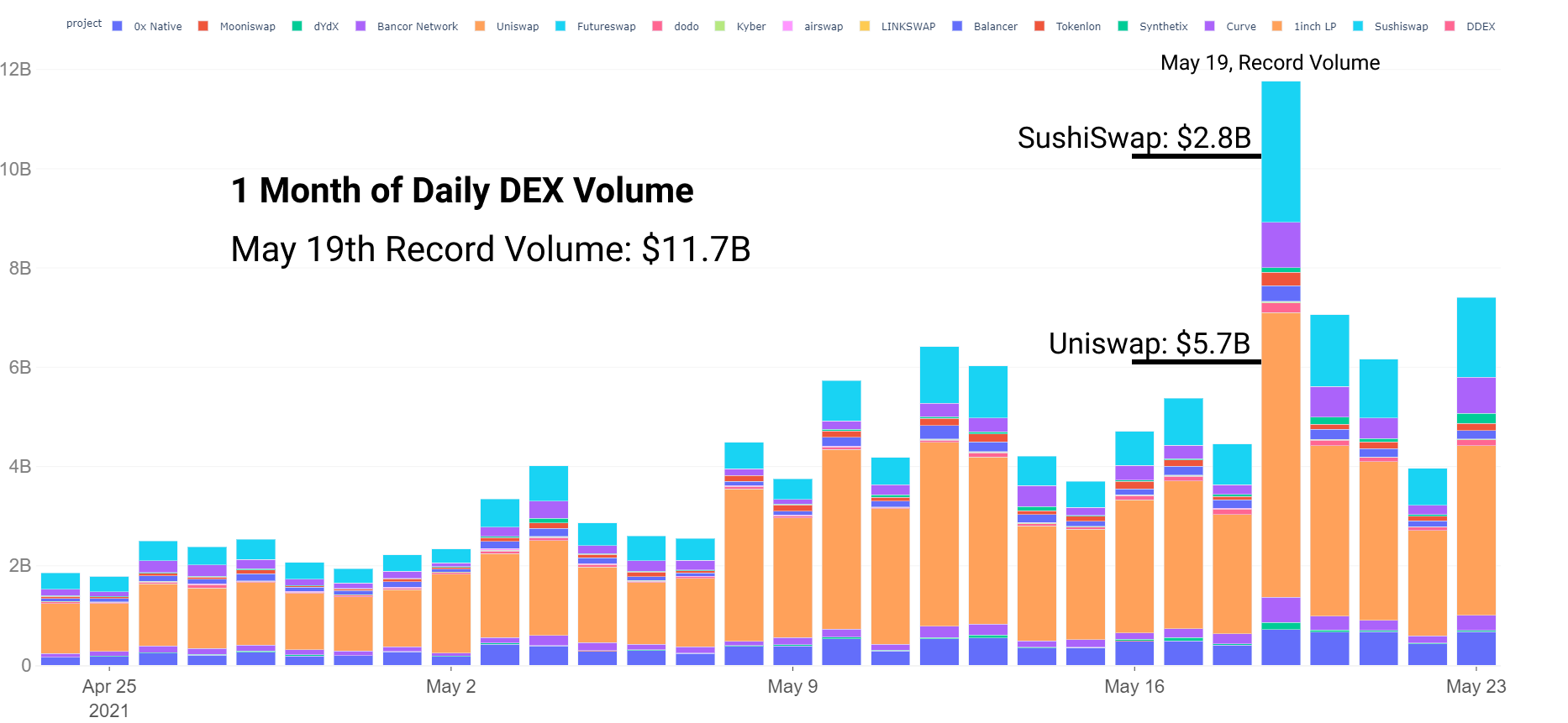
Despite rapidly declining token prices, the nascent DeFi sector held its own as decentralized exchanges experienced a record $11.7 billion in trading volume on May 19. Uniswap (UNI) led with $5.7 billion in volume, followed by SushiSwap (SUSHI) which saw $2.8 billion in 24-hour trading volume.

Daily DEX volume. Source: Dune Analytics

According to the recent DeFi Uncovered report from Glassnode, blue-chip DeFi tokens including, UNI, SUSHI, Maker (MKR), Aave (AAVE) and Compound (COMP) have largely mirrored the decline of Ether (ETH) over the past two weeks, “showing relatively high beta to ETH but not exceeding the decline from ATH by more than 15% from the decline of ETH.”

New users increase despite declining TVL

The pullback in prices, combined with users removing liquidity and rotating into stablecoins led to a 42% decline in the total value locked on smart contracts, which also closely tracked the falling price of Ether.

Total value locked in smart contracts vs. ETH/USD. Source: Glassnode

TVL is intrinsically tied to the underlying value of the deposited tokens and given that Ether is one of the main tokens locked across DeFi platforms, the falling TVL has less to do with users removing funds and is mostly related to the pullback in prices.

Throughout last week’s downturn, the percentage of the Ethereum supply locked in smart contracts remained above 23% while the supply on exchanges “jumped from 11.13% to 11.75%.”

Despite falling prices, new users continue to enter the DeFi ecosystem and the total number of unique 30-day traders on the top DEXs surpassed the 1 million mark for the first time amid last week’s sell-off.

Unique DEX traders. Source: Glassnode

Uniswap is the clear leader with 815,000 unique users between April 24 to May 23, while 1inch (1INCH) came second with 78,200 users and SUSHI ranked third with 10,900 users.

Stablecoins hold their pegs

Much of the strength seen in DeFi during the sell-off can be attributed to the healthy stablecoin market and the ability for major stablecoins like USD Coin (USDC), Tether (USDT) and Dai (DAI) to maintain their dollar peg “for the majority of the crash with volume-weighted average prices (VWAP) staying at $1.00 the majority of the time.”

DAI price vs. USDT price vs. USDC price. Source: Glassnode

The performance of DAI was seen as “especially positive for DeFi” according to Glassnode, as its circulating supply was able to adjust accordingly in response to collateral requirements and protocol stability. The report also highlighted that reclaimed collateral and DAI were removed from the supply as redemptions were claimed by collateral holders.

Posey said:

“This behavior allows collateral to stay healthy, liquidations remain at a healthy level, and DAI to maintain its peg.”

The one stablecoin that struggled to maintain its peg was TerraUSD (UST), which lost its peg on May 18 as the value of its collateral from LUNA fell below that of the stablecoin it collateralized. This led to “unhealthy behavior in its lending market Anchor (ANC),” causing a higher than average number of liquidations on the protocol’s native lending platform.

Overall, stablecoins performed their intended function and pegs held steady across the ecosystem with the on-chain stablecoin transfer volume reaching a record $52 billion during the height of the sell-off.

The views and opinions expressed here are solely those of the author and do not necessarily reflect the views of Cointelegraph.com. Every investment and trading move involves risk, you should conduct your own research when making a decision.

Go to Source

Altcoins soar while Bitcoin and Ethereum price stall near key levels

Altcoins moved higher while a lack of buy volume prevented Bitcoin and Ethereum price from breaking out after the completion of a bullish inverse head and shoulders pattern.

On May 26 the the bullish momentum that had propelled Bitcoin and altcoins into a relief rally was somewhat subdued as traders remain unsure of what may happen next. 

After an early morning attempt by Bitcoin bulls to drive (BTC) price above $40,000 was met with stiff resistance, the digital asset lost momentum and slumped back to the $38,000 support level.

BTC/USDT 4-hour chart. Source: TradingView

Despite the continued struggle, a few positive signs like a decline in BTC exchange deposits and an uptrend in addresses accumulating Bitcoin suggest that bears have stopped selling and the worst of the downturn may have passed.

Earlier in the day, Ether (ETH) also rallied close to the $3,000 level but the pullback in BTC price saw the top altcoin fall below $2,800.

Polygon leads the altcoin charge

While a majority of the cryptocurrencies are well below recently established highs, Polygon (MATIC) price bucked the trend by seeking out a clear V-shaped recovery. The altcoin rallied higher today as the project announced the launch of its SDK stack that will allow developers to easily deploy their own Ethereum-connected blockchains.

MATIC/USDT 4-hour chart. Source: TradingView

Since May 25, MATIC price has rallied 50% from a low of $1.51 to an intraday high at $2.44 on May 26.

According to data from Cointelegraph Markets Pro, market conditions for MATIC have been favorable for some time.

The VORTECS™ Score, exclusive to Cointelegraph, is an algorithmic comparison of historic and current market conditions derived from a combination of data points including market sentiment, trading volume, recent price movements and Twitter activity.

VORTECS™ Score (green) vs. MATIC price. Source: Cointelegraph Markets Pro

As seen in the chart above, the VORTECS™ Score for MATIC has been in the green zone for most of the past week and it registered a high of 94 several times on May 25, around seven hours before the price increased 50% over the next day.

Other notable altcoin performances include an 89% gain for SKALE Network (SKL) and a 67% rally from Enjin Coin (ENJ) . Origin Protocol also gained 53%.

Daily cryptocurrency market performance. Source: Coin360

The overall cryptocurrency market cap now stands at $1.7 trillion and Bitcoin’s dominance rate is 42.5%.

The views and opinions expressed here are solely those of the author and do not necessarily reflect the views of Cointelegraph.com. Every investment and trading move involves risk, you should conduct your own research when making a decision.

Go to Source

PayPal users will be able to withdraw crypto to external wallets

Prior to Wednesday’s decision, PayPal users weren’t allowed to move their holdings off the platform.

PayPal’s embrace of cryptocurrencies appears to be growing after the payments provider revealed that it will allow users to withdraw their digital assets to third-party wallets. 

The news, which was reported by Reuters Wednesday afternoon, comes just seven months after PayPal first enabled crypto purchases on its platform. At the time, the decision was heralded as a major milestone in mainstream recognition of digital assets.

The Wednesday announcement means PayPal users will be able to send their cryptocurrencies to other wallets instead of just holding it on PayPal or selling it into fiat currency for withdrawal. However, neither Reuters nor PayPal has specified when the crypto withdrawal feature would be supported. If it’s anything like PayPal’s decision to enable cryptocurrency purchases last fall, the initial rollout of third-party wallets could be gradual and location-based.

PayPal’s embrace of crypto appears to be rooted in a clearly defined strategy that sees digital-asset use cases growing rapidly over time. As Cointelegraph previously reported, CEO Dan Schulman believes we will see a “tremendous decline in the use of cash” over the next decade, adding:

“All form factors of payment will collapse into the mobile phone. Credit cards as a form factor will go away, and you will use your phone because a phone can add much more value than just tapping your credit card.”

Earlier this month, Schulman also indicated that PayPal’s crypto business was already paying dividends for the company. “We’ve got a tremendous amount of really great results going on tactically with our crypto efforts,” he said.

Go to Source

Banks cautious about crypto ahead of COVID-19 testimony before US Senate

CEOs of major American banking institutions are heading to Washington to face legislators’ questions about how they will aid a post-pandemic economic recovery.

Major Wall Street bank executives will appear before the United States Senate Banking Committee on Wednesday to discuss the role of their financial institutions in the recovery of the American economy.

Democratic lawmakers plan to grill a number of major bank execs, whose firms saw record profits during the COVID-19 pandemic while average Americans struggled to make ends meet. 

In prepared testimonies posted on Tuesday, CEOs at the Bank of America, Citigroup and Wells Fargo described their respective banks’ responses to major challenges such as inequality, diversity, climate change, taxes, as well as how their banks handle cryptocurrencies. 

This year saw a record bull run in cryptocurrency markets as major financial institutions opened up to digital assets, adding trading desks and custody wings to handle client interests in major cryptos like Bitcoin (BTC).

In his testimony, Bank of America CEO Brian Moynihan said that the bank is continuing to evaluate the benefits, risks and client demand for crypto-related products and services. “Currently, we do not lend against cryptocurrencies and do not bank companies whose primary business is cryptocurrency or the facilitation of cryptocurrency trading and investment,” he said.

Moynihan said that BofA is also assessing new technologies like distributed ledger technology, which could potentially deliver value to the bank’s customers. However, while BofA holds over 60 blockchain patents, the bank still has “not found a use case at scale,” Moynihan said.

Similarly, Citigroup CEO Jane Fraser also outlined a measured approach to crypto, stating that the bank will need to ensure clear controls and governance before engaging with cryptocurrencies. “Citi is focusing resources and efforts to understand changes in the digital asset space and the use of distributed ledger technology, including demand and interest by our clients, regulatory developments and technology advancements,” Fraser wrote.

Wells Fargo CEO and president Charles Scharf said that the company has been closely following developments around cryptocurrencies. Digital assets “have emerged as alternative investment products though their status as a currency and mechanism of payment remains fluid,” Scharf noted. The exec also mentioned that Wells Fargo is preparing to roll out a pilot for a blockchain-based settlement service within the bank’s global branch network.

The Senate Banking and House Financial Services committees will also hear from the CEOs of JPMorgan, Goldman Sachs, and Morgan Stanley. The latter two introduced limited crypto services earlier this year, while the former is reportedly mulling opening a crypto trading desk.

Go to Source

Bitcoin Price Prediction: BTC/USD Touches $40,855 Daily High

Bitcoin Price Prediction – May 26

The Bitcoin price has been increasing since a couple of days ago but was rejected as soon as it touches the $40,855 resistance level.

BTC/USD Long-term Trend: Bearish (Daily Chart)

Key levels:

Resistance Levels: $47,000, $49,000, $51,000

Support Levels: $32,000, $30,000, $28,000

BTCUSD – Daily Chart

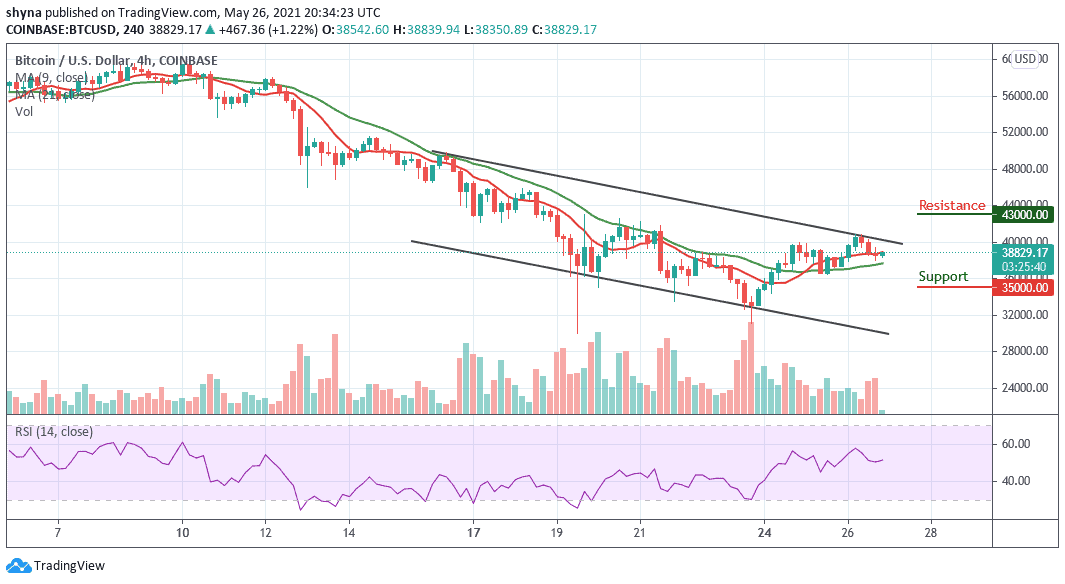
After closing at $38,361 yesterday, BTC/USD gained pace above the $40,500 resistance level today as the king coin failed to settle above this level, sliding below the 9-day moving average. The Bitcoin price begins a downside correction and it is currently trading around the $38,519 level. Therefore, if there is a proper daily close above $40,000, the Bitcoin price might start a steady increase in the coming sessions.

Bitcoin Price Prediction: Will BTC Break above $41,000 Resistance?

Ahead of the bullish movement lie the nearest resistance at $42,000, where the coin may reach or surpasses but the trend could turn down after testing the above resistance. Therefore, if the bullish momentum continues, the Bitcoin price may further fly across the 21-day moving average to reach the resistance levels at $47,200, $49,000, and $51,000.

On the downside, the seller may encounter supports at $32,000, $30,000, and $28,000 should in case the Bitcoin price crosses below the lower boundary of the channel. However, the sideways movement is been revealed on the daily chart as the Relative Strength Index (14) keeps moving in the same direction below 40-level. Meanwhile, if the market price drops, definitely the technical indicator may turns more bearish.

BTC/USD Medium – Term Trend: Bearish (4H Chart)

Since the Bitcoin price falls from the resistance level of $40,855 a few hours ago, the 9-day and 21-day moving averages have been strong support and resistance levels. Now, if the price crosses above the upper boundary of the channel, BTC/USD may print a new high of around $41,000.

BTCUSD – 4 Hour Chart

However, the technical indicator Relative Strength Index (14) is seen moving around 50-level, any bullish movement above this level may likely take the Bitcoin price to the resistance level of $43,000 and above. On the contrary, a break below the 21-day moving average could plunge the Bitcoin price to the support level at $35,000 and below.

Go to Source

Ontario Securities Commission Snuffs out Crypto Exchanges, Poloniex Targeted for Flouting Compliance

The Ontario Securities Commission (OSC) published documentation on Tuesday that claims the Seychelles-based crypto exchange, Poloniex has failed to contact the OSC in order to start compliance discussions. Poloniex meets the OSC’s jurisdiction because the trading platform operates trading accounts for Ontario residents, the OSC’s breach and conduct report notes.

OSC Says Poloniex Failed to Communicate With the Ontario Regulator

According to Ontario’s top financial regulator, the Ontario Securities Commission (OSC) sent out communications to crypto-asset trading platforms that offer digital currency services to citizens of Ontario.

On March 29, the letter said “they must bring their operations into compliance with Ontario securities law or face potential regulatory action.” The notice also told the exchanges that the firms needed to contact the OSC by April 19, 2021 “to start compliance discussions.”

However, the OSC’s latest report highlights that the Seychelles-based crypto exchange, Poloniex allegedly failed to contact the regulator. The OSC stressed that a process has been created for virtual asset service providers to follow.

“A process is in place for crypto asset trading platforms to bring their operations into compliance with Ontario securities law. Entities such as Poloniex, which flout this compliance process, expose Ontario investors to unacceptable risks and create an uneven playing field within the crypto asset trading platform sector,” the report adds.

No Other Digital Currency Exchanges Mentioned, OSC Seeks Penalties Against Poloniex

The report does not mention any other digital currency exchanges that have complied or others that may have flouted the warnings. The litigation and enforcement staff of the OSC division wants Poloniex to “cease trading in any securities or derivatives permanently or for such period as is specified by the Commission.”

Moreover, enforcement wants Poloniex to be barred from “acquiring any securities permanently” or until the OSC is satisfied. The regulator’s enforcement office also seeks to force Poloniex to:

Pay an administrative penalty of not more than $1 million for each failure to comply with Ontario securities law.

The order sought is dated May 25, 2021, by the OSC’s Litigation Counsel Charlie Pettypiece. The author notes that the Poloniex should also pay for investigation costs and all the orders proposed are “appropriate in the public interest.”

What do you think about the Ontario Securities Commission’s recent report on Poloniex and the orders sought? Let us know what you think about this subject in the comments section below.

Go to Source

Please enter CoinGecko Free Api Key to get this plugin works.
Exit mobile version