Central Bank of Nigeria Governor Says “Digital Currency Will Come to Life” but Attacks Volatile Cryptocurrencies

Central Bank of Nigeria (CBN) governor, Godwin Emefiele, says digital currency “will come to life even in Nigeria” just a few months after the central bank ordered banks to stop serving the crypto industry. While acknowledging his country’s position as one of the leading crypto markets in the world, Emefiele however insists his organization is still conducting its investigation and will “make our data available.”

Governor Says Many Nigerians Have Embraced Cryptos

Meanwhile, a report quotes the governor expressing his displeasure at the fact that many Nigerians have embraced cryptocurrencies. He said:

We have carried out our investigation and we found out that a substantial percentage of our people are getting involved in cryptocurrency which is not the best. Don’t get me wrong, some may be legitimate but most are illegitimate.

As several reports have shown, the CBN’s February 6 directive to banks appears to have failed in its objective. Nigerian interest in cryptocurrencies and other emerging fintech continues to grow. For instance, Bitcoin.com News recently reported that peer-to-peer cryptocurrency trade volumes in the country had surged while interest in bitcoin (BTC) remains one of the highest in Africa.

Crypto Market Volatility

In the meantime, Emefiele, who seems to follow events in the global crypto industry, attempts to use Elon Musk’s changing views on BTC to highlight the crypto market’s vulnerabilities.

In the past few weeks, Musk has made a series of comments about BTC as well the crypto market in general and this has caused crypto prices to fall. Emefiele explained:

We saw the market collapse. Initially, when Elon Musk tweeted around the time when we said our banking and payment facilities are no longer available for cryptocurrency transactions and he tweeted that he will invest $1.5 billion and the price (bitcoin) went up. He now tweeted and raised a few concerns and the thing (cryptocurrency) plunge.

Meanwhile, despite revealing the CBN’s commitment to creating a digital currency, Emefiele, however, fails to offer a time framework within which this is expected to come to life.

What are your views on Emefiele’s revelation that Nigeria will have its digital currency? Tell us what you think in the comments section below.

Go to Source

XRP Price Prediction: XRP/USD Price Bounces off Gradually

XRP Price bounces off – May 26
There has been an effort being made by Ripple XRP price bounces off from the lower point that it saw during the late heavy downward pressure that most crypto economies witnessed. Ripple XRP’s value now trades around the level of 1.05 at a 7.85% increase.

Price bounces off: XRP Market
Key Levels:
Resistance levels: $1.20, $1.40, $1.60
Support levels: $0.80, $0.70, $0.60

XRP/USD – Daily Chart
On the Ripple XRP/USD daily chart, a baseline has drawn to mark a key immediate support level at $0.80 for the present price bounces off a movement that the crypto has seemed to have significantly embarked upon. The emergence of a bullish candlestick on May 24, has affirmed the reason for having the baseline in place. The 50-day SMA indicator is located at $1 below the 14-day SMA trend-line that is situated at around the level of $1.20. The Stochastic Oscillators have crossed the hairs from the oversold region to point toward the north at around range 40. It shows that the crypto is on a higher note of increasing in northward pushes as paired with the US fiat currency.

XRP/USD Price bounces off, can it feature for long?
It now appears on a clearer note that Ripple XRP price bounces off from a lower trading point that it dropped during the recent depression it suffered as it was traded with the US Dollar. Currently, a technical support baseline has drawn at the level of $0.80 to showcase the vital point from which subsequent price bounces off has to be made to be able to make a full recovery of the last lost values. In the meantime, the market level at the $1.20 resistance may be the slowing line against the next positive upswing the crypto may eventually make.

Analyzing the downside of this crypto market, price bounces off up to the point of the $1.20 has to be out-rightly rejected to create a sell entry order for the XRP/USD market bears. Nevertheless, in the wake of that assumption, traders need to be cautious of their entry as well. There may also be a pause in the market price movement around that zone. But, all in all, most of the technical indicators read that there will be more room for upsides than the downsides in this present trading space of the crypto economy.

XRP/BTC Price Analysis
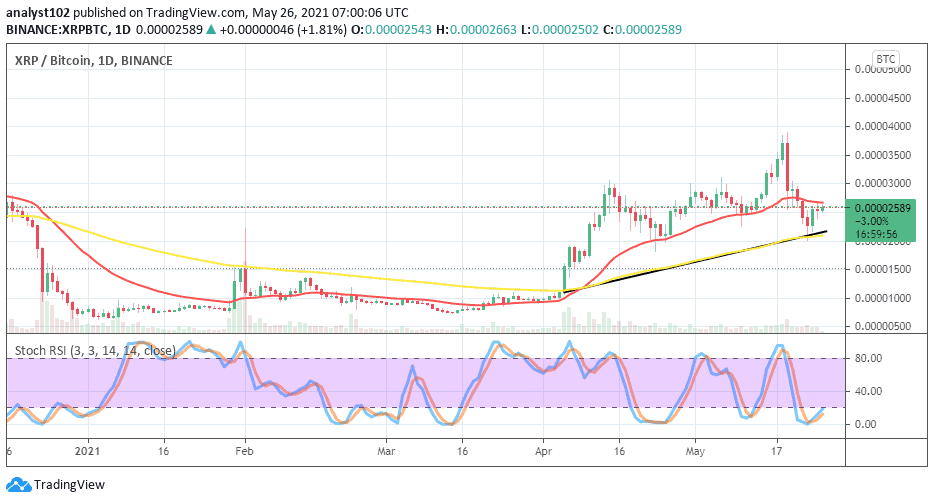
It is somewhat depicted on the XRP/BTC price chart that the kind of a downward force that occurred recently in the trade operations between the base tool and the counter instrument is a correction of an upward movement. The 14-day SMA has only breached to the downside to find support around the 50-day SMA indicator. The bullish trend-line drew along the bigger SMA to play a supportive role to where price bounces off against the counter trading tool. The Stochastic Oscillators are in the oversold region trying to cross the hairs back northwardly nearing range 20. That shows that in the next session, the base coin’s price bounces off will be most positively strengthened as compared with the US Dollar.

Go to Source

Bitcoin price rebounds to $40K, Ethereum nears $3K: Is a bigger crypto rally looming?

Bitcoin has surged past $40,000 and the cryptocurrency market is rapidly recovering.

The price of Bitcoin (BTC) has surpassed $40,000 on May 26, breaking above a key sell area for the first time in five days.

Traders expect a broader rally to come and a bullish market structure to form if Bitcoin continues to rise above $42,000 and Ether (ETH) reclaims $3,000. 

BTC/USD (orange) and ETH/USD (blue) 4-hour candle chart Source. TradingView

$42,000 and $49,000 are key resistance levels

Bitcoin has been recovering over the past week due to three major factors.

First, Tesla CEO Elon Musk and MicroStrategy CEO Michael Saylor have been encouraging Bitcoin miners to use cleaner energy.

Musk and Saylor have gone further since, speaking with Bitcoin miners in the United States about reliable energy consumption.

Second, the Bitcoin futures market reset to a large extent. According to the data from Bybt.com, when BTC crashed to below $30,000, the futures market open interest dropped from $27 billion to $11 billion.

This means that the futures market is not overcrowded, which raises the probability of a more sustainable and gradual rally.

Third, Ethereum has been rising rapidly over the past few days, which also benefits Bitcoin and altcoins because ETH saw a deeper correction than BTC.

Major cryptocurrencies rebounding as a whole is improving the sentiment around Bitcoin, leading to the gradual recovery of the crypto market.

In the near term, traders say that $42,000 is the important short-term resistance area and after that, $49,000 is the macro sell area.

A pseudonymous trader known as “Pentoshi” wrote:

“Many alts coming into some resistances +/- a 5% We’ve gotten mean reversion as discussed during the nuke However $BTC has been stuck. It started it’s LH trend a month ago. Would like to see Bitcoin pop + 42k or alts likely make their own LH’s and dip again. Clock is ticking.”

Bitcoin price chart with key levels. Source: Twitter/Pentoshi

What’s important to observe?

In the foreseeable future, the two key things to observe for Bitcoin traders are exchange outflows and the $42,000 level.

Ideally, if the $42,000 level holds and Bitcoin exchange outflows increase in tandem, that would mean that the confidence of investors in BTC and whales at above $42,000 is rising.

There are concerns that a “dead cat bounce” might form, which is a short-lasting recovery, but if BTC holds $42,000, the chance of a fakeout rally would substantially decrease.

Go to Source

You can now buy gold-backed NFTs with the mining carbon footprint offset

Wallet provider Lohko has launched gold-backed NFTs offering carbon offsets.

Digital asset wallet provider Lohko and London-based tech firm Mattereum have teamed up to launch nonfungible tokens, or NFTs, that are backed by gold and have carbon offsets attached.

According to a May 26 announcement the tokens represent ownership over physical gold bars that are stored in a vault in Singapore managed by partner Bullionstar.

Each NFT represents an underlying bar of gold, with both the token and the physical bar of gold sharing a unique serial number. The tokens are also sold with a warranty ensuring NFT’s owner “has full legal rights to redeem the physical gold bar.”

The NFTs have been listed on popular Ethereum-based NFT marketplace OpenSea, with the tokens representing either one ounce of gold, 10 grams of gold, or 100 grams of gold respectively.

One of the 100 gram NFTs also features 3D digital art depicting an animated bull on a gold bar. A version of this token appears to have been first listed on OpenSea for 7 Ether three months ago.

Lohko’s CEO, Antti Saarnio, emphasized the enhanced utility of tokenized gold over its underlying physical counterpart, stating:

“Gold’s main limitation as an investment category has been that its ownership is difficult to transfer […] NFT gold owners are able to sell their gold anywhere and to anyone in any blockchain marketplace. This is a huge benefit for gold investors providing them better liquidity and higher sales margin.”

Lohko is not the first to tokenize gold, with the Perth Mint Gold Token claiming it was the first token backed by “government-guaranteed gold” to launch on a public blockchain in October 2019, while asset manager Coinshares and wallet provider Blockchain teamed up to launch a Swiss gold-backed token on a private Bitcoin sidechain that same month.

In May 2020, centralized crypto asset lending platform Celsius launched its yield product for Tether’s XAUT gold token.

Go to Source

Gold hits four-month high following crypto crash

Spot gold last week hit its highest price level since Jan. 8 after dipping to as low as $1,680 in early March.

In the aftermath of the Mid-May crypto market sell-off, gold has seen significant price recovery.

Gold prices continued to inch higher on Tuesday, hitting $1,887 per ounce at 3:00 am EDT, according to data from TradingView.

Last week, gold reached its highest price level since Jan. 8 at $1,889, marking a four-month high after gold prices dipped to $1,681 in early March. At the time of writing, spot gold is trading at $1,882, up around 0.1% over the past 24 hours.

Spot gold year-to-date chart. Source: TradingView

The accelerated growth of the gold market came along with a major downturn in cryptocurrency markets that started on May 12. After topping above $2.5 trillion, the total crypto market capitalization started seeing consecutive slumps, eventually sinking below $1.3 trillion on Sunday, according to data from CoinMarketCap.

Total crypto market cap 30-day chart. Source: CoinMarketCap

According to Bob Haberkorn, a senior market strategist at brokerage firm RJO Futures, growing gold prices could be attributed to a weaker dollar accompanied by lower United States Treasury yields. “If the data comes out substantially better than expected, that would probably be bearish for gold because the likelihood of a Fed taper will be sooner rather than later,” he said.

A number of financial analysts have drawn parallels between the trends in the crypto and gold markets, with JPMorgan experts suggesting last week that large institutional investors were dumping Bitcoin (BTC) in favor of gold.

According to the bank, the new trend reversed a major bullish market driving Bitcoin’s price above $64,000 in mid-April. At the time of writing, Bitcoin is trading at $37,111, rebounding after touching $30,000 last Wednesday.

Go to Source

Critical $20M SafeMoon vulnerability? Project devs say no cause for alarm

One blockchain security firm says its audit of the SafeMoon smart contract has unearthed a potential $20 million vulnerability within the viral meme coin.

Popular TikTok viral “meme coin” SafeMoon could be vulnerable to malicious exploits by hackers on account of purported security vulnerabilities in its smart contract code.

According to a smart contract audit by blockchain security firm HashEx, SafeMoon currently has 12 of such vulnerabilities with five being classified as ranging between being of a “critical” and “high-severity” nature.

As part of its findings, the HashEx audit alleges that SafeMoon is vulnerable to a “Temporary ownership renounce” attack and a subsequent rug pull to the tune of $20 million. According to HashEx, the SafeMoon contract owner is an externally owned account, or EOA, that controls a significant proportion of the coin’s liquidity.

In the event of the EOA being compromised either by internal or external rogue actors, an attacker can drain the liquidity pool. Indeed, the HashEx team alleges that a hacker can temporarily override any attempts by the SafeMoon devs to send the tokens to the burn address.

However, the SafeMoon team has countered HashEx’s findings, telling Cointelegraph that contract ownership is securely held. One SafeMoon developer said that the team was aware of the issue has policies in place to ensure that the owner wallet is never connected to any third-party decentralized applications.

Apart from the potential for a $20 million rug pull, HashEx also identified a few reportedly problematic contract set functions that can allow an attacker to exclude certain users from receiving rewards or distribute rewards to a specific wallet.

Under normal conditions, each SafeMoon token sale attracts a 10% fee with half of that sum distributed as rewards for existing holders. However, HashEx alleges that an attacker can set contract functions like fees, and maximum transaction amounts to any value and siphon 100% commissions from each sale.

In effect, during a possible attack, a hacker can steal proceeds from each token sale and redirect same to specified wallets. Indeed, with all of these alleged vulnerabilities in mind, the blockchain security firm says an attacker can synergize these purported loopholes to launch an elaborate chain attack.

Responding to the HashEx audit, Thomas Smith, chief technology officer at SafeMoon said that the team was aware of the issues having already been intimated by its smart contract auditor Certik.

According to Smith, a hard fork will be required to solve many of the concerns raised by HashEx. Echoing the sentiments shared by the previously quoted SafeMoon dev, Smith stated:

“Addressing these other issues, such as ownership renounce being able to be taken back by the contract deployer, we are never going to renounce and have made our stance on that clear in the past. Internally we have policies and procedures around how the contract operates to alleviate risk of mishandling values, however, you will never see us modify fees or maxTx.”

SafeMoon is currently about 69% down from its April all-time high. Indeed, back in April, Cointelegraph reported that market commentators believed the parabolic price rally of the Binance Smart Chain-based project was unsustainable.

BSC-based projects have increasingly become victims of hacks and exploits as decentralized finance protocols sought to make a home on the Binance chain after sustained periods of high transaction cost on the Ethereum network.

As previously reported by Cointelegraph, BSC DeFi protocol PancakeBunny recently tanked 96% following a $200 million flash loan attack. In April, Uranium Finance — another BSC-native protocol — suffered a $50 million malicious exploit.

Go to Source

Bitcoin (BTC) Price Prediction: BTC/USD Rises as Bitcoin battles $40,000 resistance

Bitcoin (BTC) Price Prediction – May 26, 2021

For the past 48 hours, BTC/USD has been consolidating above$36,000 as Bitcoin battles $40,000 resistance. Buyers have been unsuccessful on previous attempts at the resistance level. Today, the market is rising and approaching the $40,000 high. Bitcoin will rally to $46,000 if the price breaks above the recent high. However, it will continue its range-bound move if the $40,000 remains unbroken.

Resistance Levels: $45,000, $46,000, $47,000
Support Levels: $35,000, $34,000, $33,000

BTC/USD – Daily Chart

There has been no significant price movement since May 19 breakdown. Initially, Bitcoin was fluctuating between $32,000 and $42,500. Now the king coin is trading marginally as price consolidates above $36,000 support. The support at $36,000 gives buyers the privilege to retest or break the $40,000 resistance level. Bitcoin is expected to rise to $46,000 if buyers sustain the bullish momentum above the $40,000 high. However, if BTC price consistently turns down from the recent high, it will suggest that the downtrend is likely to resume. There is a likelihood of price reaching the low of $28,000 if the bulls fail to resume upside momentum above $40,000 high. In the meantime, the bulls have partially broken above the $40,000 resistance. BTC/USD is now trading at $40,662.70 at the time of writing.

Russian Government Consider Partial Suspension on Crypto Payment Ban as Bitcoin battles $40,000 resistance

Pavel Krasheninnikov is the chairman of the Russian Duma’s Committee on State Building and Legislation. He indicated that the government is allowing for amendment on civil law to allow crypto payments as a “contractual medium.” Because of this, lawmakers are reportedly weighing a partial reversal of the country’s ban on cryptocurrency payments. Krasheninnikov indicated that cryptocurrencies like Bitcoin are not yet a legal payment method in Russia. The proposed amendments would allow crypto payments in Russia under contractual law. That is the payments would be only possible with the consent of all involved parties: According to the chairman : “We believe that it is necessary to make amendments to the Civil Code, the initiative is currently undergoing a necessary approval procedure. Currently, there is an understanding that digital currency is not legal as payment but this payment method, quite possibly, can be contractual.”

BTC/USD – Daily Chart

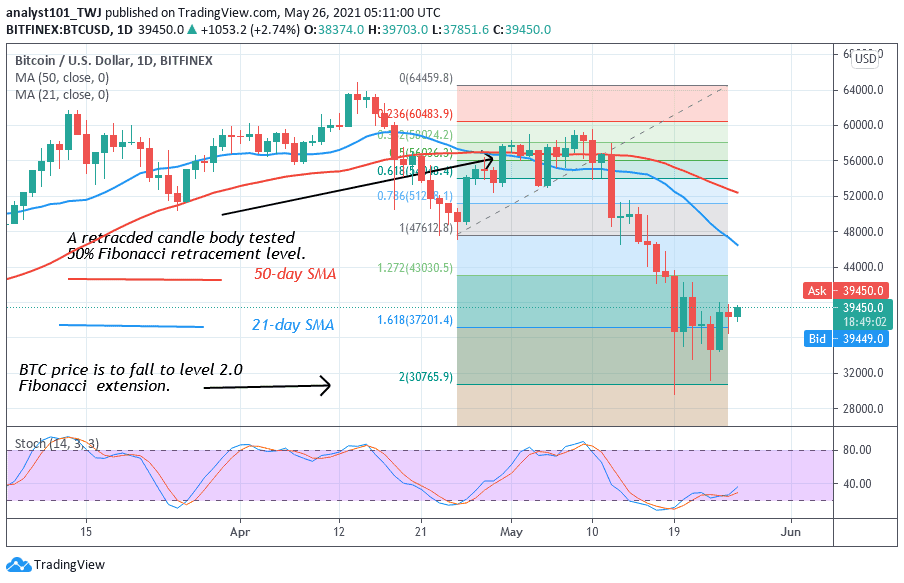
Meanwhile, the BTC price has broken above the $40,000 high. However, the bullish momentum is yet to be sustained above the recent high. It may portend negatively if the current bullish momentum is repelled. The Fibonacci tool analysis is held as price rebounded above the 2.0 Fibonacci extension level. Bitcoin bulls have an uphill task as the king coin is battling to rise in the bearish trend zone.

Go to Source

Is Jack Dorsey Right: Will Bitcoin Incentivise Renewables Transition?

Bitcoin critics mainly base their arguments on its high market volatility and the devastating impact of Bitcoin mining on the environment. Jack Dorsey, the CEO of Square, has put the counter arguments for Bitcoin mining regarding energy consumption in a recent whitepaper. According to the whitepaper, Bitcoin mining could incentivise the renewables energy sector.

Dorsey’s argument is both bold and controversial. Tesla’s CEO, Elon Musk, who had earlier agreed with Dorsey’s sentiments in a tweet, later retracted his statement and parted ways with Bitcoin, in as far as its detrimental mining process harms the environment, although Tesla still holds the coin in its treasury.

Will Bitcoin incentivise renewables transition?

On April 21, Jack Dorsey took to Twitter, saying that ‘Bitcoin incentivizes renewable energy.’ Elon Musk responded to this tweet by saying, ‘True,’ although it looks like he changed his stand a few weeks after.

Bitcoin consumes around 78 Terawatt hours of energy, equivalent to what is used in millions of US households. A report by BBC even states that Bitcoin’s power consumption in 2019 was equivalent to the energy output in Switzerland. Not to mention, the majority of Bitcoin mining takes place in China, where two-thirds of energy is derived from coal.

According to Square’s white paper, Bitcoin’s high-energy consumption during mining makes it perfect for renewable energy. Bitcoin miners can be classified as one of the best energy buyers based on how they function.

Bitcoin miners could be green energy generators’ best customers

First, Bitcoin miners consume a high amount of energy, which could provide firms in the renewable energy sector with a revenue stream based on a global cryptocurrency. In addition, Bitcoin miners are not location-specific, making them a dynamic buyer that can be switched on and off at any time despite their global location.

Flexibility in the renewable energy sector may be a great thing, but other issues need to be looked into before Bitcoin mining transitions to more sustainable energy sources. The main issues are energy storage and transmission because miners do not operate round the clock, which means it can be harder to leverage the offerings of the renewable energy sector.

The argument by Dorsey is quite interesting, but Musk’s recent sentiments on the matter had left people wondering who between the two is right.

There’s a displacement problem with Dorsey’s green idea

However, as far as Dorsey’s counter-intuitive reasoning goes, there may be one major flaw – if bitcoin miners colonise the renewables output it will displace others. That begs the question, is running clean public transport a better use of renewable energy resource than mining bitcoin?

The only certain thing is that Bitcoin and cryptocurrencies are here to stay, and they will be part of the future of payment systems. Now the crypto industry – and bitcoin ecosystem participants in particular – are turning their collective minds to ensuring that this industry works in a clean manner that will not harm the environment.

If Dorsey’s white paper predictions happen, it will propel the cryptocurrency sector to an even more dominant place in decentralized finance. Besides, the argument shows that Bitcoin enthusiasts are also concerned for the environment as they are actively looking for ways of solving the greatest limitation of the sector.

Go to Source

Why XRP Token Is The Green Coin That Solves Problems Today

Ever since Elon Musk dropped the news of Tesla’s U-turn on Bitcoin payments, attention has shifted towards more energy-efficient alternative coins. Ripple Lab’s XRP token appears to be one such coin with strong green credentials and is also solving payment problems right now.

XRP Token Solving Energy And Remittance Problems

The XRP token is one of a growing number of digital coins using far less energy in validating transactions than either Bitcoin or Ethereum. XRP transactions are also confirmed in seconds with little cost compared to Bitcoin that may take many minutes with high transaction costs.

The XRP token can be referred to as an eco-friendly or green coin because of how it was designed with sustainability in mind. According to the Ripple website, XRP is approximately 57,000 times more energy-efficient than BTC.

Contrary to other blockchains that use proof-of-work, the XRP Ledger confirms transactions through a unique “consensus” mechanism and is aiming to become carbon neutral in the next few years.

Through the Ripple Protocol Consensus Algorithm (RPCA), at least 80% of the network’s global validators have to approve a transaction before it gets added to the XRP ledger.

Ripple has always been distinctive from other cryptocurrencies due to its technology. The company terms itself as a payment solutions provider because of its primary focus on using cryptocurrency to enable cross-border payments.

Apart from the XRP token solving the environmental problem by being energy efficient, it solves cross-border problems through its RippleNet network.

National Bank of Egypt joins RippleNet Network

RippleNet is Ripple’s payment platform that consists of a collection of banks and financial technology providers that use solutions developed by Ripple for cross-border payments.

Last week, the National Bank of Egypt (NBE) and Lulu International Exchange, a Dubai-based financial services firm, collaborated to join the RippleNet network — which includes over 300 international banks and institutions.

The partnership would see Lulu Exchange and NBE come together to use RippleNet to facilitate cheaper, quicker international payments from the United Arab Emirates (UAE) to Egypt.

Buy Ripple XRP Now


Another recent partnership signed to utilize the RippleNet service was between Ripple’s joint venture, SBI Ripple Asia, and Cambodian bank SBI LY HOUR Bank.

The newly introduced remittance service powered by RippleNet will improve cross-border transactions between Cambodia and Vietnam. Through the distributed ledger-based payments network, Ripple has contributed immensely to the remittance industry.

Unlike Bitcoin and other cryptocurrencies, the XRP token can perform several functions outside the core medium of exchange services. It is useful in making cross-border payments faster, more efficient, and less costly.

XRP also acts as a neutral bridge between different currencies on the Ripple network. Through RippleNet, XRP acts as the liquidity solution developed to solve slow and expensive transactions on the network.

Ripple is also expanding its product suite. In March, the company recommended its XRP ledger to central banks stating that it could help central banks in the issuance and management of central bank digital currencies (CBDCs). This was included in Ripple’s white paper on CBDC published a few months ago.

Is Ripple’s Centralization Its Big Problem?

Digital assets are not perfect. They have their pros and cons. Ripple also has its downsides. It has often been criticized for its centralized way of operation. The Ripple network is centralized because most nodes belong to Ripple, and all XRP tokens have been pre-mined by Ripple.

Ripple’s centralized nature is one of the reasons the SEC alleged that XRP is a security. The SEC had indicated that while Bitcoin and Ethereum are not securities due to their decentralized nature. On the other hand, Ripple minted the entire supply of XRP itself when it first launched, giving rise to it being termed centralized.

However, Ripple has argued that it is decentralized. Ripple’s CTO David Schwartz has previously said that the XRP Ledger is inherently decentralized by design.

The coin reportedly hit $1 earlier today after a prolonged fall in value.

At press time, Ripple’s XRP token is trading at roughly $0.916807, up 5.48% in the last 24 hours, according to CoinMarketCap.

Looking to buy or trade Ripple (XRP) now? Invest at eToro!

Buy Ripple XRP Now

75% of retail investor accounts lose money when trading CFDs with this provider

Go to Source

Exchanges and Exchangers

There are several ways to swap digital currency in the cryptocurrency market. The choice is between the exchanges and swap services, or exchangers. Both offer a wide range of digital currencies, a lot of altcoins at an affordable cost. So what is the difference? Where it’s better to exchange Bitcoin — on crypto exchange or the exchange service?

Crypto exchange or exchanger — what is the difference?

Cryptocurrency exchange: It’s a platform where traders can perform trading operations on buying and selling crypto-to-crypto or fiat-to-crypto.

Cryptocurrency exchanger: It’s a service that offers to exchange cryptocurrency in a more simplified procedure.

Different specialists choose different sites depending on specific goals, but there are also common features that are suitable for everyone.

  1. Exchangers are guided by the exchange rate which is taken from popular exchanges. But they also add a margin to the main cost, an additional payment, which pays for the work of the site. On average, the amount can vary from 0.3% to 5%, depending on how much you want to exchange and if you exchange cryptocurrency or fiat. On exchanges, the commission is up to 0.5–1%.
  2. Some exchangers’ support teams may work on a certain schedule. Most often at night they are closed, have breaks and weekends. Most of them tend to work 24/7, and the most popular already work 24/7.
  3. Exchangers provide a limited number of coins to buy, while any crypto exchange has a reserve of funds that can be used if a trader decides to buy a large amount.

Advantages of crypto exchanger

  1. Exchangers have a simple interface because there is no need to present analysis schemes and features of cost changes.
  2. No need to register or pass verification, so you can buy cryptocurrency in a short time.
  3. Currency exchange platforms have a system of integration with popular payment services, so you can quickly transfer funds.
  4. Most often, swap services do not have a minimum amount for exchange, as well as the maximum. In fact, it is sometimes possible to exchange even a single coin.
  5. As for the services for exchange, they are customer-oriented. Usually these services provide quality support.

Advantages of crypto exchange

  1. In terms of reliability, when it comes to the exchange of large amounts, it is better to choose a crypto exchange that has been long on the market and has a good reputation.
  2. In terms of price, a more favorable rate can be found on a crypto exchange , because the price is constantly changing, and the exchange rate does not have time to react to it. On the exchange, you can choose the moment when the price has changed in your favor and sell or buy the cryptocurrency at a better price.

Let’s sum up. Crypto exchanges have more advantages for professional traders. but if you need to urgently swap a small amount of cryptocurrency, an exchanger is better than exchange.

Originally published at https://swapspace.co.


Exchanges and Exchangers was originally published in The Bullish on Medium, where people are continuing the conversation by highlighting and responding to this story.

Go to Source

Michael Saylor says Bitcoin Mining Council required to combat ‘hostile’ narrative

Michael Saylor has provided more context on the Mining Council, and hopes to combat the anti-crypto narrative with greater Bitcoin mining transparency.

MicroStrategy CEO, Michael Saylor has explained the details and thinking behind the formation of the Bitcoin Mining Council.

The council was formed on May 25 after Saylor brokered a successful meeting between Elon Musk and several top North American Bitcoin mining firms. The miners involved will provide current and planned renewable usage transparency, and will lobby other mining operations across the globe to do so as well

Speaking at the virtual Consensus 2021 conference, Saylor emphasized that the council was formed out of the need to provide greater transparency on the Bitcoin mining industry, and promote sustainable initiatives moving forward:

“The only reason we had the meeting is because we wanted to ensure the success of a decentralized cryptocurrency, and the source of decentralization is energy usage,” Saylor said.

“It turns out that Bitcoin miners don’t actually have a good forum for communicating how they generate their energy. We don’t have a standard model for Bitcoin energy usage right now, and we don’t have a future forecast model that we commonly use.”

However the Bitcoin Mining Council has proven controversial in some quarters with comparisons to the oil production cartel OPEC. Podcaster Marty Bent, the co-founder of Great American Mining, which utilizes wasted gas from energy plants to power its Bitcoin mining operations — drew comparisons to the controversial Bitcoin scaling plans emerging out of the 2017 New York Agreement, in his May 24 newsletter:

“Do they not recall the last time there was a closed door meeting that involved stakeholders who attempted to speak on behalf of an entire industry?”

But Saylor was quick to rebuff notions there was anything clandestine or non-transparent about the meeting. “If it was a secret meeting, I wouldn’t have told millions of people the next day that it was a secret meeting. Trust me, you know, we told everybody in the world that we had a meeting,” he said.

He emphasizing the need to fight back against a hostile anti-cryto narrative portrayed by some institutions and media outlets:

“We need to make sure the people that are hostile to Bitcoin and hostile to the crypto industry aren’t defining those narratives and defining those models and defining those metrics. In the absence of any good information or any response on our part, they will define those models.”

The council is made up of North American miners, including Argos Blockchain, Blockcap, Galaxy Digital, Hive Blockchain, Hut 8 Mining, Marathon Digital, and Riot Blockchain.

Elon Musk’s involvement

Saylor revealed that after a “very long conversation” with Elon Musk, the MicroStrategy CEO reached out to the Bitcoin mining firms and asked if they’d like to meet the entrepreneur. During the “constructive” meeting, the other attendees reportedly asked Musk for advice on how to combat the growing carbon anxiety surrounding Bitcoin:

“We asked Elon for his advice about how we might actually manage concerns in the mainstream. We had a detailed conversation about it. We talked about how we might be able to surface better data. “

Musk’s reported “first-order ask” was “can we come up with a way to publish or create transparency for Bitcoin mining energy usage?” and Saylor echoed this sentiment when he stated:

“I think the first step is, let’s come up with a protocol for us to publish energy information in a way that we can share it with the world and then work together to make sure that we pursue sustainable energy goals.”

Go to Source

DeFi and traditional finance could converge thanks to tokenization

It won’t be easy to bring DeFi to be on par with traditional finance, but tokenization can help it along, says Liquefy’s CEO.

Nonfungible tokens could become a bridge to connect the legacy financial system to the emerging fintech world in the near future. During a recent interview, Adrian Lai, CEO of Liquefy — an investment firm and an incubator for decentralized finance platforms — told Cointelegraph China that synthetic assets, NFTs and digital securities are redefining the way capital markets operate. 

Lai especially believes that the value of synthetic assets could give each individual in decentralized finance access to essentially any asset, as long as there is a reliable data feed. This emerging trend between traditional finance and DeFi is inevitable.

Lai also pointed out that as the convergence between security tokens and digital currencies grows greater, we will see increased activity between traditional finance and cryptocurrencies. He added that:

“We are seeing a merger of security tokens, utility tokens and NFTs. NFTs can also now represent real assets, which was not considered several years ago. The convergence of traditional finance and the crypto space is increasing more and more.”

Lai gave centralized exchanges as an example, saying that some of them have been moving beyond the traditional understanding of being simply a trading venue. Platforms like BlockFi and Coinbase offer retail-focused services like savings accounts and crypto payment options — services that make these platforms function like traditional financial institutions, at least partially.

Lai explained that synthetic assets are meant to imitate other investment products. They can combine various derivatives products such as futures, options or swaps to simulate an underlying asset. These underlying assets can include stocks, bonds, indexes, commodities, currencies or interest rates.

Challenges ahead

Although the convergence of traditional finance and the crypto industry is inevitable, Lai believes the current crypto industry still faces challenges such as liquidity exposure and reliable data oracles: “There is simply not enough information in the crypto space. When someone in crypto wants to trade illiquid assets, in many cases, there’s no adequate pricing data and other supportive information on the blockchain to facilitate the trade.”

Lai also pointed out that even though there is a lot of hype around NFTs, the current NFT market is only a digital collectible market, which does not require much liquidity. While Lai believes this collectible market is likely here to stay in the long run, several changes have to be made to help the broader NFT market grow further.

He thinks that breaking down an NFT into several parts for investment purposes could become a new trend for the digital collectible market:

“NFTs could also represent real assets, and creating a fraction of an NFT out of a real asset is a good way to offer traditional finance exposure to crypto. In this case, liquidity is important because you want to trade a fraction of the real asset.”

Tokenizing DeFi

According to Lai, tokenization has previously been primarily done via security token offerings. However, he believes that this will change due to DeFi, as tokenizing assets with DeFi could make tokenization more accessible for everyone:

“While security tokens are backed by real-world assets and their ownership is legally recognized, the liquidity of security tokens can vary, and we’ve seen in many cases that when security token owners want to sell their holdings, they may not be able to execute the trade at the best price.”

Lai believes that the maturation of DeFi and tokenization of real-world assets via DeFi protocols will have more potential than using the traditional security token offering model: “Tokenizing assets in a decentralized fashion opens up much greater liquidity for asset owners. At the same time, it gives real-world assets exposure to all of DeFi’s users.”

As Cointelegraph previously reported, 2021 will likely be a pivotal year for DeFi that will transform the way financial services are used. So, could tokenization also play a part in this?

Go to Source

Ether sails past BTC’s daily volume as Grayscale ETH Trust trades at 11% premium

Roughly $60 billion worth of ETH changed hands over the past 24 hours while BTC saw $50 billion in trade.

Ethereum is seeing renewed interest in the aftermath of Bitcoin’s travails this week, with Ether’s 24-hour trade volume topping BTC’s by a significant margin.

However it’s still a long way from doubling Bitcoin’s volume as some ETH proponents suggested. On May 25, a screenshot of CoinGecko data circulated across Crypto Twitter showing the daily volume of Ether had surpassed $115 billion while Bitcoin’s sat at nearly $53 billion.

Speaking to Cointelegraph, CoinGecko’s co-founder and COO, Bobby Ong, revealed the data depicted in the screenshot was not accurate due to either an API error, or wash-trading, resulting in inflated ETH volumes reported by the EXX exchange.

Ong stated that Coingecko has since disabled its data feed from EXX. The platform now shows Ether has driven 20% more volume than BTC over the past 24 hours with roughly $60 billion trade compared to Bitcoin’s $50.2 billion.

While CoinGecko’s Bitcoin page has seen about 75% more traffic than its Ethereum page over the past seven days, the gap has narrowed significantly in the past 24 hours. Ong noted:

“In the past 24 hours, our Bitcoin page received about 60% more traffic compared to Ethereum. When it comes to search queries, Bitcoin received only about 7% more queries compared to Ethereum.”

The surging trade activity and interest has also coincided with institutional fund manager Grayscale’s Ethereum Trust (ETHE) seeing its premium over spot Ether prices bounce up to 11%. while the firm’s Bitcoin Trust has traded at a discount since March. The data suggests that some institutions have turned their focus to Ethereum rather than Bitcoin.

Ethereum’s volume surged to overtake Bitcoin just days after segments of a leaked report from Goldman Sachs revealed the global investment bank believes Ether has a “high chance of overtaking Bitcoin as a dominant store of value.”

The report noted the growth of the burgeoning decentralized finance and nonfungible token ecosystems being built on Ethereum, as well as ETH’s dominance over Bitcoin by total transaction volume.

Go to Source

Voyager Digital sees 16X increase in quarterly revenue, first operating profit

The Canadian trading and yield app recorded $60 million in revenue for Q1, 2021.

Crypto asset trading firm Voyager Digital has announced financial results for the first quarter of 2021, and they are impressive.

The retail crypto trading and yield platform reported another record quarter, with momentum continuing into the current quarter. Total revenue for the period came in at $60.4 million, more than a 16x increase from $3.6 million over the previous quarter.

The company ended the quarter with an operating profit of $30 million and an adjusted working capital of $197 million. It was the firm’s first-ever quarter of operating profit, Voyager said in an announcement.

Trading volumes have also surged in 2021, leading to a massive revenue boost for the firm. Q1 saw $5 billion of principal volume traded compared to $350 million of principal value traded in the previous quarter.

Newly funded accounts in May have already surpassed the whole month of April, with currently 1.6 million verified users according to Nasdaq.

Voyager’s CEO and co-founder, Steve Ehrlich, stated that the platform’s leading altcoins and interest-yielding asset offerings have gained significant market share.

“Our focus on a wide range of coins has contributed to a long-term economic model with fiscal third-quarter operating margins increasing to 50%. Given our success to date, we anticipate that our operating margin should continue to scale in future periods.”

The Voyager app currently supports the trading of over 50 crypto assets. Ehrlich added that the platform saw exponential adoption of cryptocurrencies as a recognized and investable asset class in March, which translated into significant growth for Voyager.

During the first three months of 2021, Voyager continued to make significant upgrades to its systems infrastructure, and staff with a focus on platform security, scalability, and customer support.

Earlier this year, Voyager’s native token, VGX, saw explosive growth following a number of mergers and acquisitions for the Canadian company. At the time of writing, Voyager Token was trading flat on the day at $2.54 but had lost 23.4% over the past seven days in the market slump.

Go to Source

Chinese Firm Bit Mining Invests $9M to Build 100 Megawatt Bitcoin Farm in Kazakhstan

Shenzhen-based Bit Mining is planning to construct and operate a 100 MW crypto-mining data center in Kazakhstan. The project will be implemented in partnership with two local companies that will also provide the enterprise with an array of services. The total amount of the investment will exceed $9 million.

Kazakhstan to Host New 100 MW Crypto Mining Facility

Bit Mining announced this week it has entered into a binding investment term sheet with a Kazakhstani entity. The two companies will cooperate on the construction of a new crypto mining facility in the Central Asian republic. The Chinese firm will have an 80% equity interest in the new Kazakhstan Mining Data Center, with the remaining 20% held by its local partner.

The bitcoin farm will launch with a power capacity of 20 MW and when fully operational it’s expected to reach a total capacity of 100 MW. Bit Mining said it’s going to invest 60 million Chinese yuan (around $9.33 million) into the joint project.

The Chinese company has also concluded two service agreements for its mining equipment, one of which with its main partner and a second one with another company from Kazakhstan. They will provide a range of needed services including on-site device hosting, broadband network support, security monitoring, server management, and maintenance. The agreements will come into force on July 1, 2021.

Bit Mining Expands Coin Minting Business Globally

Formerly known as 500.com, Bit Mining has embarked on a rapid expansion in the crypto mining industry since earlier this year and its activities now cover cryptocurrency mining, mining pool and data center operations. Bit Mining has so far deployed bitcoin mining devices with a maximum hash rate capacity of approximately 1,031.5 PH/s. It owns three hydroelectric data centers with a total power capacity of 435 MW.

In April, before its rebranding, the Chinese firm acquired the mining company Btc.com. It currently owns the entire mining pool business operated under Btc.com, including the domain name and the platform’s cryptocurrency wallet.

The publicly-listed Bit Mining Limited (NYSE: BTCM) also bought Bee Computing (HK) Limited, a 7-nanometer cryptocurrency mining machine manufacturer. The acquisition aims to complete the vertical integration with its supply chain, the company noted, while increasing its self-sufficiency and strengthening its competitive position.

This month, Bit Mining announced a project to establish a new cryptocurrency mining data center in the U.S. state of Texas. The investment worth $25 million is part of a binding agreement with Dory Creek, a wholly-owned subsidiary of Bitdeer. The companies are planning to build and operate a 57 MW mining facility which will be powered using predominantly low-carbon energy.

What do you think about Bit Mining’s latest project in Kazakhstan? Let us know in the comments section below.

Go to Source

Please enter CoinGecko Free Api Key to get this plugin works.
Exit mobile version