Bitcoin Price Prediction: BTC/USD Dives Below $35,000 Support

Bitcoin Price Prediction – May 29

Following the $40,000 break, BTC/USD is now dropping heavily after getting rejected at $37,348.

BTC/USD Long-term Trend: Bearish (Daily Chart)

Key levels:

Resistance Levels: $44,000, $46,000, $48,000

Support Levels: $27,000, $25,000, $23,000

BTCUSD – Daily Chart

BTC/USD is now showing some signs of weakness after touching the high of $37,348 today. The Bitcoin price continued to fail to make any ground above the resistance. Therefore, it has dropped by a total of 3.52% within the 24 hours of trading as it touches the daily low of $33,850. Looking at the daily chart, we can clearly see the Bitcoin price not able to remain above the 9-day moving average.

Bitcoin Price Prediction: Is Bitcoin Price Ready To Go Lower?

The daily chart reveals to us that Bitcoin (BTC) continues to develop some signs of weakness for the past few days. Therefore, the resistance provided by the 9-day moving average continues to fail each time it attempts to break, and close, above this barrier. However, the market price still remains bearish as the signal line of the Relative Strength Index (14) moves into the oversold region.

On the other hand, the Bitcoin price needs to break the $40,000 resistance to make the market bullish in nature. But, if the sellers push the market price beneath the support at $30,000, the next level of support could lie at $28,000. Wherefore, beneath this, additional supports could be found at $27,000, $25,000, and $23,000 respectively.

Moreover, should in case the bulls regroup and push higher, the first 2 levels of resistance lie at $42,000 and $43,000. Above this, BTC/USD can hit the potential resistance at $44,000, $46,000, and $48,000.

BTC/USD Medium – Term Trend: Ranging (4H Chart)

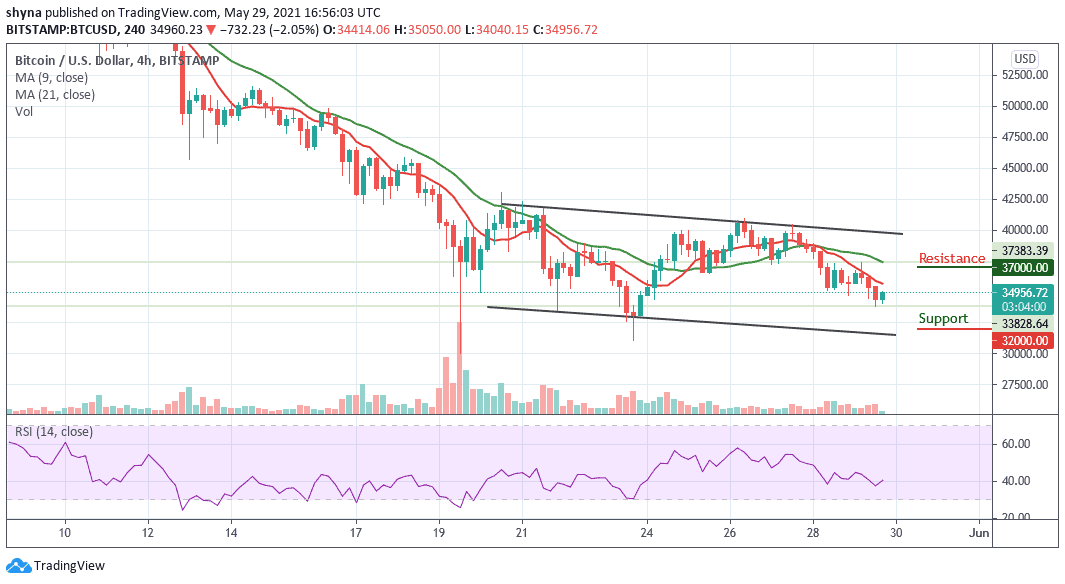
BTC/USD trades within the range of $33,000 to $40,000. Nevertheless, Bitcoin has not yet slipped below $30,000 and is still in the loop of making a bounce back from where it is currently trading at $34,956 which could take enough time before trading above $40,000. Meanwhile, the upward movement may be facing hurdles near the resistance level of $37,000 and above.

BTCUSD – 4 Hour Chart

Looking at the downside, immediate support remains around the $34,500 level while the main support is at the $33,000 level. The price might slide sharply below $32,000 which may likely test another support below the lower boundary of the channel Technically, Bitcoin is currently moving in sideways while the Relative Strength Index (14) moves around 40-level.

Go to Source

US Sends Bitcoin ATM Operator to Prison for Illegal Operation — 17 Machines Seized

A bitcoin ATM operator has been sent to federal prison for two years for running an illegal cryptocurrency exchange operation. U.S. authorities have seized 17 bitcoin ATMs, along with some cryptocurrencies, including bitcoin.

Illegal Bitcoin ATM Operator Sent to Prison

The U.S. Department of Justice (DOJ) announced Friday that a California man, Kais Mohammad, has been sentenced to two years in federal prison “for operating illegal ATM network that laundered bitcoin and cash for criminals.”

The Justice Department said that the 37-year-old operated an illegal crypto business “that exchanged up to $25 million,” some of which were “on behalf of criminals through in-person transactions and a network of bitcoin ATM-type kiosks.”

The Yorba Linda resident pleaded guilty in September last year to “a three-count criminal information charging him with operating an unlicensed money transmitting business, money laundering, and failing to maintain an effective anti-money laundering program,” the DOJ described, adding:

Mohammad has agreed to forfeit to the government 17 bitcoin ATMs, $22,820 in cash, 18.4 bitcoin and 222.5 ethereum cryptocurrency.

Mohammad owned and operated Herocoin from December 2014 to November 2019 using the moniker “Superman29.” Herocoin was a crypto exchange business that charged commissions of up to 25%, which was “significantly above the prevailing market rate,” the DOJ noted.

He typically met his clients at a public location and exchanged currency for them. “Mohammad generally did not inquire as to the source of the clients’ funds and, on certain occasions, he knew the funds were the proceeds of criminal activity. Mohammad knew at least one Herocoin client was engaged in illegal activity on the dark web,” the Justice Department said.

Mohammad also processed cryptocurrency deposited into bitcoin ATMs, supplied the machines with cash for customers to withdraw, and maintained the server software that operated the machines.

The Department of Justice said that Mohammad “intentionally failed to register his company with the U.S. Treasury Department’s Financial Crimes Enforcement Network (FinCEN)” even though he was aware of the registration requirement. He also “chose not to … develop and maintain an effective anti-money laundering program, file currency transaction reports for exchanges of currency in excess of $10,000, conduct due diligence on customers, and file suspicious activity reports for transactions over $2,000 involving customers he knew, or had reason to suspect, were involved in criminal activity,” the DOJ detailed, adding:

With respect to his bitcoin ATM network, Mohammad’s machines allowed customers to conduct financial transactions without requiring any identification and permitted customers to conduct multiple, consecutive transactions of up to $3,000 each without ever reporting suspicious activity to regulators or law enforcement.

FinCEN contacted Mohammad in July 2018 and he subsequently registered with the regulator but “continued to fail to comply fully with federal law concerning money laundering, conducting due diligence and reporting suspicious customers,” according to the DOJ.

Mohammad also conducted multiple in-person transactions with undercover agents, helping them exchange cash into bitcoin. The agents represented that they worked at a karaoke bar that employed women from Korea who entertained men in various ways, including engaging in sexual activity. “Mohammad never filed a currency transaction report or suspicious activity report for these transactions,” the DOJ said.

Do you think this bitcoin ATM operator should go to jail for two years? Let us know in the comments section below.

Go to Source

Fleeing Lynchpin of Nigerian Crypto Ponzi Scheme Inksnation Captured

The lynchpin of Inksnation, one of Nigeria’s biggest crypto Ponzi Schemes, Omotade-Sparks Amos Sewanu, has been captured. According to Nigeria’s Economic and Financial Crime Commission (EFCC), Sewanu, who was on the run, was nabbed in Sokoto, a city located in the northwest part of the country. Still, in its May 28 Twitter statement, the EFCC said it would provide details on Sewanu’s capture later.

End of the Run

The capture of the Inksnation creator comes a few months after the EFCC’s publication of a notice that asked for the Nigerian public’s help in locating him. At the time of the notice’s release, EFCC said it placed Sewanu on its wanted list for various offences which included “name dropping and fraud.”

However, in addition to these charges, the anti-graft body also said Sewanu was wanted for his involvement in the creation as well as the distribution of the Pinkcoin, an elaborate Ponzi that is packaged as a cryptocurrency. As previously reported by Bitcoin.com News, Sewanu’s Pinkcoin had already been flagged by Nigeria’s Securities and Exchange Commission.

Meanwhile, Sewanu’s arrest is now likely to trigger the collapse of a Ponzi scheme that many in Nigeria’s crypto space labelled a scam. However, despite the many warnings as well as the capture of Sewanu, few supporters of Sewanu are still defending his “innovation.”

Mixed Reaction to Sewanu’s Capture

For instance, one Twitter user named Crown expresses their exasperation with what he sees as Nigeria’s knack for destroying useful innovations. In a reply to the EFCC’s tweet, Crown said:

I just hate this country with all my heart… Someone who brings good thing that will benefit us all and stupid government says cryptocurrency a Ponzi….

However, the majority of users commended the EFCC for capturing Sewanu while some are asking the anti-graft body to go after other scammers that have similarly defrauded thousands of people. Meanwhile, at the time of writing, the EFCC had still not shared details of the capture.

What is your reaction to Sewanu’s capture? Tell us what you think in the comments section below.

Go to Source

Australian Tax Office to Prompt 400,000 Crypto Holders to Report Their Gains

Australia’s revenue service has reminded a growing number of crypto investors about their tax obligations. Rejecting the common misconception that crypto gains are only taxable when coins are cashed back into dollars, the tax office is going to prompt hundreds of thousands of taxpayers to report profits and losses from their cryptocurrency transactions.

Tax Office Targets Australians With Crypto-Related Obligations

Concerned about crypto investors evading taxes, the Australian Taxation Office (ATO) has set out to debunk the myth that cryptocurrency gains are only taxable when digital assets are converted into fiat money. People often think the digital coins are currencies but in reality, they are classified as assets, and gains from cryptocurrency trades are like gains from other investments, the tax authority explained.

ATO has estimated that 600,000 Australians have invested in cryptocurrency recently amid the surging popularity of crypto trading and rising market prices. The agency is now going to send warning letters to 100,000 taxpayers asking them to review their previously filed returns. Another 300,000 Aussies will be prompted to report their gains and losses from cryptocurrency deals as they lodge their 2021 tax return, Australian media reported.

The tax office also revealed that it’s closely monitoring the points where cryptocurrency interacts with the fiat system, helped by both the traditional financial sector and the crypto industry. The agency tracks the money back to the taxpayer using data matching profiles with cryptocurrency exchanges, according to ATO Assistant Commissioner Tim Loh who also told news.com.au:

There isn’t a game of hide and seek. We have got that information and all we are asking people to do is follow the rules. We know most Australians follow the rules.

Australian Capital Gains Tax Applies to NFTs as Well, ATO Warns

The ATO official further elaborated that the tax administration treats gains from cryptocurrency similarly to gains from shares, for example. The tax is due not only when an investor swaps cryptos for fiat money but also when one coin is exchanged for another and such transactions must be reported too. Furthermore, the Australian capital gains tax also applies to the disposal of non-fungible tokens (NFTs), Tim Loh remarked. At the same time, holding crypto funds as a long-term investment, for 12 months or more, entitles taxpayers to a discount.

A different rule applies when businesses or sole traders receive cryptocurrency for the goods and services they provide. Such payments will be taxed as income based on the value of the digital coins calculated in Australian dollars. Recognizing that the matter is quite complicated, the ATO is now focusing on helping Aussies to fill in their declarations correctly. Tim Loh advised them:

The best tip to nail your cryptocurrency gains and losses is to keep accurate records including dates of transactions, the value in Australian dollars at the time of the transactions, what the transactions were for, and who the other party was, even if it’s just their wallet address.

Loh’s comments also indicated that the Australian tax authority considers a failure to report obligations to be a bigger sin than a mistake on the declaration. “Failing to report on crypto-assets and not taking action when reminded will prompt penalties and potentially an audit,” the tax agent warned. Such penalties will be reduced significantly when taxpayers have corrected their returns.

What are your thoughts on the tax regulations for crypto investments in Australia? Let us know in the comments section below.

Go to Source

Bitcoin Price Prediction: BTC/USD Encounters Significant Reverses

Bitcoin Price Prediction – May 29
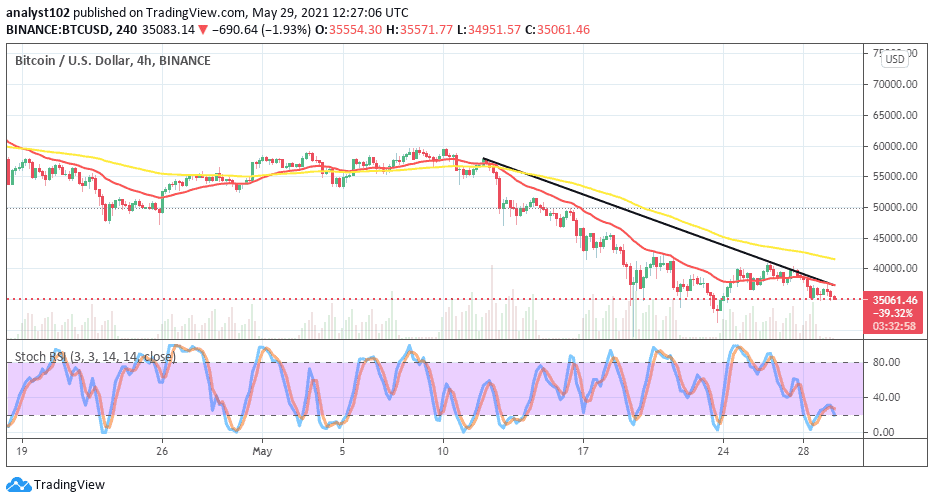
The BTC/USD market now encounters significant reverses after a strive of embarking on a rallying movement it made recently. The crypto-financial record as of the time of writing has it that the market value trades at about a -1.79% reduction around the level of $35,134.

BTC/USD Market
Key Levels:
Resistance levels: $40,000, $45,000, $50,000
Support levels: $30,000, $25,000, $20,000

BTC/USD – Daily Chart
After a line of about three days’ sessions of price converging close below the key resistance point of $40,000 between May 25 and 27. The subsequent activities until the present have been witnessing major fall-offs on a higher note while it lost momentum to break past the resistance line. The bearish trend-line still drew gone across downward the two SMAs to place a strong mark at the immediate resistance level. The 14-day SMA trend-line is underneath the 50-day SMA indicator. The Stochastic Oscillators have crossed the hairs from the overbought region to point slightly downward near range 80. The shows that the US fiat currency has potentially again begun to push the crypto market for more downs in the near time.

The BTC/USD market encounters significant reverses; will it be heightened than before?
The  crypto price encounters significant reverses are most liable to seeing  more downs Judging the next potential draw-down in the market operations of Bitcoin pairing with the US Dollar by what the Stochastic Oscillators’ reading has signaled more downsides are imminent in the near time. Intensification of downward forces as of the present time of trading will most likely put bulls on hold until a successful breakdown of the lower level of $35,000 is achieved. A price strong resurfacing below that point will possibly allow a return of energy back into the crypto economy.

Keeping the recent downtrend in a continuous moving manner, bears have again proven their stance in the market against the recent rebounding efforts made so far by the base trading instrument. It is highly expected that the level of $35,000 will be breached to the south to either revisit previous lower support or a bit lower toward the line of $25,000 afterward. However, bulls are enjoined to be on the lookout for what price will throwback during further downward depressions between $35,000 and $25,000 may in the long run.

BTC/USD 4-hour Chart
The market valuation of BTC/USD has continued is still clearly depicted a complete bearish trading situation. About three different points in time, it is depicted on the medium-term chart that the BTC/USD trade encounters significant reverses. The crypto’s price now trades below the sell signal side of the SMAs. The Stochastic Oscillators have crossed the hairs toward the south a bit over range 20 to suggest featuring more downs in the next sessions. However, bearish traders need to beware of late entry to avoid getting being whipsawed eventually.

Go to Source

Bitcoin dominance cycle suggests the 2017 crypto rally could repeat

Bitcoin dominance patterns are showing similar lows and an eerie resemblance to 2017. So what does this suggest for BTC price?

For the purposes of historical comparison, it’s also worth noting that the pattern of the dominance chart currently looks much like it did during the earlier part of 2017.

As the markets have gone into meltdown since May 12, Bitcoin (BTC) dominance has fluctuated dramatically, bucking 2021’s prevailing trend. Before the sell-off started in earnest, BTC dominance had been falling pretty steadily from around 70% in January to a low of under 40% by the time the crash was underway. At that point, BTC dominance was at its lowest since the summer of 2018. It has since recovered to above 43%.

If the same pattern is underway this time around, then the market is likely to be at the equivalent of summer 2017 when the alt season was just ramping up, and still some months away from Bitcoin’s price peak of around $20,000 in December 2017.

Of course, while the patterns draw some interesting parallels, BTC dominance doesn’t necessarily tell that much about price. But it does offer insights into how the flagship asset is performing in relation to the rest of the markets, underpinning certain trends. So, what are the likely scenarios for BTC dominance, and what would it mean for the markets?

Follow the money flow

The money flow model is one potential predictor of where the markets could go. The model states that money flows from fiat into Bitcoin, and then down from large caps, through mid-caps to small-cap altcoins before redirecting back to BTC and, ultimately, back to fiat.

This model is interesting because it pretty much sums up what happened in 2017, except that the cycle played out twice as BTC surged toward the end of the year. So, if the 2017 scenario repeats itself, BTC dominance could continue to rise until the flagship asset sees another price peak, then fall as alt season accelerates once again.

Along with the eerie similarities of the dominance charts, the behavior of the alt markets also offers some indication that they could be performing according to historical cycles. In early May, Cointelegraph reported that altcoins had flipped their previous cycle high to support — a move that last happened in 2017.

If the cycle repeats, it could still launch the alt markets to stratospheric new heights in 2021. While the performance observed during May may not offer much reassurance in this regard, there’s also nothing yet to indicate that BTC and the broader markets won’t perform according to long-term trends. Sam Bankman-Fried, CEO of exchange FTX and Alameda Research, told Cointelegraph:

“If we enter a prolonged bear market, I would expect BTC dominance to rise, as it did in 2018–2019; but the correction we’ve seen so far isn’t enough to trigger that.”

But wait…

For individual investors looking to follow the money flow, there is one big consideration. Speaking to Cointelegraph, Robert W. Wood, managing partner at Wood LLP, warned: “The elephant in the room for diversification is taxes.” He added: “Up until 2018, many investors could claim that a swap of one crypto for another was nontaxable under section 1031 of the tax code. But the law was changed at the end of 2017.”

Indeed, Omri Marian, director of the Graduate Tax Program at University of California, Irvine School of Law, confirmed that crypto-to-crypto transactions are likely to trigger tax obligations, explaining to Cointelegraph:

“Any reading of one crypto asset for another is a taxable event. So whatever the profit motivation is, a cryptoassets investor must account for the fact that rebalancing of the portfolio may have a tax cost.”

Shane Brunette, CEO of CryptoTaxCalculator, put it into practical terms, telling Cointelegraph: “If an investor switches between BTC and altcoins, the capital gain/loss would be realized in this financial year, regardless of whether or not they’ve ‘cashed out’ to fiat.” Furthermore, he clarified that “The activity would reset the length of time the investor has been holding the asset which would impact the eligibility to claim a long-term capital gains discount.”

So, be mindful that following the money flow may come with its own set of costs, and as a result, there are no guarantees that the pattern may repeat, as new variables may have an effect.

The unknown quantity

The most critical difference between 2017 and now is the presence of institutions in the markets. At least, that’s true for Bitcoin and, to some extent, large-cap altcoins such as Ether (ETH). Large swathes of the alt markets, including almost all low-cap coins and memecoins like Dogecoin (DOGE), are dominated by retail traders and investors.

Examining the dominance charts, BTC seemed to get a boost at the end of 2020 as institutional interest in cryptocurrencies started to pique. Its dominance continued to rise until around January.

But there’s some evidence that institutions could be behind the recent boost to BTC dominance. On May 21, it emerged that whales had bought $5.5 billion worth of BTC while prices were below $36,000; two days later, crypto hedge funds MVPQ Capital, ByteTree Asset Management and Three Arrows Capital all confirmed they were dip buyers.

So, there’s a chance that Bitcoin’s sudden dominance recovery may not come down to regular market cycles but instead be influenced by institutional whales scooping up discounted BTC.

Risk-off, but how far?

The question is: To what extent will the involvement of institutions make a difference to BTC dominance patterns compared with what was seen in 2017? Perhaps the most critical difference between institutions and retail investors is that institutions are far more likely to follow prevailing market conditions and go risk-off accordingly. Therefore, BTC dominance is rising as investors choose to step away from risk-on alts.

Related: For the long haul? When Bitcoin nosedived, institutions held fast

However, based on the “buying the dip” reports, it seems there’s no reason to assume that investors are going as far as going risk-off from crypto itself — at least for now. Furthermore, bullish sentiments continue to swirl around, undeterred by the market chaos of recent weeks as seen by the reports that interest in BTC appears to still be on the rise.

Therefore, there’s still every chance that if interest in BTC continues to hold, and no major bad news comes in to destroy the sentiment around crypto, the money flow model may still play out once again. For now, if history holds firm, some further increases in BTC dominance will take place before investors once again start to expand into large-cap altcoins.

Go to Source

Ignore the headlines — Bitcoin mining is already greener than you think

ESG-led Bitcoin mining is not only possible, but it’s ultimately the most responsible and prosperous way to show leadership in this growing industry.

Is it possible to mine Bitcoin (BTC) using only 100% renewable energy sources and deliver the same economic returns as those using carbon-based sources? The answer is yes, according to Square’s recent analysis on the cost of renewables and their impact on Bitcoin mining.

Unfortunately for our industry, the number of headlines and headline-making tweets about Bitcoin’s energy use and potential environmental impact has followed its rise in value in recent months. The increased media scrutiny has led to increased calls for regulatory action and even a proposed bill in the New York State Senate that would place a three-year moratorium on non-renewable Bitcoin mining in the state.

Related: Green blockchain should work smarter, not harder

This is one debate where both sides have a point. Critics are correct: Bitcoin mining does use a lot of electricity. The Cambridge Center for Alternative Finance estimates that the total electricity used worldwide by Bitcoin miners is an average of 113 terawatt-hours per year. This would place Bitcoin’s energy use somewhere between the United Arab Emirates and the Netherlands, two countries with a combined population of approximately 170 million people, which is admittedly a lot. However, the Cambridge Center for Alternative Finance’s recent “3rd Global Cryptoasset Benchmarking Study” shows that 76% of miners are using at least some renewable energy in their operations and that 39% of all energy consumption used in proof-of-work mining, such as mining Bitcoin, is from renewable sources.

Related: Is Bitcoin a waste of energy? Pros and cons of Bitcoin mining

Now that we have discussed Bitcoin mining’s energy consumption and carbon footprint, let’s try to put those figures in context. By looking at three directly relevant comparisons: the United States electricity grid, the traditional finance system and gold mining.

The electricity grid, traditional finance and gold mining

Let’s start with comparing Bitcoin mining to the electrical grid as a whole. Data from the U.S. Energy Information Administration shows that approximately 20% of U.S. electricity generation for 2020 was from renewable sources. This means that with 40% of its energy consumption coming from renewables, Bitcoin mining is twice as green as the national grid as a whole, reflecting the conscious decision-making of the industry to minimize its carbon footprint.

Moving on to traditional finance, there are two critical lenses to evaluate the industry through: 1) the financing of fossil fuel projects and 2) the industry’s carbon footprint. The former is a critical piece of the discussion, as shifting deposits away from traditional financial institutions reduces their capacity to fund environmentally destructive activities.

According to the Rainforest Action Network’s “Banking on Climate Chaos — Fossil Fuel Finance Report 2021” released in March, the world’s 60 largest commercial and investment banks have provided $3,800,000,000,000 — yes, 3.8 trillion U.S. dollars — worth of financing to fossil fuels since the signing of Paris climate accord in 2015. Think about that for a minute — the Paris Agreement is the world’s definitive step toward combating climate change, and yet, the world’s largest banks have provided financing equivalent to the GDP of Germany, the world’s fourth-largest economy, to fossil fuels since its signing.

For all of the outdated, exaggerated criticism of Bitcoin as a means of money laundering, terrorist financing and many others, the traditional finance industry has an incredible amount to answer for as far as its capital being used for destructive activities.

Looking at traditional finance’s carbon footprint, Galaxy Digital published in May “On Bitcoin’s Energy Consumption: A Quantitative Approach to a Subjective Question,” which is a breakdown of the energy consumption of Bitcoin mining and the two industries to which Bitcoin is often compared: traditional banking and gold mining. The traditional banking system analysis looks at the energy consumption of the world’s top 100 global banks, breaking down their energy consumption across four primary categories: data centers, branches, ATMs and card network data centers. Using publicly available data from industry leaders, Galaxy estimates the energy consumption to be around 260 TWh per year. This is more than double Bitcoin mining’s energy consumption and notably excludes key pillars of the system, including central banks and clearinghouses, due to lack of reliable data sources, suggesting the multiple may be materially higher.

As with its analysis of the traditional banking system, Galaxy’s analysis of gold mining captures what is likely to be only a subset of the industry’s total energy consumption. Using the World Gold Council’s own analysis contained in the 2019 report titled “Gold and Climate Change: Current and Future Impacts,” and limiting the scope of the analysis to direct greenhouse gas emissions, greenhouse gas emissions from electricity purchased by gold miners, and greenhouse gas emissions associated with the refinement and recycling of gold, Galaxy estimates the industry’s electricity consumption associated with greenhouse gases to be 240 TWh per year. At a base level, that means gold consumes around 85% more energy per year than Bitcoin mining. However, given that the Cambridge Center for Alternative Finance estimated that approximately 40% of Bitcoin mining’s energy consumption is from renewables, that means gold mining’s consumption of non-renewable energy is 3x that of Bitcoin mining.

Bitcoin’s green potential

Being better than your worst comparisons is not enough. For Bitcoin and Bitcoin mining to realize their full potential, we absolutely have to do better as an industry. We believe that the two key levers to do so are thoughtful regulation and industry action, but the inclusion of the former may surprise you. Isn’t Bitcoin supposed to be full of people who reject regulations?

The truth is, regulation on its own is neither good nor bad, but depends how it is crafted. Thoughtful, specific regulation can oxygenate an industry by supporting innovation, incentivizing good actors while disincentivizing poor actors and giving the public confidence. Look no further than the state of Wyoming, where legislators have been working with blockchain industry leaders since 2017 to pass 22 laws that provide a clear and encouraging regulatory environment that has since brought tens of billions of dollars of business to the state.

At the same time, overly broad, blunt regulation, like the anti-mining law proposed in the New York State Senate, can kill an industry. We look forward to working with regulators to help craft a regulatory regime that oxygenates the industry while addressing the very legitimate public interest concerns at the same time.

Related: Blockchain will thrive once innovators and regulators work together

Finally, we come to the stakeholders who bear the greatest burden but also have the greatest ability to enact change in decarbonizing Bitcoin mining: the industry itself. With an estimated total of 40% of the industry’s energy coming from renewable sources — which is twice the share of the overall electrical grid in the U.S. — we should be proud of the progress we have made.

However, we are unequivocal in saying that more has to be done. We believe that the Crypto Climate Accord is a brilliant first step. We encourage all in our industry to not only sign the accord and satisfy its goals of reaching net-zero emissions from electricity consumption by 2030 but to surpass those goals as soon as possible. We believe this will happen, not only because it is the right thing to do but because those in the industry who adopt 100% renewable strategies will be rewarded.

Related: Bitcoin mining’s future is green, and Russia has the best chance

The market is the ultimate arbiter of success, and we believe that the era of responsible capitalism is upon us — investors and consumers vote with their wallets, supporting responsible actors while shunning those whose actions drive negative externalities.

This article does not contain investment advice or recommendations. Every investment and trading move involves risk, and readers should conduct their own research when making a decision.

The views, thoughts and opinions expressed here are the author’s alone and do not necessarily reflect or represent the views and opinions of Cointelegraph.

Dan Tolhurst co-founded Gryphon Digital Mining in 2020 with the vision of creating the ESG-driven Bitcoin miner, and looks forward to the day that all Bitcoin mining is done using renewable energy sources. He has deep expertise as a strategy executive from his time at Netflix, The Walt Disney Company and Booz & Co., in a career spanning five continents. He holds both an HBA and an MBA from the Ivey Business School at Western University and a JD from Osgoode Hall Law School at York University. He spends his free time exploring London’s parks, travelling and cheering on his beloved Toronto Raptors.

Go to Source

Bitcoin Failing to Recapture the 200-Day MA Points to a Bear Market

  • Bitcoin has traded below the 200-day moving average for over a week
  • The moving average is now a resistance zone for Bitcoin around the $40k price level
  • Bitcoin is also trading below the 6-month moving average
  • BTC’s bullishness is hinged on reclaiming these two MAs otherwise a bear market will ensue 

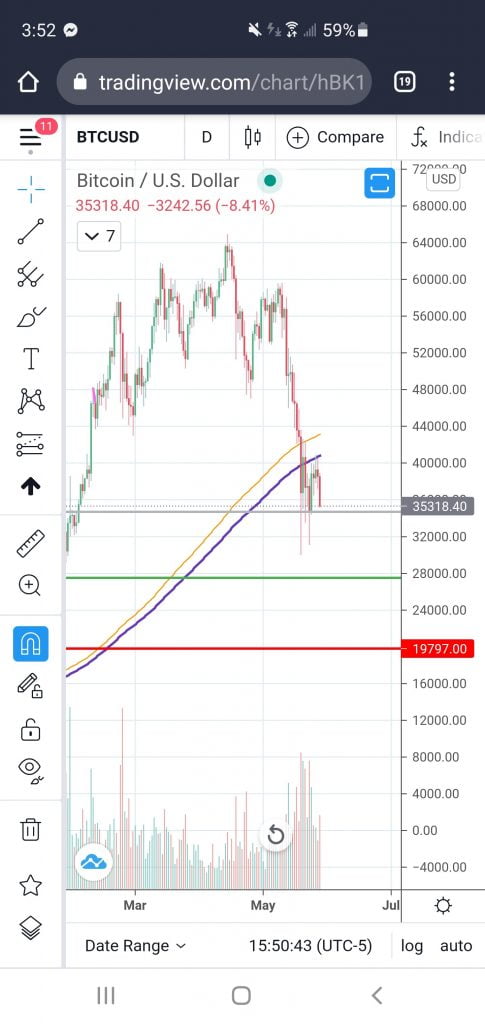
Bitcoin might have entered a bear market based on the fact that the King of Crypto has failed to reclaim the 200-day moving average as support. At the time of writing, Bitcoin has traded below this important moving average for eleven days. The 200-day MA is currently at the $40k price level that is also acting as a strong resistance level for Bitcoin.

Bitcoin Consolidating Below the 200-Day MA is Not a Good Sign

In a Twitter commentary earlier this week, Bitcoin and crypto analyst, MagicPoopCannon, pointed out that BTC consolidating below the 200-day moving average was ‘not a good sign’. He also reiterated that this moving average is now a resistance area and Bitcoin has never regained its bullish momentum if it traded over 3 days below this line. He explained:

Not to rain on the bull parade, but BTC has now spent seven [currently 11]  days below the 200 MA. Never in the history of BTC, has it spent more than 3 days below the 200, and gone on to make new all time highs, and that only happened in 2013. We’re most likely in a bear market.

Bitcoin is Also Trading Below the 6 Month MA Which is Bearish

In a follow-up to his initial analysis, Magic also pointed out that Bitcoin was also trading below the crucial 6-month moving average. He also warned that a monthly close this month, below this moving average, will confirm that Bitcoin is indeed in a bear market.

He shared his analysis of a potential Bitcoin bear market through the following statement and accompanying chart.

BTC has confirmed the 200 day moving average (in purple) as initial resistance, and it may close the month below the 6 month moving average (in orange.) Neither of those things have ever happened in a bull market, which makes it very likely we’re in a bear market now.

Go to Source

DeFi bucks crypto market correction as Uniswap v3 leads the charge

Numbers don’t lie: Uniswap v3 gains traction with DeFi users despite May’s crypto market crash.

Decentralized exchange Uniswap successfully launched version 3 of its platform in May — resulting in high trade volumes despite a downturn across the cryptocurrency markets.

The latest version of the hugely popular decentralized finance (DeFi) automated market maker (AMM) has quickly attracted a sizable amount of trade volume, seeing it move into the top five decentralized exchanges alongside Sushiswap, PancakeSwap v2 and its predecessor, Uniswap v2.

The success of v3 cannot be understated, as the cryptocurrency space has been under pressure due to a market correction in May that has cast shadows over what has been the most prolific bull run that the space has seen.

Uniswap v3 is now the leading dex in terms of trading volume, recording an average of $1.2 billion in daily transaction volume, while Uniswap v2, which was leading until very recently, currently processes just under $1 billion in 24-hour transaction value.

Furthermore, a number of fellow DeFi tokens led a rally in the markets after last week’s tumultuous correction, which has since been dubbed the biggest capitulation in the cryptocurrency markets. However, the overall market saw a $400 billion increase in value shortly after as several altcoins surged, with Maker’s MKR token gaining 91% and Yearn.finance’s YFI seeing a 72% increase. The native token of the Uniswap exchange, UNI, and AAVE also saw significant increases in value.

As a result, some analysts believe that Uniswap v3 could see increased use by liquidity providers and retail users given its improved functionality. But what changed, and is it ready to replace the previous version?

Uniswap v3 revisited

The nature of software development means that applications and platforms are in a constant state of improvement, and Uniswap is no exception. The first version of the booming DeFi AMM was released back in 2018 and has garnered thousands of users and hundreds of millions of dollars worth of transaction volume in the three years since.

Given the nascent state of the DeFi ecosystem, changes come quick and fast, and developers are constantly looking to improve current protocols and offer new products and services on their platforms.

Uniswap v2 was launched in May 2020 and introduced direct token swaps and other features that improved the overall performance of the AMM. In the year since, Uniswap has facilitated around $135 billion in trading volume and has established itself as one of the biggest cryptocurrency spot exchanges worldwide.

While the platform continued to contribute significantly to the popularity and use of DeFi, developers began work on Uniswap v3 behind the scenes, introducing improved control for liquidity providers on the platform and multiple fee tiers.

V3 is a success?

Uniswap v3’s launch in May has been heralded as a success, with the trading volume on the platform racking up some eye-popping numbers despite its inferior total value locked (TVL) compared with Uniswap v2.

Johannes Jensen, product and project manager at eToro, told Cointelegraph that the improvements made to critical issues existing in the designs of constant function market makers (CFMMs) have been a key driver in the immediate success of Uniswap v3:

“The primary contribution is the ability for liquidity providers (LPs) to offer bounded liquidity in a certain price range. With the custom liquidity provision feature, trading fees are collected and held separately, rather than automatically reinvested as liquidity in the pool. An interesting consequence of bounded liquidity positions is that the systemic implications of LP shares are inherently mitigated.”

Jensen noted that Uniswap’s v2 model essentially gave liquidity providers proportional ownership of a liquidity pool, which created a complex payout function due to impermanent losses, making the feature more similar to an options contract than a direct claim to the underlying asset.

Elias Simos, protocol specialist at Bison Trails, believes that the early success of Uniswap v3 and its innovations will continue to attract capital from liquidity providers given its improved efficiency:

“With Uniswap V3, we are seeing the emergence of capital-efficient DeFi. For reference, since its launch in early May, Uniswap V3 has ended up printing something like 120% TVL utilization vs Sushi trading at 20%.”

Aniket Jindal, co-founder of transaction infrastructure firm Biconomy, highlighted the fact that despite high fees, Uniswap v3 has attracted new users, which suggests that the improvements brought by the latest version of the AMM have been met positively: “What’s even more surprising is even after gas prices went up to insane levels, Layer 2 DEXs became more popular.”

Liquidity providers chase improved returns

The cryptocurrency ecosystem has become accustomed to things moving at breakneck speed, and the prospect of bigger, better returns could well be the catalyst to drive more liquidity providers to Uniswap v3.

Simos believes that the inherent complexities of moving across to v3 will be a short-term barrier to entry, but the bottom line, better yields and new products will drive the migration to the newest version of the AMM:

“Yes, concentrated liquidity provides new challenges, perhaps even more overhead for LPs, but firstly the yield is better, and secondly there will soon be an ecosystem of products around Uniswap V3 LP positions that will abstract some of the complexity away.”

While Jindal agreed with Simos’ sentiments that v3 could continue to attract liquidity providers, there are some factors that might create some friction in the migration of users from v2 who will have to reapprove their tokens for v3 and also for “liquidity providers who now need to select a ‘price range’ which can be complicated for many to understand.”

Jensen believes that the increased capital efficiency of the Uniswap v3 model will continue attracting new liquidity providers and traders: “The ability to provide bounded liquidity for a desirable price-range becomes an interesting tool in volatile markets, as LPs can use the model to price the inventory risk of holding less-known or volatile assets.”

Related: Uniswap v3 hopes to reinvent its DEX, others see a different path for DeFi

As a consequence, Jensen suggested that liquidity providers using specialized CFMMs like Curve might migrate to Uniswap v3, depending on the relative depth of stablecoin pairs and trading activity in competing pools. He also added that some might not necessarily want to deal with the added demand of managing their risk:

“Maintaining a consistent income during volatile markets with Uniswap V3 will require an active effort from LPs, as they will need to adjust their pricing ranges accordingly. Decidedly passive LPs may opt for lower capital efficiency to reduce the chance of suffering impermanent losses in highly volatile markets.”

DeFi powers the comeback

2021 has proven to be another monumental year for the cryptocurrency space, with major moves happening across the ecosystem. DeFi has become a major focal point, and the most recent market correction has added credence to DeFi’s influence and role.

Nevertheless, Simos highlighted the fact that DeFi has seen prolific growth since the beginning of 2020 and that important data shows that: “DeFi has been printing positive signs for over 1.5 years right now. The growth in fundamentals (TVL, volumes, users) continues to be on a hockey stick trajectory. […] Will there be short-term volatility? For sure. But the fundamentals persist.”

Jensen pointed to the role that DeFi and AMMs are playing in capital allocation from liquidity providers and their general use by everyday cryptocurrency users, so much so that they have “increasingly become an intrinsic part of how capital is allocated in crypto today.”

He also highlighted the yin-and-yang relationship of DeFi and Ethereum, with the latter still the smart contract blockchain of choice for the space. This has inevitably led to problems around high fees, but Jensen believes v3 could help alleviate some of these pain points while Ethereum continues its evolution toward a proof-of-stake future:

“Uniswap V3 may attract a more sophisticated breed of LPs which will build new features for algorithmically adjusting price-ranges based on market volatility or even sentiment data.”

Go to Source

The remaining steps to mainstream institutional investment

The crypto space suffers from its checkered history and, to grow further, the ecosystem must become safer, more usable and more mature.

It has been said that you only get one chance to make a first impression. Perhaps the best example of this old adage is the cryptocurrency space. 

From exit scams and money laundering, to unaudited code and high carbon footprints, the crypto landscape has spent the better part of the past decade scrubbing itself of its infamous past. For many, the sanitizing of the decentralized ecosystem was inevitable — simply a matter of when, not if. This mindset hindered the sense of urgency that should have been on display and may have ultimately contributed to the skepticism exhibited by mainstream institutional investors.

Today, however, the decentralized economy has grown into something much larger. Even in the face of market volatility, the culmination of decentralized finance, the nonfungible tokens craze, and the year-over-year increase in token prices have demanded the attention of these same investors who once shunned the decentralized economy.

How, then, do we convert this institutional interest into institutional investment? While the answer may be simple, the execution will likely prove far more challenging. Let’s take a look at what must be done in the months and years ahead to retain mainstream institutional interest and secure institutional investment.

Related: Institutional investors won’t take Bitcoin mainstream — You will

Security

Given last week’s dip, it’s natural to identify market stability as the most glaring problem within crypto. But, make no mistake, the primary (and most daunting) challenge facing the crypto space is security.

According to CipherTrace’s cryptocurrency crime and anti-money laundering report, major crypto thefts, hacks and frauds totaled $1.9 billion in 2020 — the second-highest annual value recorded. The good news, however, is that this figure marks a drastic reduction from the $4.5 billion in fraudulent occurrences recorded in 2019.

Significant, sustained measures have been taken by platforms across the space to make the crypto ecosystem a safer environment for traders. With crypto theft down nearly 60% in 2020, early indications are that the heightened security measures are working and that the space is becoming far safer.

Related: Report on crypto exchange hacks 2011-2020

By all means, that in itself is an impressive feat. However, to parlay interest into investment will require more than a reduction in fraud. It will take a collective effort across the space to implement measures to ward off nefarious activity. Platforms within the space are tasked with demonstrating to institutions that the crypto space is no longer for unsavory purposes but, instead, a tried and tested digital economy that cannot afford to be overlooked.

The primary way to attract mainstream institutional investment is through a wholesale cleaning of the space — a commitment to delivering, to users of any skill level, platforms that are thoroughly vetted and that place security at a premium. Safe and secure trading platforms are a must to allow for cross-ecosystem trading without the fear of a faulty platform or shoddy listings.

Mainstream institutional investors are driven by sound strategy in safe environments, not hype cycles producing misinformation. In truth, the crypto space is in the process of maturing. For it to mature to a point that translates to institutional dollars, however, will require more sustained growth.

Usability

Cryptocurrency has long suffered from a usability problem. With regard to financial investments, security and usability go hand-in-hand. Naturally, users feel more secure when the platform is easy to navigate and the functionality is up to par. However, due to speed to market and scale, user experience, or UX, has not been the first priority for crypto exchanges, and erasing that perception from the eyes of mainstream onlookers has been an uphill battle.

Related: To accelerate cryptocurrency adoption, we must first improve user experience

The early days of crypto were a lot more forgiving. Subpar UX was easy to overlook because the majority of crypto users were traders and speculators who had the technical know-how to navigate complexity. However, when less technical enthusiasts entered the space, exchanges and trading platforms shifted their focus to developing consumer-facing UX. While UX has undoubtedly improved since the early days, there is still a way to go in making transactions easy for the more discerning newcomers who are used to seamless UX across existing trading apps.

At present, the average cryptocurrency trader uses 3.36 cryptocurrency exchanges to buy, sell and hold different currencies. That means the average trader is expected to toggle between more than three separate interfaces, complete three different background checks, and track spot prices across three exchanges. This is an arduous process for even the most experienced traders. Making the assumption that the space is ready to welcome new mainstream users into the fray is entirely misguided.

Since late 2020, there has been a surge of retail and institutional interest in the space. However, the platforms in place remain hampered by inadequate UX and are far from user-friendly. To accommodate the influx of institutional users who are not crypto-savvy, it is vital that platforms place functionality and usability at a premium to not only attract these users but also to retain them.

Related: Discovering financial literacy: Crypto leads retail investment charge

Maturity

Perhaps ahead of schedule, the cryptocurrency space is creating significant waves among traditional investors. With major investors like Mark Cuban and Michael Saylor normalizing cryptocurrency investment, coupled with crypto exchange Coinbase being listed on Nasdaq, there is reason to believe that cryptocurrency will make its way into more investment portfolios. With that said, converting speculators to investors hinges on the crypto space’s ability to mature in a meaningful way.

From the outside looking in, the crypto space still conjures images of basement-dwelling twenty-somethings tinkering on GitHub and Reddit. While most of us know this is far from the case, it is incumbent upon those within the space to demonstrate the long-term viability of what is being developed from within.

2020 accelerated interest in cryptocurrency in unprecedented ways. As more centralized laymen enter the decentralized ecosystem, the space has no choice but to mature — and quickly. Rest assured, the space will mature to accommodate this new interest.

Related: What lies ahead for crypto and blockchain in 2021? Experts answer

We are in entirely uncharted territory. Cryptocurrency’s ascension into the mainstream spotlight has occurred faster than many predicted. However, for institutional investors to take the cryptocurrency space seriously enough to invest, the ecosystem must become cleaner, more usable and more mature. The current iteration of the space suffers from its checkered history, and it is incumbent upon those within the cryptosphere to reshape its image.

This article does not contain investment advice or recommendations. Every investment and trading move involves risk, and readers should conduct their own research when making a decision.

The views, thoughts and opinions expressed here are the author’s alone and do not necessarily reflect or represent the views and opinions of Cointelegraph.

James Gillingham is the CEO and a co-founder of Finxflo. James is engaged in developing and implementing strategic plans and company policies, maintaining an open dialogue with stakeholders and driving organizational success. He is an expert in managing and executing high-level strategic objectives with more than 13 years’ experience in building, developing and expanding multinational organizations. 

Go to Source

Spain’s Largest Asset Managers Still Reluctant to Invest in Cryptocurrencies

The biggest Spanish asset managers are still not convinced of cryptocurrencies as an asset class, and therefore have no plans to invest in the space yet. The declarations of several spokespeople linked to these companies state that, while there is a significant opportunity in the nascent cryptocurrency sector, it is still too young and volatile to put significant investments behind it.

Spanish Asset Managers Still Skeptical About Crypto

Spain’s largest asset managers are still not convinced crypto is a good investment vehicle, at least for now, according to statements from several key finance officials. While it is permitted for asset managers in Spain to invest in cryptocurrencies, their incipient nature, volatility, and the gray areas of regulation are keeping these big funds away from them.

Caixabank AM’s investment strategy director, Santiago Rubio, has declared they won’t touch cryptocurrencies. Caixabank AM is one of the largest asset managers in Spain, having more than 70 million euros under its custody. Their stance is shared by BBVA AM, another Spanish giant company. Its global asset allocation manager, Jaime Martinez, stated there is a possibility of investing in cryptocurrencies in the future, but they don’t have plans for doing it soon. Martinez stressed:

In 10 years it will be much more normal, today we are just starting, to call it that, in a different way of having exposure to assets and, like everything in life, you have to go step by step. We are not going to complicate our clients with things that we do not control well.

Cristina Rodriguez, of Santander AM, also explained cryptocurrencies weren’t assets promoted in their offer, stressing they didn’t have plans of investing in these vehicles. Finance managers who want to invest in crypto must update their documents to advise investors about the dangers and the volatility of these newly integrated tools.

Crypto Still Not Big in Spain

These statements paint a stark picture for the future of crypto investments by Spanish asset managers, that are still not sold on the validity of them as potentially interesting for their customers. This is clearly very different from what is happening in the U.S., where asset giants like Blackrock, which manages more than 7 trillion dollars, already has indirect exposure to bitcoin through its 16.3% stake ownership in Microstrategy.

And more recently, Larry Fink, CEO of Blackrock, stated:

The firm has monitored the evolution of crypto assets. We are studying what it means, the infrastructure, the regulatory landscape

However, these institutions seem to be inclined to lean towards more traditional investments in Spain, and will take a little more time for them to be confident in crypto.

What do you think about the opinion Spanish asset managers have on cryptocurrency? Tell us in the comments section below.

Go to Source

Every Fourth Australian Willing to Be Paid in Bitcoin, Poll Finds

A new survey has established that one in four Australians would like to receive at least part of their salary in cryptocurrency. While the motives vary between the members of this diverse group, the results indicate that the Australian nation’s overall interest in decentralized digital money remains strong.

4.7 Million Australians Would Accept Bitcoin Remuneration

The poll has been conducted among 1,000 Australian residents by the comparison website Finder. The company is actually among the first in the country to offer employees the option to take a portion of their remuneration in cryptocurrency. The platform has now found that 24% of Australians, or around 4.7 million, are ready to accept bitcoin (BTC) as part of their salaries.

Of those who would be willing to be paid in BTC, Finder pointed out, 14% have said so because they are convinced it is going up in value, while another 10% admitted a bitcoin payment would help them to invest in digital currency before tax.

Taylor Blackburn, personal finance specialist at Finder, notes that the cryptocurrency has seen impressive growth in the past year, “despite its recent drop and sometimes volatile nature.” Commenting on the outcome of the study, Blackburn further emphasized:

With more Australians looking for inflation hedges, yield-bearing assets and alternative investment opportunities, it’s not surprising that this many people are willing to be paid part of their salary in Bitcoin.

Australian Generation X and Millennials View Crypto Salary as Investment

According to the survey, Generation X Australians are more likely than others to view a crypto salary as a wise investment. 22% of the respondents in this age group think BTC is going to appreciate even more over time, along with 19% of millennials. For comparison, only 1% of baby boomers and 13% of Generation Z share their optimism.

The researchers also discovered that men with higher incomes ($100,000 and above) are more interested in Bitcoin in general. Furthermore, male respondents (21%) are far more likely to accept BTC payments than women (8%) because of their belief the cryptocurrency’s value will increase. 13% of men and 8% of female participants respectively think crypto wages will allow them to invest before taxation.

Despite the positive trends registered in the study, over half of Australians (55%) are still not interested in crypto remuneration. Another 13% fear bitcoin’s volatility which lowers their trust in the cryptocurrency. Finder also notes that 8% of the polled Aussies have stated they need to access all the money they make each payday.

Is your salary partially or fully paid in cryptocurrency? Share your thoughts on the subject in the comments section below.

Go to Source

Religious Ban on Cryptocurrencies Provokes Social Media Reproach in Ingushetia

A decision by a prominent religious body in Ingushetia to prohibit dealings with cryptocurrency has sparked controversy in the predominantly Muslim Russian republic. Critics have taken to social media to express their disagreements with the ban, pointing out that the treatment of bitcoin in Islamic jurisdictions is not one-sided.

Islamic Cleric Explains Reasoning Behind Crypto Prohibition

At a meeting in mid-April, the Ingush Council of Alims adopted a ban on the purchase and sale of cryptocurrencies by Muslims in the country. The Islamic clergymen said at the time that they took the decision after studying Islamic sources and reaching a conclusion that the religion prohibits the trading of electronic money.

Deputy Chief Mufti Magomed Hashtyrov has since been compelled to explain the council’s position. This week, he told the local newspaper Ingushetia that cryptocurrencies, as a means of payment, have no physical representation and their exchange differs from the trading of goods in a physical marketplace. The latter is not prohibited for Muslims. The theologian revealed that the council had already intervened to resolve disputes over cryptocurrency, even between clerics in one case, and stated:

Only honest labor brings people together, and virtual easy money quarrels them.

Hashtyrov then insisted that “cryptocurrency, for now, is neither money, nor it is a commodity. When it becomes publicly available, legally accepted means of payment, with a state guarantee, then we can talk about money, but not today,” Ingushetia quoted him saying.

Instagram Users React to Unfounded Ban on Crypto Trading in Ingushetia

The newspaper shared the article with Hashtyrov’s comments on Instagram and judging by the reactions, not everyone agrees with his interpretations. As reported by the Caucasian Knot portal, Ingushetians have commented that their country has more pressing issues to deal with than banning crypto transactions. “There are a lot of problems in the republic. But the clergy and authorities are ‘fixated’ on cryptocurrency,” wrote a user with the handle ‘tumgoev_111_06.’

“Ban the sale of alcohol, condemn corrupt officials,” suggested someone named ‘kaddafi.’ “They just found something to talk about and sort out,” added a user called ‘eva_mango.’ Others have challenged the validity of the imposed ban: “I have been trading cryptocurrency for two years! Before I started, I read a couple of articles on Islamic forums, where it was clearly stated that there is nothing forbidden in this, if you don’t trade futures,” noted ‘tsoro.1.’ Then ‘dzurdzuk666’ wrote:

Not money, not commodity, in what sense??? If at any time you can exchange it for money and commodity… Paper money is trash too. But we use it.

“I wouldn’t say that’s exactly ‘easy’ money. Knowledge and ability are needed to use it. It seems to me that this issue has not been fully studied by theologians,” suggests a female commenter with the Instagram handle ‘angry_hare_4,’ quoted by Caucasian Knot. The portal has also published another, better qualified opinion on the matter, that of Gapur Oziev, associate professor of economics at the International Islamic University in Kuala Lumpur. Oziev, who has been teaching Islamic banking and finance since 2008, was surprised by the Ingush clergy’s decision on the matter.

“They have announced a very old version of the fatwa. At the moment, there are a lot of scholars who do not directly prohibit it, although they condemn everything related to cryptocurrency,” he told the online edition. “There are more questions than answers. There are many dubious things, and the hadiths say to avoid the dubious. However, since there is no explicit text in the Sharia under which it would be possible to prohibit cryptocurrency, it’s not worth saying that it is haram,” Oziev emphasized.

What’s your opinion about the crypto ban imposed by Ingushetia’s Islamic clerics? Share your thoughts on the subject in the comments section below.

Go to Source

3 reasons why Polygon (MATIC) outperformed Bitcoin and major cryptos this week

MATIC, the native cryptocurrency of Polygon, rose by over 35% in the past week due to three reasons.

Polygon (MATIC) is on a tear. In the past seven days, it has gained 35% in the past seven days, outperformed every major cryptocurrency apart from Uniswap.

There are several big reasons behind the strong uptrend of MATIC, including the growing hype around Polygon, Google BigQuery announcement, and Mark Cuban’s investment.

MATIC 1-day candle chart (Binance). Source: TradingView.com

Growing sentiment and hype around Polygon

On Feb. 9, Matic first announced its plans to rebrand to Polygon. At the time, they brought in promising metaverse projects and integrated Matic Plasma Chain.

By implementing Plasma Chains, Polygon was able to provide a layer one blockchain network with built-in scaling solutions for projects.

The Polygon team said in February:

“We implemented and offered Matic Plasma Chains, a production-ready Ethereum Layer2, predicates-based Plasma implementation; We implemented and offered Matic PoS Chain, a permissionless, EVM-compatible, PoS-secured Ethereum sidechain which relies on strong Ethereum security for validator staking and checkpoints; Onboarded 80+ amazing applications, including Polymarket, Aavegotchi, Neon District, Skyweaver, Cometh, EasyFi with more being added everyday.”

Since then, Polygon has become a major layer-one blockchain project, specifically for metaverse projects with the numbers of users skyrocketing.

Polygon ranks top ten of cryptocurrencies by social volume. Source: Lunar Crush

The growing fundamentals seem to also be boosting the overall market sentiment for the blockchain project.

Bullish momentum for MATIC was picked up by the VORTECS™ data from Cointelegraph Markets Pro, which began to detect a positive outlook earlier this week, prior to the recent price highs.

The VORTECS™ Score, exclusive to Cointelegraph, is an algorithmic comparison of historic and current market conditions derived from a combination of data points including market sentiment, trading volume, recent price movements and Twitter activity.

VORTECS™ Score (green) vs. MATIC price. Source: Cointelegraph Markets Pro

As seen in the chart above, the VORTECS™ Score flipped green on the morning of May 24 and rose until peaking at 94 on May May 27 right as the price reached its recent highs above $2.30.

Google BigQuery announcement

In addition to several recent development milestones, including a Ren-Polygon bridge for seven top crypto assets and SDK for building Ethereum-compatible chains, Polygon also announced on May 29 that the project completed the integration of Polygon assets into Google Cloud’s BigQuery.

This integration is important because it improves the accessibility and positioning of Polygon; it allows users of BigQuery users to easily tap into Polygon. 

The Polygon team said:

“We are extremely thrilled to share that we have completed an integration of Polygon datasets into @GoogleCloudTech #BigQuery! This means that you can query Polygon’s datasets, run analytics and extract insights using Google’s #BigQuery platform. Blockchains are some of the richest sources of verifiable data, and this is a big step towards improving developer access to Polygon’s datasets and helping analysts unlock their immense latent value.”

Polygon is included in the BigQuery 1TB offering, which means that most BigQuery users will be able to run queries on the Polygon blockchain network to access various blockchain-related data sets.

Cuban backs Polygon

Additionally, billionaire investor Mark Cuban revealed investing in Polygon on May 25.

Cuban explained that having a high transactions per second (TPS) output is highly important to lower the cost of usage for users.

Furthermore, Cuban also emphasized that network effect is crucial, and Polygon already has many projects using the blockchain. He noted:

“Having more TPS and lower gas fees is not enough. There must be a CURRENT network effect and significant user growth. This is a challenge for most L1s and L2s because [with] few exceptions, marketing in the crypto universe is beyond awful. It is fast; it works well, and most importantly, their user base is growing exponentially.”

Analysts also say that exiting DeFi investors are becoming generally optimistic towards Polygon and projects on top of the blockchain.

Brad Laurie, a crypto analyst, stated:

“He’s right. There’s been a huge shift in support for @0xPolygon from all kinds of parties, influ, groups & powerful players. There’s no question that the ETH-#DeFi crowd are keen for the upcoming deals on $MATIC. Many of ’em are busy reading pitch-decks in prep for the hustle.”

Go to Source

The future of digital asset liquidity: Centralized or decentralized?

DeFi solutions, and the decentralized liquidity they protect, are the only way forward for the cryptocurrency space.

Last month, Bitcoin (BTC) reached above $60,000, highlighting the current frenzy around digital currencies. Following BTC, altcoins also saw substantial increases in value. All of this is music to the ears of long-term and short-term bull investors seeking increased gains, even with the current pullback and support of Bitcoin hovering around $40,000. 

However, despite all the hype around the current bull run, a lack of digital asset liquidity continues to be a significant challenge for exchanges, traders, token issuers and market makers. The reality of today’s market is that professional crypto traders cannot efficiently access global liquidity or find the best global prices to increase profits.

For token issuers, the current climate has forced them to list their coins on numerous exchanges to reach their target client base. It drives up business development costs and forces issuers into niche markets. In order for the digital currency market to continue moving forward, these categories must be understood.

Fragmentation and market forces

One of the main causes of illiquidity is rooted in market fragmentation. The idea behind crypto is much more than a sexy stock investment. Crypto is meant to be an entirely new way of handling money. But with all of the different coins — even the successful ones — and the lack of businesses accepting crypto payment, users aren’t utilizing crypto in the way it was initially intended.

Related: Professional traders need a global crypto sea, not hundreds of lakes

Of course, this was the inevitable result of the disruption of the fiat world. Fragmentation of this type is the only possible path for consumers to transition into the crypto world. And because exchanges are generally localized, they tend to service only one or a few fiat currencies. Again, consumers are left with a fragmented market and a slow adoption curve.

This situation isn’t bad, as users have free choice, but it does have consequences.

Two of those consequences are a dearth of liquidity and highly volatile prices. Consider how much the price of Bitcoin has changed over the last two years. It’s been a roller coaster ride, to say the least. That volatility makes it tough for a consumer to go on a $500 shopping spree using a mobile digital wallet at a progressive and technologically adept department store. In short, liquidation and price movements become a problem.

What’s more, the fragmentation of the marketplace has left newcomers to the space with a massive learning curve. Understanding the market and determining accurate pricing for various coins requires having many exchange accounts and a deep awareness of the sector. For this reason, many newer digital investors simply buy and hold, anticipating changes in the market but hoping for relatively rapid returns on coins — even those without clear use cases.

Related: Forecasting Bitcoin price using quantitative models, Part 1

Centralize the demons?

The complexities of the fragmented market have forced several different solutions. Some suggest centralized approaches to liquidity. By centralizing coins and standardizing markets, investors no longer face a fractured and complex maze of coins and prices. Without such negative fragmentation issues at play, investors would be more willing to trade with rapidity rather than holding for wider bid-ask margins.

While this seems coherent at first glance, such a solution is untenable. First, centralization goes against the very ethos on which cryptocurrencies were developed. Centralization is not the answer to fixing a market that grew on the back of a conscious rejection of centralized currencies. To do so would alienate much of the market itself.

Second, if the market adopts a centralized policy, the same problems that plague banks (slow processing times, lack of transparency and security, high fees) will eventually come to the digital currency market. The progress once hoped for would only be a replication of the current financial system’s failures.

Finally, even in an apparently decentralized system where all market liquidity is actually centralized into a few decentralized exchanges, investors would still be limited in how they could participate. With fewer but larger pools of liquidity available, the inevitable result is a return to a fiat-style financial system.

Related: Decentralization vs. centralization: Where does the future lie? Experts answer

Distributed solutions

Because centralized solutions run contrary to the very nature of digital currencies, a more robust decentralized solution is needed to mend the problems caused by market fragmentation. Decentralization, while a longer-term solution to the problem, can provide the market with continued adoption by institutions. This trajectory aligns with the vision of cryptocurrencies while eventually producing stability.

However, simple decentralization is not a strong enough answer. For crypto, the key to liquidity is “distributed, yet connected.” This slogan takes the best of both worlds and marries them together. Decentralization — that is, distribution — is what makes crypto so revolutionary. But the 21st century is more globally connected than ever before, a link that will only grow stronger.

This growth in connectivity, however, must be maintained through organic methodologies. To seek to force some staunch structure onto the cryptocurrency space is, of course, to centralize it. Therefore, investors and traders must weather the storm of fragmentation to protect what makes cryptocurrency so profoundly disruptive. This pathway offers connectivity, and when connectivity increases, the digital currency market becomes more liquid. Plus, the more distributed the market remains, the more the original purpose of digital currencies remains intact. The market must move in this direction in the next three to five years.

Growth toward DeFi

As the cryptocurrency market moves that way, activity will only continue to increase, allowing decentralized finance (DeFi) solutions to take over from there. DeFi solutions offer the best of both worlds: a truly distributed connectedness, which will protect the digital currency space and reduce fragmentation of the market.

Most cryptocurrency trading companies work the same way as a bank or stock exchange, where buyers and sellers must pay fees for usage. Such a practice can quickly turn into a David and Goliath situation, where traders are taken advantage of by Goliaths with more wealth and higher risk thresholds. However, in a DeFi trading pool, the benefits (and the costs) are spread evenly among all parties. For contributing to the pool, liquidity providers get rewarded with a pool token. Buyers always have a seller, and sellers always have a buyer.

Moreover, all the liquidity providers receive a share of the trading fees based upon their stake size. Truly, this is a decentralized system: Not only can someone offer crypto to the DeFi pool, but they can also contribute fiat, providing an avenue for traditional, conservative investors to play a role. If an investment group sees the benefit, count on them being there for the reward.

Among the major catalysts that will move the market in this direction, the most prominent are central bank digital currencies (CBDCs). As governments begin issuing CBDCs, they offer a far simpler entry point into DeFi. Investors and consumers alike would already be prepared for digital transactions, and the barrier for transitioning funds from fiat to crypto would be substantially lessened.

Additionally, CBDCs would allow for a more significant international movement of funds. Providing a helpful catalyst toward a fully decentralized liquidity pool would make isolated exchanges transacting only in local fiat obsolete. Forces like CBDCs and increased DeFi participation will drive change, and investors will be the better for it.

This article does not contain investment advice or recommendations. Every investment and trading move involves risk, and readers should conduct their own research when making a decision.

The views, thoughts and opinions expressed here are the author’s alone and do not necessarily reflect or represent the views and opinions of Cointelegraph.

Haohan Xu is CEO of Apifiny, a global liquidity and financial value transfer network. Prior to Apifiny, Haohan was an active investor in equities markets and a trader in digital asset markets. Haohan holds a Bachelor of Science in operations research with a minor in computer science from Columbia University.

Go to Source

Please enter CoinGecko Free Api Key to get this plugin works.
Exit mobile version