US regulators must collaborate on ‘regulatory perimeter’ for crypto: OCC head

Acting OCC head, Michael Hsu, wants greater inter-agency cooperation in establishing regulatory guidelines for the crypto sector.

The Acting Comptroller of the Currency, Michael Hsu, has expressed that regulatory agencies in the United States should establish a “regulatory perimeter” for digital assets and cryptocurrencies.

In an interview with Financial Times, Hsu indicated U.S. regulators will look to take a more active role in policing the crypto asset sector with an emphasis on minimizing the associated risks faced by investors and consumers.

“It really comes down to coordinating across the agencies,” Hsu said, adding: “Just in talking to some of my peers, there is interest in coordinating a lot more of these things.”

Hsu noted that the first meeting of the inter-agency, crypto-focused “sprint” team took place earlier this month. The team comprises representatives from the Federal Reserve, the Federal Deposit Insurance Corporation, and the Office of the Comptroller of the Currency.

Hsu described the group as “small” but “senior,” adding it is tasked with presenting “ideas in front of the agencies to consider” rather than formulating policy. Hsu emphasized the speed of growth and innovation in the crypto sector, asserting that a failure to begin acting now will only make policing the sector harder in future:

“The idea is that time is of the essence and if it’s too big that gets harder.”

Hsu is not alone in thinking the United States lacks robust regulatory guidelines for crypto assets, with SEC chairman, Gary Gensler, highlighting “gaps” in the “current system” regarding crypto while speaking to a House committee last month.

Gensler noted the U.S. Treasury Department has recently focused on “anti-money laundering and guarding against illicit activity” in the digital asset industry.

Go to Source

Chinese traders turn to OTC desks amid regulatory crackdown

Threats from China’s central government appear to have done little to quash local demand for crypto assets.

As Beijing attempts to regulate and suppress the cryptocurrency boom, traders have been evading regulatory oversight by using over-the-counter, or OTC trading desks.

According to a May 31 report published by Bloomberg, there has been a significant uptick in OTC platform usage since China announced its latest crackdown earlier this month, with China tightening restrictions prohibiting financial institutions and payment companies from providing services related to cryptocurrencies.

While exact volume data is hard to ascertain as Chinese OTC transactions are peer-to-peer and use third-party payment platforms, the exchange rate between China’s yuan and popular stablecoin Tether (USDT is seen as a key gauge of local crypto market sentiment — with demand for USDT increasing during market downturns.

According to Bloomberg, USDT/CNY fell by as much as 4.4% after the Communist Party crackdown earlier this month but has since recouped more than half the loss. The recovery suggests that peak selling may have passed as the markets begin to consolidate.

One of the concerns driving China’s crypto crackdown is capital outflows, which have been seen to spur their latest moves to suppress the industry. Bloomberg speculated that OTC trading may not pose the same capital flight risks associated with typical exchanges, suggesting regulators may not be so heavy-handed in dealing with the sector.

“Because the yuan leg of [OTC] trades takes place entirely within China’s domestic financial system, the risk of large-scale capital outflows is low,” the report noted.

China’s shift to the OTC markets mirrors the situation in late 2017 when the state first imposed a ban on cryptocurrency exchanges. Chinese traders are still believed to represent a major share of global crypto trade today despite the crackdown, with analysts estimating China owned 7% of the world’s Bitcoin and accounted for roughly 80% of trading before the 2017 clampdown.

The latest wave of government-imposed restrictions has also seen crypto mining operations targeted as China attempts to align its carbon neutrality goals. Several companies including Huobi and OKEx have halted their local mining operations and mining services for Chinese customers.

As a result, Bitcoin’s mining difficulty fell by 16% on Sunday to 21 trillion – its sharpest decline this year. Mining difficulty provides an estimate for the computing power required to produce new BTC.

The network automatically adjusts the difficulty around once a fortnight, responding to levels of competition among miners. The lower it falls, the less competition there is – suggesting that many have already powered down their rigs.

Go to Source

UK Police Raid Alleged Cannabis Farm, Finds Bitcoin Mining Facility Stealing Power

Police from the UK executed a raid in an industrial unit in the West Midlands county expecting to find a cannabis farm, but instead found a big bitcoin mining facility, that was coincidentally bypassing the controls from the local power utility company to siphon energy from the main grid, stealing thousands of pounds in the process.

UK Police Raid Alleged Cannabis Farm, Stumbles Upon Bitcoin Mining Facility

The West Midlands Police Department got a real surprise last week when they raided an alleged cannabis farm in an industrial premise, just to find the facility was used to operate a Bitcoin mine. According to reports from intelligence, all of the signs suggested the site was used as a cannabis-growing farm. The West Midlands police department stated in its report that:

We heard how lots of people were visiting the unit at different times of day, lots of wiring and ventilation ducts were visible, and a police drone picked up a considerable heat source from above. They are all classic cannabis factory signs

The mining facility had 100 S9s (one of the most popular bitcoin mining ASICs) working all day, giving the site a heated print pretty similar to the one of a cannabis farm. However, upon further inspection and after making inquiries with the local power utility company, the police found the facility was bypassing the local power utility company controls, using power directly from the source and stealing thousands of pounds of electricity in the process. Sandwell Police Sergeant Jennifer Griffin stated:

We’ve seized the equipment and will be looking into permanently seizing it under the Proceeds of Crime Act. No-one was at the unit at the time of the warrant and no arrests have been made – but we’ll be making enquiries with the unit’s owner.

Bitcoin Related Power Theft Is Now Common

As it is known, bitcoin mining is a very energy-intensive task, and machines used for this purpose spend big amounts of energy to secure the network. This fact has made cryptocurrency mining-related power theft a common occurrence. There have been several electricity theft cases in China and in Malaysia, where miners have stolen millions of dollars while operating their mining facilities.

If miners bypass the local controls and connect their machines directly to the grids, the energy consumption might be too much for the power network to handle. Iran is now facing electricity problems, with its government banning Bitcoin mining due to the blackouts its network is facing with the high demand for electricity for these purposes.

What do you think of this Bitcoin mining-related raid? Tell us in the comments section below.

Go to Source

Chinese Economist Says if Bitcoin Is Widely Adopted: ‘We’re All Going to Die, This Is Not a Joke’

A Chinese economist and assistant director at the International Monetary Institute of Renmin University, Qu Qiang, has predicted that “We’re all going to die” if bitcoin becomes widely adopted as a currency. He foresees our society falling into “a death spiral of deflation,” noting that “the whole society is going to shrink and self-explode.”

We’re All Going to Die if Bitcoin Is Widely Adopted, Predicts Chinese Economist

An assistant director at the International Monetary Institute of Renmin University, Qu Qiang, was interviewed on CGTN about bitcoin. CGTN is owned by the Chinese state media China Central Television (CCTV). The video of his interview was shared on Twitter Thursday by Hailey Lennon, who said she walked into her hotel room and it was playing on TV.

Qu was asked: “Can you give me the worst scenario, what kind of a systemic shock it will give to the current financial system if bitcoin is widely used in China or the rest of the world?” He replied:

I can tell you exactly what’s going to happen … We’re all going to die. This is not a joke.

His answer was what he called “The worst scenario or the must scenario” that will happen if bitcoin were to become “the ultimate type of currency” and “adopted by all human society.”

Qu then pointed out that “Bitcoin has a very, very strict, limited total number, which means this is a deflation currency,” noting that it will not expand the amount as human development grows.

Consequently, he asserted that with bitcoin adoption, our society will fall into “a death spiral of deflation.” He elaborated: “The whole society is going to shrink and self-explode. That’s what happened at the end of the Ming dynasty when they were short on silver.”

Qu graduated and received his doctorate in economics from Renmin University of China, where he is now a professor and a doctoral advisor. He currently serves as the external supervisor of the Bank of Beijing and the Industrial and Commercial Bank of China (ICBC). Among numerous positions he is holding is a director of the China Financial Policy Research Centre, a key research center of humanities and social sciences of the Chinese Ministry of Education.

Bitcoiners had a field day over Qu’s comments on social media. Many just laughed excessively, with some calling the whole thing an “ultimate FUD” and “state-sanctioned bullshit propaganda.”

Some debunked his silver theory. One person tweeted: “Ming dynasty collapsed for many reasons but a deflationary silver spiral ain’t one of them,” citing work by Richard von Glahn, who wrote, “This hypothesis rests on dubious theoretical and empirical grounds.”

Many mocked his knowledge of the fall of the Ming dynasty. One person suggested: “This could easily be a SNL [Saturday Night Live] skit except funnier.” Another exclaimed: “End of the world. Beware.” A third person said, “I didn’t know bitcoin ended the Ming dynasty.” A fourth person chimed in, “Imagine if were had hodled since the 15th century.”

One user got more serious and stated that “for the record, he [Qu] is clueless about Ming dynasty.” Quoting the British Museum’s history of the world, he wrote: “The Ming … state issued too much paper money, however, causing hyper-inflation. By 1425 paper money was worth only a seventieth of its original value and the use of paper currency in China was suspended.”

What do you think about Qu’s comments on bitcoin? Let us know in the comments section below.

Go to Source

Financial Guru Dave Ramsey Advises Whether One Should Invest in Bitcoin, Other Cryptocurrencies

Financial guru Dave Ramsey has given advice on whether one should invest in cryptocurrencies, like bitcoin. Ramsey sees cryptocurrency as a get-rich-quick scheme, preferring to make his money in a “methodical” and “boring” way.

Dave Ramsey’s Advice on Investing in Bitcoin and Other Cryptocurrencies

Dave Ramsey has given advice on cryptocurrency investing. Michael from Dayton, Ohio, called into The Ramsey Show saying that he had been looking into cryptocurrency and asked whether he should be investing in it. The episode, entitled “Should I Invest in Cryptocurrency?” was aired on May 20. Michael is 24 years old and has saved up $3,800 from working his job. He told Ramsey: “I just want to know what are the best investments to really look at and where to go about it.”

The self-proclaimed personal money management expert, Ramsey calls himself “America’s trusted voice on money.” He is the author of seven best-selling books: Financial Peace, More Than Enough, The Total Money Makeover, EntreLeadership, Dave Ramsey’s Complete Guide to Money, The Legacy Journey, and Smart Money Smart Kids. Altogether, they have sold more than 11 million copies.

“You have to set your investment goals with what you believe is your best path to becoming wealthy, otherwise you wouldn’t do the investment, right?” Ramsey began. Michael agreed.

Ramsey proceeded to share his investment experience. “When I was 24, I made a lot of mistakes, buying things that I thought would make me wealthy, quickly and easily,” he detailed, adding that for example, he “bought a lot of nothing-down real estate” and “went broke as a result.”

He also “bought gold futures,” putting all of his $5,000 he had at the time in it. He followed the strategy of a “gold guy,” who “had hit 14 times in a row on his prediction.” Ramsey stood to make $50K if this prediction hit. However, “he missed on that try and my little bitty $5,000 net worth was just evaporated based on my attempt to make $50K in 90 days off of $5,000,” he shared.

Turning to bitcoin and cryptocurrencies, Ramsey described: “Bitcoin’s hot. Crypto’s hot. A lot of people are making a lot of money on it right now.” However, he emphasized: “It is as you said, Michael, very very volatile and so it falls for me, an old guy, under the heading of getting rich quick and I have not found many people that get rich quick. And I don’t like losing money.” Ramsay then advised:

You can certainly do what you want to do but you called here. We do not tell people to invest in highly volatile, unpredictable investments. And currencies of any kind fall in that category. Bitcoin will be the most volatile among those, crypto would be the most volatile among those.

Nonetheless, Ramsey acknowledged that there is a chance of making money with volatile assets. He referenced a guy who called into his show, who put $3,500 into Gamestop and made $50,000. The finance guru commented, “It was interesting to watch from the outside.”

He opined: “I think you’ve got a better shot at bitcoin than you do the lotto, that’s all I’m saying, but both of them are dumb ideas in my mind and I didn’t put any money in either one of them. I’ve never bought a scratch-off ticket in my entire life.”

Reiterating that he just doesn’t like giving his money away, Ramsey said that “If I’m gonna have fun that way, I’m gonna roll down the window, throw $100 bills and cause traffic jams going down the interstate. That’s more fun.” He further noted:

Of course everybody that’s a bitcoin genius right now thinks Dave Ramsey’s an out of touch boomer, which is probably true, but I’m also worth several hundred million dollars so let’s go figure that out.

He then discussed that the investments depend on the investor’s risk tolerance and goal. He proceeded to compare beanie babies to BTC, stating that for him, “that’s right up there in bitcoin.”

“The thing is, Michael, you can invest in whatever you want but the data points tell us that people who do get rich quick don’t. That’s the bottom line,” Ramsey said.

“Out of studying 10,000 millionaires, the number of them that got rich quick is very, very, very small,” he affirmed, adding that they were “methodical and boring and didn’t have a good story to tell their golf course buddy … they just were methodical, they were boring and that’s what I’ve done.”

What do you think about Dave Ramsey’s advice on whether to invest in bitcoin or other cryptocurrencies? Let us know in the comments section below.

Go to Source

Bitcoin Price Prediction: BTC/USD Climbs to $36,500

Bitcoin Price Prediction – May 30

Bitcoin (BTC) begins to flash some signs of strength as this could mark a notable rise from its recent lows that were set earlier today.

BTC/USD Long-term Trend: Bearish (Daily Chart)

Key levels:

Resistance Levels: $46,000, $50,000, $54,000

Support Levels: $28,000, $24,000, $20,000

BTCUSD – Daily Chart

BTC/USD is currently caught within a slight uptrend as the price moves are pushing up towards $40,000 while sellers begin to lose their edge over bulls. However, the upswing comes after multiple tests of its key support between $33,000 and $35,000. The strength of the buying pressure within this level should not be underestimated, as bears failed to break it despite making several attempts to do so.

Bitcoin Price Prediction: Where is BTC Price Going Next?

According to the daily chart, the strength in BTC’s high time frame market structure seems to indicate that a move up towards $40,000 could be imminent in the near term. At the time of writing, the Bitcoin price is trading up at its current level of $35,975 which marks a slight rise from recent lows of $33,333. Presently, the bears did not have enough strength to shatter this price region as it appears that bulls now have the upper hand.

Nevertheless, if the market decides to fall, the Bitcoin price could fall below the lower boundary of the channel at $30,000, and if that support fails to hold the sell-off, traders could see a further decline towards the support levels of $28,000, $24,000, and critically $20,000. All the same, any further bullish movement above the 9-day and 21-day moving averages may hit the resistance levels at $46,000, $50,000, and $54,000 as the Relative Strength Index (14) moves around 35-level.

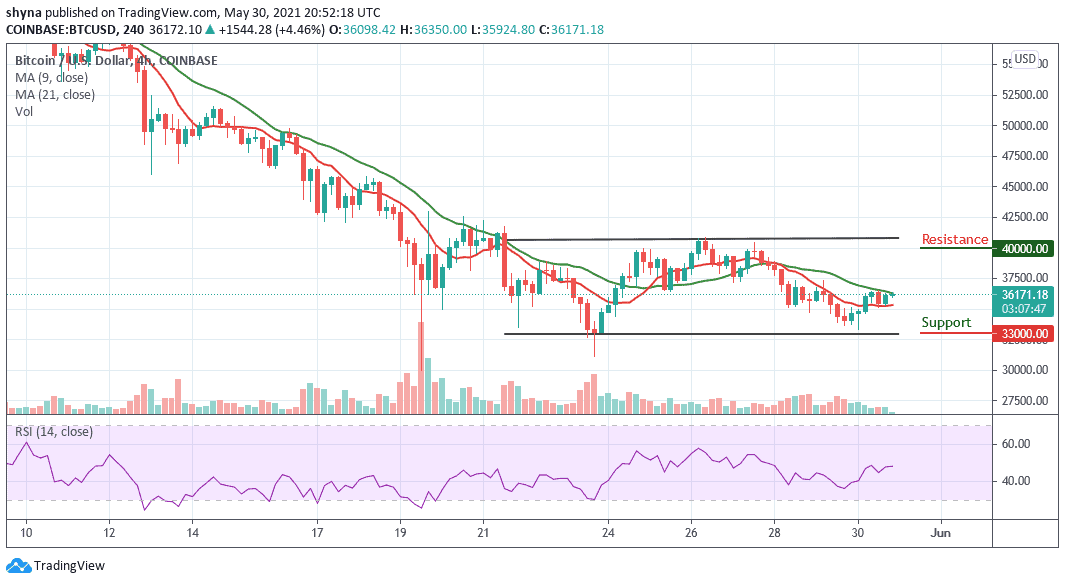
BTC/USD Medium – Term Trend: Ranging (4H Chart)

According to the 4-hour chart, BTC/USD is trading within the range of $34,000 to $36,000. Meanwhile, the intraday trading is still looking bullish as at the European session at $36,000 which is now a key support level. Meanwhile, the next key support levels are located at $33,000 and below.

BTCUSD – 4 Hour Chart

However, in as much as the buyers continue to reinforce and power the market more, traders can expect a retest at the $38,500 resistance level, and breaking this level may further push the price towards the resistance level of $40,000 and above. Similarly, the Relative Strength Index (14) moves above 45-level to confirm the bullish movement.

Go to Source

Major British Bank Natwest Alerts Customers With Tips to Avoid Cryptocurrency Scams

Major British bank Natwest has launched an alert to urgently warn its customers of cryptocurrency scams, which have been on the rise. The bank has provided several tips for customers “thinking of investing in bitcoin or other cryptocurrencies” on how to spot scams involving cryptocurrencies. “If you ignore the above advice, you could lose all of your money,” the bank cautioned.

Natwest’s Advice on How to Spot Crypto Scams

National Westminster Bank (Natwest), a major retail and commercial bank in the U.K., has launched an urgent cryptocurrency scam alert on its mobile app. The alert urges customers to beware of scams involving cryptocurrencies following a record number of reports in the first quarter.

Natwest explained that a common scam people fall victim to involves fake celebrity endorsement, such as The Virgin Group founder Sir Richard Branson. Natwest’s head of fraud prevention, Jason Costain, was quoted by the media as saying:

We have prevented millions of pounds from being sent to crypto-criminals who are exploiting the high levels of interest in the currency.

“However, consumers should always be alert, especially to the use of fake websites and bogus celebrity endorsements,” he added.

A number of people shared their screenshots on social media Wednesday of the alert they got when opening the Natwest mobile banking app. The notice begins with a message that reads: “Warning: Thinking of investing in bitcoin or other cryptocurrencies?” Natwest proceeded to highlight four key points to consider to help customers spot and avoid crypto scams.

Natwest’s alert on its mobile banking app. Source: Natwest

The first tip advises customers that if someone contacted them, “promising big profits” and offering to help them invest in cryptocurrency, it is a scam.

Furthermore, the British bank says that customers should always have control of their cryptocurrency wallets. “If you didn’t set the wallet up yourself or can’t access the money in the wallet, this is a scam,” the alert notes, adding that in this case, customers “should stop making payments immediately.”

The bank then pointed out that many cryptocurrency dealers are not registered with the U.K. Financial Conduct Authority (FCA). It emphasized that customers should always use a firm that is registered and is listed on the FCA website. The Natwest notice ends with a warning:

If you ignore the above advice you could lose all of your money.

What do you think about Natwest’s warning and tips on crypto scams? Let us know in the comments section below.

Go to Source

Notorious ‘Tiger King’ Joe Exotic Launches ETH-Based Token to Help Legal Fund

The infamous Joseph Maldonado, aka “Joe Exotic,” from the docuseries “Tiger King: Murder, Mayhem and Madness,” has launched his own Ethereum-based token. According to the website tiger-king.org, the project will also feature non-fungible tokens (NFTs) and the proceeds from NFT sales will go toward helping Joe Exotic’s legal defense team and tiger rescue funding.

‘Tiger King’ Joe Exotic Launches an ERC20 Token

The costar of the docuseries “Tiger King” has announced the launch of a new crypto asset called “TKING,” according to the reality series star’s official Twitter account. Bitcoin.com News reported on the popular docuseries last year when it was discovered that Joe Exotic’s costar Carole Baskin accepted bitcoin donations for Big Cat Rescue. Now Exotic “is back,” according to the website tiger-king.org and whoever developed an ERC20 token for him has minted a trillion TKING tokens.

“The legend of Joe Exotic has launched on the Ethereum blockchain! The man the world learned to call Tiger King from the hit Netflix documentary is back, this time as a digital currency,” the website notes. “The developers are thrilled to present Joe’s official cryptocurrency to the global public, endorsed by the man himself.”

Out of the trillion tokens, developers claim to have burnt 35% of the token supply. The development team also details that TKING tokens are “deflationary” by design as there’s a “2% burn rate on every transaction.” The website states:

Joe will always be the Tiger King, but his colorful career has landed him with a hefty legal bill in a bid to fight a corrupt legal system. Now he also faces the expense of cancer treatment.

Tiger King Received a Percentage of the Token’s Stealth Launch, Exotic’s Arch-Nemesis Carole Baskin Launches CAT Token First

According to the announcement Joe owns a percentage of TKING tokens and received them during the “stealth launch of the coin.” The website insists that “every buy will increase the value of his bag.”

Joseph Maldonado, aka “Joe Exotic,” from the docuseries “Tiger King: Murder, Mayhem and Madness,” has launched an ERC20 token. Exotic was sentenced to 22 years in prison on January 22, 2019.

Interestingly, Exotic’s costar Carole Baskin launched a cryptocurrency first and announced the project during the first week of May. Fox 13 News asked Baskin that because she is so well known that maybe a “major exchange” might list her CAT token.

“I’m being told by people in the industry that it could with its name recognition, and the fact that people love cats so much, and there’s so much buzz, but that’s not what it is right now,” Baskin explained during her interview.

Of course, the website tiger-king.org also mentions Exotic’s arch-nemesis Baskin.

“We will never let Carole win,” the TKING team insists. “Find your inner Tiger as Joe, $TKING, and his legal team stage the comeback of the century. We will land the first tiger on the moon to free Joe. Team Joe for the win!”

What do you think about the ‘Tiger King’ Joe Exotic’s new Ethereum-based crypto asset? Let us know what you think about this subject in the comments section below.

Go to Source

EZ Blockchain Partners With Texas-Based Oil Provider to Monetize Wasted Natural Gas With Bitcoin

While a number of media pundits and politicians have been talking about Bitcoin’s energy consumption, there’s been a myriad of firms working toward green solutions well before all the controversy. Unfortunately, critics don’t highlight the amount of renewables miners use or the cogeneration applications. One project called EZ Blockchain has partnered with the Texas-based oil and gas service provider, Silver Energy to monetize wasted natural gas with bitcoin, while reducing emissions.

Monetizing Stranded Gas and Reducing Emissions With Bitcoin

A firm called EZ Blockchain recently detailed that the company has partnered with Silver Energy, an oil and gas provider based in Texas. According to the firm, the team installed Silver Energy’s first mining site at the company’s Alberta, Canada location in February 2021.

After the installation of Microbt Whatsminers, EZ Blockchain said that the project reached around 1 megawatt of power consumption. All of the power is “processed from 250 MCFd of stranded natural gas using a gas-electric generator,” the company’s blog post notes.

EZ Blockchain’s setup at Silver Energy’s site.

“Today oil and gas producers are implementing Bitcoin mining in the oil field as a part of their ESG policy more often,” the cofounder and CEO of EZ Blockchain, Sergii Gerasymovych said in the report. Gerasymovych added:

Bitcoin mining’s enormous power consumption can solve environmental problems caused by gas flaring and leaking wells. Since Silver Energy is an oil and gas service company, it was a natural symbiosis for EZ Blockchain to work with them.

Natural gas is a byproduct of oil extraction and oil providers either have to flare the gas or use it in some other way. The World Bank estimates 5.3 trillion cubic feet of natural gas is flared annually into the atmosphere.

EZ Blockchain’s manufacturing production line designs and manufactures mobile data centers that act as a flare mitigation system. The company says that the Silver Energy project took three days to construct and it was fully operational by March 2021.

“We’ve had the privilege of working with EZ Blockchain over the last year. Their support in getting our mine up and running was invaluable, saving us countless hours and maximizing uptime,” Joel Gordon, Silver Energy president and CEO explained.

According to EZ Blockchain’s website, the company has expanded quite a bit since it started in 2017 and now has headquarters in Chicago, LA, and Estonia. To date, EZ Blockchain has 35 MW produced and installed and 20 MW more in production.

The firm is not the only company producing mobile bitcoin mining data centers, as the Canadian business Upstream Data also offers stranded gas solutions. Moreover, Crusoe Energy Systems a U.S.-based business offers similar crypto mining solutions for oil and gas producers as well.

What do you think about EZ Blockchain partnering with Silver Energy to mine bitcoin with excess gas? Let us know what you think about this subject in the comments section below.

Go to Source

2 Bitcoin price indicators suggest BTC has not bottomed yet

Traders are using a variety of strategies to determine whether Bitcoin price has bottomed, but on-chain activity and derivatives data hint that the situation remains precarious.

Traders are using various strategies to determine whether Bitcoin price has bottomed, but on-chain activity and derivatives data hint that the situation remains precarious.

Has Bitcoin price bottomed yet? According to @noshitcoins, derivatives and on-chain data signal that further downside could be in store.

Traders have been trying to time the much-anticipated trend reversal ever since Bitcoin (BTC) initiated its 48% correction to $30,000 on May 12. The move culminated with $12 billion worth of futures long positions being liquidated, and to date, trader’s confidence remains somewhat dampened.

The community started looking everywhere for trend reversal signs, including technical patterns, United States CPI inflation data and Bitcoin exchange deposits. For example, some analysts stated that a higher high, followed by a move above $40,000, would be enough.

However, two days later, Bitcoin managed to break the $40,000, although the move didn’t last for more than six hours. Meanwhile, other traders inferred that a retest of the $30,000 bottom is needed before a bounce.

Although there could be empirical evidence or even logic backing those statements, market prices don’t always react to external news or previous chart formations. Unlike stocks, Bitcoin investors can’t rely on commonly used valuation multiples or even comparables.

Sure, a digital store of value is one use case, but at the same time, it is uncensorable and easily transferable. Furthermore, some users value Bitcoin’s peer-to-peer fiat convertibility outside of KYC-regulated exchanges. Another factor to consider is the investors who are increasing their Bitcoin portfolio due to the lack of correlation with traditional financial assets.

This panacea of diverse and sometimes conflicting narratives creates barriers for modeling the market’s potential, adoption status, and even measuring the effectiveness of recent developments.

Some will cheer for Tesla and large companies building up Bitcoin reserves, while others couldn’t care less about who’s holding BTC and instead focus on the challenges of scalability and fungibility.

Skew: the professional “fear and greed” indicator

Call options allow the buyer to acquire Bitcoin at a fixed price when the contract expires. Put options, on the other hand, provide insurance for buyers and protect against price drops.

Whenever market makers and professional traders lean bullish, they will demand a higher premium on call (buy) options. This trend will cause a negative 25% delta skew indicator. On the other hand, if downside protection is more costly, the skew indicator will become positive.

Bitcoin 30-day options 25% delta skew. Source: laevitas.ch

A 25% delta skew oscillating between a negative 10%, and a positive 10% is usually deemed neutral. This balanced situation held until May 16, as Bitcoin lost the critical $47,000 support, which had held for 76 days.

As the markets deteriorated, so did the 25% delta skew indicator, and the cost of protective options spiked. Therefore, until the metric establishes a more neutral pattern nearer to the 5% level, it seems premature to call the market bottom.

Active Bitcoin supply signals that weak hands need to cool off

Traders also monitor the number of BTC that have been active lately. This indicator can’t be deemed bullish or bearish by itself as it does not provide information on how old the involved addresses are.

Active supply that transacted at least once in the trailing 30 days. Source: CoinMetrics

The 500% price rally from Oct. 1, 2020, and the $64,900 peak on April 14, 2021, caused a major increase in the supply moved in the months before the rally. When this metric presents a sharp decrease, it indicates that investors are no longer interested in participating at the current price level.

There are currently 2.2 million BTC active over the past 30 days, and this is significantly higher than levels seen before Oct. 2020.

As things currently stand, traders should not be so that Bitcoin has bottomed, at least until the market no longer has relevant activity surrounding the sub-$40,000 level.

The views and opinions expressed here are solely those of the author and do not necessarily reflect the views of Cointelegraph. Every investment and trading move involves risk. You should conduct your own research when making a decision.

Go to Source

Top 5 cryptocurrencies to watch this week: BTC, MATIC, EOS, XMR, AAVE

MATIC, EOS, XMR and AAVE could rally higher over the coming days if Bitcoin price can sustain within the $30,000 to $33,000 support zone.

Bitcoin (BTC) is struggling to sustain any price level during the current pullback, indicating a lack of demand at higher levels. Does this mean that the bull trend is over and the institutional investors are abandoning the crypto markets?

No! It is the other way around. Glassnode’s weekly newsletter pointed out that the Grayscale Bitcoin Trust (GBTC) premium is rising, suggesting that institutional investors are accumulating at lower levels.

GBTC is not alone, another popular vehicle for institutional investors, the Canadian Purpose Bitcoin exchange-traded fund has also witnessed strong capital inflows. According to analysts at Glassnode, this shows “early signs of renewed institutional interest.”

Crypto market data daily view. Source: Coin360

Another metric that may be signaling a possible bottom in Bitcoin is its dominance chart, which looks similar to the early part of 2017. If Bitcoin’s dominance follows a similar trajectory to 2017, it will indicate that Bitcoin is still some distance away from its peak and altcoin season still has room to run.

Now that the monthly options and futures expiry has passed, investors are likely wondering if Bitcoin could start a sharp recovery next week and which altcoins will rally if that happens. 

Let’s look at 5 cryptocurrencies that could start trending moves this week.

BTC/USDT

Bitcoin’s brief breakout could not clear the hurdle at the 200-day simple moving average ($41,014) on May 26 and 27, indicating the bears are defending this level aggressively. The downsloping 20-day exponential moving average ($41,327) and the relative strength index (RSI) near the oversold zone suggest the bears are in control.

BTC/USDT daily chart. Source: TradingView

If the BTC/USDT pair breaks the $33,000 support, the next stop could be the $30,000 to $28,000 support zone. If this zone also gives way, the pair may witness panic selling and a drop to $20,000 is possible.

The longer the price stays below the 200-day SMA, the more difficult it will become for the bulls to start the next leg of the uptrend.

However, if the price turns up from the current level and rises above the 200-day SMA, it will suggest strong buying at lower levels. That could clear the path for a possible rally to the 61.8% Fibonacci retracement level at $48,231.

BTC/USDT 4-hour chart. Source: TradingView

The 4-hour chart shows the formation of a symmetrical triangle, which generally acts as a continuation pattern. If bears sink the price below the triangle, the pair could drop to $30,000 and then to the pattern target at $20,316.

On the other hand, the setup may act as a reversal pattern if bulls push and sustain the price above the resistance line of the triangle. Such a move will suggest the downtrend is over and the pair could rally to the target objective at $51,951.

MATIC/USDT

Polygon (MATIC) has bounced off the 20-day EMA ($1.58) today, indicating that bulls are buying on dips to this support. The upsloping 20-day EMA and the RSI in the positive territory indicate the path of least resistance is to the upside.

MATIC/USDT daily chart. Source: TradingView

However, the MATIC/USDT pair has formed a symmetrical triangle pattern, indicating indecision among the bulls and the bears. If bulls push the price above the resistance line of the triangle, the pair could rise to $2.70 and then start its journey to the pattern target at $4.20.

Contrary to this assumption, if the price turns down from the resistance line of the triangle, the pair could extend its stay inside the triangle. A break and close below the triangle will signal weakness and could result in a drop to $0.80.

MATIC/USDT 4-hour chart. Source: TradingView

The 4-hour chart shows the relief rally is facing resistance at the downtrend line. If the bears sink the price below the $1.51 support, the pair will complete a bearish head and shoulders pattern that could result in a drop to $0.68.

Conversely, if buyers propel the price above the downtrend line, the bullish momentum could pick up and the pair could challenge the $2.43 resistance. A break above this level could result in a rally to $2.70.

EOS/USDT

EOS attempted a recovery, which fizzled out at the 38.2% Fibonacci retracement level at $7.89 on May 27. However, the positive sign is that the bulls have not allowed the price to dip below the $5.60 support. This indicates that traders are not waiting for a deeper fall to buy.

EOS/USDT daily chart. Source: TradingView

If bulls can push and close the price above the 20-day EMA ($6.95), it will suggest that supply exceeds demand. That could open the doors for a rally to the 50% retracement level at $9.23 and then to the 61.8% retracement level at $10.57.

This bullish view will invalidate if the bears stall the next pullback attempt at the 20-day EMA or at $7.89. Such a move will increase the possibility of a break below $5.60. If that happens, the EOS/USDT pair could drop to the 200-day SMA ($4.52) and then to $3.57.

EOS/USDT 4-hour chart. Source: TradingView

The 4-hour chart shows the bulls are defending the $5.60 support, indicating that the selling pressure has reduced. The flat 20-EMA and the RSI just below the midpoint suggest a balance between supply and demand.

If bulls push the price above $6.81, the pair could rally to the 200-SMA and then to $8.69. A breakout and close above this resistance will signal that bulls are back in the game. Alternatively, if the bears sink the price below the $5.60 to $5 support zone, the pair could drop to $3.57.

XMR/USDT

Repeated attempts by the bears to sink Monero (XMR) below the 200-day SMA ($222) have failed in the past few days. This suggests that bulls are accumulating at the current levels.

XMR/USDT daily chart. Source: TradingView

The buyers attempted to push the price above the 20-day EMA ($294) on May 29 but the long wick on the candlestick shows strong selling at higher levels. However, the bulls are again likely to attempt to clear the hurdle at the 20-day EMA.

If they succeed, the XMR/USDT pair could start a relief rally that may reach the 61.8% Fibonacci retracement level at $368.45. This level may act as a stiff resistance because traders who had bought at higher levels may close their positions.

This positive view will nullify if the price turns down and plummets below the 200-day SMA. In such a case, the pair may drop to $175 and then to $124.69.

XMR/USDT 4-hour chart. Source: TradingView

The 4-hour chart shows a symmetrical triangle formation, indicating indecision among the bulls and the bears about the next directional move. The flattish 20-EMA and the RSI near the midpoint also suggest a balance between supply and demand.

This advantage will tilt in favor of the bulls if they can push and sustain the price above the triangle. The price could then rally to the 200-SMA, which may act as a stiff resistance.

On the contrary, if the price turns down and breaks below the triangle, the pair could drop to $175 and then to $124.69.

AAVE/USDT

AAVE is attempting to rebound off the strong support at $280. This level has not been broken on a closing basis since Jan. 26, hence the bulls are likely to defend it aggressively. The 200-day SMA ($290) just above the level is an added advantage.

AAVE/USDT daily chart. Source: TradingView

However, the downsloping 20-day EMA ($398) and the RSI below 43 suggest the short-term trend favors the bears. The sellers will try to stall any relief rally at the 20-day EMA. If they succeed, the AAVE/USDT pair may again correct to $280.

A break and close below this support could start a downtrend and the decline could extend to $160. Conversely, if the bulls drive the price above the 20-day EMA, the pair could rise to $489, which is likely to act as a stiff resistance.

AAVE/USDT 4-hour chart. Source: TradingView

The 4-hour chart shows the bulls bought the dip to $280. The 20-EMA is flattening out, indicating the selling pressure is reducing. If buyers push and sustain the price above the downtrend line, the pair could rally to $418. A breakout and close above this resistance could result in a rally to $480.

This positive view will invalidate if the price turns down from the 20-EMA or the downtrend line and plummets below $280. If that happens, the bears will try to pull the price below the May 23 low at $208.09 and start the downtrend.

The views and opinions expressed here are solely those of the author and do not necessarily reflect the views of Cointelegraph. Every investment and trading move involves risk, you should conduct your own research when making a decision.

Go to Source

Cardano leads tepid crypto market recovery ahead of Memorial Day

Fears of a nasty pre-Memorial Day selloff in cryptocurrencies may have been overstated, early indicators suggest.

Cardano’s ADA cryptocurrency was back in the spotlight Sunday, leading a tepid market recovery following news that the developer network was inching closer to launching smart contracts. 

Market update

The combined value of all cryptocurrencies rose 4.4% on Sunday to $1.6 trillion, according to data from Coingecko. Among the majors, it was Cardano’s ADA leading the rally with a 17% gain. ADA peaked at $1.70, according to TradingView, and was last seen hovering just north of $1.63.

At current values, Cardano was the fourth-largest cryptocurrency with a total market capitalization of $52.9 billion.

ADA posted a strong rebound on Sunday after languishing for much of last week. Source: TradingView.

Every cryptocurrency in the top-20 reported gains on Sunday. Bitcoin (BTC) price rose 3.5% to $35,833, Ether (ETH) added 4.3% to $2,431 and Binance Coin (BNB) climbed 6% to $327.

Despite the modest rally, market sentiment remains tilted to the downside this weekend, with investors continuing to speculate about whether Bitcoin has actually bottomed out. The Crypto Fear & Greed Index has fallen to 10, on a scale of 1-100 where lower scores are associated with “extreme fear.”

What’s driving ADA?

The presence of oversold conditions following the latest market correction appears to have worked in ADA’s favor on Sunday. The cryptocurrency briefly penetrated the oversold indicator on the hourly Relative Strength Index Saturday before rebounding sharply over the next 24 hours.

Prior to the May 19 crypto market flash crash, ADA was among the top-performing digital assets. It peaked at $2.46 on May 16 before unwinding 55% over the next week. Looking beyond the immediate shift in market sentiment, ADA fundamentals remain intact.

On a fundamental note, ADA supporters are celebrating the launch of the Alonzo smart contract testnet by Cardano’s development team Input Output Hong Kong, or IOHK. As Cointelegraph recently reported, IOHK was eyeing a gradual deployment of Alonzo’s testnet in May and June. Early adopters will have the opportunity to test Alonzo Blue, the first alpha testnet, over the next month.

As IOHK explained:

The ‘Alonzo’ hard fork will bring exciting and highly-anticipated new capabilities to Cardano through the integration of Plutus scripts onto the blockchain. These will allow for the implementation of smart contracts in Cardano, enabling the deployment of a wide range of new DeFi applications for the first time.

Cardano founder Charles Hoskinson recently indicated in a YouTube video that attention will shift to solving the scalability issue once the Alonzo rollout is complete.

Go to Source

Experts answer: How does Elon Musk affect crypto space?

Here’s what crypto and blockchain industry experts think about Elon Musk’s recent comments on cryptocurrency.

Wes Levitt, the head of strategy at Theta Labs:

“Musk’s tweets and the resulting effects certainly may have hurt crypto in the eyes of some institutional investors. While a good deal of investors already consider Musk a bit of a clown and aren’t making investment decisions based on his opinions, it raises concerns about the maturity of crypto markets that an errant tweet can erase hundreds of billions of dollars in market cap in just a few days. 

The whole Dogecoin affair, in general, is not helping crypto’s image either. Many thought that 2021 was the year that cryptocurrencies would begin gaining mainstream acceptance as an asset class, but seeing a meme dog coin hit an $80 billion market cap and then crash 50% is not ideal for crypto to be taken seriously. 

Institutional capital is still entering crypto rapidly, and that will continue this year, but the effects of these tweets undoubtedly led to some tough conversations in investment committees this month. For those of us in the crypto space, the best thing to do is not give so much attention and power to Musk or any other individual.”

These quotes have been edited and condensed.

The views, thoughts and opinions expressed here are the authors’ alone and do not necessarily reflect or represent the views and opinions of Cointelegraph. This article does not contain investment advice or recommendations. Every investment and trading move involves risk, and readers should conduct their own research when making a decision.

Tim Draper, founder of Draper Associates and Draper Fisher Jurvetson:

“We have, of course, seen many ups and downs in the crypto world, so we are somewhat immune to small, one-day news items like tweets from Elon or previous comments from Warren Buffett, Jamie Dimon, etc. In general, the negative comments have come from people who have a lot of fiat currency and don’t want the system to change. Elon is somewhat different in that he is a change agent. I certainly hope he is not doing this as a pump and dump with selfish motivations. I like thinking of him as a change agent and hero.

With regard to his energy statements: I almost always agree with Elon, but here he has gotten it wrong. Secondary effects of technology rarely are what they look like on the surface. Mining encourages the use of cheap alternative energy. We have actually found more energy on the Earth because of miners. Bitcoin uses far less energy than our existing system, which chops down trees for paper money and requires enormous infrastructure. How much energy do banks, buildings, mints, printers, etc., use up in the processing of fiat dollars?

Fiat currency is inflationary and encourages wasteful spending. Bitcoiners are holders.

And finally, with companies like OpenNode and the Lightning Network, we can have far more transactions per second than the Visa network, and for a fraction of the cost and almost zero cost of energy.

There are, of course, coins that are more environmental. Tezos uses proof-of-stake instead of proof-of-work and uses less energy, but all crypto is way better than the 200 plus fiats we have out there.”

Mati Greenspan, founder of Quantum Economics:

“Even Larry Fink, CEO of BlackRock, the world’s largest money management firm, noted the ability to sway Bitcoin prices drastically with a small amount of capital. For Musk, who was briefly the world’s richest man earlier this year, this seems to be about more than just making money. He’s found a way to manipulate market sentiment in under 280 characters. We saw a bit of this from Trump as well, but Musk is clearly much better at playing this game.”

John Wu, president of Ava Labs:

“Elon has a flair for the dramatic, but there are definitely fair critiques and questions for the Bitcoin ecosystem to address. Hopefully, the increased attention from the broader public will catalyze faster adoption of renewable energy sources and transparency on how much these sources are used today.

When Tesla announced it would accept BTC for payments, I voiced my doubts that it would take hold because transactions on Bitcoin are too slow and the tax implications are significant. In taking this step, however, Tesla tested the waters on accepting crypto payments and can now explore networks optimized for near-instant finality, low fees and no environmental impact.”

Diana Barrero Zalles, director of ESG & Impact at Emergents @ Weild & Co.:

“This crypto market shows how investor psychology can heavily impact crypto markets.

Traditional notions of rational, frictionless finance, which dominated financial thinking in the second half of the 20th century, assumed that everyone in an economy is fully rational. The notion of efficient markets assumes that all assets are correctly priced at their fundamental value, adequately reflecting all public information. Investors cannot ‘beat the market’ by identifying mispriced assets.

On the contrary, behavioral finance traces its origins to a 1981 paper by Robert Shiller from Yale University and Nobel Prize recipient, who found that market fluctuations can be too large to be consistent with fully rational thinking. This theory has gained wider acceptance since the 1990s. In the crypto markets, this has shown to be psychologically more realistic time and time again. Behavioral finance tries to make sense of markets in the context of irrational investor behavior and managerial actions.

Crypto markets, which represent a small fraction of the size of mainstream financial markets, still have plenty of room to mature and develop greater efficiencies. Irrational investors and decision-makers who drive prices based on emotion and exuberance may be creating opportunities for more rational investors to take advantage of arbitrage.”

Denelle Dixon, CEO and executive director of Stellar Development Foundation:

“I think there’s good news and bad here. On the good side, bringing cryptocurrencies and blockchain into a mainstream conversation is a positive development that gives all of us in the industry an opportunity to also talk about the real benefits of the technology. 

On the downside, more consumers will see Bitcoin or Dogecoin headlines and think cryptocurrency is only a highly volatile investment for speculators. So, we have to swim upstream a bit to explain the real and valuable uses of the Stellar network and other protocols and how they are tackling the world’s problems. I would rather the focus be on use cases, which is what we choose to talk about.”

Cristina Dolan, founder and CEO of InsideChains, vice-chair of MIT Enterprise Forum:

“In some ways, Elon Musk seems to enjoy creating controversies and capturing attention with statements about his bold business goals and achievements, which have earned him a sizable fan base, as well as SEC fines. Adoption of Bitcoin by corporate treasuries has caught the attention of many investors, especially after Tesla made $101 million in profit from the sale of its Bitcoin. It is no surprise that Elon would poke fun at Bitcoin as an investment after cashing out with a profit and focusing on Bitcoin descendent, Dogecoin, which had acted more as a temporary store of value and method for value transfers.

In 2018, Elon Musk and Tesla were reported to have reached an agreement with the SEC to each pay half of the $40 million in fines because of Elon’s careless, bold tweet about the future stock price of Tesla. This ‘misleading tweet’ caused a significant ESG impact because the Tesla stakeholders are the social component, or ‘S,’ of ESG. This action also affected the ‘G’ in ESG since this was a governance issue that required changes at the board level, and it caused a 14% plunge in the Tesla stock price. This was an ESG impact, specifically on the S and the G! It is hard to argue that Elon Musk’s behavior is guided by ESG principles. His playful statements about Bitcoin and Dogecoin may have impacted the market, but there were other factors that may also have affected market sentiment. Crypto value tends to decline as tax deadlines approach.

In addition, as more institutional money has been invested in crypto, there may be other traditional macro market drivers at play like inflation or the possibility of raising rates for the 10-year treasuries. The banning of Bitcoin or crypto in places like China and Turkey hasn’t prevented citizens from accessing the cryptocurrencies, although the restrictions may now have a greater impact as more institutions engage in crypto.

As headlines about Bitcoin and crypto ignite more interest, we will see a combination of emotional reactions to celebrity endorsements, together with behaviors that correlate with traditional market behaviors. Market perceptions of crypto are not totally based on what one celebrity says or does, but there is an emotional component to all markets. There are many different payment networks that currently accept Bitcoin payments, and Apple recently posted a new job for alternative payment partnerships.

The momentum for DeFi isn’t stopping as the crypto networks continue to grow. A temporary change in market conditions or price will not eliminate the effects of Maxwell’s laws on the crypto networks. There are many dimensions of crypto innovation that are flourishing.”

Alex Wilson, co-founder of The Giving Block:

“Bitcoin has been through much worse. Long term, I don’t think it will have a major impact. Short term, I think it hurts investor confidence because it shows how much impact one person can have on short-term price movements. It’s a whole different debate, though, if Elon’s tweets were really the only thing driving the price movements.”

The energy consumption problem

The reason Tesla suspended its support for vehicle purchases using BTC was the company’s concerns regarding the “rapidly increasing use of fossil fuels for Bitcoin mining and transactions, especially coal.” Sounds reasonable for a company that develops electric cars, right? 

First of all, the question of whether BTC is a waste of energy isn’t new and has been debated by industry experts for some time already. Meanwhile, the mainstream media — The New York Times, Financial Times and Bloomberg, to name a few — went all out with headlines following Musk’s comments, blaming crypto for enormous energy use. They referred to Cambridge University’s Bitcoin Electricity Consumption Index, where the total electricity used worldwide by Bitcoin miners is currently at around 113 terawatt-hours per year. But what they failed to mention — intentionally or unintentionally — is that the latest study by the Cambridge Centre for Alternative Finance stated 39% of all energy consumption used in BTC mining was from renewable sources.

More interestingly, Galaxy Digital published a report entitled “On Bitcoin’s Energy Consumption: A Quantitative Approach to a Subjective Question,” where the company estimates the energy consumption of the traditional finance space to be around 260 terawatt-hours per year, more than twice as big as the Bitcoin industry. However, the estimations only came from available data, meaning it would be fair to say that the actual number is much higher. 

Another important note is that after the COVID-19 outbreak and the tremendous shift globally toward digitization, we must place the problem of crypto energy consumption within the broader context of internet usage. As Greenpeace USA media director Travis Nichols pointed out: 

“As web services grow and become more complex, the demand for computing power will continue to go up over the next few years, and that will require much more energy.” 

Also, Mark Cuban, billionaire investor and owner of the Dallas Mavericks, decided not to withdraw support for Bitcoin payment, arguing with Elon Musk:

“We know that replacing gold as a store of value will help the environment. […] Shrinking big bank and coin usage will benefit society and the environment.”

If we go back to Musk’s accusations against Bitcoin, they did negatively affect the industry. For example, an environmentally-focused bill in the state of New York would place a three-year moratorium on crypto mining if it passes the state’s senate. But every cloud has a silver lining, as they say. What is good is that by bringing attention to the carbon footprints made by the crypto industry, the space can more quickly move toward sustainability, as happened with the global pandemic, which forced governments globally to work on green energy amidst COVID-19.

Cointelegraph reached out to crypto and blockchain industry experts for their opinions on the following question: How do all these Elon Musk comments affect the entire crypto space?

The public’s awareness

Earlier this month, DOGE surpassed BTC in the global public interest. A survey later revealed that Americans are more familiar with the meme coin than they are with Etherum. This result might be upsetting to some, as the Ethereum ecosystem — which introduced smart contracts and became the fabric of the decentralized finance (DeFi) sector — surely deserves more recognition than a meme. 

But look at this situation from another perspective: People who were not previously familiar with cryptocurrency, blockchain technology and DeFi are starting to google Dogecoin. It might interest them and they might go deeper into the topic, resulting in a rise of awareness, which might lead to mainstream audience involvement in the crypto space. As Nick Spanos, the founder of Bitcoin Center NYC and the Zap Protocol, rightfully noticed: 

“DOGE is a powerful marketing tool, driving attention and adoption of crypto and decentralization as a concept. And in that respect, it is invaluable.”

Introduction

Recently, Tesla CEO Elon Musk has been all over the news. He became the richest man on the planet but later lost that title alongside about $6.2 billion of his fortune. Four of his SpaceX Starship rocket tests failed, but a later launching and landing were a success. This same type of roller coaster behavior — which might be a part of Musk’s nature — has also been witnessed within the cryptocurrency space.

In February, Tesla allocated $1.5 billion of its balance sheet to Bitcoin (BTC). Bitcoin’s price jumped by almost $3,000 in minutes and then surged 20% in 24 hours. A month later, Tesla decided to accept Bitcoin for payments on its electric vehicles before Musk changed his mind.

There was also the whole Dogecoin (DOGE) story: After Musk helped to pump up the meme cryptocurrency, a performance with his mother on Saturday Night Live helped to tank it. The self-proclaimed “Dogefather” later denied any official involvement in the DOGE project.

This article won’t focus on the legal concerns of Musk’s behavior, something already covered by law professor and former SEC attorney Marc Powers in his latest opinion article, where he raised important questions: 

“Does Musk have some undisclosed personal or business interest in knocking BTC and promoting DOGE? Are his tweets, which contain what some would consider wild speculation on the prices of Dogecoin and other cryptocurrencies, mere puffery and permitted First Amendment speech, or are they violations of securities, commodities, consumer or other laws?”

It will also leave aside all the price movements caused by Musk’s reckless tweeting and commenting to market analysts and experts. Instead, let’s focus on how all of this is affecting the crypto space in general.

Go to Source

SEC charges 5 for illegally promoting $2 billion Bitconnect Ponzi

The SEC says five individuals “promoted a global unregistered digital asset securities offering.”

Three years and some unforgettable memes later, the Securities and Exchange Commission has announced that 5 individuals will face charges relating to promoting the Bitconnect Ponzi scheme. 

“The SEC’s complaint alleges that these promoters offered and sold the securities without registering the securities offering with the Commission, and without being registered as broker-dealers with the Commission, as required by the federal securities laws,” the release reads.

The promoters, including Trevon Brown, Craig Grant, Ryan Maasen, and Michael Noble are said to have “advertised the merits of investing in BitConnect’s lending program to prospective investors, including by creating “testimonial” style videos and publishing them on YouTube, sometimes multiple times a day.” In exchange for their promotional efforts, the influencers and representatives were paid on a commission basis.

The release also named Joshua Jeppesen as “a liaison between BitConnect and promoters.”

Shortly after the release, Trevon Brown (better known as Trevon James) posted a Tweet in which he did not deny the charges and said that the community would “rally” around him.

“We will seek to hold accountable those who illegally profit by capitalizing on the public’s interest in digital assets,” said Lara Shalov Mehraban, Associate Regional Director of SEC’s New York Regional Office in the release. 

The company, which collapsed in 2018, was widely accused on being a ponzi scheme from several analysts and observers, including Ethereum co-founder Vitalik Buterin. Last year, an Australian man was charged in connection with the company’s fraud. Many will be familiar with the project due to a now-legendary presentation from investor Carlos Matos:

Multiple crypto lawyers have taken to Twitter to speculate on the long-term ramifications of this case. Gabriel Shapiro noted that even though the SEC is targeting a known fraud in Bitconnect, it could end up being a “blueprint” for action against other DAOs. 

Go to Source

US Senator Urges Treasury Secretary Yellen to Take Action on Cryptocurrency Scams to Protect Investors

U.S. Senator Rick Scott has urged Treasury Secretary Janet Yellen to take action on cryptocurrency scams, which he said have risen 1,000% in the past year and cost consumers at least $80 million. “This is an unregulated industry, and the alarming amount of criminal activity surrounding cryptocurrency demands action,” he told Yellen.

Senator Scott Alerts Janet Yellen to Cryptocurrency Scams

Senator Rick Scott wrote a letter to Treasury Secretary Jenet Yellen on Thursday raising concerns regarding the rising number of scams involving cryptocurrencies. The senator wrote:

I write today with concern about the risks taken by ordinary investors and the significant potential for scams related to cryptocurrency.

He explained that “Cryptocurrency values have fallen drastically over the last few weeks, while reports of scams and fraud have skyrocketed.” Senator Scott cited research by the Federal Trade Commission (FTC) stating that cryptocurrency scams have risen 1,000% in the past year and cost consumers more than $80 million, with the median amount consumers lost in the scams of $1,900.

He continued:

This is an unregulated industry, and the alarming amount of criminal activity surrounding cryptocurrency demands action.

In his letter, the senator asked how the administration plans to “protect consumers and legitimate investors from widespread cryptocurrency scams” and how the Treasury Department will “identify, stop and prevent fraud and scams in initial coin offerings and the purchase and sale of cryptocurrency on U.S. financial markets.”

He also asked about “the administration’s plan to plan to address any legal or regulatory uncertainties that may be causing the unnecessarily turbulent environment for the development and sale of cryptocurrency” and what “additional steps” Congress should take.

Senator Scott also questioned what the administration is “doing to protect cryptocurrency markets from foreign interference by our adversaries, including Communist China and Russia.” In addition, the senator wants to know of “any tools available to the administration that may offer more concrete protection and guidance to investors and innovators on these topics.”

Yellen has herself voiced concerns on several occasions over the use of cryptocurrencies in illicit transactions. She previously said that cryptocurrency was mainly used for illicit financing and promised to work with other federal regulators to come up with an effective regulatory framework for cryptocurrencies.

In February, the treasury secretary named the misuse of cryptocurrencies as a growing problem and stressed the importance of crypto regulation to ensure that bitcoin is not used in illicit transactions. She said the current regulatory framework is not up to the task of regulating cryptocurrencies. Meanwhile, the Biden administration is reportedly working on increased cryptocurrency oversight.

What do you think about Senator Scott asking Treasury Secretary Janet Yellen to take action to protect investors against cryptocurrency scams? Let us know in the comments section below.

Go to Source

Please enter CoinGecko Free Api Key to get this plugin works.
Exit mobile version