

The crypto trading platform faced some issues today amid a surge in demand.
French Crypto Broker Bitit Shuts Down
The platform will halt all withdrawals on April 30.
Swiss Insurance Giant AXA Starts Accepting Bitcoin
Private customers of AXA Switzerland can now pay bills through BTC.
What Does the Success of Coinbase’s Public Offering Mean for Crypto?
Coinbase’s share price closed yesterday at $328.28, giving the company a total valuation of $85.7 billion
LINK Soars to All-time Highs on Launch of the Chainlink 2.0 Whitepaper

- The team at Chainlink has launched the whitepaper to version 2.0 of the project
- The new whitepaper proposes hybrid smart contracts on Chainlink
- The digital asset of LINK has set a new all-time high of $44.1447 – Binance rate
- Chainlink 2.0 might signal a new phase of growth for LINK in the crypto markets
The team at Chainlink (LINK) has released a new whitepaper for the second iteration of its platform that will introduce hybrid smart contracts. Dubbed Chainlink 2.0, the new whitepaper proposes improvements to the network in seven key areas.
- Hybrid smart contracts – that will combine blockchain smart contract application capabilities with off-chain computing resources
- Abstracting away complexity – by providing developers and users with simple functionality
- Scaling – to allow the network to provide high-performance systems
- Confidentiality – providing innate transparency alongside confidential protections for sensitive data
- Order-fairness for transactions – sequencing of transactions that are fair to all users
- Trust minimization – creating a more trustworthy layer of support for smart contracts and other oracle-dependent systems
- Incentive-based security – designing mechanisms to ensure nodes have strong economic incentives
Chainlink 2.0 is a Long-Term, Multi-Year Project
The team at Chainlink went on to explain that the proposed changes will be implemented incrementally over time as explained below.
This whitepaper is a long-term, multi-year view of how Chainlink will evolve.
This ambitious vision for the Chainlink Network will be implemented incrementally with new decentralized services being released in parallel, so we can formally analyze the security impact of this vast array of new oracle functionalities.
We’re confident that Chainlink will enable smart contracts to take the next major leap in their evolution, powered by a hybrid on-chain/off-chain architecture.
LINK Soars to New Heights on News of the Chainlink 2.0 Whitepaper
The price of LINK in the crypto markets experienced a knee-jerk reaction to the launch of the whitepaper to Chainlink 2.0, hitting a new all-time high of $44.1447 – Binance rate.
At the time of writing, LINK has experienced a brief pullback and is trading at $43.50. However, the implementation of Chainlink 2.0 will be a multi-year project hinting that this is the beginning of more gains for LINK in the crypto markets.
Additionally, the bullish momentum injected by Chainlink 2.0 increases the chances of LINK hitting $67 by the end of May
Bitcoin Could Be in the Greed Stage Based on High Leverage Being Used

- Bitcoin’s market could have entered the ‘greed stage’ based on the high leverage being used by BTC traders
- The amount of leverage has increased since February
- The weekly Bitcoin chart is hinting of exhaustion and a top might not be too far away
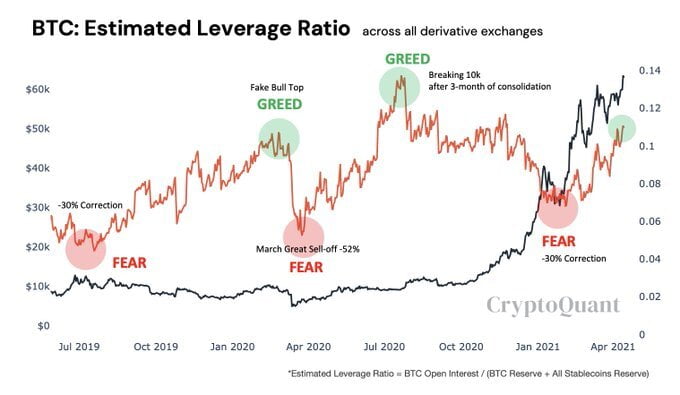
The Bitcoin market might have entered the ‘greed stage’. This is according to an analysis done by the CEO of CryptoQuant, Ki Young Ju, who pointed out that BTC traders are continually using high leverage.
Furthermore, the amount of leverage being used by Bitcoin traders has increased since February this year. Mr. Young Ju shared his analysis through the following statement and accompanying chart.
BTC market is in the greedy stage.
How much leverage people bet in derivative trading can indicate investors’ fear and greed. It has increased since February.
I’m not saying bearish, but I usually recommend buying when it’s in the fear phase.

Expanding on the observation of the CEO of CryptoQuant, on a macro level, the weekly Bitcoin chart hints at an overbought scenario for the King of Crypto. The chart, which can be found below, is clearly in parabolic territory dwarfing the 2017 bull season by a factor of 3.
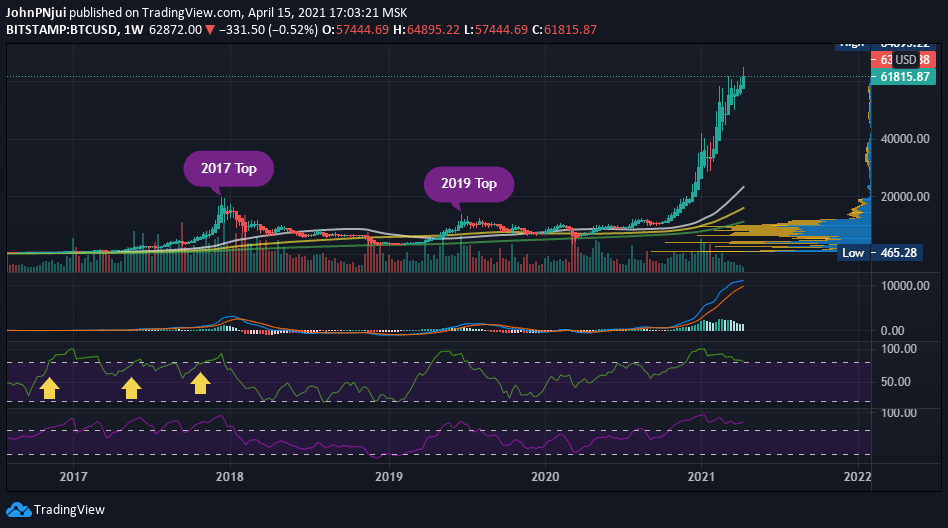

Also from the chart, it can be observed that the weekly MACD is overextended and hinting at an overbought scenario with a pullback in the weeks to follow. Furthermore, the weekly volume is also decreasing indicating a reduction in buying. The weekly MFI and RSI are also overbought at values above 80.
To note is that the weekly MFI and RSI crossed overbought territory numerous times leading up to the 2017 peak. Therefore, if the 2020 – 2021 bull season follows a similar path, then the top might just be a brief pause followed by a continuation to higher levels.
However, if the current Bitcoin market is similar to that of 2019 where the weekly MFI and RSI were in overbought territory only once, then a peak is in sight for BTC.
USDT on TRON Exceeds USDT on Ethereum 729 Days After Launch

- USDT issued on Tron (TRX) has eclipsed that issued on Ethereum
- The milestone was achieved 729 days after TRC20-USDT was launched
- Justin Sun marked the milestone through Twitter by thanking the Tron community
- TRX has had an impressive run in the markets but a pullback could be on the horizon
The amount of Tether (USDT) issued on the Tron blockchain has just exceeded that issued on Ethereum. Tron’s founder and CEO, Justin Sun, shared the milestone through the following tweet while also noting it took 729 days to achieve it.
Finally! After 729 days’ endeavors, USDT on #TRON (23.9B) has surpassed USDT on #Ethereum (23.4B). It is a historic moment.
— Justin Sun🌞 (@justinsuntron) April 14, 2021
Moments before the milestone was reached, Justin Sun thanked the Tron (TRX) community for their continued support through the following statement.
Time to witness the historical moment. In less than 2 years, USDT on TRON outperforms Ethereum in both circulation and market cap. Thank you all for the support and trust from TRONICS. TRON, to the future.
Tron (TRX) Is in Overbought Territory, Pullback Likely
At the time of writing, the amount of Tether on Tron currently stands at $23.994 Billion whereas that on Ethereum is at $23.416 Billion. TRC20-USDT has eclipsed ERC20-USDT by roughly $578 million and is a sign of Tron’s impressive journey since the launch of its Testnet three years ago.
At the same time, the price of Tron is in a bullish uptrend as seen through the 3-day TRX/USDT chart below.
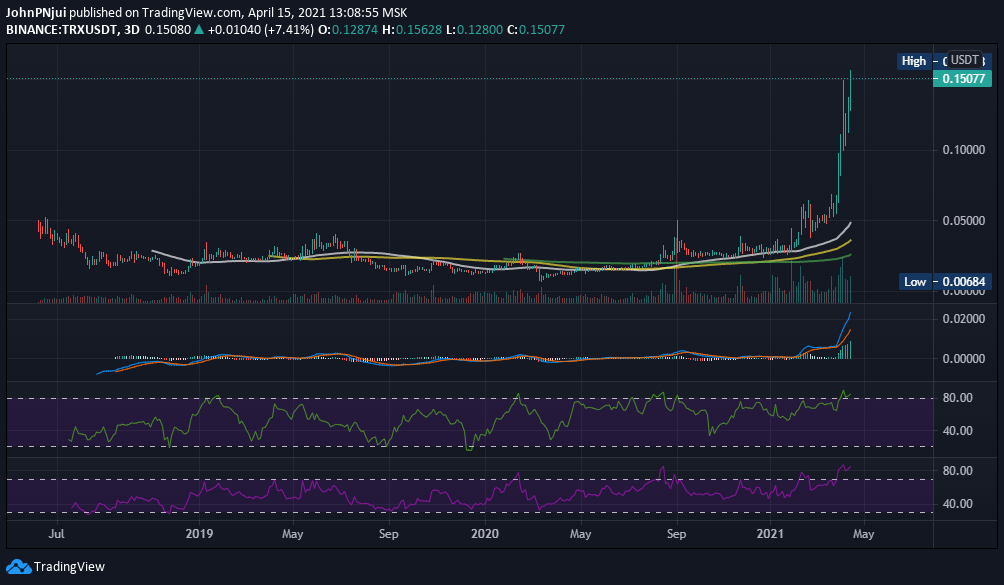

Also from the chart, it can be observed that Tron is in overbought territory on a macro level and could be due for a correction in the days to follow as shall be explained.
To begin with, the price of TRX/USDT mimics a parabolic move with the 3-day MACD confirming this. The 3-day MFI and RSI are also in overbought territory at values of 84 and 83 respectively. Secondly, the price of Tron (TRX) has deviated far from the 3 moving averages thus hinting that a correction is in the pipeline or has already begun.
With respect to short-term support zones, Tron (TRX) has the following price areas of interest.
- $0.142
- $0.135
- $0.127
- $0.118
- $0.102
- $0.098
Coinbase Closes Day 1 of Trading as the World’s Most Valuable Exchange

- Coinbase (COIN) closed the first day of trading at a value of $328
- Coinbase closed the first day of trading COIN as the most valuable exchange in the world
- Coinbase managed to eclipse the CME Group, the Hong Kong Exchanges and Clearing, and ICE
- The market cap of COIN has also exceeded that of Binance Coin (BNB)
Yesterday, April 14th, marked the first day of trading of the highly anticipated stock of Coinbase (COIN). A quick glance at Tradingview reveals that on its first day of trading, Coinbase (COIN) reached a high of $428.94 and a low of $310. The stock went on to close trading at a value of $328 as seen in the chart below.
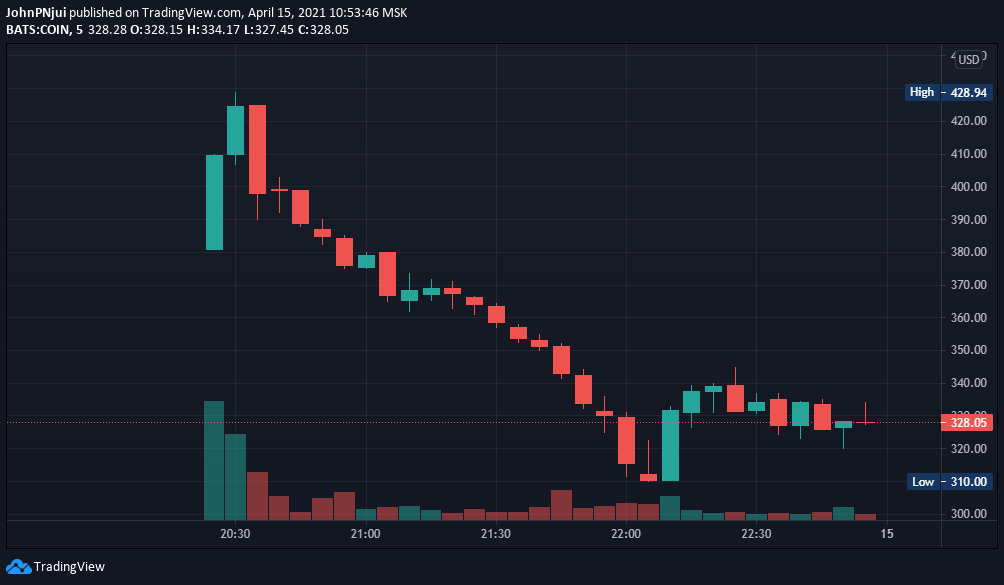
Coinbase (COIN ) Closes Day 1 as the Most Valuable Exchange in the World
Despite Coinbase (COIN) closing the day lower than it opened, the digital asset exchange succeeded in setting a new milestone in terms of being the most valuable exchange in the globe.
According to CompaniesMarketcap.com, Coinbase closed its first day of trading at a market capitalization of $87.38 Billion as seen in the screenshot below.
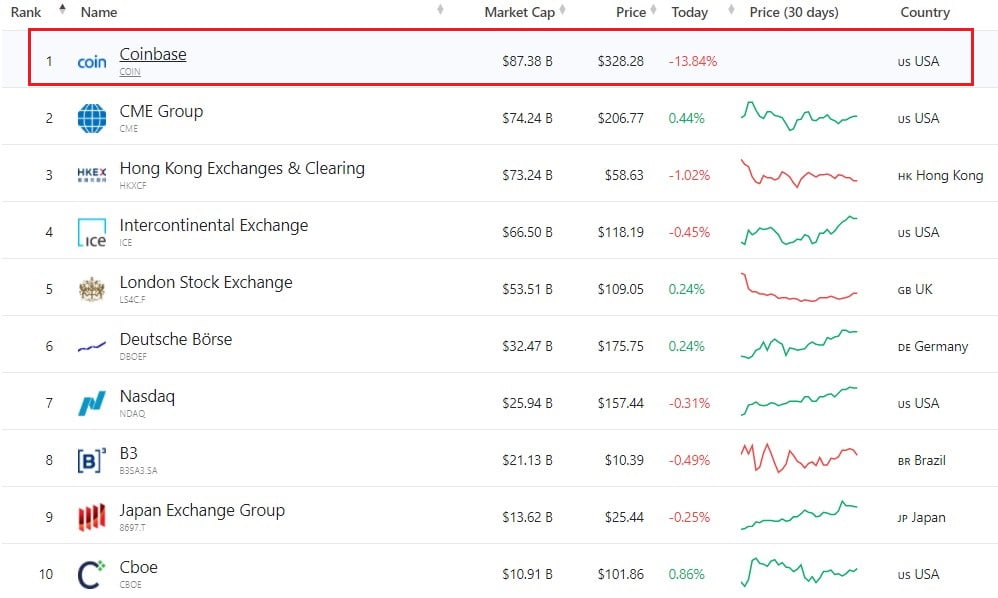

From the rankings above, it can be observed that Coinbase’s market capitalization at yesterday’s close exceeded that of known global exchanges such as the CME Group, Hong Kong Exchange and Clearing, Intercontinental Exchange (ICE), the London Stock Exchange, Deutsche Borse, Nasdaq and the CBOE.
Coinbase (COIN) Exceeds the Market Cap of Binance Coin (BNB)
At a market cap of $87.38 Billion, Coinbase (COIN) also eclipses the market capitalization of Binance Coin (BNB) at $85.565 Billion. This comparison is made with the assumption that BNB may be used to measure the value of the digital asset exchange of Binance.
Binance Postpones Listing COIN Stock Token
Yesterday, the digital asset exchange of Binance was set to list a tokenized version of the Coinbase (COIN) stock.
However, at the last moment, the team at Binance announced that they were postponing listing the token due to market volatility exhibited on the first day of trading COIN. The exchange will announce a new date for the COIN/BUSD pair to open for trading.
Chinese mining pools’ hash power plummets amid regional blackouts

Blackouts for safety inspections in China’s Xinjiang region have significantly impacted the hash rate of many top Chinese Bitcoin mining pools.
The hashing power of top Bitcoin mining pools located in Northwest China appears to have plummeted due to a regional blackout to enable safety inspections.
The news was reported by Wu Blockchain, the author of Chinese crypto newsletter Wublock, who noted significant drops in the hash rate of several major pools — with Antpool crashing 24.5%, Binance Pool dipping 20%, BTC.com falling 18.9% and Poolin dropping by 33%.
The hashrate of Bitcoin mining pools plummeted in 24 hours. Antpools fell by 24.5%, https://t.co/1YRYr58dLy fell by 18.9%, Poolin fell by 33%, Binance pools fell by 20%. The reason is that Northwest China is undergoing a complete blackout for safety inspections. pic.twitter.com/vaWgYsMEFH
— Wu Blockchain (@WuBlockchain) April 16, 2021
According to an article on Chinese media outlet Wu Talk, the region of Xinjiang is currently experiencing a “comprehensive power outage safety inspection.”
The inspections follow a recent flooding accident at a coal mine in Xinjiang that saw 21 miners temporarily trapped at three different locations. The mine was swamped in a sudden flood while making technical upgrades, resulting in communication interruptions and power outages underground. Nearly 1,500 rescue personnel were deployed to the mine to assist with the emergency.
Xinjiang is a major source of global Bitcoin hash rate, with the Cambridge Bitcoin Energy Consumption Index, or BECI, estimating the region currently represents nearly roughly 36% of China’s combined hashing power. With China comprising two-thirds of global mining power, BECI estimates Xianjian to comprise 23.3% of the global hash rate.
According to Ycharts, the outages appear to have driven a roughly 2.2% drop in the Bitcoin network’s combined hash rate in the past 24 hours, which has slid from 169.4 million terahashes per second, or TH/s, to 165.8 TH/s as of this writing.
Blockchain is hard for developers and everyday users. Is it getting any easier?

The blockchain sector has known for years that technical hurdles need to be eliminated for mass adoption to take place. Has any progress been made?


For several years, one of the biggest hurdles to blockchain adoption has concerned the fact that it’s a rather technical space. Experienced developers find it daunting to build decentralized apps using this technology. Meanwhile, consumers unaccustomed to tokens and crypto wallets often struggle with user interfaces that are far clunkier than what mainstream platforms provide.
With cryptocurrencies punching into the mainstream consciousness like never before, it has never been more important for blockchain platforms to seize the moment and offer the streamlined, easy-to-understand products and services that the masses can embrace with minimal hassle. As the old saying goes: “If you build it, they will come.”
Blockchain enthusiasts know that this technology has potential, but you could argue that a key challenge involves conveying these advantages to the public. DApps regularly deliver features that fiat-focused, centralized platforms can never provide — yet their official websites are only understandable to those who have a PhD in cryptography. (This might be a slight exaggeration, but explaining things simply can be a weak spot for many projects.)
There are a few crucial tests to be met before blockchain becomes part of everyday life for us all. Can these platforms be as simple to use as your online bank account? Can they truly be as inexpensive and fast as the fiat payment rails that have existed for decades? And is it possible to create an environment where someone interacts with a blockchain without realizing it?
A great deal of thought also needs to be applied behind the scenes. Right now, top developers are put off blockchain because of the sheer amount of time and effort it takes to grasp basic concepts. Decentralized apps can take too many lines of code to create, in programming languages that are unfamiliar. And even if these two hurdles are overcome, sky-high gas fees can mean that using certain blockchains becomes impractical because of transaction costs.
This has a knock-on effect in other ways. Companies that are keen to start utilizing blockchain technology quickly find that they are unable to do so, because they’re struggling to find talented developers who can make it happen. This drives up costs for everyone, meaning that otherwise viable ideas may not deliver a healthy return on investment. Worse still, these hurdles can mean brilliant concepts that would benefit millions of people end up being unexplored.
A number of crypto projects have now decided that enough is enough. After years of debate and discussion, they’ve concluded that user interfaces need to be simplified, applications have to be faster and slicker, and a plug-and-play mentality must be championed when it comes to blockchain development. Back in the early 2000s, it was difficult for new websites and blogs to be created without some computing knowhow. Then the likes of WordPress arrived — providing esthetically pleasing templates and drag-and-drop modules that made the process intuitive. Where’s this for the blockchain sector?
Making the technology invisible
One network that has positioned itself as the silver bullet for making blockchain technology simple and foolproof is Hathor Network. The platform says it delivers a simplified, risk-reduced sandbox where everyone can implement blockchain — making our lives, businesses and applications better. Hathor Network says it offers a familiar environment for developers who are used to building brilliant things on Web 2.0, and its infrastructure delivers end results that mean the technology is “invisible” to the soccer moms, grandparents and technical novices who use it.
The project describes itself as “the WordPress of blockchain” — and freely admits that everything Hathor Network does, Ethereum does too. But here’s the powerful point: Hathor Network delivers a simpler suite for developers that ensures there is a reduced margin for error. Transaction costs are also far more predictable than on Ethereum, and scaling solutions are already in force. This network also champions interoperability — and this means that, if a developer doesn’t find the tools that they need on Hathor Network, they can easily establish a bridge to a blockchain that does.
As well as championing easy tokenization that allows custom tokens to be created in a heartbeat, Hathor Network delivers nano contracts — an easier, safer implementation of smart contracts that also support real-world data delivered through oracles. Pre-built and simplified, nano contracts can be created through a battle-tested, drag-and-drop interface — and in future, a marketplace will be established that enables developers to integrate existing nano contracts into their DApps with minimum hassle.
Better still, none of this is at the expense of privacy. Businesses who depend on confidentiality when using blockchain technology can benefit from their very own side-DAGs. This flexibility also extends to custom tokens, which can be melted and turned back into HTR tokens with little fuss.
Hathor Network’s development is continuing throughout 2021. Nano contracts are going to be implemented for the first time, with a plethora of new use cases to emerge. The capabilities of this network will expand with every passing month, not to mention the blockchain’s throughput.
With a number of businesses expressing enthusiasm about how blockchain can transform their operations — and the sector beginning to realize that networks need to be able to interact with one another in a fluid way — Hathor Network is hoping to demystify this technology once and for all, ending years of debate by getting things done.
Learn more about Hathor Network
Disclaimer. Cointelegraph does not endorse any content or product on this page. While we aim at providing you all important information that we could obtain, readers should do their own research before taking any actions related to the company and carry full responsibility for their decisions, nor this article can be considered as an investment advice.
Brian Brooks defends fintech charter to House Financial Services Committee

Brian Brooks has defended the fintech charter he oversaw while heading the OCC, warning heavy-handed crypto regulations could undermine U.S. competitiveness globally.
Brian Brooks has defended the fintech banking charter introduced while he served as the acting comptroller of the currency after Congressional Democrats took aim at the license on Thursday.
Brian appeared as a witness before the House Financial Services Committee’s Subcommittee on Consumer Protection and Financial Institutions at an April 15 hearing titled, “Banking Innovation or Regulatory Evasion? Exploring Trends in Financial Institution Charters.”
The fintech charter was introduced by the Office of the Comptroller of the Currency, or OCC, and overseen by Brooks in 2020, allowing financial technology firms including cryptocurrency companies to offer lending and payment products without being overseen by state banking regulators, FDIC insurance, or deposits from customers.
Californian representative and chairwoman of the House Financial Services Committee, Maxine Waters, claimed that banks and state regulators have complained about the lack of regulatory scrutiny faced by fintech firms licensed under the charter:
“State regulators, community banks and credit unions have raised alarms about how new entities, including big tech firms, are receiving unconventional bank charters and offering bank products and services while evading regulations most banks, including community banks, must comply with.”
Waters characterized the OCC of having “overstepped its authority,” accusing the office of “pretending that laws signed by Abraham Lincoln were intended to create charters for fintech or cryptocurrency.”
However, Brooks told the committee the charter had bolstered regulatory oversight of the fintech and crypto industries, arguing their activities would otherwise continue outside of regulators’ view.
Brooks described the charter as empowering firms that “provide consumers with better alternatives to traditional banks on the one hand and strip-mall financiers, like payday lenders, on the other.”
Other Democrats raised concerns that Bitcoin is primarily a vehicle for criminal syndicates, with California’s Brad Sherman claiming the crypto asset is largely used by “tax evaders” and “narco-terrorists.” Texas’s Al Green also advanced what he said were his constituents’ concerns regarding the prevalence of Ponzi schemes in the crypto sector.
Brooks dismissed these worries, arguing that exclusionary regulations could hinder the United States’ technological dynamism and that heavy-handed legislation could undermine U.S. soft power in the emerging digital economy:
“We’re building a second Internet here — it’s not built for terrorist financing, it’s built to allow us to have a truly decentralized Internet. If you believe that America’s soft power in the world has a lot to do with the fact that we control ICANN and the Internet Protocol, I think you would feel similarly about these new protocols.”
Liquity Protocol attracts $1B TVL in just 10 days

The “interest-free loans” decentralized lending protocol now has $1 billion worth of locked-up value after it launched on April 5.
The team behind Liquity Protocol — a DeFi project launched on April 5 — has attracted $1 billion worth of locked up value according to data from Dune Analytics.
From $0 to $1B TVL in 10 days
Here’s some charts highlighting Liquity’s growth so far: pic.twitter.com/qpSzRp0gZs
— Liquity (@LiquityProtocol) April 15, 2021
The Pantera Capital-backed Liquity is a Swiss-based decentralized and governance-free lending protocol that offers interest-free loans against Ethereum locked as collateral, with users required to maintain a minimum collateral ratio of 110%.
Loans are paid out in the protocol’s algorithmic stable coin LUSD, which is pegged to the value of USD at a one-to-one ratio. The protocol automatically generates LUSD to meet user demand, and so far has minted a supply of 480 million stable coins, with more coins being minted than burned each day.
The loans are secured by the protocol’s Stability Pool that acts as a source of liquidity to repay liquidated debt, and also by fellow borrowers collectively acting as guarantors of last resort. Users can earn money through the protocol by staking liquidity and earn revenue from issuance fees in LUSD and redemption fees in ETH.
Data from the mammoth 10-day run published via DuneAnalytics revealed that borrowing demand has rewarded stakers so far, with an average of roughly $240,000 of fees generated per day on the protocol between April 12 and April 14. The total staked amount edged past $720,000 on April 15, and the majority of users are keeping within a collateral range between 150-250%.


On March 29 Cointelegraph reported that the Liquity Protocol had closed its Series A funding round led by Pantera Capital with a $6 million investment, which included additional contributions from companies such as quantitative investment firm Alameda Research.
The decentralized finance protocol sector continues to push past its all-time highs, with data aggregator DeFi Llama showing that there is now $123.33 billion worth of total locked-up value in DeFi protocols as of today. In its short lifespan, the Liquity Protocol has pushed itself up to rank 26 in the top 100 DeFi protocols with $1.06 billion in TVL.
Visa, Mastercard, and PayPal: Major Payment Companies and Crypto

Cryptocurrency has rapidly attracted the attention of mainstream companies. One of the year’s most significant trends has concerned the three leading payment companies—Visa, Mastercard, and PayPal—as each company has turned toward crypto.
Visa Will Settle With Crypto
At the end of March, Visa announced that it is working with the digital asset bank Anchorage. This allows its partners to settle transactions in USD Coin (USDC), a dollar-pegged stablecoin. Crypto.com will be the first company to use this feature, but Visa says that it will offer the feature to other companies as time goes on.
This is the result of at least one year of anticipation. In December 2020, Visa announced a partnership with USDC company Circle that prepared the way for the feature. Earlier, in mid-2020, Visa announced a formal stance on cryptocurrency which focused heavily on the potential of stablecoins as well as security and regulatory matters.
Though this is the first time that a Visa card partner will be able to settle in cryptocurrency, Visa already provides payment cards for more than 25 different cryptocurrency companies including Coinbase UK, Fold, and Cred.
Prior to this, Visa also explored a number of enterprise blockchain technologies. In 2016, it created a system called B2B Connect, and in 2018, it worked with Hyperledger Fabric. Both of these systems were used for internal purposes, not retail use.
Finally, Visa has invested in crypto companies. It invested $40 million on Anchorage in 2019, and it spent $30 million on another startup called Chain.com in 2015.
The firm also filed a patent for a digital dollar in 2020, though it should be noted that patents are rarely used. This patent is likely redundant with Visa’s adoption of USDC.
Mastercard Will Support Retail Payments
Mastercard announced its own plans to add support for crypto this February. It will allow merchants and end users to use cryptocurrency.
Though Mastercard will initially support dollar-pegged stablecoins, just like Visa, its services will be relatively public-facing compared to those of its competitor. Whereas Visa is using cryptocurrency for settlement behind-the-scenes, Mastercard will allow merchants and end-users to make cryptocurrency transactions.
Much like Visa, Mastercard previously allowed third-party cryptocurrency companies to create payment cards on their network. Wirex and BitPay are notable partners.
Mastercard also has developed enterprise blockchain solutions. In 2019, it announced plans to create a blockchain-based cross-border payments platform with R3. It additionally joined the Enterprise Ethereum Alliance (EEA) in 2017, which is largely focused on researching potential uses for the Ethereum blockchain in business.
Mastercard has also invested in blockchain startups. In 2015, it invested an unspecified amount in the Digital Currency Group, a crypto venture capital company.
PayPal Is Already Trading Crypto
PayPal has taken another approach. In August 2020, it announced buying and selling and then introduced those features in October. On Mar. 30, 2021, PayPal added support for crypto payments, allowing users to spend crypto rather than simply buy and sell it.
PayPal will reportedly add cryptocurrency support to its subsidiary, Venmo, by mid-2021. It also plans to expand features to the U.K. quite soon.
The service is offered via Paxos and is available to U.S. customers, who can trade four different cryptocurrencies: Bitcoin, Ethereum, Litecoin, and Bitcoin Cash.
Internal efforts are also underway. In early 2020, PayPal published job postings in search of a blockchain AML strategy director. Prior to this, PayPal worked with Braintree to allow merchants to accept Bitcoin and filed a patent to enhance blockchain speeds.
Like its competitors, PayPal has invested in crypto startups. In recent years, it has invested in regulatory tools like Cambridge Blockchain, TRM Labs, and IDKeep. In 2021, it made another investment, this time in the crypto tax startup TaxBit.
What Will Payment Companies Do Next?
Now that the largest payment companies are using cryptocurrency for settlement, payments, and trading, it seems likely that each company will expand its features competitively. It is also plausible that any of these companies could invest in cryptocurrency directly, similar to Tesla, Microstrategy, or Square.
However, the trend may not be entirely positive. While some see mainstream adoption as beneficial, payment companies will have extensive control over transactions and the ability to deny service to users—something that Bitcoin was designed to avoid.
XRP Leads the Majors on Court Boost, LTC Hits New 2021 Highs, BTC, DOGE, Apr. 12

XRP
XRP was one of the top coins for the week with a gain of 85% taking the coin to highs at $1.40. Ripple’s pending court case by the SEC saw some recent twists in the favour of the crypto project and traders are buying in anticipation of a positive result.
XRP holders had filed a request to intervene as third-party defendants in the ongoing lawsuit against Ripple Labs. The motion was initially refused and after another attempt, the request was accepted.
Lawyer John E. Deaton has been working on behalf of 10,000 XRP holders as they seek to join the case. Deaton said on his Twitter account:
The SEC told the Judge that it disputes #XRP having ANY utility. The SEC’s best argument against #XRPHolders’ intervention is that we are ‘investors’ and Congress authorized the SEC to make arguments on behalf of investors – even if we disagree.
He added, “I plan to take away their ‘best’ argument by showing that it’s not just #XRPHolders (ie. ‘speculative investors’) that are seeking intervention but also businesses, developers, etc. that utilize XRP”.
The SEC is currently suing Ripple and its executives in a $1.3 billion lawsuit over XRP, which the agency deems is an unregulated security. Ripple Labs disputes that claim and the case will continue throughout this year with some potential volatility in XRP.
Ripple has been seeing positive movement with the case after an SEC lawyer implied that cryptocurrency exchanges were not in violation of securities laws by listing XRP. This brought hopes that the major exchanges would move to re-list XRP.
The move in the last two weeks has seen XRP back at number four in the list of coins with a valuation of $60 billion. Binance Coin (BNB) sits at number three with a market cap of $90 billion.
LTC

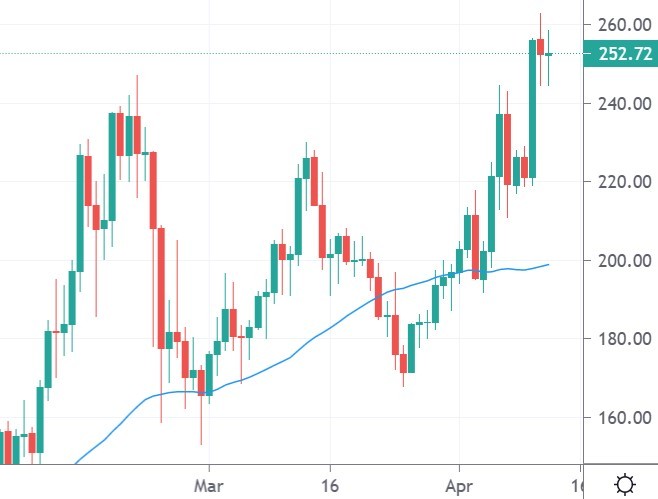
Litecoin was another strong mover this week as the coin saw new highs for the year at $260. The coin got a boost from news that CoinShares was launching a physically-backed exchange-traded product on a Swiss exchange, which will allow institutional investor access. The company also suggested that large investors were beginning to look beyond the “big two” cryptocurrencies for value as BTC and ETH hover near all-time highs.
The all-time high in LTC was nearer $360 so it is still some way from the level set in 2017, while the top two currencies have surpassed their highs from that year in a big way.
The ETF will launch under the ticker LITE and will be initially listed on the SIX Swiss Exchange with a fee of 1.5% per annum. A spokesperson for CoinShares said of the news:
As demand for digital assets amongst the traditional investment community steadily increases, we are starting to see the green shoots of demand for investment exposures outside of the top two dominant networks.
LITE is the third product launched in 2021 by CoinShares institution ETP platform CoinShares Physical. Crypto-backed ETPs have become popular in recent months due to the growing interest of institutions. This trend is acknowledged by Frank Spiteri, Chief Revenue Officer at CoinShares.
CoinShares is the largest digital investment firm in Europe, with over $4 billion in assets under management (AUM). The LITE ETP is the third major launch by the firm in 2021 after a Bitcoin-backed ETP was released in January, closely followed by an Ethereum launch in February.
BTC

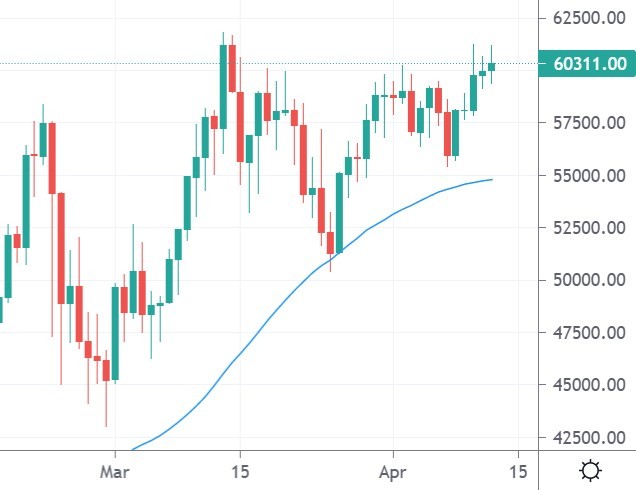
Bitcoin was back above $60k this week with the coin hitting a high above $61k before retreating. The price is trading at $60,300 on Monday as the coin sees a lack of sellers despite the elevated levels.
Glassnode research has been trying to look at new ways of judging a high in BTC and the company’s CTO Rafael Schultze-Kraft, is looking at long-term coin holdings via “Coin Days Destroyed”, which shows the total amount of holding days “destroyed” by those selling their Bitcoin.
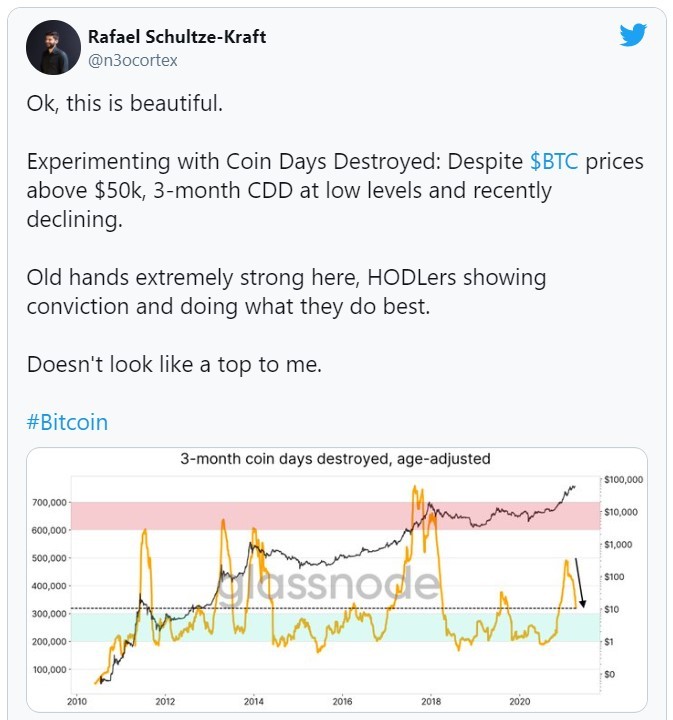

Based on a moving average, the coin days destroyed have pulled back to levels from the summer of 2019, when a price high was already made.
DOGE
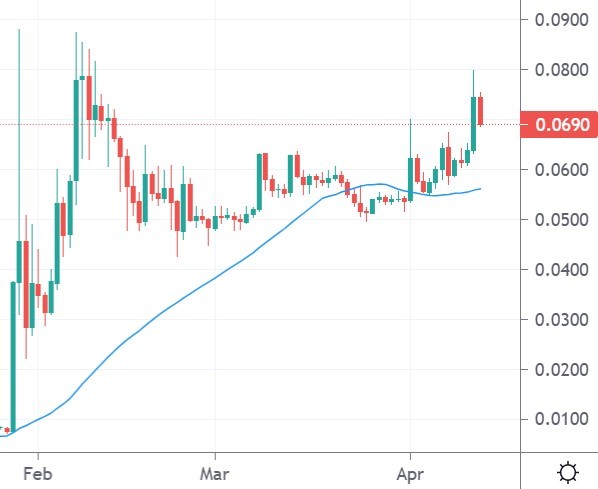
Dogecoin has been creeping higher this week with a 23% move higher to trade at $0.072. The coin touched a high at $0.08, which is close to the all-time highs, and a move through here could see further gains in DOGE and could bring other FOMO flows into the coin.

Independent research firm InvestorPlace published an article on DOGE titled “Inflation and Influencers: How Investors Can Send Dogecoin to $10”.
The report started by saying:
“Even without inflationary changes, the price could still hit $1. The cryptocurrency has 130 billion coins outstanding; a $1 price-per-coin will still leave it 55% the size of Ethereum…, the world’s second-largest crypto. And because only the marginal trade matters in asset pricing, even a few major account owners could theoretically send values soaring.”
The company also suggested that Elon Musk or another wealthy benefactor could help improve the coin by setting up a foundation for its development.
If investors want to send Dogecoin prices to $10, far more is needed than buying the coin and posting tweets. It needs a benefactor to help fund improvements. Elon Musk… could make an even bigger impact by starting a “Dogecoin Foundation” to fund development and promote adoption among startups and enterprises.
For now, the price of DOGE could make big advances if it can get through the highs set in February.
Co-Founder of South Africa’s Crypto Index Fund Reveals the Plan to Launch Country’s First Bitcoin ETF

Earle Loxton, the cofounder of EC10 (formerly DCX Capital) the institution behind the South African crypto index fund, says plans are afoot to launch the country’s first exchange-traded fund (ETF). The ETF is expected to offer South African institutional investors an indirect way of getting exposure to bitcoin.
According to Loxton, an application for this ETF will soon be lodged with the Johannesburg Stock Exchange (JSE). However, Loxton also reveals in a podcast that before proceeding with the application, EC10 alongside Easy Equities will initially prioritize finding a suitable custodian for its crypto assets. Loxton explained:
To get to the level where we will be compliant with the requirements of a listed instrument, we definitely need the services of a dedicated, regulated and registered custodian.
Therefore, as part of an arrangement, Easy Equities, which acquired the controlling stake in DCX Capital in 2020, will help secure the services of a custodian. This custodian will safely store some of the ten crypto assets that constitute the EC10 Index.
Meanwhile, during the podcast, Loxton also took the time to explain the decision to hike the EC10 management fees from 1% to 2%. In justifying the fee increase, the fund’s co-founder said:
“At 1% to be absolutely honest with you, we were never going to make a profit at 1% growing at that rate.”
Loxton also adds that because the business, which now has $27 million worth of assets under management, experienced a slow start, it, therefore, made sense to hike the fee. The EC10 index fund.
Do you believe that the JSE is now ready to approve a crypto ETF? Tell us what you think in the comments section below.