Real Estate Listings Accepting BTC Touch Record Highs, 14.3 Homes per 100,000 Accept Crypto

Bitcoin and the crypto economy have been making their way into the world of real estate these days. A recently published report shows that Realtor.com data indicates that people selling property for crypto assets have risen a great deal. Statistics show that there are 14.3 crypto accepting listings per 100,000 homes in the company database.

Real Estate Listings Are Seeing More Bitcoin Acceptance for Homes and Properties

According to a report from Yahoo Money, the housing market and bitcoin are starting to “collide.” The report talks with real estate agent Whitney Pannell who listed a renovated home for $300,000 and wrote in the listing: “Sellers are accepting Bitcoin for this home.” Pannell says that she is a “firm believer in bitcoin” and told Yahoo Money contributor Janna Herron that she believes “it will be the future.”


Bonnie Heatzig, a South Florida MLS realtor, has also seen an increased amount of real estate listings for crypto in the Sunshine State. “It’s certainly indicative that cryptocurrency is on the rise,” Heatzig told West Palm Beach news (wptv.com). “We are seeing an uptick in Bitcoin and cryptocurrencies being offered for real estate. Since the pandemic, South Florida has seen a large number of very tech-savvy titans and finance titans coming in from Silicon Valley and New York, and these are the people (who) are making these cryptocurrency offers,” she added.

The article also talked with a representative from Realtor.com and the agent said that bitcoin and crypto acceptance in the world of real estate is rising. Realtor.com’s data shows that 71 listings show crypto-asset acceptance which is roughly 14.3 listings per 100,000 homes. Back in 2018, the numbers were lower at 12.7 crypto-related listings per 100,000 homes. Nicolas Bedo, an economic research analyst at Realtor.com said in an interview with Herron that broad crypto adoption may be happening.

“If the cryptocurrency market can get a firmer foothold and grow confidence from the general public, we may see a wider adoption of home sellers accepting cryptocurrencies as payment,” Bedo remarked. In another report from Yahoo Finance, data shows that U.S. real estate sellers are trying to capitalize off of the frothy housing market and cryptocurrencies. Raul Chavez of 800buykwik.com also told Yahoo that his real estate agents have noticed the uptick in crypto listings.

“I feel in the long run, bitcoin will have the higher opportunity,” Chavez said. “Yes, it’s more volatile, but 10 years from now, this is where the world is headed.”

Rick Caruso’s LA Firm Goes Crypto and Luxury Penthouses See Bitcoin Listings

In addition to representatives from Realtor.com and 800buykwik.com, Rick Caruso’s LA-based real estate giant has embraced crypto assets for listings across his retail and commercial properties. Moreover, Caruso told CNBC that the company is investing in bitcoin (BTC) as well with the help of the Gemini exchange. “We’ve allocated a percentage of what would normally go into the capital markets into Bitcoin,” Caruso noted.


The popular online real estate blog thinkrealty.com recently published an editorial called “Three Reasons to Sell Your Real Estate for Cryptocurrency.”

Just recently the Haupt Residence in the Amagansett Dunes area of Beverly Hills got listed for $65 million or the equivalent in bitcoin. Nick Candy’s luxury Hyde Park penthouse was listed for £175 million or the equivalent in bitcoin.

Real estate agent Raul Chavez also explained that the real estate market is extremely hot right now. Flipping houses for cryptocurrency is not the problem as agents are really dealing with “inventory shortages,” the report concludes.

What do you think about the increasing number of real estate listings accepting digital currencies? Let us know what you think about this subject in the comments section below.

Go to Source

NFT Weekly Roundup: Earning Through NFTs, Legendary Muhammad Ali Collectibles, NFT Display in Times Square, and More

The NFT ecosystem is in full bloom, with several renowned names entering the playing field. As more and more artists and creators join the cash-strapped world of NFTs, we’ve got you covered with the latest announcements and launches of the week that are taking the world by storm.

Hashmasks Introduce a Passive Opportunity to Earn

Two of the biggest creative platforms, Terra Virtua and Hashmasks, recently collaborated to launch a unique set of NFTs called the Vflect Hashmasks. Setting a new benchmark in the NFT industry, Terra Virtua and Hashmasks have joined hands to implement a “rolling royalty” framework where Hashmasks NFT owners will be entitled to royalties and proceeds from the forthcoming Vflect Hashmasks Collection sale.

Hashmasks owners need to apply to license their Hashmask to be eligible to earn royalties. With over 16,000 unique Hashmasks and hundreds of special features of each Vflect collectible, this collaboration can generate millions of possible combinations.

Muhammad Ali Enterprises Joins Ethernity to Launch Collection

Ethernity Chain, a blockchain platform with a philanthropic drive, has partnered with the Muhammad Ali Enterprises (MAE) to launch the Muhammad Ali NFT collection. Designed by the renowned digital sculptor Raf Grassetti, the Muhammad Ali NFT collection showcases Ali’s life and legacy. It consists of four NFTs, named GOAT, Wings, Sting, and Float.

Ali had devoted all his life to helping those in need, and Ethernity Chain is focused on supporting charitable causes using blockchain technology, making this collaboration a good fit. Auction for the NFTs has already started on Ethernity Chain’s official website. Part of the proceeds will go to the Muhammad Ali Center, a non-profit museum and cultural center dedicated to the legendary boxer.

Community Art Pixel Board Makes 256 NFTs Available

Dcanvas, the world’s largest collaborative NFT art project, opens its doors to the public for the second time. Following the recent allocation and sale of 1024 NFTs, Dcanvas is now allocating 256 limited NFTs from its colossal community pixel board to the public.

Each of these ERC-721 NFTs contains 16 pixels (4 x 4 block). Ownership of each NFT gives you multiple privileges, including complete control over the pixel color using a 32-color palette, access to a DAO that governs royalties from future NFT-minted art pieces, and the freedom to change pixel colors at any time or re-auction it. All NFTs will be sold through the marketplace site Opensea on the Dcanvas App.

Artifex Orchestrates First-of-its-Kind NFT Display in Times Square

To honor the work of creators who pioneered a new age of NFT art, Artifex Project launches its platform to showcase leading artists and their works. It has curated a collection of original arts by leading visual artists to be auctioned as NFTs.

In a bid to promote the collection and the upcoming auction on May 17, Artifex displays on the eve of May 16 a preview of NFT artworks from 23 different creators in Times Square, New York. Dubbed as the “NYC NFT Takeover,” this unique art collection portrays the artist’s image of self. Artifex displayed previews on OUTFRONT Media billboards, Union Square, Two Bridges, and throughout Manhattan.

Reef Finance Partners With Aavegotchi to Expand Into NFTs

Following its expansion into the NFT ecosystem and the launch of Reef Chain, Reef Finance has partnered with Aavegotchi, making it the first NFT marketplace on the Substrate chain. Reef users can interact with the rare and verifiable Aavegotchi collectibles by staking REEF coins or buying fractions of the collectibles through this partnership.

Aavegotchi, a popular and innovative NFT project, combines gaming mechanics with Defi concepts. Each Defi-powered Aavegotchi is provably rare and verifiably adorable, making them the perfect fit for Reef Chain, designed to aggregate liquidity and accommodate NFT platforms and tokens.

The NFT storm doesn’t calm down. Do you think this recent crop of NFTs float like a butterfly and sting like a bee? Let us know in the comments section below.

Go to Source

Bitcoin (BTC) Price Prediction: BTC/USD Is Stuck between $53,000 and $58,000 as Bears and Bulls Continue Unending Price Tussles

Bitcoin (BTC) Price Prediction – May 7, 2021
Since May 1, BTC/USD upward moves have been restricted below $58,000 high. Bitcoin now fluctuates between $53,000 and $58,000 price levels. Bitcoin bulls have retested the $58,000 resistance level on four occasions but unable to break it. BTC price is now falling after the last rejection.

Resistance Levels: $65,000, $70,000, $75,000
Support Levels: $50,000, $45,000, $40,000

BTC/USD – Daily Chart

BTC price is falling on the downside after rejection from the $58,000 resistance zone. Yesterday, the king coin dropped to $55,500 support and pulled back to retest the $57,000 high before resuming the downward move. Selling pressure will persist if price breaks below the moving averages. The market will fall and revisit the previous low at $53,000. On the other hand, if price falls and finds support above the moving averages, the uptrend will resume. The downtrend becomes necessary because buyers fail to break the $58,000 resistance. A breakout at the $58,000 resistance will propel price to reclaim the $58,000 support. The bullish momentum will extend to the $60,000 psychological price level. In essence, the resumption of upside momentum begins when the BTC price is above the $58,000 support. Today, the market has declined to $55,896 and there are indications of a further downward move.

Largest Latin American eCommerce Platform, Mercado Libre, Adds $7.8m Bitcoin to Its Treasury
Mercado Libre is the largest e-commerce platform in Latin America. The purchase makes the eCommerce platform the 36th publicly-traded company to add Bitcoin to its balance sheet. The Argentinean Company is the first large Latin American company to acquire Bitcoin for its treasury. The company has joined other firms such as MicroStrategy and Tesla, which have holdings of BTC within their assets. The platform has announced to the U.S. Securities and Exchange Commission that it has acquired $7.8 million in BTC in the first quarter of 2021.

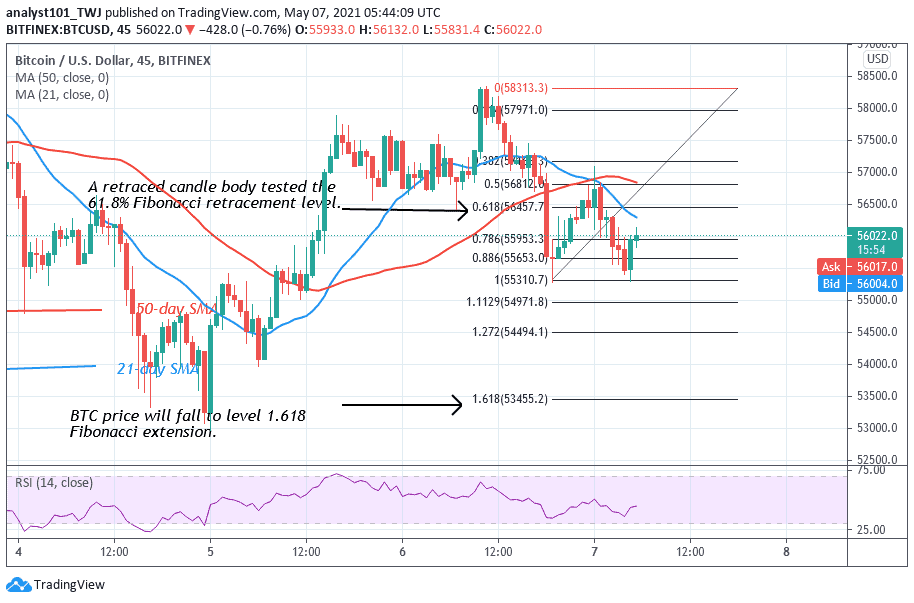
BTC/USD – 45 Mins Chart

BTC price has resumed a downward move after its rejection at $58,000 resistance. The selling pressure may continue on the downside as the coin faces further rejections. Meanwhile, on May 6 downtrend; a retraced candle body tested the 61.8% Fibonacci retracement level. This retracement implies that the selling pressure will continue to level 1.618 Fibonacci extension or the low of $53,455.20.

Go to Source

Bitcoin Price Prediction: BTC/USD Corrects Gain as Price Remains Below $59,000 Level

Bitcoin (BTC) Price Prediction – May 6

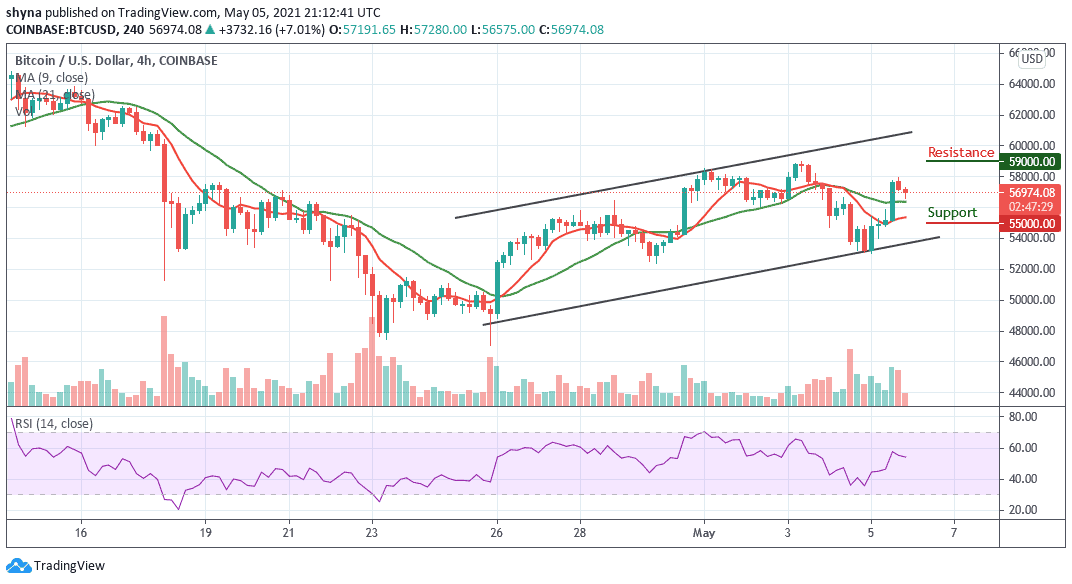
After touching the daily high of $58,400, BTC/USD drops over 0.55% as it trades at the $57,185 level.

BTC/USD Long-term Trend: Ranging (Daily Chart)

Key levels:

Resistance Levels: $62,000, $64,000, $66,000

Support Levels: $53,000, $55,000, $57,000

BTCUSD – Daily Chart

The daily chart reveals that BTC/USD failed to break the $58,000 resistance level with the current consolidation pattern as it fails to stay above the 9-day and 21-day moving averages. The Bitcoin (BTC) started the day off by trending lower toward the $56,000 level within the channel. However, crossing below the moving averages may locate the first support level at $55,000. Beneath this, support lies at $53,000, $51,000, and $49,000 levels.

What is the Next Direction for Bitcoin?

BTC/USD has been gradually and persistently working on a recovery mission with the support of $53,000. Therefore, the largest cryptocurrency hovers at $57,185 as bulls battle to overcome the resistance above the moving averages. On the downside, immediate support has been provided by the 9-day moving average at the $56,433 level. Holding above the short-term support is the key for sustaining the uptrend due to the stability exemplifies in the market.

On the upside, the red-line of 9-day MA crossing above the 21-day MA would prove to investors that bulls are finally in control. As speculation increases for gains beyond $60,000, buying orders are bound to rise, adding to the tailwind force. Today, the Bitcoin price couldn’t go higher but seen dropping beneath the $57,000 level. Although the candle is still yet to close, however, it does look unlikely that the bulls may end up closing above this resistance should in case the technical indicator RSI (14) moves above 60-level. More so, toward the upside, resistance lies at $62,000, $64,000, and $66,000.

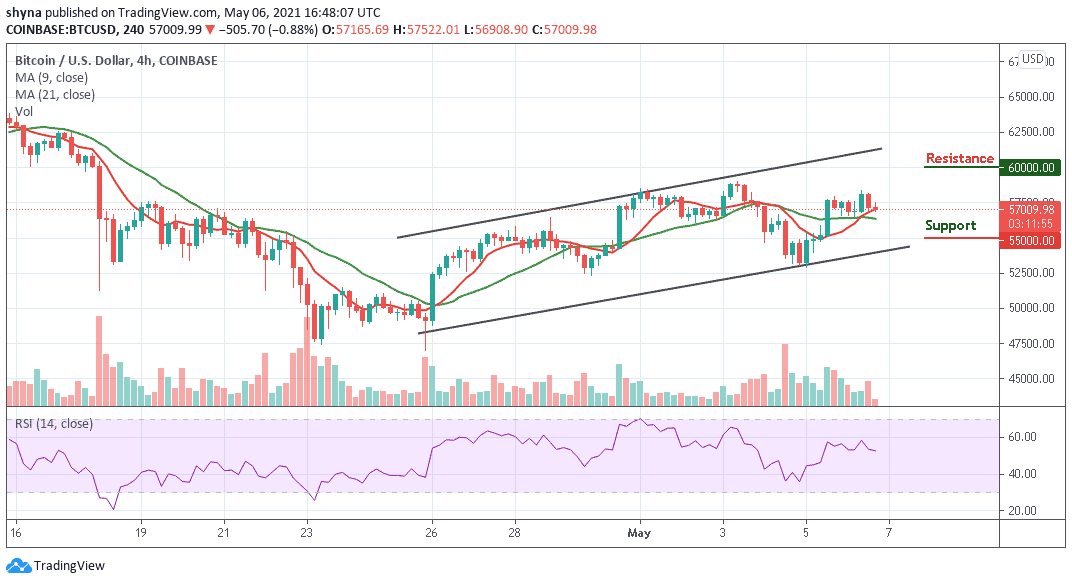
BTC/USD Medium-Term Trend: Bullish (4H Chart)

Looking at the 4-hour chart, the bears are now coming back into the market if the bulls failed to defend the support at $57,000. Nevertheless, the $55,000 and below may come into play if the bearish momentum increases in the market.

BTCUSD – 4 Hour Chart

However, if the buyers reclaim the current movement and power the market, traders may expect a retest at the $57,522 resistance level; breaking this level may further allow the bulls to hit $60,000 and above. At the moment, the RSI (14) signal line is seen moving towards the downside which may give additional bearish signals in the near future.

Go to Source

VanEck and BetaShares Await Approval for Aussie Bitcoin ETF

As Australians venture deeper into the crypto market, fund managers in the country are racing to seek approval from regulators for the first Bitcoin ETF.

Two companies that have submitted formal proposals for review and approval by the Australian Securities Exchange (ASX) are VanEck and BetaShares. The move comes despite reports in May suggesting the regulator remains wary of signing-off on a bitcoin ETF.

Plans to launch Bitcoin ETF

The regulator has confirmed that several investment companies have been making plans to launch Bitcoin ETFs. The chief executive for VanEck in the Asia-Pacific, Arian Neiron, stated that the crypto market was growing and if the ASX approved the ETFs, it would create a safe regulated space for investors.

BetaShares, an ETF provider based in Australia, stated that they had made an application to the ASX. However, the provider’s proposed ETF product did not specify whether the ETF would be directly linked to Bitcoin or other digital assets. The managing director for the company, Alex Vynokur, confirmed the application submission, explaining that it was in response to increasing demand for a bitcoin ETF product.

The ASX did not release any details of the BetaShares application. However, an ASX spokesperson said it was taking an interest in developments and had some concerns, adding that it was closely monitoring Bitcoin and the wider cryptocurrencies market.

BTC/USD 1 day chart, Binance, 6 May 2021. Courtesy TradingView

Wealthy families are buying crypto assets

The bullish trend for cryptos in Australia has been witnessed in recent weeks as wealthy investors expand their portfolios using crypto assets. Financial website Businesss Insider recently revealed that crypto investment firm DigitalX is helping a growing number of family offices to invest in digital assets.

Leigh Travers, the executive director of DigitalX, said that high net worth investors were replacing some of their gold holdings with bitcoin. He also added that bitcoin had changed from being an asset bought solely for speculative purposes, into one held as a portfolio diversifier and protection against currency debasement and rising inflation worries.

The average family office in Australia and New Zealand is thought to hold investments valued at more than $600 million. As these institutions diversify into crypto assets, even a small percentage allocation of total assets – say under 5% – would translate into a large injection of money going into crypto.

The Australian Securities Exchange has also urged firms to become more forthcoming in engaging with them. This will enable it to speed up the process of developing innovative solutions in the region.

Towards the end of April, US regulator the Securities and Exchange Commission (SEC), which has received a number of applications for a Bitcoin ETF, announced that it was delaying the reviews of the proposals until June.

Go to Source

Bitcoin Price Prediction: BTC/USD Breaks Resistance to Reclaim $57,000

Bitcoin (BTC) Price Prediction – March 5

BTC/USD is up by more than 6.94% after a sudden and bullish price spike.

BTC/USD Long-term Trend: Ranging (Daily Chart)

Key levels:

Resistance Levels: $62,000, $64,000, $66,000

Support Levels: $48,000, $46,000, $44,000

BTCUSD – Daily Chart

The daily chart reveals that BTC/USD has pushed above the crucial resistance level of $56,500. The coin is moving towards $57,000 to trade at $56,914 at the time of writing.

Bitcoin is exhibiting strong bullish momentum after what could be a sustainable break above an important technical level.

Meanwhile, BTC/USD has gained more than 6% since the beginning of the day – it is currently using support at $53,000 as a foundation to develop further upside momentum. There are signs of this upside move now gaining traction.

Bitcoin price prediction – BTC back above $60,000?

With the number one coin holding above its moving averages, the return below $57,000 could set the framework for gains towards $60,000.

Meanwhile, the technical analysis shows that the bulls are ready for action, especially when the up-trending RSI (14) is considered. Therefore, any further bullish movement towards the upper boundary of the channel could pave the way for gains above $58,500, before reaching the resistance levels of $62,000, $64,000, and 66,000.

Looking at the downside, if the price falls back below the $55,000 level and moves to cross below the lower boundary of the channel, the bears could take control over the situation very quickly. This may serve as a major blow to market sentiment, as traders could interpret it as a sign of underlying weakness. The next critical support is likely at $52,000, probably followed by $48,000, $46,000, and $44,000 support levels.

BTC/USD Medium – Term Trend: Bullish (4H Chart)

The 4-hour chart shows the price failing to stay above the moving averages – a sign of market weakness. However, the intraday trading is looking bullish; following the recent rebound at $53,000, which is the key support level. If bitcoin trades below the moving averages, it could test the next key support level at $55,000.

BTCUSD – 4 Hour Chart

But against the backdrop of the recent sharp rebound, the bitcoin price may re-commence the bullish rally to challenge resistance at $57,000. A climb above that level may encourage bulls to target a breach of the next significant resistance level at $59,000.

Go to Source

Citigroup Launches Crypto Trading and Custody Services

Citigroup, a banking giant, is launching a crypto trading and custody service. The new service aims to meet the growing demand for crypto assets.

Itay Tuchman, the global head of forex for Citigroup, has confirmed that the bank had witnessed a rapid accumulation in Bitcoin (BTC) interest from institutional clients. Tuchman announced the move in a report published in Financial Times.

According to Tuchman, banks could venture into crypto through proprietary trading, where they use their resources to make profits. “There are different options from our perspective, and we are considering where we can to best service clients. This is not going to be a prop-trading effort,” said Tuchman.

Not happening any time soon

However, Citigroup has confirmed that it is taking its time to launch crypto services. Tuchman stated that the bank would only jump into the crypto space when it was sure that its clients could benefit. It would also consult with regulators to build something robust and compliant.

“I don’t have any FOMO [fear of missing out] because I believe that crypto is here to stay and that we are just at the very beginning of the market. This isn’t a space race. There is room for more than just one flag.” Tuchman said.

In March this year, the bank released a report saying that Bitcoin could become a global trading currency after evolving. The report indicated that people’s perceptions about Bitcoin were changing. This would create a new opportunity and make the token more mainstream.

BTC/USD 1 day chart, Binance, 7 May 2021. Courtesy TradingView

Citi’s interest in Bitcoin

Citigroup analysts have written a paper on Bitcoin titled, “Bitcoin: At the Tipping Point’. The report indicated that BTC would change from a nascent form of payment to a store of value. Also, if there’s a boost in Bitcoin’s global reach, the crypto asset could easily become an international currency. This can be achieved through Bitcoin’s attributes such as decentralisation and borderless design.

Citi’s report on the currency shows that BTC may come in handy to exporters and importers. It would simplify international trading and may even be preferred to fiat currencies. Bitcoin lacks forex risk exposure. It is also fast, traceable, and guarantees the security of online payments.

Citigroup is not the only Wall Street bank to venture into the crypto space. Top banking institutions that have ventured into crypto include Bank of New York, Goldman Sachs, Mellon, and Morgan Stanley. This latest move comes amidst increased retail and institutional demand for crypto assets.

Go to Source

Terra Virtua (TVK) High-Yield Staking Comes To Binance

Binance is allowing its clients to earn interest from staking on the  Terra Virtua platform. Participants able to earn a maximum of 47.67% annual percentage yield (APY).

The staking event for the Terra Virtua NFT platform, which is aimed at artists, collectors and gamers, began on 6 May. Early stakers will fill the first spots.

Interest payments will be made daily, with the calculation period beginning at 0.00 UCT each day.

The official announcement from Binance had a visual representation showing staking activity and the standard annual rates users will earn.

Binance will offer several staking products with various periods and APYs related to the TVK. In some instances, users will be able to redeem their assets before maturity.

If a user chooses this option, Binance will give the user back their initial investment minus the distributed interest earned. At the time of writing, TVK was trading at $0.54.

TVK/USD 1 day chart, Binance, 7 May 2021. Courtesy TradingView

How staking and yield farming has grown

Staking is similar to depositing fiat in return for interest payments. It developed in crypto first as a way of earning interest on coins being ‘hodled’ and then, with the arrival of proof-of-stake blockchains, as a way of committing resources to a project in a method for selecting validators.

Since then staking has been further extended, with stakers becoming, for example, liquidity providers on DeFi networks and being rewarded with a yield in return.

The growth in the number of DeFi protocols operating lending and borrowing products saw an explosion in ‘yield farming’, where traders would hop from one network to another in search of the highest yield in a type of arbitraging strategy.

Depending on the system, the more value staked or ‘locked’ on a network and the longer duration it is locked up for, the greater the rewards. Protocols of proof-of-stake platforms will tend to select verifiers of blocks on the basis of which addresses/nodes have the largest values. Staking has become another way to earn passive income for crypto investors and arguably a more attractive approach than joining a mining pool.

Important things to note

The official report by Binance also gave some pointers about some of the most important things to note. Users can view the staking assets locked away by going to their Binance wallets and the savings section.

The APY will be displayed daily on the Binance page. The period for unlocking the staked products will be 24 hours. As an investor, one should note that staking is very risky because of the high market volatility. However, Binance has assured its customers that it will choose high-quality coins to minimise trading losses.

Go to Source

Smart Contracts Account for Almost 23% of Ethereum (ETH) Supply

Ethereum (ETH) has surged in value by over 400% since January 2021 and the main reason is the popularity of DeFi protocols, with a growing portion of ETH supply committed to the sector.

Glassnode, a leading on-chain analytics company, has published a report analysing smart contracts on Ethereum. It shows that smart contracts currently hold 22.8% of the total ETH supply. This percentage increased from 16%.

Furthermore, the supply of Ethereum on leading crypto exchanges has sharply declined in recent months. The ETH supply now held on these exchanges is currently at 12% compared to the 17% reported in September 2020.

More Ethereum on DeFi Applications

The Glassnode report shows that large ETH volumes were withdrawn from known exchange wallets, reaching more than 200,000 ETH daily. The ETH tokens transferred from exchanges are finding their way into smart contracts and DeFi applications.

The demand for ETH on DeFi protocols is boosting the value of the cryptocurrency. As of the time of writing, ETH has breached the $3,400 mark, and its market cap is more than $390 million. Ethereum now has a market cap greater than PayPal and MasterCard.

This will be the first time that Ethereum’s value reaches $3400. Some market speculators even predict that the coming months may be bullish for Ethereum and bearish for Bitcoin. With Bitcoin unable to reach its previous $60,000 ATH, Ethereum’s market dominance is growing.

ETH/USD 1 day chart, Binance, 7 May 2021. Courtesy TradingView

Increased institutional inflow

Because Ethereum can host and run decentralised applications, including DeFi, its institutional inflows have been growing strongly. The latest report from digital asset manager CoinShares shows that ETH attracted $30 million in institutional inflows last week. ETH assets under management held by institutions has now hit $13.9 billion, according to CoinShares

Grayscale, the largest global digital asset manager, recently published financials for all its crypto assets under management. The company currently has over 3.1 million ETH, valued at more than $11 billion.

Ethereum 2.0 is also reporting an uptake. The layer two network upgrade now has 4.3 million in staked ETH with a value of almost $15 billion.

Even with the high transaction fees on Ethereum, activity on its network has increased in recent months. This should continue push up the value of Ethereum and investor returns.

Go to Source

ETH Bullish Rally Shows no Signs of Slowing Down

This week has been the best ever for Ethereum (ETH). The coin has rallied past $3,500, which marks its highest value this year, with its market dominance increasing by 17%. Its latest market cap ($398 billion) means the currency is now more valuable than MasterCard, PayPal, and Bank of America.

Supporting the bull case for Ethereum is the strengthening fundamentals. For example, Ethereum deposits are lower than ETH withdrawn from exchanges, while ETH deposits to DeFi have doubled in three months.

Maintaining bullish rally

Despite the four times growth in ETH since the beginning of the year, current market activity suggests that the bull run will not be slowing down anytime soon. The supply of Ethereum on various exchanges has been slowing down faster than exchange inflows. This trend shows increased growth and less risk in investing in crypto.

The growth trend of Ethereum is also an exciting aspect that investors should be looking out for. The non-exchange ETH whale addresses have doubled while the exchange ETFs have dropped by half. This is an opposite trend to the exchange and non-exchange whale addresses.

Increase in Ethereum DeFi Deposits

As ETH is increasingly flowing out of exchanges, there is an increase in the number of ETH deposits flowing into DeFi protocols. The total value of ETH deposited in DeFi protocols has increased two times in the past three months.

In addition, deposits made to the ETH smart contracts have also increased to a record high. The value of Ethereum coins added to the deposit contracts on the Ethereum mainnet has also grown to reach around $13 billion. The total value on the Eth 2.0 deposit contracts has reached ATH 4.2 million ETH.

There has also been evidence that institutional adoption of ETH has also increased. The ETH premium recorded on Coinbase has also increased significantly since the beginning of the year. This adoption will most likely push the value of ETH higher and even result in overall success.

However, it has not been all roses for Ethereum, given the increase in gas fees on the ETH platform. Nevertheless, gas fees have dropped significantly over the last few years, attracting more investors to the platform.

It has also seen increased network activity on the Ethereum mainnet. Ethereum is also looking to complete the upgrade to Eth 2.0 by the end of next year.

The Berlin fork was the most recent milestone on the Eth 2.0 roadmap, taking place in mid April. This upgrade will increase on-chain activity on Ethereum and could push ETH prices even higher.

Go to Source

Enterprise Ethereum Alliance Appoints Tim Grant of SIX Digital Exchange to Board

Instrumental in SDX’s Digital Asset ExchangeVision, Grant Joins the EEA Board to Advance EEA’s Mission, Engage Members and Foster the Continued Adoption of Ethereum


WAKEFIELD, Mass. – April 21, 2021 – The Enterprise Ethereum Alliance (EEA) today announced the addition of a newly appointed Board member Tim Grant, head of business at SIX Digital Exchange (SDX), the Swiss-based leading digital asset exchange of SIX Group. The EEA also welcomed SDX as a member. Grant will take part in guiding the organization’s vision and in other Board initiatives as part of his participation with the EEA.

Grant will work closely with the EEA Board of Directors and member community to identify ways to accelerate the pace of Ethereum innovation and adoption.

“This is an exciting time for Ethereum. In the past year we have begun to see the true realization of the potential of Ethereum which has given birth to decentralized finance, ‘DeFi’, along with an acceleration of interest in this greatest of blockchains by exchanges and central banks. Tim’s expertise in operating enterprise-grade distributed ledger solutions for financial services will be instrumental for the EEA to align more closely with the direction of DeFi exchanges, the Ethereum Mainnet, and the Ethereum technology and its enterprise derivatives,” said EEA Executive Director Dan Burnett.

  • Join Tim Grant and EEA leaders at the April 22nd Ethereum in the Enterprise 2021, a free, half-day event, to explore how the Ethereum Mainnet can be used to drive value, speed up settlement times, increase transparency, and decentralize commerce across all industry sectors. Register free of charge at bit.ly/enteth2021.

Grant has over twenty years of deep technology and management expertise across institutional capital markets, enterprise blockchain businesses, and Ethereum from his time serving in senior positions in financial services, including as CEO of the R3 Lab and Research Centre, Managing Director at UBS O’Connor, and UBS Investment Bank and, more recently, as Founder and CEO of DrumG Technologies.

“It is with great excitement that I join the Board of Directors of the EEA, which is where leaders collaborate on what’s next on the Ethereum roadmap and how to use Ethereum technology in daily business operations. I look forward to working with the EEA Board and member community on paving the way for a thriving enterprise Ethereum ecosystem, and to take a leading role in driving growth in the Ethereum-based global institutional digital asset marketplace,” said SDX’s Head of Business Tim Grant.

Grant is driving SDX’s vision to launch the first, fully regulated DLT-based asset exchange that can develop fully integrated issuance, trading, settlement, and custody infrastructure for digital assets to serve financial institutions across global capital markets.

“We are delighted to have Tim join the EEA’s board. Tim’s passion and knowledge for blockchain and digital assets make him uniquely qualified to help the EEA advance the business use of Ethereum technology. He brings a wealth of expertise from working with financial institutions across global capital markets including the issuance, listing, trading, CSD infrastructure, and custody of digital assets and cryptocurrencies. Tim will be a tremendous asset to the EEA Board as we continue to build out our roadmap,” said John Whelan, chairman of the EEA Board of Directors and Head of Digital Investment Banking at Banco Santander.

About the EEA

The Enterprise Ethereum Alliance (EEA) enables organizations to adopt and use Ethereum technology in their daily business operations. The EEA empowers the Ethereum ecosystem to develop new business opportunities, drive industry adoption, and learn and collaborate. For additional information about joining the EEA, please reach out to membership@entethalliance.org or visit https://entethalliance.org/join.

Follow the EEA on Facebook, Twitter, LinkedIn.


The post Enterprise Ethereum Alliance Appoints Tim Grant of SIX Digital Exchange to Board appeared first on Enterprise Ethereum Alliance.

Go to Source

Enterprise Ethereum Alliance Presents Ethereum in the Enterprise April 2021

Top Ethereum and Industry Experts to Present on “The Public Mainnet: The Art of the Possible” at the free EEA Virtual Event on April 22 from 1:00 – 5:00 p.m. EDT

WAKEFIELD, Mass. — April 15, 2021 — The Enterprise Ethereum Alliance (EEA) today announced Ethereum in the Enterprise 2021: The Public Mainnet: The Art of the Possible – a free, half-day virtual event presented by the EEA on Thursday, April 22, 2021, running 1:00 p.m. to 5:00 p.m. EDT. Register free of charge at https://bit.ly/enteth2021.  

With presentations by some of the world’s most prominent Ethereum business and technology leaders in blockchain, the event will provide a highly informative and collaborative experience. 

WHAT: Ethereum in the Enterprise 2021, a virtual event and premier gathering of the top Ethereum business leaders, technologists, and industry experts in the blockchain space. Attendees will hear directly from the global Ethereum community about the latest business reference implementations, real-world use cases, and technical innovations. View the full agenda here; key topics include:

  • The Art of the Possible – Real World Examples from the World of DeFi
  • The State of Ethereum & Ethereum Roadmap
  • On-Chain vs Off-Chain: Where Compute and Storage Happens in Supply Chain and Real Estate
  • NFTs in Business and Commerce
  • How Layer 2 Addresses Barriers for Enterprises Building on the Mainnet
  • Idealists vs Realists: A Debate on Eth2, Layer 2, Rollups, and More

Fireside Chat with Joseph Lubin, Ryan Sean Adams, and More

WHO: The event will feature keynote presentations, fireside chats, case studies, and panel discussions led by industry, business, and technical speakers from leading organizations worldwide. View the speaker line-up here.  

WHEN: April 22, 2021, from 1:00 p.m. to 5:00 p.m. EDT. 

WHERE: Attendees can register free of charge for the online event at https://bit.ly/enteth2021.  

The EEA would like to give special thanks to the Ethereum in the Enterprise 2021 media partners. Learn more about becoming a media partner by contacting marketing@entethalliance.org.  

About the EEA
The Enterprise Ethereum Alliance (EEA) enables organizations to adopt and use Ethereum technology in their daily business operations. The EEA empowers the Ethereum ecosystem to develop new business opportunities, drive industry adoption, and learn and collaborate with one another. For additional information about joining the EEA, please reach out to membership@entethalliance.org or visit https://entethalliance.org/join/.   


Follow the EEA on Facebook, Twitter, LinkedIn.  

For further information: 

Alexa Stewart, EEA Public Relations 

+1 781-876-6242 

astewart@virtualinc.com  

The post Enterprise Ethereum Alliance Presents Ethereum in the Enterprise April 2021 appeared first on Enterprise Ethereum Alliance.

Go to Source

EEA Member Spotlight with Jonas Simanavicius, Co-founder and CTO at Syntropy

EEA Member Spotlight with Jonas Simanavicius, Co-founder and CTO at Syntropy

As an EEA member, Syntropy is part of the EEA community of organizations working to advance Ethereum and drive industry adoption. In the Q&A below, the EEA interviewed Jonas Simanavicius about how Syntropy is helping the ecosystem achieve the potential impact of Ethereum.

Please introduce your company and yourself briefly

Syntropy transforms the public internet into a secure and user-centric internet, where encryption and optimized performance are built-in and automatically enabled for anything and everything connected to it. Through our internet unification layer, we are connecting all cloud and bare-metal locations from 200+ providers and 550+ unique regions, leveraging all underutilized network capacity found across the web.

Anything built on the current internet can also be built on Syntropy using the Syntropy Stack. It allows anyone to create and deploy applications on Syntropy, with connections automatically optimized-for-performance and encrypted-by-default. The stack is also compatible with millions of devices and services, including cloud, on-premise and edge infrastructure. We are giving developers the power and control to build on our unifying layer.

Before starting Syntropy, I was part of the engineering and application development teams at Royal Bank of Scotland and JPMorgan Chase. It was there where I learned about Bitcoin and the potential impact that decentralized technologies could have on the world. Connecting the utility of blockchain with my expertise in networking software was a clear opportunity that I could not pass up. Teaming up with other successful tech entrepreneurs (including a co-founder of Equinix) set the rest in motion.

What first brought you to the Enterprise Ethereum Alliance, and why did you decide to become a member?

Joining the alliance made perfect sense for us given the utility of Ethereum and its obvious place in the enterprise market. We developed our technology with direct input from many enterprises, so being able to learn from even more EEA members made this an ideal match. The alliance also helps us stay up to date on business trends related to developer tools, tokenomic models, smart contract security, blockchain adoption, etc. It’s not only a great opportunity to engage with potential new users, but also collaborate with some of the most promising Ethereum-based projects and organizations.

What are you currently working on with regards to Ethereum? How will end-users benefit from your work?

Syntropy already utilizes Ethereum smart contracts, but right now we are adding the final pieces to our tokenomic model, which puts our ERC-20 token, NOIA, at the core of our protocol. In addition to this, we recently launched the Syntropy Stack, which helps developers and network teams to easily create secure optimized connections between any of their devices or services running on cloud, on-premise, or edge locations.

We think it’s a big deal for the blockchain industry as the stack can make decentralized infrastructure faster, more secure, and highly reliable. This positions Syntropy to become the go-to technology for building blockchain infrastructure, ensuring that all connections become formalized, encrypted and streamlined. Syntropy facilitates networks at its core so we realized early on that we could equip the average node runner with the right tools and remove the complexity that comes with setting up nodes.

How will the EEA enhance your organization’s current efforts?

The Syntropy tech stack has already launched. It’s tailor-made for enterprise applications. It solves real needs enterprises face every day, including the cost and hassle of setting up and managing vast networks, handling security breaches, and dealing with suboptimal internet performance.

By aggregating enterprise users and technologies like ours, we hope to bridge the gap between next-gen services and large potential users to solve real business needs.

As mentioned, our technology is also ideal to simplify and augment blockchain infrastructure setups. We’ve already done pilot tests with decentralized services like Chainlink and Polkadot — including an official integration with Elrond — and believe most Ethereum-based applications (including Ethereum itself) could benefit from our technology. We want to work with every project and network to strengthen the decentralized Ethereum ecosystem.

What EEA programs are you most excited about?

For me, it is the working groups within the alliance. Specifically, the Trusted Execution Task Force and the EthTrust Security Levels Working Group, both of which cover topics that could greatly improve our network and keep us up to date on best security practices. The blockchain-based payments interest group also looks interesting as we are seeing a lot of attention placed on token adoption and crypto regulations.

Our team and technology can be strong contributors to these areas. Learning and working with fellow members on these issues would be equally as valuable.

Learn More and Connect with the EEA
The EEA enables organizations to adopt and use Ethereum technology in their daily business operations. We empower the Ethereum ecosystem to develop new business opportunities, drive industry adoption, and learn and collaborate. Our global community of members is made up of leaders, adopters, innovators, developers, and businesses that collaborate to create an open, decentralized web for the benefit of everyone. Join us and contribute to our work!

Learn more about EEA membership, sign up for the latest updates and contact membership@entethalliance.org.

The post EEA Member Spotlight with Jonas Simanavicius, Co-founder and CTO at Syntropy appeared first on Enterprise Ethereum Alliance.

Go to Source

EEA Member Spotlight with Alexandre Bourget, StreamingFast’s Co-founder and CTO

EEA Member Spotlight with Alexandre Bourget, StreamingFast’s Co-founder and CTO
As an EEA member, StreamingFast will be part of the EEA community of organizations working to advance Ethereum and drive industry adoption. In the Q&A below, the EEA interviewed Alexandre Bourget on the ways StreamingFast helps the ecosystem achieve the potential impact of Ethereum.

Please introduce your company and yourself briefly.
StreamingFast is a radically different infrastructure product for Ethereum and for empowering developers with better queries and streaming semantics than blockchain nodes. The founding team is made up of serial entrepreneurs, with deep expertise in big data, cybersecurity, dev ops and blockchain. Combined, we have built and sold 6 companies, with the last one being sold to Intel. We have a passion for blockchain technology, and our goal is to help developers build performant applications by organizing the world’s decentralized data.

Having built big data solutions at Intel, my team and I understand the data engineering challenges of maintaining large swaths of data like blockchain data, but very few people are working on how to quickly and reliably read from this data. That’s where StreamingFast comes in, with a radically different streaming-first approach. The StreamingFast core value proposition: it’s the simplest, fastest, and most reliable blockchain data stream in the industry, for real-time as well as historical data.

What first brought you to the EEA, and why did you decide to become a member?
Enterprises that are working within the blockchain space will be helping to drive technology for the next decade to come. While core protocols tend to focus on the best write speeds to the underlying blockchain databases, it often creates a lot of compromises when it comes to reading that data. We’ve devoted ourselves to working on those solutions, and we believe that the EEA – as the first stop for those Enterprises seeking out guidance – is the perfect fit to help us share our knowledge, tooling, and expertise to save these companies months of engineering time.

What are you currently working on with regards to Ethereum? How will end-users benefit from your work?
We recently publicly released StreamingFast, a radically different infrastructure product for Ethereum. By empowering developers with better queries and streaming semantics, blockchain nodes can be optimized for a different role than they could ever natively provide. Well-known companies have been utilizing our APIs for some time and the feedback we’ve received so far has been incredibly positive. Many of the development teams we speak with utilized multiple service providers for redundancy, occasional latency issues, and feature completeness. After trying out StreamingFast, some of our users have been able to drop all of their other providers, as we were able to provide a single solution that just simply worked when they needed it. The main value propositions of StreamingFast include:

Simpler: use 90% less code. Single integration for accessing a low-latency stream of Ethereum data, from block 0 to the tip of the chain. No need for complex retry logic.
Cheaper: cut down on 99% of your Web3 calls. Avoid out-of-sync calls. Use in-stream updates to ERC-20 balances, Uniswap reserves, or any other contract’s state update.
More reliable: read linearly, no more polling. Paradigm-shifting use of a cursor for reliable linearity of the stream, guaranteed across disconnections and in fork situations. Something native nodes with WebSockets can only dream about.
Faster access to real-time blocks: Get data earlier than any other traditional node provider. Our nodes race to push out data, instead of you hitting one load-balanced node out of 1000, most of which are lagging because of propagation delays.
Complete: full history at your fingertip. Stream data and state changes from genesis. Let go of your archive nodes.
Data-rich, industry-wide. EVM-call level introspection: full call graph, all state changes, logs, keccak data, gas costs, Ether balance changes, internal transactions, input data & return data plus some decoded events and state changes.

StreamingFast is available for both Ethereum mainnet and private Ethereum deployments.

How will the EEA enhance your organization’s current efforts?
One comment we have received multiple times in the past was “How come we didn’t have StreamingFast when we started building?” We want to meet Enterprises before they start building. We know that we can save them time and money, and make sure Ethereum remains their first choice of protocol. By removing a lot of the added blockchain complexity around things like fork resolution, Enterprises will be able to get to production faster and simplify the experience for their developers. Our relationship with the EEA will provide Enterprises with exposure to the solutions they need, at the time they need them.

What EEA programs are you most excited about?
We are excited to participate in the Interest Groups as well as the Working Groups. We have been involved with blockchain enterprise deployments for multiple years. As such, we are looking forward to sharing use cases, discussing industry requirements and collaborating to develop open, standards based-specifications to accelerate the adoption of Ethereum-based enterprise solutions.

Learn More and Connect with the EEA
The EEA enables organizations to adopt and use Ethereum technology in their daily business operations. We empower the Ethereum ecosystem to develop new business opportunities, drive industry adoption, and learn and collaborate. Our global community of members is made up of leaders, adopters, innovators, developers, and businesses that collaborate to create an open, decentralized web for the benefit of everyone. Join us and contribute to our work!
Learn more about EEA membership, sign up for the latest updates and contact membership@entethalliance.org.

The post EEA Member Spotlight with Alexandre Bourget, StreamingFast’s Co-founder and CTO appeared first on Enterprise Ethereum Alliance.

Go to Source

Chainlink’s Next Level of Support Below $32 is Around $27 – Weiss

  • Chainlink is currently battling to maintain the $32 price area as a support
  • According to Weiss, $27 is the next level of support should $32 fail for Chainlink
  • On a fundamental level, the team at Chainlink has awarded a community grant to ChainSafe
  • The grant is aimed at expanding the Chainlink Oracle pallet on Polkadot

The digital asset of Chainlink (LINK) is currently undergoing a fierce battle in defense of the $32 price area. This is after the digital asset dropped to a local low of $30.02 – Binance rate – during yesterday’s crypto-wide sell-off that saw Bitcoin drop to $47,500.

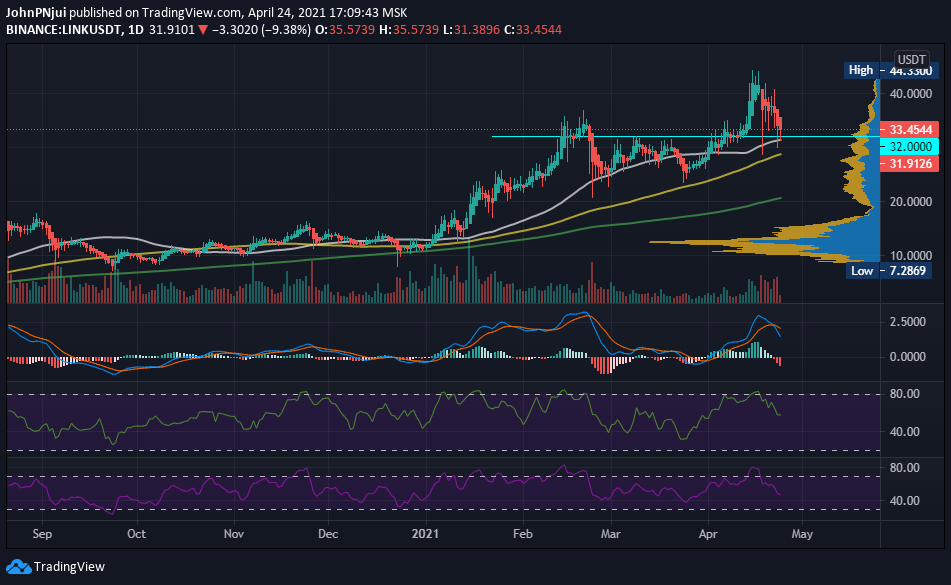
At the time of writing, Chainlink is trading at $31.866 with the team at Weiss Ratings identifying $27 as the next level of support should the $32 price area fail. Weiss used Chainlink’s volume profile to derive the $27 support, as showcased through the following tweet.

Chainlink Could Thrive in The Month of May

A quick glance at the daily LINK/USDT chart reveals that the $32 support is currently where the 50-day moving average lies. A breakdown of this level will ultimately lead to more losses with the identified $27 price zone being the next area of interest.

Also from the chart, it can be observed that the daily MACD has crossed in a bearish manner above the baseline thus confirming the possibility of LINK falling further. The daily trade volume is also in the red highlighting ongoing selling by traders. The daily MFI and RSI are also pointing towards an ongoing correction for Chainlink that should last till the beginning of next month.

Chainlink Awards Community Grant to ChainSafe

Despite the current market uncertainty surrounding Chainlink, the fundamentals surrounding LINK remain strong.

Yesterday, the team at Chainlink awarded a community grant to ChainSafe to expand and improve the on-going support of the Chainlink Oracle Pallet on Polkadot (DOT).

The grant is aimed at improving the way developers build applications on ‘Polkadot parachains, Kusama parachains, and Substrate-based blockchains to integrate a highly secure and reliable source of external data feeds’.

Go to Source

Please enter CoinGecko Free Api Key to get this plugin works.
Exit mobile version