Will Amazon’s Digital Currency Lead the Way to Crypto Adoption?

Amazon has announced plans for its own digital currency, according to various news reports. Though the project is not a blockchain-based cryptocurrency, the decision could potentially lead the way to crypto adoption in the future. Here’s why.

Amazon Has Hired a Regulatory Team

According to the U.K. newspaper The Telegraph, Amazon has recently recruited six regulatory specialists form the the Financial Conduct Authority (FCA).

Based on recent job postings from Amazon, those experts were hired to lead a new division called Digital and Emerging Payments (DEP). That division has been tasked with creating a system that will alow users to “convert cash into digital currency” for spending on services like Amazon’s retail service and Amazon Prime Video.

The Telegraph noted that Amazon already has a digital currency, “Amazon Coins,” for its app store on Kindle and Android. However, the supposed upcoming digital currency would presumably have a wider variety of uses than the system that curretly exist.

The job postings that revealed this information have been taken down, but it seems the project is still underway given that Amazon has hired for the relevant roles.

New CEO Is Interested In Blockchain

In addition to these hires, Amazon has appointed a new CEO, Andy Jassy, who will replace the company’s current CEO Jeff Bezos.

Jassy previously was the CEO of Amazon Web Services, a division which handled Amazon’s enterprise blockchain offerings. The most notable service from the division was 2018’s Amazon Managed Blockchain, which allowed companies to quickly deplyo popular blockchains like Hyperledger Fabric and Ethereum.

However, clients largely use Amazon Web Services and other enterprise blockchain services for data management purposes, not to carry out cryptocurrency transactions. As such, Jassy’s participation in Amazons’s AWS blockchain efforts is not necessarily a sign that the company will embrace cryptocof urrency.

Nevertheless, jassy has alluded to the possibility that Amazon’s clients could take blockchain services beyond their current applications. In a 2017 conference, he stated “We are very intrigued by what customers are ultimately going to do there.”

Will Amazon Make Use of Bitcoin?

Amazon’s upcoming digital currency is not necessarily a cryptocurrency. However, if it does decide to move into cryptocurrency, it has a few options.

Amazon’s first option is to use blockchain technology to manage transactions and user wallets. This strategy could look similar to the Facebook-backed Diem stablecoin, which uses Bitcoin-like blockchain, but with greater capacity for regulatory control.

The company also has the option to accept existing cryptocurrencies like Bitcoin. In that case, it could integrate with services like BitPay or Coinbase Commerce.

Finally, Amazon could buy Bitcoin as an investment without initially accepting it, similar to the course of action taken by companies like Microstrategy and Tesla. That would help the company gauge interest in Bitcoin before making further moves into crypto.

However, these options are all ultimately speculation, and Amazon’s first option may not be directly rated to cryptocurrency to begin with.

Other Factors for Amazon Crypto Adoption

Even though Amazon has not directly acknowledged cryptocurrency, it has good reason to adopt it, as some of its competitors are already doing so.

E-commerce platform Shopify has historically allowed its users to accept Bitcoin and other cryptocurrencies in their storefronts. It has also joined Libra’s Diem crypto project, and its CEO has recently expressed interest in Ethereum and DeFi.

Likewise, the tech retailer Newegg has supported Bitcoin since 2014. This year it began to accept Dogecoin alongside the more famous cryptocurrency.

Meanwhile, Dogecoin fans are petitionining Amazon to accept their cryptocurrency. The group’s Change.org petition has accumulated over 200,000 signatures. When it reaches 300,000, it will become one of the site’s most popular petitions.

In Summary

Overall, Amazon is one of the most likely companies to engage with cryptocurrency. Its plans for a digital currency, combined with its decision to promote a blockchain leader to CEO are both signs that it has some interest in the area.

Furthermore, Amazon will need to create a cryptocurrency initiative to compete with big tech companies like Facebook and PayPay, which are rapidly advancing their crypto efforts. To a lesser extent, Amazon may want to pursue cryptocurrency to compete with smaller retail companies such as Newegg and Shopify.

However, it does not seem that there will be any definitive news in the near future, and it could some time before Amazon announces a formal crypto initiative.

Go to Source

Bitcoin’s Influence on Traditional Financial Markets

Bitcoin was founded in early 2009 by an anonymous individual or group of individuals using the pseudonym Satoshi Nakamoto. It was initially mostly used for online gambling and received little coverage. However, now we see the increased popularity of virtual currency and the financial sector is trying to implement it in many different services and the growing demand actually works at its advantage. 

Advantages of Using Bitcoin 

Bitcoin is a decentralized digital asset, which means that it is not governed by any national laws. As a consequence, bitcoin is not subject to federal oversight or controls. Money is exchanged using so-called digital wallets, which ensure that all senders and recipients remain anonymous. Only non-identifiable digital wallet IDs are presented, preserving the platform’s unobtrusive nature. In addition, despite its anonymity, all transaction documents are saved, making it very straightforward. Individuals, i.e. aspects of the financial exchange, are still untraceable, but archives make bitcoin more reliable. Apart from the aforementioned advantages, bitcoin transactions have a number of other advantages, such as being fast, easy, completely digital, more convenient, and so on.

Availability is another aspect that has contributed to bitcoin’s popularity. When the number of internet users grows, so does the popularity of digital payment services and virtual currencies. Bitcoins can be bought or sold to other sovereign currencies on the internet in a matter of seconds. As a result, Bitcoin FX brokers, such as Hotforex Forex broker can now be seen in a variety of countries, improving the crypto industry’s operation. Many young, particularly technical businesses choose to use bitcoin over conventional currency because of the ease with which they can be exchanged, purchased, or sold.

Bitcoin isn’t the only cryptocurrency that has gained popularity throughout recent years. Every year, more and more digital payment mechanisms emerge on the global web. When Bitcoin, which is now regarded as the most popular cryptocurrency on the planet, rose to prominence, many expected it to cause a significant change in the way the finance sector works. Then, in 2017, bitcoin’s price plummeted, raising new concerns about the currency’s value and reliability. The markets were rocked by events that year, owing to extensive media reports of the bitcoin market price change. However, whether it affected conventional equity markets in major financial capitals such as London, Tokyo, and New York remains to be seen.

Skepticism towards Bitcoin 

Many economists and financial market experts agree that cryptocurrencies’ rising influence and current conditions are unsustainable. Many countries and their respective legislations continue to refuse to accept virtual currencies as a part of their financial realms, causing them to fall behind in meeting demand. They are either totally unrestricted and allowed to float free, or they are strictly supervised. 

As a result, companies that lack their own visibility are gradually turning to cryptocurrencies like bitcoin and others. It allows them to conduct financial transactions without having to rely on conventional banking and money transfer services. This is what led to a series of booms along bitcoin’s journey to where it is now. Despite its advantages, it still faces several obstacles and lacks adoption in conventional economic sectors, reducing its relevance and presence on the global capital system.

Influence on Traditional Financial Market 

As previously said, bitcoin and blockchain stock market hysteria sometimes make their way into the mass media. More notably, the 2017 financial crisis sparked a global outcry and had a marginal impact on related financial sectors. However, also after more than a decade since its inception, bitcoin is still considered a niche currency. Many people could be surprised by this, given that the article begins with a mention of the company’s significant market capitalization. However, its ceiling of nearly $1 trillion USD pales in contrast to the overall large money in the United States, which stands at more than $18 trillion.

With such numbers, bitcoin cannot compete with them in any way on conventional markets, limiting its position and overall influence. Gaining traction in more constrained markets, such as those in Europe and major economies around the world, is much more daunting as bitcoin fails to incorporate itself into its ecosystems.

Summing It Up 

Finally, to sum up, without a doubt, the future will bring us more technical progress and creativity. As a result, digitalized financial institutions and cryptocurrencies have a good chance of succeeding and influencing existing economies. However, given the current state of affairs, sovereign currencies will continue to dominate conventional markets for some time. One of the main reasons for that might be mentioned to be the fact that there is no shared agreement or idea of what does bitcoin represents, is it a way for exchanging goods and services, a valuable asset, or investment for the future. As a lot of countries are trying to find the best purpose of its use, it is expected to gain momentum and use it to reach higher levels. 

Go to Source

Bitcoin Price Finds Support for $60k Push, Analyst Sees LTC Rally, BAKE, FTM, May. 3

BTC

Bitcoin price gains have continued over the last week as the coin cements the support around the $50k level. There was a risk of further selling, but the bulls have kept the uptrend intact for now. 

One reason for the recent gains in BTC was another options expiration on Friday and this one was for $4.2 billion. Bearish options traders have obviously been moving along the expiry dates with large bets and when the expiration comes, BTC has room to move higher.

The bellwether of the cryptocurrency market will now seek to move back to the $60k level, which capped the upside in recent weeks. 

Bitcoin has also begun its ‘Taproot’ update, which is the coin’s biggest upgrade in years. The move will see Bitcoin multi-signature transactions cheaper, more private, and easier to deploy. Miners can include special data in their blocks from now and the upgrade will activate in November. 

Binance CEO Changpeng Zhao has said that the volatility of BTC is probably less than that of stock prices of companies with similar market caps, such as Apple and Tesla.

Volatility is everywhere. It is not unique to crypto 

The crypto exchange CEO also said that speculators are a driver, saying:

There’s always a large number of people having the herd mentality than the guys who actually do serious research. Whenever there is some negative news, they run away, whenever there’s positive news, they try to rush in and so they do cause more volatility.

BTC Price Index

BTC saw a slump to $47,500 as traders bailed out on longs, but the recovery now sees the coin above the 50-day moving average. A push through the $60k level has the all-time highs at $65,000 within reach once more. Previous fears over a crackdown on financial institutions have failed to emerge, but that would be a headwind, along with a US dollar rally after the greenback saw a strong week. Rising virus cases in the likes of India are a threat to the recovery story in the overcooked stock market.

LTC

Crypto trader and analyst Michael van de Poppe has predicted a potential 65% move in LTC/BTC in the coming weeks. “Litecoin looks great for a bullish impulse wave,” he said.

Van de Poppe told his 70k+ Youtube followers that the coin could power higher and a move of that magnitude would see the coin likely testing its all-time high versus BTC, which was $375 in late-2017.

Litecoin has seen ETF investment products set up recently which will draw institutional investors, while Grayscale Asset Management suggested that large investors had been moving outside of BTC to invest in other coins. That explains the Ethereum move above $3,000 this week and LTC has also been strong. Grayscale reported in a Tweet last week that the company is approaching $50bn of assets under management.

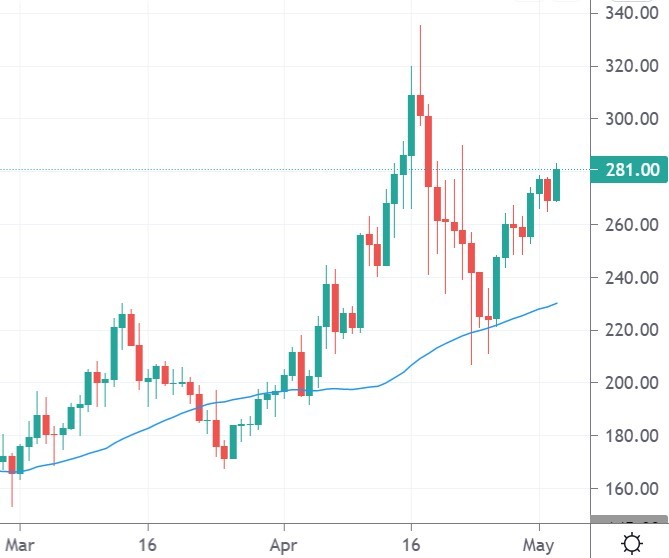
LTC Price Index

LTC is trying to make a play for the $300 level and the yearly highs were at $335.

BAKE

BakerySwap had a big week with the decentralized exchange up 400%. Similar to Pancake Swap, the platform allows the swapping of tokens on the Binance Smart Chain (BSC). There is also a marketplace for swapping non-fungible tokens (NFTs).

Liquidity providers on the Bakery exchange are rewarded with BAKE tokens, which can also be staked for NFTs. 

Bakery is now ranked at number 86 in the list of coins by market cap with a valuation of $1.3bn, while the CAKE project has a valuation above $6.8bn. The BakerySwap project’s Twitter account urges fans to: “$BAKE it, till you make it!”

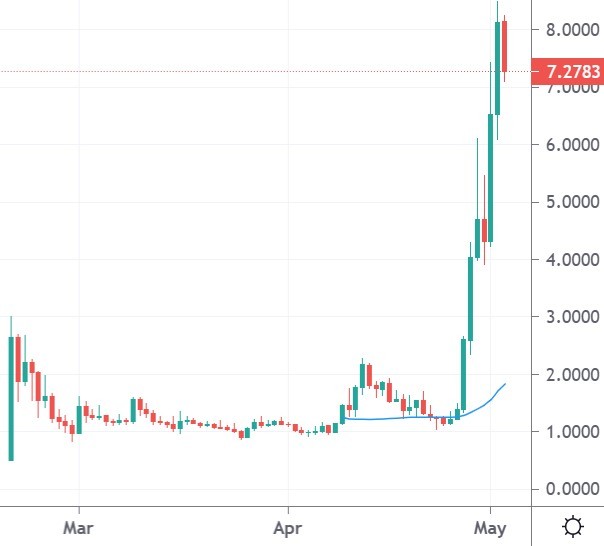
BAKE Price Index

The BAKE token has soared since April with a move from $1.00 to $8.00 as traders see it catching up to PancakeSwap.

FTM

Fantom announced last week that HyperChain Capital, a digital assets manager, has invested $15 million in the project’s ecosystem via the FTM token. HyperChain added to an earlier investment of $2.5 million in 2018. 

The Fantom project also released an upgrade called Go-Opera on Thursday. The team claims that the upgrade will improve network performance and reliability with the transaction time reducing to only one second.

Alongside this, there were also partnerships announced with SuperFarm, Clover, and Orion Protocol, which could strengthen the FTM capabilities in decentralized finance and non-fungible token space.

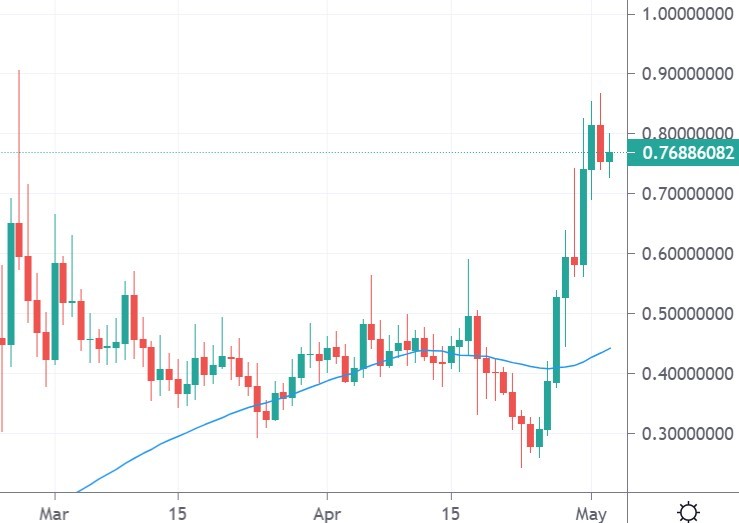
FTM Price Index

The FTM token has now more than doubled from the mid-May lows near the $0.30 level and the highs at $0.90 are now in reach. FTM has a market cap of $1.8bn and is ranked at number 72 in the list of coins. Billionaire Mark Cuban recently said he was a fan of Fantom and that started the bounce from the recent lows.

Go to Source

Who Was Satoshi Nakamoto? Speculation Ten Years After His Disappearance

April 2021 marks the tenth anniversary of Bitcoin creator Satoshi Nakamoto’s disappearance, an event that passed control of the blockchain to its community.

Nakamoto sent his last message to other developers in 2011. Among those is a note that reads: “I’ve moved on to other things. It’s in good hands with Gavin and everyone.” That message refers to Gavin Andresen, one of the earliest Bitcoin developers.

In the ten years that followed, the crypto community has engaged in widespread speculation on Nakamoto’s true identity—but it has reached no definite conclusion.

Was Hal Finney Satoshi Nakamoto?

One of the most popular candidates for Nakamoto’s true identity is Hal Finney. This theory is largely based on a Forbes article dating back to 2014.

Finney was a cryptographer who was involved in Bitcoin’s development from a very early date. He also communicated with Satoshi Nakamoto directly. An analysis between Finney and Nakamoto’s writing styles seemingly confirmed shared writing styles.

Additionally, Finney had a neighbor named Dorian Satoshi Nakamoto. Finney may have used Dorian Nakamoto’s name in order to direct attention away from himself.

However, the author of the original Forbes article, Andy Greenberg, ultimately discounted the theory upon hearing a denial from Finney himself.

Was Dorian Nakamoto the Creator?

Some have speculated that Dorian Nakamoto himself may have been Satoshi. That theory was investigated by Leah McGrath Goodman for Newsweek in 2014.

During that interview, Dorian Nakamoto stated: “I am no longer involved in that… It’s been turned over to other people… I no longer have any connection.” Those statements were seemingly taken as a confession to past involvement with Bitcoin, but Nakamoto later clarified that he was referring to past work for military contractors.

Soon, Satoshi Nakamoto’s account on the P2P Foundation website posted a message stating that he was not Dorian Nakamoto. However, Satoshi Nakamoto’s account was previously hacked, meaning that the statement means very little.

Despite Dorian Nakamoto’s denial, his image has been widely used, making him the face of Bitcoin regardless of his actual role in the cryptocurrency’s creation.

Other Candidates for Satoshi

Another candidate for Satoshi Nakamoto is Nick Szabo (above center), a cryptographer who designed a Bitcoin precursor called “Bit gold” in 1998. Researcher Skye Grey used writing style analysis to connect the two identities in 2013.

Despite this, Szabo has outright denied that he is Nakamoto: “I’m afraid you got it wrong doxing me as Satoshi, but I’m used to it,” he stated in 2014.

Hashcash creator Adam Back (above left) and b-money creator Wei Dai (not pictured) are sometimes believed to be Nakamoto as well. Both monetary technologies are precursors to Bitcoin, and both are cited in the Bitcoin whitepaper.

Finally, Craig Wright (above right) has claimed to be Satoshi Nakamoto repeatedly. He has motives for doing so: Wright has created a Bitcoin competitor called Bitcoin SV and is involved in numerous lawsuits that attempt to collect early Bitcoin address balances. This has led the majority of the crypto community to denounce his claims.

Was Satoshi Nakamoto a Group of People?

Some have speculated that Bitcoin was not created by a single person, but rather a group of collaborators. Variations on the theory have been endorsed by individuals such as the infamous tech entrepreneur John McAfee, who recently suggested that Bitcoin was created by a “team of eleven people over a period of five years.”

On the question of who authored the orignal Bitcoin whitepaper, McAfee commented: “How they decided who would write the paper, I don’t know.”

Others have speculated that Bitcoin is actually a government project. The CIA or NSA could have created Bitcoin as a “honeypot” trap: while Bitcoin provides a basic level of privacy that appeals to criminal users, it is also a system that is ultimately traceable.

Those who advance this theory claim that the Japanese words “Satoshi Nakamoto” can be translated to “central intelligence agency.” However, that is very loose translation. Even assuming that translation is correct, it is equally plausible that Satoshi Nakamoto was formerly involved with the CIA and used the term ironically.

Will Nakamoto’s Identity Be Discovered?

It seems unlikely that Satoshi Nakamoto will ever reveal his true identity. Some information can be glimpsed from online messages, such as time stamps, IP addresses, and mining patterns. Yet that has data has largely been exhausted.

All that remains are Nakamoto’s known Bitcoin addresses. Currently, there are over 1 million BTC ($57 billion) in those addresses. If any of those coins move, analysts would be able to observe Nakamoto’s spending patterns and potentially deduce his identity.

However, after more than ten years, it is unlikely that Nakamoto will ever return to move his Bitcoin, leaving his identity a mystery—possibly forever.

Go to Source

EEA Member Spotlight with Mark Fitzgibbon, DAO Member – Operations at API3 

EEA Member Spotlight with Mark Fitzgibbon, DAO Member – Operations at API3 

As an EEA member, API3 is part of the EEA community of organizations working to advance Ethereum and drive industry adoption. In the Q&A below, the EEA interviewed Mark Fitzgibbon on the ways API3 helps the ecosystem achieve the potential impact of Ethereum.

Please introduce your company and yourself briefly.

API3 seeks to create powerful decentralized applications by providing decentrally governed and quantifiably secure data feeds directly to data consumers on the Ethereum blockchain. I’m an IT professional with more than 20 years of experience and currently working with API3 in operations and the Enterprise business development team.

What first brought you to the EEA, and why did you decide to become a member?

Joining the EEA seemed a natural course of action due to our B2B focus, particularly in the Enterprise sector. We hope to contribute to the development of standards for enterprises, grow our network, and add value where we can.

What are you currently working on with regards to Ethereum? How will end-users benefit from your work?

API3 is currently working on launching our Airnode product, as well as our DAO governance portal. After that, we will be integrating numerous API data feeds onto Ethereum. Later in the year, we plan to provide an automation and integration platform for data consumers to use to build customized/aggregated data feeds on their own Airnodes.

We also recently obtained GDPR compliance certification via code audit for the Airnode oracle, a blockchain industry first. This is something we pushed hard to achieve as part of our focus on B2B and the Enterprise space specifically, to remove a significant barrier to adoption from the compliance area for Ethereum as a public blockchain. We’re also working hard to engage with Enterprises and develop strong partnerships to drive adoption and expansion of the enterprise Ethereum space, and we hope to secure opportunities and partnerships in this area in the near future.

Our most recent development was a 10 year exclusive partnership with the Open Bank Project, to bring CeFi APIs for banking onto the Ethereum chain, over 400 of them to start with.

How will the EEA enhance your organization’s current efforts?

EEA will enable us to network with other members and look for ways to add value to their operations. We’d be happy to contribute to membership education in areas based on our expertise and project focus, adding value and knowledge. We look forward to exploring the challenges and opportunities involved in bringing more varieties and quantities of real-world, API-driven off-chain data to blockchain data consumers on Ethereum. This, we hope, will lead to new applications and use case-driven projects utilizing these new types of data and helping  to grow the blockchain space as a whole over time.

What EEA programs are you most excited about?

We are most excited about the EEA’s working groups and learning from other members. The Ethereum Mainnet, Financial Services and EEA Supply Chain Interest Groups cover areas we are exploring at present, and where we hope API3 can be a valuable contributor. We also plan to participate in the soon-to-be-launched DeFi Interest Group. This is something that we hope to explore further as we spend more time engaging with EEA, learning, growing the relationship with the EEA and our fellow members. Workshop and conference opportunities for greater engagement would also help us to contribute and learn.

To learn more about API3, visit https://api3.org/, read the blog and follow along on Twitter.

Learn More and Connect with the EEA

The EEA enables organizations to adopt and use Ethereum technology in their daily business operations. We empower the Ethereum ecosystem to develop new business opportunities, drive industry adoption, and learn and collaborate. Join us and contribute to our work!

Learn more about EEA membership, sign up for the latest updates and contact membership@entethalliance.org.

The post EEA Member Spotlight with Mark Fitzgibbon, </br> DAO Member – Operations at API3  appeared first on Enterprise Ethereum Alliance.

Go to Source

EEA Ethereum Developer Tool Survey Results

The Enterprise Ethereum Alliance Mainnet Working Group created a survey to solicit input from enterprise developers working on Ethereum applications.  The survey was promoted by email to EEA mailing lists, and on Twitter, from November 2020 to January 2021. Here is a summary of the results and responses to key questions.

  • There were 42 respondents.
  • 73% of the respondents identify as an enterprise software developer or architect working on Ethereum applications.  Presumably the others are developers who do not associate with the term “enterprise.”
  • 72% of the respondents are working with Ethereum Mainnet; 74% are working with private chains; 51% are working with both.

Notable responses to “Which of these do you think are most in need of improvement, and in what ways?”

  • Solidity should have ready-made examples of supply chain and DeFi and other applications
  • Solidity: bring on-chain identity, ZKP and Homomorphic Encryption to be useful for regulatory compliant security assets
  • Solidity: We should have a webflow like software
  • Transaction tracing and Solidity debugger
  • [Bring] Web3js up to date with solidity features
  • Something like webflow
  • Stability [of] Truffle Ganache
  • Truffle, to compile each file with different compiler version, VSCode better debugger plugin.
  • Network setup, e.g., start N nodes with basic setup for privacy, permissioning – Besu is working on it but needs improving to be awesome for enterprises
  • Remix, so widely used and yet has so little resources dedicated to it
  • Smart contract coding for kids (similar to Scratch Studio)
  • Web3j, not well maintained
  • My current pain point is complete abi2 support in Web3j
  • [Support for] Rust
  • #tx/sec
  • None, but optimistic rollups to execute contracts on L2 are essential
  • Support of nodejs wrappers for quorum-based evms
  • The documentation tools need improvement. Integration in one of the major documentation-generating tools would be nice
  • IPFS browser integration
  • IPFS, or any other enterprise-grade, production ready storage solution
  • IPFS: Protected access; all the other is REST…
  • Interoperability between different Blockchains
  • Kaleido


Notable responses to “What tools or libraries or services do you think are missing and should exist?”

  • Ease/automate building API on top of smart contracts
  • General REST-API “producer” for Smart contracts
  • [Tools for] regression testing, profiling, formal verification
  • Good debug facilities across java application and solidity would be great
  • A good visual debugger
  • Signer libraries for key stores like Key Vault, KMS and HSMs
  • Webflow, 2nd layers tools for development
  • web3j or any web3 should have separate APIs to manage a) create a transaction, b) sign a transaction by web3 or independently and c) submit the transaction to the desired network.
  • Deployment libraries and hybrid development (public testnet/local – proxied which survives recompiles).
  • MetaMask … is useful but could do with more support for developers, i.e., local RPC networks
  • JS libraries for evm’s on quorum
  • UI components
  • Interoperability libraries to perform connections another blockchain networks
  • Central open-source library of smart contracts and their detailed documentation.
  • Handling decentralized organizations
  • Rust based client
  • TokenScript


Notable responses to “What standards do you think are missing or should be improved?”

  • Shielded/confidential tokens, e.g., Aztec and Anonymous Zether.
  • Interoperability between off-chain sources
  • Best practices for: non-pegged Stablecoin and Utility token economics, handling real software products based on Ethereum (business and development aspects)
  • Privacy
  • Security standards
  • on-chain encryption
  • Ipfs alternatives, interoperability
  • Documented commitments of cash bounties for security disclosures
  • REST-API first
  • Messaging
  • KYC
  • DID/SSI support as base layer for application integrations for human, company and machine identities
  • Better NatSpec standards: https://github.com/ethereum/solidity/issues/10825


Notable responses to “What other Ethereum-related challenges do you face as a developer?”

  • High gas fees
  • Gas price
  • Gas price
  • Changing – high gas cost on public blockchain
  • Ethereum 1 scalability
  • Scalability
  • Privacy
  • Security testing
  • KYC
  • CI/CD-Automation – not platform bound (e.g., Infura etc.)
  • Nonce management for resilient architectures
  • Solidity version changes
  • Solidity has many improvements to offer in the future for date and structure management
  • Slow testnet deploy/ debug standard
  • Poor documentation, Products that don’t work as expected
  • Learning resources that are up to date
  • There just isn’t the maturity that there is with Java tools. there is still a lot of copying and pasting to deploy contracts once you are doing non-simple things, e.g., deploying a solidity contract IN the genesis file WITH storage
  • Reliability: RPCs are not that reliable from an enterprise point of view. Need more features to strengthen RPC or use open source MQs for messaging
  • Communications with other developers. Need a network.
  • Bft, private transactions
  • Issues with interactions in open Ethereum
  • Building an economic system around a decentralized application that maximizes network effects in order to prevent someone forking the project and decreasing protocol revenue or needing to develop closed-source projects


Conclusions

Several suggestions for improvements to the development tool ecosystem were made. Due to the relatively small sample size, there are no major clusters or trends identified (aside from gas price/scalability). It may be useful to repeat the survey in a few months.

High transaction fees and scalability were mentioned as challenges by several respondents. This suggests a need to educate developers about Layer 2 technologies which are intended to address these problems.

The post EEA Ethereum Developer Tool Survey Results appeared first on Enterprise Ethereum Alliance.

Go to Source

Q&A with EEA’s EthTrust Security Levels Working Group Co-Chairs on the Importance of EthTrust

The Enterprise Ethereum Alliance (EEA) announced the formation of the EEA EthTrust Security Levels Working Group, which will continue the advances begun by the Ethereum Trust Alliance (ETA), now part of the EEA, on the EthTrust project. The group aims to set standards for secure, smart contract transactions that are conducted within the Ethereum ecosystem.

In the Q&A below, EEA EthTrust Security Levels Working Group Co-Chairs Tom Lindeman, the former managing director of ETA, chair of the EEA Security Special Interest Group, co-founder of ConsenSys Diligence, and director of Strategic Initiatives, ConsenSys Software Inc. and Pierre-Alain Mouy, former ETA product owner and managing director at NVISO Security in Germany, provide an overview on the new working group.

What is the function of the EEA EthTrust Security Levels Working Group and why does it arise?

Today in the Ethereum ecosystem, a rating system to help users understand the level of trust and security for smart contracts do not exist. Think of it as a Michelin rating system for restaurants – you can get an idea of the quality and level of security audit ahead of time. Given that there are still so many issues and hacks with smart contracts today, we believe that the EEA EthTrust Security Levels Working Group will help drive trust and confidence in Ethereum as a global transaction layer in 2021.

  • RSVP to attend the Dec. 15th EEA “EthTrust Security Levels,” webinar hosted by the EthTrust Security Levels Working Group leaders at 4:00 p.m. Eastern.

When will we see the first security standards for smart contracts?

We have been working on the project for several months, and as a newly launched EEA initiative, we expect to see the first working system and specifications in Q1 of 2021.

These security standards may be applied to smart contracts developed on blockchains other than Ethereum?

Yes, this is certainly possible. Currently, we are focusing on getting this to a place for Ethereum as the EEA EthTrust Security Levels Working Group. The Working Group’s mission will be to continue the advances begun by the Ethereum Trust Alliance (ETA), now part of the EEA, on the EthTrust project, that will set standards for secure, smart contract transactions that are conducted within the Ethereum ecosystem.

What is the greatest vulnerability of smart contracts?

Smart contracts are more powerful and flexible than people realize. Even if the developers only intended for certain functions to be possible, it is often the case that other interactions may be possible. Since smart contracts are open and generally permissionless, anyone can interact with them and try to find coding mistakes, logic mistakes, or unintended exploits.


What role will EthTrust play in the evolution of DeFi?

Today only a percentage of smart contracts in the Defi space, especially in the new area of yield farming, are actually formally audited. This has to change, and once it is clear that projects that have EthTrust certified smart contracts are becoming the new normal and those projects are successful, we believe that it will essentially become a requirement for launching a new project when a user is deciding whether to stake their tokens in Pool A or Pool B, for example, the first thing they may check-in whether there is an EthTrust certificate.

What’s the best way to learn more about the Working Group?

For more information about joining the EEA EthTrust Security Levels Working Group, please visit https://entethalliance.org/participate/working_groups/ or reach out to membership@entethalliance.org.

The post Q&A with EEA’s EthTrust Security Levels Working Group Co-Chairs on the Importance of EthTrust appeared first on Enterprise Ethereum Alliance.

Go to Source

How Ethereum Layer 2 scaling solutions address barriers to enterprises building on Mainnet

Tas Dienes, EEA Mainnet Working Group

December 2020

If you’ve been following the buzz in the Ethereum ecosystem recently, you’ve probably heard about high transaction fees and the limited processing capacity of Mainnet.  You may also have heard about Layer 2.  Layer 2 is a set of technologies or systems that run on top of Ethereum (Layer 1), inherit security properties from Layer 1, and provide greater transaction processing capacity (throughput), lower transaction fees (operating cost), and faster transaction confirmations than Layer 1. Layer 2 scaling solutions are secured by Layer 1, but they enable blockchain applications to handle many more users or actions or data than Layer 1 could accommodate.

Layer 2 is a broad field in which many teams are researching and building different scaling solutions that are sometimes competitive and sometimes complementary. The major categories of L2 solutions are: state channels, side chains1, plasma, optimistic rollups, zk-rollups, and validium. There are also some hybrid solutions that have properties of multiple categories.  Each has its own set of strengths, weaknesses, and tradeoffs. Diving into how each type of L2 technology works and the nuances of its tradeoffs is beyond the scope of this article, but many others have written about them.4,5,6,7

Most L2 solutions are centered around a server or cluster of servers, each of which may be referred to as a node, validator, operator, sequencer, block producer, or similar term.  Depending on the implementation, these L2 nodes may be run by the businesses or entities that use them, or by a 3rd party operator, or by a large group of individuals (similar to Mainnet).  Generally speaking, transactions are submitted to these L2 nodes instead of being submitted directly to L1; the L2 instance then batches them into groups before anchoring them to L1, after which they are secured by L1 and cannot be altered.  The details of how this is done vary significantly between different L2 technologies and implementations.

Private vs Public Ethereum

Many businesses have been building applications on or experimenting with private blockchains, including private Enterprise Ethereum implementations, despite the fact that Ethereum Mainnet’s open and decentralized nature provides certain advantages such as stronger security/immutability, transparency, lower operating cost,3 and the ability to interoperate with all of the other applications that are also on the Mainnet (network effects).  Sharing a common frame of reference avoids the unnecessary creation of numerous isolated silos which cannot communicate and share or synchronize information with each other.

These benefits are also available on L2, if desired (transparency is optional).  Transactions on L2 are umpired and secured by L1, which still acts as a common frame of reference and ensures globally consistent transaction ordering and state management. Applications can interoperate easily within an L2 instance, and can transact across L2s via cross-chain messaging.

There are numerous reasons why enterprise developers and architects have chosen to build on private chains instead of public ones.  In late 2019, John Wolpert of ConsenSys wrote a list of issues with the idea of using the Ethereum Mainnet in business.2  Here we will take an expanded version of that list of issues or objections to building on Mainnet, and look at how Layer 2 scaling solutions can change the game for some applications.

Problems with Building on the Ethereum Mainnet Impacts of Using a Layer 2 Solution
Scaling Problem: My application requires hundreds or thousands of transactions per second, which public chains can’t handle This is exactly the problem L2 solutions are designed to address.  Depending on the specific L2 technology and implementation, it may offer from 50x to over 1000x more throughput than L1.

On the high end: state channels, plasma, validium, side chains, and certain hybrid solutions.  On the lower end:  zk-rollups and optimistic rollups.

Speed and Latency Problem: Our CRM and ERP systems don’t need the kind of Transaction Per Second speeds of a Visa or Mastercard (and even they get those TPS rates through parallelization…can’t fool me). But long wait times for round-trip + consensus makes things I might do with the Mainnet a bad user experience. Some L2 solutions can provide “instant” transaction confirmations with an economic guarantee that your transaction will be included in the next L2 block.

Sidechains can also offer shorter block times and faster finality within the sidechain (though the transactions are not anchored to L1).

Finalizing L2 transactions on L1, to get the full benefits of L1 security, still depends on L1 block time. Whether you need to wait for L1 finality, L1 confirmation, or only for L2 confirmation will depend on the specifics of your application.

Finality Problem: Ethereum is an “eventual consistency” machine. If that’s changing with Eth2.0, I don’t understand it…something about a magical fast finality something. I dunno. What I do know is that all my systems are ones where a change to data is final the second it’s written. L2 may make this a bit more complicated, because transactions may need to be finalized on both L2 and L1.  At a minimum it’s the same level of complexity as L1.

However, Ethereum 2.0 introduces finality via its new consensus algorithm, Casper FFG.  After migration to Eth2, both L1 and L2 transactions can be considered finalized after some period of time.

Noisy Neighbor Problem: Other users and network activity must not disrupt my operations. As an enterprise conducting mission-critical operations that rely on predictable operation timing, I need to be comfortable that a “cryptokitty” event isn’t a possibility. I need to know that, even though the Mainnet is a public utility, there is reasonable assurance by some means that the reads, writes and computations I need to conduct business on the Mainnet will not be reduced to a crawl by the activities of others. The degree to which “noisy neighbors” can disrupt your operations by consuming most of the L1 capacity depends on the type of L2 technology and how it is implemented.  Some technologies such as plasma and validium write very little data to L1.  Because of this, the L2 operator can pay higher gas prices if needed to ensure that their transactions are processed on L1 in a timely manner.  These solutions are very resistant to “noisy neighbors”.

Sidechains are also relatively immune to this problem because they do not depend on the L1 chain. But transferring tokens or data to/from the L1 chain is still subject to the capacity of L1.

Rollup style L2 solutions are constrained by the available capacity of L1, and can suffer more from Mainnet congestion.  The L1 gas cost to anchor these L2 transactions on L1 is still much lower than the cost to make these transactions directly on L1, so the operator may be able to pay higher transaction fees in order to ensure timely processing.  These solutions are less resistant to noisy neighbors than the previously mentioned ones, but more resistant than applications running directly on L1.

If enterprise applications are sharing an L2 instance with other applications, depending on the implementation, the L2 operator may be able to provide some amount of guaranteed throughput or an SLA with respect to that L2 instance.  An application or company may also have its own L2 instance all to itself.

Private Data Problem: Eighty percent of our data is considered sensitive, internal or personally identifiable client, customer or user data. Encryption isn’t enough. Any data can be deanonymized and decrypted given time. And anyone with a full node has forever to crunch the bits on the ledger. So I don’t like putting even encrypted data on a public chain. Certain L2 technologies (such as validium, side chains, and Arbitrum SCSC) are able to keep all L2 data within the L2 instance and off of L1.

If multiple companies are writing data to the same shared L2 instance, they will be able to see each other’s data (like a consortium), but if a company has its own instance then the data can be kept private.

Security Issues: Encrypted data is still data. It is against our policy to store PII and client data, even encrypted, on peer to peer platforms. While rollups write all transaction data to L1, other solutions do not.  Some L2 solutions enable a company to run their own private L2 instance which keeps all L2 data to itself, on servers controlled by that company.

Ultimately, the need to place sensitive data on a blockchain should be questioned, as there are design patterns which avoid using blockchains as databases and focus on leveraging their strengths, while keeping sensitive data off-chain.

Data Locality Problem: GDPR requires that I can account for where PII data is stored, even when it is encrypted. And I need to be able to delete that data permanently upon request. If the data is sitting permanently on any number of nodes not controlled by me everywhere…yeah. With certain L2 solutions that do not write transaction data to L1, an L2 operator can provide a GDPR compliant L2 service which stores L2 data in a known location with the required level of security.  Or a company can run its own private L2 instance and have complete control over the L2 data.
Responsible Party Problem: My legal structure requires that there be a responsible party handling all aspects of my data and business logic. If I put data on the Mainnet, I lose a key responsible party. Some L2 solutions are run by an operator, who can offer and be held accountable for SLAs and security in traditional fashion.
Transaction Cost Problem: Ethereum gas prices have been going up. If I need to conduct millions of transactions, it’s going to be insanely expensive. This is another problem that L2 was specifically designed to address.  Because anchoring L2 transactions on L1 consumes much less gas than conducting the transactions directly on L1, L2 transaction cost is much lower.

The exact savings depends on the L2 technology.  L2s like state channels, plasma validium, and sidechains are the most economical, while L2s that store transaction data on L1, like rollups, offer less (but still substantial) savings.

Cost Unpredictability Problem: Gas prices go up and down. Crypto prices go up and down. It’s too hard to forecast how much my transactions will cost. With certain L2 implementations, there is an operator who may charge a fixed/guaranteed price per transaction.

Sidechain operators may offer flat rate pricing for variable durations of chain operation (3mo, 6mo, 12mo). Transactions within the chain would largely be gasless.

Even under variable market-based pricing, L2 greatly reduces cost per transaction.  Depending on the type of L2, L2 transaction costs may vary linearly as gas prices on L1 vary (rollups), or may be relatively decoupled because less data is stored on L1 (validium, plasma, etc.).  Given lower overall cost, the implications of variability may be reduced.

Crypto Payment Problem: I have to hold crypto and pay for transactions in crypto.  Getting my company’s treasury comfortable with buying and holding and paying in crypto is a nightmare. If the L2 instance is run by a 3rd party operator, the operator may accept payment for L2 transactions in any form of currency they choose, including traditional fiat.

This problem may also be addressed on L1 by transaction relayers (aka gas stations) who can accept payment in fiat or tokens and relay transactions to the L1 network.

Strategy Leaks Problem: Transaction metadata can be used to game the system or collect / analyze for strategic counterintelligence or corp. espionage. In the age of AI, any trace activity done on a permanent, public ledger can be used to figure out who is doing what, even if it’s just little changes to Merkle tries. L2s based on certain technologies (such as validium, side chains, Arbitrum SCSC) are able to keep L2 transaction details contained within the L2 and off of L1.  The L2 can then restrict access to authorized entities. If a company runs its own private L2 instance then the details of their transactions can be kept private (though there may be limited use cases for L2s that are used by only one entity).

It is also possible to use an approach like Baseline, wherein transactions between entities are conducted privately, and only ZK proofs of correctness (gathered in batches) are submitted to either L1 or L2.

An emerging technology called zkzk-rollup (e.g. Aztec 2.0) allows confidential transactions within the L2 so that others on the same L2 instance cannot decipher your transactions.

Also under development are data privacy and custody protocols which rely on access rights management, distributed key generation, and trusted execution environments so as to keep data private except for while inside a TEE within the Layer 2.

Confidential Code Problem: You can’t just hide the data with something like ZK-SNARKS and think that everything is ok from a corporate perspective. Many business agreements are embodied in code… business logic. If a machine can execute a smart contract, it can decompile and look at the logic, and that can leak sensitive info. Some L2s don’t support smart contracts and execution of code.

If your transactions require code execution, it may be possible to use an approach like Baseline, wherein transactions between entities are conducted privately, and only ZK proofs of correctness are submitted to either L1 or L2.

An emerging technology called zkzk-rollup (e.g. Aztec 2.0) allows confidential transactions within the L2 so that others on the same L2 instance cannot decipher your transactions.

Emotional: Bitcoin and Ethereum are for non-regulated/off book uses (i.e. criminal activity). I don’t want to be associated with that, and I’m afraid of what might happen if governments cracked down on public blockchains. As public use of Ethereum grows, it becomes more difficult for any one government to censor or block the network. While there may be global efforts to remove or reduce use by criminal actors, it is unlikely to forestall the growth of decentralized computing and public networks. The advantages of shared protocols, digital currency/tokens, trustless and automated contract execution, along with other Web3 benefits are too powerful to stop.

Running your applications on L2 can provide a degree of isolation from the public L1 blockchain.  The L2 may be operated more like traditional business IT infrastructure with security and accountability, and act as a buffer between your business and unregulated activity, but still has L1 as an umpire, plus the benefits of immutability, interoperability, and the common frame of reference that L1 provides.

Conclusion

Layer 2 scaling solutions for Ethereum Mainnet have been under development for the last few years, and are now becoming ready to take on real applications.  Building your application on a Layer 2 will help you achieve much higher throughput than running all your operations directly on Layer 1. And it will minimize transaction costs. Layer 2 can also help solve problems related to privacy, confidentiality of transactions, and data custodianship.  And it can help avoid the need for businesses to deal with cryptocurrency tokens and price volatility when paying for transactions.

There are many L2 solutions, each with its own strengths and weaknesses and tradeoffs.  It is advisable to think carefully about your application’s requirements and to study the available options before making a selection.

Examples of L2 solutions that are production ready or will be soon include:

  • Optimistic rollups (data on chain, fraud proofs)
    • Optimism
    • Offchain Labs Arbitrum Rollup
    • Fuel Network
  • ZK rollups (data on chain, ZK validity proofs)
    • Loopring
    • Starkware
    • Matter Labs zkSync
    • Aztec 2.0
  • Validium (data off chain, ZK validity proofs)
    • Starkware
    • Matter Labs zkPorter
  • Plasma (data off chain, fraud proofs)
    • OMG Network
    • Gazelle
    • Matic Network
    • LeapDAO
  • State channels
    • Connext
    • Raiden
    • Perun
  • Sidechains1
    • Skale
    • POA Network
  • Hybrid solutions
    • Offchain Labs Arbitrum SCSC – has properties of both sidechains and state channels, but falls back to optimistic rollup if validators misbehave.
    • Celer – has tunable properties of sidechains and state channels and optimistic rollups

Notes and references

  1. Some people would say that sidechains are technically not layer 2, because they are not secured by L1: https://ethresear.ch/t/understanding-sidechains/8045
  2. https://drive.google.com/file/d/1-_lHgLeIyYH2ggtKigvNhzHz7OnXFJz6/view
  3. https://github.com/EYBlockchain/fundamental-cost-of-ownership/blob/master/EY%20Total%20Cost%20of%20Ownership%20for%20Blockchain%20Solutions.pdf
  4. https://www.buildblockchain.tech/newsletter/issues/no-99-validium-and-the-layer-2-two-by-two
  5. https://medium.com/matter-labs/evaluating-ethereum-l2-scaling-solutions-a-comparison-framework-b6b2f410f955
  6. https://medium.com/celer-network/adding-hybrid-pos-rollup-sidechain-to-celers-coherent-layer-2-platform-d1d3067fe593
  7. https://ethworks.io/assets/download/zero-knowledge-blockchain-scaling-ethworks.pdf

Thanks to John Wolpert, Ken Fromm, and Jack Leahy for their input on this article.

The post How Ethereum Layer 2 scaling solutions address barriers to enterprises building on Mainnet appeared first on Enterprise Ethereum Alliance.

Go to Source

Number of XRP Whales Holding 10M+ Coins Increased by 3.5% in Q1 2021

  • Q1 2021 was a period of XRP accumulation by whales
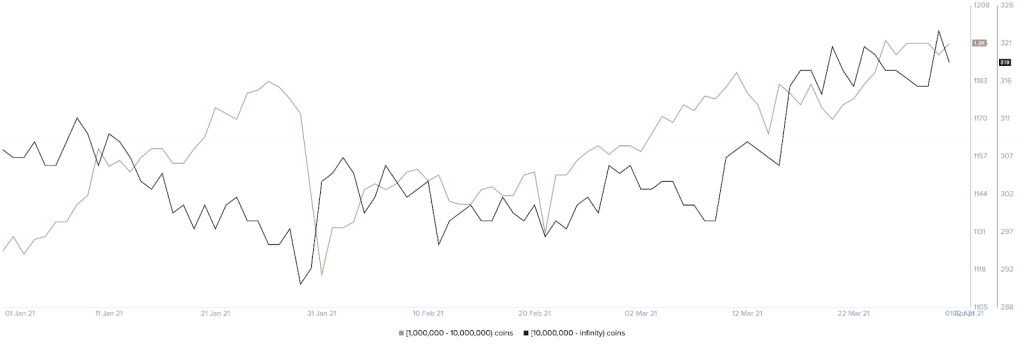
  • The number of XRP whales holding 10 million or more coins increased from 308 to 319 in Q1
  • The number of XRP whales holding between 1 million and 10 million increased from 1,125 to 1,196
  • XRP ledger transactions increased by 23% in Q1 as unique addresses increased by 15%

Ripple has released its first quarterly XRP market report for 2021 in which they point out that Q1 was a strong one for XRP in terms of accumulation and on-chain metrics.

XRP Whales Have Been Busy Accumulating in Q1

To begin with, the number of XRP whales holding 10 million or more coins increased from 308 to 319. This is a 3.57% increment from the previous quarter. During the same time period, XRP whale wallets holding between 1 million to 10 million coins increased from 1,125 to 1,196 signifying a 6.3% increment quarter to quarter.

The increment of XRP whales during the first quarter of 2021 can be visualized through the following chart from the report.

XRP Payment Volume Increased by 23% and Ledger Accounts Increased by 15%

During the same time period, the transactional activity on the XRP ledger also grew significantly. According to the quarterly report, XRP ledger payment volume hit a total of $62.3 billion. This amount was a 23% increment from the previous quarter.

Additionally, the amount of unique XRP ledger addresses grew from 2.35 million to 2.7 million which is a 15% increment quarter to quarter.

XRP’s $1.50 Support Continues to Hold, Weekly Chart Hints of Exhaustion

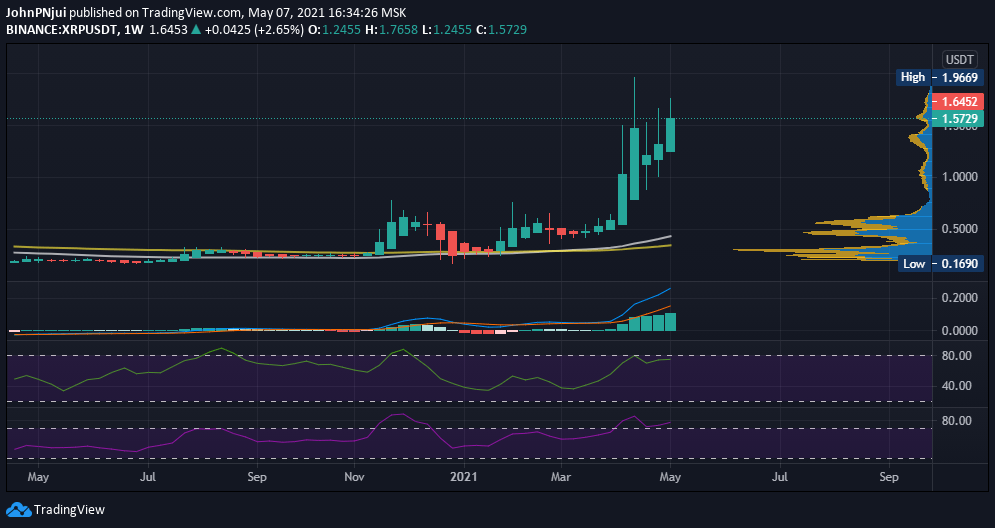
With respect to price, XRP is currently trading at $1.64 with the $1.50 price area providing considerable support into the weekend. On a macro-level, XRP’s bullish momentum could be coming to an end as seen through the following weekly chart.

From the chart, it can be observed that the weekly MACD is in overbought territory and hinting of a trend reversal in the weeks to follow. Secondly, the weekly MFI and RSI are also in overbought territory at values of 74 and 78 respectively. Thirdly, the price of XRP has deviated quite a bit from the 50-week moving average (white) further confirming an overbought scenario.

However, altcoins are currently enjoying a period of gains as the Bitcoin dominance has dropped below 50% and for the first time since December 2017. Therefore, alt season is in full swing and XRP might have enough fuel to propel it towards the $2 for a potential double top or even higher.

As with all analyses of altcoins such as XRP, traders and investors are advised to have an eye out for any sudden movement by Bitcoin – up or down – that might increase its dominance thus ruining alt-season.

Go to Source

Ethereum Classic (ETC) Hashrate Hits an All-time High of 33TH/s

  • Ethereum Classic’s hash rate has hit an all-time high of 33TH/s
  • This is the highest hash rate since ETC was launched in 2016
  • Ethereum Classic has also set a new all-time high of $179.83 – Binance rate
  • ETC is now ranked 13th in terms of market cap and still trading at a premium on Coinbase Pro
  • ETC could be gearing up for a correction according to the daily chart

The Ethereum Classic (ETC) network has hit a new milestone in terms of hash rate. According to data shared by ETC Cooperative, the Ethereum Classic network’s hash rate hit an all-time high of 33.22 TH/s and is the highest since the digital asset was launched in 2016. The team at ETC Cooperative shared this milestone of the Ethereum Classic network through the following tweet.

Ethereum Classic Hits a New All-time High of $179.83

A few hours ago, Ethereum Classic (ETC) set a new all-time high of $179.83 – Binance rate.

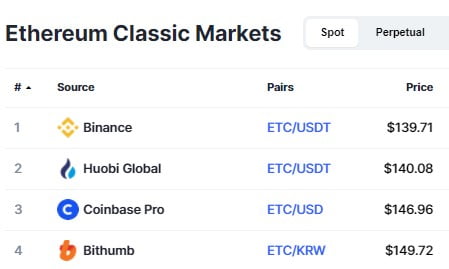
A quick glance at Coinmarketcap.com reveals that Ethereum Classic is now ranked 13th in terms of market capitalization and right below Chainlink. Furthermore, Ethereum Classic is still trading at a premium on Coinbase Pro thus hinting that retail investors are still optimistic that ETC will continue gaining in the crypto markets.

However, the premium rate on Coinbase Pro relative to other crypto exchanges has dropped from yesterday’s 13% to 5% as seen in the following screenshot. Such a drop is a sign that FOMO might be reducing amongst retail traders.

What Next for Ethereum Classic in the Crypto Markets?

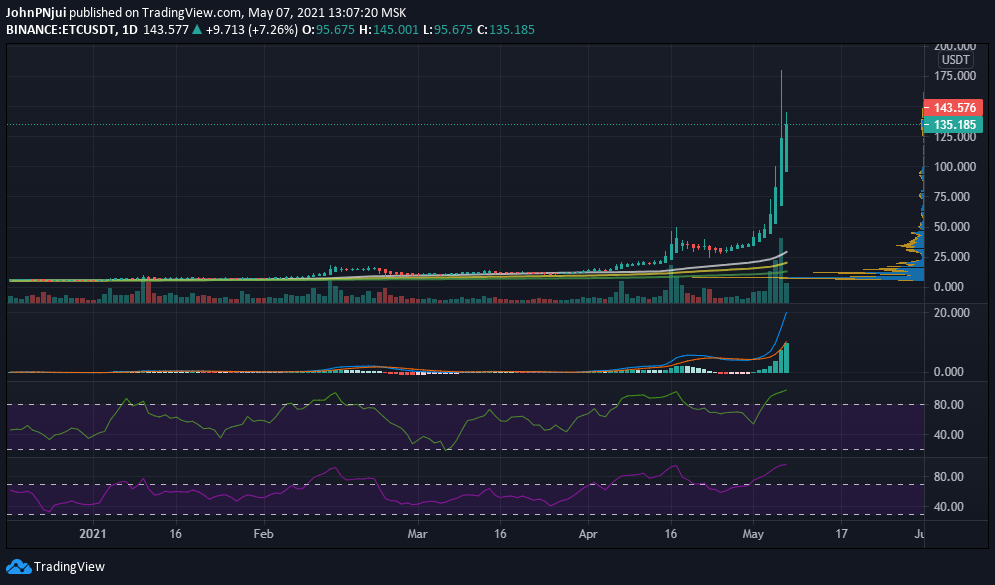
From a technical analysis point of view, the daily ETC/USDT chart has gone parabolic as seen through the screenshot below.

As with all parabolic moves, a pullback is the next logical event for Ethereum Classic as shall be explained.

To begin with, the daily MACD is overextended and ETC’s price has deviated in a big way from the three moving averages: 50-day (white), 100-day (yellow) and 200-day (green). Secondly, the daily MFI and RSI are in overbought territory at values of 100 and 98 respectively.

At the time of writing, Ethereum Classic is trading at $141. In the event of a correction, ETC will have the following price areas acting as short-term support.

  • $118
  • $115
  • $106
  • $100
  • $87
  • $81
  • $75

Go to Source

22.8% Of Ethereum’s Circulating Supply is Deposited in Smart Contracts

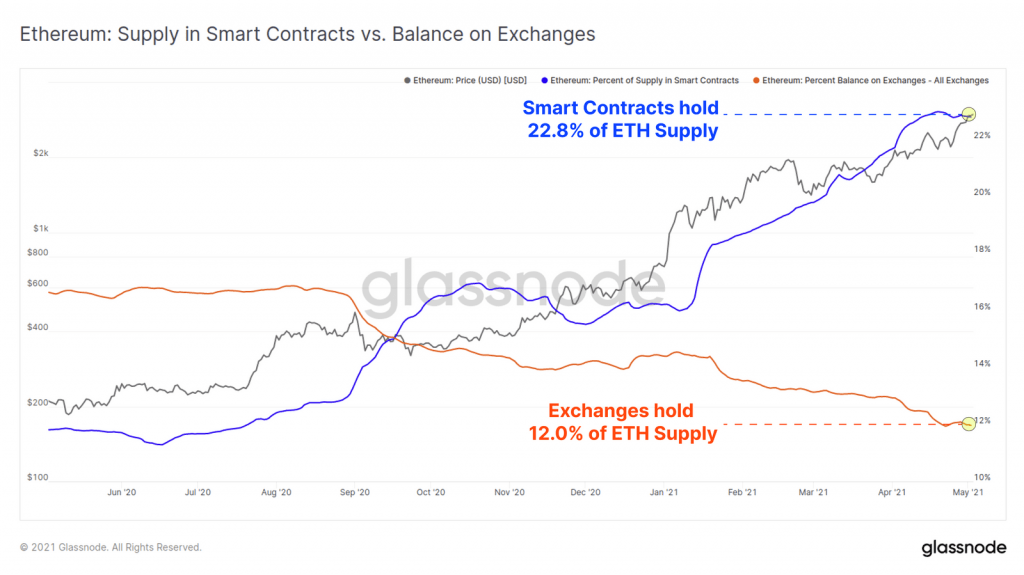
  • Ethereum deposited in smart contracts has reached 22.8% of its circulating supply
  • Ethereum on crypto exchanges has dropped to 12% of the circulating supply
  • 2021 has seen 10 events where over 200k ETH is withdrawn from exchanges in a day
  • Ethereum has set a new all-time high of $3,605 – Binance rate

The trend of Ethereum investors moving their ETH out of exchanges and into DeFi is at its peak. According to data from the team at Glassnode, the amount of Ethereum deposited in smart contracts has reached 22.8% of its circulating supply. At the same time, the amount of Ethereum left on exchanges has hit a new low of 12% of ETH’s circulating supply.

The chart below, courtesy of Glassnode, provides a visual cue of the flow of Ethereum out of exchanges and into smart contracts that are at the core of DeFi.

Ethereum Outflows Are Contributing to ETH’s Bullish Rise

From the chart, it can be observed that the amount of Ethereum’s supply held in smart contracts has risen alongside the price of ETH. Therefore, it can be confirmed that the demand for Ethereum in DeFi has been beneficial to the value of ETH.

The team at Glassnode has also identified that demand for Ethereum has reached levels where 2021 has seen over 10 events where 200k ETH has been withdrawn from crypto exchanges in a single day. Such an increase in Ethereum outflows from crypto exchanges proves that investors are more comfortable with the self-custody of their ETH and making use of it in DeFi.

Ethereum Sets a New All-time High of $3,605

With respect to price, Ethereum has just set a new all-time high of $3,604 and looks primed to keep pushing towards the $5k ceiling in the days and weeks to follow.

At the time of writing, Ethereum is consolidating at the $3,400 price area with the possibility of additional gains during the weekend. However, from a technical analysis point of view, a pullback to $3k would be an ideal way for Ethereum to cool down before another leg up.

Go to Source

Bitcoin is Ready for Another Leg Up as Exchange Outflows Increase

  • Bitcoin could be gearing up for another leg up due to investors and traders moving their BTC out of exchanges
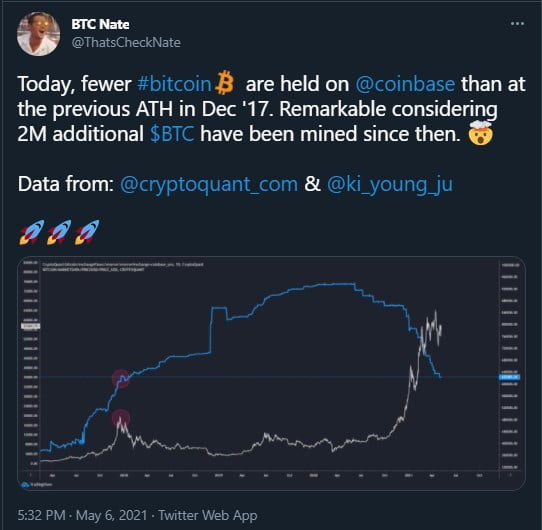
  • Less Bitcoin is stored on Coinbase than during the 2017 bull cycle
  • According to Bloomberg, Bitcoin is in the early days of adoption and primed for further growth

Bitcoin could be gearing up for another bullish move based on the amount of BTC leaving crypto exchanges.

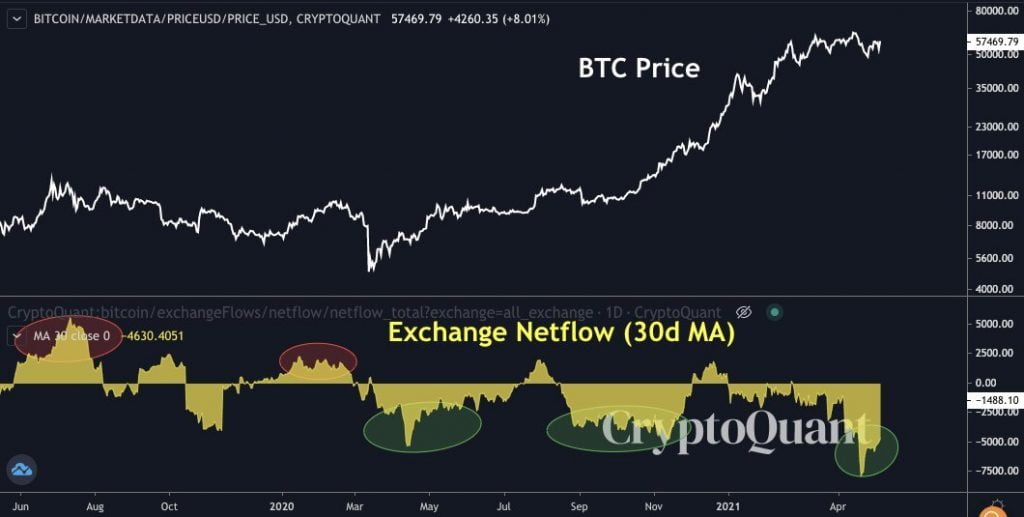
The potential for such a scenario was highlighted by the CEO of CryptoQuant, Ki Young Ju, who also explained that the outflow of Bitcoin out of exchanges, was weakening selling pressure in the crypto markets. Mr. Ju shared his analysis through the following statement and accompanying chart.

BTC is ready to get another leg up. A significant amount of Bitcoins has flowed out across all exchanges, weakening selling pressure.

Fewer Bitcoins Are Held on Coinbase Than in December 2017

The reduction in the amount of Bitcoin held on crypto exchanges was also pointed out by crypto community member @ThatsCheckNate who identified that the amount of Bitcoin being held on Coinbase, is currently lower than the amount during the peak of the 2017 bull cycle. His analysis of the Bitcoin balances on Coinbase can be seen in the screenshot below.

Bitcoin is in the Early Stages of Adoption

In addition, the team at Bloomberg has released their monthly Crypto Outlook report in which they conclude that Bitcoin has one advantage over other assets in the form of ‘timing’ within the current global economic environment that is signaling possible inflation.

According to the report, Bitcoin is in the first stages of adoption and primed for further growth as explained below.

Bitcoin has a unique advantage of good timing. Diminishing supply juxtaposed with historically low interest rates and the substantial amount of money being pumped into the system form a solid foundation for price appreciation of the firstborn crypto, if the rules of economics apply.

Adoption is in the very early days, yet it’s the key and Bitcoin appears to have won the race, as evidenced by Tesla allocating a portion of its equity wealth to the digital asset.

Go to Source

ETH Tops $3k USD for the First Time as Mainstream Adoption Blasts Higher

ETH, Ethereum Network’s native token, reached the $3k milestone on May 2nd, after a week of reaching new all-time highs. In addition to a jump in prices, ETH has been the subject of interest by institutional and private investors.

The second-largest cryptocurrency by market capitalization has experienced gains in the value of 37% over the last 7 days , which reflects the recovery the coin experienced after falling as low as $2.1k during the last week of April amid the crypto market crash.

At press time, ETH has set an all-time high of $3,058 which is likely to be surpassed if the trend observed during the last week continues, which had Decentralized Finance (DeFi) platforms running on the Ethereum network as its major driver.

With a market capitalization of over $350 billion, Ethereum has continued to experience incredible growth over the past year despite the increased congestion and gas prices it experienced ever since the DeFi Summer of 2020, gaining more than 1300% in value.

While some developers and projects have moved to other networks that promise to provide greater stability, performance, and reduced fees, the current upgrade process to Ethereum 2.0 has allowed the Ethereum Network to continue its reign over the blockchain ecosystem under the promise of a better future once the upgrade is deployed.

European Investment Bank Sold Digital Bonds On Ethereum

According to Bloomberg, the European Investment Bank (EIB) partnered with Goldman Sachs, Societe Generale, and Banco Santander, some of the most important financial institutions in the world, to sell over €100 million worth of bonds on the Ethereum Network.

The move by the European Union’s investment bank took place during the last week of April and had a noticeable impact on the performance of the network’s cryptocurrency, marking the rally that resulted in the reach of the $3k mark.

The decision by the lending arm of the European Union and the other financial institutions that participated in the process is a reflection of the increasing interest from private and governmental institutions in ETH.

They are taking advantage of the growing cryptocurrency and blockchain industries, an interest that also can be seen in the race for the development of their digital currencies.

Back in November of 2020, China’s Construction Bank (CCB) partnered with Fusang, a digital asset exchange, to issue over $3 billion in debt securities using blockchain

Ethereum Classic Is Following Ethereum’s Steps

Ethereum Classic, one of the two networks resulting from the split of the original Ethereum Network, has been a less popular alternative to Ethereum over the past years. Despite this, it has continued to be in the top 50 of the cryptocurrency ranking by market capitalization with over $5 billion in market capitalization.

Just like its sibling, Ethereum Classic has experienced high levels of increase in value over the past week with a %56 increase, which allowed it to reach a new all-time high of $44.07 on May 2nd.

The project’s website was down at the time when the all-time high was set, with a Tweet suggesting that an increased spike of interest was the main reason behind the disruption.

The surge in interest and subsequent traffic to the site was detected as a Denial Of Service Attack by the Content delivery network, which triggered security measures despite being a false alarm.

The success experienced by both Ethereum and Ethereum classic over the weekend was also mirrored by most of the projects in the top 15 by market capitalization, according to CoinGecko data.

Despite the crypto market crash experienced late in April, currencies like ETH, XRP, DOGE, UNI, BCH, and XLM have all experienced gains between 30% and 55% over the past 7 years, with experts believing it could represent the start of a new bull run soon.

The post ETH Tops $3k USD for the First Time as Mainstream Adoption Blasts Higher appeared first on Blockonomi.

Go to Source

Kazakhstan Is Preparing the Launch of a CBDC Pilot With Private Financial Companies

Central bank digital currencies (CBDCs) are steadily becoming a serious discussion among governments globally, with Kazakhstan as the latest country unveiling its plans. The National Bank of Kazakhstan is making preparations to launch a CBDC pilot program soon.

The National Bank Released a Public Consultation Paper

According to the announcement published on their website, the bank expects to pilot its prototype of a digital tenge within the private companies of the financial industry in the first stage.

The participants will adopt the CBDC to provide payment services via a two-tier architecture where the digital currency will be built.

That said, to guarantee the proper official launch of Kazakhstan’s digital tenge, the National Bank looks forward to conducting “a comprehensive study of the benefits and risks with the definition of the tasks solved by the digital currency, the method of its emission and distribution, the technology used, the impact on monetary policy, financial stability and the payment ecosystem.”

In parallel, the bank also released a 34-page public consultation paper to gather feedback from the locals and assess potential impacts that could bring the virtual asset to the national economy.

However, the National Bank of Kazakhstan didn’t disclose an approximate deadline on when the pilot will be deployed, nor when it could come to an end, implying that it can depend on the evolution of the CBDCs performance among the participants involved.

Kazakhstan’s Stance on Cryptocurrencies

The country has been showing some interest in the crypto industry despite its initial harsh stance in 2018, even suggesting a possible ban on digital asset trading and mining.

To bring relief to the coronavirus-driven economic crisis, the Ministry of Economy proposed in August 2020 a 15% tax for virtual currency mining.

Furthermore, in September 2020, Bagdat Mussin, the Digital Development Minister of Kazakhstan, revealed the government’s plans to achieve a $714 million crypto mining investment goal over the next three years.

What do you think about the announcement on launching a CBDC pilot in Kazakhstan? Let us know in the comments section below.

Go to Source

South Korea to Impose a 20% Tax on Crypto Mining Activities

The cryptocurrency industry in South Korea keeps facing regulatory challenges, and it seems that dust is far from settling. Now, crypto miners will be required to pay taxes, following the same path as digital assets traders.

Ruling to Take Place Starting 2022

According to a report published by Donga, miners should be accountable for paying taxes by deducting the amount from their earnings.

Expressly, officials from the South Korean Ministry of Strategy and Finance are set to apply a new rule for those who earn tokens over $2,220 annually by imposing a 20% tax rate.

However, regulators clarified that crypto miners would be able to deduct their electricity from the taxable income total in the filings, as those are considered as “necessary expenses.” An official from the Ministry of Strategy and Finance cited by Donga commented on the matter:

You have to prove how much you have mined the virtual currency by putting your computer in a specific place and how much the electricity bill came out.

Transaction fees from the total income will also be considered on the taxation scheme. Furthermore, digital asset miners in the country should submit their tax declarations every year in May, detailing the won value of the virtual currencies mined over the last financial year, the report said.

The new tax ruling could take effect starting next year in January.

Is the Crypto Taxation Becoming a ‘Hot Potato’ for the Government?

South Korea has been strengthening its stance towards imposing taxes on all crypto-related activities. As Bitcoin.com News reported early this year, the government will start taxing virtual currency trading profits in 2022 with a 20% tax.

But financial watchdogs have also been actively overseeing and detecting tax evaders who had not declared their crypto holdings in their submissions.

In fact, the Seoul metropolitan government recently seized digital assets worth $25 million from hundreds of investors who allegedly committed tax-related crimes.

Such conjuncture is being taken by some political parties to catch younger voters for the upcoming presidential elections, as the measures have sparked a negative backlash among that population in South Korea.

What are your thoughts on taxing crypto miners in South Korea? Let us know in the comments section below.

Go to Source

Please enter CoinGecko Free Api Key to get this plugin works.
Exit mobile version