Former OpenSea sea executive Nate Chastain hasfileda motion asking a U.S. district court to dismiss insider trading charges levied against him becausenon-fungible tokens (NFTs) do not meet the requirements for wired fraud charges.
Citing the Carpenter wire fraudtheory, Chastain’s lawyer argued that NFTs were neither securities nor commodities, and insider trading law couldn’t apply to them as the governmentrecognized them as “digital artworks” and issues.
In defense of the money laundering charges against Chastain, his counsel argued that the transparent nature of the Ethereum blockchain makes this charge unnecessary. The NFT transactions the accused executed could be accessed for further investigation.
Potential 20-year sentence
Following the insider trading accusation, Chastain was relieved of his role at OpenSea and has to face legal battles that could result in a20-yearsentence if found guilty.
The U.S. Department of Justice (DOJ)arrestedChastain in June for allegedly exploiting insider information from OpenSea’s NFT collection, and trading dozens of NFTs featured on the homepage.
Unclear regulation
Chastain’s arrest was the first of its kind in the crypto space on the grounds of insider trading. Since then, more parties have been indicted, including ex-Coinbase ManagerIshan Wahi.
Ishanallegedly revealed information about assets slated to be listed on Coinbase to friends and family, who used Ethereum-based wallets to acquire the crypto assets and sold them upon successful listing.
The accused is said to have made a profit of about $1.5 million from the illicit activity.
Much like Chastain, Ishan used a similar argument in his defense, claiming that U.S. laws for insider trading do not apply to cryptocurrencies.
Get an Edge on the Crypto Market 👇
Become a member of CryptoSlate Edge and access our exclusive Discord community, more exclusive content and analysis.
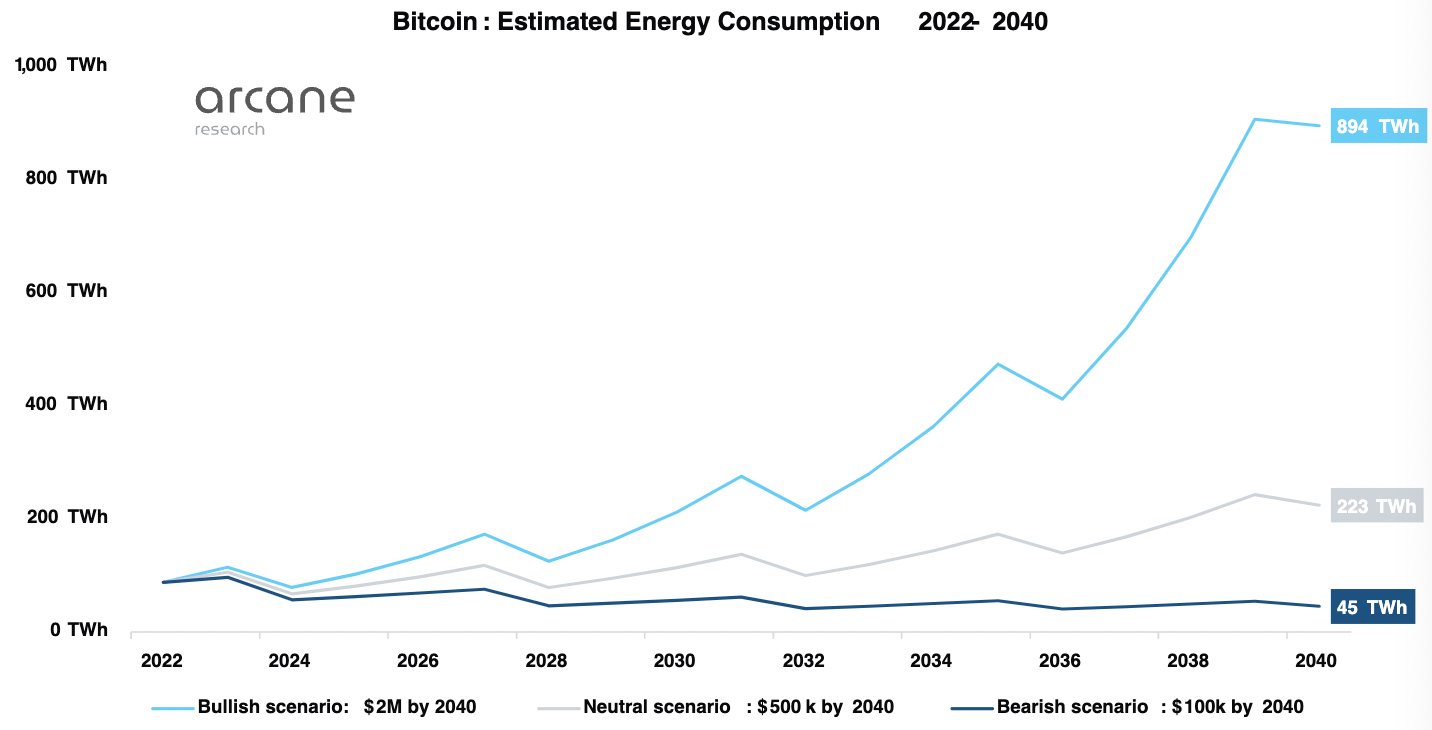
Bitcoin (BTC) mining’s energy consumption will rise 10x and hit 894 Terawatt-hours (TWh) annually if the flagship crypto’s price reaches $2 million by 2040, according to an Arcane Research report published Aug. 22.
The report calculated BTC’s future energy consumption based on bullish, bearish and neutral future scenarios.
BTC Estimated Energy Consumption 2022-2040
If the prices follow a bearish trajectory and reach only $100,000 by 2040, the energy consumption will halve from present levels and decrease to 45 TWh — equating to 0.02% of the global energy consumption in 2040 by estimation.
In the neutral scenario, where the prices reach $500,000 by 2040, the energy consumption levels are estimated to be around 223 TWh.
Bitcoin Halving limits energy consumption
The effects of halving are observable in bearish and neutral scenarios. The bearish scenario implies a 4x increase in the prices. While it would be logical for the energy consumption levels to increase, the estimated consumption levels are lower than present-day levels.
Similarly, the costs increase 20x in the neutral scenario, while consumption levels will be around 2x higher than current levels.
The block subsidy halves every 210,000 blocks, roughly every four years. Due to this, mining’s energy consumption levels will gradually weaken as time passes. The report states:
“Bitcoin’s energy consumption will only increase if the bitcoin price increases at a faster rate than the block subsidy declines. The block subsidy halves every fourth year, and the bitcoin price must double every fourth year to offset this effect.”
The report added:
“In this case, the bitcoin price must be around $650k in 2040 for its energy consumption to be higher than the current.”
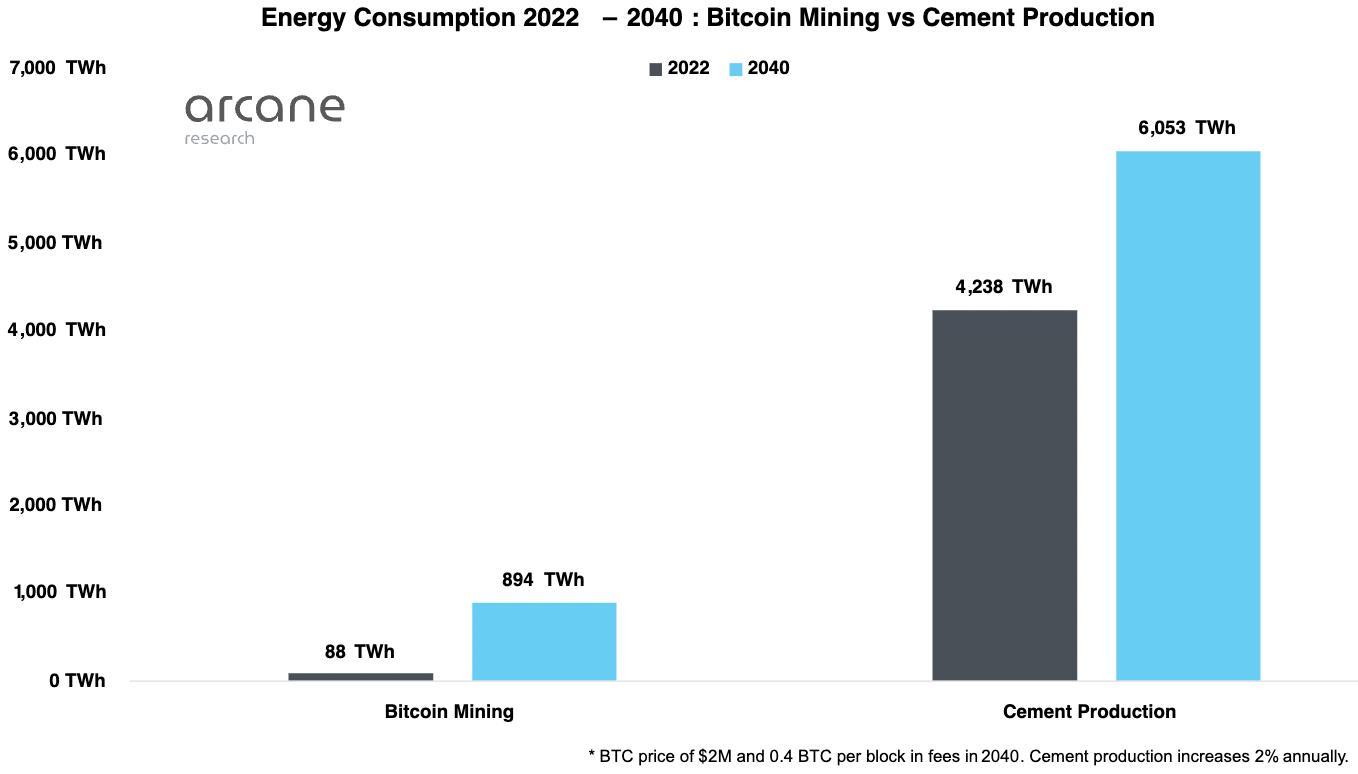
The report also compares Bitcoin’s energy production with cement production to highlight the decreasing need for energy.
Energy Consumption of Bitcoin and Cement Production 2022-2040
The chart above assumes that the most energy-consuming scenario to come true. If the Bitcoin price reaches $2 million by 2040 and the annual energy consumption reaches 894 TWh, the annual Bitcoin energy demand will equate to 0.36% of the global energy consumption.
While this is a drastic increase from the current 0.05%, it remains low compared to cement production, which consumes 2% of global energy.
Green Bitcoin mining
In addition to its decreasing energy need, the crypto community is growing bullish on sustainable energy. The community has been finding ways to utilize solar power, wind, hydropower, geothermal, tidal power, and waste energy.
Various partnerships have been arising from the crypto community, especially since the end of 2021. In May 2022, Block, Blockstream, and Tesla partnered to create a green mining farm using solar power.
In April, Marathon Digital decided to replace its energy sources with carbon-neutral ones. On the other hand, Kenya started a nationwide initiative to allow mining companies to use surplus geothermal powers.
Recent studies also reflect the growing trend of sustainable power in crypto mining. A Bitcoin Mining Council (BMC) report from October 2021 showed that the mining industry’s sustainable energy usage was 57.7%.
BMC’s following report was released in May 2022 and calculated that sustainable energy usage had grown to over 74%.
Get an Edge on the Crypto Market 👇
Become a member of CryptoSlate Edge and access our exclusive Discord community, more exclusive content and analysis.
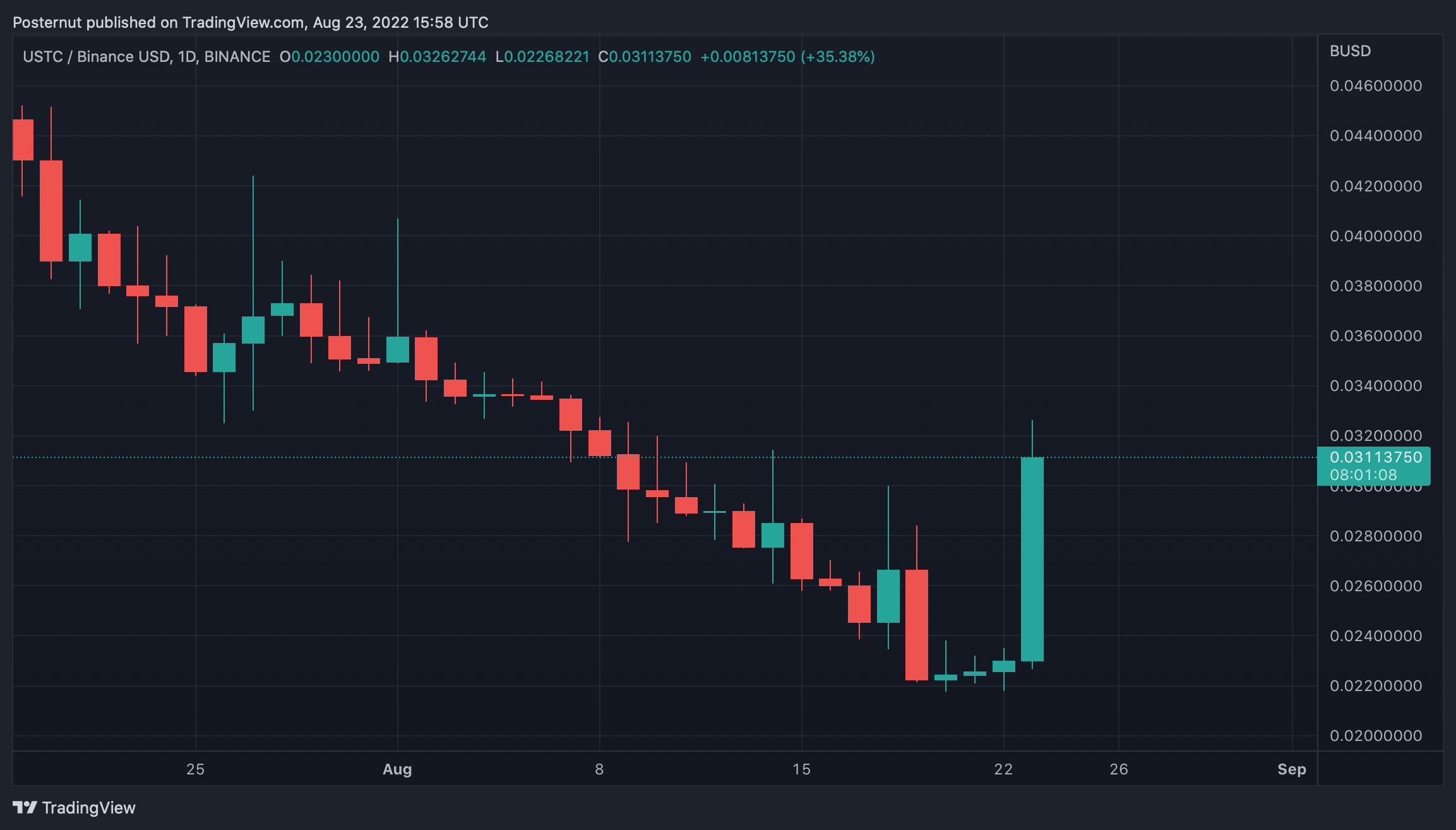
During the last 24 hours, crypto asset prices have improved as the global cryptocurrency market capitalization today has risen 1.9% to $1.07 trillion. Interestingly, the two so-called ‘defeated’ Terra blockchain tokens, now called terraclassicusd (USTC) and luna classic (LUNC), have seen significant gains. LUNC has climbed 8% higher during the past 24 hours and the once-stable coin USTC has jumped 42.2% higher against the U.S. dollar on Tuesday.
Following Do Kwon’s Recent Interview, Terra’s Classic Token See a Market Revival
For some mysterious reason, the two coins associated with Terra’s Classic network — terraclassicusd (USTC) and luna classic (LUNC) jumped significantly in value on Tuesday. The market moves follow Do Kwon’s recent interview with Coinage as the Terra co-founder spoke about the possibility of a mole within the Terra organization.
“If you’re asking me whether there was a mole at TFL, that’s probably, ‘Yes.’ Whether somebody tried to take advantage of that particular opportunity, I would say that the answer is, ‘Yes.’ But if those opportunities existed, then the blame is on the person that presented those vulnerabilities in the first place,” Kwon explained in his interview. “I, and I alone, am responsible for any weaknesses that could have been presented for a short seller to start to take profit.”
USTC/BUSD chart on August 23, 2022, at 11:59 a.m. (EST).
Four days later, both USTC and LUNC are seeing significant gains compared to a great number of coins within the crypto economy. LUNC’s price jumped 8% higher today, and USTC has increased 42.2% during the last 24 hours. USTC has seen $65,310,430 in global trading volume today, while LUNC has seen $60,659,973. In addition to the classic coin’s rising, the newest Terra Phoniex network blockchain asset LUNA is up 9.4% during the last day. Compared to the old classic coins, however, LUNA’s $32,205,006 is half the size of LUNC’s and USTC’s daily volume.
Classic Supporters Attempt to Manifest a $1 USTC, Late August Terra Classic Market Revival Follows the Failed Pump During the First Week of July
Statistics show that OKX is the most active USTC exchange today, while Kraken is the top LUNC trading platform in terms of activity. 80.16% of USTC trades are paired with BUSD, while 18.71% of USTC swaps are paired with tether (USDT). While USTC has climbed 42% in value, it is nowhere near close to reaching $1 as it currently is trading for $0.0307 per unit. While the reasons behind the Terra classic coin spikes are unknown, some crypto proponents are attempting to “manifest [a] $1 USTC.” Some Terra classic supporters have even discussed some sort of repeg concept for the once-stable coin USTC.
Anyone know why $USTC has been pumping today?
— BigDaddySherman (@BigDaddySherma2) August 23, 2022
Luna classic supporters have a very active community, and they are arguably far more vocal on social media than LUNA 2.0 supporters. There’s a LUNC DAO and a great number of Terra classic-centric social media accounts supporting the old chain and old tokens. While the Terra classic supporters have been trying to rally support on Tuesday, the tokens LUNC and UST are still referred to as “scam coins” and the “ultimate Ponzi.” Furthermore, during the first week of July, the two Terra classic coins pumped significantly but prices fell flat shortly after the brief rise. At that time in July, USTC climbed 470% higher during a seven-day period.
Tags in this story
Anchor, Classic Coins, decentralized finance, DeFi, depegged, depegging, do kwon, LUNA, Luna 2.0, LUNA 2.0 token, LUNC, LUNC DAO, Markets, markets and prices, Once-Stable Coin, Terra, Terra blockchain fiasco, Terra Classic, TerraUSD, UST, USTC, Validators
What do you think about UST’s and LUNC’s recent jumps in value? Let us know what you think about this subject in the comments section below.
Jamie Redman
Jamie Redman is the News Lead at Bitcoin.com News and a financial tech journalist living in Florida. Redman has been an active member of the cryptocurrency community since 2011. He has a passion for Bitcoin, open-source code, and decentralized applications. Since September 2015, Redman has written more than 5,700 articles for Bitcoin.com News about the disruptive protocols emerging today.
Image Credits: Shutterstock, Pixabay, Wiki Commons
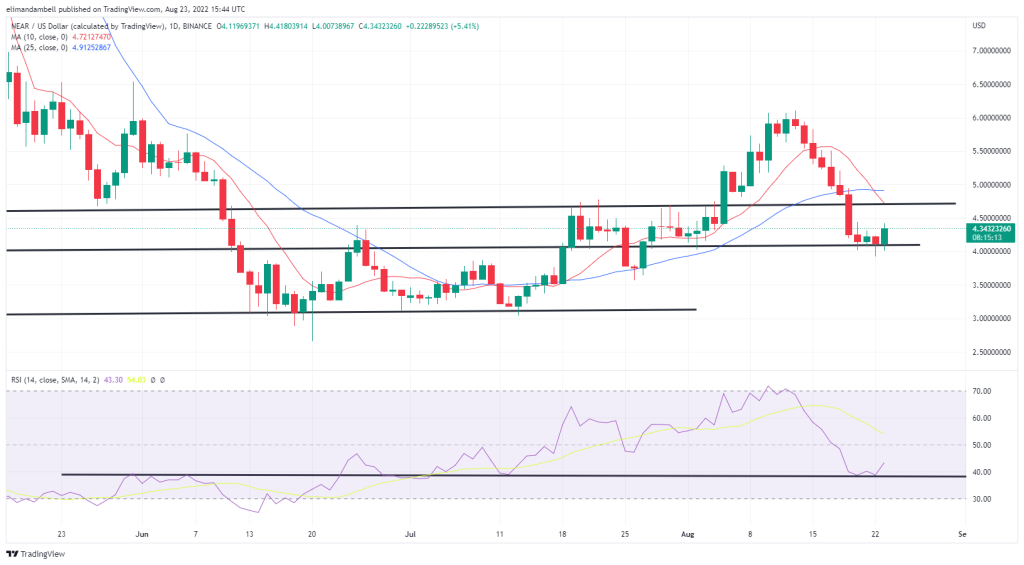
Cosmos was a notable gainer on Tuesday, as prices of the token rose by as much as 12% in the day. Today’s surge sees the cryptocurrency climb for a third straight day, hitting a five-day high in the process. Near protocol was also in the green, as it rebounded following recent declines.
Cosmos (ATOM)
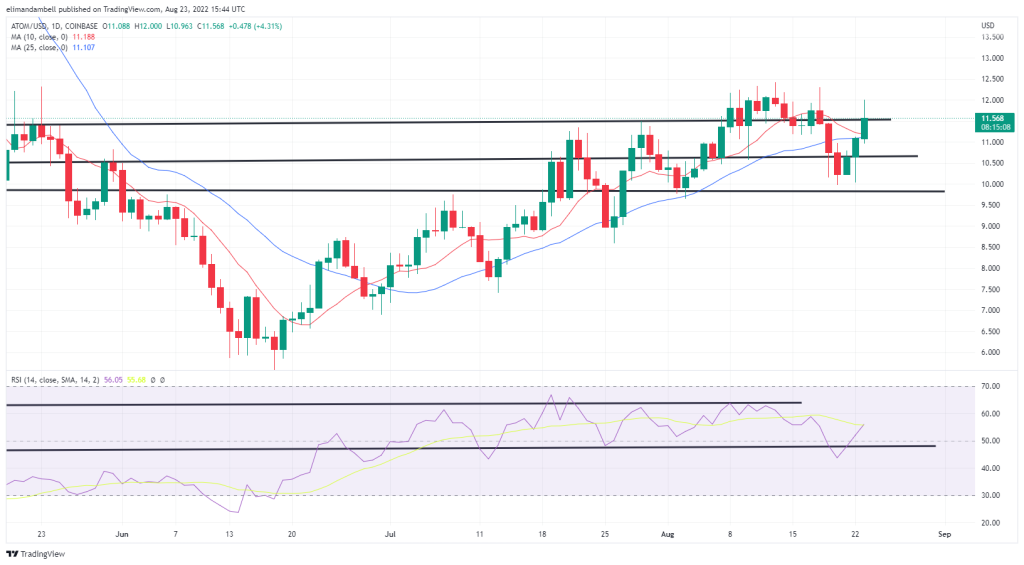
Cosmos (ATOM) was one of Tuesday’s big gainers, as prices of the token surged by as much as 12%.
Following a low of $10.25 to start the week, ATOM/USD rallied earlier today, hitting a high of $11.93 in the process.
Today’s peak sees ATOM climb higher for a third straight session, hitting its highest level since August 18 in the process.
ATOM/USD – Daily Chart
Looking at the chart, today’s move came as the token briefly broke out of a key resistance level of $11.55.
As of writing, ATOM continues to trade above this ceiling, however earlier gains have faded, with price currently at $11.56.
Overall, it appears as if previous bulls have turned bearish, liquidating their positions shortly after today’s breakout.
Near Protocol (NEAR)
In addition to cosmos, near protocol (NEAR) was also in the green in today’s session, as prices rebounded following recent losses.
NEAR/USD rallied to an intraday peak of $4.41 on Tuesday, climbing over 8% higher than Monday’s low.
Yesterday saw NEAR briefly fall below its support point at the $4.10 level, however bulls rejected a full break, and instead bought the dip.
NEAR/USD – Daily Chart
Today’s rebound in price comes as another rebound took place, on this occasion it was via the 14-day relative strength index (RSI).
As seen on the chart, the floor of 38.15 avoided a breakout of its own, and as of writing RSI is tracking at 43.45.
The next target for bulls is likely $4.70, however this will be made difficult following a downside cross of the 10-day (red) and 25-day (blue) moving averages, which could be signaling the prospect of further mid-term declines.
Register your email here to get weekly price analysis updates sent to your inbox:
Tags in this story
What is behind today’s rebound in crypto prices? Let us know your thoughts in the comments.
Eliman Dambell
Eliman brings a eclectic point of view to market analysis, having worked as a brokerage director, retail trading educator, and market commentator in Crypto, Stocks and FX.
Image Credits: Shutterstock, Pixabay, Wiki Commons
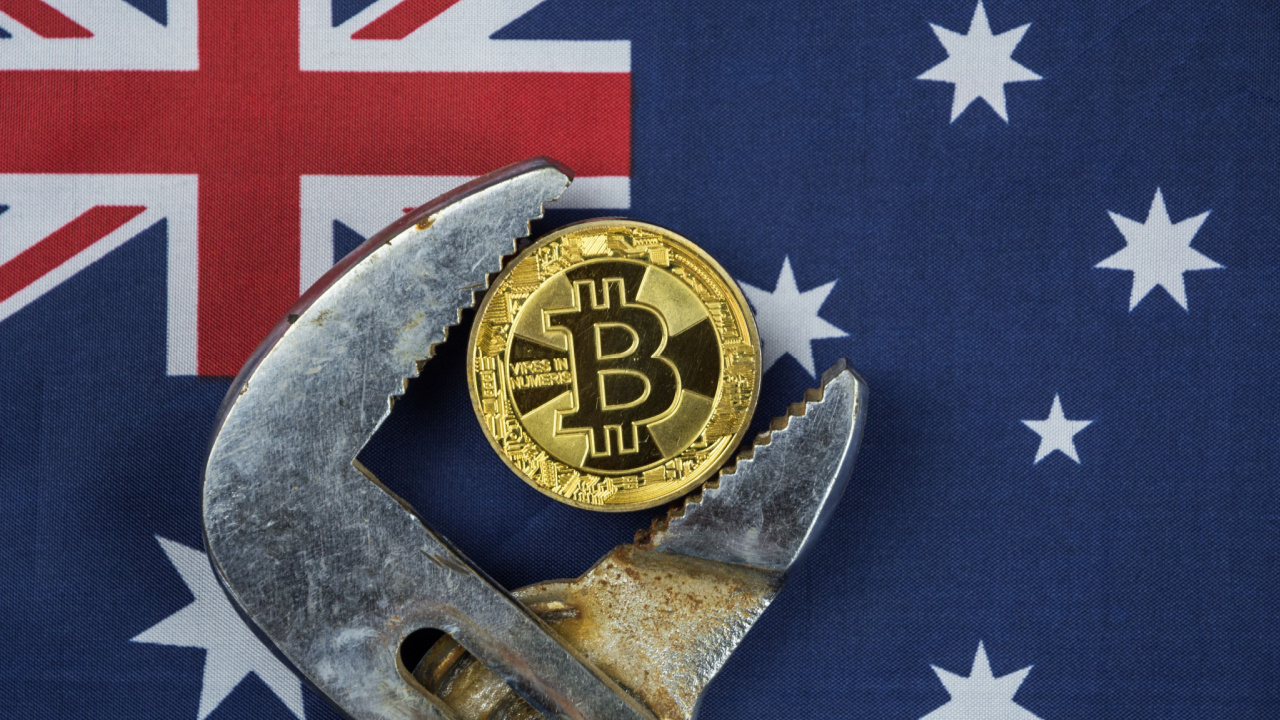
Australia intends to do a virtual stocktake of cryptocurrency assets held by its citizens, the new executive power in Canberra announced this week. The move is viewed as an indication that the center-left government plans to regulate the country’s crypto space.
Treasury Embarks on ‘Token Mapping’ to Underpin Crypto Regulation in Australia
As part of efforts to adopt rules for the cryptocurrency sector, Australia’s Treasurer Jim Chalmers unveiled on Monday that his department is preparing to conduct “token mapping,” Reuters reported quoting his statement.
The initiative will aim to catalog the various types and uses of digital currencies owned within the country and is seen as a step toward identifying which crypto assets would need to be regulated and how to do that.
Australia will be the first country to stocktake crypto holdings, Chalmers pointed out, and elaborated further:
With the increasingly widespread proliferation of crypto assets, to the extent that crypto advertisements can be seen plastered all over big sporting events, we need to make sure customers engaging with crypto are adequately informed and protected.
The announcement comes after years of deliberation on how to regulate decentralized cryptocurrencies like bitcoin. Calls to finally do so have increased in the past couple of years when stimulus payments during the pandemic and home-office working contributed to a spike in crypto investments.
A Senate inquiry carried out under the previous conservative government recommended last year the adoption of wide-ranging regulations to protect cryptocurrency owners. However, the election this past May resulted in a new center-left cabinet.
The Australian Securities and Investments Commission (ASIC) also insisted recently that the increased popularity of cryptocurrencies makes a “strong case for regulation.” The watchdog cited a survey, according to which 44% of the country’s retail investors held crypto in late 2021.
While refraining from providing specific details on any upcoming rules, Jim Chalmers described the token mapping as “the first step in a reform agenda.” His comments follow a decision by the Australian Taxation Office announced earlier this year to focus on capital gains from crypto assets as one of several priority areas where the authority thinks more efforts are needed to ensure correct reporting.
Do you expect Australia to soon introduce comprehensive regulations for its cryptocurrency sector? Tell us in the comments section below.
Lubomir Tassev
Lubomir Tassev is a journalist from tech-savvy Eastern Europe who likes Hitchens’s quote: “Being a writer is what I am, rather than what I do.” Besides crypto, blockchain and fintech, international politics and economics are two other sources of inspiration.
Image Credits: Shutterstock, Pixabay, Wiki Commons, BERMIX STUDIO
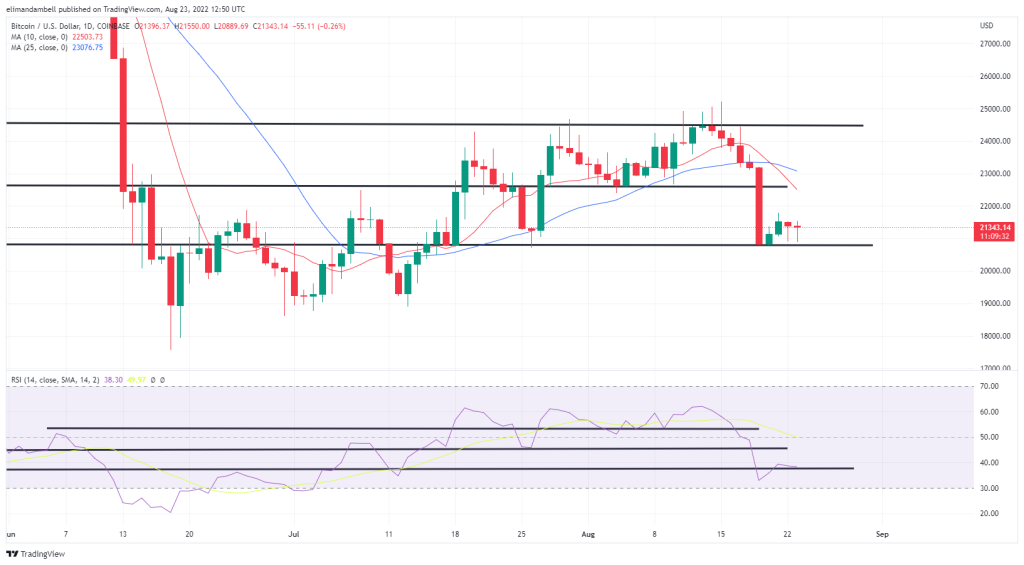
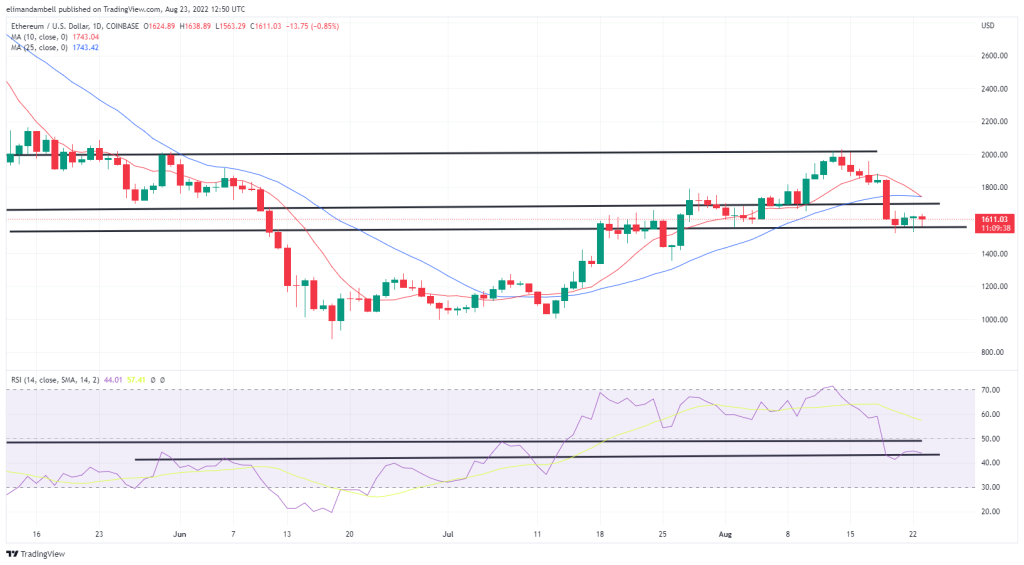
Crypto markets were back in the green on Tuesday, as bearish pressure marginally eased during today’s session. Ethereum rallied back above $1,600 earlier in the day, less than 24 hours after nearing a breakout below $1,500. Bitcoin was also higher, moving past the $21,000 level.
Bitcoin
Bitcoin (BTC) prices were trading marginally higher on Tuesday, as crypto prices rebounded following recent losses.
Following a low of $20,955.14 to start the week, BTC/USD rose to a high of $21,521.70 earlier in the day.
Tuesday’s move comes as prices continue to move away from a key support point of $20,800, as bulls attempt to reject a breakout.
BTC/USD – Daily Chart
As seen on the chart, the rebound came as another breakout attempt had failed, this time on the 14-day relative strength index (RSI).
The floor, which is the 37.40 level of the indicator, held firm in today’s session, and as of writing is tracking at 38.48.
Despite easing slightly, bearish momentum still remains, and can be seen in both the 10-day (red) and 25-day (blue) moving averages, which continue to trend downwards.
Ethereum
Like bitcoin, ethereum (ETH) also rose in today’s session, as the token once again climbed above $1,600.
ETH/USD, which was at a low of $1,553.45 to start the week, rose higher in today’s session, moving to a peak of $1,632.75.
Tuesday’s move comes as ethereum also moved away from its recent support point of $1,550, with bulls now seemingly attempting to recapture the $1,700 point.
ETH/USD – Daily Chart
Unlike BTC, there has yet to be a downward crossover of moving averages, which has kept bullish sentiment marginally alive.
This was helped by the fact that the RSI also rebounded, moving from a floor of 43.60, to now tracking at a level of 44.50.
Should ETH bulls want to recapture the $1,700 point, then price strength will likely need to move towards a ceiling of 49.
Register your email here to get weekly price analysis updates sent to your inbox:
Tags in this story
Do you expect ethereum to hit $1,700 this week? Leave your thoughts in the comments below.
Eliman Dambell
Eliman brings a eclectic point of view to market analysis, having worked as a brokerage director, retail trading educator, and market commentator in Crypto, Stocks and FX.
Image Credits: Shutterstock, Pixabay, Wiki Commons
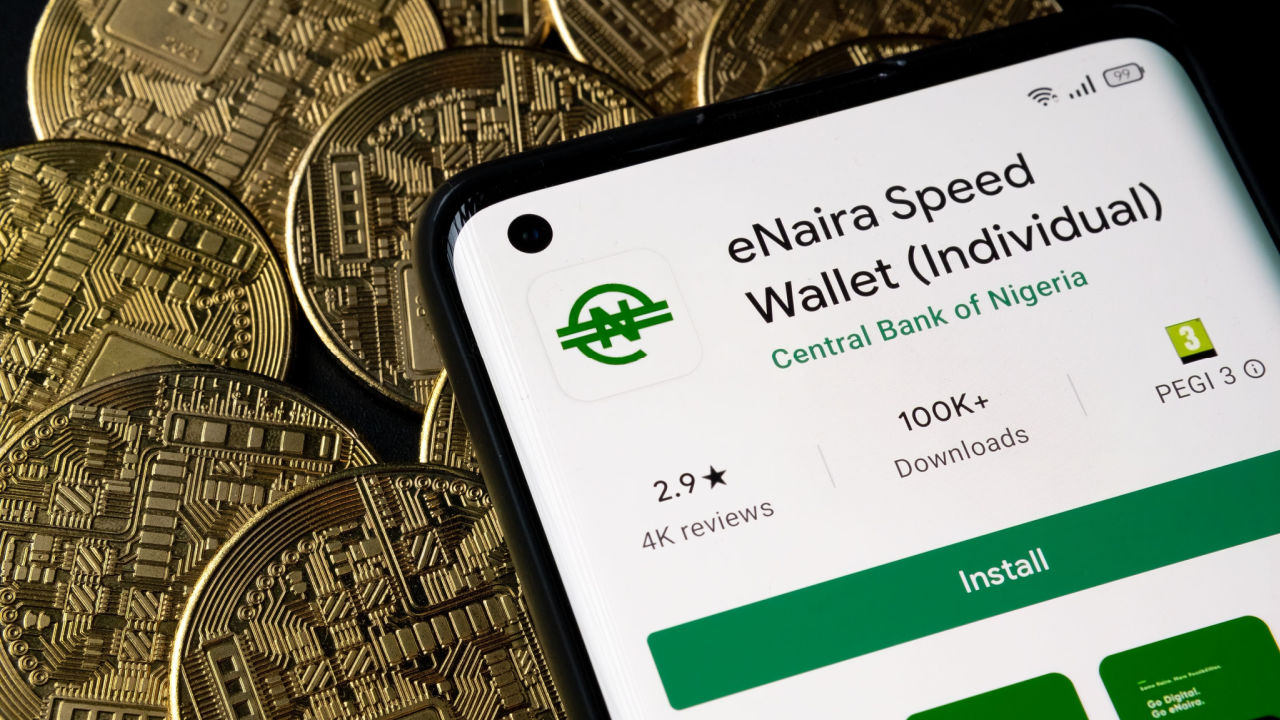
Despite the apparent slow embrace of the e-naira digital currency by Nigerians, the Central Bank of Nigeria governor has said his institution is targeting a tenfold increase in the number of users of the digital currency in the next twelve months. The governor predicted that the use of cash will “dissipate to zero” while the “use of digital currency will increase to become part of our lives.”
E-Naira to Become Available to All Nigerians
Some ten months after its launch, the app for the Nigerian central bank digital currency (CBDC) — the e-naira — has now been downloaded 840,000 times, a report has said. This revelation suggests that less than one million Nigerians have embraced the digital currency that the CBN touts as a better alternative to volatile cryptocurrencies.
The revelation of the number of times the e-naira app has been downloaded follows reports of growing Nigerian interest in cryptocurrencies. For instance, early this month, Bitcoin.com News reported that a survey had found Nigeria to be the country most obsessed with cryptocurrencies. Before that, a survey by Kucoin found that as many as 33.4 million Nigerian adults are holders of cryptocurrencies.
Even though the CBDC is still less popular than cryptocurrencies, the Central Bank of Nigeria (CBN) reportedly said it is hopeful of a tenfold increase in the number of e-naira downloads in the next 12 months. According to CBN governor Godwin Emefiele, the central bank’s ultimate objective is to ensure the CBDC is available to all Nigerians. Remarking on this objective, Emefiele, who spoke at a central bank-sponsored hackathon, said:
Just like the naira, the e-naira is expected to be available to all Nigerians and will provide more possibilities to bring the unbanked into the digital economy.
To ensure the CBDC becomes available to all Nigerian adults, the CBN revealed that starting on August 22, the e-naira will become available to unbanked adults. Emefiele reportedly said prospective users can access the e-naira by dialing 997 on their mobile phones.
Explaining why the CBN decided to introduce the digital currency, Emefiele said Nigeria had no choice but to embrace emerging technologies. The governor also predicted that the use of cash will “dissipate to zero” while the “use of digital currency will increase to become part of our lives.”
Register your email here to get a weekly update on African news sent to your inbox:
Tags in this story
What are your thoughts on this story? Let us know what you think in the comments section below.
Terence Zimwara
Terence Zimwara is a Zimbabwe award-winning journalist, author and writer. He has written extensively about the economic troubles of some African countries as well as how digital currencies can provide Africans with an escape route.
Image Credits: Shutterstock, Pixabay, Wiki Commons, mundissima / Shutterstock.com
As a crypto trader, you have to be on your toes. From checking market conditions to tracking your portfolio, there are many things to keep track of. Whether a newbie or a pro, it’s essential to pick a reliable and user-friendly platform to help you make informed decisions from the get-go and on the go.
IntroducingPhemex, an all-in-one cryptocurrency trading and digital asset investment platform. From advanced features to 24/7 customer support, Phemex has everything you need to make the most out of your portfolio.
In this Phemex article, we’ll look at all the features that make this platform stand out from the rest. We’ll also see how it could help you take your trading game up a notch!
Phemex Mobile App Features
ThePhemex Mobile Appoffers everything a crypto trader needs, all in one place. The user interface is clean and easy to navigate, making it easy for anyone to get started with the platform.
It allows you to seamlessly place orders with a single button, accessible from the home screen. You can even make deposits by scanning a QR code, removing the hassle of long and complicated wallet addresses.
Whether you’re trading short or long, the Phemex Mobile App covers you. You can even create sub-accounts to test different strategies, protecting your leading portfolio if a trade goes south.
The app’s crypto converter feature is a life-saver, allowing you toconvert any cryptocurrency into USDintuitively and straightforwardly. Phemex is the only platform that lets you move funds directly to the contract trading wallet. All trading charts and data on Phemex are live and presented in real-time, helping traders and investors make more informed decisions right from their phones.
The mobile app also gives you access to all currency pairs’ live order book and trade execution history. This is handy for tracking your portfolio’s performance or seeing how the market is moving. You can also use the app to track your Phemex trading history, performance, and portfolio value. This way, you can always stay on top of your investments and adjust strategies accordingly.
Conclusion
Phemex is a user-friendly and reliable platform that offers everything a crypto trader needs. With its advanced features and 24/7 customer support, you can be sure that you’re in good hands.
The platform has a history of looking out for its community, hosting many events, campaigns, and offers to keep users engaged throughout the year. Additionally, their referral reward system is one of the most generous in the industry, giving users immense benefits for each friend they refer.
Phemex’s mobile application far exceeds the standards people have come to expect from a cryptocurrency trading platform, bringing the entire exchange and all its features directly into your hands.
Tags in this story
This is a sponsored post. Learn how to reach our audience here. Read disclaimer below.
Bitcoin.com Media
Bitcoin.com is the premier source for everything crypto-related. Contact ads@bitcoin.com to talk about press releases, sponsored posts, podcasts and other options.
Image Credits: Shutterstock, Pixabay, Wiki Commons
Disclaimer: This article is for informational purposes only. It is not a direct offer or solicitation of an offer to buy or sell, or a recommendation or endorsement of any products, services, or companies. Bitcoin.com does not provide investment, tax, legal, or accounting advice. Neither the company nor the author is responsible, directly or indirectly, for any damage or loss caused or alleged to be caused by or in connection with the use of or reliance on any content, goods or services mentioned in this article.
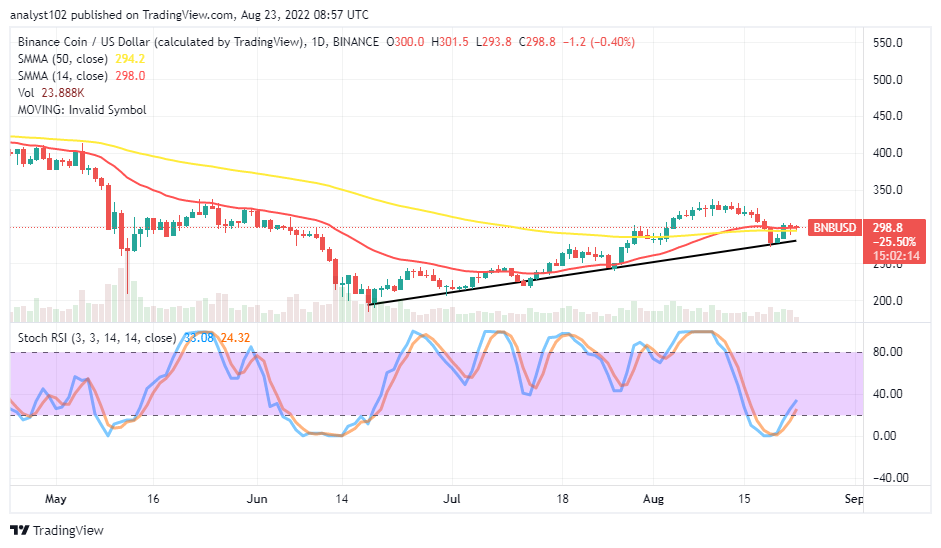
Binance Coin Price Prediction – August 23 It has been that Binance Coin holds fewer declines in its valuation against the trading worth of the US Dollar. The market maintains an average minute percentage rate of 0.40 negative, trading around $297.
Binance Coin Price Statistics: BNB price now – $297.65 BNB market cap – $47.9 billion BNB circulating supply – 161.3 million BNB total supply – 161.3 million Coinmarketcap ranking – #5 Binance Coin Market
Binance Coin Market Key Levels: Resistance levels: $325, $350, $375 Support levels: $270, $250, $230 BNB /USD – Daily Chart The BNB/USD daily chart showcases the crypto-economic market holds fewer declines around the trend lines of the SMAs. The 14-day SMA indicator is at $298 above the 50-day SMA indicator’s value line at $294.20. The bullish trend line is drawn northward to the extent to which the price has reduced over time. The Stochastic Oscillators have crossed northbound from the oversold region, keeping the range points of 33.08 and 24.32.
Buy Binance Coin Now
Your capital is at risk.
Should the BNB/USD trade sellers follow any move that tends to break down at the bullish trend line?
It may technically not be ideal for the BNB/USD trade sellers to follow any move that tends to break down at the $280, the higher point level of it as the crypto’s price holds fewer declines beneath the correctional starting value line obtained recently around the $325. Buying activities may resume while gravitational force to the downside found too weak to breach through variant supports penultimate before the $270 support level in the long run.
On the downside of the technical analysis, as of the time of writing, the BNB/USD market bears may not have a decent sell entry point until other rounds of formation occur. An overbought condition reading by the Stochastic Oscillators will give a reliable insight into when there will be time to launch logical shorting orders afterward. Therefore, short-position placers have to maintain a culture of caution at this moment.
BNB/BTC Price Analysis
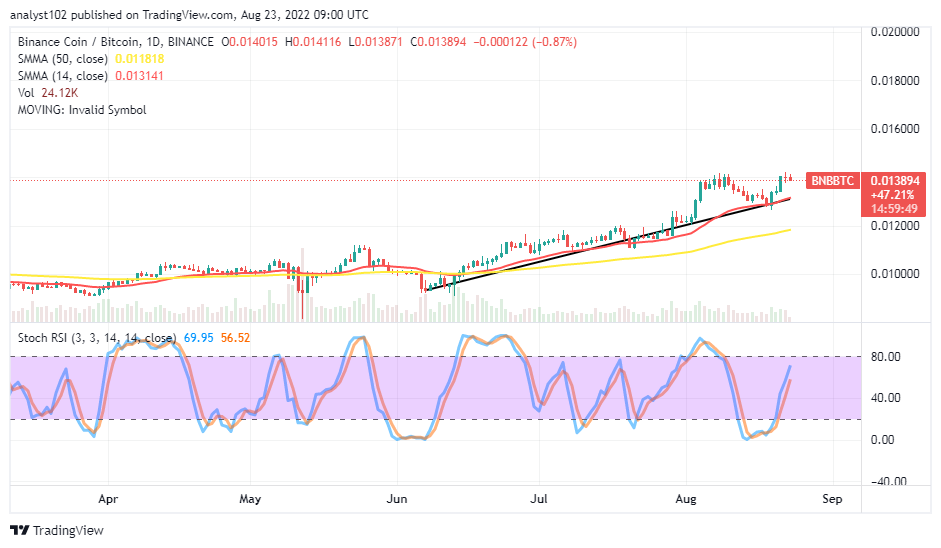
Binance Coin appears to keep a higher-trending outlook against the capacity of Bitcoin. The cryptocurrency pair price holds fewer lines of points over the trend lines of the SMAs. The bullish trend line at some point aligned with the 14-day SMA indicator above the 50-day SMA indicator. The Stochastic Oscillators have crossed northbound, reaching the 56.52 and 69..95 range values. A bearish candlestick appears in the making to signal the base crypto is on the verge of losing the strength to push more against its counter crypto.
Attorney and XRP supporter John Deaton believes new evidence will be revealed in the U.S. Security and Exchange Commission’s lawsuit against Ripple.
The SEC filed its lawsuit against Ripple Labs in late December 2020, declaring XRP a security and accusing the San Francisco payments company of selling the crypto asset without proper authorization.
Deaton represents 67,000 XRP holders in the lawsuit after U.S. District Judge Analisa Torres granted the crypto investors “Amici Curiae” status last year.
“Amici Curiae” means “friend of the court,” according to Cornell Law School. Amici curiae can submit documents known as amicus briefs on issues relevant to the case as long as the court approves the briefs in advance.
Deaton says once the summary judgment motions are out, followers of the case will likely encounter evidence that they have not previously seen or heard.
“When the Summary Judgment motions are public, we will see evidence we are currently unaware of, including testimony from Brad Garlinghouse, Chris Larsen, David Schwartz, and former Ripple employees. It includes testimony from Hinman and other SEC officials (i.e. Amy Starr, Valerie S, etc.).
I predict we also see why it was so important that XRP holders be heard. Will the SEC specifically argue XRP – the token itself – is the embodiment of all the promises and efforts made by Ripple starting in 2012 and continuing today and therefore all XRP are securities?”
Deaton also criticizes SEC Chairman Gary Gensler in a new opinion piece published on Fox Business.
“With meme stocks attracting leagues of first-time investors, and the crash in SPACs (special purpose acquisition companies) you would think Gensler has too much on his plate to be messing with cryptocurrencies that have traded for over a decade. Yet, he calls crypto the ‘Wild West’ of investing because digital assets are known to finance illegal activity. But the vast majority of money laundering takes place using the greenback, and there’s lots of bad stuff happening on an unregulated internet.”
Don’t Miss a Beat – Subscribe to get crypto email alerts delivered directly to your inbox
Check Price Action
Follow us on Twitter, Facebook and Telegram
Surf The Daily Hodl Mix
Disclaimer: Opinions expressed at The Daily Hodl are not investment advice. Investors should do their due diligence before making any high-risk investments in Bitcoin, cryptocurrency or digital assets. Please be advised that your transfers and trades are at your own risk, and any loses you may incur are your responsibility. The Daily Hodl does not recommend the buying or selling of any cryptocurrencies or digital assets, nor is The Daily Hodl an investment advisor. Please note that The Daily Hodl participates in affiliate marketing.
The anonymous host of InvestAnswers says blockchain scaling solution Polygon (MATIC) is his top altcoin pick.
In a new YouTube video, the host tells his 444,000 subscribers that MATIC may not have the most upside of any token, but it represents “the most upside balanced with the least amount of downside.”
The analyst also says Polygon, according to his calculations, has the third-highest “smart-contract platform score” after Ethereum (ETH) and Solana (SOL).
“It has the lowest risk. It has extremely high adoption. [It has] very solid daily active users, especially considering all the stuff that’s happened in this crypto winter. It has ZK (zero knowledge) rollup functionality, and the move of Ethereum to proof-of-stake will not negate the need for L2s at all, by any stretch.”
MATIC is trading at $0.82 at time of writing. The 17th-ranked crypto asset by market cap is up more than 1% in the past 24 hours and nearly 15% in the past seven days. The token is also down more than 70% from its all-time high of $2.92, which it hit last December.
The InvestAnswers host cautions that he doesn’t offer financial advice but says the $0.60 is a “pretty solid” historical support level for Polygon. He also notes that $0.65-$0.66 represents a “killer entry” for the altcoin.
[embedded content]
I
Don’t Miss a Beat – Subscribe to get crypto email alerts delivered directly to your inbox
Check Price Action
Follow us on Twitter, Facebook and Telegram
Surf The Daily Hodl Mix
Disclaimer: Opinions expressed at The Daily Hodl are not investment advice. Investors should do their due diligence before making any high-risk investments in Bitcoin, cryptocurrency or digital assets. Please be advised that your transfers and trades are at your own risk, and any loses you may incur are your responsibility. The Daily Hodl does not recommend the buying or selling of any cryptocurrencies or digital assets, nor is The Daily Hodl an investment advisor. Please note that The Daily Hodl participates in affiliate marketing.
Things have not been looking too good for the crypto market in recent months, with the market seemingly being gripped by one piece of bad news after another. To this point, on Aug. 8, the United States Department of the Treasury’s Office of Foreign Assets Control (OFAC) issued legal sanctions against digital currency mixer Tornado Cash.
As per the regulatory body, since the platform’s inception in 2019, it has been used for a host of illicit money laundering activities estimated to be worth $7 billion. Of this sum, it is estimated that $455 million was controlled by the notorious Lazarus Group, a North Korean state-sponsored hacking group. Additionally, Tornado Cash was also used to launder over $96 million of ill-gotten funds derived from June’s Harmony Bridge hack and $7.8 million from this month’s Nomad heist.
Before proceeding any further, however, it would be best to understand what exactly a cryptocurrency mixer is. Simply put, it is an offering that helps obfuscate potentially identifiable or tainted cryptocurrency funds with others to erase any trails linked with the assets, thus making it impossible for anyone to trace the tokens back to their original source.
Creator arrest leads to public outcry
On Aug. 12, Alexey Pertsev, the creator of Tornado Cash, was arrested by Dutch authorities. According to a press release issued by the financial crime authority of the Netherlands — the Fiscal Information and Investigation Service — the arrest was made based on Pertsev being involved in the “concealment of criminal financial flows and facilitating money laundering.”
While Tornado Cash can potentially be used by bad actors to hide criminal proceeds, it can and is also be used to facilitate a wide array of legitimate activities. The Dutch police have yet to make it clear as to which exact rules Pertsev broke, even though different media outlets have speculated and offered varying explanations as to why he was arrested. The Tornado creator has yet to be charged with any wrongdoing.
Following Pertsev’s detainment, a mass of protesters gathered in Amsterdam’s Dam Square on August 20 to voice their displeasure with the handling of the matter. And, while the demonstrators did not directly comment on the legal issues surrounding the arrest, they did claim that Pertsev’s arrest signaled a dark future for the fast-growing Web3 ecosystem. Not only that, but they also believe that it could have a chilling effect on the Netherlands’ existing blockchain ecosystem.
Mark Smargon, CEO of decentralized payment network Fuse, told Cointelegraph that while he is very disappointed to see a developer being arrested for simply having written a piece of code, to avoid such scenarios in the future, crypto finance entities — especially those who see mainstream adoption on the horizon — should be willing to meet regulators halfway to mitigate existing security issues while ensuring people’s rights to individual privacy.
However, Abraham Piha, CEO and co-founder of Web3-focused firm Tomi, told Cointelegraph that government sanctions like these are scary if one starts looking at them objectively:
“Tornado existed only because most blockchains were not private enough. If successive updates of Ethereum or Bitcoin include protocol integrations like Mimblewimble, will the next step be to block them as well? This act is yet another reason to push for Web3, a free web, controlled by users and not by some big brother governments.”
A spokesperson for crypto policy think tank Coin Centre noted that the nonprofit is considering taking the matter to court since it believes that the core argument prohibiting the platform from operating is unjustified. Not only that, but the independent body also believes that the Treasury’s actions may have exceeded its statutory authority.
Was Tornado’s forced shutdown unconstitutional?
In a recent interview with Bloomberg, Jesse Powell, CEO of digital-asset exchange Kraken, argued that the Treasury Department’s actions to shut the Tornado Cash could be “unconstitutional,” stating that people have a right to privacy and thus, it will be interesting to see if the regulatory body’s assertions can hold any sort of ground in a court of law. He further stated that the subsequent removal of Tornado’s native code repositories was a “totally unnecessary step.”
Recent: Ethereum Merge prompts miners and mining pools to make a choice
Following the sanctions, USD Coin (USDC) stablecoin issuer Circle decided to block all Tornado Cash addresses, to which Powell reacted: “Having a digital currency that’s so controlled and able to be controlled by maybe unconstitutional government action is a little bit scary.”
Kenny Li, co-founder and core developer for Manta Network — a privacy-preservation protocol — told Cointelegraph that the Treasury’s decision to sanction Tornado Cash is far-fetched and extreme even though in the past, certain individual crypto wallet addresses have been subject to the same treatment. But, in most cases, he said, there was a clear case of fraud, hacks or a Ponzi scheme:
“In this case, smart contract addresses are being blacklisted. Smart contracts aren’t people. Not only that, but people forget that Tornado Cash is a protocol, not a person or an entity, which means it will continue to run regardless of the sanctions. It is time that we realize privacy and anonymity aren’t the same, and Web3 is all about privacy.”
On the subject of people moving their USDC to other stablecoins following Circle’s decision to block Tornado Cash wallet addresses, Li noted that, unfortunately, there has been an increase in the number of platforms blacklisting wallet addresses maintained via Tornado Cash.
He pointed out that the move was due to Circle’s status as a regulated platform, thus obliging it to comply with any sanctions issued by a government body whose jurisdiction it operates under.
Lastly, he believes that Circle’s actions of blocking the movement of millions of dollars worth of USDC can potentially inhibit innovation within this space. Li concluded:
“No one wants their funds to be blocked, especially for activities they aren’t involved in. That said, there’s no certainty that tomorrow Tether won’t block addresses that have touched Tornado Cash. Ultimately, this action from the Treasury will likely instigate a domino effect, most of which is yet to be felt.”
Human rights violations brewing?
One aspect of Pertsev’s detention that has drawn public attention is that since his arrest, he has reportedly been denied visits of any sort, including those from his wife, Ksenia Malik.
In recent correspondence with Cointelegraph, Malik said, “He’s kept in prison as if he were a dangerous criminal,” despite simply “writing open source code.”
With Dutch authorities continuing to bar any contact with the outside — not even “one short call” — several rallies are being organized to support him. Decentralized finance aggregator 1inch tweeted that the arrest stands to establish a dangerous precedent, one that could potentially “kill the entire open-source software segment” if developers are continued to be held accountable for any misuse that emanates as a result of the software they create.
Decentralized finance aggregator 1inch tweeted that the arrest stands to establish a dangerous precedent, one that could potentially “kill the entire open-source software segment” if developers are continued to be held accountable for any misuse that emanates as a result of the software they create.
1/ Is it really a crime to be an open-source #blockchain developer nowadays ⁉️
Stand up for the right to build open-source software!
Help Alex Pertsev get out of jail!
Sign the petition: https://t.co/r5sdHaYKCN#FreeAlex #OpenSourceNotACrime #DeFi
Why is it important⤵️ pic.twitter.com/CqqD4Ds8AQ
— 1inch Network (@1inch) August 18, 2022
Despite the heartfelt sentiments of the open-source development community, it is pertinent to highlight a recent report from blockchain security platform SlowMist, which found that approximately 74% of all funds stolen from the Ethereum network over Q1 and Q2 of this year made their way to Tornado Cash, with researchers noting:
“The platform accounts for most of the initial funding for these security incidents. There have also been reports of withdrawals from exchanges, trading platforms, and personal wallets to fund these security incidents.”
Lastly, it should be noted that despite the outpouring of public support for Pertsev, his arrest hasn’t been entirely disapproved of by members of the global finance arena. For example, in a recent interview, venture capitalist Kevin O’Leary stated that platforms like Tornado Cash — which are advertised as “privacy tools” — have created a culture where it is fine to tinker around with federal regulations.
Recent: Ethereum advances with standards for smart contract security audits
In his view, Pertsev’s arrest was necessary and that it’s fine to have “sacrificed him” because it will, in his view, help introduce a high degree of stability within the market in the long run.
Therefore, moving forward, it will be interesting to see how legal issues such as these continue to be dealt with by regulatory agencies across the globe.
iFinex, the company responsible for Bitfinex Derivatives, announced on Tuesday the launch of a new service offering available to users before the highly-anticipated Ethereum Merge. The exchange now offers Ethereum Chain Split Tokens (CSTs).
Tokens available to users represent the two systems involved in the Merge: ETHW, which is proof-of-work (PoW) and ETHS, which is proof-of-stake (PoS). Bitfinex released the new trading tokens so users would be ableto trade on the potential forking event.
The coins will be available through the Bitfinex derivatives platform.
Bitfinex chief technology officer Paolo Ardoino said they released these new tokens to better prepare users for all Merge-related possibilities. However, the tokens come with an expiration date set for the end of the year.
Related:3 strategies investors might use to trade the upcoming Ethereum Merge
According to the exchange, there are three foreseeable outcomes for which these tokens can help users prepare.
If there is no consensus change on the proof-of-work chain, ETHS will expire and ETH will be given for all ETHW holdings. However, if the consensus change is successful with no fork, the opposite will happen, ETHW will expire and ETH will exchange for ETHS.
In the scenario of both a successful consensus change and a successful fork, both ETHW and ETHS tokens will be credited with ETH.
The Merge, which is scheduled to take place around mid-September, has the entire industry on edge. Users are eager to see if the event will happen around the timeframe promised by developers and also if any disruptive side effects will occur.
The Merge has been delayed multiple times in the past. Protocols like Aave encouraged users on the network to commit to PoS ahead of time, though there has been pushback from the PoW community.
Miners especially are faced with the choice of how to proceed with the Merge. While some large mining pools have already shifted to staking, other PoW miners plan to freeze contracts to keep PoW alive despite skeptics.
Prague is the birthplace of the world’s first hardware wallet, the first Bitcoin mining pool, and, reportedly, even the first Bitcoin cafe. It is among the most affluent cities in Central Europe, visited by millions of tourists each year.
Ranked as one of Europe’s most charming and beautiful cities, Prague is a burgeoning tech hub with a new generation of crypto-saavy individuals populating its streets.
Fast facts
City: Prague Country: Czechia Population: 2.7 million (Metropolitan Area) Established: 8th Century Languages: Czech, Slovak, English, Ukrainian, German, Vietnamese, Russian
Prague was a leading metropolis in the adoption of Bitcoin.
Understand
Known for its bridges, majestic fortifications and Bohemian architecture, Prague was voted the most beautiful city in the world last year by Time Out Magazine. At the crossroads of Europe, it’s visited by over 8 million tourists annually and has become a popular choice among filmmakers as a backdrop, including the makers ofMission: ImpossibleandCasino Royale.
More than 1,000 years ago, the migration of the Czech people — a Western Slavic tribe — founded the City of Prague on the banks of the Vltava river. Prague quickly developed into a major metropolitan center in medieval times and was the seat of many Bohemian kings who would also reign as the emperors of the Holy Roman Empire.
Ruled over variously by the Austrian Empire, a short era of independence, and then by Nazi Germany, Prague managed to escape destruction at the hands of Nazis or Allied bombers. But after just three years of independence after the war, communists backed by the Soviet Union staged a coup and toppled the country’s democratic government in 1948. Development stalled during communist times, and despite a flicker of hope for liberalism in the Prague Spring of 1968, it wasn’t until the Velvet Revolution protests that the ruling communist party resigned on Nov. 28, 1989, putting the local people once again in charge of their own destinies.
The Powder Tower during the Habsburg era. Source: Old-Prague.com
Crypto culture
Today, Prague is a leading tech hub in Central Europe. Having changed currencies once a generation due to their various rulers and independence, the Czech people are known for monetary skepticism and have enthusiastically adopted digital currencies. This interest has been compounded by the growing inflationary pressure on the Czech koruna (CZK), which stood at 18.0% per annum in June 2022.
Firms such as SatoshiLabs, Alza, Trezor, Braiins and many others have ramped up education about digital assets in the country. However, the Czech National Bank has largely remained on the sidelines with regard to regulating the industry. While interest in crypto remains strong among the Czech people (especially those in Prague), recent industry blowups and bear market sell-offs have hampered confidence somewhat.
But that does not take away from the fact that it was here where the world’s first hardware wallet, first Bitcoin mining pools and first Bitcoin coffee shop all came into action within the past decade. In recent years, Prague has also become a hotspot for digital nomads, being voted as the top destination in the world for remote work, along with Krakow, Poland in 2021. Thanks to the effort of early adopters, the city is rife with crypto meetups, hackathons, venues and seminars that make it distinct from its neighbors in Central Europe.
Prague’s Old Town Square. Source: Zhiyuan Sun
Notable Projects
Nowadays, cryptocurrency hardware wallets are renowned for their ability to safeguard investors’ assets in a self-custodied manner, but just who invented them? The idea all started in 2011 after a Bitcoin conference in Prague.
Two crypto enthusiasts, Pavol “Stick” Rusnák and Marek “Slush” Palatinus envisioned a small, single-purpose computer that would securely store users’ Bitcoin private keys. In 2013, the two founded SatoshiLabs. The following year, the first-ever Trezorwallet — Trezor One — launched. Then came the Trezor Model T, which added a touchscreen to the device. Both devices have sold over 1 million units since inception, with their firmware patched monthly or so. It has become the standard for hardware crypto storage worldwide.
We and @invity_io are safe & sound in Miami, ready to discuss sound money with you at @TheBitcoinConf.
Wallets? ✅ Keys? ✅ Booth AMAs, prizes, other activities? You bet!
We will be sharing the conference experience with you along the way. Let our crew tell you more details: pic.twitter.com/vNiEmZtggR
— Trezor (@Trezor) April 6, 2022
SatoshiLabscomprises a basket of companies (Trezor, Invity and Tropic Square) forming the forefront of crypto and tech development in Czechia.
The famed Trezor Model T
Apart from its flagship product, it is also responsible for creating over 20 industry standards, such as the recovery seed and passphrase used in all cryptocurrency hardware wallets today.
Like many in the crypto industry, they were incensed by the Russian invasion of Ukraine this year and wanted to help. Vojtěch Černý, head of commerce at Trezor, and Bach Nguyen, head of business development at Invity, drove nearly 900 kilometers to the Slovak–Ukrainian border town of Vel’ké Slemence, delivering humanitarian supplies and bringing back four women and two children refugees to safety in Czechia.
SatoshiLabs also donated 1 million euros worth of Bitcoin to charities helping Ukraine shortly after the war started, citing the “effects of occupation and destruction of individual freedom” during five decades of Communist rule over Czechoslovakia as the inspiration.
Invityis another branch of SatoshiLabs.
The firm is a price aggregator that scrutinizes every crypto exchange and other platforms to find the best rates for purchasing cryptocurrency. It combines everything in one place with a straightforward interface designed for users just getting into crypto. Invity also has a wide range of resources about education for novel crypto enthusiasts.
Lastly, during the development of Trezor at SatoshiLabs, it became clear that the firm needed an auditable integrated circuit with better security solutions than market alternatives. Thus,Tropic Squarewas born with an ambitious plan to make an open-source, auditable custom chip to transform low entropy code into high entropy data for cryptographic operations. Led by tech-savvy developers such as CEO Evžen Englberth and chief technology officer Jan Pleskač, chips developed by Tropic Square are now found in each and every one of Trezor’s hardware wallets.
Tropic Square staff at SatoshiLabs headquarters. Source: Tropic Square
Before he created Trezor, Palatinus founded the first Bitcoin mining project in Prague in 2010, which was simply called Bitcoin.cz. After he moved on,Braiins, a company doing embedded Linux development and research, took over the mining pool and renamed it accordingly (until recently rebranding it back to Slush Pool), with 1.3 million BTC mined since inception.
Fast forward to now, Braiins/Slush Pool has grown to become one of the biggest Bitcoin mining pools. There are currently over 15,000 users of the firm’s mining optimization software in the space, with its total hash rate accounting for 5%–8% of the overall Bitcoin network. The company derives 100% of its income via BTC and charges a 2%–2.5% commission from its mining firmware.
Kristian Csepcsar, chief marketing officer of Braiins, explains that mining and Bitcoin is a way of life — not just a way to make money:
“Bitcoin miners are one of the most hardcore Bitcoiners, and their commitment to secure networks can be seen in the global hash rate numbers. Bitcoin’s price fell more than 70% recently, but the hash rate has only dropped about 20% from all-time highs…. Bitcoin’s relative price to fiat can change, but Bitcoin will be forever one Bitcoin, and miners deeply understand this point.”
Braiins core team at Bitcoin Mining Conference 2022 in Prague. Source: Braiins
General Bytesis the world’s second-largest Bitcoin and ATM manufacturer, with offices in Prague and Bradenton, Florida. Since its inception in 2013, the company has sold over 13,000 machines across 142 countries, most of which are located in the United States.
A General Bytes ATM. Source: General Bytes
More than 180 fiat currencies can be used to purchase 60+ types of digital assets at its cash machines. Over 22.5 million crypto transactions have been performed worldwide on its network of Bitcoin ATMs.
Backed by the $2.5-billion Rockaway Capital, theRockaway Blockchain Fundis aventure capital firmbacking leading Web3 founders. Founded in 2020, the Prague-based firm has now invested in 36 projects and 26 funds. In addition to investing capital and boosting liquidity, Rockaway backs its projects through community networking, a staking team that runs its validator nodes, and an in-house development team known as RBF Labs. It was one of the early backers of Solana, along with several investments in the Cosmos ecosystem, including Agoric.
Rockaway raised $123 million in its first VC fund, which is now nearly 75% deployed with a portfolio value of approximately $300 million as of June 30. In addition to that, RBF also has a separate lending fund that provides loans to market makers and liquidity to DeFi protocols, with an asset under management of approximately $35 million at the end of June.
Where can I spend my crypto?
Located near the heart of Prague’s Old Town isBar No. 7, a laid-back venue with multilingual staff that’s extremely popular among expats and locals alike. It’s also a great place to go for value on one’s crypto: One can get delicious cocktails for around 150 CZK each ($6.24) and a pint of beer for just 25 CZK ($1.04) all paid for with crypto. There’s also a Bitcoin ATM located right inside the venue. But beware — it gets packed quickly in the evenings almost every day of the week.
Bar No. 7 Praha. Source: Zhiyuan Sun
For scenic, short-term rentals or long-ish stays, you can book and pay for lodging withPrague Siesta Apartmentsusing Bitcoin. Apartments are located at the heart of Prague, a minute’s walk away from attractions such as the Old Town Square and the Astronomical Clock. Prices vary by season and typically fluctuate above or below 2,000 CZK per night ($83.08) with discounts for longer stays.
Paralelní Polisis the first coffee shop to accept cryptocurrencies in Central Europe and has been active since 2014. Though it has now largely evolved to become a co-working space and club venue, hosting various events, projects and refreshments for its members. But one can still purchase the venue’s original Bitcoin Coffee at its doorstep. Bitcoin, Litecoin or Lightning Network are accepted. It’s named after Czech activist Václav Benda’s 1973 concept of “Paralelní Polis” (Parallel Polis) — an independent society not oppressed by laws and decisions of representatives of central authorities. The idea became a rallying call for political dissidents and sounds very much like Libertarian Bitcoiner politics.
Alzais a leading e-commerce platform in Central Europe with close to $1.2 billion in annual sales. It has a catalog of crypto-related hardware devices that customers can pay for with Bitcoin (Ether and Litecoin payments are expected in the future). It also accepts Bitcoin on its local e-commerce subsidiaries operating in Slovakia, Germany, Austria, the United Kingdom and on Alzashop.com. For crypto tourists who don’t have an address in Prague to deliver to, you can get products shipped to the unique Alza Boxes package lockers for pickup. And thanks to General Bytes, it is also possible to buy cryptocurrencies at some of Alza’s retail locations via in-store ATMs.
Finally,A Maze in Tchaiovnais a solid venue for tea and craft beer lovers alike. It is an all-in-one stop that combines elements of a teahouse, theater, gallery and bar. Cryptocurrency can be tendered for beverages and snacks. Live music is available periodically.
IT’S HERE.
…the handbook with everything you and your friends need to know about the basics of bitcoin mining.
We have 400 free copies to share this week at @MiningDisrupt in Miami, and it’ll soon be available on Amazon (hardcopy) and on the Braiins website (free e-book). pic.twitter.com/vzTCUfXZmI
— Braiins | bitcoin mining tools (@braiins_systems) July 25, 2022
Education
Braiins, the company behind Slush Pool, runs aregular blogabout how to get started on one’s Bitcoin mining rig, along with the economics of such an operation. Similarly, Alza has its ownblog seriesdedicated to educating readers and shoppers about Bitcoin. But Braiins takes it one step further by also publishing a series of books about the nature of Bitcoin decentralization and the future. They are free to read and are available in both hard copies and as completepdfson its site.
Currently, the University of New York in Prague is issuing digital diplomas using blockchain technology for all degrees accredited by the Czechia’s Ministry of Education. Students are provided a hyperlink to such accreditation with a QR code attached to verify its authenticity and can be freely shared among social networks.
‘Bitcoin: Odluka peněz od státu’ (Bitcoin: The Separation of Money From the State) by Josef Tětek and published by Braiins. Source: Josef Tětek
Controversies
Being a closely-knit crypto community, Prague is not known for crypto scams or digital asset-related crime. The majority of misconduct happened in the previous decade, such as the collapse of the Bitcash.cz crypto exchange in 2013 and the theft of approximately 485 BTC. Another instance involved Czech national Tomáš Jiříkovský and his alleged role in laundering $40 million worth of BTC in stolen funds from a securities fraud case in 2015. Earlier this year, an incidentoccurred with Trezorwhere the firm’s customer data was breached on third-party data vendor Mailchimp. It subsequently evolved into a phishing scam before it was quickly addressed.
That said, a much more serious incident occurred on August 18. Via a zero-day bug, hackers made themselves the default administrators of General Bytes’ ATMs and modified settings so that all deposits were transferred to their wallet address. A central client access server hosting the entirety of the company’s operation was compromised. General Bytes has urged customers to refrain from using its servers until its owners patches the exploit in an update.
Notable People
Pavol “Stick” Rusnák, co-founder of SatoshiLabs;Mark “Slush” Palatinus, co-founder of SatoshiLabs;Pavel Moravec, co-CEO of Braiins;Jan Capek, co-CEO of Braiins;Bach Nguyen, head of business development at Invity;Vojtěch Frgál, CEO of General Bytes;Evžen EnglberthCEO of Tropic Square;Jan Pleskač, chief technology officer of Tropic Square;Josef Tětek, economist and SatoshiLabs’ brand ambassador;Kristian Csepscar, chief marketing officer of Braiins;Vojtěch Černý, head of commerce at Trezor;Tommy Poole, owner of Bar No. 7 Praha.
Cointelegraph members based in Prague:
Ever wonder whose creative mind is behind that of Cointelegraph’s signature artistic style? Well, Cointelegraph’s talented art team is led none-other by lead artist and art editor Anastasia Zhdanova, who is based in Prague. With an art career spanning 13+ years, Zhdanova is also the creator behind theСерые будни магов(Magic Routine) comic series. She graduated from the prestigious Stieglitz Academy of Art and Design in Saint Petersburg, Russia.
Europe and crypto as portrayed by the Cointelegraph art team
If you have any suggestions for additions to this guide, please get in touch withzhiyuan.sun@cointelegraph.com
The Securities Commission (SC) of Malaysia issued a statement on Monday regarding Huobi’s operations in the country. According to the statement, the crypto exchange is now on the SC’s Investor Alert List.
Malaysian financial regulators say Huobi has been operating a digital asset exchange in the country without official registration with the SC.
Huobi Global [https://t.co/la9Y3ntGuq] has been added to the SC’s Investor Alert List for operating a digital asset exchange (DAX) in Malaysia without being registered with the SC. pic.twitter.com/z3IGgnCa0t
— SC Malaysia (@SecComMY) August 22, 2022
In a follow-up tweet, the SC said that any operations that perform or offer capital market activities within the country require its approval. Those who aren’t granted such approval are considered unlicensed or unregistered entities. Local authorities say investors are “strongly urged” not to invest in such operations.
Additionally, the SC highlighted that anyone who does utilize such a service does so at a risk and would not be able to legally resolve monetary losses.
Such a statement does not bode well for the exchange. Local investors responded to the tweet by saying a simple fix is to change exchanges.
In an official statement, the Huobi Group responded to Cointelegraph, stating that compliance is a core pillar of its business model in every country of its operations:
“We are currently in discussions with Malaysian regulatory authorities regarding our presence in the local Malaysian market.”
This comes amid an array of developments for the global exchange.
In countries such as Australia and the United States, Huobi is taking steps toward expansion. Australian regulators greenlit the exchange in early August. In the United States, Huobi has secured a FinCEN license, which brings it one step closer to offering services to American clients.
Related:Huobi co-founder reportedly looks to sell majority stake valued at over $1B
While the exchange is taking steps in the right direction in some places, there are road bumps in others, like Thailand and New Zealand. Huobi’s Thailand affiliate recently shut down because it could not fix major systematic issues, despite several extensions from local regulators.
In New Zealand, Huobi announced on Aug. 16 that it will end derivatives trading to complianc with local regulations. This comes only a few months after it won its initial license to operate in New Zealand.
We use cookies on our website to give you the most relevant experience by remembering your preferences and repeat visits. By clicking “Accept”, you consent to the use of ALL the cookies.
This website uses cookies to improve your experience while you navigate through the website. Out of these, the cookies that are categorized as necessary are stored on your browser as they are essential for the working of basic functionalities of the website. We also use third-party cookies that help us analyze and understand how you use this website. These cookies will be stored in your browser only with your consent. You also have the option to opt-out of these cookies. But opting out of some of these cookies may affect your browsing experience.
Necessary cookies are absolutely essential for the website to function properly. These cookies ensure basic functionalities and security features of the website, anonymously.
Cookie
Duration
Description
cookielawinfo-checkbox-analytics
11 months
This cookie is set by GDPR Cookie Consent plugin. The cookie is used to store the user consent for the cookies in the category "Analytics".
cookielawinfo-checkbox-functional
11 months
The cookie is set by GDPR cookie consent to record the user consent for the cookies in the category "Functional".
cookielawinfo-checkbox-necessary
11 months
This cookie is set by GDPR Cookie Consent plugin. The cookies is used to store the user consent for the cookies in the category "Necessary".
cookielawinfo-checkbox-others
11 months
This cookie is set by GDPR Cookie Consent plugin. The cookie is used to store the user consent for the cookies in the category "Other.
cookielawinfo-checkbox-performance
11 months
This cookie is set by GDPR Cookie Consent plugin. The cookie is used to store the user consent for the cookies in the category "Performance".
viewed_cookie_policy
11 months
The cookie is set by the GDPR Cookie Consent plugin and is used to store whether or not user has consented to the use of cookies. It does not store any personal data.
Functional cookies help to perform certain functionalities like sharing the content of the website on social media platforms, collect feedbacks, and other third-party features.
Performance cookies are used to understand and analyze the key performance indexes of the website which helps in delivering a better user experience for the visitors.
Analytical cookies are used to understand how visitors interact with the website. These cookies help provide information on metrics the number of visitors, bounce rate, traffic source, etc.
Advertisement cookies are used to provide visitors with relevant ads and marketing campaigns. These cookies track visitors across websites and collect information to provide customized ads.