Top Ethereum Rival Could Explode by 100%, Beating Other Large-Cap Altcoins, According to Coin Bureau – Here’s Why

A popular analyst known for his deep-dive research is laying out what might be on the horizon for a top Ethereum (ETH) competitor.

In a new strategy session, the pseudonymous host of Coin Bureau known as Guy tells his 2.09 million YouTube subscribers that he thinks layer-1 protocol Solana (SOL) could double in price if the broader altcoin rally keeps on rolling.

“SOL’s price action is also looking interesting from several angles. In terms of raw price action, SOL could potentially pull a 2x if the current recovery rally continues. This doesn’t sound like much, but if the rally does continue, it would be a larger percentage gain than other large cap altcoins.

That’s why there’s some legitimacy to [FTX CEO] Sam Bankman-Fried’s remark that Solana is underrated. There’s some more evidence to suggest that SOL could see a serious rally if the current crypto market momentum continues.”

The analyst also discusses Ethereum’s transition to a proof-of-stake (PoS) consensus mechanism that’s scheduled for mid-September. He believes the prospect of glitches or outright failure is sparking interest in several other ETH rivals, including Avalanche (AVAX) and NEAR Protocol (NEAR).

“Some of you may have noticed that Solana, Avalanche, Near Protocol and other so-called Ethereum killers have been rallying as the Merge approaches. This is no coincidence, as there are many traders who are likely trying to hedge their portfolios in case something goes horribly wrong with the Merge.”

Guy concludes by examining SOL’s price on the ETH trading pair, observing that Solana appears to follow a pattern of troughs and surges where a peak might coincide with the upcoming Ethereum Merge.

“Take a look at the SOL versus ETH chart on the weekly. Do you notice anything? Call me crazy, but I see a pattern where SOL loses value relative to ETH for around five to six weeks at a time, before seeing a one-to-three-week rally against ETH.

It’s been six weeks of decline, and with the Merge less than a month away, we could see another multi-week rally against ETH, all while ETH is simultaneously gaining in value relative to BTC [Bitcoin], and hopefully in fiat terms, too. This would translate to that 2x gain for SOL I mentioned.”

At time of writing, Solana is down 4.57% and trading for $38.67. With Ethereum priced at $1,821, SOL currently equals 0.02123 ETH.

[embedded content]

I
Don’t Miss a Beat – Subscribe to get crypto email alerts delivered directly to your inbox

Check Price Action

Follow us on Twitter, Facebook and Telegram

Surf The Daily Hodl Mix


Disclaimer: Opinions expressed at The Daily Hodl are not investment advice. Investors should do their due diligence before making any high-risk investments in Bitcoin, cryptocurrency or digital assets. Please be advised that your transfers and trades are at your own risk, and any loses you may incur are your responsibility. The Daily Hodl does not recommend the buying or selling of any cryptocurrencies or digital assets, nor is The Daily Hodl an investment advisor. Please note that The Daily Hodl participates in affiliate marketing.

Featured Image: Shutterstock/Vadim Sadovski/solvertv

Go to Source

MTV introduces the ‘Best Metaverse Performance’ award category

The 2022 MTV Video Music Awards (VMAs) added a new category to its list of competition categories. This year artists are eligible to compete under the category of “Best Metaverse Performance” for a coveted award.

Initially, the award show began in 1984 as an esteemed recognition for music video prowess. Major music artists, including Madonna, Nirvana and Kanye West, are among previous VMA recipients.

Typical award categories include, “Video of the Year,” “Artist of the Year,” and “Song of the Year,” though this year there is a Web3 twist. The VMAs took into account performances in the metaverse and created a brand new award category.

In its inaugural year, six artists are up for nomination. This includes the Rift Tour ft. Ariana Grande (Fortnite), Blackpink’s The Virtual (PUBG Mobile), BTS (YouTube), Charli XCX (Roblox), Justin Bieber – An Interactive Virtual Experience (Wave) and Twenty One Pilots Concert Experience (Roblox). 

In addition to a brand new award category, on Aug. 12 the award show announced its first-ever metaverse experience. Paramount Game Studios released The VMA Experience in the Roblox metaverse last week, which is available until Sep. 3 of this year.

Roblox has two performances up for nomination and is a virtual world very active with pop culture events, including concerts and festivals. Last year, it partnered with Insomniac, a major electronic dance music festival producer, to create virtual festivals in its metaverse.

Related: Concerts in the Metaverse could lead to a new wave of adoption

This year’s metaverse category comes after five consecutive years of declining VMA views. As the metaverse continues to expand and attract younger audiences, MTV’s move to include virtual performance may help keep it up to date. 

The music industry is rife with Web3 integrations, as it has been on a trajectory of digital consumption for years after the introduction of music streaming services. Artists are releasing singles as NFTs are now eligible for recognition on international charts, while others are utilizing blockchain to improve music licensing.

Go to Source

Can exchanges create imaginary Bitcoin to dump price? Crypto platform exec answers

One of the most substantial value propositions of Bitcoin (BTC) is that no one can create more of it apart from its fixed supply. However, an executive from a crypto exchange made a bold claim that some exchanges can create and sell BTC that’s only in their system, not on the blockchain, to manipulate the market. 

In an interview with Cointelegraph, Serhii Zhdanov, the CEO of crypto exchange Exmo, shared his beliefs that market manipulation is still prevalent in the digital asset space and gave an example of how it can happen.

According to the executive, if anyone wanted to dump the market, it’s possible to go to an offshore exchange that does not go through financial audits and ask for $100 million worth of BTC and use $10 million Tether (USDT) as collateral. He explained that:

“The exchange just adds these funds to the account, creating these Bitcoins only in their system. They do not exist on the Bitcoin blockchain. The client or internal market-making team then sells these Bitcoins equivalent to $100 million dumping the Bitcoin price on all exchanges.”

To get their profits, the market manipulators can then profit from arbitrage according to Zhdanov. “After the price is down, they buy the same amount of Bitcoin at a much lower price and make a profit,” he added.

The CEO said that fighting and preventing these potential events require stronger regulatory policies that are as comprehensive as the stock market. Zhdanov highlighted that offshore exchanges must also be regulated in the same manner as tier one exchanges or have transactions between regulated and offshore exchanges be limited. With this, the executive believes that the market will be a better place for investors of all sizes.
Related: Analyst claims that exchanges sell your Bitcoin, crypto trading platforms respond

Additionally, the executive pointed out that one of the barriers to mainstream crypto adoption is the money laundering concerns. According to the CEO, compliance and more comprehensive regulation will make these concerns go away. He said:

“Crypto is a new thing that evolves quickly, it’s highly similar to traditional investment vehicles in essence. Therefore, I think there are many things we can borrow from the stock market, where regulations have been tested over a longer time.”

Lastly, Zhdanov explained that at the moment, malicious entities like hackers are more attracted to targeting crypto rather than banks because of holes in security. The executive noted that security is also a key to a broader digital asset adoption.

Go to Source

Crypto market bloodbath leads to over $500M in liquidations in 24 hours

The crypto market registered a major slump on Friday, resulting in major cryptocurrencies losing key support and falling to new monthly lows after a prolonged bullish surge over the past month.

Bitcoin (BTC), which was looking to break through $25,000 resistance last week, fell below $22,000 to register a new two-week low of $21,747. Ether (ETH), the second largest cryptocurrency, has surged past $2,000 in the run to the Merge but slumped by 6% over the past 24 hours to register a new weekly low of $1,726.

The flash crash after weeks of bullish momentum also saw 157,098 traders getting liquidated in the past 24 hours resulting in liquidation of over $551 million. Data from Coinglass indicate Bitcoin traders lost over $203 million in liquidations, followed by Ethereum traders at $140 million.

The following liquidation chart indicates that the number of liquidated long positions outnumber the short ones by a significant margin, indicating the market sentiment was highly bullish until the flash crash. The value of short positions liquidated was only $41 million against $398 million in long positions.

Total Liquidation Source: Coinglass

BTC futures long liquidations reached an 8-month high of $84,934,697.05 on OKX (formerly known as Okex), breaking the previous high of $48,630,183.66 observed on May 5, 2022.

The sudden plunge in the crypto market is being attributed to the Fed’s expected interest rate hike in September. August consumer price index (CPI) data came lower than expected, leading to a bullish surge in crypto and forex markets alike.

Related: Bitcoin ‘very bearish’ below $22.5K says trader as BTC price dives 6%

Federal Reserve Bank of St. Louis president James Bullard said he would favor a 75 basis points increase. An interest hike by the fed next month could lead to another downturn. A similar interest rate hike of 75 basis points in June led to crypto market turmoil after an initial price surge.

Go to Source

Weak address growth points to Bitcoin price failing to sustain $25K

Bitcoin (BTC) is staging a repeat of price action from May with its latest drop, the latest data shows.

As the dust settles on a 6% comedown for BTC/USD, analysis argues that its trip to $25,000 was never meant to last.

Realized price comes back to haunt the BTC chart

After taking some by surprise with its magnitude, the latest snap losses for BTC price action are still playing out.

After falling from $23,800 to as low as $21,400 in a single hour, the largest cryptocurrency is now attempting to establish support near its realized price.

At just below $22,000, realized price refers to the sum total at which the entire BTC supply last moved.

The setup will be more than familiar to many market participants, as realized price formed an initial support line during Bitcoin’s descent in May, immediately following the Terra LUNA blowout.

Bitcoin realized price chart. Source: Glassnode

With history rhyming — at least on the chart — it remains to be seen whether other recent points of interest will continue to play their role.

Among them is the 200-week moving average (MA), a hard-won support level in July now seemingly lost in one fell swoop.

The 50-day MA, cleared in late July, is now also back above spot price at $22,260.

Going into the Wall Street open, United States equities futures showed that more downside was to come, implying more pressure on crypto markets.

Active addresses fail to support breakout

A look at network activity growth during the August run to over $25,000 meanwhile produced bearish conclusions for analyst Philip Swift.

Related: Bitcoin ‘liveliness’ lowest since 2021 amid new 5-year BTC hodl record

In a fresh tweet on the day, the creator of analytics resource Look Into Bitcoin noted that address growth had not matched similar price appreciation phases this time around.

“AASI (Active Address Sentiment Indicator) has been indicating that the current price move has not been supported by a sufficient increase in active addresses on the Bitcoin network,” he summarized.

“Experienced local highs when this has happened previously.”

Bitcoin AASI (Active Address Sentiment Indicator) annotated chart. Source: Philip Swift/ Twitter

This comes despite the total number of Bitcoin addresses ever created passing 1 billion this week, according to data from on-chain analytics firm Glassnode.

The views and opinions expressed here are solely those of the author and do not necessarily reflect the views of Cointelegraph.com. Every investment and trading move involves risk, you should conduct your own research when making a decision.

Go to Source

Canadian Regulator Limits Crypto Exposure for Banks and Insurers

  • Canada’s OSFI has created interim rules limiting banks’ exposure to cryptocurrencies.
  • The rules will come into effect in the second quarter of 2023.
  • The regulator will update the interim approach as needed.

The Office of the Superintendent of Financial Institutions (OSFI), a Canadian regulator, has said that banks and insurers in the country must limit their exposure to crypto assets. Specifically, the interim rules state that these companies can use only a small fraction of capital, and if their exposure exceeds 1% of their Tier 1 capital, they would have to notify the regulator.

The rules will come into effect in the second quarter of 2023. Another stipulation is that the banks and insurers will have to inform the OSFI if their total net short positions on those assets exceed 0.1% of Tier 1 capital.

The rules are in place until the OSFI and others can further develop the regulation surrounding cryptocurrencies, which is largely missing in the country. The regulator said that it would update the interim approach as needed to reflect various developments.

Superintendent Peter Routledge said of the interim arrangement,

“Like other financial institutions around the world, some Canadian FRFIs have exposures to cryptoassets, and we have provided this interim approach to help ensure risks in this area are managed prudently and supervised according to the principle of ‘same activity, same risk, same regulation’.”

The move marks a step forward for Canada, which has not taken too many actions in terms of providing a wide-ranging set of rules for the crypto market. That may change in the months to come as more countries, including neighbors — the United States — accelerate efforts.

Impending Regulation for the Crypto Market

The crypto market has long been facing the inevitability of regulation. However, it’s only in the past 18 months that the issue become more prominent globally. Several events, including the crash of TerraUSD, have put more attention on the matter.

Both the European Union and the United States have been doubling down on their crypto regulation efforts. A recent crypto bill by U.S. Senators is likely to be reviewed next year, while the EU has asked for stablecoin regulation in the wake of TerraUSD’s crash.

More countries will likely begin working on crypto regulation this year. The market has become popular enough that it warrants lawmakers’ attention, and their focus will be on matters such as investor protection, taxation, and the prevention of illicit activity.

Go to Source

Hodlnaut Lays Off 80% Of Its Staff To Reduce The Firm’s Expenditure

  • Crypto lender platform Hodlnaut has laid off 80% of its staff 
  • In a blog post published Friday, the firm added how the decision to lay off employees has been taken to reduce the firm’s expenditure. 

Troubled crypto lender platform Hodlnaut has laid off 80% of its staff to reduce the firm’s expenditure. Hodlanaut had earlier halted withdrawals on its platform citing “extreme market conditions.”

Hodlanaut Applies To Be Placed Under Judicial Management 

In an updated blog post, Hodlanaut has shed light on the latest company developments after halting its withdrawals earlier this month. The firm added that it has recently applied to be placed under Judicial Management and considers it the best option that may help the firm in stabilizing its financial health. 

The crypto lender platform further added how the Judicial Management will prove beneficial for the firm as it will prevent Hodlanaut from liquidating its BTC and ETH holdings. 

Furthermore, the decision will also help Hodlnaut gain its former momentum back in terms of formulating a recovery plan and rehabilitating the firm’s entire ecosystem. 

“We believe that judicial management is the option which would most benefit our users now and in the long run. First, it would avoid liquidation of Hodlnaut’s holdings of BTC and ETH at today’s depressed prices (which have fallen greatly from their 2021 all-time highs)…Second, judicial management provides Hodlnaut with the opportunity to execute its recovery plan and rehabilitate the company. ” the blog further adds. 

Hodlnaut further stated how it’s looking forward to restoring the asset-to-debt ratio to at least 1 and later allowing users to withdraw the full value of their crypto holdings. 

However, in its bid to recuperate and stabilize its finances, Hodlnaut confirmed that it has laid off 80% of its staff as a measure to reduce the company’s expenses. 

“The current team that we have retained are, in our assessment, a necessary headcount for us to carry out key functions.” 

Hodlnaut is not the only crypto firm that has reduced its company staff to reduce its financial pressure. Earlier this year, leading crypto firms including Coinbase, Crypto.com, Gemini, and Bybit have also announced mass layoffs, citing the prolonged crypto winter crisis. 

Go to Source

Twitter influencer Hodlonaut drums up support ahead of Craig Wright trial

Influencer Magnus Granath, also known as @hodlonaut, took to Twitter to rally support for his upcoming legal battle with Craig Wright. The trial will be heard In Granath’s native country Norway on September 12 and relates to a “declaratory statement” filed against Wright.

A second trial is scheduled to take place in the U.K. regarding a libel suit filed against Granath. Wright’s legal team, ONTIER LLP, stated this will take place in late 2023. Commenting on this, Granath said:

UK litigation is extremely expensive, and the last hope of my opposition is that I will not be able to continue and thus give them a default win.

Craig Wright claims to be Satoshi Nakamoto

Wright claims to be Bitcoin creator Satoshi Nakamoto. But various individuals, including Granath, have challenged this claim. In March 2019, Granath posted tweets to this effect based on what he called “a matter of public interest.”

Granath said Wright issued a “Strategic Lawsuit Against Public Participation” (SLAPPs). According to the Business & Human Rights Resource Center, SLAPPs can sometimes be used to silence individuals/entities who raise concerns over particular practices. This involves criminal or civil lawsuits to intimidate, bankrupt, or silence critics.

However, Granath vowed to hold his ground on the matter, despite it costing $2.4 million to fight “and countless hours” of his time. Going into the Norweigan trial, he expressed confidence in winning the case.

Granath is appealing to the Bitcoin community to “fundraise for legal fees and support freedom.” Donations can be made at the defendingbtc.com website, which is operated in conjunction with the OpenSats Legal Defence Fund.

UK court awards Wright £1 in case against Peter McCormack

Another challenger to Wright’s claim of being Satoshi Nakamoto is the host of the “What Bitcoin Did podcast,” Peter McCormack.

On August 1, the U.K. High Court released the outcome of the libel lawsuit Wright had filed against McCormack. Judge Justice Chamberlain ruled in favor of Wright, agreeing that Wright suffered reputational damage due to McCormack’s tweets and a single YouTube broadcast.

However, due to Wright falsifying evidence during the trial, Judge Chamberlain awarded him just £1 in damages. In this case, the judge made no ruling on Wright being Satoshi Nakamoto.

“However, because he advanced a deliberately false case and put forward deliberately false evidence until days before trial, he will recover only nominal damages.”

Commenting, McCormack thanked his legal team and the judge on the ruling.

Go to Source

Crypto markets plunge as Euro trading hours start, Bitcoin loses support at $22,000

The global crypto market cap is $ with a 24-hour volume of $. The price of Bitcoin is $21,750.59 and BTC market dominance is %. The price of Ethereum is $1,740.31 and ETH market dominance is %. The best performing cryptoasset sector is Deflationary, which gained 17%.

Go to Source

September 14 may be the biggest day in the history of the internet

The Merge has been a hot topic of conversation within the Ethereum ecosystem for years. The third revision of the original Ethereum whitepaper included references to proof-of-stake in 2014. Vitalik Buterin added references to PoS, stating that both PoW and PoS can “serve as the backbone of a cryptocurrency.”

“The mechanism behind proof of work was a breakthrough in the space… an alternative approach has been proposed called proof of stake, calculating the weight of a node as being proportional to its currency holdings and not computational resources… it should be noted that both approaches can be used to serve as the backbone of a cryptocurrency.”

Further, later in the paper, Vitalik added, “in the future, it is likely that Ethereum will switch to a proof-of-stake model for security.” It has been almost nine years since the whitepaper was published, and the move to PoS is yet to materialize.

September 14, 2022

However, as many are already aware, it is now officially scheduled for September 2022. More accurately, one Ethereum developer has now calculated the project block height will be reached at 10:57 PM CEST+2 on September 14. This date may go down on record as the most important day in the history of the internet.

The Merge is important not just because it is the culmination of years of work by the Ethereum developer community but because it cements Ethereum as one of the most critical building blocks for the future internet. It upgrades the security while lowering its energy output, thus making it a viable mechanism for companies with ESG requirements.

A PoS Ethereum silences the misguided narrative of PoW being bad for the environment while reducing Ethereum emissions by 90%. Ethereum’s inflation currently sits at 4.3%; this will drop to roughly 0.4% after The Merge, while significant fiat currencies are presently recording 40-year highs.

With The Merge now less than a month away, it is the main topic of conversation by many key players in the space. Ethereum also outperforms Bitcoin, climbing 62% from its local low in July.

Oil change at 30,000 feet

The Merge has to be one of the most technically advanced coding upgrades in the history of the internet. Ethereum hosts over 500k ERC20 tokens according to on-chain data, meaning half a million projects rely on Ethereum to settle transactions within their ecosystem. There are also roughly 4,000 dApps on Ethereum and over 500k active addresses.

The entire network will be merged with the Beacon Chain, changing its consensus mechanism, all while the network continues to produce blocks. There will be no downtime, and all applications will continue to run throughout the upgrade.

Many web 2.0 applications require servers to be restarted or put in ‘maintenance mode’ when significant updates are made. Ethereum has no such luxury; The Merge will happen while the network continues to grow.

Triple Halving

Once successfully merged, the new PoS version of Ethereum will have undergone what is commonly known as a ‘triple halving.’ Bitcoin undergoes a halving roughly every four years, causing Bitcoin issuance to be reduced by half. The effect is often believed to be the start of the next crypto bull run.

When Ethereum moves to PoS, it will issue 90% less ETH, comparable to three halvings in one block. On PoW, Ethereum issues 13k ETH per day; under a PoS consensus mechanism, it will print just 1.6k per day.

Unlike Bitcoin, which is often viewed as ‘digital gold’ and a ‘store of value,’ Ethereum is a decentralized virtual computer known as the Ethereum Virtual Machine. It allows automated, incentivized, and programmable smart contracts to interact and open the door to impossible applications in web 2.0.

The VC Perspective

Fred Wilson, the prominent VC from Union Square Ventures, published a blog post on Monday focusing on The Merge and what it means for crypto. Wilson highlighted three main points for The Merge; the reduction in carbon footprint, the change to Ethereum’s supply/demand ratio, and its increased security.

Wilson also highlighted the potential for a PoW fork to surface after The Merge. He does not, however, make any predictions as to the expected impact this will have on the ecosystem.

“ETH POW, could develop a community around it and live on and provide value to developers…ETH POW tokens could be worthless in time or worth a lot in time. There is really no way to know how ETH POW will develop.”

Regardless of the potential for fallout following an ETH PoW token launch, Wilson believes “The Merge is probably the most important change that a large scaled blockchain has ever undergone.”

The future of the internet

Web3 is now a common term in technology, but it has yet to acquire mainstream adoption. Ethereum may have been held back in its adoption with a significant upgrade hanging over its development. Once the Beacon Chain is implemented on mainnet, the future roadmap will be much more straightforward, allowing projects to launch on Ethereum without concerns that The Merge could fail.

Should web3 gain mainstream adoption and become a part of our daily lives, it is clear that Ethereum will be a major component. While layer-2 solutions will likely facilitate most transactions, Ethereum will continue to perform as the settlement layer for a large part of web3. September 14, 2022, could go down in history as the true birth of web3, or if The Merge fails, it could be its downfall. Here at CryptoSlate, we will be glued to our monitors to watch this historic moment play out for sure

Go to Source

Cosmoverse is bringing the best of the Cosmos ecosystem to Latin America

On September 26, a huge chunk of the Cosmos community is expected to flock to Medellin, Colombia, where they’ll attend the largest and most significant conference for the Cosmos ecosystem.

This is the second event hosted by Cosmoverse, which intends to become one of the biggest driving forces for the growth of the vast Cosmos. Last year, the Cosmoverse event in Lisbon, Portugal, gathered hundreds of Cosmos developers, investors, founders, and journalists and brought more awareness to the Cosmos ecosystem.

The two-day event in Medellin is set to attract an even bigger audience with dozens of speakers and an action-packed schedule.

CryptoSlate spoke to Juri Maibaum and Fabian Klauder, the co-founders of Cosmoverse, to find out more about the upcoming event.

Cosmoverse is fueling the growth of the Cosmos ecosystem

The Cosmos ecosystem has experienced unprecedented growth in 2022. Aside from reaching $1.4 billion in total value locked (TVL), Cosmos saw the hugely successful launch of its Inter-Blockchain Communication Protocol (IBC) and is expecting multiple established projects like dYdX to move their operations onto a Cosmos-based blockchain.

Maibaum believes that the IBC is the biggest factor responsible for the growth of the Cosmos ecosystem. He noted that some of the most significant exploits the market has seen in the past two years happened on cross-chain bridges, raising awareness about the need for a secure bridging protocol. With IBC essentially removing the need for cross-chain bridges, more and more projects have been looking into enabling it as a way to secure their protocols. Maibaum noted that any blockchain with light client support can easily enable IBC, a feature that will certainly increase the adoption of the novel technology.

“The possibility of setting up its customized blockchain with the Cosmos SDK opened many doors for projects. More projects can reach a higher level of customization and flexibility by being their own chain, which a) can improve UX and b) allows projects to extract more fees from the value they generate. This is especially interesting in the context of MEV. With DYDX, we saw the first major Ethereum dApp deciding to launch its own blockchain,” he explained.

However, Klauder believes that many developers are still unfamiliar with the tools Cosmos provides. One of the main goals of Cosmoverse events is to spread awareness of the Cosmos ecosystem and onboard more community members and developers.

“During our first Cosmoverse conference in Lisbon in 2021, we realized that even very knowledgeable people from the Ethereum ecosystem know about Cosmos but are unaware of its advantages! With Cosmoverse, we aim to change that.”

One way Cosmoverse plans to achieve that is by targeting one of the fastest-growing crypto and blockchain markets — Latin America.

And while Maibaum said that the event didn’t plan on targeting the Latin American market in particular, they saw the biggest potential for growth in Colombia.

“The South American crypto market is among the most exciting globally. Medellin is turning into Latam’s technology hub at the moment. Also, due to the highly inflationary Colombian Peso, the crypto industry has much adoption potential. If you observe the developer market in Colombia closely, it is impossible not to get excited about what is happening in this region.”

The fact that Devcon, the world’s largest conference for Ethereum developers, is also taking place in Colombia certainly helped. The annual Devcon Week will last from October 7 to October 16 in Bogotá and gather thousands of builders and developers. Maibaum said that the close proximity of the two events will help attract participants from the Ethereum ecosystem.

To further expand the reach of the conference, Cosmoverse is offering free tickets to students and developers from Colombia.

“If you are into crypto, Colombia is the place to be in September and October 2022,” Maibaum said.

Posted In: Cosmos, Events

Go to Source

Whitepay Introduces Crypto Payments to Ukraine’s Tech Stores

Ukrainians will be able to purchase electronics and other products with digital coins thanks to a service provided by Whitepay. The payment processor, established by the Ukrainian-born digital asset exchange Whitebit, has recently implemented crypto payments in the country’s largest tech stores.

Crypto Platform Whitepay Launches Coin Payments in Major Tech Stores in Ukraine

Whitepay, one of the platforms operating as part of crypto exchange Whitebit’s ecosystem, has introduced cryptocurrency payments for the products offered by major Ukrainian tech stores, the crypto news outlet Forklog unveiled.

Among the electronics retailers, whose customers will now take advantage of the new service, are Tehnoezh (Техно Їжак in Ukrainian) and Stylus, which manage leading online platforms in the sector, the report details.

The integration allows buyers to use more than 130 different digital currencies for their purchases. The plan is to expand the list of supported digital coins in the future.

Ukrainian crypto holders will be able to pay with digital assets through the appropriate forms at the online stores, or at physical locations through special point of sale (POS) terminals installed by Whitepay. The payment processor will maintain the system and provide customer support.

Cryptocurrencies have gained significant popularity among Ukrainians in the past few years, with their country becoming a leader in Eastern Europe in terms of adoption. Kyiv has taken steps to regulate the industry, and since Russia invaded the country in late February, the government and volunteer groups have been relying on crypto donations to finance their defense and humanitarian efforts.

The Estonia-headquartered Whitebit, a major European crypto exchange originating from Ukraine, has been a participant in such efforts. Earlier this year, the trading platform signed a memorandum of cooperation with the country’s Ministry of Foreign Affairs to provide assistance to its Anti-Crisis Center and support Ukrainian refugees through its representative offices abroad.

Other crypto companies have also offered help. The world’s largest digital asset exchange by daily trading volume, Binance, issued a special crypto card for Ukrainians forced to leave their homes behind due to the ongoing military conflict with Russia.

You can support Ukrainian families, children, refugees, and displaced people by donating BTC, ETH, and BNB to Binance Charity’s Ukraine Emergency Relief Fund.

Tags in this story
Chains, Crypto, crypto payments, Cryptocurrencies, Cryptocurrency, digital coins, Digital Currencies, electronics, payments platform, Payments processor, Retailers, tech stores, Ukraine, ukrainian, Whitebit, Whitepay

Do you think electronics retailers in other countries in the region will introduce crypto payments in the near future? Tell us in the comments section below.

Lubomir Tassev

Lubomir Tassev is a journalist from tech-savvy Eastern Europe who likes Hitchens’s quote: “Being a writer is what I am, rather than what I do.” Besides crypto, blockchain and fintech, international politics and economics are two other sources of inspiration.

Image Credits: Shutterstock, Pixabay, Wiki Commons, Kardasov Films

Disclaimer: This article is for informational purposes only. It is not a direct offer or solicitation of an offer to buy or sell, or a recommendation or endorsement of any products, services, or companies. Bitcoin.com does not provide investment, tax, legal, or accounting advice. Neither the company nor the author is responsible, directly or indirectly, for any damage or loss caused or alleged to be caused by or in connection with the use of or reliance on any content, goods or services mentioned in this article.

Read disclaimer

Go to Source

Kaiko Report Shows Latam Harnessing Crypto Mostly for ‘Real World’ Use Cases

The latest data debrief issued by Kaiko, a provider of digital assets market data, has found that while there is retail movement in Latam regarding crypto assets, most liquidity is directed to “real world” use cases. Among these activities are remittances, stablecoin-based yield generating investment options, and also payments, with Bitso and Mercado Bitcoin being the leaders in volumes traded in the area.

Latam Focuses on Crypto Differently, According to Kaiko

Much has been said about the uses that Latam countries are giving to crypto assets, many mentioning these are a lifeline in the fight against inflation and devaluation. A new data report issued by Kaiko, a cryptocurrency asset market data provider, has found that a significant part of the volumes moved in the area correspond to real-world applications of crypto, rather than just in retail trading.

Most of the volumes traded are concentrated in just two exchanges. Mexico-based Bitso, and Brazil-based Mercado Bitcoin. Bitso comes first, processing trading volumes of $20 million to $30 million consistently, and peaking at $60 million in one session in June. On the other hand, Mercado Bitcoin processes fewer crypto trades as the exchange is limited to Brazil, with its platform scoring up to $4 million in trading volume daily in the examined period.

Trading Trends and Particularities

Kaiko determined that different from other regions, Latam presents a set of particularities that focus on the use cases mentioned earlier. Bitso, one of the crypto unicorns in the region, bases its activity on the remittance sector, mostly. This is one of the reasons behind the fact that 60% of the volumes traded in the exchange involve XRP.

The exchange established a partnership with Ripple in 2020 to send almost instant remittances between Mexico and the U.S., using Ripple’s on-demand liquidity and several banking partners. This has made Bitso one of the biggest crypto remittance agents in the region, processing more than $1 billion in these operations by June. However, the exchange aims to enter more countries in the area.

Recently, the company expanded to Colombia and announced the launch of its remittance services in the country, using Circle’s USDC as part of this solution. In the same way, Bitso launched stablecoin yield-generating accounts, as part of its strategy to entice customers from countries like Argentina, which is currently battling high levels of inflation and devaluation.

Mercado Bitcoin also recently announced intentions of expanding its services to Mexico, to strengthen its offerings in the region.

Tags in this story
Argentina, Bitso, inflation hedge, Kaiko, latam, Mercado Bitcoin, remittances, remmitances, Ripple, Stablecoins, XRP

What do you think about the information presented in Kaiko’s Latam report? Tell us in the comments section below.

Sergio Goschenko

Sergio is a cryptocurrency journalist based in Venezuela. He describes himself as late to the game, entering the cryptosphere when the price rise happened during December 2017. Having a computer engineering background, living in Venezuela, and being impacted by the cryptocurrency boom at a social level, he offers a different point of view about crypto success and how it helps the unbanked and underserved.

Image Credits: Shutterstock, Pixabay, Wiki Commons

Disclaimer: This article is for informational purposes only. It is not a direct offer or solicitation of an offer to buy or sell, or a recommendation or endorsement of any products, services, or companies. Bitcoin.com does not provide investment, tax, legal, or accounting advice. Neither the company nor the author is responsible, directly or indirectly, for any damage or loss caused or alleged to be caused by or in connection with the use of or reliance on any content, goods or services mentioned in this article.

Read disclaimer

Go to Source

South African Banking Regulator: ‘De-risking’ Crypto Firms Potentially Creates ‘Opacity in Financial Conduct’

According to the latest guidance note issued by the South African banking sector regulator, Prudential Authority, risk assessment does not mean financial institutions should avoid or eliminate risks via the wholesale termination of client relationships with entities such as crypto asset service providers. Instead, the regulator wants financial institutions to only consider “de-risking” when the “risk posed is too great to manage successfully.”

A Threat to Financial Integrity

South Africa’s main banking industry regulator, the Prudential Authority, has said some banks’ decisions to terminate relationships with crypto entities “may pose a threat to financial integrity in general.” In addition, the regulator suggested that avoiding cryptocurrency entities completely could potentially weaken banks’ risk management processes.

According to a guidance note sent to financial institutions by Fundi Tshazibana, the CEO of Prudential Authority, the removal of crypto entities such as exchanges from the banking system “can potentially create opacity in the affected persons or entities’ financial conduct.” The same also eliminates the possibility of treating risks such as money laundering, terrorist financing, and proliferation financing, the eight-page guidance note added.

The remarks by Tshazibana come more than six months after reports emerged that certain South African financial institutions had sent out account termination notices to clients that offered automated cryptocurrency arbitrage services. As previously reported by Bitcoin.com News in late 2021, one of the banks, Standard Bank, insisted at the time that the termination of services to crypto entities was meant to ensure the financial institution’s compliance with regulations.

However, in the guidance note, which must also be sent to the respective institutions’ independent auditors, the CEO instead urges banks to perform the relevant risk assessment for each crypto asset (CA) or crypto asset service provider (CASP). Tshazibana explains:

It is thus prudent for banks to be able to risk categorise CA/CASP-related clients through conducting a risk assessment which will assist banks in determining the appropriate level of [money laundering, terrorist financing, proliferation financing] risk management measures necessary, as opposed to total avoidance, in line with the application of a risk-based approach.

The CEO argued that the decision to de-risk or terminate service should only be made after the “risk posed by a particular business or customer is too great to manage successfully.”

‘A Great Step Forward for Crypto’

Reacting to the Prudential Authority’s latest guidance note, Farzam Ehsani, CEO of a South African crypto exchange platform called Valr, said in a tweet that the arguments put forward by the regulator indicate it now understands the benefits of monitoring crypto transactions. Ehsani also gave his thoughts on what the guidance note means for the crypto industry. He said:

“In my view, this is a great step forward for crypto, for South Africa and for the banks themselves. It’s particularly helpful for companies in the crypto space that are responsibly trying to build products to serve people. Risks and bad actors obviously remain in crypto (as they do elsewhere) and banks won’t immediately start banking all crypto companies.”

The Valr boss also argued that the latest guidance note will likely steer South Africa “in the right direction of allowing new technologies and innovation to flourish in the country.”

Register your email here to get a weekly update on African news sent to your inbox:

Tags in this story

What are your thoughts on this story? Let us know what you think in the comments section below.

Terence Zimwara

Terence Zimwara is a Zimbabwe award-winning journalist, author and writer. He has written extensively about the economic troubles of some African countries as well as how digital currencies can provide Africans with an escape route.

Image Credits: Shutterstock, Pixabay, Wiki Commons

Disclaimer: This article is for informational purposes only. It is not a direct offer or solicitation of an offer to buy or sell, or a recommendation or endorsement of any products, services, or companies. Bitcoin.com does not provide investment, tax, legal, or accounting advice. Neither the company nor the author is responsible, directly or indirectly, for any damage or loss caused or alleged to be caused by or in connection with the use of or reliance on any content, goods or services mentioned in this article.

Read disclaimer

Go to Source

Top Crypto Gainers on Binance Today are Fan Tokens


Fan tokens have carved their own niche in the crypto scene. Their use case doesn’t exist within only the digital but provides critical powers to the holders who can govern certain aspects of their teams. One of the main reasons it seems that the top crypto gainers on Binance today are fan tokens.

And because the reason for their growth is apparent, more and more people are rallying behind these crypto assets. Here are the top crypto gainers on Binance that we are talking about.

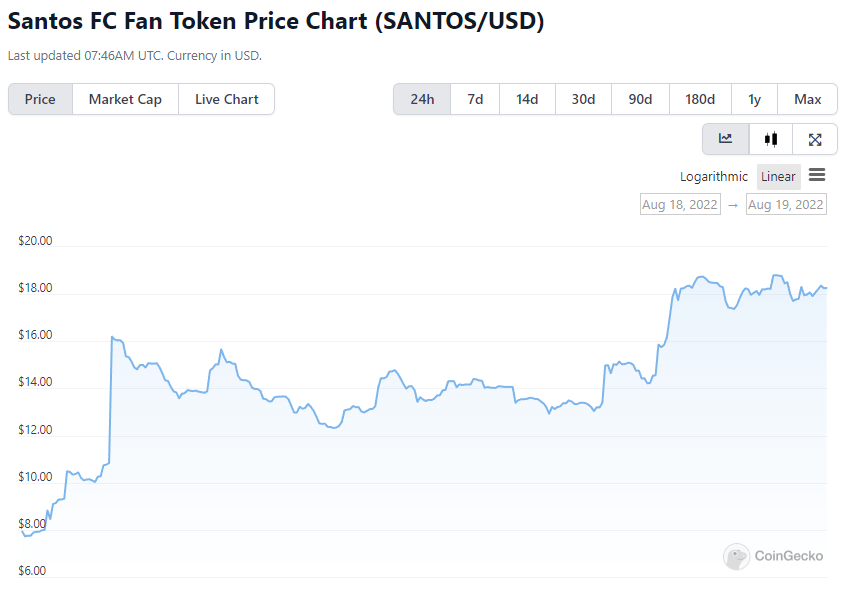
Santos

The fan token leading the charts today is SANTOS. This FC crypto has gotten a bullish rating and was up by 140.58% on Thursday. It is surprising, considering that the general crypto market was down by 1.34%. Based on the Binance smart chain, this cryptocurrency was launched in 2021 and gave the holder powers to govern certain aspects of the teams, such as the team mascot, the dance during halftime, and more.

Santos football club is one of the most traditional football organizations in Brazil – with a wide array of fans – a high percentage of which have invested in the Santos FC tokens.

The steep increase of the SANTOS price has puzzled the crypto investors, as the increase in other sports tokens. While we can’t exactly point out why SANTOS price has increased, the general bullishness about sports cryptos might be something to consider.

Buy Santos

Your capital is at risk.

ALPINE

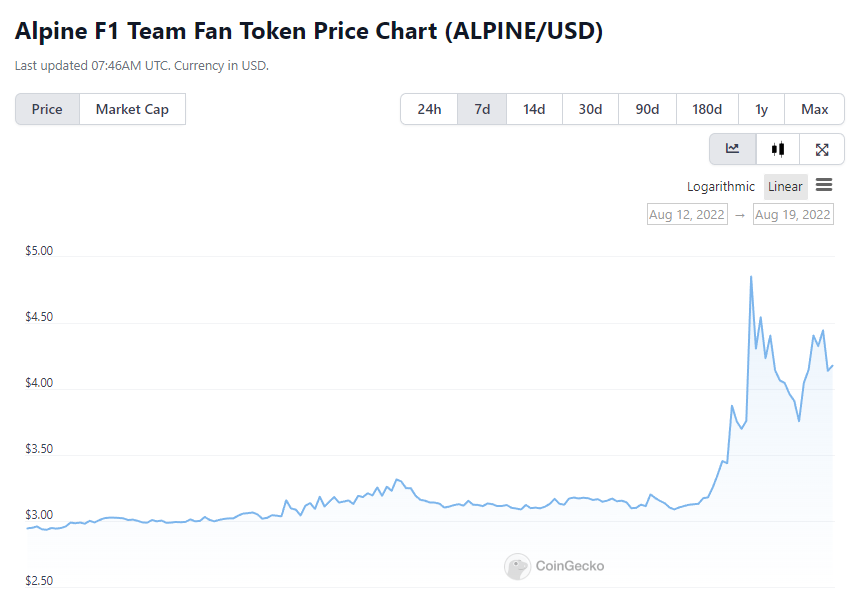
Ranking second is the Alpine FT Team Fan Token (ALPINE). It has increased by 22.1% within the last 24 hours and saw a steep increase from $3.11 to $4.85 yesterday. The crypto retraced to below $4 levels at the time of writing before bouncing to $4.2.

Binance announced the partnership with the Alpine F1 Team to join the Binance Fan token platform in early 2022. ALPINE opened on Binance at $5.33 before a steep drop to $2. Before bouncing to its all-time high of $9.54. The price then went down rapidly until it punched below the $2.00 level to $1.44 before bouncing. It then found support at $3.00 and traded sideways until the recent parabolic increase.

Buy ALPINE

Your capital is at risk.

OG

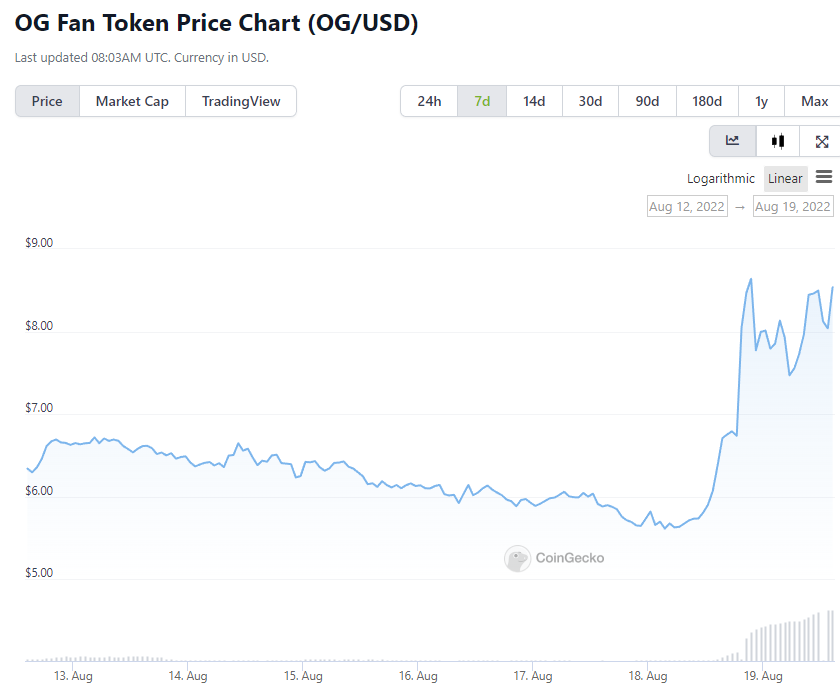
The OG Fan token is another crypto to gain a significant rally during the past 24 hours. The price increased parabolically from $5.36 to $8.64 before a marginal retrace. However, the token has bounced back since then and is currently trading at $8.44.

The OG Fan tokens represent the OG team of DOTA – one of the world’s leading competitive video games. This esports token is available on a wide array of platforms, including Binance.

OG Fan tokens are one of the oldest sports cryptos on this list, having launched in December 2020. It opened at $2.83 and traded sideways till January 2021 before experiencing a passive uptick that sent the OG price to its all-time high of $19.24. The sports crypto later experienced other upswings through the later months. However, like altcoins, it dropped to its all-time low in May at $1.18. It then established a marginal uptrend before the recent steep increase by 38.1% to $8.44.

Buy OG

Your capital is at risk.

PORTO

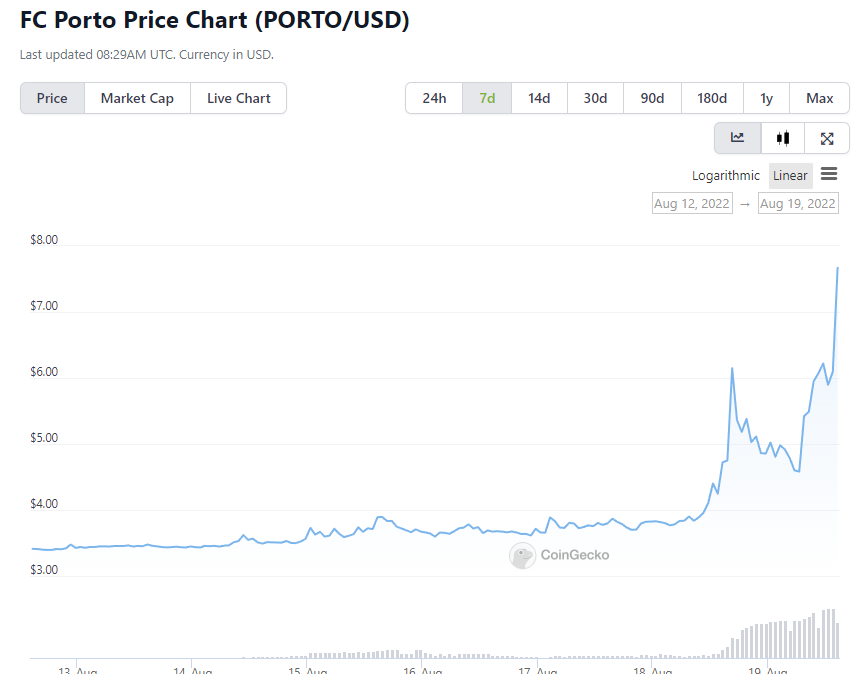
The #4 fan token on the list to experience an uptick is the FC Porto (PORTO). This crypto has experienced an increase of 100% (almost) and went from $3.89 to $6.15 before retracing. It later bounced back closer to its $7 resistance.

At the time of writing, PORTO is trading at $6.77. The FC PORTO token was introduced the November last year and was able to wick to $14.64, which is its all-time high. The average of the day remained at $8.26. It then retraced and found support at $2.0 before reaching near $6 in April 2022. PORTO then dropped to below $2 levels because of the bearish sentiments of the crypto market. After bouncing, it struggled to stay above this resistance. However, it experienced a parabolic rise in late July 2022 before trading sideways for a while.

The tokens’ value has not beyond $6.77.

Buy Porto

Your capital is at risk.

LAZIO

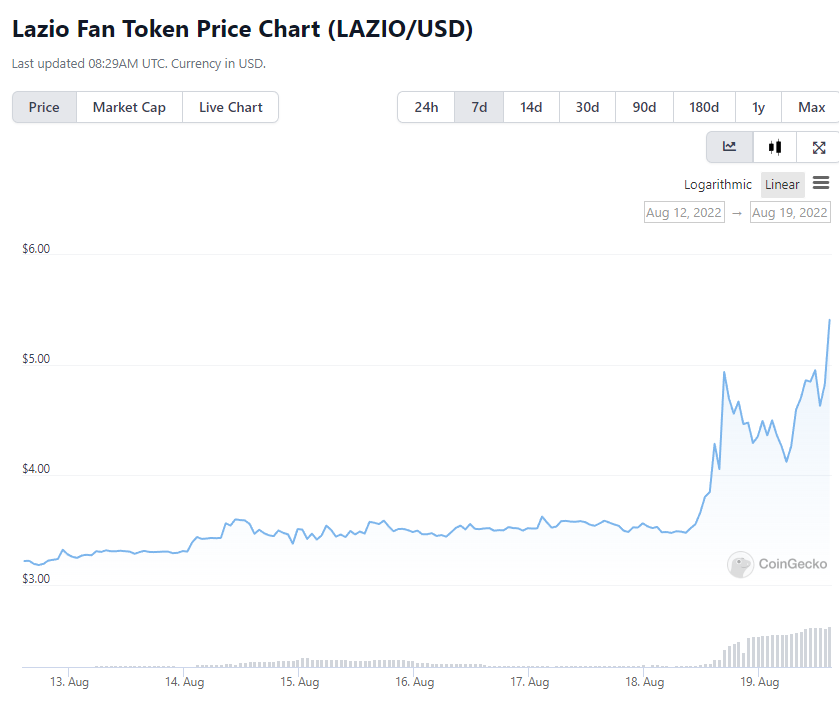
LAZIO is the fan token of SS Lazio fans letting the holders engage with the club’s ecosystem, donations, eCommerce, and NFTs. The LAZIO price rose by nearly 40% on Thursday before retracing and bouncing at an even higher level – $5.26, which is its current price.

Buy Lazio

Your capital is at risk.

BAR

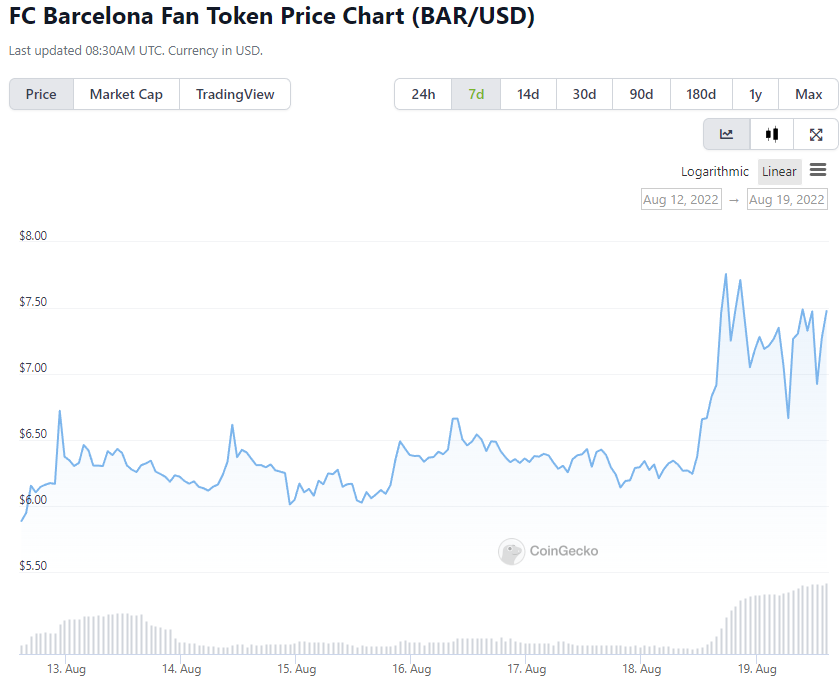
Football Club Barcelona Fans were in it for the surprise when the price of the token rose by almost 30% – going from $6.24 to $7.76.

There was a minor retrace to $6.67 later, but then the price went up to $7.78. It is the current price of this token.

Buy BAR

Your capital is at risk.

ATM

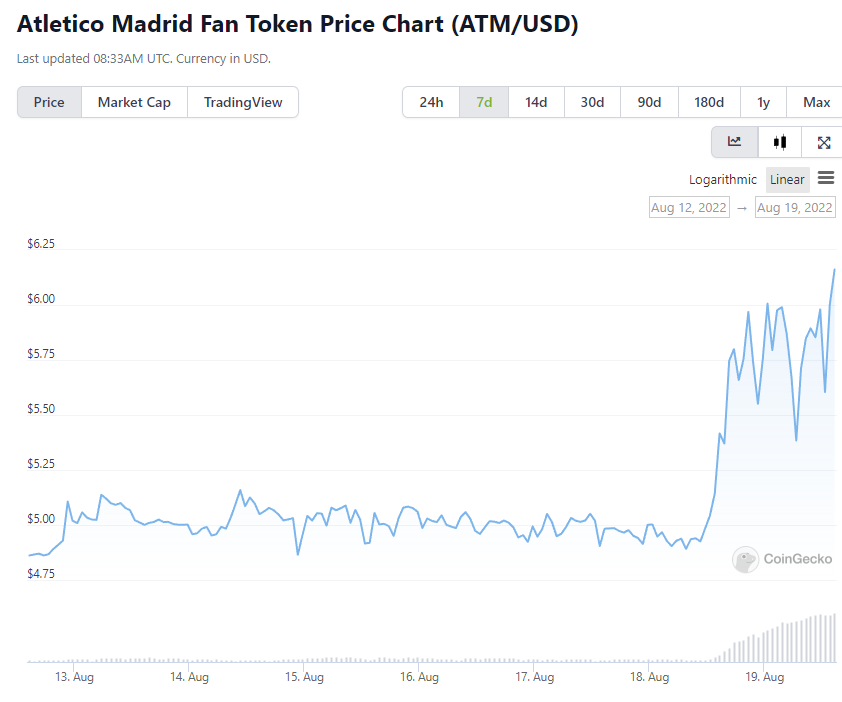
The Atletico Madrid Fan Token (BAR) experienced a 20% increase from $4.94 to $5.97 yesterday. And a minor retrace later, the price punched above the $6 levels.

At the time of writing, BAR is now trading at $6.18.

Buy ATM

Your capital is at risk.

PSG

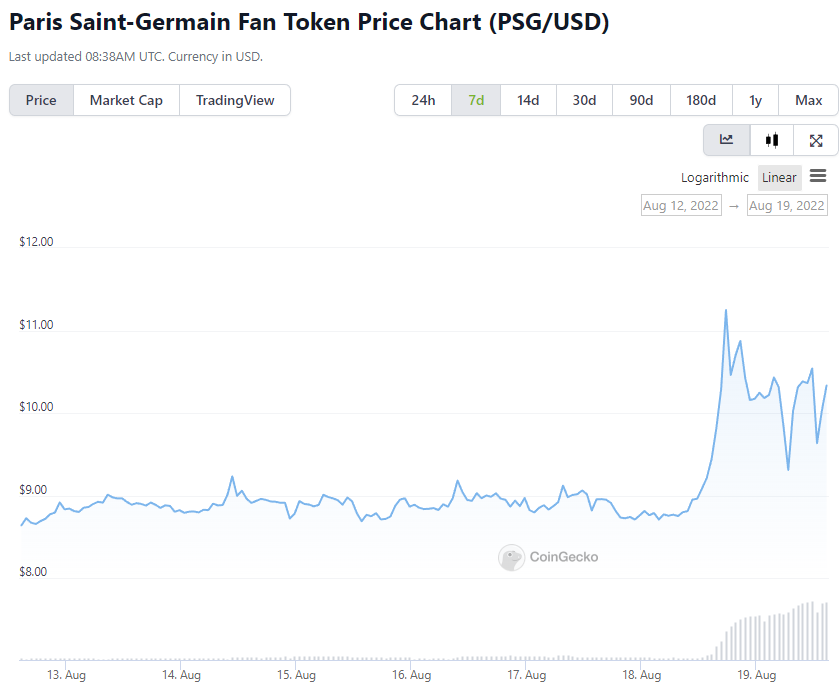
PSG, or the Paris Saint-Germain Fan token, is another fan cryptocurrency that experienced a marginal increase in the last two days. The price of this crypto went from $8.25 to $11.25, which is approximately a 20% increase. There was a marginal retrace, but it didn’t last as the price went above the $10 mark again.

At the time of writing, PSG is trading at $10.33.

Buy PSG

Your capital is at risk.

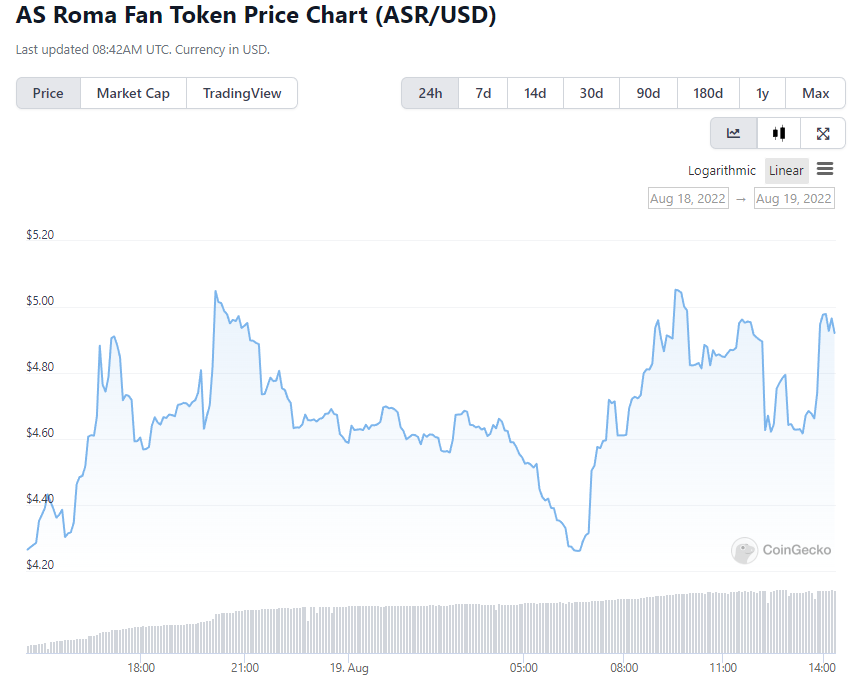
ASR

The AS Roma Fan Token is another sports crypto that went above and beyond in this bear market and experienced a steep rise. It went from trading below $4 levels to near $5. This 20% increase was parabolic – making the entire crypto community question why.

At the time of writing, ASR is trading at $4.93.

Buy ASR

Your capital is at risk.

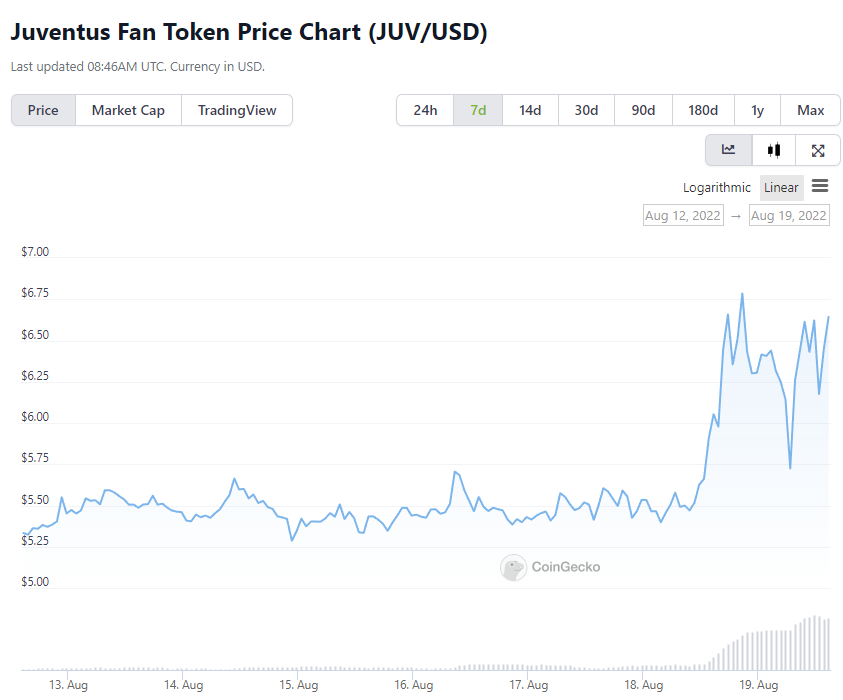
JUV

Wrapping up this list is the final sports token, the JUV representing the fans of Juventus. And like all the other cryptos on this list, the rise JUC experienced is also parabolic. It went from trading at $5 to jumping above the $6.5 mark. And at the time of writing, it is currently trading at $6.64. It is a 25% increase within a short span of time.

Buy JUV

Your capital is at risk.

Why Fan Tokens’ Prices are Increasing?

All the crypto experts are puzzled about the sudden interest in Fan tokens. Many believe that the recent listing of Battle Infinity on PancakeSwap might have something to do with this sudden interest. It is because Battle Infinity’s flagship product is IBAT Premiere League, a fantasy sports utility for the blockchain.

That being said, it is all speculation until this point, as the real reason behind fan token’s increase is still unknown. Although, it will be interesting to see how long this enthusiasm holds up – for it might give us some insight.

Read More

  • Where to Buy Chiliz

Tamadoge – Play to Earn Meme Coin

Our Rating

  • Earn TAMA in Battles With Doge Pets
  • Capped Supply of 2 Bn, Token Burn
  • NFT-Based Metaverse Game
  • Presale Live Now – tamadoge.io

Visit Site

Go to Source

Please enter CoinGecko Free Api Key to get this plugin works.
Exit mobile version