On Friday, August 19, the total crypto market capitalization dropped by 9.1%, but more importantly, the all-important $1 trillion psychological support was tapped. The market’s latest venture below this just three weeks ago, meaning investors were pretty confident that the $780 billion total market-cap low on June 18 was a mere distant memory.
Regulatory uncertainty increased on Aug. 17 after the United States House Committee on Energy and Commerce announced that they were “deeply concerned” that proof-of-work mining could increase demand for fossil fuels. As a result, U.S. lawmakers requested the crypto mining companies to provide information on energy consumption and average costs.
Typically, sell-offs have a greater impact on cryptocurrencies outside of the top 5 assets by market capitalization, but today’s correction presented losses ranging from 7% to 14% across the board. Bitcoin (BTC) saw a 9.7% loss as it tested $21,260 and Ether (ETH) presented a 10.6% drop at its $1,675 intraday low.
Some analysts might suggest that harsh daily corrections like the one seen today is a norm rather than an exception considering the asset’s 67% annualized volatility. Case in point, today’s intraday drop in the total market capitalization exceeded 9% in 19 days over the past 365, but some aggravants are causing this current correction to stand out.
The BTC Futures premium vanished
The fixed-month futures contracts usually trade at a slight premium to regular spot markets because sellers demand more money to withhold settlement for longer. Technically known as “contango,” this situation is not exclusive to crypto assets.
In healthy markets, futures should trade at a 4% to 8% annualized premium, which is enough to compensate for the risks plus the cost of capital.
According to the OKX and Deribit Bitcoin futures premium, the 9.7% negative swing on BTC caused investors to eliminate any optimism using derivatives instruments. When the indicator flips to the negative area, trading in “backwardation,” it typically means there is much higher demand from leveraged shorts who are betting on further downside.
Leverage buyers’ liquidations exceeded $470 million
Futures contracts are a relatively low-cost and easy instrument that allows the use of leverage. The danger of using them lies in liquidation, meaning the investor’s margin deposit becomes insufficient to cover their positions. In these cases, the exchange’s automatic deleveraging mechanism kicks in and sells the crypto used as collateral to reduce the exposure.
A trader might increase their gains by 10x using leverage, but if the asset drops 9% from their entry point, the position is terminated. The derivatives exchange will proceed to sell the collateral, creating a negative loop known as a cascading liquidation. As depicted above, the Aug. 19 sell-off presented the highest number of buyers being forced into selling since June 12.
Margin traders were excessively bullish and destroyed
Margin trading allows investors to borrow cryptocurrency to leverage their trading position and potentially increase their returns. As an example, a trader could buy Bitcoin by borrowing Tether (USDT), thus increasing their crypto exposure. On the other hand, borrowing Bitcoin can only be used to short it.
Unlike futures contracts, the balance between margin longs and shorts isn’t necessarily matched. When the margin lending ratio is high, it indicates that the market is bullish—the opposite, a low ratio, signals that the market is bearish.
OKX USDT/BTC margin lending ratio. Source: OKX
Crypto traders are known for being bullish, which is understandable considering the adoption potential and fast-growing use cases like decentralized finance (DeFi) and the perception that certain cryptocurrencies provide protection against USD inflation. A margin lending rate of 17x higher favors stablecoins is not normal and indicates excessive confidence from leverage buyers.
These three derivatives metrics show traders were definitely not expecting the entire crypto market to correct as sharply as today, nor for the total market capitalization to retest the $1 trillion support. This renewed loss of confidence might cause bulls to further reduce their leverage positions and possibly trigger new lows in the coming weeks..
The views and opinions expressed here are solely those of theauthorand do not necessarily reflect the views of Cointelegraph. Every investment and trading move involves risk. You should conduct your own research when making a decision.
Scott Beck, chief executive officer of United Texas Bank, called on members of the state’s blockchain working group to recommend policy for leaving stablecoins to banks rather than crypto firms.
Speaking before the Texas Work Group on Blockchain Matters in Austin on Friday, Beck suggested limiting the issuance of U.S. dollar-backed stablecoins to licensed banks rather than issuers like Circle. The United Texas Bank CEO cited a November report from the President’s Working Group on Financial Markets, in which the group said stablecoin issuers should be held to the same standards as insured depository institutions including state and federally chartered banks.
“If such stablecoins are defined to be ‘money’, banks are the proper economic actor to issue and manage stablecoins,” said Beck. “Banks have the expertise and legal framework for handling money, and unlike today’s stablecoin actors, banks are highly regulated at both the state and federal level.”
He added:
“Bringing stablecoin activities into the banking sector and prohibiting non-banks from issuing stablecoins will enhance consumer protection and attract additional resources and capital to this emerging area of economic activity.”
United Texas Bank CEO speaking before the Work Group on Blockchain Matters at the Texas Capitol on Friday
In response to questioning from working group member and MoneyGram general counsel Robert Villaseñor, Beck claimed that stablecoin issuers like Circle were holding assets at “other institutions” in contrast to banks, “effectively sucking deposits out of the banking industry.” He added that some stablecoins were particularly vulnerable to runs, potentially threatening the economy should the market reach a certain size, and leaving the issuance to banks ensured Know Your Customer rules would be followed.
Lee Bratcher, president of the Texas Blockchain Council and in attendance at the hearing, challenged Beck’s proposal as “anti-competitive.” The bank CEO countered that one of the key differences between licensed banks and private companies issuing stablecoins was that for the former, the cash behind the tokens would remain “sitting at the Fed,” also ensuring the funds would be FDIC insured.
Related:Is Austin the next US crypto hub? Officials approve blockchain resolutions
Circle’s USDC dollar-pegged stablecoin is supposedly 100% backed by cash or cash equivalents, including bank deposits, Treasury bills, or commercial paper. The stablecoin issuer announced in March that financial institution BNY Mellon would be responsible for custodying its USDC reserves — more than 52 billion coins are in circulation as of the time of publication.
The Texas Work Group on Blockchain Matters was officially formed in September 2021 following the passage of House Bill 1576. According to the group’s website, its mission includes developing a framework “for the expansion of the blockchain industry in Texas and recommend policies and state investments in connection with blockchain technology.”
FTX has reportedly begun blocking accounts that have sent coins through zk.money, a private layer-2 chain provided by the Aztec Network on Ethereum. According to Twitter users, FTX has identified the DApp as a mixer — a service it deems a “high-risk activity” prohibited by the exchange.
Reports of blocked transactions on FTX began appearing on Twitter on Thursday, sometimes with commentary about FTX’s motives and allegations that zk.money is not a mixer. Twitter users also noted that blocking transactions connected to the protocol may imply a ban with far-reaching effects, similar to the sanctions imposed by the United States Treasury Department on Tornado Cash users. The U.S. agency placed over 40 USDC and ETH addresses on the Office of Foreign Asset Control (OFAC) List of Specially Designated Nationals on Aug. 8.
Recently, FTX froze a user account who sent coins to @aztecnetwork ‘s zkmoney. According to FTX, Aztec Connect – Aztec network / zk money has been identified as a mixing service, which is a high-risk activity prohibited by FTX.
— Wu Blockchain (@WuBlockchain) August 19, 2022
Aztec Network CEO Zac Williamson took to Twitter with a long thread on Monday commenting on the situation surrounding Tornado Cash, days prior to FTX’s apparent action against the network. “There is a place for regulation in Web3. It is not at the network level. It is at the application level,” Williamson wrote, adding:
“The depressing thing is that we’ve been through this already with the World Wide Web. We don’t arrest internet service providers for the data in their cables. We don’t arrest DNS providers for signing illegal traffic.”
In light of the TornadoCash ban, I have some thoughts on the future of privacy networks that I would like to share with you all.
Despite the dark circumstances of the present, there are grounds to be optimistic about the future for web3.
A short on why…
— Zac Williamson (@Zac_Aztec) August 16, 2022
Zk.money was launched in March 2021. It describes itself as the “private DeFi yield aggregator” of the Aztec Network’s Aztec Connect software development kit. Aztec Connect, in turn, “works like a VPN: by using Aztec’s rollup contract as a proxy.” On Thursday, the Aztec Network announced that Aztec Connect was prepping to receive funding from DEX Balancer Labs.
The Federal Deposit Insurance Corporation (FDIC) has issued cease and desist letters to five companies for allegedly making false representations about deposit insurance related to cryptocurrencies.
FDIC issued a Friday press release disclosing cease and desist letters for cryptocurrency exchange FTX US and websites SmartAssets, FDICCrypto, Cryptonews and Cryptosec. In the letters, which were issued on Thursday, the government agency alleges that these organizations misled the public about certain cryptocurrency-related products being insured by FDIC.
“These representations are false or misleading,” the FDIC said in regard to “certain crypto-related products” being FDIC-insured or that “stocks held in brokerage accounts are FDIC-insured.” The regulator said these companies must “take immediate corrective action to address these false or misleading statements” on their websites and social media accounts.
Excerpts of the FDIC’s cease and desist letter to FTX US. Source: FDIC.
The FDIC has been vocal about the lack of insurance protection for non-bank entities, which includes crypto-focused firms. In July, the regulator issued a notice advising banks in the United States that they need to assess and manage risks when forming third-party relationships with crypto service providers. The FDIC reiterated that, while deposits at insured banks were protected against default for up to $250,000, no such coverage exists for crypto firms.
Related:Fed demands Voyager remove ‘false’ claims deposits are FDIC insured
It has been alleged that the FDIC has taken an overly harsh approach to digital assets, going as far as discouraging banks from dealing with crypto service providers. As Cointelegraph reported, Pennsylvania Senator Pat Toomey, who also serves on the Senate Banking Committee, sent a letter to FDIC director and acting chairman Martin Gruenberg informing him of allegations made by a whistleblower. In the letter, Toomey said he suspects that FDIC “may be improperly taking action to deter banks from doing business with lawful cryptocurrency-related (crypto-related) companies.”
The Federal Deposit Insurance Corp. (FDIC) said Aug. 19 that it issued letters demanding Cryptonews.com, Cryptoytosec.info, SmartAsset.com, FTX.US and FDICCrypto.com to stop making misleading statements about FDIC deposit insurance and implement corrective measures.
FDIC deposit insurance protects customers in the unlikely event of the failure of an FDIC-insured bank.
In the cease and desist letters sent Aug. 18, the FDIC demanded that the companies, their officers and employees abstain from alluding to any presence of FDIC deposit insurance at certain exchanges or their own platforms. It also demanded that the companies take immediate measures to correct any false and misleading statements made previously.
The FDIC alleges in the text of the letters that each entity has purportedly misrepresented the depository insurance status of holdings or furthered falsehoods concerning deposit insurance coverage.
Based on the evidence presented by the FDIC in the letter, each of the companies allegedly made false representations — including on their websites and social media accounts — stating or suggesting that certain crypto-related products are FDIC-insured or that stocks held in brokerage accounts are FDIC-insured.
According to the FDIC’s letter to FTX.US, President Brett Harrison tweeted on July 20 that “direct deposits from employers to FTX US are stored in individually FDIC-insured bank accounts in the users’ names,” and “stocks are held in FDIC-insured and SIPC-insured brokerage accounts.”
The regulator claims these statements contain false and misleading representations of the company’s uninsured products. It added:
“In fact, FTX US is not FDIC-insured, the FDIC does not insure any brokerage accounts, and FDIC insurance does not cover stocks or cryptocurrency. “
The regulator, in its letter to Cryptonews.com, listed five instances, out of many cited, where the website had allegedly either misrepresented or mischaracterized the FDIC-insured claims in their reviews of crypto exchanges.
The FDIC singled out Cryptosec.info for allegedly including a list of “FDIC-insured Crypto Exchanges” on its website along with the use of the FDIC’s official seal. SmartAsset.com also contributed to a list of supposed FDIC-insured crypto exchanges that the FDIC has asked be removed.
The regulator alleges that FDICCrypto.com used the agency’s name in its registered domain name. This, according to the FDIC, suggests affiliation with or endorsement by the FDIC, and it has demanded the company cease the use of the domain name or similar domain names immediately.
The FDIC demanded that all companies remove the offending examples from their respective spaces and called for each entity to conduct a scrubbing of any additional misleading statements and report back in 15 days with compliance.
Posted In: Legal, Regulation
Get an Edge on the Crypto Market 👇
Become a member of CryptoSlate Edge and access our exclusive Discord community, more exclusive content and analysis.
FTX has allegedly warned users against interacting with high-risk services as complaints surfaced that the exchange is blocking accounts that interacted with zk money on the Aztec network.
Chinese journalist Colin Wu reported Aug. 19 that a user’s account was frozen for making a transfer to his zk money account.
Recently, FTX froze a user account who sent coins to @aztecnetwork ‘s zkmoney. According to FTX, Aztec Connect – Aztec network / zk money has been identified as a mixing service, which is a high-risk activity prohibited by FTX.
— Wu Blockchain (@WuBlockchain) August 19, 2022
Some users took to Twitter to share their experiences. A Twitter user earlier shared some screenshots on Aug. 14, about a series of questions that FTX customer care asked when attempting to make deposits to the account.
Another user also complained about being prohibited from making withdrawals after some funds were frozen.
FTX allegedly said that addresses associated with the protocol are “high-risk” and are prohibited on the exchange. Users are advised to desist from using mixing services as it could endanger their accounts.
Aztec is a privacy protocol, not a mixer
Some users noted that Aztec Network is a privacy solution and should not be treated on the same terms as mixing services like Tornado Cash.
Can’t believe this, so anyone who interacts with a privacy chain is frozen from now on!
You know what else is privacy preserving… cold hard cash
What’s next, they start freezing those users for being involved with mixers?
— jaimin.eth | jaimin.sol (@Jaimin___Patel) August 19, 2022
zk money is a layer-2 privacy solution built on the Aztec network which enables users to perform transactions without compromising their privacy. Transaction data can be shielded from the public but the owner can choose who and what to share if the need be.
A user expressed pessimism that if freezing sprees against privacy protocols are unchecked, zk rollup solutions which are built to preserve privacy may have met an early end.
zk rollups are dead already
— 🔑 弐九84 Ø (@ghost_xnft) August 19, 2022
More concern for privacy protocols
The United States’ sanction against Tornado Cash and the arrest of a developer in the Netherlands, has brought a threat to the future of privacy-focused solutions like Monerao.
That notwithstanding, Monero still completed its hard fork on Aug. 13. The upgrade helped improve the security and privacy features of the network.
As fears about the safety of privacy protocol developers mount, Monero developer Justin Berman reiterated his commitment to keep building a solution that will give users the privacy they deserve.
I work on @monero to help make money that’s easy to use without revealing your net worth + salary + entire spending history to the world when you use it.
Completely normal thing.
I’m not going anonymous to do something completely normal.
— Justin Berman (@justinberman95) August 15, 2022
Recent FTX Stories
Get an Edge on the Crypto Market 👇
Become a member of CryptoSlate Edge and access our exclusive Discord community, more exclusive content and analysis.
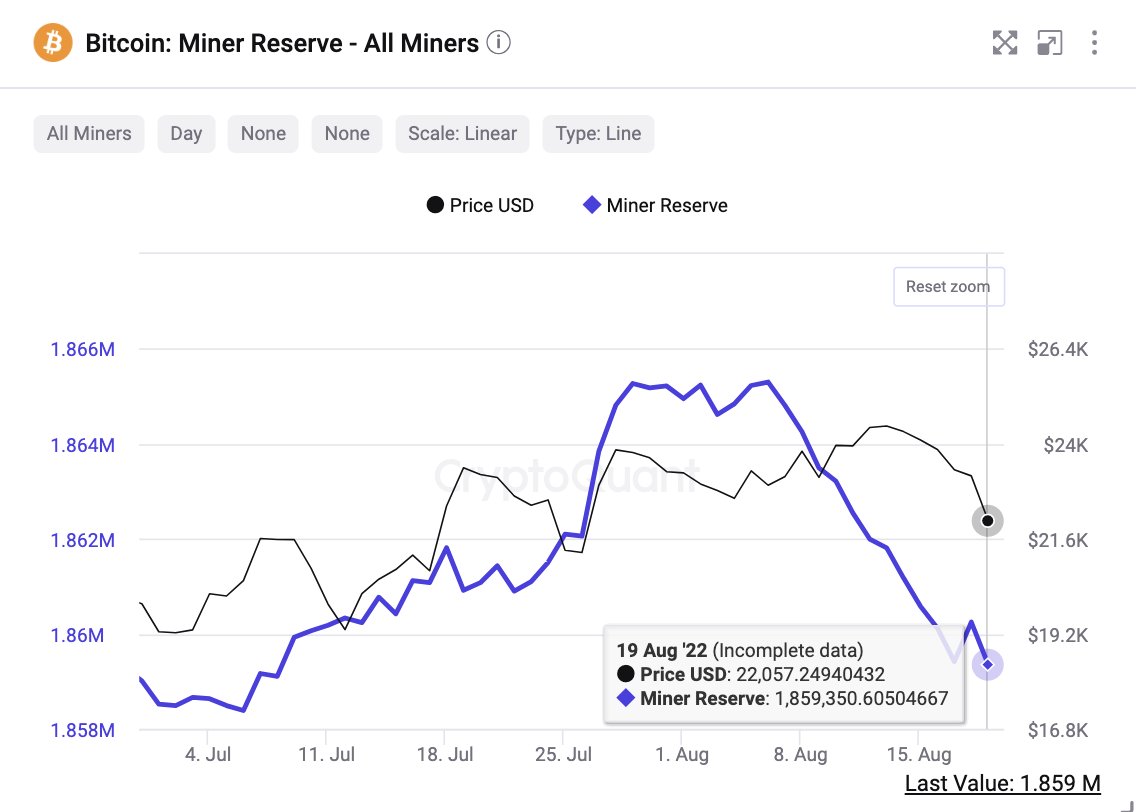
Bitcoin’s value against the U.S. dollar lost 7.3% during the last 24 hours after more than $600 million in value was removed from the $1.07 trillion crypto economy. Statistics show that a number of bitcoin miners capitulated over the last two weeks, selling 5,925 bitcoin worth millions, according to cryptoquant.com data.
More Than 6,100 Bitcoin Sold Since the First of the Month, Following a Brief Miner Capitulation Pause
Bitcoin’s U.S. dollar value slid from $23,593 per unit to $21,268 per coin at 8:30 a.m. (EST) on Friday morning. More than $600 million has been erased from the crypto economy during the last day as BTC lost 7.3% and ETH shed 7.4%. A number of other coins lost value against the U.S. dollar as well as BNB dipped by 5%, XRP slipped by 9%, and ADA lost 10.3% during the past 24 hours.
According to data stemming from cryptoquant.com shared by Ali Martinez bitcoin miners capitulated during the last 14 days. “Bitcoin miners appear to have taken advantage of the recent upswing to book profits,” Martinez said. “Data shows that miners sold 5,925 BTC in the last two weeks, worth roughly $142 million.”
Following Martinez’s tweet, cryptoquant.com data shows more than 6,100 BTC have been sold since the first of August. The web portal’sMiners’ Position Indexsays bitcoin miners are “moderately selling” bitcoin. Using today’s crypto market values, 6,100 BTC equates to $130.80 million, a much lower value than Martinez’s quote price.
Source: Cryptoquant.com Data shared by Ali Martinez.
Miners took a break from selling BTC after a flurry of mined bitcoin was sold during the two months prior to August 1, 2022. A Blockware Intelligence Newsletter published on July 29 explained that the end of miner capitulation was near. “According to the hash ribbon metric, Bitcoin is 52 days into a miner capitulation,” the Blockware newsletter said. Blockware’s report added:
The end of a miner capitulation historically marks a bear market bottom.
During the first two weeks of August, it seemed as though miner capitulation was over and BTC managed to tap $25,212 per unit on August 14. BTC has lost 14.58% since the August 14 high and it’s currently down 69% from the $69,044 per unit price recorded on November 10, 2021. This past week Bitcoin’s mining difficulty rose by 0.63% making it more difficult for miners to discover BTC blocks and with prices lower, mining bitcoin is less profitable today than it was five days ago.
Bitcoin Hashrate Skyrockets by 46% During the Past 24 Hours Following the Recent Difficulty Increase
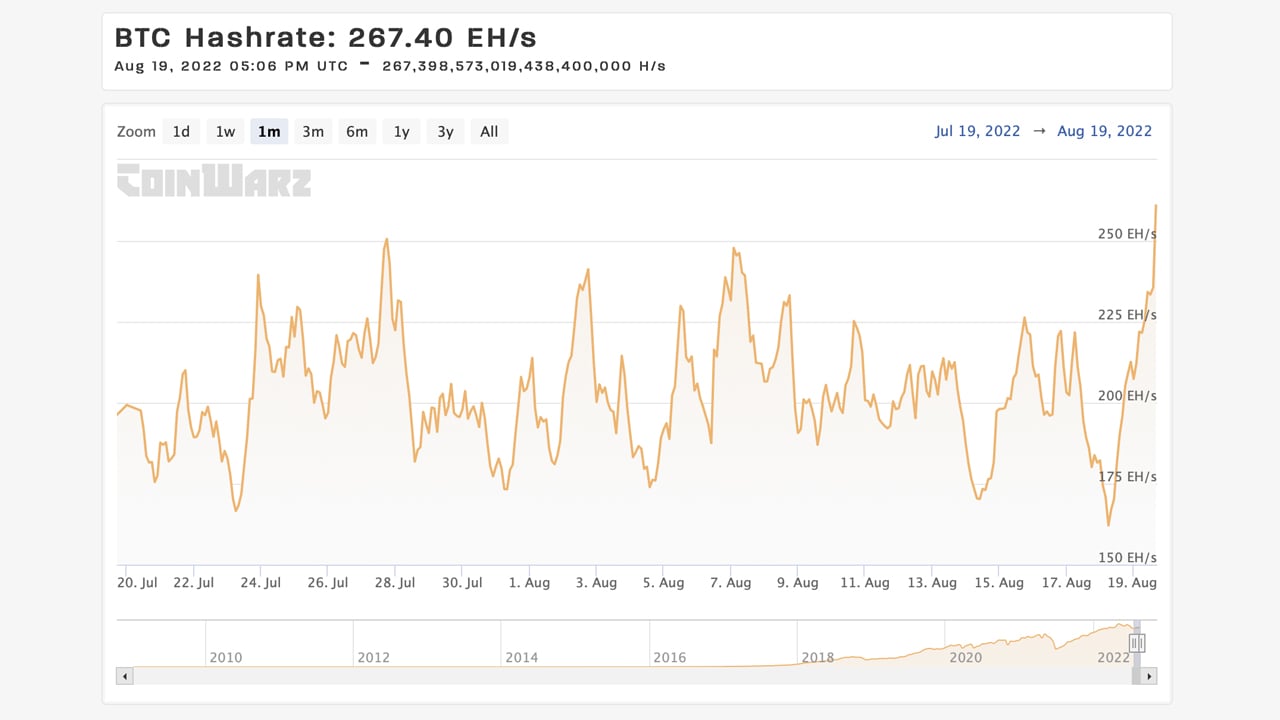
Despite the difficulty rise, after coasting along under the 200 exahash per second (EH/s) zone at 182.40 EH/s the day prior on August 18, 2022, BTC’s hashrate has skyrocketed to 267.40 EH/s. That’s a 24-hour increase of around 46.60% higher than the 182 EH/s recorded on Thursday afternoon (EST).
While BTC’s price dropped to $21,268 per unit today and the difficulty increased by 0.63% yesterday, Bitcoin’s hashrate saw an unusual spike well above the 200 EH/s zone to 267.40 EH/s on Friday.
Using the current difficulty parameter, BTC’s current market value and a cost of around $0.12 per kilowatt hour (kWh), a Bitmain Antminer S19 XP with 140 terahash per second (TH/s) can get an estimated $4.85 per day in profit. The Microbt Whatsminer M50S launched in July with 126 TH/s can get an estimated $2.74 per day in profit, according to current market statistics.
What do you think about miners selling 5,925 bitcoin during the last two weeks? Do you think miner capitulation is over or will continue? Let us know what you think about this subject in the comments section below.
Jamie Redman
Jamie Redman is the News Lead at Bitcoin.com News and a financial tech journalist living in Florida. Redman has been an active member of the cryptocurrency community since 2011. He has a passion for Bitcoin, open-source code, and decentralized applications. Since September 2015, Redman has written more than 5,700 articles for Bitcoin.com News about the disruptive protocols emerging today.
Image Credits: Shutterstock, Pixabay, Wiki Commons
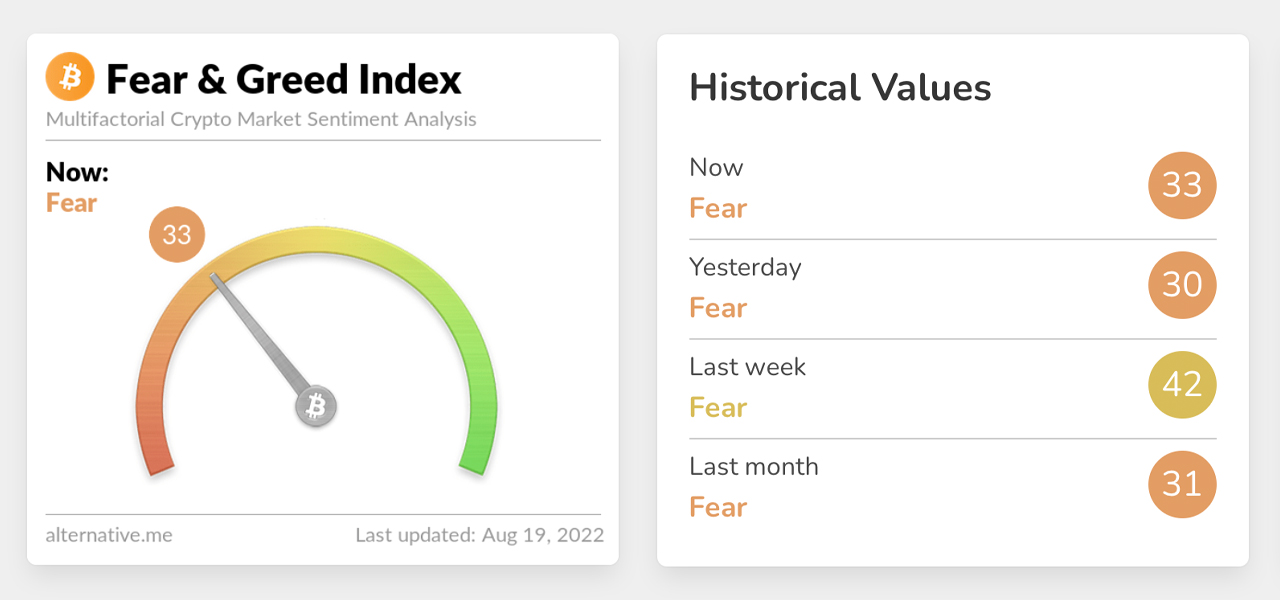
After the Crypto Fear and Greed Index (CFGI) dropped to significant lows and pointed to “extreme fear” in crypto markets at the end of May, and throughout most of June, today the CFGI rating is still in the “fear” zone, but it has seen an improvement. On June 19, the CFGI rating tapped a low score of 6 which means “extreme fear,” and 61 days or two months later, the CFGI rating now shows a score of 33 or “fear.”
CFGI Ranking Score Shows Crypto Winter Continues to Keep Investor Sentiment in the ‘Fear’ Zone
While the crypto economy has jumped back above the $1 trillion range, prices have started to drop again after the last rally. Following the Terra blockchain implosion, the crypto economy lost significant value and extreme fear shook the community into June as well. The Crypto Fear and Greed Index (CFGI) hosted on alternative.me dropped severely at the time, and on May 31, 2022, Bitcoin.com News reported the CFGI ranking score was 16 out of 100 or “extreme fear.”
Every day the CFGI ranking score analyzes “emotions and sentiments from different sources and crunch them into one simple number.” Alternative.me indicates that the value of 0 means “Extreme Fear” while a value of 100 represents “Extreme Greed.” The website adds:
The crypto market [behavior] is very emotional. People tend to get greedy when the market is rising which results in FOMO (Fear of missing out). Also, people often sell their coins in irrational reaction [to] seeing red numbers — There are two simple assumptions: 1) Extreme fear can be a sign that investors are too worried. That could be a buying opportunity. 2) When Investors are getting too greedy, that means the market is due for a correction.
In mid-June, the CFGI ranking score sunk even lower and slipped to a low score of 6 out of 100 on June 19, 2022. Historical crypto price data shows that BTC was trading for $20,553 per unit that day and the day prior on June 18, BTC tapped a 2022 low at $17,593 per unit. Today, the CFGI ranking score has improved and the sentiment value has moved out of the “extreme fear” position into the “fear” zone with a score of 33 out of 100.
BTC managed to recoup some losses after the market routs in May and June, and on August 14, 2022, the price tapped $25,212 per unit. On that same day, the CFGI ranking score jumped to a 47 showing sentiment was turning. However, during the last 48 hours, BTC has dropped significantly in value, sliding from $23,593 per unit to today’s low of $21,268. The CFGI ranking has not been able to rise above the “fear” zone and seems to be heading back to the range of “extreme fear” scores.
What do you think about the recent CFGI ranking score and the crypto economy diving in USD value again? Let us know what you think about this subject in the comments section below.
Jamie Redman
Jamie Redman is the News Lead at Bitcoin.com News and a financial tech journalist living in Florida. Redman has been an active member of the cryptocurrency community since 2011. He has a passion for Bitcoin, open-source code, and decentralized applications. Since September 2015, Redman has written more than 5,700 articles for Bitcoin.com News about the disruptive protocols emerging today.
Image Credits: Shutterstock, Pixabay, Wiki Commons, CFGI via Alternative.me
A widely followed crypto analyst is laying out the support levels both Bitcoin (BTC) and Ethereum (ETH) need to hold to recover from the market’s most recent downswing.
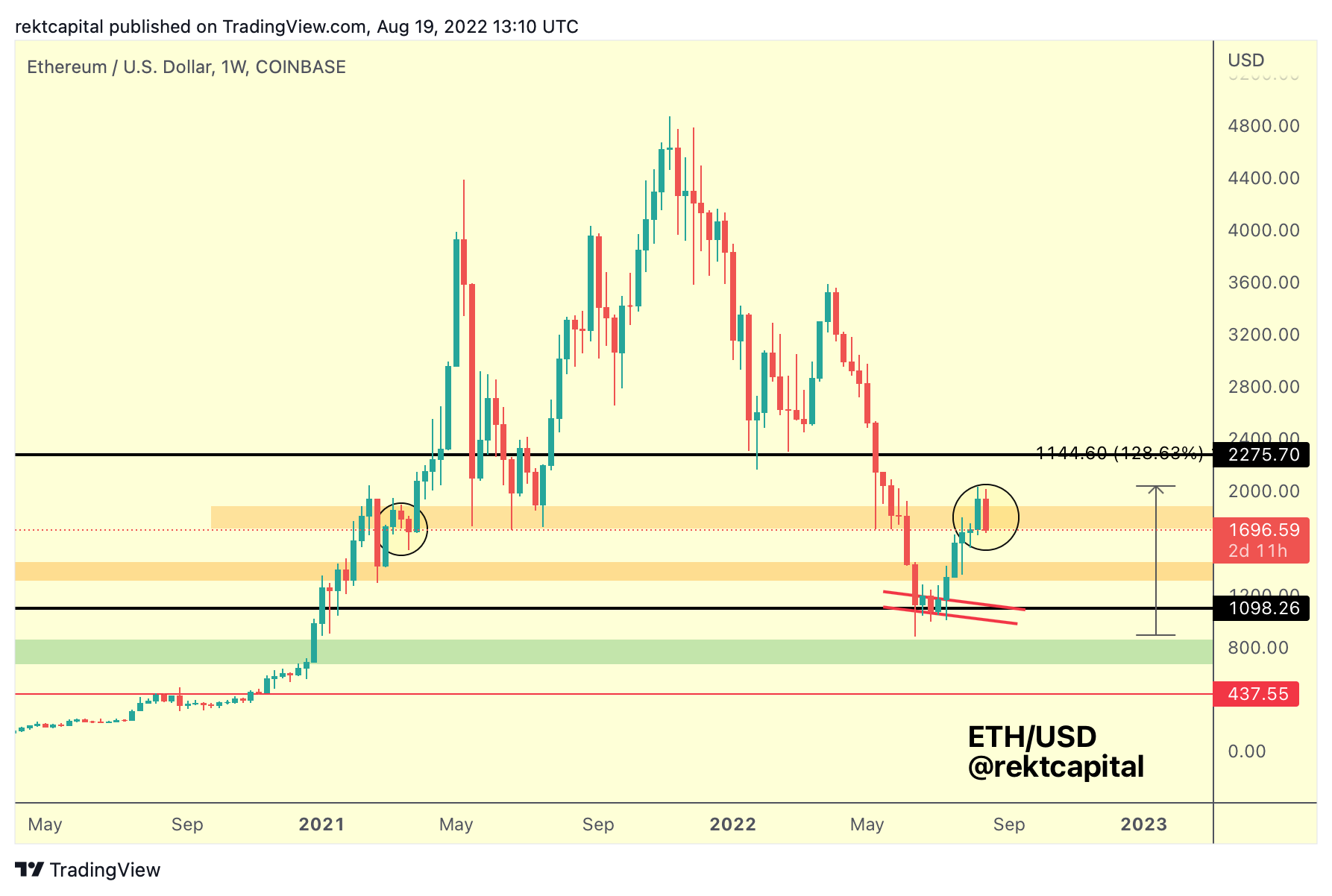
The pseudonymous trader known as Rekt Capital tells his 327,000 Twitter followers that the leading smart contract platform could close as low as $1,550 and still recover.
“ETH is now dipping in an effort to successfully retest this orange area as support.
Hold orange as support & ETH will be able to move towards $2250 (black).
Downside wicking to ~$1550 would be fine as long as ETH weekly closes inside this current orange area.”
Source: Rekt Capital/Twitter
Ethereum is changing hands for $1,694 at time of writing, a 9.1% dip in the last 24 hours.
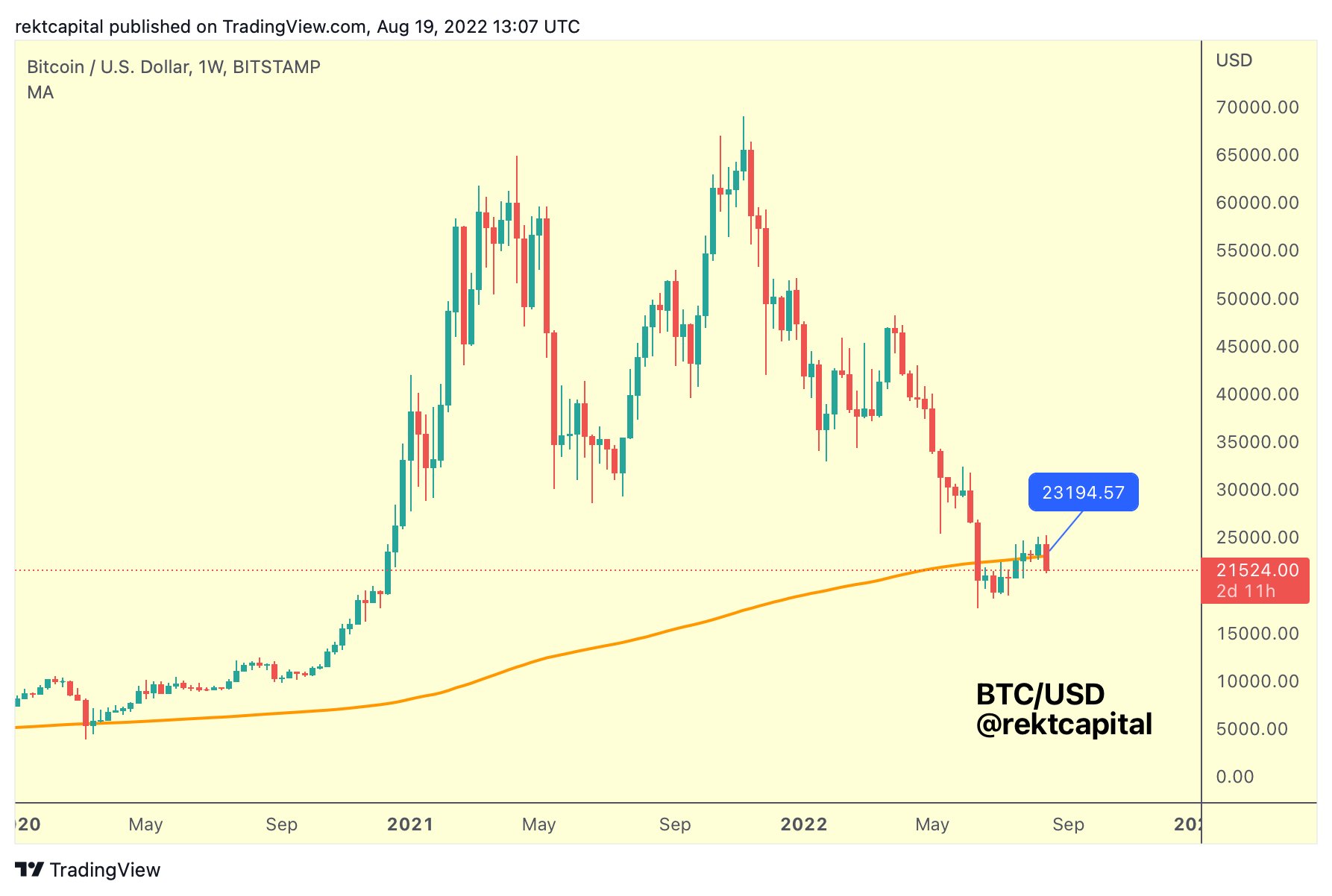
The analyst then says that the top crypto asset by market cap has lost its support at the 200-week moving average due to the latest crypto market downturn, but that recovery is possible as a relief bounce could flip that area into new resistance.
“After successfully [retesting] the 200-week moving average on weak buy-side volume, BTC has now broken down from this support.
Weekly Close below the 200-week moving average will confirm the breakdown.
If BTC indeed confirms a breakdown from the 200-week moving average…
Then it is possible that a relief bounce into the 200-week moving average to flip it into new resistance could take place. The 200-week MA represents the price point of ~$23200.”
Source: Rekt Capital/Twitter
Bitcoin is trading for $21,345 at time of writing, an 8.8% drop in the last day.
Don’t Miss a Beat – Subscribe to get crypto email alerts delivered directly to your inbox
Check Price Action
Follow us on Twitter, Facebook and Telegram
Surf The Daily Hodl Mix
Disclaimer: Opinions expressed at The Daily Hodl are not investment advice. Investors should do their due diligence before making any high-risk investments in Bitcoin, cryptocurrency or digital assets. Please be advised that your transfers and trades are at your own risk, and any loses you may incur are your responsibility. The Daily Hodl does not recommend the buying or selling of any cryptocurrencies or digital assets, nor is The Daily Hodl an investment advisor. Please note that The Daily Hodl participates in affiliate marketing.
Featured Image: Shutterstock/JLStock/Sensvector/VECTORY_NT
Singapore-based digital assets exchange Crypto.com is continuing its listing spree and adding support for two more low-cap altcoins.
Earlier this week, the exchange listed HIGH, the native asset of open-world metaverse game Highstreet.
The game offers virtual real estate and an online shop, and can be played via virtual reality on standard computers as well as on smartphones.
HIGH is trading for $1.82 at time of writing and is down nearly 2% in the past day and nearly 9% in the past week, according to CoinGecko. The crypto asset is also down more than 95% from its all-time high of $38.42, which it set last December.
Leading US-based crypto exchange platform Coinbase rolled out full retail support for HIGH in March while Coinbase Custody’s cold storage trust added custodial services for the asset in June.
Crypto.com also recently listed Cudos (CUDOS), a multi-chain computer network that aims to bridge the gap between cloud computing services and blockchain technology. The CUDOS token is used for governance, staking, and to fuel transactions on the network.
CUDOS is trading at $0.008170 at time of writing. The 616th-ranked crypto asset by market cap is down more than 1% in the past 24 hours and more than 5% in the past seven days.
CUDOS is also down more than 93% from its all-time high of $0.129565, which it hit in January 2021.
Don’t Miss a Beat – Subscribe to get crypto email alerts delivered directly to your inbox
Check Price Action
Follow us on Twitter, Facebook and Telegram
Surf The Daily Hodl Mix
Disclaimer: Opinions expressed at The Daily Hodl are not investment advice. Investors should do their due diligence before making any high-risk investments in Bitcoin, cryptocurrency or digital assets. Please be advised that your transfers and trades are at your own risk, and any loses you may incur are your responsibility. The Daily Hodl does not recommend the buying or selling of any cryptocurrencies or digital assets, nor is The Daily Hodl an investment advisor. Please note that The Daily Hodl participates in affiliate marketing.
Crypto exchange platform Gemini is rolling out staking services for blockchain scaling solution Polygon (MATIC).
The exchange is making Polygon staking available to customers in the United States (excluding New York), Hong Kong and Singapore, per a new announcement.
Gemini also plans to roll out staking for other prominent altcoins, such as Ethereum (ETH), Solana (SOL), Polkadot (DOT) and Audius (AUDIO) soon.
Says the New York-based exchange of the new feature,
“At Gemini, we simplify and secure the staking process, allowing you to stake your assets with more confidence in just a few steps. And, we protect your staked assets by reimbursing you for penalties imposed by validators on your staked tokens.”
MATIC is trading at $0.840986 at time of writing. The 16th-ranked crypto asset by market cap is down more than 4% in the past 24 hours.
Gemini is run by the famed Winklevoss twin brothers, who got their start as early Facebook developers.
The exchange has faced multiple lawsuits this summer. In early June, the Commodities Futures Trading Commission (CTFC) announced it was bringing charges against the company, alleging employees made false and incomplete statements to the agency.
Less than one week later, IRA Financial Trust, a retirement account trust firm, sued Gemini for allegedly failing to have proper safeguards in place to protect its customers’ assets.
The company also laid off around 10% of its employee roster in June, citing crypto market and macroeconomic headwinds
Don’t Miss a Beat – Subscribe to get crypto email alerts delivered directly to your inbox
Check Price Action
Follow us on Twitter, Facebook and Telegram
Surf The Daily Hodl Mix
Disclaimer: Opinions expressed at The Daily Hodl are not investment advice. Investors should do their due diligence before making any high-risk investments in Bitcoin, cryptocurrency or digital assets. Please be advised that your transfers and trades are at your own risk, and any loses you may incur are your responsibility. The Daily Hodl does not recommend the buying or selling of any cryptocurrencies or digital assets, nor is The Daily Hodl an investment advisor. Please note that The Daily Hodl participates in affiliate marketing.
A top official who oversees Colombia’s financial regulation and tax collection agency says that the second-most populous South American nation is exploring the idea of rolling out its own digital currency.
In a new interview with Semana magazine, National Tax and Customs Directorate (DIAN) director general Luis Carlos Reyes says that the government of newly-elected President Gustavo Petro is considering the creation of a CBDC or central bank digital currency.
CBDCs are an electronic form of government-backed money issued and regulated by a nation’s central bank.
Reyes says that the primary objective of creating a CBDC is to curb tax evasion, which he estimates to stand at 6-8% of the nation’s gross domestic product (GDP).
The official says that sales made in cash are not recorded, thus people can avoid paying taxes, such as the value-added tax (VAT), on those transactions. He says that tax cheating incidents can be avoided with the use of digital Colombian pesos as all transactions would be kept track of.
“One of the important goals is that when payments of a certain amount are made, they are recorded in an electronic medium…this measure would avoid this type of underhanded transaction.”
The announcement comes as the United Nations Conference on Trade and Development (UNCTD) urges emerging markets to launch a digital payment system among other policy actions to avert the widespread adoption of crypto.
The agency warns that digital assets pose a threat to the monetary sovereignty of developing nations.
Don’t Miss a Beat – Subscribe to get crypto email alerts delivered directly to your inbox
Check Price Action
Follow us on Twitter, Facebook and Telegram
Surf The Daily Hodl Mix
Disclaimer: Opinions expressed at The Daily Hodl are not investment advice. Investors should do their due diligence before making any high-risk investments in Bitcoin, cryptocurrency or digital assets. Please be advised that your transfers and trades are at your own risk, and any loses you may incur are your responsibility. The Daily Hodl does not recommend the buying or selling of any cryptocurrencies or digital assets, nor is The Daily Hodl an investment advisor. Please note that The Daily Hodl participates in affiliate marketing.
Featured Image: Shutterstock/oksanka007/Sensvector
As the hype surrounding play-to-earn (P2E) games and platforms began to dwindle in early 2022, Web3 participants began to emphasize the need for games to be more “fun” and less finance-oriented. In the most recent episode of NFT Steez, Alyssa Expósito and Ray Salmond spoke with Aron Beireschmitt, the CEO of Laguna games and founder of Crypto Unicorns, about the sustainability of P2E-focused blockchain games.
For Beireschmitt, the evolution from a play-to-earn to a play-and-earn model suggests that there is still experimentation and maturation to be seen for these games. “Nothing has changed about making games,” says Beireschmitt, but with blockchain technology, crypto natives and gamers are now able to play, own and potentially monetize from these play-and-earning models. The larger question at hand is, is it sustainable?
The paradigm and sentiment shift of P2E gaming
Regarding the shift in sentiment around P2E and how Crypto Unicorns is approaching it, Beireschmitt said it is “charting a path to sustainability through the combination of economic farming simulation” along with the real-time “skill-based gaming loops” to attract more users into its ecosystem. These gaming loops not only need to have a semblance of form and function, but also need to be fun and engaging for players, according to Beireschmitt.
However, he also acknowledged that blockchain based games are not for everyone and Crypto Unicorns target demographic are more in line with those who are crypto native.
According to Beireschmitt, there is a lack of “incentive alignment for free-to-play,” whereby developers maximize on extracting value from the minority of players who spend in free-to-play games. This disparity creates a “mismatch in the paradigm,” whereby Web3 gaming enables players to reach a new level of autonomy and ownership when it comes to in-game items, assets and skill.
For Beireschmitt, this is what makes the play-and-earn model “compelling,” since players can potentially earn along the way while playing their favorite game. Web3 not only enables players’ provenance and ownership, but with governance models, players and participants are now empowered to take “ownership of the direction the game, ecosystem and IP (intellectual property),” said Beireschmitt.
In-game economies are a work in progress
In-game economies have proven to be a sticking point for most play-and-earn games. When discussing the factors that are necessary for in-game economies to be sustainable in the long-term, Beireschmitt explained that one factor that aids is the dynamic between passive and active players. Passive players are those who invest in active players to progress themselves in the game.
However, Beireschmitt emphasized that for the dynamic to be sustainable, “skill-based gaming loops” and “token sinks” must be implemented because this returns the player back to the economy and ecosystem. As Beireschmitt put it, most play-and-earn games are still sorting their transition from “growth phase” to “maturation phase,” but he does firmly believe there are “bright futures in the days ahead!”
For more on the discussion with Aron Biereschmitt, listen to the full episode of NFT Steez. Set your reminders and tune into NFT Steez Twitter spaces airing every other Friday at 12 pm ET!
The views and opinions expressed here are solely those of the author and do not necessarily reflect the views of Cointelegraph.com. Every investment and trading move involves risk, you should conduct your own research when making a decision.
Welcome to Finance Redefined, your weekly dose of essential decentralized finance (DeFi) insights — a newsletter crafted to bring you significant developments over the last week.
This past week, Celsius’s financial troubles mounted further as a new coin report showed the company had a balance gap of $2.85 billion, more than double what it had shown in the bankruptcy filing. Aave (AAVE) called upon community members to commit to the Ethereum proof-of-stake (PoS) Merge.
Coinbase CEO said the exchange would rather wind down its staking services than implement on-chain censorship in the form of regulatory compliance. The crypto market saw another depeg this week, with the Acala ecosystem seeing its native stablecoin lose the peg.
With a sudden price drop toward the end of the week, the majority of the DeFi tokens registered a sea of red, falling in double digits on the weekly charts.
Celsius Network coin report shows a balance gap of $2.85 billion
A new bankruptcy coin report filed on Aug. 14 shows that troubled crypto lender Celsius’ actual debt stands at $2.85 billion against its bankruptcy filing claims of a $1.2 billion deficit.
The latest report shows that the company has net liabilities worth $6.6 billion and total assets under management at $3.8 billion. While in their bankruptcy filing, the firm has shown around $4.3 billion in assets against $5.5 billion in liabilities, representing a $1.2 billion deficit.
Continue reading
Coinbase would rather shut down staking than enable on-chain censorship — Brian Armstrong
In light of the recent ban on crypto mixing tool Tornado Cash and the subsequent arrest of the Tornado Cash developer, there has been a growing debate over whether crypto services providers would choose decentralization or censorship as a form of compliance.
When asked whether Coinbase and others would choose to adhere to compliance requests and impose protocol-level censorship or shut down staking services, Brain Armstrong, the CEO of Coinbase, chose the latter.
Continue reading
Another depeg: Acala trace report reveals 3B aUSD erroneously minted
High-profile security incidents continue to be a theme in 2022, with the Acala network joining a long list of stricken platforms to fall prey to exploits.
The Acala USD (aUSD) token, which acts as a native stablecoin for the Polkadot and Kusama blockchains, saw its value plummet 99% after a misconfiguration of the iBTC/aUSD liquidity pool was exploited after its launch on Aug. 14. Initial estimates from Acala noted that 1.2 billion aUSD was minted without the necessary collateral, seeing the token’s value depeg from its 1:1 peg with the United States dollar to a bottom of $0.01.
Continue reading
Aave calls on members to commit to the Ethereum PoS chain
Aave token holders have been asked to take part in an Aave Request for Comment (ARC) that would require them to ”commit” to Ethereum’s proof-of-stake (PoS) consensus.
The ARC, proposed on Aug. 16, comes in light of Ethereum’s upcoming transition to proof-of-stake. It calls for members to select the Ethereum mainnet running under PoS consensus as the new “canonical” governance system while also giving power to an authority to shut down any Aave deployments on any alternative Ethereum forks.
Continue reading
DeFi market overview
Analytical data reveals that DeFi’s total value locked remained mostly unchained from the past week thanks to the market dip toward the end of the week. The TVL value was about $66.21 billion. Data from Cointelegraph Markets Pro and TradingView shows that DeFi’s top 100 tokens by market capitalization had a bearish end of the week, with several tokens registering double-digit losses.
Gnosis (GNO) was the only token in the top 100 to be trading in the green on the weekly charts, the rest of the tokens registered double-digit losses over the past week.
Thanks for reading our summary of this week’s most impactful DeFi developments. Join us next Friday for more stories, insights and education in this dynamically advancing space.
Bitcoin (BTC) and most major altcoins witnessed a sharp sell-off on Aug. 19, but there does not seem to be a specific trigger for the sudden drop. The sharp fall resulted in liquidations of more than $551 million in the past 24 hours, according to data from Coinglass.
Barring a V-shaped bottom, other formations generally take time to complete as buyers and sellers try to gain the upper hand. This tends to cause several random volatile moves that may be an opportunity for short-term traders, but long-term investors should avoid getting sucked into the noise.
Glassnode data shows that investors who purchased Bitcoin in 2017 or earlier are just doing that by holding their positions. The percentage of Bitcoin supply dormant for at least five years hit a new all-time high of 24.351% on Aug. 18, suggesting that holders are not willing to sell in panic or for minor gains.
Could Bitcoin and most altcoins challenge their June lows or will the bulls buy the current dip? Let’s study the charts of the top-10 cryptocurrencies to find out.
BTC/USDT
Bitcoin’s major trend is down but the bulls are attempting to form a bottom. The price has been rising inside an ascending channel for the past few days. The failure of the bulls to push the price above the resistance line of the channel may have tempted short-term traders to book profits. That has pulled the price below the moving averages.
BTC/USDT daily chart. Source: TradingView
The BTC/USDT pair decline to the support line of the channel and when the price trades inside an ascending channel, traders usually attempt to buy the dips to the support line and sell near the resistance line.
Therefore, the likelihood of a bounce off the support line is high. If that happens, the buyers will try to push the pair above the moving averages. A break and close above the 20-day exponential moving average (EMA) ($23,265) could open the doors for a possible rally to the resistance line.
This positive view could invalidate if the price breaks and sustains below the channel. Such a move could open the doors for a possible drop to $18,626.
ETH/USDT
Ether (ETH) dipped below the 20-day EMA ($1,771) on Aug. 19, which is the first sign that the recovery may be losing steam. The important level to watch on the downside is $1,700 as it had acted as a strong support between Aug. 6 and 10.
ETH/USDT daily chart. Source: TradingView
If the price rebounds off $1,700 with strength, it will suggest that bulls are attempting to flip this level into support. The ETH/USDT pair could then rise to $1,960 and later to $2,030. A break above this level could indicate the resumption of the uptrend. The pair could then rally to the downtrend line.
Contrary to this assumption, if the price breaks and sustains below $1,700, it will suggest that traders who may have purchased at lower levels are aggressively closing their positions. That could pull the pair to the 50-day simple moving average (SMA) ($1,519).
BNB/USDT
BNB plummeted below the 20-day EMA ($304) on Aug. 17, indicating that the short-term traders may be booking profits. The decline continued further and the price slipped to the 50-day SMA ($272) on Aug. 19. This is an important level for the bulls to defend if they want to keep the recovery intact.
BNB/USDT daily chart. Source: TradingView
If the price turns up from the current level and rises above the 20-day EMA, the BNB/USDT pair could rise toward the overhead resistance at $338. That could form an inverse head and shoulders pattern, which will complete on a break and close above $338.
Conversely, if the price breaks below the 50-day SMA, the pair could slide to $240. Such a move will suggest that the pair may remain stuck inside a large range between $183 and $338 for some time.
XRP/USDT
The bulls failed to push Ripple (XRP) above the overhead resistance at $0.39 on Aug. 17, which suggests that bears continue to defend the level with vigor.
XRP/USDT daily chart. Source: TradingView
Usually, in a range, traders buy near the support and sell close to the resistance and that is what happened with the XRP/USDT pair.
The bulls may now wait for the price to drop near the support at $0.30 before buying. If the price rebounds off $0.30, it will indicate that the range-bound action may continue for a few more days.
The next directional move could start after buyers drive the price above $0.39 or bears sink the pair below $0.30. The price action inside a range is usually random and volatile. Hence, experienced traders generally wait for the breakout to happen before entering a position.
ADA/USDT
Cardano (ADA) broke below the 20-day EMA ($0.52) on Aug. 18, indicating that the bulls may have been hurrying to close their positions. This gave the bears a slight edge.
ADA/USDT daily chart. Source: TradingView
The sellers pressed on with their advantage on Aug. 19 and pulled the price below the 50-day SMA ($0.49). This increases the possibility that the ADA/USDT pair could decline to the crucial support at $0.40.
The bulls have defended this level on two previous occasions, hence the odds favor a bounce off it. If that happens, the pair could oscillate between $0.40 and $0.60 for some time. The bears will have to sink the pair below $0.40 to start the next leg of the downtrend.
SOL/USDT
Solana (SOL) bounced off the support line on Aug. 18 and the bulls tried to push the price above the 20-day EMA ($41). However, the bears defended the level successfully.
SOL/USDT daily chart. Source: TradingView
This exacerbated the selling on Aug. 19 and pulled the price below the 50-day SMA ($39). This invalidated the bullish ascending triangle pattern. The bears will now attempt to sink the SOL/USDT pair to $34.50.
If the price rebounds off $34.50, the pair could attempt a rally above the moving averages. If that happens, the pair could consolidate between $34.50 and $48 for some time. Conversely, a break below $34.50 could sink the pair to $31.
DOGE/USDT
Dogecoin (DOGE) turned down and broke below the breakout level of $0.08 on Aug. 18. This was the first indication that the break above $0.08 on Aug. 14 may have been a dead cat bounce.
DOGE/USDT daily chart. Source: TradingView
The bears continued their selling and have pulled the price to the trendline of the ascending triangle pattern. A break below this level could invalidate the bullish setup and open the doors for a possible drop to $0.06. This level is likely to attract strong buying by the bulls.
Alternatively, if the price rebounds off the current level, it will suggest that the bulls are attempting to defend the trendline. The buyers will have to push the DOGE/USDT pair back above $0.09 to gain the upper hand.
Polkadot (DOT) closed below the 20-day EMA ($8.46) on Aug. 17, which was the first indication that the break above $9 may have been a sucker’s rally. Sellers took advantage of the situation and pulled the price below the 50-day SMA ($7.75) on Aug. 19.
DOT/USDT daily chart. Source: TradingView
This opens the doors for a possible drop to the crucial support at $6. This level acted as a strong support on two previous occasions; hence, the bulls will again try to defend the level with all their might.
If the price rebounds off $6, the DOT/USDT pair could continue to trade inside a large range for a few days. The next strong move could start after bulls push the price above $10 or bears sink the pair below $6.
SHIB/USDT
In a downtrend, strong rallies usually end up as bull traps and that is what happened with Shiba Inu (SHIB). The buyers could not sustain the price above $0.000017 on Aug. 17 and build upon the momentum. That may have resulted in profit-booking by the short-term traders.
SHIB/USDT daily chart. Source: TradingView
The bulls tried to resume the up-move on Aug. 16 but the bears held their ground. That aggravated the selling pressure and the bears pulled the price below $0.000014 on Aug. 18. The bears will try to solidify their position by sinking the price below the 50-day SMA ($0.000012).
To invalidate this bearish view, the bulls will have to push the price back above $0.000014. If they do that, it will suggest strong buying at lower levels and could clear the path for a possible rally to $0.000017. The SHIB/USDT pair could signal a trend change above $0.000018.
AVAX/USDT
Avalanche (AVAX) could not sustain above the breakout level of $26.38 on Aug. 17, indicating that traders were rushing to the exit. The selling continued and the price broke below the 50-day SMA ($22.93) on Aug. 19.
AVAX/USDT daily chart. Source: TradingView
The bulls have to defend the support line or else the selling could intensify and the AVAX/USDT pair could decline to $16 and then to $13.71. A break and close below $13.71 could signal the start of the next leg of the downtrend.
Conversely, if the price rebounds off the support line, it will suggest that bulls are attempting to form a higher low. The buyers will have to push and sustain the price above $26.38 to gain the upper hand. Such a move will increase the likelihood of a break above $31.
The views and opinions expressed here are solely those of the author and do not necessarily reflect the views of Cointelegraph. Every investment and trading move involves risk. You should conduct your own research when making a decision.
We use cookies on our website to give you the most relevant experience by remembering your preferences and repeat visits. By clicking “Accept”, you consent to the use of ALL the cookies.
This website uses cookies to improve your experience while you navigate through the website. Out of these, the cookies that are categorized as necessary are stored on your browser as they are essential for the working of basic functionalities of the website. We also use third-party cookies that help us analyze and understand how you use this website. These cookies will be stored in your browser only with your consent. You also have the option to opt-out of these cookies. But opting out of some of these cookies may affect your browsing experience.
Necessary cookies are absolutely essential for the website to function properly. These cookies ensure basic functionalities and security features of the website, anonymously.
Cookie
Duration
Description
cookielawinfo-checkbox-analytics
11 months
This cookie is set by GDPR Cookie Consent plugin. The cookie is used to store the user consent for the cookies in the category "Analytics".
cookielawinfo-checkbox-functional
11 months
The cookie is set by GDPR cookie consent to record the user consent for the cookies in the category "Functional".
cookielawinfo-checkbox-necessary
11 months
This cookie is set by GDPR Cookie Consent plugin. The cookies is used to store the user consent for the cookies in the category "Necessary".
cookielawinfo-checkbox-others
11 months
This cookie is set by GDPR Cookie Consent plugin. The cookie is used to store the user consent for the cookies in the category "Other.
cookielawinfo-checkbox-performance
11 months
This cookie is set by GDPR Cookie Consent plugin. The cookie is used to store the user consent for the cookies in the category "Performance".
viewed_cookie_policy
11 months
The cookie is set by the GDPR Cookie Consent plugin and is used to store whether or not user has consented to the use of cookies. It does not store any personal data.
Functional cookies help to perform certain functionalities like sharing the content of the website on social media platforms, collect feedbacks, and other third-party features.
Performance cookies are used to understand and analyze the key performance indexes of the website which helps in delivering a better user experience for the visitors.
Analytical cookies are used to understand how visitors interact with the website. These cookies help provide information on metrics the number of visitors, bounce rate, traffic source, etc.
Advertisement cookies are used to provide visitors with relevant ads and marketing campaigns. These cookies track visitors across websites and collect information to provide customized ads.