Financial Guru Dave Ramsey Advises Whether One Should Invest in Bitcoin, Other Cryptocurrencies

Financial guru Dave Ramsey has given advice on whether one should invest in cryptocurrencies, like bitcoin. Ramsey sees cryptocurrency as a get-rich-quick scheme, preferring to make his money in a “methodical” and “boring” way.

Dave Ramsey’s Advice on Investing in Bitcoin and Other Cryptocurrencies

Dave Ramsey has given advice on cryptocurrency investing. Michael from Dayton, Ohio, called into The Ramsey Show saying that he had been looking into cryptocurrency and asked whether he should be investing in it. The episode, entitled “Should I Invest in Cryptocurrency?” was aired on May 20. Michael is 24 years old and has saved up $3,800 from working his job. He told Ramsey: “I just want to know what are the best investments to really look at and where to go about it.”

The self-proclaimed personal money management expert, Ramsey calls himself “America’s trusted voice on money.” He is the author of seven best-selling books: Financial Peace, More Than Enough, The Total Money Makeover, EntreLeadership, Dave Ramsey’s Complete Guide to Money, The Legacy Journey, and Smart Money Smart Kids. Altogether, they have sold more than 11 million copies.

“You have to set your investment goals with what you believe is your best path to becoming wealthy, otherwise you wouldn’t do the investment, right?” Ramsey began. Michael agreed.

Ramsey proceeded to share his investment experience. “When I was 24, I made a lot of mistakes, buying things that I thought would make me wealthy, quickly and easily,” he detailed, adding that for example, he “bought a lot of nothing-down real estate” and “went broke as a result.”

He also “bought gold futures,” putting all of his $5,000 he had at the time in it. He followed the strategy of a “gold guy,” who “had hit 14 times in a row on his prediction.” Ramsey stood to make $50K if this prediction hit. However, “he missed on that try and my little bitty $5,000 net worth was just evaporated based on my attempt to make $50K in 90 days off of $5,000,” he shared.

Turning to bitcoin and cryptocurrencies, Ramsey described: “Bitcoin’s hot. Crypto’s hot. A lot of people are making a lot of money on it right now.” However, he emphasized: “It is as you said, Michael, very very volatile and so it falls for me, an old guy, under the heading of getting rich quick and I have not found many people that get rich quick. And I don’t like losing money.” Ramsay then advised:

You can certainly do what you want to do but you called here. We do not tell people to invest in highly volatile, unpredictable investments. And currencies of any kind fall in that category. Bitcoin will be the most volatile among those, crypto would be the most volatile among those.

Nonetheless, Ramsey acknowledged that there is a chance of making money with volatile assets. He referenced a guy who called into his show, who put $3,500 into Gamestop and made $50,000. The finance guru commented, “It was interesting to watch from the outside.”

He opined: “I think you’ve got a better shot at bitcoin than you do the lotto, that’s all I’m saying, but both of them are dumb ideas in my mind and I didn’t put any money in either one of them. I’ve never bought a scratch-off ticket in my entire life.”

Reiterating that he just doesn’t like giving his money away, Ramsey said that “If I’m gonna have fun that way, I’m gonna roll down the window, throw $100 bills and cause traffic jams going down the interstate. That’s more fun.” He further noted:

Of course everybody that’s a bitcoin genius right now thinks Dave Ramsey’s an out of touch boomer, which is probably true, but I’m also worth several hundred million dollars so let’s go figure that out.

He then discussed that the investments depend on the investor’s risk tolerance and goal. He proceeded to compare beanie babies to BTC, stating that for him, “that’s right up there in bitcoin.”

“The thing is, Michael, you can invest in whatever you want but the data points tell us that people who do get rich quick don’t. That’s the bottom line,” Ramsey said.

“Out of studying 10,000 millionaires, the number of them that got rich quick is very, very, very small,” he affirmed, adding that they were “methodical and boring and didn’t have a good story to tell their golf course buddy … they just were methodical, they were boring and that’s what I’ve done.”

What do you think about Dave Ramsey’s advice on whether to invest in bitcoin or other cryptocurrencies? Let us know in the comments section below.

Go to Source

Bitcoin Price Prediction: BTC/USD Climbs to $36,500

Bitcoin Price Prediction – May 30

Bitcoin (BTC) begins to flash some signs of strength as this could mark a notable rise from its recent lows that were set earlier today.

BTC/USD Long-term Trend: Bearish (Daily Chart)

Key levels:

Resistance Levels: $46,000, $50,000, $54,000

Support Levels: $28,000, $24,000, $20,000

BTCUSD – Daily Chart

BTC/USD is currently caught within a slight uptrend as the price moves are pushing up towards $40,000 while sellers begin to lose their edge over bulls. However, the upswing comes after multiple tests of its key support between $33,000 and $35,000. The strength of the buying pressure within this level should not be underestimated, as bears failed to break it despite making several attempts to do so.

Bitcoin Price Prediction: Where is BTC Price Going Next?

According to the daily chart, the strength in BTC’s high time frame market structure seems to indicate that a move up towards $40,000 could be imminent in the near term. At the time of writing, the Bitcoin price is trading up at its current level of $35,975 which marks a slight rise from recent lows of $33,333. Presently, the bears did not have enough strength to shatter this price region as it appears that bulls now have the upper hand.

Nevertheless, if the market decides to fall, the Bitcoin price could fall below the lower boundary of the channel at $30,000, and if that support fails to hold the sell-off, traders could see a further decline towards the support levels of $28,000, $24,000, and critically $20,000. All the same, any further bullish movement above the 9-day and 21-day moving averages may hit the resistance levels at $46,000, $50,000, and $54,000 as the Relative Strength Index (14) moves around 35-level.

BTC/USD Medium – Term Trend: Ranging (4H Chart)

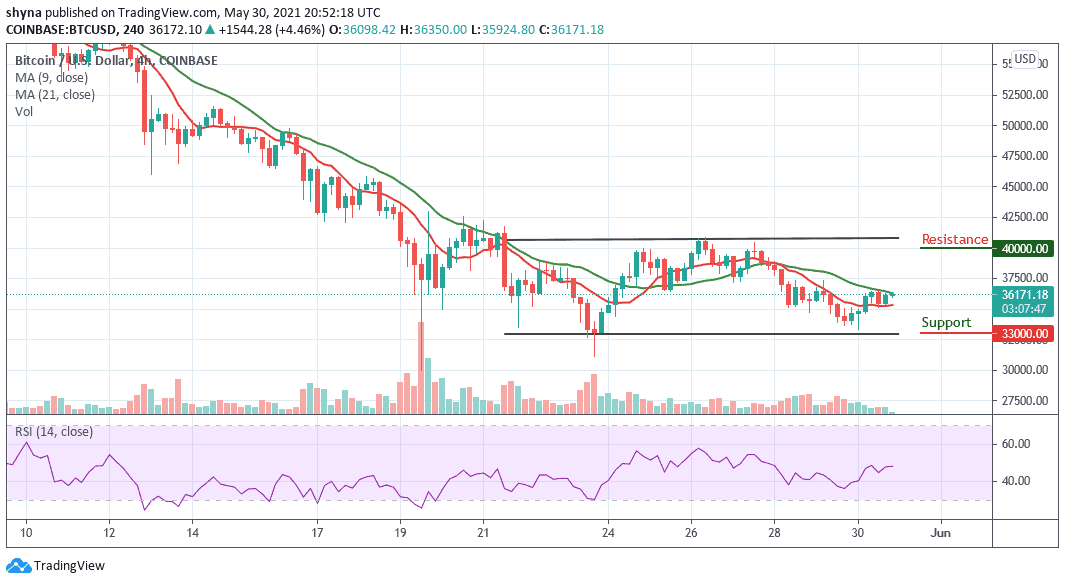
According to the 4-hour chart, BTC/USD is trading within the range of $34,000 to $36,000. Meanwhile, the intraday trading is still looking bullish as at the European session at $36,000 which is now a key support level. Meanwhile, the next key support levels are located at $33,000 and below.

BTCUSD – 4 Hour Chart

However, in as much as the buyers continue to reinforce and power the market more, traders can expect a retest at the $38,500 resistance level, and breaking this level may further push the price towards the resistance level of $40,000 and above. Similarly, the Relative Strength Index (14) moves above 45-level to confirm the bullish movement.

Go to Source

Major British Bank Natwest Alerts Customers With Tips to Avoid Cryptocurrency Scams

Major British bank Natwest has launched an alert to urgently warn its customers of cryptocurrency scams, which have been on the rise. The bank has provided several tips for customers “thinking of investing in bitcoin or other cryptocurrencies” on how to spot scams involving cryptocurrencies. “If you ignore the above advice, you could lose all of your money,” the bank cautioned.

Natwest’s Advice on How to Spot Crypto Scams

National Westminster Bank (Natwest), a major retail and commercial bank in the U.K., has launched an urgent cryptocurrency scam alert on its mobile app. The alert urges customers to beware of scams involving cryptocurrencies following a record number of reports in the first quarter.

Natwest explained that a common scam people fall victim to involves fake celebrity endorsement, such as The Virgin Group founder Sir Richard Branson. Natwest’s head of fraud prevention, Jason Costain, was quoted by the media as saying:

We have prevented millions of pounds from being sent to crypto-criminals who are exploiting the high levels of interest in the currency.

“However, consumers should always be alert, especially to the use of fake websites and bogus celebrity endorsements,” he added.

A number of people shared their screenshots on social media Wednesday of the alert they got when opening the Natwest mobile banking app. The notice begins with a message that reads: “Warning: Thinking of investing in bitcoin or other cryptocurrencies?” Natwest proceeded to highlight four key points to consider to help customers spot and avoid crypto scams.

Natwest’s alert on its mobile banking app. Source: Natwest

The first tip advises customers that if someone contacted them, “promising big profits” and offering to help them invest in cryptocurrency, it is a scam.

Furthermore, the British bank says that customers should always have control of their cryptocurrency wallets. “If you didn’t set the wallet up yourself or can’t access the money in the wallet, this is a scam,” the alert notes, adding that in this case, customers “should stop making payments immediately.”

The bank then pointed out that many cryptocurrency dealers are not registered with the U.K. Financial Conduct Authority (FCA). It emphasized that customers should always use a firm that is registered and is listed on the FCA website. The Natwest notice ends with a warning:

If you ignore the above advice you could lose all of your money.

What do you think about Natwest’s warning and tips on crypto scams? Let us know in the comments section below.

Go to Source

Notorious ‘Tiger King’ Joe Exotic Launches ETH-Based Token to Help Legal Fund

The infamous Joseph Maldonado, aka “Joe Exotic,” from the docuseries “Tiger King: Murder, Mayhem and Madness,” has launched his own Ethereum-based token. According to the website tiger-king.org, the project will also feature non-fungible tokens (NFTs) and the proceeds from NFT sales will go toward helping Joe Exotic’s legal defense team and tiger rescue funding.

‘Tiger King’ Joe Exotic Launches an ERC20 Token

The costar of the docuseries “Tiger King” has announced the launch of a new crypto asset called “TKING,” according to the reality series star’s official Twitter account. Bitcoin.com News reported on the popular docuseries last year when it was discovered that Joe Exotic’s costar Carole Baskin accepted bitcoin donations for Big Cat Rescue. Now Exotic “is back,” according to the website tiger-king.org and whoever developed an ERC20 token for him has minted a trillion TKING tokens.

“The legend of Joe Exotic has launched on the Ethereum blockchain! The man the world learned to call Tiger King from the hit Netflix documentary is back, this time as a digital currency,” the website notes. “The developers are thrilled to present Joe’s official cryptocurrency to the global public, endorsed by the man himself.”

Out of the trillion tokens, developers claim to have burnt 35% of the token supply. The development team also details that TKING tokens are “deflationary” by design as there’s a “2% burn rate on every transaction.” The website states:

Joe will always be the Tiger King, but his colorful career has landed him with a hefty legal bill in a bid to fight a corrupt legal system. Now he also faces the expense of cancer treatment.

Tiger King Received a Percentage of the Token’s Stealth Launch, Exotic’s Arch-Nemesis Carole Baskin Launches CAT Token First

According to the announcement Joe owns a percentage of TKING tokens and received them during the “stealth launch of the coin.” The website insists that “every buy will increase the value of his bag.”

Joseph Maldonado, aka “Joe Exotic,” from the docuseries “Tiger King: Murder, Mayhem and Madness,” has launched an ERC20 token. Exotic was sentenced to 22 years in prison on January 22, 2019.

Interestingly, Exotic’s costar Carole Baskin launched a cryptocurrency first and announced the project during the first week of May. Fox 13 News asked Baskin that because she is so well known that maybe a “major exchange” might list her CAT token.

“I’m being told by people in the industry that it could with its name recognition, and the fact that people love cats so much, and there’s so much buzz, but that’s not what it is right now,” Baskin explained during her interview.

Of course, the website tiger-king.org also mentions Exotic’s arch-nemesis Baskin.

“We will never let Carole win,” the TKING team insists. “Find your inner Tiger as Joe, $TKING, and his legal team stage the comeback of the century. We will land the first tiger on the moon to free Joe. Team Joe for the win!”

What do you think about the ‘Tiger King’ Joe Exotic’s new Ethereum-based crypto asset? Let us know what you think about this subject in the comments section below.

Go to Source

EZ Blockchain Partners With Texas-Based Oil Provider to Monetize Wasted Natural Gas With Bitcoin

While a number of media pundits and politicians have been talking about Bitcoin’s energy consumption, there’s been a myriad of firms working toward green solutions well before all the controversy. Unfortunately, critics don’t highlight the amount of renewables miners use or the cogeneration applications. One project called EZ Blockchain has partnered with the Texas-based oil and gas service provider, Silver Energy to monetize wasted natural gas with bitcoin, while reducing emissions.

Monetizing Stranded Gas and Reducing Emissions With Bitcoin

A firm called EZ Blockchain recently detailed that the company has partnered with Silver Energy, an oil and gas provider based in Texas. According to the firm, the team installed Silver Energy’s first mining site at the company’s Alberta, Canada location in February 2021.

After the installation of Microbt Whatsminers, EZ Blockchain said that the project reached around 1 megawatt of power consumption. All of the power is “processed from 250 MCFd of stranded natural gas using a gas-electric generator,” the company’s blog post notes.

EZ Blockchain’s setup at Silver Energy’s site.

“Today oil and gas producers are implementing Bitcoin mining in the oil field as a part of their ESG policy more often,” the cofounder and CEO of EZ Blockchain, Sergii Gerasymovych said in the report. Gerasymovych added:

Bitcoin mining’s enormous power consumption can solve environmental problems caused by gas flaring and leaking wells. Since Silver Energy is an oil and gas service company, it was a natural symbiosis for EZ Blockchain to work with them.

Natural gas is a byproduct of oil extraction and oil providers either have to flare the gas or use it in some other way. The World Bank estimates 5.3 trillion cubic feet of natural gas is flared annually into the atmosphere.

EZ Blockchain’s manufacturing production line designs and manufactures mobile data centers that act as a flare mitigation system. The company says that the Silver Energy project took three days to construct and it was fully operational by March 2021.

“We’ve had the privilege of working with EZ Blockchain over the last year. Their support in getting our mine up and running was invaluable, saving us countless hours and maximizing uptime,” Joel Gordon, Silver Energy president and CEO explained.

According to EZ Blockchain’s website, the company has expanded quite a bit since it started in 2017 and now has headquarters in Chicago, LA, and Estonia. To date, EZ Blockchain has 35 MW produced and installed and 20 MW more in production.

The firm is not the only company producing mobile bitcoin mining data centers, as the Canadian business Upstream Data also offers stranded gas solutions. Moreover, Crusoe Energy Systems a U.S.-based business offers similar crypto mining solutions for oil and gas producers as well.

What do you think about EZ Blockchain partnering with Silver Energy to mine bitcoin with excess gas? Let us know what you think about this subject in the comments section below.

Go to Source

2 Bitcoin price indicators suggest BTC has not bottomed yet

Traders are using a variety of strategies to determine whether Bitcoin price has bottomed, but on-chain activity and derivatives data hint that the situation remains precarious.

Traders are using various strategies to determine whether Bitcoin price has bottomed, but on-chain activity and derivatives data hint that the situation remains precarious.

Has Bitcoin price bottomed yet? According to @noshitcoins, derivatives and on-chain data signal that further downside could be in store.

Traders have been trying to time the much-anticipated trend reversal ever since Bitcoin (BTC) initiated its 48% correction to $30,000 on May 12. The move culminated with $12 billion worth of futures long positions being liquidated, and to date, trader’s confidence remains somewhat dampened.

The community started looking everywhere for trend reversal signs, including technical patterns, United States CPI inflation data and Bitcoin exchange deposits. For example, some analysts stated that a higher high, followed by a move above $40,000, would be enough.

However, two days later, Bitcoin managed to break the $40,000, although the move didn’t last for more than six hours. Meanwhile, other traders inferred that a retest of the $30,000 bottom is needed before a bounce.

Although there could be empirical evidence or even logic backing those statements, market prices don’t always react to external news or previous chart formations. Unlike stocks, Bitcoin investors can’t rely on commonly used valuation multiples or even comparables.

Sure, a digital store of value is one use case, but at the same time, it is uncensorable and easily transferable. Furthermore, some users value Bitcoin’s peer-to-peer fiat convertibility outside of KYC-regulated exchanges. Another factor to consider is the investors who are increasing their Bitcoin portfolio due to the lack of correlation with traditional financial assets.

This panacea of diverse and sometimes conflicting narratives creates barriers for modeling the market’s potential, adoption status, and even measuring the effectiveness of recent developments.

Some will cheer for Tesla and large companies building up Bitcoin reserves, while others couldn’t care less about who’s holding BTC and instead focus on the challenges of scalability and fungibility.

Skew: the professional “fear and greed” indicator

Call options allow the buyer to acquire Bitcoin at a fixed price when the contract expires. Put options, on the other hand, provide insurance for buyers and protect against price drops.

Whenever market makers and professional traders lean bullish, they will demand a higher premium on call (buy) options. This trend will cause a negative 25% delta skew indicator. On the other hand, if downside protection is more costly, the skew indicator will become positive.

Bitcoin 30-day options 25% delta skew. Source: laevitas.ch

A 25% delta skew oscillating between a negative 10%, and a positive 10% is usually deemed neutral. This balanced situation held until May 16, as Bitcoin lost the critical $47,000 support, which had held for 76 days.

As the markets deteriorated, so did the 25% delta skew indicator, and the cost of protective options spiked. Therefore, until the metric establishes a more neutral pattern nearer to the 5% level, it seems premature to call the market bottom.

Active Bitcoin supply signals that weak hands need to cool off

Traders also monitor the number of BTC that have been active lately. This indicator can’t be deemed bullish or bearish by itself as it does not provide information on how old the involved addresses are.

Active supply that transacted at least once in the trailing 30 days. Source: CoinMetrics

The 500% price rally from Oct. 1, 2020, and the $64,900 peak on April 14, 2021, caused a major increase in the supply moved in the months before the rally. When this metric presents a sharp decrease, it indicates that investors are no longer interested in participating at the current price level.

There are currently 2.2 million BTC active over the past 30 days, and this is significantly higher than levels seen before Oct. 2020.

As things currently stand, traders should not be so that Bitcoin has bottomed, at least until the market no longer has relevant activity surrounding the sub-$40,000 level.

The views and opinions expressed here are solely those of the author and do not necessarily reflect the views of Cointelegraph. Every investment and trading move involves risk. You should conduct your own research when making a decision.

Go to Source

Top 5 cryptocurrencies to watch this week: BTC, MATIC, EOS, XMR, AAVE

MATIC, EOS, XMR and AAVE could rally higher over the coming days if Bitcoin price can sustain within the $30,000 to $33,000 support zone.

Bitcoin (BTC) is struggling to sustain any price level during the current pullback, indicating a lack of demand at higher levels. Does this mean that the bull trend is over and the institutional investors are abandoning the crypto markets?

No! It is the other way around. Glassnode’s weekly newsletter pointed out that the Grayscale Bitcoin Trust (GBTC) premium is rising, suggesting that institutional investors are accumulating at lower levels.

GBTC is not alone, another popular vehicle for institutional investors, the Canadian Purpose Bitcoin exchange-traded fund has also witnessed strong capital inflows. According to analysts at Glassnode, this shows “early signs of renewed institutional interest.”

Crypto market data daily view. Source: Coin360

Another metric that may be signaling a possible bottom in Bitcoin is its dominance chart, which looks similar to the early part of 2017. If Bitcoin’s dominance follows a similar trajectory to 2017, it will indicate that Bitcoin is still some distance away from its peak and altcoin season still has room to run.

Now that the monthly options and futures expiry has passed, investors are likely wondering if Bitcoin could start a sharp recovery next week and which altcoins will rally if that happens. 

Let’s look at 5 cryptocurrencies that could start trending moves this week.

BTC/USDT

Bitcoin’s brief breakout could not clear the hurdle at the 200-day simple moving average ($41,014) on May 26 and 27, indicating the bears are defending this level aggressively. The downsloping 20-day exponential moving average ($41,327) and the relative strength index (RSI) near the oversold zone suggest the bears are in control.

BTC/USDT daily chart. Source: TradingView

If the BTC/USDT pair breaks the $33,000 support, the next stop could be the $30,000 to $28,000 support zone. If this zone also gives way, the pair may witness panic selling and a drop to $20,000 is possible.

The longer the price stays below the 200-day SMA, the more difficult it will become for the bulls to start the next leg of the uptrend.

However, if the price turns up from the current level and rises above the 200-day SMA, it will suggest strong buying at lower levels. That could clear the path for a possible rally to the 61.8% Fibonacci retracement level at $48,231.

BTC/USDT 4-hour chart. Source: TradingView

The 4-hour chart shows the formation of a symmetrical triangle, which generally acts as a continuation pattern. If bears sink the price below the triangle, the pair could drop to $30,000 and then to the pattern target at $20,316.

On the other hand, the setup may act as a reversal pattern if bulls push and sustain the price above the resistance line of the triangle. Such a move will suggest the downtrend is over and the pair could rally to the target objective at $51,951.

MATIC/USDT

Polygon (MATIC) has bounced off the 20-day EMA ($1.58) today, indicating that bulls are buying on dips to this support. The upsloping 20-day EMA and the RSI in the positive territory indicate the path of least resistance is to the upside.

MATIC/USDT daily chart. Source: TradingView

However, the MATIC/USDT pair has formed a symmetrical triangle pattern, indicating indecision among the bulls and the bears. If bulls push the price above the resistance line of the triangle, the pair could rise to $2.70 and then start its journey to the pattern target at $4.20.

Contrary to this assumption, if the price turns down from the resistance line of the triangle, the pair could extend its stay inside the triangle. A break and close below the triangle will signal weakness and could result in a drop to $0.80.

MATIC/USDT 4-hour chart. Source: TradingView

The 4-hour chart shows the relief rally is facing resistance at the downtrend line. If the bears sink the price below the $1.51 support, the pair will complete a bearish head and shoulders pattern that could result in a drop to $0.68.

Conversely, if buyers propel the price above the downtrend line, the bullish momentum could pick up and the pair could challenge the $2.43 resistance. A break above this level could result in a rally to $2.70.

EOS/USDT

EOS attempted a recovery, which fizzled out at the 38.2% Fibonacci retracement level at $7.89 on May 27. However, the positive sign is that the bulls have not allowed the price to dip below the $5.60 support. This indicates that traders are not waiting for a deeper fall to buy.

EOS/USDT daily chart. Source: TradingView

If bulls can push and close the price above the 20-day EMA ($6.95), it will suggest that supply exceeds demand. That could open the doors for a rally to the 50% retracement level at $9.23 and then to the 61.8% retracement level at $10.57.

This bullish view will invalidate if the bears stall the next pullback attempt at the 20-day EMA or at $7.89. Such a move will increase the possibility of a break below $5.60. If that happens, the EOS/USDT pair could drop to the 200-day SMA ($4.52) and then to $3.57.

EOS/USDT 4-hour chart. Source: TradingView

The 4-hour chart shows the bulls are defending the $5.60 support, indicating that the selling pressure has reduced. The flat 20-EMA and the RSI just below the midpoint suggest a balance between supply and demand.

If bulls push the price above $6.81, the pair could rally to the 200-SMA and then to $8.69. A breakout and close above this resistance will signal that bulls are back in the game. Alternatively, if the bears sink the price below the $5.60 to $5 support zone, the pair could drop to $3.57.

XMR/USDT

Repeated attempts by the bears to sink Monero (XMR) below the 200-day SMA ($222) have failed in the past few days. This suggests that bulls are accumulating at the current levels.

XMR/USDT daily chart. Source: TradingView

The buyers attempted to push the price above the 20-day EMA ($294) on May 29 but the long wick on the candlestick shows strong selling at higher levels. However, the bulls are again likely to attempt to clear the hurdle at the 20-day EMA.

If they succeed, the XMR/USDT pair could start a relief rally that may reach the 61.8% Fibonacci retracement level at $368.45. This level may act as a stiff resistance because traders who had bought at higher levels may close their positions.

This positive view will nullify if the price turns down and plummets below the 200-day SMA. In such a case, the pair may drop to $175 and then to $124.69.

XMR/USDT 4-hour chart. Source: TradingView

The 4-hour chart shows a symmetrical triangle formation, indicating indecision among the bulls and the bears about the next directional move. The flattish 20-EMA and the RSI near the midpoint also suggest a balance between supply and demand.

This advantage will tilt in favor of the bulls if they can push and sustain the price above the triangle. The price could then rally to the 200-SMA, which may act as a stiff resistance.

On the contrary, if the price turns down and breaks below the triangle, the pair could drop to $175 and then to $124.69.

AAVE/USDT

AAVE is attempting to rebound off the strong support at $280. This level has not been broken on a closing basis since Jan. 26, hence the bulls are likely to defend it aggressively. The 200-day SMA ($290) just above the level is an added advantage.

AAVE/USDT daily chart. Source: TradingView

However, the downsloping 20-day EMA ($398) and the RSI below 43 suggest the short-term trend favors the bears. The sellers will try to stall any relief rally at the 20-day EMA. If they succeed, the AAVE/USDT pair may again correct to $280.

A break and close below this support could start a downtrend and the decline could extend to $160. Conversely, if the bulls drive the price above the 20-day EMA, the pair could rise to $489, which is likely to act as a stiff resistance.

AAVE/USDT 4-hour chart. Source: TradingView

The 4-hour chart shows the bulls bought the dip to $280. The 20-EMA is flattening out, indicating the selling pressure is reducing. If buyers push and sustain the price above the downtrend line, the pair could rally to $418. A breakout and close above this resistance could result in a rally to $480.

This positive view will invalidate if the price turns down from the 20-EMA or the downtrend line and plummets below $280. If that happens, the bears will try to pull the price below the May 23 low at $208.09 and start the downtrend.

The views and opinions expressed here are solely those of the author and do not necessarily reflect the views of Cointelegraph. Every investment and trading move involves risk, you should conduct your own research when making a decision.

Go to Source

Cardano leads tepid crypto market recovery ahead of Memorial Day

Fears of a nasty pre-Memorial Day selloff in cryptocurrencies may have been overstated, early indicators suggest.

Cardano’s ADA cryptocurrency was back in the spotlight Sunday, leading a tepid market recovery following news that the developer network was inching closer to launching smart contracts. 

Market update

The combined value of all cryptocurrencies rose 4.4% on Sunday to $1.6 trillion, according to data from Coingecko. Among the majors, it was Cardano’s ADA leading the rally with a 17% gain. ADA peaked at $1.70, according to TradingView, and was last seen hovering just north of $1.63.

At current values, Cardano was the fourth-largest cryptocurrency with a total market capitalization of $52.9 billion.

ADA posted a strong rebound on Sunday after languishing for much of last week. Source: TradingView.

Every cryptocurrency in the top-20 reported gains on Sunday. Bitcoin (BTC) price rose 3.5% to $35,833, Ether (ETH) added 4.3% to $2,431 and Binance Coin (BNB) climbed 6% to $327.

Despite the modest rally, market sentiment remains tilted to the downside this weekend, with investors continuing to speculate about whether Bitcoin has actually bottomed out. The Crypto Fear & Greed Index has fallen to 10, on a scale of 1-100 where lower scores are associated with “extreme fear.”

What’s driving ADA?

The presence of oversold conditions following the latest market correction appears to have worked in ADA’s favor on Sunday. The cryptocurrency briefly penetrated the oversold indicator on the hourly Relative Strength Index Saturday before rebounding sharply over the next 24 hours.

Prior to the May 19 crypto market flash crash, ADA was among the top-performing digital assets. It peaked at $2.46 on May 16 before unwinding 55% over the next week. Looking beyond the immediate shift in market sentiment, ADA fundamentals remain intact.

On a fundamental note, ADA supporters are celebrating the launch of the Alonzo smart contract testnet by Cardano’s development team Input Output Hong Kong, or IOHK. As Cointelegraph recently reported, IOHK was eyeing a gradual deployment of Alonzo’s testnet in May and June. Early adopters will have the opportunity to test Alonzo Blue, the first alpha testnet, over the next month.

As IOHK explained:

The ‘Alonzo’ hard fork will bring exciting and highly-anticipated new capabilities to Cardano through the integration of Plutus scripts onto the blockchain. These will allow for the implementation of smart contracts in Cardano, enabling the deployment of a wide range of new DeFi applications for the first time.

Cardano founder Charles Hoskinson recently indicated in a YouTube video that attention will shift to solving the scalability issue once the Alonzo rollout is complete.

Go to Source

Experts answer: How does Elon Musk affect crypto space?

Here’s what crypto and blockchain industry experts think about Elon Musk’s recent comments on cryptocurrency.

Wes Levitt, the head of strategy at Theta Labs:

“Musk’s tweets and the resulting effects certainly may have hurt crypto in the eyes of some institutional investors. While a good deal of investors already consider Musk a bit of a clown and aren’t making investment decisions based on his opinions, it raises concerns about the maturity of crypto markets that an errant tweet can erase hundreds of billions of dollars in market cap in just a few days. 

The whole Dogecoin affair, in general, is not helping crypto’s image either. Many thought that 2021 was the year that cryptocurrencies would begin gaining mainstream acceptance as an asset class, but seeing a meme dog coin hit an $80 billion market cap and then crash 50% is not ideal for crypto to be taken seriously. 

Institutional capital is still entering crypto rapidly, and that will continue this year, but the effects of these tweets undoubtedly led to some tough conversations in investment committees this month. For those of us in the crypto space, the best thing to do is not give so much attention and power to Musk or any other individual.”

These quotes have been edited and condensed.

The views, thoughts and opinions expressed here are the authors’ alone and do not necessarily reflect or represent the views and opinions of Cointelegraph. This article does not contain investment advice or recommendations. Every investment and trading move involves risk, and readers should conduct their own research when making a decision.

Tim Draper, founder of Draper Associates and Draper Fisher Jurvetson:

“We have, of course, seen many ups and downs in the crypto world, so we are somewhat immune to small, one-day news items like tweets from Elon or previous comments from Warren Buffett, Jamie Dimon, etc. In general, the negative comments have come from people who have a lot of fiat currency and don’t want the system to change. Elon is somewhat different in that he is a change agent. I certainly hope he is not doing this as a pump and dump with selfish motivations. I like thinking of him as a change agent and hero.

With regard to his energy statements: I almost always agree with Elon, but here he has gotten it wrong. Secondary effects of technology rarely are what they look like on the surface. Mining encourages the use of cheap alternative energy. We have actually found more energy on the Earth because of miners. Bitcoin uses far less energy than our existing system, which chops down trees for paper money and requires enormous infrastructure. How much energy do banks, buildings, mints, printers, etc., use up in the processing of fiat dollars?

Fiat currency is inflationary and encourages wasteful spending. Bitcoiners are holders.

And finally, with companies like OpenNode and the Lightning Network, we can have far more transactions per second than the Visa network, and for a fraction of the cost and almost zero cost of energy.

There are, of course, coins that are more environmental. Tezos uses proof-of-stake instead of proof-of-work and uses less energy, but all crypto is way better than the 200 plus fiats we have out there.”

Mati Greenspan, founder of Quantum Economics:

“Even Larry Fink, CEO of BlackRock, the world’s largest money management firm, noted the ability to sway Bitcoin prices drastically with a small amount of capital. For Musk, who was briefly the world’s richest man earlier this year, this seems to be about more than just making money. He’s found a way to manipulate market sentiment in under 280 characters. We saw a bit of this from Trump as well, but Musk is clearly much better at playing this game.”

John Wu, president of Ava Labs:

“Elon has a flair for the dramatic, but there are definitely fair critiques and questions for the Bitcoin ecosystem to address. Hopefully, the increased attention from the broader public will catalyze faster adoption of renewable energy sources and transparency on how much these sources are used today.

When Tesla announced it would accept BTC for payments, I voiced my doubts that it would take hold because transactions on Bitcoin are too slow and the tax implications are significant. In taking this step, however, Tesla tested the waters on accepting crypto payments and can now explore networks optimized for near-instant finality, low fees and no environmental impact.”

Diana Barrero Zalles, director of ESG & Impact at Emergents @ Weild & Co.:

“This crypto market shows how investor psychology can heavily impact crypto markets.

Traditional notions of rational, frictionless finance, which dominated financial thinking in the second half of the 20th century, assumed that everyone in an economy is fully rational. The notion of efficient markets assumes that all assets are correctly priced at their fundamental value, adequately reflecting all public information. Investors cannot ‘beat the market’ by identifying mispriced assets.

On the contrary, behavioral finance traces its origins to a 1981 paper by Robert Shiller from Yale University and Nobel Prize recipient, who found that market fluctuations can be too large to be consistent with fully rational thinking. This theory has gained wider acceptance since the 1990s. In the crypto markets, this has shown to be psychologically more realistic time and time again. Behavioral finance tries to make sense of markets in the context of irrational investor behavior and managerial actions.

Crypto markets, which represent a small fraction of the size of mainstream financial markets, still have plenty of room to mature and develop greater efficiencies. Irrational investors and decision-makers who drive prices based on emotion and exuberance may be creating opportunities for more rational investors to take advantage of arbitrage.”

Denelle Dixon, CEO and executive director of Stellar Development Foundation:

“I think there’s good news and bad here. On the good side, bringing cryptocurrencies and blockchain into a mainstream conversation is a positive development that gives all of us in the industry an opportunity to also talk about the real benefits of the technology. 

On the downside, more consumers will see Bitcoin or Dogecoin headlines and think cryptocurrency is only a highly volatile investment for speculators. So, we have to swim upstream a bit to explain the real and valuable uses of the Stellar network and other protocols and how they are tackling the world’s problems. I would rather the focus be on use cases, which is what we choose to talk about.”

Cristina Dolan, founder and CEO of InsideChains, vice-chair of MIT Enterprise Forum:

“In some ways, Elon Musk seems to enjoy creating controversies and capturing attention with statements about his bold business goals and achievements, which have earned him a sizable fan base, as well as SEC fines. Adoption of Bitcoin by corporate treasuries has caught the attention of many investors, especially after Tesla made $101 million in profit from the sale of its Bitcoin. It is no surprise that Elon would poke fun at Bitcoin as an investment after cashing out with a profit and focusing on Bitcoin descendent, Dogecoin, which had acted more as a temporary store of value and method for value transfers.

In 2018, Elon Musk and Tesla were reported to have reached an agreement with the SEC to each pay half of the $40 million in fines because of Elon’s careless, bold tweet about the future stock price of Tesla. This ‘misleading tweet’ caused a significant ESG impact because the Tesla stakeholders are the social component, or ‘S,’ of ESG. This action also affected the ‘G’ in ESG since this was a governance issue that required changes at the board level, and it caused a 14% plunge in the Tesla stock price. This was an ESG impact, specifically on the S and the G! It is hard to argue that Elon Musk’s behavior is guided by ESG principles. His playful statements about Bitcoin and Dogecoin may have impacted the market, but there were other factors that may also have affected market sentiment. Crypto value tends to decline as tax deadlines approach.

In addition, as more institutional money has been invested in crypto, there may be other traditional macro market drivers at play like inflation or the possibility of raising rates for the 10-year treasuries. The banning of Bitcoin or crypto in places like China and Turkey hasn’t prevented citizens from accessing the cryptocurrencies, although the restrictions may now have a greater impact as more institutions engage in crypto.

As headlines about Bitcoin and crypto ignite more interest, we will see a combination of emotional reactions to celebrity endorsements, together with behaviors that correlate with traditional market behaviors. Market perceptions of crypto are not totally based on what one celebrity says or does, but there is an emotional component to all markets. There are many different payment networks that currently accept Bitcoin payments, and Apple recently posted a new job for alternative payment partnerships.

The momentum for DeFi isn’t stopping as the crypto networks continue to grow. A temporary change in market conditions or price will not eliminate the effects of Maxwell’s laws on the crypto networks. There are many dimensions of crypto innovation that are flourishing.”

Alex Wilson, co-founder of The Giving Block:

“Bitcoin has been through much worse. Long term, I don’t think it will have a major impact. Short term, I think it hurts investor confidence because it shows how much impact one person can have on short-term price movements. It’s a whole different debate, though, if Elon’s tweets were really the only thing driving the price movements.”

The energy consumption problem

The reason Tesla suspended its support for vehicle purchases using BTC was the company’s concerns regarding the “rapidly increasing use of fossil fuels for Bitcoin mining and transactions, especially coal.” Sounds reasonable for a company that develops electric cars, right? 

First of all, the question of whether BTC is a waste of energy isn’t new and has been debated by industry experts for some time already. Meanwhile, the mainstream media — The New York Times, Financial Times and Bloomberg, to name a few — went all out with headlines following Musk’s comments, blaming crypto for enormous energy use. They referred to Cambridge University’s Bitcoin Electricity Consumption Index, where the total electricity used worldwide by Bitcoin miners is currently at around 113 terawatt-hours per year. But what they failed to mention — intentionally or unintentionally — is that the latest study by the Cambridge Centre for Alternative Finance stated 39% of all energy consumption used in BTC mining was from renewable sources.

More interestingly, Galaxy Digital published a report entitled “On Bitcoin’s Energy Consumption: A Quantitative Approach to a Subjective Question,” where the company estimates the energy consumption of the traditional finance space to be around 260 terawatt-hours per year, more than twice as big as the Bitcoin industry. However, the estimations only came from available data, meaning it would be fair to say that the actual number is much higher. 

Another important note is that after the COVID-19 outbreak and the tremendous shift globally toward digitization, we must place the problem of crypto energy consumption within the broader context of internet usage. As Greenpeace USA media director Travis Nichols pointed out: 

“As web services grow and become more complex, the demand for computing power will continue to go up over the next few years, and that will require much more energy.” 

Also, Mark Cuban, billionaire investor and owner of the Dallas Mavericks, decided not to withdraw support for Bitcoin payment, arguing with Elon Musk:

“We know that replacing gold as a store of value will help the environment. […] Shrinking big bank and coin usage will benefit society and the environment.”

If we go back to Musk’s accusations against Bitcoin, they did negatively affect the industry. For example, an environmentally-focused bill in the state of New York would place a three-year moratorium on crypto mining if it passes the state’s senate. But every cloud has a silver lining, as they say. What is good is that by bringing attention to the carbon footprints made by the crypto industry, the space can more quickly move toward sustainability, as happened with the global pandemic, which forced governments globally to work on green energy amidst COVID-19.

Cointelegraph reached out to crypto and blockchain industry experts for their opinions on the following question: How do all these Elon Musk comments affect the entire crypto space?

The public’s awareness

Earlier this month, DOGE surpassed BTC in the global public interest. A survey later revealed that Americans are more familiar with the meme coin than they are with Etherum. This result might be upsetting to some, as the Ethereum ecosystem — which introduced smart contracts and became the fabric of the decentralized finance (DeFi) sector — surely deserves more recognition than a meme. 

But look at this situation from another perspective: People who were not previously familiar with cryptocurrency, blockchain technology and DeFi are starting to google Dogecoin. It might interest them and they might go deeper into the topic, resulting in a rise of awareness, which might lead to mainstream audience involvement in the crypto space. As Nick Spanos, the founder of Bitcoin Center NYC and the Zap Protocol, rightfully noticed: 

“DOGE is a powerful marketing tool, driving attention and adoption of crypto and decentralization as a concept. And in that respect, it is invaluable.”

Introduction

Recently, Tesla CEO Elon Musk has been all over the news. He became the richest man on the planet but later lost that title alongside about $6.2 billion of his fortune. Four of his SpaceX Starship rocket tests failed, but a later launching and landing were a success. This same type of roller coaster behavior — which might be a part of Musk’s nature — has also been witnessed within the cryptocurrency space.

In February, Tesla allocated $1.5 billion of its balance sheet to Bitcoin (BTC). Bitcoin’s price jumped by almost $3,000 in minutes and then surged 20% in 24 hours. A month later, Tesla decided to accept Bitcoin for payments on its electric vehicles before Musk changed his mind.

There was also the whole Dogecoin (DOGE) story: After Musk helped to pump up the meme cryptocurrency, a performance with his mother on Saturday Night Live helped to tank it. The self-proclaimed “Dogefather” later denied any official involvement in the DOGE project.

This article won’t focus on the legal concerns of Musk’s behavior, something already covered by law professor and former SEC attorney Marc Powers in his latest opinion article, where he raised important questions: 

“Does Musk have some undisclosed personal or business interest in knocking BTC and promoting DOGE? Are his tweets, which contain what some would consider wild speculation on the prices of Dogecoin and other cryptocurrencies, mere puffery and permitted First Amendment speech, or are they violations of securities, commodities, consumer or other laws?”

It will also leave aside all the price movements caused by Musk’s reckless tweeting and commenting to market analysts and experts. Instead, let’s focus on how all of this is affecting the crypto space in general.

Go to Source

SEC charges 5 for illegally promoting $2 billion Bitconnect Ponzi

The SEC says five individuals “promoted a global unregistered digital asset securities offering.”

Three years and some unforgettable memes later, the Securities and Exchange Commission has announced that 5 individuals will face charges relating to promoting the Bitconnect Ponzi scheme. 

“The SEC’s complaint alleges that these promoters offered and sold the securities without registering the securities offering with the Commission, and without being registered as broker-dealers with the Commission, as required by the federal securities laws,” the release reads.

The promoters, including Trevon Brown, Craig Grant, Ryan Maasen, and Michael Noble are said to have “advertised the merits of investing in BitConnect’s lending program to prospective investors, including by creating “testimonial” style videos and publishing them on YouTube, sometimes multiple times a day.” In exchange for their promotional efforts, the influencers and representatives were paid on a commission basis.

The release also named Joshua Jeppesen as “a liaison between BitConnect and promoters.”

Shortly after the release, Trevon Brown (better known as Trevon James) posted a Tweet in which he did not deny the charges and said that the community would “rally” around him.

“We will seek to hold accountable those who illegally profit by capitalizing on the public’s interest in digital assets,” said Lara Shalov Mehraban, Associate Regional Director of SEC’s New York Regional Office in the release. 

The company, which collapsed in 2018, was widely accused on being a ponzi scheme from several analysts and observers, including Ethereum co-founder Vitalik Buterin. Last year, an Australian man was charged in connection with the company’s fraud. Many will be familiar with the project due to a now-legendary presentation from investor Carlos Matos:

Multiple crypto lawyers have taken to Twitter to speculate on the long-term ramifications of this case. Gabriel Shapiro noted that even though the SEC is targeting a known fraud in Bitconnect, it could end up being a “blueprint” for action against other DAOs. 

Go to Source

US Senator Urges Treasury Secretary Yellen to Take Action on Cryptocurrency Scams to Protect Investors

U.S. Senator Rick Scott has urged Treasury Secretary Janet Yellen to take action on cryptocurrency scams, which he said have risen 1,000% in the past year and cost consumers at least $80 million. “This is an unregulated industry, and the alarming amount of criminal activity surrounding cryptocurrency demands action,” he told Yellen.

Senator Scott Alerts Janet Yellen to Cryptocurrency Scams

Senator Rick Scott wrote a letter to Treasury Secretary Jenet Yellen on Thursday raising concerns regarding the rising number of scams involving cryptocurrencies. The senator wrote:

I write today with concern about the risks taken by ordinary investors and the significant potential for scams related to cryptocurrency.

He explained that “Cryptocurrency values have fallen drastically over the last few weeks, while reports of scams and fraud have skyrocketed.” Senator Scott cited research by the Federal Trade Commission (FTC) stating that cryptocurrency scams have risen 1,000% in the past year and cost consumers more than $80 million, with the median amount consumers lost in the scams of $1,900.

He continued:

This is an unregulated industry, and the alarming amount of criminal activity surrounding cryptocurrency demands action.

In his letter, the senator asked how the administration plans to “protect consumers and legitimate investors from widespread cryptocurrency scams” and how the Treasury Department will “identify, stop and prevent fraud and scams in initial coin offerings and the purchase and sale of cryptocurrency on U.S. financial markets.”

He also asked about “the administration’s plan to plan to address any legal or regulatory uncertainties that may be causing the unnecessarily turbulent environment for the development and sale of cryptocurrency” and what “additional steps” Congress should take.

Senator Scott also questioned what the administration is “doing to protect cryptocurrency markets from foreign interference by our adversaries, including Communist China and Russia.” In addition, the senator wants to know of “any tools available to the administration that may offer more concrete protection and guidance to investors and innovators on these topics.”

Yellen has herself voiced concerns on several occasions over the use of cryptocurrencies in illicit transactions. She previously said that cryptocurrency was mainly used for illicit financing and promised to work with other federal regulators to come up with an effective regulatory framework for cryptocurrencies.

In February, the treasury secretary named the misuse of cryptocurrencies as a growing problem and stressed the importance of crypto regulation to ensure that bitcoin is not used in illicit transactions. She said the current regulatory framework is not up to the task of regulating cryptocurrencies. Meanwhile, the Biden administration is reportedly working on increased cryptocurrency oversight.

What do you think about Senator Scott asking Treasury Secretary Janet Yellen to take action to protect investors against cryptocurrency scams? Let us know in the comments section below.

Go to Source

Brazilians Who Held $1,000 in Crypto Last Year Must Report It on Tax Returns by End of May

Taxpayers in Brazil have only a couple of days left to file their annual tax returns. Investors who had more than 5,000 reals worth of cryptocurrency in 2020, a little less than $1,000, are obliged to report the funds on their income tax declarations this year. Brazilians who fail to do that on time face hefty fines.

Deadline for Tax Filing in Brazil Expires Midnight May 31

Brazilian citizens are required to file their 2021 income tax returns before June 1. This year, the deadline was extended by a month due to the coronavirus pandemic which took a heavy toll on South America’s largest economy. Failure to report revenues and tax obligations will result in fines starting at around $30 and going up to 20% on the tax due, Portal do Bitcoin warned readers recently.

Taxpayers who kept over 5,000 reals worth of coins in their wallets, or $960 at the current exchange rate, must report the crypto holdings to Receita Federal, the country’s internal revenue service. This year, the tax agency adopted dedicated codes on the assets and rights form for bitcoin (BTC) – 81, other cryptos such as ETH, BCH, XRP, and LTC – 82, and digital tokens – 89.

Although Brazilians are obliged to report the cryptos, not all of them will have to pay tax as it’s levied at capital gains exceeding the monthly exemption limit of 35,000 reals (approximately $6,700). Crypto profits above the threshold will be charged with capital gains tax according to a progressive scale, the news outlet elaborated.

Brazilians Who File Their Tax Declarations on Time Will Avoid Penalties

Submitting a declaration that’s not completely correct is the lesser evil than missing the deadline. Brazilians who have reported their assets on time are allowed to make corrections later, but those who fail to lodge their tax returns before June 1 will be facing penalties. And citizens that deliberately evade taxation can be fined up to 150% on the tax amount. Ana Paula Rabello, who specializes in crypto accounting, has been quoted saying:

A taxpayer who has not filed their declaration yet needs to remain calm and do nothing hastily to avoid the risk of paying more or less tax. What needs to be done now is to immediately start preparing the information.

The timely filing of the tax return is essential, Rabello stressed, or taxpayers will have issues with banks and the revenue service if they attempt to use unreported cryptocurrency. “Crypto investors must always remember that undeclared bitcoin cannot be used,” warned the accountant who has provided other tax tips in a free e-book published by Portal do Bitcoin, in which Rabello advises Brazilians how to report their crypto holdings on the 2021 income tax return.

What rules regulate cryptocurrency reporting and taxation in your country? Let us know in the comments section below.

Go to Source

Bitcoin’s Price Regains Some Losses, Signals Still Show Indecisive Crypto Markets

Digital currency market prices have been dropping during the last few days as the crypto economy now rests at $1.53 trillion in value. Crypto trade volumes have increased a hair on Sunday, and a few crypto assets have seen decent percentage gains over the course of the last seven days.

Crypto Market Prices Consolidate While Traders Wait to See if Bears or the Bulls Grab the Reigns

  • Last week, crypto proponents witnessed billions of dollars shaved off the entire crypto-economy and many are curious as to where things are headed next. Bitcoin (BTC) jumped back above the $40k handle a few days ago, but then plummeted below the $34k zone on Saturday.
  • At the time of publication, BTC is exchanging hands for $36,098 per unit and is up over 3% this week against the U.S. dollar. Despite the 4% gain last week, 30-day percentages show bitcoin prices are still down 35%.

  • The top five trading pairs with bitcoin (BTC) on Sunday, May 30, 2021, includes tether (USDT) with 57% of all trades, USD with 14%, BUSD 5.7%, JPY 4.85%, and the EUR at 4.82%.
  • The second-largest market, ethereum (ETH), is swapping for $2,439 per unit on Sunday. ETH is still down 10% during the last 30 days, but weekly stats show ETH has gained 16%.
  • Out of the top ten crypto assets in terms of market capitalization, cardano (ADA) has seen the biggest 24 hour gain today. ADA is swapping for $1.68 per unit and is up over 13% on Sunday morning (ET).
  • Akash Girimath, an Fxstreet analyst, says that the price of bitcoin (BTC) currently “hangs between whale accumulation and miners’ woes. Girimath’s outlook is quite grim and bearish, but BTC still has a chance to overcome the losses Girimath says.
  • “As grim as it may sound,” Girimath said. “Bitcoin’s price still has room to head higher, at least until $42,000. The bearish thesis put forth by the head-and-shoulders technical pattern will face invalidation if BTC generates a decisive daily candlestick close above the resistance level at $42,000.”

  • Meanwhile, bitcoin (BTC) has regained some market dominance this week despite the losses. At the time of publication, BTC dominance stands at 43.1% while ETH holds around 18% on Sunday.
  • Sunday’s biggest gainer is kicktoken (KICK) up 132% today, and stakenet (XSN) which is up 91% during the last 24 hours.
  • The biggest losers this weekend include cube (AUTO) token which is down 60% today, and agrello (DLT) down 60% this morning as well.

What do you think about crypto market prices this weekend? Do you envision a bullish rise or a continued bearish downturn? Let us know what you think about this subject in the comments section below.

Go to Source

Litecoin Price Prediction: LTC/USD Lowers Rallying Moves

Litecoin Lowers Rallying Moves– May 30
The recent uprising in the LTC/USD market now experiences price lowers rallying moves after the crypto lost momentum to surge past a resistance trading area of around $200. During the time of writing, the trading pair records about a 7.58% increase around the level of $176.

Begins a Rally: LTC Market
Key Levels:
Resistance levels: $200, $250, $300
Support levels: $140, $120, $100

LTC/USD – Daily Chart
About a few days’ sessions back, there has been a light-weighted line of price lowers rallying moves on the LTC/USD daily chart. The lowering movement began while the crypto’s price rallied to meet resistance around the value of $200 on May 27. The 14-day SMA trend-line has moved down to touch the 50-day SMA indicator a bit below the $250 market level. The bearish trend-line drew across them southward to locate the lower-key line at $200. The Stochastic Oscillators are at range 40 with closed hairs pointing towards the east direction. That suggests the possibility of getting to see a less-active price action very soon to play out in the market.

Litecoin price lowers rallying moves, is it going to feature long?
As Litecoin is presently experiencing price lowers rallying moves, the US Dollar as well doesn’t seem to exert more fearful depressions on the pace of the trading situation. That said, a strong regaining of strength could be witnessed by bulls between the lower point of $150 and the key upper line of $200 in no time. And, those points mentioned may also witness a line of range-bound trade movements while the two major market movers do not come up with more pushing pressures in the next trading session.

In continuation of a downturn movement of this crypto economy, bears have to keep on resisting any swing high in an attempt to break past the level of $200 to the north. However, the present trading point of around $176 may not be forcefully pushed further beyond the last previously achieved lower value nearing the support of $100 at a later period.

LTC/BTC Price Analysis
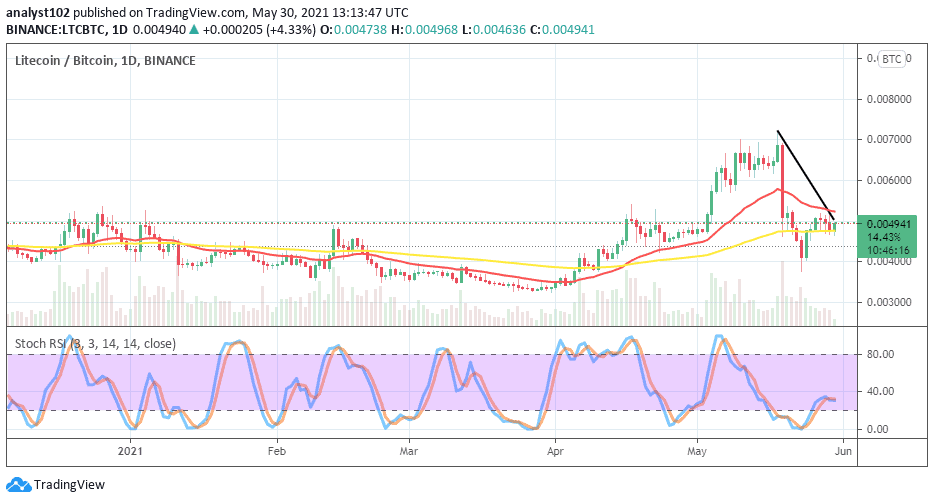
In comparison, the last downward pressures in the LTC/BTC price trending-weight have been noted not being far from the lower correctional trading point. Between May 25 and until now, the base crypto has pushed in a range-bound within the SMA trend-lines. The 14-day SMA trend-line has intercepted from the top by the bearish trend-line as the 50-day SMA indicator is placed underneath them. The Stochastic Oscillators have closed the hairs to indicate that the two cryptocurrencies pairing with each other are getting reduced in momentum in the market. That shows that an indecision trading situation is most likely tended to continue.

Go to Source

Understanding the systemic shift from digitization to tokenization of financial services

Another hurdle financial services and institutions need to address is mainstream digital asset adoption.

The financial industry has seen a rise in demand for exposure to digital — and crypto — assets in all asset classes. This has led to interest, demand and investment from institutional finance, ranging from digital asset custody to digital asset trading desks, regulatory and compliance frameworks, and audit and risk models. 

It is fair to say that digital assets have taken the financial services industry by storm. While the attention and investment from traditional finance in decentralized finance (DeFi) is hailed as a progressive step, there are enormous challenges and hurdles that financial services and institutions need to consider to make digital asset adoption mainstream.

Related: Why institutions suddenly give a damn about Bitcoin

For one thing, the industry is on a massive digitization path to modernize aging financial systems that are reliant on a ledger-based transaction system. It must ensure that the path to digitization is smooth, minimally disruptive and brings the financial system that moves assets and payments to the speed of the digital era, keeping up with digital commerce and digital delivery of services.

These efforts have brought innovation with application programming interfaces (APIs) to support new business models. These strategic APIs not only take the shape of digital products and services but also of co-creation vehicles to deliver value to the consumer and financial services ecosystem. The industry has seen a growth of full lifecycle API management as a glue to secure businesses and expose services at the same time, which shifts the IT focus from projects to strategic APIs.

Lately, the approach has involved financial technology — or fintech — partnerships and/or modernizing technology. It has focused on user experience and the API, with little attention to the systemic elements of the financial services industry, such as payment, treasury, risk models, fraud, regulatory and compliance, to name a few. While the user experience approach has achieved some success, the deficiencies have surfaced for legacy design parts of tightly coupled designs. The use cases that manifest as a financial application eventually catch up with the financial systems’ limitations, and assets locked in the ledger and reliant on the relay of batch processes to move assets.

Related: DeFi needs real-world adoption, not just disruptive pioneering

So, how does a financial institution manage these two drastically different models in tandem as the industry evolves in a complex transformation with a disruptive twist? On one hand, the digitization effort focuses on a ledger-based model, which is largely the existing infrastructure, while on the other hand, the disruptive twist promotes a token-based model, which challenges and negates the current digitization efforts. How do financial institutions manage the delicate balance in which two worlds can coexist and provide a seamless, singular experience?

Related: CeFi and DeFi will finally meet in 2021 — Let’s hope they hit it off

Understanding digitization and fintech-led disruption

The financial services industry is in a constant state of flux, including recent radical shifts. The industry has been a witness to many previous ground-shifting eras, including the introduction of computing into banking systems, anytime-banking with ATMs, and the internet and mobile technology shifting the mindset to “anytime, anywhere.”

Today, the financial services industry is largely focused on massive digitization efforts with initiatives such as open banking, Payment Services Directive-2 (PSD 2), strong customer authentication (SCA) and ISO 20022 for payment harmonization and modernization. Many of these digitization efforts are industry-led, and some are driven as a result of a regulatory directive. They are efforts to stay competitive and meet customer demands for instant, real-time movement of assets and digital fiat as settlement instruments.

Related: Europe awaits implementation of regulatory framework for crypto assets

The challenges the financial services industry faces are immense, including constant shifts in the regulatory landscape, customer expectations of digital natives, the need for real-time and around-the-clock operations to service clients’ requests, and ecosystems’ exogenous factors that are creating interesting technology engine struggles for financial institutions. The legacy infrastructure, which represents both significant investment and past modernization journeys, is now impeding the speed and scale required to unlock the digital value of not only products and services but also of the entirety of the financial institution itself.

Related: Stablecoins present new dilemmas for regulators as mass adoption looms

With the emergence of every significant change, the financial services industry has been able to adapt and withstand the disruption. The movement led by fintech is another major shift, underpinned by radically different business models that are led by new innovative technologies, business structures and the digitization of adjacent and consumer experience in every segment of digital business and engagement. This shift — coupled with mounting regulation, compliance pressures and disruption from the fintech ecosystem — is forcing the established financial services industry to rethink innovation and business models. This is to keep systems competitive, innovative and malleable for future disruptive shifts that may occur — like DeFi driven by tokenization.

Related: Tokenization of assets is not taking off, but it really should

Understanding the implications of asset tokenization

We have established that digitization is the first step in many enterprise and permissionless blockchain projects. Tokenization is the process of converting or claiming an asset and rights into a digital representation, or token, on a blockchain network. At this time, it may be prudent to draw a distinction between a (crypto) asset or currency and a tokenized asset.

A (crypto) asset or currency is a medium of exchange or a protocol-driven exchange mechanism that often embodies the same characteristics as a real-world currency — such as durability, limited supply and recognition by a network — while being backed by a common belief system, such as a fiat currency. A (crypto) asset or currency also represents a byproduct of trust systems, or consensus, as a vehicle to back the incentive economic model that rewards and fuels the trust system of a network, making it a trust currency of the network. A token, on the other hand, can be many things: a digital representation of a physical good, making it a digital twin, or a layer-two protocol that rides on the (crypto) asset or currency and represents a unit of value.

This distinction between a (crypto) asset or currency and a tokenized asset is important for understanding the exchange vehicles, valuation models and fungibility across various value networks that are emerging and posing challenges around interoperability. The challenges are not just technical, but also business challenges around equitable swaps. Tokenization of assets can lead to the creation of a business model that fuels fractional ownership or the ability to own an instance of a large asset. The promised asset tokenization on blockchain-based business networks is not just digitization or a solution to the inefficiencies of time and trust; it also creates new business models and co-creations from synergies of network participants that did not exist before.

While blockchain itself provides the technology constructs to facilitate exchange, ownership and trust in the network, it is in the digitization of value elements where asset tokenization is essential. In essence, digitization is sort of a prerequisite to tokenization. In the financial services context, digitization of existing services and token-driven DeFi present two parallel business streams, which will converge as the industry aims to provide a unified user experience.

Tokenization implies that account management and claims on assets are driven by cryptographic keys, as opposed to account management and asset management by a system operator called a bank. Though tokenization is more than just account management and claims to an asset, it enables divisibility, fungibility and disintermediated business functions, such as asset transfer. It is a fundamental building block and prerequisite for an “internet of value.”

Opinion

The answer to the question How does a financial institution manage the delicate balance in which two worlds can coexist and provide a seamless and singular experience? is a complicated one. Adequate thought needs to be given to the operational structure that encompasses the complexity of existing structures, while also encapsulating the exponential growth (and complexity) of a digital asset ecosystem. That presents both a monumental operational challenge and as a massive opportunity landscape and avenue to embark on new business models.

It is widely understood and accepted that blockchain technology lays the foundation for a trusted digital transactional network that, as a disintermediated platform, fuels the growth of marketplaces and secondary markets due to new synergies and co-creation due to new digital interactions and value-exchange mechanisms.

Open banking has led the digitization efforts with a raft of open APIs. These APIs can be extended to tokenized asset structures and turn the entire business process of various DeFi market structures into consumable units, where various asset classes, marketplaces and DeFi support services can be stitched into a singular experience hiding the transactional complexity.

This article does not contain investment advice or recommendations. Every investment and trading move involves risk, and readers should conduct their own research when making a decision.

The views, thoughts and opinions expressed here are the author’s alone and do not necessarily reflect or represent the views and opinions of Cointelegraph.

Nitin Gaur is the founder and director of IBM Digital Asset Labs, where he devises industry standards and use cases and works toward making blockchain for the enterprise a reality. He previously served as chief technology officer of IBM World Wire and of IBM Mobile Payments and Enterprise Mobile Solutions, and he founded IBM Blockchain Labs where he led the effort in establishing the blockchain practice for the enterprise. Gaur is also an IBM distinguished engineer and an IBM master inventor with a rich patent portfolio. Additionally, he serves as research and portfolio manager for Portal Asset Management, a multi-manager fund specializing in digital assets and DeFi investment strategies.

Go to Source

Please enter CoinGecko Free Api Key to get this plugin works.
Exit mobile version