The launch of Shiba Inu was accompanied by the hype of SHIB being the next Dogecoin
However, social sentiment and volume has since dropped into negative territory
Some Shiba Inu investors seem to have capitulated and sold their SHIB
Address activity surrounding Shiba Inu continues to be high despite the capitulation and low sentiment
The Shiba Inu (SHIB) token was created in August 2020 and modeled as ‘the Dogecoin killer’. Shiba Inu (SHIB) lay undiscovered for the rest of 2020 and early 2021 until Tesla’s CEO, Elon Musk, tweeted that he was considering the possibility of getting a Shiba Inu in March of this year as highlighted via the following tweet.
I’m getting a Shiba Inu #resistanceisfutile
— Elon Musk (@elonmusk) March 14, 2021
Did Elon Mean an Actual Doge or Shiba Inu (SHIB) Tokens?
As with most tweets by Elon Musk, the crypto Twitter community deciphered his Tweet to mean that he was going to purchase Shiba Inu (SHIB) tokens based on the background that he is already a fan of Dogecoin (DOGE). This then ignited interest in the meme-coin of a meme-coin (Dogecoin), known as Shiba Inu.
I’m getting a Shiba Inu #resistanceisfutile
— Elon Musk (@elonmusk) March 14, 2021
Social Santiment and Volume Wanes for Shiba Inu (SHIB)
However, the hype surrounding Shiba Inu (SHIB) has since dropped into negative territory. This is according to an analysis by the team at Santiment that pointed out that excitement surrounding Shiba Inu (SHIB) has now become bearish as illustrated in the chart below.
Some Shiba Inu Holders Have Capitulated, Address Activity Remains High
The analysis by the team at Sentiment goes on to point out that some of the Shiba Inu holders have sold their SHIB since early May when excitement surrounding the token was at its peak. In addition, Shiba Inu’s address activity has also declined along the way but is still amongst the highest in the crypto-verse as explained through the following statement and accompanying chart.
There are definitely signs that hype is over for Shiba Inu. However at the very least even though it’s active addresses have declined heavily, they remain quite high. That’s not a bad sign. It could do worse. It still puts SHIB into top 10 coins by activity on Ethereum. And it remains relatively high.
Michael Saylor has described Bitcoin as being digital property
His description of Bitcoin comes after El Salvador acknowledged Bitcoin as legal tender
He also pointed out that Bitcoin empowers billions of people with property rights, as he responded to Senator Elizabeth Warren’s attack on Bitcoin
The CEO of Microstrategy, Michael Saylor, has described Bitcoin as digital property. Mr. Saylor’s brief and concise description of Bitcoin can be found in the tweet below.
#Bitcoin is digital property.
— Michael Saylor (@michael_saylor) June 11, 2021
El Salvador is Leading the Way Towards a Better World
His description of Bitcoin was made a day after El Salvador legally acknowledged BTC as legal tender in the country. Michael Saylor went on to point out that El Salvador was ‘leading the way toward a better world’ as highlighted in his statement below.
In a country where 70% of the population is excluded from the financial system, #Bitcoin is hope. The Republic of El Salvador is leading the way toward a better world.
Michael Saylor Responds to Senator Elizabeth Warren’s ‘Attack’ on Bitcoin
Earlier this week, US Senator Elizabeth Warren, threw several jabs at Bitcoin by stating that BTC mining was consuming more energy than entire countries. She also raised several concerns that digital assets such as Bitcoin, were providing avenues for criminals to orchestrate cyber attacks such as that which affected Colonial Pipeline early last month.
In his response to Senator Warren’s statements on Bitcoin, Michael Saylor reiterated that BTC empowers billions with property rights. As a result, energy consumption should be ‘the least of our concerns’. His full response to Senator Warren’s concerns on Bitcoin can be found below.
We finally have the technology with Bitcoin to empower billions of poor and working-class people with property rights, economic security, & freedom from financial repression by the state & institutions. The fact that we use electricity to do this should be the least of our concerns.
Jack Dorsey, CEO of Twitter, hinted at the possibility of integrating Lightning Network into Twitter yesterday. Dorsey answered a Tweet of a follower saying it was “just a matter of time” for this to be a fact. Dorsey is a big Bitcoin proponent and has extended Bitcoin functionality to another of his companies, Square.
Jack Dorsey Hints at Twitter/Lightning Network Integration
Jack Dorsey hinted yesterday at the possibility of integrating Lightning Network into Twitter. Dorsey stated it was “only a matter of time” for this to happen, answering a follower’s tweet. Interestingly, the conversation started around an app called Sphinx. The app uses Lightning Network as a way of relaying messages between a set of users and for payments.
Lightning Network is a second layer protocol for payment facilitation in Bitcoin. It was designed in 2016 as a way of achieving scalability for micropayments. However, developing the network concept in the real world took some time. Now there are Lightning Network implementations that are mostly functional, albeit with some limitations.
The integration nod could mean more than one might think. Bluesky, the decentralized social media protocol Twitter is building, might include Lightning Network as more than a payment method. In the same way Sphinx chat is using it, it could be leveraged to become the backbone of a new architecture. This could also help with the discovery of decentralized solutions to censorship problems. Twitter banned former President Trump last year, for example, awakening worries about the unchecked power of the platform.
‘Only a Matter of Time’
This is not the first time Dorsey has made such an announcement. Back in 2019, the entrepreneur hinted at the integration of Lightning Network for Cash App. Cash App is a service provided by Square, that allows customers to buy Bitcoin directly. The reference was made in a podcast along with Elizabeth Stark, CEO of Lightning Labs. However, the company has still not integrated Lightning Network into the app.
To the contrary, Cash App increased the minimum bitcoin withdrawal limit from 10K to 100K satoshis last April, according to Bitcoin Magazine. Still, Bitcoin is a big element of Dorsey’s companies and this is unlikely to change anytime soon. Dorsey also recently announced Square might dabble in the hardware wallet business.
What do you think about Jack Dorsey’s Lightning Network/Twitter integration announcement? Tell us in the comments section below.
The Bitcoin Mining Council has gone live, launching its own website detailing its members and the mission statement of the organization. The council originated as a closed organization, but they are now allowing any miner to join. While Michael Saylor gets a founding member status, the site states Elon Musk has “no role” in the council.
Bitcoin Mining Council Officially Launches
The Bitcoin Mining Council, an organization born out of worries regarding Bitcoin’s energy consumption, launched officially yesterday. On the website, the council presents its mission statement. It also explains the plan to tackle the task of addressing bitcoin energy worries. The site states:
The mandate of the Bitcoin Mining Council is to promote transparency, share best practices, and educate the public on the benefits of Bitcoin and Bitcoin mining.
To achieve this, individual members need to provide accurate energy numbers. Miners and mining companies are traditionally reluctant to share these statistics in the open. The council made its debut last month when Michael Saylor hosted a meeting of a group of several miners in America. The objective of the meeting was to point bitcoin mining in a cleaner, greener direction. However, the Bitcoin Mining Council states that:
Bitcoin’s energy usage is a feature, not a bug, and provides tremendous network security. By providing a voluntary disclosure forum, miners can decide to share their energy sources, in hopes of promoting transparency.
This focus clearly leaves behind the green push that originated it. While the Bitcoin Mining council has 9 members including Microstrategy, the site states any miner can join.
Elon Musk Pushed Aside
The Bitcoin Mining Council states Michael Saylor is one of the “key members of the BMC, both as a facilitator and Bitcoin supporter.” However, Elon Musk, whose activity was key to its establishment, was sidelined. The site declares:
Elon Musk has no role at the BMC. The extent of his involvement was joining an educational call with a group of North American companies to discuss Bitcoin mining.
While Elon Musk was not involved in the creation of the organization, he drove public attention to Bitcoin’s energy consumption. Musk called Bitcoin’s energy footprint “insane” in one of his tweets. Tesla, the vehicle company where Musk is CEO, also stopped accepting Bitcoin as a payment method due to environmental concerns. This was a key circumstance that started a downtrend in the market. All of this enticed miners to take the subject seriously. In any case, the backpedaling seems to go hand in hand with Musk’s latest Twitter divorce with Bitcoin.
What do you think about the Bitcoin Mining Council? Tell us in the comments section below.
South Africa’s Intergovernmental Fintech Working Group (IFWG) has a released new position paper that calls for the regulation of the country’s cryptocurrency ecosystem. In the document, the IFWG, which is a creation of the South Africa Reserve Bank (SARB), recommends “a staged approach to bring crypto-assets within the regulatory remit through the regulation of crypto asset service providers (CASPs).”
Crypto Service Providers to Adhere to AML/CFT Requirements
The 49-page document also “sets out 25 recommendations for a revised South African policy, legal and regulatory position on crypto assets and related activities.” According to the IFWG, some of these recommendations “are already underway and in the process of being implemented while some will take much longer to implement.”
Meanwhile, in the position paper, the IFWG’s recommendations are grouped into three overarching categories. Concerning the first one, the working group recommends CASP adherence to the legislative requirements that are aimed at anti-money laundering and combating the financing of terrorism (AML/CFT). Some of these requirements include the reporting of “cash transactions of $1818.00 (R25 000.00) and above or the applicable threshold at any given time.”
Central Bank Arm to Monitor Cross-Border Crypto Transactions
In the second category, the IFWG says it wants the Financial Surveillance Department (Finsurv) of the SARB “to assume the supervisory and regulatory responsibility for the monitoring of cross-border financial flows in respect of crypto assets and CASPs.” In addition, the working group is recommending the amendment of certain parts of the exchange control regulations to enable the placement of crypto asset trading platforms (CATPs) under the purview of relevant bodies. The position paper states:
It is further recommended that a new dispensation should be created under the exchange control framework to allow CATPs (licensed as above) to source or buy crypto assets offshore for the purpose of selling to the local market, subject to specified limits to be determined by Finsurv.
In the third category, the IFWG recommends that crypto-assets be declared financial products. Such a declaration would require CASPs “to become licenced intermediaries and provide for the rendering of advice by such entities.” This, in turn, allows for “regulatory oversight and will assist in addressing the immediate exploitation of consumers by unscrupulous entities.”
IFWG Not Endorsing Crypto Assets
In the meantime, the IFWG has insisted that its release of the new position paper “should not be interpreted as any type of endorsement of crypto assets.” Instead, the working group argues that this decision “to formally bring CASPs within the domestic regulatory remit was driven by a combination of factors.”
One of these factors pertains to the need “to promote responsible innovation and regulate the conduct of these providers.” The high inherent risks associated with crypto assets as well as scam activity are the other factors that prompted IFWG’s recommendations.
Finally, the IFWG is urging crypto-asset consumers to ensure they fully understand the products and services they are gaining exposure to, as well as the associated risks.
What are your thoughts on the IFWG’s latest position paper on crypto-assets? You can tell us what you think in the comments section below.
DeFi has marked the birth of an open alternative to the current financial system, promising broader financial inclusivity.
Decentralized finance came to life with the inception of Ethereum in 2013. However, it truly hit the ground running in 2016–2017 with the backing of Ethereum developers and some entrepreneurs and experts in the financial investment sphere. To get our facts right and clear all misconceptions, DeFi encapsulates a variety of financial applications in cryptocurrency or blockchain that are geared toward removing intermediaries between parties in financial transactions.
Related: The great unbanking: How DeFi is completing the job Bitcoin started
A large majority of DeFi applications are built on top of Ethereum. The first major, and the largest, DeFi application is MakerDAO, which was founded by Rune Christensen. Ethereum, to put it briefly, is an open-source platform that uses blockchain technology to create and run decentralized digital applications.
The development of DeFi in subsequent years
As an exciting new concept, DeFi is the rapidly expanding ecosystem of blockchain-based financial products that look to replicate or expand on the capabilities of traditional finance institutions — like banks, payment processors, clearinghouses and more. DeFi is portrayed to be a solution to the problems faced by traditional banking and financial institutions and shows how it may eventually replace the old system, in real time. Regardless of the technology or platform used, DeFi systems are designed to do away with intermediaries between transacting parties.
The volume of trading tokens and money locked in smart contracts in its ecosystem has been growing exponentially, proving that this concept is here to stay. As per DeBank, there is approximately $60.5 billion in net value currently locked in DeFi.
DeFi provides an accessible approach to manage financial transactions. As the name suggests, government jurisdictions and changes by centralized financial institutions do not apply to it. This eliminates the dependency on third parties, giving users complete control over their transactions and at the same time allowing them to remain anonymous since all transactions are carried out over smart contracts on the blockchain. Transactions and trading of cryptocurrencies can be executed from any location since it provides financial inclusivity.
DeFi regulations
While there are no clear regulatory guidelines on DeFi-related topics, there are a few countries where certain isolated cases are taken into consideration by the country’s governing bodies. Although DeFi may hold great promise, it also raises novel policy and regulatory considerations.
Related: FATF draft guidance targets DeFi with compliance
The United States’ financial regulation assumes the presence of intermediaries, and it applies regulation to intermediaries as a way to regulate financial markets and related activities comprehensively. As a result, regulators and policymakers may find that DeFi can lead them into uncharted, yet-to-be-tested territory.
Why will DeFi dominate the globe?
The decentralized finance sector has seen skyrocketing growth over the years. The ethos of the crypto and DeFi function is taking baby steps into conventional finance sectors vis-a-vis the saga involving GameStop and WallStreetBets.
Related: GameStop saga reveals legacy finance is rigged, and DeFi is the answer
At some point, the question to be asked is not whether DeFi will become a major factor in the global economy but rather how creatively it will be developed and to what extent it will emerge as a force for broad benefit.
One of the keys to guiding DeFi in a beneficial direction will be integrating advanced decentralized artificial intelligence. So far, few DeFi projects have leveraged AI, but we may well see AI woven into the next burst of DeFi activity later in 2021 — and maybe even in a way that enables DeFi to push startup decentralized technical projects forward with much more velocity and purpose.
Conclusion
There are no two ways about DeFi emerging as an important player in the financial firmament today. It is not about new toys for speculators to play with nor the provision of more sophisticated financial tools for those who prefer to keep their wealth outside the control of centralized authorities. DeFi has the potential to be much more than this, but the key to achieve truly profound influence will be the extension of DeFi beyond Bitcoin (BTC) and Ether (ETH) to the broader scope of lower-liquidity cryptocurrencies.
Since 2020, DeFi has spawned a vast network of platforms and protocols that allow users to swap, trade, deposit, borrow and lend cryptocurrency for income and growth opportunities. This sort of cascading activity in the space has not been seen in traditional finance markets for decades.
This article does not contain investment advice or recommendations. Every investment and trading move involves risk, and readers should conduct their own research when making a decision.
The views, thoughts and opinions expressed here are the author’s alone and do not necessarily reflect or represent the views and opinions of Cointelegraph.
Neeraj Khandelwal is the co-founder of CoinDCX, an Indian crypto exchange. Neeraj believes that crypto and blockchain can bring about a revolution in the traditional finance space. He aims to build products that make crypto accessible to and easy for global audiences. His areas of expertise lie in the crypto macro space, and he also has a keen eye for global crypto developments such as CBDCs and DeFi, among others. Neeraj holds a degree in electrical engineering from the prestigious Indian Institute of Technology Bombay.
About 48 hours ago, Bitcoin bulls failed to sustain above the $38,000 high as Bitcoin revisits $30,000 low. The breaking of the $39,000 resistance is necessary for Bitcoin to rally above $40,000. Once buyers reclaim the $40,000 support, the bullish momentum will extend to $46,000 high.BTC/USD price lacks buyers at higher price levels as the crypto find it difficult to resume upside momentum.
Resistance Levels: $45,000, $46,000, $47,000 Support Levels: $35,000, $34,000, $33,000
BTC/USD – Daily Chart
Buy Bitcoin Now
Following the bulls’ failure to break the $38,000 resistance, the BTC price was fluctuating below the resistance level for three days. Thereafter, Bitcoin slumped above the $35,000 support. On the upside, if the bulls break the $38,000 and $39,000 resistance, BTC’s price will rally above $40,000 high. Incidentally, if the $40,000 resistance is cleared, a rally to the previous highs is possible. Since May 19, Bitcoin bulls have been defending the $35,000 support as the king coin remained stable above the critical support at $34,000. However, if the bears break below the critical support, Bitcoin will fall to the $30,000 support level.
El Salvador’s Bitcoin Adoption May Risk IMF Negotiations: JP Morgan – As Bitcoin Revisits $30,000 Low
El Salvador has adopted Bitcoin (BTC) as a legal currency within the country. JP Morgan has indicated that El Salvador’s decision to adopt Bitcoin as legal tender is of little economic benefit. Earlier on El Salvador’s parliament passed a historic bill to recognize Bitcoin as a legal tender. The “Bitcoin Law” bill was accepted by a majority of 62 out of 84 votes. The JPMorgan client note stated: “As with the dollarization in the early-2000s, this move does not seem motivated by stability concerns, but rather is growth-oriented […] But it is difficult to see any tangible economic benefits associated with adopting Bitcoin as the second form of legal tender, and it may imperil negotiations with the IMF.” Presently, El Salvador is in talks with the International Monetary Fund for a $1 billion funding program. The country is facing a potential $3.2 billion budget deficit in 2021.
BTC/USD – Daily Chart
Presently, Bitcoin is hovering below and above the $35,000 support. A rebound above the current support will catapult the crypto to retest the $39,000 resistance zone. Meanwhile, on April 25 downtrend, a retraced candle body tested the 50% Fibonacci retracement level. The retracement indicates that Bitcoin will fall to level 2.0 Fibonacci extension. From the price action, Bitcoin has retested the Fibonacci extension it is hovering above the $35,000 support.
Looking to buy or trade Bitcoin (BTC) now? Invest at eToro!
Buy Bitcoin Now
75% of retail investor accounts lose money when trading CFDs with this provider
India may be regulating crypto as an asset class under the purview of the Securities and Exchange Board of India (SEBI). In addition, a crypto bill is likely to be introduced during the Monsoon session of parliament, local media reported.
Indian Government Reportedly Considers Regulating Crypto as an Asset Class
The Indian government has yet to introduce a cryptocurrency bill. An existing bill seeks to ban cryptocurrencies. However, there have been reports of the government re-evaluating the recommendations within the bill.
The New Indian Express reported Friday that top sources tracking the crypto industry told it that “the government has moved away from its earlier hostile stance towards virtual currencies and will most likely classify bitcoin as an asset class in India soon.” The publication further conveyed:
Market regulator Securities and Exchange Board of India (SEBI) will oversee regulations for the cryptocurrency sector after bitcoin’s classification as an asset class.
The media previously reported that the Indian government will set up a panel of experts to come up with new recommendations to oversee the cryptocurrency industry in India. Sources informed the publication that an expert panel at the Ministry of Finance is working on formulating the country’s cryptocurrency policy. The publication further conveyed:
A cryptocurrency regulation bill is likely to be tabled in the Parliament during the Monsoon session.
The Monsoon session usually starts in July. However, last year, it did not start until September due to the coronavirus crisis. This year, the government expects the session to begin on its normal schedule.
Last week, India’s central bank, the Reserve Bank of India (RBI), issued a notice to banks regarding its April 2018 circular that banned financial institutions from providing services to crypto businesses and traders. The bank said that the circular is no longer valid per the supreme court ruling in March last year, emphasizing that banks cannot quote it when making decisions on cryptocurrency.
The central bank, however, reiterated that its position on bitcoin and other cryptocurrencies has not changed and it still has “major concerns,” RBI Governor Shakthikanta Das said, adding that they have been communicated to the finance ministry.
Ketan Surana, Director and chief financial officer of cryptocurrency exchange Coinsbit and member of Internet and Mobile Association of India (IAMAI), said: “We can definitely say that the new committee which is working on cryptocurrencies is very optimistic on cryptocurrency regulation and legislation.” The director emphasized:
A new draft proposal will soon be in the Cabinet, which will look into the overall scenario and take the best step forward. We are very hopeful that the government will embrace cryptocurrencies and blockchain technologies.
Do you think India should regulate crypto as an asset class? Let us know in the comments section below.
JPMorgan struggles to “see any tangible economic benefits associated with adopting bitcoin as a second form of legal tender.” Commenting on El Salvador’s bitcoinization, JPMorgan did not rule out that the country’s move to make the cryptocurrency legal tender may be “the beginning of a broader trend among similarly situated, smaller nations.”
JPMorgan’s Opinion on Bitcoinization in El Salvador
Investment bank JPMorgan released a report Friday titled “The Bitcoinization of El Salvador.” The country’s congress passed the bill making bitcoin legal tender on Wednesday, becoming the first nation to do so.
JPMorgan described: “El Salvador recently passed legislation making bitcoin legal tender, and will attempt to implement a bimonetary system with the U.S. dollar as the primary unit of account but mandating bitcoin be accepted as payment for all economic activity.”
The investment bank added that “As with dollarization in the early-2000s, this move does not seem motivated by stability concerns, but rather is growth-oriented,” elaborating:
It is difficult to see any tangible economic benefits associated with adopting bitcoin as a second form of legal tender, and it may imperil negotiations with the IMF.
The International Monetary Fund (IMF) has already voiced concerns regarding El Salvador’s move to make bitcoin legal tender, citing legal and economic issues. El Salvador is currently seeking a billion-dollar loan from the IMF.
An official with the Bank of International Settlements (BIS) has also expressed doubt in El Salvador’s bitcoin law, calling it an “interesting experiment,” but emphasizing that the BIS does not see that bitcoin can function as a means of payment.
The JPMorgan report further points out that there are questions as to how bitcoin will be treated by larger economies when it is legal tender in El Salvador. The bank warned that any treatment changes “would arguably be an unintended consequence of laws and regulations that significantly predate, and understandably did not anticipate cryptocurrency.” Nonetheless, the bank said:
Those moves may be complicated if this is the beginning of a broader trend among similarly situated, smaller nations.
After El Salvador passed the bill to make bitcoin legal tender, President Nayib Bukele said the country will be mining BTC using energy from volcanoes. He said it will be “very cheap, 100% clean, 100% renewable, 0 emissions energy from our volcanos.”
Do you think other countries will follow El Salvador’s example and make bitcoin legal tender? Let us know in the comments section below.
The U.S. Securities and Exchange Commission (SEC) and the Commodity Futures Trading Commission (CFTC) have warned investors of the risks of investing in funds with exposure to bitcoin futures.
The SEC published an investor alert on funds trading in bitcoin futures Thursday. The alert comes from the SEC’s Office of Investor Education and Advocacy (OIEA) and the CFTC’s Office of Customer Education and Outreach (OCEO).
They pointed out that some funds may engage in the trading of bitcoin futures contracts as a way to gain exposure to bitcoin, emphasizing that the cryptocurrency “is a highly speculative investment.” The document cautions:
Investors should consider the volatility of bitcoin and the bitcoin futures market, as well as the lack of regulation and potential for fraud or manipulation in the underlying bitcoin market.
They urge investors thinking about investing in a fund that buys or sells bitcoin futures “to weigh carefully the potential risks and benefits of the investment,” naming factors, such as their risk tolerance, the fund’s disclosure of its risks, and potential loss of investment.
The alert further warns that a rise in the price of bitcoin may not result in an increase in the value of the fund holding positions in bitcoin futures contracts, citing several reasons. For example, the funds may not have direct exposure to the contracts’ underlying assets. In addition, bitcoin futures contract prices can vary by delivery months and differ from the BTC price itself. Futures contracts also expire periodically, resulting in fluctuations of portfolio exposure as expiring futures positions are typically rolled into new contracts.
Meanwhile, the new chairman of the SEC, Gary Gensler, has been pushing for increased oversight of the crypto space, particularly crypto exchanges. The SEC has brought 75 crypto-related enforcement actions on the industry so far. Gensler has called on Congress to pass a law to protect investors.
What do you think about the SEC and CFTC warning about funds investing in bitcoin futures? Let us know in the comments section below.
Bitcoin traders are sitting on their hands after spotting a death cross on the daily chart but could this be a buy signal for contrarian investors?
Bitcoin’s (BTC) succession of sharp corrections from its all-time high at $64,900 has turned investor sentiment negative, at least for the short-term. While some analysts believe the bottom may have been hit, others are warning of a further fall due to the “Death Cross” pattern that, at the time of writing, is on the verge of completion.
For new traders, the name death cross itself brings a lot of negativity and a feeling of impending doom. This sentiment can trigger selling panics, especially if the market has already been going through a bear phase prior to the pattern being spotted.
However, is a death cross something to be feared or is it a crystal ball that gives traders insight on when a plunge is imminent?
Let’s find out with the help of a few examples.
What is a death cross and how accurate is it?
The death cross forms when a faster period moving average, usually the 50-day simple moving average, crosses below the longer-term moving average, generally the 200-day SMA.
LTC/USD daily chart. Source: TradingView
The crossover is bearish as it shows that the uptrend has reversed direction. Large institutional investors generally do not buy in a falling market until a bottom is confirmed. Due to this, buying dries up and investors holding positions rush to the exit due to panic, exacerbating the decline.
Before looking at a few death cross examples in the crypto markets, let’s see how the pattern has affected the S&P 500 index between 1929 to 2019. According to Dorsey, Wright & Associates, LLC, the average fall after the formation of the death cross is 12.57% and the median fall is much lesser at 7.75%.
However, if only the post-1950 period is considered, the average fall is less than 10.37% and the median is at 5.38%.
While those figures are not startling, especially for volatility-accustomed crypto traders, the bearish convergence of these two moving averages should not be taken lightly.
History shows that the death cross has resulted in a few instances of massive declines in the U.S. stock market indices.
After the death cross on June 19, 1930, the S&P 500 plummeted 78.84% before bottoming out on Sep. 15, 1932. The next terrible death cross came with a 53.44% correction that occurred from Dec. 19, 2007, to June 17, 2009.
This shows how in select instances, the death cross has been able to predict a sharp correction. However, two sharp declines of over 50% in a 90-year history suggests the pattern is not reliable enough to instil instant fear in traders.
Recent Bitcoin death crosses
As cryptocurrencies are still a nascent market, the available data is limited. Let’s review a few instances of the death cross and how it has affected Bitcoin.
BTC/USD daily chart. Source: TradingView
The most recent death cross occurred on March 26, 2020, when the BTC/USD pair closed at $6,758.18. However, this death cross turned out to be an excellent contrarian buy signal as the pair had already formed a bottom2 weeks back at $3,858 on March 13.
Before that, the pair had formed a death cross on Oct. 26, 2019, when the price closed at $9,259.78. By then, the pair had already corrected 33% from the high at $13,868.44 made on June 26, 2019.
After the cross, the pair bottomed out at $6,430 on Dec. 18, 2019, suffering a further 30% fall. From the high of $13,868.44 to the low at $6,430, the total decline was roughly 53%.
BTC/USD daily chart. Source: TradingView
In another scenario, Bitcoin’s roaring bull market topped out at $19,891.99 on Dec. 17, 2017, and the death cross formed on March 30, 2018, when the pair closed at $6,848.01. By then, the pair had already corrected over 65% from the then all-time high.
Thereafter, the selling continued and the bear market bottom formed at $3,128.89 on Dec. 15, 2018. This meant a further fall of about 54% from the death cross and a total drawdown of 84% from the all-time high.
The above instances show how the death cross occurs late in the bear market cycle and investors who wait for the pattern to form give a lot of profits back to the market. At the same time, initiating bearish bets may work for short-term traders but could prove detrimental for long-term investors.
Key takeaways
The examples show how the death cross is a lagging pattern, which forms when a large part of the decline has already occurred. Typically, long-term investors don’t need to panic if they spot the death cross on the daily charts but it is a signal to be more attentive to and perhaps prepare one’s portfolio for positioning for a variety of unanticipated outcomes.
Death crosses can also, at times, be used as a contrarian signal so when they are spotted traders should look for other indications of the chart to spot a possible bottom.
The views and opinions expressed here are solely those of the author and do not necessarily reflect the views of Cointelegraph.com. Every investment and trading move involves risk, you should conduct your own research when making a decision.
Nvidia’s new Voyager campus is serving as a test ground for what it will look like when then Metaverse meets the physical world.
One of the most powerful men in tech thinks that the metaverse — a term for a series of interlinked, persistent virtual worlds with self-contained economies — is just around the corner.
One of the most exciting use cases for blockchain and NFTs, enthusiasts inspired by Neal Stephenson’s Snow Crash have long been hoping for a VR/AR world with a crypto-powered internal market. Now, however, Nvidia CEO Jensen Huang thinks the technology to make it happen is on our doorstep.
Speaking at the virtual Computex conference, Huang said that he “believe(s) we’re right on the cusp of” the metaverse and spoke glowingly of its potential, according to a transcript of a Q&A session he had with reporters — going as far as to say that users will one day use metaverses to “simulate the future.”
RELATED: Terra Virtua releases ‘Godzilla vs. Kong’ NFTs to coincide with movie release
“There will be AR versions, where the art that you have is a digital art. You own it using NFT. You’ll display that beautiful art, that’s one of a kind, and it’s completely digital. You’ll have our glasses on or your phone. You can see that it’s sitting right there, perfectly lit, and it belongs to you. We’ll see this overlay, a metaverse overlay if you will, into our physical world,” he said.
He noted that Nvidia is already using a VR version of Nvidia’s new office building to test these theories, a campus that the company has dubbed “Voyager.” Among the world’s largest manufacturers of GPUs, Nvidia used supercomputers to “simulate architecture” for Voyager, helping with design and ecological efficiency, and eventually the company will allow employees to attend work by wearing VR headsets from home and controlling robots to move about the physical office space, a joint VR/physical workplace hybrid.
“This building completely exists in VR. We designed it completely digitally. We’re going to build it out so that there will be a digital twin of this very physical building in VR. We’ll be able to simulate everything, train our robots in it. We can simulate how best to distribute the air conditioning to reduce the energy consumption […] We can simulate all of that in our digital twin, our building metaverse, before we deploy anything here in the physical world. We’ll be able to go in and out of it using VR and AR.”
Huang isn’t the only CEO who has weighed in on NFTs and the Metaverse as of late, though he’s certainly the most optimistic. In January Fortnite founder Tim Sweeney said that NFTs are the most “plausible” path towards a functioning metaverse, but for now they remain a “speculative mess.”
Bulls and bears are equally nervous about the possible outcome of the June 25 $1.5 billion Ethereum options expiry.
On June 25, Ether (ETH) will face its largest options expiry in 2021 as $1.5 billion worth of open interest will be settled. This figure is 30% larger than March’s 26 expiry, which took place as Ether price plunged 17% in 5 days and bottomed near $1,550.
However, Ether rallied 56% after March’s options expiry, reaching $2,500 within three weeks. These moves were completely uncorrelated to Bitcoin’s (BTC). Therefore, it is essential to understand if a similar market structure could be underway for June 25 futures and options expiry.
Ether price at Bitstamp in March 2021, USD. Source: TradingView
Recent history shows a mix of bullish and bearish catalysts
On March 11, Ether miners organized a “show of force” against EIP-1559, which would significantly reduce their revenues.
The situation worsened on March 22, as CoinMetrics launched an “Ethereum Gas Report,” stating that the highly anticipated EIP-1559 network upgrade would unlikely solve the high gas problem.
Things started to change on March 29, as Visa announced plans to use the Ethereum blockchain to settle a transaction made in fiat, and on April 15, the Berlin upgrade was successfully implemented. According to Cointelegraph, after Berlin launched, “the average gas fee began to decline to more manageable levels.”
Before jumping to conclusions and speculating whether these phenomena of the Ether price bottoming near the upcoming $1.5 billion options expiry are bullish or bearish, it’s best first to analyze how large traders are positioned.
Ether options open interest by expiry date. Source: Bybt
Take notice of how June’s expiry holds over 638,000 ETH options contracts, totaling 45% of the aggregate $3.4 billion open interest.
Unlike futures contracts, options are divided into two segments. Call (buy) options allow the buyer to acquire Ether at a fixed price on the expiry date. Generally speaking, these are used on neutral arbitrage trades or bullish strategies.
Meanwhile, the put (sell) options are commonly used to hedge or protect from negative price swings.
June 25 Ether options open interest by strike. Source: Bybt
For bulls, $2,200 is the line in the sand
As displayed above, there’s a disproportionate amount of call options at $2,200 and higher strikes. This means that if Ether’s price on June 25 happens to be below this level, 73% of the neutral-to-bullish options will be worthless. The 95,000 call options still in play would represent a $228 million open interest.
On the other hand, most protective put options have been opened at $2,100 or lower. Consequently, 74% of those neutral-to-bearish options will become worthless if the price stays above this level. Therefore, the remaining 73,700 put options would represent a $177 million open interest.
It seems premature to call who might be the winner of this race, but considering Ether’s current $2,400 price, it looks like both sides are reasonably comfortable.
However, traders should keep a close eye on this event, especially considering the price impact that surrounded the March expiry.
The views and opinions expressed here are solely those of the author and do not necessarily reflect the views of Cointelegraph. Every investment and trading move involves risk. You should conduct your own research when making a decision.
The Bitcoin price is spreading the bearish move to areas just below $35,000 after numerous attempts to hold gains above $37,500.
BTC/USD Long-term Trend: Bearish (Daily Chart)
Key levels:
Resistance Levels: $42,000, $44,000, $46,000
Support Levels: $30,000, $28,000, $26,000
BTCUSD – Daily Chart
Buy Bitcoin Now
BTC/USD falls below $37,448 as the largest cryptocurrency embarked on a support smashing exercise after failing to hold above $37,000 following a significant breakout in the last few days. Therefore, the bearish control is seen across the market with other major digital assets posting similar losses as they trade below the 9-day and 21-day moving averages.
Bitcoin Price Prediction: Can BTC Price Go Lower?
The Bitcoin price is trading at $38,825 with an intraday loss of 4.05%. The prevailing trend is bearish with expanding volatility. However, the first digital asset is currently consolidating in a bearish flag pattern. Meanwhile, a breakout in this pattern in the direction of the previous trend is expected to continue. In this case, BTC/USD is expected to drop and stay below 9-day and 21-day moving averages and could move towards the critical support levels at $30,000, $28,000, and $26,000.
However, if the Bitcoin price stays above the moving averages; the price could rise to $38,000 vital resistance. Therefore, a further bullish drive could push the price to $42,000, $44,000, and $46,000 resistance levels. The technical indicator Relative Strength Index (14) is moving below 45-level, which shows a possible more bearish momentum may continue to play out.
BTC/USD Medium – Term Trend: Ranging (4H Chart)
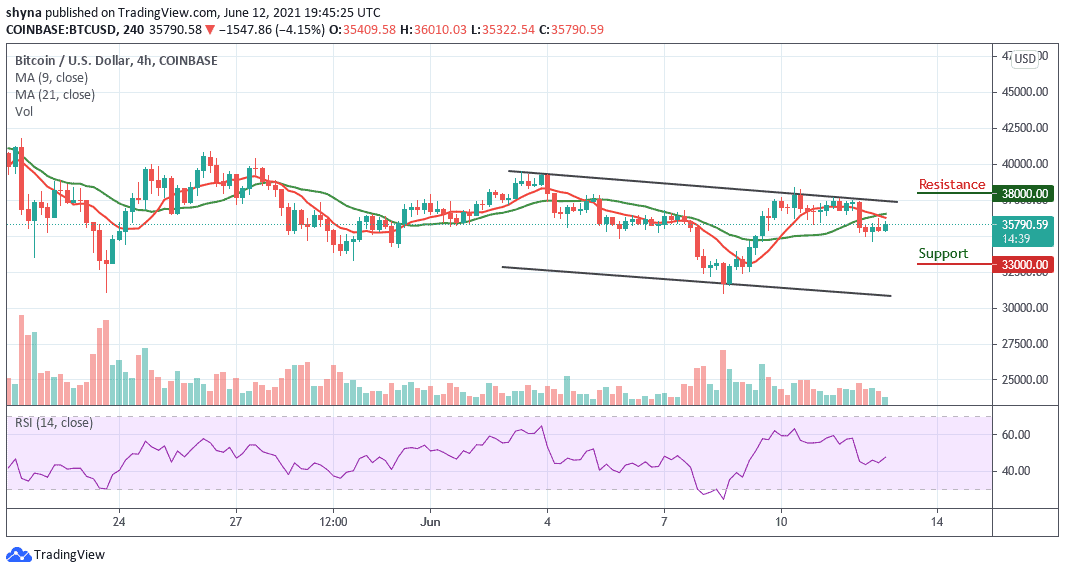
At the opening of the market today, the Bitcoin price first went up but dropped slightly within 24 hours, bringing its price from $37,448 to reach around $35,790. Should the price continue to drop below the 9-day and 21-day moving averages, it could reach the nearest support level at $33,000 and below.
BTCUSD – 4 Hour Chart
However, should in case the bulls push the coin above the upper boundary of the channel, the Bitcoin price could reach the potential resistance level of $38,000 and above. Presently, the market may continue to move sideways or experience an uptrend as the Relative Strength Index (14) indicator moves above 45-level.
Looking to buy or trade Bitcoin (BTC) now? Invest at eToro!
Buy Bitcoin Now
75% of retail investor accounts lose money when trading CFDs with this provider
The popular Twitter account and creator of the bitcoin stock-to-flow (S2F) price model explained that “$288K [is] still in play.” Meanwhile, data from the exchange Deribit shows there’s 425 bitcoin call options with a strike price of $200K set for December 31, 2021.
Plan B Says: ‘$288K Still in Play’
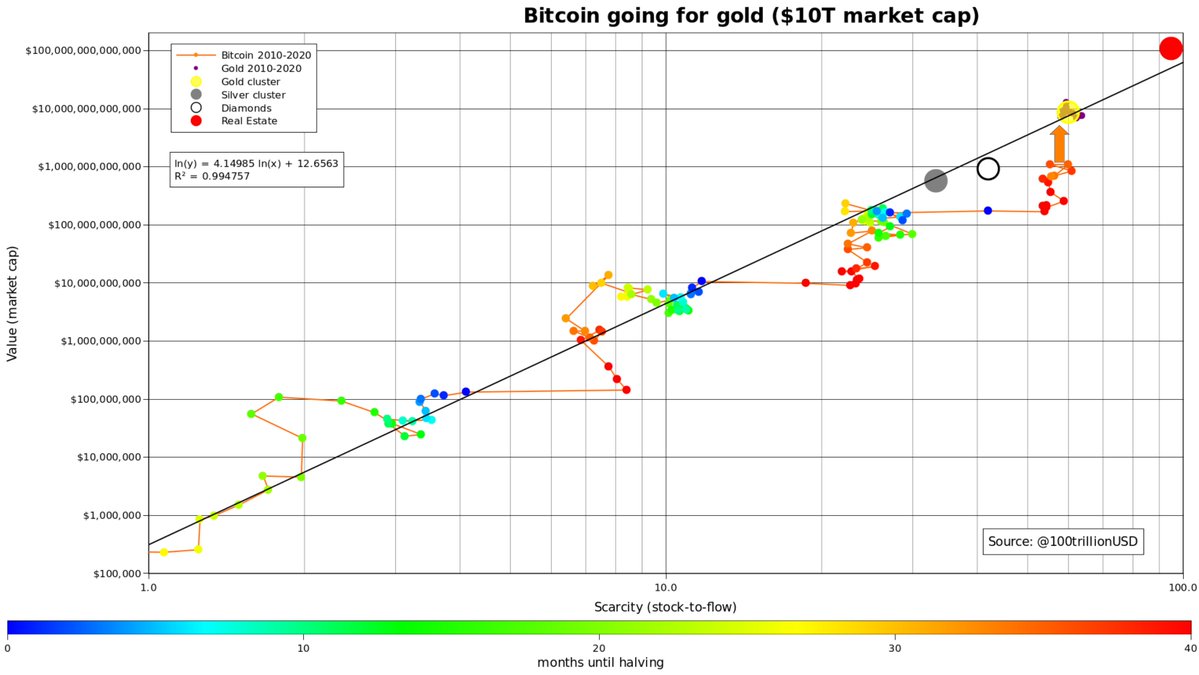
On June 12, 2021, while bitcoin (BTC) prices have been hovering just above the $35K zone, the popular Twitter account Plan B (@100trillionusd) told his 553,000 followers that six-figure bitcoin prices are still intact. Plan B is a pseudonym and he published the stock-to-flow (S2F) price model in March 2019. He also updated the S2F model to another version called the stock-to-flow cross-asset (S2FX) model.
Twelve days ago, Bitcoin.com News reported on how Plan B said his S2FX model was “intact.” Plan B has always shown confidence in his model but when he last tweeted about the S2FX being intact, he invoked a poll on Twitter. The pseudonym asked his followers if they thought the S2F model would break or will it turn out to be an excellent buy signal. When the poll completed more than 53% of the 31,824 votes said it was a “buy signal.”
Plan B’s statements on Saturday still show confidence in the model and even six-figure price targets. “$288K still in play,” Plan B said on Twitter. “It would really surprise me if bitcoin would not touch the black S2FX model line this phase. Regardless of current volatility, yellow green and blue dots will be (much) higher than red orange dots,” the analyst added.
Chart shared on Saturday, June 12, 2021, by stock-to-flow (S2F) creator Plan B on Twitter.
A Twitter account responded to Plan B’s tweet on Saturday and asked: “What gives this confidence given the large downwards deviation from the model at the moment? Is it onchain analytics?”
Plan B responded and noted that things look awfully similar to 2013 and 2017. Plan B noted:
Deviation is not much different from 2013 (S2F ~10) or 2017 (S2F ~25), just the usual inertia after a halving.
Deribit Call Options With a Strike Price of $200K for December 31, Bloomberg Strategist McGlone Sees an Ace up Bitcoin’s Sleeve
Plan B is not the only person expecting six-figure prices as data from Deribit’s call options records show more than 400 contracts with an expiry set for the last day of 2021 for a price above $200K per BTC.
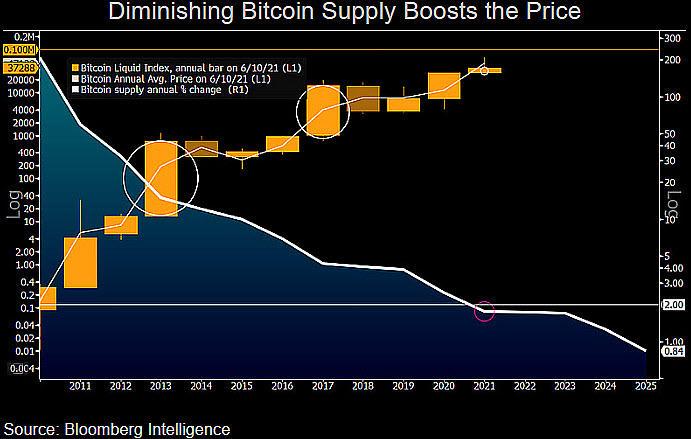
Chart shared on Saturday, June 12, 2021, by Senior commodity strategist at Bloomberg Intelligence Mike McGlone on Twitter.
Senior commodity strategist at Bloomberg Intelligence, Mike McGlone, also spoke about bitcoin’s scarcity and touched upon the next halving on Saturday.
“Bitcoin $100,000 Has Bullish Ace Up Its Sleeve: Declining Supply — This year follows a cut in Bitcoin supply, making the price more likely to appreciate if past patterns hold,” McGlone tweeted, while also sharing a chart of the diminishing BTC supply. The diminishing bitcoin supply is a stark contrast to the $8 trillion recorded on the Federal Reserve’s balance sheet for the first time in history on June 10, 2021.
Meanwhile, some skeptics as usual disagree with people like Plan B or Mike McGlone as one person responded to McGlone’s optimistic outlook. “Don’t marry the trade, it’s in a bear market,” the individual replied to McGlone on Twitter.
What do you think about the six-figure prices “still in play” for bitcoin according to Plan B or the 400+ contracts betting the price will be $200K by the year’s end? Let us know what you think about this subject in the comments section below.
We use cookies on our website to give you the most relevant experience by remembering your preferences and repeat visits. By clicking “Accept”, you consent to the use of ALL the cookies.
This website uses cookies to improve your experience while you navigate through the website. Out of these, the cookies that are categorized as necessary are stored on your browser as they are essential for the working of basic functionalities of the website. We also use third-party cookies that help us analyze and understand how you use this website. These cookies will be stored in your browser only with your consent. You also have the option to opt-out of these cookies. But opting out of some of these cookies may affect your browsing experience.
Necessary cookies are absolutely essential for the website to function properly. These cookies ensure basic functionalities and security features of the website, anonymously.
Cookie
Duration
Description
cookielawinfo-checkbox-analytics
11 months
This cookie is set by GDPR Cookie Consent plugin. The cookie is used to store the user consent for the cookies in the category "Analytics".
cookielawinfo-checkbox-functional
11 months
The cookie is set by GDPR cookie consent to record the user consent for the cookies in the category "Functional".
cookielawinfo-checkbox-necessary
11 months
This cookie is set by GDPR Cookie Consent plugin. The cookies is used to store the user consent for the cookies in the category "Necessary".
cookielawinfo-checkbox-others
11 months
This cookie is set by GDPR Cookie Consent plugin. The cookie is used to store the user consent for the cookies in the category "Other.
cookielawinfo-checkbox-performance
11 months
This cookie is set by GDPR Cookie Consent plugin. The cookie is used to store the user consent for the cookies in the category "Performance".
viewed_cookie_policy
11 months
The cookie is set by the GDPR Cookie Consent plugin and is used to store whether or not user has consented to the use of cookies. It does not store any personal data.
Functional cookies help to perform certain functionalities like sharing the content of the website on social media platforms, collect feedbacks, and other third-party features.
Performance cookies are used to understand and analyze the key performance indexes of the website which helps in delivering a better user experience for the visitors.
Analytical cookies are used to understand how visitors interact with the website. These cookies help provide information on metrics the number of visitors, bounce rate, traffic source, etc.
Advertisement cookies are used to provide visitors with relevant ads and marketing campaigns. These cookies track visitors across websites and collect information to provide customized ads.