At the Bitcoin 2021 conference in Miami, attendees listened to the first phone interview with the Silk Road’s Ross Ulbricht from the depths of the maximum-security prison in Tucson, Arizona. During the interview, Ulbricht spoke about bitcoin and how the decentralized crypto asset is “transforming the global economy.” Following the phone call, Ulbricht was placed in the hole according to the official Free Ross Twitter account.
Ross Ulbricht Speaks About Bitcoin in His First Interview from Prison
Ross Ulbricht’s voice was heard by the attendees who went to the Bitcoin 2021 conference in Miami this year. The recent interview was recorded by Bitcoin Magazine and is the first recorded phone conversation with Ulbricht after his arrest. Ulbricht touched upon the loss of his freedom and noted that from his confinement he’s “spent the last eight years watching Bitcoin grow up from in here.”
During the phone call, Ulbricht noted that he was around during the Bitcoin network’s nascent days and at that time there were not many altcoins and forks. Ulbricht said with all that aside he looked at the crypto ecosystem as one big “family.” Through his lens in prison, Ulbricht detailed that he’s seen the cryptocurrency space invoke lots of innovation since his departure. Ulbricht stated:
I’ve seen incredible innovation. I’ve seen inspiring courage. We didn’t know how things would turn out for Bitcoin back in the beginning, but over the years, I’ve been continually impressed with what you’ve accomplished— We are transforming the global economy. We have brought a taste of freedom and equality to far corners of the world. I know we can transform criminal justice, too.
Ulbricht: ‘Bitcoin Is Strong. Bitcoin Is Powerful. Our Work Is Not Over’
Ross Ulbricht’s case has been called a “miscarriage of justice” and more than 250 organizations, eminent individuals and global leaders have shown support for Ulbricht. The creator of the Silk Road marketplace has one of the largest Change.org petitions in the U.S., as the petition has been signed by 433,845 individuals to date. The petition is seeking clemency for Ulbricht as his offenses were non-violent and his “investigation, trial and sentencing were rife with abuse.” Ulbricht spoke about the Silk Road during his phone call with Bitcoin Magazine and said:
I thought with Bitcoin, I could try and do something that actually makes a difference— Back then, I was impatient. I rushed ahead with my first idea, which was Silk Road… That’s a 26-year-old who thinks he has to save the world before someone beats him to it. I had no idea Silk Road would work, but now we all know it caught on. It was used to sell drugs, and now I’m in prison.
Ulbricht also said that it was ironic that he created the Silk Road because he wanted to further “freedom, privacy, [and] equality.” But what happened was he “wound up in a place where those things don’t exist.” Meanwhile, he sees a lot of potential with bitcoin and the crypto participants, in general, because he believes “Bitcoin is strong.”
“Bitcoin is powerful. We are powerful. And our work is not over,” Ulbricht stressed. Following the phone call interview, the Free Ross Twitter account detailed that Ulbricht was recently put in the hole.
“Ross has been put in the SHU (aka ‘the hole’) after a recorded interview he did over the phone with [Bitcoin Magazine] was broadcasted at the [Bitcoin 2021 conference] this weekend. Please keep Ross in your thoughts & prayers,” the account tweeted on June 8.
What do you think about Ross Ulbricht’s recent phone interview and his reflections on the Silk Road and the Bitcoin network’s innovations? Let us know what you think about this subject in the comments section below.
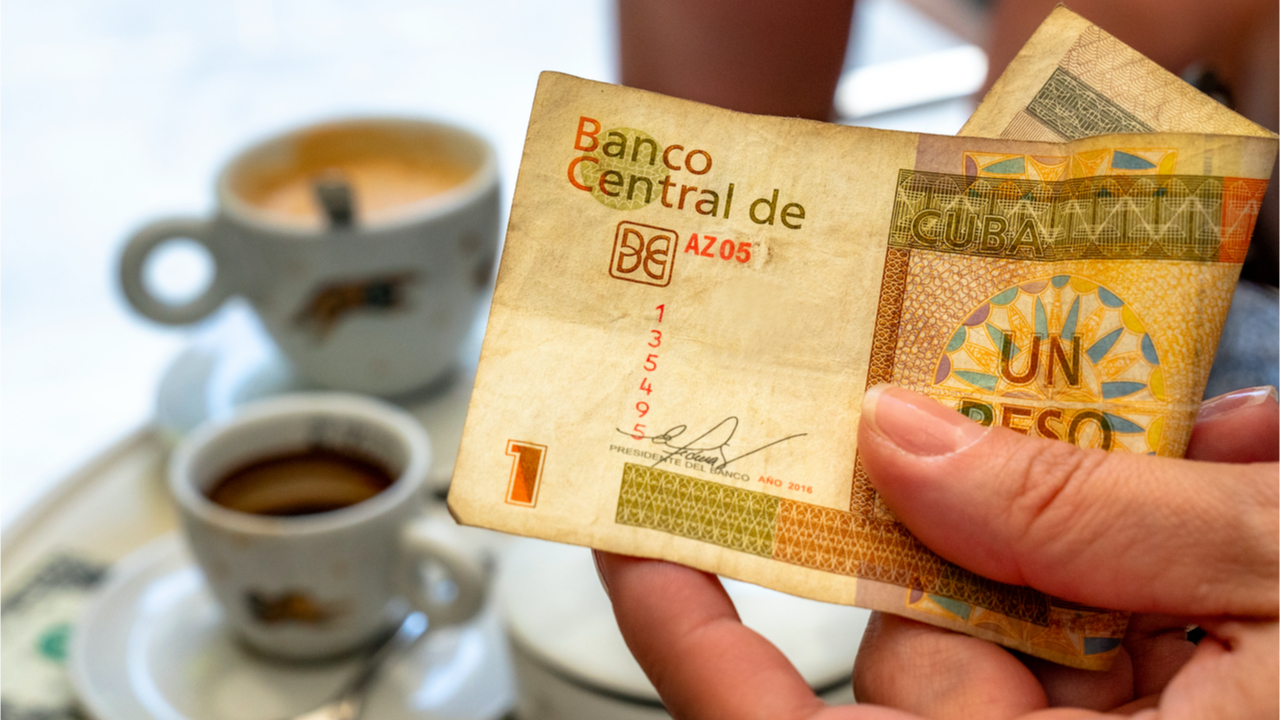
The Republic of Cuba is suspending the use of U.S. dollars due to embargo restrictions with U.S. and foreign banks. The central bank of Cuba’s restrictions stems from the “obstacles that the U.S. embargo creates for the national bank system.”
Cuba Bans USD Deposits, BCC Tells Tourists to ‘Arrive With a Currency Other Than the Dollar’
Cuba, the island country located where the Caribbean Sea, Gulf of Mexico, and the Atlantic Ocean meet, said this week U.S. dollars will be suspended in the country. The mandate comes from the country’s central bank and foreign tourists have been told to leave U.S. dollars at home when visiting. The announcement was invoked at a roundtable discussion that was aired on state-sponsored Cuban television.
“In view of the obstacles that the U.S. embargo creates for the national bank system to deposit abroad the U.S. dollars that are collected in the country, a decision was made to temporarily suspend deposits in U.S. banknotes in Cuba’s bank and financial system,” the Central Bank of Cuba (Banco Central de Cuba, BCC) members said.
Yamilé Berra Cires, the vice president of the BCC, explained during the roundtable discussion that at the beginning of the Trump administration’s leadership, the U.S. tightened the embargo’s grip. The United States has had an embargo with Cuba since 1958 and the U.S. has had numerous issues with Cuba during the Eisenhower presidency and Kennedy presidency as well. After the 2008 crisis, the U.S. and Cuba seemed to gravitate toward friendlier terms during the Obama presidency.
On Friday, the Miami Herald reported that USD in the Cuban black market skyrocketed 3x higher than the global exchange rate at 70 Cuban pesos.
However, BCC vice president Berra Cires claims issues have gotten worse since Trump and said 24 foreign banks stopped dealing with Cuba. Berra Cires also said during the roundtable discussion that 95 foreign financial institutions reported on the transgressions of Cuban national banks doing business with counterparties. “It is ever more difficult for Cuba to find international banking or financing institutions willing to receive, convert or process U.S. currency in cash,” Berra Cires further remarked.
“People who will be coming into the country during this time will have to arrive with a currency other than the dollar,” Francisco Mayobre Lence the BCC’s first vice president said.
BCC Minister-President: ‘There Is No Other Option’
Of course, after hearing about the USD ban in Cuba, members of the cryptocurrency community wanted Cuba to adopt digital currencies like El Salvador recently did with bitcoin. “It’s like [a] 50-year embargo. It’s really depressing,” one individual wrote about the Cuba situation with America on Reddit. “Will they take crypto now?” another Redditor asked in the r/cryptocurrency thread. Another crypto enthusiast responded to the question and said:
I doubt they want to be the last Latin American country to do so.
Minister-president of the Cuban central bank, Marta Sabina Wilson González explained during the roundtable discussion that Cuba had no choice but to make the decision. “We had no choice but to take this measure, which we are explaining at the Round Table, as we always do when it is a measure that affects the people, who will understand that there is no other option,” the minister detailed.
What do you think about Cuba restricting the use of U.S. dollars in the country? Let us know what you think about this subject in the comments section below.
U.S. Senator Pat Toomey has urged Treasury Secretary Janet Yellen to “make significant revisions” to the proposed crypto regulation by the Financial Crimes Enforcement Network (FinCEN) and the planned adoption of the guidance issued by the Financial Action Task Force (FATF).
Senator Asks Janet Yellen to Revise Proposed US Crypto Regulation
U.S. Senator Pat Toomey wrote a letter to Treasury Secretary Janet Yellen Thursday regarding the U.S. approach to cryptocurrency regulation. “I write to raise concerns with two proposals involving the Department of the Treasury related to the regulation and oversight of cryptocurrencies,” he began.
The first concern relates to FinCEN’s proposed rule for cryptocurrency transactions and the second relates to the FATF guidance on cryptocurrencies and virtual asset service providers (VASPs). The senator described:
While I recognize that FinCEN and FATF’s proposals are seeking to address the misuse of cryptocurrencies for illicit activity, if adopted, they would have a detrimental impact on financial technology (fintech), the fundamental privacy of Americans, and efforts to combat illicit activity. I urge you to make significant revisions to them.
The senator spent the first part of his letter explaining that “Fostering financial innovation is important” for the U.S. He believes that “cryptocurrencies stand to dramatically improve consumers’ privacy, access to financial services, and power to make decisions for themselves.”
Toomey then asserted that FinCEN’s proposed crypto rule “will negatively impact” the U.S., citing two key reasons. Firstly, it would impose “onerous recordkeeping” and reporting requirements on crypto transactions “that extend beyond existing requirements for U.S. dollar transactions.” Secondly, he argued:
FinCEN’s proposed rule may also prove to be counterproductive in combating illicit activity … By limiting individual privacy and the ability to transact with financial institutions, the rule would likely push bad actors to utilize methods that do not interface with financial institutions.
“As a result, such cryptocurrency transactions would be less susceptible to appropriate government oversight and detection,” he continued.
The senator then pointed out that some reporting requirements for USD transactions have not been updated for more than 40 years. “Existing requirements on the U.S. dollar are no longer appropriately tailored to identify illicit activity,” he opined, urging Treasury Secretary Yellen to examine whether they are “appropriate for U.S. dollar transactions.” He emphasized that cryptocurrency “can be more easily traceable than transactions utilizing U.S. dollars” in some cases.
Turning attention to the FATF guidance, Senator Toomey asserted:
FATF’s guidance will drive cryptocurrency transactions away from financial institutions, undermining the ability of law enforcement and analytics firms to identify and track illicit activity. FATF should revise its guidance to focus on transactions and entities that warrant regulation.
Concluding his letter to Yellen, the senator said that the U.S. “should support, not inhibit, financial innovation,” adding: “I urge you to take a more thoughtful approach to identifying illicit activity so financial innovation can flourish and the privacy of Americans remains respected.”
Do you think Treasury Secretary Yellen will heed Senator Toomney’s advice? Let us know in the comments section below.
AAVE, KSM, ALGO and TFUEL are showing signs of strength while Bitcoin bulls attempt to push BTC price over $38,000.
Bitcoin’s (BTC) price continues to be range-bound between $30,000 and $40,000 level for the past few days, which is not necessarily a bearish sign.
Generally, after a sharp fall, the price tends to consolidate as the asset transfers from weaker hands to stronger hands. After the transition is complete, the asset breaks out and starts a new uptrend. Usually, the longer the price consolidates in a range, the stronger the next trending move will be.
Bloomberg Intelligence senior commodity strategist Mike McGlone said on Saturday that Bitcoin’s declining supply was a positive sign, which could act as a “bullish ace” for its move higher “if past patterns hold.”
Crypto market data daily view. Source:Coin360
Yoni Assia, CEO of eToro, also told Cointelegraph that Bitcoin could see a sharp rise “over the next three to five years, as there are still 5 billion people in the world that basically don’t have good local currency.”
Related: Bitcoin price could hit $85K in months as indicators flip bullish — report.
Therefore, investors should not be discouraged by the muted price action in the short term. Bitcoin’s fundamentals remain strong and are likely to result in a new uptrend in the future.
As crypto markets consolidate, let’s analyze the charts of the top-5 cryptocurrencies that may outperform in the next few days.
BTC/USDT
Bitcoin turned down from the resistance line of the descending triangle on Jan. 12 and broke below the 20-day exponential moving average ($36,586). This suggests that the bears are aggressively defending the resistance line.
BTC/USDT daily chart. Source: TradingView
The longer the price stays below the 20-day EMA, the greater the chances of a drop to the lower levels. If bears sink the price below $34,600, the BTC/USDT pair could drop to $33,400 and then to $31,000.
A break and close below $31,000 will complete a descending triangle pattern, which has a target objective at $19,549. However, it is unlikely to be a straight drop to the lower levels because the bulls will attempt to stall the decline in the $31,000 to $28,000 support zone.
This negative view will invalidate if the price continues to move up and rises above the resistance line of the triangle. Such a move could open the gates for a rise to the 50-day simple moving average ($44,709), which is again likely to act as a stiff resistance.
A break above the 50-day SMA will suggest that the correction could be over and the bulls will gradually try to start a new up-move.
BTC/USDT 4-hour chart. Source: TradingView
The moving averages on the 4-hour chart have been crossi each other and the relative strength index (RSI) is just above the midpoint, indicating that bulls are trying to make a comeback.
A breakout and close above the resistance line of the triangle will signal that demand exceeds supply. If the bulls sustain the price above the triangle, a new up-move could begin.
Alternatively, if the price turns down from the resistance line and breaks below $34,000, it could signal a minor advantage to the bears. That could pull the price down to the critical support at $31,000. A bounce off this support will suggest accumulation at lower levels and that could keep the pair inside the triangle for some more time.
AAVE/USDT
Aave is trading inside a large range between $280 and $581.67 for the past few months. The bulls have successfully defended the support of the range on five previous occasions, hence the buyers are likely to buy the dip once again.
AAVE/USDT daily chart. Source: TradingView
If the price rebounds off the current level with strength, it will suggest that the bulls continue to accumulate on dips. The buyers will then try to push the price above the 20-day EMA ($344). If they succeed, the AAVE/USDT pair could rise to the 50-day SMA ($414), which may act as a stiff hurdle.
If the price turns down from the 50-day SMA, the pair could consolidate between $280 and $414 for a few days. On the contrary, a break above the 50-day SMA will clear the path for a northward march toward $581.67.
This positive view will invalidate if the price turns down from the 20-day EMA and breaks below the $280 support. That will embolden the bears who will then try to pull the price down to $208.09 and then to $160.
AAVE/USDT 4-hour chart. Source: TradingView
The 4-hour chart shows the bears had pulled the price below $280 but they are struggling to sustain the lower levels. However, the moving averages are sloping down and the RSI is in the negative zone, indicating advantage to the bears.
If the price turns down from the current level and breaks below $266.68, the pair could start its downward journey. This negative view will invalidate if the bulls push the price above the downtrend line. Such a move will suggest the correction is over and the pair could then rise to $500.
KSM/USDT
Kusama (KSM) has been witnessing volatile moves in the past few days. Although the bulls pushed the price above the $480 overhead resistance on June 9, they could not sustain the higher levels and the price dipped back below the level on June 10. This shows that bears are selling on rallies.
KSM/USDT daily chart. Source: TradingView
However, the buyers have not allowed the price to break below the 20-day EMA ($388). This suggests that the sentiment is turning positive as the bulls are buying the dips to the 20-day EMA.
The rising 20-day EMA and the RSI near the midpoint indicate a minor advantage to the bulls. The buyers will now make one more attempt to push the price above $480. If they succeed, the KSM/USD pair could rally to $537 and then retest the all-time high at 625.
This positive view will invalidate if the price turns down from the current level or the overhead resistance and breaks below $360. That could pull the price down to $280.
KSM/USDT 4-hour chart. Source: TradingView
The 4-hour chart shows the bulls are trying to defend the trendline support. However, the 20-EMA has turned down and the RSI is in the negative zone, indicating the bears have the upper hand.
If the sellers sink the price below $380, the pair could drop to $342. A break below this support could result in a decline to $280.
This negative view will invalidate if the bulls can push the price above $429. That could attract buying, pushing the pair to $480.
ALGO/USDT
Algorand (ALGO) bounced off the trendline on June 12 and rose above the 20-day EMA ($0.97), which suggests the bulls are buying on dips. The flattish 20-day EMA and the RSI near the midpoint suggest the selling pressure has reduced.
ALGO/USDT daily chart. Source: TradingView
The price action of the past few days has formed an ascending triangle pattern, which will complete on a breakout and close above $1.15. If the bulls manage to sustain the price above $1.15, the ALGO/USDT pair could rally to the target objective at $1.63.
Contrary to this assumption, if the price turns down from $1.15, the pair may extend its stay inside the triangle for a few more days. A breakdown and close below the trendline will nullify the bullish view and open the gates for a drop to $0.80 and then $0.67.
ALGO/USDT 4-hour chart. Source: TradingView
The 4-hour chart shows the bulls are attempting to push the price above the downtrend line. If they can sustain the breakout, the pair could rise to $1.15. A breakout and close above this resistance could start a new uptrend.
Conversely, if the price turns down from the current level and breaks below the moving averages, the bears will make one more attempt to sink the price below the trendline. If they succeed, it will signal the start of a deeper correction.
TFUEL/USDT
Theta Fuel (TFUEL) soared to a new all-time high at $0.679 on June 9 but the bulls could not sustain the higher levels as seen from the long wick on the day’s candlestick. That was followed by a sharp pullback to the 20-day EMA ($0.41) on June 12.
TFUEL/USDT daily chart. Source: TradingView
The strong rebound off the 20-day EMA shows the sentiment is positive and traders are aggressively buying on dips. The bulls will now try to push the price to the all-time high where they are likely to encounter stiff resistance from the bears.
If the price turns down from the all-time high, the bears will make one more attempt to pull the price below the 20-day EMA. If they succeed, it will suggest the start of a deeper correction.
Alternatively, if buyers propel the price above the all-time high, the TFUEL/USDT pair could resume the uptrend, with the next target objective at $0.85 and then $1.
TFUEL/USDT 4-hour chart. Source: TradingView
The 4-hour chart shows the pair rebounded strongly off the $0.40 support, which suggests accumulation at lower levels. However, the relief rally is facing resistance just below the 61.8% Fibonacci retracement level at $0.57.
This suggests that the bears have not given up yet and are selling on rallies. If the price dips below the 20-EMA, the bears will try to pull the price down to $0.40. If that happens, the pair may consolidate between these two levels for a few days.
Alternatively, if the price rebounds off the 20-EMA, it will indicate the sentiment is positive and the bulls are not waiting for a deeper fall to buy. That will increase the possibility of a break above $0.57. The pair could then rise to retest the all-time high.
The views and opinions expressed here are solely those of the author and do not necessarily reflect the views of Cointelegraph. Every investment and trading move involves risk, you should conduct your own research when making a decision.
Musk responded to a Cointelegraph tweet about Sygnia CEO Magda Wierzycka calling for the SEC to investigate him over alleged Bitcoin price manipulation.
Tesla CEO Elon Musk says his electric-vehicle company will start accepting Bitcoin (BTC) payments once there’s confirmation that miners are utilizing clean energy, offering a glimmer of hope that the FUD surrounding digital assets could soon subside.
Musk responded to a Cointelegraph tweet about recent accusations from Sygnia CEO Magda Wierzycka, who called on the United States Securities and Exchange Commission to investigate the billionaire for allegedly manipulating Bitcoin’s price.
This is inaccurate. Tesla only sold ~10% of holdings to confirm BTC could be liquidated easily without moving market.
When there’s confirmation of reasonable (~50%) clean energy usage by miners with positive future trend, Tesla will resume allowing Bitcoin transactions.
— Elon Musk (@elonmusk) June 13, 2021
According to Wierzycka, Musk knowingly pumped the price of Bitcoin only to sell a “big part of his exposure at the peak.”
“This is inaccurate,” Musk said in a Sunday response. “Tesla only sold ~10% of holdings to confirm BTC could be liquidated easily without moving [the] market.”
As Cointelegraph reported, Musk acknowledged in April that Tesla had sold a portion of its Bitcoin holdings to prove its liquidity as an alternative to cash. Just one month earlier, the billionaire confirmed that Tesla added $1.5 billion worth of BTC to its balance sheet and would begin accepting the virtual asset as payment for its vehicles.
However, Tesla’s embrace of Bitcoin-as-a-payment was short-lived after Musk flagged concerns over the cryptocurrency’s energy usage. On May 12, Musk tweeted that his company would no longer accept Bitcoin payments due to the network’s “increasingly rapid use of fossil fuels…”
Tesla & Bitcoin pic.twitter.com/YSswJmVZhP
— Elon Musk (@elonmusk) May 12, 2021
Musk’s tweet coincided with a slew of negative headlines about Bitcoin’s energy usage, China’s intent to ban Bitcoin mining and an overextended crypto rally that was showing signs of weakness. The news cycle helped trigger one of Bitcoin’s most painful episodes, culminating in a 54% drop between mid-April and mid-May.
Related: ‘I have not sold any of my Bitcoin’: Elon Musk.
On Sunday, Musk laid the groundwork for when Tesla will once again accept Bitcoin payments:
“When there’s confirmation of reasonable (~50%) clean energy usage by miners with positive future trend, Tesla will resume allowing Bitcoin transactions.”
As Cointelegraph reported, Musk was recently invited to a meeting of Bitcoin miners by MicroStrategy CEO Michael Saylor. The Bitcoin Mining Council, a voluntary, self-regulating industry body, emerged from the meeting with a mandate to use more renewable energy and promot more transparency in the mining process.
Despite all the criticism about Bitcoin mining, it’s estimated that a strong majority of miners already use alternative energy resources.
Litecoin Swings Lower in Ranges – June 13 The market worth of LTC/USD now swings lower in the range-bound zones to trade around the level of $159 at a percentage rate of around -1.28 as of writing.
Swings Lower in Ranges: LTC Market Key Levels: Resistance levels: $200, $250, $300 Support levels: $130, $1200, $110
LTC/USD – Daily Chart The LTC/USD daily chart showcases that the crypto swings lower at the range-line of $150. There have yet been some volatile price movements around the lower range trading zone that the market has over time been keeping. As a result, all the SMA indicators as well feature not much difference in their stances on the chart. The 50-day SMA is situated above the 14-day SMA with a small space between as the bearish trend-line drew across them from the top to the downside. The Stochastic Oscillators’ lines are slightly opened pointing toward the southbound between ranges of 40 and 20. That signifies a downward force is somewhat ongoing.
Buy Litecoin Now
As price swings lower around the LTC/USSD range-bound zones, will it still be prolonged?
The trade operation between Litecoin and the US Dollar swings lower overly around the lower range-bound zone of the market. The major range values of $150 and $200 are still intact as price continues to swing around them. Bulls are as well yet over the time trying to locate support basically around the lower range-line. But, they’ve not been putting much-needed efforts to stage a sustainable rebound. However, much is being expected of them by finding decent entries especially, while price goes dip more notably below the lower range-line of the market.
Up till the present, bears have between the range-bound zones the opportunity to push against any eventual active upswing that price tends to make. In the meantime, the immediate resistance level of $200 remains the best area of entry to stage a decent return of the downside if the range style of trading has to continue. But, importantly, the lower range-line of $150 has to be wary of by the LTC/USD bears afterward.
LTC/BTC Price Analysis
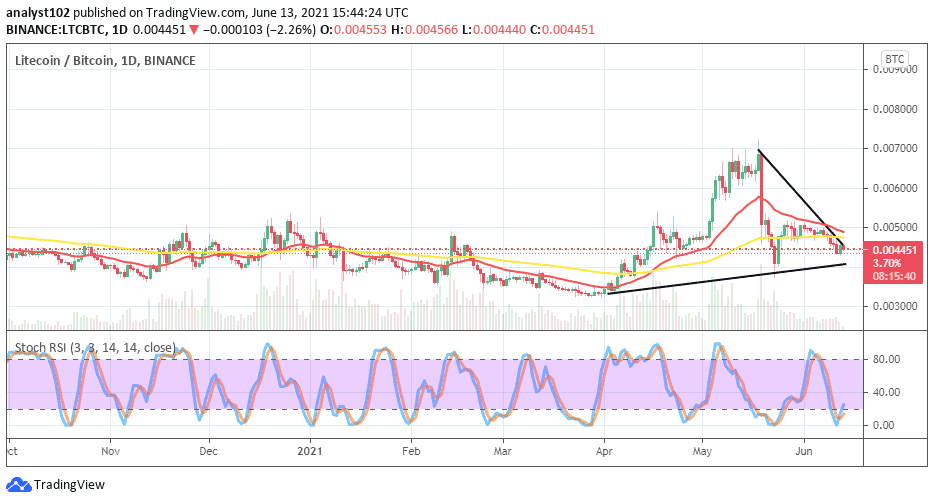
To some reasonable extent, as Litecoin’s value swings lower pairing with Bitcoin, the trend still seems in the favor of the base trading instrument. The bullish trend-line drew happens to be the only self-inclined technical tool that depicts that on the price analysis chart presently. The 50-day SMA indicator has breached to the south as the 14-day SMA trend-line is closely located above. The Stochastic Oscillators are dipped into the oversold region with slightly crossed lines pointing toward the north at range 20. That indicates that an upward swing is in the womb of time to be on the side of the base crypto coin against the flagship counter cryptocurrency.
Looking to buy or trade Bitcoin (BTC) now? Invest at eToro!
Buy Litecoin Now
75% of retail investor accounts lose money when trading CFDs with this provider
UK police are lobbying the government to change the laws to allow them to freeze cryptocurrencies. Scotland Yard detectives say currently account-freezing orders do not apply to cryptocurrency wallets, making it difficult for the police to stop criminals from transferring funds.
UK Police Want New Laws to Let Them Freeze Cryptocurrencies
Scotland Yard detectives are lobbying the government for new laws to let them freeze crypto assets of criminals, The Times reported last week.
Mick Gallagher, a retired detective chief superintendent at the Metropolitan Police, explained that the laws on freezing assets are outdated, therefore cryptocurrencies, including bitcoin, could not always be frozen or seized by the police. Gallagher, who spent 37 years in the Metropolitan Police, retired at the end of last month.
“The conversations that we’re having is about how we align cryptocurrency to the same kind of approach that we have about cash-based criminality,” he told the publication, noting that “Cryptocurrency is invisible, it’s instant, it goes around the world, it’s not tangible.” The retired detective noted that “One of the responses we have is legislation,” emphasizing:
Because cryptocurrency, and criminality involving crypto, has developed so quickly, and because legislation is so slow, we’re having conversations now about realigning some legislation that currently applies to laundered cash to cryptocurrency.
Gallagher explained that the current account-freezing orders and other money-laundering laws apply to cash and other assets, but not cryptocurrency, making it difficult for the police to stop criminals from transferring funds from bank accounts.
He and other senior detectives are lobbying the government to make changes to the laws pertaining to the freezing of assets. Gallagher noted that based on their discussions so far the government has been supportive and keen to help them tackle organized crime.
Gallagher said that “It’s about definitions,” elaborating:
In some legislation we have about account-freezing orders, the word account is a critical word. But there is no such thing as an account in the world of cryptocurrency as they use wallets. So you just have to make slight legislative tweaking so that the wording includes wallet.
Do you think the police should be allowed to freeze cryptocurrencies? Let us know in the comments section below.
With bitcoin’s popularity rising, a growing number of businesses in Scotland have been introducing cryptocurrency payments. A roofing company from Glasgow now says more and more of its customers, including pensioners, are willing to pay with crypto.
ASAP Roofing Accepts Cryptocurrency for Its Services
Kaeleb Mckay, who runs a roofing company with his father, Cameron, has recently told the British press his business is seeing soaring numbers of customers paying in cryptocurrency. The 20-year-old Scot also said he’s been surprised by the people who use cryptocurrency, with his firm’s crypto customer base including even pensioners.
ASAP Roofing and Building Ltd started accepting cryptocurrency last year, the Daily record reported, and is now taking several major coins including bitcoin (BTC), bitcoin cash (BCH), ethereum (ETH), dogecoin (DOGE), litecoin (LTC), and XRP, according to its website. The young entrepreneur from Wishaw in Lanarkshire commented:
We have been accepting crypto for a while. For a business it is ideal because it gets paid instantly.
Kaeleb’s company is a family-owned roofing and building contractor based in Glasgow, Scotland’s most populous city. It operates throughout Central Scotland and the North of England, specializing in commercial and traditional build maintenance and repair works.
ASAP Roofing’s owner admitted he has been involved in the crypto space for years. “I’ve had a personal interest in trading in cryptocurrency since 2014,” Kaeleb Mckay said, also adding he was “surprised by some of the people who want to pay that way.” He told the publication:
I did a roof repair for about £500 in November for a pensioner in her late 60s in Glasgow and she said she wanted to pay in Bitcoin.
This is not an isolated case as Mckay’s company, which advertises itself as Scotland’s premier roofing contractor, has had other elderly Brits wanting to use cryptocurrency too. “I got another guy who paid £180 in Ethereum for an emergency roof repair in the last few weeks,” he shared.
Often called the “grey pound,” pensioner cash has been increasingly targeted by crypto businesses, notes the Daily Record. In March, the U.K. Advertising Standards Authority banned an “irresponsible” ad from crypto exchange Coinfloor addressed to pensioners investing in bitcoin.
Most Scottish firms that accept cryptocurrency payments are large tech companies. However, many small businesses such as ASAP Roofing have also turned to decentralized digital money as a substitute for fiat cash.
Have you used cryptocurrency to pay for home repairs? Let us know in the comments section below.
The Purpose Bitcoin exchange-traded fund has been reaccumulating BTC since mid-May, a sign that investors are keen to buy the dip.
Demand for Bitcoin (BTC) among Canadian investors has not wavered amid the latest price correction, offering further evidence that market participants are capitalizing on heavily discounted prices.
The Purpose Bitcoin ETF, which launched in February, has now accumulated 19,692.149 BTC as of June 13, according to Bybt data. The ETF has added 284.51 BTC over the past seven days and nearly 2,000 BTC since May 15.
A massive breakdown in price has not deterred Canadian investors from seeking exposure to Bitcoin. Source: Bybt.
In fact, the ETF added to its holdings during the May 19 flash crash that saw Bitcoin wick down below $30,000 before quickly recovering.
At a current BTC price of around $36,000, the Purpose Bitcoin ETF has a value of over $709 million. Assets swelled to over $1.3 billion in less than two months of operations.
According to technician Byzantine General, inflows into the Purpose ETF suggest Canadians aren’t concerned about Bitcoin’s short-term price action.
Ha. The Canadians don’t seem to give a fuck.
They just keep adding $BTC to the ETF despite price going down. pic.twitter.com/SM9Zxiuiwv
— Byzantine General (@ByzGeneral) June 13, 2021
Indeed, on a shorter time scale, Bitcoin’s price action has been a source of concern for the bulls. The flagship cryptocurrency has been languishing below $40,000 for the past month, with each attempt to reclaim that level being firmly rejected. A confluence of technical breakdowns, weakening sentiment and negative headlines have contributed to the bearish price action.
Related: ‘Discounted’ Bitcoin more likely to hit $100K than $20K in 2021, says Bloomberg analyst.
Analysts remain divided on the trajectory of Bitcoin’s market cycle. Some believe we are still on track to break triple-digit levels this year, while others believe we are heading for a bear market. Inflows into the Purpose fund suggest many investors are ignoring short-term fluctuations in favor of a longer-term view.
Fund managers in the United States hope to replicate the success of their Canadian counterparts by launching a Bitcoin ETF of their own. As Cointelegraph reported, the United States Securities and Exchange Commission has begun a formal review of three ETF proposals, with the first decision expected later this month.
Nonfungible tokens present a new way of interacting with the arts, music, sports and the media — and even more.
It’s fun to talk about nonfungible tokens, or NFTs, because they are the perfect example of how the impact of blockchain technology in people’s lives goes way beyond the financial market. As we could see in hundreds of headlines in the past few months, they have gripped the world’s attention because they are a new manner of interacting with culture, music, sports and the media.
This article will clarify what NFTs are, how they work, how the NFT boom started, and why blockchain technology has made it possible for NFTs to create a new economy.
Related: A cure for copyright ills? NFTs promise to empower creative economies
Why is there such excitement around NFTs?
NFTs are such an exciting and fun subject to talk about because almost everyone likes music, arts, games and the internet. The feeds of every social media platform are full of people who, having shown no prior interest in crypto assets or decentralized finance, eagerly talk about nonfungible tokens. In the first half of 2021, we saw a lot of celebrities and memes endorsing NFTs.
Jack Dorsey, Twitter’s CEO, sold his first tweet as an NFT for the incredible amount of over $2.9 million this past March. Edward Snowden’s NFT, a portrait of Snowden himself, was sold for about $5.4 million, or 2,224 Ether (ETH).
The NFT of the Zoë Roth meme, better known as “Disaster Girl” due to the 2005 (and beyond) meme of her malicious smile looking at the camera while a house is on fire in the background, was sold as an NFT for 180 ETH, equivalent to almost $500,000.
Related: When dollars meet the hype: The biggest NFT hits from celebrities
Furthermore, companies from the traditional market have decided to surf the NFT wave. For example, in Brazil, the first collection in NFT of Havaianas was auctioned off last month.
NFT transaction volume has multiplied by more than 25 since December 2020, as NFTs are in people’s daily routines and lives. It could be one of your favorite songs, a cartoon of your favorite superhero or a tool in a game that your children wish to acquire. In the following chart, we can clearly see the increase of NFT transactions in the last six months, as well as business volume since the end of the third quarter before the recent pop.
What are NFTs? How do they work?
We can conceptualize an NFT as a piece of software code that verifies the property of a nonfungible digital asset, or the digital representation of the physical nonfungible asset in a digital medium. For those who prefer a more technical view:
“An NFT is a pattern of smart contracts that provides a standardized way of verifying who owns an NFT, and a standardized way of ‘moving’ nonfungible digital assets.”
In this case, any nonfungible asset may be the object of an NFT, be it domain names, tickets for an event, digital coins in games, and even identifiers in social networks like Twitter or Facebook. All those nonfungible digital assets could be NFTs.
An NFT has a data structure (token) that links metadata files that may be fixed in an image or file. That token is carried and modified to accommodate the requirements of blockchain networks such as Ethereum, Kusama and Flow, among others. The art file is uploaded in a blockchain network that creates a metadata file in the data structure of the token.
As a content creator, such as the digital artist Beeple or the rock band Kings of Leon, you upload your art file to a platform that takes your file’s metadata and passes it through the whole back-end process of a product, otherwise known as your NFT.
Your NFT then gains a cryptographic hash (a key) — a tamper-proof register with the date and time stamp carried on the blockchain network. Following the valuable data and seeing that it had not been modified at a later date is essential for any artists out there.
Loading your art on-chain may give you a better perspective of when the metadata of the art file was tokenized. Since the data of the piece of art is uploaded, nobody can retrieve it or delete it, and the chance of your artwork disappearing is practically nonexistent if your NFT is registered on a blockchain.
How has blockchain technology amplified the possibilities of NFTs?
Up until 2008, traditional NFTs did not have a unified representation in the digital world. As a result, they were not standardized, and the NFT markets closed and were limited to the platforms that issued and created a determinate NFT.
The first NFTs in blockchains started with the advent of colored coins on Bitcoin’s blockchain. Although originally designed to enable Bitcoin (BTC) transactions, their script language stores small amounts of metadata on the blockchain, which can be used to represent asset management instructions.
On the other hand, the first NFT experiment based on the Ethereum blockchain was CryptoPunks built by Larva Labs, which consisted of 10,000 collectible, “unique” punks. The fact that the punks “live” on the Ethereum network made them interoperable with digital markets and wallets.
NFTs reached the mainstream on the Ethereum blockchain in 2017 with CryptoKitties, allowing users to create digital cats and reproduce them with varying pedigrees. This was a pioneer project for creating a sophisticated system of incentives, determining that NFTs could be used as a promotional tool. This led to the fostered interest of auction contracts, which lately have become one of the primary mechanisms for pricing and buying NFTs.
Related: Art reimagined: NFTs are changing the collectibles market
The exciting part about applying blockchain technology to NFTs is that it has considerably amplified their advantages and possibilities. It has brought forth the standardization of digital, nonfungible asset representation through the ERC-721 standard. Similar to the ERC-115 and the ERC-998 standards, ERC-721 is a pattern of smart contracts on the Ethereum blockchain that brings a standardized way of verifying who owns an NFT, and a standardized way of “moving” nonfungible digital assets.
It’s worth mentioning that although Ethereum is where most of the action currently happens, there are several NFT patterns emerging on other blockchains. For example, dGoods created by Mythical Games focuses on implementing a cross-chain standard using the EOS blockchain. Also, TRON’s first NFT standard, TRC-721, was officially announced in late December 2020. The introduction of this standard is expected to help the Chinese-centric blockchain utilize various distributed ledger technology-based apps and keep up with the pace of Ethereum’s growing NFT sector.
Since then, an NFT registered on a blockchain has truly become a “unique” asset that cannot be faked, tampered with or spoofed.
Related: Experts debate whether NFTs really need blockchain
What are the main benefits blockchains bring to NFTs?
As explained above, the first benefit of NFTs backed by blockchain technology is standardization. Besides the standardization of the primary attributes of NFTs — such as property, transfer and access control — blockchain technology allows NFTs to incorporate additional features, like specifications on how to acquire an NFT, for example. Other benefits include interoperability, marketability, liquidity, immutability, proven scarcity and programmability. We will explain each one by one.
The NFT patterns make interoperability feasible so that the NFTs can move more easily among several ecosystems. In a new project, nonfungible tokens may be visualized immediately in dozens of different wallet providers, negotiable in several markets and with the ability to be acquired in several virtual worlds. That interoperability is only possible because of the open patterns allowed by blockchain technology that provide a clear, consistent, reliable application programming interface, and with the authorization to read and record data.
Interoperability, in turn, has amplified the marketability of NFTs by enabling free trade in open markets. NFTs based on blockchains allow users to move their nonfungible assets outside of their original environments. They also have the advantage of sophisticated negotiation resources, such as auctions and bids, as well as the ability to transact in any currency, from cryptocurrencies like Bitcoin and Ether to stablecoins and specific digital currencies from a determined application.
The instant marketability of NFTs based on blockchains brings greater liquidity to markets that can serve a greater variety of public, enabling significant exposure of nonfungible assets to a broader group of buyers.
The fifth and sixth advantages of the use of blockchain technology in NFTs are immutability and proven scarcity. This is because the smart contracts allow developers to set severe limits on an NFT’s supply and impose long-lasting properties that cannot be modified after a token has been issued. Therefore, one can guarantee that the specific properties of an NFT will not change with time, as they are codified in the blockchain. This is especially interesting for the physical art market that depends on the proven scarcity of an original piece.
An interesting trajectory in this new NFT world based on blockchain appeared because of recent trends and new markets, such as programmable art — which allows collectors to interfere in the original design of the art piece.
In the market of NFT-represented art, immutability and scarcity are essential. In the digital art market, the advantage of programmability could be something to consider. We can find examples of programmability at Async Art, a platform to negotiate and create NFTs that enables the owners to change their images whenever they wish. Another example of the programmability feature is the ability for a song to change its composition. That means that the music may sound different each time you listen to it. These two examples are possible by dividing a piece into separate layers called stems. Each stem has several variants for its new owner to choose from. That way, a single track of Async Music could contain many exclusive combinations of sounds.
Takeaway
Many people have yet to understand the dimension of the NFT boom and how blockchain is revolutionizing the way we consume the arts. Perhaps the subject deserves a more thorough conversation.
However, the hole-in-one of NFTs is the programmability of smart contracts on the blockchain, which always guarantees a reward to the content creator whenever their work is negotiated.
Suppose a determined content (music, art, domain name, photograph of a goal from Pelé, etc.) is transacted hundreds of times. In that case, the content creator is going to receive a commission.
This could completely change the dynamics of copyright and intellectual property because if a “division of income” is programmed into the NTF’s smart contract’s code, the content creators will no longer need to worry about the legal property of their artwork.
Indeed, nonfungible tokens and blockchain technology markets still need to embark on a long journey to solve scalability, marketing infrastructure and the applicable jurisdiction in NFTs with decentralized storage. Nevertheless, we shall not lose sight of the possibility to codify the rights of the determined digital asset behind the transaction of an NFT. This enables the appearance of new businesses and new markets governed not only by institutions or traditional validators of trust but by those who create the content appreciated in the social and productive hubs.
The views, thoughts and opinions expressed here are the author’s alone and do not necessarily reflect or represent the views and opinions of Cointelegraph.
Tatiana Revoredo is a founding member of the Oxford Blockchain Foundation and is a strategist in blockchain at Said Business School at the University of Oxford. Additionally, she is an expert in blockchain business applications at the Massachusetts Institute of Technology and is the chief strategy officer of The Global Strategy. Tatiana has been invited by the European Parliament to the Intercontinental Blockchain Conference and was invited by the Brazilian parliament to the public hearing on Bill 2303/2015. She is the author of two books: Blockchain: Tudo O Que Você Precisa Saber and Cryptocurrencies in the International Scenario: What Is the Position of Central Banks, Governments and Authorities About Cryptocurrencies?
It will take some time for consumers to warm up to crypto, but education is the key to its mass adoption.
From QR code payments to mobile banking apps, consumers worldwide are increasingly reliant on digital payment solutions, especially as mobile technology becomes more ubiquitous. Government-led efforts in driving cashless economies have been a key factor, with countries such as Singapore or the Philippines seeing their central banks driving the adoption of contactless payments during the height of the COVID-19 pandemic. As a result, usage rates for digital payments platforms have recorded promising growth, even as high as 5,000% in the Philippines alone.
Related: Digitized Europe: The shift to a cashless world
This unprecedented rise in cashless payments is also paving the way for the broader adoption of crypto, with the number of crypto users worldwide hitting around 106 million in January. While this marks an impressive 15% month-on-month growth, it is still just a drop in the ocean when compared to the 4.7 billion people who have access to the internet.
But as crypto continues to command headlines, what will it take for mass adoption to happen?
A new model of financial accessibility
Today, billions of people worldwide are unable to access even the most basic financial services via traditional means, and thus are unable to save or manage their money securely. In times of economic devastation, such as this past year in which global economies have been staggered by the impact of COVID-19, the vast gap between rich and poor has become abundantly clear. The global pandemic has only perpetuated the absence of inclusive financial infrastructure, which has led to approximately one-third of the global population having no financial safety net to fall back on.
With crypto wallets, however, anyone can transfer their crypto internationally without needing to maintain a minimum balance in their account, as long as they have an internet connection. As crypto applications are built on decentralised blockchains, transactions are performed on a peer-to-peer basis in the absence of traditional intermediaries such as bankers or brokerage houses. This results in significant savings in transaction costs, as traditional cross-border remittance fees for small amounts can be as high as 7% after taking into account intermediaries’ fees on both the sender and recipient side. Meanwhile, the same fees for cryptocurrencies are often less than 1 percent — regardless of transaction amount.
Related: Understanding the systemic shift from digitization to tokenization of financial services
Furthermore, highly decentralised platforms are permissionless, meaning that anyone with a crypto wallet and internet connection can lend, remit or trade their crypto without validation by a central authority or intermediary. Instead, transactions are executed by smart contracts, which automate them as long as pre-encoded conditions are met. Beyond the cost savings, consider the time savings as well. Remittance transactions can take several days to be processed, whereas cryptocurrencies can be transferred in mere minutes.
However, most crypto platforms still ask for some form of formal identification as part of their identity verification and Know Your Customer (KYC) process. This can range from a phone number to photo ID to proof of residential address. Some platforms adopt a multi-tier approach in which the more information that users provide, the more services they can access. While necessary for KYC and Anti-Money Laundering compliance, this poses barriers to users who do not own any formal identification documents.
Having said that, some decentralised exchanges, or DEXs, still honour the principles of anonymity and trustless working by not enforcing KYC on their users. The elimination of account verification and waiting time for approval has drawn many towards these types of DEXs — such as PancakeSwap, Uniswap and DeFiChain’s DEX — and has made finance truly accessible and inclusive for all.
Beyond simple transactions, recent innovations in the crypto space promise a much more equitable financial system where the unbanked and underbanked can access more means to build wealth. While DeFi products, such as token holding and staking on a DEX, might be a little too advanced for this group of users at the moment, simplified centralized decentralized finance (CeDeFi) services and improvements in financial literacy over time will help to open the door to these inclusive wealth creation opportunities.
Education is key to crypto adoption at scale
Widespread adoption of digital payment technologies, such as QR codes and biometrics, is definitely a promising sign that consumers have become more digitally savvy than ever before. In the Asia Pacific, more than 90% of surveyed respondents said they would consider at least one new payment method in the next year.
In addition to new payment technologies, the proliferation of retail investing has led to a paradigm shift in the investment landscape, with trading activities doubling over the past year. User-friendly platforms such as Robinhood and their well-known crypto counterparts — such as Coinbase — have made investing much more accessible to non-institutional investors.
Related: Mass adoption of blockchain tech is possible, and education is the key
This historic rise in cashless payments and retail investing saw the public gain more exposure to different asset types. However, in the United States, a staggering 84% of adults are either uninterested in cryptocurrencies or have never heard of them. While this could be attributable to the seemingly intimidating technicalities involved, we are now in a good place to gradually transition towards a more crypto-forward society.
For now, there’s much more to be done to help mainstream consumers gain a better understanding of crypto. Crypto projects, for one, would do well to invest more resources towards creating educational content to bridge the knowledge gap — whether through guides or detailed explainers. Meanwhile, taking on a more transparency-focused approach that looks to debunk misconceptions and ensure that users are aware of the risks associated with crypto, will enable those users to navigate their entry into the space with greater ease and confidence.
Crypto is the MVP in the cashless drive
As conversations on cryptocurrencies evolve, governments are taking note. While cash will not be eliminated any time soon, as many as 86% of central banks around the world are looking into central bank digital currencies in their quest to go cashless. The world’s first central bank digital currency (CBDC) — the Sand Dollar — was announced by the Central Bank of the Bahamas way back in 2018 and officially launched in October last year. The technology team behind this project was led by U-Zyn Chua, who went on to co-found DeFiChain.
Related: Did CBDCs affect the crypto space in 2020, and what’s next in 2021? Experts answer
Although CBDCs will be regulated by a central authority, their adoption will send a profound message to market participants on the legitimacy of digital currencies. The introduction of CBDCs is thus a much-needed springboard to catalyse large-scale crypto adoption.
In the short term, crypto is not going to replace the existing financial system, but will instead carve out its own ecosystem that is fit for a new generation of digital-first, financially savvy users. While it will take some time for consumers to warm up to crypto, the nascent technology will prove its worth in due time by offering cheaper, safer and more inclusive financial services for all.
This article does not contain investment advice or recommendations. Every investment and trading move involves risk, and readers should conduct their own research when making a decision.
The views, thoughts and opinions expressed here are the author’s alone and do not necessarily reflect or represent the views and opinions of Cointelegraph.
Julian Hosp is the CEO and a co-founder of Cake DeFi, a platform dedicated to providing access to decentralized financial services and applications. He is also the chairman of DeFiChain, a DeFi platform built on the Bitcoin network. Julian is an active speaker for the Washington Speakers Bureau and an adviser for the EU’s blockchain groups. Julian graduated from Medizinische Universitat Innsbruck with a Doctor of Medicine in human medicine.
On-chain data suggests that Bitcoin is staging a recovery like in December 2018 and March 2020.
Bitcoin (BTC) is still below a key moving average and that is “not a bullish sign,” says a new report, but signs of a rebound have finally arrived.
In its latest market update released on June 11, trading suite Decentrader highlighted three on-chain indicators calling for an imminent bullish continuation for BTC/USD.
Indicators echo March 2020 aftermath
Bitcoin has now spent almost a month below its 200-day moving average (DMA). This is concerning, Decentrader warns, and external factors such as geopolitical sentiment continues to weigh on sentiment.
“Bitcoin has kept the market on its toes as it continues to range between weekly support at $32,000 and near term resistance of the 200DMA currently at $42,000,” the update summarized.
“Uncertainty after the recent crash and fears around President Biden’s announcement at the G7 Summit this coming weekend around how the US will tackle cryptocurrency in relation to recent ransomware attacks, are holding price down for now.”
Bitcoin continued to range over the weekend, at the time of writing trading near $36,000 amid few signs of quashing resistance closer to $40,000.
Fortunately, however, several measures of on-chain strength now suggest that the bounce from a bearish phase within an overall bull market is now underway.
These are well known — active addresses sentiment, spent output profit ratio (SOPR) and stock-to-flow deviation. The two latter have been extensively covered by Cointelegraph.
Active addresses, meanwhile, measures whether Bitcoin is overbought or oversold at a certain price point relative to the number of active addresses on the blockchain.
Like SOPR, the indicator is currently in the same position as just after the bear market floor in December 2018 and the crash of March 2020.
As such, if history repeats itself, the only way is up.
“We received the same signal yesterday, suggesting that $BTC price was oversold relative to active addresses on-chain and could now be ready to bounce back over the coming weeks,” the update explained.
Bitcoin active address sentiment indicator as of June 11. Source: Decentrader
$85,000 within months?
Also on the cards is a rally back to the stock-to-flow trajectory line, something which its creator, PlanB, says would pose a “surprise” were it not to happen.
Related: BTC price doesn’t care about El Salvador? 5 things to watch in Bitcoin this week
Amid hopes that BTC/USD will still hit $100,000 this year, Decentrader predicted that it may only be a matter of months before Bitcoin is back on track.
“While we may not rally so hard and fast this time, fundamentally nothing has changed with how Bitcoin works, nothing is broken, we are just experiencing a lot of bad media coverage after a strong rally at the start of the year,” the company concluded.
“So we may well see price make its way back up to the stock to flow line in the coming months. This would mean new all-time highs for $BTC before the end of this year, as the Stock to Flow line is currently sitting at $85,000.”
BTC/USD stock-to-flow chart with relative strength index (RSI) dips highlighted. Source: Decentrader
After an impressive 6 months in the crypto markets, Ethereum could be gearing up for a cooldown
Timothy Peterson cautions that Ethereum may be in for a rough few months
This is based on historical performances of Ethereum during the summer months
Ethereum’s $2k support is the level to watch moving forward
If $2k fails, the 200-day moving average provides adequate support at the $1,800 price area
Ethereum may be gearing up for a few rough months ahead in the crypto markets. This is according to an analysis shared by Timothy Peterson of Cane Island Alternative Advisors, where he highlighted Ethereum’s historically poor performance during the summer months.
He shared his analysis through the following statement and accompanying chart.
Ethereum may be in for a rough few months. After a phenomenal 6-month streak of +670%, I would not be surprised if ETH takes a vacation during the summer, a time when it has historically performed very poorly.
Ethereum’s $2k is Still the Level to Watch
With respect to price action, Ethereum continues exhibiting weakness after being rejected at the $2,890 price area on Monday this past week. This price area coincides with the $2,800 resistance level and the 50-day moving average (white) as highlighted in the following chart.
Also from the chart, it can be observed that the $2k support is Ethereum’s next line of defense after the 100-day moving average (yellow) caved in due to selling pressure at the $2,400 price area. Ethreum is currently trading at $2,360 with the weekly close only hours away.
If Ethereum can maintain a value above $2k, it could possibly open the doors to a brief recovery back above $2,500. However, the daily MACD, MFI and trade volume, point towards a continual level of selling by Ethereum traders that could lead to more losses ahead.
In the event Etheruem’s $2k support is lost, ETH will have to rely on the 200-day moving average at the $1,800 price area, as its last hope in maintaining a bullish narrative into the summer.
Nine in-person NFT galleries and exhibitions have already opened or are set to open this year, and one could be near you.
As restrictions seem to be easing for many, people who are looking to leave their houses and discover their region or country can ride the nonfungible token (NFT) wave with physical exhibitions and galleries that will be opening over the second half of 2021 — with some having opened their doors already.
Will there be one opening soon in your area? Is there already one open? Are you looking to travel domestically or internationally and want to experience a medium of art that seems inaccessible?
Let’s take a look around the world at nine galleries in Australia, Europe and the United States that are blurring the line between reality and the Metaverse, and a few that are can only be seen via a trip to the Metaverse.
Put them shoes on, and let’s go
The Museum of Art and Philosophy: Hobart, Australia
The Museum of Art and Philosophy, an NFT-focused gallery in Australia, will showcase artists who were originally published in its print magazines, New Philosopher and Womankind. Upon examining the NFT boom, the gallery’s curators decided that a physical gallery would be a fantastic way to present NFTs in a manner that lets people come and experience them for themselves.
The opening will coincide with Hobart’s “Dark Mofo” festival from June 16 to 22, inclusively inviting everyone to come and see what NTFs are all about.
Out East
Two galleries in Russia are planning, or have already organized, galleries and exhibitions that display and educate people on the world of contemporary art and NFTs. As the borders open to football fans, these galleries are planning to open their doors to the world of digital art and NFTs.
Underground Museum: Moscow, Russia
Located in Zaryadye Park in Moscow, visitors of Underground Museum can see works from contemporary Russian artists along with a few features from Russian NFT artists. The pieces and exhibition are set to change at least every two weeks, and the NFTs showcased in this gallery are put up for auction on Rarible.
For example, here is an excerpt from the NFT video “Waves” by Fayaz Azizov from the second “Sovrisk #Onstream” exhibition, which opened on May 20.
Hermitage Museum: St. Petersburg, Russia
Although little is known about the actual opening of the exhibition, the world-renowned Hermitage Museum is looking to open a gallery showcasing and exploring NFT art, along with hosting seminars presented by speakers from ITMO University and museum staff and curators. This project plans to be the first exhibition in Russia to explore the usefulness of NFTs and examine just how their work can challenge traditional copyright control and ownership.
Heading West
Three galleries in Europe have dedicated themselves to showcasing NFTs, demonstrating how the new age of digital and blockchain art could have the potential to influence a new art movement.
Kiwie Space: Riga, Latvia
The Kiwi Space showroom, hosted by Kiwie 1001, presents many different NFT artists and their contributions to the NFT space. Located in the 100-plus-year-old Galerija Centrs, this public exhibition showcases up-and-coming NFT artists and all that is fresh in the digital art space — as voted by Kiwie 1001’s Discord users themselves. The exhibition started in early June, so head over to Riga if you are looking to support rising artists and a promising industry.
Francisco Carolinum Linz: Linz, Austria
From June 11 to September 15, the “Proof of Art” exhibition takes place at Francisco Carolinum Linz and is advertised as one of the world’s first exhibitions of all that is NFT: the history, the applications, future predictions and the impacts that nonfungible tokens will have on the art world.
The museum will be focused on educating its visitors on the world of NFTs, ensuring the public is aware of what is actually happening and how it all works. To bring the excitement back home, Francisco Carolinum Linz has also constructed its museum online in the Ethereum-based Cryptovoxels, ensuring that all of those who want to learn about NFTs can do so in any environment that is comfortable.
Museum of Modern African Art: Amsterdam, Netherlands
This is your last week to see the feat and excellence that is the first NFT gallery to open in Amsterdam showcasing portraits of African kings and queens. Known as the “The Portraitist,” this artist’s exhibition of NFTs of African kings is currently on display at the Museum of Modern African Art (MoMAA) as one of the first exhibitions to proudly represent African art and history on the blockchain and in the NFT community. See the works by The Portraitist up until June 18.
Heading into the New World
Three notable exhibitions are opening in the United States this summer as citizens welcome the fresh air and open galleries. Spanning three different regions of the country and three different cities, each with its own unique culture and environment, they come together with one goal in mind: promoting the world of NFT art.
Blackdove: Miami, FL
With Miami quickly becoming the hotspot for all things blockchain, the Blackdove gallery sure hits the spot in attempting to change the way people see NFTs. With the collective effort of over 50 international artists contributing more than 100 NFT art pieces, this gallery is sure to catch waves with the crypto community.
Opened on June 3, Blackdove viewers also have the option to buy an NFT on the spot, allowing visitors to directly support artists, as well as giving people the chance to own their own piece of this new contemporary, digital art.
imnotArt: Chicago, IL
After developing their own online NFT gallery, the creators of the imnotArt metaverse decided to branch out into the streets of Chicago with the first brick-and-mortar NFT gallery in the city.
The gallery opened on June 3, coining itself “not a pop-up.” The gallery creators have the goal of establishing a new way to combine the physical reality and the Metaverse together, creating an environment that is unlike anything else in its nature.
It’s happening… 30 days away!
✅First NFT Gallery in Chicago (not a pop-up) ✅Opening Event on 6/3 ✅Unique Digital/Physical Experiences
As a way of welcoming beachgoers to the world of NFTs, Venice Beach gallery Bright Moments is displaying NFTs and bringing the virtual world into reality. Moreover, art shows, speakers and other events are scheduled in the gallery, and more are invited to be booked, educating visitors and providing an entertaining, fresh environment for NFT enthusiasts and skeptics alike.
Stuck at home?
Despite a lot of the excitement being around experiencing these physical galleries in person, there are still galleries in the Metaverse that can be accessed from the comfort of your home — including Francisco Carolinum Linz, mentioned above, and others such as the Museum of Crypto Art located in Somnium Space.
There are many ways to jump on the NFT train, with galleries continuing to open around the physical world and in the Metaverse. So, regardless of which platform suits your needs, the thrill can be chased anywhere.
Over 3 million Chainlink tokens have left crypto exchanges in the last 30 days
This is despite LINK undergoing a massive 71.69% correction from its most recent all-time high of $53 to $15
Chainlink prices at $20 and below could be a good buy zone for a long-term hold
However, Chainlink’s daily chart points towards more downside with the 50-week moving average providing adequate support
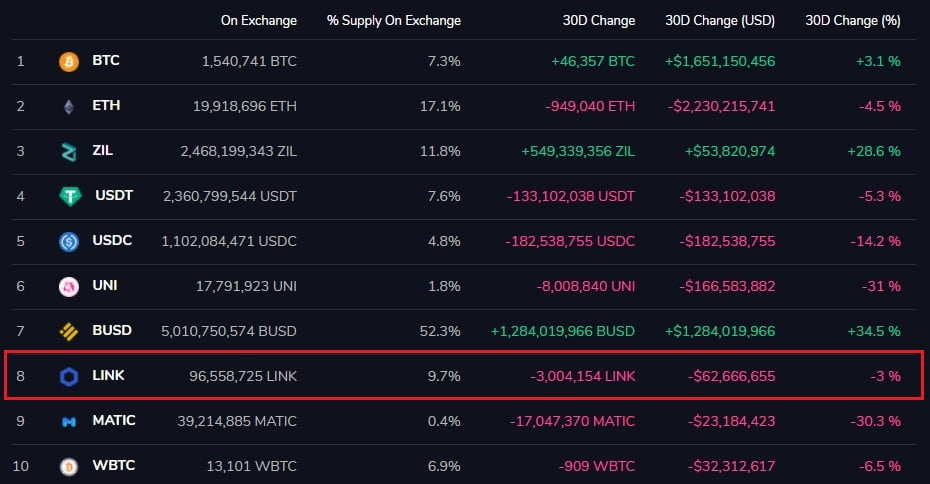
Chainlink investors have withdrawn over 3 million LINK tokens in the last 30 days as highlighted in the following screenshot courtesy of Viewbase.
Outflow Shows Optimism in Chainlink Despite Recent Crash
The outflow of more than 3 million LINK tokens valued at roughly $62.66 million, hints that Chainlink investors are playing the long game with the token. This is despite Chainlink’s recent pullback from its all-time high of $53 to a local low of $15. The move down was a 71.69% correction which was part of the crypto-wide sell-off that saw Bitcoin drop to $30k and Ethereum to the $1,800 levels.
Chainlink Loses 200-day Moving Average, 50-week Moving Average Could Provide Some Relief
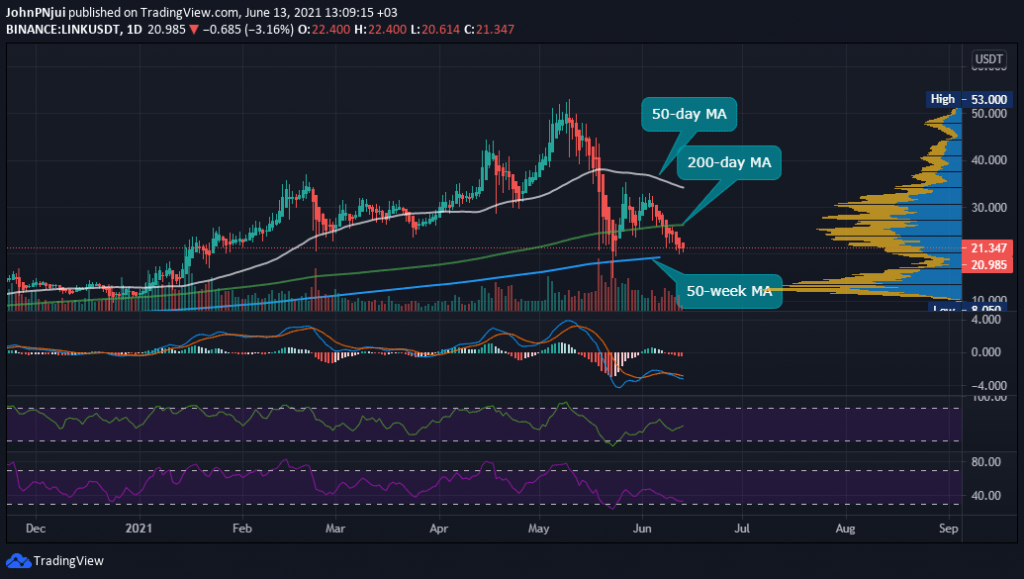
With respect to price action, Chainlink, just like Bitcoin, is trading below the 200-day moving average with a death cross about to happen in the days to follow. This, in turn, leaves the 50-week moving average as the next logical area of support for Chainlink at current levels between $20 and $19, as demonstrated in the chart below.
Also from the chart, the following observations can be made.
Firstly, Chainlink’s trade volume has been in the red for the better part of this month as some investors offload their LINK bags. Secondly, the daily MACD confirms the ongoing selling activity that is yet to show any signs of relief. Thirdly, the daily RSI points to an overbought scenario which then brings up the possibility of the 50-week moving average providing adequate support at current levels between $19 and $20.
Therefore, investors playing the long game with Chainlink might consider current levels as being ideal for adding more LINK tokens to their bags.
For the day traders willing to scalp Chainlink, having an eye out for Bitcoin is advised as LINK tends to mimic BTC during times of extreme market volatility.
We use cookies on our website to give you the most relevant experience by remembering your preferences and repeat visits. By clicking “Accept”, you consent to the use of ALL the cookies.
This website uses cookies to improve your experience while you navigate through the website. Out of these, the cookies that are categorized as necessary are stored on your browser as they are essential for the working of basic functionalities of the website. We also use third-party cookies that help us analyze and understand how you use this website. These cookies will be stored in your browser only with your consent. You also have the option to opt-out of these cookies. But opting out of some of these cookies may affect your browsing experience.
Necessary cookies are absolutely essential for the website to function properly. These cookies ensure basic functionalities and security features of the website, anonymously.
Cookie
Duration
Description
cookielawinfo-checkbox-analytics
11 months
This cookie is set by GDPR Cookie Consent plugin. The cookie is used to store the user consent for the cookies in the category "Analytics".
cookielawinfo-checkbox-functional
11 months
The cookie is set by GDPR cookie consent to record the user consent for the cookies in the category "Functional".
cookielawinfo-checkbox-necessary
11 months
This cookie is set by GDPR Cookie Consent plugin. The cookies is used to store the user consent for the cookies in the category "Necessary".
cookielawinfo-checkbox-others
11 months
This cookie is set by GDPR Cookie Consent plugin. The cookie is used to store the user consent for the cookies in the category "Other.
cookielawinfo-checkbox-performance
11 months
This cookie is set by GDPR Cookie Consent plugin. The cookie is used to store the user consent for the cookies in the category "Performance".
viewed_cookie_policy
11 months
The cookie is set by the GDPR Cookie Consent plugin and is used to store whether or not user has consented to the use of cookies. It does not store any personal data.
Functional cookies help to perform certain functionalities like sharing the content of the website on social media platforms, collect feedbacks, and other third-party features.
Performance cookies are used to understand and analyze the key performance indexes of the website which helps in delivering a better user experience for the visitors.
Analytical cookies are used to understand how visitors interact with the website. These cookies help provide information on metrics the number of visitors, bounce rate, traffic source, etc.
Advertisement cookies are used to provide visitors with relevant ads and marketing campaigns. These cookies track visitors across websites and collect information to provide customized ads.