Fidelity’s Wise Origin Bitcoin Trust and the First Trust SkyBridge Bitcoin ETF are now under review by regulators, according to paperwork filed earlier this month.
A pair of Bitcoin (BTC) ETF applications submitted by Fidelity Investments and SkyBridge Capital are under official review by the United States Securities and Exchange Commission, or SEC, reigniting a long-standing debate about whether regulators will finally approve America’s first crypto-focused ETF.
The SEC’s formal review of Fidelity Investments’ application was documented in a May 25 filing that appeared on the regulator’s website. The formal review of the SkyBridge application was outlined in a May 21 filing.
Both ETF applications were submitted in March. As Cointelegraph reported at the time, Anthony Scaramucci’s SkyBridge Capital partnered with investment adviser First Trust Advisors to develop a product that seeks to list shares on the New York Stock Exchange Arca.
The Fidelity application describes an ETF product that tracks Bitcoin’s daily price movements using a proprietary index derived from several price feeds.
U.S. securities regulators now have six ETF applications on the docket for review. A decision on the VanEck application is expected next month.
The SEC has yet to approve a single Bitcoin ETF, citing concerns over price manipulation and volatility. Proponents of a Bitcoin ETF believe this time will be different given the growing maturity of the asset class. It’s believed that a Bitcoin ETF would provide easier institutional access points to the digital asset market, which could be a boon for price and adoption.
North of the border, Canadian lawmakers have approved multiple Bitcoin ETFs. The Purpose Bitcoin ETF, which trades under the ticker symbol BTCC, accumulated $1 billion in assets under management less than two months after launching.
Bitcoin Pizza Day is an event that celebrates the first-ever Bitcoin purchase, which was made more than ten years ago. This year, it took place on Saturday, May 22.
What Is Pizza Day?
In 2010, one of Bitcoin’s earliest users, Laszlo Hanyecz, paid for two pizzas by negotiating a delivery with another user on the BitcoinTalk forums.
“I’ll pay 10,000 BTC for a couple of pizzas…maybe 2 large ones, so I have some left for the next day,” Hanyecz wrote. “You can make the pizza yourself and bring it to my house or order it at a home delivery place, but what I want is to have the food brought to me in exchange for bitcoins where I don’t have to order or prepare it myself.”
At the time, 1000 BTC was worth $25, enough for two pizzas ordered from Papa John’s. Since then, Bitcoin Pizza Day has become a yearly event, with various companies and organizations running promotions and giveaways to commemorate the date.
Pompliano Launches Bitcoin Pizza
Celebrity Bitcoin investor Anthony Pompliano has announced a one-week service called Bitcoin Pizza. Users who order through the site will receive a pizza from various local pizzerias in a specially branded “Bitcoin Pizza” cardboard box.
Part of each purchase made through Bitcoin Pizza will go to the Human Rights Foundation and its Bitcoin Development Fund, which supports crypto developers.
Slice & PizzaDAO Offered 2500 Free Pizzas
Pizza delivery network Slice has teamed up with the blockchain community project PizzaDAO to give away more than 2,500 free pizzas.
The offer is valued at about 1 BTC ($55,000) in total and has been funded through sales of cryptocollectibles (NFTs) created by the PizzaDAO collective.
To get a free pizza, users entered the code “FREEPIZZADAY” in the Slice app on May 22nd.
Papa John’s UK Gave Away Crypto Rewards
Ahead of Pizza Day, Papa John’s UK is offering its customers a chance to claim free Bitcoin with large purchases. Customers who place an order valued at more than £20 are able to claim £10 in free Bitcoin as a 50% discount.
Users must claim their Bitcoin by entering their reward code in Luno, a Bitcoin trading app. This offer was valid until May 23rd, 2021.
Additionally, Papa John’s locations in Jacksonville, Florida are giving away slices of Bitcoin-themed pizza on Pizza day with a chance to win a whole pizza.
Binance Rana a $52,000 Trading Contest
Crypto exchange Binance has announced a trading contest themed around Pizza Day. Users will need to collect “special ingredients,” which will be distributed to users who trade-specific cryptocurrencies or promote the event on social media.
Users who complete their “ingredient” collection will be entered in a draw. 200 winners will win $50 of BTC, and 20 winners will receive $20,000 of BTC. Qualifying users who do not win either draw will claim a share of a $22,200 Bitcoin prize pool.
Binance has also created a limited-edition series of pizza-themed NFTs. Eligible users will be randomly drawn to receive an NFT as part of a “lucky draw.”
Huobi Ran a $5000 Reward Airdrop
In celebration of Pizza Day, crypto exchange Huobi ran a three-day giveaway. To commemorate 5/22 (May 22), $522 worth of Bitcoin will be given to three individual winners. The remaining winners will each get $10 in Bitcoin.
In partnership with Huobi, the crypto firm Thundercore also gave away a series of Pizza Day NFTs. Between May 14 and May 22, users can enter the draw by engaging with Thundercore and Huobi Global on social media. Twenty users will be selected.
Phemex Ran a “Find Pizza Guy” Campaign
Crypto exchange Phemex also ran a contest. The exchange invited Laszlo Hanyecz to use its Earn Crypto service and generate interest on his investment.
However, Phemex says that it has been unable to contact Hanyecz; as such, it is asking the community to help recruit him via social media. Phemex will split $100,000 worth of Bitcoin between 100 participants. Phemex hoped to contact Hanyecz by May 22.
YouHodler Gives Away Tesla
Crypto loans site YouHodler also participated in Pizza Day: customers who spent more than $1000 on the service had a chance to win a Tesla Model Y.
Though the reward is not pizza-themed, the draw was live-streamed on May 22 in order to commemorate Bitcoin Pizza day.
Ballet Wallet Gives Away Keychains
The Bitcoin “metal wallet” company Ballet ran a Pizza Day promotion this year. Between May 10 and May 25, all wallet purchases came with a special pizza-themed keychain. Users could also buy a pizza-themed metal wallet from the company.
Ballet also gave away virtual tickets to a virtual webinar, which took place on May 22. Additionally, individuals who reside in Shanghai can attend the event in person and receive free pizza and refreshments.
Is There More to Come?
This article only covers promotions that were announced in advance of Pizza Day 2021. Other groups announced further events on Pizza Day itself. Watch for more announcements on Twitter via the hashtag #pizzaday.
Iran has yet again banned crypto mining activities for four months. This follows widespread power outages that are causing a public outcry.
On May 26, President Hassan Rouhani announced a halt to all crypto mining activities, including legal Bitcoin mining. The activities will remain closed until September 22. The Proof of Work (PoW) framework used by Bitcoin miners is a power-intensive activity that is also accused of causing environmental degradation.
Iran Periodical Frictions with Miners
Iran is a major hub for Bitcoin mining activities which has attracted a negative backlash from environmentalists who accuse mining rigs of causing damaging effects to the carbon footprint and this threatening environment conservation efforts.
Rouhani stated that Bitcoin mining consumed around 300MW of electricity, but this was a small number compared to illegal mining activities that consumed up to 2000MW of electricity.
Get Coin Signals!
Iran has cracked down on illegal mining activities in the past. The country’s Intelligence ministry cracked down on illegal miners by offering a $900 reward to those who gave out details that would help flush out illegal miners.
Because of high-energy consumption, various provinces and especially Tehran, have dealt with a menace of power outages leading to public frustrations. The power outages have affected homes, businesses, and even hospitals, usually affected by cuts that can happen throughout the day.
Just a Scapegoat?
The government has blamed Bitcoin miners for the outages. However, many citizens believe that this is just a scapegoat to deal with the main issue. According to many observers, the outages are caused by mismanagement of the country’s power grid and low resources. This was even confirmed by Eshaq Jahangiri, Iran’s first vice president, who confirmed that the power infrastructure needed adequate resources.
Recently, the head of the digital economy commission in the Iranian parliament, Motjaba Tavangar, also stated that research shows that Bitcoin mining takes up around 1% of Iran’s power output. According to the legislature, “The reason behind the power outages is not cryptocurrency mining, it’s stopping funding and the old distribution and generation network.”
This will not be the first time that Iran is shutting down crypto mining during summer. The country had done the same thing in the past to help offload the country’s power grid when rainfall levels were at their lowest.
Iran accounts for around 4.5% of Bitcoin mining activities globally and accumulates around $1 billion worth of revenues. The revenues from Bitcoin mining are useful in helping Iran recover from the harsh economic sanctions imposed by the United States.
The sanctions have also created high inflations in the country, which has made people turn into cryptocurrencies as a store of value. The use of cryptocurrencies to hedge against inflation has not started recently, given that other countries have also been using this alternative. Argentina and Venezuela and both facing hyperinflation, and citizens are rushing towards the crypto market.
Get Free Crypto Signals – 82% Win Rate!
Get Coin Signals!
3 Free Crypto Signals Every Week – Full Technical Analysis
Trading volume in crypto markets can be a key indicator of price volatility — but is there a direct correlation that traders can use to help inform their investment decisions?
Trading volume — the amount of an asset that changed hands over a given period — is one of the key metrics that investors use to track price trends and assess the market outlook for a specific coin in terms of liquidity and trader activity.
The ranking below zooms in on the fortunes of five coins that have had the greatest increase in average daily trade volume this month compared to the month before. Most of them — although not all — emerged as massive winners in terms of their monthly returns, but the relationship between the price and trading was not always what you’d expect.
The data from Cointelegraph Markets Pro platform sheds further light how these two indicators can influence each other.
Along with multiple other quantitative metrics, trading volume is at the heart of the VORTECS™ Score — an algorithmic comparison of historic and current market conditions derived from billions of data points gathered and analyzed by a proprietary machine learning model.
Polygon (MATIC ): +643.79%
Capitalizing on the sprawling activity in the DeFi sector and the expansion of the number of projects springing up on its platform, Polygon has had a fantastic month, conquering one all-time high (ATH) after another. The coin delivered 329% vs. USD and 456% vs. BTC alongside a 643% increase in average daily trading volume.
The trading volume dynamics faithfully followed each price uptick, reaching an impressive $11 billion on May 19. On that day, MATIC was responsible for as much as 4.5% of the crypto market’s overall trading volume.
From the look at the VORTECS™ score chart, it becomes apparent that trading volume spikes have been an essential component of each ultra high-score stretch that MATIC sported this month (red circles in the graph). These dark-green sequences, in turn, foreshadowed each new leg of the coin’s powerful rally.
Ethereum Classic (ETC): +229.23%
A legacy chain of the original Ethereum that has been abandoned by much of the community in the wake of the 2016 the DAO heist, ETC has a small but enthusiastic fanbase and a reputation of a network lacking security.
Observers are divided on what exactly triggered ETC’s 300% price run, closely followed by surging trading volume, in the first week of May. Opinions range from users suddenly seeking cheaper alternatives to the main Ethereum network to new investors mistaking the coin for its better-known cousin.
At any rate, at the height of its May 6 rally, ETC commanded a shocking 15.9% of the crypto market’s overall trading volume — not too bad for a coin that has risen from years of oblivion.
Going by the VORTECS™ chart, not only ETC’s showing was unexpected – it was historically unparalleled. The combination of market and social conditions that preceded the coin’s blast-off was not similar to those that systematically came before ETC’s price leaps in the past, as evidenced by largely neutral VORTECS™ Scores.
Telcoin (TEL): +507.8%
Telcoin, a global remittance platform whose token appreciated by 437% against USD and 600% vs. Bitcoin over the past month, owes at least some of its success to Polygon’s fiery run. The likely reason behind TEL’s surge in early May has been a layer-2 migration to the lower-fee Polygon network and the token’s subsequent listing on QuickSwap that opened attractive terms for liquidity providers.
As visible in the graph, it was the QuickSwap moment that produced the greatest increase in TEL’s trading volume rather than the even bigger price hike that followed a few days after.
It was the same surge in trading activity between May 2 and 8 that the VORTECS™ algorithm picked up and, in conjunction with other constituent metrics, deemed worthy of a series of high VORTECS™ Scores that began flashing around three days before the final leg of the price hike.
iExec RLC (RLC): +1,153.62%
RLC, the native token of cloud computing platform iExec, demonstrated the greatest month-to-month growth in average daily trading volume, adding an astounding 1,153% compared to the previous 30-day period. The coin’s price began picking up following the May 4 announcement of a Coinbase Pro listing and was boosted even more by a cascade of further exchange listings, big-name partnerships and collaborations, as well as the announcement of a developer rewards program. Over the month, RLC delivered 200% gains against USD and almost 300% against Bitcoin.
As the chart supplied by data analytics firm The TIE suggests, on May 8 and early May 9 the trading volume indicator mirrored the steeply upward price movement with a few hours’ lag. The two lines then effectively merged, indicating that further increase in trading volume was no longer driven solely by price action, but began responding to the news and heightening sentiment around the coin independently.
As visible in the graph, RLC’s VORTECS™ score had been neutral (yellow) in the days preceding the coin price’s spike, and briefly turned moderately bullish (light green) as the rally unfolded. However, when both the price and trading volume peaked, the VORTECS™ Score went from bullish back to neutral (red boxes in the graph), meaning that in the past such concerted upticks in both price and trading volume were not followed by price consistently going up or down.
In summary, RLC’s run this month did not have clear historical precedents in terms of market and social activity regularities that VORTECS™ score could capture. Rather, it has been driven by a series of bullish news announcements. This is where another element of Markets Pro functionality, NewsQuakes™, comes into play: In the same graph, it is plain to see how two listing announcements, on Coinbase Pro and Bithumb (red circle in the chart), came shortly before the rally.
OKB Token: +253.28%
The average daily trading volume of the OKEx exchange token, OKB, grew by more than 250% this month. However, this fact did not translate to a corresponding increase in the utility token’s price: Over the same 30 days, OKB lost 18.76% against USD and gained a mere 4.89% against the beleaguered Bitcoin.
A look at the token’s price vs. trading volume chart offers some explanation of this discrepancy. While trading volume largely mirrored price movement in the first half of the month, the two starkly diverged around May 19 and 20, around the time of the market-wide slump. As the price declined, the trading volume shot up.
This key to this seemingly paradoxical dynamic lies in the nature of the asset. In a bid to keep the value of the token high, every three months OKEx reduces OKB supply by buying back burning a few million coins. As the current burning period is set to expire at the end of May, some traders likely wagered on OKB staying afloat thanks to the guaranteed buyback liquidity when other digital assets were in a tailspin. Indeed, a surge in trading volume did support a brief rebound, yet it could only be sustained for a couple of days before the asset began sliding down again.
Note how the VORTECS™ algorithm remained unfazed by the May 20 increase in trading volume as the score remained neutral. A constantly learning model, it has surely seen such token burn-inspired spikes before — and apparently, in the past these spikes didn’t always spell significant price increases.
Any single metric describing an asset’s market outlook can be uninformative or even misleading on its own, yet it becomes exponentially more useful when contextualized within the recurring patterns of the VORTECS™ algorithm’s other metrics (which include price action, sentiment, and tweet volume).
Cointelegraph Markets Pro is available exclusively to members on a monthly basis at $99 per month, or annually with two free months included. It carries a 14-day money-back policy, to ensure that it fits the crypto trading and investing research needs of subscribers, and members can cancel anytime.
Cointelegraph is a publisher of financial information, not an investment adviser. We do not provide personalized or individualized investment advice. Cryptocurrencies are volatile investments and carry significant risk including the risk of permanent and total loss. Past performance is not indicative of future results. Figures and charts are correct at the time of writing or as otherwise specified. Live-tested strategies are not recommendations. Consult your financial advisor before making financial decisions. Full terms and conditions.
Though Danmarks Nationalbank’s governor seems tempted to ignore cryptocurrencies, other banks in the country continue to launch new services based on crypto.
Crypto trading volumes continue to increase, but several countries’ central banks are keen to ignore it, with Denmark being the latest to join the “crypto is negligible” narrative. Lars Rohde, governor of the country’s central bank doesn’t see the rise of crypto trading as a serious economic threat.
“I could be tempted to ignore it,” he told Bloomberg. “I think the term currency is badly used here. Most currencies store value or are means of transactions. There is no stability, no guarantee about the value of cryptocurrencies.”
Crypto is a speculative asset at best, he added.
When asked about the central banks’ moves to reduce speculative rivalry from crypto, he admitted he is more watchful of major tech companies’ moves in the payments field. Big tech’s invasion of the currency area is much more interesting, he opined.
“If tech giants get a hold on the means of transaction, then that could be a real threat to the autonomy and independence of central banks.”
Denmark was one of the earliest countries to explore the possibility of a central bank digital currency, or CBDC. The Danmarks Nationalbank discarded the idea following a one-year study from 2016 to 2017, deciding that a CBDC solution would do little to improve the current financial infrastructure of the country.
The central bank’s opinions don’t seem to have had much of an affect on other banks in the country, however. This week for instance, Denmark’s Saxo Bank announced that they are launching a new crypto FX product. This will enable users from the Middle East and North Africa, or the MENA region, to trade major cryptocurrencies like Bitcoin (BTC), Ethereum (ETH), and Litecoin for fiat currencies from a single margin account.
Other central banks around the world have voiced different takes on cryptocurrencies. The Central Bank of Kuwait issued a warning on crypto usage last week, while Canada’s central bank said it considers Bitcoin and other crypto-assets to be high risk “because their intrinsic value is hard to establish.”
De Nederlandsche Bank NV, the Dutch central bank, took a neutral stance on crypto trading in a recent statement which noted, “A crypto does not represent anything. It’s not a share in anything. It’s not a loan which is returned with interest.”
NatWest issued a crypto scam warning to mobile banking users after reportedly receiving a record number of complaints in Q1.
The U.K bank with the worst record for dealing with scam complaints has issued a cryptocurrency scam alert.
NatWest, which was rated as the worst U.K bank for accurately discerning legitimate fraud complaints in 2020, sent the warning to users of its mobile banking app after it reportedly received a record number of scam reports between January and March 2021.
The warning made particular note of one type of scam which involves hackers installing remote access software on a victim’s computer or hardware. The trick usually sees criminals winning a victim’s trust online, either by posing as an experienced trader, or pretending to be a celebrity, according to reports. The victim is then persuaded to install a cryptocurrency wallet and is urged to invest. After a certain amount of crypto is sent to the wallet, the criminal empties it via the malicious software they installed.
Head of fraud prevention at NatWest, Jason Costain, said increased interest in cryptocurrency had created an opportunity for criminals to exploit, and urged customers to be wary of fake websites and celebrity endorsements.
“We have prevented millions of pounds from being sent to crypto-criminals who are exploiting the high levels of interest in the currency. However, consumers should always be alert, especially to the use of fake websites and bogus celebrity endorsements,” said Costain.
Ironically, data from the U.K’s financial ombudsman for the year ending May 2020 revealed NatWest to be the worst bank for accurately dealing with fraud complaints from its customers.
According to the data, almost 70% of NatWest’s adjudications in such instances proved to be wrong between 2019 and 2020, as evidenced by the fact that the national regulator went on to have the decisions overturned. One year earlier, the figure was as high as 87%.
1inch Wallet users can now purchase DeFi assets through Mercuryo’s fiat onramp gateway.
Decentralized exchange aggregator 1inch Network has partnered with Mercuryo, a cross-border payment network, to provide its users with a more seamless gateway to DeFi — potentially opening up the market to greater adoption.
“To date, some users have been discouraged from entering the DeFi space because most of the existing options for buying crypto are too complicated and inconvenient,” said Sergej Kunz, co-founder of the 1inch Network, adding:
“The integration between 1inch and Mercuryo offers everyone a user-friendly way to enter the space, buy crypto with fiat and begin trading or securely hold their assets.”
Petr Kozyakov, Mercuryo’s CEO and co-founder, said his company has seen “great demand” for fiat onramp solutions to DeFi:
“It’s not possible to ignore DeFi if you look at how fast the industry is evolving. We see great demand from our users and partners to enable fiat-on-ramp solutions for DeFi enthusiasts. And we are proud to be integrated into the 1inch Wallet, as we value the power of its supportive community.”
The 1inch Network has been in the headlines recently after expanding into Polygon — a move that opened up additional liquidity sources and higher throughput for its users. On Apr. 27, 1inch also launched a new mobile wallet on Apple iOS, enabling users to instantly swap tokens on their mobile devices.
DeFi continues to be one of the hottest segments of the cryptocurrency market. Despite the recent market downturn, the DeFi sector accounts for nearly $126 billion in total value locked, according to latest industry figures. That number peaked well north of $160 billion earlier this month. The total market capitalization of DeFi projects is now worth more than $107 billion.
Even though it requires traders to spend a lot of time in day trading, the benefit involved is always enormous. There’s no doubt that you have been searching for a proper guide for day trading on popular sites like YouTube, articles, and guides all around the internet, without any lucrative information yet. You can now rest assured that you’re in the right place.
Beginning going further you will need to have an account with a reputable broker before venturing into day trading and if you don’t have one, you should make use of ETX Capital. Day trading is a high-risk investment that can either result in a massive gain or a loss. It’s a close alternative to investing in stocks and shares. The high volatility market of day trading makes it riskier than other types of investment. This affects the investment costs as well as its benefits.
A risky investment like day trading should only be performed by experienced investors with a professional trading background. And before investing in day trading, you should endeavor to make use of an amount you’re willing to lose.
With this beginner’s guide, you will still have a basic knowledge of trading to avoid losing your capital. And one thing you should also keep in mind is that it’s not everybody that can benefit from day trading. If you find it hard enough to understand and invest in it, you should take a look at other investment options like buying Shares, Stock, and an ETF.
Day Trading
Day trading involves the buying and selling of financial assets in a short time frame. This process can take seconds to a few hours. What type of financial assets can you purchase and resell? You can buy and sell financial assets like Stock or Shares, digital currencies on the forex market, Bonds, and other digital commodities.
You can purchase the asset as direct holding or derivatives, which have a different meaning. Direct holding is an asset that is directly owned by you, while derivatives are shared assets that you own like contracts and options. To become a day trader, you have to specialize in a single type of investment without switching to other alternatives. If you want to trade stocks, you can only trade stocks by having to buy shares or trade gold. In the Finpari review here, there’s a lot of information for utilizing a broker trade forex.
Why Do People Prefer Day Trade?
A lot of people participate in day trade because of the huge benefit involved. As a day trader, you need to be disciplined, with an intellect of analyzing, and trading appropriately. You need to be able to make risky investment decisions that will benefit you in generating better returns.
As a day trader, you won’t be subject to working 9 to 5 anymore because you only trade when you want to. There’s no boss ordering you to adjust your work schedule based on their preference. You are your own boss now. You work independently based on your schedule.
For people who know what they are doing, day trading can be a lucrative career for making a living. You have the opportunity to trade anywhere or in any location. If you have been dreaming of working from the park, beach, and other awesome places, day trading is what you need. As a beginner to day trading, you can make use of FP Markets brokers to venture into the trading world.
Conclusion
Unlike other forms of trading, day trading is a very demanding and lucrative type of investment. Even though it requires traders to spend a lot of time in day trading, the benefit involved is always enormous.
RippleX has announced the launch of a community grants program for projects building on the XRP ledger
The Grants Program will focus on NFTs, Core infrastructure, developer tooling, Developer UX and security
The team encourages projects focused on NFTs for the first round of grant applications
There is a June 10th deadline for the first round
Successful applicants will be teamed up with mentors
The team at RippleX has announced the launch of a community grants program aimed at funding projects that are building on the XRP ledger. The RippleX Grants program is looking for ‘open-source projects that advance the growing community around the XRP ledger’.
Funding will be provided for projects centered around the core technology of the XRP ledger as well as end-user applications. The RippleX Grants Program goes on to outline the following five areas of focus for potential developers willing to participate.
Non-Fungible Tokens (NFTs)
Core infrastructure
Developer tooling
Developer UX
Security
First Round of XRP Ledger Grants to Focus on NFTs
For the first round of applications for the grants program, the team at RippleX has requested developers to focus on Non-fungible Tokens (NFTs) on the XRP ledger. Examples of such NFT projects on the XRP ledger include marketplaces, issuance platforms, wallet support, and tools and services for XRP ledger-based NFTs.
How to Apply and the Selection Process
Interested teams and individual developers are requested to apply online through this online form.
Participants are also requested to build a prototype (not necessarily working 100%) of the project and to avail it on the open-source platform of Github.
The deadline for the first round of applications is June 10th, 2021, with applicants requested to apply early and not to wait till the last minute.
The RippleX team will also be live on the RippleXDev Twitch channel on Thursday, May 27th at 10:00 UTC and 18:00 UTC, to answer any questions regarding the first round of applications.
The Bitcoin price is seen moving sideways around $39,319 and it may be vulnerable to a bigger correction.
BTC/USD Long-term Trend: Ranging (Daily Chart)
Key levels:
Resistance Levels: $48,000, $50,000, $52,000
Support Levels: $31,000, $29,000, $27,000
BTCUSD – Daily Chart
BTC/USD sees a sudden sell after yesterday’s gains as it dropped from a high of $40,440 to as low as $37,191. Though the Bitcoin price is attempting to bounce back as the recent drop is pushing the momentum within the bearish favor and this could be the start of a further retracement lower.
Bitcoin Price Prediction: What to Expect from Bitcoin (BTC)
Looking at the daily chart, we can see that Bitcoin rolled over from above the $40,000 resistance level as it started its descent lower. Therefore, it is about to drop beneath the 9-day moving average at $38,200 but manages to find support around the $37,191 which may allow it to bounce back higher.
However, if the sellers continue to drag the Bitcoin price back beneath the support at $35,000, the first level of lower support is located at $33,000. Beneath this, the critical support lies at $31,000, $29,000, and $27,000. On the other hand, if the bulls bounce above the 9-day and 21-day moving averages, they could reach the nearest resistance levels at $48,000, $50,000, and $52,000.
On the other hand, the technical indicator Relative Strength Index (14) is moving above 35-level which shows that the market may still follow an upward movement for a market recovery if the signal line crosses above 50-level.
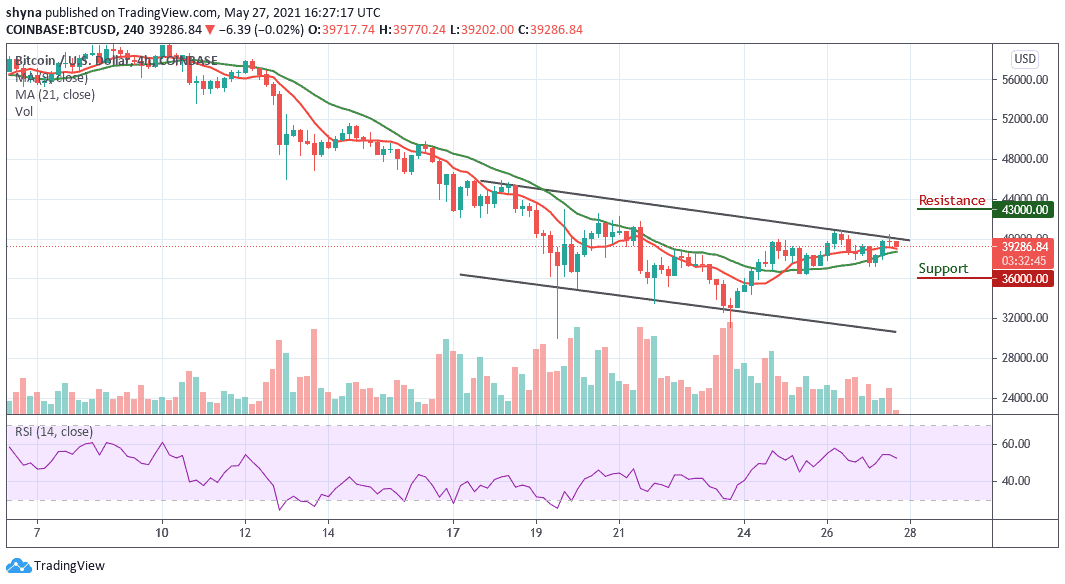
BTC/USD Medium – Term Trend: Bearish (4H Chart)
On the 4-hour chart, BTC/USD has been trading within the range of $46,800 to $36,500 been revealed by the technical indicator Relative Strength Index (14). Nevertheless, the Bitcoin price has not yet slipped below $35,000 but still in the loop of making a bounce back. However, the Bitcoin price is changing hands at $39,286 and may take time to persistently trade above $42,000.
BTCUSD – 4 Hour Chart
Moreover, according to the 4-hour chart, if the coin crosses above the upper boundary of the channel, the upward movement could be facing hurdles near the $43,000 and $45,000 resistance levels. Meanwhile, on the downside, immediate support is near the $38,500 level while the price might slide sharply below $37,000 which may likely test the main support at the $36,000 level and below.
In a sign of worldwide growing adoption, central bank digital currencies (CBDCs) programs are currently underway in many countries. West African giant Nigeria appears to be the latest entrant in a field that is garnering much attention.
Digital Naira in the Works
The Central Bank of Nigeria (CBN) is planning on launching a digital version of the Nigerian Naira, local news outlet Nairametrics reports. This was made known by Nigeria’s central bank Governor Godwin Emefiele at the 279th monetary policy rate (MPR) meeting on Wednesday.
This comes against the backdrop of February’s directive issued by the central bank instructing banks and payment processors in Nigeria to suspend crypto services to customers.
Emefiele said that the nation’s central bank is committed to making the digital naira a reality.
The CBN boss tried to justify the bank’s recent directive outlawing crypto by linking Elon Musk’s tweets to the recent crash in prices.
Get Coin Signals!
Speaking on the reasons guiding the bank’s decision, the Nigerian banker said:
“We have carried out our investigation, and we found out that a substantial percentage of our people are getting involved in cryptocurrency, which is not the best. Don’t get me wrong; some may be legitimate, but most are illegitimate.”
For many crypto professionals in Nigeria, this is a step in the right direction. Hakeem Disu, Founder of bitcoin exchange Koinwa, told Inside Bitcoins, why he thinks things could get better for the crypto sector in Nigeria. Disu said,
“The U.S is also considering a digital dollar, but none of these CBDCs can replace Bitcoin. Now that the CBN is considering the Digital Naira, we should expect a reversal of the ban soon.”
Chike Okonkwo, who oversees strategic partnerships at crypto management firm THRESHOLD told Inside Bitcoins that “Bitcoin has come to stay in Nigeria.” He believes a digital Naira would be beneficial for the industry, as a whole, if done properly.
Others like Victor Asemota, who serves as a partner at Israeli-based Venture Capital firm AnD Ventures, believe a digital naira would end the cycle of corruption in Nigeria. He said:
“This will actually reverse a lot of things. Imagine the Federal Allocation being given as StableCoin? Wherever it goes, the CBN can track. This will eliminate state corruption. Whoever convinced them deserves a Nobel Prize. My guess is that it is @CarmelleCadet Folded hands”
Nigeria Tops Crypto Charts
Bitcoin’s appeal for Nigerians started due to the stringent forex policies adopted by Nigeria’s central bank, some years back. This made it difficult for Nigerians to send or receive payments from abroad. Coupled with the rapidly declining confidence in the country’s fiat currency—the naira, Nigeria’s young population found it easy to adopt alternative currencies like Bitcoin and Ether.
Since then, cryptocurrency adoption has grown tremendously in the West African nation. Nigerians conducted 1.1 million crypto trades on peer-to-peer exchange Paxful in 20202, per reports. The country also averaged $65m per month last year on every transaction.
According to data from Blockchain.com, Nigeria is ranked as one of the fastest-growing markets for Bitcoin worldwide. Recent data from Google Trends show that Nigeria tops the ranks of countries searching on Bitcoin and investing in the asset class.
Get Free Crypto Signals – 82% Win Rate!
Get Coin Signals!
3 Free Crypto Signals Every Week – Full Technical Analysis
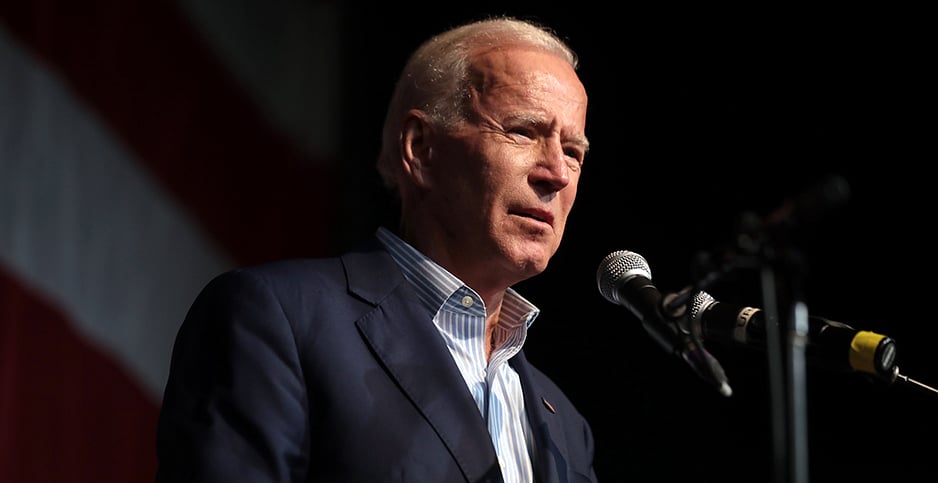
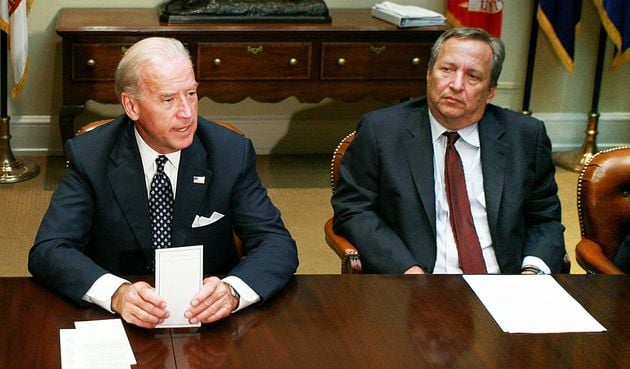
On Wednesday the White House defended President Joe Biden’s trillion-dollar spending proposals despite the criticism concerning rising inflation and low-interest rates. Inflation has risen at unprecedented levels in the U.S. and the average American’s purchasing power is growing less powerful. Now critics like JPMorgan Chase CEO Jamie Dimon and American economist Larry Summers have blasted the Biden administration because they expect inflation to grow “considerably higher.”
Americans Watch Purchasing Power Sink While Analysts Suspect Even More Inflation on the Horizon
Inflation has been a worry for American citizens ever since the U.S. government and Federal Reserve decided to increase the M1 monetary supply like never before in history. Essentially, inflation is the rise in price for goods and services, and the nation’s currency ends up buying fewer goods and services.
Reports show that nearly everything is rising in value, and the U.S. dollar can purchase far less than it could before. Car prices are expected to go through the roof this year, food prices have grown astronomical and pork prices touched a seven-year high. The USDA expects the price of food to rise from 2.5% to 3.5% for the year. It’s quite blatant that the central bank and politician’s often quoted “2% inflation rate” is a myth, as 2021 statistics show prices of goods and services in the U.S. have surged.
Despite some disapproval and inflation concerns, the Biden administration has been defending its proposed $2.3 trillion American Jobs Plan and the $1.8 trillion American Families Plan.
Morningstar.com increased its 2021 inflation forecast for the Personal Consumption Expenditures Price Index on Wednesday. “We expect 2021 core inflation of 2.5%,” the prediction notes.
“For 2022-25, our forecast is essentially unchanged; we expect moderate core inflation averaging 2.3%, just above the Federal Reserve’s 2% long-run target,” the Morningstar.com inflation report adds. Meanwhile, on May 26, financial executives and economists have criticized the Biden administration for seeking even more money from the Federal Reserve.
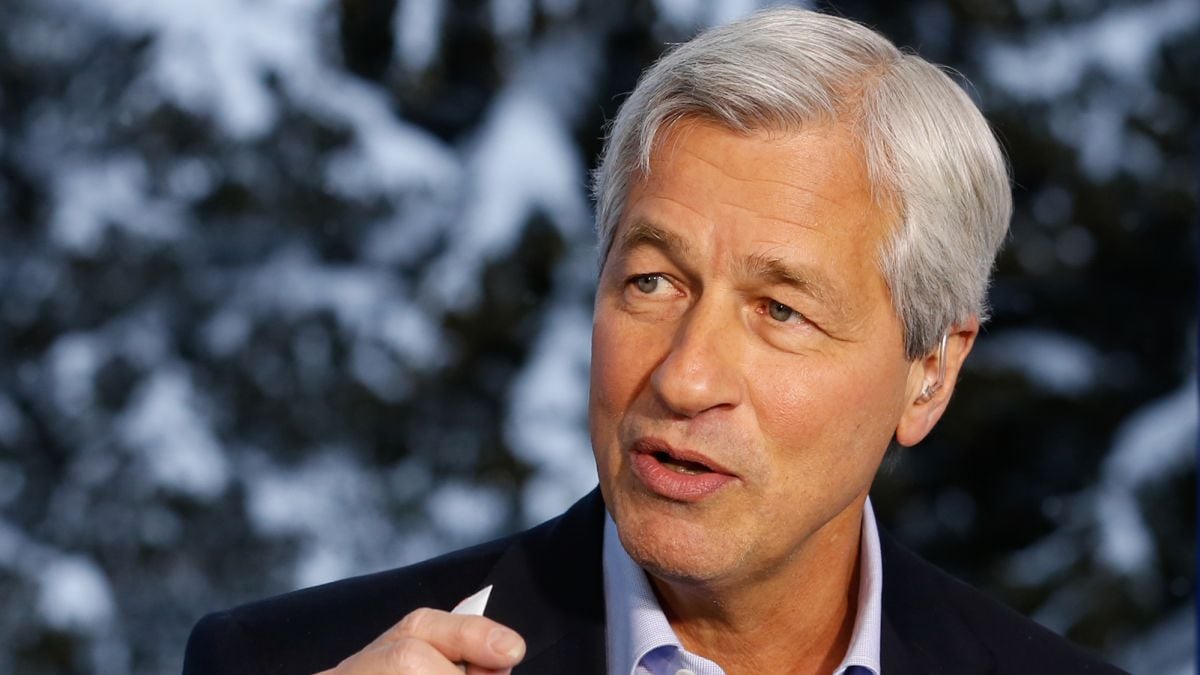
“You’re talking about unprecedented continued fiscal and monetary policy, kind of on autopilot,” JPMorgan Chase CEO Jamie Dimon explained at Wednesday’s Senate hearing. “[There is] nothing wrong with 1.6%,” Dimon added. “I would expect it to go considerably higher than that. Hopefully, it won’t be out of whack and the Federal Reserve will be able to tamp it down. But we always plan for things worse than that.”
JPMorgan Chase CEO Jamie Dimon spoke about inflation when he testified before the Senate Banking Committee held on May 25. While a great number of financial institutions and Wall Street CEOs argued against “woke capitalism” and “climate change” that day, Dimon spoke about inflation.
The JPMorgan Chase CEO, who manages the largest financial institution by assets held, said the government’s stimulus could get carried away. “If that money is wasted, it is not productively spent, we will have more inflation, less productivity, slower growth and the American democracy you will have lost even more credibility [in the] eyes of the world,” Dimon Stressed.
Despite Jamie Dimon’s commentary, the White House principal deputy press secretary, Karine Jean-Pierre, emphasized to the press that the “President’s plans are working.”
“This is a president who understands about making sure that we’re not wasteful,” she added. “He made sure there was no corruption and no waste. And so he understands how this all works.”
Larry Summers: ‘Fed’s Will Only Remove the Punchbowl After It Sees Some People Staggering Around Drunk’
Not everyone agrees with Karine Jean-Pierre and the Biden administration. At the Coindesk 2021 Consensus conference the former Clinton and Obama official, Larry Summers discussed runaway inflation and monetary easing policies as well.
“I think [the] policy is rather overdoing it,” Summers said on Wednesday. “The sense of serenity and complacency being projected by the economic policymakers, that this is all something that can easily be managed, is misplaced.”
The former Vice President of Development Economics and Chief Economist of the World Bank, former Clinton administration Treasury Department official, former director of the National Economic Council for the Obama administration, Larry Summers, has warned the Biden team of rising inflation. As far as the inflation forecast, Summers said there is “enormous uncertainty” at the Consensus conference this week.
“Joe Biden has a historic opportunity to be a great president,” Summers further remarked. “But I think they should learn the lesson of the Johnson administration’s errors that elected Richard Nixon and the Carter administration’s errors that elected Ronald Reagan.”
Summers statements concluded when he said:
The Fed’s idea used to be that it removed the punchbowl before the party got good. Now, the Fed’s doctrine is that it will only remove the punchbowl after it sees some people staggering around drunk. We are printing money, we are creating government bonds, we are borrowing on unprecedented scales. Those are things that surely create more of a risk of a sharp dollar decline than we had before. And sharp dollar declines are much more likely to translate themselves into inflation than they were historically.
Despite Clear Data and Criticism, White House Disagrees America Will See ‘Long-Term Inflation’ and It’s the Fed’s Job ‘First and Foremost’
In recent times as inflation has gripped the American economy, the U.S. dollar index (DXY) plummeted below 90 again growing weaker. Seven days ago the U.S. dollar dropped to a three-year low and economists think the dollar could dip 10% lower. Even though there is lots of data and statistics showing the dollar is weaker and inflation is dislocating the economy, the White House wholeheartedly disagrees.
In response to Larry Summers’ recent critique of Biden economics, a White House official responded and told CNN it does “not see signs of persistent dislocation or long-term inflation.”
The official noted that it does monitor the inflation rates but it’s more in the hands of the U.S. central bank. “Our team closely monitors inflationary pressures but inflation is first and foremost under the purview of the Federal Reserve,” the White House official concluded.
What do you think about Biden’s economic plan and fears of runaway inflation gripping the American economy? Let us know what you think about this subject in the comments section below.
Iranian President Hassan Rouhani has announced that cryptocurrency mining is banned in Iran, effective immediately. The ban, which will last until Sept. 22, is imposed as many cities in the country are facing major power blackouts.
Iran has banned cryptocurrency mining effective immediately, President Hassan Rouhani said on Wednesday in a televised speech at a cabinet meeting. He was quoted by the media as saying:
The ban on the mining of cryptocurrencies is effective immediately until September 22.
Many cities in Iran are facing major power blackouts and the government has blamed power cuts on cryptocurrency mining, drought, and rising demand for electricity in summer. Bitcoin News recently reported that Iran will shut down licensed crypto miners in peak hours of power consumption.
Blockchain analytics firm Elliptic estimates that around 4.5% of all bitcoin mining takes place in Iran. The firm said income from mining has allowed “the country to circumvent trade embargoes and earn hundreds of millions of dollars in cryptoassets that can be used to purchase imports and bypass sanctions.”
Iran requires licensed crypto miners to sell their bitcoins to the central bank directly. Cryptocurrencies mined legally in the country can be used to pay for imports of authorized goods. In April, Iran authorized banks and currency exchanges to use cryptocurrencies to pay for imports.
Government officials say that a majority of the energy consumption from bitcoin mining comes from illegal miners operating without licenses. In January, Iranian police confiscated 45,000 bitcoin mining machines that were illegally using subsidized electricity. President Hassan Rouhani said Wednesday:
Some 85% of the current mining in Iran is unlicensed.
What do you think about Iran banning cryptocurrency mining in the summer? Let us know in the comments section below.
During the course of the week, the cryptocurrency community has been focused on China and the country’s Financial Stability Board detailing that it aims to crack down on the bitcoin mining sector. Following the statements from Chinese officials and a few crypto businesses abandoning services in the region, executives from some of China’s largest bitcoin mining companies have openly discussed the situation.
Btc.top’s CEO: ‘If China Takes Regulatory Actions Against Crypto Mining, Then Major Chinese Manufacturers Will Sell Abroad
The million-dollar question right now is whether or not the Chinese government will continue to crack down on the crypto industry. It all started when Reuters published a report on May 18, that said: “China bans financial, payment institutions from cryptocurrency business.” Essentially the news publication said that “three financial industry associations” from China told financial institutions and payment processors “not to offer any crypto-related services.”
Services include “account openings, registration, trading, clearing, settlement, and insurance, reiterating the 2017 ban,” Reuters further noted in a follow-up explainer the next day. Then five days ago, regional reports detailed China’s 51st meeting of the Central Financial and Economic Affairs Commission, and the organization’s director, Liu He, discussed the bitcoin mining sector. Again, the Economic Affairs Commission and Financial Stability Board said it would crackdown on illegal bitcoin mining and monitor the sector.
Following the economic affairs meeting and statements from Liu He, Btc.top’s CEO Jiang Zhuoer spoke about the situation. “According to the minutes of ‘China Financial Stability Board:’ We resolutely prevent and control financial risk…. we shall crack down Bitcoin mining and crypto trading activities in order to prevent individual risks from being spread to the social level,” Zhuoer said.
“From there, we can see that the main spirit of the meeting is to ‘prevent and control financial risks,’ to restrain social capital from flowing into the crypto mining sector which might lead to risks transferring from individuals to the whole society,” Zhuoer continued. “In other words, individual mining is and has always been allowed as long as you’re responsible for your own risks and profits, whilst the mining operated by financial capital might be [forbidden].”
Zhuoer also compared the minutes this year to what was said during the minutes’ definition declared back in 2013, which was repeated Zhuoer added. The Btc.top CEO spoke about September 4, 2017, that day the world watched China ban initial coin offerings (ICOs) and then the shut down of domestic crypto exchanges. As far as China’s bitcoin miners, Zhuoer says the guidelines may invoke some losses but it may not be as bad as most think.
“Large [datacenters] and major veteran miners may suffer a significant loss this time, while the whole Bitcoin network will be as resilient as always,” Zhuoer stressed. “The worst scenario would be: large datacenters are shut down and we go back to old days in 2014-15. Small miners install several miners at home; Medium miners set dozens of miners in a warehouse or a few hundred miners in a factory; Veteran miners find a small remote hydroelectric power plant and locate there a couple thousand miners.”
The Btc.top executive added:
In conclusion, bitcoin mining will exist as normal, except the mining in China will be shifted from industrial-size datacenters to home miners, small or medium-sized miners. The entire Bitcoin network will always be strong even [if] its hashrate [declines] by 50%.
Executives from Ebang, Canaan, and Innosilicon Discuss Alternative Strategies and International Locations
In addition to Btc.top’s CEO, executives from a number of other Chinese mining firms and rig manufacturers spoke about the reported crackdowns. Reuters reported on May 26, that Chinese ASIC manufacturers “are now looking elsewhere for growth.” Alex Ao, vice president of Innosilicon Technology explained that “foreign miners will benefit.” “Places like North America and Central Asia have advantages in terms of power supply and policy support,” Ao detailed.
In another statement, Hangzhou-based Ebang International remarked that “domestic customers will go overseas to mine.” “Mining machines will still be in short supply,” the Ebang spokesperson added. Edward Lu, senior vice president of Canaan Inc, added his opinion about the situation in China. “The strategy should be to strenuously develop markets such as Kazakhstan, Canada, and North Europe, where energy resources are abundant and cheap, while regulations are clear and predictable,” Lu said.
Meanwhile, the Shenzhen-based firm Bit Mining announced plans this week that it will construct a 100 MW bitcoin mining data center in Kazakhstan. Formerly known as 500.com, Bit Mining owns Btc.com and the mining rig manufacturer Bee Computing. Similar to Bit Mining both Btc.com and Bee Computing are based in China and may face harsher regulations.
The Sichuan Energy Regulatory Office also revealed this week that it will gather on June 2 to discuss bitcoin mining. The meeting is required by China’s National Energy Administration, according to a regional report.
What do you think about the comments from Chinese mining rig manufacturers and mining farm operators? Let us know what you think about this subject in the comments section below.
PRESS RELEASE. Bitcoin.com Exchange is thrilled to announce the listing of GHX, being available to trade on the 27th May 2021 at 10:00AM UTC. GHX (GamerCoin) was created by the GamerHash team, as an incentive for the miners within the app and as a reward for carrying out the tasks on the Play&Earn module. GHX will start trading with BTC as a pair.
What is GamerHash?
GamerHash is an ecosystem where gamers can use their computing power to earn Bitcoin. That is the basic functionality of the platform, created in 2017, that has brought together over half a million gamers to this day.
One of the moot points behind the recent GHX token growth is the already working platform supporting over 600,000 registered users. The big number of users (mostly gamers) corresponds with the ease of crypto mining on the platform – you can earn BTC while playing games or watching Netflix. At the same time, you receive GamerCoin as a 20% bonus on top of the BTC you mine. Lower-end PC owners with computers not suitable for mining can join Play&Earn where they can still enjoy crypto rewards when completing simple tasks such as playing games or registering on a GamerHash partners platform. In a nutshell, GamerHash is a self-financing supercomputer – built in a decentralized manner with the help of gamers.
Most recently, GamerHash partnered with Exeedme and became a Silver Partner to Blockchain Game Alliance – one of the most influential Crypto & Gaming associations, where among its members, there is; Sandbox, Enjin, ANRKeyX, Simplex and other top NFT projects. This all boils down to a significant preparation period for future partnerships on top of ones that GamerHash already has with Chainlink and æternity.
The platform is already successful, by means of its abundance of users, but the company CMO Artur Pszczółkowski wants to go deeper and become an “Amazon of NFTs” – the team would like to convince its users to partially spend what they’ve ‘mined’ to purchase their first NFTs. More importantly, the cooperation between Chainlink and GamerHash seems to give new possibilities such as utilizing match outcomes to mint rare NFTs, which can then trade on the GamerHash Marketplace. As previously mentioned, GamerHash would like to allow gamers to trade in the P2P way of their gaming NFTs in a safe environment.
What is GamerCoin (GHX)?
According to Wikipedia, Metcalfe’s law states that the value of a network is proportional to the square of the number of connected users of the system (n2). Therefore, the high price rise of GamerCoin is not a surprise (with over 600,000 users). The native $GHX ERC-20 token is used as an incentive for the miners within the app, and a reward for carrying out the tasks on the Play&Earn module. Future use cases will consist of getting access to special events within the ecosystem, as well as creating a P2P NFTs marketplace as part of expanding the GamerHash Store (~600 products).
Another strong point about GamerHash and its GHX token is legal compliance. The team managed to have the GamerCoin whitepaper registered by the Maltese financial authorities (MFSA). It’s the first project in the European Union to launch a token within this new regulatory framework of Malta’s MFSA.
Strong Endorsement
Danish Chaudhry, CEO of Bitcoin.com Exchange, shared his views on GamerHash, and their respective token GHX: “From the beginning of the crypto industry, the gaming community has always been an integral part of the mining process, and the team at GamerHash have found a great way to target this group of individuals, and incentivise them for their hardware, and for their hobby, or work in some cases.”
Chaudhry continues on by saying; “We’re very excited to see how GamerHash will continue to empower their vision for the future of wide-scale mining via gamers, and gain further outreach with our outstanding community at the exchange.”
Artur Pszczolkowski, CMO of GamerHash expressed his enthusiasm towards the listing, stating that: “The Bitcoin.com Exchange is an important and well-respected part of the crypto ecosystem around the world. It is a great opportunity for the GH community to expand their trading area. We are delighted to be working hand in hand with such a good project. I hope it’s just the beginning of greater cooperation between us in the future”.
About Bitcoin.com Exchange
The mission of Bitcoin.com Exchange is to empower people from all over the world to trade cryptocurrencies with ease and confidence, from first-time traders to advanced trading professionals. With high liquidity, 24/7 multilingual support and dozens of trading pairs, complemented with a high level of security, it offers an attractive platform for trading any cryptocurrency. Within one year since launch, on average, the exchange has been visited by more than 500K active traders per month, and this number continues to grow as you read this sentence.
About GamerHash
GamerHash is an ecosystem with a native token GamerCoin (GHX) that is used by more than 600 000 gamers. Users exchange their idle computing power and complete Play&Earn tasks to earn Bitcoin. It can be withdrawn or exchanged for +600 digital products in the GamerHash Store. GamerCoin $GHX token is listed on top cryptocurrency exchanges such as Bithumb and KuCoin. At the same, it’s the first (EU) licensed gaming token. The project is planning to launch its own NFT marketplace focused on gaming and esport as well as reach 1.5 million users by the end of 2021.
This is a press release. Readers should do their own due diligence before taking any actions related to the promoted company or any of its affiliates or services. Bitcoin.com is not responsible, directly or indirectly, for any damage or loss caused or alleged to be caused by or in connection with the use of or reliance on any content, goods or services mentioned in the press release.
We use cookies on our website to give you the most relevant experience by remembering your preferences and repeat visits. By clicking “Accept”, you consent to the use of ALL the cookies.
This website uses cookies to improve your experience while you navigate through the website. Out of these, the cookies that are categorized as necessary are stored on your browser as they are essential for the working of basic functionalities of the website. We also use third-party cookies that help us analyze and understand how you use this website. These cookies will be stored in your browser only with your consent. You also have the option to opt-out of these cookies. But opting out of some of these cookies may affect your browsing experience.
Necessary cookies are absolutely essential for the website to function properly. These cookies ensure basic functionalities and security features of the website, anonymously.
Cookie
Duration
Description
cookielawinfo-checkbox-analytics
11 months
This cookie is set by GDPR Cookie Consent plugin. The cookie is used to store the user consent for the cookies in the category "Analytics".
cookielawinfo-checkbox-functional
11 months
The cookie is set by GDPR cookie consent to record the user consent for the cookies in the category "Functional".
cookielawinfo-checkbox-necessary
11 months
This cookie is set by GDPR Cookie Consent plugin. The cookies is used to store the user consent for the cookies in the category "Necessary".
cookielawinfo-checkbox-others
11 months
This cookie is set by GDPR Cookie Consent plugin. The cookie is used to store the user consent for the cookies in the category "Other.
cookielawinfo-checkbox-performance
11 months
This cookie is set by GDPR Cookie Consent plugin. The cookie is used to store the user consent for the cookies in the category "Performance".
viewed_cookie_policy
11 months
The cookie is set by the GDPR Cookie Consent plugin and is used to store whether or not user has consented to the use of cookies. It does not store any personal data.
Functional cookies help to perform certain functionalities like sharing the content of the website on social media platforms, collect feedbacks, and other third-party features.
Performance cookies are used to understand and analyze the key performance indexes of the website which helps in delivering a better user experience for the visitors.
Analytical cookies are used to understand how visitors interact with the website. These cookies help provide information on metrics the number of visitors, bounce rate, traffic source, etc.
Advertisement cookies are used to provide visitors with relevant ads and marketing campaigns. These cookies track visitors across websites and collect information to provide customized ads.