Bitcoin price must now hold this key level to regain $40K

Will $37,000 hold for more upside in the near term for Bitcoin?

Bitcoin (BTC) prices pulled back on May 25, wiping a small portion of the gains it had made during the previous session amid another day of volatile trading.

The BTC/USD exchange rate fell up to 6.11% after opening the Asia-Pacific session at $38,856. The pair met a strong resistance force near its 200-day simple moving average (20-day SMA) that prompted a majority of traders to secure their intraday profits.

As a result, the bids for the BTC/USD pair started dropping while heading into the early London session, eventually finding support at a level that was instrumental in limiting the market’s bearish trend during the last week’s price crash.

Bitcoin attempts to establish support level at $37,000. Source: TradingView

Rekt Capital, a pseudonymous cryptocurrency trader, called the blacked horizontal line in the chart above — roughly $37,000 — a “key retest” level, noting its significance in determining Bitcoin’s short-term market bias.

The analyst put a blue arrow above the support level that pointed north, stating that he anticipated BTC/USD to bounce back in the coming sessions. 

“Bitcoin turns $37,000 into support in the short-term,” tweeted Rekt Capital. “But might need to retest that area once again given how strong yesterday’s Daily Close was Still on track for following the blue path.”

The statement appeared as Bitcoin continued its whipsaw trend, logging sudden intraday reversals of high percentage margins. The choppy price movements reflected an absence of clear directional bias among traders, especially as analysts weighed equally convincing bearish and bullish catalysts against one another.

Will Bitcoin crash further? The opinions differ

Victor Dergunov, the founder of Albright Investment Group, admitted that he was buying the Bitcoin price dip, adding that he expects the cryptocurrency to at least reach the $40,000-$42,000 area in the near term.

“There was enormous volume leading up to and right around $30K, which is what we want to see at the epicenter of the correction process,” Dergunov explained in his note.

“Next, we see a retest attempt, at around $31K, but volume is notably weaker than during the initial drop.”

Offsetting Dergunov’s bullish opinion was portfolio management and analytics firm, the Income Generator. It said the Bitcoin market risked facing the “worst crypto winter” in its twelve-year lifetime, citing the U.S. dollar’s bullish response to rising inflation figures that could sap investors’ appetite for the cryptocurrency.

“It now seems as though rising inflation levels might actually work in the opposite direction and bring renewed buying activity back into the U.S. dollar,” Income Generator said in a note.

Meanwhile, Mike McGlone, the senior commodity strategist at Bloomberg Intelligence, reiterated his bullish stance on Bitcoin, noting that he still sees the BTC/USD exchange rate hitting $100,000 on the prospects of a declining supply rate.

“Bitcoin has backed up for reasons that support an extended bull market and a path to $100K,” he said.

“A bit hot in April, a primary factor cited for the crypto’s correction — excessive energy use — represents the strength of the world’s largest decentralized network, and getting greener.”

With “greener,” McGlone cited Elon Musk’s proposal to create a mining council in North America that could track and subsidize Bitcoin’s carbon emissions.

The Tesla CEO was instrumental in crashing the bitcoin prices from $59,000 to as low as $30,000 over the past few weeks. He criticized the cryptocurrency for its potential environmental impact and discontinued accepting it as payment for Tesla’s electric vehicles.

Go to Source

Cryptocurrency custody gives commercial banks a foothold in the market

The crypto custody business blossomed in 2019, spearheaded by fintech firms, but now its center of gravity might be shifting.

Custody services aren’t the most compelling corner of the crypto ecosystem, but 21st-century solutions for storing and safekeeping digital assets are critical if cryptocurrencies are to achieve widespread adoption. 

For that reason, Cowen Inc.’s recent announcement that the 103-year old United States investment bank wants to hold crypto on behalf of asset managers and hedge funds is noteworthy, especially when coupled with similar statements from traditional bank giants such as Bank of New York Mellon and Deutsche Bank earlier this year.

Is it too early to speak of this as a movement? “This is absolutely a trend,” Raphael Polansky, managing director at Boerse Stuttgart Digital Ventures GmbH, told Cointelegraph.

Traditional bank giants like Wells Fargo — which also announced that it would begin offering crypto services to its wealthier investors — are being nudged into the business by their customers who are eager to increase their crypto and token activities. “Those customers are also not yet willing to trust those pioneering fintech firms with three-digit million amounts,” explained Polansky, adding: “They want a reliable and trusted partner that they have known for decades, and these are still the traditional banks.”

“Yes, more [traditional] banks will offer custody services,” predicted Michael Gofman, assistant professor of finance at the University of Rochester. It’s like building a house, where “custody is the foundation,” he told Cointelegraph. Most users are scarcely aware of the custody function, but it is critical if the house is to endure.

Matthias von Hauff, CEO of TEN31 fintech Bank, told Cointelegraph: “Those jurisdictions with a solid financial regulatory regime are in general beginning to appreciate the importance of providing a sound regulatory framework for crypto custody.” He, too, expects more traditional banks to enter the custody space.

A door opener?

Legacy banks’ interest in crypto custody might at first glance seem surprising. The fees aren’t lucrative, after all; Coinbase’s custody fees, for instance, are about 50 basis points on an annualized basis. “It won’t make them [i.e., the banks] much money,” observed Gofman. But banks may view it as a kind of loss leader, enabling institutions to sell new custody clients additional — and more profitable — services, like crypto trading.

Many providers until now have been offering services virtually free of charge, noted von Hauff, while crypto custody “is a perfectly logical ‘door opener’ for a wide range of cross-selling opportunities,” adding: “It is much like offering free checking accounts to banking clients. You lose money at first, but you have a client to whom you can offer all sorts of financial products.”

Also, banks have surely been keeping a watchful eye on Fidelity Investments, the mutual fund colossus that pioneered institutional crypto custody in 2019 and, in October, expanded its digital asset coverage to Asia. Its Bitcoin (BTC) custody business has been “incredibly successful,” Fidelity CEO Abigail Johnson told Barron’s in December, adding:

“If you had asked me in the beginning if we or anybody was going to be prioritizing custody of Bitcoin, I would have said, ‘no way, I mean, that’s kind of the opposite of what it’s all about,’ but the reality is that you do need it because if you’re an individual who engages an advisor and you want to make an estate plan, you actually need somebody to custody your Bitcoin.”

Will banks supplant fintechs?

With the exception of Fidelity, an outlier, the crypto custody business really began to blossom in 2019, spearheaded by fintech firms. But now, with more established banks entering the arena, its center of gravity could be shifting.

“I would not say that the first fintech interest to this sector will invariably be superseded by traditional financial institutions, but that by entering this space, the competition for clients will certainly increase,” Sean Stein Smith, assistant professor in economics and business at Lehman College, told Cointelegraph. It’s possible that certain demographics may actually prefer to deal with fintechs rather than traditional commercial banks, he added.

There should be room for partnerships between banks and fintechs, said Polansky. “We foresee a lot of strategic moves in the market where traditional banks will invest in crypto custodians instead of building up their own solutions.”

Banks typically aren’t at the forefront when it comes to embracing new technologies, noted von Hauff, so it is “not surprising to see that most banks left this playing field to fintech firms at first. Now it seems like they are beginning to catch up.”

The nature of crypto custody could change soon too, particularly as the crypto industry moves from proof-of-work to proof-of-stake transaction validation protocols and as staking becomes more commonplace, Gofman told Cointelegraph. If a user stakes a cryptocurrency, like Ether (ETH), which helps the network to validate blocks on its protocol, that staker could expect a return on investment — e.g., 6.7% over a 365-day period.

But who is going to track, secure and document all those additional funds? “In the future, everyone will have to provide staking,” predicted Gofman, but “not every custodian will be able to do that.” It might become the province of smaller crypto-custody specialty firms.

Meanwhile, events are moving fast, and Polansky expects to see the crypto custody business largely commoditized within the next three to four years. “The speed with which different companies are building up common infrastructure is amazing.” Besides all the new market entrants, regulations could also shape the future custody business, he told Cointelegraph, adding:

“Combine those effects and we will see a network of big players with similar pricing sharing the market and making it hard for new competitors to enter.”

This should be a plus for crypto users, who will get accessible, affordable services. In addition, Polansky foresees an “interoperability of custodians” allowing customers to “more easily move tokens and cryptocurrencies between ecosystems.”

What about custody services for everyday investors?

Recent announcements have focused on crypto custody solutions for institutions, not individual investors, but this isn’t so surprising, given that institutional players and private banking clients simply have more assets to deploy, said Stein Smith, adding: “From a business model perspective, it is logical to offer services to the most valuable clients first.”

“Retail clients don’t need it,” added Gofman. They can write their private key on a piece of paper and put it in a safe deposit box. It’s not even needed for tax filing. But it’s a different story for institutional investors. Indeed, in the U.S., qualified investors holding $150,000 or more in assets must keep them under the control of a “qualified custodian.”

This makes some sense, Gofman continued. You really don’t want a company’s CEO holding the private keys to the firm’s $1-billion BTC investment. Even though the CEO probably isn’t going to run off to the Cayman Islands with the private key, it’s better to place it for safekeeping with an established financial custodian.

Retail custody solutions are behind in terms of usage and functionality, stated Polansky, and he doesn’t expect that to change. “They will remain a valid option for those who want to use them but will not take over the market.”

Crypto in retirement funds?

All in all, the fact that financial heavyweights, such as Fidelity, BNY, Deutsche Bank, Northern Trust, DBS Bank and others, want to offer custody for digital assets could be a milestone event for the crypto world, and one might expect that even retirement funds could hold crypto assets soon.

“The inclusion of Bitcoin and crypto into retirement planning is actually already underway via the utilization of self-directed IRAs,” Stein Smith told Cointelegraph. “With the increased interest and integration of crypto into traditional custodial and other financial services, it makes logical sense that Bitcoin and other crypto will become an integral part of the retirement planning process.”

Related: Bitcoin on balance sheet attracts negative attention from anti-crypto banks

Custody is a big deal, said Gofman, the groundwork of the cryptocurrency edifice, and even if custody fees remain relatively low, “1% of $1 trillion is still a lot of money.” Meanwhile, nonprofit organizations, pension funds and other institutional investors must have secure and trustworthy custodial services if they are going to invest in cryptocurrencies.

“A big reason that institutional investors have steered clear of crypto until now is the custody issue,” Duke University’s Campbell Harvey told Cointelegraph in April, adding: “They had no mechanism to store private keys. They did not want to bear the custodial risk.” But now multiple solutions appear close at hand.

Go to Source

South Africa’s central bank begins preliminary study for retail CBDC

The South African Reserve Bank has begun exploratory studies on central bank digital currencies.

South Africa is the latest country to begin exploring the possibility of creating its own sovereign digital currency.

According to a release issued on Tuesday, the South African Reserve Bank has begun preliminary feasibility studies about the “desirability and appropriateness” of a retail central bank digital currency.

As part of its announcement, the SARB defined a retail CBDC as a cash-complimentary sovereign digital currency issued by the central bank suitable for electronic payments.

“The objective of the feasibility study is to consider how the issuance of a general-purpose CBDC will feed into the SARB’s policy position and mandate,” South Africa’s central bank stated in its announcement.

According to the SARB, the preliminary study will focus on issues surrounding a potential CBDC issuance for retail use in South Africa:

“The feasibility study will include practical experimentation across different emerging technology platforms, taking into account a variety of factors, including policy, regulatory, security and risk management implications.”

South Africa’s CBDC study is expected to last until 2022 and will potentially align with the existing institutional digital payments pilot under the aegis of “Project Khokha.”

Like other central banks currently studying CBDCs, the SARB also stated that its current exploratory studies were in no way an indication of plans to issue a digital rand in the future.

Back in June 2018, the SARB launched a pilot test for Project Khokha — the country’s tokenized fiat interbank payment system. As previously reported by Cointelegraph, the project utilizes the Ethereum-based Quorum infrastructure to test digital clearing and settlements for interbank payments.

The global CBDC field continues to expand, with China seen as the de facto leader — at least among the major economies. In South Korea, the country’s central bank recently announced plans to partner with a technology firm to build a sovereign digital currency for its testing protocols scheduled to begin in August.

Go to Source

Bison Trails and Volt Capital bring ‘secure staking’ to Celo network

“Bison Trails is committed to the growth of the crypto ecosystem and innovative networks like Celo,” said Joe Lallouz, CEO of Bison Trails.

Blockchain infrastructure company Bison Trails has partnered with Volt Capital to allow users of the Celo Network to stake their tokens securely through their mobile devices. 

The collaboration sees Bison Trails running a Celo validator node for Volt Capital, thereby allowing Volt Capital’s community to stake the CELO cryptocurrency, earn rewards and help grow the network. Bison Trails’ node infrastructure allows delegators to more easily stake cryptocurrencies.

Volt Capital is an early-stage venture capital firm that has set aside $10 million to invest in various cryptocurrency projects focused on the end-user experience. Through its TD Labs subsidiary, Volt Capital has been participating in the Celo Network and running a validator on the platforms since the testnet phase. Celo Network officially graduated to mainnet on May 18.

“We’re thrilled to be working with Bison Trails to offer our community the ability to stake Celo. Bison Trails’ robust infrastructure meets our high benchmark for security, reliability, and uptime, and the team brings invaluable protocol expertise and insights,” said Mohamed Fouda, partner at Volt Capital, adding:

“The Celo community has been steadily growing, and we have been actively working with projects that are developing simple tools to enable better financial engagement with Celo to deliver the long-term vision of the project.”

Prior to the latest crypto market correction, excitement surrounding the Celo Network was on the rise leading into its Donut hard fork. The fork, which took place May 19, promises better gas efficiency, improved interoperability and the ability to connect with several Ethereum tools.

In terms of market performance, Celo is ranked within the top 100 cryptocurrency projects with a total network value of around $724 million.

Bison Trails has provided key infrastructure support for several major cryptocurrencies companies, including Crypto.com and Cosmos. In February 2021, the company launched Global Blockchain Synch, which allows customers to more easily deploy node operations. Polkadot, Kusama, Ethereum, Cosmos and EOS are just some of the main protocols that utilize the service.

Go to Source

Amid rising stablecoin inflow, cautious traders fear a dead cat bounce

Strong hands accumulated Bitcoin throughout last week’s historic correction but BTC’s inability to reclaim the $40,000 level has some traders afraid of a dead cat bounce.

The recent extreme volatility in the cryptocurrency market following Bitcoin’s (BTC) dip to $30,000 and the recovery to $38,000 has traders confused about whether the current price action is a ‘dead cat bounce’ which will see token prices head lower or a solid reversal that will set the floor for the next leg higher for the market. 

While BTC price still remains more than 40% below its all-time high of $64,863, bulls have managed to weather multiple attempts to significantly break below support at $36,000. 

BTC/USDT 4-hour chart. Source: TradingView

A closer analysis of on-chain data and exchange inflows shows that Bitcoin’s sell-off led to the market-wide downturn and Delphi Digital analyst Nick Pappageorge highlighted the fact that BTC inflow to exchanges “topped over 20,000 BTC in just one hour on Wednesday,” which was the highest level sesince March 2020.

BTC exchange inflows. Source: Delphi Digital

FUD-o-rama destabilizes the market

One of the major sources of market turbulence identified by Pappageorge was the seemingly daily FUD headlines, including yet another Chinese government ban of cryptocurrencies and concerns that Tesla would dump its Bitcoin holdings. These back-to-back fear-laced narratives led retail traders to offload their coins on exchanges to escape a further price slide.

Pappageorge also pointed to concerns raised by a pair of hacks on the Binance Smart Chain which saw the price of PancakeSwap (CAKE) and Pancake Bunny (BUNNY) plunge, with the latter being drained of $45 million worth of user funds as compounding market fears.

The turnaround in sentiment this week has been in part fueled by positive headlines such as the formation of a Bitcoin mining council following a meeting between Elon Musk, Michael Saylor and North American Bitcoin miners, which has helped spark a turnaround in BTC and altcoins. The quick reversal so triggered the debate on whether the current market activity resembles a dead-cat-bounce or a trend reversal. 

Experienced traders accumulate at lower prices

While many of the newer entrants to the cryptocurrency market have found the recent volatility nauseating, the more experienced investors jumped at the chance to accumulate BTC at a 50% discount as the number of new accumulation addresses reached new all-time highs amid the shakeout.

Number of Bitcoin accumulation addresses. Source: Glassnode

Well-known Twitter personality and Bitcoin analyst PlanB posted the following chart showing how Bitcoin oscillates around the stock-to-flow (S2F) model, showing the recent downturn is well within the standard range it deviates.

BTC price oscillations around S2F model. Source: PlanB

PlanB said:

“Buying opportunities like today are rare (Q1 2019 when I wrote the S2F article, March 2020 due to covid, and now). Life is all about choices.”

As for bullish signs needed to support a quick recovery, the May 24 Delphi Daily report from Ashwath Balakrishnan highlighted the “sharply rising” circulating supply of fiat-backed stablecoins, which has increased from “15 billion to nearly 21 billion in the last 5 days.”

Stablecoin circulating supply. Source: Delphi Digital

While this could be a sign that dip buyers are “loading up ammo,” Balakrishnan was sure to note that “it could also just be stablecoin arbitrageurs” and stressed the importance of “ensuring that the circulating supply doesn’t drop sharply to confirm these inflows will be deployed.”

A record amount of dry powder is now available on exchanges but at the same time, an entirely new cohort of cryptocurrency investors who just experienced their first 50% pullback are now wondering if they should pull out the market or double-down on their investment. The more experienced in the crowd are betting that the market is headed higher but further volatility is all but guaranteed.

The views and opinions expressed here are solely those of the author and do not necessarily reflect the views of Cointelegraph.com. Every investment and trading move involves risk, you should conduct your own research when making a decision.

Go to Source

OneOf raises $63M for new Green NFT platform for musicians

The soon-to-be-launched platform will feature NFTs from artists like Whitney Houston, Doja Cat, John Legend, TLC, H.E.R, Quincy Jones, Charlie Puth, Jacob Collier, G-Easy, AURORA, The Kid LAROI, Alesso and more.

Sustainable technology company OneOf has raised $63 million in seed funding to finance its new Green NFT platform for musicians, offering further evidence that the market for nonfungible tokens remains hot.

Several investors and venture capitalists participated in the seed round, including Bill Tai, Sun Said of Nima Capital, Sangha Capital, Tezos Foundation, Jack Herrick and Jaeson Ma of East West Ventures.

Built on the Tezos protocol, OneOf is a marketplace for artists and fans to tap into digital collectibles. The company claims that minting NFTs on Tezos uses over 2 million times less energy than leading networks like Ethereum. Artists wishing to mint an NFT on Tezos will pay zero cost for their listing, while users will be able to pay for their collections in over 135 fiat currencies.

OneOf also plans to donate a portion of its sales to an environmental cause or a charity of the artist’s choosing.

Artist Doja Cat said she’s “happy to be working with OneOf” in addressing accessibility and environmental issues at the same time.

“Blockchain has the ability to democratize ownership and bring economic empowerment to both artists and fans,” said Lin Dai, OneOf’s CEO and co-founder. “We are building a technology company with an artist-first ethos and eco-conscious mission to help introduce hundreds of millions of non-crypto native users to blockchain through easy and exciting use cases such as NFTs.”

Euphoria surrounding NFTs appears to have cooled over the past few weeks as the cryptocurrency markets tanked. Prior to the selloff, NFTs and DeFi were among the hottest trends in the cryptocurrency market.

Despite the recent pullback, the future for NFTs appears to be bright. A new industry forecast from the Invezz publication pegged NFTs at a market capitalization of $470 million by October as trading volume surges nearly 40%.

Go to Source

Negative funding rates incentivize traders to long Polygon (MATIC) and AAVE

The funding rate for MATIC and AAVE is currently rewarding traders who are leveraged longs, but it might not last for long.

Data shows that AAVE and Polygon (MATIC) traders are currently being paid up to 4.3% per week to long future contracts.

In the crypto markets, traders are usually bullish, or at least the majority of retail investors are. This causes an interesting phenomenon as it incentives arbitrage desks and whales to sell futures contracts while simultaneously buying on regular spot exchanges.

Crypto total market capitalization, USD billion. Source: TradingView

The above chart shows the incredible 240% gain accumulated in 2021 as crypto reached a $2.58 trillion total capitalization on May 11. The 53% correction that followed over the next week led to a $1.3 trillion bottom, decimating $32 billion of futures open interest.

Perpetual futures automatically rebalance daily

Unlike regular monthly contracts, perpetual futures prices are very similar to those at regular spot exchanges. This makes retail traders’ lives a lot easier as they no longer need to calculate the futures premium or manually roll over positions near expiry.

The funding rate allows this magic to occur, and it is charged from longs (buyers) when they are demanding more leverage. However, when the situation is inverted and shorts (sellers) are over-leveraged, the funding rate goes negative, and they become the ones paying the fee.

AAVE 8-hour USDT/USD margin futures funding rate. Source: Bybt

Notice how AAVE presented a positive funding rate throughout most of the last three months, apart from a couple of single 8-hour instances. The typical situation involves leverage longs paying the fee, and it oscillates from 0% to 0.30% per 8-hour period, which is equivalent to 6.5% per week.

On May 19, as cryptocurrency markets collapsed, AAVE’s futures open interest dropped from $200 to $82 million as longs either closed their positions on stop orders or got forcefully liquidated.

After a couple of days trying to stabilize, the perpetual contracts 8-hour funding rate now stands at negative 0.10%, equivalent to 2.1% per week. In this situation, shorts (sellers) pay the fee, creating an incentive for buyers.

A similar pattern emerged on Polygon (MATIC), which lost 62% on May 19 after marking a $2.70 all-time high on the previous day.

Polygon 8-hour USDT/USD margined futures funding rate. Source: Bybt

There have been some 8-hour periods of negative 0.20% and lower funding rates in MATIC’s case, equivalent to 4.3% per week. While this rate oscillates enormously, it creates pressure for short sellers to close their positions as it reduces their margins.

The opportunity is usually short-lived

A negative funding rate creates a safety net for buyers as there are incentives in place to gather strength and try to squeeze the short-sellers.

This is the reason why some analysts refer to the negative funding rate as a buy indicator. However, as soon as shorts close their positions, the situation tends to balance itself, and the funding rate is neutralized.

The views and opinions expressed here are solely those of the author and do not necessarily reflect the views of Cointelegraph. Every investment and trading move involves risk. You should conduct your own research when making a decision.

Go to Source

Mark Cuban officially backs Polygon

The Ethereum-based scaling solution recently appeared on the Mark Cuban Companies website, seemingly affirming his investment in the project.

Billionaire investor Mark Cuban has thrown his weight behind Polygon, according to a new disclosure on one of his websites, offering further evidence that wealthy investors are tapping into the digital asset market despite the recent turmoil. 

The addition of Polygon to the Mark Cuban Companies website appears to have been made recently and reaffirms the billionaire’s backing of the project.

Cuban, who was once a polarizing figure in the cryptocurrency market, has become a more vocal supporter of the nascent asset class over the past year. Recently, when Elon Musk decided to stop accepting Bitcoin (BTC) due to environmental concerns, Cuban said his Dallas Mavericks would continue to accept the digital currency as payment.

Cuban has also acknowledged that cryptocurrencies are beginning to reflect real demand for their utility, arguing that the future of the industry remains bright. 

“Having more TPS and lower gas fees is not enough,” he wrote, adding:

“There must be a CURRENT network effect and significant user growth. This is a challenge for most L1s and L2s because [with] few exceptions, marketing in the crypto universe is beyond awful.”

His backing of Polygon is hardly surprising given the network’s rapid ascension this year. Formerly known as Matic, Polygon is a multi-chain scaling solution designed to make Ether-based transactions more efficient. As Cointelegraph recently reported, Polygon’s user base grew by 75,000 in just one week, highlighting growing demand for layer-2 solutions. The influx of users generated nearly $1 billion in volumes.

When asked about what made Polygon stand out versus other second layer scaling solutions, Cuban told Cointelegraph that he was “an active user,” adding:

“It is fast, it works well and most importantly their user base is growing exponentially.”

In terms of what Mark Cuban Companies brings to Polygon, the billionaire investor said:

“I can give them feedback on marketing and we are in the process of integrating polygon into lazy.com which we think will be very beneficial to creating a platform to extend NFTs and personal galleries.”

Sandeep Nailwal, Polygon’s chief operations officer, described his conversations with Cuban as “truly mind blowing,” adding:

“It was so spectacular to know that the nuances of the industry, the tech and adoption we had figured out after months of grind, he was already thinking about those and had those questions in mind.”

Go to Source

Ethereum Aims for the Highs Again, SOL Shines Bright, CELO, Apr. 26

ETH

ETH Price Index

The Ethereum price has bounced from last week’s selling and is now aiming at the highs once more. 

The number two coin in the crypto market now has a market cap of $290 billion and hit another new record high last week even as Bitcoin struggled.

The announcement of more institutional investment products for ETH has boosted the coin and investors are looking outside of BTC after the recent gains, but also with the ongoing regulatory push, which is discussed later in the article.

According to Coinmetrics, active ETH addresses were at a new all-time high of 771,000 last week. The number beats previous highs for the network with January 2018 having 735,000 active addresses, while November 2020 had 739,000. 

Both of those time periods actually marked a high in ETH before a correction.

The price of ETH will look to test the highs at $2,600 this week and a continued bounce in BTC above $50k would help to fuel further gains in the market.

SOL

SOL Price Index

Sol was one of the strongest coins of the week and has had a big 2021 with the coin now at 13th place based on its market cap of $10.3bn. The coin soared 33% on the week and one crypto analyst sees a good future for the coin.

In a lengthy Twitter thread, Adam Cochran laid out his case for further gains in Solana. These are some of his thoughts: 

Why I think this is an interesting investment opportunity right now is timing. BSC bloomed to an $88B mcap due to retail appetite for consumer scale defi. But after a few months there infrastructure is starting to struggle under the bloat. When we look at the adoption J-curve of ecosystems, it usually takes around 6-8 months after a funding boom for teams to start rolling out consumer ready products and given that Solana based funding exploded in the past 2-3 months, that puts us right on queue.

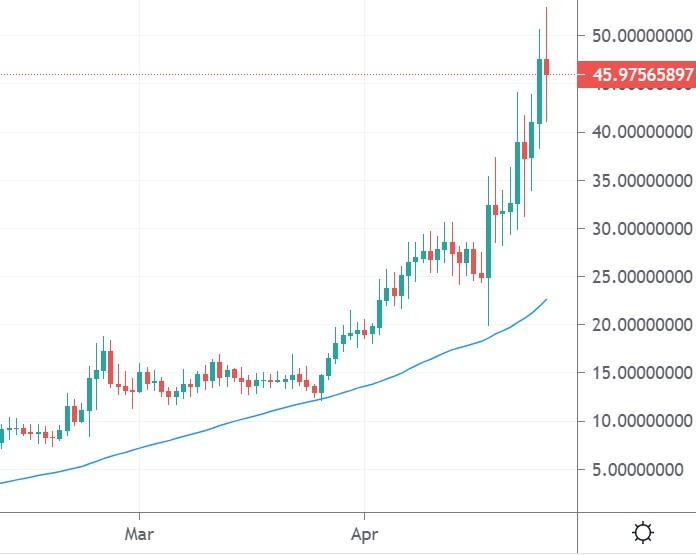
He also saw the ability for ETH and SOL to co-exist well in the ecosystem and that Solana would be in the top 3-5 coins. SOL saw record highs at the 50 level in the last two days and the coin has powered higher from a $10 price in February.

CELO

CELO was the best-performing coin this week with a 43% return and the coin has moved to number 80 with a market cap of $1.24bn after German mobile giant Deutsche Telekom made an investment into the defi platform.

The telecom giant was said to have made a “significant purchase” of the CELO token via its strategic investment fund, the Telekom Innovation Pool. Deutsche Telekom has also joined Celo’s ecosystem with a network of over 130 members, where the company’s subsidiary T-Systems MMS will be a validator implementing the Open Telekom Cloud. 

Deutsche Telekom has highlighted another sector that is open to crypto investments and it could lead to copycat investments by other competitors.

CELO Price Index

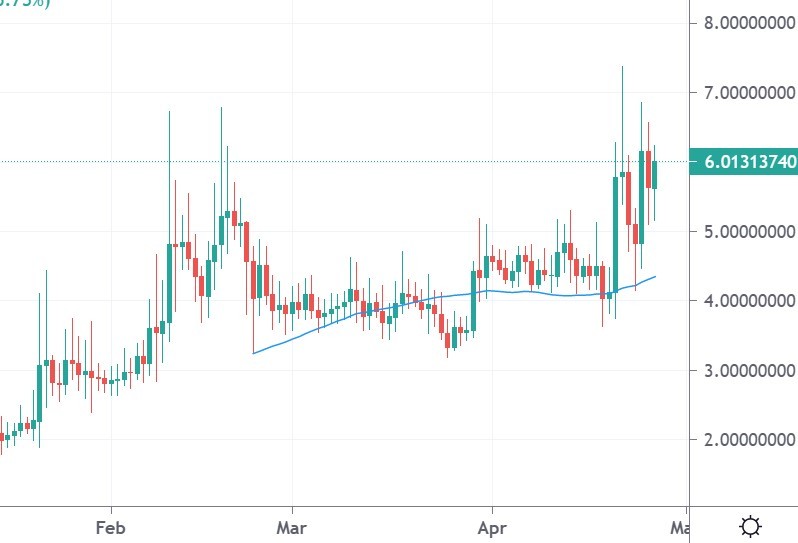
CELO has resistance at the $7.00 level and a move above that price would see further gains in the coin.

REGULATIONS

The market has been abuzz with regulatory talk over the last couple of months and the last week saw moves in that direction. 

Turkey is set to roll out restrictions on cryptocurrencies with the country’s central bank governor saying they would apply them in two weeks, adding that the bank would not ban cryptocurrencies

Turkey’s central bank chief revealed that the bank would be rolling out cryptocurrency regulations in the coming weeks. Governor Şahap Kavacıoğlu said this while speaking on the state-run channel TRT during the weekend.

According to the governor, Şahap Kavacioglu, the regulations would bring some structure to the market, but said: “You cannot fix anything by banning crypto, and we do not intend to do this.”

The governor also said there were concerns about funds that were leaving the country via cryptocurrencies. Turkey is trying to protect the value of its currency after a rise in inflation, but the reason that cryptos were invented was to avoid the impending collapse of monetary systems and governments are trying to protect those systems.

Although the governor didn’t give details on the proposed regulations, he voiced his concerns about the funds leaving Turkey via cryptos. He stated that they need to overcome the alarming amounts of funds leaving the country through such mechanisms.

The next news item said that South Korea would be moving to shut down all crypto exchanges in the country. There were around 200 crypto exchanges that would be affected by the closure.

The top financial regulator is looking at taking this action after it emerged that the firms have yet to comply with new regulatory laws introduced in the country. The chair of the Financial Services Commission, Eun Sung-soo, announced the move to a National Assembly policy committee. The regulator received no applications for the Virtual Assets Service Providers (VASPs) compliance program in the country.

The next country that could introduce some regulation is the USA, although the SEC has been talking previously about this possibility.

Charles Gasparino, a Senior Correspondent for Fox Business said: 

The Biden administration is in what’s been described to me from people close to them as the early stages of developing a regulatory approach to the crypto market… it’s being debated inside the Biden administration. From what I understand, SEC Chair Gensler… is waiting for some direction from Treasury for the overall policy before he develops a more specific regulatory approach to crypto, which will likely be the types of enforcement actions he goes after.

Charles Hoskinson, the founder of Cardano said on a Youtube video: 

There’s no reality that a government as regulation-friendly as the United States government will allow an industry with a market capitalization of over a trillion dollars to be unregulated or to live in this weird gray area of enforcement.

Both commentators agreed that BTC and cryptocurrencies were here to stay.

Go to Source

Things You Need to know About Decentralized Finance

So what is DeFi exactly? Will this be just a passing trend or will ignite a “new revolution” in the global market?

All will be revealed in the following article. So let’s dive in!

What Exactly Is DeFi?

DeFi stands for Decentralized Finance. This is the term used to refer to financial applications built on Blockchain.

Currently, Ethereum is the platform with the most active DeFi applications. However, this is not the only Blockchain – we still have a wide range of options from Blockchains by IOST, EOS, and TRON.

DeFi has always been accompanied by the term “Non-Custodial” i.e. non-mandate. Due to this feature, we often call it Open Finance.

You can visit their website by clicking this link: https://www.yield.app/

DeFi vs CeFi Comparison

CeFi is centralized finance, in which components such as organizations, trading markets, or instruments are centrally managed. Centralized finance is always accompanied by the phrase “custodial” or trust, that is, assets, products, and services in finance will be entrusted to certain organizations.

Having that said, the biggest difference between traditional finance and decentralized finance is trust. In Traditional Finance: There are intermediaries with centralized power in organizations, markets, and financial instruments. Meanwhile, DeFi leverages Blockchain’s power of transparency and decentralization to eliminate these intermediaries.

Specifically:

  • Government or banking (CeFi) will be replaced by decentralized blockchains.
  • CeFi’s assets will be replaced by tokens located in the Blockchain ecosystem. They are decentralized.

And DeFi’s mission is to provide users with access to financial services anywhere, whenever they have the Internet. DeFi’s openness is shown here.

The Many Perks Of DeFi

Privacy

DeFi dapps will have a limited need for a third party (banks or similar institutions) for the user to be custodians of their assets. At the same time, DeFi also allows users to own private keys. Transactions will be recorded under fake names to ensure the user’s privacy. 

Transparency

In the decentralized financial space, you will often hear the phrase “Don and trust, verify!” – i.e. you can verify any transaction on the blockchain as well as Defi.

Easy Access

Defi has a feature called Permissionless. Anyone at any place, any time can access and use DeFi products and services without being decentralized or restricted by any party.

High Interoperability

Building a main block makes interoperability between blocks much simpler. From there, users can create an ecosystem that can expand and become diverse over time.

Built On The Premise Of Blockchains

Blockchain technology plays the role of a ledger that records all transactions occurring in the system. It features outstanding traits such as: 

(1) Cannot be tampered with

(2) Indestructible blockchain chains

(3) High data security, high transparency

(4) Low cost

(5) Fast transactions

(6) Contracts that cannot be cheated

The Downsides Of DeFi

The only disadvantage of decentralized finance is probably the approach and usage. DeFi is tied to crypto-assets, so new users will need quite some time to learn how to use DeFi applications.

Some Components In DeFi

Decentralized Stablecoins

Stablecoins are issued in a decentralized form. 

I call these stablecoin 2.0. Generation 1.0 are stable currencies issued based on collateral, which are centralized commodities such as USD dollars, gold (USDT, USDC, TUSD, ..) And Stablecoin 2.0 (Decentralized Stablecoins) are issued based on the collateral of other cryptocurrencies (DeFi).

To put it simply, you can mortgage some of your cryptos to issue a stablecoin (with a smaller amount). In such projects, there usually are Governance tokens – this is the token that you can invest in.

Some projects that you should know: MakerDAO (MKR), Terra (LUNA), Just (JST), Reserve (RSR), Kava (KAVA), Venus (XVS).

Decentralized Lending and Borrowing

These are decentralized lending & borrowing platforms. Some notable projects: AAVE, MakerDAO, Osis, BZRX, Fulcrum, Compound, Dharma

Decentralized Insurance

This is a form of insurance for users in DeFi applications. Featured projects: Hakka Finance (3F Mutual), Yearn Insurance, Nexus Mutual, Opin.

Decentralized Exchanges (DEX)

These are decentralized exchange platforms. This should be very familiar to the experienced users, as it was developed in 2017. Up to now, they are also divided into many different types.

  • DEX 2017 – 2018: Kyber (KNC), Loopring (LRC), Bancor (BNT)
  • DEX 2020: Serum DEX (SRM), Sushiswap (SUSHI), Uniswap (UNI), 1Inch, Balancer (BAL), Curve (CRV)

Liquidity Mining

Liquidity mining allows users to make profits by providing the liquidity of the coins they have to the exchange platform. In return, the participant will receive a reward of governance token. This has been very popular since July 2020 and usually comes with the keyword Yield Farming. 

Some example: Sushiswap (SUSHI), Hard (HARD), Sun (SUN), Yam, Luaswap (LUA), Hakka Finance (HAKKA), Bella (BEL), Flamingo (FLM)

Decentralized Oracles

Oracle is a real-time data delivery system for blockchains and smart contracts. Thanks to Oracle, blockchain and smart contracts (on-chain) can interact with external data (off-chain).

Prominent projects: Chainlink (LINK), Band Protocol (BAND), DIA, Tellor (TRB), Nest Protocol (NEST), Zap, Augur (REP)

Decentralized Derivatives

Decentralized derivative products include Synthetix (SNX), Opium, Opyn, Hegic (HEGIC), and UMA.

Synthetic Assets

General assets include Synthetix, Tokenlong, and UMA

Several emerging DeFi groups in 2020

  • DeFi Ecosystem: These are projects that provide ecosystems & many different solutions, not just a single product: Hakka Finance (HAKKA), Yearn (YFI), Alpha Finance (ALPHA), Cream Finance (CREAM)
  • Decentralized Prediction Market: Projects include: Open Predict, Augur (REP), PlotX (PLOT), Decentralized Insurance (decentralized insurance).

Conclusion

As can be seen, DeFi is not just a passing trend, instead, it is an inevitable development of the market, serving the rightful needs of users. The total capitalization of DeFi projects is currently $ 18.4 B, accounting for 3.4% of the market cap. Having that said, the opportunities for DeFi’s are undeniable.

I believe we are still in the early stages of DeFi and this crypto market. Thus the best thing to do right now is to thoroughly study the topic and groups of coins that you are interested in before investing. Besides, choosing the right platform to invest in should also be a priority. It is advisable to start your DeFi journey on a safe platform that could also educate new users with the information needed. Yield App is such a platform! With this, you can discover the easiest way to earn interest in Crypto, safe and sound. 

Having that said, I wish you all the best in future investments in DeFi!

Go to Source

Crypto Exchange IPOs: Will Coinbase’s Stock Market Listing Set a Trend?

The popular U.S.-based cryptocurrency exchange Coinbase successfully ran its IPO last week, becoming one of the first crypto companies to do so. Its success means that other crypto exchanges could follow suit. Here are the stances of various exchanges.

Coinbase

Coinbase carried out its IPO on Wednesday, April 15. On that day the company’s Class A Common Stock was listed on Nasdaq under the ticker “COIN.”

Before the IPO began, Nasdaq gave Coinbase a reference price of $250 per share, giving the company a valuation of approximately $65.3 billion on a fully diluted basis.

Coinbase’s IPO has been in the works for at least a year. Rumors began to circulate in mid-2020. The firm then released its application publicly in February 2021 and announced that it had gained approval from the U.S. SEC on April 1, 2020.

Though widely referred to as an IPO, Coinbase actually carried out a direct listing. That means the company did not need to seek out underwriters and bankers; instead, company members simply converted their own existing shares to publicly listed assets.

Kraken

Kraken, another major cryptocurrency exchange, is also planning to go public. The most recent statements from company CEO Jesse Powell suggest it will do so in 2022.

Powell noted that Kraken will likely carry out a direct listing as well. In an interview on April 9, he told CNBC: “We’re looking at being able to go public sometime next year … it would probably be a direct listing, similar to Coinbase.”

Some sources have estimated that Kraken’s IPO could raise $10 billion, though Powell has stated that $10 billion is too low of a valuation to make selling shares worthwhile. He has also stated that his company is not in a “rush to raise capital” and that it is waiting to see how Coinbase’s IPO performs.

In addition to its IPO, Kraken is also seeking out new funding from VC funds and other investors. That could help it raise up to $20 billion.

Gemini

Tyler and Cameron Winklevoss’s Gemini exchange is also considering an IPO. In a January interview with Bloomberg, the exchange founders hinted at the possibility.

Cameron Winklevoss stated that the exchange is “watching the market” and “having internal discussions” on the matter. However, few technical details have been revealed, and there do not appear to be any valuation estimates for the company.

Robinhood and eToro

Distinct from crypto exchanges, two stock trading apps that offer cryptocurrency investment contracts are planning to run IPOs before the end of 2021.

The first is Robinhood, which has an estimated valuation of $40 billion. The second is eToro, which has an estimated valuation of $10.4 billion.

Though these companies’ services can only be considered adjacent to cryptocurrency, each company is highly visible in the crypto industry. It remains to be seen whether crypto investors will be interested in purchasing company shares.

Exodus

Exodus, a crypto wallet with a built-in trading platform, carried out an IPO this month. Rather than list its shares on a mainstream stock exchange such as Nasdaq, Exodus instead chose to sell shares on its own in-app trading platform.

The company’s IPO is fully regulated by the U.S. SEC and is compliant with Regulation A, meaning that it has some exemptions from certain requirements.

This means that Exodus’s IPO is relatively accessible. The firm says that it chose an approach that allowed customers to buy shares through the Exodus wallet with digital assets. It remains to be seen if other exchanges will imitate this strategy.

Binance

The popular Asia-based exchange Binance has stated that it has no intention to run an IPO, sell shares of the company, or go public in any way.

The company is apparently disinterested because it is already thriving. Binance CEO Changpeng Zhao stated during a Coindesk interview in March: “We’re not really short on funds. We’re surviving OK and we’re growing very healthily and organically.”

That assertion is backed up by Binance’s high-ranking status: Binance is the largest exchange by far, with a daily volume of $25 billion to $50 billion.

Will Crypto Exchange IPOs Become Popular?

Coinbase will be the first major cryptocurrency exchange to go public.

One possible exception is the payments app Square, which ran its IPO in 2015 before it added support for Bitcoin two years later. Several minor Bitcoin mining companies (Riot, Marathon, Canaan, and HIVE) are also traded publicly.

Regardless, Coinbase will be one of the most notable and influential stock offerings of the year. With over 500 crypto exchanges in existence, it seems likely that several more will pursue this course of action in order to raise funds.

Go to Source

Litecoin Price Prediction: LTC/USD Begins a Rally

Litecoin Begins a Rally– May 25
The LTC/USD market begins a rally after seeing a significant drop in its values over a couple of days’ trading sessions recently. Meanwhile, the crypto market hasn’t intensified much-required efforts to capitalize on the rallying motion over some last hours until now as price trades around $174 at a rate of -5.92% reductions.

Begins a Rally: LTC Market
Key Levels:
Resistance levels: $250, $300, $350
Support levels: $150, $130, $110

LTC/USD – Daily Chart
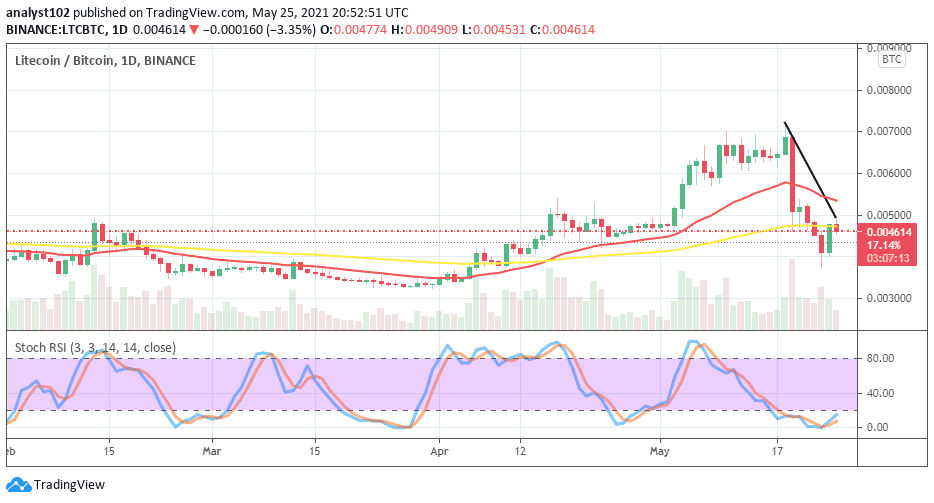
The LTC/USD daily chart shows that the crypto market begins a rally having briefly seen a breakdown of the lower support level of $150 during the May 23th day’s trading operations. Both the SMAs are still in a southward-bent posture to indicate that there are still somewhat of downward forces placing in the market. The bearish trend-line drew across the SMAs to the downside as the 14-day is over the 50-day. The Stochastic Oscillator is in the oversold region trying to open the hairs to the north direction.

Litecoin price begins a rally, will there be perfect upkeep?
There is a notable line of Litecoin that begins a rally taking its commencement around the formation of yesterday’s bullish candlestick that occurred from the depth of a downward pressure caused by the US Dollar. Having had that in place now, bulls are expected to muster catalysts to build up a buying wall from the support level of $150 or around it in the subsequent sessions.  

As regards contrary to the upside trading sentiment, bears now have up to the mid-point of about in between the $200 and $250 to launch back forces against the current rallying move that Litecoin has begun on a gradual moving process. If the presumed sell-off situation at that point has to get on an intense, the previous lower trading level of $150 will most likely be going to be revisited. In the meantime, the present level could also good for investment time.

LTC/BTC Price Analysis
Weighing the level of the trading situation between LTC and BTC, it is depicted on the chart that Litecoin begins a rally as paired with Bitcoin after about two days that the bigger SMA trading breached to the south by the purchasing power of the counter tool. The 14-day SMA is located over the 50-day SMA. The Stochastic Oscillators are trying to open the hairs toward the north from the oversold region. That signifies that the base tool’s rallying against the counter instrument will soon materialize positively in the near time.

Go to Source

China Reiterates its 2018 Ban on Bitcoin Mining and Crypto Trading

  • China has reignited plans of cracking down on Bitcoin mining and trading within its borders
  • Bitcoin has dipped from $41k to a local low of $36,600 due to the news
  • China’s government had announced and initiated a similar crackdown in 2018 which officially kicked off the bear market then

The Chinese government has once again reiterated its plans of cracking down on Bitcoin mining and crypto trading within its territories. The call to ban Bitcoin mining and crypto trading was initiated by the Vice Premier of the People’s Republic of China, Liu He, during the 51st meeting of the State Council Financial Stability and Development Committee.

The minutes of the meeting have been released by the China Government Network. An excerpt of the minutes, that have been translated using Google Translate, can be found below.

The second is to resolutely prevent and control financial risks. Adhere to the bottom line thinking, strengthen the comprehensive scanning and early warning of financial risks, promote the reform of small and medium financial institutions, focus on reducing credit risks, strengthen the supervision of platform enterprises’ financial activities, crack down on Bitcoin mining and trading behavior, and resolutely prevent the transmission of individual risks to the social field.

It is necessary to maintain the smooth operation of the stock, debt, and foreign exchange markets, severely crack down on illegal securities activities, and severely punish illegal financial activities.

Bitcoin Drops to a Local Low of $36,600

News of China once again planning on banning Bitcoin mining has resulted in BTC dropping from $41k to a local low of $36,600. Only time will tell whether Bitcoin and crypto traders will continue selling their holdings on this news.

China Had Announced a Similar Ban in 2018

The statement by Vice Premier Liu He is similar to the one that was issued by the Chinese Government back in January 2018 when it banned Bitcoin mining and crypto trading. The ban back then was aimed at cracking down on money laundering, fraud, and limiting the amount of electricity used by miners.

At the time of writing, it is still uncertain as to whether the Chinese government will follow up on its intention of cracking down on Bitcoin mining and crypto trading this time around.

Go to Source

Ethereum Could Reclaim $3.2k to $3.5k in the Short Term – Report

  • Ethereum could reclaim $3.2k to $3.5k in the short term
  • This price target is reliant on Ethereum breaking the $3k ceiling
  • Ethereum’s 50-day moving average is also acting as a resistance at the $3k price area
  • The London Upgrade in July could assist Ethereum in rallying back to $4k

Ethereum (ETH) could reclaim the $3,200 to $3,500 price area in the short term. This is according to an analysis done by the team at Crypterium who also pointed out that the $3k ceiling needed to be broken before Ethereum regained its bullish momentum. They explained Ethereum’s possible short-term price movement as follows.

An important resistance level now is the $2,975 — $3,000 range…In the near future, the price will come to this zone. After fixing inside it, the ETH chart may rise sharply to the range of $3,200 — $3,500.

Ethereum’s 50-day Moving Average is also Acting as a Resistance

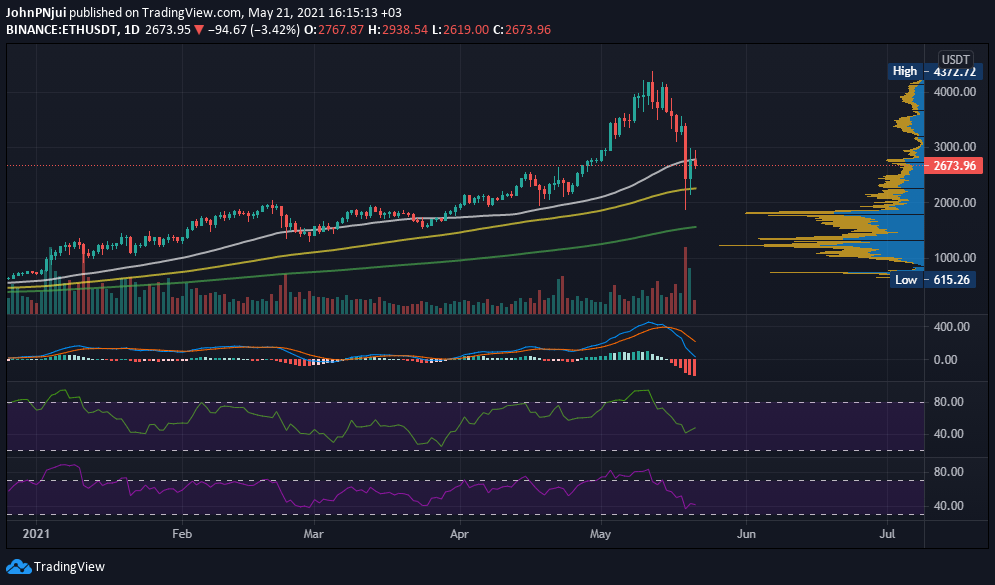
The $3k price ceiling for Ethereum also converges with the 50-day moving average (white) that is now acting as resistance as seen in the chart below.

Also from the chart, it can be observed that the daily MACD, MFI and RSI are indicating an ongoing correction for Ethereum in the crypto markets that might abate as we inch closer to the new month of June. A continuation of the pull-back could mean that Ethereum revisits the lower $2k levels, or the local low of $1,888, before the end of this month.

Ethereum’s London Upgrade Could Push ETH towards $4k

To note is that the months of June and July will be a busy time period for Ethereum developers as they finalize the London upgrade that will usher in EIP1559. The latter Ethereum Improvement Proposal is aimed at taming the issue of high gas fees as well as turning ETH into a deflationary asset.

Therefore, chances are, that the events leading up to the London Upgrade will provide enough fuel for Ethereum to rally back towards the $4k leading up to the event.

However, such a bullish possibility for Ethereum is hinged upon a stable Bitcoin without the gut-wrenching volatility that was witnessed this past Wednesday when BTC dropped from $42k to $30k in less than a day.

Go to Source

Fed’s Daily Tapering Increases by 23%- Tuesday’s Reverse Repo Removes $432 Billion from Market

Since well before the onset of Covid-19, the U.S. Federal Reserve had initiated monetary easing policies and from then on, the M1 Money Stock supply skyrocketed to levels never-before-seen in history. This weekend reports disclosed that the Fed has started to taper quantitative easing (QE) when it removed $351 billion from the market last week. This Tuesday the Fed revealed it completed a reverse repo operation for $432.9 billion.

  • On May 22, Bitcoin.com News reported on the Federal Reserve initiating overnight reverse repos (RRP) to the tune of $351 billion. Tuesday’s recently reported reverse repo shows a 23.07% increase.
  • RRP facility operations are the opposite of QE, as the Federal Reserve removes M1 from the system by selling Treasuries back to the market. The most recent overnight operations seem to be only Treasuries, as no purchases of mortgage-backed securities (MBS) have been mentioned.

  • The Federal Reserve followed the $351 billion RRP operation with $369 billion on Friday and $395 billion on Monday.
  • The U.S. central bank revealed on Tuesday $432.9 billion was removed from financial markets.
  • Since the Federal Reserve has been on a spree of reverse repo operations, speculators think the central bank will continue to increase the M1 removal. “Fed Reverse Repo 432.955 Billion from 48 counterparties Repo market is still broken, broken. We’ll break 500 billion tomorrow,” one person tweeted on Tuesday.

  • On Monday, Scott Skyrm, executive vice president in fixed income and repo at Curvature Securities commented on the reverse repo situation to Market Watch columnist Joy Wiltermuth. “Why are they going to the Fed?” Skyrm asked. “Either there is too much cash or not enough collateral. It’s two sides of the same coin,” he added.
  • “A BTIG Research team led by Julian Emanuel described the situation like a game of cat and mouse,” Wiltermuth’s report concludes.
  • In 2020 alone, estimates say the U.S. central bank’s 2020 M1 increase eclipsed two centuries of USD creation. It is estimated that 24 to 30% of all USD was created in 2020 and Q1 2021.

What do you think about the Fed’s reverse repos during the last few days? Let us know what you think about this subject in the comments section below.

Go to Source

Please enter CoinGecko Free Api Key to get this plugin works.
Exit mobile version