US SEC wants to work with Congress to regulate crypto exchanges

SEC head Gary Gensler said that the authority spends only $325 million per year on tech, which is less than some industry players spend in two weeks.

The United States Securities and Exchange Commission is looking to cooperate with Congress and other regulators to increase its oversight of cryptocurrency exchanges.

Gary Gensler, the newly appointed chairman of the SEC, said that the commission is looking forward to working with fellow regulators and Congress to fill gaps in investor protection in crypto markets. 

The official announced the plans at a Wednesday hearing before the Financial Services and General Government subcommittee of the House of Representatives.

Gensler said that the SEC needs to provide similar protections for crypto exchanges that an investor would get on the New York Stock Exchange or Nasdaq:

“If you placed an order on an app, and you said, ‘Alright, I want to buy a stock,’ there are rules that protect you that somebody won’t use your order and get ahead of you. […] So, it’s trying to bring the similar protections to the exchanges where you trade crypto assets as you might expect at the New York Stock Exchange or Nasdaq.”

The new SEC head also outlined some of the challenges to regulating the cryptocurrency industry, stating that the SEC is “under-resourced” in financial terms when compared with some of the big players in the industry. “We only spend about 16% or 17% of our budget, about $325 million a year, on technology, which is less than probably some large firms spend in a month. Some of them even spend that much in two weeks,” he noted.

Gensler previously suggested that the SEC should be cooperating with Congress to properly address crypto exchange regulation in a market volatility-related hearing of the House Financial Services Committee in early May.

Last week, Michael Hsu, the new head of the Office of the Comptroller of the Currency, announced that the agency has been in talks with the U.S. Federal Reserve and the Federal Deposit Insurance Corporation about setting up an “interagency policy sprint team” focused exclusively on crypto.

Go to Source

Austrian Post combines NFT and NFC tech for digital postage stamp

The Austrian post is set to incorporate near-field communication to its award-winning nonfungible token digital postage stamp.

Oesterreichische Post AG — Austria’s postal service — is set to adopt even more digital technology protocols for its nonfungible token (NFT) postage stamps.

In a recent announcement, the Austrian Post revealed plans for incorporating near-field communication (NFC) chips in Crypto Stamp 3.0 — the third iteration of its limited-edition NFT postage stamp collectible series.

These embedded NFC chips will allow stamp owners to verify the authenticity of the physical stamp based on metadata tied to the digital twin stored on the blockchain.

Indeed, the Austrian Post made history back in 2019 by becoming the first government-backed institution to launch an NFT. The Austrian Post Crypto Stamp also won numerous awards at the NFT Awards 2020 including the “Adoption Potential Award” and the “People’s Choice Award.”

Detailing the NFC-NFT interaction for Crypto Stamp 3.0, the post office said:

“For the first time, NFC technology is also being used on an Austrian postage stamp: The Crypto Stamp 3.0 is based on an NFC-supported authenticity check and is cryptographically encrypted. […] By reading out the NFC chip, both the authenticity and the digital twin can be revealed.”

According to the Austrian Post, the use of NFC technology eliminates the need for creating an additional scanning app to verify ownership of the NFT postage stamp.

For Stefan Nemeth, head of product management and e-business branches at Austria’s postal service, the adoption of NFC technology is a major step in adding even more intuitive features to future NFT postage stamp iterations.

Crypto Stamp 3.0 will have a market value of 9.90 euros ($12), with a total circulation of 100,000 stamps. Registration for preordering the NFT stamp will reportedly commence in June.

Since debuting its NFT postage tokens, postal services in other jurisdictions have also got in on the act. Back in March, crypto startup Coinsilium inked a partnership with the Gibraltar Philatelic Bureau to issue NFT postage stamps.

As previously reported by Cointelegraph, the United States Postal Service certified CaseMail’s postage NFTs back in April.

Go to Source

Apple Looking into Crypto Job Posting Confirms – Time to Invest in Bitcoin?

Apple has listed a new job posting stating that it is looking to hire a business development manager with experience in the crypto sector. The new manager will head the firm’s alternative payments partnership program.

The job posting also stated that the candidate needed to have at least a decade of experience in the sector and more than six years working in business development for a financial services firm.

Launching an Alternative Payments Division

The interesting part of the posting is that the individual needed more than five years of experience working with alternative payment providers. However, this was not a confirmation of what Apple was planning to do, but it was an indication that the tech giant may be looking into cryptocurrencies.

“We are looking for a proven professional in global alternative and emerging payment solutions,” Apple stated in the job posting.

This will not be the first time that Apple has seemed to show interest in cryptocurrencies. In 2019, the vice president of Apple Pay, Jennifer Bailey, stated that the company was actively looking into potential of cryptocurrencies. She also noted that the US was behind Europe in crypto adoption and that the market showed promise.

More companies venturing into crypto

This year has seen an increase in the popularity of digital currencies, boosting their value accordingly. Because of this, several major companies have become involved in the sector, seeking to tap into the market’s great potential.

For example, at the beginning of the year, Tesla, a leading electric car manufacturer, ventured into cryptocurrencies by accepting Bitcoin as a payment method. The company also invested heavily in Bitcoin, with an initial outlay of $1.5 billion. However, the firm later suspended acceptance of bitcoin payments in what was seen as a setback for the crypto industry, citing concerns over environmental impacts.

Tesla’s CEO has also been a great advocate for the crypto market. He has even been labelled a market maker because of the influence his tweets have on the crypto market’s performance. In addition to Bitcoin, Musk has also been pushing for Dogecoin and even branded himself the ‘Dogefather.’

Apple and Tesla are not the only giant firms in the US to show interest in cryptocurrencies. This year, leading payment service providers such as PayPal, MasterCard and Visa also ventured into cryptocurrencies by launching a new division. Wall Street firms have also been looking into cryptocurrencies to meet the increased demand for these assets by clients.

Despite the achievements the crypto market has made this year, the market crashed a couple of weeks ago, leading to nearly 50% of cryptocurrency value being wiped off the market. However, this has not deterred continued investment into the sector, with institutional buyers in particular leaning towards buying the dips.

Go to Source

Here’s Why Ethereum (ETH) Won’t Overtake Bitcoin – Buy BTC Now?

Analysts such as those from Goldman Sachs have argued that Ethereum (ETH) will soon surpass Bitcoin (BTC) as a store of value. However, others are equally adamant in the belief that this will not happen and that Bitcoin will retain its dominance in the broader crypto market.

Because the crypto market is highly volatile, it is practically impossible to predict which token will win in the future. Nevertheless, we can use token performance over a given period to figure out the best way of investing in the market depending on which tokens will outperform others.

Why Bitcoin will retain dominance

Bitcoin is the pioneer of the crypto industry, and remains that more popular than the rest. To begin with, Bitcoin is more accepted as a means of payment by various companies. Most firms that ventured into the crypto sector during the boom started with Bitcoin. MasterCard, Tesla, and others all chose BTC over the other pool of cryptocurrencies because of its popularity. This illustrates that Bitcoin’s dominance is in its use as a medium of exchange.

Bitcoin’s popularity was also evidenced recently after a report by NYDIG confirmed that nearly 50 million Americans own Bitcoin. This shows that in a market with many altcoins, Bitcoin stands out because people can associate with it more. If these statistics were to be compared against the people who hold Ethereum, the numbers would be much less.

Buy Bitcoin Now

Bitcoin is also more popular with those governments looking to circumvent US economic sanctions. An example of this is Iran, which has supported the use of Bitcoin to help the economy survive amidst the harsh economic restrictions imposed on the country by the US government.

However, the Iranian state wants to assert its control over the mining industry in the country and again clamped down on the industry in the country this week, blaming unauthorised miners for rolling blackouts in the country.

The other reason why Ethereum or any other altcoin will not overtake Bitcoin is that it is in almost every crypto exchange. Newly launched exchanges will start by offering Bitcoin before moving to other cryptocurrencies such as Ethereum.

Ethereum shows resilience but bitcoin is front

On the other hand, Ethereum is proving to be a formidable opponent to BTC. As the second-largest cryptocurrency globally, Ethereum also has a large clientele base, making it Bitcoin’s largest competitor.

A comparison of the growth rate between Bitcoin and Ethereum over the past year shows that BTC is up 300% compared to its price 12 months ago, while Ethereum is up 1000% in the same period.

The other reason why Ethereum is showing resilience is that it does not just get its popularity purely from being a store of value.

The Ethereum network has been a major hub for DeFi projects. The growing value of Ethereum is attributed to this. If Ethereum implements the layer two upgrade as expected, the Ether token’s value is expected to go even higher, and this will throw BTC off the rails.

Nevertheless, the brand power and network effects of being the first and biggest means bitcoin will remain the crypto leader.

Looking to buy or trade Bitcoin (BTC) now? Invest at eToro!

Buy Bitcoin Now

75% of retail investor accounts lose money when trading CFDs with this provider

Go to Source

Lack of knowledge is main barrier to crypto adoption, new survey says

55% of survey respondents said that they were aware of crypto despite never owning or using cryptocurrencies.

Among the many complications associated with cryptocurrencies like Bitcoin (BTC), a lack of knowledge and understanding of crypto is the biggest obstacle for wider adoption, according to a new survey.

The Economist Intelligence Unit, the research and analysis division of the Economist Group, released a new report called Digimentality 2021.

The study was commissioned by major payment and cryptocurrency platform Crypto.com, and contains a consumer survey of 3,053 people conducted from February to March 2021.

According to survey results, 51% of respondents said a lack of knowledge is the main barrier to the adoption of open-source cryptocurrencies like Bitcoin and Ether (ETH), while 34% of survey participants cited security concerns as the main obstacle, and 29% indicated difficulties in knowing where to buy crypto.

In terms of crypto acceptance by institutional investors and corporate treasuries, 47% of respondents said that overall market trust or understanding of digital currencies was the biggest adoption obstacle. Some 32% of survey takers cited cryptocurrency regulations as a primary obstacle to wider institutional acceptance, while 43% and 36% said financial market structures and asset volatility were the foremost obstacle, respectively.

Source: The Economist Intelligence Unit

The survey also stated that 55% of respondents were aware of cryptocurrencies despite never owning or using one. “As more people adopt and have access to digital wallets, you can just see the number who have access and invest in cryptocurrencies continues to broaden,” Goldman Sachs’ global head of digital assets Mathew McDermott said in the report.

According to a recent survey by Gemini crypto exchange, nearly two-thirds of adults in the United States are interested in learning more about cryptocurrencies or holding them soon.

Go to Source

Number of Bitcoin wallets holding 100-1K BTC soars after Tesla’s $1.5B buy-in

New data shows a dramatic rise in the number of Bitcoin wallets holding anywhere between 100 BTC to 1,000 BTC, but there may be a catch.

The amount of Bitcoin (BTC) held by whales increased by around 14% after Tesla announced its foray into the cryptocurrency sector in early February 2021.

The latest data from on-chain analytics platform Glassnode shows an inflow of roughly $19.5 billion worth of Bitcoin — according to current exchange rates — into wallets that hold at least 100 BTC and a maximum of 1,000 BTC. The deposits spiked right after Tesla revealed in its January securities filings that it had added $1.5 billion worth of BTC to its balance sheet.

The news hit the wire on Feb. 8 when the cost to purchase one Bitcoin was as low as $38,057 on Coinbase. The rates shot up toward $65,000 by mid-April, driven higher by bulls that expected Tesla’s involvement in the cryptocurrency sector to influence more corporates into adding Bitcoin to their balance sheets.

The adoption prospects for Bitcoin among corporates and other institutions boomed because of the cryptocurrency’s anti-inflation narrative. Many speculators projected Bitcoin as an insurance against the Federal Reserve’s expansionary monetary policies that sapped investors’ appetite for traditional safe-havens like the United States government bonds and the U.S. dollar.  

USD index shows erratic inverse correlation with Bitcoin after March 2020. Source: TradingView

Tesla, in its first-quarter filing to the U.S. Securities and Exchange Commission, also noted that it wanted to buy Bitcoin by utilizing its unused cash reserve worth $1.5 billion, hinting that the electric carmaker was looking to offset potential dollar devaluation risks.

The Glassnode BTC supply metric shows signs of stabilization following latest crash. Source: Glassnode

The entire Tesla episode served as a bullish cue for investors looking to maximize their returns from the Bitcoin bull run. The Glassnode metric showed that the Bitcoin supply held by 100-1K BTC wallets was stable before Tesla’s announcement but spiked dramatically after it.

But there’s a catch

However, another Glassnode metric, that measures the Bitcoin supply held by wallets with a 1K-10K BTC balance, illustrated a steady decline — from around 455,000 BTC (~$17.88 billion) to roughly 410,000 BTC (~$16.11 billion).

The outcome revealed that bigger whales sold their Bitcoin holdings following Tesla’s announcement. As a result, they became part of the 100-1K BTC supply group.

Entities with 1K-10K BTC balance dropped after Tesla’s bitcoin investment. Source: Glassnode

Meanwhile, the sell-off from the 1K-10K BTC supply group did little in offsetting the Bitcoin bull run. The cryptocurrency approached the all-time high of $65,000, indicating smaller whales and retail traders absorbed the selling pressure from bigger investors.

Bitcoin is trading around $39,300 at time of writing, down roughly 38% from its record peak in mid-April.

Go to Source

Hong Kongers use blockchain to save evidence of anti-authoritarian struggles

Hong Kong citizens are using a blockchain system to fight back against the government’s attempts to erase and overwrite the history of recent years’ anti-authoritarian struggles.

Blockchain’s potential to sustain a distributed, tamper-proof infrastructure for collective digital memory has taken on an unexpected political salience for citizens in Hong Kong. 

Soon after Hong Kong’s public broadcaster Radio Television Hong Kong, or RTHK, revealed its intent to erase any archived content over one year old, residents hurried to save a trove of past news footage that had until now been freely available to the public. The reason for their haste was the recognition that RTHK’s archive contains critical coverage of the recent years of anti-authoritarian struggles and protests that were initially sparked by the introduction of the draconian national security law, as well as evidence of these struggles’ brutal repression.

The fight over the collective record of the past has long been underway at an official level, encapsulated by the Hong Kong police’s attempt to rewrite the narrative of one of the most violent and traumatic episodes in the 2019 protests: an indiscriminate assault on civilians at the suburban subway station Yuen Long. RTHK’s impartial coverage of that episode will be among the content lost to oblivion now that incremental deletion is underway.

Against this backdrop, a blockchain platform that first emerged at the height of the protest movement is now poised to provide citizens and activists with the vital means to reclaim and preserve their recent political history in its integrity.

The platform, called LikeCoin, is a blockchain-based decentralized publishing infrastructure, which provides a decentralized registry for all manner of content. Its features enable Hong Kongers to coordinate their efforts to archive now-endangered records across one distributed and tamper-proof collective database. 

Rather than storing the data itself, LikeCoin registers the metadata i.e. information regarding the content’s author, title, publication date and location. It also stamps each entry with a unique and immutable digital fingerprint: an  International Standard Content Number, or ISCN, similar to a book’s ISBN. 

The platform’s founder, Kin Ko, told reporters that while downloading and saving content in an ad-hoc manner may help citizens to resist official censorship of history to an extent, proving the authenticity and integrity of that data in the future will be more problematic. He explained:

“If you’re the person who backed it up, you can look through the hard disk. But what if you’re not that person? Or what if your hard disk has broken? […] How do you know that [backed up] photo is the same photo taken 10 years ago? How do you know there hasn’t been extra work done to it?”

With LikeCoin’s blockchain infrastructure, 10 (or however many) years from now it will be possible to know whether or not the content has been tampered with by tracking any changes to its digital fingerprint. When it comes to historically significant archived video footage, that could offer a clue that the original file may have been re-edited in a deliberately misleading way.

LikeCoin uses its own blockchain to avoid the high transaction costs of a network like Ethereum at such a scale. Backing up a country’s recent political history is no small matter. Ethereum had, in a more limited context, memorably been used to publish and preserve a single letter by Chinese #MeToo activists battling government censorship.

Go to Source

Restricting crypto trading to millionaires good for Hong Kong, says official

Hong Kong’s Treasury Secretary says the government is right to pursue restrictive crypto regulations in the city.

Christopher Hui, Hong Kong’s Secretary for Financial Services and the Treasury has defended the recent proposal by the city’s Financial Services and the Treasury Bureau to ban retail crypto trading.

In a speech delivered at StartmeupHK virtual fintech summit on Thursday, Hui said that the proposal was in line with the government’s plan to properly police the emerging crypto market.

As previously reported by Cointelegraph, the FSTB issued a proposal after months of consultation, calling for a ban on retail crypto trading and the establishment of a strict regulatory regime for cryptocurrency exchanges.

As part of the proposal set to be presented before the city’s legislature, the FSTB argued for a minimum investment threshold for crypto trading at about $1 million. This provision will reportedly exclude about 93% of Hong Kong’s population from the city’s cryptocurrency market if passed by the government.

However, Hui is of a different view, stating, “We are of the view that a proper regulatory system could facilitate development and at the same time protect investors and adhere to international regulatory standards.” According to the Hong Kong treasury chief:

“Imposing mandatory requirements to protect investors, prohibit market manipulation, and guard against money laundering and terrorist financing, we believe the proposed regime will further facilitate development of the virtual assets industry in Hong Kong, leveraging our world-class regulatory framework.”

Apart from shutting out retail crypto activity, Hong Kong’s restrictive laws may also force exchanges out of the city despite the government’s plan to allow foreign companies to obtain operating licenses in the city.

Indeed, back in December 2020, when the FSTB was still in the middle of its consultations, several industry stakeholders criticized the planned crypto regulations. At the time, critics argued that these restrictive digital currency laws would be inimical to Hong Kong’s financial innovation agenda.

Go to Source

How Proof-of-Stake Coins Can Flourish In ESG Funds – Buy ADA, DOT, SOL, MATIC Now?

Environmental, social and governance (ESG) funds are growing in popularity with mainstream investors looking to put their money to work by generating returns from doing good for the world.

So where can crypto fit in with the ESG boom? Unfortunately, despite astronomical price surges, crypto assets have earned themselves a bad reputation on the environmentally front.

Certainly, it is the case that some cryptos have a green deficit, but there are many others that are in fact energy-efficient and could therefore be more likely to find themselves in an ESG-focused investment portfolio or fund. 

ESG Funds May Shun BTC Companies

According to research by the University of Cambridge, most Bitcoin miners are based in China, relying heavily on coal to generate energy. 

The researchers behind the Cambridge Bitcoin Energy Consumption Index also pointed out that Bitcoin uses more energy than some countries in the world.

The index puts BTC energy consumption at 113.27 TWh of electricity.

To put that into perspective, a single transaction of BTC has the same carbon footprint as 680,000 Visa transactions or 51,210 hours of binge-watching YouTube videos.

With the world looking to reduce greenhouse gas emissions, this presents a major problem for the nascent industry and the ESG funds with deep-pockets.

Buy Cardano (ADA) Now

There are hundreds of crypto protocols relying on proof of work (PoW) in validating transactions, but Bitcoin is the most well-known given its large market cap. Another famous PoW user is decentralized finance (DeFi) facilitator Ethereum which plans to migrate to a less energy-intensive mining protocol called a proof-of-stake (PoS).

Bitcoin a negative for companies unless ESG issues fixed

Due to the inherent flaws in the PoW process, ESG-focused funds may shun companies with Bitcoin in their portfolio due to the growing environmental concerns. 

ESG funds are investment portfolios of equities and bonds of which environmental, social, and governance factors have been integrated into the investment process.

These funds contain investments with high sustainability scores and exclude industries with poor records on environmental hazards, pollution, labor relations, or management practices.

In a sign of the popularity of ESG and how it is moving up the crypto agenda, One River Asset Management this week filed the One River Carbon Neutral Bitcoin Trust ETF for approval with the Securities & Exchange Commission. The fund intends to use carbon offset purchases to balance the emissions from its crypto holdings.

One River is also a supporter of Net Zero Asset Managers Initiative alongside VanEck, Fidelity, and 84 other digital asset management firms.

These groups aim to reduce global greenhouse emissions by repurposing their crypto mining practices.

Battle of the Protocols: PoW vs. PoS

PoW has played a significant role in resolving the ‘Byzantine Generals Problem’ in distributed computing (the problem of when A send to B, B can be sure that the message hasn’t been intercepted and changed before receipt). But the PoW validation protocol comes with several pitfalls.

There are currently a number of major contenders in the PoS field vying for the attentions of ESG investors, such as Cardano, Polkadot, Solana and  Celsius. Then there are the likes of EOS, Tezos and Tron, which are more established PoS networks but have slipped in popularity because of perceived governance and centralisation issues.

Standing out prominently is its slow transaction speed. It takes time before a PoW protocol reaches a consensus, and Bitcoin takes about 4-6 seconds to validate transactions. Compared to Visa’s 20,000 transactions per second (TPS), this is a paltry figure.

Another notable shortcoming is the amount of energy PoW protocols use in validating transactions, which is problematic for investors like ESG fund managers. Bitcoin reportedly consumes more energy than several countries, even though it has rapidly led to more financial inclusion for more people.

These pitfalls have seen many blockchain developers look towards PoS protocols, which are scalable, interoperable blockchain networks. PoS is also less energy-intensive and will fit into the broader goal of reducing the global carbon footprint as the world embraces cryptocurrencies.

A top contender: Solana processes 50,000 transactions per second

And with PoS projects such as Solana processing over 50,000 tps, crypto projects using this validation process may better compete with big payment networks such as Visa and Mastercard.

More crypto projects are rapidly transitioning to the PoS consensus protocol by the day, given the small amount of energy needed. A recent prediction by crypto lending platform Celsius Network CEO Alex Mashinsky pointed to DOGE as likely to take the PoS plunge soon.

Even though the meme-based cryptocurrency has a considerably low energy demand of just 0.12 KWh and processes transactions faster than BTC, Mashinsky said the auxiliary proof-of-work (APoW) asset would migrate to PoS to further cut down on its energy consumption. 

To most industry experts and ESG Funds, the continued criticism of the PoW mining process will aid the subsequent rise of PoS blockchain networks.

Looking to buy or trade Cardano (ADA) now? Invest at eToro!

Buy Cardano (ADA) Now

75% of retail investor accounts lose money when trading CFDs with this provider

Go to Source

Litecoin (LTC) Payments are Now Supported by Venmo, Protonmail Shop

  • Litecoin is now a payment option on the Protonmail shop and Venmo
  • Bitcoin, Ethereum and Bitcoin Cash is also supported by the two platforms
  • The Protonmail Shop has additional support for DAI
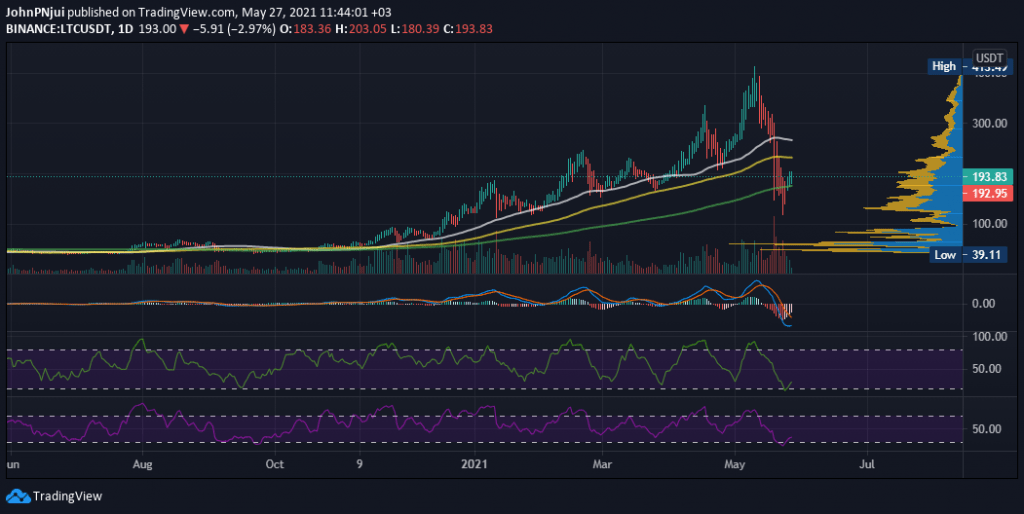
  • Litecoin has bounced back above the 200-day moving average

You can now use Litecoin (LTC) as a payment option on the Protonmail Shop and Venmo.

In the case of the Protonmail Shop, Litecoin is a payment option alongside Bitcoin, Ethereum, Bitcoin Cash and DAI. The five digital assets can be used to purchase several items on the online Protonmail merchandise store such as t-shirts, hoodies and gift cards. The site also accepts traditional forms of payment such as VISA, Mastercard, Apple Pay and Paypal.

With respect to Venmo, Litecoin is one of four crypto payment options that include Bitcoin, Ethereum and Bitcoin Cash. To note is that Venmo is a payment service owned by Paypal and allows users to send and receive funds via a mobile app. What differentiates Venmo from its parent company is that payments and purchases are made through a social feed.

Litecoin Reclaims the 200-day Moving Average

With respect to price action, Litecoin is once again trading above the crucial 200-day moving average (green) as demonstrated in the following daily LTC/USDT chart.

Also from the chart, it can be observed that Litecoin is in the process of recovering from a brutal two weeks when LTC first hit an all-time high of $413, only to dip by 71.4% to a local low of $118. The latter price level was reached as a result of the panic selling that followed the speculation that Tesla had sold its Bitcoin holdings and China’s government rekindling its ban on BTC mining and crypto trading.

The daily MACD, RSI and MFI on the Litecoin chart further confirm an ongoing reversal with the $200 price area offering an area of short-term resistance. The 100-day (yellow) moving average and 50-day (white) moving average also provide areas of resistance at $230 and $264.

In summary, Litecoin is on a path towards recovering some of the losses of the last two weeks provided Bitcoin does not experience additional volatility that would send LTC lower.

Go to Source

Chia Is Eyeing to Launch an IPO This Year

Chia, a cryptocurrency project created in 2018 that uses storage for its consensus, is eyeing a public offering this year, according to statements from its COO, Gene Hoffman. The company just received an influx of investments that are pointing it to become the next ‘green bitcoin substitute,’ due to its relatively low energy consumption compared to other proof-of-work (PoW) alternatives.

Chia Aims to Launch an IPO This Year

Chia, a cryptocurrency that was founded two years ago but launched its mainnet recently, is striving to launch an initial public offering (IPO) as soon as this year, as statements from the company backing it show. Chia Network Inc, which was founded by the Bittorrent creator, Bram Cohen, just recently received a funding round of more than $60 million, which gave the cryptocurrency a valuation of $500 million.

The companies which led the funding round were Richmond Global Ventures and the known Andreessen Horowitz, but other companies were also involved. Breyer Capital, Slow Ventures, True Ventures, Cygni Capital, Naval Ravikant, Collab+Currency, and DHVC also participated.

Gene Hoffman, COO of the company, informed the public that these resources will be used to keep hiring manpower and fuel the promotion of the cryptocurrency as an alternative to other important coins in the space, like bitcoin.

Hoffman stated:

Our goal has always been to go public relatively quickly as that will significantly clarify our regulatory environment and allow customers to use currency to hedge public market volatility, which is different from other coins.

The latest round of investments has made them confident about what they might achieve with an IPO. The recent environmental concern narrative that is now seeking greener alternatives to bitcoin’s PoW might help them in the process.

Is Chia’s Use of Hardrives and SSDs Really Green?

But, what is really Chia, and how does it compare to the Bitcoin network? Chia is a cryptocurrency that uses hard drive space, as the pivotal element of its consensus algorithm. Chia miners use this space to plot cryptographic answers that will be challenged by the network. If a block challenge has the same content that a plot in a miner hard drive, then the miner wins the reward. This is known as “Proof-of-Time-and-Space.”

Compared to the Bitcoin network, this approach is greener than PoW consensus, because common hard drives and computers spend less energy than ASIC miners to confirm transactions. However, Chia still has its not-so-green side. There have been reports that show hard disks used by Chia miners often malfunction faster than drives used normally, due to the intensive use that they experience. This creates more electronic waste that needs to be recycled or dumped, also having an impact on the environment.

Be this as it may, Chia proponents believe the asset has a real shot at becoming one of the most important cryptocurrencies in the future. Bram Cohen and Bittorent’s success has helped bolster optimism toward Chia.

What do you think of Chia going public possibly this year? tell us in the comments section below.

Go to Source

Little Green Mining Hood or the Big Bad Wolf: Musk’s Sustainability Play

Recent announcements and actions by Elon Musk surrounding bitcoin mining sustainability raise questions about the reasoning and motivations of Tesla’s Technoking. Is it possible that Musk is playing a calculated marketing game to introduce a Tesla mining solution?

The World of Bitcoin Mining According to Musk

Once upon a time, for 49 days, the world was able to purchase Teslas with bitcoin. Then, on May 12, Elon Musk posted the now-infamous tweet saying that Tesla “suspends” vehicle purchasing using bitcoin due to the increasing use of fossil fuels for bitcoin mining and transactions.

It was a curious announcement. Was Musk not aware of the bitcoin mining footprint in March when announcing that Tesla would begin accepting bitcoin? Or when he bought $1.5 billion worth of the cryptocurrency?

Another question that must be addressed – how many Teslas were actually purchased with bitcoin during those glorious 49 days? No data is available from Tesla on this, but one can speculate that not a single Tesla was paid for with bitcoin. This makes Musk’s announcement even more curious. What propelled him to reverse his earlier decision of accepting bitcoin?

To add confusion and avoid scrutiny for bitcoin’s free fall in the days after, Musk assured the market on May 17 that Tesla “has not sold any bitcoin”.

But the green genie was out of the bottle. Bitcoin mining became the conversation that framed the dip. For more than a week Musk just sat aside and let the discussion ramble on while bitcoin lost $250 billion in market value.

Then, on May 20 Musk had an epiphany; all of sudden he came up with a solution for the reputation crisis he himself created for bitcoin: miners would “just post audited numbers of renewable energy vs not.”

From there, things moved surprisingly quickly. It took only three days to arrange a “secret meeting” of Musk and Michael Saylor of Microstrategy with top North American miners. In the meeting, Musk convinced the miners not only to publish their energy reports but also to form a Bitcoin Mining Council, which drew raves and criticism alike.

Tesla to Mine Greener Bitcoin

The question remains – what is Musk’s end game here? Musk is calculated enough to assume that this whole affair isn’t coincidental.

Two things we can assert about Musk. First, he truly believes in the importance of green, renewable energy for the future of the planet; hence spearheading the electric car and solar panel markets. He even has an exit strategy if our collective effort to green-ify our planet fails – relocate to Mars. So it can be assumed, with a high degree of certainty, that Musk initiated a campaign in order to “clean” bitcoin mining. He has enough leverage, power, and influence to drive a real change in how bitcoin and other cryptocurrencies are mined.

The second thing about Musk is that he is a builder. All his current operations are churning out tangible products, whether cars, rockets, or wall batteries; he knows his way around hardware.

So if we attempt to put all the pieces of the last two weeks together, wouldn’t it be reasonable to assume that Musk is actually planning to introduce a Tesla mining solution? He has the knowledge and resources, and now after single-handedly creating a crisis-need in the crypto market for a sustainable solution for mining, coming up with one will position him as the savior.

The conversation about the bitcoin energy problem won’t disappear. It will need to be resolved. Is there anyone more suitable and capable than Musk himself to resolve it? Probably not, and Musk knows it.

Will Musk get into bitcoin mining? Will Tesla offer a “clean” mining solution? Let us know what you think in the comments section below.

Go to Source

Chinese Traders Still a Major Influence the Crypto Market, According to Experts

Chinese traders still exert a major influence in the cryptocurrency market, even with all the distinct issues they must now face to operate. This is the opinion of several experts in the field that have weighed in on how the recent prohibitions and ban proposals from China are really affecting how Chinese bagholders that conduct their business in Asian and worldwide exchanges.

Chinese Traders Still Big in the Market

Chinese traders still have a big influence on how crypto markets move even with all of the difficulties they have to operate, according to different experts with knowledge about how Asian markets work. Even sidestepping all of the government regulations, these traders are still managing to do business, taking advantage of gray markets and other services that let them exchange the local currency for crypto.

News of China invoking strict warnings toward cryptocurrency trading and initial coin offerings (ICOs) are not new: China has warned against these activities since 2017 when it outlawed domestic cryptocurrency exchanges. This has now seemingly extended to the field of cryptocurrency mining, with Chinese Vice Premier Liu He stating the country should “crackdown on bitcoin mining and trading behavior,” a statement that created some of the conditions for a big dump in the market last week.

However, according to Matthew Graham, CEO of Sino Global Capital, a local blockchain firm, Chinese traders are still really powerful in the market even now. Graham stated:

The waning influence of Chinese bitcoin traders is an exaggerated story. The fact is that Chinese traders still wield enormous influence.

Bobby Lee, the founder of BTCC, one of the first Chinese cryptocurrency exchanges, also agreed with this opinion. Lee stressed:

I think there is more Chinese traders now. Bitcoin has gained an order of magnitude in price

How Is This Happening?

After initiating harsh regulations toward most cryptocurrency-related services, an offshore gray market appeared to satisfy the demand for these assets. There are now services that allow for Chinese citizens to change their local currency, the yuan, to stablecoins such as USDT. Having USDT, traders now have the possibility of moving their business to offshore exchanges that allow for crypto to crypto trading.

In this way, the renminbi is almost unused in cryptocurrency purchases, at least officially. Bobby Lee agrees with this, stating:

“They no longer have to deal with RMB transfers, it is moving to a USDT payments society and moving into and out of bitcoin. It’s becoming an underground currency.”

Lee makes emphasis in regard to the importance that USDT has for Chinese traders as a means for achieving trading in international exchanges.

What do you think about the influence of Chinese traders in the cryptocurrency market? tell us in the comments section below.

Go to Source

South Africa Reserve Bank Commences Retail CBDC Feasibility Study

The South African Reserve Bank (SARB) says it has commenced a feasibility study for a general-purpose retail central bank digital currency (CBDC). The study, which the SARB expects to conclude in 2022, will focus on the issuance of a domestic CBDC that can be used by consumers in South Africa for general retail purposes.

Study to Focus on Retail CBDC

In a statement released on May 25, 2021, the central bank says the feasibility study will include practical experimentation across different emerging technology platforms. The study will take into account a variety of factors, including policy, regulatory, security, and risk management implications.

Still, the statement clarifies that this latest study will be distinct from the previous one. The statement explains:

It should be noted that while the CBDC feasibility study is different from Project Khokha, which focuses on the settlement of high-value transactions between commercial banks and other stakeholders at the wholesale level, it is expected that the two studies will result in better policy alignment and coordination.

However, the SARB has downplayed the possibility of it launching digital currency in the near future. It said it has “made no decision to issue a retail CBDC.”

CBDCs and the SARB’s Mandate

In 2017, the SARB created a simulation (Project Khokha) to assess if the performance, scale, and confidentiality of payments were possible utilizing the Ethereum blockchain technology. This simulation reportedly “exceeded the transaction performance target at 70,000 transactions in less than two hours.”

Additionally, the simulation achieved a “95% block propagation time in less than 1 second and 99% propagation in less than 2 seconds.” The results demonstrated that “acceptable performance is achievable, despite the geographical distribution of the banks’ hardware.” Concerning its latest feasibility study, SARB says this will also consider how the issuance of a general-purpose CBDC will feed into the central bank’s policy position and mandate.

What are your thoughts on the SARB’s latest feasibility study into CBDCs? You can share your views in the comments section below.

Go to Source

Blockchain App dotmoovs Taps Luis Figo And Ricardo Quaresma As Ambassadors

Blockchain-powered sports platform dotmoov has announced the signing of two football legends Luís Figo and Ricardo Quaresma, as brand ambassadors.

Both professional athletes hail from Portugal and will use their professional influence to educate sports enthusiasts on the burgeoning crypto industry. 

The global pandemic has forced activities in every sector to a screeching halt. One of the most affected has been the world of sports.

Tech companies are leveraging blockchain to solve this problem. An early-stage blockchain-powered sports platform is looking to incentivize sports enthusiasts through its online sports competition app.

dotmoovs Target Sports Enthusiasts

Dotmoov, a sports competition app, will enable users to participate in instant competitions with other users.  The winner will be rewarded with the Ethereum-based MOOV tokens, and non-fungible tokens (NFTs) – unique digital collectibles stored on the blockchain-based on the decision of an AI-based engine that powers the platform.

On the dotmoovs platform gamers film themselves with their smartphone’s camera while leveraging the system anti-fraud mechanism, as they take part in matches, tournaments and leagues.

Gamers choose the game, choose the stake, choose an opponent or let dotmoovs do the matchmaking, and the competition begins. There are a variety of gaming modes: Solo, Party, Teams, and Pro-Seasons, with the winners getting the prize pool minus organising fees.

Speaking on the selection of the two Portuguese legends, Head of Growth at dotmoovs Ricardo Martins Costa said the startup had tapped the celebrities to help promote its Football Freestyle competition and the app as a whole.

Figo is an ex-Portuguese star who plied his trade with Real Madrid in the early 2000s, where he formed a star-studded team with British football icon David Beckham.

“During the Covid pandemic in 2020, football fans around the world have been forced to explore new ways of playing their favourite sport,” Figo explains. He sees digital innovation as something that will continue after the worst of the pandemic is over. “Though, thankfully, the worst is now over, I believe that new ways of combining digital with physical sports will take their place together with the good old-fashioned game on the football field.”

Since leaving the professional football scene, Figo has spent his time giving back to society through the Luis Figo Foundation.

Meanwhile, Quaresma is an active professional currently plying his trade with Portuguese outfit Vitoria S.C. The flamboyant football star is a fan favourite given his large repository of footballing tricks and sensational dribbling abilities.

Commenting on the brand ambassadors news, Ricardo Martins Costa, Head of Growth at dotmoovs, said: “Since we are launching Football Freestyle as the platform’s first sport, it was clear that we had to have at least one football legend with us.”

Costa continues, explaining why Figo was such a draw: “Figo was the original Galactico, the first truly world-famous football superstar of our generation, so we had to present him with the project. Just a couple of weeks later we were flying to Madrid to meet with him and doing some shooting sessions.”

Blockchain To The Rescue

Many sports enthusiasts feel left out given the restriction on public gatherings. With football being a very physical sporting activity, fans have been banned from watching their teams play in person.

This has seen the sports suffer, with many clubs crippled due to the lack of funds.

Blockchain solutions like dotmoov’s will allow football fans to engage and compete with their peers worldwide. dotmoov’s app starts with football, but the company plans to include other sports in its ecosystem.

Another popular blockchain-based fan app is Socios which allows fans to participate in their club’s decision-making process. Football giants like FC Barcelona and English champions Manchester City all use the Socios platform built on the Chiliz blockchain.

Get Free Crypto Signals – 82% Win Rate!

Get Coin Signals!

3 Free Crypto Signals Every Week – Full Technical Analysis

Go to Source

Please enter CoinGecko Free Api Key to get this plugin works.
Exit mobile version