Don’t blame crypto for ransomware

Hackers will keep hacking as long as organizations are vulnerable — crypto is not an exception.

Recently, gas has been a hot topic in the news. In the crypto media, it’s been about Ethereum miner’s fees. In the mainstream media, it’s been about good old-fashioned gasoline, including a short-term lack thereof along the East Coast, thanks to an alleged DarkSide ransomware attack on the Colonial Pipeline system, which provides 45% of the East Coast’s supply of diesel, gasoline and jet fuel.

In cases of ransomware, we generally see a typical cycle repeat: Initially, the focus is on the attack, the root cause, the fallout and steps organizations can take to avoid attacks in the future. Then, the focus often begins to turn toward cryptocurrency and how its perceived anonymity helps to increase ransomware attacks, inspiring more cybercriminals to get into the game.

However, taking a look at the macro picture of cybersecurity attacks, we see some trends that have been emerging. For example, losses from cyberattacks grew 50% between 2018–2020, with the global losses adding up to over $1 trillion. It’s an unavoidable conclusion that speaks to the pervasiveness of security vulnerabilities available to exploit.

Related: Report on crypto exchange hacks 2011–2020

The rise in cybercrimes is also spurred on by the availability of ready-made, off-the-shelf malware easily found on the dark web for those with little skill, but who still want to profit off of the free-money opportunities unsecured organizations present. Importantly, criminals themselves have continued to evolve their strategies to evade defensive security tactics, techniques and procedures (TTPs) to ensure they can continue to be profitable. Should cryptocurrency no longer be a viable option for payment, attackers would almost certainly pivot to a different payment approach. The thought that they would simply stop attacking these organizations without crypto defies credulity.

The “root cause,” if you will, of these events is not the payment method used to reward the criminals, it is the security gaps that enabled them to breach the enterprise and, obviously, the fact that there are criminals out there committing these crimes.

With ransomware trending itself (and within the DarkSide attack), we see this ever-shifting modus operandi demonstrated. In the early days of ransomware, it was relatively cut and dry: A cyberattacker finds a way into the enterprise — most often via a social engineering attack, such as a phishing email or unsecured remote desktop protocol — and encrypts the victim’s files. The victim either pays the ransom via a wire transfer or crypto, and in most cases, gets the decryption key, which usually (but not always) decrypts the files. Another alternative is that the victim chooses not to pay and either restores their files from a backup or just accepts the loss of their data.

Cyber attack’s tactics

Around late 2019, more enterprises were prepared with backup strategies to meet these threats and declined to pay. Ransomware actors, such as the Maze ransomware group, emerged, evolved and shifted tactics. They began to exfiltrate data and extort their victims: “Pay, or we will also publically publish sensitive data we stole from you.” This greatly escalated the costs of a ransomware attack, effectively turning it from a company issue to a notification event, requiring data discovery, even more legal counsel and public scrutiny, while demonstrating the attacker’s determination to find ways around impediments to payment. (DarkSide, which is believed to have been the group behind the Colonial Pipeline attack, is an extortionate group.) Another trend, as cited in the report above, is the increased targeting of victims, finding those who are able to pay higher dollar amounts, as well as those with data they would not like to see shared publicly.

Cyberattackers will keep evolving their tactics as long as there is someone or some organization to attack; they have been doing so since the beginning of hacking. Before crypto and even cybercrime, we had dropping cash in a bag at night and wire transfers as options for anonymous payments to criminals. They will keep finding ways to be paid, and the benefits of crypto — financial freedom, censorship resistance, privacy and security for the individual — far outweigh the downside of its attractiveness to criminals who may find its convenience appealing. Vilifying crypto will not eliminate the crime.

It may be difficult, even (likely) impossible, to plug every security gap in the enterprise. But too often, security fundamentals are skipped, such as regular patching and security awareness training, which go a long way to reduce the risk of ransomware. Let’s keep our eye on the target — the enterprise — and not the prize — crypto. Or, we may be blaming fiat for all other financial crimes next.

This article does not contain investment advice or recommendations. Every investment and trading move involves risk, and readers should conduct their own research when making a decision.

The views, thoughts and opinions expressed here are the author’s alone and do not necessarily reflect or represent the views and opinions of Cointelegraph.

Michael Perklin is the chief information security officer at ShapeShift, where he oversees all product, service and enterprise security practices while ensuring they adhere to or exceed industry best practices. With over a decade of experience in blockchain and crypto, he leads a team that ensures security best practices are employed using both cybersecurity and blockchain-specific methodologies. Perklin is the president of the CryptoCurrency Certification Consortium (C4), has served on multiple industry boards, and is a co-author of the CryptoCurrency Security Standard (CCSS), which is used by hundreds of global organizations.

Go to Source

Bitcoin (BTC) Price Prediction: BTC/USD Falls as Bitcoin Hovers above $34,000

Bitcoin (BTC) Price Prediction – May 30, 2021

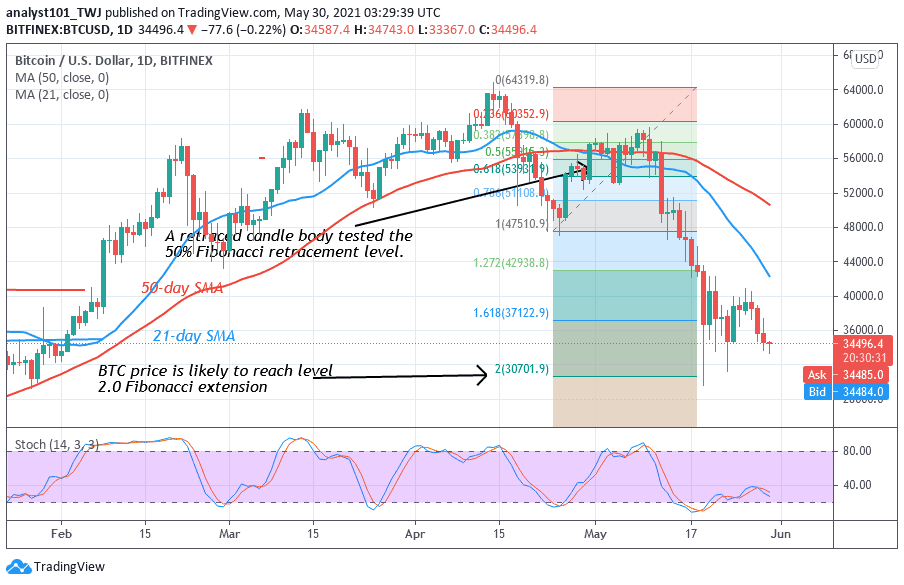
Bitcoin price is in a downward move as Bitcoin hovers above $34,000 . A break below the $34,000 support would mean a further decline to $30,000. Similarly, a rebound is equivalent to a rally to $40,000 high. The $30,000 support is where bulls have strong buying power. It is likely buyers are likely to defend the support level.

Resistance Levels: $45,000, $46,000, $47,000
Support Levels: $35,000, $34,000, $33,000

BTC/USD -Daily Chart

Since May 19 breakdown, Bitcoin has fallen to $30,000 support twice as bulls pulled back. On the other hand, Bitcoin bulls have retested the $40,000 resistance on five occasions without sustaining the bullish momentum above it. There is a deadlock above the $34,000 support as buyers and sellers continue the price tussle. The bottom line is that if Bitcoin loses the $34,000 support, the market will decline to $30,000. Interestingly, buyers will defend the $30,000 support if it falls to that level. However, a further decline to $28,000 and $20,000 is possible, if buyers fail to defend the $30,000 support.

Bitcoin Is a Speculative Asset as Criticize by Bank of Japan Governor – Bitcoin Hovers Above $34,000

Haruhiko Kuroda is the governor of the Bank of Japan and has joined the roll call of central bankers criticizing Bitcoin as a speculative asset. The governor said: “Most of the trading is speculative and volatility is extraordinarily high. It’s barely used as a means of settlement.” The BOJ governor’s comments come as Bitcoin experienced an over 50% drawdown from its $64,000 all-time-high price milestone in mid-April. The central bankers have taken Bitcoin’s current price woes as an occasion to slam BTC and cryptocurrencies in general. According to Kuroda, he repeated the sentiments of other central bankers concerning the potential viability for stablecoins as long as their issuers conform to strict regulatory protocols. Despite the current volatility, Billionaire hedge fund manager Ray Dalio has tipped Bitcoin to be a better asset than government bonds.

BTC/USD – Daily Chart

Meanwhile, Bitcoin is hovering above the $34,000 support as there are bullish signals above the current support. Meanwhile, the Fibonacci tool analysis may hold if the bears break the $34,000 support. On April 30, a retraced candle body tested the 50% Fibonacci retracement level. The retracement indicates that BTC price is likely to fall to level 2.0 Fibonacci extension or level $30,701.90.

Go to Source

Bitcoin Whales Have Accumulated 30k BTC Between $31k and $40k

  • Bitcoin whales holding 100 to 10k BTC have accumulated 30k more coins in the last week
  • The accumulation coincided with last weeks retest of $31k and rejection at $40,800
  • Earlier today, Bitcoin dipped to $33,379 before bouncing back to $36,200
  • All eyes are on the weekly close, monthly close and $30k

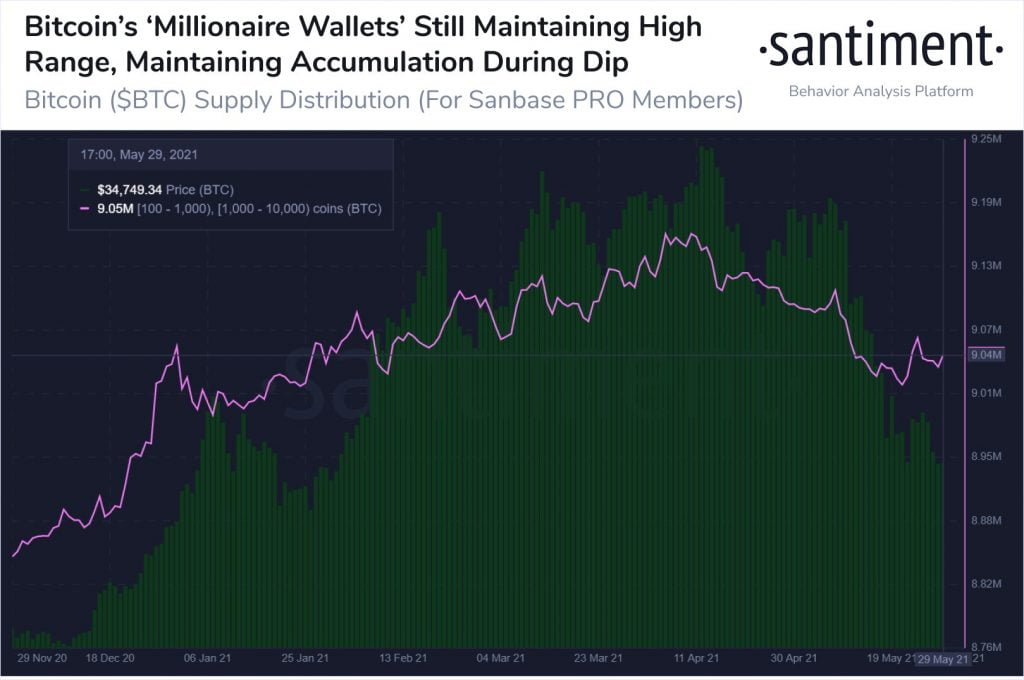
Bitcoin whales holding 100 to 10,000 BTC have accumulated 30,000 more bitcoins in the last week when the King of Crypto was consolidating between $31k and $40,800. The accumulation by whales was observed and shared by the team at Santiment feed through the following statement and chart.

Bitcoin is at $35.4k after another mild drop-off over the past day. But the key BTC millionaire bracket that we track has seen a mild uptick in holdings. Addresses with 100 to 10,000 BTC have accumulated approximately 30k more BTC this past week.

All Eyes are on Bitcoin’s Weekly and Monthly Close, $30k Support

At the time of writing, Bitcoin is once again above the crucial $35k support after a brief dip to $33,379 earlier today. The dip was soon followed by a bounce to $36,200 leading up to Bitcoin’s current price at $35,700. Bitcoin is still trading below the 200-day moving average which has created the proverbial ‘iron wall’ for BTC at the $40k to $41k price zone.

To note is that the weekly close today and the monthly close tomorrow, are still on the minds of most Bitcoin traders given that tomorrow, May 31st is the Memorial Day holiday in the United States. This in turn means that retail and institutional traders in the United States will take the day off to honor those who have fallen while serving in the US military.

Therefore, Bitcoin’s fate in the next 48 hours, will be in the hands of other global traders who will once again be eyeing the $30k and $35k price areas as logical support zones to usher in the new month of June.

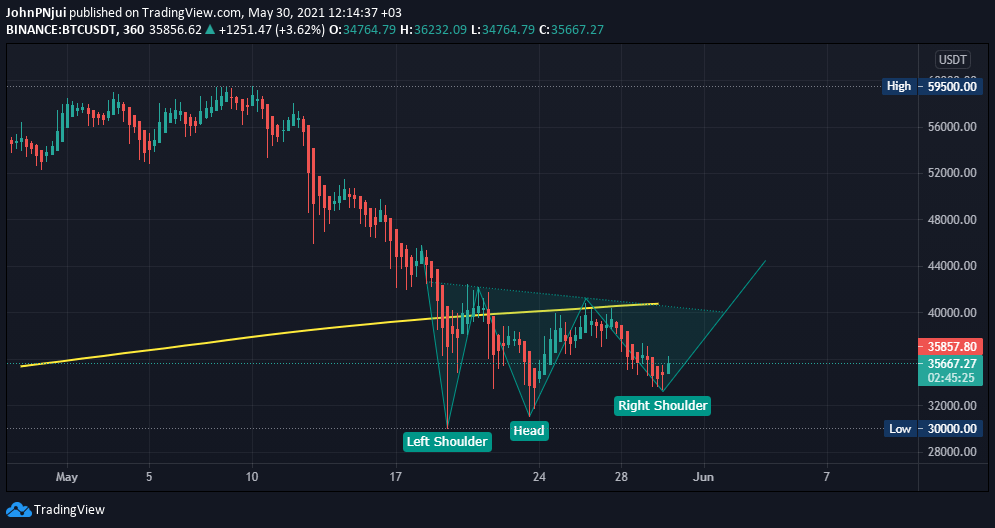
Bitcoin has Printed an Inverted Head and Shoulders Pattern on the 6hr

In terms of Bitcoin’s short-term future next week, BTC has printed what looks like an inverted head and shoulders pattern as seen in the chart below. If the pattern plays out, Bitcoin could reclaim the 200-day moving average (yellow) and go on to retest several key areas between $40k and $50k.

Go to Source

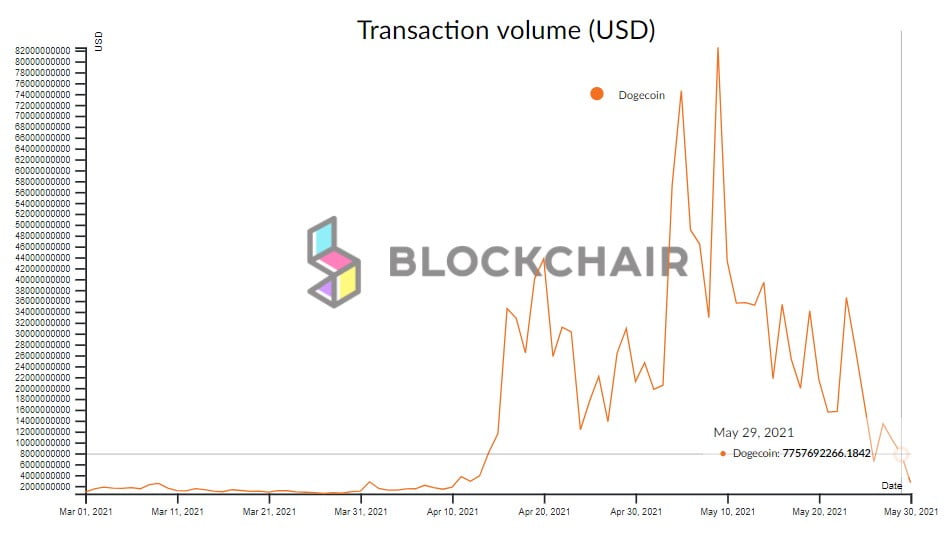
Dogecoin’s Daily Transaction Value Drops by 90% From ATH of $82.54B

  • Dogecoin daily transaction value hit an all-time high of $82.54 Billion on May 9th
  • Dogecoin’s daily transaction value now stands at $7.57 Billion indicating a 90% drop
  • The all-time high in daily transaction value also coincided with DOGE setting an all-time high of $0.74
  • The drop in transaction value is in tandem with DOGE’s ongoing correction
  • $0.50 is still a possibility for Dogecoin in the month of June

The daily transaction value sent over the Dogecoin (DOGE) network has dropped by 90% since its all-time high of $82.54 billion set on May 9th. At the time of writing, Dogecoin is currently handling $7.57 Billion in daily transaction value as highlighted in the chart below courtesy of Blockchair.

Dogecoin Undergoes a 60% Pullback from All-time High also Set in Early May

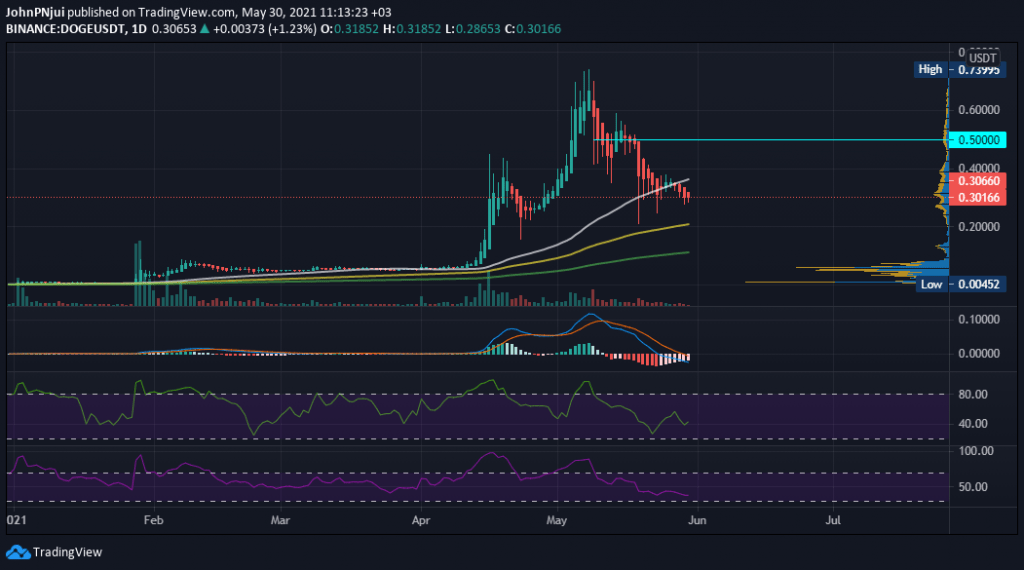
The all-time high in daily transaction value for Dogecoin also coincided with DOGE setting an all-time high of $0.74 in early May. With respect to current price action, Dogecoin is defending the $0.30 support zone after a local low of $0.211 set last week when Bitcoin dipped to $30k.

Dogecoin’s current value is a 60% drop from its all-time high with the local low of $0.211 being a 71.4% drop from the same peak value.

$0.50 is Still Possible for Dogecoin in the Month of June

To note is that Dogecoin’s weekly close is only a few hours away with the monthly close being tomorrow, Monday, May 31st. Therefore, the popular meme-coin could undergo some volatility in the next 48 hours that should abate with the new month of June.

In terms of a possible target for the new month, $0.50 still has a slight probability of being retested given that the crypto-verse has now digested the news of China once again banning BTC mining within its territories. At the same time, discussions and plans are being put in place globally to reduce the carbon footprint of crypto mining activities.

From the daily DOGE/USDT chart below, we can observe that the MACD, RSI and MFI are pointing towards a potential reversal for Dogecoin leading into the new month. In terms of resistances, Dogecoin has $0.32, $0.35, $0.38, $0.41, $0.44 and $0.47 ahead of its path towards a retest of $0.50. The 50-day moving average (white) is also a resistance around the aforementioned $0.35 price area.

As with all altcoins such as Dogecoin, the bullish scenario suggested above is hinged on Bitcoin providing the ideal environment for DOGE to thrive. This includes BTC reclaiming the 200-day moving average as support and moving on to $43k and even $50k with the new month.

Go to Source

Central Bank of Sweden Invites Financial Market Actors for Second Phase of E-krona Pilot

Sveriges Riksbank, the central bank of Sweden, will carry out the next stage of its e-krona project with the help of two organizations from the financial sector. The move signals a transition from the initial in-house testing with simulated participants to cooperation with real, external partners.

Riksbank to Work With Handelsbanken and Tietoevry to Test E-krona

The main task during the new phase of the pilot will be to trial “the technical solution for the e-krona” with the participation of real market entities. To accomplish this, Riksbank has invited Handelsbanken, one of the country’s major banking institutions, and Tietoevry, a digital services and software company. In an announcement published Friday, the regulator noted:

Involving external actors as participants in the test environment will make it possible for the Riksbank to evaluate the integration between the participants’ existing systems and the technical platform for the e-krona pilot.

One of the elements that will be tested is the integration of the payment flows developed during the first year of the pilot with the internal systems of the new participants, Riksbank explained. The partners will simulate how banks might interact with the e-krona infrastructure, Tietoevry detailed in a separate press release, elaborating:

Tietoevry will develop and test the process of interchangeability between commercial money and e-kronor and analyse how this can be carried out securely and efficiently.

The Finland-headquartered company also noted its “unique position in the Nordic financial ecosystem” thanks to a large customer base consisting of banks and payment providers. Over 70% of all Nordic bank transfers go through its payment systems and the fintech enables the leading mobile payment providers in Sweden, Norway and Finland.

Central Bank of Sweden to Integrate E-krona With Existing Banking Infrastructure

“Our role in the Swedish payment infrastructure is well established, and Tietoevry is a natural partner when exploring how to integrate a digital currency with existing banking infrastructure,” said Christian Segersven, head of financial services solutions and software development. “We are looking forward to supporting this journey towards an inclusive digital currency that will open up for innovative and secure services,” he added.

Svenska Handelsbanken, the other partner to get involved in the second stage of the e-krona pilot, is one of Sweden’s largest banks, with more than 400 branches across the country. Founded in 1871, it’s also the oldest company listed on the Swedish stock exchange. In the past couple of decades, Handelsbanken has been expanding its operations in other countries in the region as well as Netherlands and the U.K., where it has over 200 branches.

Sweden’s plan to issue a central bank digital currency (CBDC) dates back to a few years ago. Towards the end of 2020, the government in Stockholm began exploring the feasibility of digitalizing the national fiat, the Swedish krona. Arguably, the Scandinavian country has already built the world’s most cashless society. The review should be conducted within two years of its launch.

Last month, Riksbank announced the completion of the first phase of the study and released a report which highlighted the continuing decline of cash usage in the country. The central bank of Sweden emphasized the need to proceed with the project and facilitate the involvement of market actors expected to take part in the testing now and join the e-krona network in the future.

What do you think about Riksbank’s plan to digitalize the Swedish krona? Let us know in the comments section below.

Go to Source

Metalla CEO Says Crypto Industry Is a ‘License for the Private Sector to Print Money’

During an interview this week, Metalla Royalty & Streaming CEO, Brett Heath, explained that he believes cryptocurrencies will lead to the next financial crisis. The precious metals boss said history shows that “mass adoption of a new financial product” typically leads to a financial crisis.

Precious Metals Exec Says the Public Embracing Crypto May Lead to a Financial Disaster

Brett Heath is the CEO of Metalla Royalty & Streaming (NYSE: MTA) (TSXV: MTA), a company designed to generate leveraged precious metal (PM) exposure via royalties and streams for shareholders. On May 27, Heath spoke with the precious metals news desk from kitco.com and explained that he believes the mass adoption of digital currencies like bitcoin will lead to catastrophe. Economic calamities begin when society adopts a new financial product Heath asserted.

“When you look back to the last few decades and all of the financial crises that happened, they all have a couple of things in common. And one of them is the mass adoption of a new financial product or a new technology that is not very well understood,” Heath stressed during his interview with kitco.com’s David Lin.

Heath further remarked that it reminds him of the subprime mortgage crisis that tossed the financial world upside down 12 years ago. Heath added:

If we just rewind to the mortgage crisis of 2008— We had the mass adoption of mortgage-backed securities, collateralized debt obligations. And once the public had embraced this, this new financial product, then it crashed. It was a huge problem.

Crypto Adoption Will Lead to ‘Significant Financial Repercussions’

Heath continued by adding that he was skeptical of the money that has entered into the crypto economy and said that the industry was a “license for the private sector to print money.” But he also called into question the Federal Reserve’s expansion of the American money system. The PMs proponent emphasized that the crypto economy has grown at an exponential rate as well. “If you look at cryptocurrency using the total market cap of cryptocurrency, it’s over tenfold,” Heath stressed.

Business has been booming for PM companies like Metalla Royalty & Streaming as the price of gold is tapping new highs again. Gold is trading for $1,904 per ounce while silver is trading for $27.92 an ounce at the time of publication. This past March, Heath’s company acquired royalty on Eldorado Gold’s Tocantinzinho Project (NYSE: EGO) (TSX: ELD). Heath said he was thrilled to work on a project that will cover “over 2 million ounces of gold.”

While speaking with kitco.com’s David Lin, Heath said that the crypto economy seems to be a recipe for disaster and he thinks it could very well lead to a possible financial crisis. “The crypto market could go upwards $3-$10 trillion. When you have that amount of capital wiped out of digital wallets across the globe, you better believe there is going to be some significant financial repercussions that are felt,” Heath concluded.

What do you think about the Metalla Royalty & Streaming executive Brett Heath’s opinion about crypto creating a financial disaster? Let us know what you think about this subject in the comments section below.

Go to Source

Legacy banks should learn about staking and DeFi or risk extinction

When lawmaker meets crypto and turns to art: Alberto Echegaray talks about the future of DeFi and the reality of Bitcoin and art.

It’s all about the economy, cryptocurrencies, art and future projections. To talk about all this, Cointelegraph en Español reached out to artist Alberto Echegaray, the director of Trustlink and former representative of Argentina in the Financial Action Task Force.

Cointelegraph: Let’s start off by talking about your artwork, the Moneyball.

Alberto Echegaray: Moneyball began developing in 2012. It is a piece that touches on something that is taboo in art: money. And it is still taboo, although it is something that is changing now with NFTs.

What Moneyball wants to show is how most, or basically all, fiat currencies have no backing in the world right now. And how many governments take advantage of issuing these currencies to generate inflation, which is basically a tax — a phantom that takes away people’s purchasing power.

With this concept, I started to work on Moneyball with dollars. I lived in Washington, DC for about 12 years — I did some consulting for the Fed. That’s how I came to the Fed, I was invited to tour the facilities of a division where they print dollars.

At that time, they were replacing old dollars with the new dollars that are in circulation now. In one part, I found a huge warehouse with billions of dollars destroyed. That’s when I thought, This is incredible. You couldn’t take pictures — there were a lot of security measures. I asked for the destroyed money, but I was told that the money is state property, it’s not our property. And even if it’s destroyed, it’s still federal property.

I had to write a series of letters, and after several months, they gave me two million dollars in 100-dollar bills, destroyed. And so I began to create the artwork.

CT: And how did you come up with the idea of adding Bitcoin to your work?

AE: At the end of 2013, a Venezuelan in San Francisco told me about BTC and gave me some, which I still have. I didn’t pay much attention to it until 2015 or 2016.

I talked to several people in Silicon Valley, and they were telling me that it was going to be part of the future, especially blockchain. I started buying Bitcoin and really getting into it. Then I opened a fund and became a crypto missionary.

“It was super interesting. Bitcoin started to grow. And at that time, I was able to travel to different countries for work. I started to discover resistance from all of the financial sectors. It seemed like I was talking about something linked to crime or money laundering. It was terrible.”

But in 2016, I was contacted by a person who became part of the Argentine government and needed some help with technology to prevent money laundering and terrorist financing. It was Mariano Federici, head of the Financial Investigations Unit. The FIU had practically nothing to fight against money laundering with Bitcoin and crypto. It was a mess. I was asked to help, and it was an interesting challenge. More advanced systems of analysis, data and information were installed.

But I was not interested in the prosecution part of the crime; I was much more interested in the technical and crypto part. At that time, Europol held a meeting where security specialists met on the subject of crypto and cybercrime. I was new, but I was invited by the Argentine government. Then, I was invited again to the FATF, and there I met some people — specifically from the U.S., China, Russia, South Africa and Australia — who knew something about crypto. They were a very strong team. And I started to see how regulations were going to develop

CT: Did you want to do more and see the other side behind the curtain?

AE: That was in 2016/2017. But before I joined FATF in the Argentina chair, I had four years of experience working in Paris on regulatory issues. I had started to develop, in parallel, a private note off-market, and it was the first synthetic with the underlying asset being Bitcoin.

And there, I was able to structure a financial product that you could invest from a bank account. It was super successful, until the banks told me that they could not accept money because it involved BTC.

I started thinking about Cryptoball. If I had gone through fiat money, showing it to be worthless, I said I’m going to try it with crypto. I started developing the Cryptoball, but in 2017/2018, it was hard to get curved displays that would show the price of BTC. I had to contact a person in China who gave me access to flexible screens.

Cryptoball is a sphere with two flexible screens connected to software in a processor. The processor shows the real-time value of BTC that is held in a hardware wallet within the piece. It shows the price in yen, euros and dollars. By that time, I got 250 BTC, and I placed them in the Ledger wallet.

“Next to the installation at the Venice Biennale, I placed a million dollars and a million euros. There were a lot of young people. Many people from the art world asked me what it was because they didn’t understand.”

That’s when a European collector who I didn’t know approached me. He offered to meet me at a restaurant the next day. It was very interesting because then they contacted me on his behalf and talked about “His Royal Highness.”

He turned out to be a prince who is very supportive of the culture. We sat down and talked about the artwork. I couldn’t believe it because the Venice Biennale is not a place where you sell.

The Biennale ended, and I took the artwork to his house, a place in Switzerland. It’s a very interesting story.

CT: The art and crypto worlds are getting along very well. What do you think about NFTs? Do you have plans to work with this technology?

AE: I am starting the process of tokenizing some works. I’m thinking about tokenizing the sphere, but I want it to be something interesting. Not just a 3D design of artwork or a sculpture but, for example, a kind of live ticker that shows the price. Something that exists in real life, that exists in parallel in different dimensions.

I’m also working on 3D mapping and augmenting reality with a group of people. I was also invited to be an adviser on an NFT platform that has established artists.

I think we are at the beginning of tokenization and a lot of interesting things that can spread the art. By this, I mean that before, it was very difficult for artists who graduated from art schools to access galleries. This is changing dramatically. Now, art school graduates who have chosen to dedicate themselves to digital or virtual art are getting job offers, as is happening in the gaming sector, for example.

This is added to all the mass consumer brands that are getting into the virtual world. It’s amazing what’s coming.

CT: Regarding the future of private banking, do you think that banks are going to work with crypto or against crypto?

AE: All the big banks already have large crypto research divisions. They know that this is a new system within the financial system. It’s like when we talk about landline phones and cell phones — they are going to end up cannibalizing everything.

But they are still clinging to their transfer systems and their ways of charging commissions and making money, and they haven’t realized that this has changed dramatically.

“If they don’t understand staking or DeFi, and if they don’t adopt it quickly, they are going to see their business disappear overnight. There are some who try to understand it, but it’s very difficult.”

The same goes for regulators. There are not enough human resources to ask who understands both worlds. And there is no capacity, brainpower and determination. They think it is still a long way away.

CT: What do you think the state of the global monetary system will be like in 2030?

AE: I think there will be huge opportunities for the new generations. It’s a parallel system of governments, which is based on the speed of technology. I think in 2030, there will be a society that is more integrated on the one hand, but more discriminatory on the other. They are going to be very powerful groups.

What we are seeing with crypto is basically a revolution of assets or private currencies like we have never seen before. In the case of crypto, I clearly see private systems, linked to private space systems, which may or may not be open source. I see banks in this space, much more evolved digital assets, and the tokenization of commodities happening in the future.

Traders do not want to lose control of all this. That’s kind of the projection I see. I think there will be a new system that is neither capitalist nor socialist.

Go to Source

Is crypto approaching its ‘Netscape moment?’

The world of cryptocurrency shares a similar template to the emergence of the World Wide Web back in the 1990s.

This year marks the 30th anniversary of the first web page on the World Wide Web, which means a person has to be nearly half a century old to clearly remember the patchwork progress, the false starts and stops, and the trial and error that eventually gave us what is now the defining foundation of 21st-century life. 

We take the internet for granted in 2021, but it took us decades to get to this point. Throughout the years, the barriers toward adoption tumbled away, and there were clear signs that this new technology would fundamentally change the way the world lives and works.

Now, soaring Bitcoin (BTC), the blockbuster initial public offering of Coinbase and the appointment of MIT blockchain professor Gary Gensler to lead the United States Securities and Exchange Commission are offering clear signs that another technology will be transformational on a similar scale: cryptocurrency.

Do these recent developments mean crypto is approaching its “Netscape moment?”

In the early ‘90s, the internet was about connecting through a phone modem to three major services — AOL, CompuServe and Prodigy — all of which made up what we called the “World Wide Wait,” which illustrates the headache that was caused by loading those rudimentary pages. For those of us old enough to participate in these earliest days of the transition, all the way to a consumer internet, we remember well that moment when everything changed.

It was August 1995, when Netscape went public with its main product Navigator, the first browser that allowed anyone to surf the net without having to pay for “World Wide Wait’s” services. This was the moment internet adoption went mainstream, and it created a frenzy that lasted until the dot-com burst in April 2000, establishing the investor and consumer template for thinking about the internet and the World Wide Web.

Related: Blockchain Is Evolving Like the Internet: Who Will Be the Crypto Hotmail?

Crypto’s timescale: Are we there yet?

It is difficult to see tomorrow’s certainty, or at least the narrative of tomorrow that is described by today, when you are preoccupied with the uncertainty of the present. Perhaps there is no endgame in technology as a whole, making it as mysterious and tantalizing as the world of crypto.

However, it is hard not to see the parallels between the current state of crypto adoption and the internet as it existed in 1995. Despite the many news cycles obsessed with booms and busts in pricing, in terms of true financial and technological use, crypto still remains the playground of early adopters and geeks. Many institutions and professional investors are interested in playing around with it, but the vast majority of major institutional finance has yet to engage with it in any serious way.

Related: Institutional investors won’t take Bitcoin mainstream — You will

I believe 2021 will be the year when all of this changes. The global COVID-19 pandemic has led to massive fiat money-printing everywhere in the world. The cryptocurrency market stands at around a $2 trillion market capitalization, and Bitcoin is in the news daily, arguably with more regularity and over a longer period of time than it enjoyed during the boom of 2017–2018.

This new hype cycle comes with the gradual increase of general crypto awareness that has been on the rise since 2017–2018, and professional investors and institutions are even more keen to dip their toes into the water of crypto, even if that only means developing a Bitcoin exchange-traded fund.

History doesn’t repeat, it only rhymes

Crypto seems like it should be inevitable — id est, vires in numeris. The mathematical school of Thales and Satoshi Nakamoto should also keep that old phrase from the empiricist Immanuel Kant in mind: “Out of the crooked timber of humanity, no straight thing was ever made.” We cannot overlay the timeline of the internet onto crypto and say, “Aha! This is when it will happen.” Some timescales of adoption and development may continue to accelerate, while others stall behind.

External events may also intervene, such as a pandemic. Initially thought to be an event that may halt crypto markets and innovation, due to the initial financial panic and need to liquidate, the price of the flagship Bitcoin has increased tenfold in the first year of the pandemic. Governments put themselves at monetary hazard with debt spending, and people dug deeper into the online world than they did before, adhering to the cryptocurrencies that define so much online life and discussion.

Related: How has the COVID-19 pandemic affected the crypto space? Experts answer

One thing that is certain is that for crypto to enjoy that “Netscape moment,” especially in the Western world, it will need advocacy and cooperation from the U.S. government. The Netscape moment will happen when the U.S. government, particularly the SEC, comes out with clear regulations about fundraising, custodianship, “Know Your Customer” guidelines, taxes, investment and transfer rules. Even better would be the SEC declaring that crypto is not a security but a whole new asset class with its own set of rules.

Related: The US has already lost the 2020 crypto regulation race to Europe

Gensler, recently appointed to lead the SEC, has made it clear that he sees the potential and the value in new digital currencies. Recently, he announced that there will be negotiations of some unambiguous regulation for the space that could open the floodgates to billions of dollars in institutional capital. This would be a tremendous development that could stabilize initial public offerings’ day-one pops and swinging Bitcoin prices.

Related: Crypto-friendly faces poised for positions in Biden administration

The U.S. became the leader in the internet movement because, in our wisdom, we allowed e-commerce companies to grow without the burden of sales taxes in state and municipal jurisdictions. This allowed the growth of the industry to the behemoth it is today. Though Al Gore might forever rue the day he ever claimed credit for the U.S. government’s efforts to facilitate national networks and technologies through the High-Performance Computing Act of 1991, the fact is that the U.S. government’s pro-internet policies did help the internet grow as quickly as it did. Marc Andreesen, who created that “Netscape moment” and can claim at least a partial share in helping invent the internet as we know it, has said as much.

Today, the U.S. government finds itself at a similar crossroads. Countries including Switzerland, Singapore, Malta, Panama and other free market-oriented economies have already seen the light, and it’s our collective hope that the powers are willing to see the wisdom in allowing the cryptocurrency industry to thrive. Investor-friendly rules in the U.S. will allow the U.S. to keep its leadership in innovation and technology (please take note, Gensler).

If the U.S. wants to repeat the history of the last 25 years, a history that has seen America reign supreme as the global leader of technology innovation, then it must repeat the ways of its early pro-internet policies, paving the way for the new crypto technology that will break through in the same way as Netscape.

This article does not contain investment advice or recommendations. Every investment and trading move involves risk, and readers should conduct their own research when making a decision.

The views, thoughts and opinions expressed here are the author’s alone and do not necessarily reflect or represent the views and opinions of Cointelegraph.
Charles H. Silver is the CEO of Permission.io, a technology provider of permission-based advertising solutions. Charles previously founded RealAge.com, a company that used big data to connect individuals to advertisers on a permission basis. Charles is also co-founder of Reality Shares, an SEC-registered investment adviser with five publicly traded ETFs, and of Blockforce Capital, a multi-strategy cryptocurrency hedge fund. Charles is a graduate of the University of Michigan and a former staff member for a United States Congressman.

Go to Source

Billionaire Stan Druckenmiller on Dogecoin, Ethereum: Won’t Long or Short DOGE, Skeptical of ETH

Renowned investor Stanley Druckenmiller has shared his views on dogecoin and ethereum. He said he wouldn’t long or short dogecoin and laughs when the meme cryptocurrency rises in value. As for ether, he is skeptical whether it can hold its position.

Stan Druckenmiller on Dogecoin and Ether

In an interview with The Hustle last week, famed investor Stanley Druckenmiller shared his thoughts on bitcoin, ether, and dogecoin, the meme cryptocurrency that has recently taken the market by storm.

Druckenmiller founded Duquesne Capital in 1981. He managed money for George Soros as the lead portfolio manager for the Quantum Fund until 2000. He and Soros made massive profits betting against the British pound in 1992.

The billionaire investor said that dogecoin “is just like NFTs [non-fungible tokens]. It’s a manifestation of the craziest monetary policy in history.” He added: “I think since there’s no limit on supply, I don’t really see the utility of it right now. It’s just this wave of money in the Greater Fool Theory.” Druckenmiller opined:

Now having said that, I wouldn’t short it because I don’t like putting campfires out with my face. So I just try and pretend DOGE doesn’t exist. I think so little of it, it doesn’t even bother me when it goes up.

He continued: “When bitcoin used to go up, I’d go crazy because I didn’t own it. When dogecoin goes up, I just start laughing. Don’t go long and don’t go short. I mean, you know, unless you like going to Vegas, then I guess it’s okay.”

On the subject of bitcoin vs. ethereum, Druckenmiller said, “I think bitcoin has won the store of value game” because it is “a brand, it’s been around for 13-14 years, [and] it has a finite supply.” On whether other cryptocurrencies will replace bitcoin, he reiterated that BTC is “going to be very, very tough to unseat.”

While acknowledging that “the lead in smart contracts and that kind of stuff would be ethereum,” he noted:

I’m a little more skeptical of whether it can hold its position. It reminds me a little of Myspace before Facebook. Or maybe a better analogy is Yahoo before Google came along.

He described, “Google wasn’t that much faster than Yahoo, but it didn’t need to be. All it needed to be was a little bit faster and the rest is history.”

What do you think about Stan Druckenmiller’s views on dogecoin and ether? Let us know in the comments section below.

Go to Source

JPMorgan Boss Jamie Dimon Personally Advises People to ‘Stay Away’ From Cryptocurrency

JPMorgan Chase CEO Jamie Dimon has given personal advice to investors regarding investing in cryptocurrencies, like bitcoin. He said that his own personal advice to people is to “stay away” from cryptocurrencies. However, his bank, JPMorgan, will not stay away as clients want exposure to this asset class.

Jamie Dimon’s Personal Advice to Investors About Bitcoin, Other Cryptocurrencies

Jamie Dimon, the CEO of JPMorgan Chase, the largest bank in the U.S., gave his congressional testimony before the House of Financial Services Committee regarding cryptocurrency on Thursday. While admitting that JPMorgan’s clients are interested in investing in bitcoin, Dimon said:

My own personal advice to people is stay away from it. That does not mean the clients don’t want it. This goes back to how you have to run a business. I don’t smoke marijuana but if you make it nationally legal, I’m not going to stop our people from banking it.

“We are debating should we make it available in some way, in a safe way, that people can buy and sell it” and put it in their financial statements and balance sheets, the JPMorgan CEO continued. “But my own personal view, it’s nothing like a fiat currency. It’s nothing like gold. Buyer beware.”

Dimon clarified that his statements only apply to cryptocurrencies, not blockchains or stablecoins, which are “supported by assets,” he said.

The JPMorgan boss further emphasized that his personal views do not influence the financial services that JPMorgan Chase offers to its clients. “A lot of our clients are asking, ‘can we help them buy or sell cryptocurrency?” Dimon said at JPMorgan Chase’s annual shareholder meeting last week. “And we’re investing in that as we speak.”

The JPMorgan executive further said during his congressional testimony Thursday:

I don’t tell people how to spend their money, regardless of how I might personally feel about something.

Reiterating his view expressed in April that cryptocurrencies are emerging issues that need to be dealt with quickly, Dimon said in his congressional testimony that the crypto asset class could benefit from more regulation.

“I do think that eventually the regulators who are a day late and a dollar short should be paying a lot more attention to the future, like payment for the order flow, a high-frequency trading, cryptocurrency, and put a legal regulatory framework around it,” he opined.

Dimon has long been a bitcoin skeptic. He called the cryptocurrency a fraud back in September 2017. Now JPMorgan is slowly getting into the crypto space. In March, the bank launched a crypto investment product tracking public company stocks with bitcoin exposure. The bank is also reportedly working on providing clients access to bitcoin investments.

JPMorgan recently highlighted three reasons for investing in bitcoin after its analysts predicted that the price of the cryptocurrency could reach $146K as its competition with gold heats up. The firm subsequently lowered its bitcoin price estimate to $130K but said that clients can put 1% of their portfolios in BTC. Last week, JPMorgan initiated coverage of the Coinbase stock with an overweight rating and a 60% upside from the current price.

What do you think about Jamie Dimon’s personal advice to investors about bitcoin and cryptocurrencies? Let us know in the comments section below.

Go to Source

Bank of America, Citigroup, Wells Fargo Unveil Their Cryptocurrency Policies

Bank of America, Citigroup, and Wells Fargo have shared their policies regarding cryptocurrency before the U.S. Senate banking committee. The three banks are in different stages of offering crypto services to their clients. They also lag behind some of their peers, such as Morgan Stanley and Goldman Sachs, in offering access to investments with exposure to bitcoin or other cryptocurrencies.

Bank of America Evaluating Crypto Opportunities

The CEOs of Bank of America, Citigroup, and Wells Fargo gave their testimonies on cryptocurrency before the Senate banking committee last week. The committee, headed by Senator Sherrod Brown, summoned the investment bankers for its annual oversight hearing on Wall Street firms.

Bank of America CEO Brian Moynihan said that BofA was keeping distance from bitcoin and other cryptocurrencies as the bank continued “to evaluate the opportunities, risks and client demand for products and services related to cryptocurrency.” Noting that his bank holds more than 60 blockchain-related patents, he emphasized, “We still have not found a use case at scale.” The Bank of America executive confirmed:

Currently, we do not lend against cryptocurrencies and do not bank companies whose primary business is cryptocurrency or the facilitation of cryptocurrency trading and investment.

Bank of America’s analyst said in January that bitcoin was the “mother of all bubbles.” Nonetheless, the bank’s most recent fund manager survey saw “long bitcoin” as the most crowded trade. In March, the bank says the only good reason for holding bitcoin was “sheer price appreciation.”

Senator Brown is skeptical of cryptocurrencies. He recently sent a letter to the new Acting Comptroller of the Currency, Michael Hsu, urging him to review the cryptocurrency regulation under the purview of the Office of the Comptroller of the Currency (OCC).

Citigroup Taking Measured Approach to Crypto

Citigroup CEO Jane Fraser talked about her company taking a “measured approach” to cryptocurrency as the bank sought “to understand changes in the digital asset space and the use of distributed ledger technology, including demand and interest by our clients, regulatory developments and technology advancements.” The Citi executive noted:

Before we engage with cryptocurrencies, we see it as our responsibility to ensure we have clear governance and controls in place.

Citigroup is reportedly planning to launch crypto services as the firm sees a “very rapid” accumulation of interest in bitcoin. In March, Citigroup says bitcoin was at a tipping point and could become the preferred currency for international trade.

Wells Fargo Closely Watching Crypto Space

Wells Fargo CEO Charles Scharf said that his company was close to announcing a pilot project using blockchain technology “to complete internal book transfers of cross-border payments within our global branch network.” However, in terms of cryptocurrency, he said:

We continue to closely and actively follow developments around cryptocurrencies, which have emerged as alternative investments products, though their status as a currency and mechanism of payment remains fluid.

Darrell Cronk, the president of Wells Fargo Investment Institute, said last week that his firm is in the final stages of adding an actively managed cryptocurrency investment strategy to its platform. “We think the cryptocurrency space has just kind of hit an evolution and maturation of its development that allows it now to be a viable investable asset,” the executive opined.

When do you think these three banks will adopt cryptocurrency? Let us know in the comments section below.

Go to Source

As market slumps, Ren bolsters DeFi liquidity via Fantom, Polygon integrations

The integrations could bring new assets to popular DeFi platforms amid a market-wide pullback.

As digital asset markets suffer a broad pullback, cross-chain bridge protocol Ren has announced integrations with EMV-compatible chains Fantom and Polygon that could bolster liquidity across the DeFi ecosystem. 

In a blog post on Friday, Ren announced that the RenVM bridge now supports the trustless transfer of four popular cryptocurrencies to Fantom, including Bitcoin, DOGE, and ZEC. Three additional Fantom bridge assets are incoming as well, including Filecoin and LUNA. Likewise, in a post on Wednesday, Ren announced a similar seven-asset integration with Polygon:

The Fantom announcement also noted that Ren is “currently working on adding Ren-based assets to Curve, QuickSwap, BadgerDAO, and beyond.” While Ren serves as a bridge between chains, a recent collaboration with BadgerDAO on Ethereum demonstrated that a partnership with a DeFi protocol can drive protocol fees and volume for all parties. In Badger’s case, one-click bridge-and-deposit functionality has driven Badger’s WBTC vault to a quarter billion in TVL. 

Per BadgerDAO’s Chris Spadafora, $150 million in BTC has already passed through the joint protocol bridge.

Sidechains like Fantom and Polygon have become increasingly in-demand in recent months as developers, investors, and farmers look for ways to escape Ethereum’s high gas fees. Prior to the recent market slump, EMV-compatible chains played host to implementations of major Ethereum-native DeFi protocols, and sidechain tokens like MATIC have proven to be among the most resilient to the recent bearish price action. 

A popular Fantom community account hailed the trustless bridge as the “holy grail” for the chain, noting that the bridge has the potential to significantly bolster total value locked (TVL) metrics for Fantom’s various DeFi protocols, including SushiSwap, Curve, and C.R.E.A.M.

“The addition of Fantom will greatly benefit each protocol by bringing more utility to Fantom and even more velocity through RenVM,” said Ren COO Michael Burgess in a blog post. “We could not be more excited for this to go live, as it’ll help bolster utility for the entire DeFi ecosystem.”

Go to Source

Analyst says reclaiming $37,500 is Bitcoin’s crucial ‘line in the sand’

According to analysts from Decentrader, Bitcoin needs to quickly reclaim the $37,500 level and ETH needs to hold $2,300 as support to avoid bull-market-ending price action.

Bitcoin (BTC) price continues to limp lower as traders in the U.S. hit the BBQ to enjoy the upcoming Memorial Day holiday on May 31 and regulated futures and options markets like the CME are closed through the weekend.

Data from Cointelegraph Markets Pro and TradingView shows that after a brief attempt by Bitcoin (BTC) bulls to rally above $37,000 in the early morning hours on May 29, the price has tumbled below $34,000 as the support needed for a move higher failed to manifest. 

BTC/USDT 4-hour chart. Source: TradingView

Price action for Ether (ETH) was nearly identical to that of BTC, with an attempt to break above $2,500 met with stiff resistance that pushed the altcoin’s price down to $2,300.

$37,500 or bust

According to analysis from filbfilb, co-founder of Decentrader, Bitcoin’s price action is a major source of  the market’s confusion as it remains a ways away from the 20 Week Moving Average (WMA) “which is typically the line between Bitcoin being either in a bull or bear market and as such remains a bearish scenario for Bitcoin.”

Bitcoin 4-hour chart. Source: Decentrader

The analyst went on to further state that if Bitcoin is able to find solid support in the low $30,000s, the 20 WMA could turn into a major resistance zone in any attempt to move higher.

Filbfilb said:

“A drop lower would likely make the low $20,000s or the 78.6% retracement a likely target. As such, price action over the next week is particularly important.”

At this point, according to filbfilb, it is crucial for BTC to reclaim $37,500 “to avoid a retest of weekly support.”

Should Bitcoin manage to stage a rally and break above $40,000, filbfilb identified the previous support/resistance zone at $45,500 to $46,500 as the next area of resistance that will need to be overcome.

Ether draws the line at $2,300

Ether performed slightly better than BTC after it sold off back to the 61.8% retracement as the price was able to bounce back above the 20 WMA, but was ultimately rejected at the “critical pivot price” of $3,000 as the recovery momentum faded.

ETH/USD 4-hour chart. Source: Decentrader

Filbfilb identified $2,300 as an important area of support for Ether that would need to be held if bulls wanted to gather momentum for an attempt to break above the $3,000 level and retest $3,300, with this scenario be highly “dependent upon the strength of Bitcoin.”

Overall, the analyst expects that Ether will outperform BTC in any upside move and “at least match any bearish movement.”

He said,

“For now, eyes are on Bitcoin to see if the lows can be held going into the weekend, with particular attention being around the 200 DMA which is currently the line in the sand for the bulls.”

The views and opinions expressed here are solely those of the author and do not necessarily reflect the views of Cointelegraph.com. Every investment and trading move involves risk, you should conduct your own research when making a decision.

Go to Source

Elon Musk Is Still Weighing Options after Cancelling Bitcoin Payments

Recently, electric vehicle company Tesla announced plans to suspend Bitcoin as a means of payment. The decision represented a sudden reversal, as the firm initially decided to accept the cryptocurrency less than two months earlier.

Tesla Cites Environmental Concerns

Musk’s announcement indicated that Tesla chose to suspend payments due to the fact that Bitcoin mining consumes large amounts of energy.

“We are concerned about rapidly increasing use of fossil fuels for transactions,” Musk’s statement read. “Cryptocurrency is a good idea on many levels, and we believe it has a promising future, but this cannot come at great cost to the environment.”

Markets reacted quickly. After Musk made his announcement on May 12, the price of Bitcoin fell from a high of $57,000 to a low of $34,000. As of Thursday, May 27, Bitcoin has made only a slight recovery; its price currently sits at $38,600.

Despite its negative impact on the market, Musk’s announcement made it clear that the decision was temporary. Tesla intends to use Bitcoin as soon as it “transitions to a more sustainable” energy source, and the firm is looking at BTC alternatives.

Musk Discusses Clean Energy With Miners

On Monday, May 24, Elon Musk revealed that he had spoken with North American Bitcoin miners to coordinate a strategy for clean-energy Bitcoin mining.

Musk wrote on Twitter: “Spoke with North American Bitcoin miners. They committed to publish current & planned renewable usage & to ask miners [worldwide] to do so.”

Microstrategy CEO Michael Saylor added that he had coordinated a meeting between Musk and several North American Bitcoin mining companies. According to Saylor, executives from several companies were in attendance, including Argo Blockchain, Blockcap, Core Scientific, Galaxy Digital, Hive Blockchain, Hut8, and Riot.

Saylor wrote that the mining companies agreed to create a Bitcoin Mining Council, which will “promote energy usage transparency & accelerate sustainability initiatives.”

Musk Considers Dogecoin as Alternative

Musk followed up on that on later dates. On May 13, he indicated that he is “working with Doge devs to improve system transaction efficiency.” Later, developer Ross Nicoll confirmed that Musk is indeed contributing to Dogecoin’s development.

Nicoll drew attention to Musk’s history with PayPal, and stated that the project is taking advice from Musk on payment processing. Nicoll added that he can “honestly say [Musk has] improved [Dogecoin’s] transaction throughput.”

In line with Musk’s own goals, the group also discussed ways to reduce Dogecoin’s energy consumption, which is currently less than 7% of Bitcoin’s footprint.

Musk added that the results are “potentially promising,”

Prior to this, Musk polled his followers on Twitter and asked whether they would support Dogecoin payments at Tesla. Approximately 80% answered in favor.

Cardano and IOTA Solicit Tesla

Since Tesla suspended Bitcoin payments, at least two other notable blockchain projects have attempted to win the attention of Tesla and Elon Musk.

On May 13, Cardano and its creator Charles Hoskinson reached out to Musk, asking him to consider its own ADA cryptocurrency as a Bitcoin replacement. “Are we finally going to have the Cardano conversation? Come to my farm in Longmont,” Hoskinson wrote. Meanwhile, the Cardano Foundation drew attention to its efforts at sustainability.

Cardano is currently the fifth-largest cryptocurrency, boasting a market cap of $5.7 billion, making it a reasonably strong contender as a Bitcoin replacement. However, it does not seem that Musk has responded to Cardano’s invitation.

Elsewhere, on May 12, IOTA co-founder Dominik Schiener suggested that Musk adopt his own cryptocurrency, writing that “IOTA is the answer” to energy concerns.

Once again, Musk did not respond, making it unlikely that Tesla will choose to use IOTA. However, it is worth noting that IOTA has historically focused on automotive partnerships, making the idea of a Tesla partnership not so outlandish. IOTA is currently the 38th largest cryptocurrency, with a market cap of $2.9 billion.

Musk Seeks Marketability, Not Just Efficiency

Musk shone some light on his preferences this week. On May 24, YouTube personality and early Tesla investor Dave Lee asked Musk why he did not choose to use Ethereum 2.0, Cardano, Solana, Polkadot, IOTA, or other similar cryptocurrencies.

Musk responded: “Doge has dogs & memes, whereas the others do not.” It seems that, despite Musk’s insistence on an energy-efficiency, he is taking each coin’s popularity into perspective and does not want to compromise on marketability.

In light of those statements, Dogecoin and Bitcoin are the most likely candidates for Tesla’s next attempt at crypto payments once each coin undergoes a reform.

Go to Source

Circle Captures $440 Million in Financing, Rumors of SPAC Deal Follow

The Boston-based cryptocurrency finance firm Circle has announced the company has raised $440 million in financing in order to “drive market expansion and growth.” The investment was led by prominent finance firms like Digital Currency Group, Fidelity Management and Research Company, and FTX.

Circle Reveals $440 Million in Financing

  • Circle Internet Financial, Inc. has revealed the company has obtained $440 million in financing from a number of strategic investors.
  • Leading investors in Circle include Atlas Merchant Capital, Digital Currency Group, FTX, Breyer Capital, Fidelity Management and Research Company, Marshall Wace, Willett Advisors, Intersection Fintech Ventures, alongside Michael J. Price and Friends.
  • Circle has attributed a lot of growth to the “rapid rise” of the stablecoin usd coin (USDC). The company considers USDC the “fastest growing dollar digital currency, which now stands at $22 billion in circulation. USDC has grown by 436% in 2021 alone, and over 28,000% over the past 12 months.”
  • “As a company, Circle has remained committed to our mission of raising global economic prosperity through the power of digital currency, blockchains and breakthroughs in programmable money,” Circle cofounder and CEO, Jeremy Allaire said on Friday.
  • “The sustained global demand for our services powering the growth of USDC, as the most trusted and well regulated dollar digital currency, signals that we are one step closer to achieving our mission,” Allaire added during the announcement.

  • Following the financing, two sources familiar with the matter told theblockcrypto.com’s Frank Chaparro the firm is considering a special purpose acquisition vehicle (SPAC) deal.
  • FTX Exchange has been making a lot of moves in the crypto industry and FTX participated in Circle’s $440 million financing raise as well. “Circle has been an experienced player in making fiat work on blockchains for nearly eight years and has built deep capabilities to ease payments in crypto. At FTX we’re excited to partner further with Circle to help expand these capabilities to all crypto users,” the CEO of FTX Sam Bankman-Fried remarked on Friday.
  • In addition to the recent financing, Circle has addressed “financial and operational transparency” on May 25, 2021, in regard to USDC circulation.
  • Circle notes that “USDC in circulation is reviewed by independent accounting firms who could provide reasonable assurance on an ongoing basis that assets held in reserves were at all times able to meet or exceed USDC in circulation. 30 attestations to this effect later issued by Grant Thornton, one of the world’s leading accounting firms, our commitment remains unchanged.”

What do you think about Circle raising $440 million from investors? Let us know what you think about this subject in the comments section below.

Go to Source

Please enter CoinGecko Free Api Key to get this plugin works.
Exit mobile version