$1.4M in Bitcoin Remains Idle — The Curious Case of the 37-Day-Old 2009 Block Reward Spent a Year Ago

Approximately 378 days ago, before the bitcoin bull market started to heat up, a unique block was spent stemming from a coinbase reward created 37 days after the Bitcoin network launched. It seems roughly ten coins from the block reward were sold to an exchange, but 40 bitcoin worth $1.4 million at today’s exchange rates sits unspent.

As the Last Block Reward from 2009 Was Spent on May 20, 2020, Approximately 40 Bitcoins Remain Unspent

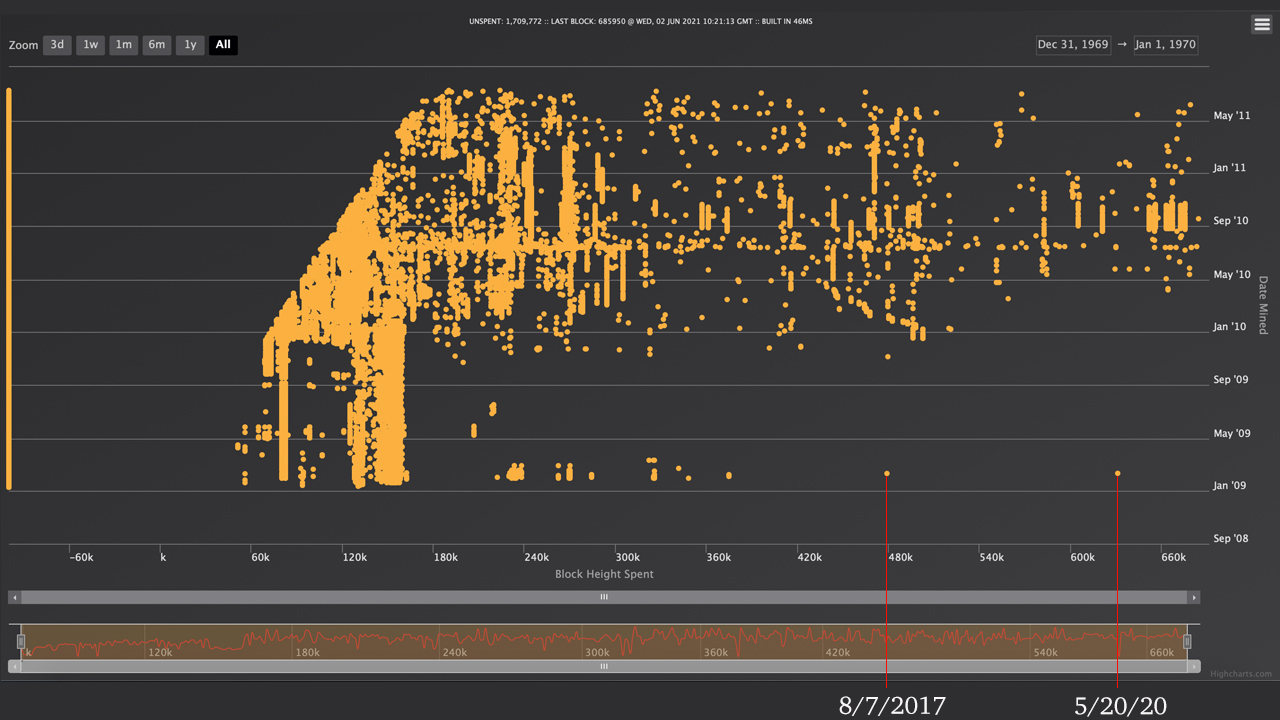
Around this time last year, a curious block was spent that invoked a great amount of speculation. On May 20, 2020, an entity spent a coinbase reward that was minted on February 9, 2009. It was widely assumed it may have been related to Satoshi Nakamoto but this assumption has never been verified. What we do know is that it was block reward 3,654 and it was spent 627,404 blocks later, at block height 631,058.

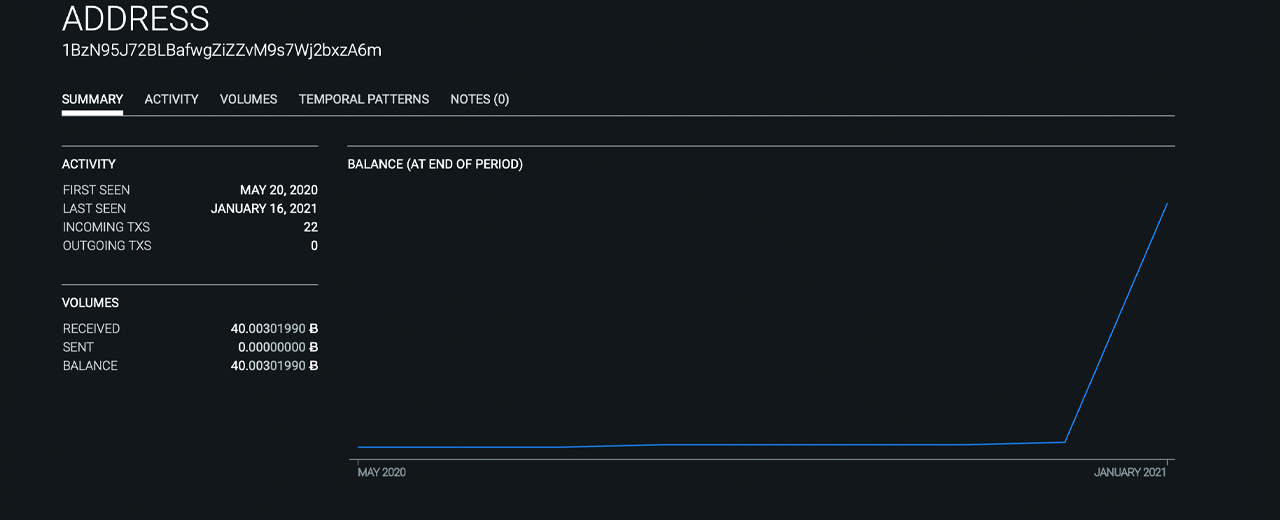
We also know that the only transaction associated with the mining of block 3,654 was the coinbase reward. The transfer that took place over a year ago saw the owner of block 3,654 move 10 BTC to one address and 40 BTC to another address. The 10 BTC, worth $372k today, was seemingly sent to an exchange, as data from block explorer oxt.me shows notes from Binance clusters. The 40 BTC, worth $1.4 million today, still remains sitting in the wallet, untouched since it was first moved last May.

Of course, users have tried to message the address and send the wallet dust since it was discovered last year. The address has seen approximately 22 transactions but the owner has not sent a single satoshi since the 40 BTC was added. Observers can also see that the owner of the notorious 2009 coinbase reward has not spent the corresponding bitcoin cash (BCH) or the bitcoinsv (BSV) associated with the reward. When the 50 BTC was moved on May 20, 2020, the bitcoin (BTC) market suddenly dropped 7% in fiat value that day.

Spending of 2009 blocks is not common and when they are spent it gets people speculating about Satoshi theories. Even 2010 and 2011 block reward transfers are very interesting, especially since these bitcoins sit idle for over ten years before moving. In 2020 and into 2021, Bitcoin.com News reported on a fascinating 2010 mining whale who spent 10,000 BTC from that year. In fact, the 2010 whale spent the coins in strings of 1,000 BTC each or 20 block rewards at a time.

The Most Recent 2009 Block Reward Spends Prior to the May 2020 Transfer

The oldest block to get transferred after the 2009 block processed on May 20, 2020, was mined on April 6, 2010, and transferred on January 3, 2021 (Bitcoin’s launch date anniversary). The last 2009 block reward spent before block 3,654 was transferred in January 2018 which was block 29,953. In fact, a consecutive number (at least 2-4) of 2009 blocks were processed on January 5, 2018. Additionally, the very next day a couple more block rewards mined in December 2009 were transferred.

This particular two-day spending spree of 2009 coins in January 2018 was a small string of transfers. The string was preceded by another string of transfers tethered to 2009 block rewards that were moved in November 2017. At that time, blocks mined on December 17, 18, 24, and 27 from 2009 were processed in the midst of the 2017 bitcoin bull run. The most recent 2009 spend was more interesting because of how young it was.

On August 7, 2017, a coinbase reward mined on the same exact day as the February 9, 2009 reward was spent, but at block height 3,607. Before that, a couple of blocks mined during that same week in 2009 were transferred in September 2015.

Between 2009 and 2011, there are well over a million unspent BTC sitting in idle coinbase rewards and many of these rewards are assumed to be Satoshi’s stash. This is why when the February 2009 block was transferred last May, crypto prices dropped 7% in fear the creator was moving coins. Whoever did move those bitcoins decided that they did not need the 40 BTC worth $1.4 million today.

What do you think about old ‘sleeping’ bitcoins from 2009-2011 coinbase rewards? Let us know what you think about this subject in the comments section below.

Go to Source

Standard Chartered Bank Launching Cryptocurrency Exchange and Brokerage

Major banking corporation Standard Chartered is launching a cryptocurrency exchange and brokerage service, giving its clients access to cryptocurrencies, such as bitcoin and ether. Standard Chartered joins a growing list of major banks worldwide that have embraced cryptocurrency.

Standard Chartered Bank Diving Into Crypto

Standard Chartered PLC (STAN.L) said Wednesday that the bank’s innovation arm, SC Ventures, will establish a cryptocurrency brokerage and exchange platform.

The new exchange will be a joint venture between SC Ventures and BC Technology Group (0863.HK), a Hong Kong-based investment company specializing in digital assets. BC Technology operates OSL, the first cryptocurrency exchange to be licensed by Hong Kong’s Securities and Futures Commission.

Alex Manson, head of SC Ventures, commented:

We have a strong conviction that digital assets are here to stay and will be adopted by the institutional market as a highly relevant asset class.

“We are constructing the building blocks for a safe and reliable investment infrastructure,” Manson added.

Standard Chartered’s new cryptocurrency exchange platform and service will be based in the U.K. and target the European market. It aims to connect institutional investors with counterparties trading bitcoin, ether, and other digital assets, the bank said, adding that it plans to launch the new service in the fourth quarter.

The announcement by Standard Chartered came shortly after HSBC Chief Executive Officer Noel Quinn said that his bank has no plans to launch a bitcoin trading desk or any other cryptocurrency services. HSBC has also changed its policy to bar clients from holding stocks of public companies that are heavy into the crypto sector, like Microstrategy.

Meanwhile, Standard Chartered joins a growing list of major banks that have embraced bitcoin, including Morgan Stanley, Goldman Sachs, Citigroup, and DBS.

What do you think about Standard Chartered launching a crypto exchange and brokerage service? Let us know in the comments section below.

Go to Source

Kirobo Makes ‘Undo Button’ Available for USDT, BNB, UNI, Sushi, Chainlink, & KIRO Transactions

PRESS RELEASE. Tel Aviv – June 2, 2021 – Kirobo, a leading cryptocurrency solutions developer, has announced that its crypto transfer ‘undo button’ is now available for transactions involving UNI, Chainlink, BNB, USDT, Sushi coin, as well as its native utility token KIRO. This extends the reach of Kirobo’s solution to over 4.5 million holders of these coins.

The ‘undo’ solution, which has so far only been deployable for BTC and ETH transactions, represents Kirobo’s first product, and allows users to reverse a crypto transfer sent in error — eliminating the myriad of human error risks inherent to the execution of crypto transactions. The company plans to integrate its solutions across several crypto exchanges over the course of 2021.

Kirobo has already created logic layers over the Bitcoin and Ethereum network, and is rolling out advanced services and solutions on top of this layer. The logic layer functions by providing a unique transaction code that must be entered by the recipient in order to receive funds from the sender. Until the recipient has entered the correct code, the sender may retrieve the funds at any time.

Tel Aviv based Kirobo is a blockchain technology company that provides state-of-the-art tools to crypto users and companies, helping them gain better control of their money. Kirobo is currently helping large scale intermediaries, crypto exchanges and payments companies offer their users unprecedented levels of transaction security.

Earlier this month, Artificial Intelligence and cryptocurrency technology solutions provider DigiCrypts Blockchain Solutions Inc. (DigiMax) announced a strategic investment in Kirobo, geared towards expediting the release of Kirobo’s soon to be launched crypto management, custody and trading products. Kirobo also recently announced the addition of crypto pioneer Brock Pierce to its Advisory Board, where he will provide strategic guidance around the global launch of the company’s portfolio of products. Pierce previously co-founded EOS Alliance, Block.one, Blockchain Capital, Tether, and Mastercoin and currently serves as Chairman of the Bitcoin Foundation.

Kirobo has also developed a range of additional bespoke solutions tailored to crypto holders and merchants – designed to further improve the DeFi ecosystem. Those solutions are set for release over the course of Q2 and Q3. Elements of Kirobo’s new tech solutions have helped the company yield two highly revered grants from the Israel Innovation Authority.

Commenting on the announcement, Asaf Naim, Kirobo CEO said: “The entire spectrum of crypto users, from entry level participants to seasoned traders, stand to benefit greatly from Kirobo’s breakthrough transaction ‘undo’ feature, which eliminates the risk of fund losses due to human error. As the crypto landscape continues to evolve, with mainstream and institutional involvement intensifying, this type of robust transaction safety net will become an industry centrepiece. We’ve all heard the horror stories of funds being sent to the wrong address or the wrong type of address.

At Kirobo, we want to make crypto management as seamless and secure as online banking, and ultimately, grant crypto users better control of their money. Crossing this threshold represents a very important stage in the ongoing maturity of crypto finance, and further illustrates the viability of blockchain as a store of value. In the weeks and months ahead, we will be making our transaction undo feature available to more coins, and unveiling new features that will revolutionize the way funds are handled in the wider crypto space — underlining our credentials as the enablers of risk-free crypto transactions.”

For more information on Kirobo’s Retrievable Transfer feature, please visit undo.kirobo.me.


About Kirobo

Kirobo has a single mission: to provide crypto users and companies with state-of-the-art tools to gain better control of their money. We do that by offering our users secure and straightforward solutions, making crypto management, custody, and trading a no-brainer. Kirobo is the proud recipient of two grants from the Israeli Innovation Authority — making it the only blockchain technology company to achieve that milestone.


Kirobo Contact

Adan Kedem

Chief Marketing Officer

adan@kirobo.io


This is a press release. Readers should do their own due diligence before taking any actions related to the promoted company or any of its affiliates or services. Bitcoin.com is not responsible, directly or indirectly, for any damage or loss caused or alleged to be caused by or in connection with the use of or reliance on any content, goods or services mentioned in the press release.

Go to Source

Artists Plan to Erect a Bronze Satoshi Nakamoto Statue in Budapest to Honor Bitcoin’s Creator

Hungary plans to be the first country in the world to erect a statue of Satoshi Nakamoto, as a life-size bronze bust of Bitcoin’s creator will be displayed in Budapest. The bronze bust design is being constructed by two sculptors, Tamás Gilly and Réka Gergely.

A Reflective and Hooded Bronze Bust of Satoshi Nakamoto to be Erected in Budapest

A statue of Satoshi Nakamoto is being created to be erected in Budapest, Hungary when the project is complete. The creators of the bronze bust, Tamás Gilly and Réka Gergely, have recently revealed design plans for the famous cryptocurrency inventor’s statue.

Of course, not knowing who the anonymous Nakamoto is makes it very hard to sculpt an image of him, but that’s not stopping Gilly and Gergely.

According to the initial design sketches, Satoshi Nakamoto will be a hooded figure that references both the unknown “people of the internet” and Bitcoin’s mysterious creator. The artists and the individual who came up with the idea believe Nakamoto deserves a life-sized bust displayed for all to see.

The person who invoked the Satoshi statue idea, András Györfi, told the press that Nakamoto’s true identity does not matter.

In fact, below the sculpted hoodie, Nakamoto’s face will be reflective in order to reinforce the concept that “we are all Satoshi Nakamoto,” the creators note.

Györfi says that the mysterious cryptocurrency inventor made the world a better place and deserves a statue.

Györfi and the sculptors are not the first to come up with a Satoshi statue idea, as an initiative to erect a virtual monument of Satoshi Nakamoto in Kiev took place three years ago. The same year, the first monument dedicated to “Bitcoin and Blockchain” was constructed in the Slovenian city of Kranj.

Alongside this, Budapest already has a full-size statue of an anonymous character in a cloaked-hoodie as well. As pictured in the feature image of this article, there’s a bronze statue of “Anonymous” at the Vajdahunyad Castle in Budapest.

What do you think about the Satoshi Nakamoto statue being designed to be displayed in Budapest? Let us know what you think about this subject in the comments section below.

Go to Source

Here’s How Panther Revolutionizes Privacy For Crypto Assets

Interoperable privacy solution Panther Protocol is looking to bring privacy into decentralized finance (DeFi), as well as the wider crypto asset universe. The startup has raised $8 million from a private sale to get the ball rolling. A roll-call of notable investors pitched in, including the likes of Moonwhale, Alphabit Fund, Kosmos VC, and several others.

Panther Aims To Enable Privacy In DeFi

Touching on the idea that decentralization does not guarantee the anonymity of its users, Panther Protocol aims to make it possible for anyone to transact in decentralized finance (DeFi) without worrying about their privacy.

Panther says that this will be possible through its fully collateralized private assets called zAssets. These private synthetics that can wrap around any digital assets will enable users to transact confidentially in the DeFi space.

Speaking on the company’s mission, Panther Protocol CEO and co-founder Oliver Gale, said:

“We believe zAssets will become an ever-expanding asset class for users who want their transactions and strategies the way they should always have been; private. Stablecoins, utility tokens, and NFTs will all become infused with privacy. Institutional DeFi and Web3 require privacy to scale and disrupt legacy systems. Our entire team is thrilled with the overwhelmingly positive response to our value proposition. These successful fundraising rounds allow us to expand a growing team of rockstars in cryptography, technology, and product.”

But even as it looks to encourage privacy, the Panther protocol will also ensure that it complies with privacy laws. The blockchain startup aims to do this through its selective private disclosures, which enable users to choose how much information they want to share publicly.

Its zero-knowledge proof disclosure system also enables users to comply with regulatory goalposts without compromising their privacy. This way, cogent information like the sender, receiver, and metadata (describing the transaction) will remain private.

Even though cryptocurrencies are generally decentralized and pseudonymous, they are not anonymous, meaning anyone can see transactions on permissionless blockchains like Bitcoin and Ethereum. Panther aims to ensure privacy in a user-friendly and intuitive way.

Interoperability Is Automatic With zAssets

Privacy and compliance are not Panther’s only concerns. According to its white paper, Panther Protocol is also looking to solve the interoperability challenge blockchains face. Interoperability allows a blockchain (both public and private) to communicate with other blockchains.

If a user owns zAssets, they will connect with other blockchains as these synthesized digital assets are built to be cross-chain. The Panther development team says its protocol will also solve scaling problems through its zAssets.

Another functionality will be end-to-end private smart contract execution, where only the transacting parties will know what is going on.

Get Free Crypto Signals – 82% Win Rate!

Get Coin Signals!

3 Free Crypto Signals Every Week – Full Technical Analysis

Go to Source

SEC Still Stalling On Crypto ETFs But UK’s First Bitcoin ETP Looms

Crypto ETFs in the US are piling up at the Securities and Exchange Commission (SEC) with multiple submissions awaiting approval. The reason the financial watchdog is showing hesitance towards launching ETFs has not been stated explicitly, but it could be concerned with how to protect investors, given the volatile nature of the crypto market, and the lack of surveillance on crypto exchanges.

Just last week, Gary Gensler, Chair of the SEC, talked about financial services in a House Committee, where he stated that the market is full of gaps in investor protection. He also said that no cryptocurrency exchange in the US had registered its official service offerings with the commission.

Possibility of Approving a Crypto ETF

Currently, there are around 12 Bitcoin ETF applications awaiting approval from the SEC. Some of the firms that have made submissions include VanEck, WisdomTree, Fidelity, Wilshire Phoenix, and First Trust SkyBridge.

Applications for Ethereum ETFs are also awaiting approval, although they are not as numerous as the Bitcoin ETF applications. VanEck and WisdomTree are the only firms to apply for an Ethereum ETF with the commission.

Buy Bitcoin Now

No one can tell whether the SEC will approve any of the applications. The commission has previously rejected multiple Bitcoin ETFs and, notably, delayed the approval decision of the VanEck Bitcoin ETF until June.

Many were optimistic about Gensler’s appointment as the commission chair, given his experience in blockchain and the crypto sector. However, his actions to date are not what the crypto community was hoping for.

Crypto ETFs: Other countries are doing Better

While the US is moving slowly on deciding whether to approve ETFs, citing investor protection concerns, other countries are ahead. Canada has approved several Bitcoin and Ethereum ETFs, and the products have been performing well on the Toronto Stock Exchange (TSX).

On the other hand, the UK is scheduled to see the launch of the first product pegged to Bitcoin’s price movements. The company expected to launch this product is ETC Group, a UK firm dealing with investments related to virtual currencies. It is not the first time that this firm will be launching an exchange-traded product (ETP). The firm launched the same product on the German Stock Exchange, and it has managed to rack up trading volumes of around $5.4 billion.

Because of how the product performed in Germany, it is not looking to expand to other markets. The firm is partnering with Aquis Exchange, a regulated venue in the UK, to launch the ETP. The firm had planned to launch the ETP directly through the London Stock Exchange, but it was unsuccessful.

Bitcoin and Ethereum ETFs expected in US “by the end of 2021”

In exclusive comments provided to insidebitcoins, Todd Crosland, CEO at crypto exchange CoinZoom, said: “While the going list of ETF applications in the US continue to grow, Canada and the UK have embraced them.”

He notes that the SEC’s sluggish behaviour is a boon for proxy bitcoin ETFs such as Coinbase. He also expects a proper ETF to be approved before year’s end. “The US has a proxy ETF in the form of the Coinbase IPO. Investors can easily get exposure to crypto through investing in Coinbase. By the end of 2021, the US should have their first few Bitcoin and Ethereum ETF’s approved,” said Crosland.

The listing of the ETP in the UK is highly likely, given that the product is also available in Switzerland, where Aquis Exchange will also seek to clear it for the Swiss market. The UK is lenient towards securities operating in Switzerland after it allowed Swiss-listed products to continue trading in London after Brexit.

However, the Financial Conduct Authority (FCA), just like the SEC, is hesitant to approve crypto services in the UK market. More than 50 firms have withdrawn applications lodged with the FCA after heavy scrutiny.

Looking to buy or trade Bitcoin (BTC) now? Invest at eToro!

Buy Bitcoin Now

75% of retail investor accounts lose money when trading CFDs with this provider

Go to Source

Coinbase rival Kraken launches mobile crypto trading in US

Kraken’s mobile crypto trading app is now available across the United States, except for New York and Washington.

Major global cryptocurrency exchange Kraken has launched a mobile crypto trading application in a new move to boost industry adoption in the United States.

The company announced Wednesday that its new app is now available for most of the United States as well as other countries around the world for both iOS and Android users.

The app allows users to trade more than 50 cryptocurrencies like Bitcoin (BTC) and Ether (ETH) via smartphones. The move follows a rollout of the Kraken mobile app in Europe this January.

“This consumer app is our first major foray into supporting wider consumer adoption in a much more simplified, easy-to-use interface,” Kraken chief product officer Jeremy Welch reportedly noted.

The new app launch comes amid Kraken trading volumes growing more than sixfold on year-to-date as of May, Welch said. “The last five months have been pretty unreal at Kraken. We’ve seen a surge in new clients and in all-time highs,” he added.

Launched in 2013, Kraken reportedly says that it has 7 million customers so far, being one of the world’s largest crypto trading venues, competing with companies like Binance, Huobi, and Coinbase. The exchange is ranked the fourth-largest cryptocurrency trading platform by daily trading volumes at the time of writing, according to data from CoinMarketCap.

Kraken’s newly rolled app will not be supported all across the U.S. as the exchange does not offer services to residents of Washington and New York due to the “cost of maintaining regulatory compliance.” The company is registered as a money services business with the U.S. Treasury Department’s FinCEN and says it complies “with legal and regulatory requirements in all jurisdictions” of operation.

The new availability comes less than two months after Kraken’s major rival, Coinbase exchange, went public on Nasdaq in April. Subsequently, major investment trust RIT Capital Partners acquired a stake in Kraken, with RIT exec James Glass noting that the crypto exchange is reportedly set to go public through a direct listing in 2022. Bloomberg reported in February that Kraken was in talks for new funding that could double its valuation to $10 billion.

Go to Source

Fortunes turning? Specialized GPUs and SSDs come to aid crypto miners

Manufacturers restrict mining of cryptocurrencies due to a shortage of GPU cards: Will this lead to the end of mining as we know it?

After an exceptional start to the year, the crypto market entered a bearish period in mid-May, causing some to reevaluate their stance on some of the fundamentals surrounding the crypto industry.

The prolonged fall of Bitcoin (BTC) — by more than 50% — and the subsequent dip in mining difficulty by 16%, which are suspected to have been partially caused by news of China’s intention to take tough measures against crypto mining and trading, as well as Tesla’s decision to stop accepting Bitcoin as payment for its electric vehicles, have turned out to be a turning point that brought criticism of crypto to a new level.

Against this background, some commentators and crypto enthusiasts have started talking about the possible end of the mining era. Or is it just a new beginning and a way for the industry to reinvent itself and make use of new solutions to appease the ever-expanding number of stakeholders?

Hardware deficit and price growth

The first bell actually rang back in February this year, when buyers of GPU cards, whether they are miners or gamers, had begun talking about a severe shortage of available cards, which led to exorbitant price increases.

For example, in the United States, some models of cards have risen in price by 120%. It should be noted, however, that the lack of components that make up the video cards have played an important role in such a price hike. What’s more, the slowdown in global supply chains on the back of COVID-19 restrictions has only exacerbated the already dire situation.

Given the spread of hysteria surrounding the short supply of GPU cards, miners were looking for alternative ways of mining cryptocurrencies as new cryptocurrencies, such as Chia (XCH), appeared. Mining this cryptocurrency requires the use of a solid-state drive (SSD), which is used for storing user data on a personal computer and is several times cheaper than GPU cards.

Chia uses free space on the device’s storage, and the more free gigabytes there are, the faster this cryptocurrency will be mined. In addition, Bram Cohen, creator of Chia Network, argued that his cryptocurrency is environmentally friendly compared to others because hard drives consume significantly less power than GPU cards, which means less harm to the environment. Of course, critics were quick to point out a key shortcoming of such a strategy, arguing that the lifespan of this equipment gets reduced to just 80–160 days, which means it must be constantly disposed of for something new.

Despite an alternative to the GPU cards, the emergence of Chia has also inevitably led to a shortage of storage devices and an increase in their prices. In China, back in April, consumers began to buy hard disc drives with a capacity of 4–18 terabytes, while SSDs were also in hot demand. In Hong Kong, the excitement instantly provoked a rise in prices for these components; depending on the model, the cost increased by $25–$75.

Fighting miners

In the wake of price increases, GPU card manufacturers began to actively fend off crypto miners back in February. Spearheading the assault, Nvidia tried to prevent mining by releasing a special driver 470.05 for its RTX 3060 cards, which are widely used for mining Ether (ETH). However, the block did not work in most cases, as miners bypassed it using cheap plugs for HDMI ports that mimic the operation of a monitor.

The unsuccessful attempt to limit the performance of GPU cards forced Nvidia to try a hardware block. At the end of May, the company announced a line of GPU cards called GeForce RTX 30 Lite Hash Rate. The GeForce RTX 30 LHR series includes video cards of the 3060, 3060 Ti, 3070 and 3080 series.

Protection against mining on these cards is implemented at the hardware level: When Ether is mined, the performance drops by half, and the overall mining efficiency decreases by more than 50%. The start of sales was scheduled for late May to early June, but the company has not yet released this product.

Nvidia’s partners have also joined the initiative by releasing GeForce RTX 30 LHR cards under their own brands, and Zotac was among the first. These cards are distinguished with a new marking so that buyers can differentiate the cards when buying one. Anti-mining cards have letters “GE” or “G” in the name, for example, Zotac RTX 3060-12GD6 Destroyer GE Pro.

Moreover, at the end of May, PC manufacturer Asus registered the v2 series GPU card with the Eurasian Economic Commission. Most likely, this is how the company labels the LHR models, which have hardware and software protection against Ether mining.

It is noteworthy that AMD, the only big competitor to Nvidia in the GPU cards market, has not yet reacted in any way to the attempts of its competitors to return the prices of gaming cards to their previous values. The company has announced no plans to release special anti-mining modifications of its accelerators. Meanwhile, the company said that it would not limit the computing power for mining cryptocurrency so that users can determine what to use the computing power of the GPU for.

Double game

Having deprived crypto miners of using gaming cards, Nvidia simultaneously offered miners an alternative in the form of a series of CMP HX accelerators. These products are focused specifically on mining, which is expressed in the presence of a special crypto mining processor (CMP) and the complete absence of external interfaces. In other words, it’s simply impossible to connect a monitor to them — thus, it can’t be used for gaming.

Asus CMP 40HX will be able to provide mining efficiency of up to 43.77 megahashes per second, while the official number announced by Nvidia stands at 36 MH/s. The 21% higher hash rate is due to memory and power consumption optimization of the video card.

It was assumed that a specialized mining card CMP 40HX would go on sale before the end of the first quarter of this year. Like all other models of specialized video cards of the CMP HX series, they will be distributed by NVIDIA partners. Asus was the first to announce possible prices for such cards: CMP 40HX could cost $699 and the younger model, CMP 30HX, whose mining efficiency is 26 MH/s, around $599.

AMD is also preparing a new GPU that will be designed for cryptocurrency mining. The cards will be based on Navi 10 and Navi 12 chips, which will be capable of mining Ether. AMD has stated that the new GPU would be released without VCN and Display Core Next DCN technologies, which will prevent them from streaming video to the display, once again, rendering them useless for gamers.

Known manufacturers of other mining equipment are not sitting on the sidelines either. Sabrent announced at the end of May the sale of PlotRipper SSDs for Chia Coin miners. The main advantage of the new SSDs is their larger capacity, which will be used gradually as the drives wear out. The PlotRipper and PlotRipper Pro models contain 4TB and 8TB NAND chips, respectively.

Is the end of crypto mining canceled?

The desire of manufacturers to separate their mining cards from gaming ones is understandable, especially when the company is experiencing problems with resources for the production and tarnishes its image in the process.

But in any production, the main thing is demand, which generates income. At the end of the first quarter of 2021, Nvidia made $155 million in revenue from the sales of GPUs designed specifically for cryptocurrency mining. In the second quarter of the fiscal year, it expects to generate $400 million.

Related: Top crypto mining hardware to expect in 2021

AMD also released its first-quarter report showing impressive revenue growth, recording a 93% rise to $3.45 billion over the same period last year. The management explained this dynamic by the surge in demand for consumer Ryzen processors and Radeon graphics cards. The average selling price has been rising in both the CPU and graphics segment. In fact, the revenue from the sales of client processors and their average price have reached record levels.

Thus, if companies continue to make such profits, in which cryptocurrency mining plays an important role, then it is likely that chip manufacturers would be willing to cater to all avenues of customers with specialized products. It may actually be that mining is not only alive and well but, in the face of a sharp drop in crypto prices, may actually come out stronger as the result.

Go to Source

Irish MEP calls for stringent crypto regulations in Europe

One Irish MEP wants even stricter stablecoin and crypto regulations in Europe.

Chris MacManus, a Member of the European Parliament (MEP) representing Midland Northwest, Ireland, has called for strict crypto regulations in Europe.

According to a report on Wednesday, the MEP from Sinn Féin wants wholesale changes to the European Union’s proposed cryptocurrency changes.

MacManus has submitted 45 amendments to the EU aimed at toughening crypto laws in the region. Detailing his proposed crypto regulations, the Irish MEP stated:

“Under my proposals, all new and existing crypto-assets will require authorisation by a ‘competent authority’ like the Central Bank. Currently, currency founders simply have to deposit a white paper that outlines the cryptos’ purpose and technology, with no scrutiny whatsoever. These white papers, under my amendments, would also require a lot more detail and transparency.”

MacManus is also going after mining and with the MEP stating that state authorities would have to examine the potential environmental impact of crypto activities before granting authorization to any project.

The Irish MEP’s recommendation also includes regulations for stablecoin issuers and virtual asset service providers (VASPs). On stablecoins, MacManus called for issuers to hold sufficient capital to back the value of their tokens in circulation.

Such a provision would mean that stablecoin holders will be able to redeem the value of their “coins” based on the fiat currency backing. For VASPs like exchanges, wallets, and third-party custodians, MacManus wants the EU’s crypto laws to mandate customer protection policies.

According to MacManus, his proposals would help to improve the transparency and security of the crypto market while combating the use of virtual currencies for criminal activities.

Back in May, Derville Rowland, financial conduct director at the Central Bank of Ireland, warned that Bitcoin was of great concern to regulators.

In September 2020, the European Commission published a regulatory proposal titled Markets in Crypto Assets (MiCA) as part of efforts to introduce region-wide cryptocurrency regulations.

MiCA has been the subject of significant debate among industry stakeholders with the International Association for Trusted Blockchain Applications (INATBA) warning that the proposed crypto rules will hamper the development of emerging crypto and blockchain startups.

Go to Source

Dogecoin gets back to pre-crash prices as $16M in DOGE shorts get liquidated

The Dogecoin bull run is not over thanks to its Coinbase listing and simultaneous DOGE price rally.

Dogecoin (DOGE) prices jumped by nearly 40% on a 24-hour adjusted timeframe on Wednesday, shaking out more than $16 million worth of bearish leverage in just one hour while almost reclaiming its pre-crash high. 

Dogecoin derivatives market records massive liquidations on hourly timeframes. Source: ByBt.com

Leveraged bearish traders caught themselves on the wrong side of trading after Coinbase Pro, a United States-based crypto trading platform, announced that it would enable DOGE trading to its portal from Thursday. 

“Starting immediately, we will begin accepting inbound transfers of DOGE to Coinbase Pro,” Coinbase confirmed in its blog post.

“Once sufficient supply of DOGE is established on the platform, trading on our DOGE-USD, DOGE-BTC, DOGE-EUR, DOGE-GBP, and DOGE-USDT order books will launch in three phases, post-only, limit-only and full trading.”

The news prompted a sudden overnight spike across DOGE spot markets, burning speculators who had placed bets on the cryptocurrency’s price decline.

The DOGE/USD exchange rate rose by up to $0.064, or 17.34%, after opening Wednesday in green. The pair reached an intraday high of $0.454 before witnessing a minor downside correction led by profit-takers. As of 12:07 UTC, DOGE was changing hands for $0.434.

Dogecoin also fared well against its top rival asset, Bitcoin (BTC). The DOGE/BTC exchange rate jumped 33% in the previous 24 hours, wiping all the losses that it had incurred against Bitcoin during the May 19 crash.

Dogecoin posts massive intraday gains against the U.S. dollar and Bitcoin. Source: TradingView

The past 24 hours witnessed Dogecoin short liquidations worth $47.83 million.

Bullish calls resurface

Dogecoin’s latest move uphill also prompted observers to predict a $1 valuation in the coming sessions, a level DOGE/USD missed after peaking out at $0.76 on Binance.

For instance, Primordial Hashrate, a crypto-focused newsletter service, cited Dogecoin’s Relative Strength Index (RSI) — a technical indicator that charts an asset’s current and historical strength or weakness — as its signal to bid DOGE/USD toward $1.

Ronnie Moas, founder of Standpoint Research — a Miami-based financial research startup — noted that Dogecoin’s addition on Coinbase Pro, a platform most popular among professional crypto traders, would open DOGE to “million more investors worldwide.”

Massive bubble

Dogecoin grew into traders’ conscience primarily after it received backing from Elon Musk. The Tesla founder and CEO posted tweets in support of Dogecoin insofar that he ended up calling himself “the Dogefather” in jest, while also recently stating that he’s “Dogecoin’s master.”

Musk’s popularity became instrumental in pushing the DOGE/USD bids up by more than 15,300% in 2021, with its market capitalization hitting $92 billion, surpassing even Airbnb and Infosys. 

But the supersonic price rally has also invited fear, uncertainty and doubt, or FUD, of a potential bubble. The panic almost engulfed the market after Musk called Dogecoin a “hustle” during his television appearance on Saturday Night Live on May 8, leading to a 45% price decline in the next three daily sessions.

The sell-off intensified further on May 19 amid a market-wide brutal sell-off. Dogecoin fell to as low as $0.29, down more than 74% from its all-time high of $0.76. Pseudonymous analyst the Asian Investor noted that Dogecoin is in the third stage of a “massive bubble” — the hype stage — that would soon follow up with deflation and panic-selling phases. He added:

“All hypes end. When this hype is over, people will look back on Dogecoin and wonder how wealth could have ever been created out of nothing.”

Dogecoin has rebounded by almost 132% after bottoming out at $0.29.

Go to Source

Bitcoin Price Prediction: BTC/USD Trading Rangebound at $40k to $35k

Bitcoin Price Prediction: Trading is Rangebound– June 2
The $40,000 to $35,000 level has been the major zone where Bitcoin versus the US Dollar trading is rangebound. The crypto’s price as of writing is at around $36,680, a 24-hour increase of 0.62%.

Trades in Ranges: BTC Market
Key Levels:
Resistance levels: $40,000, $45,000, $50,000
Support levels: $30,000, $25,000, $20,000

BTC/USD – Daily Chart

The BTC/USD daily chart now shows that the crypto market trades in a range of around $40,000 to $35,000. Previous moves lower have seen the price quickly bounce off support.

As in the previous sessions, the bearish trend-line remains drawn across the SMAs from the top, as the 50-day SMA indicator is intercepted by the 14-day SMA trend-line.

The Stochastic Oscillators are in the overbought region, seemingly trying to close the hairs a bit above range 80. And that could, at a later session, turn into a dynamic consolidation sign to indicate that the downward pressure isn’t fully exhausted.

Bitcoin price prediction: How long will rangebound trading last?

Considering the technical reading of what the Stochastic Oscillators are now signalling, coupled with the current BTC/USD rangebound trading, the downward pressure is not getting weaker, especially given that bulls have been finding the main resistance of $40,000 difficult to breach over the past couple of sessions. In that respect, decent buy orders would now have to feature at a lower value of around $35,000.

As regards the downsizing movement of the crypto’s valuation, continual pressure has to be mounted at the higher range level of $40,000. However, breaking out of that point is crucial in determining an end to the recent bearish forces that the market has faced.

Bitcoin’s proximity to the $35,000 level means a further breach to the downside could look for support around the $30,000 level.

BTC/USD 4-hour Chart

After a notable downward trend in the medium-term run of the BTC/USD market operations, the crypto’s value now trades in a range around the smaller SMA from around May 24 until the present. The 50-day SMA indicator is located over the 14-day SMA trend-line.

Additionally, the bearish trend-line is drawn down to touch the smaller SMA from above to locate the current trading level of the crypto’s price. The Stochastic Oscillators have positioned between the overbought region and range 40 trying to cross the hairs toward range 80 probably to suggest the possibility of an upswing returning in no time.

All in all, the market resistance level of $40,000 would have to be the most important trading zone determining the change of the market direction between Bitcoin and the US fiat currency.

Looking to buy or trade Bitcoin (BTC) now? Invest at eToro!

Buy Bitcoin Now

75% of retail investor accounts lose money when trading CFDs with this provider

Go to Source

Which Cryptocurrency Will Explode June 2021 Week 1?

Decentraland (MANA), the decentralized virtual world, is gaining traction with consumers and brands. The recent intersection of gaming and non-fungible tokens (NFTs) is finding expression at Decentraland, where brand events are showing a viable route to monetizing the emerging virtual world.

Which Cryptocurrency Will Explode: MANA

One cryptocurrency that is building momentum right now and primed for long-term growth is Decentraland’s MANA token. Facilitated by decentralized applications (Dapps) Decentraland, the virtual reality platform is the rave of the moment as people adjust to the effects of the pandemic. Decentraland, users can create a social experience in 3D with an economy focused on land ownership.

Built on the Ethereum-based platform, Decentraland enables users to purchase land known as parcels, build on it, and sell them whenever they want. It uses two digital assets: LAND, and MANA. Each LAND parcel is unique and limited in supply, making them valuable.

LAND is an ERC 721 non-fungible token (NFT) used to show land ownership rights on the platform while MANA is an ERC-20 token used in payment for goods and services in the virtual world.

Decentraland, founded in 2015, has seen a growing adoption as cryptocurrencies have boomed. With its capability of letting people create content and monetize them without a third party, Decentraland has become one of the go-to decentralized platform to connect people virtually, where you can use your avatar to explore the world.

Buy Decentraland (MANA) Now

Decentraland’s Adoption Wins

One of the areas Decentraland has facilitated connection in the post-pandemic era is in the travel and tourism industry. In a partnership agreement with crypto-friendly online travel agency Travala, MANA token was added to the travel website’s platform for its customers to use to book hotels and pay for flights across the world.

Top digital asset investment firm Grayscale also tapped into the virtual world after announcing the incorporation of a Decentraland Trust with the Delaware Trust Company.

Blockchain company Cheeze has also gone live on the virtual world platform by creating an NFT art gallery enabling users to influence, decide, and vote on how the world works.

South Korea tech giant Samsung also added the MANA token to its blockchain store.

Decentraland has also expanded its reach into entertainment through its virtual government decentralized autonomous organization (DAO) Decentral Games.

In a partnership deal with popular Ibiza club Amnesia, the community-owned metaverse jointly launched two virtual Amnesia dancefloors, dubbed “Amnesia Experience” and “Amnesia Hype.” This will enable users to virtually connect with the nightclub without being there physically.

MANA Token Price is Booming – Time to Buy?

Given the growing adoption of the metaverse platform, its ERC-20 token MANA has seen positive price action. Starting at a lowly $0.007883 on October 3, 2017, the MANA token has increased over 4,000% in the past four years, climbing to $1.49 on May 14, 2021.

The MANA token has dipped about 25.4% in a 14-day period, but the asset has continued to build momentum. It gained about 7.6% last week and has racked up another 3.5% on the 24-hour trading chart, per data from TradingView.

With the world pivoting towards a digitally connected experience, Decentraland’s MANA token may soon become a very hot property as more businesses move into the space.

If you are looking to diversify your crypto portfolio, loading up on some MANA tokens may be a good investment choice, especially if the crypto market is set for a new uptrend from the trough of the recent crash.

Looking to buy or trade Decentraland (MANA) now? Invest at eToro!

Buy Decentraland (MANA) Now

75% of retail investor accounts lose money when trading CFDs with this provider

Go to Source

XRP Price Prediction: XRP/USD Fails Surging Northbound

XRP Fails Surging Northbound– June 2
The market valuation of XRP/USD has been struggling to swing upward from an in-depth of the lower trading zone. But, the crypto market fails surging northbound while initially striving toward the resistance of $1.15 to now trade around the level of $1.02 at a 1.15% increase.

Fails Surging Northbound: XRP Market
Key Levels:
Resistance levels: $1.15, $1.35, $1.55
Support levels: $0.80, $0.70, $0.60

XRP/USD – Daily Chart

The XRP/USD daily chart shows that the crypto’s market valuation has been an attempt to strengthen the capacity. But, it fails to surge northbound while it touched the smaller SMA trend-line from below during yesterday’s session. The 50-day SMA indicator is situated at the level of $1 below the 14-day SMA trend-line. The critical support baseline drew at a lower line of $0.80. The Stochastic Oscillators are swerving toward the north to suggest an ongoing upward movement. Despite that, the base cryptocurrency lacks the active northward move needed to sustainably stay afloat in the market.

The Ripple XRP/USD market fails surging northbound will be on for how long?

There are variant stages of market trading situations at a particular cycle in time. The Ripple XRP/USD market fails surging northbound past the resistance of $1.15 is one of the usual situations that’s bound to happen in any risky financial operation. Currently, the market point of $1 appears to be the main zone that further trade decisions will be made. And, it is most likely that bulls may find support around it to push to the upside in no time.

Consolidation of the XRP/USD price around the values of $1 and $1.20 may either lead to a full-fledged range-bound trading situation or a strong downward reversal against the former line in the long run. A touch of the bigger SMA by the 14-day SMA seems not releasable most importantly that the market still experiences low-active price action. A breakdown of the first value earlier mentioned could mean to purposely revisit the baseline support

XRP/BTC Price Analysis

In comparison, there has been a relative trending weight in the valuation of Ripple XRP as paired with Bitcoin on the daily price analysis chart. The base crypto now very weakly pushes on the buy signal side close above the smaller SMA. The 50-day SMA indicator is located underneath the 14-day SMA trend-line. The short bullish trend-line drew in between the SMAs to show the path of that the attempted short upswings are being made. The Stochastic Oscillators have swerved northward from around range 20 to briefly point toward the north close below range 80. That suggests that some degree of slight buying pressures are going on to indicate that Ripple XRP is to an extent having an upper hand to move its stance against Bitcoin as they’re paired in no time. Therefore, the ripple XRP market currently fails to surge northbound forcefully could be that the crypto is undergoing some level that has to do with experiencing a pit stop for a while.

Go to Source

Chainlink (LINK) Now Supported as a Payment Method on LocalBitcoins

  • LocalBitcoins has added Chainlink as a payment method
  • Chainlink was added alongside Tether, Polkadot, Cardano, BCH, USDC, Dogecoin
  • LocalBitcoin has also added support for several traditional payment methods such as Uphold, PaySera, Airtel Money and More
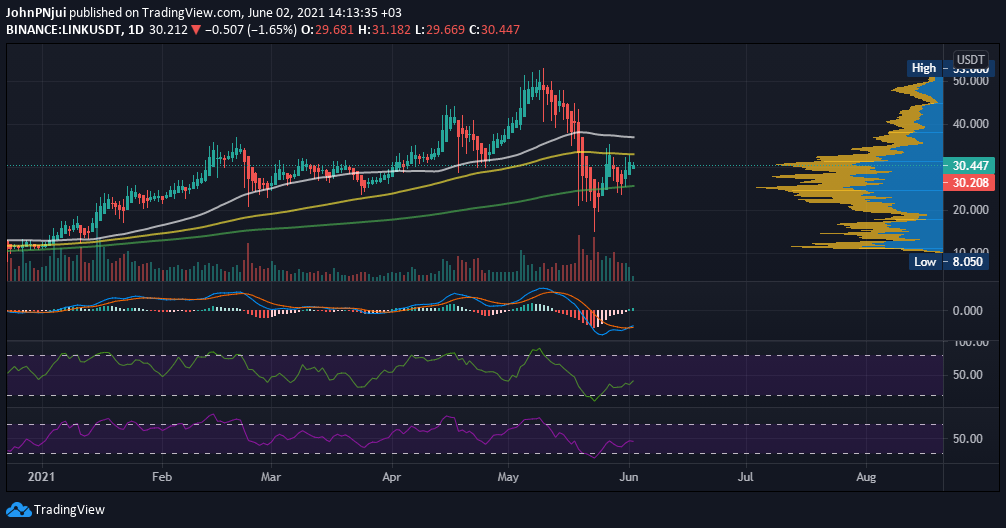
  • Chainlink is currently having a hard time breaking past the 100-day moving average at the $30 – $32 price area

The global peer-to-peer Bitcoin trading platform of LocalBitcoins has added Chainlink (LINK) as a payment method. The team at LocalBitcoin’s made the announcement back in late May and also pointed out the inclusion of additional popular digital assets as listed in the following statement.

It is now possible to create advertisements and accept Tether (USDT), Polkadot (DOT), Cardano (ADA), Bitcoin Cash (BCH), USD Coin (USDC), Chainlink (LINK) and Dogecoin (DOGE) as payment methods.

LocalBitcoins Adds Other Traditional Payment Methods

The announcement by LocalBitcoins also included the addition of the following global payment methods depending on the jurisdiction of its users.

PAYSEND, AirTM, Uphold, PaySera, Remitly, EcoPayz, Vodafone Cash, Monese, Airtel Money, Orange Money, MTN Mobile Money, Eversend, Sendwave, OneMoney, Mukuru, Zipit, Bunq, N26, Bizum, MBWay, MercadoPago, PagoFacil, RapiPago, Boleto Bancário, PIX instant payment, PicPay, Mach, Baloto, Efecty, MOVII, Nequi, PSE, YAPE, Bhim, Freecharge, PhonePe, Easypaisa, JazzCash, GCash, MonCash, Chime, N26, ERIP, GEO Pay

Chainlink Battles to Break the 100-day Moving Average

With respect to price action, Chainlink is currently trading above the crucial 200-day (green) moving average as seen in the chart below. However, the digital asset has met tough resistance at the $30 to $32 price range that also converges with the 100-day (yellow) moving average.

Also from the chart, it can be observed that the three daily indicators – MACD, RSI and MFI – are pointing towards an ongoing trend reversal for Chainlink from the bearish environment experienced in late May. Although, the daily trade volume is yet to provide the much-needed confidence to conclusively state that Chainlink will retest levels past the 50-day moving average at the $37 price area.

To note is that the value of LINK in the crypto markets is tied to its function calls on the Ethereum network. As a result, LINK’s price is hinged upon increased DeFi activity on Ethereum in addition to Bitcoin being the overall compass for the market direction in the crypto markets.

Therefore, DeFi on Ethereum needs to thrive once again and Bitcoin has to be stable for Chainlink to keep rising above $30.

Go to Source

SafeMoon: 10 Ways It Puts Your Money at Risk – Buy SAFE at this Price?

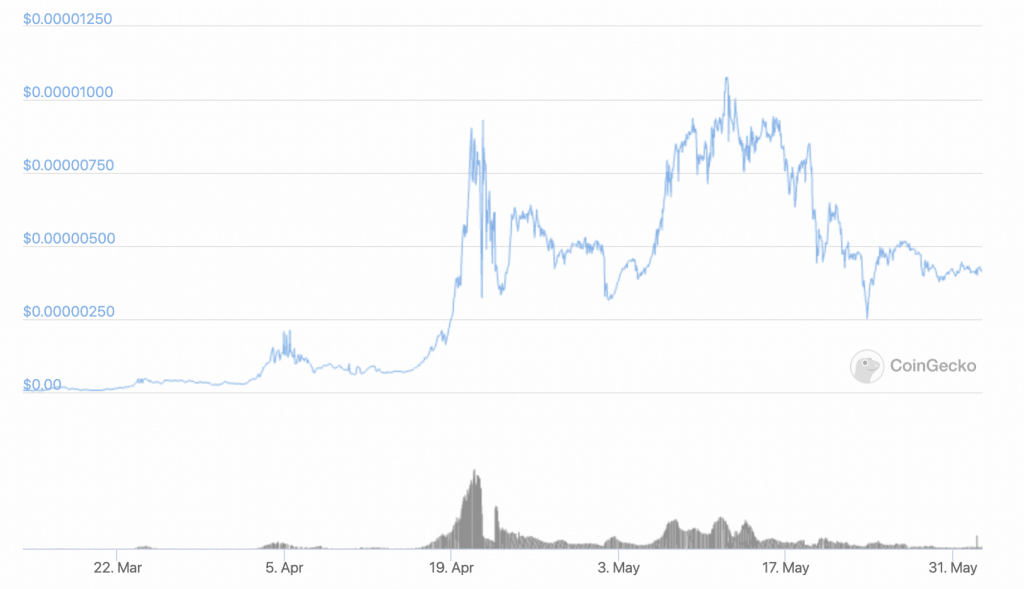
SafeMoon (SAFEMOON) is one of the most hyped cryptocurrencies in the market today. Launched in March 2021, the “DeFi token” has since climbed and fallen down the market cap rankings. It became the 33rd biggest crypto by market capitalization on May 11, when it hit an all-time high of $0.00001094 (according to CoinGecko). Since then, it has slipped down to 52nd, with its price now standing at $0.00000417.

Despite losing value, SafeMoon remains popular among investors. It has proven almost as popular as ethereum in Google searches, and rose above XRP in April and early May. It has also received vocal backing from prominent traders, such as Dave Portnoy.

However, investors should treat SafeMoon with extreme caution. It remains a highly unproven altcoin with a number of glaring flaws. We list 10 ways it puts your money at risk.

1. SafeMoon doesn’t have any utility

It may be several months old now, but still no one really knows what it is supposed to do. Safemoon describe the coin on its website as a “DeFi token,” but this doesn’t tell us much. Its ‘whitepaper‘ is also laughably thin, describing only the coin’s internal economics and nothing else.

It therefore seems that SafeMoon has designed its coin only to rise in price, and to have no wider use. This is fine for as long as it does rise in price. But if it falls, and if other altcoins offer better gains, it may collapse in a hurry.

2. SafeMoon penalises you for selling

While SAFEMOON is designed to rise in price, it charges holders for cashing out. If you sell your SAFEMOON, the SafeMoon protocol takes 10%. Half of this 10% goes to existing token holders holders. The contract also uses a quarter of the fee to ‘sell into BNB,’ according to the brief whitepaper. Basically, the owners of the contract use your sold SAFEMOON to buy Binance coin (BNB). They then pair the remaining quarter with the newly acquired BNB, adding both as a liquidity pair on PancakeSwap.

Safemoon intends this 10% fee to deter selling and to help SAFEMOON rise in price. But it’s not clear what exactly happens to the 5% which goes towards BNB. Do the contract owners — i.e. Safemoon — keep all the proceeds from adding liquidity to PancakeSwap? If so, they’re arguably profiting at the expense of SAFEMOON traders.

3. The protocol has a ‘critically severe’ issue related to safeguarding fees

DeFi security firm HashEx recently published an audit into the SafeMoon smart contract. It makes for some grim reading. Most notably, HashEx discovered two issues of “critical severity.”

The first relates to a lack of “safeguards for fees,” with the contract controlling fees (paid during SAFEMOON sales) being owned by an external account. According to HashEx, this means that if the owner of the smart contract were a bad actor, they could easily drain it of its accumulated fees. In other words, the fees you pay for selling SAFEMOON will end up lining someone else’s pockets.

4. It has another critical issue related to ownership of its smart contract

HashEx identified another issue of critical severity. It found that the ownership of the SafeMoon smart contract can be temporarily renounced. This can create confusion among users, who may incorrectly think the contract has no owner. Ultimately, HashEx says it identifies “this behavior as fraudulent.”

5. SafeMoon’s contracts have a ton of other issues

In total, HashEx identified 12 issues affecting SafeMoon’s smart contracts. Two of these are of critical severity, as described above. Another two are of high severity, with four being of medium and another four being of low severity.

What’s worse is that many of these issues can be exploited at the same time, greatly increasing the risk for investors that something will go badly wrong with SafeMoon. Here’s what HashEx concluded in its report:

At the time of the audit, the owner of the token contract is set to an EOA account (externally owned account), which implies high risks for token holders as if the owner account is compromised an attacker can break the token functionality completely (for example, by blocking any transfer).

Get SafeMoon And Other Crypto Signals Now!

6. It runs on the Binance Smart Chain, which has had its own issues

SAFEMOON is a BEP-20 token, meaning it runs on Binance Smart Chain. In itself, there’s nothing really wrong with this. However, BSC has suffered a number of issues recently across several of its platforms.

On May 20, malicious actors exploited bugs in BSC’s PancakeBunny protocol, stealing some $45 million in BUNNY tokens.

Likewise, likely manipulation of the Venus Protocol (XVS) price resulted in $200 million in liquidations on May 19.

This doesn’t necessarily affect SafeMoon. However, it suggests that the altcoin operates in a potentially uncertain environment. One which may result in traders losing money.

7. SafeMoon has very low liquidity

SafeMoon has extremely low liquidity. It’s such a small market that, if a big holder sells, its price is likely to fall steeply. For example, its price crashed by more than 80% in late April when a whale sold $8.5 million’s worth of it.

Smaller holders will never be able to predict when a larger holder is going to sell. This arguably makes holding SAFEMOON tantamount to gambling.

8. SafeMoon is hard to buy and sell

SafeMoon isn’t really listed anywhere. Right now, the only place you can really trade it is on PancakeSwap, a decentralized exchange on Binance Smart Chain. Traders therefore need to go through a relatively involved process to get their hands on it. They need to create a Binance account, buy Binance coin (BNB), swap BNB for SAFEMOON, download a wallet such as MetaMask, and also enable such a wallet to work with BSC.

With major exchanges such as Coinbase and Kraken steering clear of SAFEMOON, traders have to work quite hard to acquire the coin. But with few outlets to buy and sell it, it further worsens its problems with low liquidity.

9. SafeMoon’s team appear reluctant to answer hard questions

Back in late April, some members of SafeMoon’s team participated in an Ask Me Anything (AMA) at the Miami Crypto Experience. The thing is, they didn’t really answer any relevant questions, instead choosing mostly to speak with guests about unrelated topics. This didn’t create a good impression, and the coin promptly fell shortly after.

Such an appearance arguably fits in with the lack of detail on SafeMoon’s website and in its so-called whitepaper. There seems to be an avoidance of accountability and transparency, something which could potentially ring alarm bells.

10. It is well below its all-time high

SafeMoon has fallen much further from its recent all-time high than major cryptos such as bitcoin, ethereum and Binance coin. It’s now down by just over 61% from its ATH, according to CoinGecko. By contrast, bitcoin, ethereum and BNB are down 42%, 38% and 44% from their respective ATHs.

Source: CoinGecko

When the coin falls, it falls hard. This should be another warning sign for investors. Because even if it appears to offer big short-term gains at the moment, it also offers big losses.

Get Free Crypto Signals for SafeMoon (SAFE) and Other Crypto– 82% Win Rate!

Get SafeMoon Signals Now!

3 Free Crypto Signals Every Week – Full Technical Analysis

Go to Source

Please enter CoinGecko Free Api Key to get this plugin works.
Exit mobile version