There’s a by-product of DeFi’s boom that is little talked about

We need to have a conversation about fractionalization, and why this by-product of DeFi’s boom must be properly addressed through the development of cross-chain integrations.

Within the blockchain world, there’s endless talk about the importance of decentralization. But there’s a by-product from DeFi’s boom that is little talked about.

Fractionalization is an unavoidable consequence of the innovations we’ve seen over the past decade — and when implemented correctly, companies and individuals can benefit.

For example, it’s now possible to buy a small fraction of Amazon stock, potentially making it more affordable to millions of investors. With a single share now costing more than $3,000, this can be a high barrier to entry for most.

The explosion in non-fungible tokens has created an urgent need for such fractionalization to be applied to crypto collectibles — especially when NFTs are selling for hundreds of thousands, if not millions, of dollars. 

A substantial number of NFTs are now valued at a price that’s way higher than the average customer can afford. Fractionalization paves the way for these retail investors to engage with the market, rather than remain idle within the DeFi ecosystem. Better still, this unlocks greater levels of liquidity, something we all know is crucial to its smooth running.

Remembering our roots

Sometimes, it’s all too easy to lose sight of the fact that Bitcoin was created in response to the 2008 financial crisis — finally giving people a way to control money for themselves and creating a more transparent and democratic economy. Whereas big banks were shutting people out, crypto was creating a way to welcome them in.

With the total market cap of all cryptocurrencies recently hitting $2 trillion, and the total value locked in DeFi protocols touching $90 billion, there’s a threat of history repeating itself. Fractionalization gives everyone a chance to enjoy the features that this vibrant ecosystem has to offer — allowing us to mutually own assets that they would not have been available to buy otherwise. And if fractionalization is removed from the equation, only the wealthiest will be able to benefit from DeFi’s functionality, significantly restricting market depth.

But let’s just also take a moment to think about this from an adoption standpoint. If more people are given a chance to show interest in a specific product, awareness can grow about its value. Right now, the NFT space is dominated by whales deciding what they want to spend their disposable income on — and this creates fears that the industry’s explosion is unsustainable. 

Fractionalization gives the masses a chance to decide which projects are truly beneficial to an ecosystem, fosters innovation, and breeds passion. It’s the difference between a top-flight football match being watched by one wealthy investor behind closed doors, and 90,000 fans with season tickets getting a chance to enjoy a piece of the action.

Properly addressing fractionalization

It’s hard to overstate the importance of cross-chain bridges in helping DeFi reach its full potential, but achieving transparency in how these bridges are designed is by no means easy and should be of concern can all of us. Will they be on chain or off chain? How are validators chosen? And how can we ensure that they always act in our best interests?

On-chain bridges are the best option here because they can help achieve complete transparency, tackling the concerns of both users and developers. But there are obstacles that lie ahead. What will happen when a large number of users exceeds the bottleneck abilities of connected blockchains? In this case, a bridge may only transfer the issue from one network to another, without ever resolving the underlying problem.

Imagine if the crypto world had infrastructure that could fairly distribute the number of users through different chains — eliminating this problem altogether. It would be a feat equivalent to ensuring that commuters in the rush hour are equally spread across all the trains in a network, eliminating delays and providing everyone with a seat.

Such an approach would mean that the number of users required to create a bottleneck on the blockchain would need to be extremely high. As a greater variety of digital assets emerge and user bases across networks explode, technological advancements like this are becoming an inevitable feature of DeFi’s future — paving the way for costs on congested chains to be reduced while increasing available market liquidity.

Right now, the promise of fractionalization is being held back by the exceedingly fragmented nature of the blockchain industry. The various chains that exist are probably best compared to small islands in a vast ocean. Just like air travel made our world smaller, creating crucial connections between different lands, we need to build infrastructure that makes it easier for travelers in the crypto world to hop from one platform to another.

True financial independence lies in cross-chain integration — allowing people to combine an endless number of digital assets through a plethora of different chains.

The views, thoughts and opinions expressed here are the author’s alone and do not necessarily reflect or represent the views and opinions of Cointelegraph.

Andriy Velykyy is a former Cisco Certified Network Professional who has worked in IT since 2002, primarily in data center architecture, networking and switching. Andriy entered the crypto industry in 2015, building mining farms before moving further into tech breakthroughs such as crypto payment integration with point-of-sale devices, cyber security, and non-custodial multi-chain crypto wallets. His current project, APYSwap, is a protocol for the decentralized trading of tokenized vault shares.

Go to Source

Canaan Expects $250M Revenue in Q2 — Yields and Mining Rig Deliveries to ‘Increase Substantially’

The mining rig manufacturer Canaan saw steady profits during the Q1 after reporting its unaudited first quarter 2021 financial results on Tuesday. Canaan noted that it expects to at least sustain current profits or rise above to roughly $150 to $250 million in revenue for Q2.

Canaan Expects $250M in Revenue for Q2 – Company Recognizes It’s Hard to Predict With Current Bitcoin Volatility

On Tuesday, the China-based ASIC mining rig maker Canaan (Nasdaq: CAN) published the firm’s unaudited first quarter 2021 financial results and the company did well this year. The amount of hashrate sold jumped by 122% compared to the same period of 2020. Additionally, Canaan saw a “larger volume of sales orders of bitcoin mining machines” during the first quarter. Total net revenue was around 402 million yuan or $61.5 million according to Canaan’s unaudited financial records.

“Our financial performance improved significantly in the quarter, driven by the Bitcoin price rally, higher customer demand for quality mining machines, and our ability to ramp up mining machine production and deliveries,” Nangeng Zhang, chairman, and CEO of Canaan revealed in the audit report.

“During the period, we improved our mining machine production yields and secured sufficient capacity for future production by forging tighter partnerships with key foundry partners and other suppliers. We also maintained our strategic focus on enhancing our R&D capabilities to augment the quality and performance of our mining machines,” Zhang added.

Canaan Expects ‘Yields and Deliveries to Increase Substantially’

Canaan is expecting decent results in Q2 thanks to a large number of mining rig orders placed. The financial report noted that the company believes Q2 will at the least be on par with Q1 but could pull in a projected $150 to $250 million in revenue. Canaan’s Q1 financial results’ business outlook notes:

As the company mass produces its new generation of bitcoin mining machines, it also expects its yields and deliveries to increase substantially as compared with the first quarter of 2021. The company recognizes that the trends in bitcoin prices are currently hard to predict and cannot provide financial guidance due to bitcoin’s price volatility in late May of this year.

The Q1 news follows two reports in April where Canaan sold $93.63 million worth of ASIC rigs to Genesis Digital Assets, and 11,760 next-generation A1246 ASIC Avalonminers to a company called Mawson Infrastructure Group. During the first month of January, Canadian bitcoin miner Hive Blockchain has bought 6,400 next-generation mining machines from Canaan.

The company’s first-quarter 2021 financial results did not give Canaan shares a boost on Tuesday as CAN shares closed at $10.26 per share to $9.80 per share. Canaan’s A1246 ASIC Avalonminer is the seventh most powerful mining rig today according to asicminervalue.com stats, which shows an A1246 gets around $21 per day in profit at $0.12 per kilowatt-hour.

What do you think about Canaan expecting $150 to $250 million in revenue for Q2? Let us know what you think about this subject in the comments section below.

Go to Source

Bonded.Finance (BOND) Token Is Now Listed on Bitcoin.com Exchange

PRESS RELEASE. Bitcoin.com Exchange is ecstatic to announce the listing of BOND, being available to trade on the 2nd June 2021 at 12:00PM UTC. BOND was created by the Bonded.Finance team, as the driver and receipt of value within their platform. BOND will start trading with BTC and USDT pairs.

What is Bonded.Finance?

With nearly 7000 trackable assets and some 700 exchanges in crypto, it is an understatement to say that liquidity is scattered and that early stage projects as tradable assets make for capricious token holders. Even the meteoric rise of DeFi has done little to change this as lending/borrowing protocols and the true earning potential of tokens are realized only by a select few cryptos. Bonded Finance sees a massive opportunity in this. With crypto maturing as an asset class, there are scores of well-capitalized projects with solid volume and price histories to go with deliverables, yet, they have not been afforded the opportunity to partake in the decentralized financial services movement. Bonded has identified some fifty billion USD in untapped liquidity in this presently underserved altcoin market and has set out to aggregate these tokens to provide DeFi protocols through their algorithm-driven “smart instruments.” Bonded’s aim is to bridge the gap between established and nascent altcoin projects to provide not just traditional and DeFi services but ultimately, to create a network of shared value.

What is the BOND token?

The Bond token is inherent to the network as the sole driver for the exchange and receipt of value. Network fees, liquidations, collected interest, provider rewards and network incentives are all rewarded to Bond holders and liquidity providers. This stems from Bonded’s decentralized and trustless underpinnings with much of its utility derived from actual revenues. As a decentralized, eventually fully autonomous suite of products, there will be no salaries or overhead or any “off the top,” rather, this end-to-end solution for lending, borrowing, indexing and repurposing of capital and the generated revenues all the flow through the token as the sole incentivizer. Future uses include insurance for borrowers, early access to the Bond stable coin and eventually, full governance. And innovation. Beginning in June, Bonded’s “stacking rewards program,” will grant Bonded liquidity providers tokens from IDOs. These upstart projects are aiming to bolster their go to market strategies by gaining exposure to the Bond community by having the option to open lending markets, see their token represented in a basket of altcoins and ultimately, give them earning power and stability on the open market. As Bonded continues its development, new assets will be available for borrowing and lending, alongside new products including index protocols, synthetic assets and the release of the bToken, Bonded’s hybrid algorithmic stable coin.

Strong Endorsement

Danish Chaudhry, CEO of Bitcoin.com Exchange, shared his views on Bonded.Finance, and their respective token BOND: “The team at Bonded.Finance is run by some great individuals, and with this experience have developed a marvelous incentive-heavy network architecture, and still at its infancy. Many projects aim to tackle and gain market share in the lending ecosystem, but do not tackle this in the same way the Bonded.Finance team have. I believe they will be the pioneers in algorithmic smart instruments and decentralised financial products for digital assets.”

Chaudhry continues on by saying; “We’re very excited to see how Bonded.Finance will continue to empower their vision for the future of DeFi, and gain further outreach with our outstanding community at the exchange.”

“DeFi products are only as good as their network. Android may have a superior OS but that hasn’t slowed sales of the iPhone. Crypto will be no different but the opportunity is now as everyone jockeys for position in the hopes of not just capturing but keeping users—and that’s asking a lot. For us, that begins by rallying these longstanding communities, giving their token earning power and a reason to hang around. Outside the network, expanding awareness, visibility and opportunity to acquire the Bond token is something we must do in lockstep. Bitcoin.com is a longstanding name and a boutique exchange that we believe will bring in new users and we’re excited to work with them,” states Paul Mak, CEO of Bonded.


About Bitcoin.com Exchange

The mission of Bitcoin.com Exchange is to empower people from all over the world to trade cryptocurrencies with ease and confidence, from first-time traders to advanced trading professionals. With high liquidity, 24/7 multilingual support and dozens of trading pairs, complemented with a high level of security, it offers an attractive platform for trading any cryptocurrency. Within one year since launch, on average, the exchange has been visited by more than 500K active traders per month, and this number continues to grow as you read this sentence.


About Bonded.Finance

The Bonded platform was created to incubate and deploy experimental, high-yield, smart-contract driven financial instruments that push the bounds of open finance. Bonded is an algorithmic model that aims to unlock, aggregate, and de-risk ~50 billion in dormant value distributed amongst untapped digital assets by allowing supporters of qualifying altcoin projects the opportunity to leverage assets and realize their value.


This is a press release. Readers should do their own due diligence before taking any actions related to the promoted company or any of its affiliates or services. Bitcoin.com is not responsible, directly or indirectly, for any damage or loss caused or alleged to be caused by or in connection with the use of or reliance on any content, goods or services mentioned in the press release.

Go to Source

Pepe the Frog Creator Launches NFTs Featuring the Infamous Internet Meme

The infamous Internet meme “Pepe the Frog” will be immortalized in non-fungible token (NFT) collectible form by the frog’s original creator Matt Furie. Of course, Pepe has been featured in blockchain art before and a series of cards were created via Counterparty in 2016. However, despite the number of NFT rare Pepes on the web, Furie says when it comes to his famous frog, “Everything else is a bootleg.”

Feels Good Man

“Nothing beats the real thing,” the creator of the notorious Pepe the Frog Internet meme told the Washington Post (WP) this week. Matt Furie is well known for creating Pepe the Frog back in 2005 in a comic called “Boys Club.” When the picture hit the web, it went viral on Myspace, Reddit, 4chan and Tumbler, and later was recognized as one of the most popular memes of the last decade. Now Furie is getting into the non-fungible token (NFT) collectibles game and he’s bringing Pepe with him.

Furie has launched a web portal called pegz.fun and it features animated 2-D and 3-D creatures that Furie crafted. Users can even sign up for “plops” which seem to be an airdrop of some kind featuring Furie’s NFTs. One of the NFT pegz features a colorful depiction of Furie’s famous Pepe the Frog character. While speaking with WP, Furie said a lot of NFT artists were creating interesting pieces.

“The NFT world is new, and there are a lot of optimistic people creating cool things,” Furie said during his interview. “Pepe does not have the baggage here that he does in the ‘real world,’ and I like working with utopians and optimistic freethinkers. There are so many possibilities,” the Pepe creator added.

Pepe the Frog Creator: ‘Nothing Beats the Real Thing’

Now, Pepe is no stranger to blockchain as Bitcoin.com News has reported on the crew who created a series of Rare Pepe blockchain-based trading cards in 2016. The creation of these cards on Counterparty was after the Anti-Defamation League deemed Pepe as a “hate symbol.”

When NFTs started making headlines again in 2020 and into 2021, an NFT called “Homer Pepe” sold for $320,000 in February 2021. Furie briefly touched upon the flurry of Pepe NFT’s that were invoked before his pegz concept during his WP interview.

“Everything else is a bootleg, and I’m very inspired by bootlegs in my life and in my art,” Furie said. “But nothing beats the real thing,” he added. Pepe the Frog’s creator further noted:

This new space is laying the groundwork for the Internet 3.0. In the future, you’ll be able to trace memes back to their source.

The popular NFT artist Matt Kane spoke about Furie’s entrance into the NFT space and applauded the meme pioneer. “Matt Furie created Pepe, which inspired Rare Pepes, which provided us the proof-of-concept on which the modern NFT scene became based,” Kane remarked. “So for Matt to have had such a successful entrance to NFTs, it created a beautiful circle.”

Of course, Furie’s other colorful pegz designs are just as fun as the frog, according to the Internet meme creator. “We want to throw a rave in the metaverse for disco Pepes, lizards, tongue-waggling-whachamacallits, blobbies, gooies, pricklies and everyone,” Furie concluded. “Viral media is inside of our heads, our subconscious. It never ends. It’s best to make friends with the worms in our minds and to dance with them.”

What do you think about Pepe the Frog creator Matt Furie jumping into the world of NFTs? Let us know what you think about this subject in the comments section below.

Go to Source

Google Announces New Policy for Cryptocurrency Ads

Google has announced an update to its financial products and services policy, which includes its policy on cryptocurrency advertising. The new rules will take effect in August and all prior crypto exchange certifications will be revoked. Advertisers must request new cryptocurrency exchanges and wallets certification with Google.

Google Introduces New Crypto Ad Rules

Google Inc. posted a notice Wednesday regarding its new crypto ad policy. “This policy will apply globally to all accounts that advertise these financial products,” the Internet giant wrote.

The notice explains that Google will update its existing financial products and services policy in August “to clarify the scope and requirements to allow the advertisement of cryptocurrency related business and services.” The tech giant wrote: “Beginning August 3, advertisers offering cryptocurrency exchanges and wallets targeting the United States may advertise those products and services when they meet the following requirements and are certified by Google.”

The company proceeded to explain how advertisers can be certified. Firstly, they must be duly registered with the Financial Crimes Enforcement Network (FinCEN) “as a Money Services Business and with at least one state as a money transmitter.” Alternatively, the advertisers can be “a federal or state chartered bank entity.”

Furthermore, Google noted that the advertisers must meet all relevant legal requirements, including state, local, and federal laws and they must also “Ensure their ads and landing pages comply with all Google Ads policies.” The company elaborated:

All prior cryptocurrency exchange certifications will be revoked on August 3, 2021. Advertisers must request new cryptocurrency exchanges and wallets certification with Google when the application form is published on July 8, 2021.

Meanwhile, Google clarified that some ads are not allowed. They include “Ads for initial coin offerings [ICO], Defi trading protocols, or otherwise promoting the purchase, sale, or trade of cryptocurrencies or related products.” In addition, “Ad destinations that aggregate or compare issuers of cryptocurrencies or related products” are also prohibited.

“ICO pre-sales or public offerings, cryptocurrency loans, initial DEX offerings, token liquidity pools, celebrity cryptocurrency endorsements, unhosted wallets, unregulated Dapps, cryptocurrency trading signals, cryptocurrency investment advice, aggregators or affiliate sites containing related content or broker reviews” are some examples of the ads that are not allowed.

Google’s current financial products and services policy states: “We consider financial products and services to be those related to the management or investment of money and cryptocurrencies, including personalized advice.” Crypto ads are currently allowed in the U.S. and Japan.

What do you think about Google’s new policy on cryptocurrency ads? Let us know in the comments section below.

Go to Source

Bonsai bonanza as Zenft studio sells out $2 million NFT drop in one hour

The digital trees are a smash hit amid a demand drought for NFT projects.

While the short-term market outlook for many NFT projects look uncertain, and multiple new releases struggle to gain traction, one gardening-themed drop may have set some records by selling 8,888 nonfungible tokens (NFTs) in just under an hour.

Nonfungible token studio Zenft released a line of 8,888 unique bonzai NFT plants that quickly sold out on Tuesday, with the studio selling each digital tree for 0.08 Ether (ETH), or roughly $220 at the time of publication. The bonsais have augmented reality/virtual reality functionality, and their 3D design is a step up from previous pixelated, 2D projects. The studio celebrated the nearly $2,000,000 sale with a tweet:

The success is somewhat of a surprise, given that NFTs remain mired in a slump following explosive growth earlier this year. New drops like Crypteriors struggle to sell out completely, making the one-hour mark a particular feat.

However, some collectors suspect that the success may be due in part to clever marketing.

“I like the way they look but it feels like people are trying to recreate what happened with the Bored Apes money printing machine,” said one prominent collector who spoke to Cointelegraph on the condition of anonymity. “Been feeling a little exhausted seeing the space devolve into celeb pump and dump.”

Bored Ape Yacht Club, another recent success amid the market dip, managed to attract a fervent community in part on the back of outreach to prominent investors and collectors in the NFT space — and as one collector put it, where whales go, smaller collectors, or “plankton,” follow (sometimes to their detriment).

In an interview with Cointelegraph, “8ncient Gardener,” one of the three Zenft “gardeners” (or developers), said that marketing played a role — 8ncient “took painstaking care around crafting our giveaways,” in particular — but ultimately, the quality of the art is what made the bonsais such a hit. 

“I think our art speaks for itself quite honestly. And everyone can unify around a bonsai. We had Apes, Punks, Voxo, Sandbox, Camels — all these NFT factions all rallying around bonsai,” he said. “In a world of pixel art we made gorgeous 3D bonsai.”

The on-chain evidence is somewhat mixed. There are currently 1,736 different holders of the nearly 9,000 bonsais, with over 22% of the supply concentrated in two NFT whale addresses. From there, there’s a steep drop-off, however, with a broad range of addresses holding smaller quantities of the bonsais.

While it’s impossible to tell the exact source of the success, Zenft “Grove Councilor” “Justsomebonzai” argued that the digital trees are ultimately spreading joy:

“People genuinely like Bonsai, they’re beautiful IRL and they’re beautiful as an NFT.”

Go to Source

Altcoins and DeFi tokens breakout as Bitcoin price nears a key resistance

DOGE, KNC and KAVA are just a few of the altcoins that posted double-digit gains as Bitcoin and Ether rallied to key overhead resistance levels.

Weary cryptocurrency traders awoke to the sight of green in the markets on May 2, as bulls managed to bid the price of Bitcoin (BTC) above the crucial “line in the sand” resistance at $37,500, while Ether (ETH) briefly traded at $2,800.

The rising price of both BTC and ETH has been accompanied by double-digit gains in multiple altcoins, leading some to speculate that the market is currently experiencing an oversold bounce following the recent downturn.

Price, Twitter and trading volume data. Source: Cointelegraph Markets Pro

The leader of the pack for this most recent rally is once again Dogecoin (DOGE), which rallied 28% to an intraday high at $0.4446 following the June 1 announcement that the token would be listed on Coinbase Pro and renewed Twitter promotion from Elon Musk.

Data from Cointelegraph Markets Pro began to detect the bullish turn for DOGE on May 31, prior to the recent price rise and ahead of the Coinbase Pro announcement.

The VORTECS™ Score, exclusive to Cointelegraph, is an algorithmic comparison of historic and current market conditions derived from a combination of data points including market sentiment, trading volume, recent price movements and Twitter activity.

VORTECS™ Score (green) vs. DOGE price. Source: Cointelegraph Markets Pro

As seen in the chart above, the VORTECS™ Score for DOGE began to register green on May 31 and reached a high of 74 on June 1, just 14 hours before the system registered the NewsQuake™ announcement of DOGE being listed on Coinbase Pro, which was followed by a 45% rally.

DeFi projects gain traction

Cointelegraph Markets Pro data for Kyber Network’s KNC token shows that market conditions for the project have been favorable for some time.

VORTECS™ Score (green) vs. KNC price. Source: Cointelegraph Markets Pro

As seen in the chart above, the VORTECS™ Score for KNC shifted into the green zone on May 31 and stayed elevated for the next two days before reaching a high of 74 on June 1 when its price began a 75% rally.

Another DeFi-focused project that was identified by Cointelegraph Markets Pro ahead of its recent price move is Kava, which has gained 36% in the past 24 hours and currently trades at $4.68.

VORTECS™ Score (green) vs. KAVA price. Source: Cointelegraph Markets Pro

As seen in the chart above, conditions for KAVA have been bullish for some time, as evidenced by the sustained green VORTECS™ Score over the past week. The VORTECS™ Score for KAVA reached a high of 75 on May 31, roughly 48 hours before starting a 45% price rally.

The May 19 correction wiped out $1.2 trillion in value across the crypto market, and while shockwaves from the historic correction are still reverberating throughout the market, a handful of DeFi tokens and altcoins are beginning to show signs of bullish momentum. 

This suggests that cautious traders are slowly easing their way back into the market in hopes that the second leg of the 2021 bull market could be underway.

The views and opinions expressed here are solely those of the author and do not necessarily reflect the views of Cointelegraph. Every investment and trading move involves risk, and you should conduct your own research when making a decision.

Go to Source

Funding surpasses $2 million for this charity DAO

Multiple parties added capital to Endaoment, which aims to turn its ecosystem into a decentralized autonomous organization for donations — a charity for the people.

Opportunities for cryptocurrency usage have risen over the years as digital assets have become more well known. One operation, called Endaoment, is aiming to put charitable giving in the hands of the people and recently secured over $2 million to further its endeavor. 

“Endaoment facilitates tax-deductible giving of cryptocurrencies via its Donor-Advised Funds, a kind of charitable financial account, where donors give assets to charity, and later recommend distributions to non-profit organizations,” said a Wednesday public statement provided to Cointelegraph. “Endaoment also offers Community Funds, a pooled giving opportunity where grants are made around specific issue areas and identified by the community.” Endaoment hosts compatibility for a large number of digital assets.

This is not the first instance in which crypto-based donations have surfaced as a topic in the industry. The Giving Block has taken a number of strides to facilitate donations via crypto assets.

Endaoment is currently overseen and developed by a community foundation, although the operation aims to eventually function as a decentralized autonomous organization, or DAO — essentially a system run by the public in a democratic fashion in line with programmed rules and guidelines. Endaoment’s donor fund systems run on Ethereum’s blockchain, the statement also notes.

A number of entities donated and invested a total of $2.5 million into Endaoment as part of a seed funding round, the statement included. The capital will assist in moving toward the DAO set up.

“This capital enables us to launch the DAO that is our namesake; the first DAO to power an on-chain philanthropic institution without compromising on regulatory compliance,” Robbie Heeger, Endaoment’s CEO and president, said in the statement.

Go to Source

Price analysis 6/2: BTC, ETH, BNB, ADA, DOGE, XRP, DOT, UNI, ICP, BCH

Altcoins are picking up steam as the relief rally in Bitcoin and Ether gains traction.

Bitcoin’s (BTC) active supply — coins that have moved in the past two years or earlier — dropped to a five-month low of 44.5% on June 2, according to data from Glassnode. This indicates that investors who had purchased Bitcoin more than two years ago are not keen to sell after the 40% drop.

Even miners, who sold during the May correction have since reversed their decision. The outflows from miner addresses are at the lowest level in seven months, which suggests that miners are holding on to their Bitcoin.

Daily cryptocurrency market performance. Source: Coin360

Veteran trader Peter Brandt believes that Bitcoin’s correction could extend below $30,000. Brandt said that every 50% fall in Bitcoin’s history has stretched to 70%. He also highlighted that according to past precedence, Bitcoin is unlikely to hit a new all-time high within seven months of a 50% correction.

However, PlanB, creator of the stock-to-flow-based Bitcoin price models, believes a further sharp fall below $30,000 is unlikely. He also remains positive on the prospects of Bitcoin hitting a new all-time high this year.

At the moment, analysts are divided in their opinion on Bitcoin’s short-term price action. Let’s analyze the charts of the top-10 cryptocurrencies to determine the path of least resistance.

BTC/USDT

Bitcoin continues to trade inside a symmetrical triangle pattern as the bulls and the bears battle it out to establish their supremacy. Although the symmetrical triangle generally acts as a continuation pattern, it is difficult to predict with certainty until the price breaks out of the triangle.

BTC/USDT daily chart. Source: TradingView

The downsloping moving averages and the relative strength index in the negative territory suggest that bears have the upper hand. If the BTC/USDT pair breaks below the triangle, the bearish momentum could pick up. There is a minor support at $28,000 but if that also cracks, the pair could retest the $20,000 level.

This negative view will invalidate if the bulls push and sustain the price above the resistance line of the triangle. If that happens, it will suggest that bulls have overpowered the bears. The pair could then attempt a rally to the 50-day simple moving average ($49,201).

This level may again act as a stiff resistance but if the bulls propel the price above it, the pair will signal that the downtrend could be over.

ETH/USDT

Ether (ETH) turned down from the 20-day exponential moving average ($2,762) on June 1 but the positive sign is that the bulls did not give up much ground. This suggests that the buyers did not hurry to close their positions.

ETH/USDT daily chart. Source: TradingView

The 20-day EMA is flattening out and the RSI has risen near the midpoint, indicating that the selling pressure has reduced.

If buyers drive and sustain the price above the resistance line of the symmetrical triangle, the ETH/USDT pair could start a relief rally that may reach the 61.8% Fibonacci retracement level at $3,362.72 and then the 78.6% retracement level at $3,806.91.

Contrary to this assumption, if the bulls fail to sustain the price above the triangle, the pair may consolidate inside the triangle for a few more days. A breakdown and close below the triangle will indicate advantage to the bears.

BNB/USDT

Binance Coin (BNB) has risen above the 20-day EMA ($399) but it could face stiff resistance at $423.83. If the price turns down from this overhead resistance, the bulls will try to arrest the decline at the trendline.

BNB/USDT daily chart. Source: TradingView

If they succeed, it will suggest the bulls are attempting to form a higher low. This will increase the possibility of a break above $423.83. The BNB/USDT pair could then rally to the 50-day SMA ($505). A breakout of this resistance will suggest the downtrend may be over.

On the contrary, if the price turns down from the current level and plummets below the trendline, it will suggest the sentiment remains negative and traders are selling on rallies. The pair could then retest the critical support at $211.70.

ADA/USDT

Cardano (ADA) broke above the downtrend line on June 1 and the bulls are trying to extend the relief rally above $2 today. The 20-day EMA ($1.64) has started to turn up and the RSI is trading above 54, suggesting that the bulls have the upper hand.

ADA/USDT daily chart. Source: TradingView

If buyers succeed in pushing the price above $2, the ADA/USDT pair could rally to the all-time high at $2.47.

On the other hand, if the price turns down from $2, the bears will try to pull the price back below the downtrend line. If that happens, it will suggest that buying dries up at higher levels. The pair could then drop to the 50-day SMA ($1.52).

A breakdown and close below the 50-day SMA could attract further selling and the pair may drop to $1.33 and later to $1.

DOGE/USDT

Dogecoin (DOGE) broke above the downtrend line on May 31 and cleared the 20-day EMA ($0.37) hurdle today. The RSI has jumped into the positive territory and the 20-day EMA has started to turn up, suggesting the bulls are making a comeback.

DOGE/USDT daily chart. Source: TradingView

If buyers propel the price above $0.47, the DOGE/USDT pair could pick up further momentum and rise to $0.59.

Conversely, if the price turns down from $0.47, the pair could correct to the 20-day EMA. If this support holds, it will suggest the sentiment has turned positive and traders are buying on dips. The bulls will then make one more attempt to push the price above $0.47.

However, if the price turns down and breaks below the 20-day EMA, the pair could drop to $0.28 and then to $0.21.

XRP/USDT

The bulls tried to push XRP above the 20-day EMA ($1.07) on June 1 but met with stiff resistance from the bears. However, the buyers did not give up much ground, indicating strength.

XRP/USDT daily chart. Source: TradingView

The bulls will again try to thrust and sustain the price above the 20-day EMA. If they manage to do that, the XRP/USDT pair could start its relief rally to the 50-day SMA ($1.30) and then to the downtrend line.

Alternatively, if the price turns down from the 20-day EMA, the pair could again drop to the $0.88 to $0.80 support zone. A break below this zone could result in a retest of the May 23 low at $0.65.

DOT/USDT

Polkadot (DOT) is inching towards the overhead resistance at $26.50. The price had turned down from this resistance on May 28, hence the bears are again likely to defend this level aggressively.

DOT/USDT daily chart. Source: TradingView

If the DOT/USDT pair turns down from $26.50 but bounces off the trendline, it will suggest that bulls are accumulating on dips.

That could result in the formation of a bullish ascending triangle pattern, which will complete on a breakout and close above $26.50. The pattern target of this setup is $35.91.

Alternatively, if the bears sink the price below the trendline, the pair could drop to the support at $15. A strong rebound off this support will suggest a few days of range-bound action between $15 and $26.50.

UNI/USDT

Uniswap (UNI) turned down from the 20-day EMA ($28.41) on June 1 but the positive sign is that the bulls did not allow the price to drift down. The buyers are again trying to push the price above the 20-day EMA today.

UNI/USDT daily chart. Source: TradingView

The repeated retest of a resistance level tends to weaken it. The 20-day EMA is flattening out and the RSI has risen above 48, indicating the selling pressure has reduced.

If buyers thrust the price above the 20-day EMA and $30, the UNI/USDT pair could rise to the 50-day SMA ($33.67). A breakout of this resistance could signal an end of the downtrend.

Conversely, if the price turns down from the 20-day EMA and plunges below $25.94, the bears will attempt to pull the pair down to $21.50. A breakdown and close below this support will suggest that the bears have reasserted their supremacy.

ICP/USDT

Internet Computer (ICP) remains weak as the bulls have not been able to push the price back above $120 in the past five days. This suggests a lack of aggressive buying even at the current levels.

ICP/USDT daily chart. Source: TradingView

If the bears sink and sustain the price below the $103.71 support, the ICP/USDT pair could resume its downtrend and challenge the May 19 low at $86. If this support cracks, the pair may drop to $60.

On the contrary, if bulls propel and sustain the price above $120, it will suggest accumulation at lower levels. That may clear the path for an up-move to $168.

If the price turns down from this resistance, a few days of range-bound action is likely. The pair could pick up bullish momentum on a breakout and close above $168.

BCH/USDT

Bitcoin Cash (BCH) rose above $685.36 on May 31. The bears tried to pull the price back below the level on June 1 but they could not sustain the lower levels. This suggests buyers are trying to form a higher low.

BCH/USDT daily chart. Source: TradingView

The relief rally is likely to face stiff resistance at the 20-day EMA ($801). If the price turns down from this resistance, the bears will make one more attempt to sink the BCH/USDT pair below the $685 to $600 support zone. If they succeed, the pair could retest the May 23 low at $468.13.

Conversely, if bulls drive the price above the 20-day EMA, the momentum could pick up and the pair may rally to the 50-day SMA ($958). This level may again act as a stiff resistance but if the bulls can thrust the price above it, the rally may extend to the 61.8% Fibonacci retracement level at $1,198.53.

The views and opinions expressed here are solely those of the author and do not necessarily reflect the views of Cointelegraph. Every investment and trading move involves risk. You should conduct your own research when making a decision.

Market data is provided by HitBTC exchange.

Go to Source

Search giant Google lifts 2018 ban on crypto exchange, wallet advertisements

The new policy allows companies that have cleared rigorous regulatory hurdles to post ads.

In a surprise move today, online advertising behemoth Google has lifted a nearly three year old policy banning cryptocurrency exchanges from using its ad services. 

“Beginning August 3, advertisers offering Cryptocurrency Exchanges and Wallets targeting the United States may advertise those products and services when they meet the following requirements and are certified by Google,” reads a policy update on the company’s support page.

Requirements exchanges have to pass include needing to be either registered with “FinCEN as a Money Services Business and with at least one state as a money transmitter” or “a federal or state chartered bank entity,” potentially opening the door to ads from services like Anchorage and Paxos.

The new policy won’t open the door to the vast majority of crypto institutions, however, as “ads for initial coin offerings, DeFi trading protocols, or otherwise promoting the purchase, sale, or trade of cryptocurrencies or related products” all continue to be prohibited. News and chart aggregators as well as “signals” and analysis services also remain on the ad blacklist.

Google’s policies around crypto ads have often been conflicting, and at points experts have decried them as “unfair.” Throughout 2018 the search giant flip-flopped on an exchange ad ban, at one point had “Ethereum” as a blacklisted word in ads, and despite the strict policies still occasionally allowed scam projects to slip through. 

The new advertisement policy means that U.S.-based crypto aficionados may soon be bombarded with ads. Binance US and FTX are currently battling to carve out Stateside market share, with FTX in particular willing to spend on unconventional advertising venues. Earlier this year it was announced that FTX bought the naming rights to the home of the National Basketball Association’s Miami Heat until 2040, the soon-to-be FTX arena.

Go to Source

Classic technical indicator foresees another massive Bitcoin price drop with $16K target  

Bitcoin is forming a textbook downside continuation structure called Bearish Pennant whose ultimate breakout target lurks near $16,000.

Bitcoin (BTC) has rebounded by more than 25% after bottoming out at $30,000 during the May 19 crash. But the cryptocurrency continues to tread ahead under the possibility of facing another period of strong sell-offs owing to a classic technical indicator pattern.

Bitcoin price in a ‘Bearish Pennant’ 

Dubbed as Bearish Pennant, the pattern forms when an asset consolidates after a strong move downward and forms a small symmetrical triangle-like price range. It breaks below the range support and continues moving lower. Traders usually estimate the size of the negative breakout move by measuring the height of the earlier move.

Bitcoin is currently trading inside a similar bearish pennant structure, fluctuating sideways as it forms a sequence of lower highs and higher lows. Meanwhile, its consolidation structure precedes a massive move downhill to around $20,000. Therefore, if the BTC/USD rate breaks below the pennant structure, accompanied by rising trade volumes, its likelihood of crashing by almost $20,000 is high.

The bearish outlook also borrows cues from Bitcoin’s recent bounce. It is worthy to take notice that the cost to purchase one Bitcoin fell from almost $65,000 to $30,000 on May 19 — or by over 50% —followed by a considerable 30% bounce.

Bitcoin pennant structure and its primary downside target. Source: TradingView

Meanwhile, market analytics service Income Machine is warning of a “dead cat bounce” scenario emerging in the Bitcoin market, noting that upcoming rallies in BTC/USD could face limitations by further selling pressure near the May 26 highs (the $39,000-$41,000 area). It recommended traders exit their bullish positions near $40,000.

What’s more, Income Machine also noted that a failure to hold $30,000 as support would risk crashing bitcoin prices to $16,200 — a level that coincides with the Bearish Pennant target. The analytics firm selected $16,200 because of its historical relevance as support during the November-December 2020 session.

Bitcoin bearish outlook presented by Income Machine. Source: TradingView

“Conversely, an upside break of the May 26 highs would cause us to reverse our analysis and adopt a more bullish outlook for BTC-USD,” added Income Machine analysts.

Pankaj Balani, chief executive and co-founder of crypto derivatives exchange Delta, also anticipated an extended bearish breakdown should the bitcoin price closes below $34,000. Nevertheless, the former UBS alumni limited his downside target to $28,000, 2021’s lowest level. He told Cointelegraph:

“Traders would be keenly watching these levels before taking any decisive action. That said, the risk to the Bulls remains higher compared to that of Bears, as longer-term price action is in a downward direction.”

Bullish outlook

Balani also noted that the current price action signifies demand in the $30,000-$35,000 range. Therefore, an upward swing from the said area could end up breaking the Bearish Pennant — which Balani referred to as Symmetrical Triangle — to the upside.

“BTC is forming a classic symmetric triangle and any breakout/breakdown will lead to a significant price move,” he said, adding:

“If BTC breaks out of $40K conclusively, a move to $45K can be expected.”

Go to Source

Metaplex NFT marketplace launches on Solana

“NFTs present a real opportunity for artists to create and derive more value than ever before, and we saw an opportunity to solve the existing challenges and barriers to entry that many are currently facing with Metaplex,” said Raj Gokal, COO of Solana Labs.

A nonfungible token marketplace by the name of Metaplex has officially launched on the Solana blockchain, highlighting the continued adoption of NFT technology.

Platform developer Metaplex Foundation announced Wednesday that the new marketplace has been launched with strategic support from Solana Labs and cryptocurrency exchange FTX. The platform is designed to provide key infrastructure to the NFT community so that creators, artists and bands can easily launch customized collectibles.

Metaplex Foundation says the new platform enables “perpetual royalties to be hard-coded into NFTs,” ensuring that creators always receive a portion of secondary sales .The entire listing process will also take place on-chain.

The platform launches with several celebrity and business endorsements, including Grammy Award-winning artist RAC, creative studio Street Dreams and CryptoKickers, an NFT-based wearables band.

“Metaplex will do for NFTs what Shopify did for commerce, but takes it one step further by not acting as the middleman,” said RAC. “This aligns with the true ethos of the NFT movement, which is to kick open the door for the creator economy, not extract value from our communities.”

In addition to the protocol launch, Metaplex Foundation also announced plans to unveil a new META token to govern the protocol, though details on the new cryptocurrency were not provided.

Metaplex marks the first NFT marketplace of its kind to launch on Solana. The blockchain network expanded rapidly through the first half of 2021, with dozens of market-ready projects launching on the platform. In March, Solana Foundation, the grants program behind the network, inked two development partnerships with cryptocurrency exchanges OKEx and MXC worth $40 million.

The NFT market is forecast to double by October as trading volume surges, according to recent industry research. Analysts at Invezz concluded that NFT industry capitalization could reach $470 million by that time.

Go to Source

Polygon and AU21 Capital unveil $21M fund to support Polygon developers

The joint venture fund is intended to provide funding, developmental support and exchange listings to up-and-coming Polygon ecosystem projects.

Polygon ecosystem is getting a major funding boost thanks to a new joint venture fund with blockchain venture capitalist AU21 Capital, setting the stage for wider adoption of the Ethereum-compatible infrastructure platform. 

The $21 million Polygon Ecosystem Fund announced Wednesday is designed to provide direct funding support for promising projects building on top of Polygon. The fund will offer business development and marketing support, as well as human capital incentives.

Receiving support from AU21 is a source of strength from Polygon, given the venture capital firm’s track record in supporting highly successful projects, including The Graph, Casper Labs and Elrond, among others. AU21 was one of several companies to participate in the Cere token offering, which sold out in 1 hour.

Alexi Nedeltchev, manager of the AU21 Polygon Ecosystem Fund, said there were to main reasons why he decided to back Polygon-based projects:

“First, Polygon’s coordination with Ethereum allows us to capture an already-active ecosystem. Second, Polygon’s exceptional development potential has already been realized through a number of partnerships with top DeFi protocols, creating an important framework for future development on Polygon’s infrastructure.”

Polygon has received considerable media attention over the past few months amid signs of growing network adoption. As Cointelegraph previously reported, the platform managed to attract 75,000 new users over a seven-day period in May, highlighting growing demand for layer-2 decentralized applications.

Billionaire investor and Dallas Mavericks owner Mark Cuban has also come out in support of Polygon. The blockchain project is now listed under the Market Cuban Companies, which signifies his financial backing. Cuban told Cointelegraph that he’s an “active user” of Polygon and that its “user base is growing exponentially.”

Go to Source

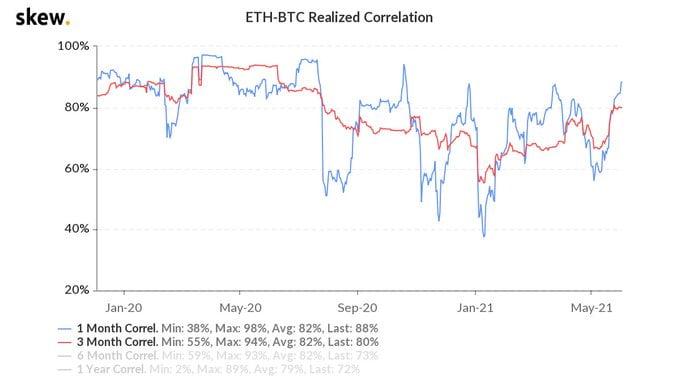
Ethereum’s 3-month Correlation with Bitcoin Hits a 10 Month High

  • Ethereum’s 3-month correlation with Bitcoin has hit a 10 month high
  • The increased correlation comes after last month’s Bitcoin dip to $30k that shook the crypto-verse
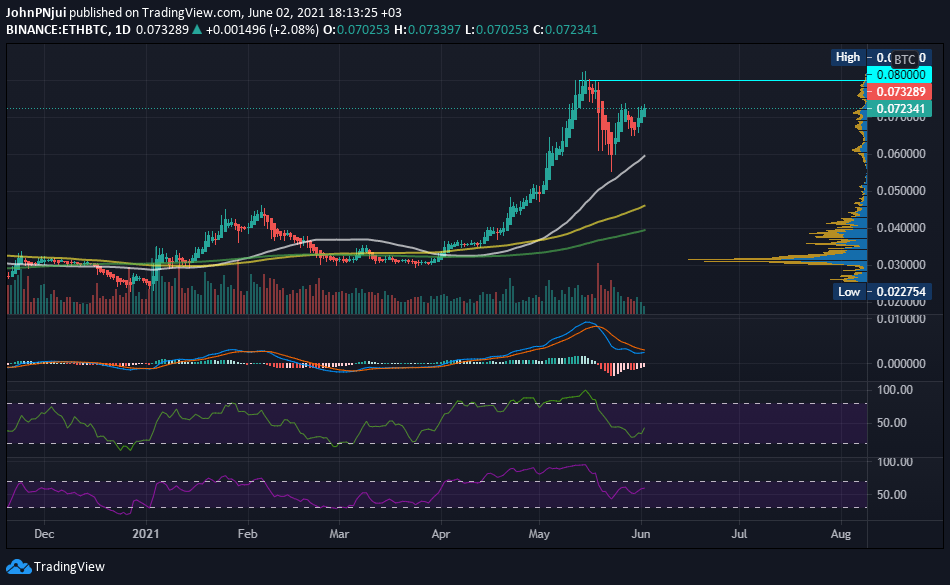
  • ETH/BTC daily chart hints of Ethereum attempting to break free from the influence of Bitcoin at least in the short term
  • However, 0.08 BTC might prove to be a difficult hurdle for Ethereum moving forward

Ethereum’s three-month correlation with Bitcoin has hit a 10 month high. The increased relationship between Ethereum and Bitcoin was identified by the team at Unfolded who shared their observation through Twitter. Their analysis included the chart below which demonstrates the increase in Ethereum‘s correlation with Bitcoin in the last few weeks.

Bitcoin Dips to $30k, Ethereum Dips to $1,728

From the chart above, it can be observed that Ethereum’s correlation to Bitcoin started rising in the middle of May immediately after ETH started to pull back from its all-time high value of $4,372. The pullback was the result of Ethereum being in overbought territory as well as Bitcoin undergoing its own pullback worth 50% that sent BTC to a local low of $30k.

Consequently, Ethereum dropped by 60% in 2 weeks to a local low of $1,728 and is currently trading at $2,728. Ethereum is attempting to break the crucial $2,800 resistance level that has converged with the 50-day moving average on the ETH/USD chart. The latter price area will determine whether Ethereum returns to bullish territory above $3k.

ETH/BTC Pair Hints of Ethereum Once Again Outperforming Bitcoin in the Month of June

A quick glance at the current daily ETH/BTC chart below reveals that Ethereum is once again attempting to break free from the influence of Bitcoin as it did in the months of April and May. From the chart, the daily MACD, RSI and MFI are hinting at Ethereum pushing towards the 0.08 BTC resistance level in the days to follow.

However, if Ethereum keeps gaining against Bitcoin, the aforementioned 0.08 BTC resistance area will be a tough one to crack for ETH as it is close to the 3-year high of 0.0824 BTC. Also to note, is that the trade volume of ETH/BTC pair has been on a decline since mid-May, indicating a slowdown in buying demand for Ethereum.

Therefore, caution is advised when trading the ETH/BTC pair moving forward as Bitcoin’s dominance might once again be asserted in the near future.

Trading of the ETH/USD pair might be a safer route given the higher probability of Ethereum breaking $3k as compared to ETH breaking 0.08 BTC.

Go to Source

Bitcoin Price Prediction: BTC/USD Ready to Break $40,000

Bitcoin Price Prediction – June 2

The Bitcoin price bounces off the support at $35,920 and added more than $2500 to its current value.

BTC/USD Long-term Trend: Bearish (Daily Chart)

Key levels:

Resistance Levels: $42,000, $44,000, $46,000

Support Levels: $32,000, $30,000, $28,000

BTCUSD – Daily Chart

BTC/USD is currently trading around $38,182 with a 4.07% gain in the past 24-hour. According to the daily chart, the Bitcoin price is fighting to stay above the important level of $38,000 as it crosses above the 9-day moving average. However, for BTC/USD to remain above this level for the next few days, the bulls need to make the $35,000 support level to be pretty strong.

Bitcoin Price Prediction: Could Bitcoin (BTC) Break Higher?

Since a couple of days ago, BTC/USD has been maintaining little upward movement, and if the first digital asset breaks above the 21-day moving average, it could touch the nearest resistance level of $40,000. Moreover, Bitcoin (BTC) needs to reclaim this important resistance level to head upwards. If successful, the primary cryptocurrency could therefore aim at $42,000, followed by $44,000, and $46,000 resistance levels.

However, looking at the Relative Strength Index (14) in the daily range, one may conclude that BTC/USD is done with the downside. Meanwhile, on the upside, recovery may not come easy and traders must be aware that support will have to be sort above $38,000 while other important zones to keep in mind are around $42,000, $44,000, and $46,000 resistance levels.

Nevertheless, despite the current movement, the RSI (14) is yet to cross above the 50-level which means that there may still be a room that could be explored by the bears. If this happens, the supports at $32,000, $30,000, and $28,000 may play out.

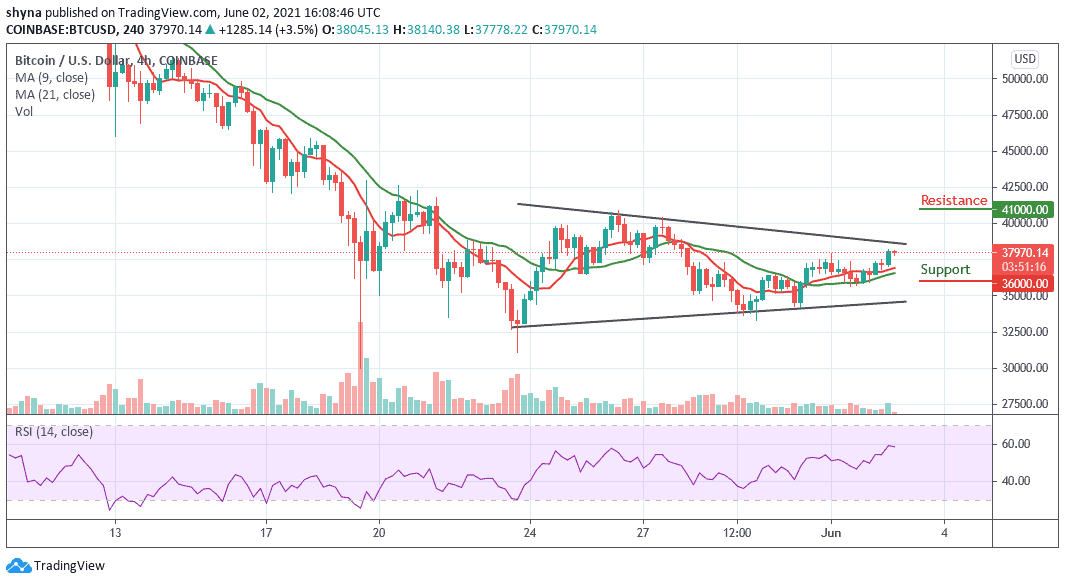
BTC/USD Medium – Term Trend: Ranging (4H Chart)

From a technical point of view, on the 4-hour chart, the technical indicator Relative Strength Index (14) keeps moving upward and ready to cross above 60-level. Meanwhile, for this to come to play there is a little bit of bullish divergence on the technical indicator as the signal line faces the north.

BTCUSD – 4 Hour Chart

However, if the Bitcoin price breaks above the upper boundary of the channel, the market price may likely reach the resistance at $41,000 and above. On the contrary, if the current market value drops below the 9-day and 21-day moving averages, it may likely touch the supports at $36,000 and below.

Go to Source

Please enter CoinGecko Free Api Key to get this plugin works.
Exit mobile version