Amazon Web Services (AWS), Amazon’s subsidiary in charge of cloud computing services, has announced that the Ethereum Network has now been integrated to allow users to provision Ethereum nodes and connect to the network in a matter of minutes.
The service only supported Hyperledger in the past but will now also support not only Ethereum’s mainnet but also testnets like Rinkeby and Ropsten.
The announcement says that the service “monitors node health, replaces unhealthy nodes, and automates Ethereum software upgrades, improving the availability of customers’ Ethereum infrastructure”, greatly simplifying the network creation process.
Amazon’s Interest in Blockchain Keeps Growing
Amazon Managed Blockchain is an AWS feature aimed to allow developers to create and manage private networks in different blockchain networks without requiring a high level of technical knowledge due to its intuitive and easy-to-use interface.
The service was launched back in April of 2019, about 5 months after the initial announcement in 2018’s re:Invent event. While the tech giant said that Ethereum would be supported by the platform, it took it almost 2 years to actually integrate the most popular network into its infrastructure.
Etherscan data shows that more than 8.3k nodes are currently running on the Ethereum network, an increase of 10.6% over the number of nodes running last month.
With the price of the network’s cryptocurrency increasing and the deployment of Ethereum 2.0 getting closer, AWS’s endorsement should prove to be beneficial when it comes to gaining adoption.
New Tools for Markets and Data
Ever since its start as an Online Bookstore back in 1994, Amazon has been increasing its dominance over different markets to become the third-largest company in the world when it comes to valuation, following Apple and Microsoft.
The company has been known to be an earlier adopter of new technologies, which has allowed it to keep its competitive edge. Now, the company seems to be preparing to develop and launch its own digital currency project in Mexico, according to job openings published on the company’s website earlier in February.
While the project has not yet been officially announced, the job post for the “Software Development Manager – Digital and Emerging Payments” position states that it is “chartered to innovate on behalf of our customers in emerging markets and for digital businesses worldwide in the payments space”.
The post also says that the initial launch country will be Mexico and will allow customers to convert their cash into digital currency to use on online services or the purchasing of goods.
It is still not clear if the tech giant is planning to create a new digital currency or to integrate existing cryptocurrencies into their platforms. However, Amazon launched a type of digital currency known as “Amazon Coins” which allowed customers to purchase products and online services.
AWS CEO is Set to Replace Jeff Bezos as Amazon CEO
Bezos announced back in early February that he would be leaving the position as Amazon’s CEO to focus on new ventures. Andy Jassy, the current CEO of Amazon Web Services, is set to replace Bezos as the leader of the tech giant once he steps down.
Jassy has been known to consider the potentials blockchain technology could have when it comes to improving Amazon’s operation by using it for more than distributed ledgers. As the CEO of AWS, he oversaw the development efforts and launch of the Amazon Quantum Ledger Database and Amazon Managed Blockchain which as previously mentioned, just integrated the Ethereum Network.
While the incoming CEO has been clear in saying that the company does not jump on the bandwagon when it comes to developing new technology because it is “cool”, his previous statements and recent moves by the company suggest that Amazon is ready to start exploring blockchain technology applications in the near future.
With the Blockchain ecosystem growing at a rapid rate as retail and institutional investors turn their attention to cryptocurrencies, as well as developers integrating the technology into their platforms, the time is great for companies to start experimenting with the use of blockchain to improve their technological and economic models.
The post Amazon Adds Support for Ethereum on Amazon Managed Blockchain appeared first on Blockonomi.
The popular oracle network Chainlink announced the launch of Chainlink Off-Chain Reporting (OCR) on February 24th, which is a highly anticipated upgrade that has been months in the making.
Chainlink claims that OCR will not only significantly improve the efficiency of the network’s data computing but it will also reduce costs by up to 90% to enable users to save in gas fees and boost adoption.
Gas costs have been the bane of Decentralized Finance (DeFi) platforms since 2020 due to high Ethereum gas prices and the difficulties that migrating to another network would imply.
The upgrade in Chainlink’s mainnet is expected to help alleviate these costs to some extent and improve the status of the DeFi niche. These costs have become prohibitive for many applications, and remove the utility of the platform for low-value applications.
According to the announcement, users will see a 10 times increase in the data that can be handled by smart contracts, which should allow new applications to emerge as new datasets become available.
The OCR update will also further decentralize the oracle network, increase the frequency of on-chain updates, improve the cost-efficiency of onboarding new nodes, reduce congestion on the chain, and reduce oracle latency.
The Future of Chainlink
Before this update, a great part of the computations realized by chainlink was taking place on-chain, which resulted in less scalability, lower efficiency, and higher computational resources being needed.
With this update, chainlink is transitioning toward an off-chain computation model in which the network will be able to function in situations where conditions are not optimal, creating a more scalable ecosystem.
Sergey Nazarov, Chainlink’s founder, said in an interview with media that the development team will be working on verifiable randomness, keeper functions, and fair sequencing, all of them with applications on the DeFi and gambling niches.
Verifiable randomness has been worked on by chainlink for over a year with iterations of it already being available.
Known as chainlink VRF, this feature allows smart contracts to increase their resilience against bad actors by creating unpredictable but verifiable cryptographic proofs that allow the network to remove malign nodes.
New Functions for Better Performance
Keeper functions and pair sequencing improve the stability of the network by improving coordination between nodes and standardizing computational procedures.
As oracle networks are all about handling and serving data requests, improving the datasets that a smart contract can handle and ensuring its availability is essential o preserve the functionality of the network, benefiting all the parties involved.
Chainlink’s token, LINK, has recently seen its price reach an all-time high of $36.95 back on February 20th, more than twice the value that saw the project made headlines in August of 2020 as it became one of the most widely known projects in the crypto sphere.
Chainlink Virtual Hackathon: Accelerating Innovation in the Smart Contract Ecosystem
Chainlink has also recently announced that it has partnered with AAVE, Consensys, Polkador, Synthetic, and other companies to run a virtual hackathon from March 15th to April 11th.
The hackathon will see developers from across the globe collaborate with each other, hear from experts in the industry, and learn about new projects. The event will also have an $80k prize pool to be distributed as bounties in categories like DeFi and Gaming.
Chainlink Co-founder Sergey Nazarov, Avalanche Founder Emin Gün Sirer, and Aave Co-founder Stani Kulechov are some of the biggest personalities that will be participating in the event.
Historically, Hackathons have been a major source of innovation in the tech industry by allowing experts of all areas to join their efforts in developing new applications for different technologies, with the best project usually receiving direct support from the organizing companies.
The post Chainlink Off-Chain Reporting (OCR) Goes Live: Boosts Efficiency of Network appeared first on Blockonomi.
Pylon.finance is a newly launched project that aims to create profits from Ethereum and the Decentralized Finance (DeFi) ecosystem, while providing an independent mining platform and token that is less influenced by the open market.
Working towards that vision, Pylon.finance was announced in June 2020, introducing an efficient and competitive way of mining and yield farming ETH.
Pylon.finance stands out from other DeFi networks by building a token backed with “tangible real-world income-generating assets”, and using its GPU mining asset to generate value. Pylon.finance has one of the largest GPU mining operations in the USA.
The $PYLON token is also unique. It is only semi-correlated to the price of Ethereum, which makes it more stable regardless of unexpected market fluctuations. While the price of ETH may fall, the profits from the mining operation won’t fall at the same rate.
Even in a bear trend, $PYLON’s price can be maintained compared with other cryptocurrencies.
What is Pylon.finance All About?
The founder of Pylon.finance is pseudonymously known as Grim Reaper, and together with a team with 6+ years of experience running the US’s largest GPU mining, the team has brought $PYLON to the market.
The team is dedicated to the project, as none of its members receive a distribution in the released tokens or any other compensation.
As the founders are equal to normal users, the team members will likely adhere to the ultimate goals of the project – as they would receive nothing if they left.
One more remarkable strategy that Pylon.finance uses is a 100% crowdsourced implementation without any traditional advertising.
According to statistics, despite no presale, and no ICO, the project was able to gather $1.15 million USD completely by word of mouth. Besides Pylon.finance, the team also started seven other farms to create a wider community in the crypto mining sphere.
The $PYLON Token is Built to Earn
$PYLON is the utility token issued by Pylon.finance, and it also allows its holder to earn along with the mining platform.
The $PYLON token takes a portion of GPU mining profit and adds it to weekly buybacks for buying $PYLON that ends up in the hands of token holders. This mechanism empowers token holders and helps to keep market movements in check.
The token was launched in the 3rd quarter of 2020. $PYLON is fixed at a total amount of 8,400 and was distributed entirely by word-of-mouth marketing.
As there was no presale, no initial coin offering, and no predetermined allocation for the developing team, everyone had the same shot at buying the token.
PYLON GPU VAULT
Pylon GPU Mining
GPU mining is a very popular method for crypto mining, especially for Ethereum, one of the largest cryptos in the world.
Unlike other networks in which mining profits are substantially affected by the ETH price and market movements, Pylon.finance nourishes its GPU mining and yield farming from its own income generated by the real-world tangible mining farm.
Pylon.finance’s GPU mining works with staked $PYLON tokens or the $PYLON/ETH liquidity pool tokens in its vault, which receive rewards in ETH from fuel fees when mining Ethereum.
The new ETH earnings are used to purchase $PYLON from the open market and distribute them to stakers. This repeating cycle, so-called Buybacks, will keep the entire network growing constantly and enlarging the total value for token staking.
How to Join and Earn With Pylon.finance
Newcomers can take part in Pylon.finance either as a miner or a liquidity pool (LP). After staking $PYLON or PYLON/ETH Uniswap tokens into the network vault, it goes to GPU mining farms where ETH transactions are mined and holders can earn rewards from gas fees.
As one of the largest ETH mining operations in the USA, PYLON runs at a speed of about 1 billion KH/s, and is able to generate over 2,600 ETH per day (according to records on the ETH mining pool hub).
Then, the buybacks will utilize the ETH rewards to purchase an additional $PYLON to add to the circulating supply and raise the value of tokens held by users.
Initially, there was a crowdsourced seed of $1 million USD placed in the PYLON GPU vault, with the Annual Percentage Yield (APY) at 33%, equivalent to $324,000 USD in buybacks.
Over time, the mining size will be scaled-up further with more value-added for every holder.
Pylon.finance covers other fees for extra costs, including insurance, Internet, equipment maintenance, warranty claims and swaps, emergency, hardware management.
Pylon’s Values
With new features built into its platform, Pylon.finance is confident that it can create benefits for both the business sector and individual participants.
Pylon.finance not only provides a focal point for crypto projects to connect with GPU mining with real-world asset backing but also gives crypto investors freedom to do mining and trading in new ways.
Many existing DeFi networks are demanding that existing users attract new members to sign up and contribute to the mining operation. Pylon.finance doesn’t use this approach at all.
With its unique Buybacks mechanism, new money will continue pouring into the Pylon ecosystem along with the mining process, ensuring the value preservation of $PYLON token.
This design makes Pylon.finance a fascinating option for crypto holders as well as traditional investors who prefer safer ways when investing their capital.
Currently, Pylon’s users can earn an APY of up to 250% and no less than 33% in a downtrend. The Total Value Locked (TVL) will keep rising as more tokens are bought via Buybacks.
Pylon.finance Makes System Security a Top Priority
As it is backed by real-world tangible assets, it is impossible to copy or replicate $PYLON tokens, which means it is non-forkable.
There is no way a single user could manipulate a majority of tokens on Pylon.finance. In addition, in order to prevent code tampering, a protocol was deployed to burn the admin keys $PYLON token was launched.
The team at Pylon.finance put a lot of thought into how to build a solid system, and from the looks of it, they have created a very attractive way to invest in the future of ETH.
A Shining Future
Pylon.finance is seizing good opportunities to overcome other DeFi platforms, and offer the market a unique value proposition.
Thanks to the real-world assets backing for its token instead of arbitrage or collateralization, as well as the magic of Buybacks, the network has unlimited buying pressure which opens up scalability and long-term viability.
Despite a low initial coin supply potential of Pylon is high, and the $PYLON token may gain a substantial amount of value. It also creates real returns, which many tokens can’t match.
The platform has so far saved 1.15 million USD into its GPU vault, and whenever a new member participates and stakes $PYLON tokens, he/she can start to benefit from dividend payments and Buybacks in no time.
According to Pylon’s founder’s prediction, ETH will undergo a pump to exceed USD 2,000, followed by a correction period, mostly depending on the market forces.
This prediction appears to be coming true, as ETH is trading above $2,000 USD at the time of writing.
In the 1st quarter of 2021, Pylon.finance will continue to widen its real-world mining operations based on the existing resources, while putting effort into generating more income for long-term growth.
To keep up-to-date with the latest developments, you can visit its website or join Pylon communities on Telegram, Twitter, or Discord.
The post Pylon.finance: Crypto Token Backed by Ethereum Mining Operation appeared first on Blockonomi.
Unstoppable Domains, a San Francisco-based startup focused on creating domains in blockchain, has announced that Cloudflare has enabled native resolution of .crypto domains.
The platform allows people to use public blockchains to host websites, which are likely harder to take offline, as blockchain isn’t able to be easily censored.
The integration will allow more than 500.000 domains using the .crypto blockchain domain to get mainstream adaptation by facilitating access for millions of internet users around the globe by using any web browser without the need for specialized software.
While blockchain domains have continued to gain popularity over the years, they have failed to gain mainstream appeal beyond cryptocurrency enthusiasts and decentralized internet advocates due to their technical nature and setup process traditionally required to access them
Now, internet users will be able to access .crypto domains just by changing a simple setting in their everyday web browsers, giving them access to the decentralized web and benefit from a truly neutral internet.
Back on February 9th, cryptocurrency exchange OKEx became one of the first exchanges to integrate support for blockchain-based addresses using Unstoppable domains for outgoing transactions, following Huobi and Coinbase’s example.
Harvesting the Power of Cloudflare Technology
Cloudflare’s Distributed Web Resolver was announced by the company back on January 13th of 2021 as a result of its research team’s efforts on finding alternatives to resolve queries that satisfied the necessities of decentralized protocols like InterPlanetary File System (IPFS) and Ethereum.
The Domain Name System (DNS) allows users to surf the web by using easily memorable URLs like “blockonomi.com” instead of http://199.188.207.53/, making the internet easier to access for users.
Distributed systems like Ethereum and IPFS are not compatible with DNS due to their intrinsic properties, forcing companies to implement different solutions such as specialized web browsers or plugins to connect.
Cloudflare is one of the leading companies providing web infrastructure and security services, allowing web services to increase their performance and security against DDoS attacks.
Now, with the integration of decentralized protocols, Cloudflare will play an essential role in the development and adoption of the decentralized web (web3).
The Decentralized Web Movement is Gaining Momentum
While blockchain technology has seen most of its success in areas like cryptocurrencies and financial platforms, other applications like Non-Fungible Tokens (NFT) and web3 have continued to gain support over the last few months.
Unstoppable Domains originally offered a way to facilitated crypto transactions by making it similar to sending mail, but it soon started expanding its horizons and applications to become one of the biggest players in Web3.
Web3 advocates see this transition to a decentralized web as an essential step in the return to the original web, where according to its creator Tim Berners-Lee “no permission is needed from a central authority to post anything, there is no central controlling node and no single point of failure.”
With concerns over censorship, monopolization, and privacy concerns on the grow each day, users who had never paid special attention to how they use web services have started to pay attention.
Matthew Gould, CEO of Unstoppable Domains, referred to these concerns by stating:
“In a time when data breaches have become commonplace, while privacy and ownership over an individual’s own digital assets are paramount, centralized control has been called into question by many forward-thinking people and companies. This new system is different. It puts the control back where it should be, back in the hands of the user.”
This has been reflected in the increasing popularity of messaging apps like Telegram and Signal among privacy concerns related to Whatsapp and Facebook messenger, increasing use of Parler by Twitter users who were banned from the platform, and the ever-growing interest in Decentralized Apps (dAPPs).
The post Unstoppable Domains & Cloudflare: Allows Any Browser to Access Ethereum-Based Domains appeared first on Blockonomi.
Everyone was shocked when US Oil prices hit zero and global futures contracts fell hard into negative territory.
Such an event had not been anticipated by the team at the EMX exchange.
The team halted trading of its USOIL-Perp contract.
Trading of the perpetual contract is yet to be reopened as the team decides on a way forward.
Yesterday’s price movement of US Crude Oil shocked everyone. The majority of traders were confident that the price of the precious commodity would not break the various support zones that were last seen in the 1980s. However, the WTI Crude Oil chart went right through the decades’ strong support zones at $15, $12 and $9. The price per barrel went to zero as futures contracts went into negative territory as low as $-40.
EMX Exchange Halts Trading of its USOIL-Perp
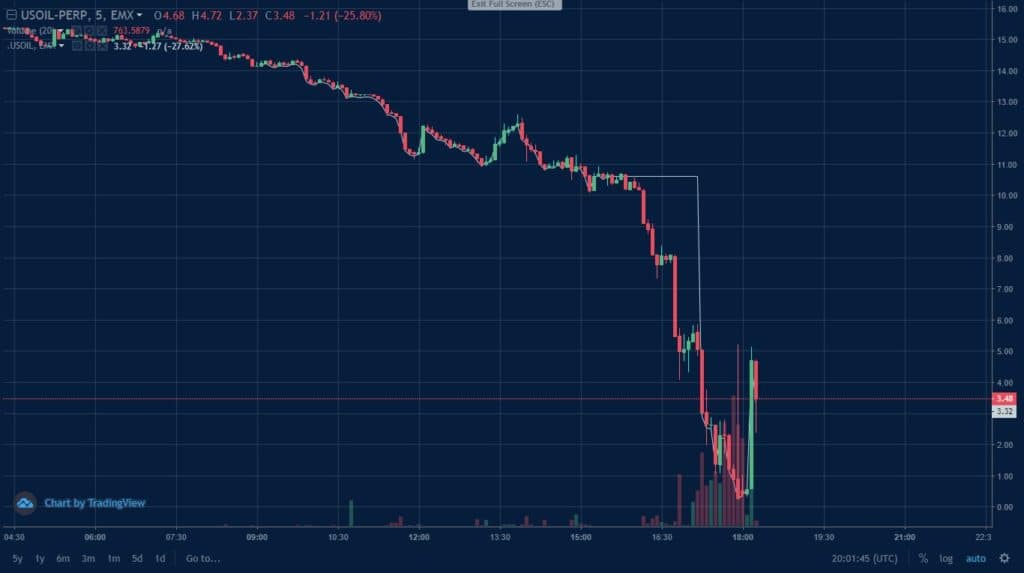
Such a scenario of negative prices of US Oil futures contracts had not been anticipated by the team at the EMX Exchange. As a result, the team decided to halt the trading of its USOIL-Perpetual contract. The screenshot below shows that trading was stopped at 18:00 (UTC) on the 20th of April. The last price of the USOIL-Perp contract was $3.48. This is after its value almost hit zero.
USOIL-Perp Chart courtesy of EMX.com
Unexpected Sequence of Events
As earlier mentioned, very few traders and investors had anticipated that the price of US Crude Oil futures contracts would go into negative territory. The team at EMX has also explained that such a scenario had not been planned for. They have since issued the following statement via Twitter explaining the situation at hand.
We are currently investigating ways to move forward with USOIL-PERP due to negative underlying prices, an edge case that we had not built for.
Additionally, the team has halted withdrawals as they verify all transactions. They explained this in a follow up of the first announcement.
For those of people who concerned about withdrawal, we are manually verifying all transactions and everyone should get it back within 1-3 business days. We apologize for the inconvenience.
For those of people who concerned about withdrawal, we are manually verifying all transactions and everyone should get it back within 1-3 business days. We apologize for the inconvenience
— EMX (@TradeEMX) April 21, 2020
What’s Next for USOIL-Perp Traders on EMX?
As the stoppage only affects the USOIL perpetual contract, trading of other contracts on EMX is still much active. However, traders who anticipated the Crude Oil meltdown and decided to go SHORT, might have to wait till the team at the exchange decides on a way forward.
More About EMX Exchange
Founded in 2017, the Evermarkets Exchange (EMX) has a vision of revolutionizing the global derivatives markets. The exchange does this by allowing users to trade contracts on equities, currencies, commodities as well as popular cryptocurrencies. The latter includes perpetual contracts on Bitcoin (BTC), Ethereum (ETH), EMX token, ChainLink (LINK) and Tezos (XTZ).
(Feature image courtesy of Erwan Hesry on Unsplash.com.)
Disclaimer: This article is not meant to give financial advice. Any additional opinion herein is purely the author’s and does not represent the opinion of Ethereum World News or any of its other writers. Please carry out your own research before investing in any of the numerous cryptocurrencies available. Thank you.
The price of US Crude oil fell hard to $0 with its futures contracts going as far down as $-40.
The once in a lifetime event, shook the crypto markets with Bitcoin (BTC) going back below $7,000.
At the time of writing this, the price of Ethereum (ETH) is holding the $168 support zone.
Analysts across the world have constantly been calling for a recession but no one was prepared for yesterday’s (April 20th) price action of US Crude Oil. The commodity fell hard to $0 per barrel with its futures contracts going down to negative territory. In the case of the latter, futures on US Crude Oil were at one point trading at $-40. However, and at the time of writing this, US Oil is currently trading at around $16.6 per barrel and $16.90 for its futures contracts. The aforementioned chaos did its fair share of damage to the price of Ethereum (ETH) as shall be elaborated.
Ethereum’s $168 Support Zone Holding Well
In one of our previous analysis of ETH/USDT, we had noted that the price of Ethereum was back in bullish territory. We had cited two reasons as to why this was so: Bitcoin’s dwindling dominance in the crypto markets and the prospects of ETH 2.0 launching later on this year. We had also identified $168 as a very strong support zone for the King of Smart contracts.
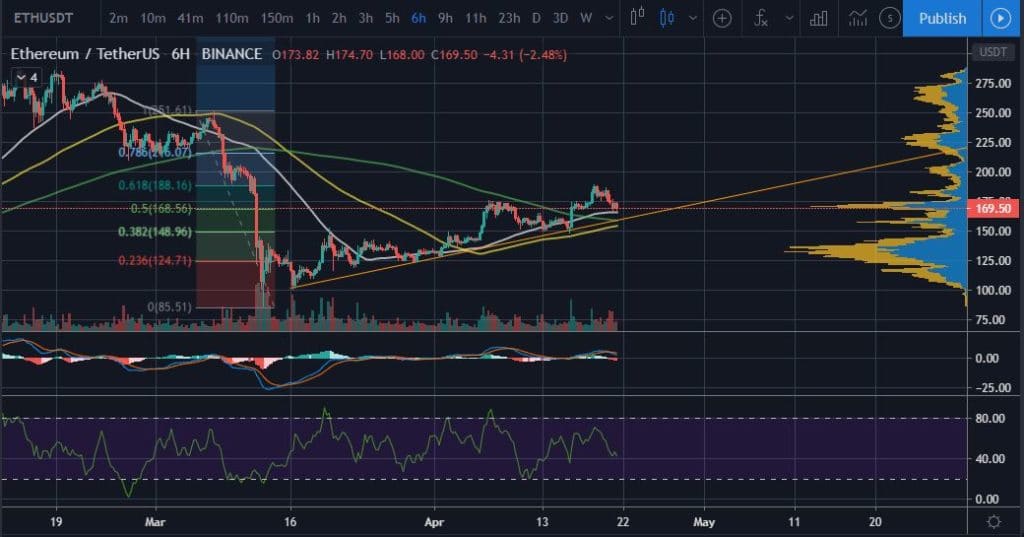
Revisiting our favorite ETH/USDT chart, we observe the following. In terms of lower time frame support zones, Ethereum has the following:
$168
$164
$162
$154
$150
$148
Ethereum’s current price at $170 is above the 50, 100 and 200 Moving averages thus providing one reason to still be optimistic that $200 is achievable.
However, the MACD has crossed in a bearish manner and the MFI also indicates that ETH/USDT is on course to retest some of the support zones identified above. Additionally, trade volume seems to be reducing in tandem with the rest of the cryptocurrencies in the markets including Bitcoin.
ETH 2.0 Progress
The Ethereum 2.0 testnet was successfully launched on the 18th of this month and has almost 20,000 validators in the few days that it has been active. The Mainnet launch is still on course to happen in July of this year.
Conclusion
On 20th April, we witnessed a history meltdown of the American crude oil prices as suppliers ran out of space of storing the commodity due to decreased demand. This is as a result of the global impact of COVID19. This meltdown affected both Bitcoin (BTC), Ethereum (ETH) and the majority of the cryptocurrencies in the markets. In the case of ETH, the coin is still holding the $168 support zone despite the oil crash. With the ETH 2.0 launch only days away, the coin might just live up to expectations of reclaiming $200. However, as with all Technical analysis, investors and traders are advised to use adequate stop losses to protect their trading capital.
(Feature image courtesy of Victor Freitas on Unsplash.com.)
Disclaimer: This article is not meant to give financial advice. Any additional opinion herein is purely the author’s and does not represent the opinion of Ethereum World News or any of its other writers. Please carry out your own research before investing in any of the numerous cryptocurrencies available. Thank you.
A new report by eToro and The Tie shows that the number of Twitter users discussing XRP has fallen drastically.
The report also indicates that members of the XRP army have continued to decline since January 2018.
The new stats could indicate a continuous trend of capitulation by XRP investors.
Times have drastically changed for XRP since the exciting days of late 2017 and early 2018. Back then, XRP was also known as Ripple and the company had yet to issue a statement explaining that the two were different entities. Additionally, XRP was trading at a premium of $3.84 due to the prospects of being listed on Coinbase in early 2018. However, this did not materialize until later. This was due to the uncertainty as to whether XRP was a security or not. In February 2019, XRP was finally listed on Coinbase at a time when it was trading at $0.32.
XRP Army Numbers Continue to Dwindle
A new quarterly report by the teams at eToro and The Tie shows that the number of Twitter users discussing XRP has fallen by 16% in the first quarter of 2020. Additionally, the number of Twitter users in the XRP army has fallen by more than 50% since October 2018 and by over 82% since January 2018. The full statement from the report can be found below.
Over the first quarter of 2020, the number of Twitter users discussing XRP fell by 16% and price declined by 9.51% (a relative 2.14% outperformance vs. Bitcoin). The number of Twitter users in the “XRP Army” (the name given to the cryptocurrency’s supporters) has fallen by more than 50% since October 2018 and declined by over 82% since January 2018 highs. For comparison, the number of Twitter users discussing Bitcoin dropped by 58% from all-time highs.
More Trouble for the Price of XRP?
Using pure logic, a drop in the number of members in the XRP Army means that holders of the coin have finally thrown in the towel and sold their holdings.
In the past few months, there has been cases of XRP community members notifying the crypto community, that they have sold all their XRP holdings. One such member is Tiffany Hayden who sold her bags as a result of constant bullying by XRP supporters. Ms. Hayden expressed her dissatisfaction with the community through the following statement.
I’m not holding $XRP anymore, XRP supporters, so find something else to talk about.
I’m not holding $XRP anymore, XRP supporters, so find something else to talk about. From my mom just now. So fucking pathetic. pic.twitter.com/g9Jtoey5sC
— 𝚃𝚒𝚏𝚏𝚊𝚗𝚢 𝙷𝚊𝚢𝚍𝚎𝚗 (@haydentiff) March 9, 2020
Brief Market Analysis of XRP/USD
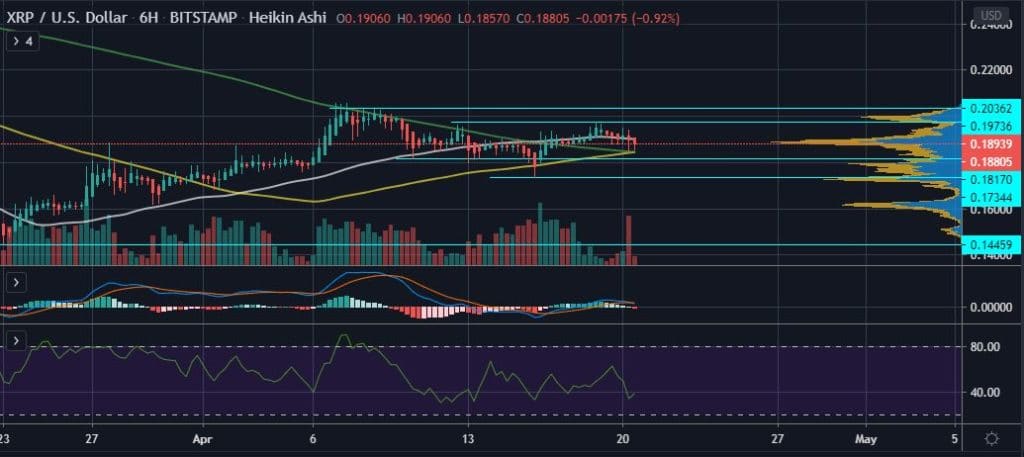
6-Hr XRP/USD Chart courtesy of Tradingview.com
Further checking our favorite 6-hour XRP/USD chart, we observe the following.
Its current price at $0.189 is below the 50 MA but above the 100 and 200 moving averages. This is an indicator of a possible move down for XRP/USD.
MACD is about to cross above the baseline in a bearish manner.
Support zones lie at $0.181, $0.1734 and $0.144
Resistance zones are at $0.197 and the $0.20 area.
MFI is still low at 40 and could provide a glimmer of hope for bulls or provide sideways movement.
Analyst Predicts Lower Levels for XRP
Popular Bitcoin and crypto analyst, @MagicPoopCannon, had in an earlier statement warned that the price of XRP could drop to as low as $0.078.
My next major downside target for XRP is at about 0.078. Regardless of whether or not a rally emerges, I think the recession will take BTC and crypto lower, and XRP should eventually reach that target.
— MAGIC (@MagicPoopCannon) April 1, 2020
Conclusion
The number of XRP Army members has been decreasing with time as seen through the report by eToro and The Tie. The new stats are indicative of possible capitulation by XRP investors. This follows a trend of notable XRP army members throwing in the towel. As a result, the value of the coin could be affected in the long run as more investors decide it is time to offload their bags.
(Feature image courtesy of Simon English on Unsplash.)
Disclaimer: This article is not meant to give financial advice. Any additional opinion herein is purely the author’s and does not represent the opinion of Ethereum World News or any of its other writers. Please carry out your own research before investing in any of the numerous cryptocurrencies available. Thank you.
On the 19th of April, the Tron network recorded its highest daily increase in new accounts.
This feat was noticed by a senior Tron Community member.
Justin Sun was baffled by the sudden increase.
However, it could be due to the Just (JST) token scale next month and the allure of staking TRX.
The Tron (TRX) network has continued to run smoothly since its mainnet was launched in mid-2018. Additionally, the number of total accounts on the network has reached a staggering 5.353 Million at the time of writing this.
Tron Records Highest Daily Increase in New Accounts
In a tweet a few hours ago, Tron community member @MishaLederman, notified the crypto community that the TRX network had experienced its largest daily increment in new accounts on the 19th of April. The tweet went on to give the following stats regarding the achievement.
The #Tron blockchain recorded its highest daily increase of new accounts yesterday, April 19: 65,226 new $TRX accounts (+1,2% daily increase in relation to all 5.3M #TRX accounts) It’s also 61% higher than the previous daily record of 40,386 from Feb 28, 2019.
Justin Sun Baffled at the Increase in New Tron Accounts
In response to the tweet by @MishaLederman, Justin Sun expressed his surprise regarding the achievement. He further stated that he had no idea as to why crypto enthusiasts suddenly decided to start using Tron. His tweet can be found below.
I have no idea why ppl suddenly start to use #TRON. #TRX $TRXhttps://t.co/wOMvddgpYr
— Justin Sun (@justinsuntron) April 20, 2020
2 Reasons: Staking and the Just (JST) Token Sale
However, there are two plausible reasons why the network has experienced a sudden spike in new accounts.
Firstly, and as pointed out in an earlier analysis, staking Tron (TRX) has continually become a profitable endeavor in the current uncertain times. Average returns are between 7 – 8% per year which is very appealing for anyone who wants to avoid trading the current crypto market environment.
Secondly, the Just (JST) token sale takes place on the Poloniex exchange on the 5th of May. The exchange will only accept TRX as the method of participation. This means any willing participant will have to open an account with Poloniex and purchase or deposit TRX if they want to reap the benefits of the IEO.
Conclusion
The Tron (TRX) network continues to grow as witnessed with the historic daily increment in new accounts pointed out by Mr. Lederman. As a result, Justin Sun expressed his surprise at the sudden increment in new users. However, two logical reasons come to mind. Users want to utilize staking on the Tron network as well as participate in the Just (JST) IEO that takes place on Poloniex. Additionally, it could also be a Tron DApp that has suddenly become popular. Only time will provide evidence of the latter theory.
(Feature image courtesy of Jungwoo Hong on Unsplash.)
Disclaimer: This article is not meant to give financial advice. Any additional opinion herein is purely the author’s and does not represent the opinion of Ethereum World News or any of its other writers. Please carry out your own research before investing in any of the numerous cryptocurrencies available. Thank you.
As the name seems to clearly suggest, a Bitcoin Improvement Proposal (BIP) is a standard that has been devised to help in the alteration of BTCs core protocol. However, in a few notable cases BIPs have even served as a source for crucial information for the Bitcoin community at large.
From a more technical standpoint, we can see that the aforementioned proposals seek to facilitate certain consensus-based critical changes (such as soft and hard forks) as well as usher in other modifications related to Bitcoin’s peer-to-peer layer and seed framework. With that being said, it needs to be made abundantly clear that not every change made via a Bitcoin software implementation has a direct effect on the core BTC protocol. In this regard, we can see that certain changes that are routinely put forth by independent developers do not require a BIP to be accepted by the community at large.
Origins
When looking at the back story of how the first Bitcoin Improvement Proposal (BIP) came to be, we can see that the first such proposal was introduced by an early crypto dev named Amir Taaki, who is widely credited as being the creator of the world’s first alternative implementation of the Bitcoin protocol — Libbitcoin.
According to a blog released by Taaki around a decade back, he made it abundantly clear that BIPs, if used correctly, has the potential to greatly benefit the overall development of Bitcoin (by making the cryptocurrency’s native ecosystem more structured and accountable.)
Not only that, as per data available online, we can see that Taaki submitted the first BIP (referred to as BIP 0001) to the Bitcoin community sometime during mid-2011. The document essentially highlighted how the entire process surrounding BIPs should be conducted and was largely inspired by the process that is currently used to improve the nitty-gritty associated with a famous digital programming language called Python (as described in PEP0).
How are BIPs vetted?
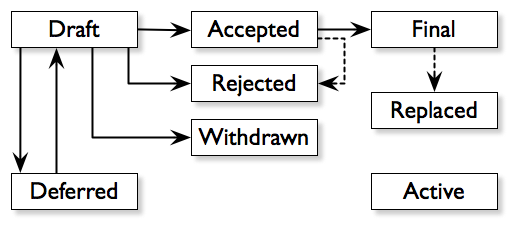
As with any proposal, a BIP starts off as a basic draft that is submitted by one or more authors. Also, prior to its submission, a BIP is discussed at length informally across a host of BTC-oriented mailing lists, Internet Relay Chat (IRC) channels, etc. Also, during its lifetime as a draft, a BIP can be modified and changed by its authors (based on community feedback) any number of times.
Also, in the case of a Bitcoin protocol change, a code-based reference implementation is necessary. Lastly, it goes without saying that a proposal is only considered final if it reaches community consensus.
Source: GitHub
Key topics worth exploring
BIP numbers:
As the name sort of alludes to, a BIP number can be thought of as a catalog code that is assigned to a proposal as per the wishes of the designated BIP editor after the draft has fulfilled a majority of the criteria (such as formatting) set forth by the global BTC community.
The BIP editor reserves a number of special rights:
When it comes to improvement proposals, the appointed BIP editor has the power to reserve certain groups of numbers for proposals that share a common link.
BIPs are non-binding:
A core aspect of BIPs worth pointing out is that they are not binding and thus legal action based on them cannot be upheld in a court of law.
What are the different types of BIPs that exist today?
In all, there exist a total of three major types of Bitcoin Improvement Proposals — namely Standards Track BIPs; Informational BIPs and Process BIPs. In this section, we will describe each of these concepts in brief:
(i) Standards Track BIPs:
These are proposals that seek to make changes to the BTC network protocol, block data or even the way in which the ecosystem validates its native transactions. Additionally, Standards Track BIPs also look to change the interoperability of two versions of BIPs and require community consensus to come into effect. A perfect illustration of such a proposal is BIP 91.
(ii) Informational BIPs:
As the name suggests, Informational BIPs are aimed at highlighting various design issues, general guidelines, and other similar data that does not have to be taken seriously by the community at large. BIP 32 is a direct representation of such a proposal.
(iii) Process BIPs:
These kinds of improvement proposals seek to implement a change in the core processes underlying the Bitcoin ecosystem. In their most basic sense, Process BIPs can somewhat be compared to Standards Track BIPs since they entail major changes that need to be vetted through a consensus vote. An example that perfectly fits into this category is BIP 2.
BIP Life Cycle
Depending upon the kind of BIP that needs to be passed, it may or may not require community consensus. However, before things reach such a stage, the submitted proposal has to go through a number of phases such as:
Drafting
Verification
Community Acceptance
Acceptance/Rejections or Amendments.
Famous BIP Examples
1. BIP 141
BIP 141 (better known as SegWit or Segregated Witness) was a proposal that was introduced all the way back in 2015 by a couple of developers who at the time were working on the Bitcoin Core project. As many of our readers may already be aware of, BIP 141 seeks to increase BTCs native network scalability as well as solve many of the issues related to the currency’s transaction throughput. Additionally, it should be pointed out that the proposal was brought into effect via a soft fork which required over 95% of the network’s miners to signal for the upgrade over a fixed period of 14 days.
In layman’s terms, one can think of Segregated Witness (aka SegWit) as being a blockchain scaling solution that allows for more transactions to take place within a single BTC block.
2. BIP 91
Quite similar to BIP 141, BIP 91 was also a soft fork proposal that was brought forth by Bitmain’s James Hilliard back in mid-2017. The goal of BIP 91 was to activate the existing SegWit solution (i.e. BIP 141) with a hash power majority of less than 95%.
3. BIP 148
BIP 148 is a user-activated soft-fork SegWit solution that was introduced during the first quarter of 2017 by an individual who goes by the pseudonym ‘Shaolin Fry’. Simply put, the proposal provides the global crypto community with a unique way in which to scale up Bitcoin’s total Tx capacity. Additionally, it bears mentioning that at the time of its deployment, BIP 148 required 50+% BTCs full node users to upgrade their software.
4. Lightning Network
The BIP associated with the Lightning Network was conceived back in 2015 by Joseph Poon and Thaddeus Dryja. The protocol makes BTC’s tx framework more scalable by allowing for instant payments to take place off-chain. This is primarily achieved through the creation of micropayment channels that allow for money transfers to go through without the risk of any counterparty thefts.
From a technical standpoint, we can see that the utility of LN is made possible through the introduction of multi-signature wallets that allow for an infinite number of transactions to take place without there being any need to store the associated data on the native BTC blockchain. The only data that is recorded onto the blockchain is the total volume of BTC that is available in the associated wallet as well as the contribution percentages of the involved parties.
Lastly, in addition to enabling instant transactions, the Lightning Network also helps in the enabling of cross-chain payments as well as smart contract utilization.
5. M.A.S.T
Merkelized Abstract Syntax Trees (or MAST as they are commonly known as) is a cryptographic tool that allows for complicated data sets to be merged into BTC tx’s in a highly streamlined manner. This allows for the total amount of data to be added to the blockchain to be greatly reduced. Technically, we can see that M.A.S.T. is an amalgamation of two separate tools — namely Merkle Trees and Abstract Syntax Trees. For those of our readers who may not be aware, Merkle trees can be thought of as algorithmic structures that allow for data to be recorded without the need for it to be downloaded. Similarly, Abstract Syntax Trees allow for complex data sets to be added to a blockchain while bringing down the total amount of data (that has been recognized as being part of a particular transaction) associated with the tx.
In this regard, there are three BIPs that seek to implement M.A.S.T. into the Bitcoin network. These include:
BIP 114:
This proposal was submitted by BTC Core dev Johnson Lau with the aim of increasing Bitcoin’s native security levels by introducing a new merkelized script into the currency’s ecosystem. Additionally, BIP 114 seeks to greatly reduce the need for large amounts of transaction data while maintaining user privacy at all times.
BIP 116:
BIP 116 was proposed by Bitcoin Core developer Mark Friedenbach as a means of allowing native BTC data to be confirmed without there being any need of disclosing the entire data set associated with the tx.
BIP 117:
Also referred to as Tail Call Semantics, BIP 117 is a proposal which when used in conjunction with BIP 116 aims to generalize the core concepts underlying M.A.S.T. while providing full support for native SegWit addresses.
The deployment of M.A.S.T allows for a number of benefits such as:
Enhanced privacy
Faster transaction speeds
Inclusion of complex data (example: smart contracts)
Increased scalability as well as overall tx volume.
6. Confidential Transactions
As the name clearly suggests, the BIP concerned with Confidential Transactions seeks to usher in a new level of privacy for the data contained within the Bitcoin network. The proposal was submitted by a well-respected blockchain developer by the name of Gregory Maxwell. It will allow bitcoin users to gain access to a host of privacy-related benefits — much like what other privacy-centric coins such as Monero (XMR) and Zcash (ZEC) currently offer their users.
7. Dandelion
Dandelion is an important BIP that seeks to redesign BTCs core network stack so as to make the premier cryptocurrency more anonymous as well as reduce many of the vulnerabilities that are currently associated with the disclosure of BTCs tx identities. Some of the core benefits of Dandelion include:
Increased difficulty in confirming the origin of a particular transaction
Reduced risks of third-party intrusions
Lowered possibility of miscreants linking BTC Txs with their source IP
8. Numerifides Trust Consensus Protocol
This is another proposal that delineates the creation of a network that is secure, decentralized and features human-readable names. It was submitted by Taylor Hawkins who in a GitHub draft mentioned the following:
“Rather than deriving justice and authority from a system that’s not supposed to look but too often does, I propose a DECENTRALIZED CONSENSUS PROTOCOL that enables a system of decentralized authority on a public piece of data, on an open blockchain and any independent, skeptical user or actor operating the consensus protocol can verify any other actor’s statement of authority in a decentralized, fair and privacy-protective manner.”
Other core facets of this BIP include:
It allows users to establish their aliases which they wish to transact on the network.
In order for this proposal to work, users are required to lock up a certain amount of Bitcoin as well as provide a PoW confirmation for the same.
Conclusion
Despite Bitcoin Improvement Proposals receiving a lot of flak over the years, we need to admit that their importance, at least as far as redefining the Bitcoin ecosystem goes, has been nothing short of monumental. And while a large number of people believe that regular BIPs can lead to more forks in the BTC network, we need to bear in mind that these changes can only be implemented through community consensus.
To keep track of BIPs, crypto enthusiasts can either choose to visit technical digital currency/blockchain portals such as GitHub — which is widely considered by many to be the largest repository of all things crypto. Alternatively, people can also follow crypto news related to this space through a number of different websites such as Bitcoinexchangeguide, Coindesk, Cointelegraph, etc.
Aziz, Master the Crypto Founder
I’m Aziz, a seasoned cryptocurrency trader who’s really passionate about 2 things; #1) the awesome-revolutionary blockchain technology underlying crypto and #2) helping make bitcoin great ‘again’!
The post Bitcoin Improvement Proposal: What is a BIP, How It Works? appeared first on Master The Crypto.
This privacy coin analysis takes a look at the two leading coins focusing on anonymizing transactions; Monero (XMR) and ZCash (ZEC).
Cryptocurrencies were launched with the aim of anonymizing online payments completely. Some of the most popular cryptocurrencies – Bitcoin, Litecoin and Ethereum – are created with specific characteristics; Bitcoin is used mainly as digital cash, Ethereum facilitates the creation of decentralized applications (dApps) and smart contracts, while Litecoin is characterized as the ‘silver‘ to Bitcoin’s gold. Unfortunately, due to their massive popularity, major coins leave lots to be desired when it comes to anonymity. For a truly private coin, you have to consider other purpose-built cryptocurrencies.
There are currently two major coins that are leading the quest for complete anonymity; Zcash and Monero. They offer a completely private online payment system but are powered by a different technology. In this article, we’re going to discuss and compare the privacy features of these coins and ascertain each of their use cases.
(Read also: Guide on Privacy Coins: Comparison of Anonymous Cryptocurrencies)
Private Cryptocurrencies
Cryptocurrencies should, in spirit and principle, be completely private. Blockchain privacy is determined by a coin’s features that obscure transactional data such as addresses and transfer amounts. Without hiding this data, blockchain forensic experts can quite easily identify users, especially since know-your-customer (KYC) laws are enforced by cryptocurrency exchanges.
Monero
Monero (XMR) adopts ‘ring signatures’, ‘ring confidential transactions’ and stealth address to obscure transactional data (the transacting parties and the amount transacted). Ring confidential transaction technology hides the route of the transaction and its amount. Stealth addresses allow the two parties to publish one address but receive payments through several unlinked addresses. This keeps, or attempts to keep sender and recipient information completely private.
Previously in 2017, it was claimed that Monero’s technology had major flaws in hiding transactional information. It was claimed that coin’s ring signatures could be de-anonymized through ‘chain-reaction analysis’.
With the integration of RingCT and stealth addresses however, those claims have been taken care of according to the Monero developer team.
Zcash
Zcash’s (ZEC) approach to privacy takes a different approach, by using a technology called ‘zk-snarks’. Basically, zk-snarks uses a concept called ‘zero-knowledge’ proofs. What this means is that you prove something while revealing a minimal amount of information. An interesting thing to note about Zcash is that stealth transactions are optional, rather than a default feature.
Trust in Zcash’s privacy was shaken when it was found that 69 percent of shielded transactions could be linked to either founders or miners. Since this is a fairly recent problem, it has still not been rectified completely.
(See also: Guide on Identifying Scam Coins)
Cryptocurrency Network Privacy
Network privacy refers to anonymizing of user information such as IP addresses through features like Tor and I2P networks.
Monero
Although Monero is a private coin that obscures its user’s data on the blockchain, it is still possible to identify users via the leaking of IP addresses. To stop this ‘vulnerability’, the Monero team is currently working on Kovri, a C++ version of the current I2P network. Kovri is being designed to de-link IP addresses from transactions and hide geolocations.
This is definitely a step in the right directions towards ensuring complete anonymity for Monero users. Kovri is still in the alpha stage so for now, users have to manage their own network protection.
Zcash
Zcash users can choose to operate on the Tor network. But like blockchain privacy, this is also optional. Unlike Monero, there are no plans for built-in network privacy features for Zcash.
Read more: Category of Cryptocurrency Market: Social Network Coins)
Default / Mandatory Privacy
Depending on the cryptocurrency, privacy features can optional or mandatory. Since there are side effects of enabling strict privacy on blockchain transfers, it’s natural that some coins will give users this choice.
Monero
Monero is a truly private cryptocurrency since it has privacy enabled by default. This default setting ensures that all transactions are carried on the same private standard. Of course, there is greater overhead fees associated with private transactions as they place a heavier workload on the network. Performance of the private network is being constantly improved by the developers.
Zcash
Perhaps one of the biggest flaws of Zcash as a privacy coin is that stealth operations are optional. This flexibility appears to be a benefit, but in reality, it just leads to a lot of confusion. Users who switch between public and private version of the blockchain risk leaking metadata that can result in reduced anonymity.
What’s more, just 13.4 percent of Zcash transactions are private. This goes to show that Zcash isn’t really being used as a privacy coin. Private transactions are expensive and few wallets support them, so this doesn’t come as much of a surprise.
Zcash is essentially a Bitcoin fork, so it’s easier for wallets to support regular transactions. Fortunately, stealth transactions on the network are becoming less expensive thanks to zk-snarks efficiency improvements. These improvements might lead to Zcash one day becoming a privacy-only coin in the future. We willl have to wait and see.
(See more: Public Vs Private Blockchain: What’s The Difference?)
Privacy-Related Drawbacks
Monero
Monero is a privacy coin by default, and as such comes with high fees and slow confirmations. The October 18th hardfork which integrates bulletproofs into RingCT has made things better as it aims to reduce transaction data by up to 80 percent.
Zcash
Keeping in mind the increased processing requirements, only a few portions of Zcash users choose stealth transactions. The Sapling upgrade has made stealth transactions much less taxing by reducing RAM requirements from 3 GB to just 40MB.
For a greater understanding of the limitations of blockchain technology (slow confirmations, high fees etc.), it is vital to understand the issue of scalability. Here is an article that breaks down scalability.
Which is the Better Privacy Coin?
Cryptocurrency is still a fairly nascent technology, and as such hasn’t been fully realized yet. Even the best private coin will eventually reveal some flaws that are simply there because the technology hasn’t matured well enough.
Still, if you are looking for the best private cryptocurrency, Monero should be your top choice. Yes, it does come with high fees and slow confirmations but its blockchain and network-level privacy are almost peerless. What’s more, you can rest assured that your transaction will be completely private as it’s the default for this coin. The key for individuals who want to keep their Monero safe is to use a secure anonymous wallet for their transactions.
So even though Monero appears to be the cryptocurrency of choice for cybercriminals, it is still a very secure technology. We really can’t blame Monero for how it is being used, just like it’s illogical to blame traditional paper money for a bank heist.
Zcash is making progress in being a great privacy coin but unless it mandates privacy by default, it can’t really be recommended.
(You might also be interested in: Cryptocurrency Guides: Comprehensive List of Crypto Guides For Beginners)
Beneficial Resources To Get You Started
If you’re starting your journey into the complex world of cryptocurrencies, here’s a list of useful resources and guides that will get you on your way:
Trading & Exchange
Crypto Guide 101: Choosing The Best Cryptocurrency Exchange
Guide to Bittrex Exchange: How to Trade on Bittrex
Guide to Binance Exchange: How to Open Binance Account and What You Should Know
Guide to Etherdelta Exchange: How to Trade on Etherdelta
Guide To Cryptocurrency Trading Basics: Introduction to Crypto Technical Analysis
Cryptocurrency Trading: Understanding Cryptocurrency Trading Pairs & How it Works
Crypto Trading Guide: 4 Common Pitfalls Every Crypto Trader Will Experience
Wallets
Guide to Cryptocurrency Wallets: Why Do You Need Wallets?
Guide to Cryptocurrency Wallets: Opening a Bitcoin Wallet
Guide to Cryptocurrency Wallets: Opening a MyEtherWallet (MEW)
Read also: Crypto Trading Guide: 4 Common Pitfalls Every Crypto Trader Will Experience and Guide To Cryptocurrency Trading Basics: Introduction to Crypto Technical Analysis.
Sponsored Ad: Your dog deserves to be healthy & happy
Enroll in our Free Cryptocurrency Webinar now to learn everything you need to know about crypto investing.
Get our exclusive e-book which will guide you on the step-by-step process to get started with making money via Cryptocurrency investments!
You can also join our Facebook group at Master The Crypto: Advanced Cryptocurrency Knowledge to ask any questions regarding cryptocurrencies.
Aziz, Master the Crypto Founder
I’m Aziz, a seasoned cryptocurrency trader who’s really passionate about 2 things; #1) the awesome-revolutionary blockchain technology underlying crypto and #2) helping make bitcoin great ‘again’!
The post Privacy Coin Analysis: Monero (XMR) vs ZCash (ZEC) appeared first on Master The Crypto.
This article takes a look at what is the difference between a crypto mainnet vs testnet, two technical terms that serve different functions.
Mainnets and testnets are common technical terms used in the cryptocurrency world to denote blockchain networks that possess vital functions. Let’s take a look at the differences between a cryptocurrency mainnet and testnet:
What is a Mainnet?
Mainnet – short for main network – is the original and functional blockchain where actual transactions take place in the distributed ledger and the native cryptocurrencies possess real economic value. In other words, the mainnet refers to the actual open-sourced blockchain itself that is publicly verifiable. The mainnet carries out the functionality of executing real transactions within the network which is stored on the blockchain and is referred to as the ‘end product’ that is open for the public to use.
Each transaction executed on the blockchain requires participants to pay a transaction fee (payable in the native coin) so as to incentivize miners to validate the transactions and prevent network spamming. For their hard work, miners will be rewarded with native coins from the protocol and also the transaction fees paid by the participants.
(Read more: Coins, Tokens & Altcoins: What’s the Difference?)
Importance of Mainnet
A mainnet serves a variety of vital functions that include:
1) Proof of Development
A Mainnet is a verifiable proof that the project has developed a functional and working blockchain where actual transactions can take place. Having a mainnet is a sign that the project is now live and is in technical progress. Additionally, a live mainnet would put the functionalities and capabilities of the blockchain to the test, since the public can participate in the network and any malfunction could compromise the inner workings of the blockchain. Therefore, launching the mainnet takes a considerable amount of resources and development to ensure that every component is working as it should. More than that, a mainnet serves as a working proof that the project is executing their vision well.
2) Credibility
A project with a mainnet possesses undoubtedly more credibility than a project without one. Since a mainnet is an actual and functioning protocol, all transactions are live and participants can transact with one another with the native coins of the blockchain. interested parties in the community can opt to become a participating node and download the protocol software. Assuming that the blockchain is open-sourced and free for anyone to participate in, the underlying codes of the blockchain is visible to the public and any concerns or issues can be highlighted by participants. The point is, the existence of a mainnet enables the creation of a live ecosystem of participants that facilitates real interaction and transactions to occur with full transparency. Without a mainnet, the project is purely conceptual or ‘theoretical’ with no working product for participants to test out. This is particularly important to understand when evaluating an ICO project that is trying to raise money; it is much harder to evaluate projects without a mainnet or even a testnet.
(See more: A Guide To Fundamental Analysis For Cryptocurrencies)
What is a Testnet?
The testnet- short for test network – is an exact replica of the original blockchain, with the same technology, software, and functionalities. The only difference is that transactions on the testnet are simulated (or ‘fake’) and the coins in the testnet does not possess any real value outside of the testnet environment.
The native coins in a testnet are like monopoly money. You can’t buy anything with that.
The testnet is a simulated environment where the functionalities and capabilities of the (original) blockchain are constantly tested and tweaked by application developers and testers. The purpose of having a mainnet is to develop the blockchain before it goes live or for ongoing testing of blockchain functionalities in a sandbox environment that is separate from the actual blockchain. The transactions on the mainnet are ‘fake’ since they are test transactions, with no transaction costs incurred and no deployment costs required by developers. Since the coins on the testnet are worthless, there is no economic incentive for miners to mine since their only purpose is to facilitate transaction testing.
In summary, activities deployed on the mainnet serves as a simulation of how the protocol would function on the mainnet itself.
Just like how pilots need to undertake 3D-simulation of flying planes before flying an actual plane, a testnet provides a testing ground for developers to test the protocol’s functionalities.
(Read also: Is it Too Late to Buy Bitcoin and Is It too Late to Invest in Cryptocurrency?)
Importance of Testnet
Testnet serves a variety of vital functions that include:
1) Constant Development
Blockchain technology is still in the infancy stages and a tremendous amount of testing and development is needed to enable mainstream adoption and usage. For instance, one of the main issues that are being addressed in the blockchain community is scalability. Rigorous research and development are being undertaken by a wide range of projects to enhance a blockchain’s capability of processing more transactions. In order to constantly enhance a blockchain’s capabilities, numerous testing on smart contract functionality, transactions, and the mining process must be undertaken. The testnet serves as a simulation on how the actual blockchain protocol (mainnet) would work under real-world conditions.
2) Prevent Disruption
A testnet allows testers and application developers to experiment on the features and functions of the protocol in a separate environment, without worrying about disrupting the main blockchain. Making the tests on the mainnet would be a nightmare since the complex interactions between components in the protocol could compromise the network or break the main chain. This would cause massive disruptions to the blockchain and could undermine the protocol. It is thus a common practice for projects to run a prototype on a testnet first, in order to iron out the technical details and ensure that everything is in order.
3) Free Testing
For blockchains that allow smart contract functionality, native coins are required to be spent in order to execute smart contract transactions. For instance, Ether (ETH) is needed to pay for computations that occur in the Ethereum blockchain (Similarly called ‘Ethereum Virtual Machine’). Testnets provide a testing ground for developers who are keen to create applications on the blockchain or test out certain functionalities without spending real currencies. It would be extremely expensive for developers to test out their application features or run experiments on the mainnet, since they would then need to buy real-value coins in bulk.
(See also: Public Vs Private Blockchain: What’s The Difference?)
Mainnet vs Testnet in Action
In order to get a better grasp of the differences between mainnet and testnet, let us take a look at Ethereum blockchain. Ethereum is an open-source, decentralized platform that facilitates smart contract functionality and allows for the creation of decentralized applications (dApps) to run securely without any control from intermediaries or third party.
Think of Bitcoin as a single app in your smartphone that is great in what it does, which is to facilitate value efficiently (digital cash). Ethereum on the other hand is like the app store, which enables anyone to create any kind of mobile applications and can be downloaded and used by anyone. Blockchain platforms like Ethereum expand the functionality of blockchain technology, while Bitcoin is just a single representation of this revolutionary technology.
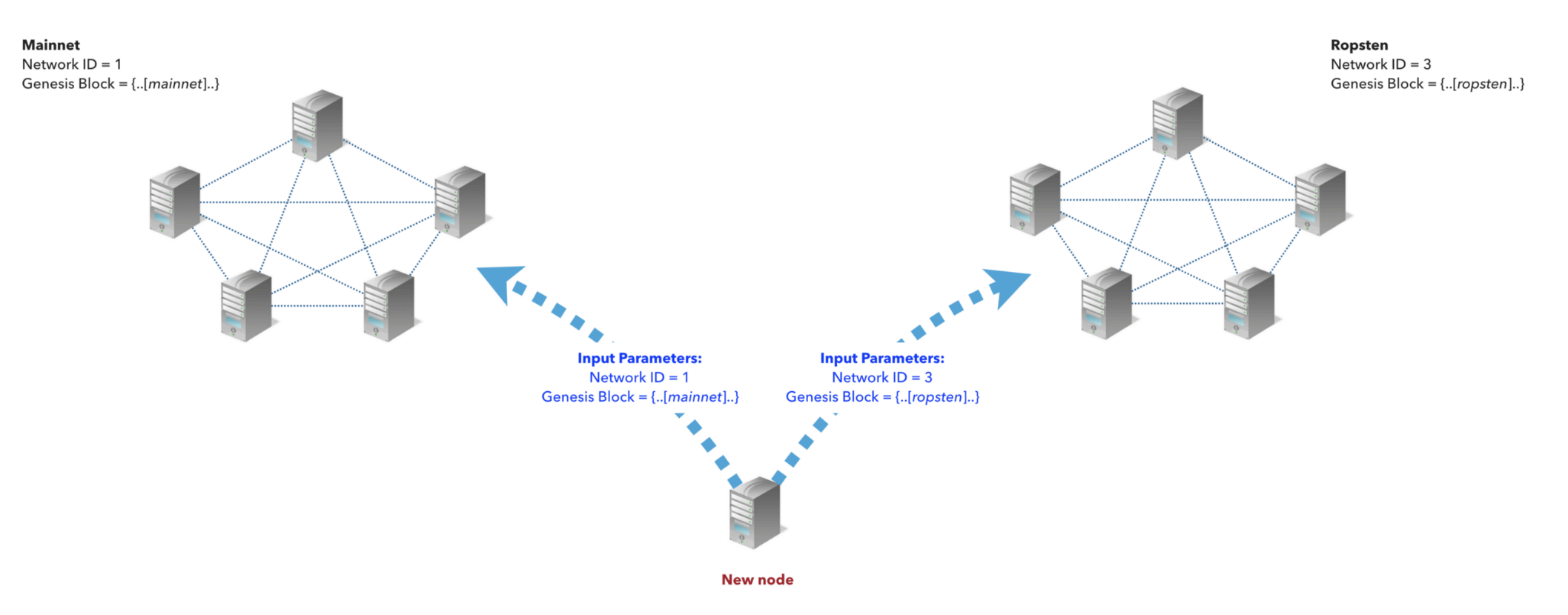
A mainnet and a testnet are two separate networks that operate independently from each other. Here’s an illustration from the context of Ethereum:
Ropsten is the most popular public testnet for Ethereum and is often used as a testing network for developers creating their own dApps on the Ethereum blockchain. Using Ropsten network, DApp developers can experiment on the functionalities on the dApp and also avoid using valuable ETH that is needed for transaction fees and smart contract deployment. Once they’re confident that their dApps work and testing is complete, they can confidently deploy their dApp on the main Ethereum network!
What sets a mainnet and testnet apart are the following factors:
Network ID: A network ID is just an identifier for a network, similar to your ID card that represents your identity. If a new node wants to join the actual Ethereum blockchain itself), they will need to join the mainnet which has a network ID of 1. If they’re keen on joining the testnet instead, they can join the Ropsten testnet which is identified using a network ID of 3.
Genesis Block: This refers to the very first block in the blockchain, which represents the starting point. Since both the mainnet and tesnet are different networks, they have a different genesis block. However, the content of the genesis block can be similar.
(Read more: Guide to Ethereum: What is Gas, Gas Limit and Gas Price?)
Upgrades
From time to time, projects would undergo changes to enhance the capabilities of the blockchain. This is akin to the software updates of your smartphones that has solved previous issues or bugs associated with the previous software versions. Although we mentioned early on that mainnets are the ‘end product’, it may not be the ‘final product’. The blockchain can undergo updates or revisions to a particular functionality, depending on the need of doing so by the developers and the greater community. In order to upgrade the blockchain, a hardfork is required. Here is a detailed guide that explains the complex concept of hard forks.
(See more: Guide to Forks: Everything You Need to Know About Forks, Hard Fork and Soft Fork)
Mainnet Swap
When a project is starting out, it will issue their tokens on other blockchains such as Ethereum or NEO to raise funds. Once they have developed their own blockchain, they will need to migrate the existing tokens issued on other blockchains to the project’s native blockchain (mainnet). This is common practice for new projects in the ICO phase.
This process is called a mainnet swap or a token swap, involving the exchange of one coin for another coin on a one-to-one ratio. The old coin that is issued on another blockchain is discarded and a new coin is issued on the new native blockchain that has been developed and launched by the project. Mainnet swaps usually occur in the following way:
Registration & Auditing:Coin holders are expected to register their coin through the project’s developers, who will then accredit these coins through a supported digital wallet. At the scheduled mainnet swap date, the old tokens are burned while the new, official coins will replace the old coins in the same wallet.
Cryptocurrency Exchange Support: Once the announcement is made, coin holders are invited to keep their coins in the cryptocurrency exchange that supports the swapping process. At the scheduled swap date, the exchange will handle the auditing, accrediting and exchange of the older coin for the newer ones.
(Read also: Breaking: 88% of Crypto Exchanges are Manipulating Trading Volume to ‘Boost’ Rankings)
Effects of Mainnet on Price
The release of a project’s mainnet can cause tremendous excitement in the community, which could affect the coin’s price. This could also contribute to an increase in volatility of the coin’s prices during that period. Let’s take a look at several instances where a mainnet launch coincided with spikes in prices.
Golem (GNT)
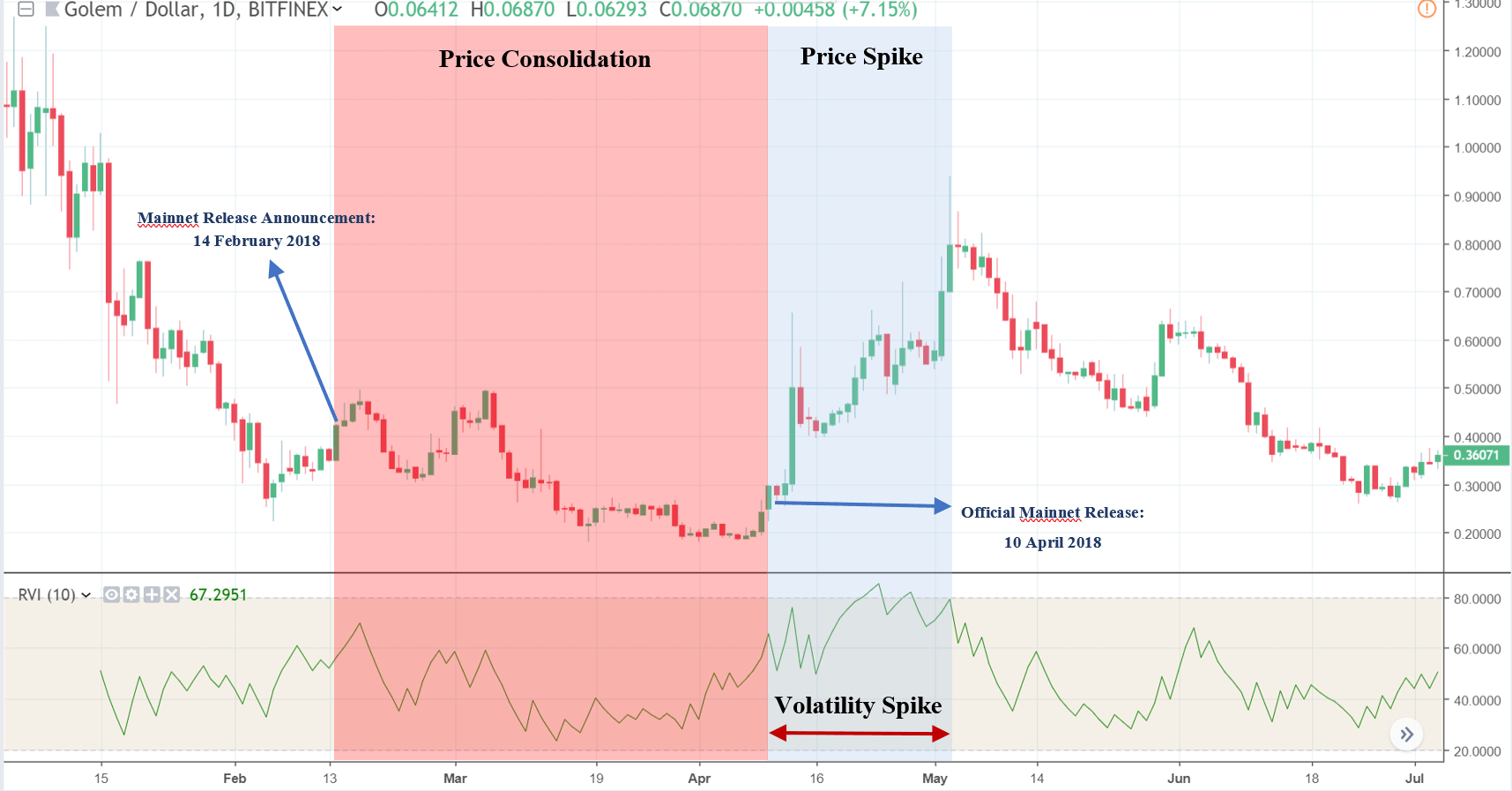
Golem is a project that is focused on creating a decentralized marketplace for sharing computing power. They released their mainnet – called Brass – on April 2018. Here’s a look at how prices reacted to the launch of the mainnet.
Golem announced on mid-February that their mainnet would be ready by the end of March to early April. The duration leading up to the mainnet launch saw GNT’s prices consolidating with relatively low volatility, as indicated by a technical analysis indicator called the Relative Volatility Index (RVI) at the bottom of the chart. When Golem officially launched their mainnet on April 10, prices started to soar tremendously, going from $0.20 to $0.60 within a span of 3 days. That’s a three-fold increase in prices! We can also see that there is an increase in volatility after the mainnet launch, which means that there is an increase in risk during that period.
(See also: 4 Types of Coins to Diversify Your Crypto Portfolio & Manage Risks)
Tron (TRX)
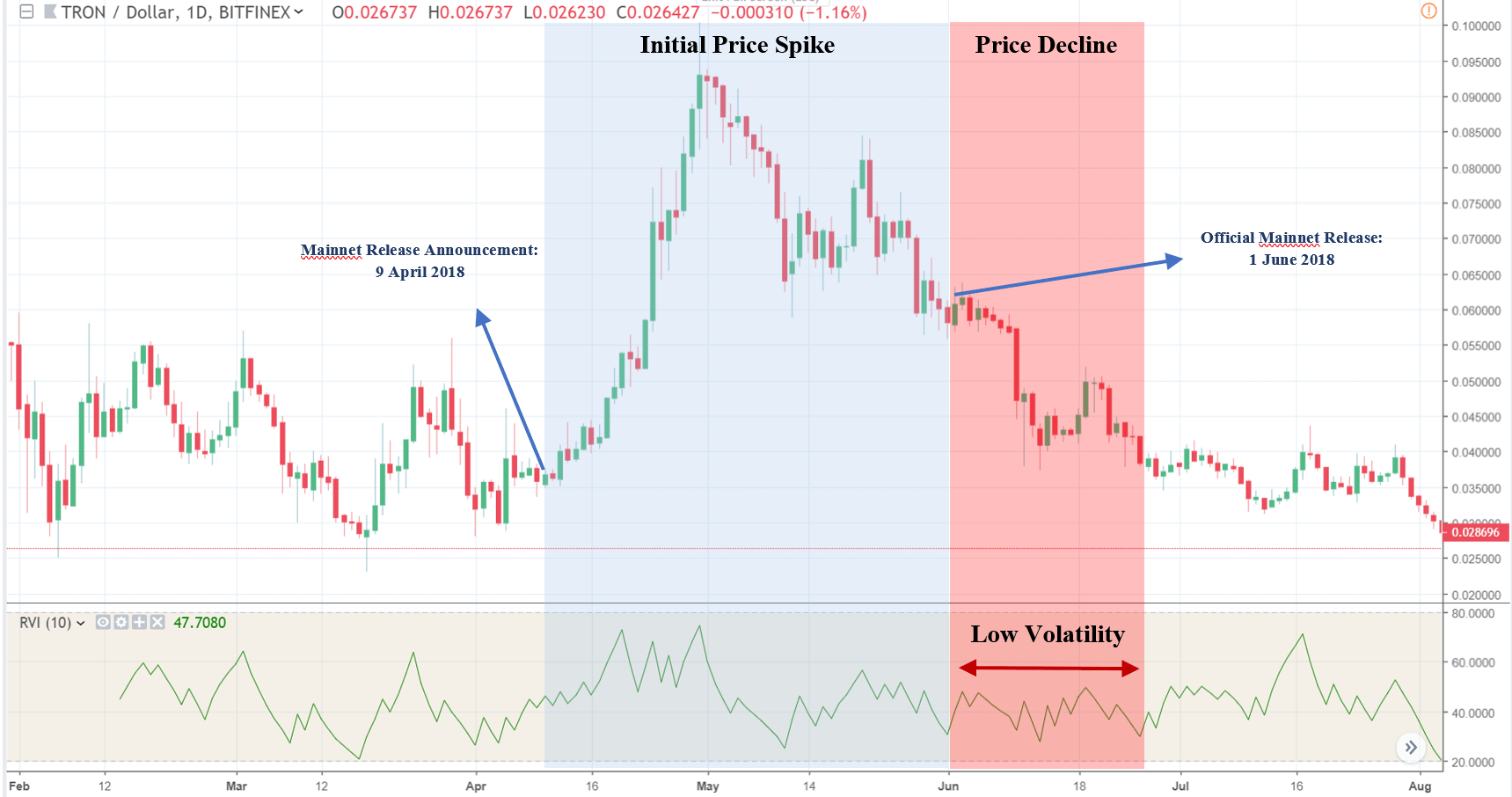
Tron is a blockchain platform focused on creating a decentralized entertainment ecosystem. It’s mainnet – called Odyssey 2.0 – was officially launched on June 1. Let’s see how it affected prices:
The announcement for the release of Tron’s mainnet was made on April 9, which saw TRX’s prices increase from $0.035 to $0.1 within 2 weeks. That’s a solid 3-fold increase in prices. This pump in prices is also caused by Tron’s announcement of distributing an airdrop of over $1.7 million on April 21, as a show of gratitude to their token holders. However, the hype generated by Tron was too great and led to a price decline a month before the actual release of their mainnet. In fact, prices continued to move downhill even after the official mainnet release, with no apparent fundamental reason that substantiates an increase or a decrease. We can imply that the hype around Tron’s mainnet was purely fuelled by sentiments.
A mainnet launch is one of the many factors that may affect the value of a cryptocurrency since its launch represents a successful start by the developers in delivering the promises set in their project roadmap. From then on, the team is expected to drive the project development forward through continual enhancement and upgrading. Although a mainnet is an essential technical aspect to consider when investing in a project, it is not unusual for the absence of mainnets or testnets in cryptocurrency projects, especially if they’re starting out and are in the ICO stages. However, rigorous due diligence has to be done in order to assess the quality and viability of the project. From our examples in Golem and Tron, it is not substantive that mainnet launches have a positive or negative impact on prices since it is largely based on the context behind the projects.
(See more: Bitcoin vs Alt Coins Returns: Comparison of Gains Between Bitcoin & Altcoins Investing)
All in All
Mainnets and testnets represent two fundamentally different networks that each represent a vital purpose for any project. A testnet is often used as a testing site for the development and continual enhancement of the mainnet, while the mainnet itself is the actual, functioning protocol that powers the blockchain network. It is important for any investor to evaluate a project based on the success of both their testnets and mainnets, since they represent a good proxy for the technical development of the project’s vision.
(You should also read: Guide to Market Capitalization: Everything You Need to Know About Market Cap)
Beneficial Resources To Get You Started
If you’re starting your journey into the complex world of cryptocurrencies, here’s a list of useful resources and guides that will get you on your way:
Trading & Exchange
Crypto Guide 101: Choosing The Best Cryptocurrency Exchange
Guide to Bittrex Exchange: How to Trade on Bittrex
Guide to Binance Exchange: How to Open Binance Account and What You Should Know
Guide to Etherdelta Exchange: How to Trade on Etherdelta
Guide To Cryptocurrency Trading Basics: Introduction to Crypto Technical Analysis
Cryptocurrency Trading: Understanding Cryptocurrency Trading Pairs & How it Works
Crypto Trading Guide: 4 Common Pitfalls Every Crypto Trader Will Experience
Wallets
Guide to Cryptocurrency Wallets: Why Do You Need Wallets?
Guide to Cryptocurrency Wallets: Opening a Bitcoin Wallet
Guide to Cryptocurrency Wallets: Opening a MyEtherWallet (MEW)
Read also: Crypto Trading Guide: 4 Common Pitfalls Every Crypto Trader Will Experience and Guide To Cryptocurrency Trading Basics: Introduction to Crypto Technical Analysis.
Sponsored Ad: Your dog deserves to be healthy & happy
Enroll in our Free Cryptocurrency Webinar now to learn everything you need to know about crypto investing.
Get our exclusive e-book which will guide you on the step-by-step process to get started with making money via Cryptocurrency investments!
You can also join our Facebook group at Master The Crypto: Advanced Cryptocurrency Knowledge to ask any questions regarding cryptocurrencies.
Aziz, Master the Crypto Founder
I’m Aziz, a seasoned cryptocurrency trader who’s really passionate about 2 things; #1) the awesome-revolutionary blockchain technology underlying crypto and #2) helping make bitcoin great ‘again’!
The post Crypto Mainnet vs Testnet: What is the Difference? appeared first on Master The Crypto.
This article takes a deeper look at second layer blockchain scaling off-chain solutions, with various implementations that are progressing as we speak.
The internet was born as an instrument for radical self-expression. When the web was young, it was all about creativity and experimentation in a truly decentralized peer-to-peer fashion. However, over time it grew from a network of hobbyists into a multi-billion industry and gradually its great power was usurped by corporations, governments, and large ISPs. Over three billion people use the internet monthly, although it’s just a handful of ISPs that serve the majority of the traffic in each country. The internet has grown to billions of websites, but most user activity is happening on Facebook, Google, Twitter, and other major platforms.
(Read also: Guide to Open Source: Importance of Open Source Technology in Cryptocurrency)
Blockchain Technology
The creation of Bitcoin in 2008 was a ground-breaking advancement in technology, promising to bring real changes to our world. The elements of decentralization, transparency, and immutability captured the imagination of many and posed a threat to traditional systems. This revolution was similar to that of the internet back in the 1990s, but with much greater intensity.
After almost a decade, the cryptocurrency landscape has evolved into a vibrant and diverse ecosystem with numerous coins and tokens with trying to solve different problems. However, much is still to be done for blockchain technology to be accessible to the mainstream public.
(See also: 3 Major Industries That Blockchain Technology is Changing)
Main Problem: Scalability
The goal of any real blockchain technology is to empower the masses through freedom and true decentralization. Bitcoin is the digital equivalent of money, but unlike traditional fiat money, it is not controlled by any single entity. Another popular manifestation of blockchain technology is Ethereum, which is a blockchain platform that facilitates the creation of decentralized applications (dApps) and tokens.
While very few can undermine the potential of blockchain technology, there are still major hurdles that limit its capabilities. In the pursuit of decentralization and immutability, blockchain technology suffers from scalability and speed issues. This phenomenon has a formal proof and is called the Decentralization, Consensus or Scale (DSC) trilema or DCS Theorem. In order words, a blockchain can achieve only two of the following three properties in a distributed system:
Decentralization:This addresses the question main questions; ‘To what extent the system is resistant to the failure of its singular element?’ and ‘How much power or influence does an entity possess?’
Consensus:This refers to whether decisions are made by a consensus of all parties or single-handedly by a small group of users
Scale: This refers to the capability of a system to cater to a larger user base, without slowing down or compromising the system
A blockchain cannot have all 3 properties; only 2 attributes can be chosen. That is why scalability, speed and throughput is an inherent problem for a public blockchain focused on upholding the principles of decentralization. However, the cryptocurrency community has been hard at work to find solutions that will address the issue of scalability.
(Read more: Top 10 Crypto/Blockchain Infographics You Must Know)
Other Pressing Issues
Another major issue faced by blockchains is privacy. The nature of consensus-driven distributed databases like Bitcoin and Ethereum is that all transaction data is stored on the blockchain and is tamper-proof. This means that all transaction data can be publicly verified and cannot be changed or altered in any way. This is important for achieving decentralization but not necessarily ideal for personal or commercial privacy. Second layer scaling solutions are addressing this issue.
Before diving deep into the analysis of existing solutions, it is worth noting that off-chain scaling is not the only option. For instance, one can achieve good scaling capabilities by sacrificing the decentralization attribute of a blockchain. Such an approach is pioneered by Delegated Proof-of-Stake (DPoS) blockchains, such as Bitshares and EOS. In a DPOS system, the network nominates a few nodes as representatives. This requires a degree of trust since these nodes are responsible for processing transactions in an honest manner.
Public blockchains are pretty much ideal examples of the network effect; high usage of the network attracts more applications, businesses, and users. That is why there won’t be too many base-level (protocol) blockchain platforms in the market; rather, all usage will converge on a few of the most advanced, highly secure and widely used networks. For instance, Bitcoin being used for payments and money while Ethereum is used for dApps and trustless code execution.
(See also: Guide to Blockchain Protocols: Comparison of Major Protocol Coins)
Blockchain Scaling Solutions
There are already several solutions that try to solve the issue of blockchain scalability.
From the classification above, there are 4 categories of scaling solutions that is being explored by the community;
First Layer (On-Chain) Solutions:Also known as the protocol-layer solution, first-layer solutions require fundamental changes to be made onto the codebase of the actual blockchain (hence the term “on-chain”. This entails engaging in updates such as increasing the block size limit or reducing the block creation time.
Second Layer (Off-Chain) Solutions:This refers to secondary applications or channels that are built on top of the main blockchain and do not require any fundamental changes to the actual blockchain. The bulk of transactions are ‘off-loaded’ to the secondary channels to reduce network congestion and facilitate faster processing speeds.
Consensus Mechanisms:Perhaps the most important mechanism of any blockchain, scalable consensus mechanisms streamline the consensus process to allow for greater scalability and transaction processing output.
Scalable Distributed Ledgers:Another form of distributed systems that have a different data structure compared to a blockchain. Distributed ledgers usually use a linear data structure rather than organizing transaction data into chained, sequential blocks like a blockchain do.
This article would be focused on examining second-layer scaling solutions, which are also called off-chain scaling solutions.
Classification of Layer 2 Solutions
Sidechains were one of the first proposals on achieving unlimited scaling and preserving privacy while maintaining the security of the base-layer protocol. Sidechains allow users to lock some coins up on the main chain and in return get coins on the parallel chain with its own rules, consensus and much more flexibility on how the protocol is governed. Sidechains add throughput, flexibility and allow one to experiment with consensus rules. Some implementations of sidechains that are close to ready include Liquid and Rootstock sidechains for Bitcoin, and Plasma for Ethereum.
Another type of off-chain solutions is state channels, which is similar in concept to sidechains. A state channel is an approach where one completely re-imagines the idea of trustless consensus between two parties. Instead of coming up with a global consensus on a public network, we can use local consensus. In order to take advantage of state channels, one must create a payment channel with a node that’s connected to a larger network. Security in state channels is usually achieved by locking up some tokens on the main network and keeping them as collateral to ensure honest behavior. Here is an example of a payment channel:
Let’s look at the different implementations of layer 2 solutions out there.
1) Plasma
Plasma is the sidechain implementation for Ethereum Blockchain which is leverages on smart contracts that takes care of all the rules and validation/governance on the Plasma chain.
Block validation on the sidechain is either done by a single operator or by a consensus of a much smaller set of validators than that of the base layer. This alone allows for the quickening of block frequency and the number of maximum possible transactions in each block. Moreover, this will avoid the issue of block propagation and latency which is always the case for base-layer blockchains, where the block must be accepted by tens of thousands of nodes around the world.
The main drawback and problem with this approach is that sidechains always introduce some degree of centralization. Ethereum developers are constantly innovating and pushing the boundaries to preserve the principle of decentralization and trustlessness as much as possible. The gateway that transfers Ether (ETH) or Bitcoin (BTC) is usually controlled by a single party and can be vulnerable to various attacks. Even though the chain operators cannot necessarily steal user funds due to the protocol rules, they still can acquire transaction data, deanonymize users or withhold some information.
(Read also: Analyzing Cryptocurrency Risk: Existing Coins vs ICO)
2) Lightning Network
Lightning Network is probably the most well-known second layer payment network which is built for Bitcoin and Bitcoin-like blockchains (e.g. Decred, Litecoin). The idea of having a peer-to-peer network that consists of payment channels is almost as old as Bitcoin itself. Satoshi Nakamoto mentioned this approach in his comments on a BitcoinTalk forum back in 2010. The Lightning Network utilizes the concept of payment channels to provide bi-directional monetary transfers and envisions a network with near-instantaneous speed, zero counterparty risk, and low fees.
The main concept in LN is a payment channel that can be opened among any two users by including a special funding transaction in the underlying blockchain. Such a transaction is completed in a form of 2-of-2 multi-sig, meaning no party can single-handedly withdraw the money. In ensuring that funds won’t be lost forever in the channel in the case of non-cooperation, or if the private key is lost, both sides are required to sign each other’s transactions to execute the transaction.
Once the channel is open and funded with some BTC, both parties can transact as fast as their peer-to-peer connection allows and pay no fees for doing so. Lightning transactions are completed in the form of cryptographic commitments. This allows for completely trustless payments; any party can close the channel and fix the outstanding trading balance on the Bitcoin blockchain at any time. In addition, LN ensures that it is impossible to cheat your trading partner by publishing an outdated commitment. This is done by having some lockup time on funds in the multi-sig. If Alice sees that Bob tries to cheat her by publishing some outdated state of their trading history (the one that is beneficial for him), she can simply provide proof in a form of a later commitment and free her funds from the multi-sig. Bob, in turn, will be punished for cheating by the protocol rules. It is the same general approach that Plasma uses to proof honesty on Plasma chain operators, though it is implemented in a different manner.
In most cases, both parties have an incentive to collaborate. In this case, the channel is closed with full cooperation of both parties by constructing a normal transaction from the original 2-of-2 escrow. This transaction would pay out the respective balance to each member, based on the most recent commitments. Neither individual has to go through the slow process of paying additional on-chain fees, nor lose out on the opportunity costs of having their BTC locked up by the protocol.
The practical use-case of LN is not that every single user will publish an onchain transaction whenever they need to make a payment; rather it will work as an actual network. If Alice does not have a direct channel opened with Bob, she can always create a multi-hop transaction that will use several channels to reach its destination – pretty much the way internet works.
Another benefit of LN is that it’s not controlled by any corporation or even a group of developers. The development started with writing a documentation called BOLT (Basis of the Lightning Technology). These BOLTs describe every aspect of the protocol in forensic detail using pseudocode and plain English. There are multiple teams around the world building an actual implementation of Lightning Network using different programming languages and platforms, but since they all collaborate on the same reference specification, the resulting software is interoperable.
The beautiful thing is that actions required to make or receive payment in Bitcoin via Lightning Network rarely takes place on-chain. This saves tremendous costs and speeds up trading significantly.
(See more: Guide to Bitcoin Scalability Solution: What is Lightning Network?)
3) GEO Protocol
GEO protocol is an off-chain scaling solution that can be built on top of any existing public blockchain and connect them in a single cross-chain network. There is no common ledger that requires computationally-expensive nodes and power to secure. Instead, it is an off-chain protocol that leverages on a distributed network of state channels and trustlines connecting them. The advantage is that unlike Bitcoin, Ethereum or Plasma, a GEO node can be spun up on a comparably slow and cheap device – like a smartphone or Raspberry Pi computer.
GEO is leveraging the concept of trustlines which was pioneered by Ryan Fugger from Ripple. The idea is quite similar to bidirectional channels in LN or Raiden, but the main difference being that trustlines occur when there is a bilateral agreement between exactly two users. This agreement consists of two credit lines (liabilities), as well as a balance indicating if, and how much, one party owes the other. Payments between non-trusting strangers are implemented by propagating balance updates through a network of trustlines until the payment reaches the receiver.
Trustlines mechanics
Trustlines consist of IOU (I Owe You) channels where users can issue their own currency or asset and the network facilitates free and unrestricted exchange of that asset. This also allows cross-blockchain exchange of value directly between holders without engaging with centralized exchanges. In order to preserve the decentralized and trustless nature of blockchain technology, the protocol does not allow freezing of either account or trustline.
Another concept developed by GEO protocol is composite channels, which are a combination of trustlines with user-issued assets and classic state channels with cryptocurrency locked up in an on-chain multisig wallet. This combines almost infinite scalability with a trustlessness of the base layer blockchain or multiple blockchains. At the end of the day, the user is allowed to not only make cryptocurrency transactions, but also tokenized fiat money, real world property and other assets. One tangible example of this technology would be a cross-chain DEx (decentralized exchange) enabled by the protocol from scratch.
4) Celer Network
Celer Network is a blockchain agnostic and horizontally scalable protocol that increases the scalability of blockchains through off-chain scaling. It utilizes a layered technology architecture, with several core technical innovations including:
Channel construct suite with sidechain channels and flexible support for generalized off-chain dApp state transitions
Optimal state routing algorithm with 15x higher transaction throughput than existing state-of-the-art solutions
Off-chain operating system that simplifies development and usage of off-chain applications on various platforms
It should be noted that there are other solutions that have taken a similar approach such as the Lightning Network, Raiden, Trinity and Plasma. Celer Network differentiates itself because it will be compatible with all the other projects fighting to scale on-chain. This is important to consider because other projects in this space such as the Lightning Network (LN) cannot work with ETH or EOS.
(Read also: Guide to Crypto Derivatives: What is Cryptocurrency Derivatives?)
5) Raiden Network
Just like Lightning Network for Bitcoin, Raiden creates a sequence of payment channels outside of the blockchain itself to resolve transactions quickly. Raiden, however, has its own ERC20-based token called RDN which is not required to make payments but will be used to get access to additional services. At some point, the team has raised $33 million to fund the development of the project via an ICO – initial coin offering.
One of the first implementations of Raiden Network is called µRaiden, which is specifically designed for micro payments in ERC20-based tokens. The difference is that µRaiden only uses unidirectional payment channels, whereas Lightning Network is leveraging bidirectional payment channels.
What Does the Future Hold?
It is imperative that blockchains radically enhance their scaling capabilities to support higher transaction output and allow for mass adoption. Solving the issue of scalability is being rigorously undertaken by the cryptocurrency community, as can be seen from the above examples. It is only a matter of time before different variations of blockchains are able to preserve the principles of decentralization as well as possessing the scaling capabilities similar to traditional payment processes such as Visa or Mastercard. Second layer networks will extend the capacity of blockchain technology and open new use-cases that in turn will bring Ethereum, Bitcoin and other technologies into the hands of the next billion people.
(You might also be interested in: Crypto ICO vs. Stock IPO: What’s the Difference?)
Beneficial Resources To Get You Started
If you’re starting your journey into the complex world of cryptocurrencies, here’s a list of useful resources and guides that will get you on your way:
Trading & Exchange
Crypto Guide 101: Choosing The Best Cryptocurrency Exchange
Guide to Bittrex Exchange: How to Trade on Bittrex
Guide to Binance Exchange: How to Open Binance Account and What You Should Know
Guide to Etherdelta Exchange: How to Trade on Etherdelta
Guide To Cryptocurrency Trading Basics: Introduction to Crypto Technical Analysis
Cryptocurrency Trading: Understanding Cryptocurrency Trading Pairs & How it Works
Crypto Trading Guide: 4 Common Pitfalls Every Crypto Trader Will Experience
Wallets
Guide to Cryptocurrency Wallets: Why Do You Need Wallets?
Guide to Cryptocurrency Wallets: Opening a Bitcoin Wallet
Guide to Cryptocurrency Wallets: Opening a MyEtherWallet (MEW)
Read also: Crypto Trading Guide: 4 Common Pitfalls Every Crypto Trader Will Experience and Guide To Cryptocurrency Trading Basics: Introduction to Crypto Technical Analysis.
Enroll in our Free Cryptocurrency Webinar now to learn everything you need to know about crypto investing.
Get our exclusive e-book which will guide you on the step-by-step process to get started with making money via Cryptocurrency investments!
You can also join our Facebook group at Master The Crypto: Advanced Cryptocurrency Knowledge to ask any questions regarding cryptos!
Stepan Gershuni
The post Second Layer Blockchain Scaling: Off-Chain Solutions appeared first on Master The Crypto.
Palm Beach Research Group has launched a new marketing campaign for its financial email newsletter, The Palm Beach Letter. The marketing campaign describes an “investment of the decade” spotted by Teeka Tiwari.
In “The Investment of the Decade” report, Teeka lists three blockchain technology companies that are expected to capture a slice of the blockchain industry as it grows by 295,000% over the coming years.
What is this so-called “investment of the decade”? Just weeks before the infamous Jetinar is set to take place, Teeka Tiwari’s Investment of the Decade is creating buzz in the cryptocurrency and blockchain world because of his past track record of proven success in picking winners who gone on to post exceptional gains. Keep reading as we explain everything you need to know about Palm Beach Research Group’s new “Investment of the Decade” report.
What is The Investment of the Decade?
Palm Beach Research Group has published a new report online called The Investment of the Decade.
If you subscribe to The Palm Beach Letter today, you will receive a free copy of the report – as well as several other bonus reports such as 5 Coins to $5 Million or Crypto Income Quarterly.
The Investment of the Decade is actually three investments: the report describes three “must-own stocks” that are expected to see enormous gains over the coming years.
All three stocks listed in The Investment of the Decade are linked to an industry that Teeka calls “Genesis”. Teeka expects this industry to grow 295,000% over the coming years:
“The invention I’m going to share with you today—which I refer to as “Genesis”, for a reason that will become clear shortly—is set to grow 32 times more than 5G.”
Teeka claims that some of America’s largest corporations have invested in this “Genesis” technology. He describes how Warren Buffett is one of the world’s top backers of Genesis, and that Apple recently received two patents for Genesis.
In the report, you’ll learn that this mysterious “Genesis” technology is simply blockchain. Teeka Tiwari is a big believer in bitcoin and blockchain. He expects the technology to grow enormously over the coming years.
In The Investment of the Decade, Teeka shares his top three blockchain technology companies. Each company is expected to capture a big slice of the blockchain market over the coming years. According to Teeka, investing in these companies today is like buying Amazon or Google before the Dot Com boom.
Why Does Teeka Expect Massive Growth in Blockchain?
Blockchain isn’t a secret technology. We’ve been hearing about blockchain and bitcoin for years. So why does Teeka believe the industry has a lot more room to grow?
Teeka Tiwari believes blockchain has “wide and varied” uses across multiple industries. Some of the specific areas where blockchain can improve include:
Modernizing the $217 trillion real estate industry
Combating the $1.7 trillion in counterfeit goods sold each year
Improving the electoral voting system
Reducing healthcare costs
Securing the food supply
Food companies are using blockchain to trace food from its origin to its final destination, for example, helping them track ingredients all the way to the finished product. Retailers are using blockchain to separate real and counterfeit goods.
Teeka also describes how major financial industries are “all over blockchain”. He describes how the Depository Trust Clearing Corporation (DTCC), for example, just moved $10 trillion onto the blockchain.
Clearly, Teeka believes there’s huge potential in blockchain technology.
If you sign up for Teeka Tiwari’s email newsletter, The Palm Beach Letter, today, then you’ll receive a free copy of The Investment of the Decade.
What is The Palm Beach Letter?
The Palm Beach Letter is an alternative financial newsletter published by Palm Beach Research Group.
The newsletter is promoted online with huge claims about the earning potential for investors. If you want to get rich quick with minimal risk, then Palm Beach Research Group may have the investment advice you need.
Palm Beach Research Group claims their model portfolio has performed extremely well over the last few years:
“Since 2011, The Palm Beach Letter’s model portfolio has performed second to none… averaging 89% per year.”
Tiwari also claims the returns have got even better since he took over the portfolio in 2016, averaging 154% per year.
By subscribing to The Palm Beach Letter, you’ll gain access to this model portfolio. You will also receive regular email newsletters with the latest financial advice, market movements, and stock tips.
Who is Teeka Tiwari?
Teeka Tiwari is a financial analyst currently working for Palm Beach Research Group. He has a background in banking.
Tiwari serves as editor of The Palm Beach Letter. He also publishes Palm Beach Confidential, which is a crypto-focused email newsletter.
Tiwari made headlines across the bitcoin community for his “5 coins to $5 million” prediction. As you see in The Investment of the Decade report, Tiwari is a big believer in crypto and blockchain technology.
What’s Included with The Palm Beach Letter?
As part of the new promotion, your subscription to The Palm Beach Letter comes with a handful of bonus reports – including the blockchain report, The Investment of the Decade. Here is what’s included with the new subscription:
One year subscription to The Palm Beach Letter
Bonus Report #1: The Investment of the Decade: Three Must-Own Stocks that Will Power Blockchain’s 295,000% Revolution
Bonus Report #2: Blockchain “Moonshots”: Three Chances to Turn $1,000 into $1.6 Million
Bonus Report #3: The Davos Manifesto
Bonus Report #4: The Private Deals Bible: How to Get Outsized Gains from Tiny Investments
Bonus Report #5: How to Own a Fleet of Classic Cars for as Little as $50 Each
Click here now to watch Teeka Tiwari’s Investment of the Decade about the Genesis Technology and Blockchain Stocks report from Palm Beach Letter.
The Palm Beach Letter Pricing
A one-year subscription to The Palm Beach Letter is priced at $49.
If you buy The Palm Beach Letter for $49 today, then you will automatically be enlisted in the automatic renewal system. Your credit card will be charged $129 one year from today, and you will continue to be subscribed to The Palm Beach Letter until you cancel.
The Palm Beach Letter Refund Policy
All purchases come with a 60-day moneyback guarantee. You can receive a complete refund on your purchase within 60 days.
If you request a refund, you are still allowed to keep the free reports, although you will no longer be subscribed to The Palm Beach Letter.
Final Word
Teeka Tiwari has published a report called The Investment of the Decade. In the report, Teeka shares his three best blockchain stocks. Teeka believes these stocks will grow significantly over the coming years as blockchain continues to grow.
To get access to Genesis Technology investment insights and The Investment of the Decade report, you’ll need to subscribe to Teeka Tiwari’s Palm Beach Letter email newsletter.
Aziz, Master the Crypto Founder
I’m Aziz, a seasoned cryptocurrency trader who’s really passionate about 2 things; #1) the awesome-revolutionary blockchain technology underlying crypto and #2) helping make bitcoin great ‘again’!
The post Investment of the Decade: Genesis Technology Blockchain Stocks Report appeared first on Master The Crypto.
The IRS and other national tax authorities have been aware of bitcoin for years.
The IRS issued its first ruling on bitcoin all the way back in 2013. If you’re not reporting crypto on your taxes in 2020, then you’re exposing yourself to significant liability.
Tax authorities in the United States, United Kingdom, Canada, Australia, Germany, Japan, and other countries have all built specific rules for crypto taxes.
Fortunately, reporting your crypto for tax purposes is easier than ever. There are crypto tax services and crypto programs. There’s crypto accounting software. There are CPAs that specialize in creating accurate crypto tax returns.
In fact, there are so many crypto tax services that it’s difficult to know which one is right for you. That’s why we want to help. We’ve ranked the best crypto tax software for 2020, including crypto tax websites, apps, programs, services, and providers.
What is Crypto Tax Software?
Crypto tax software is a tool used to calculate your cryptocurrency gains and losses.
Typically, your brokerage – the place where you buy stocks, bonds, ETFs, and other investments – would provide this statement for traditional investment products. Crypto, however, is not a traditional investment product, and crypto exchanges are not traditional brokerages.
TD Ameritrade and JPMorgan would normally issue a Form 1099 that lists all of your annual proceeds, cost basis, and gains or losses from any investment transactions, for example.
Crypto exchanges, however, do not issue any such forms.
Some cryptocurrency exchanges – including Coinbase – will issue a Form 1099-K that lists all of your gross crypto transactions. However, this information is not useful in preparing your tax return. You need to provide more data.
That means the burden of reporting your crypto gains and losses comes down to you. That’s where crypto tax software becomes useful.
Basic crypto tax software will simply compile all your cryptocurrency transactions from various sources and calculate gains and losses in US Dollars by following the IRS’s guidance.
Crypto tax software does not typically calculate the specific taxes you owe on your crypto holdings. The taxes you pay will vary based on your taxable income. Depending on the information you enter into your tax return, you might pay more or less than another filer with identical crypto transactions.
Essentially, crypto tax software takes all of the numbers from your crypto accounts and crypto wallets, takes note of any transactions you made throughout the year, then lists all of those numbers in a way the IRS can understand. Then, you can attach the report to your TurboTax e-file submission. Or, you can print off the report and attach it to any other tax return.
Do I Really Need to File Taxes on My Crypto?
Yes! The IRS has added a crypto question on Schedule 1, which means crypto has officially gone mainstream.
Failure to report crypto investments, crypto profits, or crypto losses may be treated just like failing to declare other investment income. You could face steep tax penalties this year or in the future.
Remember: if you’re trading on regulated crypto exchanges, then you likely provided personal information and possibly even your SSN. The IRS can easily find your crypto accounts.
Contrary to what somebody might tell you, the IRS does have rules in place for taxing bitcoin: the IRS and most other national tax authorities treat bitcoin like property. That means you need to report all transactions involving crypto, including how much you paid, how much you bought, and how much profit or loss arose from that transaction.
The IRS will analyze this information, then add or deduct from your taxable income.
How Does Crypto Tax Software Work?
Crypto tax software is like a third-party data aggregator. Typically, you pay a small fee for the software, and the software extracts your data from different crypto exchanges.
Someone who conducted fewer than 50 crypto transactions in the fiscal year might pay $10 to use the crypto tax software, while an institution that conducted 10,000 transactions in the fiscal year might pay $500.
Most crypto tax software works in a similar way:
You sign up for the crypto tax software and pay a fee; users with more crypto transactions to report will pay a higher fee
You give the crypto tax software read-only access to your crypto trading accounts, wallets, and other crypto sources; if you have accounts on Coinbase and Kraken, for example, then you will grant API access to those exchange accounts to your crypto tax software
Alternatively, all crypto tax software lets you upload CSV documents
The crypto tax software checks your crypto accounts and extracts your transaction history
The crypto tax software aggregates all of this transaction history; the software checks the date and time of each transaction, reports the price based on historical data, then adds up your gains and losses
Ultimately, the crypto tax software reconciles all of the transactions and prices, then produces a detailed gain and loss report compatible with IRS guidelines; typically, the two reports produced by crypto tax software include Form 8949, Schedule D and, in some cases, Schedule 1
What’s the Difference Between Good and Bad Crypto Tax Software?
At first glance, all crypto tax software might seem pretty much alike. All crypto tax software makes a similar promise to do your taxes quickly and accurately.
So what’s the difference between good and bad tax software? Here are some of the ways to compare today’s best programs and services:
Integrations: Some crypto tax software integrates with hundreds of large and small crypto exchanges. Whether you trade on major exchanges – like Coinbase – or obscure, local exchanges, this crypto tax software will be able to track account data and create deliverable information for the IRS.
Bandwidth: Did you conduct 1,000 crypto transactions in the past year or just 10? Based on the number of transactions, you might pay a cheap or expensive price for crypto tax software. A hobby trader may find crypto tax software for free because there are only 15 transactions to report over the fiscal year, for example, while an institution needs to pay $1,000 for crypto tax software because there are thousands of transactions to report.
API vs. CSV Access: Crypto tax software integrates with your exchange accounts in two ways – through Application Programming Interface (API) or Comma Separated Values (CSV). API is seamless and accurate because it connects directly to the exchange: you just copy the API key from your exchange/wallet and paste it into the crypto tax software. CSV, meanwhile, is slightly more inconvenient. You download your transaction history from your exchange in .csv format, and then upload this .csv file to the crypto tax software. Most crypto tax software supports API access to major exchanges, while more obscure exchanges require manual CSV syncing.
Reputation: Some of crypto’s biggest names offer crypto tax software. Coinbase has a crypto tax tool, for example. Other crypto tax software is offered by startups that launched last year. Reputation is important in the crypto tax space: you’re trusting your financial future to this software. Check the crypto tax software’s team page to make sure they have members with experience in compliance/regulation. Or, make sure they have some other type of proven track record that gives you peace of mind.
Accuracy Guarantees: Does the crypto tax software offer any type of guarantee? Does the provider guarantee accuracy? Some providers will actually pay your tax penalties (up to a certain limit), giving you added peace of mind that everything was reported accurately.
Price: Crypto tax software ranges from free to expensive. Traders with a high number of transactions will pay more for crypto tax software than traders with a low number of transactions. Some crypto tax software doesn’t charge a different rate based on the number of transactions, but it does charge a different rate based on the value of your account.
Country Support: Some crypto tax software is focused on the United States. Most crypto tax software, however, lets you easily produce reports for other major English-speaking countries, including the United Kingdom, Canada, and Australia. Some software also supports Germany, Japan, and other countries. Some software supports all countries simply by offering standardized reports suitable for any country.
Perks and Bonus Features: Some crypto tax software comes with certain perks and bonus features. All crypto tax software offers some type of gain/loss reconciliation, but some of the better software products also have bonus features like free portfolio tracking, educational webinars, tax planning tools, and more.
We’ve ranked the world’s best and biggest crypto tax software based on these features and more.
TaxBit
TaxBit claims to offer “crypto tax software simplified”. The software was designed by leading blockchain CPAs and cryptocurrency tax attorneys, making it one of the more reputable names in the space.
Today, TaxBit supports over 4,200 cryptocurrencies, equities, commodities, and fiat currencies. Even if you’re dealing with obscure cryptocurrencies, you should have no trouble using TaxBit to report your crypto transactions.
TaxBit also claims to offer a full audit trail, making it easy for you (or the IRS) to dive deep into any transaction and see exactly how cryptocurrency taxes were calculated. For the fiscal year 2020, TaxBit is offering 10% off all plans as well as a free trial.
Pricing
Basic ($50 Per Year)
250 transactions
10 exchanges/wallets
Current year tax form
Chat support
Plus ($175 Per Year)
2,500 transactions
Unlimited exchanges and wallets
All tax forms (2014 to 2019)
Chat support
Pro ($500 Per Year)
CPA review of tax form
25,000 transactions
Unlimited exchanges and wallets
All tax forms (2014 to 2019)
CPA phone support
CryptoTrader.tax by Coin Ledger
CryptoTrader.tax is Coin Ledger’s crypto tax software. The software claims to be the easiest and most reliable way to prepare your cryptocurrency taxes.
Like other software, CryptoTrader.tax lets you import your trades (via API) or upload a trade history file, then download your report to add to your tax return. All major crypto exchanges are supported.
One advantage of CryptoTrader.tax is that the program is a trusted TurboTax partner. Coin Ledger has partnered with TurboTax, the world’s largest tax preparation platform, to let you easily electronically file your tax return.
Another nifty feature with CryptoTrader.tax is that you can not only add your crypto transactions, but you can also report any crypto income – including income earned from mining, gifts, airdrops, and forks. Any income – including crypto-related income that didn’t arise from trades – needs to be reported to the IRS, and CryptoTrader.tax lets you do that.
Pricing
Hobbyist ($49 Per Tax Season)
Up to 100 trades
Live chat support
Unlimited report revisions
FIFO, LIFO, and specific identification
IRS Form 8949
Capital gains report
TurboTax integration
TaxAct integration
Tax-loss harvesting
Pro Trader ($99 Per Tax Season)
Up to 1,500 trades
Live chat support
Unlimited report revisions
FIFO, LIFO, and specific identification
IRS Form 8949
Capital gains report
TurboTax integration
TaxAct integration
Tax-loss harvesting
High Volume Trader ($199 Per Tax Season)
Up to 5,000 trades
Priority support
Unlimited report revisions
FIFO, LIFO, and specific identification
IRS Form 8949
Capital gains report
TurboTax integration
TaxAct integration
Tax-loss harvesting
Unlimited ($299 Per Tax Season)
Up to 100 trades
Priority support
Unlimited report revisions
FIFO, LIFO, and specific identification
IRS Form 8949
Capital gains report
TurboTax integration
TaxAct integration
Tax-loss harvesting
Any reports for 2018 and previous years are 15% of the normal report price. If you want to use CryptoTrader.tax to submit crypto-related trades and income from previous years, then you can get a small discount. Plans are also available for tax professionals.
ZenLedger
ZenLedger advertises itself as “the fastest and friendliest tax tool” for crypto users and their accountants. The crypto tax software works with all major exchanges and most major fiat and cryptocurrencies. ZenLedger imports your transactions then prepares your required documents (including capital gains reports, income reports, donation reports, and closing reports).
Just like with CryptoTrader.tax, ZenLedger is an official TurboTax partner, which means any data collected by ZenLedger can easily be added to your TurboTax electronic tax return.
ZenLedger offers more tiers than most other crypto tax software listed here, ranging from their Hobbyist option ($69 for 100 transactions) to the Unlimited option ($999 for unlimited transactions). You can also pay extra to have your tax return fully prepared for you, in which case ZenLedger will connect you with a tax attorney or CPA to fully complete your tax return.
Pricing for Standard ZenLedger Plans
Hobbyist ($69 Per Tax Year)
100 transactions or fewer
Up to $15,000 total asset value
Starter ($149 Per Tax Year)
500 transactions or fewer
Up to $50,000 total asset value
Premium ($399 Per Tax Year)
1,000 transactions or fewer
Up to $300,000 total asset value
Executive ($799 Per Tax Year)
4,000 transactions or fewer
Up to $1 million total asset value
Unlimited ($999 Per Year)
Unlimited transactions
No asset value cap
Priority support
Pricing for ZenLedger Fully Prepared Plans
Silver ($750 Per Tax Year)
50 transactions or fewer
Up to $50,000 total asset value
Up to four tax forms
One state tax return
Up to two hours of return preparation time, with additional time discounted
Gold ($1,250 Per Tax Year)
100 transactions or fewer
Up to $300,000 total asset value
Up to six tax forms
One state tax return
Up to three hours of return preparation time, with additional time discounted
Diamond ($2,500 Per Tax Year)
400 transactions or fewer
Up to $1 million total asset value
Up to eight tax forms
Two state tax forms
Up to seven hours of return preparation time, with additional time discounted
TokenTax.us
TokenTax.us lets you calculate your crypto taxes and file your return. It’s a crypto tax software platform and cryptocurrency tax accounting firm that, like many other reputable providers here, has also partnered with TurboTax. TokenTax.us supports all major exchanges via API, although you can also upload any transaction history via CSV.
After collecting your exchange data, TokenTax.us will populate Form 8949, which is the form that’s used to report capital gains. That form can easily be added to your tax return or imported directly into TurboTax.
TokenTax.us also supports margin trading taxes, including direct support for some of the world’s largest and most popular leveraged trading platforms. Deribit, BitMEX, and Bybit are all supported.
As with other software, TokenTax.us lets you create just a crypto gains/losses form or you can pay extra for a complete tax return. You can also produce crypto tax forms for any country in the world – not just America and its Form 8949 for the IRS.
Pricing
Basic ($65 Per Tax Year)
Up to 500 transactions
Only supports Coinbase, Coinbase Pro, and Binance
IRS Form 8949 or international support
Live chat support
Premium ($199 Per Tax Year)
Up to 3,000 transactions
Support for every exchange
Support for margin trading (on BitMEX, Deribit, and Bybit)
Tax loss harvesting dashboard
Everything included with Basic
Pro ($799 Per Tax Year)
Up to 20,000 transactions
Tax loss harvesting advisory session
All margin exchanges supported
FBAR included
Everything included in Premium
VIP ($1,499 Per Tax Year)
Advanced crypto reconciliation assisted by a CPA
Two 30 minute sessions with a tax expert
IRS audit assistance
Up to 30,000 transactions
Everything included in Pro
eToro Crypto Tax
eToro has a Crypto Tax Calculator found online at https://etorocryptotax.com/
The calculator is designed for informational purposes. Anyone can input major cryptocurrencies, then find out the taxes owed on those cryptocurrencies.
You select your tax year, then choose a cryptocurrency. eToro Crypto Tax supports about 30 of the world’s biggest cryptocurrencies. Then, you can manually add trades or import your trades via CSV.
The calculator then looks up the price you paid for each trade, including any profits or losses you made on your crypto trades. eToro will calculate your capital gains tax, giving you a rough idea of how much money you should owe based on your trades.
Unlike other crypto tax software listed here, eToro Crypto Tax does not create Form 8949 with the IRS, nor can the information be directly added to your tax return. However, if you’re looking for a rough outline of how much tax you can expect to pay on your crypto holdings, then eToro Crypto Tax is a great (and free) option.
Pricing
Free
Lukka.tech
Lukka is a technology and data services provider that recently launched LukkaTax for ordinary crypto users. LukkaTax is a do-it-yourself crypto tax preparation product launched in December 2019 just in time for the 2019 tax season.
As with other crypto tax software listed here, LukkaTax will create reports for your virtual currency activity on IRS Forms 1040 and 8949.
Lukka is a blockchain technology company founded in 2014. The New York-based company is best-known for offering products that automate and optimize accounting, auditing, and tax processes for consumers, investors, funds, fund administrators, OTC and proprietary trading firms, exchanges, miners, protocols, and accountants. Now, the company offers individual tax form preparation options.
Pricing
$19.95
Accointing
Accointing is a management platform that lets you easily track and manage your crypto portfolio, then produce a tax report. You can import any exchange (via API or CSV) and track over 6,000 currencies.
One unique feature with Accointing is that it’s available on desktop and mobile devices. You can track your portfolio wherever using the mobile app for iOS or Android.
Accointing will track your transactions throughout the year, your taxable income, your untaxable income (gifts, donations and lost or stolen funds), and capital gains. It’s all packaged neatly into a user-friendly interface.
Pricing
Starter Tax Report ($49.99)
Full report with up to 250 transactions
Reports for all previous years
License valid for 365 days
Advanced Tax Report ($129.99)
Full report with up to 5,000 transactions
License valid for 365 days
Reports for all past years
Professional Tax Report ($259.99)
Full report with unlimited transactions
Advanced holding period page
Tax optimizer
License valid for 365 days
Reports for all previous years
Coinbase Tax Resource Center
Coinbase has a complete Tax Resource Center under its support page. Coinbase is careful to explain that it does not offer tax advice and only offers crypto-related tax info for informational purposes. However, this information can certainly help you handle your crypto taxes for the year.
Coinbase’s Tax Resource Center, for example, explains what happens when Coinbase sends you a Form 1099-K, including what to do with that statement. Coinbase is one of the few exchanges that send a Form 1099-K, although you’ll need to meet certain limits to receive one ($20,000 of transaction volume or more in most states).
Coinbase’s Tax Resource Center also explains what to do if you receive an IRS B-Notice, which indicates there are discrepancies with your tax identification number (TIN) and the legal name Coinbase used by Coinbase to file Form 1099-K.
You can view Coinbase’s Tax Resource Center on its support page here.
Pricing
Free
CoinTracking.info
CoinTracking.info advertises itself as the leader for cryptocurrency tracking and reporting. The platform has 11 years of historical data, coin trends for 7,200 coins and $3.9 billion tracked across all portfolios.
You can use CoinTracking.info to simply track your portfolio – just like any crypto portfolio tracking app. Or, you can use the platform to create a capital gains report. Variable parameters are available for all countries, and 12 tax methods (FIFO, LIFO, AVCO, etc.) are supported.
CoinTracking.info supports direct imports from all major exchanges and dozens of lesser-known exchanges as well. You can also import coin holdings and transactions from your wallet. There’s even legacy support for closed exchanges.
Personal exports via CSV, XLS, PDF, HTML, XML, or JSON
20 personal trade backups
Prioritized transactions
Priority customer support plan
BearTax
BearTax, found online at Bear.tax, lets you fetch crypto trades from anywhere, identify transfers across exchanges, and automatically generate tax documents – similar to other crypto tax software listed here.
With BearTax, you can import your trades from almost any exchange (via API or CSV), review your trades and process them (using FIFO or LIFO methods), then automatically generate your tax documents and send them to your accountant.
BearTax lets you import from 50+ exchanges via API or CSV. There’s no limit to the number of exchange accounts you can track with BearTax. BearTax will gather your transaction information, then generate IRS Form 8949.
Pricing
Basic ($1 Per Tax Year)
Up to 20 transactions
Unlimited exchanges
Intermediate ($30 Per Tax Year)
Up to 200 transactions
Unlimited exchanges
Email support
Expert ($100 Per Tax Year)
Up to 1,000 transactions
Unlimited exchanges
Professional ($200 Per Tax Year)
Up to 10,000 transactions
Unlimited exchanges
Connect with accountant
Priority chat support 24/7
Custom file imports
CoinTracker.io
CoinTracker.io lets you calculate bitcoin taxes and track your crypto portfolio from one convenient platform. You connect your exchanges, wallets, and DeFi platforms. Then, CoinTracker.io automatically and continuously synchronizes your crypto balances and transactions.
Some people use CoinTracker.io simply to track their entire crypto portfolio. You can get a breakdown of your holdings, how they have grown over time, and other data. CoinTracker.io supports over 300 wallets and exchanges, making it easy to sync your funds wherever they’re held.
You can also instantly generate tax reports for any country in the world. Full CoinTracker.io tax reports are available for crypto users in the United States, United Kingdom, Canada, and Australia. Partial support is available to residents of every other country in the world. With a few clicks on CoinTracker.io, you can view your tax summary, then download the reports you need to file your taxes.
Pricing
Hobbyist ($49 Per Tax Year)
100 transactions
Free portfolio tracking
Cost basis methods
Trader ($199 Per Tax Year)
1,500 transactions
Free portfolio tracking
Cost basis methods
Tax summary by wallet
Pro ($499 Per Tax Year)
5,000 transactions
Free portfolio tracking
Cost basis methods
Tax summary by wallet
Priority support
Custom (Custom Pricing)
Unlimited transactions
Everything included in Pro
Blox
Blox is a cryptocurrency accounting, tracking, and managing software. It’s marketed more towards blockchain businesses instead of individual users and investors.
Key features with Blox include the ability to automatically track and sync wallets, build audit trails with CPA financial tools, have full control over bookkeeping and transactions, and view a real-time dashboard with your balances, analytics, historical data, and assets performance, among other metrics.
Some of Blox’s target customers, according to the official website, include crypto executives, asset managers, blockchain protocols, accounting firms, crypto companies, mining operations, crypto funds, and VCs. Etoro, 0x, Nexo, Crypto.com, Civic, PumaPay, Paxful, and other notable names all use Blox.
If you’re looking for a crypto accounting and tax software specifically designed for your crypto or blockchain business, then Blox is one of the best options available.
Pricing
Pro Plan (Free)
Up to $50,000 assets under management
Storage for 100 transactions
1 collaborator
Email support
Business ($299 Per Month)
Up to $20 million assets under management
Storage for 50,000 transactions
4 collaborators
Cost basis
CSV export
24 hour support response time
Enterprise ($449 Per Month)
Up to $60 million assets under management
Storage for 150,000 transactions
8 collaborators
Cost basis
CSV export
Dedicated account manager
Custom (Custom)
Unlimited assets under management
Everything included in Enterprise
Koinly
Koinly calculates your cryptocurrency taxes in 20+ countries, including the United States, Canada, Australia, Germany, Sweden, New Zealand, France, and more.
As with most other crypto tax software here, you connect your exchange API keys and blockchain public addresses, then Koinly syncs all of that information to your dashboard. With a click, you can generate tax reports to minimize your taxable gains. You can also just use Koinly to track your portfolio. You can see your coins and total value, for example, or analyze your trade performance. There’s even a built-in block explorer.
Koinnly lets you import data from anywhere. 300+ exchanges are supported, and you can import data via CSV or API. Koinly supports over 6,000 cryptocurrencies. A free trial is also available with no credit card required. Koinly also has versions of its platform specifically designed for businesses, funds, and CPAs.
Pricing
Hodler ($79 Per Year)
300 transactions
Tax report for any year
All exchanges and wallets
Income and capital gains
Trader ($179 Per Year)
3,000 transactions
Tax report for any year
All exchanges and wallets
Income and capital gains
Priority support
Oracle ($399 Per Year)
10,000 transactions
Tax report for any year
All exchanges and wallets
Income and capital gains
Priority support
Review and import assistance
Early access to new features
Bitcoin.tax
Bitcoin.tax is one of the most low-key options on this list. A free version of the platform is available, although paid plans start at $29.95 (and more expensive plans can process up to one million transactions).
Bitcoin.tax lets you import details from one of the supported exchanges. You can also add any spending or donations you might have made from your wallets, any mined coins, or other crypto income you have received. You can compare different cost-basis methodologies, including FIFO, LIFO, and average costing. You can also compare like-kind treatment. Then, Bitcoin.tax will show you your capital gains report with every transaction’s cost basis, sale proceeds, and gain, along with an income report, donation report, and closing report.
Once the Bitcoin.tax capital gains report has been produced, you can import it directly into TurboTax, TaxACT, and other tax software. You can also attach it as a statement to your tax return or print it as a PDF.
Pricing
$0 to $29.95
Bitwave.io
Bitwave.io offers tax and accounting solutions for businesses that use crypto. The crypto tax software supports multi-user wallets, accounting and taxes, AR/AP, and more. If your company uses crypto, then Bitwave.io is one option available.
Some of the advertised benefits of Bitwave include “secure”, “integrated”, and “easy”. The platform describes itself as an “industry-leading solution for secure management of your funds”. There’s a specific Bitwave accounting platform that works with existing tools like QuickBooks Online and Xero. There are also specific tools for paying bills with crypto or managing multi-sig, multi-user enterprise wallets.
Bitwave was formerly known as BitAlpha. The company is based in San Francisco.
Pricing
Custom
Crypto Tax Girl
Crypto Tax Girl, found online at CryptoTaxGirl.com, is a CPA named Laura who specializes in crypto-related taxes.
Crypto Tax Girl offers a number of crypto tax-related services. There are two courses on CryptoTaxGirl.com, for example, that teach you everything you need to know about crypto taxation in the United States. The two courses include “The Complete Guide to Cryptocurrency Taxation” ($50) and “How to Really Use Cointracking” ($199).
Laura also offers consultations, crypto gain and loss reports, tax returns, and tax advisory services. The Crypto Tax Girl website also offers free tax tips, while Laura’s YouTube page has more crypto tax explanation videos. Laura has had over 200 clients come to her for cryptocurrency tax filings, including individuals, small business owners, C-suite level business executives, expats, students, high and low-income earners, and others. Her goal, according to the official website, “is to make cryptocurrency taxation simple and easy to understand.”
Pricing
Custom
Happy Tax Services
Happy Tax, found online at HappyTax.com, is a general tax filing service where a CPA prepares your taxes for you – including your crypto profits and losses.
To get started with Happy Tax, visit HappyTax.com to find your local Happy Tax representative. Or, download the Happy Tax app and submit your tax report right from your mobile device.
Happy Tax offers a 100% guarantee of all work, and they have a free audit department if you need it. The company markets itself as “the convenience of H&R Block but better”. While H&R Block hires people with just a few days of tax preparation experience, Happy Tax works with licensed and certified CPAs. In fact, these are the only people that prepare taxes for clients at Happy Tax.
Happy Tax has four plans ranging from $100 to $500 per tax year. They also advertise a specific “crypto” package. Whether you want a complete tax return or just a profit/loss report on your crypto assets, Happy Tax may be the right choice for you.
Pricing
$100 to $500 per tax year
Crypto.tax
Crypto.tax doesn’t directly offer crypto tax returns or crypto tax calculations. Instead, this website is dedicated to listing the best crypto tax tools available today.
At a glance, you can view the latest offers and prices for Accointing, Bear.tax, CoinTracker, and ZenLedger, among others.
The straightforward website also has answers to various crypto tax questions.
Final Word
Whether you’re a hodler, crypto-accepting business, or institutional investor, you have more crypto tax software options today than ever before.
Choose a crypto tax software program today to avoid facing steep crypto tax penalties in the future.
Aziz, Master the Crypto Founder
I’m Aziz, a seasoned cryptocurrency trader who’s really passionate about 2 things; #1) the awesome-revolutionary blockchain technology underlying crypto and #2) helping make bitcoin great ‘again’!
The post Best Crypto Tax Software for 2020: Top Bitcoin Accounting Service Providers & Programs for Taxes appeared first on Master The Crypto.
Teeka Tiwari has launched a new marketing campaign for his Crypto Income Quarterly newsletter. It’s called “the tech royalty retirement plan”.
By following Teeka’s investment advice in the tech royalty retirement plan, you can “collect $180,472 every year” and “enjoy income for life” while “starting with just $100” – at least according to Teeka Tiwari.
As with other Teeka Tiwari marketing pages, the sales page for Tech Royalty is filled with grandiose claims of followers turning small investments into massive fortunes.
“I’ve turned $12K into $1,032,763 in just a little over a year?!! Wow. Thank you seems insufficient,” writes one of Teeka’s devoted followers after following his investment advice.
“Thanks to you, I have over $4.5 million,” writes another follow.
So what’s the secret behind Teeka Tiwari’s tech royalty investment system? Let’s take a closer look at how it works – and whether it’s a scam or a legitimate investment opportunity.
Let’s review Crypto Income Quarterly and see what Teeka’s Palm Beach Tech Royalty retirement plan is all about in 2020.
What is the Tech Royalty Retirement Plan?
Teeka Tiwari’s tech royalty retirement plan is described as “a royalty stream that allows you to collect cash in your hand every day, week or month – on new technology.”
These tech royalties are similar to traditional royalties, where you receive a periodic payout because of something you own – like a movie, song, or book.
Obviously, plenty of tech companies give away dividends. But what’s the difference between Teeka’s “tech royalties” and a dividend?
Teeka answers this question by stating that tech royalties pay significantly better than dividends.
“Normal dividend investments have an average annual return of just 1.85%…but tech royalties could have already handed you peak returns of 517%, 770%, 987%….even 9,161% and more.”
Teeka also claims that by taking advantage of these tech royalties today, you can earn $180,472 per year for life with just a $100 investment.
“Think about that…you can start with as little as $100…retire in a year…and enjoy income for life.”
Obviously, all of this sounds too good to be true – especially from a company like Palm Beach Research Group known for its exaggerated customer testimonials.
So what exactly is Teeka Tiwari talking about? What is a tech royalty?
Tech Royalties Are Cryptocurrencies
After dazzling you with ridiculous claims of how much money you can make by following his investment advice, Teeka Tiwari finally reaches the point of his argument: his “tech royalties” are just cryptocurrencies.
Teeka seems to be particularly bullish about the blockchain technology underlying cryptocurrencies. The sales page never actually says “blockchain” by name, although Teeka describes how many of his tech royalties/cryptocurrencies are built on this technology.
Why is there an opportunity for such exponential growth in the field? Why does Teeka claim a $100 investment can make a millionaire?
Well, Teeka describes the “network effect” of crypto and blockchain technology:
“With tech royalties, you get the chance to profit from the network effect. Tech royalty software [crypto/blockchain software] can scale to millions of users – practically overnight. Because adoption doesn’t happen one person at a time…it happens exponentially.”
Teeka also claims to have some secret investment strategy that lets him collect dividends every hour, every day, every week, or every month as needed. It’s unclear what he’s talking about here, but it seems like he’s talking about periodically selling some of your crypto assets to lock in gains, and then calling these profits “royalties”.
Click here now to watch Teeka Tiwari’s Crypto Income Quarterly Presentation right now.
Teeka Believes Cryptoassets Are the Big New Investment Class
Ultimately, Teeka’s “tech royalty” argument is built on the idea that institutions are about to flood into cryptocurrencies.
Teeka points to proof like the fact that Fidelity is adding crypto support to every brokerage account. TD Ameritrade is about to do the same. As more brokerage platforms follow suit, the money will pour into crypto – at least, according to Teeka.
Teeka also mentions Bakkt, the crypto exchange platform launched by the Intercontinental Exchange (ICE), owners of the New York Stock Exchange (NYSE). Bakkt’s volume has been steadily growing over the past few months since launching in September 2019.
With that in mind, Teeka believes other brokerages will quickly follow suit and add crypto support:
“Do you think Schwab… TD Ameritrade… Interactive Brokers… and every other online broker… is just going to stand by and let Fidelity be the only one? No way! That’s not what happens in a competitive industry like finance.”
Because of this effect, Teeka believes crypto is a new asset class just like REITs, ETFs, index funds, and tech stocks. However, unlike these asset classes, ordinary investors can invest today right along with early adopters and institutions. You don’t have to wait for a company to go public or for everyone to hear about it before you buy:
Of course, critics will say that crypto has already gone far past the “you get to buy here” point. Critics will claim that crypto has already had its historic boom and bust cycle. Will bitcoin ever return to its highs of $20,000 or more? Teeka Tiwari certainly seems to think so. If you think so too, then you can follow his investment advice to earn millions – at least, according to Teeka.
What is Crypto Income Quarterly?
Teeka Tiwari’s “tech royalty retirement plan” is just a marketing campaign for his Crypto Income Quarterly newsletter.
Once every three months, Teeka will send a copy of Crypto Income Quarterly to your inbox. The newsletter contains investment advice – like the types of cryptocurrencies you should buy right now to lock in massive gains.
As with other products from Palm Beach Research Group, Crypto Income Quarterly promises easy money and fast wealth. By following the investment advice contained within the newsletter, you can lock in huge gains with a limited chance of a loss – at least according to the Palm Beach Research Group team.
Teeka claims that he could sell Crypto Income Quarterly for much more than he’s currently selling it. Out of the sheer goodness of his heart, however, Teeka has chosen to keep prices low:
“You get access to the only hedge fund quality research currently available on this totally new opportunity to get rich outside the stock market. Of course, I could sell my research to hedge funds and other big-league investors and make about 20X to 40X what I make now. But the truth is… I have all the money I’ll ever need.”
Crypto Income Quarterly
Crypto Income Quarterly has a bizarre and expensive pricing system:
New Membership Joining Fee: $2,000
Renewal Fee: $249 every three months
Yes, you’re paying $2,000 just to join Crypto Income Quarterly. Then, you are required to pay $249 for every issue thereafter ($996 per year).
All of this information is hidden in fine print at the bottom of the Crypto Income Quarterly sales page, making it difficult to see exactly what you’re signing up for when entering your credit card information.
What’s Included with Crypto Income Quarterly?
If you subscribe to Crypto Income Quarterly through the tech royalty sales page, then you’ll get a handful of bonus products, including:
One Year Subscription to Crypto Income Quarterly: You get an annual subscription to Crypto Income Quarterly, delivered to your email inbox once per quarter.
My Top Three Tech Royalties in 2020 for Early Retirement: Teeka lists three “tech royalties” (i.e. cryptocurrencies or blockchain companies) he recommends buying today. Teeka claims that a $100 investment today will lead to a windfall of $100,000 per year or more starting this year.
10 Cryptocurrency Income Special Situations That Could Hand You $81,624 Per Year or More For Life: This eBook lists ten special cryptocurrency income situations that could hand you $81,624 per year or more for life.
Wilson’s Crypto Insights: Palm Beach Research Group’s Greg Wilson publishes a newsletter called Wilson’s Crypto Insights. The newsletter claims to provide “hedge-fund-level analysis”. Teeka also claims that “only 52 professionals in the world now receive it”.
Periodic Email Updates: Teeka will periodically send emails to subscribers to update them on any news, recent crypto developments, or position changes.
Income Crypto Quick Start Guide: Your subscription includes an eBook that explains how cryptocurrencies work, how to get started today, and how they fit into your retirement portfolio.
Crypto Video Guides: A crypto instructor named Hector Pena has put together crypto video guides that walk you through the first steps of buying cryptocurrency.
All of these bonus products are eBooks. They will be delivered to your inbox after you pay your $2,000 new membership fee for Crypto Income Quarterly.
Final Word on Tech Royalty Retirement Plan
Crypto Income Quarterly is a newsletter from Palm Beach Research Group and Teeka Tiwari. Teeka Tiwari is a former hedge fund manager who has recently specialized in crypto.
Teeka is very bullish on cryptocurrency. He seems to think that crypto is about to explode with growth. As evidence, he points to the fact that Bakkt, TD Ameritrade, Fidelity, and other major brokerage platforms all support crypto – and other brokerages should soon follow suit.
Teeka Tiwari has published a new sales page to promote Crypto Income Quarterly. The sales page talks about the “tech royalty retirement plan” and “tech royalties” you can invest in.
As with other Palm Beach Research Group products, the sales page is filled with ridiculous claims of earning potential: by investing $100 in Teeka’s recommended cryptocurrencies today, for example, you can earn guaranteed income of $100,000 per year for life. Even people who bought $100 of bitcoin in 2009 aren’t earning that kind of money!
Crypto Income Quarterly also has an unusually expensive pricing setup. You pay $2,000 just to join the newsletter. Then, you pay $249 every quarter for each additional issue of the newsletter. Making things more complicated is that all of this pricing information is hidden in fine, light-colored print at the bottom of the sales page.
Ultimately, there are significant issues with Crypto Income Quarterly and how the newsletter markets itself online, and the tech royalty retirement plan is yet another example of that.
However, if you’re bullish on cryptocurrencies and believe in Teeka Tiwari’s investment wisdom, then you may want to sign up for Crypto Income Quarterly through the tech royalty retirement plan sales page.
Discover what Teeka Tiwari’s Tech Royalty Retirement Plan is all about for his Crypto Income Quarterly newsletter.
Aziz, Master the Crypto Founder
I’m Aziz, a seasoned cryptocurrency trader who’s really passionate about 2 things; #1) the awesome-revolutionary blockchain technology underlying crypto and #2) helping make bitcoin great ‘again’!
The post Crypto Income Quarterly: Palm Beach’s Tech Royalty Retirement Plan appeared first on Master The Crypto.
We use cookies on our website to give you the most relevant experience by remembering your preferences and repeat visits. By clicking “Accept”, you consent to the use of ALL the cookies.
This website uses cookies to improve your experience while you navigate through the website. Out of these, the cookies that are categorized as necessary are stored on your browser as they are essential for the working of basic functionalities of the website. We also use third-party cookies that help us analyze and understand how you use this website. These cookies will be stored in your browser only with your consent. You also have the option to opt-out of these cookies. But opting out of some of these cookies may affect your browsing experience.
Necessary cookies are absolutely essential for the website to function properly. These cookies ensure basic functionalities and security features of the website, anonymously.
Cookie
Duration
Description
cookielawinfo-checkbox-analytics
11 months
This cookie is set by GDPR Cookie Consent plugin. The cookie is used to store the user consent for the cookies in the category "Analytics".
cookielawinfo-checkbox-functional
11 months
The cookie is set by GDPR cookie consent to record the user consent for the cookies in the category "Functional".
cookielawinfo-checkbox-necessary
11 months
This cookie is set by GDPR Cookie Consent plugin. The cookies is used to store the user consent for the cookies in the category "Necessary".
cookielawinfo-checkbox-others
11 months
This cookie is set by GDPR Cookie Consent plugin. The cookie is used to store the user consent for the cookies in the category "Other.
cookielawinfo-checkbox-performance
11 months
This cookie is set by GDPR Cookie Consent plugin. The cookie is used to store the user consent for the cookies in the category "Performance".
viewed_cookie_policy
11 months
The cookie is set by the GDPR Cookie Consent plugin and is used to store whether or not user has consented to the use of cookies. It does not store any personal data.
Functional cookies help to perform certain functionalities like sharing the content of the website on social media platforms, collect feedbacks, and other third-party features.
Performance cookies are used to understand and analyze the key performance indexes of the website which helps in delivering a better user experience for the visitors.
Analytical cookies are used to understand how visitors interact with the website. These cookies help provide information on metrics the number of visitors, bounce rate, traffic source, etc.
Advertisement cookies are used to provide visitors with relevant ads and marketing campaigns. These cookies track visitors across websites and collect information to provide customized ads.