The blockchain and crypto firm DMG Blockchain Solutions has revealed a partnership with the crypto asset mining business Argo Blockchain. The two firms have decided to launch a bitcoin mining pool that’s focused on leveraging clean energy resources.
DMG Blockchain Solutions (TSX-V: DMGI) and Argo Blockchain Plc (LSE: ARB) have recently entered into a Memorandum of Understanding to establish Terra Pool. The new bitcoin mining pool aims to utilize clean energy resources and will combine both DMG’s and Argo’s hashrate that uses hydroelectric-power.
In recent months, bitcoin (BTC) mining and all proof-of-work (PoW) mining, in general, has been criticized for how energy-intensive these networks can be. DMG’s and Argo’s Terra Pool plans to keep bitcoin mining climate-friendly by focusing on clean energy solutions.
“DMG’s increased innovative strength and continued focus on eco-friendly bitcoin mining has the opportunity to drive transformations in how the bitcoin mining community acts towards a climate-conscious future,” DMG CEO Dan Reitzik said in a statement.
The two companies also said the new eco-friendly bitcoin mining pool will work with other members of the crypto asset mining industry if the operations “expedite the shift from conventional power to clean energy.”
During the last decade, bitcoin miners leveraging renewable energy to mine BTC have utilized both renewable and surplus energy sources such as geothermal, wind, solar, natural gas, and hydropower. In more recent years, cogeneration concepts have been developed by leveraging the excess heat mining rigs release during use.
Bitcoin’s hashrate captured 185 exahash per second (EH/s) this month and the network difficulty is the highest it has ever been in BTC’s lifetime. At the time of publication, 17 publicly-known bitcoin mining pools direct hashrate at the BTC chain.
Argo Blockchain CEO Peter Wall believes that addressing clean energy efficiency in mining is a good idea for the planet. “Addressing climate change is a priority for Argo,” Wall stressed. “We are hopeful other companies within the bitcoin mining industry follow in our footsteps to demonstrate broader climate consciousness,” the Argo executive added.
What do you think about DMG’s and Argo’s clean energy Terra Pool project? Let us know what you think about this subject in the comments section below.
As the launch of the Ethereum 2.0 upgrade is coming closer, it is driving the crypto world crazier than ever. With StakeWise, staking ETH is simple and convenient, and investors are protected as their coins’ value is fully covered.
The biggest question is, how an ETH holder can stake his Ether and get them back safe and sound. In that context, StakeWise has stepped into the market, helping ETH holders to create low-risk returns. StakeWise has a solution that makes sense for staking!
About StakeWise
StakeWise is an inclusive smart contract-based platform, which works to provide a basket of ETH 2.0 services. The platform is built on the Proof-of-Stake consensus model, allowing easy token staking and a simple reward structure.
Headquartered in Estonia, StakeWise has been undergoing the beta test for nearly seven months.
In its latest update in March 2021, the platform announced a successful fundraising campaign of $2 million USD, even before its official mainnet launch. The funds were raised in a private round fundraising event and are evidence of the interest the platform is getting from investors.
In its public statements, StakeWise clearly addressed its services, including a custodial staking pool as well as non-custodial solo-staking.
StakeWise is assembled as a DAO (Decentralized Autonomous Organization) with a governance token $SWISE. It guarantees complete transparency and gives as much voting power to participants.
Earn rewards from staking Ether
A Great ETH Staking Solution
StakeWise is among the first providers to offer ETH2.0 staking solutions that are redeemable and preservable. Currently, the ETH2.0 upgrade is still taking place, meaning staked ETH cannot be exchanged back for trading until later this year when the shard chain deployment has been done.
To solve that headache, StakeWise brings in a protocol that tokenizes users’ ETH deposits into sETH2 and sends them a reward token known as rETH2. Those tokens are perfectly maintained at the ratio 1:1 to ETH, and can represent ETH in DeFi transactions.
Furthermore, the platform has announced its native token $SWISE that grants the governance decisions into the hands of users.
With $SWISE, StakeWisers are able to vote for any big matters on the chain, from commission rates to how node operators function. The token also plays as the system currency by which staking profits are shared with stakers.
In addition, users holding on to $SWISE can get proportional rewards in accordance with their ETH deposit amount.
Additionally, StakeWise is offering higher return rates for early staking. Particularly, 2% of the $SWISE supply will be rewarded to the first 25,000 ETH staked into the pool. As a result, so far, one-third of the total $SWISE cap has already been seized by investors.
Various Staking Options
StakeWise is bringing the market a staking pool and self-staking mode. When members stake their ETH into StakeWise pool, the ETH 2.0 smart contract will tokenize the deposits into sETH2 tokens, then generate an equal amount of the reward token (rETH2) for every earned ETH from the pool.
Either sETHs or rETHs can be burnt to redeem ETH at the ratio 1:1.
Reward tokens are accrued every 24 hours and distributed to all pool members based on their staking proportion.
Staking Options
Except for a 10% commission cut which is held off to compensate for the system development and maintenance, StakeWise pool is completely free. Users can deposit any amount of ETH as they wish, there is no minimum limit about that.
In order to maintain the safety and transparency of transactions, every time new ETHs are staked in the pool contract, a respective validator client key is created by the system and sent to a user’s cloud storage.
With that private key, its owner can access their tokens anytime from connected devices. It unleashes boundless control over staked tokens as well as consolidates protection against any errors or malicious acts.
In solo staking mode, users will pay $10 USD per month in exchange to be a validator on StakeWise. Solo stakers are required to deposit no less than 32 ETH, then they can assign their own withdrawal credentials to manage their funds.
To prevent any system malfunction, StakeWise will keep users’ keys on a cloud service.
Thanks to that, stakers can rest assured that they can go online 100% of the time and touch their keys whenever they want. Other than the $10 USD flat rate, solo stakers are charged with no extra fees.
They can also request a withdrawal to their predetermined address anytime, using their own withdrawal key.
Trade and Management Solutions
Besides all the profitability aspects, the founding team has made StakeWise an enjoyable destination for any crypto holders.
By paying a lot of attention to user experience, the service combines admirable advancements of ETH 2.0, such as scalability and high speed, in a friendly interface.
Users are offered real-time tracking to keep a close eye on their deposits and stay tuned about their performance and rewards second-by-second.
Moreover, StakeWise allows stakers to integrate their registries with external applications via API. Thanks to that, staking becomes substantially easier, since users can make and control remote deposits without any issues.
There will be a lot of money to be made in ETH staking, and StakeWise has created a good platform for creating returns.
Thought Leadership
StakeWise is composed of an enthusiastic and experienced team, leading by the two co-founders, Dmitri Tsumak and Kirill Kutakov.
Dmitri is a senior developer that loves blockchain technology, Kirill has built a solid background in the financial asset management sector.
Working together, the two young men have devoted all their hearts and mind to turning StakeWise into a friendly yet effective environment for ERC-20 transactions.
Speaking to the media, one of the two StakeWise founders, Dmitri, claimed their vision of making the best use of tokenomics and DAO governance to shape a thoroughly community-oriented crypto platform.
Not only is the platform shifting voting power to users, but StakeWise is also confident about bringing higher-yielding ratios for stakers, and ensuring security for its deposits.
The StakeWise social community is present on GitHub, Twitter, and Telegram, with timely updates on its latest progress. For those who want to join an early ETH staking and receive extra token rewards, StakeWise might be a good choice.
The post StakeWise Guide: Ethereum 2.0 Proof of Stake Pool & Solo Staking appeared first on Blockonomi.
This guide looks at the different category of cryptocurrency market, focusing on the 7th category which represents social network coins. This is the seventh part of the series that breaks down the crypto market into 12 major categories.
This article looks at the seventh category in the Top 100 of the cryptocurrency market, which features cryptocurrencies that are backed by a social network or platform.
Seventh Market Category: Social Network Coins
Social networking and media is an integral part of our lives, with the younger generation spending an average of 9 hours daily on social networking sites such as Facebook, Instagram, Twitter and Snapchat. However, a major downside of traditional social media is that all our personal data is stored and managed by a centralized database controlled by a corporation. This enables them to collect and harvest insights regarding our behaviours, preference, connections, habits and sensitive information. With all that valuable trove of data, our security and privacy run a real risk of being compromised. Make no mistakes, there have been multiple incidences where large social media corporations were breached or even engaged in unethical arrangements to exploit consumer data.
(See more: Evolution of Cryptocurrency: The Problem With Money Today)
Solution: Decentralized Social Network
The goal of a decentralized social network is to create a trustless and equitable balance of power across all stakeholders in the system, where all users possess control over their data. In a decentralized system, users own and manage their personal data or any data associated with their identity. With greater levels of security and privacy, decentralized social networks look to disrupt our traditional systems in an explosive way.
Here 4 social network coins in the Top 100 cryptocurrency list that are doing just that.
Reddcoin (RDD)
A social tipping cryptocurrency, Reddcoin allows users to send and receive RDD instantaneously with no fees. Reddcoin’s peer-to-peer (P2P) payment system allows integration with a wide range of social media networks such as Facebook, Reddit, Twitter etc. Instead of just giving ‘likes’ in Facebook or Twitter, users can now tip content creators across all social media platforms using RDD coins.
Reddcoin is an open-source cryptocurrency that is a fork from Litecoin (LTC). Reddcoin debuted on January 2014 and initially used a Proof-of-Work consensus mechanism but rather transited to a new consensus mechanism called Proof-of-Stake-Velocity. POSV was nativelydeveloped by Reddcoin, focusing on coin staking and active network participation (velocity). Currently, Reddcoin’s tipping system is already functional on Reddit and Twitter.
(See more: Category of Cryptocurrency Market: Pure Cryptocurrency)
Steem (STEEM)
Steem is a decentralized publishing platform that allows content creators to monetize their content. Whenever content on the Steem platform is upvoted, the content creator and those who curate the content will stand to be remunerated with Steem’s native currency (STEEM). Steem is also built on its own native blockchain. The project is a brainchild of Dan Larimer, who is also the CEO of Bithshares and EOS. There are 3 main currencies on the Steem platform:
STEEM: The main currency of Steem with an expanding supply of 100% yearly.
Steem Dollars (SBD): SBD is the stable currency that is pegged to the US Dollars, with each SBD representing USD $1. SBD was created to isolate the volatility of STEEM coins that were wholly dependent on market forces. 50% of the remuneration that content creators receive is paid through SBD coins, with the other 50% bring Steem Power.
Steem Power: This is a reputation-based, non-tradeable token that symbolizes a user’s influence and power in the network. The greater number of upvotes a user has, the more their votes will count and the higher their payout for curation will be. Users can convert their Steem Power tokens for STEEM, which will thereafter reduce their influence.
At the front end, Steem uses a Proof-of-Brain (POB) algorithm that requires users to create content in order for coins to be mined. The underlying Steem blockchain runs on the Delegated-Proof-of-Stake (DPOS) consensus mechanism, which is a highly scalable blockchain with a high throughput. Steem is an example of a cryptocurrency project that is fully functional and is gaining significant traction amongst the masses. It has an excess of over a million users and is globally ranked as #1,335 on Alexa’s website ranking.
(See also: Guide to Market Capitalization: Everything You Need to Know About Market Cap)
Mithril (MITH)
Mithril is a decentralized social media platform that, just like Steem, rewards content creators for their contribution. What Steem calls ‘Proof-of-Brain’ is called ‘social-mining’ in Mithril’s network. A unique feature of Mithril is its merchant network, which features numerous services for token holders to spend their MITH on. The range of services include premium content channels, live-streaming, online applications and retail merchandise.
Similar to Reddcoin, Mithril allows for the integration with existing social media platforms. Mithril was launched at the 2nd half of 2017, making it much younger than Reddcoin.
Mithril is built on the Ethereum blockchain and its native currency is called MITH, used as the main currency for Mithril’s ecosystem. In terms of traction, Mithril has launched a smartphone application called LIT (beta version), a social media app that looks like a mix of Instagram and WhatsApp. It has amassed a sizable amount of installations, amounting to approximately 20,000+.
(Read more: Coins, Tokens & Altcoins: What’s the Difference?)
Kin (KIN)
Kin is a token launched by a popular messenger service called Kik. Unlike most projects with no working product, Kik has a strong userbase of over 15 million active users and ranks #7 on the most popular social media platforms alongside Facebook and WhatsApp. It is no surprise that Kin raised close to $100 million for their ICO.
Kin aims to be a decentralized digital services ecosystem powered with their native currency of the same name called KIN. KIN will be used to facilitate value transfers within the Kin ecosystem, allowing direct interaction with content creators and users. A prominent feature of Kin is their Rewards Engine (KRE), a native incentive mechanism that rewards content creators based on usage of digital services that utilise Kin. Kin is currently built on the Ethereum platform, but would migrate to their own native blockchain which will be a fork off Stellar blockchain.
The primary reason for this is due to scalability concerns of existing blockchain. Kin is widely touted as one of the few decentralized applications that can drive mainstream consumer adoption of cryptocurrencies, due to their large userbase and the natural integration of decentralization to their existing business model. However, the fact that Kin has changed their directions multiple times on blockchain migration plans seems like there is a lack of vision and foresight.
(You might also be interested in: Will A Crash in Bitcoin’s Price Lead to Its Demise?)
Beneficial Resources To Get You Started
If you’re starting your journey into the complex world of cryptocurrencies, here’s a list of useful resources and guides that will get you on your way:
Trading & Exchange
Crypto Guide 101: Choosing The Best Cryptocurrency Exchange
Guide to Bittrex Exchange: How to Trade on Bittrex
Guide to Binance Exchange: How to Open Binance Account and What You Should Know
Guide to Etherdelta Exchange: How to Trade on Etherdelta
Guide To Cryptocurrency Trading Basics: Introduction to Crypto Technical Analysis
Cryptocurrency Trading: Understanding Cryptocurrency Trading Pairs & How it Works
Crypto Trading Guide: 4 Common Pitfalls Every Crypto Trader Will Experience
Wallets
Guide to Cryptocurrency Wallets: Why Do You Need Wallets?
Guide to Cryptocurrency Wallets: Opening a Bitcoin Wallet
Guide to Cryptocurrency Wallets: Opening a MyEtherWallet (MEW)
Read also: Crypto Trading Guide: 4 Common Pitfalls Every Crypto Trader Will Experience and Guide To Cryptocurrency Trading Basics: Introduction to Crypto Technical Analysis.
Enroll in our Free Cryptocurrency Webinar now to learn everything you need to know about crypto investing.
Get our exclusive e-book which will guide you on the step-by-step process to get started with making money via Cryptocurrency investments!
You can also join our Facebook group at Master The Crypto: Advanced Cryptocurrency Knowledge to ask any questions regarding cryptos!
Aziz, Master the Crypto Founder
I’m Aziz, a seasoned cryptocurrency trader who’s really passionate about 2 things; #1) the awesome-revolutionary blockchain technology underlying crypto and #2) helping make bitcoin great ‘again’!
The post Category of Cryptocurrency Market: Social Network Coins appeared first on Master The Crypto.
Vitalik Buterin, Ethereum’s co-founder, stated in an interview with Tim Ferris that he believed incoming rollups will be able to successfully support the network’s scaling before the deployment of Ethereum 2.0 and the introduction of sharding.
The rollups are layer-2 solutions that bundle transactions using sidechains before submitting them to the mainnet, increasing efficiency and reducing gas fees. This approach has become increasingly popular among Ethereum users as a way to deal with the increasing performance issues.
Ethereum Needs More Power!
The most popular blockchain network among blockchain developers has been struggling in recent months due to congestion which has resulted in high transaction processing times and gas prices, which has allowed other blockchain networks to gain popularity as the “Ethereum killers”.
Buterin expressed that while sharing while greatly increases the throughput of the network, rollups could also increase it by a factor of 100X by themselves, which would be more than enough for the network to continue operating while sharding is implemented.
Projects like Optimism and Arbitrum were mentioned in the interview as potential rollups that could provide the scalability boost over the next few months. However, the adoption of these solutions is all but sure as with every new platform there come risks that developers need to consider, as well as development costs.
Berlin Hard Fork To Be Deployed On April 14
Ethereum’s development team announced on March 8th that the Berlin hard fork was ready to be deployed in the Ropstern testnet on March 10th, while the Mainnet deployment would take place on April 14th.
The Berlin fork will see 4 Ethereum Improvement Proposals (EIP) implemented which will be EIP-2565: ModExp Gas Cost, EIP-2929: Gas cost increases for state access opcodes, EIP-2718: Typed Transaction Envelope, and EIP-2930: Optional access lists, 1 less than originally planned on January of 2021.
The hard fork will not affect Ethereum holders in any way but will require node operators and miners to update the Ethereum client to the latest version prior to the fork.
The Berlin update was originally planned to be released back in 2020 but experienced setbacks that prevented its deployment, which resulted in a longer than expected way for Ethereum supporters.
EIP-1559 Passes And Ethereum Gets Ready for ETH Burning
The EIP was originally proposed and co-authored by Vitalik Buterin back in 2019 to allow the reduction of the total ETH supply by burning part of the tokens every time it is used as gas in the network.
This approach has been taken by other blockchain networks to create a deflationary model and incentivize the holding of the cryptocurrency by fomenting scarcity. The proposal will also allow users to know the average price they will pay when doing a transaction, something that has become a guessing game over the last months.
The EIP was motivated not only by the high volatility of transaction-level fees and inefficiencies of first-price auctions but also by the long delays that users experience due to them and the instability it produced on blockchains with no block record.
New Ways to Keep on Top of Market Demand
Originally approved on Friday 5th, the proposal is currently under review and is expected to be deployed over the next months as congestion and fas prices continue to be a concern.
While the proposal and the Berlin hard fork might not resolve all of the issues experienced by users of the Ethereum network, it might alleviate some of the symptoms and allow developers to continued operating on it.
Many devs have turned to networks like Cardano and Polkadot, which have become increasingly popular as their development progresses.
While these platforms may see added users, a few small improvements in the ETH blockchain could once again put it in a secure position near the top of the crypto pantheon.
The post Vitalik Buterin Says Rollups Can Support Scaling Before ETH 2.0’s Deployment appeared first on Blockonomi.
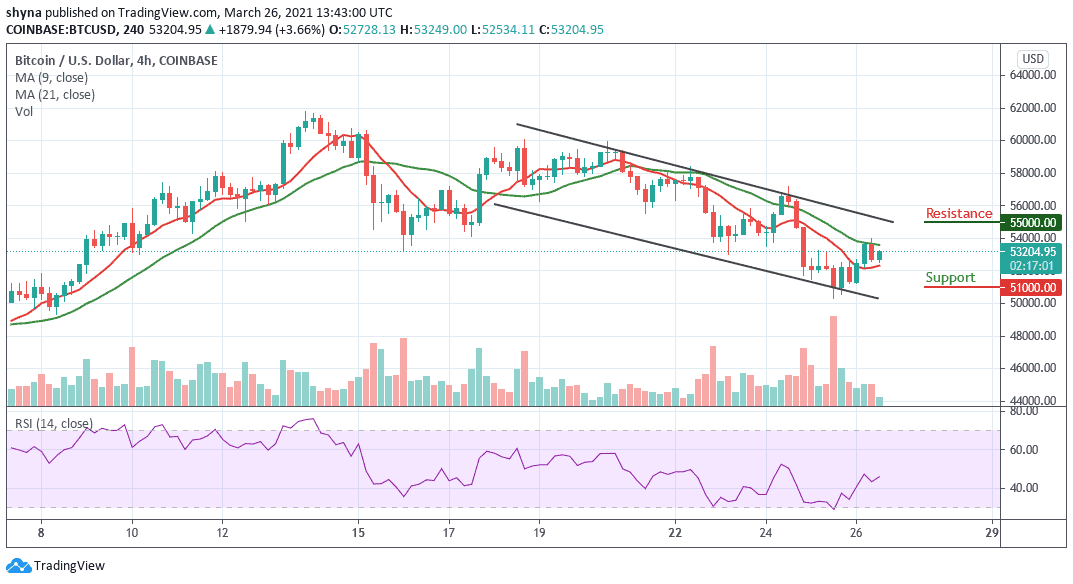
The Bitcoin (BTC) is seen recovering from the dip and it is likely to move above the resistance level of $55,000.
BTC/USD Long-term Trend: Bullish (Daily Chart)
Key levels:
Resistance Levels: $58,000, $60,000, $62,000
Support Levels: $48,000, $46,000, $44,000
BTCUSD – Daily Chart
BTC/USD bulls begin to come into the market as the price remains below the 9-day and 21-day moving averages. At the time of writing, Bitcoin is seen gaining 3.9% to trade at $53,327. Meanwhile, despite correcting lower since the past few days, traders will be excited to see the king coin finally surpass the $55,000 psychological level.
Would Bitcoin Go Up or Down?
In the past 24 hours, the number-one crypto has been fluctuating between $53,900 and $51,200 levels. Technically, looking at the two levels, they may determine the next direction that BTC/USD will follow. In other words, the Bitcoin price may decline if the $51,000 support is broken while the price may rise if the $53,000 resistance is breached.
However, bears may take advantage to break the support of $50,000 if the bulls fail to keep the price above the upper boundary of the channel. Meanwhile, the technical indicator RSI (14) is seen moving to cross above the 48-level, indicating that an uptrend may come to play in the market. Moreover, the resistance levels could be found at $58,000, $60,000, and $62,000 while the supports lie at $48,000, $46,000, and $44,000 respectively.
BTC/USD Medium – Term Trend: Bearish (4H Chart)
According to the 4-hour chart, Bitcoin’s price is currently trading around $53,204 and within the 9-day and 21-day moving averages. Meanwhile, the bullish supply is coming up slowly into the market as the bears are also trying to drag the price down. More so, in as much as the buyers can strengthen the market, the Bitcoin price can hit a resistance level of $54,000.
BTCUSD – 4 Hour Chart
Furthermore, breaking above the $54,000 level could allow bulls to test the potential resistance at $55,000 and above. Meanwhile, the technical indicator RSI (14) is currently above the 45-level, but any bearish movement may welcome the sellers back into the market which could drag the price below the 9-day moving average to reach the support level of $51,000 and below.
Fidelity Investments has applied to list a Bitcoin exchange-traded fund (ETF) that would track Bitcoin prices. This is according to the company’s preliminary filing made with the U.S. Securities and Exchange Commission.
Fidelity’s ‘Wise Origin Bitcoin Trust’
The ETF called the Wise Origin Bitcoin Trust emphasizes the money manager’s goal to bring cryptocurrencies to mainstream finance.
Wise Origin Bitcoin Trust will aim to match an index that takes spot prices from various bitcoin markets, including popular exchanges such as Coinbase and Bitstamp.
Fidelity also disclosed in the Securities filing that Fidelity Digital Assets would serve as the fund’s custodian, storing Wise Origin’s holdings.
“The digital assets ecosystem has grown significantly in recent years, creating an even more robust marketplace for investors and accelerating demand among institutions. An increasingly wide range of investors seeking access to bitcoin has underscored the need for a more diversified set of products offering exposure to digital assets,” the company stated.
Fidelity has been quite active in the cryptocurrency space for a while. The firm started by experimenting with mining digital coins and using the blockchain to execute trades.
In September, Fidelity started offering a private bitcoin investment fund to certain qualified investors.
Bitcoin’s Amazing Start To 2021
Fidelity’s filing for an ETF comes at a time where Bitcoin reached an all-time high. The digital asset had reached nearly $62,000 this month due to the persistent investments from huge U.S investors.
Bitcoin had also soared eight-fold in the last year, sparking wider interest in digital assets from investors seeking yield in a world of ultra-low interest rates.
Big companies and financial firms like Microstrategy, Tesla Inc, and Bank of New York Mellon Corp have embraced the emerging asset by purchasing millions of Bitcoin a part of their treasury management. This has sparked predictions that Bitcoin and other cryptocurrencies will become a regular part of investment portfolios.
In the past, the SEC repeatedly rejected applications for bitcoin ETFs. This blocked investors from gaining exposure to crypto through ETFs.
In 2018 alone, the SEC rejected applications for nine separate bitcoin ETFs although money managers, like VanEck Associates, have continued to press forward with additional filings.
Earlier this year, VanEck filed for the ETF with Cboe BZX Exchange. The SEC acknowledged the application and has formally kicked off its 45-day window this month.
Bitcoin (BTC) has once again reclaimed $9,000 with 5 days until halving.
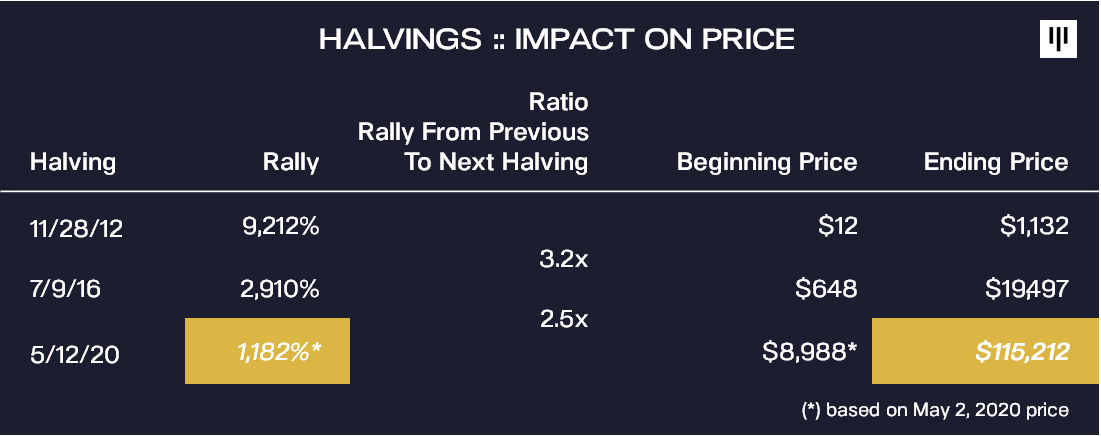
Pantera Capital’s CEO, Dan Morehead, sees a scenario where BTC hits $115,212 by August 2021.
His analysis is based on the change in the stock-to-flow ratio across each halving.
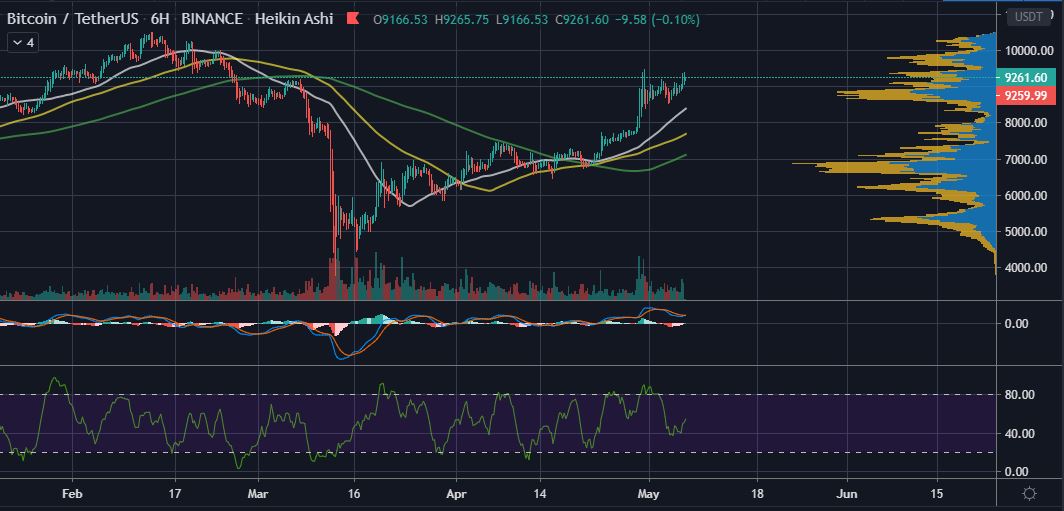
The hype and excitement surrounding the Bitcoin halving event is once again evident in the current price of BTC. At the time of writing this, Bitcoin has just broken both the $9,000 and $9,100 resistance levels and is trading at $9,261 with 5 days until halving. A brief analysis of the BTC/USDT 6-hour chart reveals that there is renewed buying interest as we draw closer to the estimated halving date of May 12th.
6-Hour BTC/USDT chart courtesy of Tradingview.com
Pantera Capital CEO Predicts Bitcoin (BTC) Could Hit $115k After Halving
With the Bitcoin halving only days away, Pantera Capital CEO, Dan Morehead, has predicted that BTC could hit $115,212 by August of 2021. His analysis is based on the change in the stock-to-flow ratio across each halving. Mr. Morehead made this predication via twitter and further elaborated on his analysis via an informative Medium blog post. His tweet can be found below.
#bitcoin could hit $115,212 in Aug 2021 based on the change in the stock-to-flow ratio across each halving.
More details here: https://t.co/fMYDXAT5qy pic.twitter.com/02uCpVoGKN
— Dan Morehead (@dan_pantera) May 5, 2020
Further highlighting key points from his Medium post, Mr. Morehead explained how a reduction in supply of BTC after each halving, will impact the price of Bitcoin.
One potential framework for analyzing the impact of halvings is to study the change in the stock-to-flow ratio across each halving. The first halving reduced the supply by 15% of the total outstanding bitcoins. That’s a huge impact on supply and it had a huge impact on price.
Each subsequent halving’s impact on price will likely taper off in importance as the ratio of reduction in supply from previous halvings to the next decreases.
Furthermore, his analysis went on to elaborate on the impact each halving has had on the price of Bitcoin.
The second having decreased supply only one-third as much as the first. Very interestingly, it had exactly one-third the price impact.
Extrapolating this relationship to 2020:
The reduction in supply is only 40% as great as in 2016. If this relationship holds, that would imply about 40% as much price impulse — bitcoin would peak at $115,212 /BTC.
Image courtesy of Pantera Capital on Medium.com
What is Stock-to-Flow Ratio?
The Stock-to-flow ratio is a measure traditionally used to gauge the abundance of commodities. It is calculated by dividing the amount of a commodity held in inventories, by the amount being produced annually.
In the case of Bitcoin, it is calculated by dividing the currently known supply of Bitcoin by the BTC mined annually. At the time of writing this, there is approximately 18.365 Bitcoin already mined with an annual production of 657,000 BTC per year. This results in a Stock-to-flow ratio of 27.9.
(Feature image courtesy of Unsplash.)
Disclaimer: This article is not meant to give financial advice. Any additional opinion herein is purely the author’s and does not represent the opinion of Ethereum World News or any of its other writers. Please carry out your own research before investing in any of the numerous cryptocurrencies available. Thank you.
Have you ever heard about Facebook and Instagram price algorithms? Well, most influencers on these social media channels will mention it, and it may confuse you. We’re here to clarify because moving forward. It will mean a lot as we discuss hedge funds and crypto prices. Social media algorithms are a distinct method of sifting and sorting a user’s timeline to include only the relevant posts and exclude those who mean less to them. Way before this was possible, social media used to give priority to the publishing time on a post, and less relevant posts were those already published. For Facebook and Twitter, this is still an option.
For our case, advanced algorithms are examining social media for hints as to why bitcoin crypto prices have stubbornly risen above the ranks in 2019. These algorithms have also been useful to foresee future crypto prices change.
Crypto prices
Social Media to Predict Cryptocurrency Values
Reuters has published a report that indicates how hedge fund managers and crypto prices administrators are using the crypto compare algorithms to extract data from social media. These companies have resolved to create computer algorithms that use social media blueprints to predict the most valuable coins within the market and their crypto prices. More than that, they can accurately predict crypto prices with super consistency. Advances in this type of endeavor have given these companies a price advantage over the older predictive sites.
Only because algorithms predict crypto prices by scanning the most inhabited social media sites, these include; Facebook, Reddit, Pinterest, and WeChat. They are full of investors seeking opinions and clicking on links to hedge funds to predict crypto prices. This is not in any way a simple task and is a high-budget venture that eventually pays off in significant digits. Therefore, the market has only the most prominent players who can implement such a profitable crypto price- program. These trends in prices are hardly ever easy to manipulate and predict due to the internet’s massive traffic. In the end, however, even programmers leave the endearing task to the digital computers for analysis and better crypto prices as well as productivity.
Cryptocurrency values
Sentiment Analysis
The programmers have enabled a feature termed the “sentiment analysis.” This involves computers sifting through social media messages to determine the investor price-mood when it comes to investing in cryptocurrency assets. They also evaluate how people view ethereum vs. bitcoin crypto prices and the ethereum current prices. It also rationally analyses the abundant retail crypto investors who predict market movements differently than other organizations.
These companies believe that people’s behavior can accurately define how they make their investments and view specific crypto prices. Social media users have only a fraction of the information on crypto prices, and they cannot know the most valued coins. Crypto prices are also constantly changing, and most of the data is unreliable, especially the economic indicators and financial records and statements.
Fake News
Every significant technological advance has its hurdles and needless to say. Sentiment analysis has run into some of its own. As they sift through the traffic and the data, they have run into what is now commonly termed fake news. These are inaccurate statements that are biased towards unreliable data, which is not very essential for investors. The algorithm creators are always pursuing accurate data and filtering out unusable data, especially on crypto prices.
This is a great challenge, but the algorithm of crypto prices works efficiently all the same. It gathers all the information from the sites and tries to decipher the people who are trading and what sites are they using for transactions. Furthermore, they evaluate the liquidation value of the crypto prices and finally filters out the fake news and requires no deposit slots to access this information. Twitter is primarily filled with irrelevant data that may mislead investors towards ambitious crypto prices.
These great leaps have made the market quite pliable and risk-free for most investors. Social media sites have paved the way for accessing relevant information. But more than this, it provides a platform for crypto advertisements geared towards people with interests in investment.
Conclusion
Hedge funds seeking a new perspective on the evolving crypto price-market is not a new phenomenon. However, the increasing advancement of social media algorithms has paved the way for crypto investors. The only big problem is the social media traffic that is abundant in irrelevant news and crypto price predictions. All these data is the biggest challenge to new crypto prices analysis algorithms. All in all, these advances in computer algorithms will keep improving and becoming sophisticated. With this in mind, all the abundant fake news regarding crypto prices will be sifted out only to derive reliable information.
As an investor, be ready to evolve with the times you are in as it might make a difference between big profits by enjoying the most economical crypto prices and regrettable investments. Remember to use safe platforms for price investment, most preferably ones that use advanced social media algorithms.
Do you believe hedge funds and crypto prices have benefitted immensely from social media algorithms, and are this the right way to go? Leave a question or a comment.
The post Hedge Funds Are Using Social Media Algorithms to Crack Crypto Prices appeared first on Crypto Trading Reviews.
This guide looks at the different category of cryptocurrency market, focusing on the sixth category which represents gaming coins. This is the sixth part of the series that breaks down the crypto market into 12 major categories.
This article looks at the sixth category in the Top 100 of the cryptocurrency market, which features coins and tokens within the gaming and gambling community.
Sixth Market Category: Gaming Coins
The integration of blockchain technology in the lucrative gaming industry seems to be an interesting combination, which has the potential to redefine the possibilities for gamers and game developers. Blockchain-based games would enable the gaming community to connect, collaborate, compete, and negotiate directly and even unlock new revenue sources.
There are also other notable benefits for gaming-based coins that include:
Tradeable Assets:Similar to the value of rare gaming collectibles, in-house gaming items or assets can also represent a collectible that provides value to the owner. Assets in traditional games have little to no value outside of the game and there is no real ownership since all rights belong to the game creator. Blockchain-based games provides real ownership of gaming assets that has value outside of the game.
Monetization: New monetization models can be conceived for not only game developers, but also gamers themselves. This alignment of incentives would foster greater levels of participation from all stakeholders.
Transparency: Smart contracts are often utilized for blockchain-based games for various aspects, such as an exchange of gaming items or battles that occur in the game itself. These transactions are transparent in the blockchain and therefore, there is no way of cheating or rigging the game without being noticed.
Interoperability Across Games: Since the ownership of the assets belongs to the player (owner), they can be imported onto another game that uses the same standard. This interoperability will potentially create a more dynamic and inclusive gaming environment.
There are 4 coins in the Top 100 that are focused on the gaming industry, which are as follows:
Storm Token (STORM)
Formerly known as Bitmaker, Storm is a gamified freelance platform for the decentralized gig economy, allowing freelancers to earn native tokens (STORM) by completing promotional user engagement microtasks (or ‘gigs’). Companies, marketers and advertisers can create microtasks on Storm’s gamified platform for freelancers hoping to earn some rewards. Tasks can include watching short videos, testing new products and services, QA testing and Peer-to-peer freelancing work. Users will earn rewards in the form of ‘bolts’, which can then be converted into the native token or even Ether (ETH) or Bitcoin (BTC).
Since Bitmaker was released back in 2014, Storm has garnered an active database of over 350,000 monthly active users and more than a million in app downloads. Storm’s native tokens are built on the Ethereum platform while Ethereum smart contracts will be used to facilitate microtask transactions in the Storm Market.
(Read also: Coins, Tokens & Altcoins: What’s the Difference?)
Funfair (FUN)
Funfair is an online, gambling platform for casino operators to host trustless, provably-fair gambling through the use of smart contracts. Funfair’s solution solves the issue of high operating costs and lack of trusts prevalent in traditional online casinos. Funfair’s platform will feature a variety of gambling games such as Blackjack and Baccarat. Additionally, Funfair looks to license out its platformas a turnkey solution to online casinos or anyone who wants to set one up, allowing them to customize their own casino for their users.
A unique aspect of Funfair is the use of ‘Fate Channels’ to solve the scalability issue, which are basically in-house modifications of off-chain state channels. This allows transactions to be processed much quicker than the current speed capacity of existing public blockchain. Funfair can support 100 – 1,000 Transactions Per Second (TPS), far beyond the capacity of 15TPS afforded by Ethereum’s blockchain.
Electroneum (ETN)
Electroneum is a novel cryptocurrency that can be mined with a smartphone. Anyone with a smartphone can mine cryptocurrencies without having prior technical knowledge. All they need to do is allow the mobile mining app to run on the background and they will simultaneously earn Electroneum’s native tokens called ETN.
Electroneum is a fork of Monero (XMR) and retains some privacy features itself. The consensus algorithm used by Electroneum is Proof-of-Work (POW), with over half of the coin supply already pre-mined. It is important to note that Electroneum was suspected to have suffered from a 51% attack, after suspicious mining activity was reported in April 2018.
(See also: Guide to Market Capitalization: Everything You Need to Know About Market Cap)
Wax (WAX)
WAX – acronym for Worldwide Asset eXchange – is a decentralized marketplace for virtual gaming assets. WAX allows anyone to create virtual stores on its platform, focusing towards gaming assets. WAX is often referred as the ‘Amazon’ of digital gaming assets. WAX is created by developers from OPSkins, which is the global marketplace leader for virtual, gaming assets.
The consensus algorithm powering WAX is Delegated-Proof-of-Stakes (DPOS), which allows for greater transaction outputs as compared to traditional public blockchains. The WAX project is backed by a strong list of advisors, including billionaire Mike Novogratz.
Beneficial Resources To Get You Started
If you’re starting your journey into the complex world of cryptocurrencies, here’s a list of useful resources and guides that will get you on your way:
Trading & Exchange
Crypto Guide 101: Choosing The Best Cryptocurrency Exchange
Guide to Bittrex Exchange: How to Trade on Bittrex
Guide to Binance Exchange: How to Open Binance Account and What You Should Know
Guide to Etherdelta Exchange: How to Trade on Etherdelta
Guide To Cryptocurrency Trading Basics: Introduction to Crypto Technical Analysis
Cryptocurrency Trading: Understanding Cryptocurrency Trading Pairs & How it Works
Crypto Trading Guide: 4 Common Pitfalls Every Crypto Trader Will Experience
Wallets
Guide to Cryptocurrency Wallets: Why Do You Need Wallets?
Guide to Cryptocurrency Wallets: Opening a Bitcoin Wallet
Guide to Cryptocurrency Wallets: Opening a MyEtherWallet (MEW)
Read also: Crypto Trading Guide: 4 Common Pitfalls Every Crypto Trader Will Experience and Guide To Cryptocurrency Trading Basics: Do Charts & Technical Analysis Really Work?
Enroll in our Free Cryptocurrency Webinar now to learn everything you need to know about crypto investing.
Get our exclusive e-book which will guide you on the step-by-step process to get started with making money via Cryptocurrency investments!
You can also join our Facebook group at Master The Crypto: Advanced Cryptocurrency Knowledge to ask any questions regarding cryptos!
Aziz, Master the Crypto Founder
I’m Aziz, a seasoned cryptocurrency trader who’s really passionate about 2 things; #1) the awesome-revolutionary blockchain technology underlying crypto and #2) helping make bitcoin great ‘again’!
The post Category of Cryptocurrency Market: Gaming Coins appeared first on Master The Crypto.
We have already covered where to spend bitcoin, but now let’s review how accepting bitcoin payments work for merchants and learn the best ways to receive cryptocurrency payments for businesses and ecommerce.
How to Accept Crypto Payments for Merchants
Over the last four to five years, the global crypto community has witnessed a massive surge in the number of entrepreneurs operating within this ever-growing financial domain. In this article, we will seek to present a detailed guide of how independent business operators and merchants can start accepting Bitcoin (BTC) for their goods in a highly streamlined/straightforward manner. Some of the core topics that will be covered in this guide include:
Which wallet is ideal for facilitating mainstream business transactions.
How to process BTC-related tx’s in person as well as in digital fashion
Which physical platforms can merchants make use of to process point of sale interactions
Which services (physical or digital) can be used to convert Bitcoin into other digital or fiat currencies
How can merchants minimize their market volatility related losses
Top 14 Bitcoin Payment Gateways to Use for Businesses and Companies
Why should merchants choose BTC?
Before getting into the nitty-gritty of how merchants can accept BTC payments, it could be useful for our readers to understand the core benefits associated with the flagship cryptocurrency. To start off with, we can see that the most prominent advantage of using Bitcoin is that all of the currency’s native transactions are completely irreversible. To elaborate on this point, we can see that most traditional fiat payment processors either make use of banks or other intermediary platforms to facilitate their transactions. As a result of this, merchants often have to deal with the possibility of losses caused due to chargebacks and other similar scams. And while merchants affected by such issues can quite easily put in a request for a refund, the entire process can be quite arduous and time-consuming.
When talking about Bitcoin (BTC), there is no chance of a chargeback occurring since the asset makes use of a decentralized network — which leaves no room for bad actors asking for refunds (in relation to cases that are disputable). Not only that, owing to BTC’s unique operational framework, any accounts associated with the currency can never be frozen by a centralized governance agency (such as a bank, Paypal, lending institution, etc).
Other key advantages of Bitcoin include:
Low Tx Fees: While credit card operators and payment providers normally charge their clients’ heavy fee rates of around 3+% (along with conversion charges), BTC transactions can be processed for around $1, irrespective of the size of the payment.
Future Ready Technology: With each passing day, more and more people are starting to become aware of the financial potential that cryptocurrencies (such as BTC) truly possess. In this regard, many experts believe that merchants who start adopting alternative monetary technologies such as Bitcoin will be able to lure in more customers, especially as time goes on and the global finance sector moves to a totally digital mode of operation.
What to Look for When Choosing a BTC Wallet for Accepting Payments
In order for a merchant to start accepting Bitcoin (BTC) payments, he/she has to acquire a cryptocurrency wallet. In this regard, it should be pointed out that one of the safest wallet solutions out there is Bitcoin Core since it is totally self-sufficient and does not require its owner to be dependent on any third-party servers, however, it does bear mentioning that the wallet can take a long time (sometimes weeks to months) to become fully operational since it requires users to download the entire history of the Bitcoin blockchain.
In this regard, it can be easier for users to employ a wallet option that is considerably lighter in terms of its overall resource consumption — such as the ‘Blockchain Wallet’, a storage solution that is extremely CPU-friendly and can be set up within a matter of minutes. With that being said, the wallet does depend on certain third-party entities and is thus more prone to external intrusions as well as third party hacks that Bitcoin Core.
One of the key advantages of the Blockchain Wallet is that as soon as a BTC tx is received on it, it becomes available to the user for spending. This is in stark contrast to Bitcoin Core and other soft wallets that require a number of confirmations before the crypto assets in question become usable. For example, Bitcoin Core needs a minimum of one confirmation in order for a transaction to be confirmed — a process that can take anywhere from 10 – 60 minutes, depending upon the total congestion being experienced by the network. Additionally, soft wallets (such as the one on Coinbase) require three confirmations that could sometimes force customers to wait for an entire day. This would not only make retail customers wary of this technology but also render Bitcoin quite useless for everyday transactions.
Last but not least, it is of utmost importance that a merchant analyzes the BTC payment received from a customer before handing over the purchased goods so as to make sure that the required transaction fee has been used. This is because if a high-enough tx fee is not employed, the payment can sometimes take days to come through. Not only that, if the fee amount is set to zero, there is a chance that the payment may fail to even come through.
The Easiest Way to Receive Bitcoin Online
In order for merchants to accept BTC, they need to access their wallets and go to the send/receive section. For example, if a merchant wishes to accept a payment, he/she needs to go to the “receive” tab and copy the given address so that it can then be supplied to the payee. It is of utmost importance that the merchant makes sure that the address is copied carefully since even a small error (i.e. one wrong letter or number) could result in the payment being sent to a completely different wallet and the money being lost forever.
Other points worth highlighting:
Online merchants should ideally send their BTC wallet addresses to their clients via email, text message, or IM. Additionally, they can also print their addresses on their official invoices and simply make use of the same document over and over again for all future financial transactions.
In addition to accepting their BTC payments manually, merchants can also digitize their payments by making use of plug-ins that are designed for platforms such as WordPress and OpenCart.
How to Receive BTC from a Physical Location?
For retail store operators to receive a BTC payment, the standard process of copying a wallet address and sending it over to the customer can be quite arduous and inefficient. Thus, to make the process more streamlined, it can be much easier for merchants to make use of a QR code (that is linked to his native crypto wallet) to process the incoming payment. In its most basic sense, a QR code is a black square block that contains all of the required data associated with various digital and physical storage entities. Not only that, the use of such a code completely eliminates any chances of customers sending their funds to the wrong address.
In order for a merchant to make the process of receiving BTC payments highly simplified, he/she can simply display the QR code associated with their wallet on their checkout counter. This can allow customers to simply log in to their mobile wallet solutions and scan the displayed code. The process literally takes just a couple of seconds and can allow digital payments to be sent across in an almost instantaneous fashion. Additionally, some retailers even make use of a tablet computer that are meant solely for the purpose of accepting BTC payments. The tablet can make use of an app like Blockchain Merchant which automatically generates a custom QR code for a customer to scan and send through the required funds.
Lastly, if a retailer completely wants to eliminate any chances of theft, he/she can provide their clients with a QR code that is affiliated with an offline wallet (that is not even present inside the store where the tx is being processed.)
Determining an Exchange Rate
Another crucial element when it comes to accepting BTC payments is the use of a correct exchange rate — since the price of Bitcoin seems to vary from one cryptocurrency trading platform to another. Thus, in order for merchants to remain consistent with their pricing, they should make use of a single exchange and employ its tx rate for facilitating the day’s payments. In this regard, it is best for a merchant to stick to an established exchange that is most suited to the country’s specific fiat. For example, Bitfinex, Coinbase, Kraken can be used for USD.
On a more technical note, we can see that in order for merchants to calculate the exact amount they are due in terms of BTC, they can simply divide the product’s sale price with the value of BTC at that given point of time.
Manual calculations can also be carried out by merchants to determine how much Bitcoin (BTC) the payee needs to send through for his/her specific order.
Today, there are a whole host of Bitcoin-based ecommerce plug-ins that can be used to automate the conversion process with the touch of a button. It is important to do this as a time-sensitive transaction due to volatility that does exist.
Services that Allow Merchants to Convert their BTC to Fiat
As most of our readers are probably well aware of, one of the biggest problems when it comes to accepting BTC is the element of market volatility — i.e. the price of Bitcoin can change quite substantially between the time it is obtained by the seller and when it is sold for fiat. In this regard, it is worth mentioning that there currently exist a number of services that protect merchants from market losses (since they allow for near instant Bitcoin to fiat conversions to take place).
One of the prominent examples of such a service is Bitpay, a platform that allows users to instantly exchange their BTC to fiat — with the converted funds being transferred to the merchants linked bank account within a matter of minutes. Additionally, BitPay also provides its users with a guarantee that they will only be charged a total tx fee of 1% fee — an amount that is substantially lower than what most Bitcoin ATMs charge to convert a users BTC holdings to fiat.
Other facets of BitPay worth noting:
The platform comes with a full fledged BTC payment system that requires merchants to simply download the BitPay app on their PoS device. The app not only sets up a wallet for the retailer but it also serves as a one stop shop for the user to start accepting BTC in a completely hassle free manner.
The only conceivable downside to using BitPay is the fact that it is a centralized platform and is linked to various banking institutions. As a result of this, merchants could have their monetary inflow blocked by a bank for no reason at all.
Another easy way of accepting bitcoin payments is through the use of the widely employed ‘Blockchain Wallet’ (a storage solution that does not require users to complete certain ID checks and is completely decentralized). Similarly, biz owners can also choose to install a BTC ATM directly in their store, a move that will not only help in seamless crypto-fiat conversions but will also attract more businesses to this lucrative financial instrument.
Lastly, a merchant can also send his/her BTC to an exchange and then convert it for the fiat currency of his/her choice. This process is quite simple but can be quite time consuming and costly (because of the higher tx fees involved). Not only that, owing to the time lag that exists between transferring one’s BTC to a crypto exchange and then withdrawing it, the flagship cryptocurrency may end up losing some of its intrinsic monetary value.
Merchants Can Choose to HODL
Many merchants these days choose to forego converting their Bitcoin (BTC) to fiat so as to hold on to their crypto assets. This is because many business owners have started to realize the true financial potential of Bitcoin and its expected future value. Similarly, some retailers want to own BTC so that they can spend it later for their personal use. With that being said, if a merchant does decide to hold on to their BTC in the long-term, he/she must make sure that their holdings are kept safe in a hardware wallet that can be maintained offline. Many may choose to do this given the bullish bitcoin price predictions that exist in the community as a whole, but it will come down to making sure everything matches up on your balance sheet and can cover your day to day expenses.
Not only that, merchants should always maintain a copy of their private keys or the seed for their Bitcoin (BTC) wallet, so that if in the future any problem arises, their funds can be recovered with the touch of a button. However, these seed keys should never be stored on one’s computer device, since it is relatively easy for hackers to obtain access to a person’s PC, laptop or tablet.
Top Bitcoin Payment Gateways
Crypto payment gateways are payment networks that are not limited by borders of any kind. As such, they allow quick and easy transfers of money in the form of digital currencies, which is extremely useful to merchants and others who wish to make near-instant transactions around the world.
Those payment gateways that allow the use of Bitcoin are, therefore, known as Bitcoin payment gateways. They often also accept a number of altcoins, such as Ethereum, XRP, Bitcoin Cash, Litecoin, and others. Another thing that payment gateways allow is the conversion of BTC into other cryptocurrencies, or even traditional currencies, such as USD or EUR.
This is a feature that had seen a lot of use in the last year, as the crypto market entered a so-called crypto winter — period when prices were on a constant decline. Those who earned cryptocurrencies in one way or another needed a way to cash out quickly before their payments reduced due to the drop in price.
Luckily, payment gateways allow immediate conversions, and the increase in demand has inspired the creation of numerous platforms that have since started working as payment gateways. They feature numerous tools for many different purposes, including the automatic transfers of coins, monitoring the market, and more.
Why do merchants choose to accept Bitcoin?
The number of crypto users continues to grow, despite the low prices. Numerous countries around the world already recognized this growth, and they are in the process of creating cryptocurrency-related regulations that would protect investors and reduce the potential for scams, theft, and other similar crimes.
With all the attention going toward cryptos, there are numerous benefits that merchants can enjoy if they choose to start working with them. For example, crypto transactions allow users full control, which makes it safer for merchants and customers alike to use crypto. Next, accepting cryptos as a payment option might allow merchants to expand their reach and include more customers. The payment methods are discreet, while all payment information is stored on the blockchain.
The security is much greater, as there are no risks of fraud, while merchants and customers alike can keep their private data confidential. In addition, transaction fees are much lower when compared to traditional payment methods.
Further, the expansion of cryptocurrencies means that they can be extremely useful for international trips. This also means that cross-border payments are instant and that they require no third parties, and suffer no payment delays. There are other benefits as well, but rather than listing them, we will discuss some of the top crypto payment gateways that accept Bitcoin, and that can be used for enjoying all of the benefits mentioned earlier.
1) Coinbase
Coinbase is the largest and most popular crypto exchange in the US, and also one of the largest ones around the world. By simply downloading the merchant app, business owners can start accepting Bitcoin and a handful of other coins. Furthermore, one of the greatest benefits is that it is possible to instantly convert Bitcoin into fiat, and vice versa.
Coinbase has a number of other features as well, such as great speeds and no transaction fees when it comes to accepting coins; integration with numerous services (Shopify, OpenCart, WooCommerce, etc.), it adds a payment button to merchant’s website, and it is integrated with API.
2) CoinsBank
CoinsBank is also a very popular service which can easily be synced with a debit card. It also offers a mobile app that is available for iOS and Android devices. Apart from that, it allows instant withdrawals and deposits, and it features greater security due to two-factor authentication. It works with most major fiat currencies, such as the USD, GBP, EUR, or Russian Ruble. Both the service and the support system are available at all times. The exchange also does everything in its power to provide minimal risks and maximum profits.
3) BitPay
BitPay is another US-based service, and one of the oldest Bitcoin payment gateways in the world. It has been around since 2011, and using it is easy. All that users need to do is download the exchange’s app, and they will be ready to start accepting payments in crypto. It also offers its own Bitcoin Debit Card for easy transactions and crypto-to-fiat conversion.
It also features open-source plugins for eCommerce platforms, and it even allows Bitcoin donations. It should be noted, however, that all payments transactions can be made wth Bitcoin. BitPay also uses PoS mechanism, it is accepted around the world, and it allows bank deposits in around 38 different countries, while it supports 40 different languages.
Its interface is simple and user-friendly, while it also features two-factor authentication for greater security. The speed of transfers can also be manually set, in accordance with users’ needs. Finally, it is compatible with all Bitcoin Cash (BCH) wallets.
4) CoinGate
Next, we have CoinGate, which allows the use of Bitcoin and altcoins, while it accepts payments in multiple currencies, including BTC itself, as well as EUR and USD. It also uses POS applications for different platforms, including iOS, Android, and web browsers. It also comes with plugins for eCommerce platforms, and it supports numerous digital currencies.
5) Blockchain
Blockchain is also among the oldest payment gateways for Bitcoin, similarly to BitPay. It is a great payment gateway for personal use, as well as for businesses. It supports only three cryptocurrencies, however, which include Bitcoin, Ethereum, and Bitcoin Cash. It is also a well-known (free) crypto wallet, but it goes beyond that, as it serves as a repository of information, developments, and statistics.
Next, it provides Bitcoin payment APIs, although the implementation process is more complex than those of previous entries. As such, it requires a bit of technical know-how, but it is easy to use it as a mobile app for Android.
6) BTCPay Server
BTCPay Server is an open-source, self-hosted, free Bitcoin payment gateway which also supports multiple altcoins. It allows merchants and regular users to accept payments into their wallets directly, with no additional fees or transaction cost. This is seen by many as the service’s biggest advantage.
It also features great speeds due to the lightning network, and it offers greater security and privacy. Sending payments is easy thanks to the BTCPay button.
7) Blockonomics
Blockonomics is another very popular and useful crypto gateway which is permissionless, and it requires no authentication from third parties. It also does not need additional API integration in order o work. Making payments is easy, and all that potential customers need to do is scan the QR code. This makes it extremely secure, with increased anonymity for everyone involved. It also supports several cryptocurrencies, many of which are from Bitcoin’s ecosystem, as well as some of the most well-known and used wallets, like Ledger Nano S, Trezor, and alike.
8) SpicePay
SpicePay is also a great choice, as it allows accepting and exchanging coins quickly and easily, in addition to providing a secure wallet for storing them. It has a number of features, such as increased security and convenience, support for numerous fiat currencies, like USD, GBP, EUR, and CAD. It also allows withdrawals to SEPA or PayPal, and it features e-commerce and retail plugins. Finally, it allows users to save around 2% on every transaction, while its BitGo feature allows the use of its app on the desktop and mobile systems alike.
9) CoinPayments
Next, there is CoinPayments, which is specially designed for online merchants. It supports over 1200 different cryptocurrencies, including BTC, XRP, BCH, and LTC. Furthermore, the merchants are charged 0.5% per transaction.
It offers plugins for all of the most popular webcarts out there, and it makes the payments faster by supporting GAP600 Instant Confirmations. It also rewards users through the coin and token airdrops, and it can converge coins automatically.
10) SpectroCoin
SpectroCoin is yet another free wallet that can allow users to exchange their funds instantly. It works with over 30 cryptos, and it has quite high withdrawal and deposit limits. It also features e-commerce plugins, a Bitcoin debit card, and a SpectroCoin API, which allows purchase or sale of numerous coins.
11) GoUrl.io
This is a completely free Bitcoin wallet which is also open-source. It is also among the most trusted wallets on a global level due to its e-commerce plugins and API interface. It allows users to sell much more than coins, however, including videos, music, images, URLs, and even text, all in exchange for cryptocurrencies.
It does not require a bank account authentication or an ID, which increases the users’ privacy. Users can easily sell any product and get Bitcoin or some other cryptocurrency in exchange. It also offers an Affiliate Program which also allows participants to earn more.
12) Shopify Gateway
Shopify is a great e-commerce payment gateway, with a massive user base. Its transaction fees are extremely low, while all transactions are secure and fast. Payments can be received at any time or place, while its POS apps allow users to use the wallet on multiple devices. It also does not require PCI compliance.
13) ALFAcoins
Approaching the end of the list, we have ALFAcoins, which is also among the most trusted Bitcoin payment gateways. It also supports some of the newest coins as well. It also has a unique feature, which is a BitSend payout system. The system makes payments easy and quick, which is perfect for paying salaries or bonuses in crypto. The platform works with a number of top coins, including Bitcoin, Bitcoin Cash, XRP, Ethereum, Litecoin, and DASH.
It also has loyalty programs, financial services, and digital gaming, all of which allow users to earn additional funds. Payments are easy to make, and funds are transferred rather quickly. Furthermore, the service is available around the world, even in countries such as North Korea or Iran.
14) BitcoinPay
Finally, there is Bitcoin pay, which is one of the simplest, and likely the most popular ways to accept crypto payments into a wallet or a bank account. It features zero fees, and it is easy to use. Its customer support is also available at all times, while the service can be used on iOS and Android as well. Users can request payments via email, and make them instantly.
Furthermore, it supports e-commerce plugins from over 196 countries around the world, and it works with other platforms such as Magento, PrestaShop, OpenCart, WooCommerce, and more.
Conclusion
In rounding off this piece, it should be made absolutely clear that the most decentralized way for accepting BTC payments is for merchants to make use of a wallet that does not require any confirmations. Additionally, merchants should ensure that their online payment system has no leaks/failure points and has all of its required security protocols in place.
In case a merchant is making use of Bitpay or some other similar service, he should make sure that he does not get involved in any illegal activities, since he risks losing all of his payments.
We hope this guide has been helpful to you and can, in some way, assist you in setting up a business that is fully capable of accepting Bitcoin payments (both in their digital or physical form).
Aziz, Master the Crypto Founder
I’m Aziz, a seasoned cryptocurrency trader who’s really passionate about 2 things; #1) the awesome-revolutionary blockchain technology underlying crypto and #2) helping make bitcoin great ‘again’!
The post Accept Bitcoin Payments: Top 14 Merchant Gateways To Use appeared first on Master The Crypto.
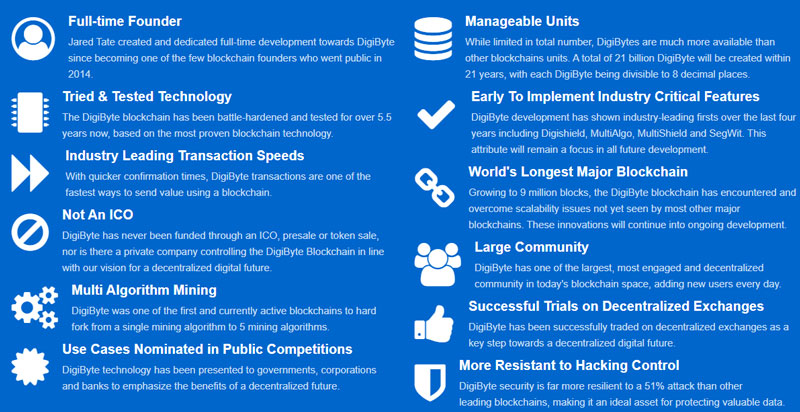
Digibyte decentralized cryptocurrency specializes in digital asset-based blockchain technology security with high transactional volume throughput via its $DGB token.
Jared Tate, creator of Digibyte blockchain, author of Blockchain 2035 (first book written by a blockchain founder), is the leader of the community-driven developer-friendly project that is a fork of the bitcoin source code, not the BTC blockchain itself, that specializes in security of distributed digital assets.
Similar to Satoshi’s roll out of the Bitcoin protocol software on January 3rd, 2009 with a message from the newspaper, inventor Jared Tate also did the same with Digibyte five years and one week later on January 10th, 2014 with a message from USA Today’s 1/10/2014 reading “Target: Data stolen from up to 110M customers.” Also like Bitcoin, there was no pre-mine or ICO launch and this message was on the very first block of the $DBG blockchain.
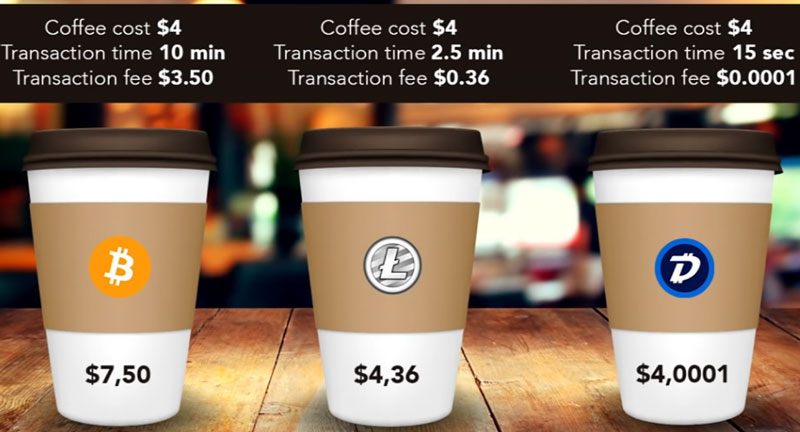
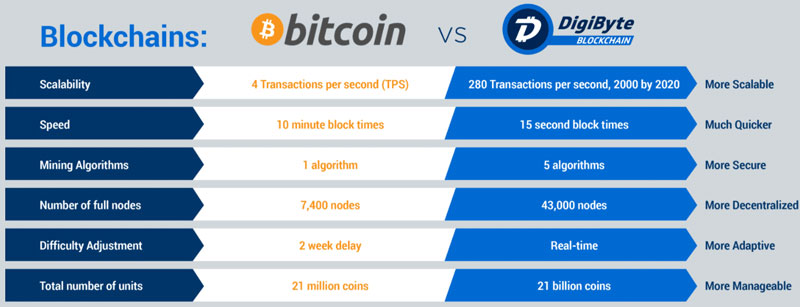
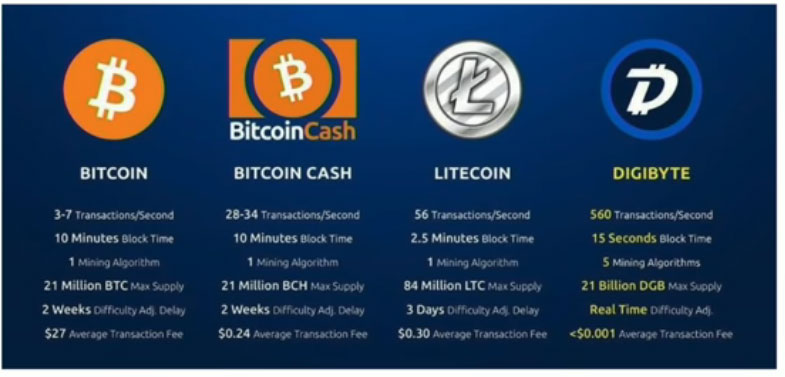
The DigiByte Blockchain technology has quite a bit of variations made from the original Bitcoin source code and whitepaper. We will cover these below like the 21 billion coins issued in 21 years (1% monthly gradual decrease vs the major 4 year), or being 40x faster than Bitcoin with 15-second block times (vs 10 minutes) and doing 560 transactions per second versus only 7 for BTC.
Name: Digibyte
Symbol: $DGB
Date Launch: January 10, 2014
Official Website: digibyte.io
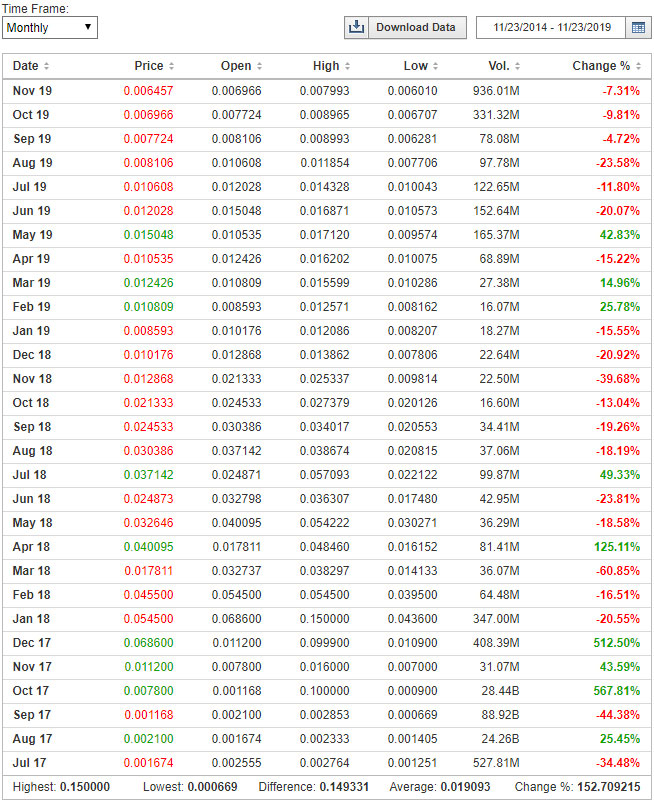
All-Time High Price: $0.128895 DBG/USD exchange rate value on January 6, 2018
Creator: Jared Tate (Josiah Spackman Ambassador and Foundation Member)
Core Team: Gary Mckee, Noah Seidman, GTO90, Yoshi Jager, ploenne, Rudy Bouwman
Whitepaper: No [“we want to be doers. Not white paper pumpers, to under-promise and over-deliver.”]
Features: First altcoin cryptocurrency to adopt SegWit, real-time difficulty adjustment
Functions: Digibyte blockchain has three layers; a core protocol layer, digit asset layer and apps layer
Extras: Block Explorer, BitcoinTalk Forum
Events: DigiByte Global Summit (April 19th, 2019) https://digibytesummit.io/
Social Media Profiles: Twitter, Telegram, Reddit, GitHub
Book: Blockchain 2035: The Digital DNA of Internet 3.0
PR Services: Cassiopeia Services
Support Contact: official website contact form
Let’s review the Digibyte cryptocurrency coin and blockchain technology to see how this unique decentralized communications system works as well as how the promising DigiAssets layer works to help bring issuance of digital assets, tokens, digital identity, smart contracts and more to life.
Digibyte Review: How DGB Coin Works
What is DigiByte?
The DigiByte Blockchain – DigiByte DGB
The Development of DigiByte
The Rest of the Team
The Technology of DigiByte
The 5 Mining Algorithms
Price History: DigiByte’s Spike’s and Crashes
DigiByte’s Future
Reasons to Invest in DigiByte
Purchasing and Storing DigiByte
Purchasing DigiByte
Storing DigiByte
How to Get a DigiByte Wallet
Summary
The cryptocurrency industry kicked off with the launch of Bitcoin over a decade ago, and Bitcoin managed to rule the blockchain until new digital assets called “altcoins” came out. These altcoins have often followed the trajectory of Bitcoin through the years, but there are many assets that have managed to hang in the top assets by market cap as they’ve proven their worth.
What is DigiByte?
Before diving entirely into everything that DigiByte can do, the most important piece of the puzzle is to understand exactly what it is. DigiByte was one of the first altcoins in the entire world, created in 2014. However, it was mostly on its own that year, launching an initial token sale and didn’t have much publicity at the time.
DigiByte has collected many supporters through the last few years, and advocates of the token state that it is more scalable and secure than other cryptocurrencies on the market. Those same supporters believe that it is a solid contender against Bitcoin, Litecoin, and other top options in the market, and already has about 100,000 nodes around the world. However, much like Bitcoin, DigiByte is created with a maximum supply of 21 billion DGB. With this limit, no more DGB can ever be created. The digital asset cryptocurrency DGB has a 1,000:1 ratio to BTC and will be mined in 21 years (2014-2035).
Despite the popularity amongst its users, the adoption of the token has been rather slow, and it is still considered to be obscure, in comparison with the competitors of the token. With the long-time performance of DigiByte, it should come as no surprise that it has also established its own blockchain – DigiByte DGB.
The DigiByte Blockchain – DigiByte DGB
Launching with the DigiByte crypto asset was the blockchain, making it the longest-running blockchain in the entire world. There are many features that it possesses that makes it potentially faster than others, but that year had only a few other public blockchain projects even introduced at the time. The blockchain has an active community, though it may never reach the popularity that Bitcoin did.
Reviews of DigiByte state that the blockchain actually processes at a much faster speed than Bitcoin, and that speed has been rising. Based on projections from the company, the blockchain should be able to handle 2,000 transactions per second by 2020.
The Development of DigiByte
DigiByte was created by a man named Jared Tate in 2013, who launched the genesis block of the cryptocurrency in January 2014. Once the launch commenced, Tate decided to dedicate all of his time to the development of the project, funding the project with donations from the DigiByte foundation. Statements from CoinCentral.com state that it is possible that the team involved with the token hold a lot of DGB themselves, due to the mining processes required for the asset.
Rudy Bouwman is the secretary and vice chairman of the DigiByte Foundation, though he was only appointed to that position in November 2019, according to his LinkedIn profile. Before then, he was the CMO and co-founder of the DigiByte Awareness Team.
The Rest of the Team
While the official website for DigiByte doesn’t state who the team is, but LinkedIn shows a few developers that state that they are involved with the project. Along with Tate and Bouwman, the team seems to be made up of:
Mohamed Rashad, a miner since January 2017
Glenn Grider, a core member in exchange liaison and research since April 2016
Nana Esi Hammah, an economist and outreach associate since May 2018
Michelle Dougherty, a member of the DigiByte Blockchain Awareness since March 2019
Suhas Hegde, a blockchain architect since February 2016
Additional employees are listed on DigiByte for a total of less than 30 people, though their names are presently unavailable.
The Technology of DigiByte
The website for DigiByte is filled with plenty of marketing information, but details on the technical side is a little difficult. The asset is considered to be a UTXO-based cryptocurrency, which means that every new transaction includes a specific identifier on every coin. Anytime a coin enters a user’s wallet, it is categorized as “unspent,” and sending that coin to another person makes it “spent,” inherently stopping the digital currency from being overspent and solving other security issues.
DigiByte’s token is mined in the same was as Bitcoin – with a Proof-of-Work mining algorithm. However, unlike Bitcoin, the platform uses five different mining algorithms – Qubit, Skein, Groestl, Scrypt, and SHA256.
There are three layers associated with the software infrastructure of the DigiByte cryptocurrency. Those three layers include:
Core communications and global network
A public ledger and digital assets
Applications
The 5 Mining Algorithms
By taking on five mining algorithms, the company creates a better opportunity for mining decentralization than what other ASIC-friendly cryptocurrencies do. The SHA256 algorithm is used by Bitcoin, while the Scrypt algorithm is used by Litecoin and Dogecoin. Every 15 to 18 seconds, a new block is mined, using different algorithms, so each one of the five algorithms mine a block every 1.5 minutes.
DigiByte is responsible for introducing Segregated Witness technology, keeping the blockchain small and scalable with limited transaction sizes. Due to these small sizes and five-year track record, the blockchain in the project is the longest in existence, even surpassing Bitcoins’.
Every DigiByte enters circulation with the use of mining, though miners need to use their computing power to process these transactions, adding blocks to the network. A CPU, CPU, or ASIC is needed to do so, which will need specialized mining software and a DigiByte wallet. Consumers can either mine on their own or they can join a mining pool, which is created when multiple miners pool their resources together to share their processing powers. Members of a mining pool split the rewards of their effort equally. Many consumers end up choosing to mine in pools, since solo mining with low hash rates reduces the chance of solving a block.
The different mining algorithms are made to work with different mining hardware. SHA256 and Scrypt are predominantly used by ASIC miners. Skein and Groestl predominantly are used with GPUs instead. However, Qubit works on a combination of different types of hardware. Considering the high cost of specialized mining hardware, it could be less expensive to simply purchase DigiBytes directly, if the user doesn’t already own the computing hardware needed.
With the use of multiple algorithms, the DigiByte miners cannot take 51% control, which means that centralization cannot be achieved, and the network is secured against an attack.
Price History: DigiByte’s Spikes and Crashes
The price of DigiByte has been volatile in recent history, recording relatively constant activity through 2017 with minimal growth. However, there were multiple spikes and crashes through both 2017 and 2018.
The spike in June 2017 coincided with a possible announcement that was set to be released on Twitter. Investors acted quickly to get involved by purchasing DigiByte, which pumped up the price. While the company hinted at the upcoming announcement, the actual release of the announcement didn’t come until a few days later, which stated that the company was launching a new wallet with some new features. However, before the announcement even came out, the price had already dropped below the price of DigiByte before the hint even came out.
The next spike happened around the same time as Bitcoin’s surge, which took Bitcoin to nearly $20,000. From December 2017 to January 2018, the price rose, following a tweet from John McAfee, who said that DigiByte is a company that is worth keeping an eye on. The spike lasted through the start of 2018, but the correction of the cryptocurrency market at the end of January 2018 took down most crypto assets, including DigiByte.
Digibyte price history chart: month by month highs and lows for DGB coin the past two years
Apart from a brief period in Q3, there’s been no real fluctuation for the cryptocurrency in 2018. The rise in price at that time was around the same time that the company announced that their wallets would be available for iOS and Android. At that time, the Apple App Store also started making it possible to make payments in DigiByte.
Through 2019, the cryptocurrency has remained mostly steady with a few spikes – March 2019, April 2019, and between the end of May and beginning of July. However, since mid-June, the value of the cryptocurrency has continued to drop, falling from $0.016274 to $0.0065, as of November 24th, 2019.
DigiByte’s Future
With very little change in the last few years on the cryptocurrency, DigiByte seems to be getting more attention in the gaming industry. In another platform developed by the creators called DigiByte Gaming, gamers are offered the chance to gain DGB as a reward for taking time on the games included.
The CEO of DigiByte – Tate – has committed to pushing for greater focus on the DigiByte Foundation and public outreach. The adoption of DigiByte has been one of the more difficult challenges that the team has faced, though the continued progress of this asset relies on it. Though the token seems to have historically had a solid and loyal following, the token took a dive this year.
The fast transaction speed and scalability of DigiByte makes it ready for the long run in the cryptocurrency market. Predictions by CoinSwitch last year suggest that the total value of DGB will reach $9.20 by 2021.
Digibyte (DGB) History Timeline:
October 2013 = Work on DigiByte begins
January 10, 2014 = DigiByte official launch
February 28, 2014 = DigiShield Hardfork
September 1, 2014 = MultiAlgo Hardfork
December 10, 2014 = MultiShield Hardfork
December 4, 2015 = DigiSpeed Hardfork
April 28, 2017 = SegWit Activated
Sep 19, 2018 = DigiByte Core 6.16.5 Released
April, 2019 = DigiAssets Released
July, 21st 2019 = Odocrypt Hardfork
Digibyte Crypto Exchanges to Trade DGB on:
Bittrex
Cryptopia
HitBTC
Huobi
KuCoin
Litebit
Livecoin
OKEx
Poloniex
Shapeshift
Sistemkoin
Upbit
Yobit
Reasons to Invest in DigiByte
There are many reasons for consumers to invest in the DigiByte crypto asset, starting with the fact that it only takes about 15 seconds to process a transaction, unlike Bitcoin’s 10-minute wait. To add to the security offered by the platform, the creators of DigiByte implemented DigiShield and MultiShield, supporting the longest blockchain in the world.
Now, DigiByte is making the technology available to global payments systems, allowing merchants, consumers, and mainstream societies around the world. With DigiByte Gaming, the asset can even be used in gameplay, giving it long-term potential and the opportunity to expand upon its value. However, as Bitcoin and other cryptocurrencies thrive, they may create competition for DigiByte. There are these Digibyte (DGB) marketing pictures floating around on the internet comparing it to Bitcoin and Litecoin:
and
and
Still, despite the competition, DigiByte remains one of the top 100 cryptocurrencies by market cap, placed directly in the middle.
Purchasing and Storing DigiByte
Right now, DGB is accepted on multiple cryptocurrency markets, including Bittrex, Poloniex, Sistemkoin, HitBTC, Kucoin, Upbit, and YoBit, where it shows high trade volumes. There’s never been an initial coin offering, though the company held a private investment financing round on the project in December 2014 with undisclosed seed capital listed.
Purchasing DigiByte
To purchase DigiByte, consumers need to sign up on an exchange’s website, like Bittrex, Huobi, or Poloniex. However, Binance is another story. Over the last few years, it has become an unfortunate battle, though reports in late 2018 stated that the DigiByte didn’t even need to be listed with Binance. In March of 2019, Tate even stated that the Binance Coin is a “blood sucking token” and “a parosite.”
CoinSwitch advertises that they have a method for consumers to get the best price for their purchases. CoinSwitch is a cryptocurrency conversion platform. Consumers can also use it as a way to exchange other cryptocurrencies for DGB crypto.
Storing DigiByte
DigiByte offers a wallet that is compatible with all operating system, which makes it easy to use it from any compatible device. The wallet from DigiByte must be downloaded from the official website. However, there are also multiple third-party wallets that already support DGB, including Coinomi, Ledger, Trezor, Guarda, Exodus, Satowallet, and others.
How to Get a DigiByte (DGB) Digital Asset Wallet
In order to secure a DigiByte wallet, consumers must download it from their official website. Consumers will need to choose the wallet based on their operating system. Presently, the website has options for:
DigiByte Core Windows (32 and 64 bit)
DigiByte Core Mac OS X
DigiByte Core Linux (32 and 64 bit)
DigiByte Android
DigiByte iPhone & iOS
DigiByte Go Wallet (Chrome Extension)
After downloading the wallet, it will need to be installed on the device, where it can be opened. Consumers are advised to accept the defaults and that the time it takes to sync the wallet might be a little longer. For the best protection, back up the wallet as well.
The website also includes third-party wallets that consumers can download to store their DGB, including Trezor, Ledger, KeepKey, SafePal, Trezor, SecuX, Coinomi, Exodus, ABRA, Jaxx Liberty, OwnBit, EdgeWallet, Atomic, Trust, Satowallet. and Guarda. Consumers that want to see additional wallets can visit DigiByteWallets.com.
Who is Jared Tate?
As mentioned, Jared, a Texas-based computer programmer from Arco, Idaho, is the Digibyte creator and co-author of the Blockchain 2035 book.
Jared has been involved with Bitcoin since 2012, which in the fall of 2013 he found improvements to make in the Bitcoin source code and could not get his changes implemented so we went off and created DGB in 2014 after his bitcoin core protocol improvements were rejected and applied them in the new digital asset, DGB.
Here are a few videos of interviews he has done:
and
and
Summary
Every cryptocurrency is created with a different purpose as each creator interprets a current problem with a way to solve this problem. Digital currencies allow for the possibility of instant transactions and transfers that can cross borders and are even usable for services and physical goods. However, they can also be restricted to specific communities, like social networks and online games. At the end of the day, when there are thousands of crypto coins to choose from, the Digibyte blockchain and DGB cryptocurrency focuses on speed, scale and security and offers a passionate community that in today’s market seems greatly undervalued and will surely benefit from the next bull run more than most of its competitors. We would not be surprised to see $DGB and the Digibyte coin be a top 10-20 token given all of the innovation and advancements they have brought to the ecosystem.
Aziz, Master the Crypto Founder
I’m Aziz, a seasoned cryptocurrency trader who’s really passionate about 2 things; #1) the awesome-revolutionary blockchain technology underlying crypto and #2) helping make bitcoin great ‘again’!
The post Digibyte Cryptocurrency and Blockchain: DGB Coin Analysis appeared first on Master The Crypto.
In a recent tweet, the team at BitTorrent (BTT) has highlighted why the BTFS file system is better than Filecoin (FIL).
The teams behind both projects have been throwing jabs at each other ranging from accusations of plagiarism and going as far as claiming the other is ‘vaporware’.
Filecoin’s (FIL) Mainnet is set to be launched between mid-July and mid-August.
In a recent tweet, the team at BitTorrent (BTT) highlighted why its BTFS file system is better than Filecoin (FIL). The tweet showcased how the BTFS system has more to show than Filecoin that is yet to launch its mainnet after several postponements. The lack of Filecoin having a functional product is the focal point of the debate as to which is better. The full tweet by BitTorrent made 8 comparisons that can be found below.
Why #BTFS is better than #Filecoin? 1⃣ Integrated with $BTT economy 2⃣ #TRON network 3⃣ 100M user base 4⃣ Simple and intuitive Host UI 5⃣ Mainnet launched 6⃣ #BitTorrentSpeed、#DLive 7⃣ Active community 8⃣ Dedicated global professional teams#BTT @justinsuntron @OfficialDLive pic.twitter.com/eY3KSQVE5H
— BitTorrent Inc. (@BitTorrent) May 4, 2020
Previous Tweef Between Filecoin (FIL) and BitTorrent (BTT)
The recent tweet by BitTorrent is a follow up of a Tweef that transpired in mid-April between Justin Sun and Juan Benet of Filecoin (FIL). Benet was the first to point out that BTFS’ new logo looked like it had been plagiarized. His remarks alluded to the fact that Justin Sun and the Tron Foundation have been accused of borrowing ideas from other open-source projects.
Aaaaaahahaha it’s not enough to fork all our code, rebrand it and lie its theirs; copy paste random chunks of our papers, and defraud their investors with a nonsensical mishmash. Tron also can’t even think of an original logo.
Justin Sun was quick to respond to the accusations by asking if the hexagon shape on the new BTFS logo was owned by Benet. Sun went on to accuse Filecoin of copying BitTorrent’s technology. Additionally, he slammed the project as being ‘vaporware’ with no functional product.
Filecoin’s (FIL) Mainnet Launch in 2020
Both the Filecoin and Tron ICOs were carried out in September of 2017. However, Tron has a wide range of achievements under its belt more than Filecoin. As earlier mentioned, the key to the whole discussion is that Tron launched its mainnet in mid-2018 and Filecoin has yet to launch its final version of the platform. At the time of writing this, Filecoin has set its mainnet launch for mid-July to mid-August this year.
(Feature image courtesy of Hermes Rivera on Unsplash.)
Disclaimer: This article is not meant to give financial advice. Any additional opinion herein is purely the author’s and does not represent the opinion of Ethereum World News or any of its other writers. Please carry out your own research before investing in any of the numerous cryptocurrencies available. Thank you.
Unlike the stock markets, the cryptocurrency market never closes and never sleeps, which can be a highly stressful scenario for traders and even casual investors in the industry.
Users familiar with crypto investment will also be familiar with the (joyful or sinking) feeling of waking up in the morning to be greeted by a pleasant or unpleasant surprise when they check their portfolio and see large gains or losses.
As a result of the volatility of the market, trading bots have become increasingly popular among traders by allowing them to remain in control of their trading at all times, with the bot not sleeping even while the trader is. In addition, a correctly specified bot allows trades to be executed faster and more efficiently than the trader would be able to do manually.
The explosion of popularity in cryptocurrency has also resulted in a big increase in the number of crypto trading bots available, either for free from open-source platforms or licensed to users in exchange for flat fees.
However, it is difficult to ascertain which of them work as intended and which of them are an absolute waste of time. This post will consider the background to what exactly trading bots are and whether they work for Bitcoin & Crypto trading (and more importantly, for your Bitcoin trading).
We have rigorously tested each bot on this list, you can click through to each one to view our detailed reports and findings and this post is constantly updated with any new options that come on the market.
Top Trading Bots
If you are in a hurry, here’s our pick of the top 2 bot platforms on the market right now.
In this section we will take a look at some of the popular and publicly-available bots you can use. In most cases these bots will offer more than automated trading. Some of the platforms give clients advanced trading tools, as well as access to numerous crypto exchanges.
Cryptohopper
Cryptohopper is one of the most established players in the auto trading scene for several reasons. Firstly, they run entirely on the cloud, so no installation is required making 24/h trading possible. They also have an incredibly intuitive dashboard, and only require a 5 minute set up to start trading.
Next to this they are the only bot to embed external signalers, allowing new traders to subscribe to a growing list of professional analysts from around the world. Many use machine learning, intelligent algorithms and employ teams of mathematicians to target rising coins. Signals are sent directly to the users bots which buy and sell when they receive them.
Signaler dashboard where you can subscribe
The bot allows you to take advantage of bull markets with a trailing stop-loss, and has full technical analysis features from Stoch and RSI to Bollinger Bands and MACD.
Cryptohopper has a very nice modern dashboard area where you can configure and monitor everything and comes with a config wizard or pre-created templates for the popular exchanges – Binance, Bittrex, Poloniex, GDAX and Kraken.
Traders with more experience can incorporate their favorite technical indicators, triggers and use tools that are handy in bear markets, such as DCA & shorting features.
Unlike many other bots, Cryptohopper does not charge any trading fees, and is one of the few bots to offer a free trial for a month with the ability to upgrade to Bunny ($19 p/m), Hare ($49 p/m) and Kangaroo ($99 p/m).
We have completed an Indepth Review of Cryptohopper here.
Visit Cryptohopper
3Commas
3Commas is a popular trading bot which works with a number of exchanges including Bittrex, BitFinex, Binance, Bitstamp, KuCoin, Poloniex, GDAX, Cryptopia, Huobi and YOBIT. The bot works 24 / 7 with any device as it is a web-based service so you can monitor your trading dashboard on mobile as well as desktop and laptop computers.
It allows you to set stop-loss and take-profit targets and also has a social trading aspect which allows you to copy the actions of it’s most successful traders.
Another interesting feature is it’s ETF-Like crypto portfolio feature which allows you to Create, analyze and back-test a crypto portfolio and Choose from the best performing portfolios created by others.
We have completed an Indepth Review of 3commas here.
Visit 3Commas
Quadency
Quadency is a digital asset management platform that provides automated trading and portfolio management solutions for both retail and institutional traders.
Quadency Review
The platform incorporates a comprehensive range of features designed to streamline the process of trading and investing in cryptocurrencies. These include a variety of trading bots that come pre-configured or can be customized as desired, advanced charting, and portfolio analytics.
These features all combine to enhance the crypto trading experience, and Quadency supports automated trading on Binance, Bittrex, Coinbase Pro, Kucoin, Liquid, and OKEx.
Check out our full Quadency Review here.
Visit Quadency
Coinrule
Coinrule is one of the newest trading bot platforms on the market which has some great features and is suitable for beginners and more advanced traders alike. It supports the most popular exchanges like Binance, BitMEX, Coinbase Pro, and Kraken and can be accessed for free by using a Starter account.
Paid subscriptions range from $29.99 to $249.99 per month with the differing account tiers designed to cater to traders of differing experience and activity levels.
Anyone interested in using the platform can always sign up for a free Starter account and test it out in order to figure out if opting for a paid subscription will be beneficial.
You can check out our full review of Coinrule here.
Visit Coinrule
Exchange Valet
Unlike many of the other trading bots on this list, Exchange Valet is more of a trading toolset and crypto portfolio management platform. Most crypto exchanges don’t give traders a ton of tools to use. Exchange Valet is filling in the gaps with commonly used trading tools like simultaneous stop loss and take profit orders.
If you are used to using a trading platform like MT4 or MT5, the ability to set simultaneous stop loss and take profit orders is taken for granted. Many exchanges don’t support either order type, or allow traders to use both at the same time.
Exchange Valet lets you set both stop loss and take profit orders at the time time, which is extremely useful for active traders.
Let’s say you want to open a position in BTC, but your expectation is that it will rally for another 10%. If you are wrong about the direction of the BTC market, there is no need to stick around and watch your trading capital get eaten up by a nasty downward price movement.
Exchange Valet’s platform would allow you to open up your BTC trade with both a stop loss and take profit order at whatever price level you like. If you are correct, and BTC rallies by 10%, Exchange Valet will lock in that profit by selling the position. If you got it wrong, your stop loss will keep a volatile market from blowing up your trading account.
Handy Portfolio Management Tools Too!
Exchange Valet also allows you to keep an eye on all your positions, and rebalance them almost automatically. The platform will display all of your crypto holdings on a pie chart, and allow you to buy a specific percentage of your portfolio’s total value in a single crypto.
Let’s say you want to hold 40% of your total portfolio’s value in ETH. Exchange Valet will give you a simple input field that will let you buy whatever percentage of any crypto that you like. This is an easy way to make sure you maintain the balance of cryptos that you like, without doing a ton of work.
Exchange Valet also has solid communication tools. All of your orders can be delivered via Telegram (they call it Speedtrade), and other information will be emailed to you if you like. Portfolio info can also be delivered with Telegram, or by using the platform’s proprietary chatbot.
Exchange Valet Lacks Some Features
If you are looking for an automated trading platform, Exchange Valet isn’t going to be a good choice for you. While it does offer super useful trading features, it really isn’t a trading bot. It is also limited to Binance and Bittrex. This may or may not be an issue, but it is something to consider.
Exchange Valet is also costs cryptos to use. The platform offers new users a 14 day free trial, but after that it will cost you $29 USD per month, $75 USD for three months, or $250 USD if you buy a year’s worth of service.
If you are an active trader with a big portfolio these prices could make sense, although there are other platforms that give you more features for a similar price.
Two areas where Exchange Valet shines are security and connectivity. The platform meets ISO 27001, ISO 27017, and ISO 27018 standards for data security. It also offers a lot of information via Telegram, which is great if you want to keep an eye on your portfolio when you aren’t in front of a computer.
Worth Learning More About
If you prefer to trade your own account, Exchange Valet could be a great tool for you. While it does lack algo-based trading features, it does offer traders all the tools they would find on a conventional trading platform.
Exchange Valet takes your security seriously, which is great to see. The communication tools that Exchange Valet built are also useful. If you are looking for a platform that fills in the gaps that exchanges left open, Exchange Valet is worth a deeper look!
Read our full review of Exchange Valet here.
Visit Exchange Valet
CryptoTrader
The CryptoTrader bot is a cloud based trading bot that provides users with fully automated trading solutions while not requiring them to install the bot on their own system. CryptoTrader features a strategies ‘marketplace’ that allows users to buy their favorite trading strategy, or alternatively to sell strategies developed by themselves.
Cryptotrader supports most of the major exchanges for both backtesting and live trading, with the backtesting tool allowing users to review how their strategies would work under different market conditions.
CryptoTrader offers five different subscription plans, with fees ranging from 0.006 BTC to 0.087 BTC per month (Bitcoin is the only payment method accepted). The separate packages include a number of differences, including the number of bots operating on the user’s behalf as well as the maximum equity limit.
Although though some knowledge of coding is beneficial when setting up strategies in the CryptoTrader bot, there are a number of free and paid strategies available for users that are not experienced / interested in coding.
The CryptoTrader bot also has a wide level of interoperability, with the service offering email and text notifications to alert users on important market events or changes in trends.
Read our Indepth Review of CryptoTrader.
Visit CryptoTrader
Haasbot
Created in 2014 by Haasonline, Haasbot trades Bitcoin and many other altcoins,
Although Haasbot is probably the most complete of the trading bots that are currently available, doing much of the labour with relatively minimal input required from the user, in order to provide this service it is pretty expensive, with costs ranging from between 0.04 BTC and 0.07 BTC for a three-month period.
At those prices, it is clear that anybody willing to take a chance on it should be knowledgeable about what they expect to get out of the platform and be committed to doing so.
Haasbot is an outgrowth of HaasOnline Software, which was started by Stephan de Haas in the 1990’s. The same company is also behind HaasOnline Trade Server (HTS), which is a automated system that is designed to trade cryptocurrencies.
The Haasbot platform operates on Windows, MacOS, and Linux, and allows traders to choose from more than 10 different ‘bots’. The more you decide to spend, the more bots you will have access to on the platform.
Given the prices involved in using the bots, it is a good idea to do some research on the returns they have generated in the past.
Read our Indepth Review of HaasBot here.
Visit Haasbot
Zignaly
Zignaly is a trading terminal with cryptocurrency trading bots that lets you trade automatically with help from external crypto signal providers. For the moment the platform costs just $12 per month.
The platform is incredibly easy to use and can be utilized as a passive income machine. Zignaly lets you easily connect with a TradingView account, so you can use it with your favorite indicators. Alternatively, you can use the Zignaly trading terminal to create your full strategy at once.
Because Zignaly is still pre-launch, the number of exchanges that it operates with is limited. The development team says that once the full version is live, KuCoin, Coinbase Pro, Poloniex and Bittrex will be added to the platform. The company also plans to offer its clients unlimited currency pairs without any additional cost.
One of the nicest things about Zignaly, besides the price, is the developers’ commitment to transparency. The full development teams’ info is available online, and anyone who wants to learn more about the founders can find their personal information on their social media profiles.
Read our Indepth Review of Zignaly here.
Visit Zignaly
Apex Trader
Apex Trader is another newer platform which offers and easy intro into trading automatically use bots. The platform features trading bots that can be used to employ a number of trading strategies, and work via API connections to popular cryptocurrency exchanges including Binance, ByBit, Kraken, and KuCoin.
Apex Trader is highly configurable and provides over 100 technical indicators which means that anyone can create their own automated trading strategies and then deploy them to run 24/7 on a wide range of trading pairs.
Apex Trader Homepage
The platform’s free 7 day trial period also allows you to get a feel for Apex before committing to a paid monthly subscription.
We have also reviewed Apex Trader here.
Visit Apex Trader
Cap.Club
Cap.Club is a simple way to gain access to advanced trading features. The platform was designed in Russia, and currently works on Binance and Bittrex. The platform offers traders automated buying and selling algos, as well as advanced order types.
One of the first things that you will probably notice about Cap.Club is the simplicity of both its website and interface. If you are just getting into automated trading, or have little coding knowledge, this simplicity could be a big plus for you.
The platform comes in two versions.
The free version will give you all of the trading strategies that the full platform features, but you will be limited in how many can run at once. The free account is also limited in communication. The full version will send you alerts via both Email and Telegram, but the free one is only going to contact you with Email.
If you want to use the platform for free, it is ready to go. For those that want to upgrade, it currently costs $30 USD per month, or can also be bought on a yearly basis for a discounted price of $300 USD.
Simple to Use, Lots of High-End Features
Don’t let the simplicity of Cap.Club’s interface fool you, it delivers some high-end trading tools. In addition to limit and trailing orders, Cap.Club offers it users three trading programs:
Smart Sell (long)
Smart Buy-Sell (long)
Smart Sell-Buy (short)
These algos seek to make money automatically for Cap.Club’s clients. There aren’t a ton of reviews out there for how effective the algos are, but they are all 100% free to use with the basic package.
The platform that Cap.Club put together offers a lot of value, and also is a nice compromise between an algo-driven trading platform, and a trading platform that gives you some of the normal trading tools that are lacking on most crypto exchanges.
Cap.Club also includes a visual strategy editor with both the free, and premium package. If you understand how trading strategies work, but can’t put them into code, a visual strategy editor could be a good fit for you.
Instead of having to write your own algo in code, you can use a visual strategy editor to lay it out with symbols. Once you have the strategy together, it is simple to run. You may find that your strategy ideas are profitable, and they could help you outperform the market.
Cap.Club Gives You a Lot
The fact that Cap.Club allows you to use its platform for free is great. While you will be limited in how many strategies and APIs you can run at once, it will help you to figure out if the platform makes sense for you.
For frequent traders having some sort way to use limit and trading orders is almost necessary. Buying and selling at market rates isn’t ideal. Trailing stops and take profit orders can help you to ride a winning position, which makes it possible for a single position to make the entire subscription worthwhile.
The big downside to Cap.Club is the fact that it only supports two exchanges.
If you don’t want to trade with Binance or Bittrex, then Cap.Club isn’t going to be of much use to you. That said, it is really easy to set up Cap.Club with Binance and Bittrex, which makes opening a new account at one or both of the exchanges worth thinking about.
Easy Set-Up and Support
Once you open up your Cap.Club account, all you have to do is go to the exchange of your choice, and generate an API. You will get a new API, and a secret code. Just go back to Cap.Club, and enter the info into the fields it provides you with. The process is super simple, and should only take you a few minutes.
Cap.Club also has a deep support section online. If you need help connecting your exchange account to their platform, or figuring out how to use any of the tools, you should be able to find any information you need. The support is included with both account types, which is a great feature.
Overall Cap.Club looks like a capable automated trading platform that also gives traders some useful tools, as long as you use one of its two supported exchanges.
Visit Cap.Club
Signal Groups
Signal is a platform that is made specifically for Binance. Signal does give traders on Binance some badly needed tools, and a high level of connectivity. If you want automated trading, or to use another exchange, this platform isn’t for you.
Much like Exchange Valet, Signal gives traders the tools they would find on a trading platform like MT4. In addition to simultaneous stop loss and take profit orders, it also allows traders to program laddered buying, as well as trailing stops.
Most of the features that Signal offers are extremely useful for traders. While a platform like Signal isn’t really going to be useful for a crypto investor who is looking to HODL for the long-term, the tools that Signal delivers will help traders who are used to fully-featured trading platforms.
Signal is Built for Binance
If you trade on Binance and are looking for advanced trading tools, Signal could be the right platform for the job. As mentioned above, being able to use stop loss and take-profit orders simultaneously is a must for traders.
In addition to adding simultaneous stop loss and take-profit orders, Signal gives you the ability to buy into a position over a period of time. This is called a laddered buy, and it cab be handy if you think there is a big move coming in a token’s price.
Instead of buying your entire position at one, you can automatically set Signal up to do the buying for you. This can also be good for larger traders who want to spread their orders out, and reduce the chance they will influence the market price of a token noticeably.
Signal also offers two interesting tools that some traders might find useful.
The platform allows users to sell existing coins, and also has a ‘targets’ tool. The sell existing coins tool allows Signal users to sell specific coins, and the targets tools lets traders set levels where positions can be sold. Both tools may be handy for advanced traders.
Great Connectivity
Signal offers a simple set of tools, but it can be accessed from almost any device. Many of the other platforms on this list have to be run on a computer, and won’t work on iOS or Android.
Connectivity is one area where Signal shines. You can use the platform from just about any device, including the two most popular mobile operating systems. If you are looking for a fully-featured trading platform for Binance that you can use almost anywhere, Signal is a good fit.
The platform will also notify you via SMS when your orders are executed, which can be handy if you need to stay on top of the market. It also gives you the ability to track your trading performance over time, which can be very handy if you are trading frequently.
Not Built for Everyone
Signal isn’t going to be a good fit for every crypto trader out there. While it does fill in some gaps on Binance, it only works with one exchange, and doesn’t offer any sort of algorithmic trading options. If you are looking for a bot, this isn’t the platform for you.
There isn’t much information on the costs involved with using Signal, and it could be free. There is also the promise of more features in the future, as the website states that “this is just the beginning.”
If Signal is free to use, and the team behind it is planning to add exchanges and features in the future, it is very promising for the platform. As it stands today Signal is a good looking product that has a clean interface, as well as a solid development team behind it.
The platform seems to be geared towards frequent traders, and could be a good fit if you are on Binance, and trade a lot. Even with the more basic trading tools that Signal offers regular traders will probably have a much raiser life.
Read our Full Signal Review here.
Visit Signal
Live Trader
If you are looking for a one stop trading bot platform, Live Trader could be the thing for you. Depending on which plan you decide to sign up for, Live Trader will give you access to 25, 250 or 1000 unique trading bots.
Live Trader also works with some of the largest crypto exchanges out there. You can use Live Trader with Polonix, Bitstamp, Bitfinex, Binance, KuCoin and Kraken. The platform is 100% cloud-hosted, which makes it easy to run on just about any hardware there is.
Connecting Live Trader to your exchange, or exchanges of choice is simple, and Live Trader has lots of support tools online to help its clients get their account set up quickly.
The real advantage that Live Trader offers clients is the sheer number of trading bots, as well as a novel back-testing system. Unlike some platforms that need direct access to an exchange to do backtesting, Live Trader can run advanced backtesting simulations on paper.
Live Trader Offers a Lot
The first thing to notice about Live Trader is the number of exchanges that it will function with. Instead of being limited by your trading bot, Live Trader gives you numerous choices for an exchange. It also allows you to run multiple trading strategies at the same time, depending on which plan you decide to purchase.
While Live Trader is a pay-only service, it does offer a limited free trial so you can learn more about what you would be buying if you sign-up. The basic plan allows you to run one strategy, the mid-level plan gives you five simulations strategies, and the top-level plan that gives you 1000 bots to choose from will let you run 10 of them at once!
If you are wondering about pricing, the base plan costs $15 USD per month, the mid-level plan costs $39 USD per month, and the top-level plan will run you $79 USD per month. Given that Live Trader takes care of all the hosting, the rates it charges aren’t unreasonable.
Geared for Algos
Live Trader is definitely set up for traders that want to use algos. If you are looking for a platform that will give you some advanced order types, and a few basic algos, Live Trader might be overkill. On the other hand, if you are looking for a deep selection of automated trading algos, Live Trader could be a perfect fit.
There are a truly amazing number of automated trading algos on Live Trader. In addition to the algos that Live Trader has available, there is also an algo marketplace you can browse through.
If you would like to develop your own trading tools, Live Trader has a strategy builder that will allow you to construct your own strategies, and back test them on any exchange the platform supports. All of this adds up to a huge selection of algos for automated crypto trading on some of the most popular crypto exchanges out there.
Not a Freebie
Live Trader does deliver a lot of algorithmic trading, but it isn’t cheap. If you are on the fence about how algos might fit into your crypto trading, Live Trader could be a lot to take on at first. The entry-level plan Live Trader isn’t too expensive, and could be a good place to get started with automated crypto trading.
With all the features that Live Trader includes, it is reasonable to expect that the more advanced plans would cost substantially more.
Live Trader lets you trade on numerous exchanges with a multitude of algos at the same time, which isn’t the easiest thing to do on the back-end. All those cloud servers cost money, and doing the same thing on your own machine would get expensive.
Live Trader is a Great Platform for Algo-Driven Trading
There isn’t any getting around the amount of algos that Live Trader lets you access with either the mid or high level subscription. Having 250+ algos to choose from is an amazing tool set for any crypto trader to use.
If you are looking for a platform that delivers loads of algos, works with many of the most popular crypto exchanges, and lets you do extensive off-exchange backtesting, Live Trader is worth learning more about.
All of the plans also have a solid support system backing them up, which you can learn more about on the platform’s website. The homepage also offers a chat window, which is nice to see!
Visit Live Trader
GunBot
GunBot is a well known cryptocurrency trading bot which uses individual strategies that are completely customisable to fit your trading style. It can operate on the following exchanges: Bittrex, Binance, Poloniex, Bitfinex, Cex.io, GDAX, Kraken and Cryptopia. You can run the bot on your own computer or use a VPS and can manually add different coin pairs, pick a strategy and set it to work.
GunBot a versatile trading platform, and it also offers a lot of value for the money. The platform has a few different plans, that range from 0.04 BTC for the Starter Edition to 0.3 BTC for the Ultimate Edition. At current prices, the starter edition would only cost $160 USD, and offers users the option to buy a lifetime license for an additional fee.
The features that GunBot includes in its Starter Edition are worthwhile for the price. Included in the Starter Edition is a copy of GunBot Lite, as well as three algos to choose from. The next two levels add loads of functionality, with the Pro Edition adding backtesting capabilities, and cryptosight as standard features.
GunBot can be used on any of the major platforms, including Linix or VPS. It is estimated that there are more than 6,000 traders that use GunBot on a daily basis, and it has gotten numerous positive
Visit GunBot
Gekko
Gekko is an open-source trading bot and backtesting platform that supports 18 different Bitcoin exchanges. Gekko is entirely free and can be found on the GitHub platform. Gekko is a relatively straightforward trading app to use that includes an interface and basic strategies from the outset, which allows you to be more comfortable with the use of the bot.
Gekko also has a number of plugins available that will allow you to be updated regardless of what level of connectivity you have. Although Gekko is not a high-frequency trading bot (making only a couple of trades per week, depending on configuration), nor a bot which allows you to exploit arbitrage opportunities, its list of supported exchanges and basic strategies means that it is probably a good place to start for anybody interested in utilizing Bitcoin trading bots.
Visit Gekko
Zenbot
Similar to Gekko, Zenbot is also an open-source trading bot for Bitcoin traders. As an open-source project, Zenbot is available for users to download and modify the code as necessary.
However, there have been question marks in the community over the development of Zenbot, with no updates having been made to the platform for a significant number of months. This means that no additional exchanges have been added to the platform for almost one year, meaning that it may have access to less information than some of its competitors. However, on the positive side, Zenbot, unlike Gekko, does offer high-frequency trading as well as supporting multiple cryptocurrencies in addition to Bitcoin.
Visit Zenbot
What are Trading Bots?
In essence, a trading bot is a software program that interacts directly with financial exchanges (often using API’s to obtain and interpret relevant information) and places buy or sell orders on your behalf depending on the interpretation of the market data.
The bots make these decisions by monitoring the market’s price movement and reacting according to a set of predefined and pre-programmed rules. Typically, a trading bot will analyze market actions, such as volume, orders, price, and time, although they can generally be programmed to suit your own tastes and preferences.
Trading bots have been popular for many years in various conventional financial markets. However, trading bots have not been traditionally available to the average investor as they cost a significant amount of money.
For example, a Bloomberg terminal can often cost in excess of $10k. However, due to the transparent nature of blockchain, cryptocurrency exchanges tend to grant their customers direct market access that provides users with the opportunity to analyze the exchange’s electronic order book, which was a type of access that was traditionally exclusively available to brokers and investment houses in conventional financial markets.
With many people trading Bitcoin passively and therefore unable to dedicate large amounts of time to analyze the market, the intention is that Bitcoin bots will allow users to establish more efficient trading without having to keep on top of the market at all times.
Types of Trading Bot Strategies
Although the cryptocurrency market is much less mature than other financial markets, the digital nature of the market has meant that despite the fact that it has had significantly less time to integrate algorithmic trading, the technology has not been slow in catching up on its rivals in terms of providing a trading bot service, allowing for investors to obtain access to a wide range of trading strategies, some of the most popular of which are considered below:
Arbitrage
In the early days of cryptocurrency trading one of the primary strategies that traders used to make profits was arbitrage – i.e. buying assets in one market and then selling them in another for a higher price, thus earning profit on the difference. As cryptocurrency exchanges were decentralized, there were often large differentials between prices offered on various exchanges, meaning that profits could be made through arbitrage.
Although the spread between exchanges are much smaller now, they do still appear from time to time and trading bots can assist users in making the most of these differentials. In addition, arbitrage can also be utilized in traders looking to involve futures contracts in their trading strategies by benefiting from any difference that exists between a futures contract and its underlying asset, by considering futures contracts that are traded on various different exchanges.
Market Making
Trading bots can also allow investors to use the market making strategy. This strategy provides for “continuous buy and sell prices on a variety of spot digital currencies and digital currency derivatives contracts” in an effort to “capture the spread between the buy and sell price”.
In order to carry out the market making strategies, in involves making both buy and sell limit orders near the existing market place. As prices fluctuate, the trading bot will automatically and continuously place limit orders in order to profit from the spread.
Although this may be profitable at certain periods, the intense competition around this strategy can result in it being unprofitable, especially in low liquidity environments.
Do Trading Bots Work?
Trading bots work by reacting to the market. It gathers the data it needs in order to execute a trade based on analysis of the trading platform. However, with cryptocurrency, the trading platform only tells half of the story, with many rises and falls being based on other sources (such as John McAfee’s Twitter or other online rumors!) that cannot be programmed into the bot for analysis.
In addition, as noted above, the spread between the exchanges has flattened somewhat, meaning that the opportunities for inter-exchange arbitrage are much lower than in previous years.
Many trading bots use what is known as an exponential moving average (EMA) as a starting point for analyzing the market. EMA’s track market prices over a set time period, and bots can be programmed to react to what that price does – such as moving beyond certain thresholds.
By programming the bots, traders can set their thresholds to correspond with their risk appetites. However, one of the downsides of EMA is that it is based on past history, which, as all traders will know, is not indicative of future performance, especially in the cryptocurrency industry where volatility is rife. Therefore the question of whether trading bots work is a multi-faceted one in which the problem answer is that they work, but not necessarily for everybody.
Trading bots offer a variety of advantages, including having constant interaction with the market, as well as the not-insubstantial factor of removing the emotion from trading. However, on the other hand, by using the wrong trading strategy or relying on the trading strategy of others, a trading bot could simply end up automating a set of poor market trading decisions.
Reasons to Consider Using a Bot
Cryptos are a great new asset class, but it is hard to create a return from them in the same way that cash or a stock creates value. Most people associate stocks with gains from price appreciation, but many of the best stocks pay out dividends. There isn’t really an analogue for this in the crypto market, unless crypto owners lease out their cryptos to derive an income from their holdings.
From an investment standpoint, passive income is extremely important. As the last year has shown us, we can’t assume that asset prices will show gains year-over-year. One argument for holding stocks through a bear market is that they will continue to pay dividends, which can then be reinvested in the company when the stock prices is depressed.
Cryptos are more like a commodity than a company from an investment standpoint, which leaves investors with something of a problem. There is absolutely no reason to hold on to a commodity in a bear market, as it doesn’t deliver any kind of return aside from price appreciation.
Trading Bots Give Crypto Investors Income Options
If you want to put your crypto portfolio to work for you, trading bots could make sense to use. There are many different kinds of bots out there, and some can take advantage of market movements to create gains automatically.
Instead of relying on dividends, trading bots allow you to leverage your crypto holdings to make an income via trades. This system of income generation may not be quite as secure as compounding dividends, but it is one of the only options available to crypto investors.
The ‘bot’ is important because unlike a human, it is awake and looking for income opportunities 24/7. Of course, there is no such thing as free money.
Any risk that can generate a return has the potential to lose money. It is a good idea to make sure that any automated investment platform you choose to trust with your cryptos can prove that it works with a verifiable transaction history.
Be Realistic About Returns
It is easy to get carried away with dreams of quick money made in the financial markets.
The years that led up to the massive crypto rally of 2017 were amazing, but now the reality of the crypto market is setting in. If you are looking to make the kind of returns that many saw in 2017 with a trading bot, you will probably be disappointed, or go broke.
The simple fact is that in order to create returns, you have to take on risk. The bigger the risk, the greater the possible return. On the other hand, when you take big risks, the possibility that you will face catastrophic losses is very real. There isn’t any algo that can ‘de-risk’ trading, no matter how advanced it is.
If you are looking to make 3-6% per year on your crypto holdings with a trading bot, you will probably find something that works for you. There are many low risk trading strategies that do produce returns, and an algo will make sure that you don’t lose your discipline lunging for the brass ring.
Keep in mind that a portfolio manager than can consistently produce annual returns around 10% will beat 99% of professional money managers. Expecting an algo to do more than that probably isn’t wise.
Conclusion
Trading bots can assist traders in ensuring that they are always interacting with the market, even when they are physically unable to do so. They can assist in removing some of the stress and emotions that are often found in any financial trading markets, not least the cryptocurrency market.
However, trading bots are not for everybody, nor does everybody need one. Casual investors are not the prime target of trading bots, and if your intention is to buy and hold Bitcoin then a trading bot is probably not the correct investment for you.
In addition, if you are not a competent programmer or familiar with the creation of financial strategies, trading bots may also not be for you. However, if you have the requisite knowledge and ability to overcome these obstacles then a trading bot can be a worthwhile tool in monitoring and making gains from the Bitcoin market.
The post Beginner’s Guide to Bitcoin & Crypto Trading Bots appeared first on Blockonomi.
Best Places to Spend Bitcoin: Ultimate List of Where Crypto’s Accepted Online in 2020
A few years ago, only a handful of recognizable retailers accepted bitcoin. Today, as the growing cryptocurrency adoption trend continues upward, there are more places to spend bitcoin online than ever before. Let’s review the best things you can buy with Bitcoin from top stores, service providers and businesses in the new 2020 decade.
We’ve collected a lengthy list of all major crypto-shopping-friendly retailers, merchants, platforms and services who currently accept bitcoin payments.
Bitcoin is now in its eleventh year since the BTC blockchain’s initial start. Over the years some places drop while new stores add, test and trial the payment option of bitcoin. We will do our best at ensuring this digital-asset-accepting directory is the most accurate aggregation of new company and product entrants too.
While one day this comprehensive list of crypto shopping places could become obsolete in terms of spreading awareness on where to use bitcoin in 2020 and beyond. Meaning, in a sense; the updated curation process becomes pointless in nature as the whole world begins to transact in blockchain-based assets and the tokenization transition unfolds where accepting virtual currencies are commonplace at a global scale for commerce. While this many be years away, the futuristic ‘programmable money’ forecast of how bitcoin and e-commerce merge to create a truly digital-value-transfer marketplace is slowly maturing as the usability and comfortability grows in the crypto ecosystem.
For now, this is the biggest index of where to use cryptocurrencies to buy goods and services online and pay in bitcoin in a true peer to peer style. This growing catalogue will help you find the best places to spend bitcoin in 2020, where you can make a payment using cryptocurrencies and maybe even catch a glimpse of the prestigious ‘bitcoin accepted here‘ sign when buying things.
Our best places to spend bitcoin rolodex contains 32 categories with over 270 stores and services from around the world.
Biggest Brand Name Stores
Computers and Electronics
Sports Places
Gambling
Sports Betting
Online Poker
Las Vegas Casinos
Vape Stores
Travel Platforms
Healthcare
Internet Websites
Auction Websites
Virtual Private Networks
Gift Cards
Payment Platforms
Gaming Places
Movie Theaters
Food, Drink and Restaurants
Fashion and Jewelry
Guns and Weapons
Insurance Companies
Real Estate
Gold and Precious Metals
Adult Entertainment
Invest, Save and Earn
Universities and Colleges
Dating Websites
Forex Brokers
Law Firms
Cars and Automotives
Misc Services & Networks
Charities and Donations
$9,522.08
Bitcoin (BTC)
1h0.00%
24h1.69%
USD
EUR
GBP
And just for your viewing pleasure, here is the live bitcoin price today:
Top Brand-Name Stores Accepting Bitcoin
Target
Target is one of America’s most popular retailers. Target does not directly accept bitcoin at any of its stores, although you can easily buy Target gift cards on Gyft and other platforms using bitcoin, then spend the gift cards in-store.
Whole Foods
Whole Foods does not directly accept bitcoin at any of its stores in the United States, Canada, and the United Kingdom. However, there’s an easy workaround that lets you spend bitcoin at Whole Foods regardless: just buy a Whole Foods gift with bitcoin through Gyft.com. Then, you can buy anything you like from Whole Foods.
Uber
Uber doesn’t directly accept crypto in exchange for rides. However, most gift card retailers, including eGifter, sell Uber gift cards in exchange for crypto. You can buy an Uber gift card with bitcoin, then spend that Uber gift card on any ride.
Macy’s
Macy’s, like Uber and Whole Foods, doesn’t directly accept bitcoin, although it’s easy to buy a Macy’s gift card with bitcoin from any major gift card retailer. Once you have a Macy’s gift card, you can easily spend that gift card at any store without restrictions.
Wikipedia
Wikipedia is the world’s largest open-source encyclopedia. The company accepts donations in bitcoin and many other payment methods.
AT&T
AT&T is the first major telecommunication company in the United States to accept cryptocurrency payments for bills, new phones, and other products and services. AT&T accepts bitcoin payments through BitPay.
Tesla
Automobile giant Tesla made headlines all the way back in 2013 when a customer used bitcoin to purchase a Tesla S from a dealership in Newport Beach, marking the first time bitcoins were used to purchase a luxury car. Today, however, Tesla does not officially accept bitcoin for cars at any of its dealerships.
Xbox
You can buy Xbox games, add-ons, and Xbox live subscriptions using bitcoin. Microsoft accepts bitcoin across its online store for most digital products and services.
PlayStation Network
You can use bitcoin to purchase games, subscriptions, and other add-ons on the PlayStation Network.
Walmart
Walmart sells gift cards via most major gift card platforms, including eGifter. Buy a Walmart gift card online using bitcoin, then spend that gift card at any Walmart store.
Rakuten
Rakuten is a Japanese e-commerce giant launched in 1997. Over the last decade, the “Amazon of Japan” has expanded rapidly outside of Japan. They were also one of the first big e-commerce companies to start accepting bitcoin: in March 2015, Rakuten announced it would begin accepting bitcoin payments across its global marketplaces.
Around the same time, Rakuten also invested in payment processing startup Bitnet Technologies. Then, earlier in 2019, Rakuten acquired a wallet called Everybody’s Bitcoin, rebranding the wallet to Rakuten Wallet. Clearly, Rakuten sees a future in bitcoin, and the company continues to accept bitcoin through its marketplaces today.
Plus, the platform formerly known as Ebates is now Rakuten. You can get up to 40% cash back at 2,500+ stores, including Amazon, eBay, Macy’s, Kohl’s, and Walmart, using Rakuten.
Visit Rakuten.com to start shopping with bitcoin today.
Overstock
Overstock was the first major retailer to start accepting bitcoin. Overstock’s CEO, Patrick Byrne, is a huge supporter of cryptocurrency and blockchain technology and is routinely asked to speak at blockchain conferences. Today, Overstock accepts more than just bitcoin; the company also accepts ETH, BCH, LTC, XMR, and DASH. To pay with bitcoin, just choose the items you want on Overstock, then select bitcoin on the payment screen.
Fiverr
Gig marketplace Fiverr offers a wide range of products and services for $5. The company now accepts bitcoin.
Monoprix
European convenience and grocery store giant Monoprix is popular throughout Europe. You can spend bitcoin at the company’s online store. The company has also signalled plans to start accepting bitcoin at its retail stores in the future.
Etsy
E-commerce marketplace Etsy accepts payments in bitcoin. You can buy arts, crafts, and other handmade items using bitcoin directly through Etsy.
Intuit
Accounting giant Intuit dominates the small and medium-sized business accounting space. The Silicon Valley-headquartered company now accepts bitcoin in exchange for accounting software subscriptions. And, the software itself supports reporting income in bitcoin, among other crypto-related services.
Alza
Alza is the largest online retailer in the Czech Republic, although the company also operates e-commerce websites in Slovakia (Alza.sk), Germany (Alza.de), Austria (Alza.at), and the United Kingdom (Alza.co.uk). Alza accepts bitcoin at all of these online stores. Alza also offers a bitcoin service called BTC ATM, a cryptocurrency exchange and wallet where you can buy and sell cryptocurrencies. Alza also operates a small number of bitcoin ATMs at the company’s central showrooms in Prague and Bratislava (the ATMs are operated by General Bytes on behalf of Alza).
Best Computers and Electronics Places
Newegg.com
Newegg is one of the internet’s largest computer parts retailers. You can buy laptops, fully-built gaming PCs, peripherals, parts, and more. Newegg has accepted bitcoin for years. Just select bitcoin on the final payment screen. You can pay using any type of bitcoin wallet.
Dell
PC Giant Dell lets you buy certain computers using bitcoin. In fact, Dell gives you a discount for using bitcoin: Dell will slash 10% off the price of certain PCs when you buy with bitcoin.
Avalancha
You may not have heard of Avalancha, but it’s huge in Argentina. The e-commerce shop sells electronic items and other gadgets, and you can now pay with bitcoin thanks to a partnership with Latin American bitcoin payment processing platform BitPagos.
DISH Network
DISH Network was one of the biggest names to accept bitcoin back in 2016. Today, the telecom giant lets users use bitcoin to pay for satellite TV subscriptions, although all other DISH products and services require payment in USD.
TigerDirect
TigerDirect is a PC parts retailer like NewEgg. The company sells parts, systems, peripherals, and more. You’ll notice many PC parts retailers accept bitcoin. Miners, after all, are some of the biggest bitcoin users in the world, and they need to buy computer parts.
Eyeboot
Eyeboot is a crypto mining hardware retailer that offers ASICs and other crypto miners. As with most other bitcoin miner retailers, Eyeboot accepts bitcoin in exchange for hardware.
Memory Dealers
Computer parts retailer Memory Dealers accepts payment in bitcoin. Memory Dealers is associated with Roger Ver, the Bitcoin Jesus, a big crypto influencer.
FastTech
FastTech sells a wide range of electronic products, including everything from lasers to e-cigarettes to photography gear. You can buy anything on the website using bitcoin.
GoDark Faraday Bags
Faraday bags protect your phone, tablet, and other electronic devices from EMR damage, hacking, location tracking, and other incoming signals. The bags work by blocking incoming signals between 600 MHz and 5 GHz, which includes all Wi-Fi, cell phone, Bluetooth, and GPS signals. GoDark offers an extensive selection of Faraday bags and you can pay using bitcoin.
Headphones.com
Headphones.com is an online headphone and earbud retailer. The company accepts crypto in exchange for all types of audio gear.
Best Sports Places
Sacramento Kings
The Sacramento Kings have tried to draw techies away from the Bay Area by offering a range of bitcoin incentives. Not only can you buy Sacramento Kings tickets with bitcoin, but you can also buy beer, jerseys, hot dogs, and more. Bitcoin is widely accepted in the Sacramento Kings organization both online and in-person at the Golden 1 Center.
San Jose Earthquakes
Located in the heart of Silicon Valley, the San Jose Earthquakes smartly started accepting bitcoin at their home stadium. You can also use bitcoin to pay for concessions at various spots around the stadium.
Best Gambling Places
BetChain
BetChain is a fully-regulated and licensed gambling platform under the regulations of Curacao. The company is particularly popular for its slot machine games, and it’s one of the biggest names in the industry that accepts bitcoin payments.
Cloudbet Casino
Cloudbet Casino is operated by gaming company Betsoft. The company accepts deposits through bitcoin, and you can play using any mobile or desktop device.
Betcoin
Betcoin is one of many gambling platforms that accepts bitcoin. Betcoin is a desktop and mobile gambling platform where you can play blackjack or roulette or even gamble on virtual horse racing. Betcoin accepts deposits in bitcoin.
FortuneJack
FortuneJack offers sports betting, casino games, dice, live virtual casino games, and other traditional gambling games. FortuneJack is also popular among crypto users for its provably fair section, where you can play games and prove those games are perfectly fair. Many bitcoin-specific gambling platforms offer provably-fair games, but FortuneJack is one of the few major gambling platforms that also offers provably-fair games.
OneHash.com
Bitcoin gambling platform OneHash offers dice games, casino games, sports betting, financial event betting, and more. Users can bet with BTC.
1xbit.com
1xbit.com was launched in 2016 with more than 1,000 live casino games. The platform also features sporting events and 3,000 slot machine games. Users can bet using 10+ cryptocurrencies, including bitcoin.
32Red Sport
32Red Sport is a British online casino with more than 500 casino games. The platform accepts bitcoin as a deposit method, letting you use bitcoin to play slots, roulette, blackjack, poker, and more.
BitStarz
BitStarz is yet another bitcoin gambling platform that lets you gamble cryptocurrency in exchange for real winnings. You can play a wide range of casino games in a provably fair gambling environment.
Oshi Casino
Oshi Casino offers several slot machines and other casino games. The company lets you gamble directly with bitcoin.
mBit Casino
mBit Casino is a licensed and regulated gambling platform that doesn’t even accept fiat currencies: the company only accepts bitcoin and other major cryptocurrencies.
Best Sports Betting Websites
William Hill
William Hill is one of the world’s largest bookmakers. The company also accepts bitcoin as a deposit option, allowing users to deposit bitcoin, convert it to fiat currency, then bet on sports on the platform.
SBOBET
SBOBET is a licensed online bookmaker offering casino games, sports betting, and horse betting, among other options.
BetBTC
BetBTC is an anonymous sports betting website that primarily uses bitcoin for all sports bets.
Sportsbet
Sportsbet is a global sports betting platform that lets you bet on everything from cricket to soccer to DOTA2. The platform accepts deposits in bitcoin.
BetOnline
BetOnline is a popular sports betting website because it operates in many countries with regulatory issues, including the United States, the United Kingdom, and Australia. They also accept deposits in bitcoin.
Benfica
Sport Lisbonia e Benfica, also known more simply as Benfica, is a popular Lisbon, Portugal-based sports club. The company accepts bitcoin for game tickets, merchandise, concessions, and more. If you’re ever in Lisbon, you can spend bitcoin on a great day of sports.
Fairlay
Fairlay is a sports betting platform that recently started accepting bitcoin, allowing users to bet anonymously using the world’s largest digital currency.
Bitcoin Rush
Bitcoin Rush is a bitcoin betting platform founded in 2013. Today, the platform offers casino games and sports betting.
Nitrogen
Nitrogen is a bookmaker that accepts deposits and withdrawals in bitcoin. Clients can bet on sports in specific targeted regions through the platform, including everything from tennis to women’s basketball.
Bovada
Bovada not only accepts bitcoin for its poker games; the site also accepts bitcoin for its sports betting. You’ve been able to bet on sports with bitcoin since May 2016. Just deposit bitcoin into your Bovada wallet to get started.
MyBookie
MyBookie is a sportsbook launched in 2014. The company accepts bitcoin for deposits.
InterTops
InterTops was launched in 2016 to offer sports betting and other online gaming and gambling options. You can deposit bitcoin and immediately start playing over 200 games through InterTops.
Bet365
Bet365 is one of the biggest names in the gambling and casino space. The company processes bitcoin payments through NETELLER.
5DIMES
5DIMES is an online sports betting leader that recently started to accept bitcoin as a payment.
Coinbet24.com
Coinbet24.com allows users to bet on sports after depositing bitcoin. Welcome bonuses and other bonuses are also available regardless of your deposit method.
Best Online Poker Sites
Ignition Poker
Ignition Poker is one of a handful of major poker websites that accepts bitcoin. The company is one of the largest online poker sites in the United States.
Bovada Poker
Bovada Poker accepts bitcoin payments through Coinbase. The company is one of the best-known names in the online poker world to accept bitcoin.
Best Las Vegas Casinos
Golden Gate Casino
The Golden Gate Casino in Las Vegas now accepts bitcoin for chips. Founded in 1906, Golden Gate Casino is one of the most popular casinos in Vegas.
The D Las Vegas Casino Hotel
The D Las Vegas Casino Hotel accepts bitcoin for all gambling games and hotel rooms.
Aliante Casino and Hotel
Aliante Casino and Hotel accepts bitcoin and other digital currencies for its games, slot machines, rooms, and suites.
123 Vegas Win
123 Vegas Win offers 700 casino games, and you can play all of these games using bitcoin. Welcome bonuses are available on the first four deposits made by a new client.
Best Vape Stores
Vape Dojo
Vape Dojo recently announced it would start accepting bitcoin for all orders of e-liquid. You can buy e-liquids online with bitcoin.
8BitVape
8BitVape is one of the world’s best-known vape suppliers. The company is particularly popular in the United States and United Kingdom for its custom e-liquid.
Mt. Baker Vapor
Mt. Baker Vapor now accepts bitcoin as a payment option.
Black Forest Vapes
UK-based Black Forest Vapes now accepts bitcoin for its high-quality e-liquid.
E-Liquid UK Store
E-Liquid UK Store sells electronic cigarettes, e-liquid juices, and more through its online store, primarily serving the UK market.
Fog On The Tyne
Fog On The Tyne was founded in 2012 to sell electronic cigarettes and e-liquids online. The company now supports bitcoin payments.
Vape Crypto
Vape Crypto explains everything you need to know directly in its name: this company e-cigs and supplies in exchange for crypto.
StealthVape
StealthVape is one of the most prominent names in the vape industry. You can spend bitcoin for any products at the StealthVape online store.
Vape & Juice
Vape & Juice is a UK-based company that accepts bitcoin for all products listed on the company’s online store.
Best Travel Places
Expedia
Expedia is one of the world’s largest travel websites. The company offers an extensive selection of hotels, flights, rental cars, travel packages, and more. In 2017, Expedia became the first major travel website to start accepting bitcoin thanks to a partnership with Coinbase. Today, Expedia continues to accept bitcoin in exchange for flights, hotels, car rentals, and packages.
Bitcoin Travel
So you have bitcoin and want to travel. That’s why, fittingly enough, some entrepreneur founded Bitcoin Travel (https://bitcoin.travel). The website lists travel and booking websites that accept bitcoin. Just use the website to search for available flights and hotels, then find travel services that accept bitcoin.
Cheap Air
Cheap Air, not to be confused with CheapoAir, is a flight aggregator that helps you find cheap flight tickets. The website also offers accommodations, rental cars, and more. Once you arrive at the Cheap Air payment screen, you’ll find a range of accepted cryptocurrencies available for payment, including BTC, BCH, LTC, and DASH.
Berkeley Travel
London-based luxury travel agency Berkeley Travel accepts bitcoin and other digital currencies for all travel products and services listed online, including luxury holiday packages and more.
AirBaltic
AirBaltic started accepting bitcoin for flights in summer 2014, making them the first major airline to start accepting bitcoin. The Riga, Latvia-headquartered company flies all across Europe and worldwide. However, you can only spend bitcoin on certain flights. Flights to and from China, Indonesia, Jordan, Iceland, India, Russia, Taiwan, Vietnam, Japan, Lebanon, and Malaysia are excluded from bitcoin payments. Initially, AirBaltic charged a fee of 5.99 EUR for each bitcoin booking, although AirBaltic recently dropped the fee.
AirLithuania
Lithuania’s national airline lets you pay in bitcoin for flights across its service network.
LOT Polish Airlines
Poland’s national airline was founded all the way back in 1928, making LOT the world’s oldest airline to accept bitcoin for certain flights.
Holiday Inn
Holiday Inn does not accept bitcoin across the entire chain. However, as a bit of a publicity stunt, Holiday Inn started accepting bitcoin at one hotel on Union Street in Brooklyn, New York.
BTCTrip
BTCTrip sells hotel bookings and flights, letting you pay with bitcoin, Litecoin, Dogecoin, and other popular digital currencies. The company’s slogan is ‘Fly with Bitcoin’, which tells you everything you need to know about BTCTrip.
Virgin Galactic
Richard Branson’s Virgin Galactic lets you pay for space travel with bitcoin. If you ever wanted to drop a casual $10 million on space travel, then Virgin Galactic is a great option.
One Shot Hotels
The Spanish hotel chain One Shot Hotels accepts bitcoin at two of its locations in Madrid. The company has other hotels across Europe, including locations in London, Barcelona, and Valencia, that may start accepting bitcoin in the future.
TravelbyBit
TravelbyBit started by specializing in bitcoin-related events and activities, making it easy for bitcoin users to attend major blockchain conferences. Today, TravelbyBit is a complete flight and hotel booking platform that showcases great deals around the world. You can pay using BTC, BNB, or LTC, although the website also accepts conventional payment cards like Visa, MasterCard, and American Express.
VisionApartments
Swiss-based vacation rental company VisionApartments now lets all customers pay for all rentals with bitcoin.
Vacation Rentals Las Vegas
The appropriately-named company Vacation Rentals Las Vegas started accepting bitcoin and other major cryptocurrencies for stays at their vacation homes throughout Las Vegas.
Ocean Reef Resorts
Ocean Reef Resorts has a major presence across Destin, South Walton, and Panama City Beach in Florida. The company lets you book rooms and suites using bitcoin.
WebJet
Australia-based travel agency WebJet has accepted bitcoin since 2015. Today, customers can easily use WebJet to book flights and cruises with bitcoin. The company partnered with BitPOS to process bitcoin payments.
eTravelSmart
Online bus booking service eTravelSmart now accepts bitcoin as a payment.
Flyhi.fi
Flyhi.fi, established in 2002, sells flight tickets in 13 countries. The company accepts bitcoin payments for all flight reservations and tickets.
9flats.com
Berlin-based vacation rental company 9flats.com accepts bitcoin payments for all short-term home rentals.
CheapBizClass
CheapBizClass says everything you need to know in the name: the company specializes in arranging cheap business class travel. The goal is to sell you tickets that let you fly in business class for the same price as a normal economy seat. And yes, you can travel in style using bitcoin.
Destinia
Destinia lets you book hotels, flights, and travel packages using crypto. The website has an interface that looks surprisingly similar to the popular travel booking site Kayak. Like Kayak, you can view all types of accommodations, flights, car rentals, and travel options, then pay using bank cards, PayPal, or bitcoin. One drawback with Destinia is that the company does not seem to accept bitcoin for all travel products booked through the site.
aBitSky
Get cheap domestic or international flights with aBitSky, which lets you spend bitcoin on all types of flights, hotels, car rentals, and package deals. The EU-based company has been operating since 2002, although they only recently started accepting bitcoin.
Future.travel
Future.travel is yet another flight aggregator platform that lets you pay using MasterCard, Visa, or bitcoin. The site is operated by a Vietnam-based company called Blue Ocean Trading and Consulting. Future.travel only offers flights, including round trip, one-way, and multi-city flights.
AirTreks
AirTreks promises to offer simple around-the-world flights. The company lets you explore routes for multi-stop international flights using their TripPlanner. If you want to go from London to Sydney but have to stop in Bali on the way, for example, then AirTreks makes it easy to book that flight. They also have dedicated travel packages like ‘Circle the Globe’, ‘The Grand Escape’, and ‘Beach Hopping’, all of which involve multiple flights taking you all over the world. AirTreks has operated since 1987, and the company now accepts bitcoin.
PrivateFly
If you’re a bitcoin whale, then you shouldn’t be flying commercial. Spend some of your bitcoin hoard on PrivateFly, which lets you book a private jet with bitcoin. The website lets you book private jets in the United States and worldwide. Just enter your current location, destination, and date, then view available private jet flights and pay with bitcoin.
MoreStamps
MoreStamps lets you add ‘more stamps’ to your passport by booking flights, hotels, activities, transfers, airport lounges, and more online. The website even has its own digital currency called MP Coin, and 1 MP = 1 USD. MoreStamps accepts 40+ cryptocurrencies, including everything from ANT and BAT to BTC, BCH, and ETH.
CryptoCribs
CryptoCribs is like AirBnb for crypto users. The website features properties from all over the world. Enter your destination city and dates, then browser properties and pay owners directly in bitcoin. The goal of CryptoCribs is to build a community of crypto nomads around the world.
Travala
Hotel booking website Travala has a network of 500,000+ hotels. You can book accommodations at any of them using XRP, BNB, TUSD, and many other cryptocurrencies.
RentHop
RentHop, unfortunately, does not let you rent homes in bitcoin. However, you can advertise on the site and pay in bitcoin, saving up to 60% if you pay for advertisements in bitcoin.
Greitai
Greitai is a flight, hotel, and car rental search platform that not only lets you buy with bitcoin, but also supports 20+ other altcoins.
Best Healthcare Places
Medicover Group Hospital
Medicover Group Hospital in Poland made headlines for being one of the first major medical organizations to start accepting bitcoin. The group operates a network of private hospitals across Poland, offering a range of healthcare services.
Best Internet Websites
WordPress
WordPress was another internet giant that jumped on the bitcoin bandwagon early. The online publishing platform has accepted bitcoin since 2012. You can buy professional hosting and other WordPress services using bitcoin. You can also find plenty of WordPress plugins that make it easy to accept bitcoin on your own WordPress website.
Mega.nz
File sharing website Mega.nz offers cloud storage and file hosting. Founded by Megaupload founder KimDotcom, Mega.nz accepts bitcoin for account upgrades, allowing premium users to enjoy higher download limits and other benefits.
Reddit
Social news aggregator Reddit lets users buy premium features using bitcoin. Buy Reddit Gold with bitcoin, for example.
Namecheap
Domain registration giant Namecheap has helped users register over 10 million domain names. The company was also one of the first major names to accept bitcoin: Namecheap has accepted bitcoin since 2013. The partnership with bitcoin makes sense for Namecheap: the company has always led the way for internet freedom and is one of the biggest supporters of the Electronic Frontier Foundation (EFF).
4chan
It makes sense that the anonymous message board 4chan would support the anonymous digital currency bitcoin. 4chan has allowed users to purchase premium features using bitcoin for several years.
Lumfile
Lumfile is a free cloud-based file server platform. The company has accepted bitcoin for premium account subscriptions since 2012.
QHoster
Spend bitcoin on hosting and VPS services using QHoster.
Hostinger
Hostinger has provided web hosting since 2004, and the company accepts bitcoin as a payment option.
Hostwinds
Hostwinds was launched in 2010 to provide shared hosting, business hosting, reseller hosting, and managed Windows/Linux hosting, among other services. The company recently started accepting bitcoin and other digital currencies.
Bitcoin Web Hosting
The appropriately-named Bitcoin Web Hosting specializes in providing anonymous web hosting. The company offers privacy, anonymity, and a variety of hosting options, all available with one simple bitcoin payment.
Host1Plus
This hosting company has a major presence across Asia, Europe, and Africa. The company accepts bitcoin as payment for all hosting services.
LightSpeed Hosting
LightSpeed Hosting is a major web hosting provider that accepts bitcoin, Bitcoin Cash, and other cryptocurrencies in exchange for hosting services.
Tutanota
Tutanota lets you spend your anonymous internet money on anonymous email service. Use bitcoin to subscribe to the privacy-focused email platform.
Protonmail
Protonmail, like Tutanota, accepts bitcoin in exchange for anonymous email service.
Grooveshark
Grooveshark supports bitcoin payments. In January 2018, Grooveshark became the first major music streaming company to offer bitcoin as a leading payment option.
Best Auction Websites
Reddit BitMarket
The Reddit subreddit BitMarket is an online auction community of around 10,000 people. Transactions in the community are primarily done using bitcoin.
Bitfiy
Bitfiy is one of the world’s largest crypto-focused auction websites. The platform lets users trade items for bitcoin (BTC) or Litecoin (LTC) in a P2P marketplace. The site also has an escrow system that gives buyers and sellers added protection. To date, Bitify has completed over $7 million in transactions and sold over 100,000 items.
TripleClicks
Auction website TripleClicks.com offers regular auctions using a system that will be familiar to anyone who has used eBay. The company’s penny auction feature, Pricebenders, is particularly popular. You can deposit money into the site and get ‘TCredits’ using bitcoin. All transactions on the platform are done in TCredits.
Ubid
Ubid has five million users compete for items through a traditional online auction interface. Ubid accepts bitcoin and other payment methods.
Best Virtual Private Networks (VPNs)
PureVPN
Setup a virtual private network (VPN) with bitcoin using PureVPN, a commercial VPN service.
ExpressVPN
ExpressVPN is one of several major VPN services that accept bitcoin in exchange for virtual private network services. The company offers VPN apps for Windows, Mac, iOS, Android, Linux, and more, helping bitcoin users keep their data safe online.
Nord VPN
Panama-based Nord VPN offers a free, three-day trial and a 30-day moneyback guarantee to ensure customers are happy with their service. The company also accepts payment in bitcoin and other cryptocurrencies.
CyberGhost
CyberGhost is a Romania-based VPN with easy-to-use software and a feature-rich interface. The company accepts bitcoin as payment for all VPN services.
AirVPN
AirVPN is yet another VPN that accepts bitcoin as payment. The company lets you browse the internet with complete security and anonymity. It also offers features like a killswitch to prevent apps from accessing the internet if the link to the VPN loses connectivity.
Bullet VPN
Bullet VPN has a large global network of servers and a 30-day money back guarantee. The company accepts payment with bitcoin, credit cards, and PayPal.
Private Internet Access
Private Internet Access is an advanced privacy protection and security platform that takes advdantage of VPN tunneling. The company’s services can be setup to operate at the TCP/IP level, making everything extra secure. Private Internet Access accepts bitcoin as payment.
Best Gift Cards Places
eGifter
eGifter is one of the giants of the bitcoin gift card space. The company slashes costs by issuing digital gift cards instead of physical gift cards. Not only is this more convenient, but you also get access to your gift card instantly. Today, eGifter lets you buy a range of gift cards for both tech and non-tech products and services – from Domino’s pizza to Walmart gift cards and more. Nike, Adidas, and other major retailers are also available through eGifter.
Gyft
Gyft, like eGifter, is a digital gift card platform that lets you spend bitcoin on gift cards from a wide range of merchants. Gyft also makes it easy to manage your current gift cards. If you want a one-stop shop gift card platform that lets you easily spend bitcoin, then Gyft is a great option.
Purse.io
Purse.io was launched with the goal of “making crypto useful”. Today, Purse is an online marketplace that allows anyone to get an Amazon discount of up to 33% off anything by naming their own discount and paying with cryptocurrency. Amazon does not officially accept bitcoin payments. However, Amazon indirectly accepts bitcoin payments through Purse.io. Just buy an Amazon gift card through Purse.io, then start shopping on Amazon. You can also sell Amazon gift cards for bitcoin through Purse.io.
Giftoff
Giftoff is yet another gift card retailer where you can buy gift cards for thousands of retailers in exchange for bitcoin. Giftoff has more of a European focus than other gift card websites, including gift cards for Tesco, H&M, and Argos, but there’s something for everyone. You can buy gift cards using Visa, MasterCard, American Express, Apple Pay, BTC, or BCH.
Paxful
Paxful, unlike every other platform listed here, doesn’t let you buy gift cards for bitcoin, but it does let you sell unused gift cards for bitcoin. If you have unused gift cards lying around your house going to waste, then Paxful lets you maximize the value of those gift cards with bitcoin.
Best Payment Platforms
Stripe
Payment giant Stripe started accepting bitcoin in 2017. Like Shopify, Stripe allows merchants to choose whether or not they want to accept bitcoin.
SimplePay
Payment platform SimplePay was founded in 2012 to simplify the payment process. The platform now allows clients to choose to accept bitcoin payments.
Braintree
Chicago-based Braintree offers mobile and web payment systems for e-commerce companies. The company accepts bitcoin.
Shopify
Canadian e-commerce giant Shopify provides payment services for thousands of shops around the world. Shopify does not accept bitcoin for their services directly. However, Shopify has partnered with Bitpay to allow store owners to accept bitcoin. Store owners using Shopify can enable bitcoin payments, then start accepting crypto for any products or services. If you find a store that uses Shopify for payments, then there’s a chance that the store accepts bitcoin.
Mint
Mint might not fall under the category of conventional payment platforms. However, Mint.com does accept bitcoin, making it easy for you to manage your budget on-the-go from any device.
Best Gaming Places
Big Fish Games
Big Fish Games is a mobile and desktop gaming platform offering a range of games you can purchase and play. Big Fish Games accepts bitcoin payments in exchange for their games.
Zynga
Online gaming giant Zynga lets you spend bitcoin on in-app items. The company’s games are all free, although you can spend unlimited amounts on in-game purchases. Whether you’re playing Farmville, Words with Friends, Hit it Rich, or Dawn of Titans, you can use bitcoin to get ahead of your friends.
Microsoft Games
Microsoft began accepting bitcoin for certain parts of its online store all the way back in 2014. The company briefly canceled bitcoin payments when transaction fees skyrocketed in 2017, although Microsoft now accepts bitcoin once again. The company lets you spend bitcoin on digital items from the Windows Store and Xbox Store, including movies, games, and apps. Just deposit bitcoin into your Microsoft account, then spend that bitcoin on any Microsoft products.
Green Man Gaming
British online game retailer Green Man Gaming accepts bitcoin in exchange for various games. Most Green Man Gaming products can be easily activated on Steam, and you can often find games cheaper than what you see on Steam.
Keys4Coins
Keys4Coins accepts crypto in exchange for keys for PC and console games. Browse top titles from Steam, Origin, Uplay, and other platforms, then buy them directly from the website using fiat or cryptocurrencies. Keys4Coins accepts BTC, DOGE, LTC, BCH, DASH, VTC, and XMR along with USD, EUR, GBP, and NOK. You can also buy gift cards, including Xbox gift cards and PSN gift cards, using all of these cryptocurrencies.
CJS CDkeys
CJS CDKeys specializes in offering digital download keys for the latest games with instant delivery. The website has been operating since 2009, although they only recently started to accept bitcoin. As with other key retailers here, all keys offered by the company are genuine, sealed keys for brand new games.
Humble Bundle
Socially conscious gaming bundle retailer Humble Bundle accepts bitcoin in exchange for games, ebooks, software, and other digital content.
Best Movie Theaters and Entertainment Places
Theatre Tickets Direct
Theatre Tickets Direct is a UK-based ticket retailer. The company sells tickets for shows in London, including famous West End theatre productions and musicals. All the way back in 2014, the company became the world’s first ticket agency to allow customers to pay for theatre tickets using bitcoin.
MovieTickets.com
MovieTickets.com is an online movie ticket retailer that lets you easily purchase tickets to 30,000 screens in the United States, Canada, the United Kingdom, and Latin America. The company accepts bitcoin in exchange for movie tickets.
Major Cineplex
Thailand movie theater giant Major Cineplex now accepts Bitcoin Cash (BCH) at all its locations, allowing you to purchase movie tickets with BCH anywhere in Thailand.
AMC Theaters
AMC Theaters is the second largest movie theater company in North America, and they accept bitcoin as payment.
Lionsgate Films
Lionsgate Films partnered with GoCoin to integrate bitcoin into its payment system, although it’s not totally clear how this integration will work.
Best Food, Drinks, and Restaurants Places
Domino’s
Domino’s does not accept bitcoin directly. However, they do accept Domino’s gift cards, and you can buy Domino’s gift cards with bitcoin using eGifter and similar gift card platforms.
Dunkin’ Donuts
When you buy a Dunkin’ Donuts gift card with bitcoin, you can spend that gift card at any Dunkin’ Donuts location nationwide. No, you can’t directly pay with bitcoin at Dunkin’ Donuts, but you can easily pay with bitcoin indirectly via a gift card from eGifter or another major gift card website.
KFC
KFC doesn’t accept bitcoin chainwide. However, the company made headlines worldwide when KFC Canada decided to accept bitcoin for a limited time in exchange for the Bitcoin Bucket. The company processed payments in-store through bitcoin, and buckets were delivered directly to the customer’s home address.
Brewdog
The United Kingdom’s thriving mega-brewery Brewdog recently announced that it would start accepting bitcoin at its London location. The company’s founder sees bitcoin as a way to “keep innovating”: “We’ve done it with beer, we’ve done it with our business model, and now we are championing a new way of paying for a pint,” explains Brewdog co-founder James Watt. Brewdog also accepts crypto in exchange for company stock. Brewdog officially supports BTC, BCH, and BCHSV.
Foodler
Foodler is a food delivery service similar to Uber Eats, Skip The Dishes, and DoorDash, among many other competitors. Foodler is one of the few food delivery services, however, that lets you pay with bitcoin.
Coca Cola Vending Machines
Coca Cola has announced plans to integrate its vending machines with the Lightning Network, which should allow you to buy Coke with bitcoin in the near future.
Aeguana Vending Machines
Vending machine company Aeguana recently launched a new vending machine that accepts bitcoin and other digital currency payments.
American Green ZaZZZ Vending Machine
American Green ZaZZZ is a vending machine that dispenses marijuana. The company recently integrated bitcoin into its acceptable payment methods, letting you officially buy weed with bitcoin.
Anchor Grill in New York
You can spend bitcoin on a world-class steak the next time you’re in New York City. Anchor Grill, which specializes in “modern European cuisine”, lets you pay your bill in bitcoin every time. Fresh seafood, Mediterranean dishes, and char-grilled steaks are all available to order.
Auza’Atar in New York
Auza’Atar is a Lebanese and Middle Eastern restaurant based in New York’s East Village. The restaurant features a wide range of Middle Eastern dishes, but it also accepts bitcoin for al lmenu items.
Arrowhead Beef
Arrowhead Beef makes organic, grass-fed beef. The company offers ground beef, contemporary steaks, premium roasts, premium steaks, and special cuts – all of which are available for purchase with bitcoin. Visit ArrowheadBeef.com, then shop from different cuts of beef and pay with bitcoin.
Bees Bros
Bees Bros sells honey and honey-based products through BeesBros.com – and yes, they accept bitcoin. You can spend bitcoin on honey caramels, honey roasted almonds, honey beeswax lotion, honey soap, honey lip balm, and many other honey -based products.
Pizza For Coins
It’s easier than ever to spend bitcoin on pizza thanks to Pizza For Coins (PizzaForCoins.com). Enter your address into the website, then view pizza shops near you willing to accept bitcoin or 50 different altcoins. Instead of individually searching for pizza places that accept bitcoin, you can view all available pizza places at a glance.
Honest Brew
Buy beer with the world’s largest cryptocurrency thanks to Honest Brew. The company sells beer from its own brewery and affiliated breweries – all in exchange for bitcoin. Unlike most breweries, UK-based Honest Brew does business exclusively online, shipping beers to customers across the UK and around the world.
Subway
Subway does not currently accept bitcoin at any of its stores. However, back in 2013, the sandwich shop made headlines for accepting bitcoin at a single outlet in Allentown, Pennsylvania. The owner of the shop decided to give a 10% discount to anyone paying in bitcoin. One Redditor drove hours for the privilege of buying a footlong with bitcoin – there’s even a video:
Lieferando
Lieferando is one of the biggest food delivery operations in Germany. With 11,000 partner restaurants, the company also accepts bitcoin, making it easy to get the food you want delivered to your address at any time anywhere in Germany.
Pembury Tavern
Pembury Tavern is an English pub with 20+ beers on tap and an extensive selection of wines, spirits, and soft drinks. They also serve Sunday roasts and New York-style pizza, among other food. You can pay your bill with bitcoin at Pembury Tavern.
Old Fitzroy
Old Fitzroy is a traditional pub in Sydney. It’s also one of the oldest pubs in Sydney. The bar accepts bitcoin in exchange for drinks, food items, and theater tickets.
Killfish Bars
Russia’s Killfish bar chain has accepted bitcoin since 2018. In fact, Killfish Bars take things a step further by actually allowing patrons to create their own digital wallets just for the bar. Killfish has a presence in 25 Russian cities.
EVR Bar
EVR Bar is a New York City bar that lets you pay your tab with bitcoin. All bitcoin payments are processed using BitPay.
The Pink Cow
The Pink Cow is a Japan-based restaurant that started accepting bitcoin all the way back in 2013. Since 2017, the company has focused more on Bitcoin Cash (BCH), and it even hosted the world’s first Bitcoin Cash meetup in December 2017. Today, the restaurant lets you pay your bill in BCH or BTC.
CryptoCoffee
CryptoCoffee is a crypto-focused coffee distributer that sells coffee for cryptocurrency across most of Europe. Buy a range of blends and single origin coffee products with CryptoCoffee today.
Undead Coffee
Undead Coffee is a coffee retailer that accepts bitcoin. The company operates entirely online, selling fresh roasted coffee, single origin coffee, coffee blends, and more.
Nothing Fishy
Nothing Fishy is a specialized online retailer that sells just one product: an omega 3 fatty acid supplement sourced from algae instead of fish. That’s it. The company ships worldwide, offering 60 softgel and 120 softgel bottles. You can find cheaper prices buying direct from Amazon, but Nothing Fishy does accept bitcoin.
Pex Peppers
Want to spend your bitcoin on the spiciest hot sauce possible? Pex Peppers can help. Pex Peppers offers a wide range of extra spicy hot sauces all available for purchase for bitcoin.
Best Fashion and Jewelry Places
6 Dollar Shirts
Custom t-shirt company 6 Dollar Shirts lets you build a customized shirt for just $6, then pay for it using bitcoin. If you want a decent, affordable t-shirt customized in dozens of different ways, then 6 Dollar Shirts is a great budget option that accepts bitcoin.
Beloved Shirts
Ecommerce apparel retailer Beloved Shirts offers custom-made clothing for men, women, and children. You can spend bitcoin on t-shirts, hoodies, sweatshirts, shorts, athletic apparel, and more.
Girlmeetsdress.com
Girlmeetsdress.com is a female fashion website that offers a variety of dresses for women.
Aeropostale
Aeropostale doesn’t specifically accept bitcoin. However, you can buy gift cards with bitcoin through Egifter, then walk into any Aeropostale and use that gift card.
American Eagle
American Eagle works the same way as Aeropostale with regards to bitcoin: you can buy a gift card with bitcoin through Egifter, then walk into any American Eagle to spend it on clothes.
Reeds Jewelers
Forward-thinking jewelry companies like Reeds Jewelers accept bitcoin in exchange for engagement rings, wedding rings, earrings, necklaces, bracelets, and other types of jewelry. The company also regularly has promotions like free shipping and 45% sitewide sales, making them a good option for bitcoin users looking for a delay.
Tens
Tens is a glasses retailer that lets you spend bitcoin on a range of trendy lenses. The company not only accepts bitcoin, but they also emphasize sustainability – so you can look good and feel good about your purchase.
RealWatches.com
RealWatches.com is an online watch retailer offering a variety of styles for men and women.
Queen Bee of Beverly Hills
Designer handbag retailer Queen Bee of Beverly Hills lets you buy luxury handbags in exchange for bitcoin.
Kobelli
Kobelli sells handmade jewelry in exchange for bitcoin. This isn’t your run-of-the-mill jewelry store: this is high-quality jewelry created by some of the world’s best craftspeople. All products are available for purchase with bitcoin.
BitDials
Order watches, cuffs, and other accessories through BitDials, which accepts bitcoin in exchange for all online products.
ShirtWasCash
A clever play on an old internet meme, ShirtWasCash lets you buy a wide range of self-proclaimed “weird” shirts. New designs are released almost every day. Shirts are separated into categories for guys, ladies, pets, and more.
Minku
Minku offers leather goods with customizable embossed names and dedications available. If you want to spend your bitcoin on quality leather, then Minku is a great option.
Tortuga Backpacks
If you have a big gaming laptop to carry, then you can’t trust your laptop to any ordinary backpack. Tortuga Backpacks is a great option. The roomy backpacks provide enough room for even a 17” or 19” gaming laptop along with plenty of extra room for peripherals.
Hipptee
Hipptee is a graphic t-shirt manufacturer that not only accepts bitcoin; they also use the bitcoin Lightning Network. Hipptee accepts bitcoin on all purchases under $50.
Samer Halimeh
In 2017, luxury diamond retailer Samer Halimeh began accepting bitcoin in exchange for jewel trades and sales. The company has a strong presence in London, New York, and Riyadh.
Menlo Park
High-end jewelry retailer Menlo Park accepts bitcoin in exchange for high-end jewelry and watches. The company began accepting bitcoin after increasing demand from customers wanting to spend virtual currencies.
Best Guns and Weapons Places
GunGear.ca
GunGear.ca is one of a small number of gun stores that accepts bitcoin in exchange for firearms. The online gun retailer uses Coinbase as its payment processor. GunGear was founded in 1989. Today, the company offers an extensive range of firearms along with ammunition, holsters, knives, and other accessories. In the past, the company has offered steeper discounts to customers who pay with bitcoin (like 15% off for all customers and 18% off for bitcoin customers).
Central Texas Gunworks
Austin’s Central Texas Gunworks was the first gun store to accept bitcoin as payment – a change they made all the way back in 2014. The store lets you buy guns with bitcoin online or in their retail locations. Central Texas Gunworks also accepts ETH and LTC.
Best Insurance Companies
Innovation Insurance Group
Innovation Insurance Group lets you pay your insurance premiums with bitcoin and other major cryptocurrencies. The appropriately-named insurance company also claims to specialize in insuring cryptocurrency users.
INGUARD
INGUARD has accepted bitcoin payments since all the way back in 2013. The company decided to accept bitcoin to differentiate itself from its competitors.
CoverYou
CoverYou lets its customers in Belgium and the Netherlands pay their premiums with bitcoin. CoverYou is a unique insurance company: the company specializes in covering smartphones and tablets, making it easy to replace your electronic devices if they get lost, stolen, or broken.
Best Real Estate Places
Glen Oaks Escrow
Southern California real estate firm Glen Oaks Escrow recently announced that they are accepting payment with bitcoin through BitPay. The company made the decision after noticing a rising number of properties being sold for bitcoin.
Real Estate Maximums
North American real estate company Real Estate Maximums announced they would accept bitcoin payments from customers across the United States and Canada. The company was founded in 1999 and specializes in residential sales.
Brookliv
New York City-based real estate company Brookliv started accepting bitcoin in 2018. The company wanted to make it easier for younger clients to invest in real estate using digital currencies.
Kuper Sotheby’s International Realty
Kuper Sotheby’s International Realty announced in September 2017 that they would start accepting bitcoin. The Texas-based real estate company started accepting bitcoin as a way for someone to easily transfer a digital asset into a tangible asset.
BitcoinRealEstate
BitcoinRealEstate, found online at BitcoinRealEstate.com, has a surprisingly wide selection of properties available for purchase with bitcoin. Want to buy a penthouse for a few hundred BTC? BitcoinRealEstate.com is one place you can do that.
Best Gold, Precious Metals, and Coins Places
American Bullion
American Bullion has traditionally specialized in gold bullion, although the company recently started accepting bitcoin as payment. The company’s CEO described bitcoin as being “full of possibilities and unlimited potential”. You can buy physical gold and silver with bitcoin through American Bullion.
Provident Metals
Provident Metals accepts bitcoin in exchange for investment-grade precious metals and bullion.
Sharps Pixley
Sharps Pixley is a London-based gold dealer founded all the way back in 1778. The company recently announced that it would start accepting bitcoin as payment for precious metals. Sharps Pixley is a member of the London Bullion Market Association, and the company operates shops throughout the United Kingdom where investors can buy, trade, and store precious metals.
Vaultoro
Vaultoro is young compared to most other gold retailers on this list. However, the company accepts bitcoin in exchange for gold, silver, platinum, palladium, and other precious metals.
Amagi Metals
Amagi Metals is a coin collecting hub that sells gold and silver coins among other collectibles. The website accepts bitcoin through its page at www.amagimetals.com/bitcoin. Just click ‘Buy Gold and Silver with Bitcoin’ to get started.
Bullion79
Bullion79 makes it easy to sell one store of value for another. Swap your bitcoin for gold or silver bars, coins, and other items. Bullion79 doesn’t just accept bitcoin: bitcoin is the website’s primary currency for transactions. Just visit https://bullion79.com, click pay, then see the price of your items in bitcoin.
Apmex
Apmex sells precious metals in exchange for bitcoin, including gold and silver bars along with platinum, palladium, and other metals. You can visit the official website at www.apmex.com/now-accepting-bitcoin to pay with bitcoin. Just choose the precious metal you want to buy, then checkout with Bitpay whenever you’re ready.
Best Adult Entertainment Places
PornHub
PornHub is one of the top 30 most-visited websites in the world. As with other porn companies, PornHub realized its customers were often unwilling to hand over credit card info. They were, however, happy to hand over cryptocurrencies. PornHub has been a bitcoin supporter for a long time, but the adult entertainment giant now accepts LTC, TRON, and ETH as well. Pay for PornHub Premium with crypto!
Naughty America
Porn website Naughty America accepts bitcoin in exchange for subscriptions, which are priced around $95 per year or $30 for one-month (you get a steep discount on annual subscriptions). Naughty America accepts bitcoin, and your subscription gets you access to 7 other porn websites. Avoid having porn subscriptions show up on your credit card bills or bank statements!
Playboy
Long-running adult entertainment publication Playboy accepts bitcoin with one caveat: you can only use bitcoin to purchase premium features through Playboy TV. Based on the company’s early support for bitcoin, however, it’s certainly possible other bitcoin support is added in the future.
Suicide Girls
Online pin-up girl hub Suicide Girls accepts payments with bitcoin.
LiveJasmin
LiveJasmin is an adult entertainment website best known for its live cam shows. The platform accepts bitcoin and other major cryptocurrencies as a payment, letting you pay for a subscription using any cryptocurrency supported by PumaPay.
Best Invest, Save, and Earn Interest Offers
BlockFi
Invest your bitcoin and earn compound interest with BlockFi. There are dozens of platforms that let you earn interest in exchange for depositing bitcoin, although Blockfi is arguably the most legitimate crypto loan platform in the industry. Sign up for a BlockFi Interest Account (BIA) and earn interest rates of 6% to 8% per year.
Nexo
Nexo is BlockFi’s biggest competitor. The platform offers annual interest rates of 7% to 8% on bitcoin hodlers, making it easy to earn compound interest on your bitcoin holdings. Nexo also accepts deposits in UDST, TUSDT, USDC, PAX, and DAI.
CoinLoan
Similar to the two platforms above, CoinLoan offers interest rates up to 12%, making it easy for bitcoin hodlers to earn maximum returns on their holdings.
YouHodler
YouHodler offers annual interest rates of 7% on bitcoin and up to 12% on USDT holdings. The platform also accepts BNB, USDC, PAX, and TUSD. Whatever your preferred digital currency may be, you may be able to earn interest on it using YouHodler.
Ledn.io
Ledn, found online at Ledn.io, has advertised itself as a financial service provider for hodlers. The company lets bitcoin hodlers earn fixed interest rates on deposits.
Best Universities and Colleges Places
Simon Fraser University (SFU) Bookstore
Vancouver’s Simon Fraser University (SFU) is one of the few major educational institutions to accept bitcoin. The SFU Bookstore accepts bitcoin for clothing, stationary, textbooks, course materials, and all types of SFU gear, among other items.
MIT Coop
Founded in 1882, the Coop is the campus store for Harvard and MIT. The Coop accepts bitcoin payments in exchange for textbooks, course materials, university-branded gear, and more.
University of Cumbria
The University of Cumbria was one of the world’s first universities to accept a digital currency. The college also allows a portion of its tuition fees to be paid using bitcoin – one of the few schools in the world that allows this.
European School of Management and Technology Berlin
European School of Management and Technology (ESMT) Berlin is one of the world’s few institutions to offer complete degrees in exchange for bitcoin. You can use crypto to pay for full degrees and individual high-level programs.
King’s College
King’s College of New York City was one of the first US-based schools to accept payments in bitcoin. School administrators actually recommend paying with bitcoin as a way to avoid 2% to 3% transaction costs.
University of Nicosia
Cyprus’s University of Nicosia was a surprising trailblazer when it comes to using bitcoin for tuition. Today, students can continue using bitcoin to pay for tuition at U of N.
Best Dating Websites
OKCupid
Dating website OKCupid lets you pay for premium subscriptions with bitcoin. In fact, OKCupid was one of the first major internet companies to accept bitcoin back in 2013.
Badoo
Badoo is a dating app that started accepting bitcoin surprisingly early but has never really updated its bitcoin payment system, which is why you’ll find plenty of complaints about Badoo’s bitcoin payments online.
Luxy.com
Luxy.com is a dating platform catering to high-profile members like millionaires, celebrities, supermodels, and business executives. All members are required to have an annual salary of $200,000, and all accounts must be verified.
Best Forex Brokers
eToro
eToro is one of the best-known forex brokers available today. Founded in 2006, the Cyprus-based company offers to trade in stocks, commodities, currencies, and indices. You can deposit bitcoin into your eToro account and start trading immediately.
ForexTime
Want to make your fortune by buying or selling foreign currency? ForexTime (FXTM) is one of a handful of forex brokers that accepts crypto as a deposit option. Launched in 2011, ForexTime supports 250 instruments across shares, commodities, metals, and different currencies.
AvaTrade
AvaTrade is a forex broker that accepts bitcoin for deposits. Open a trading account, then deposit bitcoin to start trading immediately.
Plus500
Plus500 is a leading contract for difference (CFD) provider offering a range of financial products to users in 50+ countries. The company accepts BTC and ETH for deposits.
FBS
Online forex platform FBS offers CFDs and precious metals to traders around the world, and they recently added bitcoin as being officially supported currency. The Russia-based company maintains satellite offices in China, Egypt, Indonesia, Malaysia, and Thailand.
FX Choice
FX Choice was founded in 2008. Today, the forex platform accepts bitcoin as a deposit method for its MT4 and MT5 trading platform.
Finpro Trading
UK-based ECN broker FinPro Trading offers desktop and mobile trading for customers. They also accept bitcoin as a deposit method and charge no fees on bitcoin transactions. In fact, FinPro trading will refund all fees charged by banks for the conversion of fiat currency to bitcoin.
InstaForex
InstaForex was founded in 2007 and is one of the world’s best-known brokers today. The company offers a 100% bonus on initial deposits. As of recently, the company accepts bitcoin for deposits and withdrawals.
Turkey Forex
London-based Turnkey Forex accepts bitcoin as a deposit option.
Best Law Firms
Nordic Law
This Finland-based law firm recently started accepting bitcoin as payment for legal services.
StepToe & Johnson LLP
StepToe & Johnson LLP has locations in Brussels, Beijing, Chicago, London, Los Angeles, Phoenix, and Washington. The company just announced that they will start accepting bitcoin to go along with an expansion of their blockchain division.
Frost Brown Todd LLC
Frost Brown Todd is a nationwide law firm with locations across the United States. The law firm became the first major firm to accept bitcoin as payment back in 2017. They claim they had substantial customer demand to pay in bitcoin.
McLaughlin & Stern LLC
Founded in 1898, McLaughlin & Stern is one of America’s oldest law firms, and the firm now accepts bitcoin as payment for legal services.
Best Cars and Automotive
Post Oak Motor Cars
US-based car dealership Post Oak Motor Cars recently announced that it would start accepting bitcoin in exchange for vehicles. The company processes crypto payments through Bitpay.
Classic Recreations
Another US-based dealership, Classic Recreations, now accepts bitcoin as a payment option. The custom car company makes it easy to spend crypto on building the car of your dreams.
Misceallenous / Other
1-800-Flowers
1-800-Flowers.com is a New York-based flower company that sells flowers online across the United States. The company has accepted bitcoin in partnership with Coinbase since 2013. Buy flowers with bitcoin and send them to a loved one with 1-800-Flowers.
TrickMugs
Buy special, color-changing mugs with bitcoin. TrickMugs mugs will change color to reveal hidden messages, making them an ideal gift.
Spokester
Make your bicycle wheels sing with ‘Spokesters’. Available in a variety of colors, these devices promise to provide “miles and miles of fun” by giving any bicycle an engine sound. It’s a small plastic device that fits in the spokes of your bicycle tires – similar to how you would use a playing card or clothespin. Plus, you can pay using bitcoin.
CoinFueled
CoinFueled lets you spend prepaid gift cards using bitcoin. Across the United States and Canada, drivers can use gift cards to purchase gasoline at thousands of different stations.
Shield n Seal
Want a better way to seal your leftover food? Shield n Seal is a quick and simple product – and the online order page accepts bitcoin.
Aloha Tuners
Aloha Tuners sells electronic tuning instruments online through its no-nonsense, Hawaii-themed eCommerce store. The tuners come in a range of shapes from aliens to owls to dogs. You can pay for everything using bitcoin.
Swagnets
Swagnets offers high-tech swag catered to techies. The company’s core product is a magnet that covers your laptop’s camera. The ‘Swagnet’ lets you protect your privacy without scratching or taping your laptop. Each Swagnet is made from carbon steel, and they stick to your MacBook’s built-in magnets. Plus, because the Swagnets are magnetic but not magnets, they won’t hurt your computer.
Roadway Moving Company
Want to move from one state to another? In 2017, America’s Roadway Moving Company became the first major moving company to accept bitcoin as a valid form of payment.
Cointracking
Coin portfolio tracking platform Cointracking accepts bitcoin as payment
Poster Burner
Poster Burner sells custom posters. You can upload a screenshot or photo to the website, then order a custom print of that photo. Take a photo of your bitcoin portfolio and show it off in front of your friends, for example.
Denarium
Denarium lets you buy a physical version of your bitcoin and other cryptocurrencies. you can encase your bitcoin in gold and other precious metals, for example. Sure, it’s a bit frivolous compared to holding bitcoin in digital form, but it certainly looks cool.
T-Mobile Poland
T-Mobile’s Poland division accepts payment in bitcoin.
Bitcoinshop.us
Bitcoinshop.us is an online retailer catered specifically to bitcoin users. The website features a wide range of items for the home and business, including everything from watches to air conditioners. Bitcoinshop.us also accepts other cryptocurrencies, including DOGE and LTC.
Essential Oil Wizardry
Exchange bitcoin for essential oils with Essential Oil Wizardry, an online homeopathic retailer.
Modafinilxl
Modafinilxl is a cheap, online pharmacy that offers a wide selection of generic drug brands at rock-bottom prices.
Santyka
Santyka is another well-stocked online pharmacy with a wide selection of generic drugs available for cheap prices.
Synergetic Press
Synergetic Press is an online book retailer specializing in mindfulness books like “Secret Drugs of Buddhism” and “Mystic Chemist”, among others. The company accepts bitcoin in exchange for all physical and digital eBooks.
Chicago Sun-Times
The Chicago Sun-Times was one of the first newspapers in the United States to accept bitcoin for subscriptions.
Crypopet
Want to use your bitcoin to buy pet food, supplies, and more? Cryptopet is your friend. The website accepts bitcoin in exchange for all types of pet foods, supplies, and accessories.
Tradebit
Tradebit is one of the world’s largest digital content marketplaces. With over 2 million downloads available, Tradebit lets users buy and sell downloadable products through its website and pay for everything with bitcoin.
Bittunes
Bittunes is a global music system with one million users. The company recently launched an Android app, and the platform is available in 100 countries.
EMWiRES
EMWiRES only accepts bitcoin through its online store. The company sells CDs and music streaming services for bitcoin.
Best Charities
Red Cross
International charity organization Red Cross accepts bitcoin (and BCH) in any denomination through Bitpay. If you want to donate to international aid relief with your bitcoin, then the Red Cross is one of the best-known options.
United Way
The United Way is one of the world’s best-known non-profit organizations, and it has also been a long-standing supporter of bitcoin.
Greenpeace
Greenpeace has accepted donations in bitcoin since September 2014. The environmental organization takes pride in the fact that it doesn’t take money from corporations or governments, although they happily accept individual donations in bitcoin.
The Water Project
The Water Project was founded with the goal of giving clean access to safe and potable drinking water across Sub-Saharan Africa. The organization was one of the first to accept cryptocurrency payments; today, The Water Project accepts donations in BTC, BCH, ETH, and LTC.
Code to Inspire
Code to Inspire was founded with the goal of giving women coding skills they could use to empower their communities to improve their socio-economic conditions. The Afghanistan-based non-profit accepts bitcoin and other donation methods.
BitGive
BitGive was founded in 2013 to work alongside international charities to improve public health and environmental protection efforts. The organization accepts bitcoin as a donation.
Autism Speaks
Autism Speaks lets you use bitcoin to advance autism awareness. Just visit the website, scroll to the bottom of the page, and click the ‘Donate Here’ button. Click the link, and then you’ll see a Bitpay link that lets you pay with bitcoin. If you donate, your bitcoin will be used to fund research and awareness of autism spectrum disorder in the United States and worldwide.
Tor Project
The Tor network is a group of volunteer-operated servers that allow people to improve their privacy and security on the internet. Thanks to the Tor Project, your bitcoin can go towards advancing internet privacy – a cause that is understandably close to many bitcoiners.
The Internet Archive
The Internet Archive is a non-profit organization dedicated to preserving the internet. If you want to contribute to the massive digital library, then you can donate using bitcoin.
50+ Other Charities
In total, there are 50 major charities that now accept bitcoin, including everything from the Free Software Foundation to Burning Man Project to the Ronald McDonald House. Purse.io made a list of charities that accept bitcoin. You can view the list here.
Anywhere Credit Cards Are Accepted
Today, it’s easier than ever to spend bitcoin anywhere credit cards are accepted. you have multiple options available, including:
Buy a virtual or physical Visa or MasterCard gift card using a gift card retailer like eGifter
Get a bitcoin debit card through a service like BitPay or Bitcoin.com
Use a gift card platform to buy a gift card for thousands of different restaurants, retailers, websites, and more
Ultimately, it’s easier than ever to spend bitcoin today. We expect to regularly add new places to spend bitcoin on this list.
How to Spend Bitcoin Online Resources
As this list of accepted bitcoin places to shop and use in online ecommerce stores, there are a few dedicated how to find places to spend bitcoin websites:
SpendBitcoins.com
SpendaBit.com
It may be worth-while to learn how to earn bitcoin online so you can spend it too. Although many bitcoin price predictions will make you want to ‘hodl’ (some say hold on for dear life) as it could double or triple in value over the years, especially due to the bitcoin halving. Remember, when shopping with bitcoin online to always protect your private keys, safeguard your wallet data and use the official websites and stores to avoid bitcoin scams.
As the bitcoin price moves up and down and the Bitcoin payment acceptance reaches more website and merchant adoption than ever before, there are many useful resources to check out that help people review where to spend bitcoin online and what things you can buy with bitcoin on the Internet.
Aziz, Master the Crypto Founder
I’m Aziz, a seasoned cryptocurrency trader who’s really passionate about 2 things; #1) the awesome-revolutionary blockchain technology underlying crypto and #2) helping make bitcoin great ‘again’!
The post Spend Bitcoin: Top Places Accepting Crypto Payments in 2020 appeared first on Master The Crypto.
Live XRP Price: Real-Time Ripple Coin USD Exchange Rate Value
$0.187742
XRP (XRP)
1h0.00%
24h0.13%
USD
EUR
GBP
Ripple is one of the biggest companies in the crypto ecosystem, their XRP coin is the token you love to hate.
Ripple, ran by Ripple Labs (originally Opencoin), is a platform and a currency. It is made up of a blockchainless payment protocol designed as a day to day low commission exchange network using the company’s patented-technology, the Ripple protocol consensus algorithm (RPCA). The Ripple payment protocol hopes to be adopted and integrated into the existing banks of today to faciliate fast international transactions worldwide by providing a frictionlesss cross-border remittance service to help send money globally.
From founders Chris Larsen and Jed McCaleb to current CEO Brad Garlinghouse, this review of the Ripple company and XRP cryptocurrency is going to be a deep dive on how the coveted XRP coin (currently ranked #3 in total market cap) is used to represent and transfer value on the Ripple Network.
As the Ripple (XRP) user base continues to grow with bullish price predictions , let’s review ‘the other crypto’.
What is Ripple and How XRP Works
In its most basic sense, Ripple can be thought of like a real-time gross settlement system which, along with its associated cryptocurrency ‘XRP’, has been designed to make monetary transactions more streamlined and hassle free for its users. The project was launched back in 2012 as a means of providing the global finance community with an all-in-one payment processing and remittance ecosystem that could be used by several different entities such as:
300 financial/banking institutions (in 40 countries and 6 continents)
Startups
Business owners
Consumers
As per the project’s whitepaper, Ripple seeks to replace the global payment infrastructure that is currently being utilized across the globe with a system that is not only ‘decentralized’ but also open source-based and easily accessible to people irrespective of their financial background. In addition to this, using its native token creation system the platform allows its users to devise their very own crypto and fiat currencies. As a result of these features, Ripple has been adopted by several different banking outfits as well as financial organizations because of its RippleNet growth towards being instant, reliable and cheap costs.
As the Ripple and XRP era continue, the RippleNet advantages of having speed, certainty, liquidity management and transparency are putting both the company and crypto coin in a unique position given the thousands of cryptoassets in the market today.
Reviewing Ripple’s Origins: The Who, What and When
XRP (XRP) Rank: 4
$0.187742
Price (BTC)
Ƀ0.00002000
Marketcap
$8.31 B
Volume
$1.11 B
24h Change
0.13%
Total Supply
100.00 B XRP
Before we can get into the impressive Ripple resume of partnerships like American Express, MoneyGram, Santander, PNC, SBI Remit and BeeTech or acknolwedge that XRP trades on over 100 markets and exchanges, let’s go back to the beginning and unearth some of the organic origins of the company and token.
As some of our regular readers may be aware of, work on the Ripple project began back in 2004 when developers Jed McCaleb, Arthur Britto, and David Schwartz became inspired by a decentralized payment system called RipplePay.com that was devised by a Canadian web dev named Ryan Fugger. However, McCaleb’s idea was to make use of blockchain technology in order to make the aforementioned system more transparent as well as eliminate many of the inefficiencies associated with the Bitcoin ecosystem (such as excessive power consumption, poor tx speeds and centralization) – (which would later turn into Stellar Lumens (XLM)).
In this regard, it also bears mentioning that quite unlike Bitcoin, all XRP based transactions are verified through the use of a community-wide consensus vote instead of users having to rely on miners to greenlight their transactions.
In 2012, Ripple’s core dev team welcomed Chris Larsen who then requested Fugger to provide his team with the required permission to continue work on RipplePay.com and transform the platform into a full-fledged cryptocurrency and monetary system. These developments helped spur the creation of OpenCoin — an organization that would later be re-christened as Ripple Labs.
Around this time, Larsen and co also started to devote a lot of time towards the creation of what we now know as the Ripple Transaction Protocol (RTO), a system that allows users to facilitate instant transfers irrespective of their physical locations. To be a bit more specific, the protocol is compatible with a number of digital currencies as well as other asset mediums. The team programmed the RTPs core framework in such a way that it only relied on a central ledger that would be administered by several different servers continuously for transaction verification purposes.
Additionally, to help in the faster processing of individual transactions, the team behind Ripple devised a cryptocurrency called the XRP that was designed to help users move their funds around in a highly streamlined manner. If that wasn’t enough, Ripple also linked Bitcoin to its native state, thereby allowing crypto enthusiasts to use the platform to send payments directly into any BTC wallet of their choice.
All of this would essentially form into today’s RippleNet, which is Ripple’s global payments network. Here is how it works:
During the first half of 2013, Ripple Labs announced the release of its platform’s reference server and client as open source software, thereby allowing independent developers to contribute towards Ripple’s ensured future progress. Not only that, by the beginning of 2014, Ripple’s core dev team had already started to shift its focus on the banking sector, to try and replace the existing, outmoded systems that many banks are still making use of till this very day to facilitate their day-to-day transactions. In this regard, just a few months later, Munich-based Fidor Bank became the first mainstream financial entity to adopt the Ripple Transaction Protocol (RTP). This news was soon followed by the word that New Jersey-based Cross River Bank and Kansas-based CBW Bank had also followed suit.
By the end of 2014, Ripple, who wants to become the world’s most relitable global payments network, had announced several notable partnerships with big-name players such as Western Union, the Commonwealth Bank of Australia, the Royal Bank of Canada and Earthport, a global payment service that is affiliated with companies like the Bank of America and HSBC. However, the following year, Ripple Labs was fined a total of $700,000 by the Financial Crimes Enforcement Network (FinCEN) because of certain violations related to the Bank Secrecy Act. As a result of the penalty, the folks over at Ripple swiftly proceeded to add several AML monitoring modules to their protocol to make it fully compliant with existing U.S. finance laws.
Over the last 2-3 years, Ripple Labs has grown quite exponentially, with the organization’s offices now present in a number of different countries such as Australia, the United Kingdom, and Luxembourg.
Here is a curated image of all of the Ripple Labs investors from 2013 to 2016:
Key Points Worth Bearing in Mind
When talking about the Ripple ecosystem, native transactions only occur when users facilitate cryptographically signed transactions via XRP or a unique fiat currency of their choice. In this regard, it should be pointed out that all XRP digital asset transactions are monitored using Ripple’s internal ledger system, the XRP Ledger.
XRP is an open-source, decentralized digital asset built for payments ~ official Ripple.com website
Ever since Ripple’s cross-border tx framework was employed by several banks around the world, more and more people have begun to view crypto-enabled technologies with a more open mind.
Owing to Ripple’s ever-increasing adoption across a wide array of mainstream financial domains, a large number of investors and traders are now beginning to trust the platform. And while we are on the noteworthy topics of interest in the Ripple ecosystem, let’s stick this statement in there as it is one of the bigger macro-talking points about the Ripple vs XRP debate which we will review below.
Ripple and Mining
Unlike other popular cryptocurrencies like Bitcoin, Ethereum and Monero, XRP cannot be mined. This is because while BTC and other similar digital assets make use of miners to process their native transactions, transfers associated with Ripple are facilitated through the use of a system-wide user consensus framework (which essentially renders the concept of mining useless).
Additionally, it should also be pointed out that upon its inception, Ripple’s core design team only created a total of 100,000,000,000 XRP — a figure that has not wavered since, despite continued community complaints regarding the same. Also, it bears mentioning that upon XRPs release, a number of people criticized how the currency was being distributed, with the founders retaining 20 percent of all XRP tokens.
Lastly, because of its “zero mining potential,” a number of crypto enthusiasts have called out the digital currency for being too centralized. Not only that, but the aforementioned fact has also limited the overall use and growth of the project in some ways.
What Distinguishes XRP from Other Premier Cryptocurrencies?
Unlike Bitcoin, Ripple comes backed by a full-fledged monetary ecosystem that can be utilized for a wide array of purposes. Similarly, when compared with Ethereum (a platform that is designed primarily for computing purposes) Ripple deals exclusively with financial functions such as remittances, cross-border txs etc. This is the very reason why Ethereum, EOS, Bitcoin have not been adopted by banking institutions — since they lack the basic infrastructure needed to process voluminous monetary transfers.
What is the Ripple Transaction Protocol and who controls it?
The Ripple Transaction Protocol (RTP) is a digital framework through which all of Ripple’s monetary processes take place. This is in stark contrast to other cryptocurrencies that make use of a blockchain consensus algorithm to facilitate/process their transactions.
While we are on the subject, it would also be useful for our readers to understand that all transactions taking place within the Ripple ecosystem require a certain level of pre-existing trust in order to proceed. What this means is that if two users have not established a trust relationship already, the tx in question will stay in limbo until a linear path involving all of the associated parties is established. The aforementioned concept has been borrowed from Islamic banking principles wherein all exchange of money is done through the use of mutual trust relationships instead of charging the other person an interest rate.
Now, talking about who controls Ripple, a quick look at the project’s core infrastructure we can see that the project is far more centralized when compared to a host of other cryptocurrencies. This is because Ripple Labs still maintains a leading role when it comes to the development of XRP. Not only that, the organization also owns a major share of all XRP that is currently in circulation today.
XRP: An in-depth Ripple Cryptocurrency Coin Look
In its most basic sense, XRP can be viewed as the cryptocurrency that powers the Ripple ecosystem. In this regard, a perfect analogous comparison would be that of Ether and Ethereum platform.
In terms of XRP’s value, the currency’s price is determined simply by how many people (at any given point in time) find the asset useful. Also, due to Ripple’s amazing utility as a financial services platform, a number of established banks have started to adopt the technology to enhance their overall tx efficiency. This has helped spur the price of XRP and has given it the market strength that very few other digital currencies currently enjoy.
As mentioned previously, back when Ripple was first launched, the project’s core dev team created a total of 100,000,000,000 XRP that were meant to be used for all transaction related purposes. Also, unlike other cryptocurrencies, XRP is unmineable, but its total circulation supply can be increased — however, there are no plans to do such a thing anytime soon.
From an acquisition standpoint, we can see that quite like most of the other cryptocurrencies in the market today, XRP too can be purchased from a number of different exchanges and trading platforms with the touch of a button. Similarly, storing XRP is also quite straightforward and can be done using a number of different wallet solutions.
What Advantages Does Ripple Offer?
Mainstream Adoption: Ripple is currently backed by a whole host of mainstream financial institutions and payment providers including HSBC, Western Union, CBA and the Royal Bank of Canada. This puts Ripple in a unique position of mainstream acceptance that a few other digital currencies currently enjoy.
Regulatory Green Light and Versatility: From the very beginning, Ripple has laid great importance on establishing its core framework in line with the regulatory requirements of various finance agencies across the globe. To better understand the scenario, we can see that Ripple can be used to generate custom tokens while the XRP can be traded against a host of digital commodities such as frequent flyer miles, cell phone minutes etc.
Low Tx Costs: When compared to many of its associated crypto offerings, Ripple possesses a host of niche’ advantages (such as low transaction fees, payment freedom, and global availability) that make it unique. Not only that, but XRP is also one of the fastest digital assets on the market today (which is also the reason why the currency has been adopted by so many banking institutions.)
The XRP Coin Downsides
Finite Supply: One of Ripple’s biggest issues is its finite supply — which is currently capped at the 100,000,000,000 mark. And despite the project’s core backing community repeatedly calling for the currency’s supply to be increased, Ripple’s dev team has time and again refused to create more XRP — something that has lead to the creation of certain deflationary/supply related problems with the project.
Centralization: As mentioned before, a whopping 20% of XRP’s total supply belongs to Ripple’s founders. On top of that, Ripple cannot be mined, an aspect that is considered to be one of the biggest drawbacks of the premier asset.
Past Troubles: In the past, Ripple Labs has faced legal action from regulatory authorities such as the FINCEN. For example, it should be pointed out that in 2015, the government agency fined Ripple Labs a whopping sum of $700,000 for violating the Bank Secrecy Act. Similarly, Ripple was also sued last year for alleged fraud concerning an ICO scheme.
Lack of Transparency: A major issue with Ripple is that XRP transactions can be frozen by the system. An example of this is when a couple of years back, co-founder Jed McCaleb tried to liquidate $1 million worth of his XRP holdings — an action that was halted by a third party entity. This episode not only left a bad impression on the global crypto community (regarding XRPs overall utility) but also resulted in many people arguing that the idea of a transaction being halted by a third party entity runs counter to the very foundation of what blockchain tech and crypto stand for.
How Does Ripple Work?
As Ripple’s widespread popularity has continued to surge, more and more institutions are beginning to employ XRP as a mediator in their fiat currency exchanges. This is because a whole host of different financial assets cannot be swapped in exchange for each other directly. Instead, they need to be traded through the use of the US dollar — which serves as an intermediary swap facilitator. In this regard, Ripple fulfills the same function, but at a processing cost, that is substantially lower than a USD-based tx.
Additionally, as mentioned in an earlier section, Ripple is now also being used by many international banks to speed up their cross border transactions. To elaborate on the matter, we can see that Ripple currently boasts of a TPS rate of four seconds per transaction. This figure is not only much higher when compared to other similar digital currencies, but it is also much faster when compared with the tx capacity of various traditional banking systems.
Lastly, Ripple’s ecosystem has been designed in a way that allows users to devise their very own custom tokens that are backed by XRP.
Safety: Is using XRP really Secure?
Straight out the door, it needs to be made clear that any monetary system that relies on a computer or other digital platform can never be 100 percent safe. However, in regards to Ripple, we can see that the technology makes use of a number of protocols that make it extremely secure — so much so that many banks have decided to forego the use of their natve tx systems in favor of Ripple’s blockchain tx platform.
Also, from the very beginning, it has been quite obvious to the global crypto community that Ripple is designed primarily to work within the confines of today’s existing financial laws — which basically means that the platform conforms to the same regulations that conventional banks and payment providers have to adhere to.
Lastly, over the past 4-5 years, a number of digital currency enthusiasts have slighted Ripple for being too centralized. This has given birth to many fears that the project might, in fact, be just another elaborate ponzi scheme or scam. However, since Ripple has adhered to various mainsteram financial regulations from day one, this narrative has failed to gather any sort of real momentum.
Ripple vs Bitcoin
A question that many budding crypto investors and tech enthusiasts seem to often as is, “If Ripple is so much more advanced than BTC, how come its use is still quite limited when compared to the flagship cryptocoin?”. The simple answer is that Bitcoin and XRP serve two completely different functions. For example, BTC is meant to serve as an SOV that can also be used for financial transactions. However, Ripple is more of a consolidated financial services platform that makes tx’s faster, streamlined and secure for its users. With that being said, Bitcoin’s simplicity is what makes it more appealing to many investors over other premier digital assets such as ETH, EOS, ADA and XRP.
From an adoption standpoint, Ripple faces quite a battle because many vendors still prefer to make use of BTC due to its market reputation and overall ease of use.
As things stand, the number of merchants making use of BTC far outweighs those using XRP.
How is XRP as an Investment Vehicle?
While many people continue to stock up on BTC and ETH because they think these assets will continue to multiply in value as we move into the future, the question of whether XRP can be used for similar purposes is also gaining a lot of momentum in recent years.
While XRP does not guarantee any profits, the fact that its parent platform (Ripple) is becoming increasingly popular amongst a whole host of mainstream financial institutions, puts the currency in a unique position of profitability than other crypto coins don’t currently enjoy.
Plus, thanks to the overall versatility of the Ripple network, more and more companies are finding new ways in which to make use of the technology. This has propelled XRP into the realm of the world’s most traded cryptocurrencies.
Current Ripple Company Partnerships
In this section, we will look at a detailed list of all the financial institutions that are currently a part of RippleNET — a diverse ecosystem comprising of central/private banks, remittance firms, brokerages and payments providers that make use of one or more of Ripple’s remittance systems (i.e. xRapid, xCurrent, and xVia). These platforms have been tested quite thoroughly and many independent researchers have found that they are demonstrably better than the SWIFT protocol in terms of:
Transaction times
Processing fees
Uncertainty in transaction execution
For those of our readers who may not be aware of what SWIFT is, it can be thought of as a messaging network that is currently being used by a wide array of banks/financial institutions to send and receive information (as well as money) from each other.
Also, it bears mentioning that all of the entities that are currently a part of RippleNET can make use of the network to facilitate their intl. transactions in a highly streamlined manner.
In regards to some of the banks that are currently making use of Ripple’s various cross-border services include established players such as Standard Chartered, RBC, SBI, Axis and RakBank of UAE is up and running. Additionally, a number of corporate giants (such as Accenture, Deloitte, Santander, UBS, UniCredit) too are utilizing Ripple’s framework to make their internal transactions smoother and more hassle-free.
Provided below is a detailed list of all the banks that have signed a partnership/agreement with Ripple:
(i) North America and Canada:
American Express
Standard Chartered
Bank of America Merrill Lynch
PNC Financial Services
Cuallix
Catalyst Corporate Federal Credit Union
Star One Credit Union
CBW Bank
Cross River Bank
Royal Bank of Canada
DH Corporation
Canadian Imperial Bank of Commerce
Scotiabank
Bank of Montreal
ATB Financial
TD Bank Canada
Saldo
(ii) The United Kingdom, Spain, France, Germany and other smaller European Nations:
Interbank
Euro Exim Bank
Bank of England (Central bank)
HSBC
Barclays
Vitesse
Royal Bank of Scotland
Credit Agricole
Natixis
Banco Santander
BBVA
Banca Intesa Sanpaolo
UniCredit
Reise Bank
Fidor Bank
Rabobank
Erste Group AG
UBS
Credit Suisse
Nordea
Skandinaviska Enskilda Banken AB
Akbank
(iii) Middle East — Israel, Kuwait, Lebanon, Saudi Arabia,
Bank Leumi Le-Israel
National Bank of Kuwait
Kuwait Finance House
Bank Dhofar
Saudi Arabian Monetary Authority (Central bank)
First Bank of Abu Dhabi
RakBank
Al Rajhi Bank
(iv) Asia — Singapore, Thailand, Vietnam, India, Indonesia, Japan and S.Korea
DBS Group
OCBC Bank
United Overseas Bank
Singapore Exchange
Krungsri
Bank of Thailand (Central bank)
Bank of Indonesia (Central bank)
Siam Commercial Bank
Cargills Bank
Kotak Mahindra Bank
IndusInd Bank
Axis Bank
Yes Bank
Faysal Bank
Shanghai Huarui Bank
Woori Bank
SBI Holdings
Mitsubishi UFJ Financial Group
Fukui Bank
Star Bank
Aomori Bank
Ashikaga Bank
Awa Bank
AEON Bank
Senshu Ikeda Bank
Iyo Bank
Oita Bank
Orix Bank
Gumma Bank
Keiyo Bank
San-In Godo Bank
Sikoku Bank
77 Bank
Shimizu Bank
Juroku Bank
Shinkin Central Bank
Shinsei Bank
Hachijuni Bank
Bank of Yokohama
SBI Sumishin Net Bank
(v) Australia and New Zealand
ANZ
Westpac
Commonwealth Bank of Australia
Macquarie Group
National Australia Bank
Now that we have listed out a majority of the banks that are currently making use of RippleNET, let’s take a look at some of the mainstream payment/remittance providers that too have ported their existing systems onto one of Ripple’s cross-border payment platforms. Some of the key names include:
American Express FX International Payments
InstaRem
SendFriend
Beetech
Viamericas
Transpaygo
UniPAY
MoneyGram
Zip Remit
Itau Unibanco
Western Union
UAE Exchange
TransferGo
SBI Remit
FlashFX
Earthport
Mercury FX
Cambridge Global Payments
Finastra
Davis + Henderson (D+H)
Finablr
LianLian Pay
IDT
GoLance
AirWallex
Dlocal
TAS Group
Ripple: A Brief Timeline of the XRP Coin
Bitcoin
$9,461.34
$9,461.34
1.18%
Ethereum
$237.03
$237.03
3.17%
Tether
$0.999608
$0.999608
0.11%
XRP
$0.187742
$0.187742
0.13%
Bitcoin Cash
$237.28
$237.28
2.17%
Bitcoin SV
$174.30
$174.30
1.44%
Litecoin
$43.68
$43.68
1.14%
Cardano
$0.081597
$0.081597
2.29%
Binance Coin
$16.28
$16.28
1.6%
EOS
$2.56
$2.56
0.96%
2011 — The Origins
While not a lot is known about how Arthur Britto, Jed McCaleb, and David Schwartz came together, it is a well documented fact that the aforementioned individuals came across each other sometime during the spring of 2011. Over the course of the year, this small group continues to work on the development of XRPs basic ledger framework.
2012 (August) — Larsen joins the crew
During August 2012, McCalen, Britto and Schwartz are joined by a famous developer and blockchain enthusiast by the name of Chris Larsen, who had previously worked for a number of successful fintech projects such as E-Loan and Prosper.
2012 (October) — Fugger gives permission
A couple of months after Larsen joins Ripple (not known by that name at the time), the team approaches Ryan Fugger — creator of the original RipplePay website back in 2004 — to continue dev work on his brainchild. Fugger agrees to support the new project and thus spurs the creation of a new firm called OpenCoin.
2013 (February) — Promotions commence
During the latter half of February 2013, OpenCoin starts to advertise itself on Bitcointalk.org (a popular crypto web portal). The promotion campaign goes on for a few months, with the terms of the deal being quite simple — all new sign ups receive 1,000 XRP.
2013 (March – May) — Funding and growth
During the first half of 2013, Ripple continues to make waves across the world. This is because during a period of 2-3 months, the firm is able to raise a substantial sum of money from a number of established angel investors such as:
Pantera Capital
Andreessen Horowitz
Lightspeed Venture Partners
FF Angel LLC
Vast Ventures
Bitcoin Opportunity Fund
IDG Capital Partners
Google
Additionally, it should also be pointed out that during the funding period of Ripple’s early operations, Ripple Labs essentially gave out a certain percentage of ownership of the company to various investors who had shown trust in the project.
2013 (Q3) — OpenCoin changes its name officially
As part of the Money 2020 Expo 2013, representatives for OpenCoin announce that their firm is officially changing its name from OpenCoin to Ripple Labs. The move, in hindsight, proves to be an amazing PR decision, since the term Ripple has now become synonymous with the crypto industry.
2013 (November) — New collaboration announced
During the last week of November, Ripple Labs decides to collaborate with Georgia Tech’s Computing for Good (C4G) initiative.
2014 (January-March) — XRP daily tx volume continues to increase
During the first half of 2014, XRP’s transaction throughput continues to increase, with many exchanges reporting the currency’s daily tx volume to be around the $40 million mark.
Owing to Ripple’s amazing tech capabilities, the platform continues to become increasingly popular all over the globe. Not only that, many developers start to take notice of the project and promote its potential within the global finance sector. In a similar vein, during the latter half of November, Ripple starts to pitch its technology to various banking institutions and remittance providers.
2015 (March) — A controversy erupts
In a sudden turn of events, Ripple Labs restricts Jed McCaleb (one of the co-founders of Ripple) from selling his personal XRP holdings. In all, it is reported that Jed tried to offload a total of 100 million XRP to an unidentified individual for a sizeable sum of $1 million.
To stop the sale from going through, Bitstamp chooses to freeze it’s USD tokens in Jed’s wallet.
2015 (April) — Expansion continues
Owing to Ripple’s ever-increasing popularity, the project continues to expand its operations and set up new offices in locations all over the globe. In April, Ripple Labs opens a new research center in Sydney, Australia to boost its R&D efforts in a big way.
2015 (September) — The rise of XRPChat and downfall of XRPTalk
Within a single month, XRPTalk — an independent platform that provided Ripple enthusiasts with an avenue to come together and debate/discuss XRP-related news (without the negativity that pervaded Bitcointalk.org) — shuts down. The project is the brainchild of an individual referred to as Hurukan. By the end of the month, the forum is no longer online and a new project called XRPChat starts to gain traction amongst the global crypto community. Quite similar to its predecessor, XRPChat also provides its users with a forum to discuss a wide array of matters related to Ripple, XRP and the Interledger Protocol.
2016 (January) — Garlinghouse takes over
During the second week of January, Ripple formally introduces Brad Garlinghouse as its new CEO. Garlinghouse was formerly the CEO and Chairman of Hightail and had also previously held high-ranking positions at a number of other different firms such as AOL (President of Consumer Applications) and Yahoo (Senior Vice President).
2016 (February) — McCaleb lawsuit gets settled
After months of the lawsuit staying in limbo, Jed McCaleb and Ripple Labs finally come to an agreement wherein Jed agrees to a host of resale conditions related to his personal XRP holdings.
2016 (March-July) — Expansion continues
Ripple’s clout continues to increase globally, with the firm opening a string of European offices in premier cities such as London (March) and Luxembourg (June). Following this period, there is also a significant increase in the daily trade volume of XRP.
2016 (September) — New investors continue to flock towards Ripple
By the end of September, Ripple’s technological offerings continue to lure in more and more high profile investors. Some big-names include Standard Charter, Accenture, SCB Digital Ventures, SBI Holdings, Santander Innoventures, CME Group, and Seagate Technologies.
2016 (November) — Tiffany Hayden makes her presence felt
Sometime during mid-November, Tiffany Hayden, the CEO of XRP, is named as one of the most influential leaders within the blockchain industry by a respected media outlet. This helps boost the company’s market profile and further increases consumer interest in Ripple/XRP.
2017 (March-April) — New features added
Between March and April, Ripple’s development team announces the addition of two new features to its existing financial ecosystem — namely, Escrow and Payment Channels. These features help in increasing the general performance and scalability of The Ripple Consensus Ledger (RCL). Not only that, they also allow companies to adopt the RCL as well as the Interledger Protocol (ILP) with much more ease.
Around the same time, Ripple released a blog post announcing its decision to sign partnerships with a total of 10 new banks. Some big names in this regard include:
BBVA in Spain
MUFG in Japan
Akbank in Turkey
SEB in Sweden
Axis Bank and Yes Bank in India
2017 (May-July) — XRP trading pairs included on Kraken
During May, Kraken — one of the top cryptocurrency exchange platforms in the world at the time — announces its decision to add a total of four different XRP trading pairs (RP/EUR, XRP/JPY, XRP/USD, and XRP/CAD) to its native tx interface.
2017 (September) — Lawsuit brought forth against Ripple by R3
A few days into September, R3 LLC, an enterprise blockchain technology company, sues Ripple in relation to a specific legal agreement where the firm had agreed to sell up to 5 billion XRP for a certain price. In return, Ripple countersues R3 stating that the company had reneged on a number of contractual promises, and the lawsuit was a ploy to cash in on XRPs increasing monetary success. In the end, a Delaware judge provides a ruling that sides with Ripple’s version of the story.
2018 – present
During the first week of January 2018, the price of XRP hit its all-time high, with single token trading for a whopping sum of $3. However, in subsequent months, the asset witnesses a gradual decline, with the currency closing out the year at a dismal price point of $0.37. In a similar vein, it bears mentioning that XRP’s performance all through 2019 remains quite disappointing. For example, over the last 9 months, the digital asset has continued to slide — with its value decreasing by a further 15% during the aforementioned period.
Lastly, it bears mentioning that during mid-2018, a class-action lawsuit is filed against Ripple in which the claimant alleges that the firm has propagated the use of a scam that allowed it to “raise hundreds of millions of dollars through unregistered sales of its XRP tokens.” The case is still in court and will hopefully find resolution soon.
Next, let’s move on to our last two main ripple review points in covering the misconceptions between Ripple vs XRP differences, being the company and the coin, and finally the promising predictions and exciting expectations coming from Ripple for XRP.
Ripple (Company), XRP (Coin) and Their Relationship
Ripple and XRP have generally created misunderstandings across the cryptocurrency community. Can we use them interchangeably? Is XRP the same as Ripple? Is XRP a security? These are concepts that yet generate some doubts to crypto investors and users. Nevertheless, in a recent article released by Thomas Silkjaer in Forbes, he provides a clear answer to 14 common misunderstandings about Ripple and XRP.
To expand on above, let’s review the differences between Ripple and XRP and attempt to clear up any misconceptions floating around the XRP army community.
Ripple is a company that aims at improving cross-border transactions with products and services that it has developed. In general, banks and financial institutions have very costly services for sending funds abroad as the global remittance industry for international cross-border payments is north of $1 trillion annually. They are not only expensive for users but they are also inefficient because they take a long time to be settled.
The Most Common Mistakes About XRP and Ripple
Ripple has developed two main cross-border products: xCurrent and also xRapid (which is now On-Demand Liquidity (ODL). Until now, the most adopted product has been xCurrent, since xRapid was launched at the end of 2018. xCurrent is a settlement system that allows participants to send messages, clear and settle transactions.
The services provided by this product are so efficient that they are competing against the current solutions provided by SWIFT, the market leader. SWIFT’s system allows companies and firms to settle payments in a few days.
If settling transactions using xCurrent is fast and less expensive, why to use the digital asset XRP? The solution that the author of the article provides is that everything can be performed faster and in a cheaper way.
Using the xCurrent soluton, if banks have nostro/vostro arrangements, Ripple is able to change the balances on both accounts in a few seconds. Due to the fact that xCurrent is built using the Interledger protocol, it is possible to use FX rates in real time.
About it, Ripple Insights explains:
“The cost and complexity of holding these (nostro/vostro) accounts around the world is one reason why only a handful of banks can process global transactions. The burden of maintaining nostro accounts worldwide is simply unsustainable for most organizations.”
With xRapid it is possible to eliminate the need to use these accounts. xRapid sources liquidity on-demand allowing institutions to purchase XRP for Fiat, make a transaction, and sell the XRP for fiat once again. This can be processed in just a few seconds.
Thus, the first point that Silkjaer makes is that XRP is not needed to process transactions, but it can be used by firms if they want to reduce costs even further.
The second misunderstanding that he talks about is related to XRP volatility and how banks could be affected by it. XRP is clearly volatile. This is how virtual currencies work. They can fluctuate in just a few hours. That means that banks are exposed to these exchange rate fluctuations for a long period of time.
Nevertheless, there is no need for institutions to hold the XRP cryptocurrency. At the same time, the xRapid product works in a very fast way. Institutions purchase the asset, make the transfer, and sell the XRP in a few seconds. A transaction could take just 4 seconds to be confirmed by the network. This is much less than the 10 minutes that are necessary for Bitcoin (BTC) to be settled.
In general, handling fiat currencies for long periods of time is related to volatility. The Euro just dropped almost 1.2% against the US dollar in just a few minutes on March 7. In just a year the Euro dropped 10% compared to the US dollar.
In sum, it is not necessary for parties using XRP to hold the digital currency. They only have to handle them for a few seconds. Instead, using fiat currencies in nostro/vostro accounts, the fluctuation rates for longer periods of time could have a larger effect on the institution.
Stablecoins could also play an important role in helping companies process cross-border transactions. As they are linked to a fiat currency and their value fluctuates very little in comparison to XRP, they might be a good choice in some situations.
However, handling stablecoins is not the same as moving value across borders. Bitcoin, Litecoin (LTC) or XRP there is no promise of value. They are valuable assets per se. Meanwhile, stablecoins are just a promise of value in the future.
Stablecoins can be easily moved and provide stability, but their value ultimately depends on the funds behind them. Thus, the stablecoin is as volatile as the currency it is pegged to and it is issued by a third party that has the necessary fiat to back them all.
Using XRP of other virtual currency that is based in a decentralized blockchain network does not require firms to trust other institutions. The whole network works by itself and if a transaction is processed, it will arrive and the value would have been moved.
Another discussion that Silkjaer brings is related to digital currencies issued by central banks. Could they compete against XRP? Clearly, they are able to do so. The same as with stablecoins. Financial companies and firms would have to place their trust in a centralized authority that is the same institution that created the fiat currency that backs the central bank digital currency (CBDC).
To understand if a CBDC is a better fit for financial companies, it is important to take into account the liquidity of a specific corridor, and whether it is a better fiat than XRP for this specific transaction.
The author of the article debates a very controversial topic. Is XRP a real cryptocurrency? There are individuals that claim that XRP is not a cryptocurrency. But it is important to understand what digital currencies are. Silkjaer provides the reader with three different definitions from the Oxford Dictionary, from Merriam-Webster and from Wikipedia.
He summarises the three definitions in the fact that they need encryption techniques to verify transactions, a decentralized system and no central issuing or regulating authority. As the author of the article believes, these apply to XRP.
He explains that the misconception regarding this issue is related to the fact that XRP does not use Proof-of-Work (PoW) or Proof-of-Stake (PoS) as a consensus algorithm. The XRP uses a consensus mechanism and participants have no rewards for being part of this network.
Is XRP decentralized? This is another controversial topic that the crypto market tends to evaluate and discuss. PoW and PoS rely on the calculation of hashes in order to verify transactions and unlock rewards for miners and stakers.
Ripple is based on Consensus, which is different than PoW and PoS. Consensus eliminates the risk of double spending on the network that PoS and PoW could eventually experience in the case of a 51% attack. Moreover, Ripple has different validators that work around the world and Ripple Labs accounts only for 4 percent of the total number of validators in the network.
Furthermore, the Consensus mechanism makes forks easily possible. There are several participating nodes which trust a different number of validators each. As Silkjaer explains, the first part of the Consensus is agreeing which transactions include in the upcoming ledger. The second part of the Consensus is validation.
Validators validate transactions independently. This results in an identifying hash of the ledger. The hash is then used to compare the results amongst the validators, and after consensus is met, the “winning” version of the ledger will be used.
One of the misconceptions that the community has about XRP is related to the fees that they have to pay to perform a transaction. In this case, using the XRP ledger includes a fee. Larger fees would allow transactions to be processed faster by validators.
However, the fee paid by users is not returned to a central authority, but instead, it is burned, making XRP a deflationary currency. When creating an account on the XRP ledger it is necessary to have a small “reserve.” The fees and reserves were created to avoid spam and malicious attacks. At the moment, the base reserve is 20 XRP.
Another controversial topic is related to who created XRP. The author of the article mentions that in 2004, a developer named Ryan Fugger developed a payment protocol and decentralized platform called Ripplepay.
Later in 2011, Arthur Britto, Jed McCaleb and David Schwartz started working on the XRP ledger in order to eliminate the risks of 51% attack that Bitcoin could eventually experience.
In 2012, Chris Larsen joined the team and Fugger decided to start a new company known as OpenCoin. Until 2013 they gathered $9 million and they created the Ripple Labs company making the source code public.
The founders of the company decided to donate XRP to the company (OpenCoin at that time) and they also kept some funds for themselves.
About Ripple issuing XRP, he commented:
“Whether Ripple issued XRP is at best a blur. The XRP ledger was developed before the company was formed, but the founders of the company were also the people who developed the ledger.”
There are some individuals that believe that Ripple can print more XRP. However, there are no current methods for this to happen. It is not possible to create more XRPs. As the network is “decentalized,” as explained before by Silkjaer, to create more XRP it is necessary for the whole network to approve a major code change.
Ripple controls around 60% of the total XRP supply and it works as part of its revenue model. However, the company cannot access to large amounts of XRP. These funds are locked in escrow and the company can release just 1 billion every single month. The intention is to avoid flooding the market and other further problems. Thus, they sell the XRP coins on OTC or institutional investors.
Ripple sells XRP in order to sustain its business, but once the funds end, they will not have any revenue from the XRP cryptocurrency. Nevertheless, as Ripple’s software is “likely” subscription based (which details about the new RippleNet Home release), onboarding clients will be providing a continues revenue stream.
There are many other things that users believe incorrectly about Ripple. However, XRP has proven to be useful for many companies around the world and individuals that want to process cross-border transactions in an easy way. One of the firms that is implementing Ripple’s technology is BeeTech Global, a company located in Brazil and that allows customers to process payments around the world in a fast and cheap way.
What the World Looks Like For Ripple in 2020: XRP Expectations?
While it has divided members of the crypto community ever since it emerged on the scene, Ripple has remained entrenched as a strong performing payment solution for financial institutions, while also being one of the top 5 cryptocurrencies on the scene with XRP. This is particularly impressive considering that it was one of the cryptocurrencies which bore the brunt of the long bearish trend which epitomized the year of 2018.
Even with these setbacks in mind, investors put a lot of emphasis and faith into Ripple as a competitor to the top contenders within the crypto space, but even with these high hopes, the future remains a challenging thing to predict, as there are a lot of factors that we, as traders need to take into consideration.
Some of the questions that need to be asked is what exactly is going to drive the growth of Ripple over the course of this year? And is it at all possible for XRP to break past the $10 mark, let alone the $5 or $1 price margins over this year?
The best first step, when it comes to these questions, is the take a look at the technical and financial elements.
Is Ripple Still a Powerful Force?
The underlying purpose of Ripple in its conception is to provide a more effective and rapid system of completing remittances and cross border payments in a way which proves to be far faster than the institutional system of ‘Nostro Accounts’.
For Ripple, and its products such as xRapid, cross border payments are made by using XRP tokens, of which the majority are held by the developer itself. These tokens are used as a medium of transaction internationally, with users converting fiat currency into this crypto in order to be rapidly exchanged overseas.
How fast is this compared to the ‘current’ system of international transactions? Ripple’s own financial system takes roughly four seconds.
With this in mind, why exactly is it that Ripple proves to be so technically advanced when compared to other crypto assets that are on the market? This is mainly due to the fact that the commission on Ripple exchanges is far lower than its competitors, especially when performed through major banking institutions ($0.00001).
It is because of this attribute that it proves far more capable, and successful in gaining traction over time, especially as scalability and congestion impact on Ethereum, and sluggish transaction speeds hamper Bitcoin.
Bottom line – Banks like fast, Banks like cheap, so with Ripple and xRapid, they manage to get both as a solution to a time consuming and an expensive old system of cross border payment solutions.
Some of the advantages that Ripple manages to boast include:
Rapid transaction system which takes approximately 4 seconds.
Far more resilient to issues with network downtime, as well as resistance in the face of cyber-attack.
Remarkably low transaction fees, especially in comparison with its counterparts.
Ripple allows for the exchange of any kind of fiat currency or real-world asset (Commodities such as Oil and/or Gold) with a uniform range of commissions.
The underlying blockchain is controlled and managed by Ripple Labs, which gives XRP and Ripple a greater degree of legitimacy in the eyes of institutions, including major multinational banks, such as Union Credit, UBS, Santander and many more.
The State of Ripple – Its Price Forecast Over 2020 in Technical Terms
There are a wide range of websites and exchanges which boast analysts and crypto personalities that offer some kind of predictions when it comes to the world of Ripple. For these people and predictions, they base them off technical analyses of forecasting charts, the price performance of XRP over time, and the underlying trends which can come to profoundly influence the market.
So with all of these potential metrics to call upon, is there a general consensus?
One thing that they appear to come to the same conclusion on is that the value of XRP will not be rising above the $1 mark for the foreseeable future. An example of this includes a forecast from Wallet Investor which, over 2019, argues that XRP will reach a ceiling $.05 but will not rise higher.
In comparison, DigitalCoin believes that XRP’s high price point will reach $0.62 by the final quarter of 2019. While this is something that . is agreed upon by a number of financial forecasts and analysts, there are websites out there that . provide a far more optimistic view of XRP. Examples of this include Express.co.uk and FXStreet, both of which believe that XRP will reach high points of $3-5 over the course of 2019.
So with a wide range of forecasts being provided by investors in the crypto space, who are users supposed to believe in this situation? And why exactly is there such a disparity between subjective and more unbiased forecasts?
Practical application of these forecasts often demonstrates that basing a strategy on any of them wholeheartedly doesn’t work out well. As a result of this, users should ensure that they take the metaphorical helm of their investments, making use of a range of analytics as well as personal knowledge and experience.
So, What Do Experts Say About the Matter?
One of the things that really spiked the ambitions of speculators and investors over the course of 2018 was the introduction of the new xRapid system (which is now rebranded to ODL or On-Demand Liquidity). It was so well recieved and generally anticipated that investors honestly believed that XRP could surge upward to $500 with its release.
While this breakout was hoped for, the great breakout never came to fruition for XRP and its supporters – XRP, like many others, was kept in value-based check due to the dramatic bearish downturn which enveloped the crypto market in its entirety.
Regardless of the bearish downtrend, the CEO of Ripple, Brad Garlinghouse made it clear of his optimism regarding xRapid during one of his interviews:
“I’ve publicly stated that by the end of this year I have confidence that major banks will use xRapid as a liquidity tool, this calendar year. By the end of next year [2019], I would certainly hope we would see in the order of magnitude of dozens.”
There are a number of experts out there that certainly share these sentiments, believing that Ripple has some serious potential. They come out with the following opinions:
Expert
Their Take
Pinnacle Brilliance Systems: Roman Guelfi-Gibbs
“Ripple has more potential to make a jump in 2019. As the market implement more projects based on Ripple, it will outperform Ethereum. In 2018, it was too early for Ripple to reign, now is the right time.”
Shidan Gouran (Global Blockchain Technologies):
“Ripple wasn’t likely to outperform Bitcoin and Ethereum due to three reasons. First, is its low market cap. Second, Ripple isn’t suited for everyday purchases. Thirdly, Ripple isn’t bought with fiat money – ETH or BTC is required for that. Thus, the demand for ETH and BTC will only continue growing.”
John-Paul McCaffrey (Long Island University):
“Even though there’s no fiat exchange for Ripple, that might change soon.”
Samson Williams ( SeedUps):
“Ripple is the product of banks, and we will witness its bump after the 2018 recession.”
While these are optimistic about the potential of Ripple, with each of them believing that the chain has the ability to truly take the market by storm. But each of these experts stop short of providing a precise prediction when it comes to price.
What is Going to Drive Ripple’s Growth in 2020?
What is it that really demonstrates the kind of success that Ripple has undergone since it begun? The best answer to this is the fact that the number of exchanges that insist on listing it acts to demonstrate this.
It was only recently that Ripple was under accusations of paying its way onto the Coinbase marketplace, with representatives from Ripple Labs categorically denying the fact. 2018 was a busy enough year for XRP, as it managed to surge forward by 200 percent, thanks in large part to the collective efforts of both creators on the platform as well as its dedicated community.
So with 2019 coming to an end and 2020 around the corner, what is the likelihood of this surge happening here? And what exactly will help to boost the price of Ripple over this time?
Compared to any of the years that have preceded the world of cryptocurrency, 2019 is poised to be a truly watershed year for mass adoption. Ripple CEO, Brad Garlinghouse has argued that this mass adoption wave will provide the conditions for a profound upswing for the crypto asset market, with the number of exchanges that currently host XRP looking set to increase over time.BitTrue, for example, was one of the more recent crypto exchanges that have since added Ripple to its market. Along with Bitrue, Kraken has since announced the trading pair of XRP and Bitcoin Cash (BCH). With new trading pairs making for some good news for its ecosystem as a whole.
There’s a growing level of interest from banks and financial institutions. And it’s this interest that serves as a powerful driving force for Ripple and its future success. There are an increasing number of banks based in Japan that are interested in working with Ripple in the future, and the attention that it is getting thanks to the effectiveness of xRapid will continue to grow. This snowballing rate of interest is likely to push XRP’s value upwards.
Along with this growing level of interest, Ripple is obtaining a far greater amount of trust. According to a number of surveys from late 2018 demonstrates that traders have little in the way of doubt that XRP has all the potential to provide major returns to investors over the course of 2019.Even with a market cap which is far smaller than its more influential rivals such as Bitcoin and Ethereum, Ripple is more likely, and better placed to deliver some spectacular returns over this year, largely because of its real use case as well as growing popularity based on this real-world applications.
There are a far greater number of partnerships which are just around the corner for Ripple. And this interest in collaborating with Ripple isn’t just coming from international banks and financial institutions. R3 and its Corda Network intend to partner up with Ripple and make use of XRP for its Network.In total, this brings the total number of partnerships that Ripple has secured up to a grand total of over 280. And among these, there are a number of central banks that can be included in this list. SBI Holdings, which also seeks to collaborate with Ripple, as it intends to truly revolutionize the Japanese financial world over the next five years, with Ripple intending to be a major keystone in this.
Forging the RippleNet – PNG Bank Jumps Into Blockchain and Ripple
Ranked among the top ten in the banking world within the United States, PNC Bank has officially joined RippleNet. As a result of this, customers of the bank will have the ability to make use of real-time international payments thanks to Ripple’s proprietary system.
Coming from the world of global remittances, Western Union has a particular interest in collaborating with and working in conjunction with Ripple. In doing so, this would help to drastically cut down the cost that comes with the current process of international payments and remittances.
The diverse and increasingly evolving market of the Middle East is one that Ripple is taking a particular interest in. Among these regions, it has its sights set on the . matured and booming markets of Dubai and regions nearby and on the prosperous Gulf Coast. It’s within this region that there is a particularly ravenous demand for international payments and remittances, and Ripple is the brand that is in the best position to provide this to these regions. It has a particular niche in the market taken care of for these nations to truly benefit from.
With a new range of products coming to the market under the broad name – RippleNet (and the new RippleNet Home), has gained a great deal of press from interested parties. These include products such as xRapid, xVia, as well as xCurrent and the InterLedger Protocol. Each of these products will allow Ripple to really put itself above and beyond any other kind of product that is out there.
There are certainly a large number of elements that will see to the continued growth of XRP over the course of 2019. With all of these factors in mind, it’s a matter of when as opposed to if on the subject of XRP’s economic growth. For as long as these plans and goals are being fulfilled in the eyes of its partners and investors, Ripple will be able to really build up momentum and begin a thunderous upward pace.
In summary, Ripple may not be winning too many supporters if they were to judge it on just how decentralized it is, or how much anonymity it provides to its users. It balances this out with an ever-growing number of institutional support and stability, including the ever-growing interest of big market players. Is there enough driving force there to substantiate its growth.
Is There an Estimation on How Much XRP Will be Worth by the end of 2019?
Along with the amount of interest that Ripple has generated among institutional investors and financial companies, there has been a greater level of speculation placed on the price that Ripple would be able to meet by the end of 2019.
There are those that go so far as to claim that XRP will be able to hit the $100 margin, if not even breaching the $500 mark in the near future of 2019, but that remains empty speculation as of yet. And there has already been more than enough discussion about the real prospects that sit just behind the real possibilities that will allow for the growth of XRP.
And while there is every hope that XRP will be able to soar beyond its humble beginnings, even breaching the $5-10 marker will be a difficult feat for XRP.
The Short Term Perspective
Over the last few months, we’ve seen the creation of two falling wedges, both of which have acted as starting points for a series of breakouts which happened shortly thereafter. The first one took approximately 260 days, and allowed for a dramatic rise of 192 percent in the underlying value of XRP; taking it from $0.26 to $0.86.
The second is currently ongoing, and has spanned a total of 150 days so far, and we can expect a breakout to take shape any time soon. For the moment, the price of Ripple has been moving sideways. Should a breakout take shape for XRP, we can either expect it to reach $0.57 or even $0.80.
While there has been a great deal of work done to truly refine and improve the performance for XRP and Ripple overall, we cannot understate the impact that the crypto market has on digital assets as a whole.
Ripple, in spite of its continued improvements, has kept a relatively static market cap of $12 billion, and with the majority of its XRP being held by the company in question, even if there was a breach in the upper supports for its value, investors cannot capitalize on this in a major way, as would be possible from other cryptos.
Can and Will Ripple be Able to Reach $10 in 2020?
There are a number of experts out there that Ripple would be able to break through the resistance levels of $.40 to $.50 which have held Ripple in a price stasis for some time. This would allow XRP to break this formerly price-oriented circle and allow it to push up to $1.
But while it’s expected that this will happen, is it something that we can expect over the course of the first quarters of 2019? These same analysts believe that it can breach these resistance points, but not by Q1 – there are few if any factors that would substantiate that kind of claim.
While this is the unfortunate reality that optimistic types will have to concede to. Once there is a greater influx of institutional investment within the Ripple ecosystem, things and fortunes may very well change for the better. Should this happen, we can expect the underlying value of XRP to reach:
Around $1-2 during Q2 2019
Around $3-5 during Q3 2019
Around $5-10 during Q4 2019 (it’s an ideal scenario)
What’s Stopping Ripple From Developing Further?
We can easily list off the kinds of advantages that come with the application of Ripple. But with that said, it isn’t at a loss when it comes to disadvantages that it needs to work on redressing. Here are some of the things that may very well put off investors when it comes to Ripple:
Ripple is a currency with a lot of centralization involved in it. It is controlled by Ripple Labs predominantly. And with approximately 61 percent of XRP’s existing volume being held by the company in question. The end result of this is that it damages the potential liquidity, with traders often taking the time to accuse Ripple of altering the market.
At this moment in time, Ripple can’t be purchased with fiat currency at this moment in time. Traders instead, can only exchange it for another kind of cryptocurrency, with these same alternative cryptocurrencies benefiting from this factor.
Ripple is taking a lot of time to focus itself in on institutional finance and banks. As a result, it can’t be directly used in order to conduct online purchases on an individual basis, losing it a great deal of flexibility. This lack of versatility is something that will not help if Ripple intends to compete with cryptocurrencies that are fighting to get into the hands of individual buyers and sellers.
At this moment in time – the cryptocurrency market is undergoing a cooling off period. And along with this, the days in which companies can raise an immense amount of money from barely substantiated ICOs and white papers have eroded into the past. As a result, we’re seeing far more skepticism from a market that has woken up from an incredibly hyped bullish trend. Traders are making more informed decisions, and are not going to stomach high risks with the promise of higher yields anymore.
At this moment in time, the cryptocurrency market needs to undergo a major overhaul, in order to really push XRP out of its lower value circle that it currently resides in.
The Bottom Line is This
Ripplers will stay rippling. The XRP army and global Ripple community are easily one of the biggest to represent a common cause of making global payments easy. From the hardcore crypto twitter crowd support of XRP to the company’s University Blockchain Research Initiative (UBRI), Ripple’s bottom line is bullish as ever for 2020 and beyond.
If any and / or all of these various predictions on the price of XRP do come true, then we may very well see Ripple break past the lower $0.25 resistance level, and maybe even beat the previous high mark price record of $3.65. This seems to be the most likely situation once Ripple managed to fully implement On-Demand Liquidity (xRapid) over the course of this year.
However, we did not focus on the XRP price or Ripple coin exchange rate value today, instead this was learning about Ripple, the company, and XRP, the cryptocurrency; and what they represent individually, collectivley and as a big part of the emerging bitcoin-led ecosystem of digital assets and virtual currencies.
Aziz, Master the Crypto Founder
I’m Aziz, a seasoned cryptocurrency trader who’s really passionate about 2 things; #1) the awesome-revolutionary blockchain technology underlying crypto and #2) helping make bitcoin great ‘again’!
The post Ripple (XRP) Guide: Live XRP/USD Price and 2020 Coin Outlook appeared first on Master The Crypto.
We use cookies on our website to give you the most relevant experience by remembering your preferences and repeat visits. By clicking “Accept”, you consent to the use of ALL the cookies.
This website uses cookies to improve your experience while you navigate through the website. Out of these, the cookies that are categorized as necessary are stored on your browser as they are essential for the working of basic functionalities of the website. We also use third-party cookies that help us analyze and understand how you use this website. These cookies will be stored in your browser only with your consent. You also have the option to opt-out of these cookies. But opting out of some of these cookies may affect your browsing experience.
Necessary cookies are absolutely essential for the website to function properly. These cookies ensure basic functionalities and security features of the website, anonymously.
Cookie
Duration
Description
cookielawinfo-checkbox-analytics
11 months
This cookie is set by GDPR Cookie Consent plugin. The cookie is used to store the user consent for the cookies in the category "Analytics".
cookielawinfo-checkbox-functional
11 months
The cookie is set by GDPR cookie consent to record the user consent for the cookies in the category "Functional".
cookielawinfo-checkbox-necessary
11 months
This cookie is set by GDPR Cookie Consent plugin. The cookies is used to store the user consent for the cookies in the category "Necessary".
cookielawinfo-checkbox-others
11 months
This cookie is set by GDPR Cookie Consent plugin. The cookie is used to store the user consent for the cookies in the category "Other.
cookielawinfo-checkbox-performance
11 months
This cookie is set by GDPR Cookie Consent plugin. The cookie is used to store the user consent for the cookies in the category "Performance".
viewed_cookie_policy
11 months
The cookie is set by the GDPR Cookie Consent plugin and is used to store whether or not user has consented to the use of cookies. It does not store any personal data.
Functional cookies help to perform certain functionalities like sharing the content of the website on social media platforms, collect feedbacks, and other third-party features.
Performance cookies are used to understand and analyze the key performance indexes of the website which helps in delivering a better user experience for the visitors.
Analytical cookies are used to understand how visitors interact with the website. These cookies help provide information on metrics the number of visitors, bounce rate, traffic source, etc.
Advertisement cookies are used to provide visitors with relevant ads and marketing campaigns. These cookies track visitors across websites and collect information to provide customized ads.