The Bitcoin bulls prepare for a shock as the technical indicator getting ready to send the first digital asset to $45,000.
BTC/USD Long-term Trend: Bullish (Daily Chart)
Key levels:
Resistance Levels: $57,000, $59,000, $61,000
Support Levels: $45,000, $43,000, $41,000
BTCUSD – Daily Chart
BTC/USD is seen falling towards $50,000 once again as the largest cryptocurrency embarked on a support smashing exercise after failing to hold above $53,000 following a significant breakout in the last few days. The bearish control is widespread across the market with other major digital assets posting similar losses as they trade below the 9-day and 21-day moving averages.
What is the Next Direction for Bitcoin?
At the time of writing, BTC/USD is recovering above $51,000 from the daily low of $50,305. However, if bulls increase their entries, they might likely create more volume, in turn, pushing the market price above the next key levels at $54,000 and $56,000. It is now clear that $57,000 is the most critical level in Bitcoin’s recovery journey. Therefore, the further bullish movement may reach other resistance levels at $59,000 and $61,000.
According to the technical indicator RSI (14), BTC/USD is still in an area with intense support as the signal line crosses below 45-level. This explains the immediate reversal above $51,050. On the other hand, a breakdown under the pattern’s support is likely to encourage more selling entries which may likely pull the BTC/USD massively below $50,000. However, losses below the moving averages could signal more retracement to levels closer to $45,000, $43,000, and $41,000 supports.
BTC/USD Medium-Term Trend: Bearish (4H Chart)
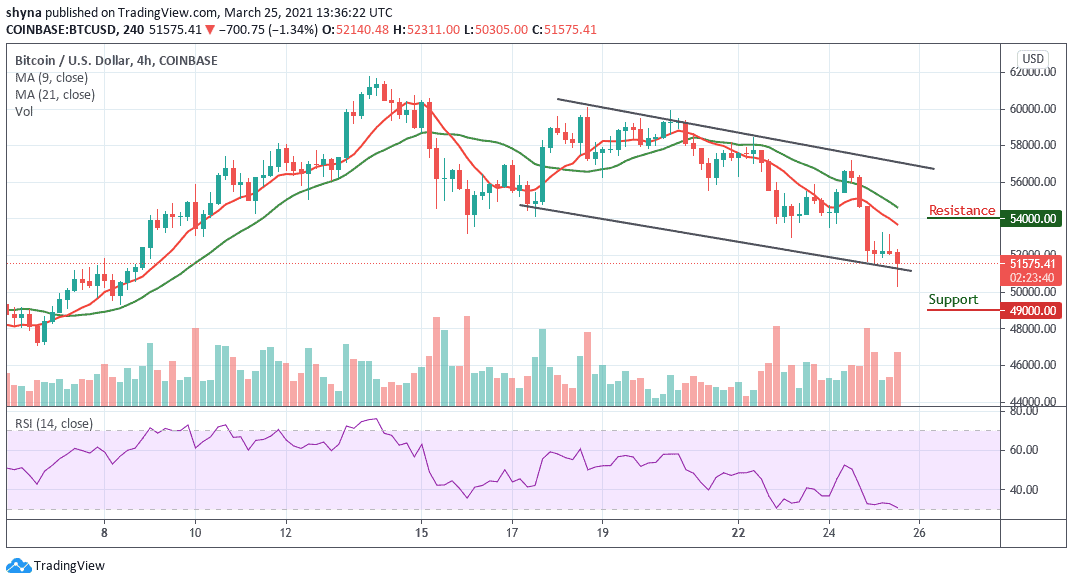
On the 4-Hour chart, the Bitcoin price stays below the 9-day and 21-day moving averages and the immediate support is below the moving averages at the $51,000 level. The price may likely fall below $50,000 if the bears fully stepped back into the market.
BTCUSD – 4 Hour Chart
However, a further bearish movement could test the critical support at the $49,000 level and below while the resistance is located above the moving averages at the $54,000 and above. Technically, Bitcoin is currently moving into the negative side as the technical indicator RSI (14) moves into the oversold region.
Billionaire hedge fund manager Ray Dalio says there is a growing possibility of bitcoin being banned following its growing threat to fiat.
Bitcoin May Get The Gold Treatment
The Bridgewater Associates boss – who heads the world’s largest hedge fund manager- said in an interview with the editor-in-chief ofYahoo! Finance Andy Serwer that Bitcoin could get the gold treatment.
He said it’s possible the US government outlaws Bitcoin, the same way gold was taken away from private hands in the past.
The billionaires said no government would like to see another currency challenging its monopoly on supply and demand.
With Bitcoin playing a pivotal role in re-routing many investments away from the traditional financial systems, some governments are already considering it a threat to their continued control of the economic engine.
Giving an instance, Dalio mentioned the Indian government’s continued attempts to ban private ownership of cryptocurrencies like Bitcoin.
The Asian nation is revisiting crypto in a new bill it wants to present in the parliament. The move, which the wider Indian community has heavily criticized, will see private crypto investors penalized and possibly jailed after the grace period of 6 months.
Government officials are torn on the issue, saying the government should adopt a dynamic approach to dealing with emerging technology. Others have said crypto-assets like Bitcoin constitute a danger to the economy. Citing massive price rise and ebbs, the opposition camp says Bitcoin would harm an already fragile economy.
BTC A ‘Storehold of Wealth’
Bridgewater Associates is a major player in the assets management circle. The firm currently holds $150 billion in assets under management (AUM), making it one of the world’s largest hedge funds.
Ray Dalio, who serves as a co-chief executive of the firm, said headmires Bitcoin for several reasons.
According to him, Bitcoin has been able to evade the popular 51% attack, enabling one-party control of most of a system’s mining power. This, to Dalio, is a major plus as Bitcoin has addressed government agencies’ major fears.
He also mentioned that Bitcoin had built a massive following since its inception in 2009, and those who got in early are now wealthy. To Dalio, Bitcoin has proven itself as a store of wealth, making it some sort of digital cash.
Dalio is right when he says Bitcoin is used to preserve wealth.
MicroStrategy’s Michael Saylor has been speaking on Bitcoin’s capability in storing value for the past year.
The intelligence company, which has so far converted most of its cash reserves to Bitcoin, owns a treasure trove of Bitcoin.
Tesla’s Elon Musk is also another advocate for Bitcoin. The electric car company staked 7% of its cash reserves in Bitcoin in early February. In a recenttweet, CEO Elon Musk said customers can now pay for Tesla cars with Bitcoin giving BTC a unilateral exchange value.
You can now buy a Tesla with Bitcoin
— Elon Musk (@elonmusk) March 24, 2021
Musk also pointed out that Bitcoin received by the car company will not be converted back to cash but held in its digital state.
Where is Ripple’s XRP Cryptocurrency Headed? – A Look at the Digital Asset’s Future
Even with the market currently experiencing a fresh new wave of bearish momentum, many industry experts are still quite hopeful as to the crypto sector returning to its all-time-highs sometime in the near future. In this regard, it bears mentioning that Ripple’s XRP token presents the global investor community with an ROI that is substantially larger when compared to other premier crypto assets like Bitcoin. This is because, at XRP’s current value of $0.25, a return to $3.30 would signify a profit increase of more than ten times.
In this piece, we will look at the opinions of various experts and analysts who have been operating within this domain for quite some time. However, before we start doing that, let’s look at some of the reasons that have made XRP so popular over the past couple of years:
Why Does Ripple’s XRP Have A Strong Following?
(i) Institutional Use:
As many of our regular readers are probably well aware, the Ripple ecosystem provides the finance industry with a platform that eliminates many of the problems that are currently associated with cross border transactions. Some of these issues include:
Extremely slow processing speeds: While Paypal takes anywhere between 2-4 days to facilitate international transfers, XRP allows monetary exchanges (local or international) to take place within a matter of minutes.
Tx Costs: Traditional payment processors take anywhere between 3%-5% of the total amount being transferred as processing charges. In this regard, XRP transactions cost just a fraction of what people have to otherwise pay when using conventional payment solutions (such as ApplePay, SWIFT, Paypal, etc).
Unreliability: Ripple makes cross-border payments far more reliable and efficient (especially for large finance operators) by making use of a decentralized ledger that offers a high degree of transparency.
Lastly, it should be pointed out that so far over 100 financial institutions have partnered with Ripple (and are currently making use of the firm’s blockchain solutions and technologies). For example, earlier this year, Ripple entered into an agreement with an Oman-based bank called BankDhofar in order to facilitate its monetary transactions in the most cost-effective, seamless manner possible. Similarly, in the past, Ripple has entered into agreements with other established financial institutions such as Banco Santander, Moneygram as well.
(ii) Big Name Partnerships:
Over the course of the past couple of years, Ripple has entered into partnerships with many firms that have made investors optimistic about the price of XRP. For starters, Ripple recently came together with Flutterwave — a blockchain firm that is looking to bridge the gap that currently exists between the African market and the rest of the global economy. Similarly, Ripple also signed an agreement with Moneynetint — an e-money firm based in the United Kingdom — to help the payments processor facilitate its various voluminous financial tx’s ( for corporate clients only.)
(iii) Super Fast Transaction Rates:
Previously, Visa used to hold the title of being the world’s fastest payments processor. However, all this has changed since Ripple recently dethroned the multinational giant by showcasing processing speeds of up to 50,000 transactions per second — a figure that is substantially higher (<2X) than what Visa has to offer (24,000 TPS).
How Does The Crypto Community Feel About XRP’s Future?
Edith Muthoni — Poor Short-term Outlook
Edith is the Chief Editor at LearnBonds.com, a personal investment site and community with more than 100,000 monthly readers. In her view, XRP has been one of the most disappointing coins of the year. Since late 2018, the digital currency has assumed a bearish trend in what she considers to be its lowest moments yet. She further points out that even though the technology being presented by Ripple is hugely promising, this potential hasn’t reflected in the performance of XRP. In an email to MasterTheCrypto, Muthoni further added:
“In the past 2 to 3 months, the coin has shown faint indicators of a bullish trend forming when paired with Bitcoin. I, therefore, won’t write it off yet – though I wouldn’t recommend anyone to buy in right now. In the long run, nothing about the coin or its blockchain technology gives any indicators of significant price improvements. I am of the opinion that should it assume a bullish trend, it will be so sudden that it will find most investors and regular traders off-guard.”
Ryan Selkis — Optimistic about Mid-to-Long Term Future
Ryan Selkis — the Founder and CEO of Messari — is quite optimistic about the future of Ripple, primarily because he believes that the crypto platform provides companies with a novel protocol that is not only easy to use but also helps streamline payments to different parts of the world. As a result of this, Selkis is quite hopeful that the premier digital token will once again scale back up to its previous ATH within the coming year or so.
Peter Brandt — Continued Price Volatility
The Factor LLC CEO is one of those people who is known to back up his predictions with solid stats and figures. In this regard, when asked about the future of XRP, Brandt stated that XRP was exhibiting signs of coiling up (despite showcasing strong fundamentals.) This, in his opinion, was mainly because Ripple was manipulating the market at large — something which Brandt believes will cause XRP to fall by another 20% by the end of 2019.
InvestingHaven — $20 by the end of 2020
InvestingHaven is an analysis website that its provides readers with detailed breakdowns, price analyses of various digital assets. In this regard, the media outlet claims that by the end of 2019, XRP could very well reach a price point of $20 — a prediction that is most likely to not come true, especially when considering that the currency’s current value lies around the $0.247 mark.
Exante — $0.5 Within Next 3-4 Months
In an online interview with Master The Crypto, the analysis team over at Exante told us that Ripple (XRP) has enjoyed the reputation of being one of the best blockchain ecosystems for banks and other similar financial institutions for quite some time now. As a result of this, the company is poised to bridge the gap that currently exists between the traditional finance sector and the crypto market. Additionally, the folks at Exante also believe that as we move into the future, Ripple may serve as a blockchain ‘channel’ for fiat and various crypto transactions.
“The XPR rate in 2019 is very stable compared to other major tokens. It remained in the $0.24-$0.48 range (twofold magnitude of variation), while the ETH and BTC rates varied threefold and fourfold, respectively. XRP is temporarily on the decline, yet with moderate dynamics. In September, it lost 7% while the overall crypto market lost 15%. Stable rate is a key showing for many investors (especially institutions), so in the long run, they may have greater interest in XRP than BTC. In the future, the stability factor may boost XRP prices over classic crypto. Predicting asset prices in the volatile cryptomarket is a daunting task. Think of the Bakkt trade start as an example. That said, I believe XPR will remain in the $0.2-$0.3 range for the next few weeks, possibly rising over $0.5 by the end of the year.”
Exante is a European investment company that provides its customers with an online trading platform with access to 50+ global markets. In 2012, the firm founded the world’s first cryptocurrency hedge fund Bitcoin Fund. Exante is authorized by the European regulators MFSA and CySEC.
Naeem Aslam — Positive Short-Term Valuation
Naeem Aslam is a well-respected crypto analyst who recently commented on what he thinks the value of XRP will be in the coming future. He believes that XRP is heavily oversold at the moment and thus it would be wise to invest some of one’s life savings in the premier digital asset.
Phil Nunn — Strong Long-Term Outlook
Phillip Nuun is the CEO of Wealth Chain Capital & The Blackmore Group. In his view, Ripple’s XRP token will continue to play a large role within the global crypto ecosystem. And while he did not give an exact number as to where the digital token will reach in the coming few years, he did add that the future looked bright for XRP and that Ripple was as important to the global tech landscape currently as Microsoft was during the ’90s and the early 2000s.
Daniel Ameduri — Positive Mid-to-Long Term Outlook
Daniel Ameduri is the co-founder of Future Money Trends as well as the author of Don’t Save for Retirement: A Millennial’s Guide to Financial Freedom. He recently told Master The Crypto that owing to XRPs utility in facilitating fast, low commission currency exchanges (which can happen on average 4 times per second), many people all over the world are beginning to forego their dependency on the US dollar and have started to transition to crypto. Ameduri further added:
“As XRP continues to be adopted by banks such as PNC, Santander, Standard Chartered, and more, we will see momentum build on itself which will give XRP strong fundamentals for higher prices going forward. I expect the overall crypto market to be in a long-term uptrend as I’m a believer in the blockchain. XRP is one of the most respected top crypto assets and as Bitcoin rises, I fully expect the rising tide to reflect in higher prices for XRP. I believe in 5 years, we will see new all-time-highs. Currently XRP is at $0.25 and its ATH is at $3.84, clearly, I’m very bullish on the future of XRP. We will need Bitcoin to regain confidence to the upside to ultimately see it build momentum.“
LongForecast — Between $0.1 – $0.2 till 2021
Another popular website that is known for its well-researched price predictions. In regards to XRP, the research team over at LongForecast believes that the third-largest cryptocurrency by total market capitalization will continue to hover between the $0.1 and $0.2 value range (at least till mid-2021). However, in the long term (i.e. by 2023) the price of XRP may once again surge and reach a price point of around $0.49 per token.
OracleTimes — $5 by December 2019
The popular crypto media outlet posted an article recently in which their research team mentioned that they foresee the price of XRP scaling up to around the $5 by the end of this year. However, since the start of 2019, Ripple’s flagship digital currency has dipped by more than 10% — as a result of which, many experts are now quite dismal when it comes to XRPs future financial potential.
Roman Guelfi — Decent Short-Term Outlook
Respected crypto analyst Roman Guelfi believes that 2019 will turn out to be a good year for XRP — especially since Ripple recently on-boarded several established projects (as well as other blockchain/crypto-related companies) to bolster its mainstream credibility. And while Guelfi did not provide an exact price prediction to back up his claims, he did add that by late 2019, XRP might force other established crypto assets to “take a backseat”.
UsLifted — Approximately $23 by late-2020
Crypto prediction portal ‘UsLifted’ claims that within the next 16 months or so, the price of a single XRP token might scale up to a mammoth $22.79 (along with a circulating supply of 38,739,145,924 XRP.)
Lance Morginn — 100 to 500% Increase In Use
Lance Morginn, President of Blockchain Intelligence Group (BIG) a Vancouver-based blockchain-agnostic search and analytics intelligence firm, working directly with financial services, ATMs, exchanges and banks, regarding the XRP price projection.
I think that XRP has some real legs and therefore could see significant increases in the coming years. In the next 6 months, I think we could see 100 to 500% increase and in the long run it could be a significantly higher increase based on today’s price. When asked about his views on XRP as a currency from a financial POV, he stated I would anticipate we will see more firms like SBI which are embracing the Ripple network. At the end of March of this year they connected 13 banks to their blockchain payment app.
In the long run, we will only have a handful of cryptocurrencies and I do believe XRP has a chance of being one of them,
XRP Coin Predictions In Closing
After a tumultuous 2018, XRP’s performance over the past couple of months seems to have somewhat stabilized. However, when looking at the fundamentals of the currency, many experts believe that great things might be in store for XRP. For starters, Ripple has recently entered into partnerships with a large number of established firms and business ventures — something that has infused the market with a lot of investor confidence.
With that being said, it should be made clear that any of the opinions/expert takes that have been outlined above should merely be viewed as guidance pointers and not as concrete investment advice. For people looking to invest big in this market, it is best that they do their due diligence as well as consult a few financial advisors who have been active within this somewhat nascent domain for a few years now.
Aziz, Master the Crypto Founder
I’m Aziz, a seasoned cryptocurrency trader who’s really passionate about 2 things; #1) the awesome-revolutionary blockchain technology underlying crypto and #2) helping make bitcoin great ‘again’!
The post Ripple Price Prediction: XRP Coin Forecasts appeared first on Master The Crypto.
CryptoProfile ICO Review: A comprehensive review and analysis on CryptoProfile ICO, which aims to create a consolidated marketing airdrop platform.
Note: This represents the writer’s personal opinions and does not – in any way- constitute a recommendation of an investment or financial advice. Please assume caution when investing in cryptocurrencies and do so at your own risk, as it is extremely volatile and you can lose your money.
Overview
CryptoProfile is a leading blockchain marketing agency that is creating a consolidated airdrop platform for the ICO market. The goal of the platform is to connect Initial Coin Offering (ICO) projects with a large network of cryptocurrency enthusiasts, with various services that would significantly enhance a project’s marketing campaigns. The core services of the platform will include Education, Airdrops, Bounties and Investment opportunities.
With the airdrop platform, CryptoProfile is trying to solve 2 core issues:
Unreliable Airdrop Mechanisms: Airdrops have been a unique mechanism in the cryptocurrency market with the main function of distributing free tokens from ICO projects to the masses for publicity and marketing purposes. However, the existing airdropping mechanisms are often m annual and unreliable, especially for participants that possess a financial incentive – such as marketers, writers, partners, and referrers – that enhances the exposure and publicity of the ICO.
Shady ICO Practices:It is no secret that the ICO market is rife with shady practices, money-grabs, scams and Ponzi schemes that prey on vulnerable participants in the cryptocurrency market. The absence of any regulations makes it easy for ICO projects with ill-intent to get away with their schemes. Alternatively, the high failure rates of ICOs are a result of the lack of product viability.
(See more: Dangers in Cryptocurrency Investing)
Application
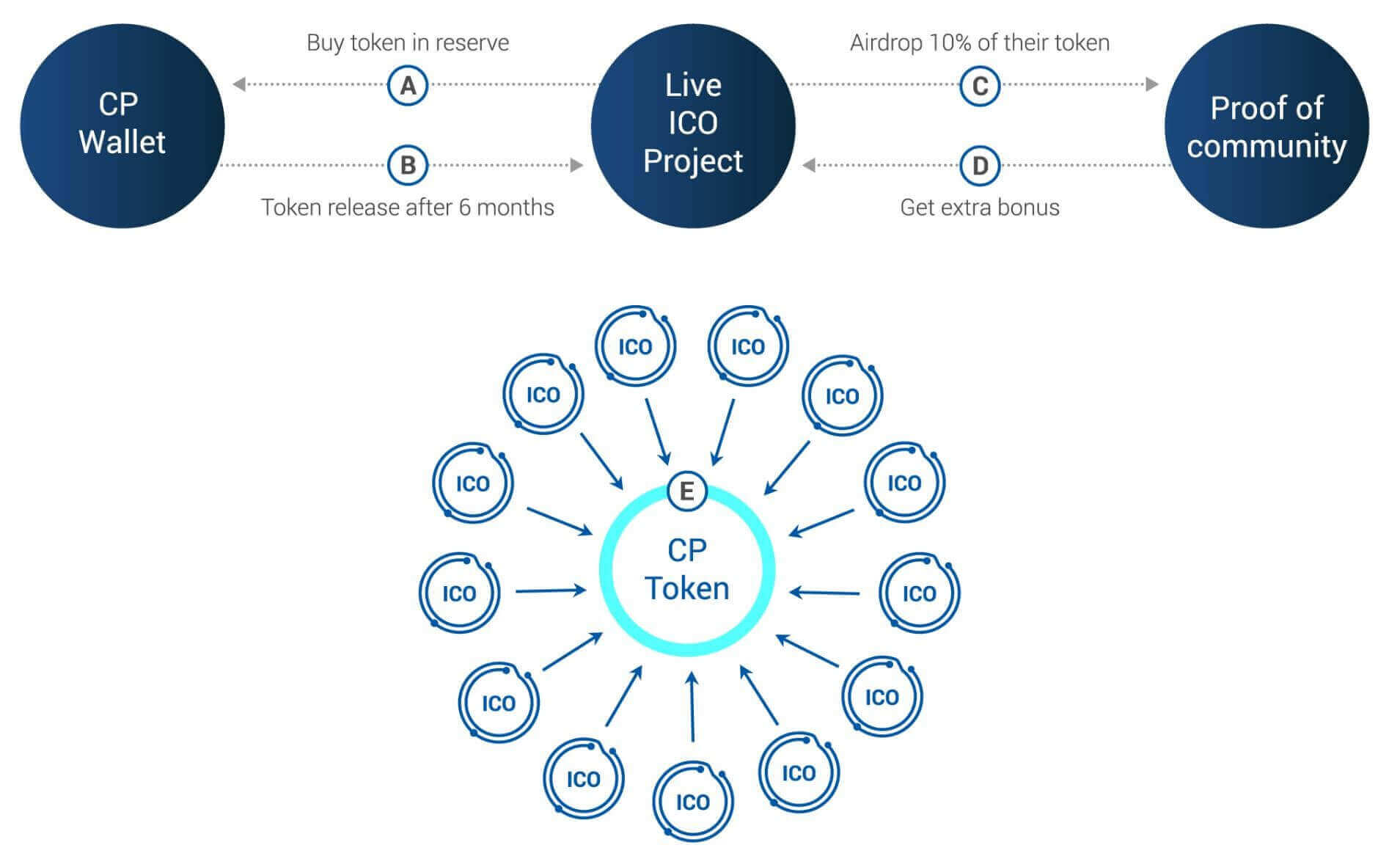
CryptoProfile looks to streamline the airdropping process while preserving a rigorous standard of business acumen since the success of its platform is directly correlated with the success of the ICOs within the ecosystem. Here is a visual flow of how the platform will function:
The airdrop mechanism instituted by CryptoProfile will run as follows:
ICO Projects on-boarded by CryptoProfile will need to upfront USD100k for the marketing exposure and services of the network. In return for that, USD 100k value of CP tokens will be given to the ICO project.
The CP tokens returned to the ICO project will be locked up in a smart contract for six months and released when the project has successfully listed their native tokens on an exchange.
The ICO project will need to allocate 10% of their ICO token to CryptoProfile, which thereafter allocate 100% of that token pool and airdrop to CP token holders in order to further stimulate interest and participation from the cryptocurrency community
All CP token holders will be rewarded with airdropped tokens each time an ICO is onboarded into the CryptoProfile network.
There is also an avenue for CP token holders to invest transparently on the ICOs which interest them within the CryptoProfile ecosystem.
Due Diligence Mechanism
Every ICO project will need to be screened thoroughly to ensure that they conform to the standards set by CryptoProfile. The due diligence mechanism is as follows:
Business Viability: The project must be able to address a current problem with an adequate target market and feasible cash-flow predictions.
Technology:The project must be backed by a sound technological base that works and fits the overall project goals.
Token Economics:A stable token economic model is a pivotal factor in the success of the project. Key variables to look out for is the degree of centralization, escrow mechanisms and the synergy of the tokens with stakeholders’ interest
Team:The team working on the product must be qualified with the necessary skills and dynamism for the project’s success.
Coin Utility:The value of any token is fully contingent on its utility. There must be a solid use-case and application for the tokens within the ecosystem.
Regulation: Given the increased scrutiny of the greater cryptocurrency market, the regulatory aspects of any project will need to be analyzed within the context of its jurisdiction before anything else.
(Read also: Why do people hate Bitcoin & Cryptocurrencies? Here’s 5 Common Misunderstandings)
Unique Selling Point
Novel Economic Model: CryptoProfile is one of the first platforms that focus on creating a consolidated airdrop platform for ICO projects. The platform naturally aligns the long-term interests of stakeholders, with listed ICO projects getting the marketing exposure from the extensive network of investors who hold CryptoProfile’s native tokens (called CP). CP holders are financially incentivized to also increase the marketing exposure of ICO projects within the ecosystem through the consolidated airdrop mechanism.
Team
Here is CryptoProfile’s team:
All of the team members of CryptoProfile is based in the country of its incorporation, which is in Singapore. There is a total of 7 core members that make up the team, headed by Max Ng, the managing director. Max has been in the cryptocurrency space since 2012, focusing on cryptocurrency education and trading on his previous endeavors. He has also been credited as creating a global charting methodology with an estimated accuracy of 80% on speculation detection. Along with his co-founders, they are advisors to various ICO projects in the early stage round. A notable highlight is CryptoProfile’s Global Business Development Director, Amarpreet Singh, who is rated as one of the top 10 Global ICO/STO Advisor and was a former economic advisor to the World Bank.
(See more: Types of Coins to Diversify Your Crypto Portfolio & Manage Risks)
Traction
Partnerships
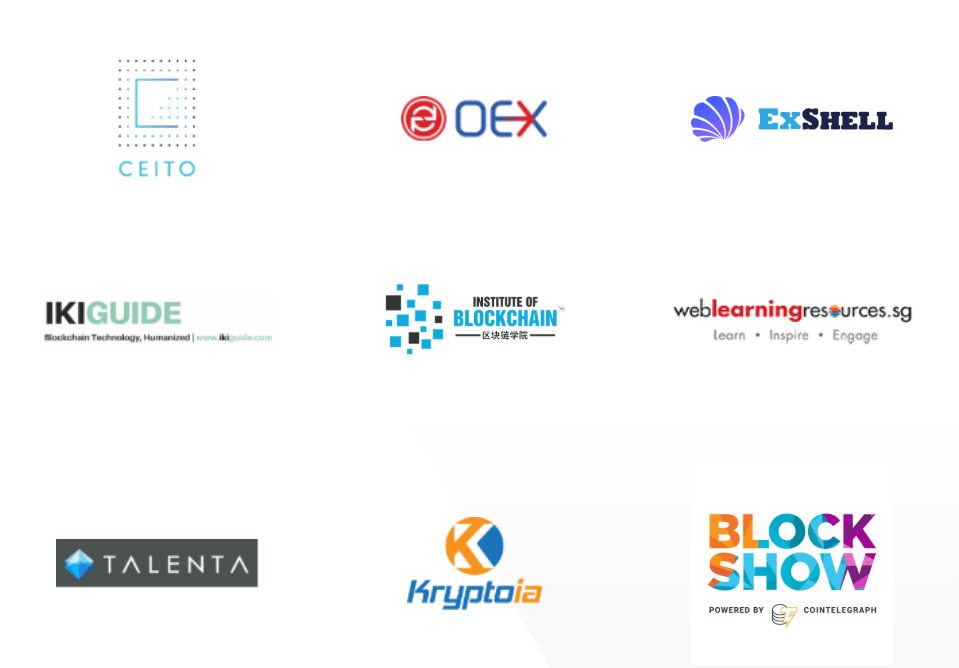
Here are Cryptoprofile’s partners:
Cryptoprofile has partnered with various educational entities such as the Institute of Blockchain, WebLearningResources, and IKIGuide. This is aligned with their initial focus of spearheading cryptocurrency awareness and education to the cryptocurrency community. CryptoProfile are also active in the cryptocurrency events space, partnering the likes of BlockShow (by CoinTelegraph).
Roadmap
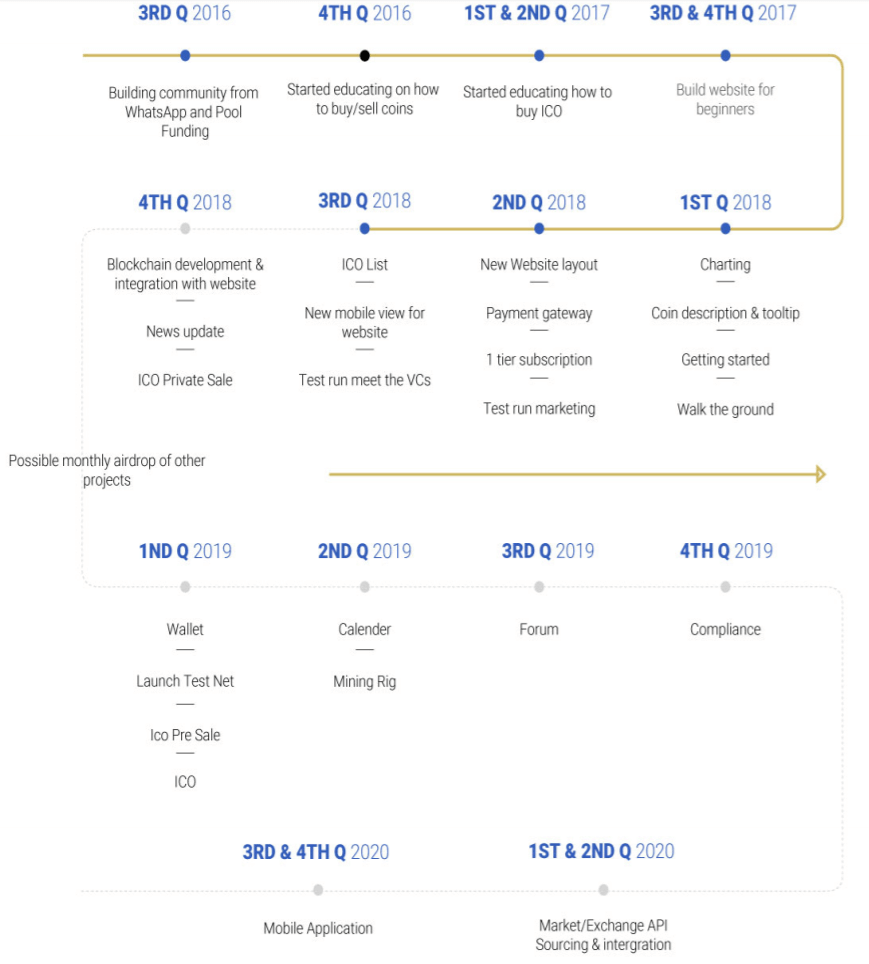
Here is CryptoProfile’s roadmap:
CryptoProfile has been operating since the third quarter of 2016, beginning with educational services and resources for the greater cryptocurrency community. It has then grown into a full-suite marketing agency that has established itself in the Asian region. The pre-sale and actual ICO will take place in the first quarter of 2019. The first half of 2019 would see the development of their native wallet and the launch of their test-net.
(Read more: Crypto Beginners Guide: 5 Things Crypto Newbies Should Know)
Token Economics & Utility
Token Metrics
Here’s is the breakdown of Cryptoprofile’s native tokens, CP:
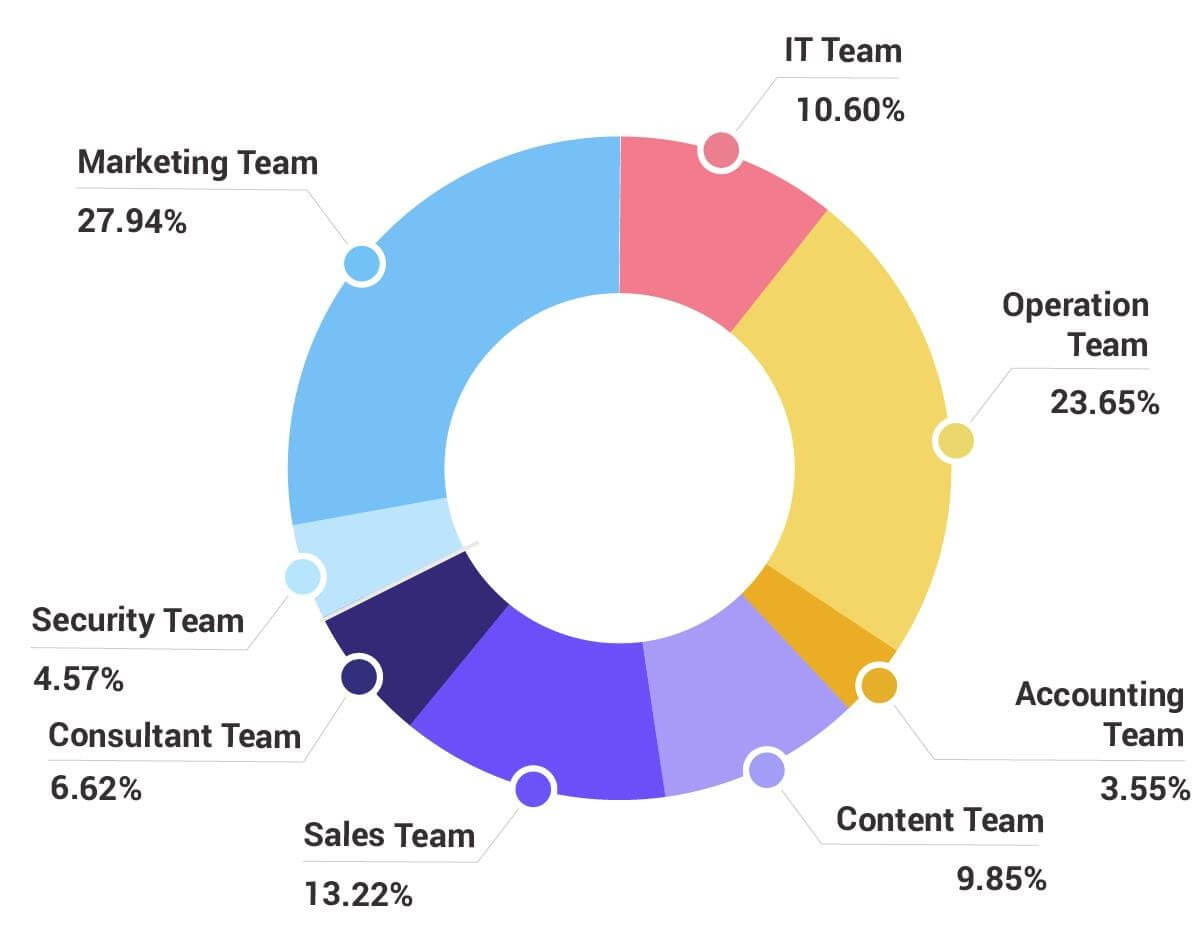
CryptoProfile has already completed their private sale round with great interest and is now looking towards their pre-sale round, which commences at the start of 2019 for a period of 30 days. Over a quarter of the total funds raised will go towards marketing expenses in a bid to create the publicity and branding of the platform.
Token Utility
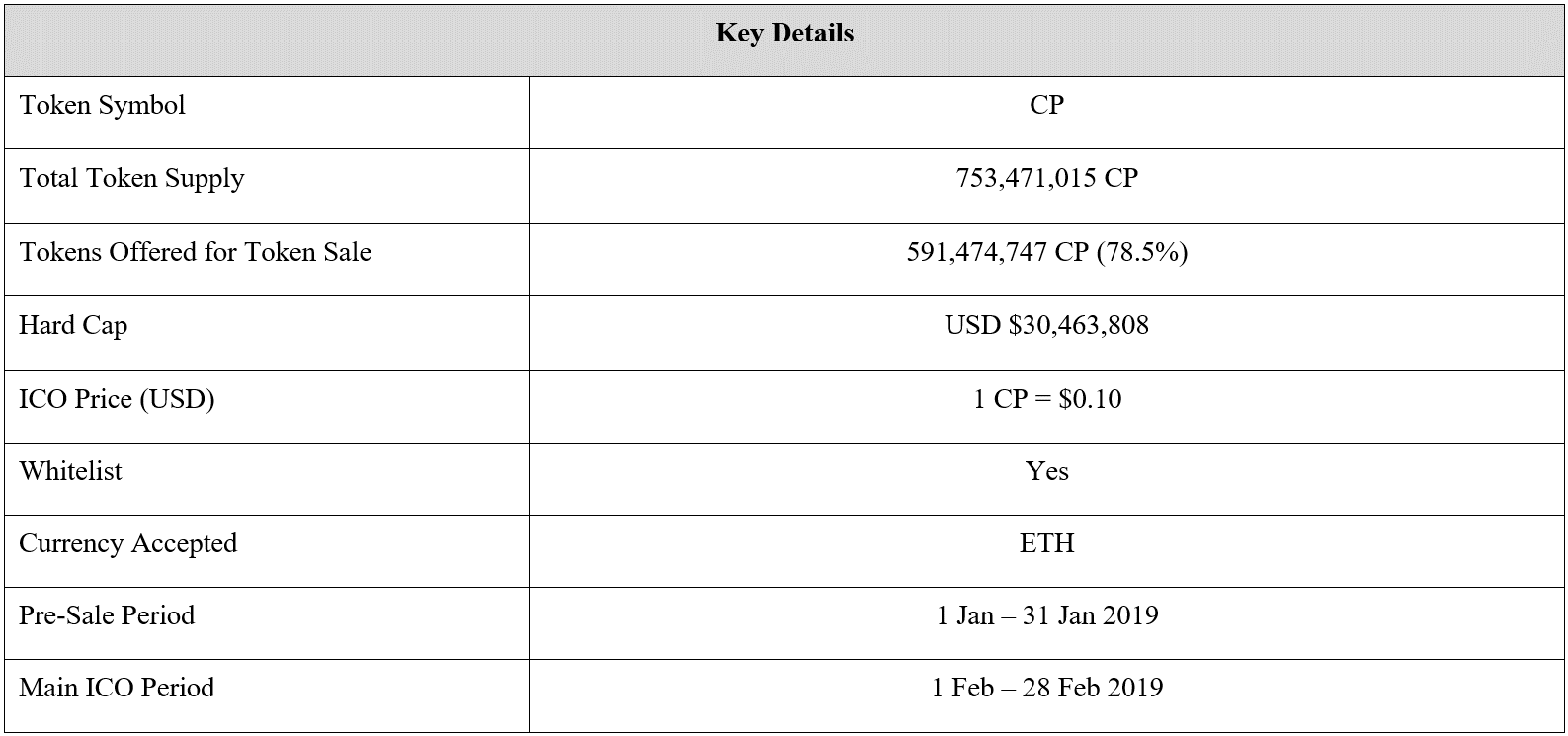
CryptoProfile’s native coin is an ERC 20 token called CP, which is built on the Ethereum blockchain. The soft cap of CryptoProfile’s token sale will be $1.1 million while their hard cap stands at $30. 4 million.
CP is a utility token with the following use cases:
Main Currency:CP will be the main currency in CryptoProfile ecosystem, which is required to interact with the platform’s key components. ICO projects that are onboarded into the platform is required to convert their fiat into the native CP tokens to access their marketing exposure,
Remuneration: There will be a wide reward pool for stakeholders of the CryptoProfile network, such as content writers and bounty hunters. They will be rewarded in CP tokens
(See more: Will A Crash in Bitcoin’s Price Lead to Its Demise?)
Strengths
Lucrative Market Potential:The cryptocurrency market is one of the fastest growing industries globally, even at when the market experienced a bear market for the rest of 2018. Though volatile, the infancy of blockchain technology has attracted many in the space, with market capitalizations of the general cryptocurrency market standing in excess of $150 billion.
Novel Economic Model: CryptoProfile is one of the few projects around that tries to enhance the airdropping mechanism that is unique to the cryptocurrency market. Ensuring that all stakeholders in the ICO marketing process is aligned financially and for the long-term, it adds strong value to their native tokens, CP.
Due Diligence Mechanism:CryptoProfile’s platform ensures that only credible projects are onboard. Projects will be assessed using a strict standard that consists of its potential viability, technology metrics, team strength, and token utility. This is a positive point since the credibility of CryptoProfile’s platform is only as strong as the credibility of the individual ICO projects within the ecosystem.
(Read more: 5 Valuable Lessons From The Cryptocurrency Market in 2018)
Weaknesses
Lack of Technical Details: The whitepaper lacks the technical details on the blockchain end of the platform.
Moderate Roadmap: The second half of 2019 looks quite uneventful according to the roadmap, which sees CryptoProfile focusing on forums in the third quarter and compliance matters in the last quarter. It seems relatively lax relative to the schedule of other ICO projects.
Summary
From its humble beginnings focusing on cryptocurrency awareness and education, Cryptoprofile has grown into an established marketing agency that has its sight on redefining the airdropping process. Being an integral and unique part of the cryptocurrency world, airdrops has often been unreliable and limited in its effectiveness as a marketing tool. With a platform specifically focused on delivering value to new ICO projects and financially incentivizing all stakeholders in the process, the long-term vision of each ICO project is extrapolated to the greater community.
Verdict: Good Project
(Read also: Evolution of Cryptocurrency: The Problem With Money Today)
Beneficial Resources To Get You Started
If you’re starting your journey into the complex world of cryptocurrencies, here’s a list of useful resources and guides that will get you on your way:
Trading & Exchange
Crypto Guide 101: Choosing The Best Cryptocurrency Exchange
Guide to Bittrex Exchange: How to Trade on Bittrex
Guide to Binance Exchange: How to Open Binance Account and What You Should Know
Guide to Etherdelta Exchange: How to Trade on Etherdelta
Guide To Cryptocurrency Trading Basics: Introduction to Crypto Technical Analysis
Cryptocurrency Trading: Understanding Cryptocurrency Trading Pairs & How it Works
Crypto Trading Guide: 4 Common Pitfalls Every Crypto Trader Will Experience
Wallets
Guide to Cryptocurrency Wallets: Why Do You Need Wallets?
Guide to Cryptocurrency Wallets: Opening a Bitcoin Wallet
Guide to Cryptocurrency Wallets: Opening a MyEtherWallet (MEW)
Read also: Guide on Privacy Coins: Comparison of Anonymous Cryptocurrencies and Guide To Cryptocurrency Trading Basics: Do Charts & Technical Analysis Really Work?
This represents the writer’s personal opinions and does not – in any way- constitute a recommendation of an investment or financial advice. Please assume caution when investing in cryptocurrencies and do so at your own risk, as it is extremely volatile and you can lose your money.
Enroll in our Free Cryptocurrency Webinar now to learn everything you need to know about crypto investing.
Get our exclusive e-book which will guide you on the step-by-step process to get started with making money via Cryptocurrency investments!
You can also join our Facebook group at Master The Crypto: Advanced Cryptocurrency Knowledge to ask any questions regarding cryptos!
Aziz, Master the Crypto Founder
I’m Aziz, a seasoned cryptocurrency trader who’s really passionate about 2 things; #1) the awesome-revolutionary blockchain technology underlying crypto and #2) helping make bitcoin great ‘again’!
The post ICO Analysis: CryptoProfile ICO Review appeared first on Master The Crypto.
RainCheck ICO Review: A comprehensive review and analysis on RainCheck ICO, which aims to disrupt the online-to-offline commerce space.
This represents the writer’s personal opinions and does not – in any way- constitute a recommendation of an investment or financial advice. Please assume caution when investing in cryptocurrencies and do so at your own risk, as it is extremely volatile and you can lose your money.
Overview
Raincheck is an online-to-offline (O2O) commerce platform that allows retail brands to track and influence online product discovery to physical, in-store sales. On the user end, Raincheck platform allows them to source for products online and be notified – at a contextual and relevant time – when the product is available in nearby stores. Simultaneously, users will be notified of various offers and rewards that is currently applicable to them.
Raincheck plans to create a complete the O2O loop by integrating a decentralized peer-to-peer (P2P) loyalty and payment network into their current commerce platform. The ultimate goal is to reach all data points and stakeholders within the online-discovery and offline-purchasing loop.
Here are the following problems that Raincheck aims to solve:
Absence of Offline Data Analytics: Statistics show that 85% of people are likely to browse for products online and make a purchase physically at the retail store. Though it is easy to gather consumer behavioral data online, current technology prevents data to be gathered once users leave the online store
Broken Customer Loyalty:The current loyalty programs are faced with obvious weaknesses; most people do not use their loyalty points since they could never accumulate enough points for a worthwhile reward. Additionally, loyalty programs can accrue significant liabilities to businesses.
(See more: A Guide To Fundamental Analysis For Cryptocurrencies)
Interview with Founders
We had the opportunity to engage in a high-level interview with RainCheck’s Founder & CEO, Cameron Wall. We asked several important questions about RainCheck according to several metrics. Have a look at the interview below:
Application
Raincheck aims to provide users with a personalized shopping experience while enabling businesses to measure digital marketing spend offline,where most sales occur. This is achieved through their patent-pending commerce platform that allows businesses to track online-to-offline sales cycle and also enables card-linking loyalty capabilities for user’s debit/credit cards.
Card-linking is a process of linking up users payments cards (debit/credit cards) directly to a merchant’s loyalty program, digital offer and cash-back bonuses.
Here is the general overview of the Raincheck platform:
The Raincheck platform is divided into 10 interconnected modules that can operate on multiple instances, with each module being as open as possible to enable wide third-party acceptance. All instances are based on the AWS Cloud Environment. Now, it is important to understand that the Raincheck platform uses a centralized structure since it uses Amazon’s AWS cloud server. The integration of blockchain functionality comes at the next step, which is on the payment processing network.
(Read also: Category of Cryptocurrency Market: Blockchain Platform)
Tokenization of Payments Data
In order to successfully link offline sales data with online data, data regarding the payment networks need to be integrated into the overall framework. That is why Raincheck will tokenize personal data associated with a payments card (debit/credit card). This token-based system will capture the offline-to-online data that is accessible at product (SKU) level rather than the merchant-level, which previously has been rare. Here’s an example:
Merchant-Level Promotion: Spend $200 at merchant ABC tomorrow and receive $2O cash-back
Product (SKU) Level:Buy product CDE tomorrow and receive 20% cash-back or 30 loyalty points
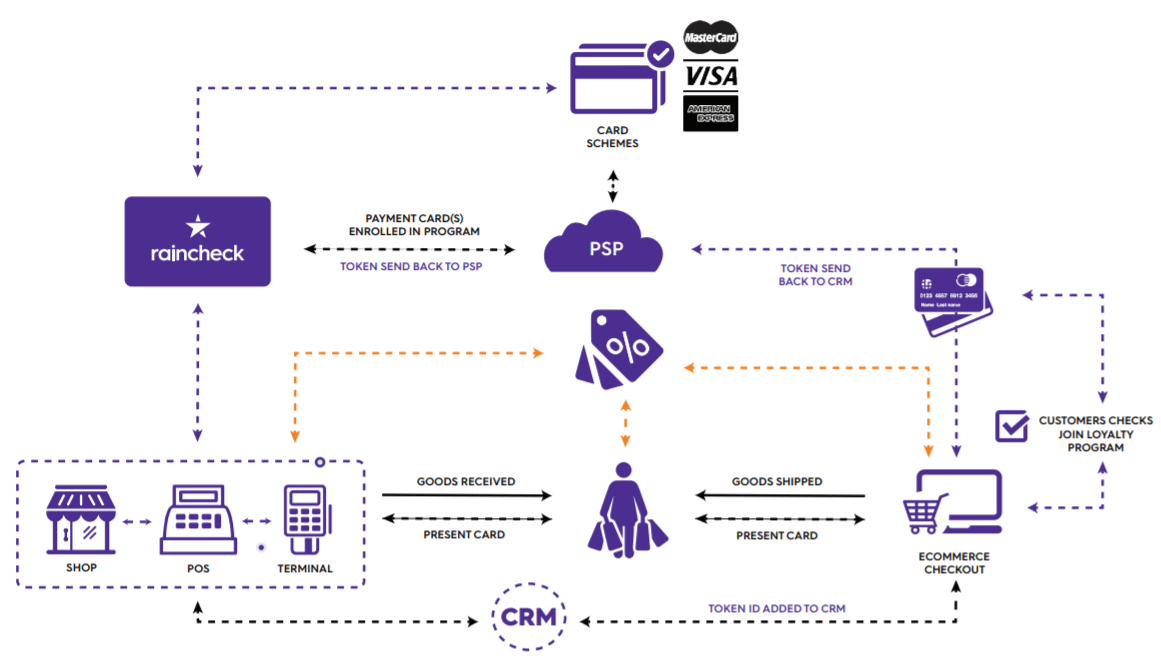
Tokenizing payment card data and integrating it to a traditional Customer Relationship Management (CRM) system would create a more personalized system for end consumers. Here is how the token-based system will work in the greater scheme of things:
Stakeholders
The core functionality of the Raincheck platform will enable tracking, measuring and rewarding users from online product discover to physical, in-store purchasing. Here are the advantages that stakeholders will gain using the Raincheck platform:
Users: Shoppers can use Raincheck’s free service to be rewarded by just discovering online products and buying them at a later time (both online or physical shops) through rebates, discounts and cash-backs
Retail Businesses: Businesses would be able to gather critical consumer behaviour data from O2O sales which previously would have been unattainable, which can now be used in their marketing analysis.
Payment Processors: The likes of Paypal and Stripe can now capture offline sales derived from online discovery and increases their revenue channels through commissions or charging fees via the O2O cycle
Financial Institutions:Banks can create more personalized card schemes for their customers by having access to SKU-level data
Channel Partners: Distributors such as online publishers could represent new revenue channels for businesses
(See more: Guide to Cryptocurrency Liquidity: Understanding Liquidity & Its Importance)
Technical Overview
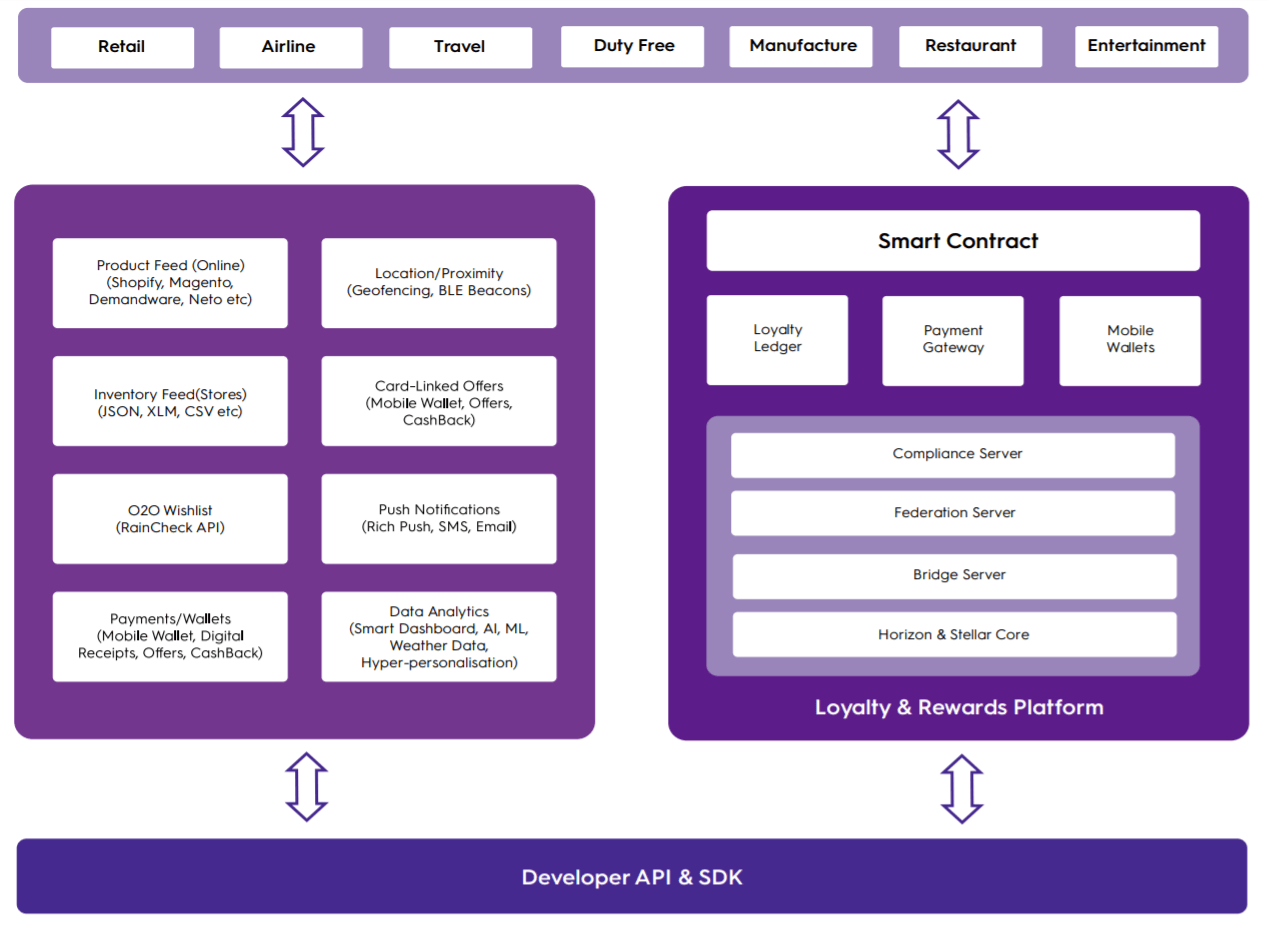
The Raincheck platform will be made up of the existing centralized commerce platform (fueled by AWS server) with a decentralized component which is the Loyalty & Rewards platform that is built on the Stellar Network. Stellar was chosen since it is a high-throughput, decentralized blockchain with low latency and strong security. Here is the technical overview of Raincheck’s platform:
Unique Selling Point
There are several elements that make Raincheck stand out:
Patent-Protected Technology: Raincheck ‘s technology is currently patent-pending and once granted, will serve as a strong moat to deter competitors in a lucrative market.
End-to-End Data Points Bridging the Online and Offline World:Raincheck’s solution will focus at the Stock Keeping Unit (SKU) level instead of only the merchant and spend level that is the status quo of the industry. This means that the entire data point from when an online product is discovered to when it is purchased in an offline store can be gathered and utilized.
(Read more: Guide to Blockchain Protocols: Comparison of Major Protocol Coins)
Team
Cameron Wall (CEO) leads the team with a belt of entrepreneurship ventures focused on mobile and web development for global enterprises. His expertise in mobile and cloud-based applications is a natural fit for the business. William Lin (CTO) heads the technical end, with expertise in cloud based backend and front-end development of web platforms and mobile applications. Although Raincheck’s website and whitepaper mentions William’s expertise in machine learning, artificial intelligence and blockchain systems, there is no indication of those skills as per his previous working experience. The business end is headed by Peter Bremner, who has strong corporate and government links from his established corporate background.
There are 8 other team members that takes on blockchain development, artificial intelligence and mobile development.
(See more: Guide on Identifying Scam Coins)
Advisers
Raincheck features a comprehensive list of advisors with expertise in each technological layer of the Raincheck platform, from the technology side to the retail side. Leveraging the expertise of a wide-array of experts from the technical and business side is always a good indicator.
Though comprehensive, there seems to be no prominent advisors for Raincheck.
Traction
There are 4 indicators of Raincheck’s progress so far. They include a pilot program, mobile applications, browser extensions and awards they’ve achieved.
1. Pilot Program
Raincheck has successfully engaged in a pilot initiative of their platform in 2017. The 6-month pilot phase in Australia saw 6 retailers leveraging on Raincheck’s platform. The approximate number of users were 2,675.
The pilot program shed several interesting insights that supported Raincheck’s hypothesis that people would save online products they’re discovered for a later point in the future. It also revealed that the physical store represents the most important channel of sales acquisition for retail brands.
2. Mobile Application
Raincheck has a mobile app both in the Google play store and the Apple store. Here is how the app looks like:
Here is a look at the reviews of the mobile app from both Google and Apply playstore:
The volume of reviews is insufficient for a credible conclusion since the app has gained a limited review rate, which could be easily manipulated. The install rates, which is a better indicator of user reception seems to indicate minimal traction, with the Google play store gaining only 500+ installs. Given the paunch of the mobile app in 2016, this seems to indicate lacklustre traction amongst users.
3. Mobile Extensions
Raincheck has also developed browser extensions for its application, both in Chrome web store and Apple’s Safari. However, the amount of users that have downloaded the extensions aren’t convincing of Raincheck’s traction:
Chrome’s version has only amassed 44 users of Raincheck’s application, which is extremely small. This is not a good indicator of Raincheck’s traction.
4. Awards
On the awards front, Raincheck has raked up several awards that include those from Visa and Accenture. Here are the accolades that they’ve received:
Awards are definitely a positive indicator of a strong project concept. Winning several awards from prominent institutions puts Raincheck a step ahead of many ICOs that have not reached this level of recognition.
(Read also: Crypto Trading Guide: 4 Common Pitfalls Every Crypto Trader Will Experience)
Token Economics & Utility
Token Metrics
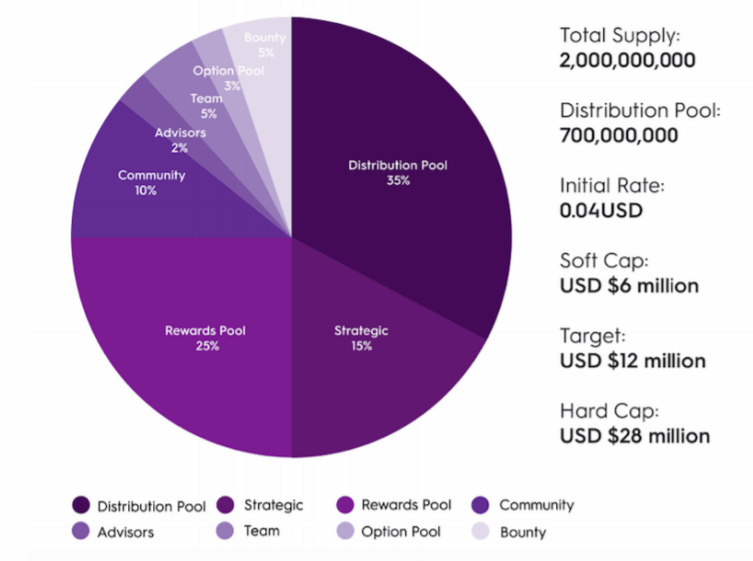
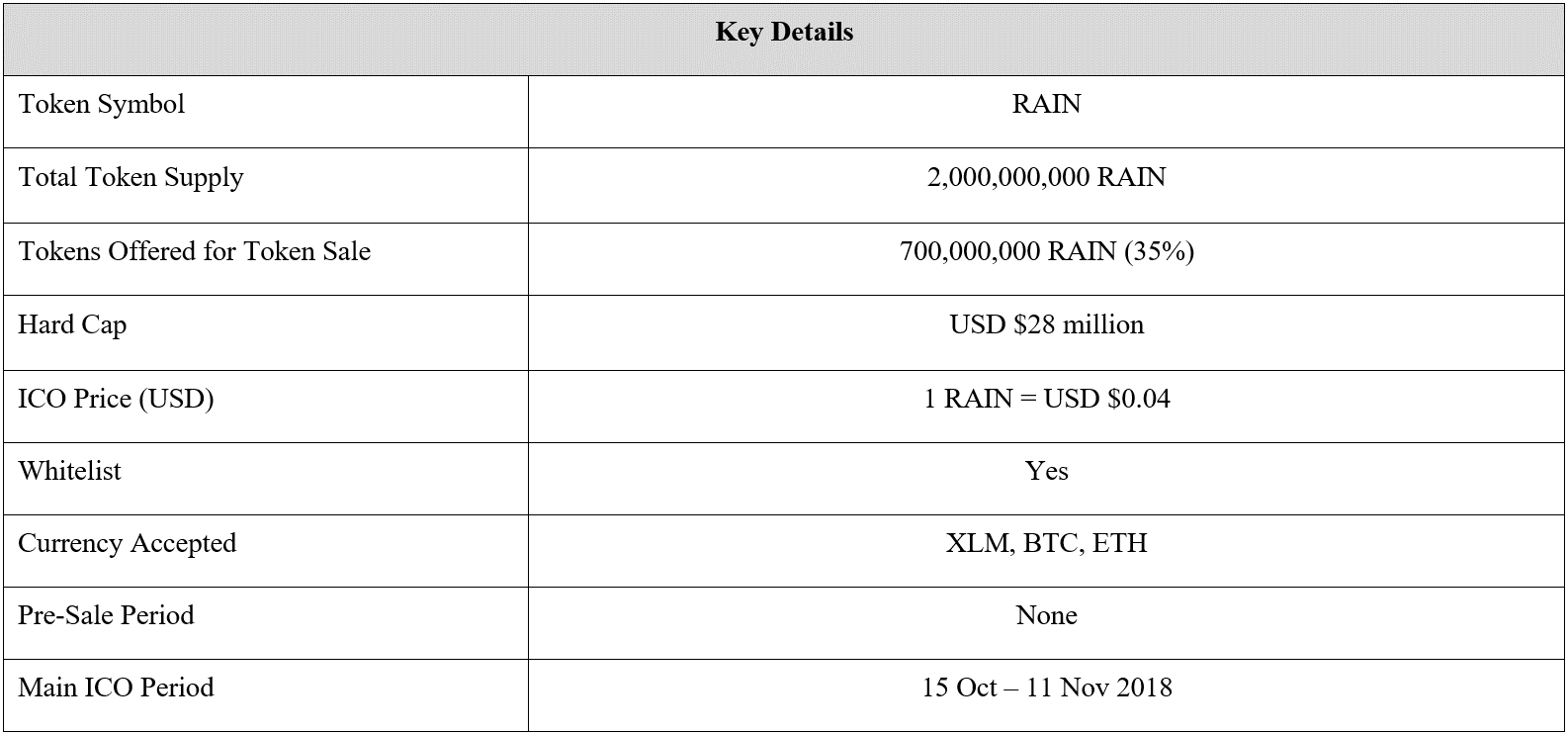
35% of the total pre-mined supply of Raincheck’s native tokens will be distributed at the ICO. This is a relatively lower allocation compared to other ICOs, which usually allocates upwards of 50% of their token supply to the ICO. A lower ICO allocation equates to greater centralization of the token supply, which could be unnerving for investors. Fortunately, Raincheck is transparent about its token supply breakdown. Here are the vesting schedule for different categories of their token distribution:
Strategic Pool:Tokens will be reserved over a 3 year period and will be allocated to strategic partners and enterprise organizations to stimulate participation and traction.These organizations would be offered an opportunity to purchase RAIN tokens at market rates
Team:Tokens will be vest 12 months from the start date of the sale period, to align employees with long-term objectives
Advisors:Tokens will be frozen for 6 months from the end of the public sale period and will then vest over a 24 month period
Rewards Pool: Leftover ICO tokens will be transferred to the rewards pool, which will be used as to reward participation in the ecosystem and promotion of Raincheck. There will also be a token-burning mechanismwhere RainCheck will periodically buy back and burn RAIN tokens using the profit generated from the O2O shopping and overseas commerce business
Raincheck’s $28 million hardcap is at the higher spectrum of ICO funding, which is quite surprising given the bear market the general cryptocurrency market has been experiencing since the start of the year. It will be extremely hard for Raincheck to hit their hardcap given the state of the market.
(Read more: Analyzing Cryptocurrency Risk: Existing Coins vs ICO)
Token Utility
Raincheck will feature its own utility token that is called RAIN, which will be used as the primary currency within the Raincheck platform. Users need to possess RAIN tokens to access the range of services and functions on the platform. Here are the use-cases for RAIN token:
Medium-of-exchange between merchants and users
Value unit within Decentralized Autonomous Organizations (DAOs), which will be staked by brands in relation to their community membership
Rewards trading between different loyalty programs and schemes
These use-cases will fuel the demand for RAIN tokens. Given the fixed supply of pre-minted tokens, the long-term value of RAIN is directly tied to the success of Raincheck’s platform. Additionally, the burning mechanism employed by Raincheck to buy-back and burn RAIN using operational profits would serve to enhance RAIN’s long term value given that its supply would periodically decrease.
Roadmap
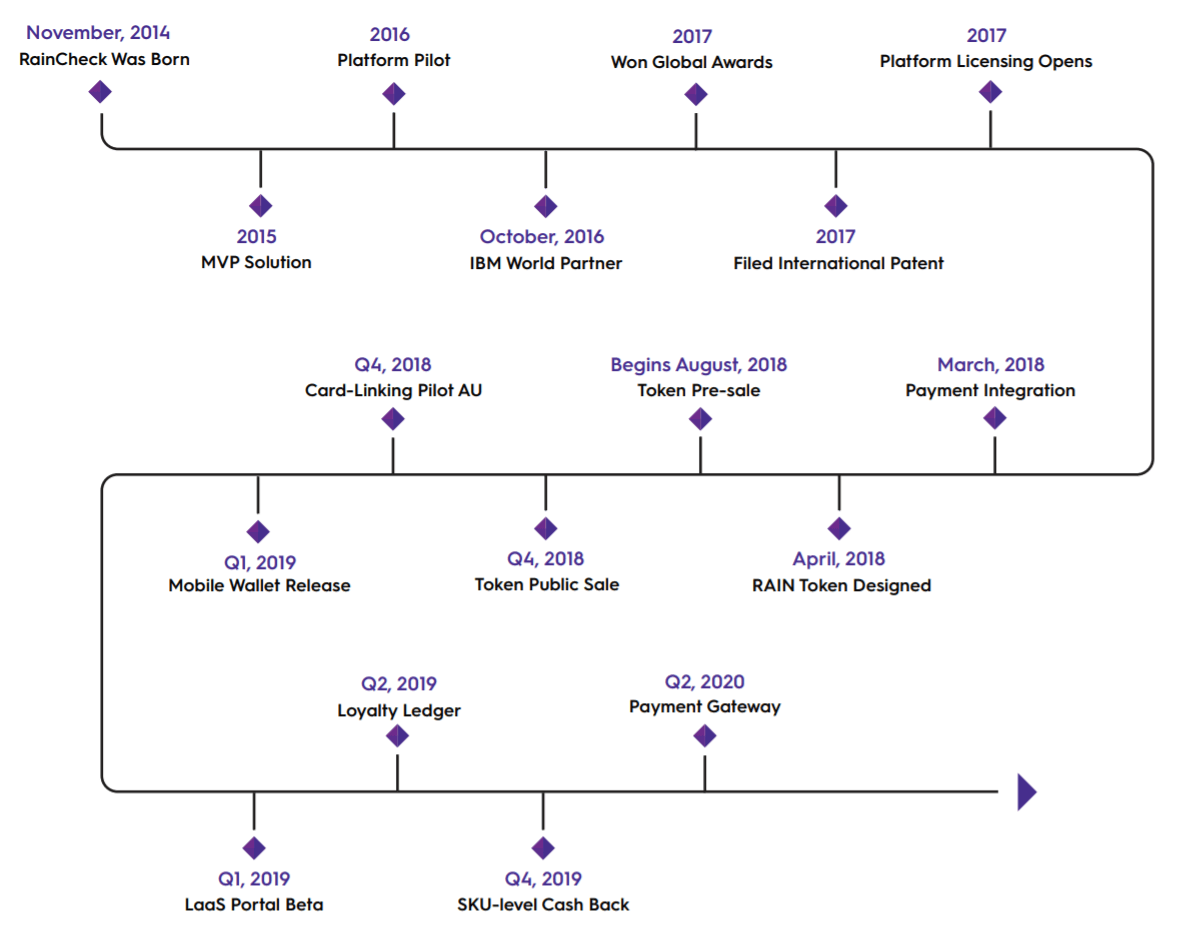
Here is the roadmap for Raincheck:
Raincheck has a long track record when compared to the majority of ICO projects. It was established way back in 2014 and has released its platform in 2016. Moving forward, the completion of Raincheck’s solution could stretch as far as the 2nd quarter of 202, which is a long way ahead.
(See also: Guide to Forks: Everything You Need to Know About Forks, Hard Fork and Soft Fork)
Strengths
First Online-to-Offline Commerce Solution: Raincheck has created an end-to-end solutions to capture offline retail data in conjunction with online consumer data, which could prove invaluable to brands and businesses in understanding their consumers more.
Scalability: Raincheck’s platform is built on the Stellar blockchain, which can process much more transactions that its competitors built on the Ethereum blockchain. This focus on scalability is vital in ensuring that Raincheck’s platform can scale with more transactions in a viable manner.
Track Record:Raincheck has been operating for close to 4 years, which puts it at the higher percentile of ICO projects with a track record and a working product.
Accolades: Raincheck has won several awards and recognition from prominent establishments such as VISA and Accenture for their project, which is a good sign of credible project model.
Patent-Protection: Raincheck’s core system is patent-pending, which if granted, allows for greater barriers to entry for future competitors
Weaknesses
Centralized Core System: Raincheck’s core system is built on an AWS, centralized server with the decentralization aspect coming from its loyalty & rewards platform. Since its core system is centralized, it is vulnerable to various risks which could be mitigated using a decentralized system.
Little Traction:Looking at indicators of traction via mobile application and browser extension downloads, the numbers are small considering Raincheck has launched them in 2016. This is a sign of poor user attraction towards Raincheck’s solutions.
Little Hype: There seems to be limited resources and publications surrounding the potential impacts of Raincheck’s solutions, which could significantly enhance commerce industry
Summary
Raincheck offers a viable solution in bridging the online commerce world to the physical, in-store sales cycle that can prove invaluable to retail businesses that are gearing towards a more data-centric approach in understanding the consumers. Though Raincheck’s decentralized loyalty platform and token-based structure, the final piece of a complete online-to-offline commerce solution could finally be in the way for the industry.
Verdict: Good Project
(Read also: Evolution of Cryptocurrency: The Problem With Money Today)
Beneficial Resources To Get You Started
If you’re starting your journey into the complex world of cryptocurrencies, here’s a list of useful resources and guides that will get you on your way:
Trading & Exchange
Crypto Guide 101: Choosing The Best Cryptocurrency Exchange
Guide to Bittrex Exchange: How to Trade on Bittrex
Guide to Binance Exchange: How to Open Binance Account and What You Should Know
Guide to Etherdelta Exchange: How to Trade on Etherdelta
Guide To Cryptocurrency Trading Basics: Introduction to Crypto Technical Analysis
Cryptocurrency Trading: Understanding Cryptocurrency Trading Pairs & How it Works
Crypto Trading Guide: 4 Common Pitfalls Every Crypto Trader Will Experience
Wallets
Guide to Cryptocurrency Wallets: Why Do You Need Wallets?
Guide to Cryptocurrency Wallets: Opening a Bitcoin Wallet
Guide to Cryptocurrency Wallets: Opening a MyEtherWallet (MEW)
Read also: Guide on Privacy Coins: Comparison of Anonymous Cryptocurrencies and Guide To Cryptocurrency Trading Basics: Do Charts & Technical Analysis Really Work?
This represents the writer’s personal opinions and does not – in any way- constitute a recommendation of an investment or financial advice. Please assume caution when investing in cryptocurrencies and do so at your own risk, as it is extremely volatile and you can lose your money.
Enroll in our Free Cryptocurrency Webinar now to learn everything you need to know about crypto investing.
Get our exclusive e-book which will guide you on the step-by-step process to get started with making money via Cryptocurrency investments!
You can also join our Facebook group at Master The Crypto: Advanced Cryptocurrency Knowledge to ask any questions regarding cryptos!
Aziz, Master the Crypto Founder
I’m Aziz, a seasoned cryptocurrency trader who’s really passionate about 2 things; #1) the awesome-revolutionary blockchain technology underlying crypto and #2) helping make bitcoin great ‘again’!
The post ICO Analysis: RainCheck ICO Review appeared first on Master The Crypto.
Trivver ICO Review: A comprehensive review and analysis on Trivver ICO, which aims to redefine the extended reality advertising space.
This represents the writer’s personal opinions and does not – in any way- constitute a recommendation of an investment or financial advice. Please assume caution when investing in cryptocurrencies and do so at your own risk, as it is extremely volatile and you can lose your money.
Overview
Trivver is creating an advertising platform for extended reality environments. Extended Reality (XR) is an exciting new technology that covers the following scope:
Augmented Reality (AR):Enhances real experiences with digital overlays of objects and information
Virtual Reality (VR):Submerges user into a an entirely new reality
Mixed Reality (MR): A hybrid of AR and VR
Trivver’s technology allows an advertiser or an advertising agency to create, manage and monitor ad campaigns in real time. More specifically, advertisers can create 3D elements for their brand and deploy it across a wide-range of XR environments of their preference.
(See more: A Guide To Fundamental Analysis For Cryptocurrencies)
Application
The goal of Trivver is to create a next-generation advertising platform that leverages on both virtual reality and augmented reality to deliver a highly fascinating and engaging ad experience for users. The core of Trivver’s technology is called ‘Smart Objects’, which are highly customizable and engaging 3D-objects in extended reality environments.
(Read also: Breakdown of Cryptocurrency Market: 12 Major Cryptocurrency Categories)
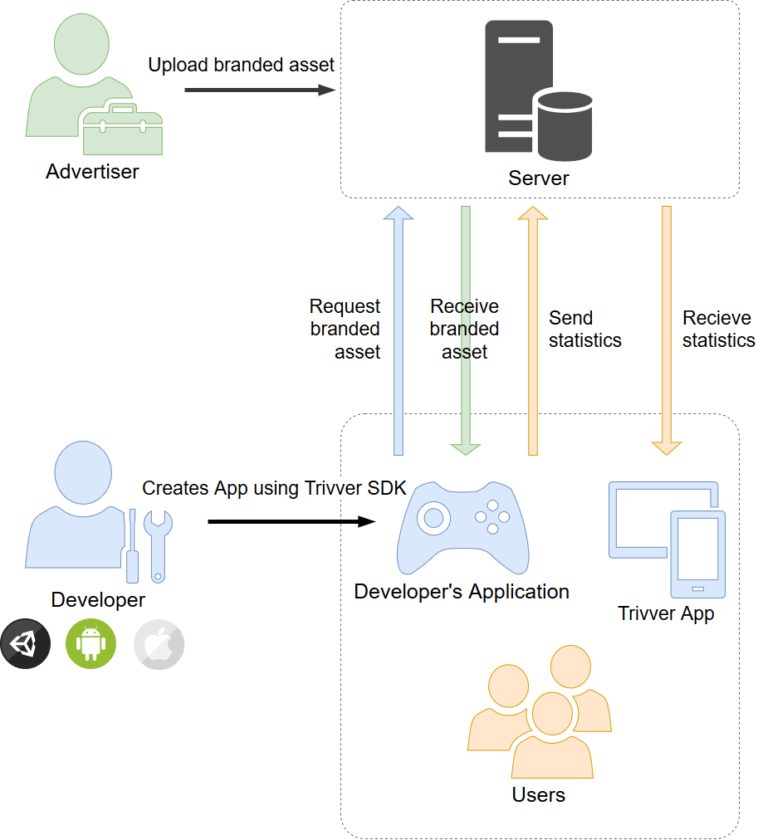
Here is a diagram flow which illustrates how Trivver will work:
There are 3 main stakeholders in the Trivver network:
Advertisers: Advertisers can create contextual, enriching and personalized XR ad campaigns – through smart objects – that are integrated with the necessary information that relates to branding, offers and various call-to-action. Consumer data would also be automatically collected through Smart Objects, which would provide valuable insights for the advertisers.
Publishers: Publishers can monetize their platform (website, mobile applications etc.) with XR-denominated ad space that is native to the context of the environment. User data would also be available for publishers to enhance user experience and effectively index their content.
Consumers:Customers are incentivized to earn native tokens in return for their time, attention span and data.
Extended reality is an exciting technology that can be applied to various use cases that include:
Online Gaming
Virtua Real Estate Tours
Virtual Reality Experiences
Augmented Retail Shopping
(See more: Guide to Cryptocurrency Liquidity: Understanding Liquidity & Its Importance)
Technical Overview
It seems that Trivver will create their native blockchain with smart contract functionality. The use of blockchain will be geared towards its XR ad exchange, where transactions on the platform will be managed, executed and recorded in the blockchain. There are 5 core components of Trivver’s ecosystem, that include:
XR Ad Exchange (XRAE):The core component of Trivver’s solution is XRAE, a platform that connects buyers and sellers of XR ad inventory. It allows agencies, network or advertiser to conceive, run and track highly-targeted ad campaigns in any XR environment (which include desktop applications and mobile applications). This is where Trivver’s native blockchain and smart contract functionality comes into play:
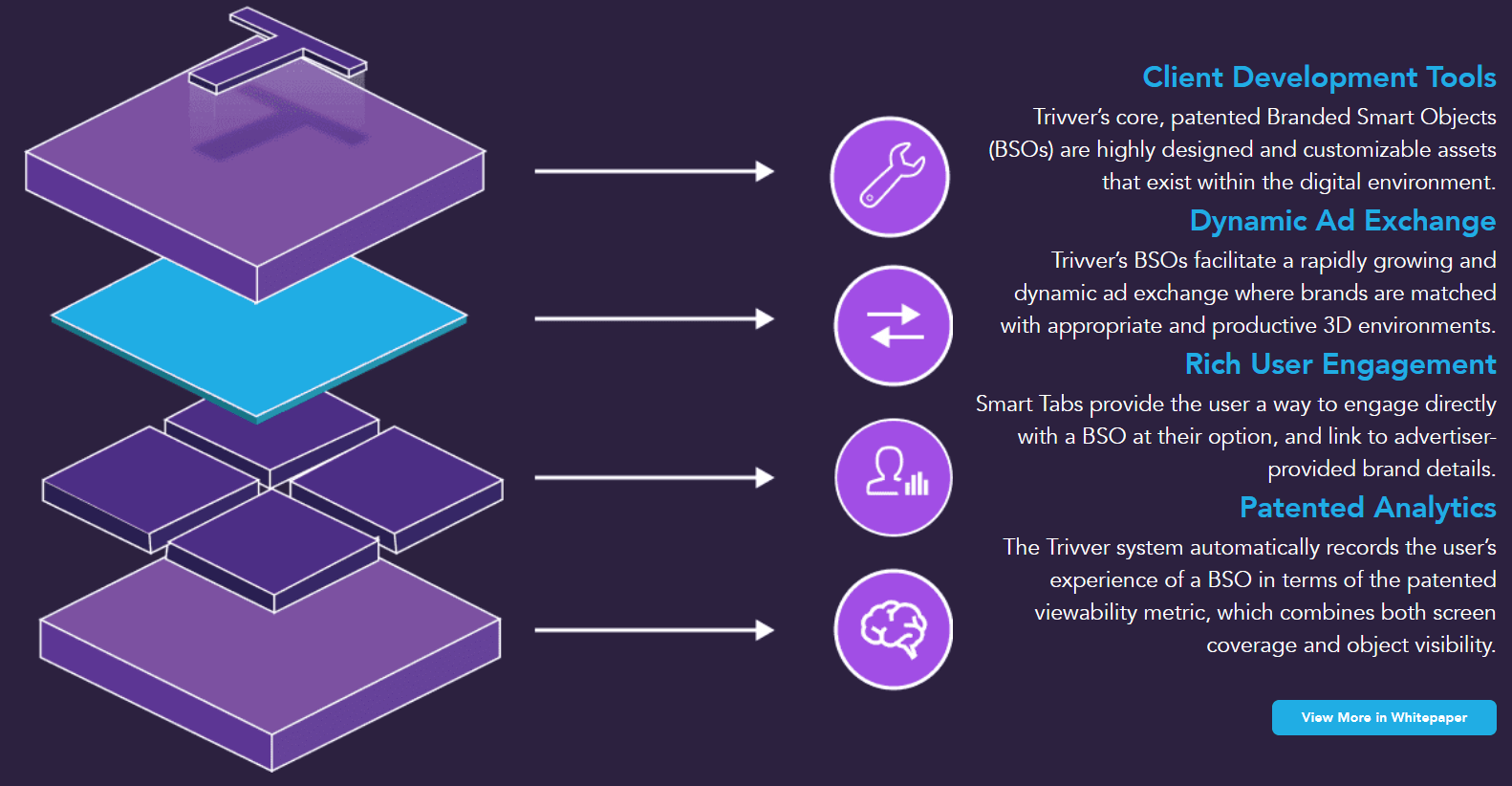
3D Asset Editor:Trivver’s native application that facilitates the conversion of advertisers’ 3D brand model to a Branded Smart Object (BSO). BSOs are basically customizable assets which exist within the natural setting of digital environments, with the purpose of disseminating information to consumers about the digital object (such as business branding or product offers) and collecting user data. Trivver’s asset editor will ensure that the advertisers model is automatically-sized and oriented across any XR environments.
Software Development Kit (SDK): A toolkit for developers and content creators to embed their XR environments with ad spots for BSOs
Smart Object Catalog:A comprehensive library of Generic Smart Objects (GSOs) models, which will be used by content developers to create their XR environments and populate ad spaces with Smart Objects (such as furniture, motor vehicles, appliances, design elements, sporting and outdoor equipment). GSO’s are the foundation for creating BSOs.
The difference between GSO and BSO is that GSOs are the baseline template for smart objects while BSO is integrated with branding information, such as SKU data, product offers, social media links, coupons and other calls-to-action
Trivver Data Engine (TDE):An extension of Trivver’s functionalities, TDE harvests user data collected from BSOs to construct algorithms which can predict user behavior and serve ads to users based on their unique histories and preferences. With patented, native technologies integrated into the TDE.
Unique Selling Point
There are several elements that make Trivver stand out:
Patent-Protected Technology:Trivver holds a comprehensive library of patents within the XR advertising solutions market. This is a strong moat to deter competitors in a lucrative market.
Automated Scaling of Smart Objects:Trivver’s patented technology allows smart objects to be auto-scaled dynamically in correct proportions across any XR environments, thereby preserving its authenticity. This has been a major challenge for advertisers and publishers in the XR industry.
(Read more: Analyzing Cryptocurrency Risk: Existing Coins vs ICO)
Team
Here is Trivver’s team:
Trivver is led by Joel LaMontagne (CEO), a computer scientist that designed the algorithms driving Trivver’s technologies and platform. He is currently the custodian of an extensive array of several design and software patents, and is a notable member of the Association of National Advertisers (ANA) and the Interactive Advertising Bureau (IAB). Alongside Joel is Alan Haft (President), a serial entrepreneur that is has been involved in major acquisitions, most notably the acquisition of Day Software’s US branch by Adobe for $240 million. He is also a public commentator on the field of business and technology. Another notable mention is Trivver’s Chief Data Officer, Kevin Conroy, who was the president of Digital and New Platforms at Metro-Goldwyn-Mayer (MGM). Kevin has garnered impressive accolades that include being recognized as a “Digital All-Star” by Broadcasting & Cable and included as “25 Executives to Watch” by Digital Media Wire.
The bulk of Trivver’s team is made up of business and sales executives, with only the CEO and CTO having technical expertise in software engineering. Unfortunately, there isn’t anyone in the team that has prior blockchain expertise. (See more: Guide to Centralized Cryptocurrencies: What Makes a Coin Centralized?)
Traction
Partnerships
Trivver has secured several partnerships that include:
Advantego Corporation: A public-listed company specializing in digital communications and intelligent software solutions
Immersive Entertainment: A developer and publisher of Virtual Reality Entertainment Software
Private Beta
Trivver’s platform is currently at private beta stage, accepting a limited number of interested applicants. For those wanting to test out their beta, you can sign up here.
Roadmap
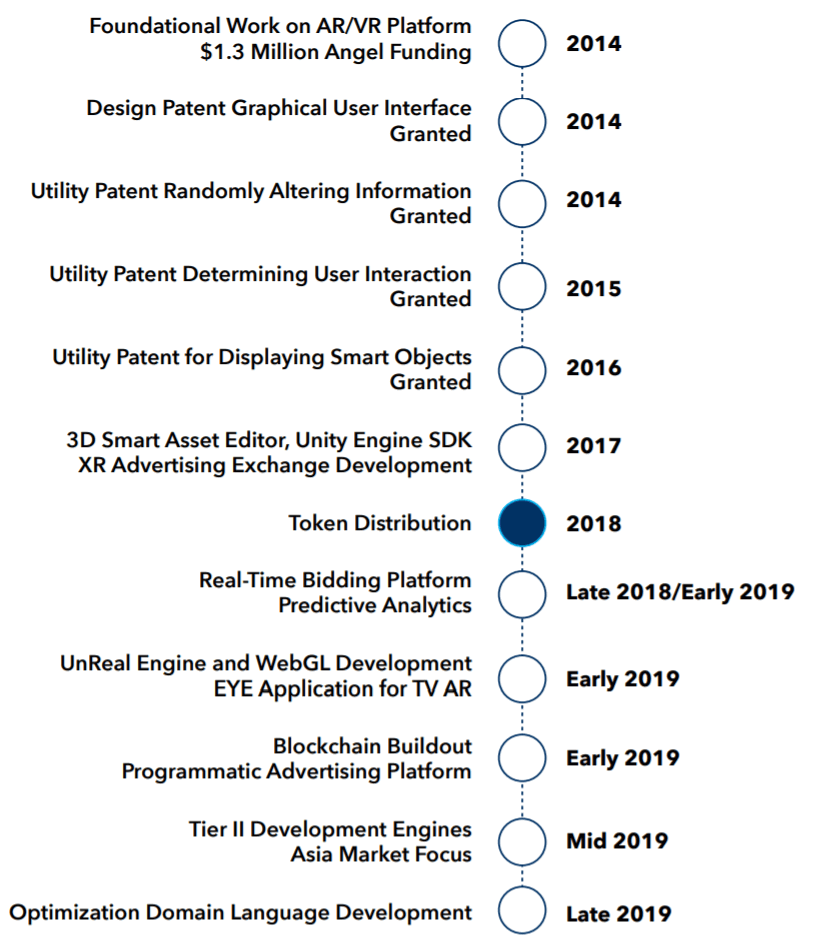
Here is Trivver’s roadmap:
Development of Trivver’s solution began in 2014, with initial investment from angel investors. Since then, Trivver has been developing its technologies and patenting them. Trivver’s native blockchain will be developed in early 2019, with its real-time bidding platform being the top priority at the moment.
Token Economics & Utility
Token Metrics
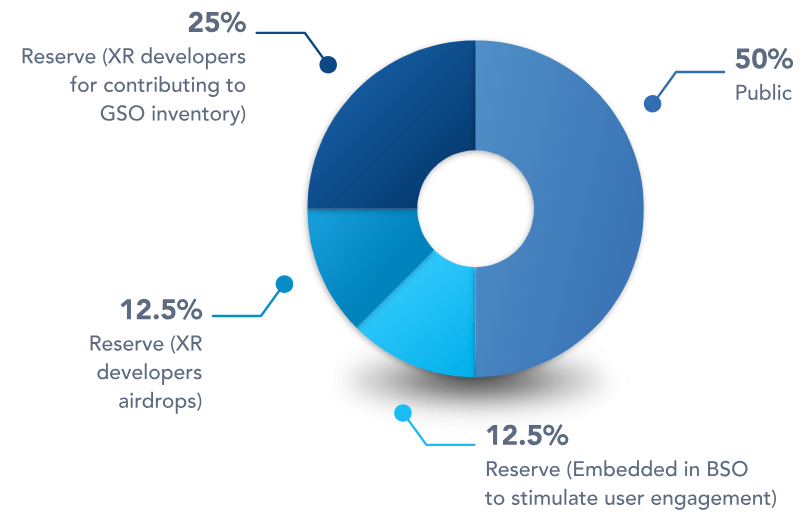
50% of the total token supply will be allocated towards a reserve fund aimed towards facilitating growth of the Trivver network; developers will be incentivized to contribute to Trivver’s catalog while users can earn native tokens for their time. A point of ambiguity is the sustainability of the reserve fund, which doesn’t seem to indicate any mechanism to enrich the fund.
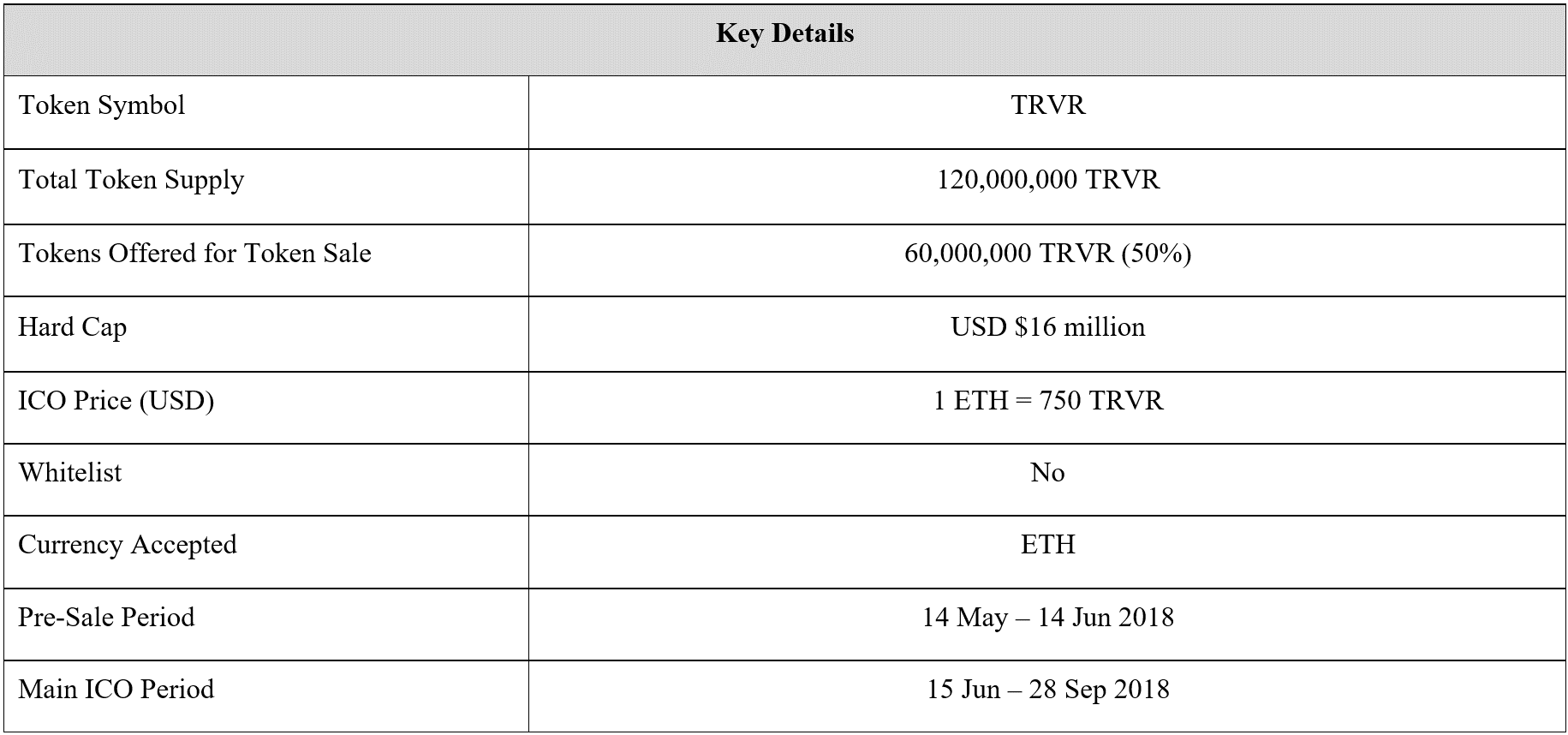
Trivver’s hard cap is relatively at the lower end, but in this bear market, it is understandable that there will be challenges to hit their hardcap.
(See also: Coins, Tokens & Altcoins: What’s the Difference?)
Token Utility
Trivver’s native coin is an ERC 20 token called TRVR, which is built on the Ethereum blockchain. TRVR is a utility token with the following use cases:
Main Currency: TRVR will be the main currency in Trivver’s ecosystem, which is required to interact with the platform’s key components. TRVR will be also used as the settlement medium between for users that will utilize Trivver’s platform
Discounts: Token holders will be entitled to discounts across Trivver’s services, which will incentivize TRVR usage
TRVR’s supply is fixed, with no further increase in supply. There will be a burning mechanismwhere TRVR tokens used for payment will be burnt over time. This will gradually lead to a decrease in token supply. There is no mention of how this mechanism would actually work, and further clarity must be needed. In general, a reduction in token supply is beneficial to the long-term valuation of the coin; a higher network usage will result in greater demand for the coins and token prices would increase, since TRVR’s supply would be reduced through the burning mechanism. On that alone, we’re positively favouring the token economics.
(Read also: Crypto Trading Guide: 4 Common Pitfalls Every Crypto Trader Will Experience)
Strengths
Lucrative Market Potential:The Extended Reality industry is a lucrative market with massive potential and is expected to grow in excess of $200 billion by 2022 from its current value of $20+ billion.
Patented Technology:Trivver holds an extensive library of patents pertaining to their technology, ranging from their smart object technology to artificial intelligence processes. From a corporate standpoint, patents deepen an entity’s economic moat. This could protect them from competition in the future.
Technological Advancement: Trivver’s technology allows smart objects to be auto-scaled dynamically in correct proportions across any XR environments. This would streamline the XR advertising space considerably and allow for high network scalability, since smart objects can be used in any XR environments.
Burning Mechanism:TRVR tokens will be burnt with payment usage on the platform, which would enhance the long-term valuation of TRVR since its supply would be diminishing. This assumes that demand is constant or growing, proportionate to Trivver’s network usage.
Strong Team: Trivver’s top management is made up of highly capable individuals with entrepreneurial experience and expertise in business management and software engineering. The
Weaknesses
Limited Reserve Fund:50% of Trivver’s total supply would be allocated towards ‘Reserve’, which will stimulate growth by incentivizing developers and consumers to participate in the network. However, there is no mention of any mechanism to enrich the reserve fund; once the reserve runs out the incentives run out. Unless Trivver is planning to create their native blockchain and reveal further blockchain-specific details, this is a point of ambiguity.
Lack of Blockchain Expertise:There seems to be a lack of blockhain-oriented individuals in the Tirvver team. Though its CTO (Simon) is well-versed in the gaming industry, his Linkedin profile doesn’t seem to suggest blockchain-related experience. There are also no blockchain expertise on the advisory board.
Lack of Technical Details:There is no mention of the technical specification and implementation of Trivver’s blockchain in its white paper. This makes is hard to assess the scope and depth of the project. It is noted in the roadmap that the Blockchain functionality would be created on early 2019. There is also no mention on their go-to market strategy, which is a vital component to attract a viable community.
Summary
The market opportunity of extended realities is huge; more so finding and specializing in a niche in the XR industry. Trivver’s solution towards advertising in the XR space could stand to be a market leader in the niche, especially so when they are well-insulated with their extensive library of patents protecting their technologies. As it stands, the project is still at the private beta mode and there are fundamental aspects that need to be clarified, especially regarding the blockchain aspects.
Verdict: Good Project
(Read also: Evolution of Cryptocurrency: Replacing Modern Cash)
Beneficial Resources To Get You Started
If you’re starting your journey into the complex world of cryptocurrencies, here’s a list of useful resources and guides that will get you on your way:
Trading & Exchange
Crypto Guide 101: Choosing The Best Cryptocurrency Exchange
Guide to Bittrex Exchange: How to Trade on Bittrex
Guide to Binance Exchange: How to Open Binance Account and What You Should Know
Guide to Etherdelta Exchange: How to Trade on Etherdelta
Guide To Cryptocurrency Trading Basics: Introduction to Crypto Technical Analysis
Cryptocurrency Trading: Understanding Cryptocurrency Trading Pairs & How it Works
Crypto Trading Guide: 4 Common Pitfalls Every Crypto Trader Will Experience
Wallets
Guide to Cryptocurrency Wallets: Why Do You Need Wallets?
Guide to Cryptocurrency Wallets: Opening a Bitcoin Wallet
Guide to Cryptocurrency Wallets: Opening a MyEtherWallet (MEW)
Read also: Guide on Privacy Coins: Comparison of Anonymous Cryptocurrencies and Guide To Cryptocurrency Trading Basics: Do Charts & Technical Analysis Really Work?
This represents the writer’s personal opinions and does not – in any way- constitute a recommendation of an investment or financial advice. Please assume caution when investing in cryptocurrencies and do so at your own risk, as it is extremely volatile and you can lose your money.
Enroll in our Free Cryptocurrency Webinar now to learn everything you need to know about crypto investing.
Get our exclusive e-book which will guide you on the step-by-step process to get started with making money via Cryptocurrency investments!
You can also join our Facebook group at Master The Crypto: Advanced Cryptocurrency Knowledge to ask any questions regarding cryptos!
Aziz, Master the Crypto Founder
I’m Aziz, a seasoned cryptocurrency trader who’s really passionate about 2 things; #1) the awesome-revolutionary blockchain technology underlying crypto and #2) helping make bitcoin great ‘again’!
The post ICO Analysis: Trivver ICO Review appeared first on Master The Crypto.
Amazon Web Services (AWS), Amazon’s subsidiary in charge of cloud computing services, has announced that the Ethereum Network has now been integrated to allow users to provision Ethereum nodes and connect to the network in a matter of minutes.
The service only supported Hyperledger in the past but will now also support not only Ethereum’s mainnet but also testnets like Rinkeby and Ropsten.
The announcement says that the service “monitors node health, replaces unhealthy nodes, and automates Ethereum software upgrades, improving the availability of customers’ Ethereum infrastructure”, greatly simplifying the network creation process.
Amazon’s Interest in Blockchain Keeps Growing
Amazon Managed Blockchain is an AWS feature aimed to allow developers to create and manage private networks in different blockchain networks without requiring a high level of technical knowledge due to its intuitive and easy-to-use interface.
The service was launched back in April of 2019, about 5 months after the initial announcement in 2018’s re:Invent event. While the tech giant said that Ethereum would be supported by the platform, it took it almost 2 years to actually integrate the most popular network into its infrastructure.
Etherscan data shows that more than 8.3k nodes are currently running on the Ethereum network, an increase of 10.6% over the number of nodes running last month.
With the price of the network’s cryptocurrency increasing and the deployment of Ethereum 2.0 getting closer, AWS’s endorsement should prove to be beneficial when it comes to gaining adoption.
New Tools for Markets and Data
Ever since its start as an Online Bookstore back in 1994, Amazon has been increasing its dominance over different markets to become the third-largest company in the world when it comes to valuation, following Apple and Microsoft.
The company has been known to be an earlier adopter of new technologies, which has allowed it to keep its competitive edge. Now, the company seems to be preparing to develop and launch its own digital currency project in Mexico, according to job openings published on the company’s website earlier in February.
While the project has not yet been officially announced, the job post for the “Software Development Manager – Digital and Emerging Payments” position states that it is “chartered to innovate on behalf of our customers in emerging markets and for digital businesses worldwide in the payments space”.
The post also says that the initial launch country will be Mexico and will allow customers to convert their cash into digital currency to use on online services or the purchasing of goods.
It is still not clear if the tech giant is planning to create a new digital currency or to integrate existing cryptocurrencies into their platforms. However, Amazon launched a type of digital currency known as “Amazon Coins” which allowed customers to purchase products and online services.
AWS CEO is Set to Replace Jeff Bezos as Amazon CEO
Bezos announced back in early February that he would be leaving the position as Amazon’s CEO to focus on new ventures. Andy Jassy, the current CEO of Amazon Web Services, is set to replace Bezos as the leader of the tech giant once he steps down.
Jassy has been known to consider the potentials blockchain technology could have when it comes to improving Amazon’s operation by using it for more than distributed ledgers. As the CEO of AWS, he oversaw the development efforts and launch of the Amazon Quantum Ledger Database and Amazon Managed Blockchain which as previously mentioned, just integrated the Ethereum Network.
While the incoming CEO has been clear in saying that the company does not jump on the bandwagon when it comes to developing new technology because it is “cool”, his previous statements and recent moves by the company suggest that Amazon is ready to start exploring blockchain technology applications in the near future.
With the Blockchain ecosystem growing at a rapid rate as retail and institutional investors turn their attention to cryptocurrencies, as well as developers integrating the technology into their platforms, the time is great for companies to start experimenting with the use of blockchain to improve their technological and economic models.
The post Amazon Adds Support for Ethereum on Amazon Managed Blockchain appeared first on Blockonomi.
The popular oracle network Chainlink announced the launch of Chainlink Off-Chain Reporting (OCR) on February 24th, which is a highly anticipated upgrade that has been months in the making.
Chainlink claims that OCR will not only significantly improve the efficiency of the network’s data computing but it will also reduce costs by up to 90% to enable users to save in gas fees and boost adoption.
Gas costs have been the bane of Decentralized Finance (DeFi) platforms since 2020 due to high Ethereum gas prices and the difficulties that migrating to another network would imply.
The upgrade in Chainlink’s mainnet is expected to help alleviate these costs to some extent and improve the status of the DeFi niche. These costs have become prohibitive for many applications, and remove the utility of the platform for low-value applications.
According to the announcement, users will see a 10 times increase in the data that can be handled by smart contracts, which should allow new applications to emerge as new datasets become available.
The OCR update will also further decentralize the oracle network, increase the frequency of on-chain updates, improve the cost-efficiency of onboarding new nodes, reduce congestion on the chain, and reduce oracle latency.
The Future of Chainlink
Before this update, a great part of the computations realized by chainlink was taking place on-chain, which resulted in less scalability, lower efficiency, and higher computational resources being needed.
With this update, chainlink is transitioning toward an off-chain computation model in which the network will be able to function in situations where conditions are not optimal, creating a more scalable ecosystem.
Sergey Nazarov, Chainlink’s founder, said in an interview with media that the development team will be working on verifiable randomness, keeper functions, and fair sequencing, all of them with applications on the DeFi and gambling niches.
Verifiable randomness has been worked on by chainlink for over a year with iterations of it already being available.
Known as chainlink VRF, this feature allows smart contracts to increase their resilience against bad actors by creating unpredictable but verifiable cryptographic proofs that allow the network to remove malign nodes.
New Functions for Better Performance
Keeper functions and pair sequencing improve the stability of the network by improving coordination between nodes and standardizing computational procedures.
As oracle networks are all about handling and serving data requests, improving the datasets that a smart contract can handle and ensuring its availability is essential o preserve the functionality of the network, benefiting all the parties involved.
Chainlink’s token, LINK, has recently seen its price reach an all-time high of $36.95 back on February 20th, more than twice the value that saw the project made headlines in August of 2020 as it became one of the most widely known projects in the crypto sphere.
Chainlink Virtual Hackathon: Accelerating Innovation in the Smart Contract Ecosystem
Chainlink has also recently announced that it has partnered with AAVE, Consensys, Polkador, Synthetic, and other companies to run a virtual hackathon from March 15th to April 11th.
The hackathon will see developers from across the globe collaborate with each other, hear from experts in the industry, and learn about new projects. The event will also have an $80k prize pool to be distributed as bounties in categories like DeFi and Gaming.
Chainlink Co-founder Sergey Nazarov, Avalanche Founder Emin Gün Sirer, and Aave Co-founder Stani Kulechov are some of the biggest personalities that will be participating in the event.
Historically, Hackathons have been a major source of innovation in the tech industry by allowing experts of all areas to join their efforts in developing new applications for different technologies, with the best project usually receiving direct support from the organizing companies.
The post Chainlink Off-Chain Reporting (OCR) Goes Live: Boosts Efficiency of Network appeared first on Blockonomi.
Pylon.finance is a newly launched project that aims to create profits from Ethereum and the Decentralized Finance (DeFi) ecosystem, while providing an independent mining platform and token that is less influenced by the open market.
Working towards that vision, Pylon.finance was announced in June 2020, introducing an efficient and competitive way of mining and yield farming ETH.
Pylon.finance stands out from other DeFi networks by building a token backed with “tangible real-world income-generating assets”, and using its GPU mining asset to generate value. Pylon.finance has one of the largest GPU mining operations in the USA.
The $PYLON token is also unique. It is only semi-correlated to the price of Ethereum, which makes it more stable regardless of unexpected market fluctuations. While the price of ETH may fall, the profits from the mining operation won’t fall at the same rate.
Even in a bear trend, $PYLON’s price can be maintained compared with other cryptocurrencies.
What is Pylon.finance All About?
The founder of Pylon.finance is pseudonymously known as Grim Reaper, and together with a team with 6+ years of experience running the US’s largest GPU mining, the team has brought $PYLON to the market.
The team is dedicated to the project, as none of its members receive a distribution in the released tokens or any other compensation.
As the founders are equal to normal users, the team members will likely adhere to the ultimate goals of the project – as they would receive nothing if they left.
One more remarkable strategy that Pylon.finance uses is a 100% crowdsourced implementation without any traditional advertising.
According to statistics, despite no presale, and no ICO, the project was able to gather $1.15 million USD completely by word of mouth. Besides Pylon.finance, the team also started seven other farms to create a wider community in the crypto mining sphere.
The $PYLON Token is Built to Earn
$PYLON is the utility token issued by Pylon.finance, and it also allows its holder to earn along with the mining platform.
The $PYLON token takes a portion of GPU mining profit and adds it to weekly buybacks for buying $PYLON that ends up in the hands of token holders. This mechanism empowers token holders and helps to keep market movements in check.
The token was launched in the 3rd quarter of 2020. $PYLON is fixed at a total amount of 8,400 and was distributed entirely by word-of-mouth marketing.
As there was no presale, no initial coin offering, and no predetermined allocation for the developing team, everyone had the same shot at buying the token.
PYLON GPU VAULT
Pylon GPU Mining
GPU mining is a very popular method for crypto mining, especially for Ethereum, one of the largest cryptos in the world.
Unlike other networks in which mining profits are substantially affected by the ETH price and market movements, Pylon.finance nourishes its GPU mining and yield farming from its own income generated by the real-world tangible mining farm.
Pylon.finance’s GPU mining works with staked $PYLON tokens or the $PYLON/ETH liquidity pool tokens in its vault, which receive rewards in ETH from fuel fees when mining Ethereum.
The new ETH earnings are used to purchase $PYLON from the open market and distribute them to stakers. This repeating cycle, so-called Buybacks, will keep the entire network growing constantly and enlarging the total value for token staking.
How to Join and Earn With Pylon.finance
Newcomers can take part in Pylon.finance either as a miner or a liquidity pool (LP). After staking $PYLON or PYLON/ETH Uniswap tokens into the network vault, it goes to GPU mining farms where ETH transactions are mined and holders can earn rewards from gas fees.
As one of the largest ETH mining operations in the USA, PYLON runs at a speed of about 1 billion KH/s, and is able to generate over 2,600 ETH per day (according to records on the ETH mining pool hub).
Then, the buybacks will utilize the ETH rewards to purchase an additional $PYLON to add to the circulating supply and raise the value of tokens held by users.
Initially, there was a crowdsourced seed of $1 million USD placed in the PYLON GPU vault, with the Annual Percentage Yield (APY) at 33%, equivalent to $324,000 USD in buybacks.
Over time, the mining size will be scaled-up further with more value-added for every holder.
Pylon.finance covers other fees for extra costs, including insurance, Internet, equipment maintenance, warranty claims and swaps, emergency, hardware management.
Pylon’s Values
With new features built into its platform, Pylon.finance is confident that it can create benefits for both the business sector and individual participants.
Pylon.finance not only provides a focal point for crypto projects to connect with GPU mining with real-world asset backing but also gives crypto investors freedom to do mining and trading in new ways.
Many existing DeFi networks are demanding that existing users attract new members to sign up and contribute to the mining operation. Pylon.finance doesn’t use this approach at all.
With its unique Buybacks mechanism, new money will continue pouring into the Pylon ecosystem along with the mining process, ensuring the value preservation of $PYLON token.
This design makes Pylon.finance a fascinating option for crypto holders as well as traditional investors who prefer safer ways when investing their capital.
Currently, Pylon’s users can earn an APY of up to 250% and no less than 33% in a downtrend. The Total Value Locked (TVL) will keep rising as more tokens are bought via Buybacks.
Pylon.finance Makes System Security a Top Priority
As it is backed by real-world tangible assets, it is impossible to copy or replicate $PYLON tokens, which means it is non-forkable.
There is no way a single user could manipulate a majority of tokens on Pylon.finance. In addition, in order to prevent code tampering, a protocol was deployed to burn the admin keys $PYLON token was launched.
The team at Pylon.finance put a lot of thought into how to build a solid system, and from the looks of it, they have created a very attractive way to invest in the future of ETH.
A Shining Future
Pylon.finance is seizing good opportunities to overcome other DeFi platforms, and offer the market a unique value proposition.
Thanks to the real-world assets backing for its token instead of arbitrage or collateralization, as well as the magic of Buybacks, the network has unlimited buying pressure which opens up scalability and long-term viability.
Despite a low initial coin supply potential of Pylon is high, and the $PYLON token may gain a substantial amount of value. It also creates real returns, which many tokens can’t match.
The platform has so far saved 1.15 million USD into its GPU vault, and whenever a new member participates and stakes $PYLON tokens, he/she can start to benefit from dividend payments and Buybacks in no time.
According to Pylon’s founder’s prediction, ETH will undergo a pump to exceed USD 2,000, followed by a correction period, mostly depending on the market forces.
This prediction appears to be coming true, as ETH is trading above $2,000 USD at the time of writing.
In the 1st quarter of 2021, Pylon.finance will continue to widen its real-world mining operations based on the existing resources, while putting effort into generating more income for long-term growth.
To keep up-to-date with the latest developments, you can visit its website or join Pylon communities on Telegram, Twitter, or Discord.
The post Pylon.finance: Crypto Token Backed by Ethereum Mining Operation appeared first on Blockonomi.
Unstoppable Domains, a San Francisco-based startup focused on creating domains in blockchain, has announced that Cloudflare has enabled native resolution of .crypto domains.
The platform allows people to use public blockchains to host websites, which are likely harder to take offline, as blockchain isn’t able to be easily censored.
The integration will allow more than 500.000 domains using the .crypto blockchain domain to get mainstream adaptation by facilitating access for millions of internet users around the globe by using any web browser without the need for specialized software.
While blockchain domains have continued to gain popularity over the years, they have failed to gain mainstream appeal beyond cryptocurrency enthusiasts and decentralized internet advocates due to their technical nature and setup process traditionally required to access them
Now, internet users will be able to access .crypto domains just by changing a simple setting in their everyday web browsers, giving them access to the decentralized web and benefit from a truly neutral internet.
Back on February 9th, cryptocurrency exchange OKEx became one of the first exchanges to integrate support for blockchain-based addresses using Unstoppable domains for outgoing transactions, following Huobi and Coinbase’s example.
Harvesting the Power of Cloudflare Technology
Cloudflare’s Distributed Web Resolver was announced by the company back on January 13th of 2021 as a result of its research team’s efforts on finding alternatives to resolve queries that satisfied the necessities of decentralized protocols like InterPlanetary File System (IPFS) and Ethereum.
The Domain Name System (DNS) allows users to surf the web by using easily memorable URLs like “blockonomi.com” instead of http://199.188.207.53/, making the internet easier to access for users.
Distributed systems like Ethereum and IPFS are not compatible with DNS due to their intrinsic properties, forcing companies to implement different solutions such as specialized web browsers or plugins to connect.
Cloudflare is one of the leading companies providing web infrastructure and security services, allowing web services to increase their performance and security against DDoS attacks.
Now, with the integration of decentralized protocols, Cloudflare will play an essential role in the development and adoption of the decentralized web (web3).
The Decentralized Web Movement is Gaining Momentum
While blockchain technology has seen most of its success in areas like cryptocurrencies and financial platforms, other applications like Non-Fungible Tokens (NFT) and web3 have continued to gain support over the last few months.
Unstoppable Domains originally offered a way to facilitated crypto transactions by making it similar to sending mail, but it soon started expanding its horizons and applications to become one of the biggest players in Web3.
Web3 advocates see this transition to a decentralized web as an essential step in the return to the original web, where according to its creator Tim Berners-Lee “no permission is needed from a central authority to post anything, there is no central controlling node and no single point of failure.”
With concerns over censorship, monopolization, and privacy concerns on the grow each day, users who had never paid special attention to how they use web services have started to pay attention.
Matthew Gould, CEO of Unstoppable Domains, referred to these concerns by stating:
“In a time when data breaches have become commonplace, while privacy and ownership over an individual’s own digital assets are paramount, centralized control has been called into question by many forward-thinking people and companies. This new system is different. It puts the control back where it should be, back in the hands of the user.”
This has been reflected in the increasing popularity of messaging apps like Telegram and Signal among privacy concerns related to Whatsapp and Facebook messenger, increasing use of Parler by Twitter users who were banned from the platform, and the ever-growing interest in Decentralized Apps (dAPPs).
The post Unstoppable Domains & Cloudflare: Allows Any Browser to Access Ethereum-Based Domains appeared first on Blockonomi.
Everyone was shocked when US Oil prices hit zero and global futures contracts fell hard into negative territory.
Such an event had not been anticipated by the team at the EMX exchange.
The team halted trading of its USOIL-Perp contract.
Trading of the perpetual contract is yet to be reopened as the team decides on a way forward.
Yesterday’s price movement of US Crude Oil shocked everyone. The majority of traders were confident that the price of the precious commodity would not break the various support zones that were last seen in the 1980s. However, the WTI Crude Oil chart went right through the decades’ strong support zones at $15, $12 and $9. The price per barrel went to zero as futures contracts went into negative territory as low as $-40.
EMX Exchange Halts Trading of its USOIL-Perp
Such a scenario of negative prices of US Oil futures contracts had not been anticipated by the team at the EMX Exchange. As a result, the team decided to halt the trading of its USOIL-Perpetual contract. The screenshot below shows that trading was stopped at 18:00 (UTC) on the 20th of April. The last price of the USOIL-Perp contract was $3.48. This is after its value almost hit zero.
USOIL-Perp Chart courtesy of EMX.com
Unexpected Sequence of Events
As earlier mentioned, very few traders and investors had anticipated that the price of US Crude Oil futures contracts would go into negative territory. The team at EMX has also explained that such a scenario had not been planned for. They have since issued the following statement via Twitter explaining the situation at hand.
We are currently investigating ways to move forward with USOIL-PERP due to negative underlying prices, an edge case that we had not built for.
Additionally, the team has halted withdrawals as they verify all transactions. They explained this in a follow up of the first announcement.
For those of people who concerned about withdrawal, we are manually verifying all transactions and everyone should get it back within 1-3 business days. We apologize for the inconvenience.
For those of people who concerned about withdrawal, we are manually verifying all transactions and everyone should get it back within 1-3 business days. We apologize for the inconvenience
— EMX (@TradeEMX) April 21, 2020
What’s Next for USOIL-Perp Traders on EMX?
As the stoppage only affects the USOIL perpetual contract, trading of other contracts on EMX is still much active. However, traders who anticipated the Crude Oil meltdown and decided to go SHORT, might have to wait till the team at the exchange decides on a way forward.
More About EMX Exchange
Founded in 2017, the Evermarkets Exchange (EMX) has a vision of revolutionizing the global derivatives markets. The exchange does this by allowing users to trade contracts on equities, currencies, commodities as well as popular cryptocurrencies. The latter includes perpetual contracts on Bitcoin (BTC), Ethereum (ETH), EMX token, ChainLink (LINK) and Tezos (XTZ).
(Feature image courtesy of Erwan Hesry on Unsplash.com.)
Disclaimer: This article is not meant to give financial advice. Any additional opinion herein is purely the author’s and does not represent the opinion of Ethereum World News or any of its other writers. Please carry out your own research before investing in any of the numerous cryptocurrencies available. Thank you.
The price of US Crude oil fell hard to $0 with its futures contracts going as far down as $-40.
The once in a lifetime event, shook the crypto markets with Bitcoin (BTC) going back below $7,000.
At the time of writing this, the price of Ethereum (ETH) is holding the $168 support zone.
Analysts across the world have constantly been calling for a recession but no one was prepared for yesterday’s (April 20th) price action of US Crude Oil. The commodity fell hard to $0 per barrel with its futures contracts going down to negative territory. In the case of the latter, futures on US Crude Oil were at one point trading at $-40. However, and at the time of writing this, US Oil is currently trading at around $16.6 per barrel and $16.90 for its futures contracts. The aforementioned chaos did its fair share of damage to the price of Ethereum (ETH) as shall be elaborated.
Ethereum’s $168 Support Zone Holding Well
In one of our previous analysis of ETH/USDT, we had noted that the price of Ethereum was back in bullish territory. We had cited two reasons as to why this was so: Bitcoin’s dwindling dominance in the crypto markets and the prospects of ETH 2.0 launching later on this year. We had also identified $168 as a very strong support zone for the King of Smart contracts.
Revisiting our favorite ETH/USDT chart, we observe the following. In terms of lower time frame support zones, Ethereum has the following:
$168
$164
$162
$154
$150
$148
Ethereum’s current price at $170 is above the 50, 100 and 200 Moving averages thus providing one reason to still be optimistic that $200 is achievable.
However, the MACD has crossed in a bearish manner and the MFI also indicates that ETH/USDT is on course to retest some of the support zones identified above. Additionally, trade volume seems to be reducing in tandem with the rest of the cryptocurrencies in the markets including Bitcoin.
ETH 2.0 Progress
The Ethereum 2.0 testnet was successfully launched on the 18th of this month and has almost 20,000 validators in the few days that it has been active. The Mainnet launch is still on course to happen in July of this year.
Conclusion
On 20th April, we witnessed a history meltdown of the American crude oil prices as suppliers ran out of space of storing the commodity due to decreased demand. This is as a result of the global impact of COVID19. This meltdown affected both Bitcoin (BTC), Ethereum (ETH) and the majority of the cryptocurrencies in the markets. In the case of ETH, the coin is still holding the $168 support zone despite the oil crash. With the ETH 2.0 launch only days away, the coin might just live up to expectations of reclaiming $200. However, as with all Technical analysis, investors and traders are advised to use adequate stop losses to protect their trading capital.
(Feature image courtesy of Victor Freitas on Unsplash.com.)
Disclaimer: This article is not meant to give financial advice. Any additional opinion herein is purely the author’s and does not represent the opinion of Ethereum World News or any of its other writers. Please carry out your own research before investing in any of the numerous cryptocurrencies available. Thank you.
A new report by eToro and The Tie shows that the number of Twitter users discussing XRP has fallen drastically.
The report also indicates that members of the XRP army have continued to decline since January 2018.
The new stats could indicate a continuous trend of capitulation by XRP investors.
Times have drastically changed for XRP since the exciting days of late 2017 and early 2018. Back then, XRP was also known as Ripple and the company had yet to issue a statement explaining that the two were different entities. Additionally, XRP was trading at a premium of $3.84 due to the prospects of being listed on Coinbase in early 2018. However, this did not materialize until later. This was due to the uncertainty as to whether XRP was a security or not. In February 2019, XRP was finally listed on Coinbase at a time when it was trading at $0.32.
XRP Army Numbers Continue to Dwindle
A new quarterly report by the teams at eToro and The Tie shows that the number of Twitter users discussing XRP has fallen by 16% in the first quarter of 2020. Additionally, the number of Twitter users in the XRP army has fallen by more than 50% since October 2018 and by over 82% since January 2018. The full statement from the report can be found below.
Over the first quarter of 2020, the number of Twitter users discussing XRP fell by 16% and price declined by 9.51% (a relative 2.14% outperformance vs. Bitcoin). The number of Twitter users in the “XRP Army” (the name given to the cryptocurrency’s supporters) has fallen by more than 50% since October 2018 and declined by over 82% since January 2018 highs. For comparison, the number of Twitter users discussing Bitcoin dropped by 58% from all-time highs.
More Trouble for the Price of XRP?
Using pure logic, a drop in the number of members in the XRP Army means that holders of the coin have finally thrown in the towel and sold their holdings.
In the past few months, there has been cases of XRP community members notifying the crypto community, that they have sold all their XRP holdings. One such member is Tiffany Hayden who sold her bags as a result of constant bullying by XRP supporters. Ms. Hayden expressed her dissatisfaction with the community through the following statement.
I’m not holding $XRP anymore, XRP supporters, so find something else to talk about.
I’m not holding $XRP anymore, XRP supporters, so find something else to talk about. From my mom just now. So fucking pathetic. pic.twitter.com/g9Jtoey5sC
— 𝚃𝚒𝚏𝚏𝚊𝚗𝚢 𝙷𝚊𝚢𝚍𝚎𝚗 (@haydentiff) March 9, 2020
Brief Market Analysis of XRP/USD
6-Hr XRP/USD Chart courtesy of Tradingview.com
Further checking our favorite 6-hour XRP/USD chart, we observe the following.
Its current price at $0.189 is below the 50 MA but above the 100 and 200 moving averages. This is an indicator of a possible move down for XRP/USD.
MACD is about to cross above the baseline in a bearish manner.
Support zones lie at $0.181, $0.1734 and $0.144
Resistance zones are at $0.197 and the $0.20 area.
MFI is still low at 40 and could provide a glimmer of hope for bulls or provide sideways movement.
Analyst Predicts Lower Levels for XRP
Popular Bitcoin and crypto analyst, @MagicPoopCannon, had in an earlier statement warned that the price of XRP could drop to as low as $0.078.
My next major downside target for XRP is at about 0.078. Regardless of whether or not a rally emerges, I think the recession will take BTC and crypto lower, and XRP should eventually reach that target.
— MAGIC (@MagicPoopCannon) April 1, 2020
Conclusion
The number of XRP Army members has been decreasing with time as seen through the report by eToro and The Tie. The new stats are indicative of possible capitulation by XRP investors. This follows a trend of notable XRP army members throwing in the towel. As a result, the value of the coin could be affected in the long run as more investors decide it is time to offload their bags.
(Feature image courtesy of Simon English on Unsplash.)
Disclaimer: This article is not meant to give financial advice. Any additional opinion herein is purely the author’s and does not represent the opinion of Ethereum World News or any of its other writers. Please carry out your own research before investing in any of the numerous cryptocurrencies available. Thank you.
On the 19th of April, the Tron network recorded its highest daily increase in new accounts.
This feat was noticed by a senior Tron Community member.
Justin Sun was baffled by the sudden increase.
However, it could be due to the Just (JST) token scale next month and the allure of staking TRX.
The Tron (TRX) network has continued to run smoothly since its mainnet was launched in mid-2018. Additionally, the number of total accounts on the network has reached a staggering 5.353 Million at the time of writing this.
Tron Records Highest Daily Increase in New Accounts
In a tweet a few hours ago, Tron community member @MishaLederman, notified the crypto community that the TRX network had experienced its largest daily increment in new accounts on the 19th of April. The tweet went on to give the following stats regarding the achievement.
The #Tron blockchain recorded its highest daily increase of new accounts yesterday, April 19: 65,226 new $TRX accounts (+1,2% daily increase in relation to all 5.3M #TRX accounts) It’s also 61% higher than the previous daily record of 40,386 from Feb 28, 2019.
Justin Sun Baffled at the Increase in New Tron Accounts
In response to the tweet by @MishaLederman, Justin Sun expressed his surprise regarding the achievement. He further stated that he had no idea as to why crypto enthusiasts suddenly decided to start using Tron. His tweet can be found below.
I have no idea why ppl suddenly start to use #TRON. #TRX $TRXhttps://t.co/wOMvddgpYr
— Justin Sun (@justinsuntron) April 20, 2020
2 Reasons: Staking and the Just (JST) Token Sale
However, there are two plausible reasons why the network has experienced a sudden spike in new accounts.
Firstly, and as pointed out in an earlier analysis, staking Tron (TRX) has continually become a profitable endeavor in the current uncertain times. Average returns are between 7 – 8% per year which is very appealing for anyone who wants to avoid trading the current crypto market environment.
Secondly, the Just (JST) token sale takes place on the Poloniex exchange on the 5th of May. The exchange will only accept TRX as the method of participation. This means any willing participant will have to open an account with Poloniex and purchase or deposit TRX if they want to reap the benefits of the IEO.
Conclusion
The Tron (TRX) network continues to grow as witnessed with the historic daily increment in new accounts pointed out by Mr. Lederman. As a result, Justin Sun expressed his surprise at the sudden increment in new users. However, two logical reasons come to mind. Users want to utilize staking on the Tron network as well as participate in the Just (JST) IEO that takes place on Poloniex. Additionally, it could also be a Tron DApp that has suddenly become popular. Only time will provide evidence of the latter theory.
(Feature image courtesy of Jungwoo Hong on Unsplash.)
Disclaimer: This article is not meant to give financial advice. Any additional opinion herein is purely the author’s and does not represent the opinion of Ethereum World News or any of its other writers. Please carry out your own research before investing in any of the numerous cryptocurrencies available. Thank you.
As the name seems to clearly suggest, a Bitcoin Improvement Proposal (BIP) is a standard that has been devised to help in the alteration of BTCs core protocol. However, in a few notable cases BIPs have even served as a source for crucial information for the Bitcoin community at large.
From a more technical standpoint, we can see that the aforementioned proposals seek to facilitate certain consensus-based critical changes (such as soft and hard forks) as well as usher in other modifications related to Bitcoin’s peer-to-peer layer and seed framework. With that being said, it needs to be made abundantly clear that not every change made via a Bitcoin software implementation has a direct effect on the core BTC protocol. In this regard, we can see that certain changes that are routinely put forth by independent developers do not require a BIP to be accepted by the community at large.
Origins
When looking at the back story of how the first Bitcoin Improvement Proposal (BIP) came to be, we can see that the first such proposal was introduced by an early crypto dev named Amir Taaki, who is widely credited as being the creator of the world’s first alternative implementation of the Bitcoin protocol — Libbitcoin.
According to a blog released by Taaki around a decade back, he made it abundantly clear that BIPs, if used correctly, has the potential to greatly benefit the overall development of Bitcoin (by making the cryptocurrency’s native ecosystem more structured and accountable.)
Not only that, as per data available online, we can see that Taaki submitted the first BIP (referred to as BIP 0001) to the Bitcoin community sometime during mid-2011. The document essentially highlighted how the entire process surrounding BIPs should be conducted and was largely inspired by the process that is currently used to improve the nitty-gritty associated with a famous digital programming language called Python (as described in PEP0).
How are BIPs vetted?
As with any proposal, a BIP starts off as a basic draft that is submitted by one or more authors. Also, prior to its submission, a BIP is discussed at length informally across a host of BTC-oriented mailing lists, Internet Relay Chat (IRC) channels, etc. Also, during its lifetime as a draft, a BIP can be modified and changed by its authors (based on community feedback) any number of times.
Also, in the case of a Bitcoin protocol change, a code-based reference implementation is necessary. Lastly, it goes without saying that a proposal is only considered final if it reaches community consensus.
Source: GitHub
Key topics worth exploring
BIP numbers:
As the name sort of alludes to, a BIP number can be thought of as a catalog code that is assigned to a proposal as per the wishes of the designated BIP editor after the draft has fulfilled a majority of the criteria (such as formatting) set forth by the global BTC community.
The BIP editor reserves a number of special rights:
When it comes to improvement proposals, the appointed BIP editor has the power to reserve certain groups of numbers for proposals that share a common link.
BIPs are non-binding:
A core aspect of BIPs worth pointing out is that they are not binding and thus legal action based on them cannot be upheld in a court of law.
What are the different types of BIPs that exist today?
In all, there exist a total of three major types of Bitcoin Improvement Proposals — namely Standards Track BIPs; Informational BIPs and Process BIPs. In this section, we will describe each of these concepts in brief:
(i) Standards Track BIPs:
These are proposals that seek to make changes to the BTC network protocol, block data or even the way in which the ecosystem validates its native transactions. Additionally, Standards Track BIPs also look to change the interoperability of two versions of BIPs and require community consensus to come into effect. A perfect illustration of such a proposal is BIP 91.
(ii) Informational BIPs:
As the name suggests, Informational BIPs are aimed at highlighting various design issues, general guidelines, and other similar data that does not have to be taken seriously by the community at large. BIP 32 is a direct representation of such a proposal.
(iii) Process BIPs:
These kinds of improvement proposals seek to implement a change in the core processes underlying the Bitcoin ecosystem. In their most basic sense, Process BIPs can somewhat be compared to Standards Track BIPs since they entail major changes that need to be vetted through a consensus vote. An example that perfectly fits into this category is BIP 2.
BIP Life Cycle
Depending upon the kind of BIP that needs to be passed, it may or may not require community consensus. However, before things reach such a stage, the submitted proposal has to go through a number of phases such as:
Drafting
Verification
Community Acceptance
Acceptance/Rejections or Amendments.
Famous BIP Examples
1. BIP 141
BIP 141 (better known as SegWit or Segregated Witness) was a proposal that was introduced all the way back in 2015 by a couple of developers who at the time were working on the Bitcoin Core project. As many of our readers may already be aware of, BIP 141 seeks to increase BTCs native network scalability as well as solve many of the issues related to the currency’s transaction throughput. Additionally, it should be pointed out that the proposal was brought into effect via a soft fork which required over 95% of the network’s miners to signal for the upgrade over a fixed period of 14 days.
In layman’s terms, one can think of Segregated Witness (aka SegWit) as being a blockchain scaling solution that allows for more transactions to take place within a single BTC block.
2. BIP 91
Quite similar to BIP 141, BIP 91 was also a soft fork proposal that was brought forth by Bitmain’s James Hilliard back in mid-2017. The goal of BIP 91 was to activate the existing SegWit solution (i.e. BIP 141) with a hash power majority of less than 95%.
3. BIP 148
BIP 148 is a user-activated soft-fork SegWit solution that was introduced during the first quarter of 2017 by an individual who goes by the pseudonym ‘Shaolin Fry’. Simply put, the proposal provides the global crypto community with a unique way in which to scale up Bitcoin’s total Tx capacity. Additionally, it bears mentioning that at the time of its deployment, BIP 148 required 50+% BTCs full node users to upgrade their software.
4. Lightning Network
The BIP associated with the Lightning Network was conceived back in 2015 by Joseph Poon and Thaddeus Dryja. The protocol makes BTC’s tx framework more scalable by allowing for instant payments to take place off-chain. This is primarily achieved through the creation of micropayment channels that allow for money transfers to go through without the risk of any counterparty thefts.
From a technical standpoint, we can see that the utility of LN is made possible through the introduction of multi-signature wallets that allow for an infinite number of transactions to take place without there being any need to store the associated data on the native BTC blockchain. The only data that is recorded onto the blockchain is the total volume of BTC that is available in the associated wallet as well as the contribution percentages of the involved parties.
Lastly, in addition to enabling instant transactions, the Lightning Network also helps in the enabling of cross-chain payments as well as smart contract utilization.
5. M.A.S.T
Merkelized Abstract Syntax Trees (or MAST as they are commonly known as) is a cryptographic tool that allows for complicated data sets to be merged into BTC tx’s in a highly streamlined manner. This allows for the total amount of data to be added to the blockchain to be greatly reduced. Technically, we can see that M.A.S.T. is an amalgamation of two separate tools — namely Merkle Trees and Abstract Syntax Trees. For those of our readers who may not be aware, Merkle trees can be thought of as algorithmic structures that allow for data to be recorded without the need for it to be downloaded. Similarly, Abstract Syntax Trees allow for complex data sets to be added to a blockchain while bringing down the total amount of data (that has been recognized as being part of a particular transaction) associated with the tx.
In this regard, there are three BIPs that seek to implement M.A.S.T. into the Bitcoin network. These include:
BIP 114:
This proposal was submitted by BTC Core dev Johnson Lau with the aim of increasing Bitcoin’s native security levels by introducing a new merkelized script into the currency’s ecosystem. Additionally, BIP 114 seeks to greatly reduce the need for large amounts of transaction data while maintaining user privacy at all times.
BIP 116:
BIP 116 was proposed by Bitcoin Core developer Mark Friedenbach as a means of allowing native BTC data to be confirmed without there being any need of disclosing the entire data set associated with the tx.
BIP 117:
Also referred to as Tail Call Semantics, BIP 117 is a proposal which when used in conjunction with BIP 116 aims to generalize the core concepts underlying M.A.S.T. while providing full support for native SegWit addresses.
The deployment of M.A.S.T allows for a number of benefits such as:
Enhanced privacy
Faster transaction speeds
Inclusion of complex data (example: smart contracts)
Increased scalability as well as overall tx volume.
6. Confidential Transactions
As the name clearly suggests, the BIP concerned with Confidential Transactions seeks to usher in a new level of privacy for the data contained within the Bitcoin network. The proposal was submitted by a well-respected blockchain developer by the name of Gregory Maxwell. It will allow bitcoin users to gain access to a host of privacy-related benefits — much like what other privacy-centric coins such as Monero (XMR) and Zcash (ZEC) currently offer their users.
7. Dandelion
Dandelion is an important BIP that seeks to redesign BTCs core network stack so as to make the premier cryptocurrency more anonymous as well as reduce many of the vulnerabilities that are currently associated with the disclosure of BTCs tx identities. Some of the core benefits of Dandelion include:
Increased difficulty in confirming the origin of a particular transaction
Reduced risks of third-party intrusions
Lowered possibility of miscreants linking BTC Txs with their source IP
8. Numerifides Trust Consensus Protocol
This is another proposal that delineates the creation of a network that is secure, decentralized and features human-readable names. It was submitted by Taylor Hawkins who in a GitHub draft mentioned the following:
“Rather than deriving justice and authority from a system that’s not supposed to look but too often does, I propose a DECENTRALIZED CONSENSUS PROTOCOL that enables a system of decentralized authority on a public piece of data, on an open blockchain and any independent, skeptical user or actor operating the consensus protocol can verify any other actor’s statement of authority in a decentralized, fair and privacy-protective manner.”
Other core facets of this BIP include:
It allows users to establish their aliases which they wish to transact on the network.
In order for this proposal to work, users are required to lock up a certain amount of Bitcoin as well as provide a PoW confirmation for the same.
Conclusion
Despite Bitcoin Improvement Proposals receiving a lot of flak over the years, we need to admit that their importance, at least as far as redefining the Bitcoin ecosystem goes, has been nothing short of monumental. And while a large number of people believe that regular BIPs can lead to more forks in the BTC network, we need to bear in mind that these changes can only be implemented through community consensus.
To keep track of BIPs, crypto enthusiasts can either choose to visit technical digital currency/blockchain portals such as GitHub — which is widely considered by many to be the largest repository of all things crypto. Alternatively, people can also follow crypto news related to this space through a number of different websites such as Bitcoinexchangeguide, Coindesk, Cointelegraph, etc.
Aziz, Master the Crypto Founder
I’m Aziz, a seasoned cryptocurrency trader who’s really passionate about 2 things; #1) the awesome-revolutionary blockchain technology underlying crypto and #2) helping make bitcoin great ‘again’!
The post Bitcoin Improvement Proposal: What is a BIP, How It Works? appeared first on Master The Crypto.
We use cookies on our website to give you the most relevant experience by remembering your preferences and repeat visits. By clicking “Accept”, you consent to the use of ALL the cookies.
This website uses cookies to improve your experience while you navigate through the website. Out of these, the cookies that are categorized as necessary are stored on your browser as they are essential for the working of basic functionalities of the website. We also use third-party cookies that help us analyze and understand how you use this website. These cookies will be stored in your browser only with your consent. You also have the option to opt-out of these cookies. But opting out of some of these cookies may affect your browsing experience.
Necessary cookies are absolutely essential for the website to function properly. These cookies ensure basic functionalities and security features of the website, anonymously.
Cookie
Duration
Description
cookielawinfo-checkbox-analytics
11 months
This cookie is set by GDPR Cookie Consent plugin. The cookie is used to store the user consent for the cookies in the category "Analytics".
cookielawinfo-checkbox-functional
11 months
The cookie is set by GDPR cookie consent to record the user consent for the cookies in the category "Functional".
cookielawinfo-checkbox-necessary
11 months
This cookie is set by GDPR Cookie Consent plugin. The cookies is used to store the user consent for the cookies in the category "Necessary".
cookielawinfo-checkbox-others
11 months
This cookie is set by GDPR Cookie Consent plugin. The cookie is used to store the user consent for the cookies in the category "Other.
cookielawinfo-checkbox-performance
11 months
This cookie is set by GDPR Cookie Consent plugin. The cookie is used to store the user consent for the cookies in the category "Performance".
viewed_cookie_policy
11 months
The cookie is set by the GDPR Cookie Consent plugin and is used to store whether or not user has consented to the use of cookies. It does not store any personal data.
Functional cookies help to perform certain functionalities like sharing the content of the website on social media platforms, collect feedbacks, and other third-party features.
Performance cookies are used to understand and analyze the key performance indexes of the website which helps in delivering a better user experience for the visitors.
Analytical cookies are used to understand how visitors interact with the website. These cookies help provide information on metrics the number of visitors, bounce rate, traffic source, etc.
Advertisement cookies are used to provide visitors with relevant ads and marketing campaigns. These cookies track visitors across websites and collect information to provide customized ads.