Ethereum Aims for the Highs Again, SOL Shines Bright, CELO, Apr. 26

ETH

ETH Price Index

The Ethereum price has bounced from last week’s selling and is now aiming at the highs once more. 

The number two coin in the crypto market now has a market cap of $290 billion and hit another new record high last week even as Bitcoin struggled.

The announcement of more institutional investment products for ETH has boosted the coin and investors are looking outside of BTC after the recent gains, but also with the ongoing regulatory push, which is discussed later in the article.

According to Coinmetrics, active ETH addresses were at a new all-time high of 771,000 last week. The number beats previous highs for the network with January 2018 having 735,000 active addresses, while November 2020 had 739,000. 

Both of those time periods actually marked a high in ETH before a correction.

The price of ETH will look to test the highs at $2,600 this week and a continued bounce in BTC above $50k would help to fuel further gains in the market.

SOL

SOL Price Index

Sol was one of the strongest coins of the week and has had a big 2021 with the coin now at 13th place based on its market cap of $10.3bn. The coin soared 33% on the week and one crypto analyst sees a good future for the coin.

In a lengthy Twitter thread, Adam Cochran laid out his case for further gains in Solana. These are some of his thoughts: 

Why I think this is an interesting investment opportunity right now is timing. BSC bloomed to an $88B mcap due to retail appetite for consumer scale defi. But after a few months there infrastructure is starting to struggle under the bloat. When we look at the adoption J-curve of ecosystems, it usually takes around 6-8 months after a funding boom for teams to start rolling out consumer ready products and given that Solana based funding exploded in the past 2-3 months, that puts us right on queue.

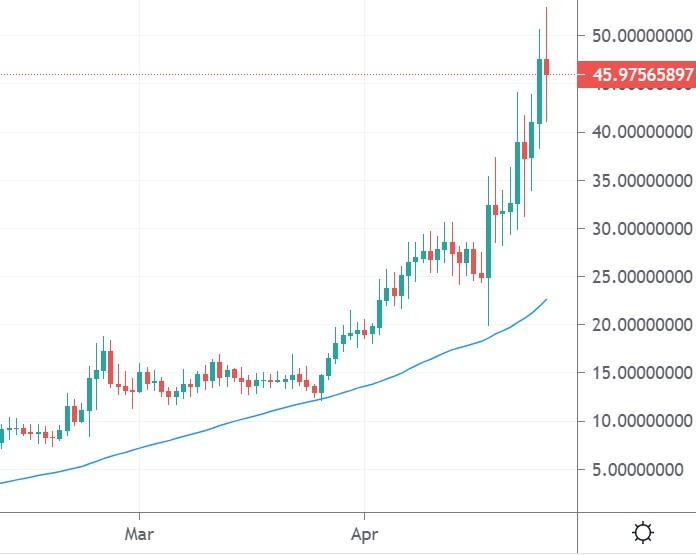
He also saw the ability for ETH and SOL to co-exist well in the ecosystem and that Solana would be in the top 3-5 coins. SOL saw record highs at the 50 level in the last two days and the coin has powered higher from a $10 price in February.

CELO

CELO was the best-performing coin this week with a 43% return and the coin has moved to number 80 with a market cap of $1.24bn after German mobile giant Deutsche Telekom made an investment into the defi platform.

The telecom giant was said to have made a “significant purchase” of the CELO token via its strategic investment fund, the Telekom Innovation Pool. Deutsche Telekom has also joined Celo’s ecosystem with a network of over 130 members, where the company’s subsidiary T-Systems MMS will be a validator implementing the Open Telekom Cloud. 

Deutsche Telekom has highlighted another sector that is open to crypto investments and it could lead to copycat investments by other competitors.

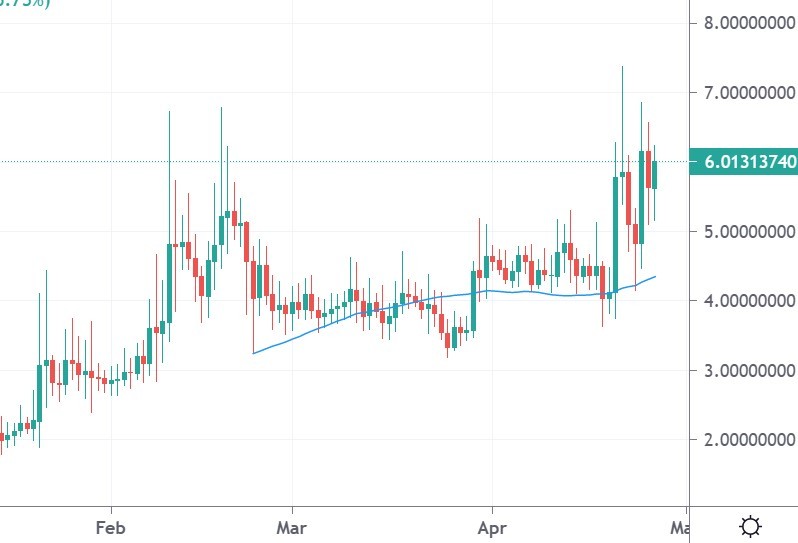
CELO Price Index

CELO has resistance at the $7.00 level and a move above that price would see further gains in the coin.

REGULATIONS

The market has been abuzz with regulatory talk over the last couple of months and the last week saw moves in that direction. 

Turkey is set to roll out restrictions on cryptocurrencies with the country’s central bank governor saying they would apply them in two weeks, adding that the bank would not ban cryptocurrencies

Turkey’s central bank chief revealed that the bank would be rolling out cryptocurrency regulations in the coming weeks. Governor Şahap Kavacıoğlu said this while speaking on the state-run channel TRT during the weekend.

According to the governor, Şahap Kavacioglu, the regulations would bring some structure to the market, but said: “You cannot fix anything by banning crypto, and we do not intend to do this.”

The governor also said there were concerns about funds that were leaving the country via cryptocurrencies. Turkey is trying to protect the value of its currency after a rise in inflation, but the reason that cryptos were invented was to avoid the impending collapse of monetary systems and governments are trying to protect those systems.

Although the governor didn’t give details on the proposed regulations, he voiced his concerns about the funds leaving Turkey via cryptos. He stated that they need to overcome the alarming amounts of funds leaving the country through such mechanisms.

The next news item said that South Korea would be moving to shut down all crypto exchanges in the country. There were around 200 crypto exchanges that would be affected by the closure.

The top financial regulator is looking at taking this action after it emerged that the firms have yet to comply with new regulatory laws introduced in the country. The chair of the Financial Services Commission, Eun Sung-soo, announced the move to a National Assembly policy committee. The regulator received no applications for the Virtual Assets Service Providers (VASPs) compliance program in the country.

The next country that could introduce some regulation is the USA, although the SEC has been talking previously about this possibility.

Charles Gasparino, a Senior Correspondent for Fox Business said: 

The Biden administration is in what’s been described to me from people close to them as the early stages of developing a regulatory approach to the crypto market… it’s being debated inside the Biden administration. From what I understand, SEC Chair Gensler… is waiting for some direction from Treasury for the overall policy before he develops a more specific regulatory approach to crypto, which will likely be the types of enforcement actions he goes after.

Charles Hoskinson, the founder of Cardano said on a Youtube video: 

There’s no reality that a government as regulation-friendly as the United States government will allow an industry with a market capitalization of over a trillion dollars to be unregulated or to live in this weird gray area of enforcement.

Both commentators agreed that BTC and cryptocurrencies were here to stay.

Go to Source

Things You Need to know About Decentralized Finance

So what is DeFi exactly? Will this be just a passing trend or will ignite a “new revolution” in the global market?

All will be revealed in the following article. So let’s dive in!

What Exactly Is DeFi?

DeFi stands for Decentralized Finance. This is the term used to refer to financial applications built on Blockchain.

Currently, Ethereum is the platform with the most active DeFi applications. However, this is not the only Blockchain – we still have a wide range of options from Blockchains by IOST, EOS, and TRON.

DeFi has always been accompanied by the term “Non-Custodial” i.e. non-mandate. Due to this feature, we often call it Open Finance.

You can visit their website by clicking this link: https://www.yield.app/

DeFi vs CeFi Comparison

CeFi is centralized finance, in which components such as organizations, trading markets, or instruments are centrally managed. Centralized finance is always accompanied by the phrase “custodial” or trust, that is, assets, products, and services in finance will be entrusted to certain organizations.

Having that said, the biggest difference between traditional finance and decentralized finance is trust. In Traditional Finance: There are intermediaries with centralized power in organizations, markets, and financial instruments. Meanwhile, DeFi leverages Blockchain’s power of transparency and decentralization to eliminate these intermediaries.

Specifically:

  • Government or banking (CeFi) will be replaced by decentralized blockchains.
  • CeFi’s assets will be replaced by tokens located in the Blockchain ecosystem. They are decentralized.

And DeFi’s mission is to provide users with access to financial services anywhere, whenever they have the Internet. DeFi’s openness is shown here.

The Many Perks Of DeFi

Privacy

DeFi dapps will have a limited need for a third party (banks or similar institutions) for the user to be custodians of their assets. At the same time, DeFi also allows users to own private keys. Transactions will be recorded under fake names to ensure the user’s privacy. 

Transparency

In the decentralized financial space, you will often hear the phrase “Don and trust, verify!” – i.e. you can verify any transaction on the blockchain as well as Defi.

Easy Access

Defi has a feature called Permissionless. Anyone at any place, any time can access and use DeFi products and services without being decentralized or restricted by any party.

High Interoperability

Building a main block makes interoperability between blocks much simpler. From there, users can create an ecosystem that can expand and become diverse over time.

Built On The Premise Of Blockchains

Blockchain technology plays the role of a ledger that records all transactions occurring in the system. It features outstanding traits such as: 

(1) Cannot be tampered with

(2) Indestructible blockchain chains

(3) High data security, high transparency

(4) Low cost

(5) Fast transactions

(6) Contracts that cannot be cheated

The Downsides Of DeFi

The only disadvantage of decentralized finance is probably the approach and usage. DeFi is tied to crypto-assets, so new users will need quite some time to learn how to use DeFi applications.

Some Components In DeFi

Decentralized Stablecoins

Stablecoins are issued in a decentralized form. 

I call these stablecoin 2.0. Generation 1.0 are stable currencies issued based on collateral, which are centralized commodities such as USD dollars, gold (USDT, USDC, TUSD, ..) And Stablecoin 2.0 (Decentralized Stablecoins) are issued based on the collateral of other cryptocurrencies (DeFi).

To put it simply, you can mortgage some of your cryptos to issue a stablecoin (with a smaller amount). In such projects, there usually are Governance tokens – this is the token that you can invest in.

Some projects that you should know: MakerDAO (MKR), Terra (LUNA), Just (JST), Reserve (RSR), Kava (KAVA), Venus (XVS).

Decentralized Lending and Borrowing

These are decentralized lending & borrowing platforms. Some notable projects: AAVE, MakerDAO, Osis, BZRX, Fulcrum, Compound, Dharma

Decentralized Insurance

This is a form of insurance for users in DeFi applications. Featured projects: Hakka Finance (3F Mutual), Yearn Insurance, Nexus Mutual, Opin.

Decentralized Exchanges (DEX)

These are decentralized exchange platforms. This should be very familiar to the experienced users, as it was developed in 2017. Up to now, they are also divided into many different types.

  • DEX 2017 – 2018: Kyber (KNC), Loopring (LRC), Bancor (BNT)
  • DEX 2020: Serum DEX (SRM), Sushiswap (SUSHI), Uniswap (UNI), 1Inch, Balancer (BAL), Curve (CRV)

Liquidity Mining

Liquidity mining allows users to make profits by providing the liquidity of the coins they have to the exchange platform. In return, the participant will receive a reward of governance token. This has been very popular since July 2020 and usually comes with the keyword Yield Farming. 

Some example: Sushiswap (SUSHI), Hard (HARD), Sun (SUN), Yam, Luaswap (LUA), Hakka Finance (HAKKA), Bella (BEL), Flamingo (FLM)

Decentralized Oracles

Oracle is a real-time data delivery system for blockchains and smart contracts. Thanks to Oracle, blockchain and smart contracts (on-chain) can interact with external data (off-chain).

Prominent projects: Chainlink (LINK), Band Protocol (BAND), DIA, Tellor (TRB), Nest Protocol (NEST), Zap, Augur (REP)

Decentralized Derivatives

Decentralized derivative products include Synthetix (SNX), Opium, Opyn, Hegic (HEGIC), and UMA.

Synthetic Assets

General assets include Synthetix, Tokenlong, and UMA

Several emerging DeFi groups in 2020

  • DeFi Ecosystem: These are projects that provide ecosystems & many different solutions, not just a single product: Hakka Finance (HAKKA), Yearn (YFI), Alpha Finance (ALPHA), Cream Finance (CREAM)
  • Decentralized Prediction Market: Projects include: Open Predict, Augur (REP), PlotX (PLOT), Decentralized Insurance (decentralized insurance).

Conclusion

As can be seen, DeFi is not just a passing trend, instead, it is an inevitable development of the market, serving the rightful needs of users. The total capitalization of DeFi projects is currently $ 18.4 B, accounting for 3.4% of the market cap. Having that said, the opportunities for DeFi’s are undeniable.

I believe we are still in the early stages of DeFi and this crypto market. Thus the best thing to do right now is to thoroughly study the topic and groups of coins that you are interested in before investing. Besides, choosing the right platform to invest in should also be a priority. It is advisable to start your DeFi journey on a safe platform that could also educate new users with the information needed. Yield App is such a platform! With this, you can discover the easiest way to earn interest in Crypto, safe and sound. 

Having that said, I wish you all the best in future investments in DeFi!

Go to Source

Crypto Exchange IPOs: Will Coinbase’s Stock Market Listing Set a Trend?

The popular U.S.-based cryptocurrency exchange Coinbase successfully ran its IPO last week, becoming one of the first crypto companies to do so. Its success means that other crypto exchanges could follow suit. Here are the stances of various exchanges.

Coinbase

Coinbase carried out its IPO on Wednesday, April 15. On that day the company’s Class A Common Stock was listed on Nasdaq under the ticker “COIN.”

Before the IPO began, Nasdaq gave Coinbase a reference price of $250 per share, giving the company a valuation of approximately $65.3 billion on a fully diluted basis.

Coinbase’s IPO has been in the works for at least a year. Rumors began to circulate in mid-2020. The firm then released its application publicly in February 2021 and announced that it had gained approval from the U.S. SEC on April 1, 2020.

Though widely referred to as an IPO, Coinbase actually carried out a direct listing. That means the company did not need to seek out underwriters and bankers; instead, company members simply converted their own existing shares to publicly listed assets.

Kraken

Kraken, another major cryptocurrency exchange, is also planning to go public. The most recent statements from company CEO Jesse Powell suggest it will do so in 2022.

Powell noted that Kraken will likely carry out a direct listing as well. In an interview on April 9, he told CNBC: “We’re looking at being able to go public sometime next year … it would probably be a direct listing, similar to Coinbase.”

Some sources have estimated that Kraken’s IPO could raise $10 billion, though Powell has stated that $10 billion is too low of a valuation to make selling shares worthwhile. He has also stated that his company is not in a “rush to raise capital” and that it is waiting to see how Coinbase’s IPO performs.

In addition to its IPO, Kraken is also seeking out new funding from VC funds and other investors. That could help it raise up to $20 billion.

Gemini

Tyler and Cameron Winklevoss’s Gemini exchange is also considering an IPO. In a January interview with Bloomberg, the exchange founders hinted at the possibility.

Cameron Winklevoss stated that the exchange is “watching the market” and “having internal discussions” on the matter. However, few technical details have been revealed, and there do not appear to be any valuation estimates for the company.

Robinhood and eToro

Distinct from crypto exchanges, two stock trading apps that offer cryptocurrency investment contracts are planning to run IPOs before the end of 2021.

The first is Robinhood, which has an estimated valuation of $40 billion. The second is eToro, which has an estimated valuation of $10.4 billion.

Though these companies’ services can only be considered adjacent to cryptocurrency, each company is highly visible in the crypto industry. It remains to be seen whether crypto investors will be interested in purchasing company shares.

Exodus

Exodus, a crypto wallet with a built-in trading platform, carried out an IPO this month. Rather than list its shares on a mainstream stock exchange such as Nasdaq, Exodus instead chose to sell shares on its own in-app trading platform.

The company’s IPO is fully regulated by the U.S. SEC and is compliant with Regulation A, meaning that it has some exemptions from certain requirements.

This means that Exodus’s IPO is relatively accessible. The firm says that it chose an approach that allowed customers to buy shares through the Exodus wallet with digital assets. It remains to be seen if other exchanges will imitate this strategy.

Binance

The popular Asia-based exchange Binance has stated that it has no intention to run an IPO, sell shares of the company, or go public in any way.

The company is apparently disinterested because it is already thriving. Binance CEO Changpeng Zhao stated during a Coindesk interview in March: “We’re not really short on funds. We’re surviving OK and we’re growing very healthily and organically.”

That assertion is backed up by Binance’s high-ranking status: Binance is the largest exchange by far, with a daily volume of $25 billion to $50 billion.

Will Crypto Exchange IPOs Become Popular?

Coinbase will be the first major cryptocurrency exchange to go public.

One possible exception is the payments app Square, which ran its IPO in 2015 before it added support for Bitcoin two years later. Several minor Bitcoin mining companies (Riot, Marathon, Canaan, and HIVE) are also traded publicly.

Regardless, Coinbase will be one of the most notable and influential stock offerings of the year. With over 500 crypto exchanges in existence, it seems likely that several more will pursue this course of action in order to raise funds.

Go to Source

Litecoin Price Prediction: LTC/USD Begins a Rally

Litecoin Begins a Rally– May 25
The LTC/USD market begins a rally after seeing a significant drop in its values over a couple of days’ trading sessions recently. Meanwhile, the crypto market hasn’t intensified much-required efforts to capitalize on the rallying motion over some last hours until now as price trades around $174 at a rate of -5.92% reductions.

Begins a Rally: LTC Market
Key Levels:
Resistance levels: $250, $300, $350
Support levels: $150, $130, $110

LTC/USD – Daily Chart
The LTC/USD daily chart shows that the crypto market begins a rally having briefly seen a breakdown of the lower support level of $150 during the May 23th day’s trading operations. Both the SMAs are still in a southward-bent posture to indicate that there are still somewhat of downward forces placing in the market. The bearish trend-line drew across the SMAs to the downside as the 14-day is over the 50-day. The Stochastic Oscillator is in the oversold region trying to open the hairs to the north direction.

Litecoin price begins a rally, will there be perfect upkeep?
There is a notable line of Litecoin that begins a rally taking its commencement around the formation of yesterday’s bullish candlestick that occurred from the depth of a downward pressure caused by the US Dollar. Having had that in place now, bulls are expected to muster catalysts to build up a buying wall from the support level of $150 or around it in the subsequent sessions.  

As regards contrary to the upside trading sentiment, bears now have up to the mid-point of about in between the $200 and $250 to launch back forces against the current rallying move that Litecoin has begun on a gradual moving process. If the presumed sell-off situation at that point has to get on an intense, the previous lower trading level of $150 will most likely be going to be revisited. In the meantime, the present level could also good for investment time.

LTC/BTC Price Analysis
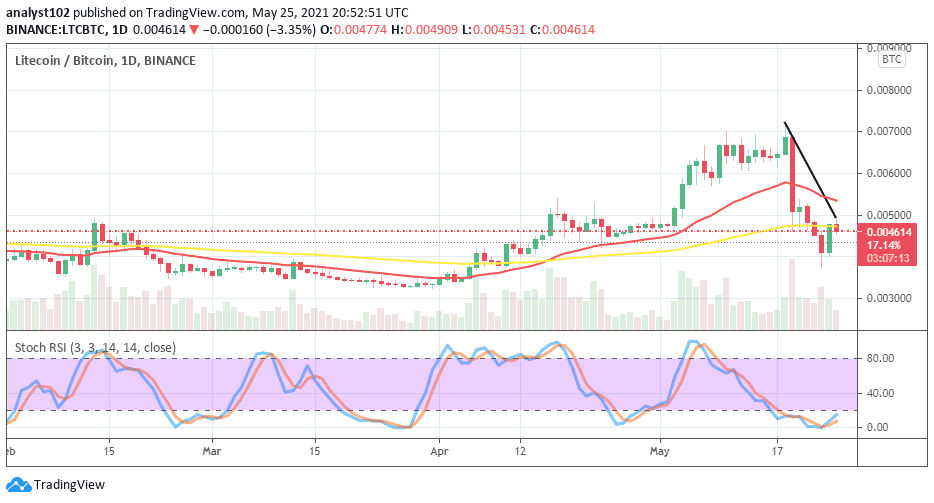
Weighing the level of the trading situation between LTC and BTC, it is depicted on the chart that Litecoin begins a rally as paired with Bitcoin after about two days that the bigger SMA trading breached to the south by the purchasing power of the counter tool. The 14-day SMA is located over the 50-day SMA. The Stochastic Oscillators are trying to open the hairs toward the north from the oversold region. That signifies that the base tool’s rallying against the counter instrument will soon materialize positively in the near time.

Go to Source

China Reiterates its 2018 Ban on Bitcoin Mining and Crypto Trading

  • China has reignited plans of cracking down on Bitcoin mining and trading within its borders
  • Bitcoin has dipped from $41k to a local low of $36,600 due to the news
  • China’s government had announced and initiated a similar crackdown in 2018 which officially kicked off the bear market then

The Chinese government has once again reiterated its plans of cracking down on Bitcoin mining and crypto trading within its territories. The call to ban Bitcoin mining and crypto trading was initiated by the Vice Premier of the People’s Republic of China, Liu He, during the 51st meeting of the State Council Financial Stability and Development Committee.

The minutes of the meeting have been released by the China Government Network. An excerpt of the minutes, that have been translated using Google Translate, can be found below.

The second is to resolutely prevent and control financial risks. Adhere to the bottom line thinking, strengthen the comprehensive scanning and early warning of financial risks, promote the reform of small and medium financial institutions, focus on reducing credit risks, strengthen the supervision of platform enterprises’ financial activities, crack down on Bitcoin mining and trading behavior, and resolutely prevent the transmission of individual risks to the social field.

It is necessary to maintain the smooth operation of the stock, debt, and foreign exchange markets, severely crack down on illegal securities activities, and severely punish illegal financial activities.

Bitcoin Drops to a Local Low of $36,600

News of China once again planning on banning Bitcoin mining has resulted in BTC dropping from $41k to a local low of $36,600. Only time will tell whether Bitcoin and crypto traders will continue selling their holdings on this news.

China Had Announced a Similar Ban in 2018

The statement by Vice Premier Liu He is similar to the one that was issued by the Chinese Government back in January 2018 when it banned Bitcoin mining and crypto trading. The ban back then was aimed at cracking down on money laundering, fraud, and limiting the amount of electricity used by miners.

At the time of writing, it is still uncertain as to whether the Chinese government will follow up on its intention of cracking down on Bitcoin mining and crypto trading this time around.

Go to Source

Ethereum Could Reclaim $3.2k to $3.5k in the Short Term – Report

  • Ethereum could reclaim $3.2k to $3.5k in the short term
  • This price target is reliant on Ethereum breaking the $3k ceiling
  • Ethereum’s 50-day moving average is also acting as a resistance at the $3k price area
  • The London Upgrade in July could assist Ethereum in rallying back to $4k

Ethereum (ETH) could reclaim the $3,200 to $3,500 price area in the short term. This is according to an analysis done by the team at Crypterium who also pointed out that the $3k ceiling needed to be broken before Ethereum regained its bullish momentum. They explained Ethereum’s possible short-term price movement as follows.

An important resistance level now is the $2,975 — $3,000 range…In the near future, the price will come to this zone. After fixing inside it, the ETH chart may rise sharply to the range of $3,200 — $3,500.

Ethereum’s 50-day Moving Average is also Acting as a Resistance

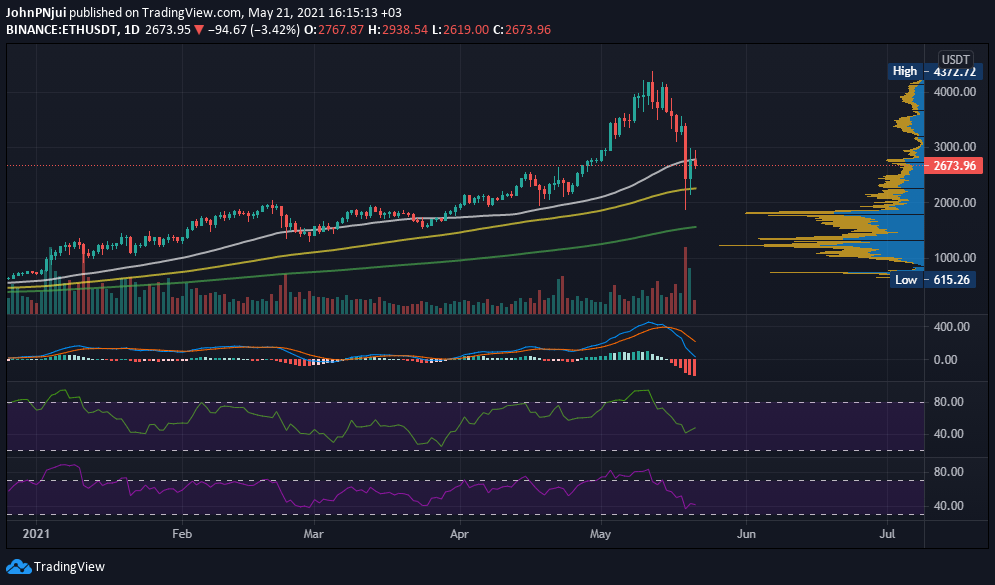
The $3k price ceiling for Ethereum also converges with the 50-day moving average (white) that is now acting as resistance as seen in the chart below.

Also from the chart, it can be observed that the daily MACD, MFI and RSI are indicating an ongoing correction for Ethereum in the crypto markets that might abate as we inch closer to the new month of June. A continuation of the pull-back could mean that Ethereum revisits the lower $2k levels, or the local low of $1,888, before the end of this month.

Ethereum’s London Upgrade Could Push ETH towards $4k

To note is that the months of June and July will be a busy time period for Ethereum developers as they finalize the London upgrade that will usher in EIP1559. The latter Ethereum Improvement Proposal is aimed at taming the issue of high gas fees as well as turning ETH into a deflationary asset.

Therefore, chances are, that the events leading up to the London Upgrade will provide enough fuel for Ethereum to rally back towards the $4k leading up to the event.

However, such a bullish possibility for Ethereum is hinged upon a stable Bitcoin without the gut-wrenching volatility that was witnessed this past Wednesday when BTC dropped from $42k to $30k in less than a day.

Go to Source

Fed’s Daily Tapering Increases by 23%- Tuesday’s Reverse Repo Removes $432 Billion from Market

Since well before the onset of Covid-19, the U.S. Federal Reserve had initiated monetary easing policies and from then on, the M1 Money Stock supply skyrocketed to levels never-before-seen in history. This weekend reports disclosed that the Fed has started to taper quantitative easing (QE) when it removed $351 billion from the market last week. This Tuesday the Fed revealed it completed a reverse repo operation for $432.9 billion.

  • On May 22, Bitcoin.com News reported on the Federal Reserve initiating overnight reverse repos (RRP) to the tune of $351 billion. Tuesday’s recently reported reverse repo shows a 23.07% increase.
  • RRP facility operations are the opposite of QE, as the Federal Reserve removes M1 from the system by selling Treasuries back to the market. The most recent overnight operations seem to be only Treasuries, as no purchases of mortgage-backed securities (MBS) have been mentioned.

  • The Federal Reserve followed the $351 billion RRP operation with $369 billion on Friday and $395 billion on Monday.
  • The U.S. central bank revealed on Tuesday $432.9 billion was removed from financial markets.
  • Since the Federal Reserve has been on a spree of reverse repo operations, speculators think the central bank will continue to increase the M1 removal. “Fed Reverse Repo 432.955 Billion from 48 counterparties Repo market is still broken, broken. We’ll break 500 billion tomorrow,” one person tweeted on Tuesday.

  • On Monday, Scott Skyrm, executive vice president in fixed income and repo at Curvature Securities commented on the reverse repo situation to Market Watch columnist Joy Wiltermuth. “Why are they going to the Fed?” Skyrm asked. “Either there is too much cash or not enough collateral. It’s two sides of the same coin,” he added.
  • “A BTIG Research team led by Julian Emanuel described the situation like a game of cat and mouse,” Wiltermuth’s report concludes.
  • In 2020 alone, estimates say the U.S. central bank’s 2020 M1 increase eclipsed two centuries of USD creation. It is estimated that 24 to 30% of all USD was created in 2020 and Q1 2021.

What do you think about the Fed’s reverse repos during the last few days? Let us know what you think about this subject in the comments section below.

Go to Source

Realm Closes $2.25M for Seed Investment to Build NFT Powered Microverses

PRESS RELEASE. Realm, a new NFT microverse platform, has closed its first investment round at $2.25M led by Alphabit with strategic investments from NGC, Genesis Block Ventures, LD Capital, Moonrock, and SL2 amongst other funds.

Realm aims to challenge the current NFT platforms by offering creators and players a personalised metaverse aptly dubbed a “microverse”. Each microverse, known as a realm, will come with an original genetically coded blockchain avatar. The NFT platform integrates OpenSea’s vast NFT marketplace, and has partnered with Reef Chain to harness the power of Substrate and the Polkadot framework to ensure cross-chain compatibility.

“We’ve been working on how the metaverse will blur the lines between digital and virtual realities for six months. We’re excited to have some world class investors on board who align with our vision of making everybody the master of their own realm,” said Matthew Larby, Realm CEO and Founder.

“Alphabit has made a seed stage investment in this innovative NFT project, which marries AR and VR to really bring to life the digital collectible world. It really captures the imagination of what the future could look like, forging a path in the new metaverse,” said Liam Robertson, CEO of Alphabit.

Realm plans to use the investment to grow the team, accelerate development of the simple creator tools that democratise creation, and build a wide range of smart objects for artists to use to express themselves in virtual spaces. Users of Realm will be able to utilize the platform in a series of different mediums including utilizing the AR functionality on a phone to enter their microverse through “magic window” AR technology that has been built by the Realm team.

Microverse denizens are welcome to sign up for early access to claim their “realm” which is scheduled to debut during Q3 of 2021.


About REALM

Realm is a community driven open-source project to create personalised metaverses. Realm allows creators to combine music, art, and games to create the perfect realm and mint it as an ERC-1155. Discover art galleries in space to underwater auctions through augmented reality portals, and collect pets with cross-chain genetics.


Media Contact: Cassie Doubleday / cassie@realm.art

Location: United Kingdom


Website: https://www.realm.art/

Twitter: @Enter_Realm

Telegram: https://t.me/Enter_Realm

Instagram: @Enter_Realm


This is a press release. Readers should do their own due diligence before taking any actions related to the promoted company or any of its affiliates or services. Bitcoin.com is not responsible, directly or indirectly, for any damage or loss caused or alleged to be caused by or in connection with the use of or reliance on any content, goods or services mentioned in the press release.

Go to Source

Data Shows Bitcoin Addresses in Accumulation Captures Fresh New Highs

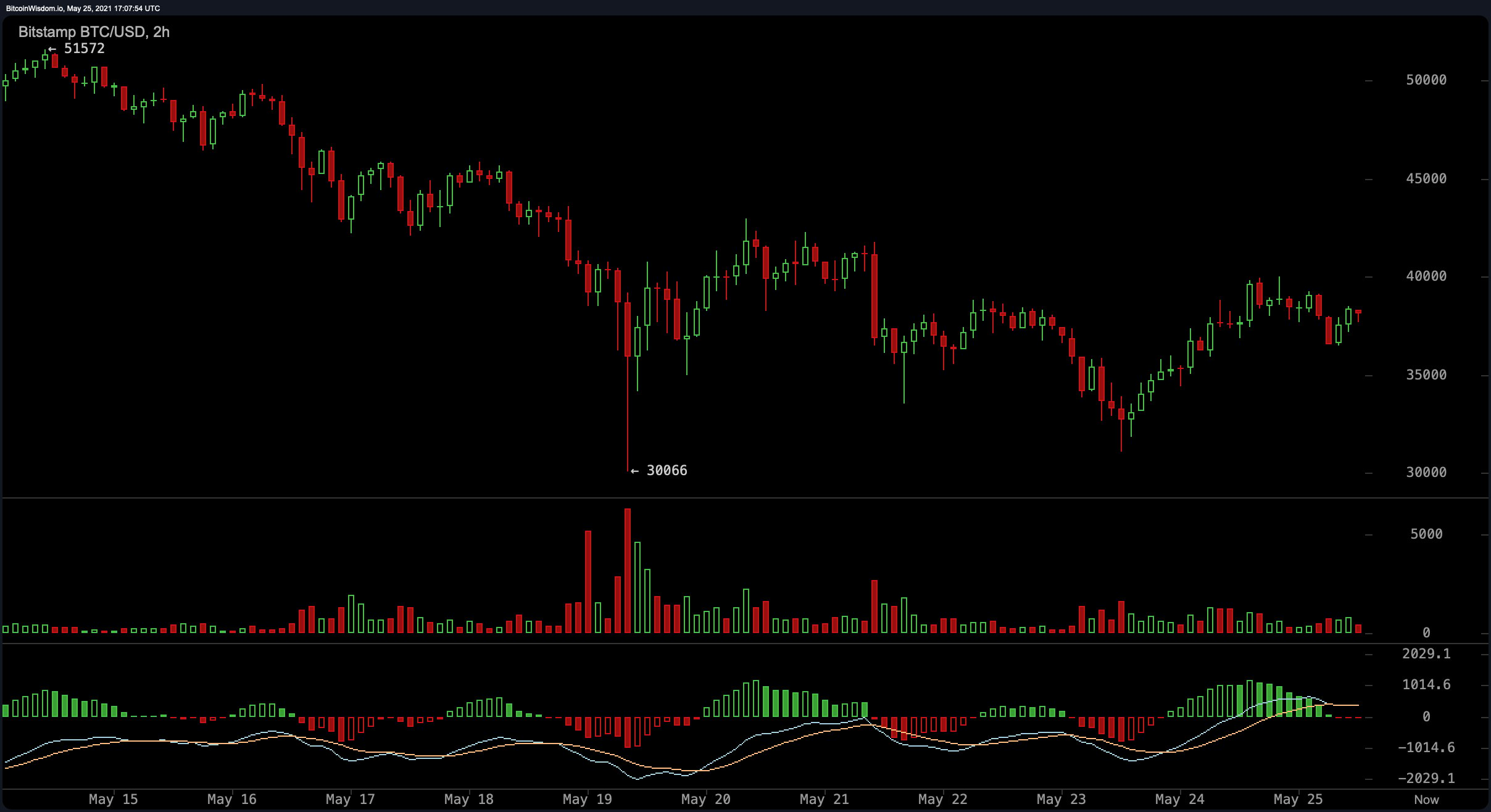
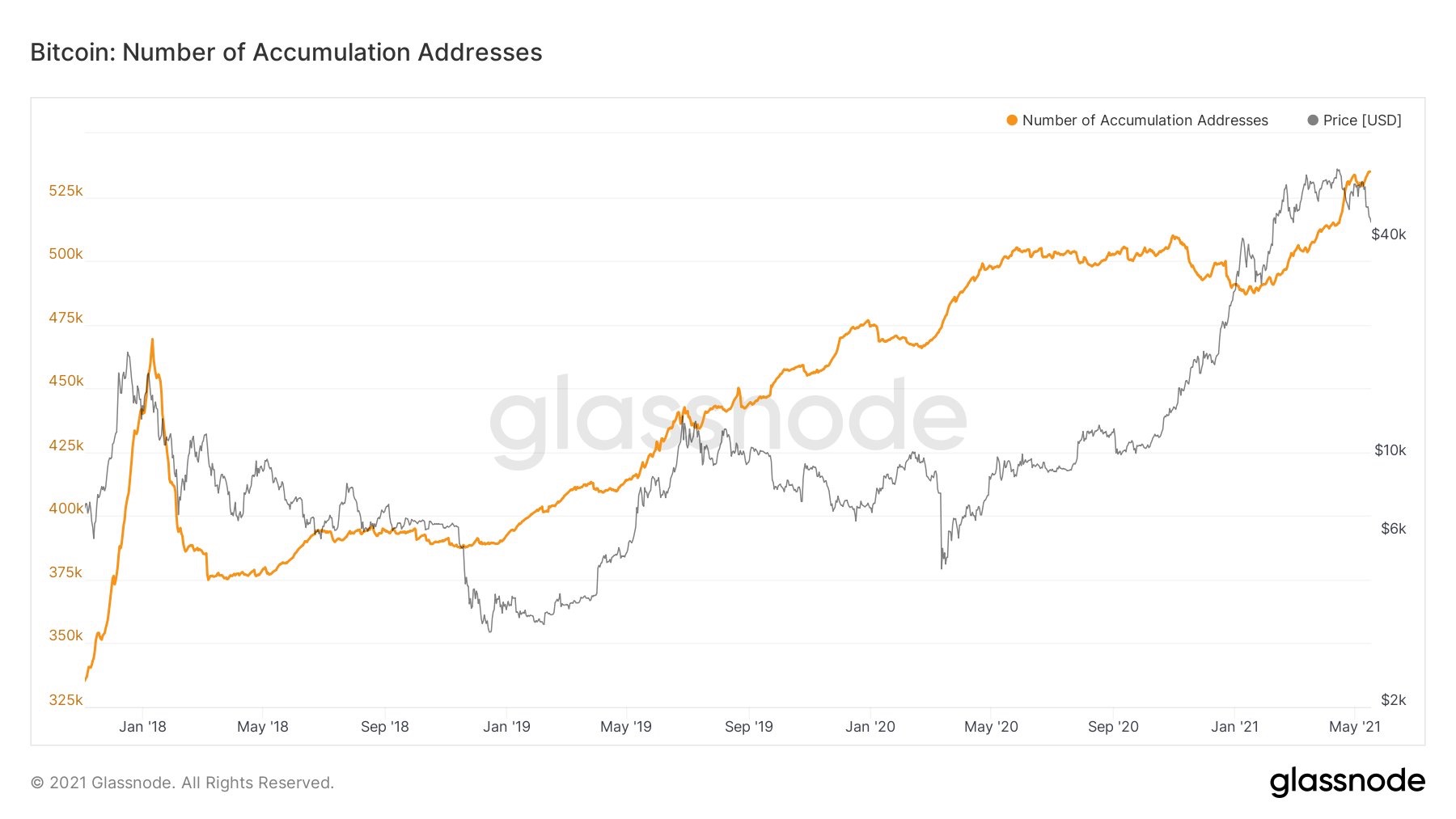
After bitcoin prices dipped to a low of $30,066 per unit last week, lots of people have been focused on the panic sellers. Meanwhile, when bitcoin prices plunged, the number of bitcoin addresses in accumulation tapped an all-time high at 545,115 addresses.

Number of Bitcoin Accumulation Addresses Hit New Highs

Bitcoin (BTC) prices slid from a $64,895 per unit high to a low of $30,066 per bitcoin in 30 days losing more than 53% in value. When the price plunge took place data from Glassnode’s bitcoin “accumulation addresses” spiked.

The number of bitcoin addresses in accumulation shows fundamental strength signals and gives investors a perspective of long-term holders. Glassnode’s data reflects addresses with little to no incoming transactions, as opposed to addresses that are more active.

Nine months ago, Glassnode reported on accumulation addresses reaching the 500k mark. “There are over 500,000 Bitcoin ‘accumulation addresses’ holding a total of 2.6 million BTC (~14%). Accumulation addresses: – have 2+ incoming txs – never spent BTC – were active in the past 7 years (accounting for lost coins) – exchanges & miners are excluded,” the analytics firm said at the time.

The current number of bitcoin addresses in accumulation recorded on Monday, May 24, 2021, was approximately 545,115 addresses, according to Glassnode stats.

Glassnode’s “The Week On-Chain” highlights “anecdotal indicators” from Bixen’s Mustafa Yilham recent tweet storm that alluded to miner sell pressure stemming from China.

“Observing the spending of miner coins demonstrates that whilst there is an uptick in miner-to-exchange flows,” Glassnode’s report notes. “Up from 100 BTC/day to 300BTC/day, this still represents a relatively small portion of the ~900BTC/day issuance,” the researchers said.

More than 16,000 addresses have been added to the sum of bitcoin addresses in accumulation since the first week of May. Following the dip to $30,066, bitcoin addresses in accumulation jumped higher.

What do you think about the number of bitcoin addresses in accumulation stats? Let us know what you think about this subject in the comments section below.

Go to Source

Fund Manager One River Files SEC Prospectus for Carbon Neutral Bitcoin ETF

On Monday, the crypto asset fund manager One River filed a unique bitcoin exchange-traded fund (ETF) registration with the U.S. Securities and Exchange Commission (SEC). According to the Form S-1 filed, One River wants to list a carbon-neutral bitcoin ETF on the New York Stock Exchange (NYSE).

One River’s Bitcoin ETF Aims to Provide a Fund That Offsets Carbon Emissions Associated With Bitcoin Mining

Carbon-neutral bitcoin mining has been a topical conversation these days within the cryptocurrency community. One River is taking bitcoin funds to a different level by registering for a carbon-neutral bitcoin ETF with its partner the carbon credit platform MOSS. The CEO of MOSS Luis Felipe Adaime detailed in April that the “MOSS Carbon Neutral Custody allows any institutional or corporate investor a means to offset the carbon emissions associated with crypto assets.”

On May 24, 2021, One River filed a Form S-1 registration with the SEC in order to disclose the company’s prospectus summary of the “One River Carbon Neutral Bitcoin Trust.” Common shares are to be listed on NYSE if the SEC approves the ETF, and performance will be measured with the MVIS One River Carbon Neutral Bitcoin Index. The ETF will leverage the spot price of carbon credits to offset calculations tethered to bitcoin energy consumption.

“The Index is constructed using bitcoin price feeds from eligible bitcoin spot markets and volume-weighted median price average (“VWMP”), calculated over 20 intervals in rolling three-minute increments with adjustments to reflect the current spot price of carbon credits necessary to offset the estimated carbon footprint attributable to each bitcoin,” One River’s ETF filing notes. “The Index is designed to reflect the performance of bitcoin in U.S. dollars on a carbon-neutral basis,” the filing adds.

Crypto Community’s Focus Continues to Center on Bitcoin’s Energy Consumption

The trust will hold bitcoin and offer direct exposure to the leading crypto assets in USD but on a “carbon neutral basis.” Essentially, the trust offered by One River “provides direct exposure to bitcoin, and the Shares of the Trust are valued on a daily basis using the same methodology used to calculate the Index, as adjusted to reflect the expenses associated with the offsetting carbon credits.”

One River’s Carbon Neutral Bitcoin Trust filing with the SEC, follows the topical conversation being discussed during the past two weeks ever since Tesla stopped accepting bitcoin (BTC) for payments. More recently, Musk has been talking about working with North American bitcoin miners with the creation of a Bitcoin Mining Council. The focus on the Bitcoin network’s energy consumption has not left the limelight since, and One River’s filing comes at an interesting time.

What do you think about One River’s Carbon Neutral Bitcoin Trust filing on Monday? Let us know what you think about this subject in the comments section below.

Go to Source

Korea’s crypto market is among the strongest — and the strangest — in the world

Between strict capital controls and regulations, Korea’s cryptocurrency industry is so closed off that Bitcoin commands a steep premium and DeFi is in its infancy.

On a day in which Bitcoin crashed briefly to $30,000 in a rampant bear market, the leading cryptocurrency never got anywhere close to that on Korean exchanges. The so-called “kimchi premium” saw to that, keeping the price of Bitcoin as much as $5,000 above its level on leading U.S. exchanges.

The major reason for this kimchi premium is that Korea’s exchanges are fairly isolated by a combination of the country’s strict capital control laws preventing funds from leaving the country, and the tax code and anti-money laundering (AML) regulations that make it difficult for foreigners to use Korean exchanges — even giants like Bithumb and Upbit — without local Korean bank accounts.

Nor is that premium the only part of South Korea’s crypto industry that sets it apart from the rest of the world. Among other things, the market’s isolation combined with the extraordinary stability of the Korean won has kept stablecoin usage low and the embrace of decentralized finance, or DeFi, well behind that of the rest of the world.

Korea’s Bitcoin boom

Despite this isolation, Korea’s embrace of Bitcoin in particular and cryptocurrency in general is very strong. In April, more than five million unique cryptocurrency users — about 10% of the country’s population — reportedly bought or sold digital assets at least once since the beginning of 2021.

On May 19, the day the kimchi premium hit $5,000, just one Korean exchange, Upbit, had a 24-hour transaction volume of more than $31.5 billion, according to CoinMarketCap. Add in the rest of the country’s “big four” cryptocurrency exchanges, Bithumb, Korbit and Coinone, and it was $38.1 billion — substantially more than has been traded recently on the leading Korean stock exchange KRX.

One interesting aspect of Korea’s cryptocurrency craze is how broadly it is spread across age groups. One February survey showed that almost half of the users of leading Korean exchanges Bithumb and Upbit were in their 40s or 50s — many of them mothers. That said, a broader survey of Korean crypto exchange apps in March showed that young people dominate the ranks of new Korean crypto users, with those in their 20s and 30s accounting for nearly two-thirds of the new monthly app users in the first three months of the year. However, they are investing small amounts, often less than $100.

All that’s clearly having an impact. Bithumb Korea recently announced that its Q1 2021 net profit was up 876% compared with the previous year.

Government roadblocks

At the same time, the Korean government and regulators are far from being fans of cryptocurrency. In February, Bank of Korea Governor Lee Joo-yeol told a National Assembly committee hearing that “a crypto asset is an asset that has no intrinsic value.” He added that “it is difficult to understand why the price of Bitcoin is so high.”  

Korea’s crypto regulations also make it difficult for foreign competitors. In December 2020, the world’s biggest exchange, Binance, shuttered its Binance Korea operation less than a year after it launched, thanks in large part to a law that banned exchanges operating in the country from sharing order books — meaning Binance Korea could no longer lean on Binance’s liquidity.

That law came into effect in March 2021, the same month that another leading cryptocurrency exchange — OKEx — announced it was shuttering its Korean operations due to the new AML regulations. It has also been suggested that these rules will make it difficult for smaller Korean exchanges to compete with the big four.

Not a fan of stablecoins?

Despite this booming crypto market, Korea is far behind the rest of the world in adoption of stablecoins, in no small part because the Korean won is stable enough that there isn’t as strong a need for stablecoins in the largely walled-off crypto market.

Beyond that, the Korean government frowns on stablecoins, according to Oleg Smagin, head of global marketing at Delio, a leading Korean crypto lending and staking firm. That makes exchanges leery of them, he adds.

In addition, exchange fees are low — largely in the 0.15% to 0.25% range at the big four. While the fees for withdrawals in won are flat and very low — about $1 — the fee for moving cryptocurrencies directly off can be steep. The big four’s withdrawal fees range from 0.0005 to 0.0015 BTC to withdraw Bitcoins directly — $20 to $60 for one BTC at $40,000.

Which could help explain why the Korean won is the fourth-most traded national currency for Bitcoin, behind only the Japan yen, the euro, and the dominant U.S. dollar.

The CeFi-DeFi hybrid

One victim of Korea’s closed-off crypto market and unfamiliarity with stablecoins is that the booming DeFi industry hasn’t had a chance to take hold there, Smagin says.

“2019 became a tipping point for the wide adoption of DeFi globally, but in Korea it was barely recognized, mostly because most of the local retail investors lacked experience using overseas crypto services and the adoption of stablecoins was low,” he says.

Delio’s solution is a hybrid centralized-decentralized finance model that uses CeFi as a way to build the initial crypto lending ecosystem that will become more and more decentralized over time. In the meantime, the firm realized there is an “enormous niche for a CeFi crypto-to-crypto lending service that can serve the needs of the local traders,” Smagin says.

The firm currently has four CeFi lending offerings, as well as a new payment service that lets Delio wallet holders pay with Bitcoin at a network of more than 70 retail firms services by payment app Money Tree. In addition, it’s Delio Liquidity arm provides institutional clients with digital asset loans of between $800,000 and $45 million. 

Delio offers Bitcoin and Ethereum loans of up to 90% of the borrower’s BTC or ETH collateral, and also provides lending services to Bithumb customers, who can use either BTC or ETH, or Korean won, as collateral. Staking and yield farming are also available. Delio recently passed $2 billion in total value utilized.

Delio’s DeFi hybrid plans are centered around Ducato, a won-based stablecoin project scheduled to launch in the third quarter of 2021. The KRWD stablecoin — fixed at one won — will be generated by collateralizing cryptocurrency. Ducato is a DeFi protocol with its own token, DUCATO, which is used to pay fees and for governance. But the CeFi Delio platform provides the stablecoin with a user-friendly interface.

Learn more about Delio

Disclaimer. Cointelegraph does not endorse any content or product on this page. While we aim at providing you all important information that we could obtain, readers should do their own research before taking any actions related to the company and carry full responsibility for their decisions, nor this article can be considered as an investment advice.

Go to Source

Here are 2 key price indicators every crypto trader should know

The best traders keep a sharp eye on an asset’s momentum. Here’s why the RSI and moving averages are the perfect indicators for this task.

Technical analysis, the study of chart patterns, is a tool that helps traders increase their edge over others.

This is done by keeping the trader on the right side of the trend and providing warnings when the trend is about to reverse. There are many indicators and patterns that can accomplish this task but there is no one particular indicator that fits the bill for all market conditions.

Therefore, traders prefer to use a combination of indicators, which come in handy both during trending and range-bound markets. However, this does not mean the trader should clutter every chart with all the available indicators. In some cases, using too many indicators will only hamper the decision-making process and create confusion rather than assist the trader.

As traders develop their chart reading skills, they tend to reduce the number of indicators and use the ones that are more suited to their style of trading. Here again, there is no perfect set of indicators that will give better results than others, it is just a matter of preference and practice.

In this article, the set of indicators that will be discussed are moving averages and the relative strength index. Without going too deeply into the technicalities of each indicator, the basic ways of using them effectively will be highlighted. The methods discussed here are in no way complete, there are myriad other possibilities and traders can use the ones that work best for them. The explanation can be used as a guide for honing the analyzing skills further.

Moving Averages

Moving averages are trend-following or also called lagging indicators as they provide delayed feedback after the price movement has already occurred. The most popular time frames that are used for trading and investing are the 20, 50, and 200-period moving averages. Short-term traders also use the 5 and 10-period moving averages but they tend to whipsaw and may not be suitable for everybody.

There are four types of moving averages: simple, exponential, smoothed and weighted but the most popular ones in use are the simple and exponential moving averages.

For calculation, exponential moving averages give more weightage to recent price data, hence they tend to respond quickly to price changes. On the other hand, a simple moving average gives equal weightage to the price data, hence they tend to be comparatively slow in responding to price changes.

Therefore, traders tend to use EMA for the shorter time frame, such as 10 and 20 as they catch the changes quickly and for the longer time frames, the simple moving averages are used because trends usually do not change direction quickly. For the current example, the 20-day EMA and the 50-day SMA will be used.

Relative Strength Index (RSI)

The relative strength index (RSI) is a momentum indicator, which captures changes in price and functions as an oscillator that ranges between values of 0 to 100.

As a general practice, readings of below 30 are termed as oversold, and above 70 are presumed to be overbought. While these boundaries work well during a range-bound market, they tend to give false signals during trending phases.

The most popular time frame used is a 14-period RSI. However, this is not set in stone because short-term traders may use a 5 or 7 period RSI while long-term investors may opt for 21- or even 30-period RSI.

One of the most popular uses for the RSI is spotting a divergence, which warns traders of a possible trend reversal. After the basics, let’s see some methods to use the indicators for analysis.

The first thing a trader should learn is to spot a trend. Trading in the direction of the trend is rewarding because an established trend offers several profitable trades. Let’s understand this with some crypto price action.

Examples of a range-bound market

BTC/USDT daily chart. Source: TradingView

In a range-bound market, the moving averages criss-cross each other and do not slope up or down for an extended period of time. See the area enclosed by the ellipse in the chart above where Bitcoin (BTC) remained range-bound and the moving averages flattened out. Such markets tend to lack direction and are difficult to forecast and trade.

DOT/USDT daily chart. Source: TradingView

As shown in the chart above, Polkadot’s (DOT) price was stuck in a range and the moving averages were flattish without any sense of direction. When the price is largely contained between two boundaries, the market is said to be range-bound.

Next, let’s try to spot a trending market because this is where the most lucrative trading opportunities arise.

Identifying an uptrend

BTC/USDT daily chart. Source: TradingView

Bitcoin was largely stuck in a range from Aug. 1, 2020, to Oct. 20, 2020. During this period, the moving averages were flat and without any direction.

However, on Oct. 21, 2020, the price broke above the range and the RSI also jumped into the overbought territory. During the start of a new trend, the RSI generally remains overbought for the initial period of the trend and the same could be seen here as well.

As the price moved up, the 20-day EMA started to turn up first and then the 50-day SMA followed suit. When a trend starts, it generally remains in force for an extended period. Let’s look at another example of a trend.

DOT/USDT daily chart. Source: TradingView

After staying in a range from Sep. 6, 2020, to Dec. 27, 2020, DOT broke out of the range on Dec. 28, 2020. The RSI also rose to overbought levels above 70 and the moving averages started sloping up. Again, notice how the 20-day EMA was quick to move up while the 50-day SMA took time to catch up.

In the above case, the RSI did not remain overbought for an extended period but remained above 50, indicating one rule does not fit everywhere.

Identifying a downtrend

Unlike uptrends, which take time to form and remain in force for an extended period, downtrends are violent and can either stretch for a long time, similar to the 2018 crypto bear market, or could quickly reverse direction after a sharp fall.

BTC/USDT daily chart. Source: TradingView

The above chart has two important things for the trader to note. First, the RSI had been making lower tops since the end of February, even though the price had continued to move up. This is a classic sign of a possible trend reversal. Again, this is not foolproof but if traders combine the signal with the price action, then the possibility of avoiding a catastrophe is high.

The negative divergence on the RSI gained importance when the moving averages completed a bearish crossover where the 20-day EMA, which had been staying above the 50-day SMA for the past few months, broke below the 50-day SMA. This was a sign that the short-term price action was weakening and the trend may reverse.

After staying in a range for a few days, Bitcoin broke down on May 12 and the moving averages started to turn down. This, along with the RSI in the negative territory was a signal to traders that the trend was reversing. As long as the price remains below the moving averages and both the 20-day EMA and the 50-day SMA keep sloping down, the trend will remain bearish.

DOT/USDT daily chart. Source: TradingView

In the above chart we can see that after the uptrend, DOT became stuck in a range with the moving averages flattening out and criss-crossing each other. It is difficult to call this a top because the price could have gone either way. However, if the trader also looked at the RSI, it was flashing a negative divergence, warning of a possible reversal.

The sharp fall on May 19 confirmed the downtrend as both moving averages started to turn down and the RSI is in the negative zone.

Remember, no signal is absolute!

For most new traders, the moving averages and the RSI are essentially the starting point for identifying trends.

Investors dipping their toes in trading should definitely practice identifying the main trend as this could keep them from going against the market and getting burnt. In subsequent articles, entry and exit strategies using the indicators will be discussed.

The views and opinions expressed here are solely those of the author and do not necessarily reflect the views of Cointelegraph.com. Every investment and trading move involves risk, you should conduct your own research when making a decision.

Go to Source

Biden administration is reportedly reviewing ‘gaps’ in crypto regulation

White House officials are believed to be examining existing rules around cryptocurrencies and whether new restrictions are needed to protect investors from massive drawdowns like we saw last week.

Officials within the Biden administration are reportedly studying “gaps” in cryptocurrency regulations following the latest bout of volatility in the market, sending a signal that new rules could soon be proposed. 

People familiar with the matter informed The Washington Post that White House officials are studying whether digital assets like Bitcoin (BTC) can be used to finance terrorist activities. They are also mulling whether retail investors should be protected from the extreme price fluctuations of digital asset markets.

Bitcoin’s brief collapse below $30,000 last week triggered a panic wave of selling, as digital asset markets shed over $1 trillion in value in just ten days. Peak to trough, the digital asset market was nearly cut in half between mid-April and mid-May.

A new proposal from the United States Treasury that would require cryptocurrency holders to report all transfers above $10,000 to the Internal Revenue Agency was one of many catalysts behind the decline. The Biden administration’s plan to double the IRS’ workforce over the next decade was also a source of worry among investors who feel that the United States is quickly losing its competitiveness on matters related to taxation and digital asset markets.

At present, federal lawmakers do not believe that wild swings in crypto prices can threaten broader financial-market stability, The Washington Post claimed, although the risks are worth monitoring. “They’re aware of the fact that there are all kinds of risks in the abstract and things to look out for, but they are still largely in a wait-and-see posture,” the anonymous source said.

At its peak, the cryptocurrency market was collectively valued at over $2.5 trillion, which is tiny in comparison to the broader financial system. However, as crypto continues to grow, what the government deems to be an acceptable risk may change.

Go to Source

Stellar Development Foundation invests $15M in Mexico crypto exchange

Airtm is aiming to solve a myriad of financial challenges in Latin America tied to last-mile remittance, affordability and equitable access to the global banking system.

Airtm, a Mexico City-based digital wallet and exchange operator, has received $15 million in funding from the Stellar Development Foundation, or SDF, as it seeks to expand financial services and cryptocurrency adoption in Latin America. 

The investment, which is the largest SDF has ever made as part of its Enterprise Fund, will enable Airtm to integrate with Stellar in the coming year. As part of the Stellar network, Airtm will be able to better provide its users with access to global financial services.

“Airtm exists because financial systems throughout the developing world are not aligned with their people’s needs and global aspirations.” said Airtm CEO Ruben Galindo Steckel, adding:

“With this investment, and our integration with the Stellar network, we will continue to advance on our mission of helping consumers and businesses throughout the developing world access stable money that holds its value, is instant to transfer with no fees, compatible with the global economy, and can be withdrawn as local currency whenever, and wherever it’s needed.”

Stellar Development Foundation is a nonprofit organization that leverages blockchain technology to better streamline global financial services. Its Enterprise Fund has invested in several projects this year alone. This includes a $5 million investment in Wyre and a $750,000 allocation to Nigeria-based payment platform Cowrie.

Latin America appears to be a prime focus for SDF, given the continent’s reliance on cash payments. As SDF noted, 91% of all transactions in Mexico are still made in cash as of 2020.

Digital currency adoption appears to be gaining traction in Mexico, with local exchange Bitso becoming the first billion-dollar crypto platform on the continent.

Go to Source

Eight Major Cryptocurrencies Accepted by Crypto Sportsbooks

The year 2020 was a year of boom for industries adopting cryptocurrency payments, most especially Bitcoin. For instance, in the latter part of 2020, the renowned Payment system, Paypal made an announcement that it was going to incorporate Bitcoin into its array of products. 

Blockchain technology is steadily taking over various industries in the world, and the online gambling industry is not an exception to this development. With the security and anonymity (which are two very vital features in the industry) provided to users by cryptocurrency, it is no surprise that the casino industry has welcomed this form of payment with open arms. Several online casinos now permit cryptocurrency transactions, some of them include Stake.com, Cloudbet, amongst many others we have provided for you. You can find more online sportsbooks that accept cryptocurrencies on CryptoBetting. 

When cryptocurrency payment entered the market, it began popularly with Bitcoin which is the most valued cryptocurrency, however, there has been a boom in the industry and other coins are now beginning to gain ground also. These coins include Bitcoin, Bitcoin Cash, Ethereum, Litecoin, Monero, Dash, Ripple, Dogecoin.

1. Bitcoin:

It is impossible to discuss online crypto gambling with the exclusion of Bitcoin, thanks to its status as the pioneer of all cryptocurrencies. It is also the largest cryptocurrency platform in the world and has the highest value amongst all available coins. This coin dates back to 2008 on the official registration of the name “Bitcoin.org” as a domain name, and in the following months, Satoshi Nakamoto circulated a Bitcoin white paper known as “Bitcoin: A Peer-to-Peer Electronic Cash System”. Less than three months after, an open-source code, “genesis block” was released which was the Bitcoin blockchain.

As it is the main cryptocurrency, several online casinos make use of it. Between 2018 and 2021, there has been a noticeable increase in the use of Bitcoin. Of all forms, this is the best to hold, as some online casinos are Bitcoin-specific. 

2. Bitcoin Cash:

As the name implies, this form of payment has something to do with Bitcoin and many persons get confused due to the names. Although Bitcoin Cash is an offshoot of Bitcoin, they are separate cryptocurrencies. Bitcoin began with a node size that was small, and consequently caused a limit on the number of transactions that could take place per second, hence some portion of the Bitcoin community wanted an alternative. Therefore, it got created to improve and enhance the block size so transactions could be completed in a faster period of time. 

Compared to Bitcoin in terms of value, Bitcoin Cash does not hold such a high value. However, even though it is not as valuable as Bitcoin, it is a good cryptocurrency that is accepted among online casinos.

3. Ethereum:

Ethereum is another major cryptocurrency. Released in 2015, it followed the pattern of Bitcoin but with slight alterations. Though, when it comes to functionality, Ethereum is ahead of Bitcoin at this. This coin has been scandal-free and is a very good choice when you wish to make and receive payments online. 

Another exciting feature of Ethereum is users can easily carry out safe deals with it. This is because it can be used as a means to hold funds until the other party meets the conditions, hence, it guarantees fairness. When it comes to betting with cryptocurrencies, Ethereum is among the best due to its smaller house take-on wagers, thanks to its link to edgeless gambling tokens.

4. Litecoin:

This is somewhat an offspring of Bitcoin, though which has a lesser value. Litecoin trumps Bitcoin when it comes to confirming transactions, this is because it is nearly four times as fast as Bitcoin in confirming transactions. If there is one thing that online sports bettors want, it is swift and seamless transactions, hence this coin has provided that.

The entire basis of creating this coin was to reduce the time for registration; since Bitcoin could use as much as 10 minutes in registering transactions, Litecoin was able to cut this to about 2 – 2.5 minutes in registering transactions. Also, in terms of fees that the processing nodes charge when compared to Bitcoin, the fees using Litecoin are low.

5. Monero:

This is also an altcoin that has thrived on the benefits of Bitcoin, such as the ability of anonymous transactions. The selling point of this payment platform is its security. The payments made are handled in such a manner that tracing them to the source is absolutely impossible. This is a result of the complex encryption in the blockchain. However, the disadvantage of the coin lies in the fact that it isn’t a public cryptocurrency and is used for illegality on the dark web.

6. Dash:

Dash was previously known as Xcoin, which got released in 2014. The name got changed to DarkCoin before it then got changed to Dash. It has the highest active altcoin community worldwide. The main attraction of Dash lies in the fact that deposits can be made quickly and transactions are swift.

7. Ripple: 

The idea behind the creation of this coin came way back in 2004. It started as Ripple.com which was created by Ryan Fugger, it was to bring about a decentralized currency that could be used by people within communities. The work inspired another system, OpenCoin, a project continued by Chris Larsen and Jed McCaleb.

It got released initially in 2012. The investors included Google Ventures and Andreessen Horowitz. The company was renamed as RippleLabs and continuing with the initial concept by Ryan Fugger, the Ripple cryptocurrency got released. It can be trusted as some of the investors are Google Ventures and Standard Chartered bank. It also offers you security and anonymity.

8. Dogecoin:

Introduced in 2013, This coin is represented by “Doge” the popular Shiba-Inu dog meme. The Dogecoin code is an offshoot of Litecoin which is an offshoot of Bitcoin. However, compared to the two, Dogecoin is newly being made use of in sports betting. Doge betting options can be found on online sportsbooks that offer the only cryptocurrency as their payment methods.

Just like the rest of the cryptocurrencies, Doge has no restrictions on the country. The downside of Dogecoin is that crypto-only sites usually will accept the coin directly, meaning you cannot withdraw winnings in fiat currency. Also, though some bookmakers accept payment in doge, your deposit and withdrawal will firstly get converted to BTC before you use it to bet. The coin is appropriate for minor transactions, since it is faster than BTC or ETH, makes use of a shorter processing time, and requires reduced network fees. 

DOGE is an appropriate coin for small transactions, as it is faster than other big coins, such as Bitcoin or Ethereum, and it also has smaller network fees and processing times.

These cryptocurrencies are easily among the major ones you’ll find on top crypto sportsbooks, thanks to their early periods of introduction and reasonable values. If you were considering betting with crypto, go right ahead, you can rest assured that it is safe, secure, and ensures your anonymity. 


Go to Source

Please enter CoinGecko Free Api Key to get this plugin works.
Exit mobile version