Ever since March of last year, where most of the world’s markets crashed heavily on the realisation of Covid-19’s impact, the appetite for risky investment has been extremely low. Many have been waiting to see how the global economy recovers from the pandemic, and the signs are starting to show.
In the US, the powerhouse of trading and investment, there has been special attention paid to government policy in regards to the handling of the pandemic. The new Biden administration has put through a new stimulus plan, but also spelled out a new infrastructure plan that ranges in at $2.2 trillion.
US policies have already played their part with the markets, and as PrimeXBT analyst Kim Chua notes,after the hiccup regarding rising yields sending risk assets correcting lower, the markets are back to risk-on mode again after Biden announced his $2.2 trillion infrastructure plan.
This new spending will again be financial by USD printing, which will send the USD back lower and stop yields from rising. With yields stable at 1.67% and the US government having just given out $1.9 trillion in reliefs, this additional $2.2 trillion if approved, will not only cause optimism to spike, thereby shoring up risk assets, it will also fuel higher inflation, which will mean higher asset prices.
Employment is recovering, which means people will have more ability to spend. Earnings by companies will then increase due to increase in economic activities and higher spending by consumers. Either way, everything points to higher stock prices, and way higher crypto prices.
The S&P has already broken 4,000 on the back of this positive news and I see the stock markets a lot higher than they are now by September. For cryptocurrencies, the timing cannot be better for a $100,000 BTC and $3,000 ETH by that time.
The rise in traditional markets thanks to this risky appetite is of course pleasing, but it is further highlighted in the growth of cryptocurrencies. Still seen as incredibly risky and volatile, a bigger appetite should help bolster these digital assets in the coming months.
About Kim Chua, PrimeXBT Market Analyst:
Kim Chua is an institutional trading specialist with a track record of success that extends across leading banks including Deutsche Bank, China Merchants Bank, and more. Chua later launched a hedge fund that consistently achieved triple-digit returns for seven years. Chua is also an educator at heart who developed her own proprietary trading curriculum to pass her knowledge down to a new generation of analysts. Kim Chua actively follows both traditional and cryptocurrency markets closely and is eager to find future investment and trading opportunities as the two vastly different asset classes begin to converge.
The post PrimeXBT’s Kim Chua: Risk-on Appetite Is Back After Biden’s New Infrastructure Plan appeared first on Blockonomi.
Automated trading platforms or ‘bots’ have become a popular way to trade cryptos. Instead of having to watch the crypto markets, and look for entry and exit opportunities, crypto trading bots do most of the work. Cryptohopper and 3commas have emerged as two of the most popular trading bots in the marketplace, and they both offer great tools for trading cryptos.
Cryptohopper and 3commas offer many similar tools and both charge a fee to use their services. If you want to see a quick rundown of the similarities and differences between the two platforms, just skip down to the next section.
It is impossible to say which platform is better in an objective sense. Both Cryptohopper and 3commas give users a range of automated tools to choose from, and both will make trading crypto a lot easier.
Have a look at what Cryptohopper and 3commas do, and see if either one would make a good addition to your trading toolkit.
Also take a look at our complete Trading Bots guide where we go into more detail about how these platforms work and provide some more options.
Cryptohopper vs 3Commas
Cryptohopper and 3commas both work from an API key that will allow the platform to make transactions on your behalf at a number of popular crypto exchanges.
Both platforms have a lot in common and will provide the following features:
Cloud-based platform for 24/7 connectivity
Fee-based service
Work with a range of crypto exchanges via an API key
Automated trading options
Long/short trading with limit orders
User-friendly trading interface
Marketplace for Purchasing third-party bots & signals
Cryptohopper: The Rundown
Depending on how you choose to define a trading bot, Cryptohopper may or may not fit that definition. Cryptohopper is a great trading platform that offers advanced trading tools, as well as signaling and backtesting tools that professional traders use regularly.
Read: Our Full Cryptohopper Review
Visit Cryptohopper
Cryptohopper lets its clients use a cloud-based platform that can manage numerous crypto positions on 8 major crypto (officially supported) exchanges. The exchanges that officially support Cryptohopper are:
KuCoin
Binance
Coinbase Pro
Bittrex
Poloniex
Kraken
Huobi
Bitfinex
Cryptohopper supports 75 tokens according to its website, so clients won’t have any trouble finding a token pair to trade.
How Cryptohopper Works
Cryptohopper will allow its clients to use a range of semi-automated trading tools on supported exchanges. Once it is configured by a user, the Cryptohopper bot will trade automatically on exchanges with a client’s account.
The platform also features trading signals that can help you decide if you want to enter or exit a position. In addition to automated trading, Cryptohopper also has social trading functionality that will let traders work together to profit.
Cryptohopper Tools
Cryptohopper will allow you to set up buying and selling parameters on any of the crypto exchanges that support its platform. The triggers that you decide to use can be configured to work in any market conditions, but the platform doesn’t really offer a fully automated trading algo.
Cryptohopper Dashboard
Cryptohopper has the following order types/trading tools:
Trailing Stop Loss – When a position moves in your favor, it can be a good idea to use a stop loss order that adjusts itself to the market, so that some of the gains will be a sure thing. A trailing stop loss does this for you, and Cryptohopper has it as a standard feature on its platform
Searching for Targets – One of the reasons why traders use automated tools is because they simply can’t be at a trading terminal 24/7. Cryptohopper will be at every exchange, all the time, looking to open or close a position when the market moves to a level that you determine. This is extremely handy for traders who aren’t able to make trading a full-time job but have a good idea of the positions they want to take.
Reserved Funds –If you want to make sure there is always something saved-up in your account, Cryptohopper has a reserved funds tool that lets you set aside a given amount of tokens. This may or may not be a useful feature for your individual style of trading, but it is a nice tool to have available.
Scalp Trading – Scalp trading (or ‘scalping’) is a way to make money quickly off of small market movements. Cryptohopper has automated the scalping process, and the platform will scalp on your behalf along parameters you decide.
Positive Pair Trading –The trend is your friend, and Cryptohopper has created a positive pair trading tool to help find the best opportunities for making a winning trade. Cryptohopper’s positive pair tool will look for any tokens pairs that have been performing well over the last 24 hours, and enter those markets.
Triggers – The crypto markets can move quickly, and Cryptohopper’s triggers allow you to get in on the action. You can set up triggers to buy or sell short any of the tokens that Cryptohopper supports, and make a trade when the market moves in the direction you think it will take.
Short Selling – Selling a token short means that you will be able to profit from a fall in its value, and Cryptohopper has created the ability to sell a token short when a trigger point it hit. You can also set up a level where the position would be closed, and your profit locked-in.
Dollar Cost Averaging – When you buy a larger position in smaller increments, the amount that the overall position cost to buy changes. This is called dollar-cost averaging, and Cryptohopper has built a dollar-cost averaging tool into its trading platform. There are many ways to use dollar-cost averaging, and you can learn more about it on Cryptohopper’s website.
Signalers – Cryptohopper allows third-party traders to act is signalers as a part of its social trading network. You are able to see the kind of trading track record that a signaler has, and trade your tokens with them. Of course, past trading success is no guarantee of future returns, but it is a nice option if you want to use the insights of other traders to potentially profit!
Cryptohopper Pricing
Cryptohopper has a three-tiered pricing model that also allows you to demo the lowest tier for a week at no cost.
Cryptohopper Pricing
Pioneer Plan: Free Trial for 7 Days – The Explorer hopper plan is free to use for seven days.
Explorer: Starter package ($19 Per Month) – The starter packagae will cost $19 USD per month. This plan will give you the ability to manage 80 positions chosen from up to 15 tokens, with technical analysis applied every 10 minutes. You will also be able to set-up 2 triggers with this plan.
Adventure: Trader Plus Package ($49 Per Month) –The Adventure Hopper plan is Cryptohopper’s mid-range plan, and it will cost you $49 USD per month. This plan boosts the number of positions to 200 and lets you trade in 50 different tokens. You will also get technical analysis applied every 5 minutes, and be able to use 5 triggers.
Hero: Pro Trader Package ($99 Per Month) – The Hero Hopper plan is the top-of-the-range offering from Cryptohopper. It allows you to manage up to 500 positions selected from 75 tokens. You will be able to use 10 triggers and receive technical analysis every 2 minutes, and it costs 99 USD per month. The Hero Hopper plan also adds altcoin signals to the rest of the features.
If you want to learn more about Cryptohopper, please check out our in-depth review right here.
Is Cryptohopper a Better Platform?
If you are looking for a platform that can manage your crypto trading, Cryptohopper could be a good choice. It does offer a range of automated trading tools, that once configured are more or less automatic. Building your own trading algos might sound difficult, but Cryptohopper’s platform is very intuitive.
One area where Cryptohopper shines is the sheer number of positions it allows its customers to keep open. Even the most basic plan will allow you to trade up to 80 positions, which is a large number for any single trader. The cost to try Cryptohopper on a medium-term basis is also reasonable, and it can be paid for on a month-to-month basis.
Cryptohopper is a very capable automated trading platform, and it is a great fit for anyone who wants to be connected to the crypto markets all the time. Whether or not it is superior to 3commas is a subjective question, and would be answerable only on a case-by-case basis. Let’s look through what 3commas does, and get a feel for what it offers its clients.
Visit Cryptohopper
3Commas: The Rundown
3commas offers its clients a range of automatic trading options. Unlike Cryptohopper, 3commas does have fully automated trading bots that will operate without being configured by the client.
3commas also allows the use of simple trading tools to create custom bots, and also has simple automated trading tools for simpler trading strategies.
Read: Our Full 3Commas Review
Visit 3Commas
3commas will operate with the following crypto exchanges (supported features given according to 3commas website and reproduced verbatim):
As you can see, the functionality of 3commas is highly dependent on what exchanges you feel comfortable using. For a deeper look into what each of these tools allows you to do, keep on reading!
The Tools
3commas has a flexible structure that allows traders to use mostly automatic trading bots, create automated trading sequences, or just use automated buying and selling tools.
This may be one area where 3commas is a better fit for some traders, as it has algos that are basically automatic once some simple parameters are created.
3Commas Dashboard
Smart Trading – The smart trading feature allows you to set up trade parameters that will be automatically executed by 3commas cloud-based platform. These tools are similar to the ones that are offered by Cryptohopper and will allow you to stay on top of the market without being lashed to a trading terminal. Both long and short trading is supported by the platform, as long as it is allowed by the exchange.
Auto Trading Bot – The Auto Trading Bot that 3commas is basically automatic. All you have to do is choose a token pair, and enter some basic trading parameters. Once the bot is active, it will work on your behalf to make profits. You can fine-tune the bot you use by choosing a long, short or composite strategy for the token pairs you want to trade, and the bot will basically do the rest.
Like everything on 3 commas, there are some variables you can tweak, and try to ramp up your gains. The composite bot tool allows you to mix long and short positions over a variety of token pairs, to take advantage of more complex trading strategies.
There is also a list of the top bots from the last 24 hours, in case you want to try and jump on a willing trend. All of these tools create the potential for profit and are almost totally automated. Of course, once you set the bot loose, you will be responsible for any losses, so starting small is probably a good idea.
3commas Pricing
3commas has three plans that offer more to traders as they climb the pricing ladder. Unlike Cryptohopper, 3commas does offer a 3 day free trial if you signup for their pro plan.
3Commas Pricing
The Starter Package – For $22 USD per month, 3commas will give you access to the Smart Trading terminal with no trading limits and include errors and cancelations notifications. Due to the fact that most of the crypto exchanges only support the Smart Trading terminal, this plan would probably be a good place for most traders to start.
The Advanced Package – For $37 USD per month, 3commas gives you everything from the Starter Package and adds access to simple bots, as well as personal signals provided by Trading View.
The Pro Package – The Pro Package from 3commas will set you back $75 USD per month and adds both complex and Bitmex bots to the offering, as well as full portfolio management. There are also deals for customers who sign up for longer periods of time with 3commas.
If you want to read more about 3commas, please check out our in-depth review right here.
Visit 3Commas
Which Automated Trading Platform is Better?
It is fair to say that both Cryptohopper and 3commas are great in their own regard. There are many overlapping features between the two platforms, and if you are looking for simple automated trading tools (not a trading bot), either one should be able to fulfill your needs.
One advantage that Cryptohopper has over 3commas is that the platform can be used without cost for a week, which is great for people who have never used an automated trading platform, and aren’t sure if it will be a good fit. Where 3Commas offers a 3 day free trial if you signup for their top “Pro” plan.
3commas is nice for people that want to have access to a fully-automatic trading platform, which will trade along parameters that are created by the client. Both offer marketplaces where you can purchase pre-built bots or trading signals and both work with a variety of the most popular crypto exchanges.
Cryptohopper’s starter plan is $19 per month and 3Comma’s is $22. But Cryptohopper’s top plan is $99 per month and 3Comma’s is $75 so it might make sense to go with 3Commas if you need more positions and Cryptohopper’s if you are just starting out.
We recommend you at least try out both free trial periods to see which one suits your needs best.
A Word on Safety
One of the biggest concern that surrounds automated trading platforms is how well they keep client funds safe. While both Cryptohopper and 3commas use industry-standard safety protocols, whenever you generate an API key for your account, you are putting funds at risk of theft.
Every trader will have to decide for themselves whether or not the risk of loss via theft is worth using an automated trading platform, which will trade real assets on their behalf. The upside is access to the markets on a nonstop basis, and the risk is that some crafty hackers will figure out a way to take advantage of a platform’s unforeseen security shortfall.
These safety risks aren’t specific to 3commas and Cryptohopper, which have done a good job in designing platforms that have adequate safety precautions.
It may be a good idea to start using automatic-trading with a small amount of tokens, and see how it goes. If you like the platform you choose, and the returns are good, it is always possible to add funds and increase the position sizes.
The post 3Commas vs Cryptohopper: Which is The Best Crypto Trading Bot Platform in 2021? appeared first on Blockonomi.
With mass adoption comes the risk that cryptocurrency may lose one of its core value propositions: decentralization.
This is the year cryptocurrency finally starts to break into the mainstream. From Elon Musk and Tesla investing in and accepting Bitcoin (BTC) to the recent nonfungible token craze, the days of blockchain tech being the domain of cypherpunks and coders are behind us.
Still, the technology has not quite advanced to the stage where the average person will feel comfortable using it. And the longer the usability of cryptocurrency takes to reach the level where it connects with nontechnical users, the higher the risk that centralized companies will take over the task of improving accessibility instead, harming the censorship resistance of this relatively new technology as it finally surges into the mainstream consciousness.
Let’s look at the state of the crypto usability landscape as it stands today.
When Bitcoin chose to reject on-chain scaling via big blocks, it essentially placed all its hopes and dreams of being usable as an everyday currency on second-layer scaling solutions, foremost among them being the Lightning Network. While functional today, the Lightning Network nonetheless introduces a whole new host of complexities, including liquidity balancing, opening and closing channels, routing payment paths, maintaining connectivity at all times in order to receive funds and so on. And perhaps most challenging to new users, moving funds off-chain onto the Lightning Network requires an on-chain transaction (as do various other Lightning Network functions), triggering those awful, long confirmation times and high transaction fees. All in all, this is a frustrating experience even for a savvy cryptocurrency user and an absolute non-starter for complete newbies.
Thankfully, tireless developers have deployed a new generation of Lightning Network wallets that significantly improve the user experience to a level where a nontechnical user may be comfortable using them. The second-generation Lightning Network wallets, such as Phoenix, achieve this by outsourcing some of the functionality of a regular Lightning Network node — including opening channels, managing liquidity, automatic backups and more — to the wallet provider.
Essentially, they resemble custodial wallets in almost every way except that they’re noncustodial. That is, the user maintains control over their own funds and the service provider can’t run off with (or deny access to) their money. Basically, two main objectives were prioritized: ease of use and user control over funds, and any and all necessary trade-offs were made in order to achieve this. And the results are pretty good: If you use a second-generation Lightning Network wallet, you can send and receive pretty easily without being exposed to the complicated inner workings of the network, and you still keep full control over your money at all times. You just have to trust the Lightning Service Provider, or LSP, for a lot more than if you were just using Bitcoin on-chain.
The challenge comes in the precedent and direction this sets for the ecosystem. This approach makes an increasing number of users reliant on a shrinking number of large LSPs to move their Bitcoin around with ease, resembling the legacy financial system where transaction processing coalesces around a small number of major payments companies.
Sure, many users would still be able to control their own funds and become protected from inflation and currency manipulation, but save for a hardy few technophiles running their own nodes, most people will be relying on centralized entities in order to transact.
Even “fast” competitors don’t seem like it from the user’s perspective
To be fair, not every cryptocurrency suffers from the complications of a congested main chain and a still-nascent second-layer solution. Plenty of chains, most notably the major Bitcoin forks and projects like Litecoin (LTC), have low on-chain fees and regular confirmation times. However, even this experience is insufficient for an end-user.
No matter what Bitcoin Cash (BCH) fans say, transactions are not, in fact, instant, and paying through many popular payment processors or depositing to exchanges will still necessitate waiting for several confirmations, which can take many from minutes to, sometimes, hours. The average user won’t understand why they have to wait, or why the waiting time is variable, or that the service should have been able to trust zero-confirmation transactions but chose not to. They will only understand that they had to wait, and will be frustrated as a result.
Of course, some coins, such as those based on proof-of-stake, can be considered secure after a single conformation, significantly cutting down on waiting times. Depending on the chain, this may or may not be sufficient to ensure a seamless user experience. Dash (DASH) transactions become permanent after a single confirmation (roughly 2.5 minutes) and can be considered highly secure in under two seconds, creating an experience rivaling or surpassing that of proof-of-stake coins despite being a proof-of-work network.
However, not all exchanges and services fully understand the underlying technology, and so this experience can be hit-or-miss. Still, other networks, like Nano (NANO), reach transaction finality in a matter of seconds. However, this may come with significant network reliability trade-offs. No one cares that they can get a payment instantly finalized if the entire network can become unreliable for days, even weeks, due to spam attacks.
Usernames are centralized, rudimentary, a mess or on a testnet
Even once the problem of fast, reliable transactions is solved, there still remains a major key to usability necessary for mass adoption: usernames. While QR code scanning can be simple enough, for web, remote and other situations, copying and pasting long cryptographic hashes is a non-starter. We need a simple, social way for people to pay, leveraging human-readable usernames and contact lists.
There are quite a few systems out today that accomplish this to a certain degree. However, most have significant trade-offs in either usability or trust, or both. Solutions like Ethereum Name Service simply resolve to a static address, which still often reveals said long, ugly address in the user interface, and creates some troubling privacy issues by exposing your entire transaction history to anyone who can simply paste your address into a block explorer. The Foundation for Interwallet Operability is similar, except with even more complexity due to wallet-specific domains and implementations.
Related: Crypto transactions must be easier. That’s it. That’s the headline
Another solution is provided by HandCash, a popular wallet for Bitcoin SV (BSV), which does not resolve to a static address and supports contact lists. The problem is that the solution is centralized: Users must rely on the company and its infrastructure entirely. A similar setup across the BSV ecosystem, Paymail, lets users easily resolve to a new address every time without relying on a single centralized system. However, just like with email, Paymail relies on whichever server hosts your domain, with the only option for censorship-resistance being hosting your own server. Also, there is no universal contact list system. Both of these more user-friendly solutions underscore the unfortunate direction toward centralization, as easy-to-use solutions are hard to make decentralized.
Once again, DASH is focused on providing the most elegant solution to the usability problem — building a decentralized application layer that, among other things, offers both usernames and contact lists on the protocol level in an intuitive, user-friendly, completely decentralized form. However, this years-in-the-making solution is still on testnet, and it remains to be seen if a wide public release will happen in time to impact the trend of mass adoption toward centralized services.
The danger that end-users will simply trust bank-like companies
Of course, the real risk isn’t that cryptocurrency ease-of-use solutions will struggle or fail to take hold. The greater risk is that fully custodial solutions will simply win out, returning us to the same old financial system we sought to escape from, only (allegedly) backed by crypto.
We’re already seeing examples of this, from incentivized blogging platform Publish0x encouraging withdrawals directly to centralized exchanges in order to avoid high Ethereum fees to United States fast food giant Chipotle giving away Bitcoin exclusively to exchange accounts. Then there are the forays into crypto that payment giants like PayPal and Visa have made. If we’re not careful, in the future we could be spending our cryptocurrency through the exact same companies and services we used for our fiat currency, still at the mercy of the same players we sought freedom from in the first place.
We’re at a crossroads: Create ease of use in a decentralized way or let mainstream adoption power the death of decentralization. The challenge is formidable, but the stakes are too high to simply concede. Is cryptocurrency up to the task?
This article does not contain investment advice or recommendations. Every investment and trading move involves risk, and readers should conduct their own research when making a decision.
The views, thoughts and opinions expressed here are the author’s alone and do not necessarily reflect or represent the views and opinions of Cointelegraph.
Joël Valenzuela is a veteran independent journalist and podcaster, living unbanked off of cryptocurrency since 2016. He previously worked for the Dash decentralized autonomous organization and now primarily writes and podcasts for the Digital Cash Network on the LBRY decentralized content platform.
As Ripple fends off SEC lawyers, XRP enjoys an explosive weekend pump
Amid a weekend pump carrying multiple cryptocurrencies higher, Ripple’s XRP looks to be leading the way with a push as high as 30% on the daily — carried on the back of a string of legal victories and rumors of relisting at some exchanges.
Where Bitcoin and Ethereum are up merely 2.7% and 3.4% respectively on the day, XRP climbed to $1.36 before retreating to $1.32, where it sits at the time of publication. The digital currency is now up 111% on a 7 day basis, and a staggering 544% on the year. The recent push has also buoyed XRP back into the top 10 cryptocurrencies by marketcap, behind only BTC, ETH, and BNB at #4.
🙂 pic.twitter.com/qYIf6RPOoY
— sats (@satsdart) April 10, 2021
The rally flies in the face of a lawsuit from the Securities and Exchange Commission, which charges that XRP’s $1.3 billion ICO was an “unregistered securities offering.” The news led multiple exchanges to delist the currency, and XRP lost its place as the 3rd largest currency by marketcap, at time looking as if it would even fall out of the top ten.
The bad news for XRP didn’t stop with the SEC, either. In March Ripple CEO Brad Garlinghouse announced that the company would be “winding down” its relationship with Moneygram — a once highly-touted partnership that investors often pointed to as proof of the digital currency being on a path towards becoming “the standard” for payments and settlement.
Despite the deluge of negative headlines, it appears all buyers needed was a small ray of hope to jump back in — and they’ve gotten exactly that. Ripple lawyers have notched two victories in their legal battle against the SEC, including winning access to internal SEC discussion history regarding cryptocurrencies, and a court denied the SEC the ability to disclose the financial records of two Ripple execs, including Garlinghouse.
Ripple executives themselves seem heartened by the news, with CTO David Schwartz saying the US isn’t “prepared” to regulate cryptocurrencies (a possible dig at the ongoing legal proceedings).
All in all, it’s just another week for one of the most controversial cryptocurrencies in the space.
According to professional trader Scott Melker, Ethereum’s “tremendous upside potential” could overshadow Bitcoin this year.
Ethereum is likely to outperform Bitcoin, at least in the short term, said veteran trader Scott Melker in an exclusive interview with Cointelegraph.
Alt szn is upon us
Melker sees this period of Bitcoin’s price consolidation as particularly bullish for the second largest cryptocurrency, that recently reached new all time highs. Melker sees Ether’s outstanding performance as the main catalyst of the recent altcoin market bull run.
He also revealed he has been largely switching his dollar-cost averaging strategy from Bitcoin to Ether in the last few months, in order to take advantage of Ethereum’s “tremendous upside potential”.
“It’s like investing in the Internet in the early 1990s to me.”, Melker said.
According to Melker, Etherum could reach the $10K price target within the end of 2021.
“ I don’t see why that’s crazy. It’s basically just under a five X from here. […] Bitcoin did almost three times that last year.”
To find out about Melker’s outlook on Ether, XRP and other large-cap altcoins, watch the full interview on our YouTube channel and don’t forget to subscribe!
Coming every Saturday, Hodlers Digest will help you track every single important news story that happened this week. The best (and worst) quotes, adoption and regulation highlights, leading coins, predictions and much more a week on Cointelegraph in one link.
Top Stories This Week
Bitcoin suddenly hits $60,000 as a new resistance battle liquidates $850 million
A bout of long-overdue volatility has hit the crypto markets, propelling Bitcoin to highs of $61,276.67 on Saturday.
A sudden push allowed BTC/USD to exit the $50,000 price range in the early hours of the morning. This move had been weeks in the making, with the digital asset repeatedly trying (and failing) to break $60,000 for most of March.
Analyst Lex Moskovski said Bitcoin is now grinding up to a new all-time high, writing: Being a bear is expensive.
But its unclear how much staying power this rally has, and as weve seen over recent months, erratic market movements over weekends dont always endure.
The favorable market conditions led to new all-time highs for Ether and Binance Coin on Saturday and another altcoin has also been making a comeback, too.
XRP surpasses $1 for the first time since 2018: Whats behind the new rally?
XRP has had a remarkable week, and over the past seven days, its almost doubled in price. On Tuesday, the altcoin smashed through the $1 zone for the first time since March 2018, with its price going from strength to strength in the days that followed.
It is currently trading above the next resistance level at about $1.20, prompting some to set their sights on a macro sell-wall of $2 that dates all the way back to December 2017.
XRP has now regained the coveted position of the fourth-largest cryptocurrency by market cap. The uptick in trading volume may have been linked to Ripple unveiling a new acquisition designed to enhance its cross-border payment capabilities.
There was also some upbeat legal news for Ripple this week. Ripple Labs has been granted access to the SECs documents expressing the agencys interpretations or views on the subject of crypto assets.
Counsel representing Ripples CEO, Brad Garlinghouse, believes it may be game over for the SECs suit should they find any evidence that the regulator has deemed XRP akin to Bitcoin or Ether.
Speaking to Cointelegraph, Ripple Labs chief technology officer David Schwartz urged U.S. regulators to look at the rest of the world, warning America risks falling behind when it comes to crypto and blockchain regulation.
Coinbases first-quarter revenue hits record $1.8 billion ahead of its Nasdaq listing
Its been a week of upbeat statistics for the crypto sector. We saw the total market cap hit $2 trillion, meaning that the industry is now worth as much as Apple. There was a big milestone as 100 cryptocurrencies all secured their own $1-billion market cap for the first time. It was also revealed that the crypto industry got more funding in Q1 than all of last year.
Next week is also shaping to be a significant one as Coinbase gears up to make its stock market debut. And ahead of Wednesdays direct listing, we got an insight into the companys finances revealing that revenues hit $1.8 billion from January to March.
The exchanges numbers seem very healthy, indeed, undoubtedly because of the bull run that emerged during the first quarter. Net income has been estimated at between $730 million and $800 million for the period with monthly active users now exceeding 6 million.
But not everyone is cracking open the champagne. Some analysts have warned that Coinbases $100-billion valuation is far too high.
David Trainer, CEO of the investment research firm New Constructs, wrote in a note to clients: Its hard to make a straight-faced argument that the firm can justify the lofty expectations baked into its valuation given increasing competition in a mature cryptocurrency trading market and the lack of sustainability in its current market share and margins.
Paris Hilton drops surprisingly well-informed article about NFTs
Paris Hilton has written an impassioned article about NFTs, declaring that she sees them as the future of the creator economy.
The entrepreneur and former reality star appears to be aiming to position herself as an authority on the NFT space, at least for a mainstream audience, as she readies to release a new drop soon.
Celebrating their role when it comes to digital art and fashion not to mention bringing the world of trading cards into the 21st century she wrote:
Some of these applications might even change the way we live. What if we could use NFTs as collateral for physical items? Or as a way to trade for them?
Hilton sold her first NFT in August 2020 before the mania arrived in 2021 an NFT depicting a painting of her cat, which sold for $17,000. She donated all the proceeds to charity.
Couple gets married on Ethereum blockchain for $587 in transaction fees
Coinbase employees Rebecca Rose and Peter Kacherginsky have gotten married using the Ethereum blockchain adding a whole new meaning to the vows for richer or poorer.
In addition to a traditional Jewish wedding ceremony, Kacherginsky wrote an Ethereum smart contract named Tabaat that issued tokenized NFTs, the rings.
The ceremony itself consisted of two transactions: the transfer of the NFT rings from the contract to Rose and Kacherginsky. In total, the ceremony took four minutes to be validated by the Ethereum network and incurred $50 in miner fees.
By contrast, the average physical wedding in the United States costs roughly $25,000.
The NFTs depict an animation of two circles merging to become one and were illustrated by artist Carl Johan Hasselrot.
Rose wrote on Twitter: The blockchain, unlike physical objects, is forever. It is unstoppable, impossible to censor, and does not require anyones permission. Just as love should be. What could possibly be more romantic than that?
Announcement of the week
Markets Pro delivers up to 1,497% ROI as quant-style crypto analysis arrives for every investor
Its now been a month since Cointelegraph Markets Pro launched bringing professional crypto market intelligence to every investor.
New figures this week showed that 41 of the 42 trading strategies tested by Markets Pro are currently beating Bitcoins investment returns, and 36 of them are winning against an evenly weighted basket of the top 100 altcoins.
Two key features are offered to subscribers. The first is the VORTECS Score, which is derived from an algorithm that examines multiple different variables (including sentiment, tweet volume, price volatility and trading volume) and compares those with historically similar marketscapes.
And the second is NewsQuakes: alerts on events that have historically had a significant impact on an assets price over the following 24 hours.
Cointelegraph Markets Pro is available exclusively to subscribers on a monthly basis at $99 per month, or annually with two free months included.
Winners and Losers
At the end of the week, Bitcoin is at $60,531.89, Ether at $2,165.46 and XRP at $1.31. The total market cap is at $2,054,795,567,223.
Among the biggest 100 cryptocurrencies, the top three altcoin gainers of the week are Bitcoin Gold, KuCoin Token and XRP. The top three altcoin losers of the week are Klaytn, Holo and Dent.
For more info on crypto prices, make sure to read Cointelegraphs market analysis.
Most Memorable Quotations
Fascinating to see that since inception ETH has outperformed BTC by 250%. It only fell below its initial price in BTC for the first 5 months of its existence in 2015.
Raoul Pal, Real Vision co-founder
The pandemic, quite frankly, was a catalyst for institutional adoption, and specifically Bitcoin and the narrative, or use-case, around digital gold.
Tom Jessop, Fidelity
Industries from across the global economy are beginning to decarbonize their operations. We can do the same in crypto. We have the opportunity to decarbonize the industry.
Crypto Climate Accord
What we need is for the United States to be the leader here. We need to embrace this, so we need to make sure that we use this technology to continue to be a leader on the global stage.
Anthony Pompliano, Morgan Creek Digital co-founder
Even though Im a pro-crypto, pro-Bitcoin maximalist person, I do wonder whether if at this point, Bitcoin should also be thought of in part as a Chinese financial weapon against the U.S.
Peter Thiel, PayPal co-founder
Im not using crypto to buy fiat; Im not using crypto to buy houses. I just want to keep crypto. And I dont plan to convert my crypto into cash in the future.
Changpeng Zhao, Binance CEO
Not for nothing, $XRP technically has taken all necessary strides to be bullish. After the exchange delistings and write-off by most of CT, this essentially left the market short from both a positional and sidelined standpoint. This can move much higher.
Cantering Clark, crypto derivatives trader
If you look at gold as a $10 trillion market cap, Bitcoin is about 10% of that, and if we believe Bitcoin is a 100 times better version than that, then its fairly safe to say that theres a stark chance that Bitcoin captures a lot of gold and market share, and more.
Yassine Elmandjra, Ark Invest analyst
Prediction of the Week
Ark Invest and JPMorgan expect Bitcoin to hit $130,000$470,000
JPMorgan Chase expects Bitcoin to reach $130,000, while Ark Invest anticipates the market valuation of BTC to surpass that of gold.
The optimistic macro prediction from both funds revolves around the scarcity of Bitcoin, which has buoyed its popularity as a safe-haven asset.
Bloomberg Intelligence also has high hopes when it comes to the second quarter of 2021. This week, it predicted that the second quarter was more likely to deliver a further surge to $80,000 than a capitulatory move to $40,000.
FUD of the Week
Bitcoin to zero? Not while this Redditor has $187,000 to spend
There have long been doomsday predictions that well see Bitcoin prices plummet to zero, but one person has vowed that this wont happen, not on their watch.
Reddit user u/Substantial-Ad-5012 wrote: Bitcoin will never go to zero in my lifetime. Because I am willing and able to buy all the Bitcoin ever mined at one cent each.
In the unlikely event that Bitcoin does in fact drop to $0.01, it would cost a mere $187,000 to pick up every coin in circulation not accounting for the fact that up to 20% of all Bitcoin are inaccessible.
Theyre not alone. Binance CEO Changpeng Zhao told his followers last March that they shouldnt be worried about BTC hitting zero. So long as I have a penny left, it wont happen, he wrote.
Paxful denies reports of customer data leak
An anonymous online source was recently spotted trying to sell private customer and employee data allegedly obtained from crypto exchange Paxful.
However, a spokesperson from the company has told Cointelegraph that no customer data has been jeopardized.
Explaining that Paxful hasnt fallen victim to a data breach, the spokesperson added: The employee data that the person claims to have was obtained illegally from a third party supplier that Paxful previously used; Paxful terminated its contract with this supplier in September 2020.
The person attempting to sell the information claimed to have phone numbers, names and addresses, as well as other private information belonging to users and the dump purportedly boasted more than 4.8 million entries.
Ledger faces class action from phishing scam victims
Ledger and Shopify have been hit by a class-action lawsuit over a major data breach that saw the personal data of 270,000 hard wallet customers stolen between April and June 2020.
Phishing scam victims John Chu and Edward Baton filed the lawsuit in California against the crypto wallet provider and its e-commerce partner Shopify on Tuesday.
The plaintiffs alleged that the firms negligently allowed, recklessly ignored, and then intentionally sought to cover up the data breach.
The data was stolen when rogue employees of Shopify accessed the companys e-commerce and marketing database for Ledger, with the hackers then selling the data on the dark web.
Had Ledger acted responsibly during this period, much of that loss could have been avoided, they claim.
Chu lost $267,000 worth of Bitcoin and Ether, and Baton lost $75,000 worth of Stellar in phishing scams that impersonated correspondence from the firms.
Best Cointelegraph Features
DeFis critical missing piece: Credit scores
Traditional finance is built not on collateral but on reputation, and DeFi will grow by following suit, Rafael Cosman argues.
You dont own me: XRP price surge defies SECs clampdown on crypto
Since the start of April, the surge in price of XRP has been backed by high tweet volumes, which approached relative highs.
Crypto at risk after Facebook leak: Heres how hackers can exploit data
Attacks on digital asset exchanges and trading platforms have decreased drastically in recent years, but data leaks still leave users vulnerable.
I noted last week that the Ethereum price was “looking to make another drive towards the highs at $2,000.” The number two cryptocurrency by market cap did just that and blew through the previous obstacle to see new all-time highs above $2,100.
The last two weeks saw the amount of staking in the coin reach a new high near 4 million ETH. Another development in the works is the release of Uniswap (UNI) v3, which is being targeted for May 5th. UNI v3 will launch on the Ethereum mainnet and the developers have said it will be, “the most flexible and capital-efficient automated market maker ever designed.”
Uniswap has said that a new feature will give liquidity providers up to 4000x capital efficiency relative to the current version, which will see higher returns on their capital. Multiple fee tiers will also be added, which will allow users to be “appropriately compensated for taking on varying degrees of risk.”
It is also hoped that the new upgrade could solve the problem with high Ethereum gas fees. Uniswap says that gas costs on v3 swaps will be “slightly cheaper” than the current version of the decentralized exchange. The highly-anticipated Optimism layer-two scaling solution will also follow soon after the v3 launch.
Transactions made on the Optimism deployment will likely be significantly cheaper.
ETH Price Index
Ethereum now has a line in the sand at the $2,000 level for the next path ahead. A dip below could lead to a deeper correction, while the coin can push higher if support keeps the coin elevated above the previous highs.
BTC
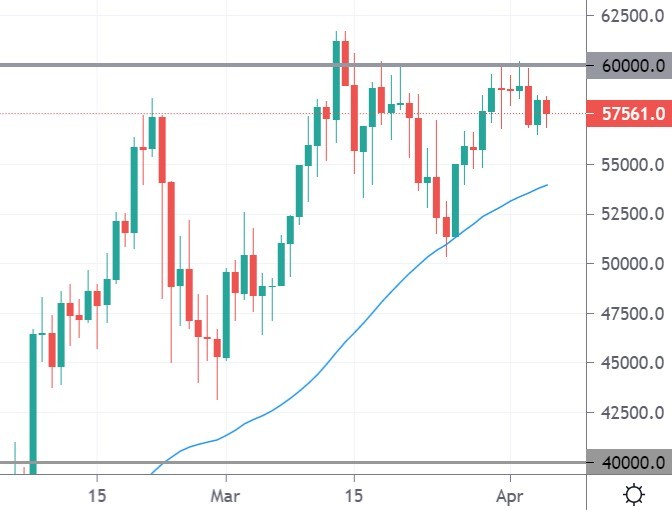
The Bitcoin price has stalled below the $60,000 price level despite a JP Morgan report talking of a $130k price target.
The investment bank noted that increased institutional investment was, “likely to arise from the recent change in the correlation structure of bitcoin relative to traditional asset classes”.
The coin’s volatile dips have always been a headwind to the coin’s acceptance as an asset class but as more come to the sector, higher volumes have smoothed out the volatile moves.
“Considering how big the financial investment into gold is, any such crowding out of gold as an ‘alternative’ currency implies big upside for bitcoin over the long term,” JP Morgan said.
Mechanically, the bitcoin price would have to rise to $130,000, to match the total private sector investment in gold.
In other BTC news, Binance’s crypto derivatives platform Binance Futures has seen big growth in its popularity as retail money continues to pour in. Binance runs lucrative trading competitions and this will be enticing traders to take their chances for a chance to win a stash of coins.
Open interest on the exchange’s derivatives platform hit a record high of over $10 billion on Saturday, relating to year-on-year growth of almost 4,000%.
Another development coming for BTC is the launch of a micro futures contract on the Chicago Mercantile Exchange. The contract will launch on May 3rd will allow investors to start trading with 0.1 BTC, rather than the 5 BTC needed on the full-size contract.
BTC Price Index
This will be an important week for BTC after a failure to get back above $60k. There is a risk of a further correction if buyers don’t emerge at these levels.
WRK
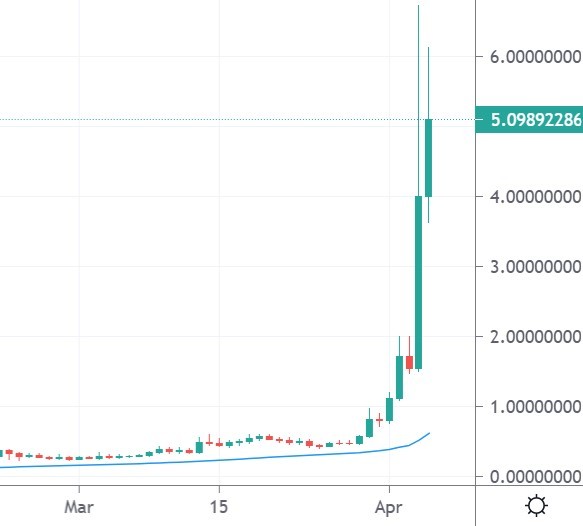
The Binance-backed WazirX cryptocurrency exchange has also been growing in popularity and the native WRX token has soared with an 850% rise in the last week alone.
WRX Price Index
WazirX has moved higher on news that the platform was launching a marketplace for non-fungible tokens (NFTs) for Indian artists. Nischal Shetty, founder of WazirX said:
It will truly transform the market in our rapidly digitising world with a growing interest in NFT across the globe.
The price of WRX has rallied to $5.00 with a market cap of $5 billion, but it is only a couple of weeks ago that we noted a story about the potential for the Indian government to ban cryptocurrencies in the country.
Investors should await some clarity on the government’s stance before considering WRX at these prices. The coin is currently ranked at number 83 in the list of the top valued coins.
HOT
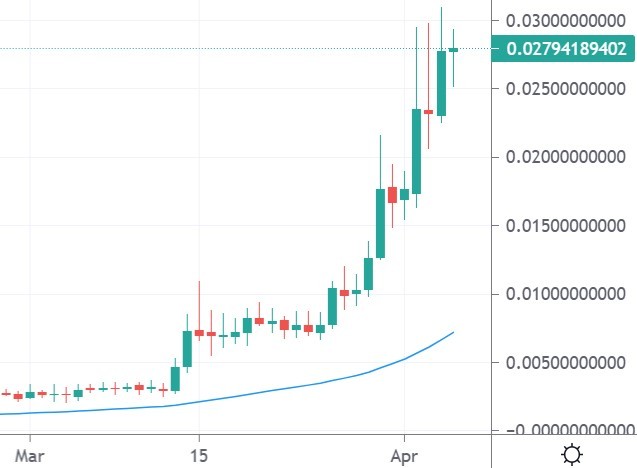
Holo has been another strong performer recently with a surge into the top 30 coins by market cap. The HOT token closed out January at $0.00073 but has rocketed higher to $0.027 for a return of 3,500%.
HOT Price Index
The latest push higher was driven by the March 25th announcement that Holo Limited was granted a U.S. patent for the rrDHT networking innovations within Holochain. The project developers said,
…this patent represents an easy way to represent complex distributed data models, and manage them with high resilience.
Holo clarified in a blog post that the patent was filed to prevent trolls from filing patents on this innovation and also to protect the “rights of the users to have sovereignty over their data.” While this is a positive step, only time will tell if Holochain can offer a reliable alternative to blockchain technology. The coin has seen a big surge from just 1 cent in February to a current high above $0.20.
Holo’s decentralized data platform seeks to let users own their own data and control their identity. Holo now has a market cap of $5 billion after its recent push higher.
On April Fools’ Day, Litecoin rebranded itself as “Bitcoin Lite.” The joke was a thorough effort, with a completely revamped website and Twitter account. Though the change was a joke, it contained a bit of truth: Litecoin really is based on Bitcoin’s code.
The project’s original site has been restored, but you can still view the “rebrand” here.
Litecoin is NOW BITCOINLITE! Read more about this historic transformation… https://t.co/byi1HGRaHj #BitcoinLITE #BitcoinLiteFAM pic.twitter.com/KE0OlXRfkE
— BitcoinLite (@litecoin) April 1, 2021
Ethereum Introduces “Sudo” Function
Ethereum developers on GitHub proposed a “sudo” opcode, referring to the Unix command that gives admin users full control of the system. Such a feature would be disastrous to the Ethereum blockchain, which is designed so that none of its participants have full control over the network or its transactions.
The tongue-in-cheek proposal reads, “Security Considerations: It will be fine.”
EIP-3455 is even more important than EIP-1559, please support!https://t.co/bRqqrsViTe pic.twitter.com/22kLmIIak9
— Andre Cronje (@AndreCronjeTech) April 1, 2021
Kucoin Lists Suez Token
Crypto exchange Kucoin announced that it is listing a new token, Suez Token, supposedly created to solve the recent Suez Canal blockages.
The were a few clues that hinted at the nature of the joke. The project supposedly planned to raise funds by selling NFT tokens with photos of Japanese movie monsters, while the team operated from an unlikely base: King Kong’s Skull Island.
📢 NEW LISTING
World Premiere! @Suez_Token $SUEZ gets listed on #KuCoin! 🚢
Suez Token was created to speed up the process of dredging the #SuezBlock and prevent similar issues from happening again.
Read more about Suez Token: https://t.co/UjhRHpOca0 pic.twitter.com/LFYu99uRta
— KUCOIN (@kucoincom) April 1, 2021
Circle Says U.S. Treasury Will Adopt USDC
Circle CEO Jeremy Allaire reported that the U.S. Treasury plans to adopt his firm’s USDC stablecoin as its digital dollar. Though Allaire is clearly not serious, the joke is apt, given that U.S. regulators and banks are warming up to stablecoins.
BREAKING NEWS: US @federalreserve and @USTreasury announce that US Government will adopt USDC as new Dollar Digital Currency standard, accelerating US role in global digital currency.
— Jeremy Allaire (@jerallaire) April 1, 2021
The Teletubbies Introduce a Crypto Token
Canadian media company WildBrain announced a Teletubbies-themed token called “TubbyCoin,” along with an ICO sale to distribute the new cryptocurrency. Although fictional, the company is actually planning to donate money to charity based on how much the April Fools joke circulates on Twitter.
The TubbyCoin BigHugs! Token, an official Teletubbies cryptocurrency made with special HugTech from WildBrain Labs is here. For every like, share, comment of #TubbyCoin, the TubbyCoin becomes more valuable! Let’s take it to the moon. 🚀: https://t.co/CZJn5R7NI9 pic.twitter.com/B1Nt8OjFXe
— Teletubbies (@TeletubbiesHQ) April 1, 2021
Beeple Art Vandalized With Spray Paint
The Onion reported that Beeple’s NFT art was vandalized with spray paint. Though the piece of art actually exists and was auctioned for $69 million in early March, editing the image in Microsoft Paint does not make any changes to the crypto token itself.
The joke was retweeted by Riccardo “FluffyPony” Spagni of Monero.
Truly shocking.https://t.co/vzKOmHuqcm
— Riccardo Spagni (@fluffypony) March 30, 2021
Peercoin Migrates to Ethereum
Peercoin announced that it is moving to Ethereum—an unlikely move for a project that preceded Ethereum by over two years and is based on Bitcoin’s code.
After much deliberation, the Foundation, has decided to migrate #Peercoin to #Ethereum as an ERC721 token. 100 billion new coins will also be generated to help fund development and marketing efforts. Stay tuned for more updates!$PPC #ETH #blockchain #cryptocurrency #crypto pic.twitter.com/KiXGKAZlRK
— Peercoin (@PeercoinPPC) April 1, 2021
0x Rebrands With Extensive Makeover
0x, a decentralized exchange protocol, rebranded itself. It says that after years of research, it has decided to make its logo blue.
We just rebranded👇 pic.twitter.com/USVJouG7zi
— 0x 🍵 (@0xProject) April 1, 2021
Flipkart Accepts Bitcoin
On March 31, Indian commerce site Flipkart tweeted that it had added support for Bitcoin payments. Hours later, the company followed up with another tweet: it crossed out “Bitcoin” and stated that the announcement was in fact an April Fools’ joke.
The future is here. We now accept Bitcoin as a convenient mode of payment. Update your app now. pic.twitter.com/l3MlY2qwRd
— Flipkart (@Flipkart) March 31, 2021
Not a Joke: Chipotle Runs Bitcoin Giveaway
Mexican food restaurant Chipotle began a $100,000 “Burritos or Bitcoin” giveaway on April 1st. Despite the unlikely giveaway theme, the contest is legitimate. World Burrito Day falls on the first Thursday of every April, and this year, it happened to fall on April Fools’ Day. The contest’s extensive terms and conditions also show that it is legitimate.
As Bitcoin rises in popularity, concerns are being raised about the environmental impact of Bitcoin mining. However, there may be solutions.
Bitcoin Mining’s Environmental Impact
Bitcoin is produced through mining, an energy-intensive process that introduces new cryptocurrency into circulation by rewarding those who contribute computer power.
Though mining was originally done by individuals, the industry has grown highly competitive, meaning that a large portion of Bitcoin mining is done by large firms such as Bitmain. Individually-sold ASIC mining devices also contribute to energy usage.
Recent estimates suggest that Bitcoin mining worldwide requires more mining power than entire countries. An analysis from Cambridge University published in February 2021 suggests that mining consumes about 121.36 terawatt hours (TWh) of energy per year globally. That amount is equivalent to about 0.6% of global power consumption, and comparable to the consumption of nations like Norway or Argentina.
Transparency In Mining
Shark Tank host Kevin O’Leary has drawn attention to the problem of Bitcoin’s energy usage. Though O’Leary has warmed up to Bitcoin and decided to make the asset 3% of his investment portfolio, he is still concerned about energy consumption.
In conversation with crypto news site Coindesk in March, O’Leary stated that he wants to ensure that his Bitcoin is mined efficiently. He compared parts of the Bitcoin mining industry to unethical diamond mining companies that produce blood diamonds.
“There’s a whole new metric around the concerns people have around sustainability about the origins of the coin…was it mined in China, was it mined in a country under tariff or restrictions with the U.S government?” O’Leary noted. “How do I know I’m not supporting mining a country where human rights are abused, like China?”
O’Leary suggested that he is now investing directly in mining companies themselves, which give him a portion of their Bitcoin output. This ensures that ethical mining is profitable. It remains to be seen whether other companies will follow suit.
Eco-Friendly Power Sources
In December 2020, Bitcoin and cash payments firm Square announced that it is planning to offset carbon emissions by supporting clean Bitcoin mining operations.
Through its Bitcoin Clean Energy Investment Initiative, Square has committed $10 million in order to support energy mining companies. That initiative and the funds that it distributes could offset some of the ecological costs of mining Bitcoin.
Though Square does not mine Bitcoin itself, it will reduce its own energy consumption. The firm aims to achieve net zero carbon emissions by 2030.
Square co-founder and CEO Jack Dorsey stated that his payments firm “believe[s] that cryptocurrency will eventually be powered completely by clean power.” He also hopes that Square’s decision will “accelerate this conversion to renewable energy.”
Better Mining Regulations
Though some crypto companies are taking it upon themselves to confront Bitcoin’s energy consumption, other changes are coming from regulators. In March, China’s Inner Mongolia region announced plans to ban Bitcoin mining.
Though the region was previously one of the most popular areas for Bitcoin mining due to cheap energy prices, it has failed to meet China’s energy targets. Now, several facilities will shut down and new facilities will be prevented from opening.
Over the past several years, various other regions have taken similar stances. Though the EU has no plans to ban cryptocurrency mining entirely, Bitcoin mining could be subject to rules around “energy efficiency, the power sector, and greenhouse gases emissions,” according to statements made by EU regulators in 2018.
Elsewhere, in the U.S., New York’s NYDFS is asking firms to pay attention to climate change, noting that mining’s energy cost “is sizable compared to the value of the virtual currencies.” It remains to be seen if these guidelines will be enforced.
Altcoins and Indirect Investments
Bitcoin’s energy consumption will also be offset as the crypto industry grows around it. Though Bitcoin will always rely on mining, other cryptocurrencies like Ethereum are moving to alternate systems that consume little energy, such as proof-of-stake.
Additionally, Bitcoin derivatives mean that institutional investors can invest in assets that track the price of Bitcoin without actually holding BTC itself. Though that doesn’t reduce the amount of energy that Bitcoin uses, it does mean that investors will likely have a way to invest in Bitcoin even if its ecological footprint becomes a bigger issue.
This month’s non-fungible token (NFT) craze also provides a way to invest in crypto without any connection to Bitcoin mining. Whereas Bitcoin mining’s scarcity comes from electrical costs, NFTs are rare because they are unique items by design.
Is Bitcoin Ecologically Sustainable?
Though concerns of Bitcoin’s environmental impact are widespread, there are plenty of ways to improve on current mining practices. Regulation, transparency, offsets, and alternative crypto investments can help reduce Bitcoin’s ecological impact while still leaving room for the competition that the mining industry requires.
It is that time of year again and we are happy to announce our Annual Cryptocurrency Market Survey. It has been an exceptional year for crypto and our editorial staff cannot wait to hear what you think.
Share your thoughts.
The survey takes just a few seconds, your answers are completely anonymous, and once you have submitted your thoughts you will get full access to the full range of our readers’ opinions.
2021 has been the biggest year in crypto history. We want to understand what’s driving this latest Bitcoin-led explosion by asking our thousands of daily readers their views on the cryptocurrency market today.
When the survey is complete look for expert analysis from our editorial staff. We will team up to create the most comprehensive report on views in the cryptocurrency community in 2021.
Remember it only works if you participate and share your views. Do not forget to spread the word to your crypto-loving friends.
CLICK HERE TO TAKE THE QUICK SURVEY.
When the survey is complete, we will publish the full results with our analysis here on Bitrates. Our editorial team will also conduct interviews with a few select readers to get a better understanding of your views.
If you are interested in participating in our interviews, please email editor@bitrates.com!
Signal, the cross-platform encrypted messaging service is facing criticism this week, after the company Signal Messenger told the public it was integrating the cryptocurrency mobilecoin. Moreover, controversy surrounds the company’s founder and CEO Matthew Rosenfeld, known as ‘Moxie Marlinspike’ over his previous ties with the Mobilecoin project.
The Relationship Between Mobilecoin and Signal
During the last week, Signal Messenger has been under fire for integrating the privacy-centric cryptocurrency mobilecoin (MOB). The subject has been trending on social media and forums as a number of crypto advocates are not pleased with the choice.
According to the MOB project’s website, the entire distributed ledger is “opaque” as “individual transactions are cryptographically protected, and the network uses forward-secrecy.” Since Signal’s announcement MOB has gained over 450% since then and today it’s up 20% during the last 24 hours.
MOB is currently trading for $58 per unit and the trading platform FTX Exchange is the most active market trading it today. Controversy is tied to the relationship Marlinspike allegedly had with Mobilecoin prior to the integration. Word on the street is Marlinspike was simply a MOB advisor but documents indicate the Signal founder may have played a CTO role.
In addition to that controversy, the project has been accused of being centralized, a copy of monero (XMR), and 100% pre-mined as well. A pre-mine is when the network’s entire supply of native tokens is created right away and developers and early investors have access to it all.
“Mobilecoin is 100% premined,” the Reddit user and r/cryptocurrency forum moderator u/samsunggalaxyplayer said. “100% of the supply was created in 16 outputs that can be distributed however the initial founders like. There is extremely limited information about how they will be distributed, though it’s highly likely that the founders will keep some for themselves.”
‘Private Keys Stored on a Secure Enclave,’ Mobilecoin CEO Denies Marlinspike Was a CTO
The Redditor also said that Mobilecoin team members like to “discredit Monero wherever they can.” On Twitter, software developer Pokkst spoke out against the Mobilecoin project as well. A few more things about Mobilecoin,” the developer tweeted. “When Mobilecoin is run with Intel SGX, user’s private keys are transmitted to remote nodes and stored in their secure enclave. Lol. Basically Intelcoin. It’s 100% premined, with a hardcoded 0.01 MOB fee per tx. Currently, that’s $0.66 per [transaction]. All [transaction] fees currently go to Mobilecoin Foundation.”
Pokkst added:
The creator of Signal has a huge stake in Mobilecoin, so Moxie is pumping his bags by using Signal.
Following the Mobilecoin announcement, people who disliked Signal’s integration with MOB started to recommend the encrypted messaging service called Session. The Session project leverages a blockchain and is a Signal fork. Despite the documentation showing Moxie as the CTO, Mobilecoin CEO Joshua Goldbard recently said that “Moxie was never CTO.”
What do you think about the controversy over Signal and the Mobilecoin project? Let us know what you think about this subject in the comments section below.
On April 9, 2021, the Delaware-based company and sponsor of the “Kryptoin Bitcoin ETF Trust” filed an S1 amendment for a bitcoin exchange-traded fund (ETF) with the U.S. Securities and Exchange Commission (SEC). The asset manager re-filed its 2019 ETF application and instead of leveraging NYSE, the company plans to use Cboe BZX.
Kryptoin Joins the List of Bitcoin ETFs Hoping for Approval in 2021
The race for a bitcoin exchange-traded fund (ETF) in the United States has grown thick with competition in recent days. The asset manager Kryptoin has recently revealed it has re-filed with the SEC in order to get an ETF approved. With Kryptoin joining the competition, there are now seven bitcoin-based ETFs hoping to get approved by the U.S. regulator. The list includes Valkyrie, Vaneck, Fidelity, NYDIG, Wisdomtree, First Trust & Skybridge, and Kryptoin.
Kryptoin’s prospectus is not much different than its 2019 filing, except at that time it had chosen to list on NYSE Arca. However, this time around, Kryptoin’s prospectus sent to SEC on Friday named Cboe BZX as the listing exchange. Kryptoin has decided to add its prospectus to the list of bitcoin ETF filings, while both Vaneck and Wisdomtree step up for the SEC review. The company’s product will be named the “Kryptoin Bitcoin ETF Trust,” and the company would like to launch as soon as it is permissible.
The preliminary prospectus subject to completion further notes the “objective is to provide exposure to bitcoin at a price that is reflective of the actual bitcoin market where investors can purchase and sell bitcoin, less the expenses of the Trust’s operations.” Kryptoin adds that the firm will leverage a reference rate in order to determine the value of shares.
The SEC filing states:
In seeking to achieve its investment objective, the Trust will hold bitcoin, and in seeking to ensure that the price of the Trust’s shares is reflective of the actual bitcoin market, the Trust will value its shares daily as determined by the CF Bitcoin US Settlement Price.
Kryptoin CEO Has Experience With the SPDR Gold Shares ETF
There are already two North American bitcoin-based ETFs in Canada, and a few weeks ago in South America Brazil launched its first bitcoin ETF as well. The United States has yet to allow a bitcoin ETF, as the SEC has denied plenty and many have withdrawn their preliminary filings. The SEC has cited issues like price manipulation but since a lot of institutional money has jumped into the crypto ecosystem, many firms have hopes for 2021 approval.
Kryptoin’s ETF is led by Jason Toussaint, a businessman who has a lot of experience with ETFs. Toussaint was previously the CEO of World Gold Trust Services, a sponsor of SPDR Gold Shares ETF (GLD). Kryptoin’s CEO and board member Toussaint has also worked with ETFs and other investments with Morgan Stanley, Northern Trust Asset Management, and JP Morgan Asset Management.
What do you think about Kryptoin’s bitcoin ETF filing and the other ETFs waiting for approval? Let us know what you think about this subject in the comments section below.
Goldman Sachs CEO David Solomon foresees “big evolution” coming to cryptocurrency regulation as demand for bitcoin from clients continues to rise. He says that Goldman will “continue to find ways to serve our clients as we move forward.”
Crypto Regulation Will Experience ‘Big Evolution,’ Says Goldman Sachs’ Chief
David Solomon, the CEO of global investment bank Goldman Sachs, shared his view on cryptocurrency regulation in an interview with CNBC this week.
Regarding the regulation for bitcoin and other cryptocurrencies, the Goldman Sachs executive said he thinks that cryptocurrency “is a space that’s evolving,” predicting:
I think there’ll be a big evolution as to how this evolves in the coming years.
Emphasizing that his company operates within the rules set by regulators, the Goldman Sachs CEO noted: “I’m not going to speculate on where the rules will go for regulated financial institutions, but we’re going to continue to find ways to serve our clients as we move forward.”
Solomon detailed that Goldman Sachs is focused on how to support demand from clients for bitcoin and other cryptocurrencies. “We continue to think about digital currencies and the digitization of money in a very proactive way,” he opined, mentioning specifically that his firm “can help clients facilitate custody positions in digital assets.”
The Goldman Sachs chief reiterated: “As our clients have demand to be involved in this space we can continue to find ways to support our clients … That’s the lens that we’re really looking through.” Solomon clarified:
There are significant regulatory restrictions around us and us acting as a principle around cryptocurrencies like bitcoin.
Goldman Sachs recently brought back its bitcoin trading desk and will be offering a “full spectrum” of bitcoin investments. The firm is seeing huge institutional demand for bitcoin.
Do you agree with Goldman Sachs’ CEO about regulatory evolution coming to the crypto space? Let us know in the comments section below.
In the SEC v. Ripple case, the court has denied the request by the U.S. Securities and Exchange Commission (SEC) for personal financial records of Ripple’s executives that are not connected to XRP. The court says that it “is not convinced” that personal banking records would show the violations as claimed by the SEC.
Another Win for XRP in SEC v Ripple Case
In the lawsuit brought by the U.S. SEC against Ripple Labs, CEO Brad Garlinghouse, and co-founder Christian Larsen over the sale of XRP tokens, the court has denied the SEC’s request to obtain personal financial records of the defendants that are unrelated to XRP. The order was signed by Magistrate Judge Sarah Netburn on Friday.
“The SEC has served the individual defendants with Requests for Production seeking their personal financial records over an eight-year period,” the order explains. It adds that the commission has “also issued third-party subpoenas to several financial institutions at which the individual defendants maintain accounts, seeking similar records.”
The order notes: “Garlinghouse and Larsen move for a protective order to avoid their discovery obligation and to quash the subpoenas served upon SVB Financial Group, First Republic Bank, the Federal Reserve Bank of New York, Silver Lake Bank, Silvergate Bank, and Citibank, N.A. The motion is granted.”
Referencing Section 5 of the Securities Act, which details that all issuers must register non-exempt securities with the SEC, the order states:
The court is not convinced that the personal banking records would show (or even could show) what the SEC claims they would – individual violations of Section 5.
The judge additionally has found that “the SEC has not presented any evidence that individual defendants have hidden transactions or that the documents produce support any inference of hidden transactions.”
Furthermore, the judge explained that the motion for a protective order by Garlinghouse and Larsen is granted because “the court finds that the SEC’s requests for the individual defendants’ personal financial records, apart from those records of XRP transactions that are already promised, are not relevant or proportional to the needs of the case.” The judge further ruled:
The SEC shall withdraw its Requests for Production seeking the individual defendants’ personal financial records and withdraw its third-party subpoenas seeking the same.
“If, as discovery progresses, the SEC uncovers evidence that the individual defendants have not been forthcoming with records of their XRP transactions, it may provide such evidence to the court and renew its application,” the order concludes. The full court filing can be found here.
Ripple recently won discovery from the SEC and the commission has been ordered to produce internal records on bitcoin, ether, and XRP. Meanwhile, a petition has been started asking SEC’s new chairman to drop the Ripple lawsuit and end the war on XRP.
What do you think about the judge ruling in favor of Ripple against the SEC over personal financial records unrelated to XRP? Let us know in the comments section below.
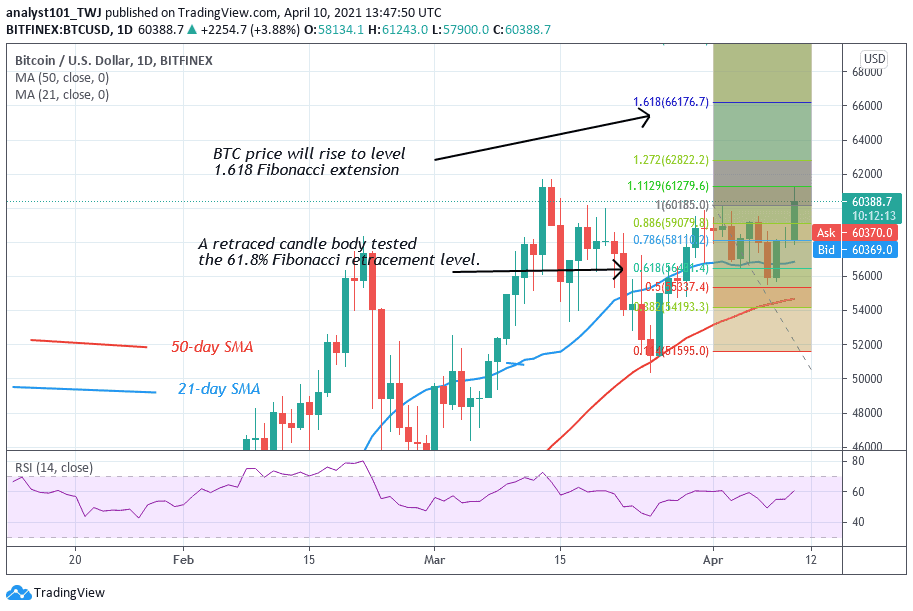
Bitcoin (BTC) Price Prediction – April 10, 2021 BTC/USD made positive moves above the $60,000 overhead resistance as price reached a high of $61,243. Unfortunately, buyers could not sustain the bullish momentum above the overhead resistance. Today, BTC price has fallen below the $60,000 support. A further downward movement of the coin is likely.
Resistance Levels: $58,000, $59,000, $60,000 Support Levels: $40,000, $39,000, $38,000
BTC/USD – Daily Chart
Today, BTC price broke the $60,000 overhead resistance as price reached the high of $61,243. In previous price actions, buyers broke the overhead resistance on two other occasions. On March 14, the bulls broke the psychological price level as price rallied to $61,699 high. On April 2, buyers also made concerted efforts to break the resistance but the market reached a high of $60,190. One common feature in the price action is that buyers failed to sustain the bullish momentum above the overhead resistance. Meanwhile, Bitcoin has fallen to $58,450 low and pulled back. The bottom line is that if the bears break the $58,000 support, the market will further decline to $54,000 low. On the other hand, if the $58,000 supports holds, Bitcoin will resume upside momentum.
HSBC Blacklists Microstrategy’s Stock for Investing In Bitcoin HSBC is an investment banking giant that has classified MicroStrategy as a “virtual currency product.” HSBC has directed users that already own MicroStrategy stock not to buy additional shares. According to reports, buying MicroStrategy stock is no longer possible for HSBC customers on the bank’s online trading platform — HSBC InvestDirect or HIDC. The message from the banking giant includes the following: “HIDC will not participate in facilitating (buy and/or exchange) products relating to virtual currencies, or products related to or referencing to the performance of the virtual currency.” The reason for the blacklisting is that MicroStrategy is a virtual currency product.
BTC/USD – Daily Chart
Bitcoin has fallen after breaking the overhead resistance. Meanwhile, the upside momentum will resume if the BTC price retraces and finds support above the $58,000 support. Nevertheless, the Fibonacci tool has indicated an upward movement of price. On April 2 uptrend, a retraced candle body tested the 61.8% Fibonacci retracement level. This retracement gives the impression that BTC price will rise to level 1.618 Fibonacci extension or the high of $66,425.90.
We use cookies on our website to give you the most relevant experience by remembering your preferences and repeat visits. By clicking “Accept”, you consent to the use of ALL the cookies.
This website uses cookies to improve your experience while you navigate through the website. Out of these, the cookies that are categorized as necessary are stored on your browser as they are essential for the working of basic functionalities of the website. We also use third-party cookies that help us analyze and understand how you use this website. These cookies will be stored in your browser only with your consent. You also have the option to opt-out of these cookies. But opting out of some of these cookies may affect your browsing experience.
Necessary cookies are absolutely essential for the website to function properly. These cookies ensure basic functionalities and security features of the website, anonymously.
Cookie
Duration
Description
cookielawinfo-checkbox-analytics
11 months
This cookie is set by GDPR Cookie Consent plugin. The cookie is used to store the user consent for the cookies in the category "Analytics".
cookielawinfo-checkbox-functional
11 months
The cookie is set by GDPR cookie consent to record the user consent for the cookies in the category "Functional".
cookielawinfo-checkbox-necessary
11 months
This cookie is set by GDPR Cookie Consent plugin. The cookies is used to store the user consent for the cookies in the category "Necessary".
cookielawinfo-checkbox-others
11 months
This cookie is set by GDPR Cookie Consent plugin. The cookie is used to store the user consent for the cookies in the category "Other.
cookielawinfo-checkbox-performance
11 months
This cookie is set by GDPR Cookie Consent plugin. The cookie is used to store the user consent for the cookies in the category "Performance".
viewed_cookie_policy
11 months
The cookie is set by the GDPR Cookie Consent plugin and is used to store whether or not user has consented to the use of cookies. It does not store any personal data.
Functional cookies help to perform certain functionalities like sharing the content of the website on social media platforms, collect feedbacks, and other third-party features.
Performance cookies are used to understand and analyze the key performance indexes of the website which helps in delivering a better user experience for the visitors.
Analytical cookies are used to understand how visitors interact with the website. These cookies help provide information on metrics the number of visitors, bounce rate, traffic source, etc.
Advertisement cookies are used to provide visitors with relevant ads and marketing campaigns. These cookies track visitors across websites and collect information to provide customized ads.