Stock ETF buyers pounce on dip as Bitcoin funds bleed $1.6 billion

US spot Bitcoin ETFs have lost $1.6 billion in November, while stock funds attracted billions of dollars from investors buying the dip.

US spot Bitcoin exchange-traded funds (ETFs) recorded $95 million in net outflows on Tuesday as investors poured billions of dollars into stock funds during a market pullback.

Tuesday’s withdrawals brought net outflows from US spot Bitcoin (BTC) ETFs to roughly $1.6 billion since the start of November, according to SoSoValue data.

Bitcoin ETF outflows eased for a third straight session, while stock funds accounted for all 17 of the top US-listed ETFs by inflows over five trading sessions, according to Bloomberg ETF analyst Eric Balchunas.

Read more

Go to Source

SEC enforcement actions fall 24%, crypto cases in spotlight

The SEC filed 348 actions in fiscal 2026, down from 456 a year earlier. Cases included alleged Bitcoin mining fraud and an FTX audit settlement.

The US Securities and Exchange Commission (SEC) filed 348 enforcement actions in fiscal 2026, down 23.7% from 456 a year earlier.

Its annual enforcement results included cases involving alleged crypto fraud and failures in FTX’s audits.

In its Tuesday release, the SEC said it had charged three purported crypto trading platforms and four investment clubs in an alleged scheme that defrauded investors of at least $14 million. In a separate case, the agency accused the founder of a Bitcoin mining business of misappropriating $48.5 million after raising more than $95.6 million from about 6,400 investors.

Read more

Go to Source

Ethereum Co-Founder Says ETH Goes Beyond Bitcoin and Gold as a Store of Value

TLDR:

  • Lubin says ETH shares gold and Bitcoin’s non-debt monetary design, while offering added network utility.
  • Ethereum’s censorship resistance and guaranteed transaction execution form key parts of Lubin’s argument.
  • Stablecoins, DeFi, collateral and smart contracts could expand demand for ETH as onchain activity grows.
  • Lubin predicts quantum-safe, AI-safe ETH by 2027–28, but provides no technical details for the forecast.

Joseph Lubin argues that ETH could become a stronger store of value as inflation and economic volatility rise. In a post on X, Lubin warned that nation-state currencies and other assets could lose purchasing power during heightened instability.

He described gold and Bitcoin as established stores of value, but argued that ETH offers additional monetary and utility features. These include censorship resistance, programmable transactions, collateral use, and Ethereum’s role in stablecoin activity. 

Lubin also predicted that ETH would become quantum-safe and AI-safe money by the end of 2027 or partway through 2028.

Why Lubin Sees ETH as a Store of Value

Lubin’s argument starts with ETH’s monetary design. He said ETH, like gold and Bitcoin, is not debt-based or credit-based money. He also pointed to Ethereum’s resistance to censorship.

According to Lubin, transactions on Ethereum’s layer 1 cannot be blocked. This applies to simple payments and complex decentralized finance applications. 

He added that valid transactions are guaranteed to execute, whether they move one dollar or billions. Lubin also said Ethereum is cheap and easy to use at any scale.

Lubin described ETH as disinflationary. He said periods of high network activity can make its supply deflationary. He sees this feature as another reason ETH could preserve value over time.

He further argued that ETH is relatively inexpensive to hold and secure. That could matter to users seeking assets they can store and use across different market conditions. However, these characteristics do not guarantee that ETH’s market price will rise.

Ethereum Utility Could Strengthen ETH’s Monetary Role

Beyond scarcity, Lubin’s thesis depends on Ethereum’s expanding economic activity. 

He described ETH as useful across decentralized finance, stablecoins, and smart-contract-based business processes. Ethereum also hosts what he called the bulk of stablecoin activity.

He expects finance and eventually other industries to move more activity onchain. Stablecoins serve as payment money and units of account, while ETH can support applications and collateral arrangements. 

Lubin argued that collateral becomes more powerful when the asset backing agreements can grow in value. That remains a thesis, not a guaranteed outcome for borrowers or investors.

He also emphasized programmability, which lets developers attach logic to transactions. Smart contracts can automate agreements, payments, and business processes. Lubin linked this capability to a future economy involving people and machine intelligence.

His post also addressed privacy and transparency. He said Ethereum-based financial instruments can be public or private, while remaining selectively disclosable and auditable. He cited tools including Railgun, stealth addresses, privacy pools, and zero-knowledge proofs.

Lubin expects Ethereum’s base layer and modular layer-2 networks to support more high-value transactions and agreements. His post did not provide technical details supporting his quantum-safety and AI-safety timeline.

The central point is that Lubin sees ETH as more than a scarce digital asset. He believes its monetary properties and Ethereum’s utility could reinforce each other as onchain activity expands. Whether that translates into lasting price appreciation will depend on adoption, network activity, and market demand.

The post Ethereum Co-Founder Says ETH Goes Beyond Bitcoin and Gold as a Store of Value appeared first on Blockonomi.

Go to Source

XRP Whales Scoop Up $72M as Bitcoin and Ethereum Holders Reduce Exposure

TLDR:

  • XRP whales accumulated 65.32M XRP worth nearly $72M in four days, according to Santiment’s whale data.
  • Bitcoin whales reduced holdings by over 34,000 BTC, worth $2.6B, as BTC dropped below $73,000 this week.
  • Ethereum whale wallets shed about 17,800 ETH worth $40M over the past week, according to Ali Charts.
  • Unlike BTC and ETH whale balances, XRP whale holdings recovered toward 4B tokens in Santiment charts.

Large cryptocurrency holders are taking different positions as BTC’s decline continues, with XRP whales increasing their balances while Bitcoin and Ethereum whales reduce theirs. Santiment charts shared by analyst Ali Martinez on November 10 show that large XRP holders added approximately 65.32 million tokens over four days, valued at nearly $72 million. By contrast, Bitcoin whales reduced holdings by more than 34,000 BTC, while Ethereum whales shed around 17,800 ETH during the previous week.

Bitcoin Whales Reduce Holdings as BTC Drops Below $73,000

Bitcoin recorded the largest reduction by dollar value among the three assets. Martinez reported that whale holdings declined by more than 34,000 BTC, worth roughly $2.6 billion, as the cryptocurrency fell from $79,000 to below $73,000.

The accompanying Santiment chart shows a broadly consistent decline in the balances tracked, with the latest reading near 5.24 million BTC. Earlier bars were closer to 5.28 million BTC, indicating that large-holder exposure contracted alongside the price.

The sequence matters as accumulation during falling prices can sometimes absorb available supply. In this case, however, the tracked Bitcoin wallets were reducing their balances rather than increasing them. The figures do not establish which wallets sold on exchanges or why their holdings changed.

Ethereum Whales Trim Exposure as XRP Accumulation Accelerates

Ethereum recorded a smaller reduction. Martinez said large holders shed approximately 17,800 ETH over seven days, equivalent to around $40 million at the prices used in his analysis. Its Santiment chart shows a less uniform pattern than Bitcoin’s.

Holdings rose early in the observed period, declined afterward and briefly recovered before the latest reading weakened again. Although both groups reduced exposure, their reported dollar changes differed substantially. Bitcoin’s $2.6 billion contraction was about 65 times Ethereum’s $40 million decline. Meanwhile, XRP moved in the opposite direction.

According to the same analysis, whale wallets accumulated 65.32 million XRP over four days, bringing the value of the increase to almost $72 million. The XRP chart shows balances recovering after a midperiod decline. Its final bar rises toward 4 billion XRP, the highest point in the displayed sequence, contrasting with Bitcoin’s falling bars.

What the Whale Divergence Means for Crypto Markets

These movements indicate different short-term holding patterns among the wallet groups tracked for each cryptocurrency. They do not prove that funds withdrawn from Bitcoin or Ethereum were transferred into XRP.

Basically, changes in wallet balances can reflect purchases, sales or transfers, while the charts alone cannot identify investor intentions. The monitoring windows also differ: four days for XRP versus roughly one week for Bitcoin and Ethereum.

For now, the reported data documents XRP whale accumulation occurring alongside reductions in Bitcoin and Ethereum holdings, without establishing whether that divergence will persist or affect prices.

The post XRP Whales Scoop Up $72M as Bitcoin and Ethereum Holders Reduce Exposure appeared first on Blockonomi.

Go to Source

Trump Still Wants to Buy Bitcoin but a Legal Wall Stands in the Way: Witt

Image of President TrumpFormer White House crypto adviser Patrick Witt says President Donald Trump is still interested in buying bitcoin for the U.S. Strategic Bitcoin Reserve, but open-market purchases face a serious legal problem. “The President’s Interested in It” Witt, who stepped down as executive director of the White House crypto council in October for the private sector, […]
Go to Source

“From Authorization to Supervision”: European Regulators Outline the Next Phase of MiCA as MERGE Madrid 2026 Concludes

MADRID, November 11, 2026 – MERGE Madrid 2026 concluded at the Palacio de Cibeles, bringing together leaders from traditional finance, blockchain, investment, and regulation. The three-day conference forms part of MERGE, a leading institutional platform for crypto, blockchain, and Web3 in Southern Europe and Latin America, focused on bringing traditional financial institutions and the digital […]
Go to Source

Ripple-Backed Evernorth Crashes Over 23% as Insiders Get Cleared to Sell

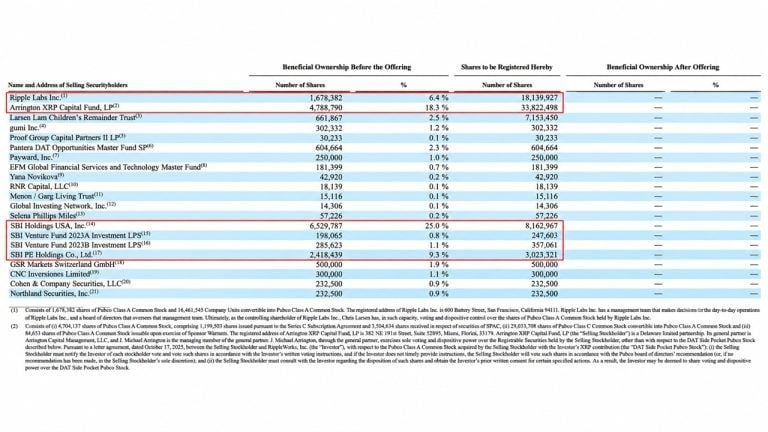
Evernorth Holdings (Nasdaq: XRPN), the XRP treasury company backed by Ripple, plunged 23.5% to $7.96 on Nov. 10 after a prospectus covering up to 73.7 million shares for resale went live. The Filing Behind the Drop The sell-off followed a final prospectus dated Nov. 9 and filed with the U.S. Securities and Exchange Commission (SEC). […]
Go to Source

MSCI Rules on Strategy Today and Billions in Forced Selling Hang on It

Strategy (Nasdaq: MSTR) heads into MSCI’s final November review list on Nov. 11 with its index seat on the line, and analysts are already gaming out what a removal could cost. The Countdown to MSCI’s Verdict The index provider finalized new rules on Oct. 15 that make “non-operating companies” ineligible for its Global Investable Market […]
Go to Source

Launching a Stablecoin: Become an Issuer or Partner With One?   

Law and Ledger is a news segment focusing on crypto legal news, brought to you by Kelman Law – A law firm focused on digital asset commerce. The opinion editorial below was written by Michael Handelsman for Kelman.Law. A payments company wants merchants to settle invoices in a dollar stablecoin bearing its name. Before it […]
Go to Source

Crypto Donors Flooded 2026 Midterms With a Record $471 Million

The cryptocurrency industry poured a staggering $471 million into the 2026 U.S. midterm elections, nearly doubling its 2024 contributions. An extensive investigation by James Delmore, a blockchain and crypto market analyst for Breadcrumbs and an independent writer, traces the extraordinary flow of political money, revealing which candidates and committees benefited, where the industry’s financial firepower […]
Go to Source

Missouri Turns Federal Gambling Law on Novig as Polymarket Sues State AG

Missouri’s attorney general has asked a federal court to stop sports-centric prediction market platform Novig from taking money from Missouri residents under a 2006 federal anti-gambling law, while Polymarket U.S. filed its own suit to block the state’s crackdown. Both filings landed on Nov. 9 in the same federal court in St. Louis. Missouri Counterclaims […]
Go to Source

Coinbase, Kalshi and Other Firms Back CFTC in Fight Over Stock Perpetuals

A dispute over who may regulate perpetual futures linked to individual US stocks is drawing some of crypto’s most prominent companies into federal court. Coinbase, Kalshi, Kraken parent Payward, DRW, Jump Trading and Paradigm have sought permission to support the Commodity Futures Trading Commission in litigation brought by the Capital Markets Alliance Association. Their proposed intervention follows approvals for new stock-linked perpetual products earlier this month.

TL;DR: Six firms filed a proposed friend-of-the-court brief backing the CFTC’s authority in the single-stock perpetual futures case. A judge earlier denied emergency relief but questioned the regulator’s legal basis for the approvals. The court has not delivered a final ruling on whether the products should remain available.

Why the legal issue is more complicated than crypto versus Wall Street

A perpetual futures contract provides economic exposure to price changes without a preset expiration date. It is a familiar structure in cryptocurrency markets. Applying the design to an individual listed US company raises a separate statutory question: which agency’s rules govern the product, and what obligations attach to the exchange listing it?

The Capital Markets Alliance argues that these contracts belong within the securities-law framework rather than under the CFTC’s treatment of security futures. The companies supporting the regulator argue that the law permits the agency’s approach and that blocking the products would limit US-listed alternatives to offshore markets. Those are legal positions advanced in an active dispute, not findings that either side has finally won.

The stakes extend beyond where an order is matched. Classification influences customer protections, margin rules, market surveillance and whether a new product can lawfully be offered to eligible participants.

The judge’s November 3 order matters

In the published federal court order, Judge Valerie Caproni denied a request for a temporary restraining order. That means the plaintiff did not obtain an immediate halt at that stage. The reasoning, however, was not a broad endorsement of the CFTC’s authority. The judge indicated the plaintiff was likely to succeed on the statutory question but had not demonstrated the imminent irreparable harm required for emergency relief.

That distinction is essential. A failed emergency application is not the same as a judgment that the products comply with the law. A preliminary-injunction dispute and the broader merits can still produce further decisions, and both sides may submit additional arguments.

Tokenized shares and stock perps are not equivalent

NewsBTC recently examined the NYSE’s proposed tokenized securities venue. That project is about representing and settling security ownership. A stock perpetual gives a trader a derivative claim whose value is linked to a share; it does not necessarily transfer ownership of that share or its voting and dividend rights.

Likewise, our coverage of Ripple Prime’s round-the-clock RWA-linked swaps illustrates how conventional markets can be referenced by crypto-native derivatives. The legal treatment of each product depends on its structure and jurisdiction, not simply the fact that it can trade 24 hours a day.

What happens now

The immediate questions are whether the judge accepts the proposed outside briefs, how the plaintiff’s latest reply addresses the statutory objections, and what relief the court considers appropriate. There is no basis to describe the matter as settled or to assume that every stock perp listing has permanent authorization.

The case is a serious test of how US financial regulation adapts to perpetual trading conventions. Its outcome could influence the shape of future listings, but the facts today support a narrower statement: the CFTC’s approvals are being challenged, and the industry is organizing a legal defense.

Written by the News Desk and edited by Samuel Rae.

Walt Launches Standalone Crypto App After Years Inside Telegram

The wallet platform that grew up inside Telegram is trying to become a destination in its own right. Walt, previously branded Wallet in Telegram, launched a standalone Android app on November 10. The company says an iOS version will follow. For the first time, customers can sign up without using Telegram, with Google and Apple among the supported account routes.

TL;DR: Walt has launched a separate Android app while keeping its existing Telegram integration. The service advertises access to more than 200 cryptocurrencies, tokenized US stocks and ETFs, perpetual futures and yield products, subject to regional availability. iOS is planned, not already live as part of today’s announcement.

The real change is distribution

The new app largely bundles products Walt had already developed inside Telegram. That means the headline is not the invention of a new trading contract or token. The commercial difference is that Walt no longer needs a user to start in a messaging app before becoming a customer.

According to the company’s product announcement, the app offers more than 200 cryptocurrencies, over 100 tokenized US stocks and exchange-traded funds, and perpetual contracts linked to crypto and some traditional asset classes. Walt also advertises yield features and AI-assisted research and trading tools. Availability and restrictions differ by jurisdiction and by individual product.

The company’s rebranding guidance explains that Walt and Telegram’s separate Money wallet are different services. That matters for users who remember an older ‘Wallet’ label and could easily assume the products now share an operator or custody arrangement.

One account across two interfaces

Walt says existing users can sign in through Telegram and access the same funds through the standalone app. New users can register without Telegram. This shared-account design may reduce the inconvenience of switching channels, but users should still confirm the account recovery, security and withdrawal rules of the actual wallet service they use.

There is also an important distinction between owning a tokenized representation of a US stock and holding the original share through a conventional brokerage account. Product terms determine shareholder rights, corporate actions and redemption. NewsBTC’s coverage of transfer agents in tokenized securities describes why those legal and operational details are central to a credible market.

NewsBTC has also examined Visa’s institutional stablecoin settlement expansion. That infrastructure serves a different audience, but it underlines how wallet apps and payment networks are both trying to make digital balances more usable outside speculative trading.

The new app’s perpetual futures are another product that deserves clear risk labeling. They provide leveraged or derivative exposure rather than ownership of the underlying asset, and can carry liquidation and funding risks even when presented in a convenient mobile interface.

Can a messaging wallet win a place on the home screen?

Walt’s distribution advantage has been access to Telegram users, but downloads, funded accounts and repeated use are different measures. The company says it has a large registered audience without publishing a full current breakdown of active users and trade volumes in this announcement. Those are the numbers that would help measure the standalone app’s impact.

The next milestones are an iOS release, geographic availability, fees and the adoption of products users cannot obtain as conveniently in the Telegram interface. Walt has now delivered the separate app. Whether customers will make it their primary home for digital assets remains an open commercial question.

Written by the News Desk and edited by Samuel Rae.

Charles Schwab Opens Live Solana, Avalanche and Chainlink Trading to Eligible Clients

Charles Schwab has moved three major altcoins from its expansion plan into its live crypto trading menu. The brokerage announced on November 9 that eligible Schwab Crypto clients can now trade Solana, Avalanche and Chainlink, alongside Bitcoin and Ethereum. The distinction between ‘planned’ and ‘available’ is the new milestone here.

TL;DR: Schwab Crypto now supports SOL, AVAX and LINK trading for eligible retail clients, adding to its BTC and ETH offering. Schwab says its service became broadly available to qualifying customers in October 2026. The announcement concerns direct crypto trading, not approval of new exchange-traded funds for these tokens.

Why the launch timing matters

Schwab began offering early access to its crypto service in May and opened it to eligible retail clients in October. The November addition broadens a product already running in the market, rather than announcing a future concept with no users. That gives the three altcoins a route to customers who prefer established brokerage infrastructure and account management over a separate crypto-native trading platform.

NewsBTC covered the earlier Schwab expansion plan in August. The new press release supplies the operational update those readers would have been waiting for: the named assets are available, subject to Schwab’s account and jurisdiction requirements.

This is an important qualification because access is not universal. Customers must qualify for the service, and conventional brokerage protections or product terms should never be assumed to apply identically to every digital-asset holding. Investors should read the published risk disclosures and custody arrangement rather than relying on the familiarity of the corporate brand.

Three assets, three different exposures

Solana is a smart-contract network whose economic activity includes trading, payments and tokenized assets. Avalanche operates a different blockchain ecosystem with an emphasis on customizable network infrastructure. Chainlink is associated with data and connectivity services used by smart contracts. They are all crypto assets, but they are not interchangeable bets on a single technology.

That distinction helps explain why broadening a brokerage menu does not immediately establish institutional conviction in any particular network. A broker chooses instruments for a combination of liquidity, client interest, operational readiness and risk controls. Adding a symbol is a meaningful access decision; it is not a research conclusion that the asset must outperform.

For further ecosystem context, NewsBTC’s recent look at Solana’s network upgrades and tokenized-asset activity shows why a network’s technical evolution should be assessed separately from the price of a token on a brokerage screen.

Adoption is a different question from availability

The launch raises useful questions: how many customers will open or fund Schwab Crypto accounts, how much activity will flow into the new assets, and whether more tokens follow? The announcement does not provide day-one trading volumes or say how much demand each token will receive.

A larger, more familiar distribution channel could change the market over time by widening who can participate. But whether it deepens liquidity or simply moves existing traders from one provider to another will require actual usage data. For now, the verified news is an operational launch with a clearly defined set of supported coins.

Written by the News Desk and edited by Samuel Rae.

Standard Chartered Expands Prime Brokerage Partnership With 24X to Cover BTC and ETH

Institutional investors will be able to access Bitcoin and Ether trading through an expanded relationship between 24X and Standard Chartered. In a November 10 announcement, 24X Bermuda said the banking group will extend its prime-brokerage role from foreign-exchange products to digital assets on 24X’s multi-asset technology platform.

TL;DR: 24X says Standard Chartered is expanding its prime-brokerage relationship to cover BTC and ETH. The arrangement is aimed at institutional counterparties accessing crypto and FX through one execution infrastructure. It changes the trading and counterparty workflow for eligible participants; it is not a retail exchange rollout.

One relationship across different trading markets

The company’s stated model allows an institutional participant to face Standard Chartered as its central counterparty while using 24X for execution, matching, liquidity configuration and straight-through processing. That separation matters. The participant’s commercial relationship and credit exposure are handled differently from the technology that matches orders.

Traditional foreign exchange and spot cryptocurrency trading do not have identical market structures or risk profiles. FX markets have established bank relationships, while crypto markets operate around the clock and rely on a patchwork of exchanges, brokers and custody providers. An integrated platform can simplify some operational tasks, although it still requires clients to understand the product-specific terms.

The release says 24X already offered FX, non-deliverable forwards and spot services. BTC and ETH are the additional digital-asset instruments named in the expanded partnership. It would be misleading to claim the agreement immediately covers every token, derivative or jurisdiction.

Counterparty quality is not the same as risk elimination

A recognized bank acting as a central relationship may appeal to institutions that want more familiar onboarding, credit arrangements and oversight. It does not remove Bitcoin volatility, market liquidity problems or the possibility of disruptions in the surrounding infrastructure. Nor should the word ‘prime’ be used as a shortcut for saying all trades are insured or guaranteed.

Institutions will need to evaluate exposure limits, settlement timing, custody arrangements, collateral terms and what happens during market stress. The distinction between an execution venue and the organization responsible for a trading obligation is especially important for crypto, where the history of market failures has made counterparty concentration a persistent concern.

NewsBTC previously looked at Ripple Prime’s effort to bring traditional markets into 24-hour trading workflows. That is a distinct product and operator, but it reflects the same strategic demand: customers increasingly want to manage digital and conventional exposures without jumping between disconnected systems.

What should be confirmed next?

The announcement establishes the partnership expansion, but it does not provide a full ledger of live client trades, volumes or fee terms. Commercial success depends on whether eligible counterparties find the combined trading and brokerage model attractive enough to move business from existing venues.

As tokenized securities and digital assets enter more established markets, investors may become less focused on whether a blockchain is present and more concerned with the legal machinery behind settlement. Our report on the NYSE’s tokenized securities infrastructure partners describes why those arrangements matter. For 24X, the next proof point will be active institutional adoption rather than the breadth of the announcement alone.

Written by the News Desk and edited by Samuel Rae.

Please enter CoinGecko Free Api Key to get this plugin works.
Exit mobile version