RBC Capital Markets has published a report suggesting that computing giant Apple is in a position to introduce cryptocurrency services for its retail users. The report has circulated widely, raising the question of whether Apple has any interest in the matter.
What Are Apple’s Current Crypto Policies?
Apple does not have definitive policies on cryptocurrency. The company banned cryptocurrency wallets from its app store in 2014 but now allows them. Current third-party wallets include apps from major exchanges like Binance and Coinbase.
The company also allows users to spend their Apple Pay balance on cryptocurrency through various third-party brokerages and exchanges. Opera, for example, integrated Apple Pay with its built-in crypto exchange in March 2020. However, this was done under Opera’s own initiative, and Apple itself had no involvement in that decision.
One policy remains very strict. Apple continues to ban apps that use device power to mine or generate cryptocurrency. However, non-intensive “cloud mining” is permitted. Apple’s current policy on crypto mining has been in place since 2018.
The firm has also patented crypto-adjacent technologies. The company patented a centralized digital currency called “iMoney” in 2013. It also patented a blockchain-based timestamp system in 2017. These patents will not necessarily come to fruition, but they suggest that Apple is open to the technologies discussed therein.
CEO Tim Cook Has Spoken Out Against Crypto
Apple executives have expressed their own positions on crypto. In September 2019, Apple CEO Tim Cook declared that Apple would not launch its own cryptocurrency.
“A private company shouldn’t be looking to gain power this way,” he stated. Cook added that other companies should not do so either, seemingly in response to Facebook’s ties to the Diem stablecoin. Cook also argued that the right to issue new currencies should be the responsibility of national governments, not corporations.
Although Cook is clearly opposed to Apple launching a cryptocurrency, that does not necessarily mean that Apple cannot act as a brokerage for existing cryptocurrencies.
At least one executive has made positive statements on the topic of Bitcoin and crypto. In September 2019, Jennifer Bailey, VP of Apple Pay, stated that the company is monitoring Bitcoin: “We’re watching cryptocurrency. We think it’s interesting. We think it has interesting long-term potential,” she stated.
Cook himself has even promoted Apple Pay as a privacy-preserving payment option. Though Apple’s approach to privacy is not directly comparable to Bitcoin’s own design, Apple could see Bitcoin as an asset that is compatible with its mission.
Steve Wozniak Has Endorsed Bitcoin
One of Apple’s original co-founders, Steve Wozniak, has expressed positive sentiment toward cryptocurrency in the past. He bought and sold an undisclosed amount of Bitcoin when it was priced at $700 and says that the asset has potential.
“Only bitcoin is pure digital gold… and I totally buy into that,” Wozniak said in a CNBC interview in July 2018. He drew attention to Bitcoin’s decentralization as his reason for favoring the coin and argued that altcoins tend to compromise this vision.
Wozniak has also launched a blockchain business called Efforce, which uses blockchain technology to create a marketplace for green companies. The company’s crypto token WOZX went live on various exchanges in December 2020.
However, Wozniak has had minimal involvement with Apple since 1985, and as such, his statements regarding Bitcoin say little about the company’s own attitudes.
Big Tech as Competition
Even though Apple demonstrates mixed feelings toward cryptocurrency, the attitudes of its competitors are clear. PayPal has fully embraced cryptocurrency, allowing retail users to buy and sell Bitcoin and other assets directly from their account interface.
Meanwhile, Facebook has backed the Diem Association and its upcoming stablecoin, also aimed at retail users. Microsoft and Amazon both offer enterprise blockchain solutions, while Google Cloud is running nodes for several public blockchains. Even Twitter is exploring blockchain as the basis of a decentralized social media standard.
With several Big Tech companies embracing crypto and blockchain, Apple may soon feel motivated to join in with the rest. Though this will not necessarily take the form of a retail crypto service, Apple clearly has many options.
Bitcoin and Ethereum are assets that top the rating of cryptocurrencies. For most people, even those to whom these names say something – it’s twin brothers, alternative and competing organizations. For those who are deeply interested in blockchain issues – fundamentally different technologies.
Ethereum and Bitcoin: parallels and rivalries of major cryptocurrencies
Understanding the fundamental differences between Bitcoin and Ethereum, allows us to move to the comparison of the assets of ETH and BTC. It will allow us to determine what is better – Bitcoin or Ethereum, if we are talking about investing and mining. Before we move on to defining the pros and cons, it is worth listing the common traits:
Both resources are mined and traded;
Special wallets are needed to store the key codes that ensure ownership;
Trading in cryptocurrencies, including Bitcoin and Ethereum, takes place on the platforms of exchanges;
The value of both cryptocurrencies largely depends on the supply and demand, that is, is prone to jumps in connection with the events of the industry.
Ethereum transactions make it difficult only to reduce the prevalence of this asset, although the situation is gradually rectified.
Ethereum is also faster when it comes to transactions. This trend is especially noticeable in crypto gambling, which has been developing rapidly in recent years. Despite the fact that fast transactions was something always associated with Bitcoin, Ethereum managed to snatch the title of “fastest crypto” years ago. It is quite easy to prove this fact – as soon as you sign up with one of the Ethereum casinos reviewed here and make deposits or withdrawals you can be sure that the funds will be available on your account in just seconds.
The pros of Bitcoin
There are so many people talking about the advantages of Bitcoin that this is its main plus. Attention provides buying, buying – rising price, price increase – an opportunity to get passive income or earn on the course. But bitcoin also has significant advantages:
Banks, business sharks, and big investors are already behind the most important of cryptocurrencies. This negates the chance to depreciate at once: Bitcoin can already be considered a reliable asset.
It is easier to work with Bitcoin coins: almost all exchanges, trading platforms and even payment systems have added it to the list of assets. This simplifies transactions, buying and selling opportunities, and transferring to fiat money.
Terminals for “cashing out” Bitcoin are not uncommon. On the Internet, this cryptocurrency is accepted by many services and even online stores.
The economic model of Bitcoin, which initially limits the total volume of coins, so works for miners. There will be no oversupply of the resource, that is, there will be no reduction in the cost due to saturation.
Ethereum advantages
Ethereum is a second-generation cryptocurrency that has been aptly nicknamed Bitcoin 2.0. The creators of Ether were able to prevent errors of the prototype and exclude them from their product. The benefits of the Ethereum digital asset are:
The system is designed for mining with small capacities, the developers deliberately chose the target audience of miners with small and medium-performance PCs;
The Ethereum block is optimized: scaling provides a high transaction rate. For Bitcoin, the processing time is up to 2 minutes, Ethereum – 10-15 seconds.
Ghost’s own code and protocol allow you to get rewarded from blocks you’ve already mined. This type of earnings is added to mining and profits from cranes.
The MetaMask app allows you to work with the Ethereum blockchain directly from the browser. So far, it’s only Chrome, but over time, the developers plan to add other bundles.
Mining Ethereum outside the pool with its own resources is still a reality.
The reward for Ether for miners does not decrease with time, in Bitcoin every 4 years it is reduced threefold. The duration and amount of production in the Ethereum ecosystem are not limited.
Ether is a consumable for creating applications in the Ethereum environment, meaning it needs at least some programmers and optimizers. This ensures the demand for it, although it strongly divides the audience interested in dominant cryptocurrencies.
To put it simply: consumers of Ethereum will remain working with smart contracts representatives of business and IT-sphere, and Bitcoin will buy ordinary user goods and services.
Ether prospects: what are the chances of bypassing Bitcoin?
The above advantages of the cryptocurrency, which is still occupying the second position, make you seriously wonder whether the leadership of Bitcoin is so sustainable. The rise of BTC provided a high, raised around the media system. Experts, who consider digital smart contracts the most promising platform for business, political technologies, and storage systems, believe that the first drop in interest in Bitcoin will lead to the automatic rise of the real Ethereum consumed. Tokens, which will be in demand for many years, which will ensure an increase in the price of ETH.
Herman Neglyad, the deputy of the Russian anti-money laundering body, Rosfinmonitoring, has said his organization will monitor cryptocurrency transactions that involve the conversion from crypto to fiat. Neglyad made this revelation during a recent meeting of the State Duma Committee on financial markets.
Banks Already Cooperating
According to a Russian news site, Regnum, the anti-money laundering body is already getting cooperation from banks.
“Banks have already begun to pay attention to exchange operations, that is, when they see that an operation has come after the exchange of virtual assets for hard currency, they have already begun to evaluate them and actually inform us about these operations,” said Neglyad.
Also, the Rosfinmonitoring official adds that his organization, alongside the country’s central bank will introduce “a separate code, distinguishing a separate group of such suspicious transactions, that is, to further orient traditional financial institutions to this problem.”
Meanwhile, Neglyad’s remarks about Russia’s intention to monitor crypto to ruble transactions follow recent comments by the country’s President, Vladimir Putin. As reported by Bitcoin.com News, President Putin has voiced his concern over what he termed “illegal cross-border transfers of cryptocurrencies.” The Russian leader adds that criminal elements were “increasingly using these digital financial assets, and this justified increased monitoring.”
Russia’s Push to Regulate Cryptocurrencies
Over the past few years, the Russian nation-state has grappled with the question of how to regulate cryptocurrency use in the country. In September 2020, the country proposed harsh penalties for individuals that fail to disclose cryptocurrency holdings in excess of a certain threshold. In February 2021, Bitcoin.com News reported that a bill recognizing cryptocurrencies as the property had advanced in the Russian parliament.
In the meantime, it is not clear if Neglyad’s remarks are linked to President Putin’s earlier comments. However, the Regnum report says the State Duma Committee meeting at which Neglyad spoke had been held “in preparation for the report of the Russian government.”
What are your views on Rosfinmonitoring’s proposal to monitor cryptocurrencies? You can share your thoughts in the comments section below.
Oaktree Capital’s Howard Marks has warmed up to bitcoin. He admitted that he had a knee-jerk reaction to the cryptocurrency and dismissed it too soon. Since then, the price of bitcoin has risen tenfold as demand for the cryptocurrency soars among retail and institutional investors.
Howard Marks Changes Stance on Bitcoin
Howard Marks, co-founder and co-chairman of Oaktree Capital Management, talked about bitcoin during an interview with CNBC last week.
As institutional investors become increasingly interested in bitcoin and major companies have announced their investments in the cryptocurrency, Marks said: “I’m opening my mind on bitcoin. I was ‘knee-jerk’ skeptical.” He clarified:
While bitcoin doesn’t have an intrinsic value, the same can be said of the dollar and many, many other things that have value like paintings and diamonds. I’ve been more sensitized to the supply-demand case.
The Oaktree Capital founder similarly told The Korea Economic Daily on March 15 that back in 2017, when bitcoin rose in popularity, he was “very dismissive of it because it doesn’t have intrinsic value.” He added that he has been studying and found that “people make the case for bitcoin … on the basis of supply and demand.”
He noted that the supply of bitcoin is fixed, “unlike the dollar, which can be printed in infinite amounts,” adding that “the demand [for bitcoin] is growing because more people are interested in it.” However, he pointed out that “it’s a little circular because people want it because it’s going up in price and it’s going up in price because people want it. That’s circular.”
Exploring “independent reasons why people want it,” Marks named some benefits of bitcoin. “The argument is that it’s very useful to be able to trade instantaneously, you can trade 24 hours … seven days a week.” He compared it to banks, stating that with banks you can’t send a wire any time. In addition, he said: “It’s confidential. Nobody knows about your holding but you, the government can’t know, etc. Nobody can steal it from you. It’s better than an emerging market currency.” He concluded:
So there’re all these arguments about why people want it. And the demand grows and the supply doesn’t grow, then the economics tell us [that] the price goes up.
He then pondered if those reasons are enough to justify the price of bitcoin. He noted that the price of BTC was about $5,000 when he dismissed it in 2017, and now it’s above $50,000. “So the people who bought it at $5,000, so far they look right,” he said.
Chart showing the price of bitcoin from 2017 to the present. Source: markets.Bitcoin.com
Currently, the price of bitcoin stands at $56,106 according to markets.Bitcoin.com. This represents a 1,022% increase from its price when Marks dismissed it.
Meanwhile, a growing number of institutions are getting into bitcoin. Elon Musk’s Tesla, for example, has invested $1.5 billion in the cryptocurrency and recently began accepting BTC as a means of payment for its cars. Goldman Sachs has relaunched its BTC trading desk after seeing huge demand for bitcoin from institutions. Morgan Stanley recently said it will offer wealthy clients access to bitcoin funds. There are now three bitcoin ETFs trading in Canada and major firms, including Fidelity and JPMorgan, have applied with the U.S. Securities and Exchange Commission (SEC) to launch bitcoin-based products.
Commenting on his initial, dismissive reaction to bitcoin, Marks admitted, “now I’ve learned how much I don’t know, so you shouldn’t talk about things you don’t know about.” He reiterated:
My initial response was a knee-jerk reaction without information and that’s not a good way to behave.
What do you think about Howard Marks’ new bitcoin stance? Let us know in the comments section below.
Is the BTC Block Reward Halving Really a Bullish Factor?
The most popular crypto-centric question today is about the details of the infamous bitcoin mining halving.
Every four years, Bitcoin’s block reward (earned by miners who successfully add new blocks to the end of BTC’s blockchain) is cut in half. This is a day-one Satoshi whitepaper core component that has not nor will not deviate from the origins of bitcoin’s first release of turning CPU time and electricity into a digital currency.
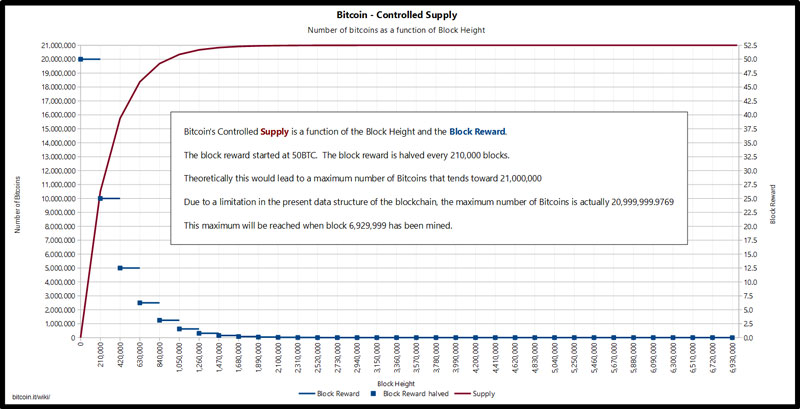
The fascination lies within the actual bitcoin halving date not being set to occur on a specific day but rather once the written-in-code blockchain distributed ledger technology’s public chain of blocks gets to block height #630,000. At its foundational-base, every ten minute cycle continuously produces a new block (currently at 12.5 BTC / lowers to 6.25 BTC) as this magical phenomenon happens every 210,000 blocks.
First, a reduction from 50 BTC to 25 BTC in November 2012, then the second halving shifted the pre-determined goalposts from 25 to 12.5 BTC in July 2016. Now, the anticipation of the next halving event will see the block rewards drop from 12 to 6.25 BTC in May 2020. This permanent change in the mining rewards system for newly-minted bitcoins is Satoshi’s vision for designing a deflationary, digitally-scarce cryptoasset.
The excitement is now building up about what effects the halving will have on bitcoin’s price and the entire cryptocurrency market, knowing the 18th million BTC (85% of all) has already been issued to-date.
For reference, the 2024 bitcoin halving date (in May/June) will be whenever the blockchain reaches a block height number of 840,000, effectively lowering the block rewards generation from 6.25 BTC down to 3.125 BTC per 10 minute increment. With exactly 30 Bitcoin halving events remaining (all 21 million bitcoins in circulation by 2140) there’s under 300,000 blocks to mine before the next blockhalf; let’s review the history, the celebratory party events and all-intriguing price volatility fluctuations bound to happen.
Bitcoin Mining Halving Sentiment: The Bulls vs Bears
For the rest of 2019 and first half of 2020, bitcoiners anxiously await to see if the consensus comes true. In the words of Mr. Tepper regarding the 2016 bitcoin halving, Fitz said, “It’s Halvening!!!”
There is no shortage of #BTC hope and optimism (hopium) being tossed around into all kinds of bold outcomes about this major mining milestone. In traditional markets, a simple rule of thumb usually concludes if you reduce the overall supply of newly issued coins it will more than likely lead to higher price per coin. So far, history sides with bitcoin’s price seeing a substantial rise in the past due to increased demand overtime.
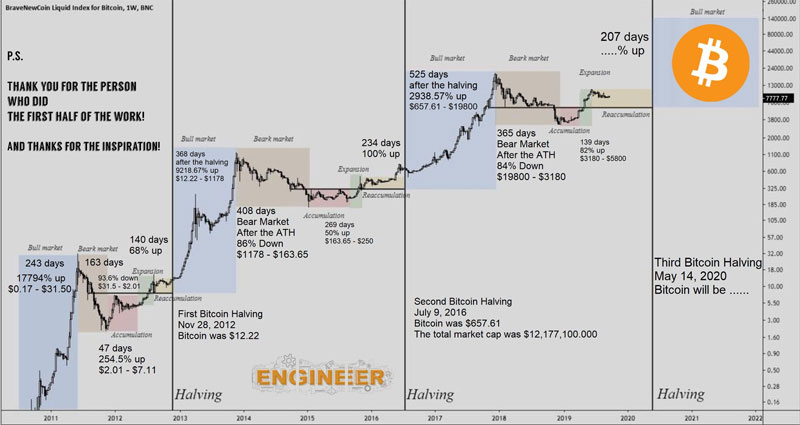
It may be commonly accepted in the crypto world that the block reward halvings are bullish for Bitcoin’s price due to the charts outlined below. Indeed, when you look at the price charts for the past two $BTC halvenings, this obviously appears true from a zoomed-out historical viewpoint. The November 28, 2012 halving the bitcoin price was $12.35 BTC/USD and 5 months later was $127 USD. The July, 9 2016 bitcoin halving day’s price was at $650 USD and was nearly $760 just five months later. The needle is moving once again.
The Bitcoin network software is built-upon a few invariable premises. At 12.5 BTC x 6 (six 10 minute cycles per hour) is 75 bitcoins minted per hour x 24 hours per day is 1,800 BTC per day issued. Then, quick math for 2020 halving and beyond to the next for years until 2024, shows it will be 6.25 BTC x 6 equals 37.5 per hour x 24 hours per day is only 900 BTC per day rewarded. This is a 50% reduction, effective instantly.
Further, simple math puts the past four years of block rewards mining system going from 1,800 per day, which is 657,000 BTC annually, to 900 BTC per day which is only 328,500 BTC annually in comparison. Sprinkle in some natural cryptocurrency adoption, regulation clarity and payment tech optimization and it is a recipe for a very entertaining 2020 pre and post bitcoin halving year.
It does not take an economic savant to apply simple supply and demand consensus mechanisms regarding scarcity of supply and rising demand. The debate about bitcoin being a possible safe haven asset shelter upon global turmoil and uncertainty is growing daily, weekly and monthly. Once the 2020 bitcoin mining halving happens, the on-chain effects are immediate and impact formulated forever. When these scales are tipped in the favor of lowering the newly created bitcoins granted for successfully mining a block and getting the reward to the miner trading computational power and securing the Bitcoin network, price volatility is bound to unfold.
Click on image to enlarge and see entire bitcoin halving price history chart
One caveat to consider is to know what can enhance the upward trend following the halving, like it has historically in the charts in 2012 and 2016. An acceptance as a reservoir can really build a strong foundation and bigger base. As the man (or women), or they, myth or legend Satoshi Nakamoto put it:
“It might make sense just to get some in case it catches on. If enough people think the same way, that becomes a self-fulfilling prophecy.”
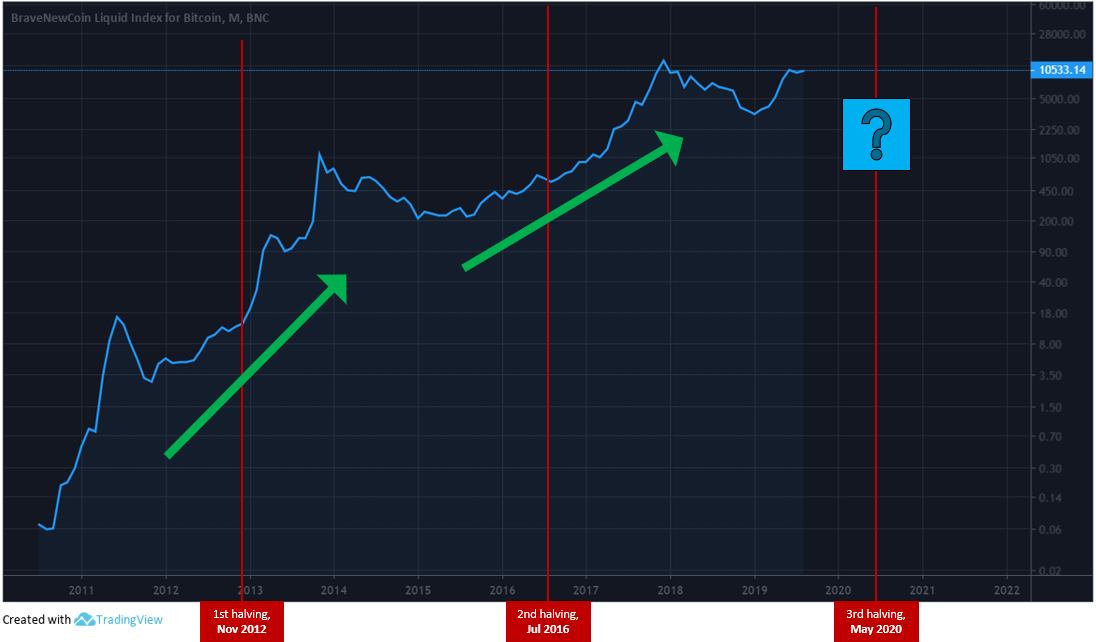
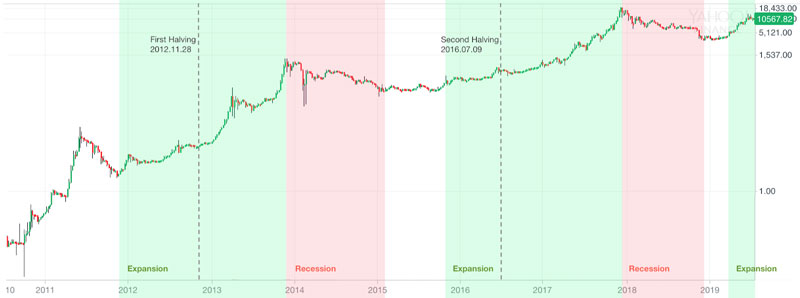
Many want to know what will the price be at the date of halving. Here is a visual representation overview of the historical timeline.
The two previous price peaks have both occurred approximately one year after the halvings, suggesting perhaps the next peak will occur in mid-2021 if the pattern repeats. Will the third time be a crypto charm?
Before comparing the first 2012 halving to the 2016 bitcoin halving, the quote on controlled supply from Bernard Dempsey hits home:
A fixed money supply, or a supply altered only in accord with objective and calculable criteria, is a necessary condition to a meaningful just price of money.
As the era of decentralized finance emerges, here is what we know so far.
With roughly 360,000 blocks left to mine with nearly 200 days left before the official btc blockchain mining halving in the middle of May 2020, and factoring in what the 2012 all time high and low prices of $12 to $1,163 peaks (96x return) and falling back down to $220 range or the 2016 value of $658 USD and seeing nearly $20,000 all time highs (30x return) and falling back down to $3,100 range, many love to speculate about how the bitcoin halving will effect the BTC price in the new few months before and after the block rewards are cut in half for the third time in history.
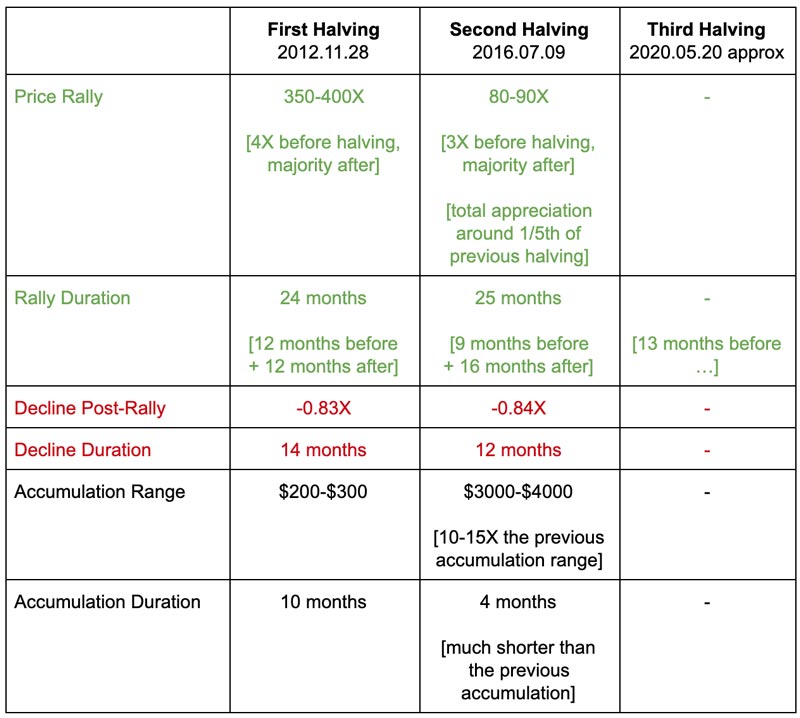
Here are the flagship crypto cliffnotes about the past bitcoin mining block reward halvings:
image courtesy of huddl
First Halving: took place on November 28, 2012 with a price of $12.50 BTC/USD exchange rate Price Ranges: before halving it got boosted four-fold, then increased its value by 350-400X $BTC Price Status: the first halving response lasted 1 year before and boosted valuations 1 year after Post Bull Market Cycle: bitcoin declined in value by 83%, then accumulated at $200-$300 for 10 months
The summarizes into bitcoin bull market price action lasted a full 24 months, or two years long.
That is in the same timeframe we are in now gearing up for the third bitcoin mining halving event.
Second Halving: took place on July 9, 2016 with a price of $650 BTC/USD exchange rate Price Ranges: the price of BTC went up three-fold before halving event before going up 90X $BTC Price Status: accumulation started nearly 9 months before, appreciation in value lasted 16 months Post Bull Market Cycle: declined the value of bitcoin by 84% before consolidating at $3,000-$3,500 base
The second halving symbolizes the bottom of bitcoin’s price to be 10X of the first halving support.
Third Halving: May 20, 2020 Price Ranges: April 1, 2019 bitcoin price went above $4,000 and saw as high as $13,400 in June Bull Market Status: while the price of bitcoin hovers around the $8,000-$10,000 range, it’s wait and see Post Bull Market Cycle: time will tell all, just grab the #whenlambo memes.gif and have the popcorn ready
However, the real question is whether the price action of the past has been caused by the block reward halvings, or if it was merely a coincidence. Most people in the cryptocurrency industry will suggest that the former is true, but the need for verification needs to be thought out in multiple ways. Nothing is guaranteed.
While the first mining halving cycle was referred to as the retail cycle, followed by a venture cycle, the third phase is dubbed the institutional cycle. That puts only 2.6 million blocks out of 21M total left. #digitalscarcity
But First, A Background Drop on the BTC Halvings
The first two bitcoin halvings saw extremely similar patterns surface as the stages transpired as such:
before: the anticipation of a significant reduction in the new block rewards and liquid supply boosts price
after: FOMO kicks in, higher demand comes in from retail speculators and fresh investors with deep pockets
crash: the bubble burst goes boom, a colossal collapse ensues after reaching all time high in BTC/USD values
the fall: demand goes down the drain, blood in the streets mentality, harsh realities of a crypto winter set in
foundation: a new base finally settles, market equilibrium restores itself and accumulation stage begins
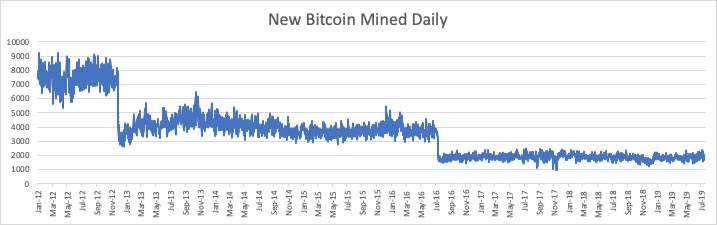
One of the greatest features of Bitcoin is it’s capped supply of 21 million and it’s predictable inflation schedule, which is a native part of the Bitcoin code. In the chart below, you can see the existing supply of bitcoins vs. the rate at which 1,800 new coins are being mined (144 blocks per day x 12.5 BTC).
coinmetrics new bitcoin mined daily graphic
At first glance, the block halvings are certainly a disadvantage for those who mine Bitcoins. However, this is a crucial step to reduce currency inflation — bolstering Bitcoin’s main value proposition. And, so long as more people believe in that value proposition, the “real world” value of mining new blocks can keep increasing over time even as the block reward is halved. The next halving cycle will depreciate to 900 new coins daily.
If 1 BTC is worth $100k, a 6.25 BTC block reward would be worth significantly more to miners than a 12.5 BTC block reward when BTC is worth just $10k. On top of that, miners profit from transaction fees, which can become more and more valuable over time as the Bitcoin network continues to grow.
Reviewing the previous halvings
At the time of the first halving in November 2012, the entire Bitcoin economy was too small to be noticed by institutions. In fact, Bitcoin’s price had fallen by over 90% — from $ 31 to $ 2 — about 1 year prior. The price started to rebound in November 2011 and continued to rise through the halving in 2012 until it reached an all-time high of over $1200 in November 2013.
Of course, Bitcoin had another collapse that began at the end of 2013 and lasted until 2015. Then, about 8 months ahead of the next halving that would occur in July 2016, Bitcoin’s price started to recover. During this time, several venture capital companies and hedge funds became involved in the cryptocurrency market along with millions of new retail investors, ultimately pushing Bitcoin to a value of nearly $20k in December 2017. Again, ,ost of the appreciation came after the halving: BTC was worth $650 at the time of the halving, and subsequently increased by more than 30x.
Halvings and bull markets past
The brief review of these two cycles shows an obvious trend in which Bitcoin’s price starts to rise 8-12 months before a halving is anticipated to occur and continues for about 1 year following it. What needs to be investigated is whether the halvings are causing this positive price trend, or if the bull markets and halving events are merely correlated by coincidence.
Factors that affect Bitcoin’s price
Let’s analyze the factors that could provide us with explanations on how the halving leads to an increase in the value of Bitcoin. First of all, we need to analyze the activity of the miners.
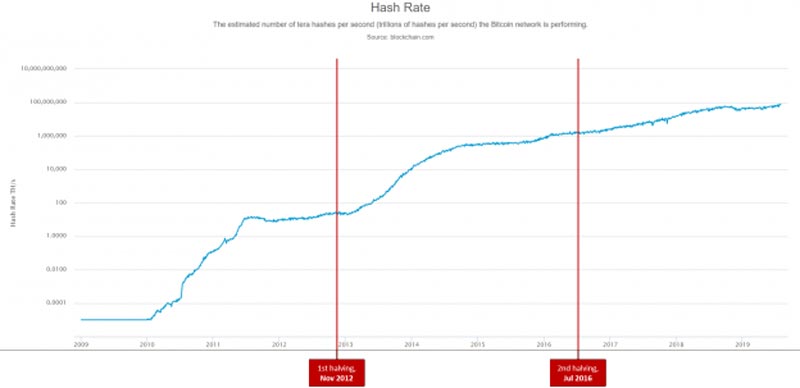
blockchain.com graph showing the all time high rate power of the bitcoin blockchain
Bitcoin miners play a key role in the Bitcoin network by confirming transactions. However, miners are also considered marginal suppliers because it’s thought that they typically sell their newly mined bitcoins as soon as possible. All other factors being equal, if miners have fewer bitcoins to sell after a halving, they reduce the total sell volume (i.e. the supply side of the market). As we know, when supply decreases while demand stays constant, price increases.
Another component to consider is that Bitcoin miners have two sources of revenue: the newly minted bitcoins and the transaction fees. When all 21 million bitcoins have been mined, transaction fees will remain the only source of revenue. Even though transaction fees are taken from the existing supply of Bitcoin, for miners they are a source of revenue just like block rewards. In fact, miners are equally likely to sell them to cover their operating expenses. Therefore, the value of transaction fees must also be considered as part of the supply side.
Of course, the other side of the market is demand, which has increased significantly over time as retail, venture, and institutional money have all gotten involved. This growing demand has no doubt had a massive impact on price increases — further muddying the waters as to whether the halvings have been major causes of the past bull markets or if it’s just a coincidence that they occurred during times when demand was taking off.
Popular Theory: “Halving Reduces Liquid Supply Significantly”
The “liquid supply” of a currency is the portion of the total supply which is actively circulating. In other words, HODLing your Bitcoin for months or years on end removes them from the liquid supply, because they aren’t being traded or exchanged.
It’s believed that miners aren’t typically HODLers because they have to sell into fiat currencies to pay operational expenses. This means that newly mined BTC are part of the liquid supply.
In the first ~4 years of Bitcoin’s existence, 7500-8000 BTC were mined every day and added to the circulating supply. After the first halving, this amount fell to 3700-4000. Currently, 1900–2000 Bitcoins are added to the supply every single day, which will drop below 1000 Bitcoins a day after the next halving.
In terms of US dollars, what emerges is a somewhat different view. As we mentioned, Bitcoin’s price was $13 on the day of the first halving. So when the daily amount mined was cut by about 4000 BTC (from 8000 to 4000), this amounted to a ~$52k reduction in value of Bitcoins joining the liquid supply each day. For the second halving when BTC was $650, this amounted to approximately $1.3M reduction.
But what does that mean?
Well, think about it this way: a reduction of any sizeable amount in liquid supply means that even if demand stagnated and remained flat, the price would increase as a result of the halving. This, ultimately, is why many people think that halvings are bullish.
Contradicting Theory: Efficient Market Hypothesis
There is one HUGE point that the halving bulls tend to ignore or explain away: the efficient market hypothesis (EMH). This essentially states that in a rational market, assets always trade at their fair value on exchanges.
Of course, no market is perfectly rational. The question is: how rational is the Bitcoin market?
Bitcoin’s inflation schedule is known years in advance. That means that the reduction in liquid supply that results from a halving is known to every informed participant in the market years in advance.
If this is public knowledge, the EMH states that the effects of the halving should be priced in by the market before the halving actually occurs. In other words, it can explain some of the bullish price action that seems to occur in the months leading up to a halving, but the bullish price action afterwards wouldn’t be a result of the reduction in liquid supply if the EMH holds true.
With venture and institutional funds now holding heavy bags of Bitcoin, it seems likely that the market is far more rational today than ever before. So with that being said, how likely is it that the next halving will actually trigger another huge bull run?
If the Bitcoin market isn’t efficient, why didn’t hashrate drop after past halvings?
One final point to consider is the important metric of network hashrate. That is, the total computing power of all the miners in the Bitcoin network at the time of the halving.
If miners have to sell most or all of their coins immediately after receiving them to pay for their operational costs, you would expect the halvings to make mining unprofitable for many miners.
However, based on the historical hash rate, halvings have not caused any noteworthy drops in total hashing power. This indicates that perhaps the EMH is valid, and miners are rational enough to include halvings when they calculate future costs and revenue.
In a non-techy way, in the past it was easier to solve blocks and generate new bitcoins for miners. Lower competition, mining difficulty adjustments were smaller and less powerful hardware equipment (ASICs) to solve cryptographic algorithms was required than today. The new halving it will usher in a whole new era of the mining industry.
Conclusion: Causation or Coincidence?
Reflecting on the two contradictory theories above, one thing we can say is that the next halving is not guaranteed to cause another bull run to a new all-time high. It could just as easily be the case that the next halving makes mining unprofitable for a large portion of the current miners, leading to a shard drop in hashrate and decrease in public sentiment about the stability of the Bitcoin network.
Maybe Bitcoin’s market is efficient, and halvings do get priced in ahead of time. That would explain why price action has turned positive many months before each of the past halvings. At the same time, isn’t it possible that the months of positive price action leading up to the halvings garner significant attention from new investors, driving up demand and fueling the latter portion of the bull markets following the halvings?
It’s hard to say for sure now, but maybe we’ll have our answer after another halving or two. Many are in agreement that given the fixed-supply asset, a price appreciation will occur. This scarcity enhances value motto in the bitcoin world will have an even greater compelling tendency to be bullish going into the 2020 bitcoin halving event.
We’ll leave you with one last thought and a few questions…with the honorary wisdom of Satoshi Nakamoto, lets close out this bitcoin halving guide with a poignant message he/she/they sent to the early-adopting crypo community:
“If you don’t believe me or don’t get it, I don’t have time to try to convince you, sorry.”
Should investors take the bite and bet big on bitcoin and see these sub $8,000-$10,000 prices today as a one-time buying opportunity? As a smart investor, there is a market opportunity where the world is watching and can predict when the reduction of any commodity supply by 50% is going to happen. This is likely to have ripple effects felt all across the ethereal realm of virtual currencies and cryptoassets led by the number one crypto, Bitcoin.
Will the store of value element of bitcoin come into play and live up to its digital gold 2.0 nickname? What makes any object of interest valuable is the law of supply and demand. Can the leading cryptocurrency continue to outdo its all time highs and surpass old peaks? Time will tell, the question is whether or not you will be behind, before, or backing bitcoin’s halvening.
Aziz, Master the Crypto Founder
I’m Aziz, a seasoned cryptocurrency trader who’s really passionate about 2 things; #1) the awesome-revolutionary blockchain technology underlying crypto and #2) helping make bitcoin great ‘again’!
The post Bitcoin Halving: 2020 BTC Mining Block Reward Chart History appeared first on Master The Crypto.
Today’s Live Bitcoin Price: Real-Time BTC/USD Market Values
$9,522.08
Bitcoin (BTC)
1h0.00%
24h1.69%
USD
EUR
GBP
Where is the Price of Bitcoin Going? Over 50 Industry Movers and Shakers Weigh-In with BTC Forecasts
Ask anyone in the crypto world what their bitcoin price prediction is and they surely have a forecast, right?
While 2018 saw the price of Bitcoin stumble from its December 2017 all time high of $19,893 BTC/USD down to $3,131, it finally found a spark out of the 15-month ‘crypto-winter’ bear market in April 2019.
After soaring over $5,000+ on to a year-high of $13,387 according to CoinMarketCap (June), the number one cryptocurrency by market cap has been able to weather the doom and gloom storm by staying afloat hovering around the $8,000-$12,000 range to-date. But curious minds want to know, what’s next for $BTC?
MTC is grateful for dozens of credible crypto analysts, noted experts and prominent personalities who provided us with their futuristic bitcoin price insights. Examining the whole collection of BTC price predictions gets interesting when inquiring spectators start coming to the ever-evolving crypto industry.
After all, it costs nothing to give a formal forecast so the following is simply a fun to entertain best-of list. Without further ado, let’s jump right into the heart of the matter and sift through crypto community chatter.
This bitcoin price prediction overview is put together in four different sections:
Over 50 $BTC price forecasts from crypto influencers, traders, analysts and die-hards
bitcoin price history 2009 – 2019, year by year (see where BTC has been, to know where it is going)
what influences the price of bitcoin; market volatility, supply/demand scarcity, value vs speculation)
top 50 bitcoin price catalysts that could spark the next BTC/USD bull market run in 2019 and 2020
Top 50 Bitcoin Price Predictions: 2019, 2020-2024 Forecast List
After the most popular top BTC predictions list, be sure to research the bitcoin price history timeline of events and review the curated checklist of the top 50 bitcoin price catalysts all crypto enthusiasts should pay attention to in 2019. The 2020 bitcoin halving is also worth-while to see why many faithful bitcoin leaders can fathom the following foretelling forecasts. This catalogue of notable influencers’ will be continually updated as predictions are made public.
Let Master The Crypto know in the comments how your crystal ball matches up with these known bitcoiners; all the from crypto celebrities to BTC/USD experts to public trading analysts and even industry insiders, check out the 2019 list of prophetic Babe-Ruth like point-to-the-moon crypto calls.
Bitcoin (BTC) Rank: 1
$9,522.08
Price (BTC)
Ƀ1.00000000
Marketcap
$175,317,706,609
Volume
$21,832,492,541
24h Change
1.69%
Total Supply
21,000,000 BTC
The following 2019 resource is a massive compendium of expert opinions/hot takes regarding what they think is in store for Bitcoin in the short and long term. The responses are quite varied in ranges, with some predicting BTC will scale above the $20,000 benchmark with ease in 2020 and other public figures believe the #1 coveted crypto coin can see a price point of $100,000 to $1 million within the next 10 years.
With that being said, it needs to be understood that even though the opinions of these experts are based on a host of quantitative data points, please acknowledge the inherent volatility of the bitcoin market and know these BTC/USD forecasts should not be taken as financial investment advice.
Take a genuine glance at the chronological timeline history of bitcoin’s price to see where it’s been to know where and why all of these cryptocurrency influencers are predicting such high BTC/USD values in the future.
1. Anthony ‘Pomp’ Pompliano (The Bitcoin Permabull)
The co-founder of Morgan Creek Capital is one of the most well-respected names when it comes to crypto-related advice (as is demonstrated by his 250k+ following on Twitter). In his opinion, all of the financial info associated with Bitcoin currently points to the fact that the currency will most likely scale up to a price point of around 50,000 US dollars by the end of 2022.
Some of the factors, in Pomp’s opinion, which seem to be greatly influencing BTCs price at the moment include:
Parabolic increases in the value of Bitcoin that are taking time to stabilize.
Bearish market conditions that seem to be creeping in time and again.
Lastly, it also bears mentioning that Mark Yusko, Pomp’s partner in crime at Morgan Creek too believes that Bitcoin could easily scale past the $75,000 mark by the end of 2020.
2. John McAfee (The Crypto Crusader)
The man, the myth, the legend. What can you say about John McAfee that hasn’t already been said? McAfee is a digital security pioneer who revolutionized how people protected their PCs and laptops back in the late ’90s and early 2000’s. Since then, he has forayed into the world of blockchain/crypto and has made many outlandish predictions regarding the price of Bitcoin.
For starters, he believes that BTC is on its way up to the $1 million mark by the end of 2020 — a prediction that sounds quite silly at first but when you consider the relative accuracy of McAfee’s previous claims, one is given to at least hearing the man out. In this regard, it should be pointed out that back in 2016 and 2017, John unequivocally stated that big things were in store for Bitcoin and that the flagship crypto would soon be worth $5,000. Little did he know that by the end of 2017, Bitcoin would reach its all-time high value of USD 20,000 (approx).
3. Jefferey LIU Xun (XanPool CEO)
Jefferey Xun, CEO of XanPool — an instant P2P fiat gateway that does not require custody — believes that in the short term, BTC will most likely to go down because of certain factors such as dwindling funding rates, contango, etc. He is also of the opinion that, in the near future, a number of other altcoin offerings will quite likely go down as well — a trend that has been quite visible over the past 12 months. In terms of the future of the altcoin market in general, Xun adds
“Altcoins will lose their market cap to some newer assets/ digital offerings coming into the market. Think about projects like Pokla, Eth 2.0 etc… essentially companies that hosted ICOs in 2017, and then and haven’t launched their product yet. When these products finally go live, they will gain dominance against a ton of existing alts, and perhaps even Bitcoin.”
4. Max Keiser
One of the earliest proponents of all things Bitcoin, Max Kiser has been talking about the premier digital currency since it’s market value lay at a meager price point of around $3. Additionally, he is also the host of a program called the ‘Keiser Report’ — a finance-oriented talk show that has time and again highlighted the advantages of crypto tech as well as exposed the biased inflationary policies of central banks all over the globe.
On the subject of Bitcoin’s monetary potential, Kaiser recently tweeted out that digital currency is all set to break past its previous ATH and climb up to around the $28,000 mark soon.
5. Trace Meyer
Veteran investor ‘Trace Meyer’ who has made a fortune for himself working within various traditional market sectors has been a major proponent of Bitcoin for a long time now. Meyer released his first pro-BTC blog back in 2011 — a time when the digital asset was trading for around $0.25 per token. Additionally, late last year, the maverick entrepreneur/ ardent defender of free speech released a tweet in which he claimed that using his uniquely crafted prediction algorithms, he was quite certain that the price of Bitcoin would reach $115,000 in the coming future.
6. Tom Lee
Fundstrat Global Founder Tom Lee is viewed by many from within the global finance community as being a perennial crypto bull. This is because Lee has frequently made bold claims about the future of various cryptocurrencies — with many of these predictions falling flat on their face. With that being said, it’s not as if Lee’s investment advice has not been on point many times in the past.
Speaking on the subject of BTCs future valuation recently, the Fundstrat CEO claimed that owing to the premier digital currency’s increasing mining costs, the price of a single token could quite easily scale up to around the $25,000 territory.
7. Bobby Lee
BTC Foundation board member and founder/CEO of BalletCrypto — Bobby Lee — is one of the few experts to have accurately predicted that Bitcoin would bottom out around the $3k mark sometime during early 2019. In this regard, Lee now believes that the flagship cryptocoin will experience a bull run during 2020 which will help push its price in an upward direction quite rapidly. Not only that, but he also claims that by the end of 2021, BTC will hit a peak of $333,000 before crashing once more and dropping to around the $40,000 mark.
8. Andy Hoffman
Hoffman is a crypto consultant as well as the CEO of Coingoldcentral. Additionally, between 2011-2017 he worked as the Marketing Director of a major, well-respected bullion dealer, Miles Franklin. Elaborating on his views regarding the future of Bitcoin, he told MasterTheCrypto:
“It is estimated that the global bond market is currently valued just over $100 trillion, 15% of which is negative-yielding – whilst total fiat currency outstanding is $90 trillion, total stock market capitalization $80 trillion, and the market cap of all the gold ever mined $9 trillion. Bitcoin is a far superior store-of-value asset than gold, so I expect it to one day be worth more than gold. As well, it could over time usurp some of the functions of legacy assets, making it worth significantly more. Thus, my “conservative” estimate is that within five years, it will be worth at least $5 trillion, or more than $250,000/BTC.”
9. Russell Okung
Seeing NFL star Russell Okung’s name along with those of seasoned crypto players such as Trace Meyer and Bobby Lee may seem quite funny at first, however, the Los Angeles Chargers left tackle has been one of the most vocal backers of Bitcoin over the past year or so. For starters, he lodged an official request with the NFL to allow players to receive their payments in crypto (if they so wished to do so). Not only that, but he has also been able to convince other established sporting big-wigs such as Buffalo Bills’ Quarterback Matt Barkley to join the crypto freight train.
Earlier this month, Okung hosted a Bitcoin (BTC) conference in Los Angeles to spread awareness about cryptocurrencies in general. The event was attended by the who’s who of crypto including:
Bitcoin developer Jimmy Song
Anthony Pompliano
Crypto investor and podcaster Peter McCormack.
10. David Drake
Drake, who is the founder of LDJ Capital, believes that as awareness regarding crypto continues to grow, it would not be surprising to see Bitcoin become increasingly more expensive. In this regard, he believes that by the end of the year, BTC will rise to a price point of around $30,000. Not only that, his optimism seems to permeate beyond Bitcoin into a host of other altcoins – who he believes will play an ever-increasing role in the day-to-day life of the global economic sector.
11. Jeet Singh
Indian-American business entrepreneur Jeet Singh is probably best known for being the co-founder of Art Technology Group – a venture that pioneered the use of software and other digital tech mediums within the e-commerce market during the early ’90s. The project was extremely successful and thrust Singh and his partner Joseph Chung front and center of the global finance stage.
In Singh’s estimation, Bitcoin will most likely suffer from a period of volatility in the short term – which will cause the premier digital asset to float around the 10k mark for quite some time. Following this period, he believes the asset will scale up beyond $50,000 threshold. Lastly, it also bears mentioning that over the last six years, Singh has been working exclusively as a cryptocurrency portfolio manager.
12. Tim Draper
Founder of several established ventures such as Draper Associates and DFJ, Tim is widely considered to be the godfather of viral marketing – mainly because of his use of online mediums such as Skype, Hotmail, etc. Over the last 2-3 years, he has been a vociferous advocate of all things crypto and believes that the price of Bitcoin will most likely reach a mammoth price point of $250,000 by the end of 2022.
13. Vinny Lingham
Lingham, who is a board member of the BTC Foundation as well as the co-founder of Civic, believes that Bitcoin’s value is destined to keep rising and eventually go through several ‘boom and bust’ cycles. In this regard, he was quoted as saying:
“Bitcoin currently is priced at 2.5% chance of being worth $100k or .25% chance of being worth $1m.”.
Even though Lingham is highly optimistic about the price of Bitcoin, he doesn’t have a timeline as to when the premier crypto asset will begin its ascent and reach its destined financial heights. For starters, since BTC is both a scarce and valuable commodity, it’s value is bound to keep increasing. However, Lingham does concede that in order for the alt-currency’s value to soar, it needs to move from being just a digital commodity to becoming a store of value as well as a legitimate transaction medium.
14. Cameron Winklevoss
Cameron and his brother Tyler Winklevoss are responsible for establishing Gemini – one of the world’s most trusted cryptocurrency exchange platforms. In this regard, Cameran has been bullish on BTC (as well as a host of other digital assets) from the very start. Not only that, the brothers have served as some of the first mainstream proponents of this burgeoning asset class.
On the subject of Bitcoin’s future market potential, Cameron has stated time and again that because of the asset’s long term SOV properties, it has the potential to rapidly gain value and even reach a price point of $320k per token within the next couple of decades.
15. Kenneth Rogoff
The ex-chief of the IMF (International Monetary Fund) is not a big believer in the power of crypto. Essentially, he believes that owing to the use of Bitcoin for tax evasion and money laundering purposes, the crypto industry as a whole will have to face an increasing amount of heat from regulatory agencies all over the world – something that will eventually lead to the demise of the asset class completely. On the subject, Rogoff was quoted as saying:
“I think Bitcoin will be worth a tiny fraction of what it is now if we’re headed out 10 years from now… I would see $100 as being a lot more likely than $100,000 ten years from now.”
16. Bill Gates
The billionaire who has regularly featured in the list of the world’s most wealthy individuals has been a crypto hater since Bitcoin came to the forefront back in 2011. For example, a few years ago, Gates went on record to state that the asset class was a pure ‘greater fool theory’ type of investment. And while he hasn’t ever given an official price prediction for Bitcoin, he is quite sure that the asset will become worthless in the coming few years.
17. Joe Davis
Davis is a well-respected economist who believes that there is a good chance that Bitcoin’s price might to down to zero over the next few years. Additionally, he also points out that because BTCs price is merely based on speculation, it is subject to insane price swings.
Lastly, Davis – who is currently serving as the head of Vanguard’s investment strategy group – believes that people should only put their money in traditional investment vehicles that are known to provide their owners with definitive returns. Davis further says Bitcoin is a poor store of value, due to its volatility, and advises folks to only invest in tried-and-tested assets.
18. John Pfeffer
The Pfeffer Capital partner has time and again showcased his support for Bitcoin because he believes that the digital currency is one of the first viable assets to possess the power to completely replace gold.
Additionally, he has also mentioned in the past that if BTC does become a mainstream store-of-value, it would not be surprising to see the value of a single token surge past the $700,000 mark. To back up his assertions, he recently released some stats: Pfeffer stated that if BTC was somehow able to replace all of the world’s privately held gold bullion (estimated to be worth $1.6 trillion), the Bitcoin in circulation (at that given point in time) would become worth $90,000 apiece – a price point from where the premier digital currency would continue to increase in value.
19. Alexey Ermakov
Ermakov is the CEO of Aximetria, a mobile wallet and next-gen financial service for traditional and crypto-assets. In his estimation, Bitcoin will become one of the main means of preserving wealth as we move into the future — especially as people all over the globe transition to a digital way of conducting their finances. Additionally, he also believes that over time, cryptocurrencies (especially Bitcoin) will continue to gain momentum and flourish because of the simple fact that BTC is one of the few financial instruments that can easily be transferred across international borders without any restrictions.
In Ermakov’s estimation, it would not be surprising to see Bitcoin reach a price point of $70,000 in the coming few years.
20. Leonid Matveev
According to Matveev, the Head of Trending Analytics for Waves, many factors influence the cryptocurrency market at any given time — with one of the main ones being the real-world use of cryptocurrencies. However, owing to the flooding of this market in recent years, he believes that more than 95% of all current cryptocurrencies will be gone forever within the next 10 years. Matveev told MasterTheCrypto:
“To date, few currencies can compete with Bitcoin. Belief in the new technology of value transfer is confirmed by the relatively wide use of Bitcoin all over the world. Several factors serve as the driver of growth in the popularity of bitcoin.”
These factors include:
Development of an infrastructural framework that allows users to exchange Bitcoin for fiat money.
Growing needs of financial market participants in the diversification of risks. For example, new types of assets – such as Bitcoin – do not correlate with traditional securities, which makes investments safer.
The global exchange of tax information is forcing people who want to keep their savings hidden, to look for other ways to escape.
21. Craig Russo
Craig is the founder of PEER, a Boston-based startup behind the popular crypto/gaming media outlet SludgeFeed. In this estimation, Bitcoin’s price will continue to outperform other alternative asset classes through the next few years. In the near-term (1-2 years), he says he wouldn’t be surprised to see BTC trading in the $20-30K range, taking out previous all-time highs. Not only that, but he also believes that with the influx of institutional dollars and more liquid futures products, the flagship cryptocurrency will begin seeing a reduction in its volatility — thus allowing the price of Bitcoin to witness more extended ranging behavior at these levels.
With that being said, Russo makes it abundantly clear that he is not one of those people who believes that a global economic downturn will be bullish for Bitcoin. In this regard, Russo told MasterTheCrypto:
“At the end of the day, Bitcoin has only existed in a risk-on macro environment and I simply don’t believe that investors will continue holding onto BTC if we see a crash in the equity markets.”
22. Michael Poutre
Michael Poutre is a well-respected industry leader who currently serves as a Managing Partner at Terraform Capital — an investment fund focusing on developing blockchain companies. Elucidating his thoughts on the future of Bitcoin, he told BEG that the fact that the premier digital asset has stabilized around the US$10,000 mark is proof enough that it is here to stay — a point that could have probably been argued just a few years ago. Furthermore, Poutre highlights the fact that governments around the world are starting to embrace the advantages of digital currencies, as a result of which Bitcoin is slowly being looked at by many as being ‘digital gold’ (as well as a good hedge option for the malaise du jour). In many instances, Bitcoin has proven to be a more effective hedge than gold. He further told MasterTheCrypto:
“While 17 million (or so) of the 21 million Bitcoins have been mined, there are factors to consider which can and should affect the price movement. The current price of Bitcoin reflects the market cap of all known mined coins, yet at some point, we will start pricing Bitcoin based on the ‘available float’ – and this could cause a generous increase in the price. Terraform believes that the price of Bitcoin will double from the current prices in the next 6 months, and we have a 24-month price target of US$50,000 per BTC.”
23. Nicholas Pelecanos
Pelecanos is one of NEM Ventures’ primary advisors and has been a part of the global crypto ecosystem from the very start. In his view, Bitcoin will witness several tangible price increases over its medium to long-term future because of certain factors such as:
The net global debt volume reaching record highs.
Technical indicators such as bond yield signaling an incoming financial crisis.
In Pelecanos’ opinion, the aforementioned factors alone paint a scary picture of what the future may hold. Thus, he believes that a majority of central banks and governments around the world can already see the incoming crisis and are aware that, unlike in 2008, they are in no position to bail out the banking system. He further told MasterTheCrypto:
“In the event of a banking crisis, Bail-in laws allow banks to freeze a portion of the savings from their users’ accounts and then credit their users with bank stock (which during a financial crisis will be shedding the majority of its value). When people become aware that their banked savings are not safe, I can see large capital in-flows into Bitcoin. If Bitcoin can attract just 5% of global household savings we would expect to see a 7x increase from today’s price or a $58,000 BTC. I can imagine negative interest rates would have a similar effect.”
24. Serena Williams
The global women’s tennis icon released a tweet a few months back stating that she has invested some of her life’s earnings in Bitcoin. Not only that, via an Instagram post earlier this year, the sports icon also revealed to her followers that she had secretly launched an investment company called ‘Serena Ventures’ back in in 2014 — through which she made investments in Coinbase. And while Serena hasn’t given an exact number as to how far the value of Bitcoin might increase in the future, her support in itself for the flagship cryptocoin shows that the currency is destined for great things in the future.
25. Ashton Kutcher
Actor and one-time model ‘Ashton Kutcher’ launched his very own venture capital firm — A-Grade Investments — nearly a decade back. As part of his professional pursuits, Kutcher put in an undisclosed sum of money into BitPay back in 2013. Not only that, the following year, he participated in a $12 million funding round for BitGo — a blockchain cybersecurity company.
In Kutcher’s opinion, crypto is an avenue that makes people feel safe about their wealth and Bitcoin, in particular, is an asset that has the potential to completely revamp how the global economic system works.
26. Murad Mahmudov
The host of ‘On the Record’ — a podcast that features some of the biggest names from the world of crypto — Murad believes that Bitcoin will scale up to it’s all-time-high within the next 12-16 months. Additionally, it bears mentioning that during one of his recent conversations with Tone Vays, he pointed out that Bitcoin was all set to surge past the $20,000 mark soon, a statement with which Vays agreed saying:
“There is a 40% chance that this happens next year.”
27. Jim Blasko
Blasko is the founder of Bitcoin Talk Radio and has been bullish on Bitcoin’s monetary prospects for nearly a decade now. As per this calculations, the digital asset’s future financial worth can stretch anywhere between $100,000 and $200,000 by the end of 2020 or early 2021. Elaborating on his stance a bit further, Blasko points out that due to Bitcoin’s mining reward being cut in half (from 12.5 Bitcoins per block mined to 6.25 Bitcoins) it would not be shocking to see more and more FOMO permeate the market gradually – thereby making the price of the digital currency soar to new heights.
28. Robin Singh
The Koinly.io founder believes that Bitcoin’s reach has been growing along with its price so there’s no reason to assume it will slow down in the long term. With that being said, he told MasterTheCrypto that the short term price of the asset depends heavily on whether projects like Libra make it into the public – and are received with the enthusiasm that matches all the hype currently surrounding this upcoming stable-coin offering.
Additionally, Singh also points out that interest from large companies will continue to play a big role in Bitcoin’s price increase in 2019 but the underwhelming launch of Bakkt only days ago has shown that not all of the hype surrounding this space should be believed – especially since BTC has dropped by over $2k since its launch.
“My price forecast for 2020 based on current market conditions would be around $8k. But then again BTC is volatile and if Libra is released the price could very well reach $15-20,000.”
29. Joe DiPasquale
In DiPasquale’s opinion, BTC’s price could range anywhere between $10,000 to $100,000 during the next 5 years. This is because he believes that the various fundamentals associated with the premier alt-currency are extremely likely to change as time goes on.
30. Matias Dorta
Founder of ICO Informer, Dorta believes that by the end of next year the price of Bitcoin will hover around the $30,000+ region. This is because he foresees several countries adopting the crypto-asset as a reserve currency before the end of the coming decade. Additionally, he also stated in an interview that as we move into the future, the “digital gold” narrative associated with Bitcoin will only continue to gain more and more traction.
31. Bobby Ullery
Ullery, the CTO of crypto firm Waysay, is a big supporter of premier digital assets such as Bitcoin and Ethereum. As per his calculations, the aforementioned currencies will share a $4.5 trillion market cap by 2020. Not only that, but Ullery also believes that by 2020 (a time when there will be approximately 18,375,000 BTC in circulation) the price of a single Bitcoin will rise to $61,900.
32. Fred Schebesta
Fred Schebesta is probably best known for being the co-Founder and CEO of Finder — a media outlet that has a decent presence within the world of crypto finance. He believes that Bitcoin’s price has the potential to explode by the end of 2020, however, for the time being, the currency will most likely continue to hover around the $10,000 region.
33. Fran Strajnar
Fran is probably best known for being the founder and CEO of crypto/blockchain firm Techemy Ltd. He has quite an optimistic outlook when it comes to BTC and believes that by the beginning of 2020, the flagship cryptocurrency will be able to break past the $200,000 mark. His estimates are based on the fact that the rate of BTCs adoption (which has been increasing quite rapidly over the past couple of years) is directly proportional to its price.
34. Sam Doctor
Fundstrat’s Quant Strategist Sam Doctor is a Bitcoin bull who believes that widespread crypto mining can lead to a reduction in the price of the BTC/USD pair while increasing the breakeven cost growth ratio of the premier digital currency. Additionally, as per a recent tweet by Doctor, he thinks that Bitcoin will close out the year at a price point of around $36,000.
35. Jack Dorsey
Jack Dorsey, the co-founder of Twitter, is a big supporter of Bitcoin — primarily because he owns a massive chunk of the flagship cryptocurrency himself. Additionally, he also has a stake in Lightning Labs — the venture responsible for creating/operating BTCs Lightning Network. In Dorsey’s own words, he is “extremely bullish” on the long term prospects of the BTC, with him going as far as saying that the crypto asset will one day become the single global currency of the world. However, he is not unrealistic in his approach and believes that such a global shift will take a minimum of 10 years to realize because we still don’t have the necessary technological capabilities needed to deploy Bitcoin as a daily transaction currency.
36. Roger Ver
One of the best-known crypto evangelists in the world, Ver has been pushing people to buy Bitcoin since the early half of 2011 — a time when the digital currency was being sold for a meager $10. To elaborate on how passionate Ver is about crypto, he has been making bold price bets concerning BTC for quite some time now. For example, in 2011 he bet a cool $10k on the fact that bitcoin would outperform gold, silver, the U.S. stock market, and the U.S. Dollar by a factor of 100 within the next two years. Ver’s prediction was off by a margin of just 60 days.
Also worth mentioning is the fact that Ver believes that Bitcoin Cash (BCH) is the real Bitcoin because it still adheres to the original vision of the premier digital coin. In this regard, he believes that BCH will eventually surpass BTC in terms of its price and will scale up to around the $250,000 region in the coming few years.
37. Ronnie Moas: $28,000
Respected analyst Ronnie Moas stated last year that Bitcoin’s financial future would pick up in 2019 — with the digital currency closing out the year at a price point of over $28,000. Late last year, he also pointed out that several institutions along with many of the world’s financial elites were trying to scare casual investors by manipulating the market big time.
38. Brandon Quittem
Independent crypto author/analyst Brandon Quittem believes that by the end of next year, Bitcoin will be worth approximately $75,000 – which is roughly about 10 times the price that the premier digital token is today.
39. Wences Casares: $1 Million
Bitcoin bull Wences Casares is also one of those dudes who believe that Bitcoin is headed to the 1 million dollar mark within the next 10 years or so. However, he made his bold claim at a time when BTC was surging and was close to it’s all-time-high value of 20,000 dollars. For those of our readers who might not be aware of who Casares is, he is an Argentinian entrepreneur who founded bitcoin wallet startup Xapo.
As per one of his recent interviews, he bought his first Bitcoin back in 2011 as a way to circumvent the volatility issues that were being faced by the Argentinian Peso. He also mentioned that many investors will soon be kicking themselves for not buying Bitcoin earlier — i.e. around a time when the currency was trading between $10,000 to $20,000.
40. Chamath Palihapitiya
Venture capitalist/ ex-Facebook employee Chamath Palihapitiya seems to agree with Casares and thinks that Bitcoin will be worth $1 million (within the next 20 odd years( and will scale up to around the $100k mark within the next 36-48 months. Palihapitiya has a lush history of making smart business moves — as is highlighted by his decision to become a part-owner of the Golden State Warriors, an NBA franchise that has made it to the finals 5 years in a row now. Not only that, his firm Social Capital currently has under its control more than $1.2 billion worth of customer funds. And while it is not clear as to how much BTC Palihapitiya currently owns, it is estimated that he possesses anywhere between 400,000 and 1 million bitcoin today. When asked why he is so bullish on bitcoin? Palihapitiya says that bitcoin is a “fantastic hedge and store of value against autocratic regimes and banking institutions”.
41. Kay Van-Petersen
Respected financial analyst Kay Van-Petersen has been affiliated with several big-name institutions such as ‘Saxo Bank’ over the past decade. However, he now specializes in crypto analytics and has gone on record to say that Bitcoin will be worth around $100,000 by 2028. In addition to this, he also believes that crypto will end up accounting for 10% of all daily currency trading volume in the future — eventually competing with many established fiat currencies. Lastly, it also bears mentioning that as per a study released by Unblock.net, Van-Petersen’s data seems to be mathematically valid.
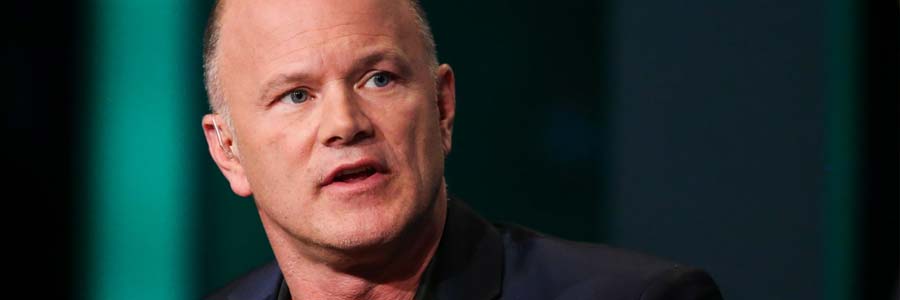
42. Mike Novogratz
The former Goldman Sachs executive and founder of investment firm Galaxy Digital ‘Mike Novogratz’ predicted back in December 2018 that during 2019, Bitcoin’s value would gradually rise and close out the year on a high note. Not only that, but he also predicted that by the start of 2020, several established financial institutions would have entered this space — thereby allowing the price of various cryptocurrencies to soar.
43. Spencer Bogart
Blockchain Capital partner Spencer Bogart is a well-respected figure within many crypto circles because of his astute price predictions as well as mathematically sound analysis. This is best highlighted by the fact that he is regularly called to speak at many blockchain/crypto-related conferences around the world.
In terms of his BTC price outlook, Bogart spoke with Bloomberg earlier this year and stated that by the end of 2019, the price of Bitcoin would stabilize — following which it would once again start its upward financial ascent. Additionally, he also believes that owing to the efficacy/utility of the bitcoin network, the digital currency will gain more and more traction within the global finance arena.
44. Llew Classen
Bitcoin Foundation’s executive director Llew Clasen, previously said that by the end of 2018, the price of Bitcoin would reach a minimum of $40,000 — a prediction that fell short by quite a huge margin. Since then, Classen has remained fairly quiet and has refrained from giving any other predictions.
45. Sonny Singh
Bitpay CCO Sonny Singh recently said that he sees the price of Bitcoin scaling up to around the $20,000 by Thanksgiving 2019. To back up his claims, Singh has cited several factors such as:
The launch of multiple crypto ETFs within this space.
The increasing influx of money for various crypto-related startups over the last year or so.
46. Tai Lopez
Even though Lopez got into crypto quite late when compared to most of his contemporaries, the respected investor recently stated that if the global diaspora of millionaires were to allocate merely 1 percent of their holdings into bitcoin, the price of the flagship crypto-asset would rise to $60,000 within just 6-12 months. Similarly, in some other of his videos, he has gone on record to state that Bitcoin might become worth $1 million by 2024.
47. Zhao Dong
Zhao Dong is probably best known for being one of the largest over-the-counter (OTC) bitcoin traders in China. In the past, he has boldly claimed that a $50,000 price target for Bitcoin was not at all difficult and that the price of the premier asset would rise anywhere between 100% – 200% over the next three years.
48. Arthur Hayes
Arthur Hayes is a well-known industry figure — mainly because of his current role as the CEO of BitMEX. And while one would be tempted to believe that Hayes has an extremely bullish outlook towards the crypto market, in a recent interview he claimed that Bitcoin would experience record lows all through 2019.
49. Justin Sun
Justin Sun has become a major player within the global crypto ecosystem — with the TRON CEO even dishing out a huge sum of money to have dinner with legendary investment savant Warren Buffett recently. In terms of his predictions for Bitcoin, Sun stated in an interview earlier this year that the digital currency would trade anywhere between $3,000 and $5,000 for the entirety of 2019.
50. NAS
Nasir bin Olu Dara Jones — better known by his stage name NAS — is one of those venture capitalists whose name tends to fly under the radar because of his hip-hop associations. However, back in 2014, NAS launched a firm called QueensBridge Venture Partners (QBVP) through which he invested big in Bitfury. Not only that, as part of his VC pursuits, the rapper has also invested in many other companies including:
Coinbase
Robinhood
Block Cypher
And even though he has refrained from giving any major price predictions in relation BTC recently, he is convinced that the flagship cryptocurrency will evolve into an independent sector of its own within the next 5-10 years.
51. Snoop Dogg
Everybody’s favorite rapper Snoop Dogg — who has previously gone by different aliases such as Snoop Lion, D.O.G.G, etc — is a big believer in Bitcoin. In the past, he has invested big in many different crypto ventures including altcoin exchange/ trading platform Robinhood along with other celebrities such as Jared Leto and Ashton Kutcher.
52. David Mondrus
Mondrus, who is the CEO Trive — a platform designed to weed out “fake news” from the internet — seems to agree with John McAfee and thinks bitcoin could very well reach a value point of $1 million within the next ten years or so. He believes that owing to an ever-increasing demand for BTC, the price of the digital asset will continue to rise exponentially.
53. Eric Wade of Crypto Capital
Eric Wade, long time crypto supporter who used to mine bitcoin, and now runs a cryptocurrency market newsletter in Crypto Capital, puts his 2020 BTC price prediction at $50,000 due to a simple formula. That is no change in fundamentals but a big increase in adoption and technology developments. He believes the bitcoin halving will be the spark plug and if BTC crosses $20,000, that the same bull panic FOMO of 2017 will kick in and shoot straight up to $50,000 a lot faster than you think.
Bitcoin Price Prediction Updates for 2019 and 2020
This growing list of bitcoin price predictions in 2019 for years 2020 and beyond will continue to evolve as more inquires get answered from top analysts and insightful community contributors. While it may be all in good fun to entertain these bold futuristic bitcoin value forecasts, please note all investments into $BTC are a gamble and one that must not be taken lightly considering any short term or long term play is not without reason.
Master The Crypto is very thankful to each of these individuals who shared their insights with us exclusively.
As the price of Bitcoin continues to get predictions from known individuals and industry insiders, we will update the list and hopefully have hundreds of curated $BTC to USD exchange rate value forecasts to share with you to see who and when people become right (for the fun of it). We hope you enjoyed this bitcoin price prediction review of the top $BTC value forecasts for 2019.
Now, let’s shift gears and think about all of the bitcoin predictions you just reviewed. There is a saying to note – if you want to know where something is going, know where it came from. In order to fully understand the visionary predictions about the future bitcoin price, let’s look into the bitcoin price history and compare where it came from in the past decade and where it is going in 2020 and beyond.
New 2019 Bitcoin Price Timeline Updates
Below is a list of the early pioneering days of the price action history of bitcoin’s value in US dollars. Here’s the latest updates from January to November 2019:
October 26, 2019 – November 2019: the USD price of Bitcoin rebounded back to nearly $10,000, hovering in low $9,000s
September 22 – October 25, 2019: BTC price went under $7,5000 after being above $10,000 during this phase
August 6, 2019: manages to climb back over $12,000 for a week after slipping to under $9,500
July 10, 2019: BTC/USD makes it back above $13,000 for the last time in 2019 so far
June 26, 2019: Bitcoin all-time-high for 2019 of over $13,100+ before falling back to $9,800 on July 1
June 22nd, 2019: bitcoin price nearly crosses $11,000 after being just $7,700 on June 9.
May 14th, 2019: BTC/USD exchange rate value surpasses $8,000, the first time since July 28, 2018
April 23rd, 2019: After months of bearish conditions, Bitcoin was finally able to leave behind its initial losses from May and scaled up to a five-month high of $5,600.
March 31st, 2019: All through March, Bitcoin was able to slowly gather financial momentum — with the crypto asset closing the month on a positive margin of around $4,100.
February 28th, 2019: Bitcoin’s price hovered below the $3,500 mark over the first week of February. However, soon thereafter the currency’s value started to rise and reached a price point of $3,867.
January 31st, 2019: At the time, the CBOE — in conjunction with VanEck and SolidX — withdrew its proposal that sought to entail the creation of a Bitcoin ETF only to resubmit a couple of weeks later.
January 1st, 2019: The year started rough for Bitcoin, with the premier digital currency staying below the $4k mark for a few weeks running. Even the overall capitalization of the crypto market stooped to around the $66 billion mark.
December 3rd, 2018: For the first time in many months Bitcoin mining became an unprofitable activity. Not only that, only for the second time in its brief existence, BTC’s mining difficulty ratio dipped by a whopping 15% — thereby making way for a sharp depreciation in the currency’s total value.
November 15th, 2018: Bitcoin Cash undergoes a hard-fork thereby facilitating the creation of Bitcoin ABC and Bitcoin SV — with the latter project being helmed by the notorious Dr. Craig S Wright, an Australian computer scientist who claims to be the pseudonymous inventor of Bitcoin, ‘Satoshi Nakamoto’. Additionally, owing to the fork, the price of Bitcoin dropped to $4,275.
October 31st, 2018: The day marked the 10th birthday of Bitcoin’s Whitepaper causing the market to rise by a cool 5%.
October 15th, 2018: Institutional custodian Fidelity announced the launch of its very own digital currency trading platform, as a result of which, the price of Bitcoin rose sharply.
September 18th, 2018: Cryptocurrency Exchange, Zaif Falls gets scammed by hackers to a tune of more than $60 Million. Bitcoin’s price continues to hover around the $6k mark.
Bitcoin (BTC) Price History: List of Events Worth Noting
In order to know where bitcoin is going, it may be important to wonder where the price of BTC/USD has been before today.
After sending the market abuzz with excitement, Goldman Sachs released a press statement claiming that the firm was dropping all plans of launching a Bitcoin-based trading desk anytime soon. This announcement came at a time when the market at large was struggling and the price was of Bitcoin was in freefall.
(ii) Bitcoin ETF Delayed by the US SEC (August 2018)
On the 7th of August, the US Securities and Exchange Commission released a statement in which the regulatory body made it abundantly clear that it was going to be delaying its decision on several Bitcoin ETF proposals that had been submitted to it.
(iii) Bakkt Launch Made Official by the Intercontinental Exchange (ICE) (August 2018)
A representative for ICE — the parent company of the New York Stock Exchange — released a statement on the 3rd of August stating that the financial juggernaut was going to launch a cryptocurrency startup known as Bakkt that would be supported by several established multinational firms including Microsoft, Starbucks, etc.
(iv) SEC Rejects ETF Proposal from The Winklevoss Twins for Second Time (July 2018)
For the second time within the space of a few months, the US SEC rejected an ETF proposal submitted by Tyler and Cameron Winklevoss — owners of the crypto trading platform ‘Gemini’.
(v) Blackrock Hints at Crypto Exploration (July 2018)
During the second half of July 2018, the CEO of Blackrock — one of the world’s largest wealth managers — announced his eagerness to examine the prospect of a crypto and/or Bitcoin-related fund.
(vi) Blanket Ban on Crypto Ads Reversed by Facebook (June 2018)
On the 23rd, Facebook announced that it was going to be lifting its ban on all crypto-related content which was announced during the first quarter of 2018. At the time, the price of Bitcoin was found floating around the $6,600 region.
(vi) Bithumb Falls Victim to Hacking Scandal — June 2018
The first few weeks of the month was pretty hard on Bitcoin, with the currency hovering around the $5,800 territory — thanks to South Korean crypto exchange ‘Bithumb’ being hacked by miscreants to the tune of more than $31 million.
(vii) Four Crypto Exchanges Brought to Court by the US CFTC (June 2018)
The United States Commodities and Futures Trading Commission filed several subpoenas on the 11th of June against Bitstamp, Kraken, ItBit, and Coinbase. In the court document, a representative for the CFTC pointed out that the aforementioned trading platforms had been indulging in different market manipulation tactics.
(viii) DOJ Launches Probe into Allegations of Widespread BTC Price Manipulation (May 2018)
US Department of Justice authorities launched an extensive criminal probe to assess whether certain financial entities were deliberately manipulating the price of Bitcoin for their personal gains. On the 24th of the month, the price of a single Bitcoin lay at $7,609
(viii) UpBit Headquarters Raided by Local Tax Agencies (May 2018)
On the 11th of May 2018, S.Korean tax officials raided UpBit’s office after they received word that the crypto exchange was manipulating its books. As a result of this news, the price of Bitcoin fell sharply 5.5% within a span of just a few days (from around $8,711to $8,372)
(ix) Goldman Sachs Announces its Plans to Explore Crypto Trading Solutions (May 2018)
A report released by the New York Times on the 3rd of May 2018, stated that finance giant Goldman Sachs was going to be exploring the prospect of launching its very own Bitcoin trading platform. The announcement sent the price of Bitcoin soaring above the $8,800 threshold.
(x) Twitter Bans Cryptocurrency Ads on its Platform — (March 2018)
In the wake of Facebook and Google deciding to ban all crypto-related ads on their respective platforms, Twitter too soon followed suit and did the same.
(xi) Google Bans Cryptocurrency Advertisements (March 2018)
During the first week of March, Google imposed a major ban on all ads related to crypto-assets as well as on Initial Coin Offerings. Google also provided a full range of crypto-specific terms within its broader ‘bad advertisements’ policy.
(xii) SEC Issues New Operational Guidelines for Crypto Exchanges (March 2018)
As FB, Google continued to ban all crypto-related activities on their respective platforms, the US SEC issued new guidelines asking all crypto exchange platforms to register with the regulatory body to continue with their regular, day-to-day operations. On the 7th of March, the price of a single Bitcoin stood at $8,344.
(xiii) Facebook Enforces Shocking Ban on Crypto Ads (January 2018)
On the last working day of January 2018, the social media juggernaut announced its intention to ban all ads related to cryptocurrency and Initial Coin Offerings from its platform.
(xiv) Coincheck Gets Hacked (January 2018)
One of Japan’s largest crypto exchanges Coincheck fell victim to a group of hackers who were able to walk away with 123 million dollars worth of XRP, and 500 million NEM tokens. The price of Bitcoin lay around $8,800.
(xv) PayPal co-Founder Peter Thiel Acquires Massive Chunk of BTC (January 2018)
Many media outlets reported on the 3rd of January that Venture Capitalist Peter Thiel had bought millions of dollars worth of Bitcoin. At the time, the price of Bitcoin stood at $13,870.
Bitcoin Price in 2017
(xvi) Bitcoin Scales Up to its All-Time High Value (December 2017): $19,893
The 18th of December marked the day when Bitcoin reached its financial apex — a threshold that has since not been broken.
(xvii) CBOE Announces the Launch of Bitcoin Futures Contracts (December 2017)
The second week of December 2017 saw the CBOE launching Bitcoin-based futures contracts. This resulted in the price of the premier asset soaring wildly. Not only that, even the total market cap of the digital currency market as a whole rose sharply around this time.
(xviii) Launch of Segregated Witness Proposal (SegWit2x) Cancelled (November 2017)
Bitcoin’s core dev team announced on the 8th of November 2017, that it was putting its plans of implementing the SegWit2X protocol on the backburner. The price of BTC on the day stood at $7,844
(xix) CME Introduces Bitcoin Futures Contracts into the Market (October 2017)
The Chicago Mercantile Exchange released a circular in which it was brought to the attention of the masses that the financial institution was going to launch a Bitcoin Futures contract by the end of 2017. This was the first time an established financial entity had come forth and shown such explicit support for BTC — mainly because, up until then, BTC was viewed largely as a shady investment tool. Also, in the wake of the above-stated announcement, the price of Bitcoin started to soar and scaled up to a then ATH of touch $6,601.
(xx) Bitcoin Surges Pas $5k Threshold for the First Time (October 2017)
On the 13th of October, Bitcoin, for the first time in its young history, rushed past the $5k mark. This feat was considered quite miraculous by many, especially since the crypto asset had started the year around the $966 mark.
(xxi) China Shuts Down All Crypto Exchanges (September 2017)
After assessing the situation in quite a lot of detail, Chinese tax officials concluded that they would be banning all crypto trade avenues operating within the country’s borders. The announcement immediately caused investors all over the world to panic and sell their BTC holdings — thereby causing the premier digital currency’s value to drop sharply almost overnight.
(xxii) JP Morgan Chase CEO Jamie Dimon Calls Bitcoin a Fraud (September 2017)
Jamie Dimon, the CEO of JP Morgan at the time stated in an interview that he thought of Bitcoin as a ‘fraudulent scheme’ that would eventually cause immense financial stress to a lot of investors. However, the market at large seemed to ignore Dimon’s words since Bitcoin continued to stay strong around the $3,800 region.
(xxiii) Chinese Government Issues Ban on ICOs (September 2017)
During the first week of September (on the 3rd to be exact) the Chinese government implemented an umbrella ban on all ICO related activities.
(xxiv) Bitcoin Undergoes Hard Fork, Bitcoin Cash $BCH Created (August 2017): $3,384
Since the start of 2017, many from within the global crypto community had been asking for a BTC hard fork quite vehemently — primarily because of the scalability issues related to Bitcoin. As a result of the split, the world bore witness to the birth of Bitcoin Cash (BCH).
(xxv) Japan Recognizes Bitcoin as a Legitimate Transaction Medium (April 2017)
The first day of April saw the Japanese government recognize Bitcoin as a legal payment method. News of the announcement sent the price of Bitcoin soaring to a relative high of $1,215.69
(xxvi) SEC Rejects Winklevosses Request for a Bitcoin ETF (March 2017)
The US SEC rejected a Bitcoin ETF proposal submitted to it by the Winklevoss brothers. The reason cited for this refusal was a lack of stability within the crypto market.
(xxvii) Bitcoin Breaks Past $1K Threshold After Nearly Thirty-Six Months (January 2017)
After experiencing a decent rally all through 2016, the price of Bitcoin finally crossed the $1,000 mark after a long long time.
Bitcoin Price in 2016
(xxviii) Bitfinex Gets Hacked, Loses Nearly $72 Million Worth of Crypto (August 2016)
In August, premier cryptocurrency exchange ‘Bitfinex’ announced that it had fallen victim to a cyber scam, which resulted in hackers making their way with a little more than 120,000 BTC. Owing to this massive security lapse, the price of Bitcoin dipped by a whopping 20% almost overnight. In addition to all this, many news reports were claiming that some Bitfinex officials had prior knowledge that this hack was going to take place.
(xxix) Bitcoin Undergoes its Second Halving Event (June 2016)
On the 9th of June, Bitcoin’s block reward quotient was halved once again — thereby reducing mining returns from 25 Bitcoin per block to 12.5.
(xxx) Steam Announces Support for Bitcoin (April 2016)
Gaming platform ‘Steam’ released a statement during the first half of April, announcing its decision to accept BTC as a medium of purchase for its wide array of video game titles and other digital content. This move was quite short-lived because just a few months later, Valve — the parent company behind Steam — rescinded its decision to allow BTC payments.
Bitcoin Price in 2015
(xxxi) Dr. Craig Wright Claims that He is Satoshi Nakamoto (December 2015)
Wired published an in-depth piece on the 8th of December claiming that Australian computer scientist Dr. Craig Wright was the man responsible for creating Bitcoin. The author of the piece, Gwern Branwen, cited a series of emails, deleted blog posts to support his (as well as Wright’s) lofty claims. It was also around this date that Bitcoin’s symbol was officially accepted into the Unicode.
(xxxii) Winklevoss Owned Gemini Exchange Goes Live (October 2015)
Cameron and Tyler Winklevoss came to the forefront when they announced the launch of their very own cryptocurrency trading platform — Gemini. Upon its inception, the exchange was one of the first to base all of its operations in the United States and be fully regulated by local authorities. As things stand, Gemini is operational within 26 states across the US with all of its deposited assets having been insured by the FDIC.
(xxxiii) CTFC Declares Bitcoin to be a Commodity (September 2015)
Despite there being a lot of confusion surrounding the financial status of Bitcoin, on the 18th of September 2015, a representative for the United States’ Commodity Futures Trading Commission (CFTC) announced that the regulatory body would henceforth classify “bitcoin and other virtual currencies as being legitimate financial commodities.”
(xxxiv) New York Introduces a Mandatory BitLicense for Exchanges (June 2015)
On the 3rd of June, the NY Department of Financial Services introduced its very own regulatory scheme known as the ‘BitLicense’. Using this tool, crypto service providers would be allowed to trade digital assets such as BTC, ETH etc. in a completely seamless, hassle-free manner. The price of bitcoin was $232.05.
However, to acquire the aforementioned license, exchanges were required to pay an application fee of $5,000, as well as provide certain biometric data to the FBI.
(xxxv) Coinbase Comes into Existence (January 2015)
Coinbase — currently one of the largest crypto exchanges in the world — came into existence on the 26th of January, 2015. The firm was backed by several venture capital firms and was able to commence its operations across 25 states upon its inception.
(xxxvi) Bitstamp Loses Over 18,000 of its Customers BTC Savings (January 2015)
Using a host of social engineering strategies, hackers were able to steal more than 5.2 million dollars worth of BItcoin from Bitstamp’s coffers. Not only that, the security lapse forced the once premier crypto trading avenue to be shut down for a total of eight days.
Bitcoin Price in 2014
(xxxvii) Microsoft Announces Decision to Accept Bitcoin (December 2014)
Computing giant Microsoft announced back in December 2014 that it was going to start accepting Bitcoin payments from its US customers in exchange for its various digital apps, games and other content (through Windows and XBOX.)
(xxxviii) US Gov. Auctions Off More than 30k Bitcoin (June 2014)
Back in 2013, US regulatory authorities were able to seize a total of 30,000 BTC tokens from individuals who had been indulging in nefarious, silk-road related activities. This handsome sum of crypto was subsequently auctioned off on the 27th of June to the highest bidder — who accidentally turned out to be the billionaire/venture capitalist ‘Tim Draper.
(xxxviii) People’s Bank of China Shuts Down Many Crypto Bank Accounts (April 2014): $501.7
Following a deadline given by the Chinese government to all of the nation’s local crypto exchanges, authorities started to crack down on any trading platforms working in conjunction with local banking institutions.
(xxxix) IRS Announces BTC Will be Subject to Uniform Taxation Laws (March 2014): $453.05
The central tax authority of the USA — the Internal Revenue Service — announced on the 26th of March that Bitcoin would be taxed in pretty much the same way in which real estate is taxed across the country.
(XL) Crypto Exchange Mt. Gox Gets Hacked, Forced to Shut Down (February 2014): $662
On the 7th of February, Mt Gox was subject to a massive DDoS attack that resulted in the firm losing a whopping sum of 744,000 BTC that belonged to its customers. Following this incident, the exchange was forced to shut down on February 24th – with many of the company’s executives facing legal action thereafter.
Bitcoin Price in 2013
(XLI) China Bars Local Financial Institutions From Using Bitcoin (December 2013)
Owing to the rising popularity of Bitcoin within China, the PBOC — People’s Bank of China — took a unilateral step to ban Bitcoin as a medium of exchange within the country’s borders.
(XLII) BTC Surges to a Relative High of $1,242 on Mt Gox (November 2013)
With Chinese investor interest in BTC surging all through 2013, the price of Bitcoin rose to a new high on the 29th of November.
(XLIII) China Legalizes Crypto Trading (November 2013)
The PBOC released a statement on the 18th of November that officially allowed the country’s citizens to “participate in the bitcoin market”. Around the same time, Ross Ulbricht — the person behind Silk Road — was also convicted and sentenced to jail — thereby causing widespread uproar across the globe. As part of the crackdown, US officials were able to seize more than 170,000 BTC.
(XLIV) Department of Homeland Security Issues a Warrant Against Mt. Gox (May 2013)
Officials working for the Department of Homeland Security seized over 3 million dollars from a Wells Fargo Bank account which was linked to the then CEO of Mt. GOX ‘Mark Karpeles’. As part of the investigation, govt officials found Karpeles to be guilty of illegally transmitting money against the banks’ terms of service.
After the EU issued a $10 million bailout package for Cyprus (following the nation’s economic struggles) back in 2013, the price of Bitcoin started to surge for the first time in its brief history— with the value of a single token spiking from $80 to over the $260 mark within just a few days time.
Bitcoin Price in 2012
(XLVI) Bitcoin Undergoes its Inaugural Block Halving Event — November 2012
As a result of Bitcoin undergoing its first halving event, the mining rewards associated with the premier cryptocoin dropped from 50 Bitcoin per block down to 25 Bitcoin per block. In addition to all this, content management solution – WordPress – too announced its decision to start accepting BTC for its various internal/external monetary transactions. As per a press release issued by the firm back in 2012, a spokesperson wrote: “Our goal is to enable people, not block them”.
(XLVII) Linode Hack Sees Firm Lose Over 46,000 Bitcoin (March 2012)
On the very first day of March 2012, a hacker breached Linode’s security cover and was able to make his way with more than $228,000 worth of digital assets from the company’s coffers. Some of the prominent people who were affected by this incident included:
Bitcoin Lead Developer – Gavin Andresen
Bitcoinica
Marek ‘Slush’ Palatinus.
Bitcoin Price in 2011
(XLVIII) Mt. Gox Hacked For the First Time (June 2011)
Before falling victim to its now-infamous hacking scandal of 2013, Mt. Gox’s security protocols were also breached a couple of years earlier. According to some reports, the incident saw the once premier trading platform lose a total of 4,019 Bitcoin.
(XLIX) Gawker Publishes an In-Depth Report About Silk Road (June 2011)
Gawker reporter ‘Adrian Chen’ published a piece back in June 2011, in which he clearly outlined how many crypto enthusiasts were making use of a deep web trading portal called Silk Road to facilitate their drug deals. In addition to this, a couple of months earlier, three crypto exchanges (including Britcoin, Bitcoin Protocol, BitMarket) went live – thereby allowing their users to successfully trade BTC in exchange for several different fiat assets. Not only that, around the same time, BTC’s value zipped past that of the US Dollar for the first time.
Bitcoin Price in 2010
(L) Mt. Gox Opens its Doors to the Public (July 2010)
On the 18th of July, Jed McCaleb, the lead developer behind Mt Gox officially released his brainchild for public use. McCaleb was previously known as the person behind a technology called peer to peer (P2P) — which allows users to share data in a completely localized manner. Also, in a matter of 6-8 months, McCaleb ended up selling his baby to Mark Karpeles (on March 6th, 2011), who then went on to turn Mt. Gox one of the biggest crypto entities of that time.
(LI) Bitcoin For Pizza: Laszlo Pays for his Meal Using 10,000 BTC
Laszlo, a BTC enthusiast from the United States, infamously paid for 2 Papa John’s pizzas using Bitcoin (10,000 BTC to be exact). The pizzas were approximately worth 25 dollars at the time.
Similarly, just 5 months earlier, a firm called ‘the New Liberty Standard’ had successfully purchased a total of 5,050 Bitcoin from an individual called Sirius for just 5 dollars.
Bitcoin Price in 2009
(LII) First Official BTC TX Facilitated by Satoshi Nakamoto (January 2009)
The world’s first Bitcoin transaction took place on the 19th of January between Satoshi Nakamoto and his tech associate Hal Finney. The tx saw a total sum of 10 BTC being exchanged between the two individuals.
(LIII) Genesis Block Established (January 3rd, 2009: $0)
On the 3rd of January, 2009 the world finally bore witness to the birth of Bitcoin — as Satoshi Nakamoto mined the premier currency’s first block ( now known fittingly as the Genesis block.)
There you have it bitcoiners. The future forecasts and historical bitcoin price timeline, laid out all right in front of you. Now, it’s time for the last two notches on the belt and that is to discuss the economic factors that influence the price of bitcoin (supply/demand) and top 50 Bitcoin catalysts for the BTC/USD price to turn bullish again. From the mining halving, institutional interest and decentralized financel/global banking, here are a few key compontents to keep a pulse on in the next few months and years.
Traders and economists around the world at multiple skill levels have been trying to predict the price of Bitcoin through the years, ever since the industry started. Even with many different methods of analysis, Bitcoin has continued to be a controversial and highly risky investment, and the rest of the cryptocurrencies typically follow the same pattern.
Many different factors come in with price oscillation of Bitcoin in different periods, and some of these factors remain unknown at this point. By understanding the fundamental variables that determine where Bitcoin’s price lands, investors have the upper hand in the future.
The Volatility of Bitcoin
One of the most common words that arise concerning Bitcoin is volatility. Volatility, at least in the economic sector, shows the intensity of changes over a given period for a security. As a financial asset is more volatile, the price can change at a faster and more significant pace.
Bitcoin reached $6,300 on November 15th, 2018, and the price fell to $3,700 within ten days, which is a decline of 40%. This kind of drop for a traditional asset would be historical, but it has become relatively typical for Bitcoin. While it is typical to connect the volatility of an asset to the risk associated with it, the connection isn’t wrong exactly. However, since it focuses exclusively on the negative impact of volatility, it isn’t a complete perspective.
Taking ownership of a large amount of any volatile security exposes the investor to the possible price fluctuations that come with it, impacting their financial portfolio. Over time, holding onto it could bring some unpleasant trends, and the propensity for risk is necessary to understand. On the other hand, having highly volatile security could come with massive rewards, if the trader has the knowledge to follow the events that made a difference. Price increases happen quickly, which means that traders can take hefty profits upon closing positions if they made the correct predictions.
Throughout the lifetime of Bitcoin, Bitcoin has continually been highly volatile, which is mostly because the value relies on the speculation over the future potential of the security. Bitcoin’s oscillations make a lot more sense with understanding the events that have impacted the asset previously.
Brief History of Events That Have Influenced Bitcoin
Reviewing the bitcoin price history timeline is only part of the story. Bitcoin was born as a solution and an answer to the financial crisis, launching in 2009. Still, very few people believed that it would end up reaching the heights that it has so far. In the beginning, only a select few even knew of its existence, and the value of Bitcoin was only $0.0001. In the last decade, Bitcoin has even gone as high as $20,000, which means that it has had the best performance of any asset during the past decade.
Bitcoin didn’t start getting a ton of attention until 2013, coinciding with the drama surrounding the Cyprus bank. In November, Chinese investors decided to make a big Bitcoin purchase, which made the price rise by over 1,000%. Unfortunately, this forward momentum didn’t last.
Within a few months, in February 2014, Mt. Gox faced a massive DDoS attack. Since approximately 70% of the trades involving Bitcoin were handled by the company at the time, this attack put a massive damper on the price. Bitcoin and altcoins alike were hit hard, facing a drop of about 40% and the start of a long bear market.
Next, by late 2016, Bitcoin started to experience a steady climb in price, which ended up continuing into 2017. The cryptocurrency market was flooded with billions of dollars, but the big showstopper of 2017 was the influx of initial coin offers. It seemed like the public didn’t care about qualifications or any proof of profit by blockchain startups, because everyone wanted to be a part of the craze.
Unfortunately, the hype didn’t hold up. Scalability problems with Bitcoin arose, which means that the transaction fees and wait times jumped with the price. While Bitcoin ended up reaching just under $20,000, a crash sent the market tumbling down fast, dropping to a low of $4,000. Bitcoin was hit hard, but the rest of the market was hit even higher. Most ICOs ended up dead in the water within a few months.
Knowing and understanding these events in the price history of Bitcoin is key, as they ultimately impact the price of Bitcoin in a major way. Still, the biggest influence is the economic forces in the background.
Beneath the Surface of Bitcoin’s Market
Bitcoin’s price heavily includes volatility and major news events as part of its narrative, but they are indirect influences. Most of the time, the actual mechanisms behind the value of Bitcoin aren’t discussed, but they are important to understand. Ultimately, it all comes down to supply and demand.
This fundamental economic principle states that the value associated with any good or service comes from two factors – how much exists (supply) and how much people want/need (demand). The price goes up when the demand is greater than the supply, and it drops when the supply is more than the demand. When the principle is applied to goods and services, it makes sense. However, it’s a bit harder to understand with Bitcoin.
Supply and Demand with Bitcoin
In most situations involving supply and demand, goods and services are paid for with currency. However, when currency is the only commodity involved in a transfer, which is what’s involved with Bitcoin, things are a little different. Supply and demand still apply, but the conversation is about two different currencies, i.e. Bitcoin and US dollars.
While the seller of BTC for USD is on one side of the market, the other side involves the individuals that are trying to use USD to purchase BTC. The “price” for that moment is the dollar amount that buyers and sellers settle on for each other’s offers. Ultimately, this arrangement means that the volume of sell orders in conjunction with the buy orders is the equation that matters. Increasing supply is connected to greater sell volume, though the price decreases with constant demand.
Breaking it down simply, Bitcoin’s future price can be predicted with the factors that influence supply and demand. While it is impossible to understand this circumstance perfectly, there is plenty that traders can do to at least understand it better. It is possible to achieve perfect knowledge of supply, but that’s a matter that will be dealt with later in this discussion.
For demand, the key contributing points include:
BTC’s price
The price of complementary and substitute goods
Consumer income and purchasing power
Subjective expectations of consumers
Elasticity of the supply
Consumer needs and desires
As the price of a good or service increases, the demand decreases, making the correlation between quantity and price inverse. When demand is more positive for assets, the assets are referred to as Giffen goods. While it might look like Bitcoin is one of those rare circumstances, since the demand may increase for Bitcoin when the price starts to move upwards, there’s a major piece of information missing.
The available supply and total supply of Bitcoin are two different things, and both of them are contributing factors in the price of Bitcoin.
Scarcity – Bitcoin’s Limited Supply
Everyone has access to the knowledge of the total supply of Bitcoin, and anyone can go on the blockchain to see how many BTC are in circulation at this exact moment in time. It is also public knowledge that the total supply of Bitcoin will be 21 million BTC, which is programmed into the protocol of the asset. Likely this number will never change since that would basically destroy the main value proposition of Bitcoin.
Bitcoin was developed to have something that no national currency has – unforgeable scarcity. Governments around the world have the ability to increase their fiat currency’s supply at any time, but the same power is not available to anyone with Bitcoin. The Bitcoin protocol has predetermined the number of coins to ever be “minted.” While adding coins to the supply via mining is possible, it won’t ever exceed the number of coins originally determined.
The number of coins that will enter the Bitcoin market is predictable and transparent, which means that the supply isn’t elastic. The price of Bitcoin is volatile for exactly this reason since the demand has no influence on the supply. Typically, goods and services don’t function in this way in the economy, but there’s a version of supply for Bitcoin that is involved in the market that makes its circumstances unique.
Available Supply and Bitcoin’s Price
The last piece of the economic puzzle of Bitcoin is the available supply. Available supply typically is a reference to the volume of BTC that individuals are willing to sell off at any price. Available supply is not the same as circulating supply, as the latter is the amount of BTC that has already been mined, but they cannot be purchased.
Ultimately, it comes down to simple math: Available supply = Circulating supply – BTC that are being held or are lost.
Let’s say there’s 18 million BTC in the circulating supply. Assuming that two million BTC have been lost over time with a forgotten password, hard drives, and other issues, there would be 16 million BTC left. The owners that hold 15.999 million of that BTC would most likely not sell below $10,000. The most available supply at any price below $10,000 would not exceed 1,000 BTC. If buyers were willing to purchase 2,000 BTC without price being a factor, what could happen?
Firstly, the available 1,000 BTC would sell for somewhere under $10,000. However, the number of willing sellers would decline, and the price that the buyers would be willing to cover would steadily increase still, representing demand. Buyers would end up pushing the price over $10,000 each when more sellers (supply) become willing to part with the asset.
If at any point, the sell volume is higher than the buy volume, the price will drop. If the reverse is true, then the price will start to rise. Volatility can decrease over time, but the changes between buy and sell volumes will continue endlessly.
The Differences Between Speculation and Intrinsic Value
Humans are responsible for assigning intrinsic value to an asset, based on the cost of production, functions, and scarcity. With fiat currency, the value is based on their use and social contract as the main currencies in their economies. However, Bitcoin has no association with any government or other institutions and is instead a currency of the internet. How it is possible for Bitcoin to have true intrinsic value as a currency?
Before getting into that concern, let’s break down the three basic functions of any currency –
Means of exchange.
Store of value.
Unit of measurement.
Identifying the intrinsic value of cryptocurrencies is a little different since detractors assign Bitcoin value of zero in this scenario. The value is due to the fact that the virtual currency isn’t linked to a tangible asset, local economy, or government.
Still, that doesn’t mean that Bitcoin doesn’t possess the same three functions.
As a means of exchange: Businesses around the world accept Bitcoin and cryptocurrency as payment, but this acceptance is still few and far between. Bitcoin’s mass adoption depends on their solutions to the scalability issues that it has faced for years, which is being corrected through multiple upgrades and innovations.
As a store of value: Even though Bitcoin’s unpredictable and volatile nature of the present makes for a difficult argument in favor of being a store of value, that won’t necessarily influence the future. In fact, it could end up being the best store of value ever had, since the decentralized nature makes it possible for anyone to access Bitcoin. When it comes to transferring wealth especially, the digital currency is still attractive.
As a unit of measurement: The only way to be used as a unit of measurement is to have stability. Unfortunately, Bitcoin presently lacks this quality.
How strong currency increases with continual use. Becoming a strong store of value comes with increasing the individuals that are willing to trust it. Luckily, as the tech improves and the market adds new investors, Bitcoin’s intrinsic value will increase with time, but the likelihood of this actually happening could be anyone’s guess.
Based on the history of every new currency through the years, the ones that used the currency first were the ones who had the greatest gains when the rest of the local economies caught on. If a trader believes in Bitcoin’s chance of being adopted at a mass scale, purchasing some to remove it from the available supply may be the right step towards being involved in its progress.
Top 50 Bitcoin Price Prediction Catalysts on the Horizon
The bitcoin halving is happening but there are numerous other crypto catalysts entering the conversation.
Even though Bitcoin, along with the whole cryptocurrency market, is going through a stalling phase after a pleasant resurgence over the last few months, there is still good news yet to come for the market.
During the course of the Baltic Honeybadger conference, the head of investments during the crypto hedge fund – Adaptive Capital – Murad Mahmudov took the time to provide insight into the kind of catalysts that Bitcoin has to look forward to.
So how many ‘catalysts’ does the cryptocurrency have ahead of it? An impressive amount to be thoroughly clear – more than 50 to be exact – and each of these have the potential to provide some serious wind in the metaphorical sails of Bitcoin when it comes to vital segments like growth, adoption, application and, more importantly for investors. Each of these could help boost the appreciation of its price towards the end of 2019 and into 2020 and beyond.
During this conference, Mahmudov argued that, while there are some pretty impressive winds blowing in favour of Bitcoin in the future, there are some big factors in the present day that are helping it in the present. Some of these include the profound and deteriorating level of trust in the relationship between the people and political and business organs such as the government, the media and companies.
This brittle relationship between the people and the ‘mainstream’ political and business world is juxtaposed with the growing power, influence and efficiency of Bitcoin and its network. In addition to this growth, there is a greater desire from the public to improve their literacy and personal use of BTC.
“If inflation, state surveillance, geopolitical tensions, commercial banks and negative interest rates make fiat currency holders suffer, there will likely be an increasing incentive towards buying and holding bitcoin,” Mahmudov stressed.
So with over 50 different forces converging on Bitcoin to project it further forwards from the digital world into the minds and (often) pockets of millions, here is a comprehensive list of what these are exactly. This list of bitcoin price accelerators will give you a hint to why the 52 predictions above are so bullish for the return of bitcoin to all time high BTC exchange rate values.
First: Mainstream trust wanes as Bitcoin’s prestige grows
According to recent surveys, and as previously mentioned, the level of trust between multinational companies, banking institutions, government bodies, and even mainstream media and journalists has reached a profound low compared to more than a few decades.
Second: Interpersonal trust has also been dangerously eroded
This, of course, depends on where exactly you look and ask these questions. But it’s worth taking into consideration that even in the most ‘free’ places in the world (Northern Europe and Scandinavia), only 60 percent of people believe that their fellow man can be trusted. Check out the source right here.
Third: International Trust is on the decline too
The Westphalian system, the system of international relations that we most commonly know in the western world is seriously being stress-tested this century. With the current climate between nations resembling something out of Pulp Fiction, or Hateful Eight. (Yes, I like Quentin Tarantino).
Fourth: We are living less and indebted more
According to recent surveys, the quality of life enjoyed by people in 2019 is actually heading backwards. If anything, the quality of life is worse than it was in 2008. Meanwhile, the level of global debt is reaching record highs; rising by more than 50% of their levels during the global financial crisis of 2008.
Fifth: The Debt is far worse than we’re being told
The figures that we currently have on global debt only (worryingly) accounts for those that are ‘on the books’ of financial, governmental, etc institutions. If we were to take into consideration that kind of expenses that go ‘off the books’ such as nationalised industries, government expenditures on social security, pensions, healthcare – it gets far worse.
Six: The US Dollar and the multi-trillion debt
Over the world, the current landscape of the economy is in dire straits, and it’s something that’s not helped at all by the low interest, low inflation landscape. As a result, the USD debt is in negative yield to the tune of more than 15 trillion.
Seven – The divided choir of Economists
Contrary to popular belief: economics as a field is like physics – if you’re not terrified by it then you haven’t understood it. There are plenty of economic schools of thought, and the latest one is Modern Monetary Theory – which has brought up further questions as to how to approach monetary policy in the future.
Eight – Even greater divides
While social mobility is something that the English speaking world prides itself on, we are currently living through a period of time where wealth .inequality has never been higher. In fact, it’s reached a 100-year high in the western world, while it’s also reached multiple-decade highs in other regions of the world. This issue dove-tails quite succinctly with the emergence of new economic perspectives on monetary policy.
Nine – Age of Extremes
Much akin to the titular Hobsbawm book of the same name which studied the 1930s onwards – this increasing inequality, social and political disharmony and dissaffection has since led to the emergence of populist leaders and demagogues throughout the world, both on the left and right sides of the political spectrum. This is contributing to our earlier point of international disquiet between sovereign states as well.
Ten – With Extremes Come more extremes
With popular demagogues and political ‘Strong men’ comes the ever dangerous prospect of them dipping their hands into economics, monetary policies and even asset acquisition. This, to paraphrase Lenin, has the potential to ‘shuffle the cards and spoil the game’ of international economics.
Especially if they resolve themselves to disrupting taxation, and even confiscating assets. This makes the lure of a decentralized cryptocurrency even more powerful.
Eleven – Banking appetites for gold is at an all-time high
We are not only seeing a whettened appetite for Gold from central banks, but if we take into consideration that the price of precious metals like Gold and Silver have since increased with economic instability – things are looking hairy for mainstream finance.
Twelve – Dollar’s prestige is ebbing
Even though it occupies the lion’s share of the global currency – the prestige of the US Dollar is declining at a faster rate – so much so that we are hearing louder and louder calls for an alternative – which have included virtual currencies and stablecoins, according to the likes of the outgoing Mark Carney of the Bank of England.
Thirteen – The age of Banking Secrecy is over
While regions of the world like the Bahamas and Switzerland were basically seen as havens for your money, this is becoming a thing of the past – as these same countries are working even more closely and frequently with tax authorities to weed out potential tax evasion, among other kinds of malpractices.
Fourteen – Mass-Surveillance is Emerging more and more
Orwell is unfortunately being proven correct when he put pen to paper and created ‘1984′. Mass Surveillance has sharply increased, not just in the more authoritarian regions of the world either – as cities like London have taken a liking to facial recognition.
Fifteen – No-Cash, only card/cardless
Going cashless is all well and good so long as it remains a choice for those that prefer to make use of it. But in countries like Sweden, the diminishing use of paper money has actually led to more people being frozen out of the system as it steadily becomes more digital.
Sixteen – Sanctions and money as a weapon
With the Trump administration – we are seeing international settlement networks sprout up and even get closed down as international sanctions against the likes of Iran and Russia come into play. This places even more strain on the financial system, while making these same authoritarian states seek out alternative financial methods to duck out from sanctions.
Seventeen – Bitcoin’s growing influence as a counterpoint
While Mahmudov stops short of saying it, Bitcoin has steadily cultivated a reputation as being a financial safe haven for peoples money and investments. The reason being that it has yet to fully become ‘safe’ for its users, and will take some time before this aspiration can be realised, but it is a viable haven.
Eighteen – ‘The torch has been passed’
This new generation of people is far more literate and curious about new things compared to the generations that came before them. As the less technologically literate ebb away, this new generation is going to profoundly disrupt the ‘accepted’ norms.
Nineteen – The Internet is Rapidly growing
The number of new denizens of the internet is skyrocketing, and it’s helped along by the fact that people from the emerging world are steadily getting more and more plugged into the internet.
Twenty – The Emergence of Smartphones
The Internet of Things is something that is worth taking into consideration too – especially with far more people, not only having smartphones, but making thorough use of them for watching videos, searching the internet, and even making financial decisions through these revolutionary devices.
Twenty-one – The world is more online than ever
Being on the internet has gone from being an interesting option to a downright necessity, no matter who you work for. As a result, there’s a lot more of a need for money to be as accessible and fluid as other parts of these highly digitalized people’s lives.
Twenty-Two – Bitcoin and the rise of financialization of crypto
Cryptocurrencies, and especially Bitcoin, have steadily gained an appeal, not only as a financial instrument for its users, but as an investment vehicle and (to some) staple of a meaningful portfolio. With the green light given to Bakkt and its Bitcoin futures contracts – Bitcoin and cryptos are entering the conventional investment world.
Twenty-Three – Bitcoin is steadily improving for scale and effect
Even though Bitcoin has been known for its recalcitrance to changing for its users and an increasing user base. Cryptocurrencies have steadily been working on layer-1 and layer-2 solutions to address chronic issues such as transaction costs, sharding and scalability. And Bitcoin is no stranger to the need for this, as its core development team have been working on these matters too – in spite of BTC’s economic performance.
Twenty-Four – BTC Core still paving the way with consistency
Big Blocks? Internal implosion? Regardless of the rift-raft thrown bitcoin’s way, the day-1 core fundamentals are constantly being improved on and maintained no matter how well or fast the bitcoin value grows.
Twenty-Five – Bitcoin’s Layer-2 technologies
Addressing the multiple bottlenecks that come and serve to prevent mass adoption for Bitcoin. Its core development team have been working hard to bring forward some layer-2 solutions, which include Lightning, which boosts transaction speed, as well as Merkle trees for decreasing the demand for memory space and processing speed for processing information.
Twenty-Six- More is coming when it comes to improvements
As previously mentioned, while Bitcoin has introduced changes to its system already with the introduction of the lightning Network for processing speed, and Merkle trees. Bitcoin has a number of different improvements and features, which include: (Submarine Swaps, Atomic Swaps, Dual-funded channels, Sphinx, Neutrino, Eltoo, etc.).
Twenty-Seven – Infrastructure is being laid for Bitcoin
Lightning Network is something that is coming to far more elements of Bitcoin – especially as developers seek to put it to more thorough use, along with other products and services being added.
Twenty-Eight – Bitcoin’s Powerful hash rate
While the likes of Bitcoin SV and ABC have fought viciously over the matter of hash rate and processing power, the hash rate of Bitcoin has reached an unprecedented high.
Twenty-Nine – Hash Rate (again)
Bitcoin’s hash rate disruption is something that is quickly improving over the years. Which is great news for its pool of miners.
Thirty – Bitcoin Custody solutions
With this increased popularity among both newcomer and professionalised investors – the need for more professional accompanying services to Bitcoin investments. Specifically secure storage solutions and especially custody solutions.
Thirty-one – Bitcoin Use cases grow
Far more than just being applied as a virtual kind of money, Bitcoin has been adding to its ever-growing list of use-cases, with the lightning network being put to use as a payment and even gaming solution with the likes of Satoshi Games.
Thirty-Two – Bitcoin as a known challenger
While Bitcoin came to public attention as a booming investment market before the bubble growth and pop. These same people, along with millions more are slowly coming to the realization that Bitcoin is more than just an investment avenue, and that it has elements that are superior to other kinds of money products out there.
Thirty-Three – Bitcoin is on the rise in general
With Bitcoin’s core development team and community embracing new and innovative solutions to its currency and blockchain, it’s an infrastructure that is growing significantly and shows little sign of stopping as of yet.
Thirty-Four – The memery
Bitcoin Memes are more than just a novelty – they’re part of a very powerful marketing campaign and, let’s face it – they’re highly effective. Digital Marketing 101 teaches us that if you can create something that breaks into a viral phenomenon, then you will have obtained a reach that is well beyond just thousands.
Thirty-Five – Bitcoin Literature is emerging
Along with this viral marketing, Bitcoin literature and information about cryptocurrencies and blockchain, in general, are becoming more wide-spread. And this is helped along by intellectuals such as Andreas Antonopoulos along with Don and Alex Tapscott publishing books to that effect.
Thirty-Six – Bitcoin Education
Along with this advent of literature, memes and broader investment, Bitcoin has seen a proverbial flowering of education for those that are genuinely curious about it and the underlying technology. We’re even seeing a growing popularity of courses, not just from major industry figures, but also from established academic institutions too, such as the University of Oxford, Harvard and others.
Thirty-Seven – The rise of Sole-Bitcoin entrepreneurship
Bitcoin is more than just an industry surrounding the mining of the coin, it has allowed for allied and supply-based businesses and entrepreneurship to emerge as well. This includes a range of hard wallet and cold storage providers, custodial solutions, and even futures contract traders, as we’ll see on the market soon with Bakkt.
Thirty-Eight – More and More traditional finance
With the growing popularity of Bitcoin and other cryptocurrencies, we’re seeing the steady trickle in of conventional and institutional finance and investors come in. Especially as professional businesses like the Intercontinental Exchange start to provide professional services for these investors.
Thirty-Nine – the stock to flow ratio
Seeing as though Bitcoin will become increasingly hard to extract, due in part to the increasing need for hashing power from miners, but also from its in-built system of scarcity, this will create a far greater market valuation. As supply diminishes, thanks in part to halvings and fixed supply, users will help to feed demand, allowing its valuation to increase.
Forty – Bitcoin Penetration
We’re sparing you the innuendos to simply go into the fact that while Bitcoins penetration of the political bubbles like Westminster and DC remain relatively small compared to other industries. The fact that blockchain-based solutions like Facebook Libra have managed to do it already stands as a testament to what Bitcoin has, as of yet accomplished.
Forty-One – Bitcoin’s Still a Drop in the Global Financial Market
When considering just how big the stock market is or the deriatives market and real estate is – let alone the nearly $8 trillion gold precious metals market is – $BTC is still relativley tiny in market cap. Not to mention, gold is dozens of centuries old while #Bitcoin is merely a decade old and counting. The ‘programmable money’ future of bitcoin within the global monetary base has plenty of room to grow.
Forty-Two – The Sharpe Ratio
No, not the TV show, but the Bitcoin Sharpe Ratio. For some better context: the Sharpe ratio refers to the performance and rate of return enjoyed by Bitcoin investors compared to assets that have a reduced or zero risk rate investment. For Bitcoin, it enjoys a higher risk-adjusted return compared to other kinds of asset classes out there – but investors have a pretty prodigious return on investment in the best cases.
Forty-Three – Non-correlation
Bitcoin is an iconoclastic digital asset, that’s a given, but the fact that it’s simply not correlated with any other kind of asset class out there means that it can sometimes run contradictory to other assets and their performance.
Forty-Four – A Remittance killer
When it comes to international products like MoneyGram and Western Union, making use of a cryptocurrency like Bitcoin, it completely side-steps any need for a third party to instigate a payment or transfer internationally. Remittance solutions are actually an incredible valuable industry, and the fact that cryptocurrencies provide an innovative and cost-effective solution is invaluable to millions of users.
Forty-Five – Destruction as creation for ICOs and Altcoins
While we’ve seen the (very) literal ‘Tulip Mania’ of ICOs and altcoins in 2016/2017, the landscape is becoming a lot more user-friendly for new and experienced cryptocurrency users. Which is very much welcomed for all users considering the fact that it makes the crypto space easier to navigate and provides it with a greater likelihood of earning users trust.
Forty-Six – Volatility is lowering
One of the net positives in the Bitcoin world now is that we are certainly not seeing the kind of market volatility that we did in 2017 and 2018. There’s a greater sense of stability in the cryptocurrency market, and this is a welcome change for Bitcoin, especially if it sees itself being treated in the same way as a conventional currency.
Forty-Seven – Metrics going on-chain
One massive plus that we’re seeing from on blockchain and, especially for Bitcoin, is that major investors are keeping a firm grip on their holdings of BTC. This has the added plus of not contributing to market volatility due to large positions being sold off or bought up.
Forty-Eight – small denomination holders on the rise
While Over the Counter (OTC) and institutional investors are steadily emerging, we are still seeing out fair share of small denomination holders. According to the same on-chain metrics that we referenced, we are seeing an increase in the amount of users with small denominations of BTC. These range from 1, .1 (or .2 in this writer’s case) or even .01BTC being held in a digital or hard wallet.
Forty-Nine – Bitcoin’s price rise
Last month, we saw Bitcoin’s price surge upward to see one of its all time highs before slightly retreating. Even though the momentum didn’t carry there, we are still seeing some optimistic growth from the currency.
Fifty – Bitcoin on the continued rise
According to Log Log analysis from recently, which showcases logarithmic pricing, as well as time-scale, demonstrates that even though we’re seeing a slow down in the price movements of Bitcoin, we are going to see slower, reliable but continued increases in the price of BTC, and with much less volatility than before.
Fifty-One – Less drops
Along with this more reliable surge upwards, the amount of monthly price lows has been demonstrably decreasing in frequency and intensity according to analytics. And, what’s even better news, is this is likely to continue into the future.
Fifty-Two – Self-reinforcement
Bitcoin’s underlying design means that there are attributes to it that allow for a continuous self-feeding loop which allows it to steadily become stronger, which is only going to support the levels of confidence that investors have in the cryptocurrency long-term. Which is also going to bleed over to other cryptocurrencies.
There you have it bitcoin believers. From the Genesis-Satoshi Nakamoto days to the most popular crypto experts price predictions ranging from $100,000 – $1,000,000 million US dollar exchange rate per bitcoin (BTC) coin. The market is heating up for a major move or a meltdown, but considering the aggregate of what you just read, from the bullish BTC price predictions, to the steady rise in bitcoin’s price during its first ten years and if just a few of the 50 bitcoin market cap value catalysts start to click at once it could turn the market green and go moon bound again.
A look at the top bitcoin price predictions and historical BTC pricing timeline events should help further the conversation of seeing where bitcoin has went, to know where it is possibly going in the future. If you have a bitcoin price analysis or forecast prediction, please submit it via an email at support@masterthecrypto.com to be added to the list.
Aziz, Master the Crypto Founder
I’m Aziz, a seasoned cryptocurrency trader who’s really passionate about 2 things; #1) the awesome-revolutionary blockchain technology underlying crypto and #2) helping make bitcoin great ‘again’!
The post Bitcoin Price Predictions + BTC Price History Timeline Guide appeared first on Master The Crypto.
What do you get when you cross a cat, a Pokemon, and an Iron Age warrior? A venture capital fund, of course!
One of the toughest puzzles in crypto is figuring out what to take seriously.
On Friday, the DeFi Alliance — a decentralized finance startup incubator and accelerator — announced a list of 11 new members. Some were predictable, such as oracle provider Chainlink and VC stalwart Blockchain Capital, but one name stood out in particular: eGirl Capital, the social media menace and upstart venture capital outfit inspired by a horned-up Internet subculture.
The announcement prompted an industry-wide heavy sigh and rubbing of the eyes:
So @egirl_capital has joined the @defialliance what timeline is this lol. https://t.co/UWbsemV94t
— Qiao Wang (@QwQiao) March 26, 2021
eGirl members, such as Degen Spartan, are known just as much for their cogent analysis of crypto’s notoriously complex markets as they are for posting nothing but animated porn for weeks at a time. One member — perhaps one of the best and brightest on cryptoTwitter — dons the Internet persona of a Pokemon, Ditto, that has transformed into a couch so that people will unwittingly sit on them. The constellation of memetic touchstones animating these various comedic bits is too exhausting to summarize and likely worth an anthropological study.
While it might be easy to pass the group off as a joke gone too far (by that standard the t-rex in Jurassic Park is a pet that got off-leash), eGirl has been included in some high-profile press releases of late. The group participated in a $4.9 million funding round for decentralized finance protocol Alchemix, and has also announced investments in Radicle and Unisocks. They’ll be releasing the first episode of a in-house podcast series next week.
As for their funding, in a question-and-answer document this reporter caught a glimpse of a figure prior to a committee decision to delete it and offer no comment in an effort to appear more “mysterious;” if accurate, it was staggeringly high.
Their arrival on the investment scene comes amid a period of professionalization and institutional adoption for crypto. Hedge funds that previously dismissed cryptocurrencies as a scam are now setting up trading desks. The assets are getting to be so boring that retirement funds are allocating money into digital currencies.
eGirl made it clear, however, that they’re willing (and perhaps eager) to lob a glitter bomb into the midst of the increasingly buttoned-up affair. As DAO and community growth specialist Pet3rpan put it:
“egirl/eboy aesthetic is a big fuck you to traditional ideals of culture of the last 10 years, we dont care that we aren’t cool.”
Anon currency, anon VCs, anon projects
Traditional venture capital organizations bring varying degrees of utility to a project besides money. Delphi Digital, for instance, can actively contribute to the architecting and engineering of the tokenomics and contracts of a protocol. Many bring public relations expertise and can attract significant publicity.
So why would anyone work with an organization overwhelmingly peopled with anons? And, likewise, what do the anons think they can bring to the table?
“Crypto was started by an anonymous founder with strong pseudonymity built into the heart of the bitcoin protocol and all those who followed it. Bitcoin is stronger for it too,” they said. “[…] While egirl has invested in a wide range of anon and non-anon projects, anon funds funding anon teams can reverse this trend and bring back the privacy preserving qualities we all value deep down in our heart of hearts.”
eGirl member Scoopy Trooples, who is also a core team member for eGirl portfolio protocol Alchemix, noted that eGirl’s involvement was key in helping to generate ideas and refine the wider vision. In a Tweet, they also thanked eGirl for bootstrapping liquidity, fostering insider connections, and promoting the project:
@egirl_capital for being quick to understand the concept of our application and providing ample funding for our initial sushi pool. Their investment thesis into Alchemix was a fantastic piece that raised awareness. Industry connections through them have also been instrumental.
— scoopy trooples (@scupytrooples) March 27, 2021
These benefits are derived in part from the wide range of backgrounds the various eGirls represent, and in part from the familiarity all members have with the ecosystem.
“eGirl is committed to supporting decentralized primitives for dapps and DeFi. We’re frequent users and contributors so we know first-hand what brings value to users and the community. Also, memes and anime.”
In some ways, their emergence feels inevitable: if traditional VCs are increasingly comfortable investing in anon teams and DAOs, why wouldn’t the VCs eventually go anon themselves?
“eGirl capital is merely the resultant product of a world where traditional limits and restrictions are finally being broken through,” said Twitter trader and personality loomdart. “We are reverting to a system with less hand rails, and while this may seem scary it lets true talent stand out, unhindered by historical ties.”
He followed this quote up shortly after with a message bemoaning it for sounding too much like a “battle cry from the war of the roses.” It was obvious, however, that he meant it.
eQueens
While eGirl may be the first popular example of an all-anon crypto VC, it won’t be the last. Given how they’re comparatively long in the tooth, the group offered some advice for enterprising frog avatars looking to form their own investment organizations, including members holding each other accountable with clearly-defined roles and taking time to develop sophisticated, high-conviction investment theses.
“The nature of an anon decentralized collective is naturally to be very adhoc about things. While this may work in the early days, establishing norms and organizational structure to the collective will help the group to coordinate and persist,” they said.
.@egirl_capital will become the Berkshire Hathaway of our generation
this is an unrivalled investor dream team, books will be written, movies will be made pic.twitter.com/RiYYsuiecW
— John Dummett (@zoomerjd) March 21, 2021
The irony, of course, is that eGirl itself remains self-evidently ad hoc. When this reporter asked if it would be appropriate to refer to a member as a “partner at eGirl Capital,” the question set off a brief flurry of debate about whether “partner” entails legal connotations and if the word implied a formal hierarchy. Different members even offered contradictory answers as to whether or not the group can be considered a VC in the traditional sense:
“eGirl isn’t a VC, we’re simps. We’re a grassroots group of contributors that support projects with strong teams and visions. eGirl includes engineers, business leaders, product managers, meme creators, technical analysts and investors,” they said.
So what happens when the group finally decides what, exactly, it is? When the joke goes as far as it can, propelling the eGirls — whether in spite of or due to the anime, anonymity, and bad puns — into the same lofty echelons of success as the Alamedas and the Delphis of the world?
They offered a simple vision:
“First she is an eGirl, then she becomes an eWoman and later an eQueen.”
Located in Union Square, the location will display NFTs on auction on high-res screens.
Mainstream adoption of nonfungible tokens doesn’t seem to be slowing down anytime soon as the first-ever art gallery dedicated solely to NFT-backed art has opened in New York City.
Superchief, an artist collective that operates galleries in New York and Los Angeles, announced the launch of the new gallery in the Union Square neighborhood. The gallery will display NFTs via a collaboration with Blackdove, a manufacturer of high-resolution digital art display screens.
The first exhibition, titled “Season One Starter Pack” (possibly a nod to the video game/digitial art cultural crossover) casts a wide net, featuring over 300 artists. Each of the artists will be auctioning a one-of-one NFT of their displayed work, as well as a 72-print drop. The gallery will be accepting cryptocurrency as well as credit card payments.
The exhibition joins a spate of dubious “first-ever” claims from various galleries and museums around the world eager to display NFT-based work — dubious because Cryptopunks were on display in galleries as early as 2017, and pioneers like Kevin Abosch have been displaying blockchain-based art well before NFTs were even a concept.
Russia’s Hermitage museum will be hosting a NFT exhibition set to include works from artists like Abosch, and on Friday, a museum in Beijing opened what it claimed to be the first “major” NFT exhibition.
Likewise, critic, collector and artist Kenny Schacter is planning a dual physical-and-virtual show at German gallery Nagel Draxler on April 9, possibly a world’s first, which will run simultaneously in the Metaverse at the Museum of Crypto Art and the Museum of Contemporary Digital Art.
The spree of institutions follows a now-legendary run of NFT headlines over the last few months. Once considered a technical niche, NFTs are now seemingly everywhere — even on the evening news. Likewise, major media publications which traditionally have ignored blockchain entirely are now covering NFTs, in part due to the absurd sums of money flooding into the space. This month, legendary auction house Christie’s sold a work by digital artist Beeple for over $69 million.
The company recently raised $100M in VC funds. How does it plan to spend that money?
Blockchain analytics firm Chainalysis recently added $100 million to its books thanks to investments from a number of parties, including Salesforce CEO Marc Benioff.
In a report from CNBC on Friday, Chainalysis CEO Michael Gronager suggested that the success of this fundraising round was due to a feeling of “heightened momentum” in the cryptocurrency space.
“Chainalysis, the blockchain analysis company, today announced it secured a $100 million Series D financing led by Paradigm, bringing its valuation to over $2 billion,” the company said on Friday in a statement provided to Cointelegraph. “Previous investors Addition and Ribbit increased their investment in the company, and TIME Ventures, the investment fund for Marc Benioff, also participated.”
When asked what the project intends to use its newly acquired funds for, Chainalysis’ senior director of communications, Maddie Kennedy, told Cointelegraph, “We’re using the funds to expand our enterprise data offering,” adding that:
“We’ll continue to invest in investigations and compliance software, but we’ll also build out new data products both for our existing customer base and new audiences.”
Chainalysis will also focus on crypto businesses, asset managers, financial service providers, government agencies and more as it builds new solutions, Kennedy explained.
Since crypto’s inception more than a decade ago, governments have stepped up their activity in the industry, looking to provide greater clarity and regulatory enforcement. Kennedy seems to feel that a certain level of governmental oversight is good for adoption of the technology:
“Working with government agencies and demonstrating cryptocurrency’s transparency has helped bring cryptocurrency into the mainstream. Once regulators and law enforcement are comfortable with crypto, financial institutions and major corporations can invest in it too. We’re proud to have collaborated with our customers and partners across government and commercial enterprises to make cryptocurrency a legitimate and trusted part of the global financial system.”
Back in September 2020, Chainalysis won a $625,000 deal with the United States Internal Revenue Service for services that track anonymity-focused Monero (XMR) transactions.
Bitcoin price bounced off the 50-day moving average but the real test is near $57,500 where the bears are likely to push back.
Glassnode data shows Bitcoin (BTC) exchange reserves on Coinbase have dropped by about $8 billion. This indicates that institutional investors are locking away their purchases in cold storage for the long term instead of booking profits.
HODLing by institutions is a huge positive as it will continue to reduce Bitcoin’s available supply, which may boost prices even if demand begins to diminish.
The news flow suggests no slowdown in institutional adoption. New Zealand Wealth Funds Management revealed that its product KiwiSaver Growth Strategy allocated 5% of its assets to Bitcoin in October 2020.
According to the firm’s chief investment officer James Grigor, the first Bitcoin purchase took place when Bitcoin was at $10,000. This means that when Bitcoin hit an all-time high at $61,825.44, the firm was sitting on a 518% profit. Grigor also added that Bitcoin could feature in more KiwiSaver schemes within the next five years.
In a recent podcast with Raoul Pal, New York Digital Investment Group CEO Robert Gutmann said the firm has been receiving inquiries from sovereign wealth funds about possible Bitcoin investments. Pal disclosed that Singapore’s sovereign wealth fund Temasek had been buying virgin Bitcoin from miners.
More investors may arrive if the United States Securities and Exchange Commission approves a Bitcoin exchange-traded fund. The latest to seek approval to launch a Bitcoin ETF is Fidelity Investments. This shows that legacy financial firms are aggressively adding support to Bitcoin.
The arrival of all kinds of investors into the crypto space is a positive sign. While that may be bullish for the long term, let’s analyze the charts of the top-10 cryptocurrencies to determine the short-term trend.
BTC/USD
The bulls had pushed Bitcoin above the 20-day exponential moving average ($54,426) on March 24, but they could not sustain the higher levels, as seen from the long wick and the negative close on the daily candlestick.
BTC/USDT daily chart. Source: TradingView
The BTC/USD pair dipped to the 50-day simple moving average ($51,282) on March 25, which is an important support to watch out for because the bears have not achieved a close below it since Oct. 9 of last year.
If the bulls can sustain the current rebound and push the price above the 20-day EMA, the pair may rise to the downtrend line. The bears are likely to mount a stiff hurdle at this level.
If the price turns down from the downtrend line, the bears will make another attempt to sink the pair below the 50-day SMA. If that happens, the pair may witness increased selling pressure from short-term traders, resulting in a drop to $46,000 and then $43,006.77.
Alternatively, if the bulls can drive the price above the downtrend line, the pair may rise to the all-time high at $61,825.84. A breakout of this resistance will suggest the resumption of the next leg of the uptrend.
ETH/USD
Ether (ETH) has been trading below the moving averages for the past three days, signaling weakness. The bulls are attempting a relief rally today but the pullback may face selling by the bears at the 20-day EMA ($1,711).
ETH/USDT daily chart. Source: TradingView
If the price turns down from the 20-day EMA, the bears will try to sink the ETH/USD pair to $1,500 and then $1,289. The marginally downsloping 20-day EMA and the relative strength index (RSI) just below the midpoint suggest a minor advantage to the bears.
However, if the bulls can push the price above the moving averages, the pair may rally to the downtrend line. A breakout of this line will open the doors for a retest of the all-time high at $2,040.77. If the price turns down from the downtrend line, the pair may form a symmetrical triangle.
BNB/USD
Binance Coin (BNB) slipped below the 20-day EMA ($251) on March 24 and bears continued their selling on March 25, but they could not break the 50-day SMA ($216) support. This attracted buying from the bulls who are currently trying to push the price back above the 20-day EMA.
BNB/USDT daily chart. Source: TradingView
The flat moving averages and the RSI just above the midpoint suggest a balance between supply and demand. If the bulls can push the price above the downtrend line, the BNB/USD pair could rise to $309.50.
Contrary to this assumption, if the price turns down from the downtrend line, the bears will once again try to break the 50-day SMA support. If they succeed, the pair may drop to the critical support at $189.
ADA/USD
Cardano (ADA) repeatedly turned down from the 20-day EMA ($1.14) for the past three days, but the bears could not break the $1.03 support. This suggests accumulation by the bulls at lower levels.
ADA/USDT daily chart. Source: TradingView
The bulls have pushed the price above the 20-day EMA today. If they can sustain the higher levels, the ADA/USD pair may gradually move up to $1.48. The bears are again likely to pose a stiff challenge at this resistance.
The 20-day EMA is flat and the RSI is just above the midpoint suggesting a possible range-bound action for a few days. This neutral view will invalidate if the price turns down and breaks below $1.03. That could signal the start of a deeper correction to $0.80.
DOT/USD
Polkadot (DOT) broke below the symmetrical triangle and the 50-day SMA ($32.55) on March 24, indicating the bears have overpowered the bulls. Usually, after the price breaks below an important level, it tends to retest the level. In this case, the price may rise to the breakdown point, which is close to the 20-day EMA ($34.26).
DOT/USDT daily chart. Source: TradingView
If the price turns down from this resistance, it will suggest the sentiment has turned negative and traders are selling on rallies. The bears will then try to sink the price below $26.50. If they can pull it off, the DOT/USD pair could extend its decline to the pattern target at $18.22.
This negative view will invalidate if the bulls can push and sustain the price above the 20-day EMA. Such a move will suggest strong buying at lower levels and a possible consolidation for a few days.
XRP/USD
XRP dropped below the $0.50 support and the moving averages on March 24. However, the positive thing was that the lower levels attracted strong buying from traders and the price snapped back above the $0.50 level on March 25.
XRP/USDT daily chart. Source: TradingView
The RSI bounced off the midpoint and the moving averages are sloping up, indicating the sentiment has turned positive and traders view dips as a buying opportunity. If the bulls can drive the price above $0.60, the XRP/USD pair may rally to $0.65 and then $0.78.
On the contrary, if the price again turns down from $0.60, it will indicate a lack of demand at higher levels. That could keep the pair range-bound for a few more days.
UNI/USD
Uniswap (UNI) plunged below the support of the $27.97 to $35.20 range on March 24. However, the bears could not sink the price below the 50-day SMA ($26.38), which shows the bulls are defending this level.
UNI/USDT daily chart. Source: TradingView
The UNI/USD pair has bounced off the 50-day SMA and the bulls will now try to push the price above the 20-day EMA ($29.62). If they succeed, the price may once again rise to the $35.20 to $36.80 overhead resistance zone.
On the other hand, if the pair turns down from the 20-day EMA, the bears will once again try to sink the price below the 50-day SMA. If that happens, the pair may drop to $20.74. The 20-day EMA has started to turn down and the RSI is just below the midpoint, suggesting a minor advantage to the bears.
THETA/USD
THETA is currently consolidating in a strong uptrend. The bulls purchased the dip to the 38.2% Fibonacci retracement level at $10.31 on March 25. This shows the sentiment remains positive and traders are buying the dips.
THETA/USDT daily chart. Source: TradingView
If bulls can thrust the price above the $13 to $14.96 zone, the THETA/USD pair could start the next leg of the uptrend that may reach $19. The rising moving averages and the RSI in the overbought zone suggest the path of least resistance is to the upside.
Conversely, if the bears successfully defend the overhead resistance zone, the pair may remain range-bound between $10.31 and $14.96 for a few days. A break below $10.31 could extend the decline to the 20-day EMA ($8.74).
LTC/USD
Litecoin (LTC) turned down from the 20-day EMA ($191) on March 24 and broke below the trendline of the symmetrical triangle. This is a negative sign as it suggests that the triangle is acting as a reversal pattern.
LTC/USDT daily chart. Source: TradingView
The downsloping 20-day EMA and the RSI in the negative zone suggest the bears have the upper hand. If the price again turns down from the 20-day EMA, the bears will try to extend the correction to $152.94 and then to $120.
However, the bulls are unlikely to give up easily. They will try to push the price back above the 20-day EMA. If they succeed, it will show aggressive buying at lower levels and may keep the LTC/USD pair inside the triangle for a few more days.
LINK/USD
Chainlink (LINK) plummeted below the minor support at $26.28 on March 24 and reached the important support at $24. Although the bulls have held this support for the past two days, the rebound lacks strength, indicating a lack of confidence among buyers that the correction may be over.
LINK/USDT daily chart. Source: TradingView
The 20-day EMA ($27.97) has started to turn down and the RSI has dipped into the negative territory, suggesting that bears have the upper hand. A break below $24 could intensify selling that may drag the LINK/USD pair to $20.11.
This negative view will invalidate if the bulls can push the price above the 20-day EMA. Such a move will suggest strong buying at lower levels and could keep the pair range-bound between $24 and $32 for a few days.
The views and opinions expressed here are solely those of the author and do not necessarily reflect the views of Cointelegraph. Every investment and trading move involves risk. You should conduct your own research when making a decision.
On Feb. 23, Tether and Bitfinex announced that their legal battle with the New York Attorney General’s office had come to an end with an $18.5 million settlement.
Tether Admits to No Wrongdoing
For the past two and a half years, the New York Attorney General’s office has taken action against Tether and Bitfinex for alleged wrongdoing.
The original allegations suggested that Tether, Bitfinex, and their parent company iFinex mishandled $850 million through a third-party processor. Supposedly, the firms used reserve funds meant to back the Tether stablecoin (USDT) to cover up its losses.
Tether and Bitfinex denied those claims throughout the duration of the case. Now, under the terms of the settlement, they will admit to no wrongdoing.
The two firms will, however, pay $18.5 million as part of the settlement. Tether and Bitfinex say that the settlement amount should be seen as “a measure of [their] desire to put this matter behind us and focus on [business].”
The firms concluded that, contrary to speculation, there was no finding that Tether issued its stablecoin “without backing, or to manipulate crypto prices.”
NYAG Office Comments on the Settlement
The New York Attorney General’s office (NYAG) has also published its own statement on the settlement, which takes a much more negative stance.
In addition to the penalties listed above, Bitfinex and Tether will no longer be able to operate in New York or supply New York residents with trading services.
Furthermore, both cryptocurrency firms will need to take steps to improve the transparency of their platforms. The firms must produce reports each quarter proving that they are separating their funds properly. They must also disclose the funds backing the Tether stablecoin supply and report their use of non-bank payment processors.
And although Tether is not forced to admit to wrongdoing, the NYAG maintains that its investigation found issues with the company. At several points in time, Tether reportedly lacked financial backing and shuffled funds almost immediately after reports.
Attorney General Letitia James commented on the settlement. She said that Bitfinex and Tether “recklessly and unlawfully covered-up massive financial losses,” adding that Tether’s claim that its stablecoin “was fully backed by U.S. dollars at all times was a lie.”
James noted that the NYAG’s actions this week will prevent corporate fraud and send a message to other firms, both within and outside of the crypto industry.
Is Tether at Risk of Failure?
Since it was created in 2014, Tether has become a core part of the cryptocurrency market. The stablecoin is designed to maintain a $1.00 value.
Tether serves as a substitute for cash withdrawals on cryptocurrency exchanges, making it highly appealing to legitimate traders and fraudulent traders alike. It currently has the highest trading volume of any cryptocurrency: with a 24-hour volume of ~$200 billion, Tether has twice the trading volume that Bitcoin does.
Revenue from Tether and Bitfinex fees help Tether to increase the stablecoin’s supply. Unlike many other cryptocurrencies, Tether Ltd. can freely and unilaterally mint new tokens so long as it plausibly has backing for the coin. The stablecoin now claims a market cap of $35 billion, an amount that will likely continue to rise.
Despite its success, Tether is widely distrusted within the cryptocurrency community. Many critics see its auditing practices as unsatisfactory, and some see the firm’s admission that USDT is backed by assets other than U.S. dollars as a tacit admission that the stablecoin has insufficient collateralization for its supply.
It is not clear whether Tether can or will fail, or whether it will continue to succeed. However, the fact that Tether was able to settle with the NYAG suggests that it could escape charges from other regulators and the public with minimal damage.
Currently, a series of class-action lawsuits are underway. Tether and Bitfinex have attempted to dismiss those charges; few other developments have taken place.
The Cardano price has surged by 30% on the week as the ADA coin now trades at number three in the list of coins. The project now has a valuation of $40 billion and is sandwiched between Ethereum and Binance Coin, with market caps of $175bn and $39bn respectively.
ADA has been rising as the Cardano developers continue to upgrade the blockchain to a system that founder Charles Hoskinson has said will “kick Ethereum’s ass”.
ADA Price Index
The price of ADA saw a new record high above the $1.40 level and the coin has pulled back to the $1.27 area. The price of ETH is far away but the circulating supply in both coins is very different. Ethereum has a 117 million coin supply, while Cardano has a supply of almost 32 billion coins.
The latest surge capped a very strong February performance for the coin and was driven by a Twitter announcement from the founder that another milestone in the Goguen upgrade had been completed. Hoskinson said:
WE’RE ON!! We can today confirm that the ‘Mary’ #Cardano protocol update is now fully confirmed for March 1st. Another key milestone in the #Goguen rollout, the update introduces native tokens & multi-asset support, bringing exciting new use cases for #Cardano.
The latest update will allow Cardano to support fiat-pegged stablecoins and let users create non-fungible tokens (NFTs), which is a booming space in the crypto world. NFTs can prove the authenticity of items and the art world is starting to embrace the movement with digital art going for millions.
ADA will look to get back above the $1.40 resistance and try to gain further ground on ETH. This will likely depend on Bitcoin’s ability to see new highs after the coin extended its pullback to lows near $43k. The coin has since bounced back above the $48k level as dip buyers move in.
ETH
Ethereum is also looking to bounce from the recent market selling as Gas prices have plummeted on the network.
Gas fees have fallen from highs around $38 last week to around $12 now, for a 70% reduction. Transaction fees are a big obstacle for ETH and it is an area that the development team is focused on fixing in the latest V2.0 upgrade. Network clog is a burden for developers and traders and Ethereum founder Vitalik Buterin has released a new improvement proposal named EIP-3298 last week. The move suggests removing gas refunds tied to the “self-destruct” function in Ethereum’s London update. EIP-3298 is scheduled for the second quarter of Q2 2021. If it is successful then it could help Ethereum to regain market share that has been lost to DeFi competitors such as Binance Smart Chain (BSC). Developers started looking further afield after gas prices rose in summer 2020 when the DeFi boom began.
ETH Price Index
Ethereum now trades at $1,535 after finding support at the February lows near $1,350. The coin will now seek to move higher with the recent all-time highs at $2,000 being the ideal target for ETH.
SOL
SOL Price Index
Solana was another coin seeing big gains in February and the coin has seen a high at $18.00 before the recent selling. Price has since rebounded to test the $15.00 level again.
One of the big drivers for the coin this year was the move by Binance to accept SOL coins for staking. Binance investors can now lock up their Solana tokens in order to receive staking rewards of 43% per year, but there is a catch. The maximum allowable staked amount is just 20 SOL ($300), which means users would earn a maximum of around $140 for the year.
The Solana project is a high-speed blockchain that boasts speeds of up to 65,000 transactions per second. Validators help to keep the network running and are given SOL tokens for their work.
Another boost to the Solana ecosystem was the decentralized exchange (Dex) ‘Raydium’. The exchange is looking at integrating SushiSwap. A post in a SushiSwap forum talked about Solana was designed to solve the gas fee issue.
Sam Bankman-Fried, who stepped into Sushi after controversy over the founder selling his stake, said of Raydium:
Integrating SushiSwap would help bring users and Sushi airdrops over to [Raydium], and would help bring fast and cheap transactions, liquidity, and fees back to SushiSwap.
Another new DeFi platform announced its integration with Solana in Parsiq. The project introduced ‘Smart Triggers’ to the crypto world, which allow real-time on-chain events to trigger off-chain actions. These give developers the technology to automate workflows and interact with real-world applications.
Solana trades with a market cap of $3.9 billion and stands at number 19 in the list of coins.
FTM
Fantom was the strongest mover on the week with the FTM token up almost 70%.
Dallas Mavericks owner and crypto enthusiast Mark Cuban has given his support for Fantom in an interview with Binance founder Changpeng Zhao. Cuban said that he owns DeFi projects in his portfolio, with one of them being FTM, which is the latest coin to be called the “Ethereum Killer”. Cuban said he was also an investor in Injective Protocol (INJ) and Polygon (MATIC).
Fantom provides a development space for programmers to build decentralized applications (dApps) and the team is proposing a system that can offer lower fees than Ethereum. Ethereum is at risk of losing further market share to these projects if it cannot rectify the gas issue quickly.
FTM Price Index
FTM has bounced from yesterday’s low at the $0.400 level and the coin is now trading at $0.588 with the recent flash high sitting at $0.900.
In February, several investment firms worked toward creating Bitcoin ETFs, a long-awaited cryptocurrency investment vehicle. The Canadian firm Purpose Investments has just earned approval, while NYDIG and Grayscale have weighed in on the matter.
What Are Bitcoin ETFs?
Bitcoin exchange-traded funds, or ETFs, are investment vehicles that mirror the price of Bitcoin itself and provide indirect exposure to the cryptocurrency.
Bitcoin ETFs are mainly aimed at institutional investors who do not want to make use of Bitcoin wallets and exchanges and would prefer to invest through traditional avenues.
Other related vehicles exist, including Bitcoin futures, investment funds, and exchange-traded products (ETPs). Though each type of investment varies, ETFs have broad advantages. They introduce competition, thereby improving fees. They also trade on the stock market, making ETFs a highly accessible option.
Despite those advantages, Bitcoin ETFs have not yet been approved in any significant way. The U.S. Securities and Exchange Commission has blocked over a dozen proposals to date. Nevertheless, proposals continue in hopes of a successful Bitcoin ETF, and this year could see some of the first Bitcoin ETFs come to fruition.
Two Canadian Funds Gain Approval
Though Bitcoin ETFs do not yet exist in the United States, Canadian ETFs are moving forward. Canadian regulators have approved a Bitcoin ETF from the Toronto-based firm Purpose Investments, which will begin trading on markets under the ticker BTCC.
Another Canadian fund, 3iQ, says that it has also gained preliminary receipts for Bitcoin ETFs in every Canadian province and territory except for Quebec.
The Ontario Securities Commission was responsible for approving these ETFs. The regulator, in its decision, noted that new investment vehicles can succeed or fail. “Securities regulators are not mandated to try to pick winners and losers,” it concluded, thereby giving justification to Purpose Investments’ ETF.
That statement suggests a much lighter touch than U.S.-based securities regulations, but the new ETF could be a precursor to ETF approvals in the United States.
NYDIG Files for ETF
In the U.S., the New York Digital Investment Group (NYDIG) has filed an ETF proposal with the U.S. Securities and Exchange Commission. That decision could see the firm introduce an ETF by the end of 2021.
Morgan Stanley is listed as the first authorized participant, meaning that the bank will sell shares at prices based on the market conditions surrounding the ETF. The fund is expected to trade on the NYSE Arca exchange under an unknown ticker symbol.
NYDIG already works extensively with Bitcoin and other cryptocurrencies. It offers other funds, such as its Institutional Bitcoin Fund LP, Bitcoin Strategy Fund, and Bitcoin Yield Enhancement Fund. Last year, NYDIG raised $190 million for one of those funds, adding to millions of dollars already under management.
In light of its previous success, NYDIG’s upcoming ETF could be among the most popular investment funds, assuming that it succeeds and is not rejected by the SEC.
Grayscale Posts an Update
Elsewhere, Grayscale’s CEO Michael Sonnenshein has made statements on the possibility of introducing an ETF after repeated failures in earlier years.
Grayscale was one of the earliest investment firms to pursue a Bitcoin ETF in 2017. In an interview with The Block, Sonnenshein stated that Grayscale spent most of the year pursuing approval, but “realized the regulatory environment wasn’t ready for a bitcoin ETF” and decided to withdraw from the approval process.
Grayscale currently operates the Grayscale Bitcoin Trust (GBTC) and has $30 billion of cryptocurrency under its control. Sonnenschein says that the firm hopes to “register and uplift GBTC onto a national securities exchange as a bonafide ETF” in the future.
However, there do not appear to be any formal attempts by Grayscale to do so.
Will There Ever Be a Bitcoin ETF in the U.S.?
It seems likely that U.S. regulators will approve a Bitcoin ETF in the future. Bitcoin is rapidly accumulating value. Institutional investors are clearly willing to invest in existing vehicles, and regulators outside the U.S. are somewhat open to the idea of ETFs.
However, a U.S. Bitcoin ETF will not necessarily arrive this year, and a lack of clear statements on the part of the SEC itself means that it is difficult to estimate a timeline.
Forex trading and cryptocurrency trading go hand in hand. It is easy to invest in either type of asset through online brokers or exchanges. However, each investment has slightly different qualities. Here’s what you should consider before investing.
Benefits of Forex Trading
Over 180 assets: Forex trading, or foreign exchange trading, involves trading different international currencies for one another, such as the U.S. dollar, the British pound, the Japanese yen, the Australian dollar, and others. There are over 180 different currencies worldwide, though availability varies depending on which forex brokerage you use.
Trillions of dollars in volume: The forex market is one of the largest financial markets in the world, with a daily trading volume of approximately $5 trillion.
High liquidity: High trading volumes mean that forex markets can settle trades quickly and inexpensively, something that is necessary given rapidly changing prices. The forex market is open 24/7, another important fact for investors seeking convenience.
Low limits: The liquidity of the forex market means it is possible to invest relatively little money in the market, often as little as $50. Similarly, fees are often quite low.
Many trading strategies: There are many strategies for investing in forex beyond basic trading or “buying low and selling high.” It is also possible to use leverage and margin trading to earn a profit, though those strategies come with high risks.
Hundreds of years old: The forex market has stood the test of time. The earliest forex services were offered in the 1800s by banks such as Alex. Brown & Sons and Banco Espírito Santos. Retail forex services emerged more recently, circa the 1970s.
International value: Forex currencies are often backed by fiat or government decree. This means that prices are indirectly tied to international industries, politics, and resources—making forex a good choice for investors who keep up with world affairs.
Benefits of Cryptocurrency CFDs
Cryptocurrency CFDs, or contracts for difference, provide a way to invest in cryptocurrency without actually holding those cryptocurrencies.
Thousands of assets: There are thousands of cryptocurrency assets on the market today, the most popular of which are Bitcoin and Ethereum. As with foreign currencies, availability may differ between exchanges.
Moderate volume: The cryptocurrency derivatives market has a 24-hour volume of about $132 billion, according to cryptocurrency analytics site CoinGecko. Though that is considerably lower than forex daily volumes, and though CFDs make up just one part of the crypto derivatives market, that volume is still significant.
High liquidity: Cryptocurrency CFDs can be settled quickly and are not limited by the transaction speed of the relevant coin’s underlying blockchain. Additionally, like forex exchanges, crypto exchanges are typically open around the clock.
Low limits: Cryptocurrency CFDs do not typically require large investments.
One decade old: Cryptocurrency trading is considerably younger than forex trading. Bitcoin was created in 2009, and CFD exchanges did not emerge until later, making the market is less than a decade old. Despite crypto’s young age, there are several reputable exchanges, and crypto’s cutting-edge nature appeals to some investors.
Various sources of value: Cryptocurrencies get their value in many different ways. Bitcoin, for example, gains its value from competitive mining, while EOS acquired value through an Initial Coin Offering (a fundraiser similar to a stock market IPO). Widespread innovation makes each cryptocurrency a unique investment.
No technical knowledge required: Because CFDs do not offer direct exposure to actual cryptocurrency, CFDs do not require you to learn to manage a crypto wallet. Though this makes CFDs undesirable for investors who want to use their crypto for practical purposes, CFDs are excellent for those who are investing for profit.
Regulated prices: Unlike standard cryptocurrency exchanges, CFDs are subject to traditional financial regulations that ensure that prices are fair.
Trade Both at FXCM
FXCM offers both forex trading and crypto CFDs. They offer 39 trading pairs featuring 14 different forex currencies. They also offer cryptocurrency CFD pairs featuring Bitcoin (BTC), Ethereum (ETH), Litecoin (LTC), Bitcoin Cash (BCH), EOS, and Stellar (XLM).
You can get started at FXCM.com’s cryptocurrency page. Australian users can find it here, and South African users click here.
Risk Warning: FXCM’s service includes products that are traded on margin and carry a risk of losses in excess of your deposited funds. The products may not be suitable for all investors. Please ensure that you fully understand the risks involved.
New partnerships, the growing popularity of NFT art and the upcoming launch of JumpNet are just a few reasons why Enjin has rallied more than 800%.
Nonfungible tokens (NFTs) have taken the world by storm as stories of record-breaking digital art sales now regularly appear on mainstream news outlets and popular culture.
One project that has been well-positioned for years to capitalize on this growing trend is Enjin Coin (ENJ), whose co-founder Witek Radomski was also involved in the development of the ERC-1155 token standard, which enabled the creation of NFTs on the Ethereum (ETH) network.
Data from Cointelegraph Markets and TradingView shows that the price of ENJ has risen by 800% in the past month, going from a low of $0.34 on Feb. 23 to a new all-time high of $3.09 on March 15 thanks to a continuous surge in trading volume.
ENJ/USDT 4-hour chart. Source: TradingView
Three reasons for the explosive growth for Enjin include the announcement of its Ethereum scaling solution JumpNet, increased exposure and trading volumes due to multiple exchange listings and the continued growth of the NFT sector.
Cheaper fees for NFT transactions
Momentum for Enjin really started to pick up in early March after the project revealed JumpNet, which is a private version of the Ethereum blockchain that uses a Proof of Authority (PoA) consensus mechanism to enable instant, gas-free on-chain transactions.
High transaction costs have been one of the biggest challenges facing the cryptocurrency community over the past six months thanks to increased use of the Ethereum network by decentralized finance (DeFi) protocols and the increasing popularity of NFTs.
JumpNet, which is scheduled to launch on April 6, aims to solve this issue for the NFT sector by allowing users to send and receive Enjin Coin and ERC-1155 tokens for free as well as mint, trade and distribute ERC-1155 tokens at no cost.
Enjin also has future plans to integrate Efinity, a decentralized blockchain for NFT’s that “will support next-generation token features and assets from any blockchain.” According to the team, this will help enable multi-chain interoperability and allows NFT holders on any blockchain to move over to JumpNet and benefit from free transactions.
Exchange listings help expand Enjin’s userbase
A second driver of ENJ price has been its listing on a number of cryptocurrency exchanges. This pushed total trading volumes to new highs and also resulted in a spike in on-chain activity and active addresses.
Number of active addresses holding ENJ. Source: Glassnode
The exchange listings started in late February when ENJ trading pairs were added to Crypto.com and FTX, helping to initiate the price rally.
Other notable integrations that happened in March include being voted into Bancor’s (BNT) liquidity mining and being listed on Huobi Global, OKEx and Gemini exchange.
The NFT craze boosts Enjin’s ecosystem growth
The third reason why ENJ price went parabolic in March is related to the overall growth in popularity of NFTs as they mainstream in art circles and in the business sector. This has had a knock-on effect on the number of new partnerships the project has been able to establish and brought a lot more attention to the project.
Some of the recent gaming additions to the Enjin ecosystem include Age of Rust, The Six Dragons, Ludena Protocol, and South Korea’s gaming-focused social app GameTalkTalk.
VORTECS™ data from Cointelegraph Markets Pro began to detect a bullish outlook for ENJ on Feb. 28, prior to the price rally in March.
The VORTECS™ Score, exclusive to Cointelegraph, is an algorithmic comparison of historic and current market conditions derived from a combination of data points including market sentiment, trading volume, recent price movements and Twitter activity.
VORTECS™ Score (green) vs. ENJ price. Source: Cointelegraph Markets Pro
As seen in the chart above, the VORTECS™ Score for ENJ climbed into the green and hit a high of 67 just hours before the price began to rally over the next three weeks.
After dropping to a low of 31 on March 3, the VORTECS™ Score again turned upward as the price of ENJ rose to a peak at 89 on March 10, which is five days before Enjin established a new all-time high a $3.09.
Mainstream adoption of nonfungible tokens and the promise of creating a fee-free environment that supports NFTs from a variety ofblockchains has Enjin well positioned to see further growth during the current bull market.
As the concept of tokenization spreads beyond art to areas like real estate and historical documents, projects that provide a user-friendly NFT ecosystem could eventually become centerpieces of the rapidly developing digital asset industry.
The views and opinions expressed here are solely those of the author and do not necessarily reflect the views of Cointelegraph.com. Every investment and trading move involves risk, you should conduct your own research when making a decision.
We use cookies on our website to give you the most relevant experience by remembering your preferences and repeat visits. By clicking “Accept”, you consent to the use of ALL the cookies.
This website uses cookies to improve your experience while you navigate through the website. Out of these, the cookies that are categorized as necessary are stored on your browser as they are essential for the working of basic functionalities of the website. We also use third-party cookies that help us analyze and understand how you use this website. These cookies will be stored in your browser only with your consent. You also have the option to opt-out of these cookies. But opting out of some of these cookies may affect your browsing experience.
Necessary cookies are absolutely essential for the website to function properly. These cookies ensure basic functionalities and security features of the website, anonymously.
Cookie
Duration
Description
cookielawinfo-checkbox-analytics
11 months
This cookie is set by GDPR Cookie Consent plugin. The cookie is used to store the user consent for the cookies in the category "Analytics".
cookielawinfo-checkbox-functional
11 months
The cookie is set by GDPR cookie consent to record the user consent for the cookies in the category "Functional".
cookielawinfo-checkbox-necessary
11 months
This cookie is set by GDPR Cookie Consent plugin. The cookies is used to store the user consent for the cookies in the category "Necessary".
cookielawinfo-checkbox-others
11 months
This cookie is set by GDPR Cookie Consent plugin. The cookie is used to store the user consent for the cookies in the category "Other.
cookielawinfo-checkbox-performance
11 months
This cookie is set by GDPR Cookie Consent plugin. The cookie is used to store the user consent for the cookies in the category "Performance".
viewed_cookie_policy
11 months
The cookie is set by the GDPR Cookie Consent plugin and is used to store whether or not user has consented to the use of cookies. It does not store any personal data.
Functional cookies help to perform certain functionalities like sharing the content of the website on social media platforms, collect feedbacks, and other third-party features.
Performance cookies are used to understand and analyze the key performance indexes of the website which helps in delivering a better user experience for the visitors.
Analytical cookies are used to understand how visitors interact with the website. These cookies help provide information on metrics the number of visitors, bounce rate, traffic source, etc.
Advertisement cookies are used to provide visitors with relevant ads and marketing campaigns. These cookies track visitors across websites and collect information to provide customized ads.