Denmark’s central bank governor Lars Rohde says that he can be tempted to ignore cryptocurrency, stating that it is not a threat to the central bank at present. However, he pointed out that the real threat could come from big technology companies “invading the currency area or the transaction means.”
Denmark’s Central Bank Governor Tempted to Ignore Cryptocurrency
Danish central bank governor Lars Rohde discussed cryptocurrencies on Bloomberg from Copenhagen on Wednesday. He was asked whether the central bank sees the rise in cryptocurrency trading as a serious economic threat. The governor was specifically asked if the central bank is taking the matter seriously or whether it largely continues to ignore cryptocurrency.
Governor Rohde replied:
I could be tempted to ignore it. I think the term currency is badly used here. Most currencies are stores of value or means of transactions.
He added, “There is no stability and no guarantee from any side about the value of cryptocurrencies so it is a very speculative asset at best.”
The governor was further asked whether he thinks that central banks in general will take action to try to reduce the rivalry from cryptocurrency. He affirmed: “At present, no I don’t think that is an issue.”
Rohde proceeded to share what he believes is much more interesting. The governor opined:
What’s more interesting is big tech invading the currency area or the transaction means. That could be very very interesting and maybe also a real threat to the autonomy and the independence of central banks.
Rohde has long been a bitcoin skeptic. In December 2017, he warned people to stay away from bitcoin, stating that “It is deadly.”
He noted at the time that cryptocurrency “is not a regulated market,” emphasizing that “It is not the responsibility of the authorities. It is the responsibility of the individual.” Rohde then told investors not to “come and complain to us if it goes wrong.” In addition, he said, “I see bitcoin as tulipmania, which is a bubble that is out of control.”
What do you think about the central banker’s comments on cryptocurrency? Let us know in the comments section below.
A Zimbabwean fintech lawyer, Prosper Mwedzi, recently initiated a process that seeks to bring recognition and regulation of cryptocurrencies. Under this private member bill procedure, a legislative proposition initiated by private citizens will be debated in the Zimbabwean parliament. If the crypto regulation bill succeeds in garnering the required support, it will become part of the country’s national laws.
Meanwhile, Mwedzi’s attempt to use the private bill to bring regulation to Zimbabwe’s crypto space comes more than two years after the Reserve Bank of Zimbabwe (RBZ) issued a public advisory against cryptocurrency trading. For an update on the private bill’s progress, Terence ZImwara of Bitcoin.com News recently reached out to Mwedzi. Below are Mwedzi’s responses to a set of questions that were sent to him.
Bitcoin.com News (BCN): Can you start by telling us what prompted you to go the route of a Private Member’s Bill?
Prosper Mwedzi (PM): We have been trying to get regulators thinking about the future of digital assets in our economy since 2018 but there has been no meaningful engagement or progress. Going down the Private Bill route is a sign of frustration about inaction by regulators as we feel that we have exhausted all the other available avenues.
BCN: Can briefly tell us what this process is really about?
PM: The bill is all about enabling innovators and entrepreneurs to operate in the market under oversight by the Reserve Bank. This has the ability to strike a balance between protecting the public and enabling innovation. The Zimbabwean constitution provides for citizens to be able to legislate in their area of interest by following the private bill procedure although this is not very common.
BCN: What is the current status of the bill and what has been the reaction like?
PM: Currently, we are trying to create awareness about the technology and form alliances with stakeholders to promote the bill to the public. The risk of taking the bill through the procedure when there are fewer people who understand the technology especially in Parliament is that it can get shot down on first reading and that would be disastrous.
BCN: How do you rate the bill’s chances of success given the fact that something similar was attempted in the past but this ultimately failed?
PM: We are hopeful that developments globally will help get Parliament thinking about its next steps for the benefit of the country.
Currently, Zimbabwe is lagging in this space when compared to our neighbouring countries like South Africa where there is an impetus on policymakers and legislators to move fast to usher the nation into the digital age. This is a non-partisan matter and it shouldn’t be controversial.
BCN: In your view, are Zimbabwean regulators now ready to embrace digital assets or they are still pursuing the wait and see approach?
PM: It looks like they are taking the wait and see approach but I also think that the knowledge gap in this space is impacting meaningful action on the ground by regulators as they lack the expertise.
BCN: Besides this initiative, what else are you doing to help the Zimbabwean crypto space grow?
PM: We have been pushing mainly on the educational front to make people realise the benefits of this technology in our economic circumstances. We are encouraging young people to participate in this industry which is growing fast and is now worth over $2 trillion dollars. If anyone is interested in building products in this space we can help with sourcing funding from VCs. We are providing training services as well.
BCN: What kind of impact has the Covid-19 related economy shut down had on the Zimbabwean crypto industry?
PM: I think this has had a positive impact, people had more time at their hands and they have sought new skills and made an entry into crypto. Though it is difficult to measure quantitatively this is our view.
BCN: What do you think are some of the obstacles that crypto enthusiasts still face?
PM: Currently, Zimbabwe is excluded on many platforms and this makes it challenging for traders to access exchange services and also to fund accounts. I would say on-ramps to crypto is still a barrier as well as off-ramps though the latter is less of a problem as there are always buyers on the local market when someone wants to sell. I would also mention the lack of knowledge to get into crypto to start.
We have been mentoring new adopters and highlighting the risks and opportunities in crypto. I would also say that regulation is the elephant in the room- the current ban on the banking sector from servicing crypto activities is a big and real obstacle.
What are your thoughts on Mwedzi’s initiative? Tell us what you think in the comments section below.
A look at the last week of crackdowns, including a ruling from Vice Premier Liu He. Hong Kong echoes Beijing with stricter controls of their own, limiting retail investors in the administrative region.
This weekly roundup of news from Mainland China, Taiwan, and Hong Kong attempts to curate the industry’s most important news, including influential projects, changes in the regulatory landscape, and enterprise blockchain integrations.
China regulations, FACT or FUD?
Normally, this weekly column takes a broad look at all the developments, news, and even gossip from within China. This week, most topics took a backseat to the news that another crackdown had rippled through the industry, threatening to topple markets into a full-blown bear market.
Abandoning the mines
It was all fun and games until a ruling came down from the top. Liu He, who is Vice Premier of China and member of the all-powerful eight-person politburo, led a meeting on preventing and controlling financial risks. Among the decisions was a crackdown on Bitcoin mining and trading activities, putting a dagger through the heart of anyone hoping to see a more open regulatory environment. There were immediate signs that the ruling would not be taken lightly, with the province of Inner Mongolia setting up a reporting hotline to rat out people disobeying the order.
BTC.TOP, one of the largest mining pools in the world with a reported 2.5% of the global hashrate, immediately complied by announcing it was closing down operations. That didn’t stop BTC.TOP founder Jiang Zhuo from taking to micro-blogging platform Weibo to announce that Bitcoin was a tool China could use to break up the monopoly of the US dollar in international trade.
Western pundits scramble for answers
China’s role in the mining community had been a major source of distrust between East and West, with some Bitcoiners claiming that China’s possible control of the mining community could threaten the ability of the chain to remain fully decentralized. Consequently some celebrated the news of the ban, thinking that the mining community would become more fragmented. However, just because China is banning operations doesn’t mean that Chinese companies will lose their dominant position in the industry. As Primitive Capital partner Dovey Wan pointed out, many miners are simply packing up and moving out of the country. Registering and basing their operations in regions like the US, Kazakhstan, or even Africa wouldn’t actually stop the mined BTC from belonging to Chinese miners, it would just make the centralization of the network harder to actually track.
Exchanges and trading platforms haven’t been greatly affected so far. In 2017, when exchanges were first targeted by regulations, the impact was much higher since many of the leading exchanges were registered in China. Nowadays, platforms are all domiciled in other countries, have offshore servers, and cater to much more diverse user bases. Local authorities will have a lot less interest in interfering with these operations, since the impact to the Chinese society is much less obvious. Huobi temporarily suspended futures trading to Chinese users, but it doesn’t look to be a permanent change to how they operate. Futures platform Bybit revealed they were closing accounts registered with Chinese phone numbers by June 15th, but since most of their users are non-Chinese, the negative impact will be much less than the risk they would be taking on by continuing to serve Chinese users.
Have your cake and eating it too
This seems like a winning situation for China as it can get closer to its carbon neutral goals by reducing the amount of Bitcoin mines. At the same time, it’s also cementing eCNY as the country’s only digital asset. Finally, profits from mining and exchanges will probably still trickle back to the mainland, as offices of exchanges and mining operations are unlikely to follow the hardware out of the country.
Don’t forget about Hong Kong
Hong Kong is pushing forward with its ban on retail cryptocurrency trading by announcing measures that would place a minimum threshold of around $1 million on investment. Christopher Hui, Hong Kong’s Secretary for Financial Services and the Treasury, has defended the requirements stating he believes they protect investors, prohibit market manipulation, and guard against money laundering and terrorist financing. The decision will definitely make cryptocurrency in the special administrative region easier to track and make it harder for citizens in mainland China to circumvent the rules.
It is not the first time Uniswap governance has been dominated by a whale.
The effect of whales on Uniswap governance is a topic of hot debate once again after Harvard’s blockchain group threw a massive amount of voting power behind its own proposal.
The proposal, made on May 27 by the Harvard Law School Blockchain and FinTech Initiative, is for the creation of a fund that would finance existing and new political groups engaged in crypto policy making and lobbying to defend decentralized finance against regulation.
The proposed fund would have a chest of 1-1.5 million UNI, worth approximately $28 million to $42 million at current prices. At the time of writing Harvard Law BFI has pledged 10.46 million UNI tokens, or 99% of the votes, in favor of the proposal. There are just 766,460 votes against it so far.
Industry observer and critic of centralized governance, Chris Blec from DeFi Watch, was one of the first to comment on the heavily weighted voting mechanism.
⚠️ @HarvardLawBFI just cast a 10.45m UNI vote in favor of its own proposal to pay a bunch of lawyers 1.5m UNI out of the treasury.
Their vote accounts for 99.9% of the “yes” votes so far.
Here we go again, y’all. https://t.co/9M9Da6XyVz pic.twitter.com/r3axyG35QW
— Chris Blec (@ChrisBlec) May 27, 2021
The “here we go again” quip refers to Uniswap’s first governance vote in October 2020, proposed by trading platform Dharma to reduce the proposal submission threshold. The proposal would have given the majority of the voting power to the top two token holders (Dharma and blockchain simulation platform Gauntlet). The two of them dominated the ballot with their own heavy bags bringing Uniswap’s governance into question, however, the vote was defeated by a tiny margin.
The lobbying fund, if passed, would have four primary goals according to Harvard, consisting of educating policymakers to preempt regulatory, legal, political, and tax threats to DeFi, secondly achieving regulatory clarity for DeFi related activities. The third goal would be to advance laws that support DeFi and decentralized governance, and finally encourage other DeFi protocols’ governance communities to contribute to the effort.
Harvard Law BFI responded stating that it was only natural for them to vote for their own proposal, adding:
“Additionally, we have this voting power from UNI holders who delegated their votes to us (which they are free to retract at any time).”
It stated that there were enough votes to create a snapshot proposal, but it cannot unilaterally get it through a consensus check without a majority of votes.
At the moment the proposal is in “temperature check” mode which means it needs a minimum of 25,000 UNI in support, which it already has. To pass a full proposal after the “consensus check” stage, it needs a quorum of 40 million UNI in favor.
Gamestop may be working on its own NFT marketplace, while Rookie of the Year candidate LaMelo Ball is set to drop 500 Dynamic NFTs.
It appears that “r/wallstreetbets” favorite meme stock company GameStop is in the process of developing its own NFT marketplace.
Oh wow, @GameStop is launching an NFT platform https://t.co/3lkqgJTiwS pic.twitter.com/3BT1Szo9qJ
— Brad Michelson (@BradMichelson) May 25, 2021
While an official announcement hasn’t been made, the gaming giant appears to have launched a website named “nft.gamestop” — and is currently on the lookout for recruits:
“We welcome exceptional engineers (solidity, react, python), designers, gamers, marketers, and community leaders. If you want to join our team, send your profile or something you’ve built to: nfteam@gamestop.com.”
Information on the bare bones website is sparse. Apart from the job listing, there is a Nintendo Game-Boy-like gaming console with a GameStop cartridge placed at the top. The console’s screen has green text which reads “power to the players, power to the creators, power to the collectors.” The website budget looks like it was under $20.
Interestingly, there is a link under the console to an Ethereum address. Upon searching the address on Etherscan, it looks like the firm will be utilizing Ethereum’s ERC721 standard, with an overview showing a “GME token” although there are zero in circulation so far.
In the comment section on Etherscan, some “r/wsb” members have already flocked to show support, with several people commenting with “I like the stonk,” — a popular meme within the community.
LaMelo having a tokenized ball
Charlotte Hornets star LaMelo Ball is set to drop a collection of 500 Dynamic NFTs — non-static and updatable NFTs — before the NBA Rookie of the Year announcement in June. The collection will be dropped on lameloball.io.
“As I learn more about blockchain, I realize this is the most powerful and unique way to engage my fans in a way that’s special to them individually,” Ball told ESPN on May 28.
Ball is one of three rookie of the year candidates and is dropping 500 “Dynamic NFTs” that will automatically update to include the award (if he wins it).
Unlike static NFTs which can’t change, Dynamic NFTs can be updated with new data as they rely on “perpetual smart contracts that use oracles to communicate with and react to external data and systems” according to Chainlink Labs.
Dynamic NFT Framework, Chainlink Labs
Utilizing Dynamic NFTs, Ball plans to update or “level up” the NFTs according to events from his NBA career. The 20-year-old also plans to offer lotteries that will allow collectors of the NFTs to “burn” them in exchange for that chance to win game worn-memorabilia.
“LaMelo will become the first athlete to mint his career on the blockchain,” Sher Chaudhary told ESPN, The co-founder of Playground, the Southern California-based NFT design studio working with Ball.
According to ESPN, along with the 500 Dynamic NFTs, the rookie of the year candidate has plans to release a further 9,500 standard NFT’s on the Ethereum Blockchain.
NFTs are Gucci
Christie’s art auction house has announced the launch of a new NFT auction dubbed “Proof of Sovereignty” — which includes a tokenized fashion film from Gucci.
The auction is already underway and due to close on June 3 and is being curated by the co-founder of art and crypto media advisory firm Universe Contemporary, “Lady PheOnix.”
The auction will consist of artworks from 19 different artists and includes fashion giant Gucci’s first-ever NFT — a tokenized fashion film co-directed by Alessandro Michele and by renowned photographer and director Floria Sigismondi.
The film explores the themes of “universal desire for renewal; a yearning to bloom and flourish after the shadow of winter has passed,” and has a starting bid of $20,000.
All of the proceeds from Gucci’s NFT sale will be donated to UNICEF USA, which supports UNICEF’s role in COVAX — “an initiative aimed at ensuring global equitable access to COVID-19 vaccines.”
Animoca Brands and Hedera
NFT game developer Animoca Brands has entered into a partnership with a public distributed ledger or DLT, network Hedera Hashgraph to develop two DLT-based gaming projects.
Hedera Hashgraph revealed the first project is an NFT based soccer game, that will feature tradable tokenized player NFTs which are backed by Hedera’s native token HBAR.
The NFTs will be redeemable for HBAR after an unrevealed “cooldown period,” with the firm claiming that this will represent the “first time that an NFT will be redeemable for a fixed and guaranteed amount of an underlying crypto asset.”
The second project dubbed “Helix Warp” will be an independent DLT-based online gaming platform focused on taking down cheaters.
Coming soon – Helix Warp
“Helix Warp will counteract cheating by creating a server-side simulation environment and leveraging the Hedera Consensus Service to record results. Game developers will be able to plug into Helix Warp and deploy hack-resistant leaderboards in their games.”
“Helix Warp will target HTML5 games, to begin with and utilize the Helix Warp token to underpin the ecosystem,” the blog post added.
Blockchain development platform Reach is aiming to create universally compatible DApps by building a JavaScript-like programming language.
Reach, a blockchain development platform for decentralized applications, has raised $12 million from investors to further its goals of simplifying the DApp creation process, the company announced on Wednesday.
The latest funding round takes the total sum raised by Reach to $48 million as the firm aims to produce a JavaScript-like programming language for use in building blockchain applications. At present, most major blockchains launch with their own unique programming languages, meaning the applications built on each platform are rarely compatible with any other.
Reach launched in 2019 and has thus far achieved compatibility with the Ethereum and Algorand blockchains, with plans to expand the compatibility of its code compiler to adapt to any network.
Reach founder and CEO Chris Swenor said the fundraising effort took the project closer to becoming the main platform for interoperable DApp development.
“This investment accelerates our path to becoming the primary method the world builds decentralized applications that will form the basis of global interaction,” said Swenor. “We are thrilled by the momentum we have seen so far and the unprecedented support by investors and pioneering networks who share our vision for bringing blockchain mainstream.”
Ethereum is already home to the largest percentage of blockchain developers, with twice as many as the foremost cryptocurrency, Bitcoin (BTC), according to some reports. Algorand launched in 2019 with the goal of scaling blockchain performance — a goal it has since made progress toward with a reported 1,000 transactions per second and sub-cent fees.
Algorand CEO Steve Kokinos talked up the importance of having simple programming languages that are accessible to all developers — something that must be achieved if Algorand’s visions are to be realized.
“We believe it is critical to empower all developers with simple languages that put safety and correctness at the forefront. This is aligned with our vision for the future of finance where smart contract infrastructure will support billions of dollars of value and exchange around the world,” Kokinos said.
Traders remain cautious following last week’s brutal sell-off, but on-chain data is beginning to signal increasingly bullish activity while the crypto market awaits the next major move.
Price action for Bitcoin (BTC) and the wider cryptocurrency market was relatively subdued on May 27 as nervous traders remain unsure of what comes next following last week’s market plunge that saw leveraged traders wiped out as BTC dipped as low as $30,000 before its price rebounded.
Data from Cointelegraph Markets Pro and TradingView shows that while Bitcoin’s price has managed to put in higher highs and higher lows over the past week, bulls continue to face stiff resistance at any meaningful attempt to break above $40,000 as bears defend the psychologically important level.
BTC/USDT 4-hour chart. Source: TradingView
For many traders, the recent correction likely triggered PTSD-like flashbacks of the market crash of 2017 and 2018 and the ensuing two-year crypto winter, and this could be a reason why the market seems indecisive at the moment.
Given that many traders are unsure of what might come next for Bitcoin’s price, it’s wise to consider the various bullish and bearish scenarios that could play out and to also take stock of the opinions of analysts in the sector.
Traders remain cautious after the recent sell-off
According to David Lifchitz, managing partner and chief investment officer at ExoAlpha, it’s important to look closely at the recent market events and review the catalysts that created the current situation.
Lifchitz told Cointelegraph that following an “almost uninterrupted bull run from $10,000 in October 2020 to an all-time high for BTC at $65,000 in mid-April 2021,” the market saw several waves of profit-taking ahead of the “great deleveraging of 2021,” which saw the price of BTC fall by 54% to $30,000, while Ether (ETH) and altcoins were hit even harder.
According to Lifchitz, the correction succeeded in “drastically reducing the amount of leverage that prevailed in the ecosystem,” which can be seen as a healthy development for the overall market, as it will help “to build on a more stable base.”
Estimated leverage ratio for Bitcoin. Source: CryptoQuant
Lifchitz cautioned that while data shows that some early dip-buyers managed to pick up tokens near the lows, both volumes and futures open interest have remained weak, “showing no urgency to reload.”
The monthly options expiration for Bitcoin and Ether are less than 24 hours away, and Lifchitz believes they are standing in the way of “any meaningful move in the very short term.” He also suggested that it will be “difficult to convince burned investors to get back in the game just now” due to a lack of upside catalyst and the recent reminder that “prices do not always go up.”
This has put the market in a “wait-and-see phase,” according to Lifchitz, with both trend followers and contrarian investors needing “to see some motion, either up or down” before they engage in the market.
Lifchitz said:
“The market definitely needs a catalyst, either upward or downward to move ahead. A too long period without any catalyst could lead to investors fatigue who might decide to cash out and seek other pastures, which would act as gravity on cryptos triggering a downward move. The next few days/weeks will be very telling of what to expect next.”
Bullish indicators abound
While the average crypto trader is currently in a state of stasis and awaiting the next major market move to signal what BTC might do next, on-chain data indicates bullish moves from larger players who took full advantage of the recent dip by buying.
According to Micah Spruill, managing partner and chief investment officer at S2F Capital, most of the selling that was seen at the recent lows “has been from newer entrants to the market” who have “been selling at a loss and seem to be exhausted at this point.”
In a conversation with Cointelegraph, Spruill pointed to BTC net transfer volume, which shows that following the bearish downturn between May 17 and 20, “Massive amounts of USDC and USDT have been sent to exchanges (to buy BTC, ETH, etc.) and pull them off to long term storage.”
BTC net transfer volume to/from all exchanges. Source: Glassnode
Further analysis shows that retail wallets holding between 0.1 and 1 BTC, as well as whale wallets holding between 1,000 and 10,000 BTC, have been accumulating at these levels in preparation for an overall move higher.
Another bullish indicator mentioned by Spruill is entities’ net growth, which “is recovering back to prior levels” and may signal that “the bull market is back in full force” if this trend continues over the next few weeks and the metric resumes its highs.
Entities net growth for Bitcoin. Source: Glassnode
Overall, Spruill sees a positive move for BTC in the future, although the timing is questionable due to a variety of factors.
Spruill said:
“I think there’s a possibility we could spend an extended period of time (months) between the $30,000 to $42,000 level as the market digests recent events and we endure a mid-cycle re-accumulation period. Alternatively, it’s possible we have a COVID-like recovery whereby we see Bitcoin break outside this range soon and recover much faster than others are expecting.”
The views and opinions expressed here are solely those of the author and do not necessarily reflect the views of Cointelegraph. Every investment and trading move involves risk, and you should conduct your own research when making a decision.
DeFi is in the spotlight and Bitcoin fans may be getting jealous in this week’s Finance Redefined.
As a kid who grew up in a podunk-nothing, mid-sized American city, I know what it’s like to read parachute journalism covering topics and stories close to my heart. Some bad news for my fellow DeFi brethren: you’re all about to get a taste of that feeling, too.
A colloquialism for when reporters tackle material outside their normal scope (picture a correspondent ‘parachuting’ into a war zone, clipping up a short segment, and beaming back to more hospitable climes), parachute journalism often leads to uninformed, sensationalist, and/or propagandistic coverage lacking key nuance — work that consciously or unconsciously confirms the biases of the audience or the reporter themselves. Growing up, I read it over and over again when some new intelligencer blew through town — an ascot-wearing so-and-so covering the G20, the Stanley Cup finals, a campaign stump. They often worked for a publication with “New York” in the title, and were always so pleasantly taken by how a smoggy former steel town could have restaurants that served edible food — somehow our “culinary scene” has been “up-and-coming” for the better part of thirty years.
I could go on, but I’ll save yinz. Point is, if the last week is any indication it’s best to get ready for a whole lot of gasbags phoning in boilerplate takes from the frontlines of DeFi.
Amid predictable memecoin, “look at these kids speculating” narrative fare, in the past week CNBC, Bloomberg, Fortune, and the Wall Street Journal have all featured pieces on decentralized finance intros, profiles, and overviews. Some have been readable, including a “Made It” CNBC profile on DeFi angel investor Cooper Turley — a well-respected advocate whose only blemish is that he stubbornly continues to support ‘social tokens’ as a use case. Others have been puzzling.
Sometimes you farm the content
And sometimes the content farms you https://t.co/SnhyCFgC9d
— Andrew T (@Blockanalia) May 20, 2021
It’s odd to hear strangers gossiping about your house. To this end, it was a balm to see Blockchain Capital’s Spencer Bogart handle an interview with CNBC with grace, charm, and enough wit to dance on heads:
Defi will massively transform the crypto industry, or will it? @emilychangtv and @thestalwart ask Blockchain Capital’s Spencer Bogart https://t.co/GYN6SHomsh pic.twitter.com/X1utENtqAr
— Bloomberg TV (@BloombergTV) May 25, 2021
The bar has been set — any DeFi aficionado interviewed on live TV owes it to the culture to wink at the home crowd. “Future of France” indeed.
Separating signal from noise in crypto can be notoriously difficult. I’d argue that the sudden influx of mainstream airborne regiments are all noise — look past them, and see what’s brewing in the background.
This week, the University of Pennsylvania’s Wharton school of business published a research report titled “DeFi Beyond the Hype.” Likewise, Goldman Sachs published a piece earlier this month arguing that Ethereum beats Bitcoin as a store-of-value in part because an overwhelming portion of DeFi is built using the Ethereum chain.
“Ether beats bitcoin as a store of value. The Ethereum ecosystem…provides developers a way to create new apps. Most of DeFi apps are being built on Ethereum. The greater number of transactions in ether vs bitcoin reflects this dominance” – Goldman Sachs Global Macro Research pic.twitter.com/vNkQ1HlDYM
— SantΞago R Santos (@santiagoroel) May 22, 2021
Much like how the value propositions Bitcoin proponents parroted over the course of a decade finally worked their way into soundbites and research notes last year, DeFi’s narrative rise now seems inevitable.
Even when it’s well-intentioned, parachute journalism can feel glib and condescending to those truly versed in the topic at hand — but it’s easier to swallow when better and broader awareness is on the horizon.
A condensed history of DeFi on Bitcoin
The Tweet of the week comes from DeFi Pulse’s Scott Lewis, who gave us a condensed history of how Bitcoin maximalists attempt to warp narrative reality about the growing might of DeFi:
history of bitcoin on defi:
Dec 2018: DeFi is a scam Mar 2019: it is offensive to say Lightning Network is DeFi . July 2020: well actually bitcoin is the only DeFi project that matters. yields are a scam. May 2021: we are love defi. we are building defi. yields coming soonTM.
— Ξ (@scott_lew_is) May 26, 2021
This is an abrupt about-face from the past year or two, a period where Bitcoin-or-nothing types ignored DeFi, passed it off a curiosity, or attempted in some cases to talk it out of existence. As Michael Saylor recently and bizarrely tried to argue in a poignant fit of denialism, if you simply ignore all other chains and assets (and the significant sums of value that they’re driving) with some arbitrary definitions, Bitcoin’s dominance actually stands at 93%!
When considering network dominance in the crypto industry, I find it clarifying to separate crypto-asset networks like #Bitcoin from crypto-application networks like Ethereum & stablecoins. Bitcoin dominance has advanced from a low of 71.05% on December 20, 2017 to 93.57% today. pic.twitter.com/03cbWVyoLY
— Michael Saylor (@michael_saylor) September 20, 2020
In reality there have long been good teams working towards Bitcoin-based smart contracts and DeFi products. Perhaps the best known is RSK Labs, though much like Ethereum’s very own Optimism they always seem a few months away from being a few months away (shouts, Bruno Caboclo). Early Bitcoin experiments should be credited for paving the way for blockchain-based smart contracts as well: Vitalik cites the Colored Coins project as one of his inspirations for ETH.
Moving forward, Bitcoiners will be cheering for and closely watching RSK and others as they inch towards production — the kind of obsessive monitoring and “breadcrumb-hunting” usually seen among shitcoin communities. Lord, how delicious.
But no matter how many BTC-based projects reach mainnet, the race has already been run. There are both trusted and trustless BTC yield-bearing products in production as of today. Badger and Ren’s collaboration is proof of how far non-native ecosystems are ahead: two projects could collaborate on a deep integration bridging multiple contracts and products to create a one-click, cross-chain yield-bearing account. Each component step of that is a small feat requiring an organic developer community — the type that takes years to build.
Hodlers, of course, will argue that Bitcoin is the most trusted — the only one institutions will opt for, something something “second move advantage.” Problem is, institutions don’t trust any coins at all, hardcore hodlers don’t trust RSK, and while Ethereum-based DeFi users are increasingly branching out to alternatives like Solana and Polygon, what unique qualities can Bitcoin-based DeFi offer? Realistically, where do the TVL and the developers come from?
I own Bitcoin and I plan to buy more in the future, so I’m not bashing. But for the present and the foreseeable future, the DeFi narrative is out of their control.
Other major stories this week:
CT Consulting: Polygon on the rise
DeFi leads rebound, total crypto mcap gains $400 billion
The 20-day EMA and 50-day SMA are often used by traders to observe the market’s momentum and calculate the best time to enter and exit an asset.
The first step to successful trading is the identification of medium- and short-term trends. Traders who remain on the right side of the trend and use risk management principles usually end up earning profits. An equally important activity in the trading process is calculating the entry.
Many times, traders are afraid to pull the trigger in the optimal moment and end up missing a large part of the rally. As they see the markets move higher from the sidelines, the urge to buy keeps increasing, and many times, they end up buying near the top.
To avoid such mistakes, it is important to devise an easy system for purchasing. Every trader wants to buy low and sell high, but that is easier said than done. Instead, traders should focus on capturing a major portion of the rally by taking the least possible risk. Let’s learn some easy strategies for doing this.
Trading in a range-bound market
Although the price action in a range-bound market is volatile and random, it can still be traded. If the ranges are too tight, it is better to sit on the sidelines instead of trying to trade choppy price action.
ADA/USDT daily chart. Source: TradingView
On the other hand, if the range is well-defined and large, as in the above example, traders may try to trade it. The easy method is to buy on a rebound off the support and book profits near the resistance of the range. The stops for such trades can be kept just below the support of the range.
The larger the number of touches both on the support and resistance of the range, the better it is to trade because the possibility of whipsaws are less. Usually, every range-bound action is followed by a strong bullish or bearish move. Hence, when the trend changes, traders should alter their trading strategy accordingly.
How to buy in a bull market using moving averages
After a bull trend starts, the asset continues to make higher highs and higher lows. Traders who keep waiting to buy on a significant correction miss the bus. Therefore, when the trader identifies an upsloping 20-day exponential moving average (EMA) and 50-day simple moving average (SMA), it is time to look for an entry opportunity.
BNB/USDT daily chart. Source: TradingView
Binance Coin (BNB) started its uptrend in February when the moving averages began to slope up and the relative strength index (RSI) sustained in the overbought territory.
After the trend is established, traders should wait for a low-risk opportunity to buy. In an uptrend, the 20-day EMA acts as a strong support. Therefore, traders can wait for the price to dip and rebound off the 20-day EMA before buying. This gives a low-risk buying opportunity, as the stop-loss can be placed just below the 20-day EMA or the swing low.
In the above chart, ellipses are used to mark the points where traders could have purchased. The price dipped to the 20-day EMA on six occasions, which could have been good entry points. However, on one of the trades, the stops could have hit.
On March 25, the price broke below the 20-day EMA and the swing low was made on March 16. This could have hit the stops of short-term traders. However, the bears could not sustain the price below the 20-day EMA because the bulls bought the dips to the 50-day SMA.
The price quickly rose above the 20-day EMA on March 27, indicating resumption of the uptrend. In such cases, traders can either buy on a close above the 20-day EMA or the most recent swing high because it signals that bulls are back in command.
Let’s investigate a few more examples.
BTC/USDT daily chart. Source: TradingView
Bitcoin’s (BTC) chart above is a good example of how traders who bought the bounce off the 20-day EMA (entries marked using arrows) would have hit their stops just a few days later as the price broke below the 20-day EMA and the swing low where the stops may have been kept.
This shows there is no fool-proof entry opportunity, and traders should be willing to buy again at higher prices if the uptrend resumes.
In all three cases, the price took support close to the 50-day SMA and bounced back above the 20-day EMA. This was a signal to traders that the trend has resumed. This is generally a good entry point as the stop-loss is well defined and the profit potential is high. On all three occasions, the trade turned out to be profitable.
FIL/USDT daily chart. Source: TradingView
During vertical rallies, the momentum is so strong that the price does not correct to the 20-day EMA. In such cases, if traders keep waiting for the entry near the 20-day EMA, they can miss the entire rally.
FIL/USDT daily chart. Source: TradingView
Therefore, when trading coins that are witnessing a strong vertical rally, traders can reduce the period of the exponential moving average to 10. By doing that, two entry opportunities open up, which offer a good risk-to-reward ratio for traders.
Moving averages as resistance in a downtrend
After the trend changes direction to a downtrend, the moving averages tend to act as points of resistance.
BTC/USDT daily chart. Source: TradingView
Bitcoin’s 2018 bear market is a good example to understand how moving averages behave in a downtrend. Each of the relief rallies halted near the 20-day EMA, indicating the bears were shorting when the price reached this resistance.
After the downtrend was established, there were two occasions when the price rose above the 50-day SMA. Note that before this happened, the RSI dipped close to the oversold territory, which may have attracted counter-trend traders.
ETH/USDT daily chart. Source: TradingView
In Ether’s (ETH) bear market during 2018, see how the price remained below the 50-day SMA from June until the end of the year. The relief rallies reversed direction from either the 20-day EMA or the 50-day SMA.
Don’t waste time looking for the “perfect” entry opportunity
Most times, the best entries also fail and the stop loss orders are hit. After experiencing a string of losses, novice traders often become discouraged and do not buy at higher levels, instead waiting to buy at the same level their stops were hit or lower. Because of this, they miss a large part of the uptrend.
In a bull phase, traders should be ready to buy when the trend resumes. Treat each trade as a fresh one, and do not be fixated on the profit or loss realized on the previous ones.
Each coin’s behavior is different; therefore, traders should alter the periods of the moving averages to suit the coin and then devise entry points accordingly.
Talos seeks to accelerate institutional adoption of digital assets. It now has some of the industry’s biggest backers supporting its mission.
Talos, an up-and-coming institutional technology provider for cryptocurrency trading, has secured $40 million in Series A funding from some of the biggest venture capitalists in the digital asset market.
The raise, which was led by Andreessen Horowitz, also had participation from PayPal Ventures, Fidelity Investments, Galaxy Digital, Elefund, Illuminate Financial and Steadfast Capital Ventures.
Talos said the Series A funding will help bootstrap the expansion of its institutional trading platform. The company provides fund managers and other institutions with liquidity sourcing, direct market access, and clearing and settlement services. Its clients include buy-side institutions and financial service providers such as banks, broker-dealers, over-the-counter desks, custodians and exchanges.
Anton Katz, Talos’ co-founder and CEO, said in a statement that the firm has “gained significant traction over the last two years” in attracting new institutional clients, adding:
“Now, by partnering with some of the most prominent players in the global financial markets, we can realize our goal of providing the fabric for institutional trading of digital assets around the world.”
Arianna Simpson, partner at Andreessen Horowitz, said, “We have reached an inflection point where widespread institutional adoption will progress only with robust, expansive and institutional-grade market infrastructure in place.”
PayPal Ventures managing partner Peter Sanborn touted digital assets as playing a “key role” in the global financial system, adding that Talos’ software “provides that critical market structure support and enables institutions to reliably interact with digital currencies.”
Andreessen Horowitz has made a big splash in the digital currency market this year, backing layer-two scaling solutions, NFT marketplaces and privacy-focused blockchain protocols to the tune of $76 million. The venture capital firm has also unveiled plans for a $1 billion crypto fund that will be used to bootstrap various up-and-coming digital asset companies.
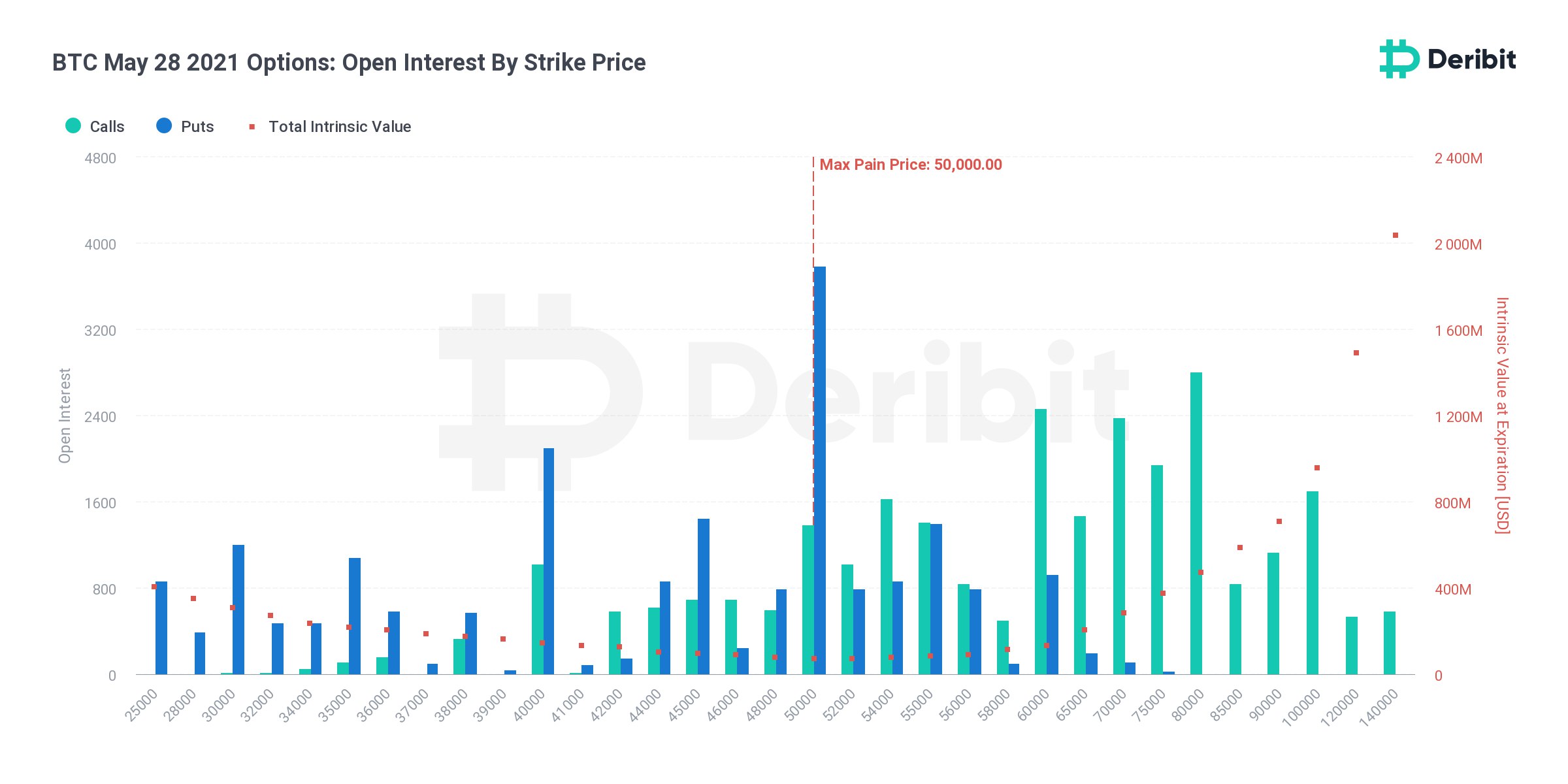
According to data from Skew Analytics, more than 55,000 bitcoin options contracts worth $2.2 billion will expire on Friday. Statistics further show, as far as options are concerned, Deribit captures the lion’s share of contracts with 48,469 bitcoin options contracts ($1.95 billion notional) set to expire.
55K in Bitcoin Option Set to Expire, Deribit Carries $1.95 Billion Notional
Another large options expiry is set to happen on May 28, 2021, following last week’s bitcoin (BTC) market sell-off. The analytics provider’s Twitter account from skew.com revealed on May 25, 2021, that over “55k bitcoin options expiring this Friday with $40k strike open in $130mln notional.”
Skew data shows approximately 55,900 contracts ($2.2 billion) will expire around 4 a.m. (ET) on Friday.
The options expiry follows the recent market carnage stemming from China, significant leverage, and environment FUD during the last two weeks. However, Skew Analytics said that bitcoin (BTC) markets absorbed “this week’s sell-off much better than during the COVID-19 panic on the 12th of March 2020 with BTC going
Data from the derivatives exchange Deribit shows the lion’s share of bitcoin options contracts have been placed on the trading platform. In regard to BTC options, in terms of open interest, exchanges like Ledgerx, Okex, and CME follow Deribit’s lead respectively.
At press time, BTC ‘max pain’ at $50k is 26.9% higher than bitcoin’s (BTC) current spot market price at 5:30 p.m. (ET) on Thursday evening.
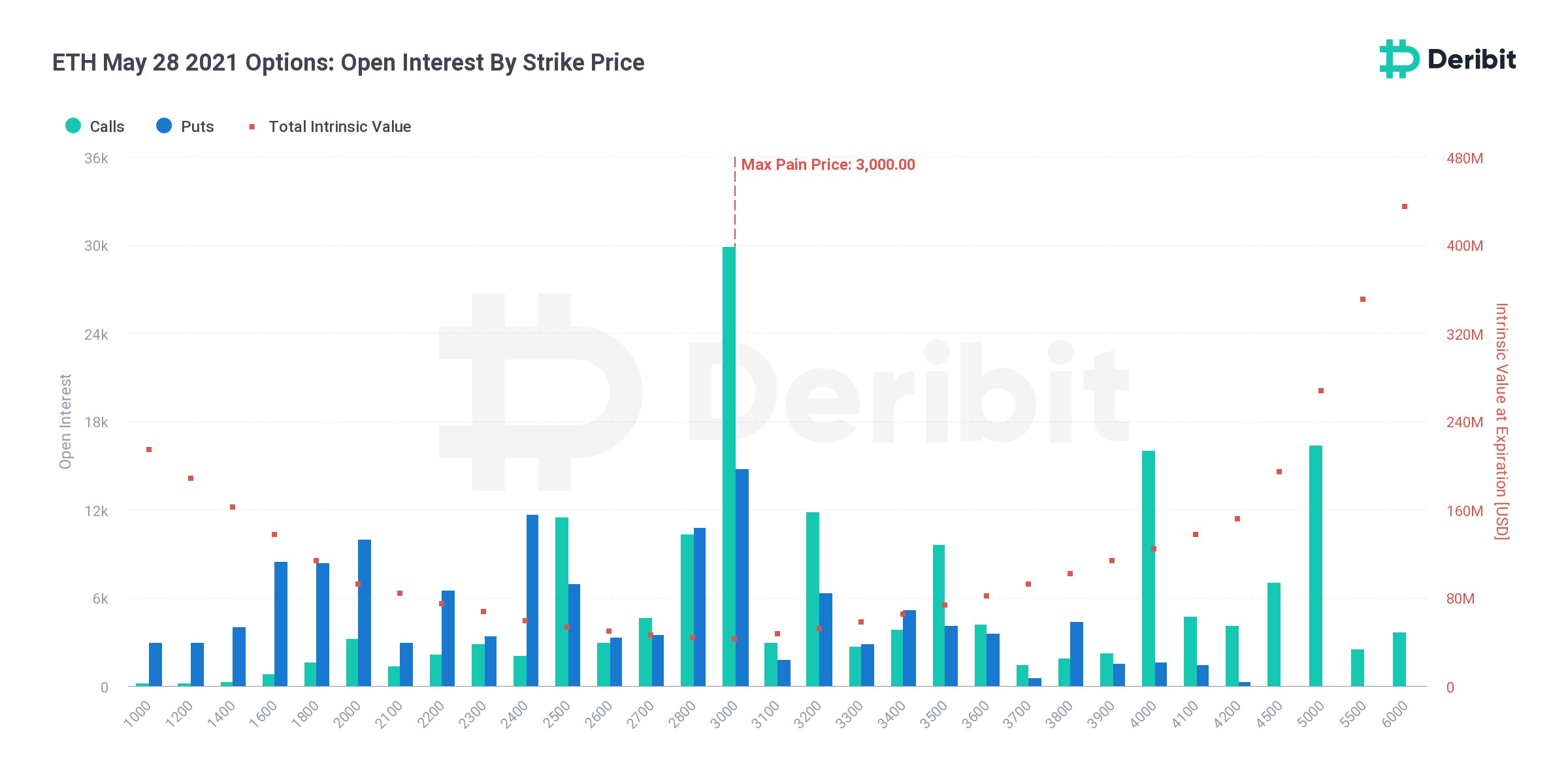
Insights from Deribit indicate the exchange has a “large expiry coming up tomorrow as 48,469 BTC option contracts (USD 1.95b notional) expire and 307,558 ETH options (USD 877m notional).”
Deribit Insights notes that “‘max pain’ for BTC is USD 50k and ETH USD 3k.” Deribit has also launched a new August expiry and July futures will be launched on May 28, 2021.
The derivatives exchange further notes that “Contango has returned with annualised yields up to 8.5% for BTC and 10% for ETH,” and “perpetual funding positive again as well.” The Deribit Implied Volatility Index (DVOL) “ decreased to (still elevated) level of 110-115.”
At press time, ETH ‘max pain’ at $3k is 11.11% higher than ethereum’s (ETH) current spot market price at 5:30 p.m. (ET) on Thursday evening.
Last Friday, Deribit’s Insights’ Twitter account tweeted about the 48 hours in ethereum (ETH) options. “19/5 Short gamma+vega positions forced closed in explosive spot volatility. Fast market pricing surged Implied vol >350%; Realized way higher,” the exchange noted at the time. “But on 20/5 while BTC Options were calm, ETH Option flows saw large Straddle buyers pre-empting a big move.”
Five days later on May 26, Skew Analytics wrote that as far as ETH volatility is concerned “current market volatility is back on par with [the] 2017 cycle.”
What do you think about the 55k worth of bitcoin options set to expire on Friday? Let us know what you think about this subject in the comments section below.
Like Bitcoin, DeFi’s ambition to build a fully decentralized global network is the fundamental source of its revolutionary characteristics – that of being trustless and enabling disintermediation. It is these two characteristics that build the core value of DeFi and determine its long-term market growth. It’s easy to see why this is so:
On the one hand, the core model of any DeFi project must be zero-centric in order to carry unlimited trust, exhibiting the value of a decentralized network beyond the market value of one single product or a brand.
On the other hand, a decentralized network must also be disintermediated, in order to compete with centralized products and retain its most critical competencies.
A non-cooperative network is a naturally robust decentralized network model. Shield is building a decentralized non-cooperative game theory based, derivatives trading network consisting of traders, dual liquidity pools, liquidators and brokers.
Shield Decentralized Network Based on Non-cooperative Game Theory
Non-cooperative game theory was first proposed by John Forbes Nash in 1950, describing a multiplayer game system that is not limited to two people (i.e., a zero-sum game) and that is stable after achieving a “Nash equilibrium”. Before the birth of blockchain, most governance systems of human society, including banks, exchanges, internet majors, and social institutions were based on zero-sum games. Zero-sum game systems pinned their hopes on leaving organizational functions, or providing order to combat decay, to a few centralized parties.
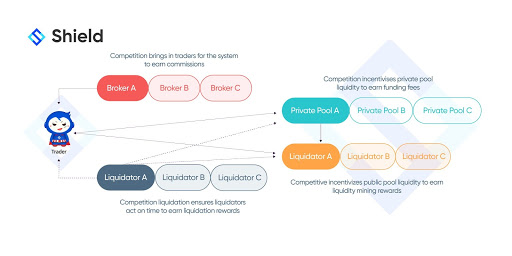
However, a governance system based on zero-sum games is an unstable structure that moves to the left or to the right as the power of the game parties changes, a structure that, right from day one, determines the convergence of power to the strongest side of the game leading to the collapse and reconstruction of order over and over again. The Shield protocol is such a non-cooperative game network, as shown in this graph:
Shield’s decentralized network is maintained by four key constituents: broker, private pool LP, public pool LP and liquidator. The transmission is executed via the governance token – SLD.
Broker (responsible for bringing in trades): Consists of 4 levels, where traders are introduced to the network via competition to earn commissions, with different commission rates for different levels. C and D levels will take out 10% and 20% of the commission rates respectively into the reward pool. Every 30 days, 60% and 40% of the reward pool will be divided equally between the A and B brokers, and the ranking will be reset based on the latest ranking.
Private Pool LP (Order Seller): Featured one address for one private pool, with each private pool competing with each other to provide liquidity (competing to be an option seller) to earn funding fees and SLD rewards for order taking liquidity.
Public pool LP (Backup pool): A unified large liquidity pool that earns liquidity mining rewards by competing to provide guaranteed liquidity.
Liquidators (provide liquidation): compete to perform network liquidation tasks and earn liquidation rewards.
Each aspect of the network has a clear interest incentive and sufficient competition mechanisms, so they all perform the needs of the network for their own benefit. Thus they reach the optimal Nash equilibrium of the whole network to maintain the decentralized security and stability of the network.
Dive Into Tokenomics for long-term Value
The key to a decentralized and stable network is to deliver sufficient and reasonable incentives to each of the players maintaining the network through the value vehicle of a token.
Shield has designed the following mining incentives for the public pool LPs, private pool LPs and liquidators who maintain the network:
Reserve liquidity mining: each block that provides liquidity to the public pool will be rewarded with a “liquidity share*32” in SLD.
Order taking liquidity mining: liquidity from either from private pool or public pools will be rewarded with the SLD of ” order funding fee * 30%/0.05″ upon order taking.
Liquidation mining: liquidators will receive the SLD liquidation compensation reward of “Liquidation with Ether system Gas fee*150%/0.05” (in case of insufficient system fund) as well as the liquidation contest SLD reward.
The mining rewards will be halved for every 20% of the remaining mining share.
Shield generates a buyback price by maintaining 10% of the total SLDs in circulation as always equal to 100% of the value of the buyback pool (derived from 90% of the transaction fees), while the SLDs mined are redeemed by swap&burn contract (as shown above).
When the secondary market price of SLDs is higher than current swap price, then the value of Swap&Burn pool will keep going up, because no one will swap.
When the secondary market price falls back below current swap price, anyone can buy SLDs on the secondary market to earn the difference from this Swap&Burn pool, thus ensuring a minimum price in the secondary market price (this minimum price is similar to the price in stock valuation through PE valuation).
While the transaction fees on the left side Swap&Burn pool increases with the development of the business model, the right side of the SLD pool will deflate as burn and mining rewards halve. Therefore, the value of SLDs will continue to rise in the long run.
Conclusion
Shield is the first decentralized derivatives network with non-cooperative game theory. Each player who helps maintain the network is fully incentivized. And the redemption of the token is accomplished through an innovative Swap&Burn model. Under the logic of uncapped business growth, i.e. uncapped growth in the value of Swap&Burn and continued deflation of the passes used to redeem value as they are destroyed and mined by half, the value of Shield’s native token, SLD, has long-term value potential.
This is a sponsored post. Learn how to reach our audience here. Read disclaimer below.
On Wednesday, the Veriblock project, a blockchain that leverages the implementation of proof-of-proof (PoP) consensus, announced an initiative to secure the Dogecoin blockchain using Bitcoin. The Veriblock Foundation believes the effort counters the hostile ‘Blood Bitcoin’ narrative in regard to recent environmental concerns over proof-of-work (PoW).
Veriblock to Secure Dogecoin via PoP and Bitcoin’s PoW
The Veriblock Foundation, a nonprofit created to bolster the adoption of Veriblock’s PoP securitizing consensus algorithm, has revealed a new initiative dedicated to securing the Dogecoin network. Presently, Veriblock developers are in the midst of integrating PoP into the Dogecoin codebase and aim to “present an open-source beta to the Dogecoin community soon for testing and feedback.”
Additionally, the Veriblock team will perform a 51% attack on the PoP-enabled version of Dogecoin in order to showcase the benefits of this technology. Veriblock’s cofounder and chief technical officer Maxwell Sanchez discussed the benefits of the organization’s PoP technology and how the BTC network’s PoW can be better utilized.
“Bitcoin has been under public fire recently for the large carbon footprint of its Proof-of-Work mining protocol,” Sanchez said. “Veriblock reuses Bitcoin’s mining power to secure the world’s blockchains, amortizing the per-transaction environmental cost to levels far below what legacy financial systems provide while enabling Bitcoin to easily meet the requirements demanded by many Fortune 500 companies interested in blockchain technology,” Sanchez stressed.
The Veriblock executive further added:
As Bitcoin becomes better utilized through technologies like Proof-of-Proof, it has the potential to become the world’s most efficient and secure financial platform while providing solutions that transcend finance to fight police corruption, enforce digital property rights, and more. We hope that our work can help to realize Bitcoin’s potential as the security backbone for the digital ecosystem of tomorrow.
Veriblock says that the PoP technology lets any blockchain inherit the powerful security offered by the BTC network’s hashpower. Sanchez believes that the integration of PoP will benefit both chains by securing Dogecoin and making Bitcoin more pleasing to environmentalists.
“Dogecoin already utilizes a shared security model by merge-mining with Litecoin, making it a perfect candidate for Veriblock’s security inheritance technology,” Sanchez emphasized. “Merge-mining has several critical security issues and decoupling Dogecoin from Litecoin will significantly benefit the security profile of both projects while making Bitcoin eco-friendly,” the Veriblock executive explained.
Veriblock’s PoP Was Very Controversial in 2019, Project’s CTO Claims PoW Is Needed, While PoS and PoC Are Fundamentally Insecure
Veriblock’s project is nothing new to the crypto community, as people have been discussing PoP for quite some time. In December 2019, Veriblock was controversial for its use of block space and the usage made PoP the most used BTC-based OP_Return protocol that year.
At the time Bitcoin (BTC) influencers called the Veriblock outputs “inefficient,” “abuse,” and “spam.” At the end of 2019, small block advocates grew very frustrated with the PoP outputs and even published blog posts about “Transaction Eugenics.” However, in 2020 and into 2021, controversial topics involving Veriblock’s use of the Bitcoin blockchain’s block space stopped.
During Wednesday’s Dogecoin announcement, Veriblock said that even though some people are advocating for proof-of-stake (PoS) and Proof-of-Capacity (PoC) consensus models, members of the Veriblock team argues that these “solutions are fundamentally opposed to the decentralized ethos that Bitcoin was founded upon.”
“Without a Proof-of-Work component, PoS and PoC are fundamentally insecure and is more analogous to the traditional finance world where financial institutions can hold funds hostage and blackball transactions at whim,” Sanchez added.
“These alternative security protocols don’t solve the same problems or provide the same benefits of Bitcoin’s Proof-of-Work, so comparing their ‘efficiency’ to Bitcoin is a non-starter. However, using a technology like Proof-of-Proof backstops these weakly-subjective security protocols with a Proof-of-Work component, making them viable,” the Veriblock executive concluded.
What do you think about the Veriblock PoP idea and its plans to secure the Dogecoin network? Let us know what you think about this subject in the comments section below.
Graphics cards manufacturer Nvidia has earned $155 million in revenue from chips designed for cryptocurrency mining during the first fiscal quarter. The company admitted that crypto miners have also pushed sales up in the gaming products segment which remains its main market.
Leading GPU Maker Reports Record High Video Card Sales Supported by Crypto Miners
Announcing its first quarterly results for the fiscal year 2022, Nvidia revealed its total revenue rose 84% in Q1 that ended on May 2. The record high $5.66 billion figure, which exceeded preliminary expectations, comes from the company’s gaming, data center and professional visualization platforms. Surging demand for graphics processing units (GPUs) during the pandemic, along with the growth of AI applications have played a major role, but so have booming crypto markets.
While $155 million of the total have been attributed to crypto-specific chips, Nvidia also admitted that cryptocurrency miners have boosted sales in its larger gaming card segment, Reuters reported, noting that the company did not disclose their share. Nvidia expects purchases of its CMP chips, made specifically for professional crypto mining, to reach $400 million in the second quarter.
As cryptocurrency prices were reaching their all-time highs earlier this year, Nvidia launched the dedicated mining chips to divert miners’ demand from its most important product line. It also limited the mining efficiency of its regular graphics cards to protect supply for gamers. Nvidia CEO Jensen Huang was quoted by CNBC saying:
What we hope is that the CMPs will satisfy the miners and will stay in the professional mines.
On Wednesday, the company also said that its first-quarter gaming revenue reached $2.76 billion, an increase of 106% from a year ago, while data center revenue was up 79% to $2.05 billion.
Nvidia Struggles to Determine Miners’ Contribution to ‘Larger Than Ever’ Gaming Market
Despite the positive news, Nvidia shares lost 1% to $621.95, according to data provided by Reuters. The report implies that investors might have been put off by the surge in card purchases for crypto mining usually occurring when the value of cryptocurrencies rises. In the past days and weeks, however, crypto markets have been hit by a series of negative statements and moves by public figures and governments that have brought prices down across the board.
To reduce the impact of the volatile crypto demand on investors’ sentiment and address complaints by gamers over shortages of the popular Geforce RTX 30-series cards, Nvidia has used software and technology to make its GPUs less suitable for crypto mining while offering the purpose-built CMP chips separately. “It effectively increases our production and supply,” said Jensen Huang, commenting on the changes.
The chief executive also remarked that the gaming market is now larger than ever before and emphasized that the growth trend is going to continue. Although crypto miners have clearly influenced the financial results of Nvidia’s core business, even after the chips were tweaked, CFO Colette Kress has been quoted stating that the company still finds it “hard to determine to what extent” they have contributed to its gaming division.
What do you think about Nvidia’s latest revenue data? Let us know in the comments section below.
Investors are backing the Balancer protocol with greater conviction. Could this be a sign that market hype surrounding DeFi is ramping up again?
The capital raise was led by Blockchain Capital, Fintech Collective, LongHash Ventures, Fenbushi Capital, Continue Capital and Kain Warwick, the founder of DeFi protocol Synthetix. The funds will be used to strengthen Balancer’s role as a core infrastructure provider of the DeFi market.
“By allowing for the most flexible and composable liquidity pools in the AMM space, the Balancer Protocol is uniquely positioned as a core infrastructure component for decentralized finance protocols and applications,” said Aleks Larsen, an investor with Blockchain Capital. He added:
“We see this aspect of the technology in Balancer as a strong long-term indicator, as protocols that are widely embedded in higher level systems are able to drive powerful network effects and defensive moats.”
Balancer has a history of attracting funding from leading VC firms. Last November, Alameda Capital and Pantera Capital threw their weight behind the DeFi project. In March of this year, Three Arrows Capital and DeFiance Capital led a $5 million raise for the company.
There has been considerable buzz around Balancer of late after VORTECS™ data from Cointelegraph Markets Pro indicated the start of a new bullish phase for the project. Although much of that bullish outlook has subsidized in the wake of last week’s market cycle correction. The value of BAL token is down 17% over the past week.
The Balancer protocol aims to become the leading source of liquidity in the DeFi market. The team has placed a strong emphasis on driving adoption in the Asia Pacific region, which could emerge as a hotbed for decentralized finance products.
Several prominent investors from within the cryptocurrency industry have purchased $24.25 million in Balancer tokens in a coordinated move to springboard adoption of the automated market maker.
We use cookies on our website to give you the most relevant experience by remembering your preferences and repeat visits. By clicking “Accept”, you consent to the use of ALL the cookies.
This website uses cookies to improve your experience while you navigate through the website. Out of these, the cookies that are categorized as necessary are stored on your browser as they are essential for the working of basic functionalities of the website. We also use third-party cookies that help us analyze and understand how you use this website. These cookies will be stored in your browser only with your consent. You also have the option to opt-out of these cookies. But opting out of some of these cookies may affect your browsing experience.
Necessary cookies are absolutely essential for the website to function properly. These cookies ensure basic functionalities and security features of the website, anonymously.
Cookie
Duration
Description
cookielawinfo-checkbox-analytics
11 months
This cookie is set by GDPR Cookie Consent plugin. The cookie is used to store the user consent for the cookies in the category "Analytics".
cookielawinfo-checkbox-functional
11 months
The cookie is set by GDPR cookie consent to record the user consent for the cookies in the category "Functional".
cookielawinfo-checkbox-necessary
11 months
This cookie is set by GDPR Cookie Consent plugin. The cookies is used to store the user consent for the cookies in the category "Necessary".
cookielawinfo-checkbox-others
11 months
This cookie is set by GDPR Cookie Consent plugin. The cookie is used to store the user consent for the cookies in the category "Other.
cookielawinfo-checkbox-performance
11 months
This cookie is set by GDPR Cookie Consent plugin. The cookie is used to store the user consent for the cookies in the category "Performance".
viewed_cookie_policy
11 months
The cookie is set by the GDPR Cookie Consent plugin and is used to store whether or not user has consented to the use of cookies. It does not store any personal data.
Functional cookies help to perform certain functionalities like sharing the content of the website on social media platforms, collect feedbacks, and other third-party features.
Performance cookies are used to understand and analyze the key performance indexes of the website which helps in delivering a better user experience for the visitors.
Analytical cookies are used to understand how visitors interact with the website. These cookies help provide information on metrics the number of visitors, bounce rate, traffic source, etc.
Advertisement cookies are used to provide visitors with relevant ads and marketing campaigns. These cookies track visitors across websites and collect information to provide customized ads.