Colonial Pipeline BTC Saga: Coinbase Debunks Theory it Was Involved

  • The US DoJ has recovered 63.7 BTC of the 75 Bitcoin paid out to hackers by Colonial Pipeline
  • The FBI was in possession of a private key that helped recover the Bitcoin
  • A theory has been circulating that the funds were sent to Coinbase and that the exchange helped the authorities
  • The CSO at Coinbase has since debunked the theory

Earlier today, news hit the internet that the US Department of Justice (DoJ), alongside the FBI, had recovered 63.7 Bitcoin of the 75 BTC that had been paid out to the hackers of the Colonial Pipeline fuel system.

The hack that happened last month, led to massive fuel shortages in the Eastern parts of the United States thus prompting the company to pay out the aforementioned ransom to avert further damages to its systems.

Theory That Coinbase Was Involved in recovering the Bitcoin

According to the chronology of events leading to the seizure of the Bitcoin by the DoJ, a judge in San Fransisco, approved the seizure of the finds from the said wallet which was located in the Northern District of California. The location of the wallet (California) thus led to the theory that the funds were sent to Coinbase.

Coinbase Debunks the Theory it was Involved With the Seizure of Bitcoin from Colonial Pipeline Hack

It is with this brief background of events that the Chief Security Officer at Coinbase, Philip Martin, has published an elaborate thread on Twitter, debunking the theory that the Bitcoin wallet containing the funds, was hosted by Coinbase.

Mr. Martin started out by stating that Coinbase was not the target of the warrant that granted the seizure of the Bitcoin, neither was the exchange in possession of any BTC from the Colonial Pipeline hack. According to his analysis, the private keys were probably obtained through old fashion police work.

An excerpt of his views on the matter can be found below.

Coinbase uses a pooled hot wallet, so handing over a specific private key wouldn’t make a ton of sense, and we’ve (for obvious security reasons) not built a private key export API endpoint into our signing systems.

I’ve also read that because the seizure warrant specified property in the Northern District of California, it had to be targeted at Coinbase. Nope. What this likely means is that the private key is located at one of the many Northern California FBI field offices.

So how did they get the private key? Maybe some whiz-bang magic, but my guess would be it was some good ol’ fashioned police work to locate the target servers, and an MLAT request and/or some political pressure to get access.

Go to Source

Polkadot’s Parachain Vision Materializes Following Successful Kusama Auction

After months of hype around the launch, the first Kusama parachain auction went off without a hitch. The now active parachain has already begun successfully processing transactions, paving the way for future slot auctions.

Kusama’s First Functional Parachain Goes Live

The anticipation surrounding Polkadot parachains over the last few months has at last been realized following the first successful parachain auction on the Kusama canary network. This development marks the first time that a 100% decentralized, heterogeneously-sharded blockchain has been launched.

The parachain, awarded to “Shell,” has since been upgraded to “Statemine,” a common-good parachain with several different utilities and functionalities. Other parachains will leverage Statemine’s utility thanks to the XCM protocol, which also allows KSM tokens to move between Kusama and the parachain seamlessly.

With this proof of concept in place and operational, “Parachain Slot Auctions” can commence, but they will require the input of the KSM community. The selection of parachains for the Kusama relay-chain revolves around staking the greatest amount of KSM tokens for as long as possible. Once the Kusama Council and KSM holders decide on the auction timeline, the next round of auctions can commence.

Accordingly, the Polkadot team has recommended the following auction timeline for the council and KSM stakeholders to approve:

  • June 15th, 2021 – 12:00 CEST (Central European Summer Time): Opening of bidding for first Kusama parachain slot auction.
  • June 17th, 2021 – 09:00 CEST: End period of first Kusama parachain slot auction commences. Any bids made prior to this date will be counted in the final result, with any bids made after this date and time facing a lower likelihood of consideration in the final results on a linear-reducing basis.
  • June 22nd, 2021 – 09:00 CEST: Bidding officially ends for the first Kusama parachain slot auction. No bids will be accepted for this auction beyond this point.
  • June 22nd, 2021 – 11:00 CEST: The first parachain slot auction winner will be announced based on the highest bidder over the previous five days.
  • June 22nd, 2021 – 12:00 CEST: The second parachain slot auction will begin.
  • June 29th, 2021 – 12:00 CEST: The third parachain slot auction will begin.
  • July 6th, 2021 – 12:00 CEST: The fourth parachain slot auction will begin.
  • July 13th, 2021 – 12:00 CEST: The fifth parachain slot auction will begin.

What do you think about the first Kusama parachain auction? Let us know what you think in the comments section below.

Go to Source

Kenyan Banks Warn Clients Against Crypto Trading

A few Kenyan banks have started sending out warning alerts to clients engaged in cryptocurrency trading to be wary of the associated risks. These warnings have reportedly been sent to clients who have “used their credit and debit cards to buy cryptocurrencies on crypto exchanges.”

Crypto Trading Risks

According to a local report, one of the banks, NCBA Bank Kenya is now advising clients “not to buy, hold, or trade in virtual currencies.” In a warning sent to clients who have previously transacted on crypto exchanges, NCBA Bank said:

In accordance with the Central Bank of Kenya (CBK)’s circular No. 14 of 2015, virtual currencies such as Bitcoin are not legal tender in Kenya. No protection, therefore, exists for you as our customer in the event that the platform holding or trading in cryptocurrency fails or goes out of business.

Throughout the emailed alert, the NCBA Bank repeats the common lines that are used by central banks when attempting to discredit digital currencies. For instance, NCBA Bank says “transactions in virtual currencies are largely untraceable, making them susceptible to abuse by criminals.”

Unregulated Crypto Exchanges

Furthermore, the bank also warns that cryptocurrencies are traded on exchange platforms which “are not properly regulated” and that consumers risk losing all their funds in the “event these exchanges collapse or close business.” While NCBA Bank clients can still transact with cryptocurrency exchanges, the bank still warns that it does not “approve cryptocurrency transactions.”

In the meantime, the report speculates that the banks’ latest action could mean that the CBK still frowns on cryptocurrencies. For example, in 2015 the central bank issued an advisory asking Kenyans to desist from cryptocurrency transactions. Similarly, in April 2018, the CBK cautioned banks against dealing in cryptocurrencies.

However, despite these warnings, crypto trading continues to grow in Kenya and some reports say the country now has the second-largest peer-to-peer traded volumes on the continent. It remains to be seen if acts by Kenyan banks are going to slow down crypto traded volumes.

What are your thoughts on Kenyan banks’ decision to warn clients against dealing with crypto exchanges? You can share your views in the comments section below.

Go to Source

Alternative 401(k) Product Offers In-Plan Cryptocurrency Investment via Coinbase Institutional

On Monday, the San Francisco-based retirement plan provider for small to medium-sized businesses, Forusall, announced the launch of an alternative 401(k) plan that offers in-plan cryptocurrency access. According to the alt 401(k) investment option, Forusall is working with Coinbase Institutional as its retirement plan partner.

Forusall and Coinbase’s Institutional Arm Offer Crypto-Infused Alt 401(k) Plan

Forusall, the “one-click” retirement provider founded in 2012, has revealed that digital currency investors can now leverage the company’s alt 401(k) investment option in order to obtain tax-advantages from crypto asset investments.

The company Forusall claims to manage plans for over 600,000 employees from companies like Target, Coca Cola and Citigroup. By November 2019, Forusall was advising employees with over $1 billion in assets. The company’s focus on crypto assets applies to the alt 401(k) product, which can also leverage environmentally focused funds, mutual funds, and real estate.

“For too long, too many Americans haven’t had the same access to alternative investments that wealthy and professional investors have had. Our mission is to provide every American with the tools necessary to build a brighter financial future, and making these alternatives more readily available is a key step towards that,” Jeff Schulte, CEO of Forusall explained during the announcement.

The company’s website also mentions growing crypto asset interest and highlights that 60% of institutional investors believe in investing in crypto assets. “6 out of 10 institutional investors feel that digital assets have a place in their portfolio and 36% are already using it,” the Forusall website notes.

Alt 401(k) Plan Provides 5% Allocation With a Choice Between 50 Crypto Assets

Forusall’s announcement on Monday details that employers can choose to add the crypto option and employees can direct up to 5% of their portfolio into digital assets. The plan works with Coinbase Institutional, so employees that leverage Forusall’s alt 401(k) investment option can choose from 50 unique crypto assets. The retirement plan provider further said that the company monitors the crypto allocations and employees can always rebalance their portfolios into different assets.

The lead at Coinbase’s institutional crypto arm, Brett Tejpaul, explained during Forusall’s alt 401(k) announcement that expanding digital assets to mainstream retirement plans will broaden the playing field.

“When we created our institutional platform, our initial focus was making cryptocurrency accessible to institutional investors and high-net-worth individuals,” Tejpaul remarked. “The next evolution is to broaden our reach and we are thrilled to be working with Forusall, the leading 401k technology platform, to expand access to cryptocurrency through 401ks.”

The alt 401(k) option from Forusall is not the first retirement plan to add crypto assets into the fray. The U.S.-based Digital Asset Investment Management (Daim) revealed in November 2020, that it offers a company-sponsored 401(k) retirement plan. Daim’s product allocates up to 10% in bitcoin via the institutional-grade custodian Gemini Trust. The firm New York-based Gemini also works with Bitwage to give employees the ability to invest their pre-tax and post-tax dollars in bitcoin (BTC).

What do you think about Forusall’s alt 401(k) investment option that allows a 5% allocation into cryptocurrencies via Coinbase? Let us know what you think about this subject in the comments section below.

Go to Source

Scammers Pick Bank Transfers Over Cryptocurrency, Australian Report Reveals

Investment scams have been by far the most common type in Australia recently, a new report by the country’s consumer watchdog has revealed. And while a growing number of Australians fall victim to fraudulent schemes involving cryptocurrency, bank transfers remain the scammers’ favorite way to extract money.

Australians Lose $670 Million to Scammers in a Year, Including $75 Million Through Bank Transfers

Residents of Australia have lost $851 million Australian dollars (almost $670 million) in over 444,000 reported scam cases in 2020, the Australian Competition and Consumer Commission (ACCC) announced in its latest Targeting Scams report published Monday.

The review compiles data from the commission’s own Scamwatch website, Australia’s cybersecurity center Reportcyber, other government agencies, and about a dozen banks and financial intermediaries. ACCC Deputy Chair Delia Rickard commented:

Last year, scam victims reported the biggest losses we have seen, but worse, we expect the real losses will be even higher, as many people don’t report these scams.

The agency has registered increasing financial losses to investment scams in 2020 with the total figure reaching a record-high $328 million Australian dollars ($254 million). Reports to Scamwatch increased by 63% to 7,295 and losses rose to $66 million Australian dollars, or over $51 million. Almost 34% of people who reported an investment scam lost money. The average loss was $26,713 Australian dollars, or around $20,000.

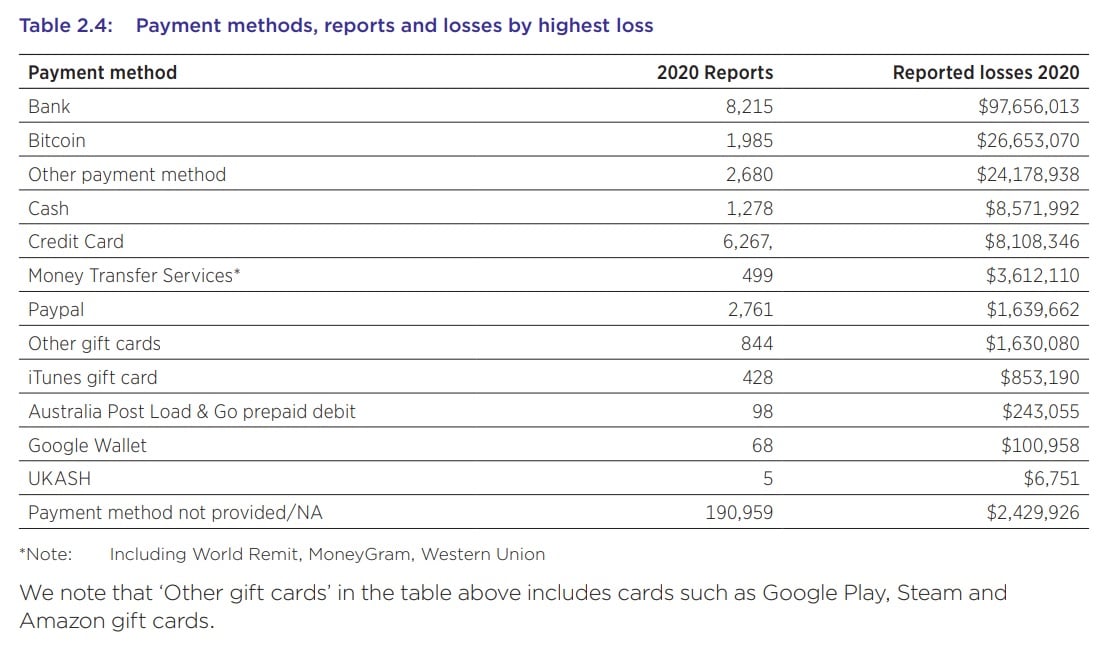
Bank transfers remained the most common payment method used by scammers, with over $97 million Australian dollars ($75 million) lost through such transfers, a 40% increase over the previous year. According to the ACCC, bitcoin (BTC) was the second-highest payment method, with $26.5 million in losses, or a little over $20.5 million. Adding these to the “Other Payments” category, including cryptocurrencies such as ethereum (ETH) and apps like Zelle or Skrill, brings the total to $50 million Australian dollars (almost $39 million).

‘Romance Baiting’ Scams Lure Young Australians to Fraudulent Crypto Investment Schemes

Despite still lagging behind traditional payment methods, bitcoin and other crypto payments are becoming more common. “The perceived anonymity of unregulated cryptocurrencies can impede the ability to recover funds or identify scammers. It is likely that we will see increased use of Bitcoin and other cryptocurrencies in the years to come,” the ACCC report remarks.

Amid an ongoing Covid crisis, health and medical scams increased last year more than 20 fold compared to 2019, accounting for over $3.9 million Australian dollars ($3 million) in losses. But in 2020, Scamwatch identified a new type of scam, which it refers to as “romance baiting,” often associated with crypto payments. Perpetrators are targeting social groups which have not previously suffered heavy losses.

Victims are typically contacted on a dating app, redirected elsewhere and lured into an investment scam involving cryptocurrency, the ACCC explained. Young Australians, aged between 25 and 34 years, have lost the most money to romance baiting last year – $7.3 million Australian dollars ($5.66 million). In total, citizens filed 414 reports of such scams, with losses reaching $15.4 million Australian dollars (almost $12 million). Crypto scams are by far the most common in this genre (57%), the commission noted.

Other scams targeting potential crypto investors have employed fake celebrity endorsements. The face, name, and personal characteristics of a well-known public figure are usually used to sell a product or a service. This product could be health-related or linked to an investment strategy encouraging people to invest in various cryptocurrency schemes. The report details that victims are offered an opportunity to collect high returns in a rather short period of time from a trading or investment platform that suddenly disappears.

What are your thoughts on the findings in the ACCC report? Let us know in the comments section below.

Go to Source

Why this coin’s price is up 20% when all else is red – Buy Theta Fuel

Theta Fuel is rocking the house. The crypto market is a sea of red today but there is one coin that stands out amidst the carnage, and that’s Theta or to be more precise its gas coin Theta Fuel.

Theta Fuel is up 20% today while all around tens of billions of dollars is being wiped off market valuations.

Why? It’s because the mainnet goes live on 30 June and the price (of both coins) has been rising in anticipation of that event.

Theta is the native token of the network, which is a blockchain protocol for streaming video content, with the aim of improving both the delivery and quality of video.

Since the end of May Theta Fuel has tended to outperform the Theta token

Theta is powering video streaming with blockchain

It includes a clever approach, although it is not unique, as users of BitTorrent will tell you. Chief among its features is to incentivise network users to share unused or redundant computing resource and bandwidth peer to peer.

In addition, the other main feature of the network is in enabling a peer to download from another peer, and not just from the original distributor of video content.

But unlike BitTorrent, which has made its name as the go-to tool for piracy, Theta is about optimising efficient content distribution that lowers cost of delivery.

And also, unlike BitTorrent, Theta actually fully operates on the blockchain. Justin Sun‘s Tron bought BitTorrent back in 2019 and created the BTT token, which naturally runs on the Tron blockchain and is used for incentivising activity but is very far from a video delivery system running on distributed ledger technology.

Theta Fuel (TFUEL) up 20% today at $0.568

Today Theta is actually down, but is still outperforming the rest of the market, showing a decline of -4% to $8.9 compared to bitcoin’s  -8% to $33,196, at time of writing.

But it is the Gas token of the network that has got us excited today. Theta Fuel (TFUEL) is up an astonishing 20% at $0.568, up 3% since I started writing this story.

As with Gas on Ethereum, Theta Fuel is used to pay for on-chain computations in smart contracts and for their deployment, and in the case of the Theta network, used for the remuneration of the relayers of streamed video content.

Market participants began to sit up and take notice of Theta when talent agency the Creative Artists Agency (CAA)joined the network by becoming the operator of one of its  validator nodes.
 

Theta has a super fast dPoS blockchain

Unlike Ethereum, Theta operates on a Proof of Stake protocol of the delegated variety (dPoS), which makes it a super-fast and cheap network.

In June last year Binance Research estimated that Theta network on-chain transactions per second (tps) would be around 500 and 10,000-plus for bandwidth sharing.

In addition to the validator nodes run by the likes of CAA, the network also has community-run ‘Guardian’ nodes and these also got some love a couple of days ago when the devs announced another successful milestone in Theta’s journey, with the launch of 1-click delegated staking through its wallet.

We rate Theta Fuel a strong buy as well as the Theta token itself. Down days are good for accumulation but you may want to dollar cost average into the market at this point by buying a manageable amount on a regular basis, as there is always the risk of a ‘buy the new, sell the rumour’ moment after the mainnet goes live (30 June), with traders looking to book profits.

Looking to buy or trade Crypto now? Invest at eToro!

Buy Crypto Now

75% of retail investor accounts lose money when trading CFDs with this provider

Go to Source

Bitcoin price due for break below $30K trader warns after 9% daily loss

A breakout to avoid a fresh price dip would be a “miracle,” says Crypto Ed as storm clouds gather for Bitcoin bulls.

Bitcoin (BTC) traded worryingly near $30,000 support on June 8 amid fresh predictions of incoming lows.

BTC/USD 1-hour candle chart (Bitstamp). Source: TradingView

BTC price hints at “sub $30,000” move

Data from Cointelegraph Markets Pro and TradingView followed BTC/USD as the pair lost 9% overnight on Monday.

No amount of good news was able to help bulls, with potential adoption breakthroughs in Latin America conspicuously doing nothing to boost lackluster price action.

U.S. Treasury Secretary Janet Yellen likewise failed to lift the mood when she voiced support for higher inflation.

Instead, Bitcoin dropped to $32,000, at the time of writing coming off a rebound to $33,000.

For popular trader Crypto Ed, the outlook was uninspiring — and even included a trip below the $30,000 mark.

“It did the white ABC I posted before the weekend,” he told Twitter followers, referring to a forecast price rotation.

“Now in green box but I’d expect 1 more leg down today, followed by a bounce to ~35k From there down again, sub 30k, or ‘up only’ again, but the latter feels more like a miracle tbh.”

Crypto Ed’s BTC price chart with ABC structure. Source: Crypto Ed/ Twitter

Moving averages cause alarm

As Cointelegraph reported, traders are already on edge over a potential “death cross” involving two key moving averages which could spell further downside.

This could extend beyond the short term, Cane Island Alternative Advisors investment manager Timothy Peterson noted, thanks to BTC/USD now lingering below its 200-day moving average for almost three weeks.

“This metric has *always* marked the end of a bull run and the start of a bear market,” he added in comments on Monday.

Bitcoin price behavior vs. 200-day moving average chart. Source: Timothy Peterson/ Twitter

Go to Source

One percent of Bitcoin’s supply has been locked in the WBTC protocol

More than $6 billion worth of Bitcoin is now tokenized on Ethereum as WBTC.

One percent of Bitcoin’s circulating supply is currently tokenized as Wrapped BTC (WBTC), equating to nearly $6.2 billion worth of BTC. 

The milestone was acknowledged by the product manager of crypto custody firm BitGo, Kia Mosayeri, who tweeted the news on June 7. BitGo is the custodian for the Wrapped Bitcoin protocol, which was launched its Bitcoin-backed ERC-20 token WBTC on Ethereum in January 2019.

According to Etherscan, there are currently 187,610 Bitcoins wrapped on the protocol, equating to a fully diluted market capitalization of $6.18 billion. The current circulating supply of BTC is nearly 18.73 million, according to CoinGecko, confirming the 1% milestone.

BTConEthereum estimates there are 240,620 Bitcoins that have been tokenized across various protocols for use on Ethereum, representing a combined capitalization of $7.91 billion. Wrapped Bitcoin exerts a clear dominance over the sector, representing 78% of all Bitcoin tokenized on Ethereum.

Other leading Bitcoin tokenization protocols include second-ranked Huobi BTC with 37,906 BTC or 15.7% of the Bitcoin’s supply, and the third-ranked RenBTC with 10,226 tokenized BTC. Synthetic BTC also holds 1,471 BTC, followed by imBTC with 1,169 Bitcoin, and TBTC with 916 BTC.

The recent proliferation of yield farms and interest-bearing Ethereum-based DeFi protocols supporting tokenized BTC has been the primary force driving the sector’s growth.

In late April, Ethereum-based BTC yield protocol BadgerDAO teamed up with RenVM to launch a bridge between renBTC and its own yield farms. DeFi Llama estimates that more than $540 million worth of assets is locked on the BadgerDAO platform.

Go to Source

Spanish seafood firm partners with IBM for supply chain tracking

Spanish multinational seafood giant, Nueva Pescanova Group, has partnered with The IBM Food Trust to trace the shrimp and prawns it fishes on the blockchain.

Spanish-based seafood firm, Nueva Pescanova Group, has announced its working with IBM to utilize its Food Trust platform — a distributed ledger technology platform designed for supply chain traceability.

According to a June 8 announcement from IBM, the partnership is already underway, with Nueva Pescanova utilizing blockchain technology to track shrimp fishing in Argentina and prawn cultivation in Ecuador.

In the announcement, Ignacio González, the CEO of the Nueva Pescanova Group, stated the tracability platform will help the firm in meeting the United Nation’s Global Dialogue on Seafood Traceability (DGST) standards, stating:

“We want to offer our consumers all over the world rigorous and detailed information on the traceability of our seafood products, from their origin until they reach their tables. Now is the time for businesses across the seafood sector to begin addressing the GDST standards.”

Nueva Pescanova Group is a leading multinational seafood firm that was founded in 1960. The company covers the cultivation, production, processing, and distribution of seafood.

IBM’s Food Trust traceability platform was designed for the food industry, enabling members of the network to view comprehensive supply chain data from products in “near real-time” — offering significant efficiency savings to producers, minimizing fraud across the global market, and ensuring safety and sustainability obligations are met.

Sustainability is an issue of increasing importance to seafood consumers, with IBM referencing its 2020 Europe Food Sustainability study, which found that nearly 50% of respondents would buy more seafood if they had more information on its “origin, safety and production.”

The partnership adds to the growing list of food and agricultural firms that have partnered with IBM for blockchain-based supply chain solutions.

In February, Multinational retail giant Carrefour partnered with IBM to track the supply chain of chicken and microgreens. In December 2020, Cointelegraph reported that Nestlé, Dole, and olive oil giant CHO were already leveraging the IBM Food Trust Network.

Go to Source

Crypto markets tumble after miners unload 5,000 BTC in one week

With Bitcoin’s price consistently trending below its 200-day moving averages and heavy selling identified among miners, some analysts are bracing for further bearish momentum.

The crypto markets are against dropping, with Bitcoin crashing below $33,000 for the first time since May 23 as Ethereum similarly broke below support at $2,500.

The downward momentum comes as bearish indicators continue to stack up for Bitcoin, with popular analyst William Clemente III identifying that miners sold more than 5,000 BTC over the past week — worth roughly $164 million at current prices.

Crypto author Timothy Peterson also highlighted that BTC’s price has remained below its 200-day simple moving average (SMA) for 17 days consecutively.

”This metric has *always* marked the end of a bull run and the start of a bear market,” he asserted.

Although the markets appear to be posting a small intra-day bounce — with BTC currently hovering near $33,000 after dropping to $32,400 and ETH currently changing hands for $2,500 after bouncing off a local low of roughly $2,430 — both markets have crashed approximately 15% since posting respective local highs of $39,600 and $2,900 on June 3.

However, while both Ether and Bitcoin have been shedding value over recent weeks, capital flows for crypto investment products suggest that institutional investors are pivoting towards Ether.

According to a June 7 report from CoinShares, Bitcoin investment products saw record outflows of $141 billion this past week while Ether products reported inflows of $22 million.

Go to Source

Huobi Eco Chain’s TVL surges to $2.7b, but two DApps represent 86% of locked assets

The decentralized exchange Mdex and yield aggregator Filda represent roughly $2.4 billion of Heco’s $2.7 billion TVL combined.

Despite Huobi Eco Chain attracting an impressive total value locked (TVL) since launching in December, just two DApps represent 86% of the blockchain’s TVL.

According to crypto data aggregator, CryptoRank, approximately $1.98 billion or 73% of Heco’s TVL is locked in the Mdex decentralized exchange.

Mdex is Heco’s rival to PancakeSwap, an automated market maker offering yield farming incentives to users. In early April, Mdex also launched on BSC to gain access to a wider range of tokens not supported on Heco Chain.

Yield aggregator Filda is the second-largest DApp on Heco, with Filda representing a TVL of almost $400 million or 13% of Huobi Eco Chain’s combined value locked. As such, all other DApps share the remaining 16% or roughly $300 million in assets locked in Heco.

Huobi’s Ethereum Virtual Machine (EVM)-compatible public chain was rolled out in December 2020 to compete with among the emerging sector EVM-interoperable chains.

In spite of the capital centralization, Heco is now significantly beating out many of its rivals by TVL, including the $362 million TVL of performance-focused Solana blockchain has a total value locked of $362 million according to SolanaProject, and Avalanche’s has $225 million locked according to the Markr explorer.

According to Heco Chain stats, the number of unique addresses interacting with the chain has surged 390% over the past three months to tag a record 12 million. Heco also reports a daily transaction count of 1.67 million.

In April, Heco teased that it had received applications from 213 DApps hoping to launch on the blockchain.

Heco is also a long way from challenging its principal rival, Binance Smart Chain, which boasts a TVL of $20.6 billion according to BSCProject — more than seven and a half times that of Heco Chain. The top BSC project is PancakeSwap with $7.8 billion locked or 38% of BSC’s combined TVLl.

Binance Smart Chain also hosts.1 million transactions daily according to BSCscan.

Go to Source

Latin lawmakers don lazer eyes on Twitter in support of Bitcoin

An increasing number of Latin American lawmakers are donning Lazer eyes on their Twitter avatars to express their support for Bitcoin and digital assets.

Gabriel Silva, a Panamanian congressman, is moving to follow in El Salvador’s footsteps by proposing legislation to adopt Bitcoin and other cryptocurrencies on a national scale. 

El Salvador’s president, Nayib Bukele announced during the Miami Bitcoin conference on June 6, that he will submit a bill to lawmakers demanding that Bitcoin be made legal tender.

In a June 8 tweet, Silva emphasized the significance of Panama not being left behind by Bukele’s progressive crypto plans, which also includes removing capital gains tax on Bitcoin in El Salvador. According to a rough translation, Silva asserted:

“This is important. And Panama cannot be left behind. If we want to be a true technology and entrepreneurship hub, we have to support cryptocurrencies.”

“We will be preparing a proposal to present at the Assembly. If you are interested in building it, you can contact me,” he added.

Bukele’s announcement has prompted similar moves from other politicians across Latin America, however, few concrete policy proposals have been announced.

On June 7, Paraguayan congressman, Carlitos Rejala, tweeted “El Salvador to the Moon” and uploaded a picture of himself with laser eyes — a popular crypto meme used to express Bitcoin maximalism on crypto Twitter.

Earlier today, the crypto community had turned their attention to Brazilian politician, Fábio Ostermann, who similarly posted a picture of himself with laser eyes accompanied by the hashtag “#lasereyestill100k.”

Despite positive sentiment on social media regarding the apparent bullishness of Latin American lawmakers, the price of Bitcoin has continued to decline.

The price of Bitcoin has slumped roughly 10% since Bukele’s June 6 announcement from $36,000 to roughly $32,500 at the time of writing.

Go to Source

Former SEC head and treasury undersecretary defend US crypto regulations

Former top policymakers Jay Clayton and Brent McIntosh has defended the crypto regulatory regimes established during their respective government tenures.

The regulatory pressure is mounting in the U.S., with more politicians questioning whether the current framework is adequate.

An opinion piece penned for Wall Street Journal by former SEC Chairman, Jay Clayton, and former Undersecretary of the Treasury, Brent McIntosh, have defended the United States’ existing regulatory apparatus regarding crypto and warned that excessive rulemaking could stifle innovation.

The discussions come as cryptocurrencies have been thrown into the regulatory spotlight once again in the wake of two crippling ransomware attacks in the U.S. Over the weekend, two senators deliberated on the prospect of banning cryptocurrencies as a solution to the ransomware attacks.

Clayton served as SEC head from May 2017 until December 2020 and stated that the agency did not take up Bitcoin regulation because the asset was declared not to be a security before he took up his position as its head. Clayton has remained in the industry following his departure from the SEC and currently advises One River Asset Management on cryptocurrencies.

McIntosh was the Under Secretary of the Treasury for International Affairs from September 2019 until January 2021, previously serving as General Counsel to the Department of the Treasury between 2017 and 2019.

The pair emphasized the challenge of finding a pragmatic regulatory balance that ensures basic consumer protections without stifling the crypto industry’s growth, warning that the sector could easily be subjected to excessive or insufficient regulatory oversight while praising existing guideline:

“Existing regulatory frameworks provide the tools to address many of the risks of new technologies without stifling their promise.”

They advised policymakers to ground their efforts in the principal objectives underpinning existing financial regulations. These include financial stability and the prevention of fraud and illicit activity.

The pair concluded that a coordinated approach is required that ensures the U.S. retains its role as a financial leader:

“A prompt, coordinated approach to regulatory clarity that builds on our existing knowledge base will empower responsible innovation and ensure that the U.S. financial system continues its leadership role in the formation of capital, the provision of credit, and the maintenance of stability on which the modern global economy depends.”

Those in power appear to be angling for a heavier-handed approach, with Treasury Secretary, Janet Yellen, stating that the misuse of crypto is a growing problem in February.

SEC chairman Gary Gensler also hinted at greater regulatory oversight for U.S. crypto exchanges in early May.

Go to Source

Bitcoin Price Prediction: BTC/USD Downsizes Against $35,000 Level

Bitcoin Price Prediction – June 7
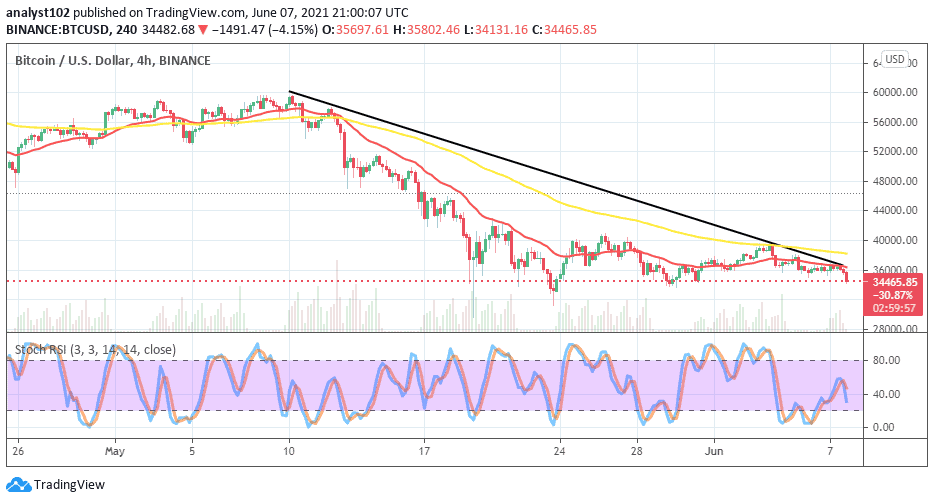
The aftermath consequent range trading situation between Bitcoin as paired with the US Dollar has currently led the crypto market to downsize against the $35,000 level. Price is now trading around $34,587 at a reduction of -3.60 percent.

BTC/USD Market
Key Levels:
Resistance levels: $40,000, $45,000, $50,000
Support levels: $30,000, $25,000, $20,000

BTC/USD – Daily Chart

The BTC/USD chart shows that the recent lower trading zone currently witnessing the crypto market downsizes against $35,000 level to the south. Today’s session now appears with a higher falling pressure that has put the market on the verge of getting to see lower values. The bearish and the 14-day SMA trend-line are located underneath the 50-day SMA indicator. The Stochastic Oscillators have crossed southbound from the overbought region to point south-direction in support of the current ongoing sell-off of the crypto trade situation.

The current downsizes against the $35,000 level, could it push further into bearish trend resumption?

There is every tendency of seeing the BTC/USD market downsizes against the $35,000 level while bulls fail to hold their stance against the current pressure inflicted on the market by the US Dollar. A sustainable forceful breakdown of the point is most needed to be able to have a clearer picture in confirmation of that technical assumption. In the course of that presumed scenario, bulls are enjoined to patiently wait for either a notable price reversal movement or a formation of a bullish candlestick stemming up from a dip trading zone of the market afterward.

The breaking down of the lower point of $35,000 may potentially on a gradual moving mote put the crypto further under variant falling pressures. The Stochastic Oscillators’ southbound crossing averaging range 40 signifies that a degree of tangible selling pressure is ongoing. As a result, traders needed to have taken an advantage of the market to have entered a sell order position earlier around the mid-point of the recent lower range market level.

Looking to buy or trade Bitcoin (BTC) now? Invest at eToro!


Buy Bitcoin Now


BTC/USD 4-hour Chart

On the medium-term chart, the BTC/USD market’s price downsizes against its main lower range trading level of $36,000 as the $40,000 upper range line is now seen above all the SMAs. The bearish trend-line moved down across the 50-day SMA indicator to closely place near over the 14-day SMA trend-line at the point of current active falling forces of the market. The Stochastic Oscillators have crossed the lines southbound briefly past range 40 to signally back the possibility of seeing the drawdown move getting strengthened. At this point, all buying sentiments may have to be suspended for a while. But, on the contrary, A strong reversal bearish move against the level of $36,000 may in most cases signify a return of an upward move to decimate the present downward force.


75% of retail investor accounts lose money when trading CFDs with this provider

Buy Bitcoin Now

Go to Source

21shares to Launch Bitcoin ETP for Institutional Investors in the UK

Switzerland-based 21shares announced it’s going to offer its crypto exchange-traded product (ETP) to institutional investors in Britain. The platform said the aim is to provide U.K. investors with exposure to bitcoin without the need to deal with crypto custody and security.

New Bitcoin ETP to Be Offered on London-Based Aquis Exchange

The 21shares bitcoin ETP (ABTC) will be made available through a partnership with GHCO, a leading market maker and liquidity provider that specializes in exchange-traded funds (ETFs). It will be listed on Aquis Exchange, a multilateral trading platform based in London and Paris. The exchange facilitates stock trading across 15 European markets.

The ETP is engineered like an ETF and will be centrally cleared, 21shares detailed in a press release on Monday. As ETPs trade on exchanges similarly to stocks, institutional investors in the U.K. will be facing a regulated framework and structure to which they are already accustomed to. The Swiss company further elaborated:

The ETP has been designed to provide institutional U.K. investors with secure and cost-effective exposure to Bitcoin without the associated Bitcoin custody and security challenges.

UK Launch to Follow Debut on Euronext Paris and Amsterdam

The bitcoin ETP will be offered in the United Kingdom this summer, following successful launches on Euronext Paris and Amsterdam on June 1, 21shares revealed. One unit of the ETP represents exposure to roughly 0.00035 bitcoin entitlement, the crypto firm added. Its chief executive Hany Rashwan was quoted stating:

This is the right time to bring our successful crypto ETP to the institutional U.K. market. Our strong track record and existing institutional reach across continental Europe means that investors can confidently gain exposure to Bitcoin via a liquid and conventional investment product.

Institutional investors will have access to ample liquidity provided by GHCO which is an authorized participant in the offering.

“GHCO has been actively trading ETFs and recently started quoting crypto ETPs. It has an unrivaled track record in quoting the tightest spreads, a key demand for institutional investors,” 21shares pointed out.

Zug-headquartered 21shares is a leading crypto ETP issuer with over $1.5 billion in assets under management across 14 ETPs listed on several European stock exchanges. The company has already offered cryptocurrency ETPs for institutional investors in Switzerland, Germany, France, Austria, and the Netherlands. In March, 21shares launched bitcoin cash (BCH) and ethereum (ETH) ETPs on Deutsche Boerse’s Xetra.

What’s your opinion about cryptocurrency exchange-traded products? Tell us in the comments section below.

Go to Source

Please enter CoinGecko Free Api Key to get this plugin works.
Exit mobile version