The U.S. Internal Revenue Service (IRS) says it needs congressional authority in order to obtain the information needed to regulate cryptocurrency. “We get challenged frequently and to have a clear dictate from Congress on the authority for us to collect that information is critical,” IRS Commissioner Charles Rettig said.
IRS Says It Needs More Authority to Collect Crypto Data
IRS Commissioner Charles Rettig said Tuesday during a Senate Finance Committee hearing that the IRS needs more authority to do its job in regulating cryptocurrency. He said:
I think we need congressional authority. We get challenged frequently and to have a clear dictate from Congress on the authority for us to collect that information is critical.
The commissioner noted that the cryptocurrency market is growing and its value is now approximately $2 trillion, with more than 8,600 exchanges worldwide.
The Biden administration has proposed requiring businesses to report information on cryptocurrency transactions valued at more than $10,000 to the IRS. This is part of the administration’s broader efforts to crack down on tax evasion. “Cryptocurrency already poses a significant detection problem by facilitating illegal activity broadly including tax evasion,” the U.S. Treasury Department stated.
Rettig opined:
Most crypto, virtual currencies are designed to stay off the radar screen.
The IRS recently issued John Doe summonses to cryptocurrency exchanges Circle, including Poloniex, and Kraken to obtain records of their cryptocurrency users. The tax agency seeks “information about U.S. taxpayers who conducted at least the equivalent of $20,000 in transactions in cryptocurrency during the years 2016 to 2020” on these exchanges. The summonses direct the exchanges to “produce records identifying the U.S. taxpayers described above, along with other documents relating to their cryptocurrency transactions.”
Robert Wearing, IRS’ deputy associate chief counsel for Procedure & Administration, said last month that the agency will seize cryptocurrencies and sell them to satisfy tax collection if taxpayers fail to meet their tax obligations. In March, the IRS launched Operation Hidden Treasure to target unreported crypto income.
What do you think about the IRS seeking congressional authority to collect crypto data? Let us know in the comments section below.
The chief investment officer of global investment firm Skybridge Capital says bitcoin still has more upside than gold. While expecting both gold and bitcoin to rally, he said his hedge fund is sticking to bitcoin.
Asset Manager Skybridge Prefers Bitcoin to Gold
Troy Gayeski, co-chief investment officer (CIO) and senior portfolio manager at Skybridge Capital, a $7.5 billion hedge fund, says gold is good but bitcoin is better, Bloomberg reported Sunday. He believes that both gold and bitcoin are likely to rally even as the Federal Reserve moves to taper asset purchases, elaborating:
We’re going to stick to bitcoin and crypto because we just think there’s more upside.
While acknowledging that bitcoin has more volatility than gold, the CIO noted: “you’re going to capture a little bit more juice than you will in gold from that same phenomenon.”
The price of bitcoin soared to the $65,000 level in April before plunging. It currently stands at $32,512 based on data from Bitcoin.com Markets. Meanwhile, gold came close to sinking into a bear market in March but its price recovered and erases year-to-date losses.
Gayeski, added:
All fiat-currency alternatives — which have all gone through fairly recent substantial corrections — are in a much better place now to handle that eventual taper and gradual slowing of money-supply growth, than they were as they were making higher-highs after higher-highs.
Skybridge launched its bitcoin fund in December last year with $25 million. By the time it opened up to the public in January, the fund’s assets under management had risen to $310 million. The Skybridge Bitcoin Fund is an institutional-grade fund investing in bitcoin. Fidelity Digital Assets, a division of Fidelity Investments, serves as the firm’s bitcoin custodian and Ernst & Young serves as its auditor.
According to Gayeski, the Skybridge Bitcoin Fund is up 51.2% as of June 1, from its inception last December.
The firm’s founder, Anthony Scaramucci, has predicted that the price of bitcoin will reach $100,000 before the year-end simply due to heavy demand for the cryptocurrency and its diminishing supply.
In March, the firm registered a bitcoin exchange-traded fund (ETF) with the U.S. Securities and Exchange Commission (SEC). Gayeski expects the SEC to approve the product by the fourth quarter of 2021 or the first quarter of next year.
Do you agree with Skybridge Capital’s executive about bitcoin? Let us know in the comments section below.
Solana, a proof-of-stake, smart contracts-enabled currency, is aiming to raise $450 million in a funding round that was extended last March. The Solana ecosystem, which is backed by Sam Bankman-Fried, founder and CEO of derivatives exchange FTX, would use these funds to take on Ethereum supremacy in the Defi ecosystem.
Solana to Raise $450 Million in Funding Round
Solana, the FTX-backed, proof-of-stake coin is aiming to raise $450 million in a funding round that was set to close, but instead expanded in March, according to a report from Decrypt. The outlet, citing anonymous sources, states the currency had targeted significantly less money in a smaller funding round, but found big capital interested in backing the project.
While there is still no confirmation on the amount of money raised by Solana, these funds would be used to entice developers to construct and bring their already existing projects to the network. The project is part of a group of cryptocurrencies called “ethereum killers,” which seek to mimic the functionalities that this project has while improving on throughput and fees.
Solana claims to be technically superior to Ethereum, offering to process up to 50,000 transactions per second. The project has experienced a rise in popularity due to its very low transaction fees and the use of its token platform by the FTX exchange, who allows deposits and withdrawals from this network. Last year, FTX CEO Sam Bankman-Fried opted to build the company’s Serum decentralized exchange on top of the Solana blockchain instead of on the Ethereum network due to these advantages.
‘Ethereum Killers’ — One More to the Pile
While Solana is one of the most impressive networks aiming to replace Ethereum, with several defi-based projects choosing it as their chain, it is by no means the only one. Avalanche, another similar project launched just last year, has also risen to the top of the ranks of these “ethereum killers,” claiming to be even better, allowing users to issue subnets, with higher throughput and faster finality.
Even Cardano, a platform founded by Ethereum founder Charles Hoskinson, is now introducing its smart platform capabilities and has generated significant interest in the cryptocurrency community. All of these chains are racing to achieve some kind of stable support before Ethereum manages to fix its scaling issues. Luckily for them, Ethereum founder Vitalik Buterin announced that scaling through sharding is not likely to be implemented before late 2022.
What do you think about Solana’s current funding round? Tell us in the comments section below.
Crypto and blockchain industries need to play by the rules to realize their full potential, Concordium CEO says.
The anonymity of Bitcoin (BTC) and other cryptocurrencies is a hot topic in the crypto space. While the transactions are open to track in a public blockchain, it is challenging to link a transaction with a real-life person in many use cases. As an identity-centric platform, Concordium takes a different direction by offering complete transparency.
“The time has come for the blockchain industry to respect the general rules of society,” Concordium chairman Lars Seier Christensen said in an announcement. The launch of Concodium Blockchain marks the end of the era of anonymity, opacity, and the lack of transparency, he added.
Developed and advised by leading executives and board members from corporations like Volvo, Ikea, Saxo Bank, MasterCard, and others, the Concordium Blockchain and its cryptocurrency GTU will launch the mainnet on June 9.
According to the release, Concordium believes credible participants looking to enter crypto and blockchain are hindered by the lack of a regulation-friendly environment, which delays the industry’s broader adoption.
The Concordium platform offers “guarantees of governance and transparency, without compromising privacy,” the announcement reads. Users are identifiable and the provenance of every transaction is trackable to meet the needs of global regulators.
As Cointelegraph previously detailed, Concordium utilizes a two-step process to achieve privacy without anonymity. Identities are verified via Know Your Client providers. The identity providers store the personal data behind a user ID reference, issuing an identity certificate. This is then stored on the blockchain in an encrypted form.
On-chain anonymity revokers can decrypt these certificates to extract the user ID. This enables governments to use the identifier with the identity provider to reveal real-world data, but only if they provide official and specific mandates like court orders.
“This industry needs to realize that without trust and acceptance, there is nothing,” said Concordium chief executive Lone Fonss Schroder. She added:
“Global business is rules-based. The sooner the blockchain and crypto industry wakes up to the need to play by the rules, the sooner the full potential of blockchain will be realized.”
Earlier this year, Concordium raised over $41 million from private and strategic sales, valuing the company at $4.45 billion.
“Most crypto, virtual currencies are designed to stay off the radar screen,” said Charles Rettig.
Internal Revenue Service chief Charles Rettig called out lawmakers for not taking the initiative on addressing the problem of many U.S. residents not paying taxes on crypto.
In a Tuesday senate hearing on the IRS’ fiscal year 2022 budget, Rettig said that the agency would likely require a “clear dictate from Congress” to regulate crypto. The IRS has listed $32 million in its budget for “crypto-related enforcement operations” as well as $41 million related to cybercrime in its attempts to address the issue of non-reporting or underreporting taxpayers.
“The authority for us to collect that information is critical,” said Rettig. “The most recent market cap in that world — in the crypto world — exceeded $2 trillion and more than 8,600 exchanges worldwide, and by design most crypto, virtual currencies are designed to stay off the radar screen, so we will be challenged.”
Rettig was responding to Ohio Senator Rob Portman, who in April said he intended to introduce a bipartisan bill aimed at addressing the problem of many crypto users in the U.S. not paying taxes. The IRS chief added that “non-filer virtual currency” would be one area in which the agency would be focusing to close the tax gap in the future, and he “would appreciate the opportunity” to work with lawmakers on the issue.
Last month, officials at the Treasury Department called for crypto exchanges and custodians to report transactions greater than $10,000 to the IRS as part of a tax proposal for President Joe Biden’s American Families Plan. The agency currently has no independent verification of such transactions, potentially leading to a widening tax gap.
Rettig added at the hearing:
“We do need additional tools, and we absolutely need additional resources.”
According to data from the IRS in October 2020, 83.6% of taxes were paid “voluntarily and on time” from 2011 to 2013. However, the Treasury Department has projected that the tax gap could reach roughly $7 trillion total over the next decade should the government fail to take action.
Data from Cointelegraph Markets Pro and TradingView showed BTC/USD making repeated lower lows on short timeframes during June 8.
A previous dip took the pair to $32,000 before a brief rebound, with that level subsequently giving way.
At the time of writing, Bitcoin was plumbing to levels not seen since May’s initial $30,000 correction, with BTC focusing in on $31,500.
As Cointelegraph reported, traders have gone on record to predict a fresh capitulation event across cryptocurrencies, something that could shave around 20% off the total crypto market capitalization. Under such circumstances, Bitcoin could trade at $25,000 in the short term.
“From a technical point of view its difficult not to see $30k being tested and probably break,” Filbfilb, co-founder of trading suite Decentrader, told Cointelegraph.
“If this is to prove to be a bottom it would make sense to test the liquidity resting around 28k before bouncing. If there fails to be a response around those prices which quickly recovers weekly support of 32k, then the outlook will be bleak.”
A look at buy and sell positions on largest global exchange, Binance, shows support lining up at $30,500, with resistance curiously thin below $40,000.
Buy and sell positions on Binance as of June 8. Source: Material Indicators/Twitter
$19,000 seen as ultimate floor
For on-chain monitoring service Whalemap, meanwhile, essential support areas for BTC/USD more broadly begin at $28,000.
Analysts used the “cohort-based realized price,” a metric that extends realized price according to how large a wallet is, along with the prices at which current hodlers bought while Bitcoin was running to its $64,500 all-time highs.
“To conclude, there is massive confluence at the 19k level which makes it super hard for BTC to go lower than that,” the analysts tweeted.
“Another level with confluence is at 27-28k. At least a relief bounce from there would make a lot of sense.”
Nonetheless, should Bitcoin go below $20,000, it would be the first time in history that the high from a previous bull cycle has been broken.
Whalemap BTC/USD volume chart with support levels. Source: Whalemap/Twitter
Coinseed also created an ERC-20 token whose message is targeted at New York Attorney General Letitia James.
Coinseed, a crypto platform that enabled micro-investing in cryptocurrency assets for its users, has shut down its operations.
Delgerdalai Davaasambuu, founder and CEO of Coinseed, announced the decision via a statement published on the platform’s website.
Detailing his decision to shutter the business, Davaasambuu wrote:
“It is with an incredibly heavy heart, today I’m announcing that I am winding down the business due to a lawsuit from the NYAG (New York Attorney General).”
As previously reported by Cointelegraph, the Office of the New York State Attorney General brought fraud charges against Coinseed back in February. At the time, the NYAG accused Coinseed of misleading investors with the sale of unlicensed securities to the tune of over $1 million.
The NYAG’s legal assault on Coinseed was based on alleged violations of the Martin Act, a New York anti-fraud law. Under New York State Attorney General Letitia James, the office also used the Martin Act in its pursuit of crypto exchange Bitfinex and stablecoin issuer Tether.
In his message posted on the Coinseed website, Davaasambuu berated principal actors of the NYAG, including former New York State Attorney General Eric Schneiderman. The Coinseed chief accused the NYAG of double standards in its pursuit of the company.
Back in February, the Coinseed CEO dismissed the NYAG’s case against the company, stating that United States citizens were not involved in its 2017 initial coin offering.
Davaasambuu also accused the NYAG of profiting from the lack of clear-cut regulations in the state as a means of extorting settlement payments from cryptocurrency firms.
The Coinseed closure comes as the company no longer has access to payment providers following the NYAG lawsuit. Davaasambuu promised to return user funds at a later date.
As part of the closure announcement, the Coinseed boss also revealed an ERC-20 token seemingly created to spite James. Dubbed FuckLetitaJames (FLJ), the token will reportedly be airdropped to interested persons.
Litecoin Market Dares Breaking Lower – June 8 It is currently observed at a closer viewing point that the LTC/USD market dares breaking lower the range-line as the price has been fluctuating around the value of 155 at a rate of -4.24 percent.
LTC/USD – Daily Chart Today’s trading session as depicted on the LTC/USD daily chart that price dares now dares breaking lower range-line as the level of $150 has briefly traded past to the south initially. A bearish candlestick is in the forming motion. The 50-day SMA indicator SMA has been intercepted from the top by the 14-day SMA trend-line as the bearish remains crossed downward against the SMAs’. The Stochastic Oscillators have crossed the lines from the overbought region to point southbound briefly past range 40 suggesting a downside pressure is the offing.
Breaking lower past the range-line, will the ETH/USD market see a huge drawdown?
Breaking lower past the range-line, it has now been noticed by ongoing selling pressure in the ETH/USD economy that a southward move Is imminent in the near session. A sudden pull-up from the lower range point of $150 will most likely push back the market into another trial trading situation of a bullish trend returning. However, if such a presumed scenario doesn’t have a volatile move, the range-bound may tend to continue.
As both the bearish and the 14-day SMA trend lines remain placed at the immediate resistance and the upper range-line of $200 below the 50-day SMA indicator portends that some degree of downward pressure is still somewhat in the market operations. Bears ought to have taken the advantage of the situation to have placed a sell order around the upper range-line. But, they now have to be wary of their position around the lower range-line.
Looking to buy or trade Litecoin (LTC) now? Invest at eToro!
Buy Litecoin Now
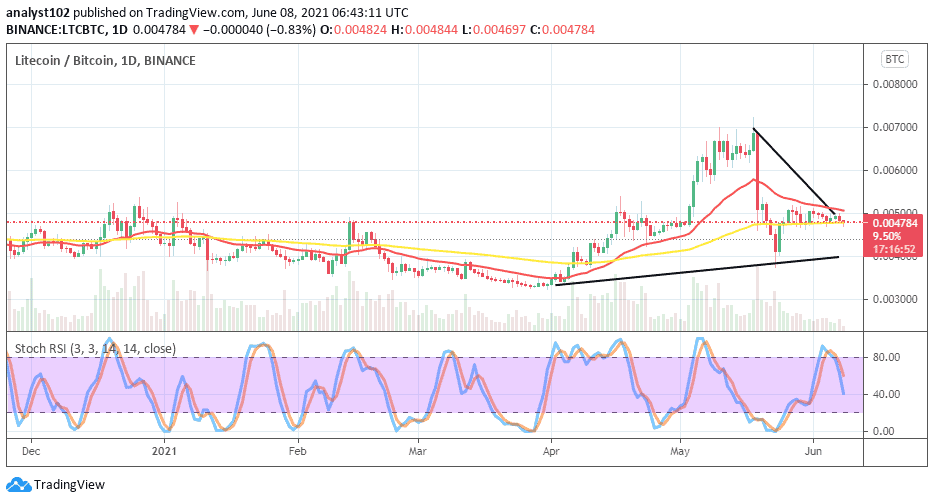
LTC/BTC Price Analysis
Comparing the market moving-capacity between Litecoin and Bitcoin, the base crypto yet possesses a higher length as paired with the most valuable counter crypto to some extent. A line of variant higher lows is kept occurring on the buy signal side of the bigger SMA indicator. The 14-day SMA and the 50-day SMA trend lines are pointing toward the east direction to validate an ongoing range trading outlook of the cryptos. The Stochastic Oscillators have slightly crossed downward from the overbought region to point to the south near over range 40. Going by that, the base crypto is on the verge of breaking the lower range zone as placed against the counter cryptocurrency.
75% of retail investor accounts lose money when trading CFDs with this provider
“The probability as more and more people keep using Bitcoin, it’s going to keep moving up,” said Marc Lasry.
Marc Lasry, co-founder and CEO of Avenue Capital Group, believes that despite recent volatility in the crypto market, it likely isn’t going away.
In a Tuesday interview with CNBC’s Squawk Box, Lasry said that while the price of Bitcoin (BTC) could go anywhere from $20,000 to $100,000, the market has been established, implying it is unlikely to go to zero. The billionaire commented that his 2018 prediction that BTC would reach $40,000 was based on institutional investors driving interest.
“Once a market is created, it’s there,” said Lasry. “The probability as more and more people keep using Bitcoin, it’s going to keep moving up. It’s happened a little bit quicker than I thought it would.”
He added:
“I should have bought a lot more — that was my mistake.”
Lasry’s prediction three years ago came when the price of Bitcoin was under $10,000 following the 2017 bull run and subsequent crash. At the time, he said BTC investors could make “5 to 10 times their money in 3 to 5 years.”
Since reaching an all-time high price of $64,899 in April, the crypto asset has dropped significantly, seemingly triggered by Elon Musk’s Tesla saying it had ceased accepting BTC as payment for vehicles due to environmental concerns. On Tuesday, BTC’s price fell under $32,000 following a United States Department of Justice announcement that a task force had seized $2.3 million in crypto used to pay for ransom as part of an attack on the Colonial Pipeline system.
Investors’ appetite for gold increased as they assessed higher inflation and a major price crash in the Bitcoin market.
May was a testing time for cryptocurrencies like Bitcoin (BTC). The flagship digital asset was already wobbling after rallying to nearly $65,000 in mid April, owing to profit-taking sentiment among traders.
Elon Musk accelerated the sell-off by reversing his company’s plans to accept Bitcoin as payment for Tesla’s electric cars.
Later in the month, the People’s Bank of China reiterated to the country’s financial institutions against the use of virtual currencies for payments. Chinese authorities are also starting to keep a close eye on crypto mining — the process by which computers mine cryptocurrencies like Bitcoin.
More blows to the cryptocurrency sector came from the U.S. tax and monetary authorities, including Federal Reserve Chairman Jerome Powell, who suggested that more regulations are needed.
All and all, the flurry of negative updates caused the cryptocurrency market to lose more than $500 billion in May. Being the benchmark digital asset, Bitcoin also suffered the brunt of aggressive downside pressure, falling 35.50% in the month.
Bitcoin is undergoing a sharp trend reversal on its monthly charts following May’s crash. Source: BTCUSD on TradingView
Meanwhile, physical gold exchange-traded funds (ETFs) recorded its strongest months in May 2021 since September 2020. The funds across the globe attracted a combined total of $3.4 billion compared to September’s $4.8 billion, according to data provided by the World Gold Council (WGC).
In detail, U.S.-based gold ETFs experienced an inflow worth $2.1 billion. The European gold ETFs reported $1.6 billion worth of deposits. Nonetheless, Asian funds tracking the precious metal’s prices noted an outflow of about $300 million.
Gold ETF flow chart. Source: WGC
Strong demand for gold ETFs also contributed to the rise of its spot prices. As a result, the XAU/USD exchange rate jumped 7.6% in May to $1,912.785 an ounce.
Negative correlation
The polar opposite moves in Bitcoin and Gold markets indicated that a short-term negative correlation has been brewing between them. In addition, Wall Street veterans Nick Colas and Jessica Rabe also wrote in their DataTrek Research report that the sell-off in virtual currencies might have boosted gold’s appeal among institutional investors.
The market strategists projected Bitcoin as a riskier alternative to Gold. Meanwhile, they noted that the precious metal’s value does not decline by half in five weeks because of Elon Musk tweets, nor does it respond to policymakers’ ban threats.
“Gold is, relative to virtual currencies, a no-drama investment. [Therefore], we continue to recommend a 3-5 percent position in gold for diversified portfolios.”
Bitcoin is largely a speculative bet for wealthy and small retail investors seeking quick profits. But the fixed supply of BTC has also seen it benefit from fears of rising inflation, similar to gold. Corporates including Tesla, Ruffer Investments, Square, and MicroStrategy added Bitcoin to their cash-ruled balance sheets.
They did so to offset inflation risks brought forth by the Federal Reserve’s unprecedented expansionary policies, including near-zero interest rates and a $120 billion monthly asset purchasing program.
The high-profile investments played a key role in doubling Bitcoin prices in the first quarter of 2021, fueled further higher to around $65,000 by mid-April by an increase in debt-fueled leveraged bets and influx of new retail traders into the market.
On the other hand, Gold ETFs reported six months of back-to-back outflows until May 2021. JPMorgan analysts in January 2021 reported that gold ETFs lost about $7 billion in the same period Grayscale Bitcoin Trust (GBTC), a trust operated by New York-based Grayscale Investments, attracted $3 billion.
The lack of capital injection into precious metal funds also lowered its spot bids; XAU/USD closed the first 2021 quarter down 10.14% opposed to Bitcoin’s 100% returns.
In May 2021, another JPMorgan report suggested that large institutional investors secured their profits in Bitcoin to seek opportunities in gold. They cited open interest data in Bitcoin futures contracts on the Chicago Mercantile Exchange that experienced its biggest drop since October 2020. JPMorgan analysts said:
“The bitcoin flow picture continues to deteriorate and is pointing to continued retrenchment by institutional investors.”
Bitcoin (orange) trended inversely to gold (pink) so far into 2021. Source: TradingView
The statements also appeared as Ruffer Investments, a U.K.-based fund that manages about $33.95 billion for wealthy individuals and charities, also announced Tuesday that it has unloaded its entire Bitcoin position and has netted $1.56 billion in profits.
Duncan MacInnes, investment director at Ruffer, told the Finance Times that they had shifted the funds into gold, commodity stocks, and inflation-protected bonds.
Macinnes added that Bitcoin is still “on the menu” of Ruffer’s potential investments in the future, noting that the world is desperate for new safe-haven against ultra-low bond yields.
Though its billionaire owner has personally spoken out against digital assets many times, Berkshire Hathaway’s investment may indicate the firm is more open to the idea.
Brazilian digital bank Nubank has raised $500 million from Berkshire Hathaway, a multinational holding company run by billionaire Warren Buffett.
In an announcement from Nubank on Tuesday, the digital bank said the $500 million investment would be used to continue its international expansion — the company recently launched in Colombia — as well as attract new executives from major tech companies. Nubank reported it has more than 40 million customers in Brazil, Mexico and Colombia.
Nubank CEO David Vélez said the funding would help in “democratizing access to financial services” across Latin America. He said that only half the people in the region have bank accounts, with roughly 21% using credit cards.
“No one thought it was possible to change the financial system, but we were always convinced that there was room for disruption and innovation and, more importantly, that customers deserved better service,” said Vélez.
Buffett has personally spoken on Bitcoin (BTC) and other cryptocurrencies previously, saying they “basically have no value” and that he will never own any himself. In a shareholders meeting last month, vice chair Charlie Munger referred to crypto as “useful to kidnappers and extortionists.”
However, over the last year, the multinational conglomerate has invested in more firms related to technology and beyond, including cloud technology company Snowflake. Berkshire Hathaway also holds billions of dollars worth of Apple and Amazon stock as of March 31.
The OSC published a statement of allegations against Mek Global Limited and PhoenixFin Pte. Ltd. on Monday for allegedly violating local securities laws.
The Ontario Securities Commission, or OSC, is taking stern action against two companies associated with KuCoin for allegedly failing to comply with local securities laws, setting the stage for further regulatory action against the cryptocurrency platform.
The companies targeted by the OSC are Seychelles-based Mek Global Limited and Singapore-based PhoenixFin Pte. Ltd. Collectively, the companies operate KuCoin, one of the world’s fastest-growing cryptocurrency exchanges. As of Tuesday, KuCoin had processed more than $1.3 billion worth of crypto transactions over the previous 24 hours, according to industry data. That puts it in the 35th position globally among cryptocurrency exchanges.
“KuCoin is operating an unregistered crypto asset trading platform, encouraging Ontarians to use the platform, and allowing Ontario residents to trade crypto asset products that are securities and derivatives,” a statement from OSC reads.
The securities regulator previously warned cryptocurrency exchanges against offering derivatives trading — namely, that they must seek regulatory approval from the OSC or face consequences. Exchanges were given until April 19 to bring their operations into compliance.
As Cointelegraph previously reported, the OSC has already taken regulatory action against Polo Digital Assets, the parent company of Poloniex, for allegedly failing to comply with Ontario securities laws. Like KuCoin, Poloniex allegedly failed to contact the securities regulator by the April 19 deadline.
Ontario has become a hotbed for cryptocurrency activity in recent months. The jurisdiction is now home to North America’s first Bitcoin (BTC) exchange-traded funds. The debut Purpose Investments ETF secured $1.3 billion in assets under management during its first two months of operation, highlighting pent-up demand for digital assets.
Evolve Funds Group launched Ontario’s second Bitcoin ETF in February, offering direct exposure to Canadian dollar- and U.S. dollar-denominated units of BTC.
As an EEA member, Quantstamp is part of the EEA community of organizations working to advance Ethereum and drive industry adoption. In the Q&A below, the EEA interviewed Richard Ma on the ways Quantstamp works with the ecosystem to help Ethereum reach its full potential.
Please introduce your company and yourself briefly.
I am the CEO of Quantstamp, the leader in blockchain security, and a strategic thinker who cares for the wellbeing of those around me. Quantstamp’s mission is to drive the mainstream adoption of blockchain technology through our security services. To date, Quantstamp has performed over 200 audits for our clients and protected more than $100 billion worth of digital assets from hackers.
What first brought you to the EEA, and why did you decide to become a member?
We became a member of the EEA’s broad community and membership base in order to work with other companies around best practices for assisting NGOs, governments, and private industry in implementing Ethereum technology safely. We are excited to bring our experiences to the table including working with the World Economic Forum to help governments and other stakeholders understand the technological choices and trade-offs associated with developing CBDCs, and securing cutting-edge projects like Ethereum 2.0 (Prysm and Teku clients), Maker, Compound, Curve, and Beeple B.20
The infrastructure of tomorrow is being built today, and the EEA is a great place to work on this infrastructure with our peers. We are excited to leverage our security expertise to help other EEA members and the broader private industry make this transition safely.
What are you currently working on with regards to Ethereum? How will end-users benefit from your work?
We are consistently auditing several DeFi and NFT projects at any given time. End-users benefit from our work because they can participate in the digital economy with a higher degree of safety. When someone is interested in using a DeFi protocol or purchasing an NFT-powered asset, they get excited when they hear it was secured by Quantstamp. We are honored to have earned this level of trust and we intend to keep earning it.
What EEA programs are you most excited about?
We are excited about working with the EEA members, community, and team around developing secure technical specifications for enterprise-ready Ethereum implementations. Interoperability is one of Ethereum’s strengths, but each piece needs to be secure to make it work. We are thrilled to be part of the EEA to help make that happen.
Learn More and Connect with the EEA
The EEA enables organizations to adopt and use Ethereum technology in their daily business operations. We empower the Ethereum ecosystem to develop new business opportunities, drive industry adoption, and learn and collaborate. Join us and contribute to our work!
Learn more about EEA membership, sign up for the latest updates and contact membership@entethalliance.org
The post EEA Member Spotlight with Richard Ma, </br> CEO and Co-founder at Quantstamp appeared first on Enterprise Ethereum Alliance.
British asset management firm Ruffer reportedly said its bitcoin investment has generated about $1.1 billion in profit. The firm says bitcoin has been “a wonderful store of value” and it is still optimistic about the cryptocurrency in the long term.
Ruffer Profits $1.1 Billion From Bitcoin Investment
London-based asset management firm Ruffer revealed that it made $1.1 billion in profit from its bitcoin investment in five months, The Sunday Times reported on June 6. The firm has about £22.4 billion ($32 billion) under management as of April 30.
Hamish Baillie, an investment director at Ruffer, said the asset management firm initially invested about $600 million in bitcoin in November last year when the price of BTC was below $20,000. The director detailed:
When the price doubled, we took some profits for our clients in December and early January. We actively managed the position and by the time we sold the last tranche in April, the total profit was slightly more than $1.1 billion.
Baillie explained that stimulus checks have fueled some demand for cryptocurrencies, noting that younger people’s interest in them could falter as lockdowns end and economies reopen.
The investment director expects institutions to keep buying BTC for their portfolios and embrace the cryptocurrency as an alternative haven asset.
Regarding whether Ruffer will buy more bitcoin, the director said that it is “certainly not off the menu.” Moreover, he called out “hyperbole and misinformation” surrounding bitcoin’s energy consumption. He also pointed out bitcoin’s “huge social benefits” in countries such as Venezuela. Baillie opined:
It’s been a wonderful store of value.
Ruffer previously explained that its BTC investment “diversifies the company’s investments in gold and inflation-linked bonds, and acts as a hedge to some of the monetary and market risks that we see.” The firm further noted: “Due to zero interest rates the investment world is desperate for new safe-havens and uncorrelated assets. We think we are relatively early to this, at the foothills of a long trend of institutional adoption and financialisation of bitcoin.”
A spokesperson for Ruffer was quoted by Reuters on Tuesday as saying:
Long term, we remain interested in digital assets and the role they can play in real wealth preservation. In the short term, following the sharp increase in the bitcoin price, we felt bitcoin was exhibiting more risk.
What do you think about Ruffer’s bitcoin strategy? Let us know in the comments section below.
Deutsche Bank published a report Monday noting that the United States is facing “the very real specter of consumer-driven inflation.” The bank’s chief economist David Folkerts-Landau and others notably highlight the Federal Reserve’s monetary easing policy and recent tolerance toward higher inflation.
Deutsche Report: ‘Transitory Inflation Could Feed Into ’70s Style Stagflation’
The price of commodities in the U.S. has surged according to a number of recently published studies over the last two months. Currently, commodity-price increases are moving in lockstep as products like oil tapped a two-year high, the price of lumber jumped 377% in a year’s time, electronics are 10% more expensive across the board, copper has risen to record highs, soybeans and corn prices have skyrocketed, and retail beef and pork is eliciting “sticker shock.”
On June 7, Germany’s lending giant Deutsche Bank published a report with a dire warning to the U.S. concerning inflation. The study features Deutsche’s chief economist, David Folkerts-Landau, the company’s head of economic research, Peter Hooper, and thematic researcher Jim Reid. The analysts believe rising inflation could be a ticking “time bomb” and the U.S. central bank may feel consequences for delaying actions.
“The consequence of delay will be greater disruption of economic and financial activity than would otherwise be the case when the Fed does finally act,” Folkerts-Landau wrote in the report. “In turn, this could create a significant recession and set off a chain of financial distress around the world, particularly in emerging markets,” the Deutsche economist added. However, the inflation may start a little later than most think, as economies are more fluid than they were last year being locked down.
“Consumers will surely spend at least some of their savings as economies reopen,” Folkerts-Landau detailed in the report.
Foreign Markets Rattled by US Inflation Data
U.S. inflation fears are troubling foreign markets as both Asian and European markets have been shaken due to American inflation data concerns. Meanwhile, the cryptocurrency economy has not performed as most believed it would in the face of inflation, while gold on the other hand has seen a significant lift in value from the economic fears gripping the United States.
The Deutsche team says the Fed may be patient for a year and continue to be tolerant of higher inflation rates. However, the Deutsche reports’ authors Folkerts-Landau, Hooper, and Reid disagree with the Fed’s current assessment.
“It may take a year longer until 2023 but inflation will re-emerge. And while it is admirable that this patience is due to the fact that the Fed’s priorities are shifting towards social goals, neglecting inflation leaves global economies sitting on a time bomb,” according to the report. “The effects could be devastating, particularly for the most vulnerable in society.” Furthermore, the Deutsche team says that inflation could be transitory but eventually it could boil over into something far worse.
“A lack of preparation for the return of inflation is concerning. Even if some inflation today is transitory, it may feed into expectations as in the 1970s,” the report concludes. “Even if only embedded for a few months, these expectations may be difficult to contain with stimulus so great.”
What do you think about the Deutsche Bank report warning the U.S. about rising inflation? Let us know what you think about this subject in the comments section below.
We use cookies on our website to give you the most relevant experience by remembering your preferences and repeat visits. By clicking “Accept”, you consent to the use of ALL the cookies.
This website uses cookies to improve your experience while you navigate through the website. Out of these, the cookies that are categorized as necessary are stored on your browser as they are essential for the working of basic functionalities of the website. We also use third-party cookies that help us analyze and understand how you use this website. These cookies will be stored in your browser only with your consent. You also have the option to opt-out of these cookies. But opting out of some of these cookies may affect your browsing experience.
Necessary cookies are absolutely essential for the website to function properly. These cookies ensure basic functionalities and security features of the website, anonymously.
Cookie
Duration
Description
cookielawinfo-checkbox-analytics
11 months
This cookie is set by GDPR Cookie Consent plugin. The cookie is used to store the user consent for the cookies in the category "Analytics".
cookielawinfo-checkbox-functional
11 months
The cookie is set by GDPR cookie consent to record the user consent for the cookies in the category "Functional".
cookielawinfo-checkbox-necessary
11 months
This cookie is set by GDPR Cookie Consent plugin. The cookies is used to store the user consent for the cookies in the category "Necessary".
cookielawinfo-checkbox-others
11 months
This cookie is set by GDPR Cookie Consent plugin. The cookie is used to store the user consent for the cookies in the category "Other.
cookielawinfo-checkbox-performance
11 months
This cookie is set by GDPR Cookie Consent plugin. The cookie is used to store the user consent for the cookies in the category "Performance".
viewed_cookie_policy
11 months
The cookie is set by the GDPR Cookie Consent plugin and is used to store whether or not user has consented to the use of cookies. It does not store any personal data.
Functional cookies help to perform certain functionalities like sharing the content of the website on social media platforms, collect feedbacks, and other third-party features.
Performance cookies are used to understand and analyze the key performance indexes of the website which helps in delivering a better user experience for the visitors.
Analytical cookies are used to understand how visitors interact with the website. These cookies help provide information on metrics the number of visitors, bounce rate, traffic source, etc.
Advertisement cookies are used to provide visitors with relevant ads and marketing campaigns. These cookies track visitors across websites and collect information to provide customized ads.