Russian central bank ‘short-sighted’ regarding crypto, lawmaker says

A long-time member of the Russian State Duma has criticized the central bank’s approach to digital assets.

A Russian State Duma member has blasted the central bank’s tough stance on the cryptocurrency industry for ignoring the growing demand for crypto in the country.

Fedot Tumusov, a member of the “A Just Russia” party representing the Siberian region of Yakutsk, has criticized the Bank of Russia’s approach to regulating the crypto industry following a Tuesday plenary meeting of the State Duma.

In a Tuesday Telegram post, Tumusov outlined the growing need to create an ecosystem that allows Russian residents to purchase cryptocurrencies like Bitcoin (BTC) amid increasing demand. The official argued that despite Russia enforcing crypto legislation earlier this year, the Bank of Russia has been negligent, refusing to authorize local banks to offer crypto investment services.

Tumusov said that central bank governor Elvira Nabiullina has been speaking openly about the bank’s reluctance to deal with decentralized cryptocurrencies, focusing on a state-controlled digital ruble instead. “Reluctance or not, this will not change the situation. It is necessary not to struggle with the reality but rather to adjust to it, to respond to the challenges of the time,” Tumusov argued.

The lawmaker noted that many countries around the world offer clear tax laws and policies that allow the industry to develop. He stated that Russia needs methods to deal with crypto that aren’t just prohibitions:

“Short-sightedness can be costly for Russia. Cryptocurrencies are the reality. Either we will accept it, or we will lose.”

Related: Russian Bitcoin critic says he would have bought BTC for 100 rubles

Tumusov’s remarks on crypto come shortly after reports confirmed that major Russian banks such as private bank Tinkoff have been unable to offer crypto services due to the Bank of Russia’s tough stance on digital assets. Meanwhile, state-backed commercial banks such as Sberbank and VTB largely criticize the industry, claiming that they don’t like Bitcoin because it’s too risky.

While Russian banks are hesitant to dive into digital assets, major crypto companies like Binance have established a presence in the country. According to a June report by crypto intelligence firm Chainalysis, Russia is ranked the fifth-largest country in the world according to its estimated realized Bitcoin gains in 2020, following the United States, China, Japan and the United Kingdom.

Go to Source

Within five years, US hedge funds expect to hold 10.6% of assets in crypto

North American hedge funds are at the vanguard of crypto-curious investors, although EU and U.K. funds are not far behind, expecting to hold 6.8% of their assets in crypto within five years.

A new survey of 100 chief financial officers at hedge funds worldwide has indicated that the sector is planning a significant increase in its exposure to crypto assets in the near term.

The survey, conducted by Intertrust, suggests that if the respondents’ forecasts were broadly mirrored across the sector, assets in crypto held by global hedge funds could hit $312 billion. United States-based funds were most bullish about the new asset class, expecting to raise their portfolio exposure to crypto to 10.6% on average within five years.

Their European Union- and United Kingdom-based counterparts gave a slightly more modest figure, although still significant: 6.8% on average. Intertrust’s sample included chief financial officers of funds that each manage an average of $7.2 billion in assets. The CFOs themselves personally expected to have a minimum of 1% of their portfolios in crypto.

High-profile hedge fund managers such as Paul Tudor Jones have been vocal advocates of Bitcoin (BTC) amid concerns about inflationary tendencies in the economy. SkyBridge Capital CEO Anthony Scaramucci takes a similar view of Bitcoin’s potential as a store of value, considering it superior to gold. 

Related: Scaramucci’s SkyBridge BTC fund launches with $25-million investment 

Another big name in the sector that is backing cryptocurrency is Alan Howard, co-founder of major asset manager Brevan Howard. Just this week, Howard invested in two digital asset startups following his earlier investment in a digital asset custody services provider created by Nomura in partnership with Ledger and CoinShares. He also owns a 25% stake with One River Digital Asset Management. There have also been reports of Brevan Howard’s plans to directly invest in crypto.

Aside from traditional hedge funds’ increasing confidence in the asset class, there are also a number of attempts to launch new crypto funds in the hope of replicating the successes of Bitwise and Grayscale.

Go to Source

A Bitcoin indicator with a ‘perfect’ history just told you to buy the dip

A $40,000 BTC price provides a classic entry point, the Bitcoin-to-stablecoin ratio oscillator suggests.

MicroStrategy may be as smart as ever “buying the dip” in Bitcoin (BTC) as an indicator with a “perfect” history tells traders to buy.

In a tweet on Tuesdsay, popular analyst Cole Garner flagged bullish signals for the Bitcoin-to-stablecoin ratio oscillator.

Buy the dip or mind the whale?

After MicroStrategy announced plans to raise another $1.5 billion, the proceeds of which could be used entirely to purchase Bitcoin, BTC/USD cemented support at $40,000.

The move followed praise from both Elon Musk and investor Paul Tudor Jones, the latter now advocating a 5% BTC position in comparison to the previous 1%.

Currently, the Bitcoin-to-stablecoin ratio oscillator predicts a classic buying opportunity, even at new local highs.

The oscillator measures the amount of Bitcoin on exchanges relative to the amount of stablecoins. According to Garner, when the ratio’s moving average enters a lower bound, shown in green on an accompanying chart, it’s time to enter BTC/USD.

Bitcoin-to-stablecoin ratio oscillator with buy points highlighted. Source: Cole Garner/Twitter

Since 2019, the indicator has not failed once at catching a bullish uptrend in Bitcoin.

“A perfect BTFD hit rate since 2019, and it just printed another buy signal,” Garner commented.

Ki Young Ju, CEO of on-chain monitoring resource CryptoQuant, which produces the indicator, nonetheless sounded the alarm over a possible fresh sell-off this week. This, he said, could come from Bitfinex, where a whale has amassed a significant short position.

“If dumping happens again, it might come from Bitfinex,” Ki told Twitter followers.

“Most of the exchanges have digested most of the $BTC inflows after the plunge. Except for Bitfinex. All eyes on Finex whales.”

Bitcoin unexecuted volume index as of June 11. Source: Ki Young Ju/Twitter

Trader eyes “MicroStrategy fractal”

MicroStrategy committing more funds to Bitcoin, meanwhile, could be enough positive news in itself to buoy the market.

Related: Bitcoin price could hit $85K in months as indicators flip bullish — Report

As noted by Filbfilb, co-founder of trading suite Decentrader, MicroStrategy buy-ins have uncanny timing when it comes to higher BTC spot rates.

This, he told subscribers of his Telegram trading channel on Friday, was more like a “fractal” than a casual relationship.

MicroStrategy CEO Michael Saylor continues to be vocal on Bitcoin amid the fundraising announcements, earning a significant platform on social media.

“If you invest 5% of your portfolio in bitcoin, you have made the decision to invest 95% of your portfolio in assets getting demonetized by bitcoin,” he responded to Tudor Jones.

Go to Source

$1.3M worth of BTC donated to Bitcoin-hodling charity in less than 3 weeks

The Bitcoin Water Trust has already received more than $1.3 million worth of BTC donations despite launching just three weeks ago.

New York-based non-profit, Charity: water, has received more than $1 million in BTC donations to its Bitcoin Water Trust within three weeks of the trust’s launch.

The Bitcoin Water Trust was announced during the 2021 Bitcoin conference in Miami. The initiative attracted attention for its “HODL MODL” treasury management strategy — with the non-profit accepting donations in Bitcoin that it will not touch until 2025.

According to the charity’s website, a total of 32.5949 BTC has been donated so far, which equates to more than $1.3 million at current prices.

The charity is hoping to leverage the hypothetical gains Bitcoin could make over the coming years. A June 14 blog post from U.S.-based crypto exchange Gemini — which is providing crypto custody services for the trust — asserts that donations received by the charity today could have a much larger impact if held into the future:

“This new charity model — the HODL MODL — creates a new paradigm for charitable giving. It brings the HODL ethos of Bitcoin to charitable giving, and means your bitcoin donation today could make an even bigger impact tomorrow.”

Gemini’s founders, Tyler and Cameron Winklevoss have also agreed to match the first 50 Bitcoin donated to the Bitcoin Water Trust.

“We’re thrilled to help a fellow mission-driven organization like Charity: water accept bitcoin and maximize its humanitarian efforts,” the post added.

Charity: water was founded in 2006, with the non-profi working to launch community-owned water projects that provide clean water and sanitation to developing nations. The organization first began accepting Bitcoin donations in 2014.

Related: The rise of crypto charities: Elongate and Munch raise millions for various causes.

Charity has become a popular topic within the crypto industry in recent months after Ethereum co-founder Vitalik Buterin donated billions worth of SHIB tokens that had been airdropped to his wallet by the meme-coin’s creators.

Buterin donated one-tenth of his SHIB holdings to charity after burning the remaining 90% to deter other altcoin developers from airdropping massive quantities of their token’s supply to his wallets for promotion. The India Covid Relief Fund was among the top recipients of Buterin’s dog-token stash, receiving more than $1 billion worth of SHIB.

On May 31, the Human Rights Foundation (HRF) — an organization that supports human rights activism globally — launched several Bitcoin-based grants as part of its $210,000 Bitcoin Development fund.

Go to Source

Trading of Polkadot (DOT) On Coinbase Pro to Start Tomorrow, June 16th

  • Polkadot has been listed on Coinbase Pro
  • Coinbase Pro is currently accepting DOT deposits in preparation for trading that begins tomorrow, June 16th
  • The Coinbase effect is still alive and kicking as seen with DOT’s double-digit gains since the announcement
  • Polkadot’s 200-day moving average continues to act as a resistance. DOT needs to reclaim it for the continuation of a bullish narrative

The US-based digital asset exchange of Coinbase Pro is now currently accepting deposits of Polkadot in preparation for the trading of DOT that will begin tomorrow, June 16th, at 9 am Pacific Time. Coinbase Pro announced the immediate listing of Polkadot yesterday, June 14th. However, Polkadot (DOT) is yet to be made available on the regular Coinbase.com and its mobile apps.

Coinbase Effect Still Alive and Kicking, Polkadot Rises By Double Digits

A brief look at Coinmarketcap reveals that Polkadot is the only top 10 digital asset exhibiting 24-hour double-digit gains. This then leads to the conclusion that the Coinbase effect is still alive and kicking in the crypto-verse despite the last few weeks of continual selling in the markets. The screenshot below, courtesy of the tracking website, highlights how Polkadot stands out from the rest due to the listing on Coinbase Pro.

Polkadot’s 200-day Moving Average Acting as Resistance

From a technical analysis point of view, Polkadot is performing a balancing act between bear and bull territory.

A quick glance at the daily DOT/USDT below, reveals that Polkadot is attempting to reclaim the crucial 200-day moving average (green) as support after trading below this crucial line for over a week.

Also from the chart, it can be observed that Polkadot’s 50-day moving average (white) is attempting to avert the formation of a death cross. This, in turn, points towards an attempt by Polkadot traders to return DOT back to bullish territory. In addition, the daily MACD hints at a renewed interest in Polkadot by buyers.

The daily MFI and RSI are yet to enter into overbought territory. Therefore, Polkadot could be gearing up for additional gains as the trading of DOT begins tomorrow on Coinbase Pro. In terms of resistances above the 200-day MA, the 50-day moving average should be a tough area to break for Polkadot at the $29.80 price area.

Go to Source

Europe Raises 20 Unicorns This Year Including Crypto Companies

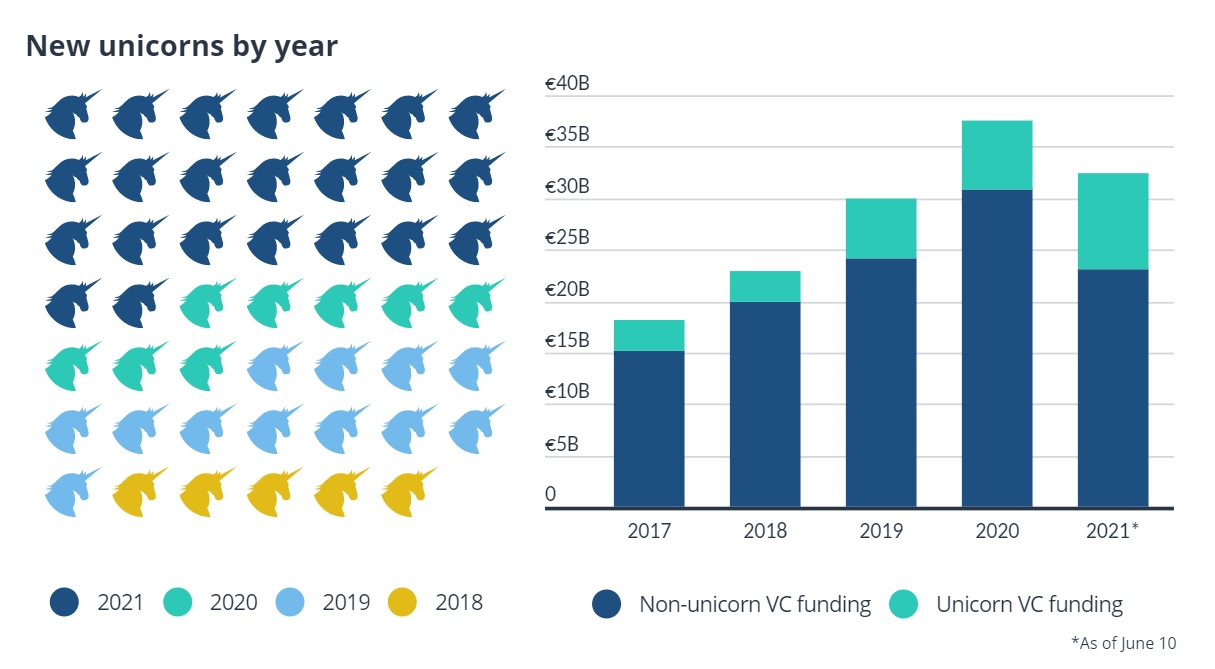
Twice as many European startups have achieved unicorn status in 2021 compared to last year. Despite the negative effects of the ongoing Covid crisis, young companies on the Old Continent, including several crypto unicorns, have managed to attract a record high amount of VC capital.

European Unicorns Collect €32.5 Billion in 2021

This year alone, 23 companies in Europe and Israel have become unicorns (startup companies valued at over $1 billion), beating last year’s total of eight, according to a report by financial data and software firm Pitchbook. European startups have managed to attract a staggering €32.5 billion (around $39.3 billion) since the beginning of 2021. This year’s capital inflow could easily surpass the €37.6 billion raised in the whole of 2020.

Of the total, 20 companies are based in Europe, including several crypto startups. The U.K. accounts for most of these unicorns, with London-headquartered Blockchain.com currently valued at $5.2 billion after securing $420 million in two funding rounds earlier this year.

Germany is next with digital wealth manager Scalable Capital, valued last week at $1.4 billion after raising over $180 million in a round led by Chinese tech giant Tencent. French crypto security startup Ledger became the latest to join the bunch with $380 million in new funding last week.

The Old Continent is now home to almost 12% of the world’s unicorns with over 50 active companies, the published data revealed. The capital attracted by these entities has continuously grown over the past five years and the 2021 total is expected to reach a record high.

The term unicorn, used to describe startups valued at over $1 billion, was coined by venture capitalist and angel investor Aileen Lee in 2013. It alludes to the rarity of such successful ventures.

US Capital Drives Up Startup Valuations Across Europe

European decacorns, or companies worth over $10 billion, have also performed quite well this year. Swedish fintech startup Klarna, for example, was valued at $31 billion in March, becoming the continent’s most valuable VC-backed firm. Klarna was leading the board already in September 2020, at $15 billion, but was replaced by Checkout.com in January of this year, when the online payments company gained a $15 billion valuation, Pitchbook detailed.

According to the authors of the report, the growing participation of U.S. investors has been a major factor in the investment increase in Europe. Almost half of the unicorns’ top 10 backers, such as Accel and Insight Partners, are based across the pond. Pitchbook also emphasized:

U.S. firms have been actively targeting Europe’s tech startups, which tend to have lower valuations than their U.S. counterparts, offering more opportunities for higher growth rates.

The financial data firm believes that the effects of robust investment into unicorns based in Europe could create even larger valuations in the future. “We expect transatlantic capital flows to continue to increase and strengthen valuations in Europe, as cash-rich U.S. investors seek new companies showing strong potential that could be introduced to the U.S. market,” said Nalin Patel, private capital analyst at Pitchbook.

What are your expectations about the future of these European unicorns? Let us know in the comments section below.

Go to Source

Docker Changes Free-Tier Service Policy Due to Cryptocurrency Mining Abuse

Docker, a popular cloud computing integration solution, is making changes to its free-tier service due to cryptocurrency mining abuse. The service discontinued its “autobuild” feature due to misuse by bad actors, using it to mine cryptocurrencies in their servers. This is a modus operandi that is now affecting several cloud continuous integration platforms, including GitHub, GitLab, and Microsoft Azure.

Docker Forced to Make Changes to Its Free-Tier Services

Docker, a popular CI cloud service, is making changes to its service policy due to crypto mining abuse. The cloud computer continuous integration service announced last week it will no longer provide its autobuild features to its free-tier service. Docker announced this in a blog post, stating the attacks have grown in recent months, affecting their paying customers. The team declared:

In April we saw the number of build hours spike 2X our usual load and by the end of the month we had already deactivated ~10,000 accounts due to mining abuse. The following week we had another ~2200 miners spin up.

Docker is an immensely popular piece of software that allows applications to run in compartments. This means that a package possesses all the libraries needed to run the app. This new restriction will affect some users that leveraged the autobuild feature for free. The Docker team stated that while this was not an easy decision to make, it was the only measure they could take to mitigate the abuse.

Although Docker is a notable platform affected by this new kind of attack, it is by no means the only one. Several continuous integration cloud base providers are now facing similar attacks, and are also studying countermeasures.

Cloud Computing in the Crosshairs

These attacks are also affecting companies like GitHub, GitLab, and Microsoft Azure, which offer cloud computing services. The attackers hijack the continuous integration services adding code to the apps that change their original function. The virtual machines spawned to compile apps are repurposed to mine cryptocurrencies for their lifespan, affecting the performance of these services.

But the problem goes beyond free tiers. An engineer from CodeShip, a cloud platform, stated in an interview given to The Record that:

Sometimes they pay the small fees for our accounts, which are way cheaper than renting on AWS directly, and mine cryptocurrency at maximum capacity.

While the problem persists, bigger companies can afford to cope with the added performance hit. Small companies, however, will likely be forced to fight these attacks with countermeasures such as the one Docker executed.

What do you think about Docker making changes to its policies due to mining abuses? Tell us in the comments section below.

Go to Source

Argentinian National Soccer Selection Launched Its Official Token

The Argentinian National Soccer Selection launched its official token last week, with a great reception. The token that would give fans involvement in the decisions regarding the soccer team, sold out quickly. The Argentinian National Soccer Selection is the first national team to launch its own fan token. Nonetheless, other European clubs already have their fan tokens.

The Argentinian National Soccer Selection Launched Its Official Token

The Argentinian National Soccer Selection, one of the most popular teams worldwide, launched its fan token last week. The token, launched in partnership with the platform Socios.com, will allow fans to have involvement in some decisions involving the team. According to a blog post from the AFA, the Argentinian Soccer Association, fans will:

“Have the possibility of taking part in surveys, discounts, exclusive promotions, and unique experiences, which will only be intended for those who own these digital currencies.”

The launch was a success, selling out in less than three hours according to official reports. Although the sale completed successfully, reports note the platform faced some hiccups and was inaccessible for some time. However, more than 600K tokens, giving the selection an income of more than a million dollars.

Argentina’s home stadium is Estadio Monumental Antonio Vespucio Liberti in Buenos Aires. The La Selección (national team) made it to approximately five World Cup finals during the team’s lifetime.

The sale happened in two phases: 400K tokens were sold at two dollars each, and then the price was set according to supply and demand. Each user could buy only 250 tokens. The Argentinian team is the first national selection to launch its own fan token. The president of the AFA, Claudio Tapia, stated:

Through official Tokens, fans will feel closer to our selection and will be able to participate in exclusive prizes and experiences. We are very excited about this new announcement, which reinforces the confidence of large companies in AFA’s commercial projects.

Fan Monetizing Trend

Argentina joins other teams such as Atletico de Madrid, Barcelona FC, Juventus, and AC Milan in launching its own token. Socios.com is a pioneer in monetizing fan interest, allowing them to speculate with the price of these tokens. The service provides a launchpad that allows teams and brands to monetize their engagement through its Ethereum based platform.

More than 26 sports teams already established partnerships with Socios to launch their own tokens. Last month, UFC also announced they would use the platform to emit their token, bringing their huge engagement to the brand. Socios.com is expecting more teams to join their platform, as fans are looking for more interactive experiences involving their favorite teams.

What do you think about the Argentinian National Soccer Selection launching its own token? Tell us in the comments section below.

Go to Source

Introducing HUMAN Protocol: A New Way for Humans and Machines to Securely Connect and Collaborate

HUMAN Protocol is an infrastructure to reshape how humans work, by supporting distributed job markets in which any job, of any size or type, can be securely tokenized, published, and completed. The Protocol facilitates direct, globally mapped connections that bring workers closer to the rewards of their work, organizations to workforces, and machines to understanding.

HUMAN Protocol also provides the tools for better human-to-machine collaboration; within the job markets it supports, AIs can handle repetitive tasks while humans focus on specialized or creatively challenging tasks.

HUMAN’s vision is to create a more human world: disintermediated yet connected, with every viewpoint and background accounted for and represented, in which all value produced is rewarded.

Distributed Job Markets

To improve a digital world, you must address its foundations: the mechanisms and systems through which people connect, interact, and collaborate. HUMAN enables distributed job markets, but it is not the job market itself. Rather, it provides the tools, infrastructure, plugins, and APIs to support broad-scale data markets – which, in time, will become markets to support any type of work. It connects distributed workers with global opportunities to empower an already flourishing gig economy, to ensure it is workers, not corporates, that have control over the opportunities available to them, and receive more value from their contributions.

New technologies require new data. Data informs the capability of machines to accurately interpret the world. A company producing a smart car may require data to be labeled by up to 40,000 people; as the size of the data sample increases, so does the accuracy. Currently, it is difficult to hire such a workforce. Organizations are forced to rely on traditional data vendors, which provide untargeted, less relevant datasets that are susceptible to greater bias.

If organizations can select who labels data, they can better assure the relevancy of the dataset produced. HUMAN Protocol provides the end-to-end infrastructure – the tools, plugins, integrations, and API – to hire, manage, validate, and compensate workers at scale. The job markets it supports are secure and automatic; various Protocol systems handle the publishing and distribution of work tasks, the validation of completed tasks, and the release of funds. The Protocol provisions trust between distributed parties, ensuring organizations can more reliably access global workforces, and that workers, based anywhere, can access global opportunities.

How HUMAN Protocol Works

HUMAN Protocol is designed to distribute tasks across the globe in pursuit of more balanced and accurate information. For example, it can look for variation in responses to arrive at a consensus of what’s true: an amalgamation of thousands or millions of perspectives. The network enables automatic objective measurements of all work done. This includes a network of Validators and a two-part oracle system, which securely verifies the successful completion of tasks and the information provided to the network.

Three key entities within HUMAN Protocol are Requesters, Workers, and Exchanges. Every application to run on or integrate HUMAN Protocol functions as an exchange: a matchmaker between jobs published by a Requester, and tasks completed by Workers.

  • A job is a request for work – represented as a group of tasks to be done – published by the Requester. There are many standard job types represented within HUMAN Protocol. Alternatively, the Requester can select a custom job type.
  • A task is any labor performed by a user – a Worker – in which value is produced. Each task represents an individual work interaction: the labeling of data, the identification of correct information, the solving of a puzzle. A single job can be made up of thousands or millions of tasks. An organization may want to develop a dataset targeted at a specific topic, achieved through the completion of thousands or millions of tasks by a distributed workforce.
  • Jobs are broken down into their composite tasks, each of which can be independently completed by a Worker. An example of a job type may be to scan a page. An example of a task within that job type may be to type in the displayed letters or numbers, or affirm their correctness.
  • For many types of jobs – such as the labeling of data – the result is improved through the diversity of the workforce completing it. Global diversity in human-to-machine interactions is critical to empowering a new generation of AI and ML technologies.
  • Every completed task is a handshake, signifying work requested, work completed, and transactions made.

HMT is the native token of HUMAN Protocol. It is the primary mechanism of value transfer within the network. Those wishing to have a million images labeled must fund the smart contract with HMT; the websites and Workers on the other end, who complete the work, are paid in HMT. Network service operators are also compensated in HMT. There is a fixed supply of the HMT token.

To learn more about HUMAN Protocol’s architecture, visit the HUMAN technology page – or, for a breakdown of how jobs are securely published, validated, and fulfilled, read the blog piece on the lifecycle of a HUMAN job.

A Home for the World’s Largest Workforce

The first application to run on HUMAN Protocol is hCaptcha: a widely adopted, privacy-protecting alternative to traditional CAPTCHA systems. hCaptcha is interacted with by 15% of internet users, representing the world’s largest data-labeling workforce. This is only the beginning, however. HUMAN and its partners are working to bring the Protocol to more applications, each functioning as an Exchange between Requesters and Workers, to realize new distributed markets and ways of working, and increase the points of human-to-machine interaction.

HUMAN Protocol already produces a large volume of work interactions; to not overload any single blockchain, thousands to millions of tasks are batched into each transaction. Interoperability is key to HUMAN Protocol’s scalability, and to supporting the growth of the distributed markets that it enables. As more applications integrate with HUMAN Protocol, creating and incentivizing two-sided markets, the number of transactions and tasks rewarded will require further cross-chain distribution. To support this, and as part of the Foundation’s goal to gradually decentralize the Protocol, HUMAN has partnered with Solana, Polkadot, and Chainlink, with further partnerships planned.

What’s Ahead

HUMAN Protocol’s purpose is to grow and support distributed markets. This can propel a new generation of AI and ML technologies and gig economies, and is supported by the applications that currently run on it. Now, alongside the HUMAN community, developers, and enterprises, HUMAN enables everyone to explore the possibilities the Protocol provides, realizing the secure and transparent tokenization of more types of labor across more applications.

To learn more about available integrations and APIs, visit the developer page.

For more information on HUMAN Protocol, visit the website or blog. Alternatively, follow the team on Twitter or join the community Telegram channel to receive the latest updates.


This is a sponsored post. Learn how to reach our audience here. Read disclaimer below.

Go to Source

RUNE Shoots by 7.94% in 24 Hours to $9.84 – How to Buy RUNE

It may be the right time to start looking towards altcoins that will diversify your portfolio because of the volatile nature of the crypto market. One of the coins that need to remain at the top of your list is ThorChain RUNE. The coin’s performance in the last 24 hours remains impressive. At the time of writing, RUNE was trading at $9.58.

RUNE Price Analysis

It is still unclear whether RUNE will move towards the upper level or the lower level. If the token pulls back to the nearest lower support level of $6.50, it will create an attractive entry point for traders who want to leverage the dip.

However, RUNE may still progress to a bullish trend, creating the next upper resistance level at $10. Traders who follow market trends need to wait for the token’s value to push past a higher high resistance of $15, which will show the resumption of an upward price movement.

Source: TradingView

The chart above shows that RUNE is still in a bearish market. The MACD signal is still on a low, while the RSI is below 45. However, market momentum shows that the coin may be moving towards an upward price movement. The data also shows that the coin has not been oversold and hence an upward price movement is possible.

Buy Crypto Now

The volume levels also show that demand for the token is declining, and it is now below supply. The metric is also a signal that shows RUNE is still on the verge of another bear market.

ThorChain is a decentralized network that allows token trading across different chains. It does not derive its value from pegging or wrapping around other assets but allows trade across Layer 1 blockchains. Traders can shift from one token to the other without going through a centralized exchange.

The interoperability of the blockchains opens an ideal platform for DeFi developers and the entire ecosystem. The popularity of the ThorChain ecosystem increased after it was considered by Multicoin Capital when the firm said that RUNE addresses were their largest position.

Where to Buy RUNE

eToro

If you want to purchase RUNE tokens, you need to create an account on a cryptocurrency exchange platform. One of the most popular exchanges that support ThorChain is eToro. eToro offers competitive trading fees and a big list of crypto trading pairs that will allow you to exchange the token for others you may want to add to your crypto holdings.

Coinbase

Coinbase is also a leading crypto exchange that supports RUNE. Coinbase offers a secure trading platform and it also makes it easy to buy and sell cryptocurrencies because of its user-friendly features.

Looking to buy or trade Crypto now? Invest at eToro!

Buy Crypto Now

75% of retail investor accounts lose money when trading CFDs with this provider

Go to Source

The Global Decentralized Finance Bunker

The Global Decentralized Finance Bunker
Solanax is a new DeFi protocol built on top of the Solana network that will catapult Decentralized Finances to unprecedented performance levels. As a decentralized and non-custodial automated pool-based liquidity mechanism supporting trades within the Solana ecosystem, Solanax is looking to revolutionize DeFi. The Ethereum main-net proof-of-work (PoW) consensus design flaws are no longer news, as they have stifled Ethereum’s growth for a long time. For example, Ethereum’s 15 transactions per second are far too sluggish, resulting in record-high transaction fees.

Its trustless token swaps, trading, and more significantly reorientation of the crypto world towards Solana. Solanax is destined to become a vital asset exchange community platform.

SOLANAX will remove all intermediaries, complexity, and time-consuming procedures from the equation, giving users the freedom to trade without fear of censorship or losing ownership of their assets.

In summary, Solanax has the following features:

  • Users have complete control
  • Next-level liquidity
  • Friction-less yield
  • Light-speed swaps
  • DeFi is faster, cheaper, and more powerful.

The project’s goals
Companies are always on the lookout for open source liquidity and Defi protocols that offer competitive interest rates. It is an element of their fund strategy for their clients.

Solanax strives to be the most widely used open-source liquidity and defi protocol for fund businesses, as well as a reliable and secure Ethereum-Solana and even more than three-way bridge. When new projects of this nature are announced, people are always delighted.

  • Utilize a blockchain to bring DeFi even closer to people, hence allowing it to scale even better.
  • Make financial tools more accessible to the general public.
  • Make it faster to cut cost on gas fee, hence cheaper
  • Build an interface that allows people to create a comfortable trading environment (limit orders; alerts; and more).
  • A central order book provides liquidity access across the ecosystem, so individuals are not reliant on a single source of liquidity.

Incentives for early adopters
The first beneficiary of the project is early adopters, who will be rewarded with platform incentives, with 40% of their total token supply allotted to them. The platform does not charge any fees. Stakeholders of the $SOLD Token will get all swap trading fees (0.2 percent from the maker and 0.3 percent from the taker). So, as expected, a large community popped up around Solanax on Sunday as soon as private sales were revealed!

Why Solana?
Solana blockchain has increasingly become the blockchain of choice for newly launched projects. As such, the company has re-evaluated its strategies and now expanding its capacity to accommodate the rising demand for faster blockchain services. The blockchain aims to be the go-to network for decentralised applications, that’s according to sources at Solana. Over time, it’s looking to effectively compete or even surpass the market leader, Ethereum.

Solana blockchain uses a new method of verifying transactions, proof of history (PoH), to solve the scalability and speed issues that have been problematic to its predecessors, Bitcoin and Ethereum. Scalability is one of the most challenging aspects of blockchain technology to overcome. As these networks expand, they frequently encounter transaction speed and confirmation time constraints, which consequently leads to a high cost of transactions. Through PoH, Solana can handle thousands of transactions per second, with significantly cheaper transaction fees. Solana attempts to achieve these by maintaining security and decentralization.

The Significance of Solana to DeFi Projects
DeFi technologies are meant to increase financial access to the increasingly capitalistic society. These technologies will continue to improve the lives of many people on the other side of the world who previously lacked access to financial instruments that would have allowed them to compete in a capitalistic world. Investing in a future where everyone is more equal is a no-brainer.

We believe that Solana will be a significant player in the crypto space. A vast percentage of people are still unaware of the Solana blockchain. On the other hand, the team behind Solana is discreetly warping the crypto environment with new financial possibilities. Solana has piqued our interest, and we’ve collected a group of crypto professionals from around the world to collaborate on the Solanax Project. The Bunker of Global Decentralized Finance.

SOLDonomics

Total Supply: 80 000 000 SOLD Tokens
Private Sale: Total available supply – 10,000,000 SOLD
Period: 06/06/2021 – 25/06/2021
Token price – 0.1 USD with 3months vesting period;
Token price – 0.15 USD w/o vesting period;
Initial Exchange Offering: Total available supply – 10,000,000 SOLD

Round 1: 28/06/2021 – 05/07/2021 | 0.20 USD | Available supply: 5,000,000 SOLD
Round 2: 08/07/2021 – 13/07/2021 | 0.25 USD | Available supply: 3,000,000 SOLD
Round 3: 16/07/2021 – 19/07/2021 | 0.30 USD | Available supply: 2,000,000 SOLD

Check out our website and Twitter for more information about the upcoming release, Airdrop, IEO, and Private Sale.
Users can participate in this Private Sale by emailing the team at sales@solanax.org

https://solanax.org/
https://twitter.com/Solanaxorg
White paper: https://solanax.org/whitepaper.pdf

Go to Source

Bitcoin price bottom is in, says Fidelity exec as crypto market exits ‘extreme fear’

Macro comparisons suggest that there’s no more room for dips on BTC/USD, suggests Jurrien Timmer.

Bitcoin (BTC) has already hit its price bottom, one of the industry’s top executives believes as BTC price action stays above $40,000.

In a tweet on June 14, Jurrien Timmer, director of global macro at U.S. multinational financial services corporation Fidelity Investments, called time on any further Bitcoin price dips.

Bitcoin bulls increase confidence

BTC/USD maintained higher levels overnight on Monday after surging through $40,000 resistance. Despite not yet fulfilling traders’ predictions of a $47,000 push, the mood has become broadly positive on the back of fresh high-profile praise from the likes of Elon Musk and Paul Tudor Jones.

For Timmer, the time has come to look higher, not lower, when it comes to charting Bitcoin’s next move.

“In my view, it looks like the bottom is in,” he summarized.

Timmer uploaded a chart comparing BTC/USD with the GS Retail favorites basket, a relationship which highlights similar local bottom formations.

GS Retail favorites basket vs. BTC/USD chart. Source: Jurrien Timmer/ Twitter

Fidelity has increased its Bitcoin activities in recent times, releasing a dedicated analytics platform and even applying to launch an exchange-traded fund (ETF). U.S. regulators began scrutinizing the application in late May.

Fear & Greed ditches the emotion

Meanwhile, another aspect of cryptocurrency which is back near 40 is the Crypto Fear & Greed Index — a classic sentiment gauge adding to the bullish mood.

Related: A Bitcoin indicator with a ‘perfect’ history just told you to buy the dip

After hitting its lowest in more than a year in recent week, Fear & Greed has rebounded to 38/100 — approaching neutral territory.

The Index uses a basket of sentiment measures to determine whether traders are overly bullish or bearish at a certain price, and therefore whether tokens are oversold or conversely due for a sell-off.

Crypto Fear & Greed Index as of June 15. Source: Alternative.me

Go to Source

Bitcoin investors more bullish than ever despite 50% price crash: survey

A survey reveals investors are still bullish on Bitcoin and other cryptocurrencies despite the recent market drop.

Despite Bitcoin (BTC) and the wider cryptocurrency market experiencing one of its worst crashes in recent memory, investors are apparently more bullish than ever regarding the future fortunes of Bitcoin and a host of altcoins.

That’s according to the results of a Q2 retail investment survey conducted by crypto firm Voyager Digital, which polled 3,671 high-frequency traders on the Voyager platform.

The survey’s findings revealed that 81% of respondents are more confident in the future of cryptocurrency, even after the violent price crash in April and May, which saw Bitcoin and others lose more than 50% of their value.

Many coins have since recovered significantly, although the market still remains uncertain. Despite this, 87% of the survey’s respondents said they planned to increase their crypto holdings over the next quarter — an increase on the 80% who said the same in Q1.

Some 39% of respondents said they expected the Bitcoin price to fall between $56,000 and $70,000 by the end of Q3 2021, while 28% predicted a Bitcoin price between $41,000 and $55,000. The percentage of respondents who believed Bitcoin would reach a price of $71,000 stood at 18%, down from the previous survey’s figure of 20%.

Notably, more than nine out of 10 of those polled said they thought the United States Securities and Exchange Commission would eventually approve a Bitcoin ETF — an exchange-traded fund that crypto proponents believe will boost the value of Bitcoin through exposing it to institutional investment.

Among the altcoins that respondents said they were most bullish on, Cardano (ADA) turned out to be the most popular. Some 55% said they were bullish on Cardano above any other altcoin, with Dogecoin (DOGE) coming in second (11%), followed by Chainlink (LINK) (6%) and Polkadot (DOT) (6%).

Voyager Digital CEO Steve Ehrlich said it was encouraging to see continued faith in the cryptocurrency market despite the recent crash. Ehrlich suggested the results of the survey indicate that most investors view the recent market dip as a buying opportunity, rather than a portent of worse to come.

“The fact that the vast majority of our large sample size of investors are more confident in the future of cryptocurrency, shows how people see May’s volatility in many crypto-assets as a buying opportunity,” said Ehrlich.

“Our findings show that 87% of investors are looking to increase their crypto holdings in the next quarter, a much higher percentage compared to the last survey we conducted in April,” he added.

Go to Source

Elon Musk the hero crypto deserves, but maybe not the one it wants, says exec

The furore created by Musk’s erratic tweets could leave investors out of pocket, but could also bring new eyes to crypto in the long run.

Elon Musk’s ability to move cryptocurrency markets with his tweets represents a danger to the average investor, says CoinSwap founder Erik Nurm, but the furore created around the Tesla CEO’s social media activity could draw more eyes to crypto in the long run.

Nurm pointed out that Musk’s tendency to tweet about Bitcoin (BTC), Dogecoin (DOGE) and other cryptocurrencies began shortly after the Tesla chief was banned from tweeting about his own company by the Securities and Exchange Commission.

“Elon has been manipulating the market by creating FUD around Bitcoin. He is playing the same game he did with the stock market,” said Nurm.

“After he was banned by the SEC from tweeting about Tesla, he has shifted focus to the crypto market, where he can run free on social media for now,” he added.

The CoinSwap founder sees turmoil in the markets at present, largely thanks to the ever-changing temperament of Elon Musk, which appears to run hot and cold. Earlier in the year Musk announced Tesla would accept Bitcoin as a payment option for its electric cars, only to reverse his decision weeks later.

More recently, Musk reversed his decision once again, announcing that Tesla would accept Bitcoin as a payment option once 50% of its mining was carried out with clean energy usage.

Related: Elon Musk lays out when Tesla will begin accepting Bitcoin payments

But Musk’s erratic nature when interacting with the crypto world could ultimately attract more people to it in the long run, even if for the wrong reasons, says Nurm.

“Even though Musk is temporarily causing turmoil in the market, his involvement could be beneficial for crypto in the long-term as he is attracting new people to crypto, albeit for sometimes the wrong reasons,” he said.

Nurm referenced Musk’s newest cryptocurrency plaything: CumRocket (CUMMIES), a token supposedly created for use in the adult film industry which quadrupled in price in the space of 10 minutes when Musk began tweeting about it.

“His efforts to drive up the price of certain coins, like Dogecoin and more recently CumRocket, are potentially more dangerous as these apparent pump-and-dump schemes could leave many ordinary people out of pocket.”

Related: Primal arrogance and greed: Elon Musk slammed for crypto manipulation

A pinch of sodium chloride is needed when interpreting Musk’s tweets, says Nurm, who added that the multi-billionaire CEO may have ulterior motives when he gives the thumbs up or thumbs down on a given coin.

“I hope people take all of Musk’s crypto tweets and other comments with a pinch of salt — and they must remember he has ulterior motives,” Nurm ended.

Go to Source

This unknown cryptocurrency soared by 164,842% in hours, only to crash 99%

One random cryptocurrency’s market valuation jumped by billions of dollars in just three hours, reaching the 17th spot on the top crypto index.

About $7.65 billion entered the cryptocurrency market in just three hours via a widely unknown altcoin on June 14.

Dubbed as WebDollar (WEBD), the token’s per-unit price surged from $0.0003711 to $0.6121 between 0900 GMT and 1200 GMT. That marked a little over 164,842% gains in its market valuation. Nevertheless, the price spike accompanied declines in volumes; they dropped from around $345.2K to $318.94K during the rally.

Breaking down those three hours of wild price action illustrated a sequence of incredible pumps and dumps.

According to data fetched by CoinMarketCap.com, the first WEBD jump took its market capitalization from $1.84M at 0954 GMT to $1.5B at 0959 GMT — that’s just three minutes.

Later, as of 1039 GMT, the market capitalization fell back to $5.12M, followed by another spike to $9.5B at 1129 GMT.

At one point in time, WebDollar had become the 18th largest cryptocurrency project by market cap, beating more established blockchain protocols like Stellar, VeChain and Tron.

WebDollar’s market cap explodes by more than $7.65B within a few hours, only to crash by 99% later. Source: CoinMarketCap.com

But then, the volatile madness came to an end as the token’s market valuation crashed by more than 99% less than two hours after topping at $9.5B. As of 0700 GMT on Tuesday, it was $10.38M. Meanwhile, WebDollar’s crypto ranking fell from 18 to 873.

The IndoEx factor

WebDollar’s price action on Monday showed characteristics of a pump-and-dump token. Apprehensively, the project’s market capitalization sprinted upward and downward by multi-billion dollars even as its trading volume remained confined within the $400K range. And looking closely, 99.23% of its trading activity originated from a single exchange called IndoEx.

Most of the WEBD volumes during the token’s pump-and-dump were recorded at IndoEx cryptocurrency exchange. Source: CoinMarketCap.com 

IndoEx LTD is registered in the United Kingdom under company number 12029621. The exchange is said to be headed by a person named Collins Spencer, who serves as its chief executive and financial officer. Another entity, called Grace North, currently serves as IndoEx’s chief technology officer.

Cointelegraph’s attempt to locate the two executives on LinkedIn and Twitter returned no results. Meanwhile, a run through IndoEx’s reviews by its previous customers showed them accusing both Spencer and North of bearing fake identities.

“Spencer Collins (CEO/CFO), Grace North (CTO) is fake person, work as support in telegram chat,” wrote Leo99 in his grievance on Bitcoin forum BitcoinTalk.org. “Continually postpone solving all problems for the future or ignore messages.”

A deeper look into IndoEx LTD’s official filings with the UK Registrar office showed that it received a First Gazette Notice in November 2020 for not sharing details about its shareholders. The company responded to the authority with only one name, Collins Spencer, who holds 1200 shares, hinting that IndoEx is an individually-owned company.

The U.K. Registrar later struck off the notice against IndoEx LTD. Nonetheless, the exchange continues to operate without approval from the UK Financial Conduct Authority (FCA). 

FCA directory returned no results matching IndoEx LTD

The research led to three key takeaways:

  • The WEBD price pump-and-dump originated from one exchange called IndoEx, operating under a UK-registered entity IndoEx LTD.
  • Collin Spencer, the only stakeholder in the company, does not exist anywhere on social media.
  • IndoEx’s Linkedin Profile boasts about having 10-50 employees, but only three of them are using the business-oriented social media service. All of them have hidden Linkedin profiles and are from Indonesia, not the UK.

Evidence so far points that IndoEx was instrumental in single-handedly pumping and dumping the WEBD token on Monday. The token was trading flat during the Tuesday session of June 15.

Go to Source

Please enter CoinGecko Free Api Key to get this plugin works.
Exit mobile version