Nifty News: Olympic NFT pins and games, world’s first intelligent NFT and more

Sotheby’s has revealed the world’s first “intelligent” NFT, Playboy is auctioning off a tokenized boarding pass to the “bunny jet”, and Olympic-themed NFT collectibles are dropping this month.

Playboy, the lifestyle and entertainment brand famous for its distinctive logo — among other things, has launched its first collection of five animated NFTs, on a new NFT market placed dubbed “Raretoshi” which is backed by Blockstream’s Liquid sidechain.

The NFTs were unveiled during the lead up to the 2021 Bitcoin Miami conference on June 3:

All of the NFTs are one-of-one editions, and include three Miami-themed animations, an animated magazine cover with the bunny logo covering a model, and a tokenized “bunny boarding pass.”

Playboy NFTs. Source: Raretoshi

Collectors can bid for the NFTs using Liquid Bitcoin (L-BTC)   — a type of asset on Blockstream’s Liquid sidechain, with a supply that is pegged 1:1 with Bitcoin.

The highest starting price is 5 L-BTC worth roughly $188,315 for the “bunny boarding pass” — which includes a bonus of a round-trip flight on the Big Bunny jet, anywhere in the U.S., for the collector and 10 other guests.

Bidding activity, however, appears to be non-existent so far, with no bids placed on any of the five artworks at the time of writing.

Olympic standard NFTs

The International Olympic Committee (IOC) and nWay — a subsidiary of game developer Animoca Brands — have collaborated to drop a set of Olympic-themed tokenized NFT pins and a video game.

The Olympic themed video game will launch in the lead up to the 2022 Beijing Olympic Winter Games and players will be able to earn free Olympic NFT collectibles if they’re any good.

The animated 3D pins commemorate historic events from the history of the Olympics — and vary in rarity and value. The first set of pins will be available on nWay from June 17, and can be traded on a peer-to-peer marketplace to be launched shortly after the first drop.

Intelligent NFTs

Sotherby’s art auction house claims its auctioning off the first ever intelligent NFT (iNFT), with bids closing June 11.

The one-of-one iNFT dubbed “Alice” depicts an ERC-721 tokenized female Robot, developed by Robert Alice in collaboration with robotics firm Alethea AI.

“The first iNFT ever made, this iNFT stands at the genesis of a new medium. The collector will add to their collection this historic iNFT which will refine and develop based on their questions,” says the description of Alice on the project’s website “thefirstinft.” 

According to the website, it may actually cost the collector to maintain and update the iNFT with the project noting that “depending on collectors’ plans for the iNFT, the associated hosting costs of the API calls to Alethea AI’s GPT-X will pass in full into the care and duty of the collector.”

Alethea AI does however offer a one-time free of charge set up for the intelligent NFT. The auction has six days to go and currently has a top bid of $35,000.

NFTs to raise funds for the Sydney Children’s hospital

A Melbourne-based digital artist who goes under the alias “Hipworth” on Twitter has created a one-of-one NFT which will be auctioned off at the Gold Dinner Gala on June 10 — with all the proceeds going to the Sydney Children’s hospital.

The NFT has been minted on NFT marketplace Makersplace, and depicts a silver animated queen statue backed by electronic music. Bids can be placed leading up to the event, and currently has a high bid of $1,000.

Go to Source

Oh baby! Tracking IVF progress on the blockchain

VeChain has partnered with top Shanghai-based Renji Hospital to launch MyBaby, a blockchain-based service that tracks IVF progress.

Enterprise blockchain VeChain, in partnership with Shanghai’s Renji Hospital, has announced the launch of a smart medical care project dubbed “MyBaby” — a blockchain-based In-Vitro fertilization (IVF) service application.

The project also includes collaboration with Vechain partner DNV — with the latter working with VeChain to provide supply chain governance along with product and digital assurance for the project.

Vechain, a supply-chain management and smart contract platform said in a post that MyBaby is the “first service” to combine third-party IVF data with blockchain technology:

“The cryptographically secured properties of blockchain technology create a secure and reliable environment and enhance the user experience in a way that is unprecedented in the IVF field.”

The MyBaby project aims to improve the IVF process by enabling families to transparently see all of the data associated with the development of eggs into embryos traced on blockchain.  VeChain believes the MyBaby app has the ability to ease anxiety, depression and stress associated with the IVF cycle.

As part of the MyBaby service, all information and data trails from the IVF process, including “imagery produced by medical tools to the delivery of the zygote itself” will be uploaded on the VeChainThor blockchain — with the information only accessible to authorized users of the MyBaby Application.

“MyBaby’s benefits are multifaceted, allowing users to view and track the extraction, labeling, and scoring of fertilized eggs as well as the cultivation and preservation of embryos,” the medium post read.

The project claims to provide additional security for sensitive and private medical data, by reducing the number of “intermediaries between production and delivery of data.”

This isn’t the first time Renji Hospital has moved to incorporate blockchain tech, back in 2019 it partnered with VeChain and DNV to launch the “world’s first” blockchain-based “Intelligent Tumor Treatment Center.”

Go to Source

It’s Mati Greenspan versus the Maxis at ‘Shitshow’ 2021

Bitcoin maxis went to town on Greenspan after he called it a ‘crypto conference’.

The Miami Bitcoin 2021 conference officially kicks off on June 4 and with it has resurfaced controversy over crypto tribalism involving some of the industry’s leading figures.

Organizers expect attendance exceeding 50,000 for the Mana Wynwood Convention Center hosted conference. Among the attendees in Miami this year is the founder of Quantum Economics and a former Senior Market Analyst at eToro Mati Greenspan.

Writing today, Greenspan highlighted a growing rift in the crypto community in what he described as a ‘toxic problem’. The financial advisor had inadvertently ignited a social media storm with the innocuous comment that Bitcoin 2021 would be “Biggest crypto conference ever!”

Greenspan was told in no uncertain terms that it was a “Bitcoin conference” intended only for BTC enthusiasts. Bitcoin Magazine editor Pete Rizzo set him straight:

“It’s a Bitcoin conference, about Bitcoin. Bitcoin is the subject and hence why it’s used as an adjective,”

Greenspan replied that “Bitcoin is a cryptocurrency sir”, however, it only served to fuel the tirade from Bitcoin maximalists claiming exclusivity on the event.

The Miami Bitcoin 2021 conference will run until June 5 and play host to a vast pool of industry luminaries ranging from former congressman Ron Paul, Twitter’s Jack Dorsey, the Winklevoss twins, and Morgan Creek Digital partner Anthony Pompliano. To be fair to the organizers they have been crystal clear that it’s a Bitcoin Only Event/No Altcoins Allowed in the Telegram channel:

“This is a Bitcoin only conference. Please stay focused and on topic at the event. Save conversations about other protocols and cryptocurrencies for outside the conference.”

A clearly disappointed Greenspan retorted that there was clearly a lot of insecurity among the Bitcoin crowd, and eventually tired of the debate exclaiming: “This really is a shitshow.”

In his newsletter today he clarified his thoughts on the topic:

“Now, obviously everyone is entitled to their own opinion, and they can call me whatever names they like, but the one thing I want to say about all this is that these so-called Maxis don’t own the Bitcoin network. I am a Bitcoiner too, and there is nothing anyone can do about it.”

Greenspan said that “zealotry” was unproductive and urged the community to “focus our energy toward a common enemy and not spend our time and efforts on infighting. It doesn’t help.”

The Bitcoin-only vibe extended beyond Greenspan with some questioning why Ethereum co-founder Vitalik Buterin had made an appearance after various photos of him surfaced including one with Miami’s pro-crypto Mayor Francis Suarez. Buterin actually unveiled Ethereum at the Bitcoin Miami 2014 event.

DeFiPulse co-founder Scott Lewis saw the funny side of things:

Go to Source

DeepDAO secures $3M for expansion even as DAO treasuries halve in one month

Data analytics website, DeepDAO, has secured $3 million from notable investors to expand its data suite for tracking decentralized autonomous organizations.

DeepDAO, a website aggregating data on decentralized autonomous organizations (DAOs), has raised $3 million for future expansion in a round led by venture capital firms Hypersphere and DFG.

An announcement asserts the “overwhelming demand for DeepDAO’s seed round shows strong interest in data products for the DAO space and the belief the DAO ecosystem will grow.”

DeepDAO v1 currently provides data for more than 100 DAOs, aggregating data on organizations’ treasuries, membership, and governance.

According to the site, DAOs currently represent more than 66,000 members and $587 million in assets under management (AUM) — although the AUM has fallen 46% from more than $1 billion in the past month amid the recent crypto market downtrend. DAO treasuries are still up more than 300% since early November however.

Speaking to Cointelegraph, DeepDAO founder and CEO, Eyal Eithcowich, predicts the total AUM of DAOs will exceed $10 billion in AUM and represent more than one million users by the end of 2021. 

Founding advisor to DeepDAO and Bitfwd Capital chairman, Daniel Bar stated the team plans to expand data coverage, integrate DAOs from additional networks, and launch new governance tools using the funds. Bar also noted the platform will offer an enhanced user experience, including social feeds and forums, stating:

“The decentralized governance space is developing at a breakneck speed, DeepDAO is serving […] the DAO space by providing a one stop shop where governance can be tracked.”

“We’re committed to listing all these governance systems across multiple chains and platforms, explore and analyze them as one large ecosystem, and provide social features and services to enable a transparent and active community,” added Eithcowich.

Despite the rapid growth of DAOs over the past year, Bar notes a number of challenges facing the nascent sector, including identity, standardization, and a steep learning curve.

“Most people still think of DAOs as a nebulous concept, the ‘Aha moment’ that DAOs are Web3’s social network didn’t click to most people yet. But it’s getting closer,” Bar said.

Hypersphere partner, Jack Platts, described the DeepDAO platform as making decentralized governance “easily accessible to everyone,” stating:

“Decentralized protocols are governed by their users, but to unlock the transparency and inclusivity we need high quality tools.”

Go to Source

Blockchain.com says ‘Goodbye Big Apple, Hello Miami!’

Miami Mayor says he wants “a Miami that lasts forever” as he announces Blockchain.com’s move to Miami.

Major crypto solutions provider Blockchain.com is moving its U.S. headquarters from New York to  Miami in an attempt to spur aggressive growth over the next few years.

The $5 billion firm intends to hire 300 new full-time employees in the region over the next 18 months. The news broke a day before the city played host to the world’s largest Bitcoin conference, Bitcoin 2021.

Miami Mayor Francis Suarez made the announcement at City Hall with Blockchain.com CEO Peter Smith. He explained that not only will the move boost local employment but it will also be an investment in the local science, technology, engineering, and maths (STEM) community via educational programming. Suaraz said:

“Blockchain.com’s arrival in Miami perfectly encapsulates what the Miami Movement is all about — leveraging Miami’s talent against the world’s top companies in order to build towards our goal of becoming a Miami that lasts forever and a Miami that works for everyone.”

Blockchain.com cited a key driver of the move was “the city’s welcoming regulatory environment serving as a hotbed of crypto innovation.” The firm’s global headquarters will still be based in Londonn, however, Miami will stand as its U.S. HQ.  Blockchain.com also has offices in San Francisco which will remain.

Blockchain.com, with a $5 billion post-money valuation, is arguably the biggest blockchain-related scalp claimed by Miami since Mayor Suarez began his intense crypto push. The company services 32 million users across 200 countries.

Over the last year, Suarez has made it clear that he wants to landmark Miami as the country’s crypto center. Crypto finance firm XBTO Group purchased a new Miami office in April, Scott Minerd from global investment firm Guggenheim Partners and Peter Thiel associate Keith Rabois have also bought property here. FTX crypto exchange secured a 19-year deal for naming rights to the Miami Heat arena, and Borderless Capital announced a $25 million fund for Miami-based crypto businesses on June 2.

Suarez has also held meetings with the Winklevoss twins, Elon Musk, Twitter CEO Jack Dorsey, and Google CEO Eric Schmidt in an effort to convince them of Miami’s benefits.

Suarez has demonstrated a personal conviction as well, publicly revealing that he owns Bitcoin and Ethereum, and is planning on “buying the dip”.

Go to Source

UK FCA buys another 9 months to review crypto companies’ registrations

The Temporary Registrations Regime’s end date for crypto companies has been pushed to March 2022.

The United Kingdom’s Financial Conduct Authority (FCA) has extended the end date of crypto-asset companies’ temporary registration from July 2021 to March 2022.

The Temporary Registrations Regime, or TRR, was established last year to enable crypto businesses to continue trading while their registrations were still being assessed by the FCA. With the latest announcement, any crypto companies that applied before Dec. 16, 2020 have temporary registration until March 31, 2022.

After becoming the supervisor of Anti-Money Laundering and Counter-Terrorist Financing measures for crypto companies in the United Kingdom, the FCA obliged all crypto-asset businesses to comply with the country’s AML regulations. The initial deadline for the registration was Jan. 10, 2021.

But since the COVID-19 pandemic made site visits difficult, along with the “the complexity and standard of the applications received,” the FCA announced the TRR and issued temporary registrations to all businesses that submitted an application before Dec. 16. The initial period of the TRR was set to end on July 9.

The temporary registration is limited to businesses that were active prior to Jan. 10, 2020. New companies require full registration.

According to the announcement, an “unprecedented number of businesses” withdrew their applications due to their substandard operations regarding their money laundering regulations. “The extended date allows cryptoasset firms to continue to carry on business while the FCA continues with its robust assessment,” the announcement reads.

The FCA’s announcement reiterates the risks involved in crypto asset trading, stating that an FCA registration does not guarantee the protection of client assets. The financial regulator issued a warning earlier this year when Bitcoin (BTC) took a dive below $33,000, stressing that investors should be ready to lose all their money while investing in crypto.

Go to Source

Survey Finds Gen Z More Likely to Invest in Cryptocurrencies and Memes Over Traditional Investments

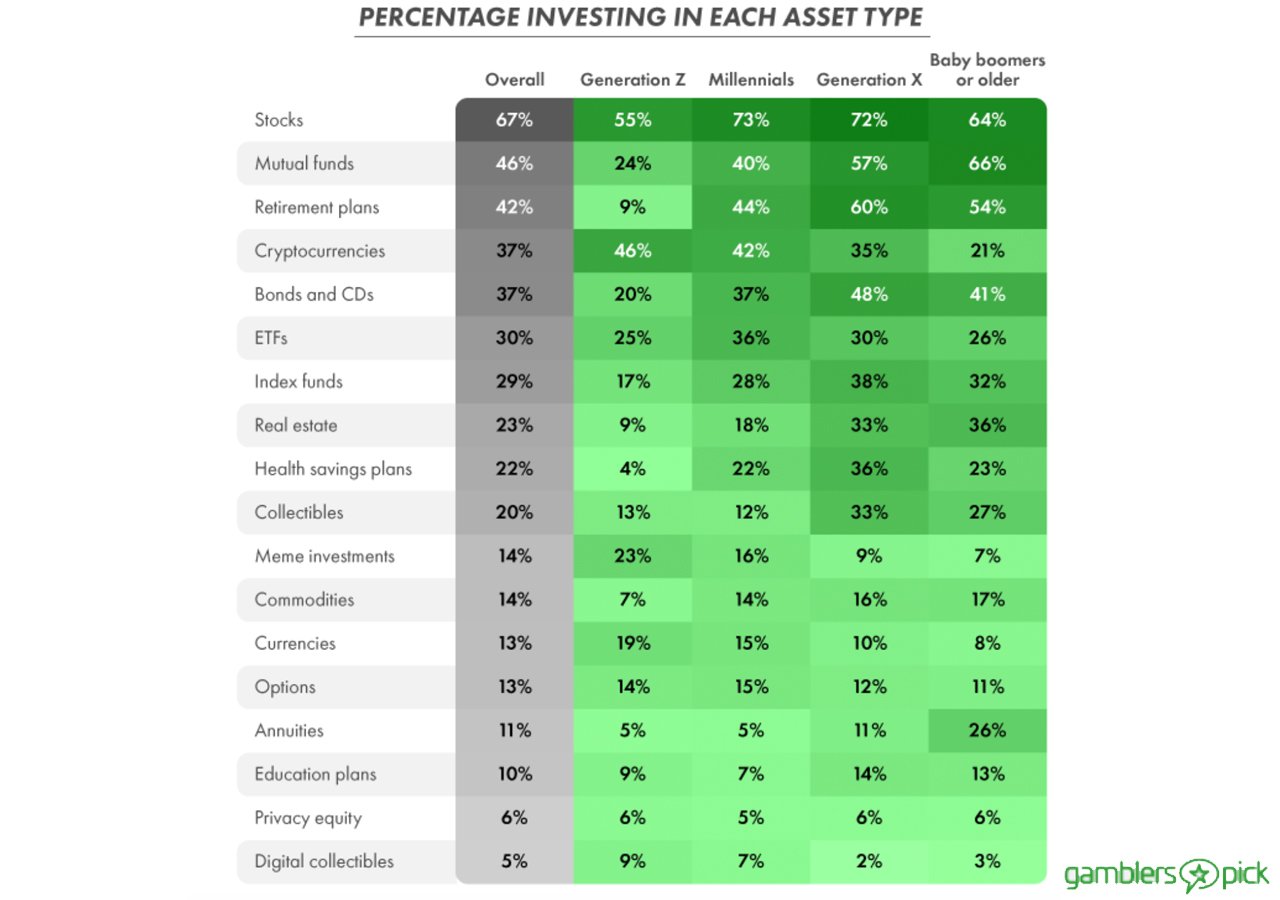
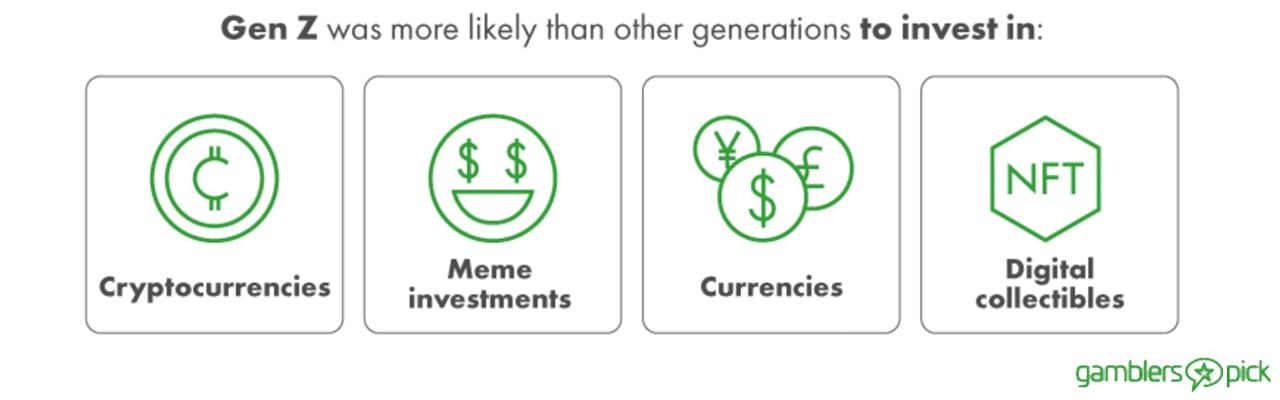
A recent study published by Gambler’s Pick notes that Gen Zers are less likely to invest in traditional investments like equities and more likely to invest in cryptocurrencies, meme investments, and non-fungible tokens (NFTs).

Gen Z More Likely to Invest in Cryptocurrencies and Meme Investments Than Stocks and Common Assets

The web portal gamblerspick.com published a study at the end of April that highlights the investment choices of Gen Zers. Generation Z or Gen Z for short is a demographic that succeeds Millennials.

The group colloquially known as “zoomers,” were born between the mid-to-late 1990s and up until the early 2010s. The Gambler’s Pick survey notes that Gen Zers are more apt to invest in cryptocurrencies and NFTs over traditional stocks.

The survey polled 872 people and 24% of the group represented Gen Z and 27% were Millennials. “25% were Gen Xers, and 24% were baby boomers or older,” the Gambler’s Pick study adds. Some key findings noted that Gen Z likes collectives but is still more likely to invest in stuff like sneakers and clothes.

Interestingly, the Gen Z crowd noted why they were investing and they mentioned fighting back “against institutions” and to “participate in a movement.”

With things like meme assets, cryptocurrencies, and NFTs at the forefront of investment, Gambler’s Pick says that zoomers deal with high-risk investments better than older generations.

“Baby boomers (and older respondents) tended to prefer to be a little safer with their investments,” the Gambler’s Pick researchers detail. Rather than technical analysis and stock fundamentals, Gambler’s Pick said Gen Z would rather take “tips and opinions” from Reddit, social media, and family and friends.

Lastly, the study with 872 respondents shows that zoomers believe that markets are manipulated and high-net-worth individuals and institutions rule the roost.

“Generally, baby boomers (and older) were a little more skeptical of these theories, but the younger generations were pretty sure there’s some truth behind them,” the study’s researchers concluded.

What do you think about Generation Z liking cryptocurrencies, memes, and NFTs over traditional investments like stocks? Let us know what you think about this subject in the comments section below.

Go to Source

UK Regulator Extends Temporary Registrations Regime as Crypto Firms Fail to Meet AML Rules

Many companies operating with cryptocurrencies are not meeting anti-money laundering regulations, the U.K.’s Financial Conduct Authority revealed. The government agency has extended its temporary registration scheme after facing a growing number of crypto firms that are withdrawing their applications.

FCA Extends Temporary Registrations Regime Till End of March 2022

The Financial Conduct Authority (FCA) announced Thursday it’s extending the end date of the Temporary Registrations Regime (TRR) for crypto businesses to March 31, 2022. The regulatory body pointed out that a “significantly high number” of companies are not meeting current anti-money laundering (AML) requirements which have resulted in “an unprecedented number” of entities withdrawing their applications. In a statement published on its website, the FCA noted:

The extended date allows cryptoasset firms to continue to carry on business while the FCA continues with its robust assessment.

Last year, the financial regulator said that all businesses trading cryptocurrencies on Jan. 10, 2020, are subject to the country’s updated Money Laundering Regulations. Initially, they were required to register with the FCA by Jan. 10, 2021. Later on, the compliance deadline was moved to July 9 and the TRR scheme was introduced to allow cryptocurrency firms that applied for registration before Dec. 16, 2020, to continue to work while their applications are still being processed.

Brits Warned FCA Does Not Have Consumer Protection Powers

In this week’s announcement, the FCA explains that Britain’s anti-money laundering and counter-terrorist financing legislation is tailored to protect against “enabling the transfer and disguise of funds from criminal activity, or funding of terrorist groups.” The agency, which operates independently under the U.K. government, further stated:

While this is not the only element that the FCA will assess in relation to an applicant, the FCA will only register firms where it is confident that processes are in place to identify and prevent this activity.

Crypto assets are highly speculative and prone to losing value quickly, the financial authority warned, emphasizing that it has not been granted powers to provide consumer protection for the activities of British crypto companies, even when they are registered with it. If consumers invest in cryptocurrencies, they should be prepared to lose their money, the FCA added, stressing it is unlikely that they will have access to the Financial Ombudsman Service or the Financial Services Compensation Scheme.

Why do you think some crypto companies are not meeting Britain’s AML regulations? Share your thoughts on the subject in the comments section below.

Go to Source

Study Shows NFT Sales Plummeted 90% Over the Last 30 Days, NFT Wallets Dip 70%

According to a recent study, non-fungible token (NFT) sales have dive-bombed 90% since the market’s record sales on May 3. Market data shows over 130,000 NFT sales that day and 30 days later sales are down to a touch over 84,000, dropping more than 35% last month.

Protos.com Study Claims ‘NFT Bubble Has Popped’

Non-fungible tokens (NFTs) have been all the rage in 2021 and sales continue to this day. However, a recent study published by protos.com indicates that NFT sales have been dropping and NFT sale values have plummeted as well. The report shows that last month $102 million in NFTs were sold on May 3 and the latest seven-day data shows only “$19.4 million in NFT sales were processed in the past week.”

The protos.com study shows the NFT ecosystem saw a 90% drop from the May 3 high and only a few projects are continuing to sell.

Weekly data via nonfungible.com

Currently, projects like Cryptopunks and Hashmasks have been able to sustain sales, and market statistics from nonfungible.com reflect this fact. 30-day stats from nonfungible.com indicate there were 84,645 sales worth $134 million. Over 52,000 were primary sales and more than 32,000 were secondary sales.

Monthly data via nonfungible.com

The study also shows that the number of active NFT wallets has slid from 12,000 per day to 3,900, which is a loss of close to 70%. Other top NFT sales stemmed from Sorare, Meebits, Decentraland, Superrare, and the Sandbox.

One Meebit NFT sold for $2.6 million last month while a single Cryptopunk sold for $1.4 million. Four other Meebit NFTs below the recent Cryptopunk NFT sale, sold for $1 million each.

In the last seven days Cryptopunks has seen more than $4.8 million in 79 unique sales. Meanwhile, Sorare data is different, with $2.4 million in weekly sales but across more than 10,000 sales. The stats from the protos.com study give the publication the opinion that the NFT bubble has popped and the report’s author concludes by highlighting this subjective valuation.

“All things considered, the data suggests the NFT bubble lasted just four months — and it popped about this time in May,” the researcher from protos.com writes.

What do you think about the NFT study and protos.com saying the NFT bubble has popped? Let us know what you think about this subject in the comments section below.

Go to Source

ECB: Digital Euro to Boost Global Appeal of European Money, Fight ‘Artificial Currencies’

The digitization of traditional currencies like the euro has the potential to increase their international appeal, the European Central Bank says in a new report. A failure to offer a digital currency would endanger financial stability, ECB warns. The regulator is concerned about the prospect of tech giants dominating payments through their “artificial currencies.”

Eurozone’s Central Bank Reviews Role of Euro in Light of CBDC Project

The global appeal of fiat currencies depends on economic fundamentals, but some characteristics of digital money could promote their adoption beyond the issuing jurisdiction, the European Central Bank (ECB) has noted in a recent review of the international role of the euro. Specific design features can also incentivize non-residents to use a digital euro as a means of payment, unit of account and store of value, the regulator says.

Safety is a key feature, the bank points out, as a central bank digital currency (CBDC) would be a claim on the balance sheet of the issuer and could mitigate the risks associated with traditional cross-border transactions that involve correspondent banking.

A CBDC would also bring lower transaction costs, expanding access to payment services and lowering mark-ups of intermediaries. Remittance transfers, for example, could become more efficient.

The central bank of the Eurozone believes that a CBDC could also partially or fully act as a substitute for unstable national currencies in countries with weak economies, becoming a local means of payment, a savings vehicle, and ultimately the unit of account. A digital currency would facilitate the use of electronic invoices, receipts, identities, and signatures. End-users could benefit from access to products competing with those offered by big tech companies.

ECB Worried About Foreign Tech Giants Dominating Payments

The European Central Bank emphasizes that a CBDC would help to maintain the autonomy of domestic payment systems. A failure on the part of a central bank to offer a digital currency, on the other hand, would entail risks to the stability of the financial system. The authors of the CBDC section of the report, Massimo Ferrari and Arnaud Mehl, warn:

One concern could be a situation in which domestic and cross-border payments are dominated by non-domestic providers, including foreign tech giants potentially offering artificial currencies in the future.

Companies like the global social media platform Facebook have been working to develop their own native currencies, the popularity of which could quickly increase due to their large customer base. According to the economists, “Not only could this threaten the stability of the financial system, but individuals and merchants alike would be vulnerable to a small number of dominant providers with strong market power.” Ferrari and Mehl think that the “ability of central banks to fulfill their monetary policy mandate and role as lender of last resort would be affected.”

The study, which was published Wednesday, also explores alternative design choices for a digital currency, noting that specific features would determine the global outreach and the international role of the currency in which a CBDC is denominated. Among these features are interoperability with non-domestic payment systems, restrictions on use by non-residents, user anonymity, and the underlying mechanism for online as well as offline transfers and settlements.

“A digital euro could contribute to strengthening the global appeal of the euro, but would not change the fundamental forces that define international currency status” such as stable fundamentals, size of the issuing economy, and liquidity of financial markets, the report concludes, noting the importance of cooperation with other central banks in the G20 format.

The ECB is yet to initiate a digital euro project. Officials have previously indicated that the Governing Council’s decision is to be expected around mid-2021. Dozens of nations are already working to issue CBDCs, including China, the U.S. and Russia.

What’s your opinion about central bank digital currencies? Share your thoughts on the subject in the comments section below.

Go to Source

Digital bank Anchorage offers Ethereum-backed loans to institutions

Institutional investors can get USD on credit without liquidating their ETH.

Crypto custody bank Anchorage Digital is expanding its services into crypto-backed loans for institutional investors.

Clients at Anchorage can now access a line of USD credit backed by Ethereum through its partnership with U.S. commercial bank BankProv.

Anchorage Financing will introduce a simple way for investors to put their Ethereum holdings to work, enabling them to access USD to meet their needs without liquidating their holdings according to the announcement. The crypto custodian also offers staking services for additional yields on Ethereum

The digital asset bank holds on to the ETH, using it as collateral should a client be unable to repay the dollar loan. Clients with large ETH holdings will be able to access a larger line of credit. Anchorage already provides Bitcoin-backed loans through other capital providers.

Ethereum-backed loans may be under collateralized if the borrower passes appropriate risk due diligence checks according to Anchorage co-founder Diogo Mónica.

Dave Mansfield, CEO of BankProv, said that Anchorage’s collateral management tech is “world-class”, adding that it is a trusted partner to the banking industry:

“We firmly believe in our mission and belief that the crypto market should be afforded the same access and rights to traditional financing tools as any other legal, well-capitalized and compliant business in America.”

Anchorage was the first crypto firm to receive a charter from the U.S. national bank regulator in January 2021. BankProv is the tenth oldest bank in America, operating for over 200 years as The Provident Bank before a rebrand in 2020.

In late February, Anchorage raised $80 million in a Series C funding round led by GIC, Singapore’s sovereign wealth fund, with participation from Andreessen Horowitz, and Blockchain Capital. The funding helped the custodian to assist institutions by bringing crypto to their users and diversifying their corporate treasuries.

In late March, Anchorage teamed up with cryptocurrency trading platform Prometheum to launch a fully regulated alternative trading system, or ATS, tailed specifically for professional crypto investors.

Go to Source

BSC’s Impossible Finance raises $7M for multi-chain DeFi incubator

DeFi protocol Impossible Finance is building a multi-chain incubator to expand out from BSC.

Impossible Finance, a Defi protocol built on Binance Smart Chain, has completed a $7 million seed funding round backed by over 125 institutional and angel investors — with the funds going towards the development of a multi chain DeFi incubator.

The seed round was led by venture capital firm True Ventures, and quantitative investment firm Alameda Research, blockchain development firm Hashed and investment firm CMS Holdings.

Impossible Finance was launched on BSC on April 9, and the protocol currently offers DeFi investors token swaps, liquidity pools, and staking rewards through the Impossible Finance (IF) token

The new funding will go towards development of a multi-chain ecosystem for the project, which plans to expand to support to Ethereum and Polygon, along with deployments on layer-two (L2) solutions and other platforms in the future.

As part of the multi-chain ecosystem, Impossible is also developing an automated market maker (AMM) liquidity protocol, which will act as the backbone for a decentralized incubator and launch pad for new DeFi projects. And of course, it will launch the related Impossible Decentralized Incubator Access (IDIA) token.

Plans to expand support to Ethereum and Polygon are timely in light of a wave of recent exploits on the BSC, including a growing list of rug pulls and hacks. It raises the question of whether hacks and exploits are somehow endemic to how the platform operates, or just part of its growing pains?

In recent weeks, DeFi protocol BurgerSwap was drained of $7.2 million in a flash loan attack, along with yield protocol Belt Finance, which lost $6.3 million after a hacker exploited a flaw in the protocol’s vault.

PancakeBunny suffered a $200 million flash loan attack from a hacker who borrowed a “huge amount” of Binance Coin (BNB), and then proceeded to manipulate BUNNY’s price and dump it all and completely tank the price of the asset.  Spartan Protocol was also drained off $30 million in a coordinated attack on its liquidity pool.

Earlier this year, users of yield vault project Meerkat Finance lost $31 million on the platform due to an alleged rug pull by the developers. Uranium Finance, an AMM platform built on the BSC was subject to a hack — with the hacker reportedly swooping in to exploit a bug in Uranium’s balance modifier logic and stealing $50 million in the process.

Go to Source

Shanghai Man: ‘Green-light’ for miners? CZ not responsible for BSC, Uniswap frauds on TV

CZ claims Binance didn’t really make Binance Smart Chain, Beijing to distribute $6.2 million in free digital yuan, and miners speak out about clean energy mining

This weekly roundup of news from Mainland China, Taiwan, and Hong Kong attempts to curate the industry’s most important news, including influential projects, changes in the regulatory landscape, and enterprise blockchain integrations.

Could green miners get a pass?

Last week’s column had a look at the recent crackdown on cryptocurrency miners as China heads towards a more carbon-neutral policy. This week, the Southwest province of China was humming a slightly different tune as the Sichuan Energy Regulatory Office organized a symposium on the topic. The province has a heavy mining concentration due to low cost energy generated from a developed hydroelectric power system. The symposium failed to reach a resolution, leading to speculation that the green energy of the province will lead to much more positive regulation.

Zhang Nangeng, CEO of mining-machine manufacturer Canaan, added to this speculation by calling for China to make allowances for green-energy powered miners. “For-profit miners prefer regions with low electricity prices that indicate oversupply, and likely energy waste. Bitcoin miners also help create jobs in impoverished regions and contribute to fiscal coffers,” pointed out the CEO. It seems unlikely that China will continue to allow miners to abuse coal-powered electricity in regions like Inner Mongolia, but for Sichuan there is definitely an argument to be made in favor of the lucrative mining industry.

Uniswap rug pulls on state-run TV

On June 2, national television channel CCTV-13 reported on virtual currency fraud in their News Room segment. In the report, they introduced how a virtual currency TRTC was listed on Uniswap before having all the liquidity removed. Blockchain smart contract auditor SlowMist was also featured as they demonstrated how the fraudulent activity was conducted. In the TRTC case, 59 ETH were removed from the pools, worth about $100,000. CCTV-13 concluded by warning about the risks of financial fraud on cryptocurrency platforms such as Uniswap. On Twitter, Uniswap founder Hayden Adams mistakenly tweeted about the segment, confusing the video clip as a positive report. Apparently Adams hasn’t spent as much time practicing his mandarin as other early Ethereum pioneers Vitalik Buterin and Gavin Wood, who both have a decent grasp of the language.

BS and C?

In a Chinese-language interview on May 29, Binance founder CZ distanced himself further from Binance Smart Chain by claiming that it has no control over the chain and that it was not responsible for the creation of it. He coyly suggested that BSC has been a community project and that he rarely speaks to the team behind it. Binance and competing Chinese exchanges may be rethinking their positioning after a series of hacks and exploits have haunted the various ‘smart chains’ that offer further utility to exchange tokens and their users.

Blockchain, not Bitcoin

Despite the increasingly harsh regulatory environment, China hasn’t backed down on its pro-technology stance. On May 31, new blockchain technician standards were released from the Ministry of Human Resources and Social Security and the Ministry of Industry and Information Technology. The standards detailed what skills and core competencies are required to work in the industry.

$6.2 million CBDC airdrop

Beijing is launching another digital yuan lottery as it continues to push the release of the central bank digital currency. The Beijing Local Financial Supervision and Administration announced on June 2 that the government will distribute the free currency to citizens who apply before June 7. This comes in the same week that former People’s Bank of China director Yao Qian stated that the digital yuan was not to be used as a surveillance tool. He claimed the technology was initially developed to counter the private sector’s control of the payment sector. The western world might remain skeptical on this point but the need to balance the private sector is certainly plausible, given the national dominance of Alipay and WeChat pay.

Go to Source

Bitcoin nears $40K amid warning BTC price will correct before bull market resumes

Another price dip is required before continuation, one trader says, giving a short-term target of $36,000 for BTC/USD.

Bitcoin (BTC) edged closer to $40,000 on Thursday as bulls gathered increasing signals that the bottom is in.

BTC/USD 1-hour candle chart (Bitstamp). Source: TradingView

BTC/USD to $36,000 next?

Data from Cointelegraph Markets Pro and TradingView showed BTC/USD retaining levels it reclaimed a day before, including the critical $37,500.

Now, eyes were on the coming days for confirmation of a breakout or rejection — volatility was already forecast to enter by the weekend.

For popular trader Crypto Ed, the market might need another bearish test in the short term before coming back with a vengeance. In the meantime, it may be a case of grinning and bearing familiar moves.

“I think we’re close to a reversal and a correction during the day before up again,” he told Twitter followers on Thursday.

“BTC to $36k and ETH $2500? Might be a boring day….”

He added that he assumed that BTC/USD is going to correct rather than continue upward.

Bottom-hunting metrics demand attention

Meanwhile, two new metrics that specifically try to catch Bitcoin price bottoms went live on monitoring resource Glassnode this week in a timely release for traders.

Created by David Puell, well known for his famous Puell Multiple indicator, delta cap and balanced price both provided cues that Bitcoin may already be in recovery.

“Watch out for confluence on these in the next bear,” Puell added.

BTC/USD delta cap vs. price chart. Source: Glassnode

As Cointelegraph reported, opinions continue to focus on this year seeing a double top pattern on Bitcoin similar to 2013.

In both previous bull markets, major retracements from local highs were standard on the way to ultimate peaks; and as such, there is nothing unusual about current behavior. That was the opinion of stock-to-flow creator PlanB this week in conversation with podcast host Preston Pysh.

Go to Source

Curve (CRV) sees 150% rebound as DeFi bottoms and ETH gas fees drop

Falling Ethereum gas fees, the launch of Convex Finance and the DeFi sector reaching a potential bottom back CRV’s impressive 150% rally since May 23.

DeFi tokens and protocols took a heavy hit on May 19 as Bitcoin price dropped to $30,000 and while BTC has entered what some analysts describe as a ‘compression’ phase, the total value locked in DeFi and the value many of the sector’s tokens have yet to rebound to the levels seen before the market crash.

Curve DAO token (CRV) stands among the few DeFi tokens that have seen a strong recovery over the past two weeks due to reduced Ethereum gas fees, the launch of Convex Finance and the DeFi sector beginning to find a bottom. 

CRV/USDT 4-hour chart. Source: TradingView

Data from Cointelegraph Markets Pro and TradingView shows that CRV has increased 55% since June 1, rallying from a low of $1.76 on June 1 to an intraday high at $2.76 on June 3 alongside a 250% increase in 24-hour trading volume.

Convex Finance launch attracts CRV holders

One source of the sudden rise in price and momentum for CRV is Convex Finance (CVX), an optimizer for the Curve Protocol that enables swaps of similar assets like stablecoin to stablecoin transactions.

Since it’s official launch on May 17, the Convex protocol has rapidly gained a substantial user base thanks to yields as high as 52.16% and some analysts have suggested that the protocol is challenging  Yearn.finance for CRV-related deposits.

Data from Defi Llama shows that in the two and a half weeks since the launch of Convex Finance, the total value locked (TVL) on the protocol has surpassed $2.3 billion with stakers on the protocol earning $4.3 million in total revenue.

Total value locked on Convex. Source: Defi Llama

Both Convex Finance and Yearn.finance rely heavily on CRV for the operation of their platforms and the increased activity has resulted in a decline in the circulating supply of CRV. This may have helped to boost CR price as investors clamor to stake tokens for the highest return possible.

Curve Finance and the wider DeFi ecosystem could also be benefitting from the sharp decline in gas fees on the Ethereum (ETH) network, which had previously priced out many retail traders from performing the simple approval and confirmation transactions required to stake and claim earnings from DeFi protocols.

Average Ethereum gas fee. Source: Etherscan

Lower fees have allowed a wider range of users to re-engage with their favorite DeFi protocols, and Curve has been a significant beneficiary of this development.

The VORTECS™ indicator flashed before the breakout 

VORTECS™ data from Cointelegraph Markets Pro began to detect a bullish outlook for CRV on May 31, prior to the recent price rise.

The VORTECS™ Score, exclusive to Cointelegraph, is an algorithmic comparison of historic and current market conditions derived from a combination of data points including market sentiment, trading volume, recent price movements and Twitter activity.

VORTECS™ Score (green) vs. CRV price. Source: Cointelegraph Markets Pro

As seen in the chart above, the VORTECS™ Score for CRV registered bullish readings throughout the past week with a high of 77 coming late in the day on May 31. This was roughly 15 hours before the price rallied 55% over the next 48 hours days.

The views and opinions expressed here are solely those of the author and do not necessarily reflect the views of Cointelegraph.com. Every investment and trading move involves risk, you should conduct your own research when making a decision.

Go to Source

Please enter CoinGecko Free Api Key to get this plugin works.
Exit mobile version