Ocean Protocol, the decentralized data exchange protocol has announced that it has partnered with Polygon, previously known as Matic, to integrate its smart contracts and market to the polygon ecosystem.
The integration will allow Ocean Protocol’s users to save on gas fees at a time when congestion continues to increase on the Ethereum network, which has become one of the major deterrents for small investors to acquire cryptocurrencies native to Ethereum.
Matic rebranded itself to Polygon earlier this year as it aimed to become Ethereum’s bridge with other blockchain networks. The project has been adopted by over 90 dApps and 200k unique users, completing over 8 million transactions.
The ocean market is no available to publish, swap, stake, and consume data in the Polygon Network paying a fraction of the gas prices required by Ethereum and with lower latency. Developers can also now use the Ocean libraries and front-end components with Polygon.
Ocean Protocol’s founder, Trent McConaghy, referred to the partnership by stating:
“Polygon has a long history of collaboration with the Ethereum ecosystem with an eye towards scaling and security. The Polygon team has developed a first-class platform for running EVM-based contracts and bridging across chains. It’s our pleasure to leverage Polygon so that our users benefit from far lower gas costs in Ocean Market and in other emerging dapps & protocols that use Ocean.”
Ocean Protocol will Continue to Run in the Ethereum Mainnet
In spite of the move, the Ocean Protocol team continues to maintain the deployment to the Ethereum Mainnet in the future with no changes. The Ethereum 2.0 upgrade is expected to address most of the issues currently plaguing the network with high latency, low reliability, and high gas prices.
Ocean users can choose to publish their datasets and other services in Ethereum and/or Polygon, with the tradeoff consisting of UX and familiarity for lower latency and gas prices.
While at this time there are no bridges implemented for data tokens, the Ocean Protocol development team is working on fixing the “technical gotchas” that prevented their deployment on the first release.
For now, publishers and stakers can republish their services and datasets in Polygon if most liquidity is removed from the poll in Etherum, ensuring that stackers don’t see their gains siphoned.
In future updates, it is expected that these bridges will allow seamless interoperability between both chains, further improving the efficiency of the protocol and the benefits for users.
Oraichain partners with Ocean
Oraichain, an AI-powered oracle solution has announced its partnership with Ocean protocol to integrate products, data, and services.
Ocean protocol is especially useful for developers and companies working with Artificial Intelligence (AI) due to the high amount of data required to train neural networks and other types of AI.
Now, Ocean protocol will also be benefiting directly from AI via Oraichain’s Mainnet, which launched back in February, by exploring integrations between both ecosystems and their products, as well as expanding the offering of the Ocean Market
With the AI industry’s relevance continue to grow in the technology world, projects like Ocean and Oraichain are expected to see an increase in adoption in the coming years as the need for data increases at the same time as privacy concerns.
Bruce Pon, Ocean Protocol co-founder, said that the partnership is expected to be “a dynamic addition to our data and AI ecosystems” which will not only diversify the platform’s offering but also open the door to the exploration of new synergies between both ecosystems in the following months.
As blockchain becomes more popular, fast-moving platforms may be able to secure a user base as larger platforms are unable to deliver the same kind of performance.
The post Ocean Protocol Partners With Polygon Network for Lower Gas Fees appeared first on Blockonomi.
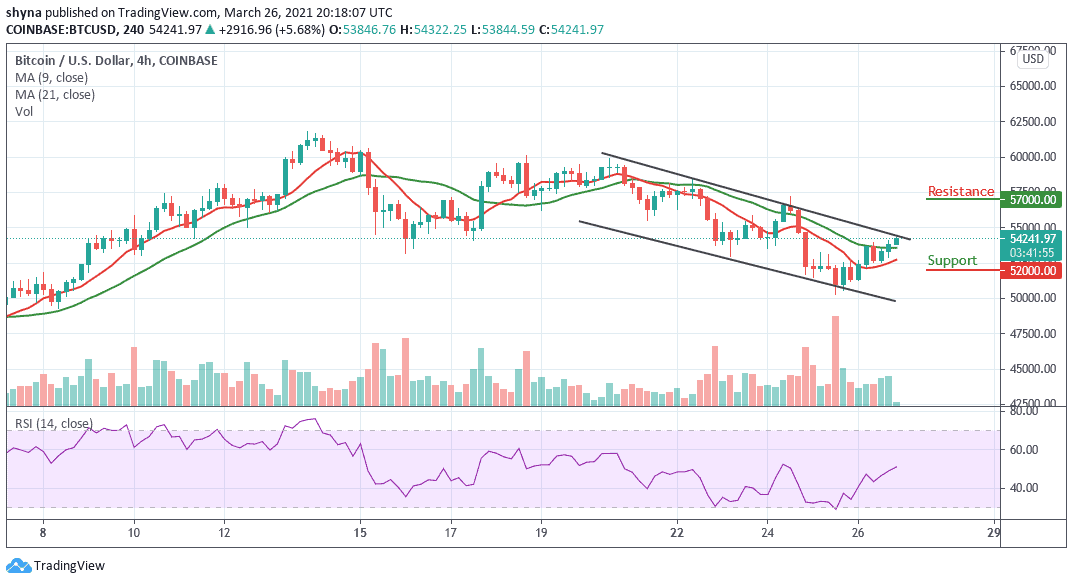
BTC/USD is on track for having the first bullish day after several falls as the bulls take the price up from $51,320 to $54,096.
BTC/USD Long-term Trend: Bullish (Daily Chart)
Key levels:
Resistance Levels: $58,000, $60,000, $62,000
Support Levels: $48,000, $46,000, $44,000
BTCUSD – Daily Chart
BTC/USD is seen recovering above the previous support turned resistance of $54,000. Today, short-term price action has formed a wedge that has clearly broken to the upside. This has resulted in price levels attempting to continue the uptrend. Buying volume has yet to flood back into the market and will be required in order to sustain any form of a new uptrend.
Where is BTC Price Going Next?
Meanwhile, as long as the 9-day remains above the 21-day moving averages, traders can expect BTC to consolidate at higher levels. That’s if we could see a further climb above the $54,000 which is fast approaching; it may likely reach the resistances at $58,000, $60,000, and $62,000. Nevertheless, the critical support levels are located at $48,000, $46,000, and $44,000 respectively.
Currently, the Bitcoin price follows a dominant bullish bias. A glance at the technical indicator RSI (14) displays a positive picture of the coin in the near-term. Besides, maintaining a gradual upward slope above the 60-level, the technical indicator is increasing as a signal for growing buying entries.
BTC/USD Medium-Term Trend: Bearish (4H Chart)
Looking technically, BTC/USD needs to climb $55,000 above the upper boundary of the channel to mitigate the short-term bearish pressure and allow for an extended recovery towards $56,000. This psychological barrier may closely follow by $57,000 and $59,000 resistance levels.
BTCUSD – 4 Hour Chart
In contrast, the nearest support is at $53,000, and a sustainable move lower will increase the downside pressure and push the price towards $52,000 and $50,000 support levels. Considering that the RSI (14) on a 4-hour chart is moving to cross above the 50-level, traders might expect more bullish signals into the market.
The blockchain and crypto firm DMG Blockchain Solutions has revealed a partnership with the crypto asset mining business Argo Blockchain. The two firms have decided to launch a bitcoin mining pool that’s focused on leveraging clean energy resources.
DMG Blockchain Solutions (TSX-V: DMGI) and Argo Blockchain Plc (LSE: ARB) have recently entered into a Memorandum of Understanding to establish Terra Pool. The new bitcoin mining pool aims to utilize clean energy resources and will combine both DMG’s and Argo’s hashrate that uses hydroelectric-power.
In recent months, bitcoin (BTC) mining and all proof-of-work (PoW) mining, in general, has been criticized for how energy-intensive these networks can be. DMG’s and Argo’s Terra Pool plans to keep bitcoin mining climate-friendly by focusing on clean energy solutions.
“DMG’s increased innovative strength and continued focus on eco-friendly bitcoin mining has the opportunity to drive transformations in how the bitcoin mining community acts towards a climate-conscious future,” DMG CEO Dan Reitzik said in a statement.
The two companies also said the new eco-friendly bitcoin mining pool will work with other members of the crypto asset mining industry if the operations “expedite the shift from conventional power to clean energy.”
During the last decade, bitcoin miners leveraging renewable energy to mine BTC have utilized both renewable and surplus energy sources such as geothermal, wind, solar, natural gas, and hydropower. In more recent years, cogeneration concepts have been developed by leveraging the excess heat mining rigs release during use.
Bitcoin’s hashrate captured 185 exahash per second (EH/s) this month and the network difficulty is the highest it has ever been in BTC’s lifetime. At the time of publication, 17 publicly-known bitcoin mining pools direct hashrate at the BTC chain.
Argo Blockchain CEO Peter Wall believes that addressing clean energy efficiency in mining is a good idea for the planet. “Addressing climate change is a priority for Argo,” Wall stressed. “We are hopeful other companies within the bitcoin mining industry follow in our footsteps to demonstrate broader climate consciousness,” the Argo executive added.
What do you think about DMG’s and Argo’s clean energy Terra Pool project? Let us know what you think about this subject in the comments section below.
As the launch of the Ethereum 2.0 upgrade is coming closer, it is driving the crypto world crazier than ever. With StakeWise, staking ETH is simple and convenient, and investors are protected as their coins’ value is fully covered.
The biggest question is, how an ETH holder can stake his Ether and get them back safe and sound. In that context, StakeWise has stepped into the market, helping ETH holders to create low-risk returns. StakeWise has a solution that makes sense for staking!
About StakeWise
StakeWise is an inclusive smart contract-based platform, which works to provide a basket of ETH 2.0 services. The platform is built on the Proof-of-Stake consensus model, allowing easy token staking and a simple reward structure.
Headquartered in Estonia, StakeWise has been undergoing the beta test for nearly seven months.
In its latest update in March 2021, the platform announced a successful fundraising campaign of $2 million USD, even before its official mainnet launch. The funds were raised in a private round fundraising event and are evidence of the interest the platform is getting from investors.
In its public statements, StakeWise clearly addressed its services, including a custodial staking pool as well as non-custodial solo-staking.
StakeWise is assembled as a DAO (Decentralized Autonomous Organization) with a governance token $SWISE. It guarantees complete transparency and gives as much voting power to participants.
Earn rewards from staking Ether
A Great ETH Staking Solution
StakeWise is among the first providers to offer ETH2.0 staking solutions that are redeemable and preservable. Currently, the ETH2.0 upgrade is still taking place, meaning staked ETH cannot be exchanged back for trading until later this year when the shard chain deployment has been done.
To solve that headache, StakeWise brings in a protocol that tokenizes users’ ETH deposits into sETH2 and sends them a reward token known as rETH2. Those tokens are perfectly maintained at the ratio 1:1 to ETH, and can represent ETH in DeFi transactions.
Furthermore, the platform has announced its native token $SWISE that grants the governance decisions into the hands of users.
With $SWISE, StakeWisers are able to vote for any big matters on the chain, from commission rates to how node operators function. The token also plays as the system currency by which staking profits are shared with stakers.
In addition, users holding on to $SWISE can get proportional rewards in accordance with their ETH deposit amount.
Additionally, StakeWise is offering higher return rates for early staking. Particularly, 2% of the $SWISE supply will be rewarded to the first 25,000 ETH staked into the pool. As a result, so far, one-third of the total $SWISE cap has already been seized by investors.
Various Staking Options
StakeWise is bringing the market a staking pool and self-staking mode. When members stake their ETH into StakeWise pool, the ETH 2.0 smart contract will tokenize the deposits into sETH2 tokens, then generate an equal amount of the reward token (rETH2) for every earned ETH from the pool.
Either sETHs or rETHs can be burnt to redeem ETH at the ratio 1:1.
Reward tokens are accrued every 24 hours and distributed to all pool members based on their staking proportion.
Staking Options
Except for a 10% commission cut which is held off to compensate for the system development and maintenance, StakeWise pool is completely free. Users can deposit any amount of ETH as they wish, there is no minimum limit about that.
In order to maintain the safety and transparency of transactions, every time new ETHs are staked in the pool contract, a respective validator client key is created by the system and sent to a user’s cloud storage.
With that private key, its owner can access their tokens anytime from connected devices. It unleashes boundless control over staked tokens as well as consolidates protection against any errors or malicious acts.
In solo staking mode, users will pay $10 USD per month in exchange to be a validator on StakeWise. Solo stakers are required to deposit no less than 32 ETH, then they can assign their own withdrawal credentials to manage their funds.
To prevent any system malfunction, StakeWise will keep users’ keys on a cloud service.
Thanks to that, stakers can rest assured that they can go online 100% of the time and touch their keys whenever they want. Other than the $10 USD flat rate, solo stakers are charged with no extra fees.
They can also request a withdrawal to their predetermined address anytime, using their own withdrawal key.
Trade and Management Solutions
Besides all the profitability aspects, the founding team has made StakeWise an enjoyable destination for any crypto holders.
By paying a lot of attention to user experience, the service combines admirable advancements of ETH 2.0, such as scalability and high speed, in a friendly interface.
Users are offered real-time tracking to keep a close eye on their deposits and stay tuned about their performance and rewards second-by-second.
Moreover, StakeWise allows stakers to integrate their registries with external applications via API. Thanks to that, staking becomes substantially easier, since users can make and control remote deposits without any issues.
There will be a lot of money to be made in ETH staking, and StakeWise has created a good platform for creating returns.
Thought Leadership
StakeWise is composed of an enthusiastic and experienced team, leading by the two co-founders, Dmitri Tsumak and Kirill Kutakov.
Dmitri is a senior developer that loves blockchain technology, Kirill has built a solid background in the financial asset management sector.
Working together, the two young men have devoted all their hearts and mind to turning StakeWise into a friendly yet effective environment for ERC-20 transactions.
Speaking to the media, one of the two StakeWise founders, Dmitri, claimed their vision of making the best use of tokenomics and DAO governance to shape a thoroughly community-oriented crypto platform.
Not only is the platform shifting voting power to users, but StakeWise is also confident about bringing higher-yielding ratios for stakers, and ensuring security for its deposits.
The StakeWise social community is present on GitHub, Twitter, and Telegram, with timely updates on its latest progress. For those who want to join an early ETH staking and receive extra token rewards, StakeWise might be a good choice.
The post StakeWise Guide: Ethereum 2.0 Proof of Stake Pool & Solo Staking appeared first on Blockonomi.
This guide looks at the different category of cryptocurrency market, focusing on the 7th category which represents social network coins. This is the seventh part of the series that breaks down the crypto market into 12 major categories.
This article looks at the seventh category in the Top 100 of the cryptocurrency market, which features cryptocurrencies that are backed by a social network or platform.
Seventh Market Category: Social Network Coins
Social networking and media is an integral part of our lives, with the younger generation spending an average of 9 hours daily on social networking sites such as Facebook, Instagram, Twitter and Snapchat. However, a major downside of traditional social media is that all our personal data is stored and managed by a centralized database controlled by a corporation. This enables them to collect and harvest insights regarding our behaviours, preference, connections, habits and sensitive information. With all that valuable trove of data, our security and privacy run a real risk of being compromised. Make no mistakes, there have been multiple incidences where large social media corporations were breached or even engaged in unethical arrangements to exploit consumer data.
(See more: Evolution of Cryptocurrency: The Problem With Money Today)
Solution: Decentralized Social Network
The goal of a decentralized social network is to create a trustless and equitable balance of power across all stakeholders in the system, where all users possess control over their data. In a decentralized system, users own and manage their personal data or any data associated with their identity. With greater levels of security and privacy, decentralized social networks look to disrupt our traditional systems in an explosive way.
Here 4 social network coins in the Top 100 cryptocurrency list that are doing just that.
Reddcoin (RDD)
A social tipping cryptocurrency, Reddcoin allows users to send and receive RDD instantaneously with no fees. Reddcoin’s peer-to-peer (P2P) payment system allows integration with a wide range of social media networks such as Facebook, Reddit, Twitter etc. Instead of just giving ‘likes’ in Facebook or Twitter, users can now tip content creators across all social media platforms using RDD coins.
Reddcoin is an open-source cryptocurrency that is a fork from Litecoin (LTC). Reddcoin debuted on January 2014 and initially used a Proof-of-Work consensus mechanism but rather transited to a new consensus mechanism called Proof-of-Stake-Velocity. POSV was nativelydeveloped by Reddcoin, focusing on coin staking and active network participation (velocity). Currently, Reddcoin’s tipping system is already functional on Reddit and Twitter.
(See more: Category of Cryptocurrency Market: Pure Cryptocurrency)
Steem (STEEM)
Steem is a decentralized publishing platform that allows content creators to monetize their content. Whenever content on the Steem platform is upvoted, the content creator and those who curate the content will stand to be remunerated with Steem’s native currency (STEEM). Steem is also built on its own native blockchain. The project is a brainchild of Dan Larimer, who is also the CEO of Bithshares and EOS. There are 3 main currencies on the Steem platform:
STEEM: The main currency of Steem with an expanding supply of 100% yearly.
Steem Dollars (SBD): SBD is the stable currency that is pegged to the US Dollars, with each SBD representing USD $1. SBD was created to isolate the volatility of STEEM coins that were wholly dependent on market forces. 50% of the remuneration that content creators receive is paid through SBD coins, with the other 50% bring Steem Power.
Steem Power: This is a reputation-based, non-tradeable token that symbolizes a user’s influence and power in the network. The greater number of upvotes a user has, the more their votes will count and the higher their payout for curation will be. Users can convert their Steem Power tokens for STEEM, which will thereafter reduce their influence.
At the front end, Steem uses a Proof-of-Brain (POB) algorithm that requires users to create content in order for coins to be mined. The underlying Steem blockchain runs on the Delegated-Proof-of-Stake (DPOS) consensus mechanism, which is a highly scalable blockchain with a high throughput. Steem is an example of a cryptocurrency project that is fully functional and is gaining significant traction amongst the masses. It has an excess of over a million users and is globally ranked as #1,335 on Alexa’s website ranking.
(See also: Guide to Market Capitalization: Everything You Need to Know About Market Cap)
Mithril (MITH)
Mithril is a decentralized social media platform that, just like Steem, rewards content creators for their contribution. What Steem calls ‘Proof-of-Brain’ is called ‘social-mining’ in Mithril’s network. A unique feature of Mithril is its merchant network, which features numerous services for token holders to spend their MITH on. The range of services include premium content channels, live-streaming, online applications and retail merchandise.
Similar to Reddcoin, Mithril allows for the integration with existing social media platforms. Mithril was launched at the 2nd half of 2017, making it much younger than Reddcoin.
Mithril is built on the Ethereum blockchain and its native currency is called MITH, used as the main currency for Mithril’s ecosystem. In terms of traction, Mithril has launched a smartphone application called LIT (beta version), a social media app that looks like a mix of Instagram and WhatsApp. It has amassed a sizable amount of installations, amounting to approximately 20,000+.
(Read more: Coins, Tokens & Altcoins: What’s the Difference?)
Kin (KIN)
Kin is a token launched by a popular messenger service called Kik. Unlike most projects with no working product, Kik has a strong userbase of over 15 million active users and ranks #7 on the most popular social media platforms alongside Facebook and WhatsApp. It is no surprise that Kin raised close to $100 million for their ICO.
Kin aims to be a decentralized digital services ecosystem powered with their native currency of the same name called KIN. KIN will be used to facilitate value transfers within the Kin ecosystem, allowing direct interaction with content creators and users. A prominent feature of Kin is their Rewards Engine (KRE), a native incentive mechanism that rewards content creators based on usage of digital services that utilise Kin. Kin is currently built on the Ethereum platform, but would migrate to their own native blockchain which will be a fork off Stellar blockchain.
The primary reason for this is due to scalability concerns of existing blockchain. Kin is widely touted as one of the few decentralized applications that can drive mainstream consumer adoption of cryptocurrencies, due to their large userbase and the natural integration of decentralization to their existing business model. However, the fact that Kin has changed their directions multiple times on blockchain migration plans seems like there is a lack of vision and foresight.
(You might also be interested in: Will A Crash in Bitcoin’s Price Lead to Its Demise?)
Beneficial Resources To Get You Started
If you’re starting your journey into the complex world of cryptocurrencies, here’s a list of useful resources and guides that will get you on your way:
Trading & Exchange
Crypto Guide 101: Choosing The Best Cryptocurrency Exchange
Guide to Bittrex Exchange: How to Trade on Bittrex
Guide to Binance Exchange: How to Open Binance Account and What You Should Know
Guide to Etherdelta Exchange: How to Trade on Etherdelta
Guide To Cryptocurrency Trading Basics: Introduction to Crypto Technical Analysis
Cryptocurrency Trading: Understanding Cryptocurrency Trading Pairs & How it Works
Crypto Trading Guide: 4 Common Pitfalls Every Crypto Trader Will Experience
Wallets
Guide to Cryptocurrency Wallets: Why Do You Need Wallets?
Guide to Cryptocurrency Wallets: Opening a Bitcoin Wallet
Guide to Cryptocurrency Wallets: Opening a MyEtherWallet (MEW)
Read also: Crypto Trading Guide: 4 Common Pitfalls Every Crypto Trader Will Experience and Guide To Cryptocurrency Trading Basics: Introduction to Crypto Technical Analysis.
Enroll in our Free Cryptocurrency Webinar now to learn everything you need to know about crypto investing.
Get our exclusive e-book which will guide you on the step-by-step process to get started with making money via Cryptocurrency investments!
You can also join our Facebook group at Master The Crypto: Advanced Cryptocurrency Knowledge to ask any questions regarding cryptos!
Aziz, Master the Crypto Founder
I’m Aziz, a seasoned cryptocurrency trader who’s really passionate about 2 things; #1) the awesome-revolutionary blockchain technology underlying crypto and #2) helping make bitcoin great ‘again’!
The post Category of Cryptocurrency Market: Social Network Coins appeared first on Master The Crypto.
Vitalik Buterin, Ethereum’s co-founder, stated in an interview with Tim Ferris that he believed incoming rollups will be able to successfully support the network’s scaling before the deployment of Ethereum 2.0 and the introduction of sharding.
The rollups are layer-2 solutions that bundle transactions using sidechains before submitting them to the mainnet, increasing efficiency and reducing gas fees. This approach has become increasingly popular among Ethereum users as a way to deal with the increasing performance issues.
Ethereum Needs More Power!
The most popular blockchain network among blockchain developers has been struggling in recent months due to congestion which has resulted in high transaction processing times and gas prices, which has allowed other blockchain networks to gain popularity as the “Ethereum killers”.
Buterin expressed that while sharing while greatly increases the throughput of the network, rollups could also increase it by a factor of 100X by themselves, which would be more than enough for the network to continue operating while sharding is implemented.
Projects like Optimism and Arbitrum were mentioned in the interview as potential rollups that could provide the scalability boost over the next few months. However, the adoption of these solutions is all but sure as with every new platform there come risks that developers need to consider, as well as development costs.
Berlin Hard Fork To Be Deployed On April 14
Ethereum’s development team announced on March 8th that the Berlin hard fork was ready to be deployed in the Ropstern testnet on March 10th, while the Mainnet deployment would take place on April 14th.
The Berlin fork will see 4 Ethereum Improvement Proposals (EIP) implemented which will be EIP-2565: ModExp Gas Cost, EIP-2929: Gas cost increases for state access opcodes, EIP-2718: Typed Transaction Envelope, and EIP-2930: Optional access lists, 1 less than originally planned on January of 2021.
The hard fork will not affect Ethereum holders in any way but will require node operators and miners to update the Ethereum client to the latest version prior to the fork.
The Berlin update was originally planned to be released back in 2020 but experienced setbacks that prevented its deployment, which resulted in a longer than expected way for Ethereum supporters.
EIP-1559 Passes And Ethereum Gets Ready for ETH Burning
The EIP was originally proposed and co-authored by Vitalik Buterin back in 2019 to allow the reduction of the total ETH supply by burning part of the tokens every time it is used as gas in the network.
This approach has been taken by other blockchain networks to create a deflationary model and incentivize the holding of the cryptocurrency by fomenting scarcity. The proposal will also allow users to know the average price they will pay when doing a transaction, something that has become a guessing game over the last months.
The EIP was motivated not only by the high volatility of transaction-level fees and inefficiencies of first-price auctions but also by the long delays that users experience due to them and the instability it produced on blockchains with no block record.
New Ways to Keep on Top of Market Demand
Originally approved on Friday 5th, the proposal is currently under review and is expected to be deployed over the next months as congestion and fas prices continue to be a concern.
While the proposal and the Berlin hard fork might not resolve all of the issues experienced by users of the Ethereum network, it might alleviate some of the symptoms and allow developers to continued operating on it.
Many devs have turned to networks like Cardano and Polkadot, which have become increasingly popular as their development progresses.
While these platforms may see added users, a few small improvements in the ETH blockchain could once again put it in a secure position near the top of the crypto pantheon.
The post Vitalik Buterin Says Rollups Can Support Scaling Before ETH 2.0’s Deployment appeared first on Blockonomi.
The Bitcoin (BTC) is seen recovering from the dip and it is likely to move above the resistance level of $55,000.
BTC/USD Long-term Trend: Bullish (Daily Chart)
Key levels:
Resistance Levels: $58,000, $60,000, $62,000
Support Levels: $48,000, $46,000, $44,000
BTCUSD – Daily Chart
BTC/USD bulls begin to come into the market as the price remains below the 9-day and 21-day moving averages. At the time of writing, Bitcoin is seen gaining 3.9% to trade at $53,327. Meanwhile, despite correcting lower since the past few days, traders will be excited to see the king coin finally surpass the $55,000 psychological level.
Would Bitcoin Go Up or Down?
In the past 24 hours, the number-one crypto has been fluctuating between $53,900 and $51,200 levels. Technically, looking at the two levels, they may determine the next direction that BTC/USD will follow. In other words, the Bitcoin price may decline if the $51,000 support is broken while the price may rise if the $53,000 resistance is breached.
However, bears may take advantage to break the support of $50,000 if the bulls fail to keep the price above the upper boundary of the channel. Meanwhile, the technical indicator RSI (14) is seen moving to cross above the 48-level, indicating that an uptrend may come to play in the market. Moreover, the resistance levels could be found at $58,000, $60,000, and $62,000 while the supports lie at $48,000, $46,000, and $44,000 respectively.
BTC/USD Medium – Term Trend: Bearish (4H Chart)
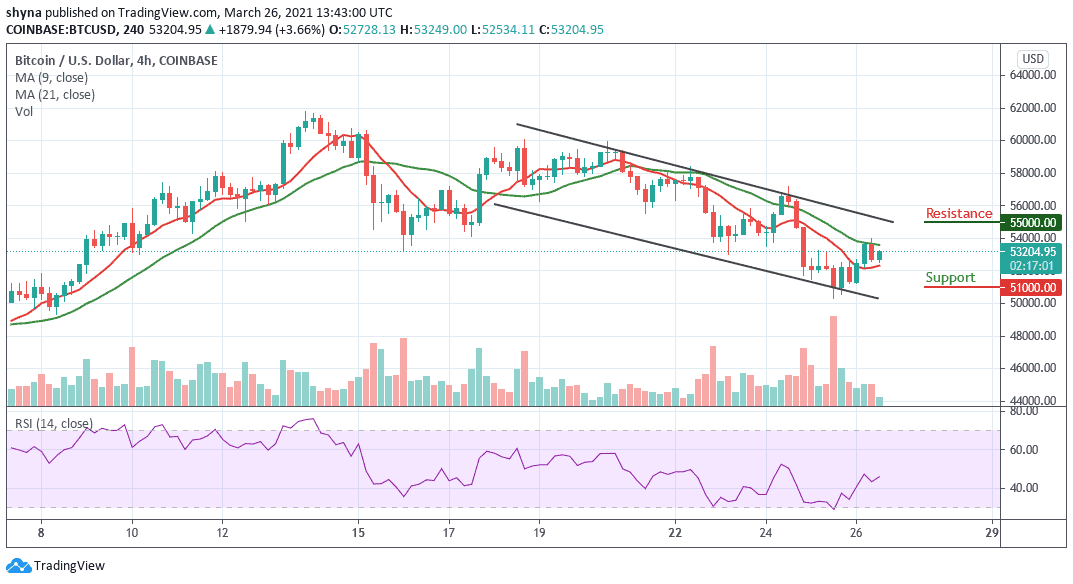
According to the 4-hour chart, Bitcoin’s price is currently trading around $53,204 and within the 9-day and 21-day moving averages. Meanwhile, the bullish supply is coming up slowly into the market as the bears are also trying to drag the price down. More so, in as much as the buyers can strengthen the market, the Bitcoin price can hit a resistance level of $54,000.
BTCUSD – 4 Hour Chart
Furthermore, breaking above the $54,000 level could allow bulls to test the potential resistance at $55,000 and above. Meanwhile, the technical indicator RSI (14) is currently above the 45-level, but any bearish movement may welcome the sellers back into the market which could drag the price below the 9-day moving average to reach the support level of $51,000 and below.
Fidelity Investments has applied to list a Bitcoin exchange-traded fund (ETF) that would track Bitcoin prices. This is according to the company’s preliminary filing made with the U.S. Securities and Exchange Commission.
Fidelity’s ‘Wise Origin Bitcoin Trust’
The ETF called the Wise Origin Bitcoin Trust emphasizes the money manager’s goal to bring cryptocurrencies to mainstream finance.
Wise Origin Bitcoin Trust will aim to match an index that takes spot prices from various bitcoin markets, including popular exchanges such as Coinbase and Bitstamp.
Fidelity also disclosed in the Securities filing that Fidelity Digital Assets would serve as the fund’s custodian, storing Wise Origin’s holdings.
“The digital assets ecosystem has grown significantly in recent years, creating an even more robust marketplace for investors and accelerating demand among institutions. An increasingly wide range of investors seeking access to bitcoin has underscored the need for a more diversified set of products offering exposure to digital assets,” the company stated.
Fidelity has been quite active in the cryptocurrency space for a while. The firm started by experimenting with mining digital coins and using the blockchain to execute trades.
In September, Fidelity started offering a private bitcoin investment fund to certain qualified investors.
Bitcoin’s Amazing Start To 2021
Fidelity’s filing for an ETF comes at a time where Bitcoin reached an all-time high. The digital asset had reached nearly $62,000 this month due to the persistent investments from huge U.S investors.
Bitcoin had also soared eight-fold in the last year, sparking wider interest in digital assets from investors seeking yield in a world of ultra-low interest rates.
Big companies and financial firms like Microstrategy, Tesla Inc, and Bank of New York Mellon Corp have embraced the emerging asset by purchasing millions of Bitcoin a part of their treasury management. This has sparked predictions that Bitcoin and other cryptocurrencies will become a regular part of investment portfolios.
In the past, the SEC repeatedly rejected applications for bitcoin ETFs. This blocked investors from gaining exposure to crypto through ETFs.
In 2018 alone, the SEC rejected applications for nine separate bitcoin ETFs although money managers, like VanEck Associates, have continued to press forward with additional filings.
Earlier this year, VanEck filed for the ETF with Cboe BZX Exchange. The SEC acknowledged the application and has formally kicked off its 45-day window this month.
Bitcoin (BTC) has once again reclaimed $9,000 with 5 days until halving.
Pantera Capital’s CEO, Dan Morehead, sees a scenario where BTC hits $115,212 by August 2021.
His analysis is based on the change in the stock-to-flow ratio across each halving.
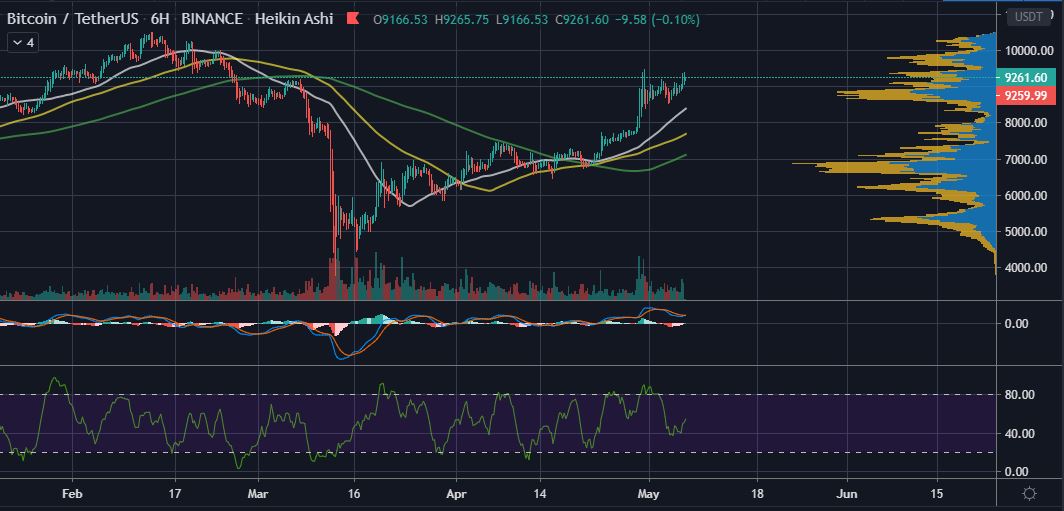
The hype and excitement surrounding the Bitcoin halving event is once again evident in the current price of BTC. At the time of writing this, Bitcoin has just broken both the $9,000 and $9,100 resistance levels and is trading at $9,261 with 5 days until halving. A brief analysis of the BTC/USDT 6-hour chart reveals that there is renewed buying interest as we draw closer to the estimated halving date of May 12th.
6-Hour BTC/USDT chart courtesy of Tradingview.com
Pantera Capital CEO Predicts Bitcoin (BTC) Could Hit $115k After Halving
With the Bitcoin halving only days away, Pantera Capital CEO, Dan Morehead, has predicted that BTC could hit $115,212 by August of 2021. His analysis is based on the change in the stock-to-flow ratio across each halving. Mr. Morehead made this predication via twitter and further elaborated on his analysis via an informative Medium blog post. His tweet can be found below.
#bitcoin could hit $115,212 in Aug 2021 based on the change in the stock-to-flow ratio across each halving.
More details here: https://t.co/fMYDXAT5qy pic.twitter.com/02uCpVoGKN
— Dan Morehead (@dan_pantera) May 5, 2020
Further highlighting key points from his Medium post, Mr. Morehead explained how a reduction in supply of BTC after each halving, will impact the price of Bitcoin.
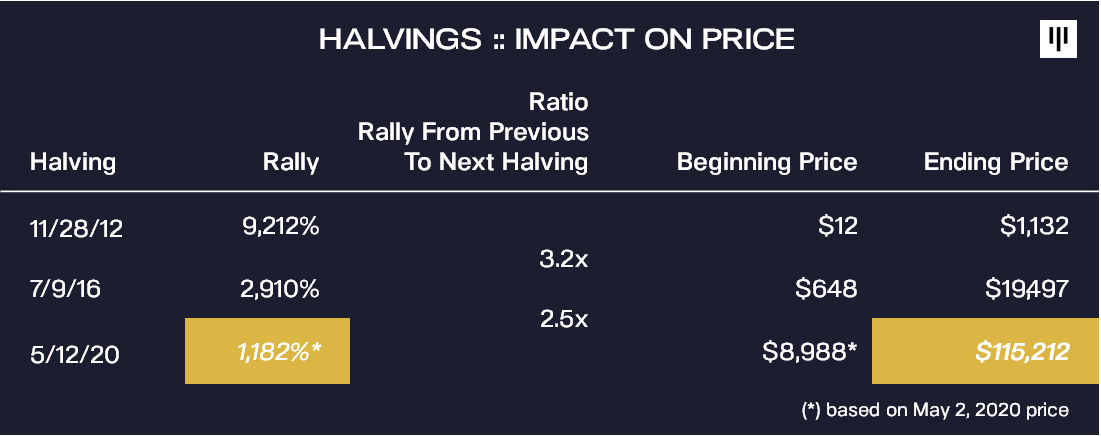
One potential framework for analyzing the impact of halvings is to study the change in the stock-to-flow ratio across each halving. The first halving reduced the supply by 15% of the total outstanding bitcoins. That’s a huge impact on supply and it had a huge impact on price.
Each subsequent halving’s impact on price will likely taper off in importance as the ratio of reduction in supply from previous halvings to the next decreases.
Furthermore, his analysis went on to elaborate on the impact each halving has had on the price of Bitcoin.
The second having decreased supply only one-third as much as the first. Very interestingly, it had exactly one-third the price impact.
Extrapolating this relationship to 2020:
The reduction in supply is only 40% as great as in 2016. If this relationship holds, that would imply about 40% as much price impulse — bitcoin would peak at $115,212 /BTC.
Image courtesy of Pantera Capital on Medium.com
What is Stock-to-Flow Ratio?
The Stock-to-flow ratio is a measure traditionally used to gauge the abundance of commodities. It is calculated by dividing the amount of a commodity held in inventories, by the amount being produced annually.
In the case of Bitcoin, it is calculated by dividing the currently known supply of Bitcoin by the BTC mined annually. At the time of writing this, there is approximately 18.365 Bitcoin already mined with an annual production of 657,000 BTC per year. This results in a Stock-to-flow ratio of 27.9.
(Feature image courtesy of Unsplash.)
Disclaimer: This article is not meant to give financial advice. Any additional opinion herein is purely the author’s and does not represent the opinion of Ethereum World News or any of its other writers. Please carry out your own research before investing in any of the numerous cryptocurrencies available. Thank you.
Have you ever heard about Facebook and Instagram price algorithms? Well, most influencers on these social media channels will mention it, and it may confuse you. We’re here to clarify because moving forward. It will mean a lot as we discuss hedge funds and crypto prices. Social media algorithms are a distinct method of sifting and sorting a user’s timeline to include only the relevant posts and exclude those who mean less to them. Way before this was possible, social media used to give priority to the publishing time on a post, and less relevant posts were those already published. For Facebook and Twitter, this is still an option.
For our case, advanced algorithms are examining social media for hints as to why bitcoin crypto prices have stubbornly risen above the ranks in 2019. These algorithms have also been useful to foresee future crypto prices change.
Crypto prices
Social Media to Predict Cryptocurrency Values
Reuters has published a report that indicates how hedge fund managers and crypto prices administrators are using the crypto compare algorithms to extract data from social media. These companies have resolved to create computer algorithms that use social media blueprints to predict the most valuable coins within the market and their crypto prices. More than that, they can accurately predict crypto prices with super consistency. Advances in this type of endeavor have given these companies a price advantage over the older predictive sites.
Only because algorithms predict crypto prices by scanning the most inhabited social media sites, these include; Facebook, Reddit, Pinterest, and WeChat. They are full of investors seeking opinions and clicking on links to hedge funds to predict crypto prices. This is not in any way a simple task and is a high-budget venture that eventually pays off in significant digits. Therefore, the market has only the most prominent players who can implement such a profitable crypto price- program. These trends in prices are hardly ever easy to manipulate and predict due to the internet’s massive traffic. In the end, however, even programmers leave the endearing task to the digital computers for analysis and better crypto prices as well as productivity.
Cryptocurrency values
Sentiment Analysis
The programmers have enabled a feature termed the “sentiment analysis.” This involves computers sifting through social media messages to determine the investor price-mood when it comes to investing in cryptocurrency assets. They also evaluate how people view ethereum vs. bitcoin crypto prices and the ethereum current prices. It also rationally analyses the abundant retail crypto investors who predict market movements differently than other organizations.
These companies believe that people’s behavior can accurately define how they make their investments and view specific crypto prices. Social media users have only a fraction of the information on crypto prices, and they cannot know the most valued coins. Crypto prices are also constantly changing, and most of the data is unreliable, especially the economic indicators and financial records and statements.
Fake News
Every significant technological advance has its hurdles and needless to say. Sentiment analysis has run into some of its own. As they sift through the traffic and the data, they have run into what is now commonly termed fake news. These are inaccurate statements that are biased towards unreliable data, which is not very essential for investors. The algorithm creators are always pursuing accurate data and filtering out unusable data, especially on crypto prices.
This is a great challenge, but the algorithm of crypto prices works efficiently all the same. It gathers all the information from the sites and tries to decipher the people who are trading and what sites are they using for transactions. Furthermore, they evaluate the liquidation value of the crypto prices and finally filters out the fake news and requires no deposit slots to access this information. Twitter is primarily filled with irrelevant data that may mislead investors towards ambitious crypto prices.
These great leaps have made the market quite pliable and risk-free for most investors. Social media sites have paved the way for accessing relevant information. But more than this, it provides a platform for crypto advertisements geared towards people with interests in investment.
Conclusion
Hedge funds seeking a new perspective on the evolving crypto price-market is not a new phenomenon. However, the increasing advancement of social media algorithms has paved the way for crypto investors. The only big problem is the social media traffic that is abundant in irrelevant news and crypto price predictions. All these data is the biggest challenge to new crypto prices analysis algorithms. All in all, these advances in computer algorithms will keep improving and becoming sophisticated. With this in mind, all the abundant fake news regarding crypto prices will be sifted out only to derive reliable information.
As an investor, be ready to evolve with the times you are in as it might make a difference between big profits by enjoying the most economical crypto prices and regrettable investments. Remember to use safe platforms for price investment, most preferably ones that use advanced social media algorithms.
Do you believe hedge funds and crypto prices have benefitted immensely from social media algorithms, and are this the right way to go? Leave a question or a comment.
The post Hedge Funds Are Using Social Media Algorithms to Crack Crypto Prices appeared first on Crypto Trading Reviews.
This guide looks at the different category of cryptocurrency market, focusing on the sixth category which represents gaming coins. This is the sixth part of the series that breaks down the crypto market into 12 major categories.
This article looks at the sixth category in the Top 100 of the cryptocurrency market, which features coins and tokens within the gaming and gambling community.
Sixth Market Category: Gaming Coins
The integration of blockchain technology in the lucrative gaming industry seems to be an interesting combination, which has the potential to redefine the possibilities for gamers and game developers. Blockchain-based games would enable the gaming community to connect, collaborate, compete, and negotiate directly and even unlock new revenue sources.
There are also other notable benefits for gaming-based coins that include:
Tradeable Assets:Similar to the value of rare gaming collectibles, in-house gaming items or assets can also represent a collectible that provides value to the owner. Assets in traditional games have little to no value outside of the game and there is no real ownership since all rights belong to the game creator. Blockchain-based games provides real ownership of gaming assets that has value outside of the game.
Monetization: New monetization models can be conceived for not only game developers, but also gamers themselves. This alignment of incentives would foster greater levels of participation from all stakeholders.
Transparency: Smart contracts are often utilized for blockchain-based games for various aspects, such as an exchange of gaming items or battles that occur in the game itself. These transactions are transparent in the blockchain and therefore, there is no way of cheating or rigging the game without being noticed.
Interoperability Across Games: Since the ownership of the assets belongs to the player (owner), they can be imported onto another game that uses the same standard. This interoperability will potentially create a more dynamic and inclusive gaming environment.
There are 4 coins in the Top 100 that are focused on the gaming industry, which are as follows:
Storm Token (STORM)
Formerly known as Bitmaker, Storm is a gamified freelance platform for the decentralized gig economy, allowing freelancers to earn native tokens (STORM) by completing promotional user engagement microtasks (or ‘gigs’). Companies, marketers and advertisers can create microtasks on Storm’s gamified platform for freelancers hoping to earn some rewards. Tasks can include watching short videos, testing new products and services, QA testing and Peer-to-peer freelancing work. Users will earn rewards in the form of ‘bolts’, which can then be converted into the native token or even Ether (ETH) or Bitcoin (BTC).
Since Bitmaker was released back in 2014, Storm has garnered an active database of over 350,000 monthly active users and more than a million in app downloads. Storm’s native tokens are built on the Ethereum platform while Ethereum smart contracts will be used to facilitate microtask transactions in the Storm Market.
(Read also: Coins, Tokens & Altcoins: What’s the Difference?)
Funfair (FUN)
Funfair is an online, gambling platform for casino operators to host trustless, provably-fair gambling through the use of smart contracts. Funfair’s solution solves the issue of high operating costs and lack of trusts prevalent in traditional online casinos. Funfair’s platform will feature a variety of gambling games such as Blackjack and Baccarat. Additionally, Funfair looks to license out its platformas a turnkey solution to online casinos or anyone who wants to set one up, allowing them to customize their own casino for their users.
A unique aspect of Funfair is the use of ‘Fate Channels’ to solve the scalability issue, which are basically in-house modifications of off-chain state channels. This allows transactions to be processed much quicker than the current speed capacity of existing public blockchain. Funfair can support 100 – 1,000 Transactions Per Second (TPS), far beyond the capacity of 15TPS afforded by Ethereum’s blockchain.
Electroneum (ETN)
Electroneum is a novel cryptocurrency that can be mined with a smartphone. Anyone with a smartphone can mine cryptocurrencies without having prior technical knowledge. All they need to do is allow the mobile mining app to run on the background and they will simultaneously earn Electroneum’s native tokens called ETN.
Electroneum is a fork of Monero (XMR) and retains some privacy features itself. The consensus algorithm used by Electroneum is Proof-of-Work (POW), with over half of the coin supply already pre-mined. It is important to note that Electroneum was suspected to have suffered from a 51% attack, after suspicious mining activity was reported in April 2018.
(See also: Guide to Market Capitalization: Everything You Need to Know About Market Cap)
Wax (WAX)
WAX – acronym for Worldwide Asset eXchange – is a decentralized marketplace for virtual gaming assets. WAX allows anyone to create virtual stores on its platform, focusing towards gaming assets. WAX is often referred as the ‘Amazon’ of digital gaming assets. WAX is created by developers from OPSkins, which is the global marketplace leader for virtual, gaming assets.
The consensus algorithm powering WAX is Delegated-Proof-of-Stakes (DPOS), which allows for greater transaction outputs as compared to traditional public blockchains. The WAX project is backed by a strong list of advisors, including billionaire Mike Novogratz.
Beneficial Resources To Get You Started
If you’re starting your journey into the complex world of cryptocurrencies, here’s a list of useful resources and guides that will get you on your way:
Trading & Exchange
Crypto Guide 101: Choosing The Best Cryptocurrency Exchange
Guide to Bittrex Exchange: How to Trade on Bittrex
Guide to Binance Exchange: How to Open Binance Account and What You Should Know
Guide to Etherdelta Exchange: How to Trade on Etherdelta
Guide To Cryptocurrency Trading Basics: Introduction to Crypto Technical Analysis
Cryptocurrency Trading: Understanding Cryptocurrency Trading Pairs & How it Works
Crypto Trading Guide: 4 Common Pitfalls Every Crypto Trader Will Experience
Wallets
Guide to Cryptocurrency Wallets: Why Do You Need Wallets?
Guide to Cryptocurrency Wallets: Opening a Bitcoin Wallet
Guide to Cryptocurrency Wallets: Opening a MyEtherWallet (MEW)
Read also: Crypto Trading Guide: 4 Common Pitfalls Every Crypto Trader Will Experience and Guide To Cryptocurrency Trading Basics: Do Charts & Technical Analysis Really Work?
Enroll in our Free Cryptocurrency Webinar now to learn everything you need to know about crypto investing.
Get our exclusive e-book which will guide you on the step-by-step process to get started with making money via Cryptocurrency investments!
You can also join our Facebook group at Master The Crypto: Advanced Cryptocurrency Knowledge to ask any questions regarding cryptos!
Aziz, Master the Crypto Founder
I’m Aziz, a seasoned cryptocurrency trader who’s really passionate about 2 things; #1) the awesome-revolutionary blockchain technology underlying crypto and #2) helping make bitcoin great ‘again’!
The post Category of Cryptocurrency Market: Gaming Coins appeared first on Master The Crypto.
We have already covered where to spend bitcoin, but now let’s review how accepting bitcoin payments work for merchants and learn the best ways to receive cryptocurrency payments for businesses and ecommerce.
How to Accept Crypto Payments for Merchants
Over the last four to five years, the global crypto community has witnessed a massive surge in the number of entrepreneurs operating within this ever-growing financial domain. In this article, we will seek to present a detailed guide of how independent business operators and merchants can start accepting Bitcoin (BTC) for their goods in a highly streamlined/straightforward manner. Some of the core topics that will be covered in this guide include:
Which wallet is ideal for facilitating mainstream business transactions.
How to process BTC-related tx’s in person as well as in digital fashion
Which physical platforms can merchants make use of to process point of sale interactions
Which services (physical or digital) can be used to convert Bitcoin into other digital or fiat currencies
How can merchants minimize their market volatility related losses
Top 14 Bitcoin Payment Gateways to Use for Businesses and Companies
Why should merchants choose BTC?
Before getting into the nitty-gritty of how merchants can accept BTC payments, it could be useful for our readers to understand the core benefits associated with the flagship cryptocurrency. To start off with, we can see that the most prominent advantage of using Bitcoin is that all of the currency’s native transactions are completely irreversible. To elaborate on this point, we can see that most traditional fiat payment processors either make use of banks or other intermediary platforms to facilitate their transactions. As a result of this, merchants often have to deal with the possibility of losses caused due to chargebacks and other similar scams. And while merchants affected by such issues can quite easily put in a request for a refund, the entire process can be quite arduous and time-consuming.
When talking about Bitcoin (BTC), there is no chance of a chargeback occurring since the asset makes use of a decentralized network — which leaves no room for bad actors asking for refunds (in relation to cases that are disputable). Not only that, owing to BTC’s unique operational framework, any accounts associated with the currency can never be frozen by a centralized governance agency (such as a bank, Paypal, lending institution, etc).
Other key advantages of Bitcoin include:
Low Tx Fees: While credit card operators and payment providers normally charge their clients’ heavy fee rates of around 3+% (along with conversion charges), BTC transactions can be processed for around $1, irrespective of the size of the payment.
Future Ready Technology: With each passing day, more and more people are starting to become aware of the financial potential that cryptocurrencies (such as BTC) truly possess. In this regard, many experts believe that merchants who start adopting alternative monetary technologies such as Bitcoin will be able to lure in more customers, especially as time goes on and the global finance sector moves to a totally digital mode of operation.
What to Look for When Choosing a BTC Wallet for Accepting Payments
In order for a merchant to start accepting Bitcoin (BTC) payments, he/she has to acquire a cryptocurrency wallet. In this regard, it should be pointed out that one of the safest wallet solutions out there is Bitcoin Core since it is totally self-sufficient and does not require its owner to be dependent on any third-party servers, however, it does bear mentioning that the wallet can take a long time (sometimes weeks to months) to become fully operational since it requires users to download the entire history of the Bitcoin blockchain.
In this regard, it can be easier for users to employ a wallet option that is considerably lighter in terms of its overall resource consumption — such as the ‘Blockchain Wallet’, a storage solution that is extremely CPU-friendly and can be set up within a matter of minutes. With that being said, the wallet does depend on certain third-party entities and is thus more prone to external intrusions as well as third party hacks that Bitcoin Core.
One of the key advantages of the Blockchain Wallet is that as soon as a BTC tx is received on it, it becomes available to the user for spending. This is in stark contrast to Bitcoin Core and other soft wallets that require a number of confirmations before the crypto assets in question become usable. For example, Bitcoin Core needs a minimum of one confirmation in order for a transaction to be confirmed — a process that can take anywhere from 10 – 60 minutes, depending upon the total congestion being experienced by the network. Additionally, soft wallets (such as the one on Coinbase) require three confirmations that could sometimes force customers to wait for an entire day. This would not only make retail customers wary of this technology but also render Bitcoin quite useless for everyday transactions.
Last but not least, it is of utmost importance that a merchant analyzes the BTC payment received from a customer before handing over the purchased goods so as to make sure that the required transaction fee has been used. This is because if a high-enough tx fee is not employed, the payment can sometimes take days to come through. Not only that, if the fee amount is set to zero, there is a chance that the payment may fail to even come through.
The Easiest Way to Receive Bitcoin Online
In order for merchants to accept BTC, they need to access their wallets and go to the send/receive section. For example, if a merchant wishes to accept a payment, he/she needs to go to the “receive” tab and copy the given address so that it can then be supplied to the payee. It is of utmost importance that the merchant makes sure that the address is copied carefully since even a small error (i.e. one wrong letter or number) could result in the payment being sent to a completely different wallet and the money being lost forever.
Other points worth highlighting:
Online merchants should ideally send their BTC wallet addresses to their clients via email, text message, or IM. Additionally, they can also print their addresses on their official invoices and simply make use of the same document over and over again for all future financial transactions.
In addition to accepting their BTC payments manually, merchants can also digitize their payments by making use of plug-ins that are designed for platforms such as WordPress and OpenCart.
How to Receive BTC from a Physical Location?
For retail store operators to receive a BTC payment, the standard process of copying a wallet address and sending it over to the customer can be quite arduous and inefficient. Thus, to make the process more streamlined, it can be much easier for merchants to make use of a QR code (that is linked to his native crypto wallet) to process the incoming payment. In its most basic sense, a QR code is a black square block that contains all of the required data associated with various digital and physical storage entities. Not only that, the use of such a code completely eliminates any chances of customers sending their funds to the wrong address.
In order for a merchant to make the process of receiving BTC payments highly simplified, he/she can simply display the QR code associated with their wallet on their checkout counter. This can allow customers to simply log in to their mobile wallet solutions and scan the displayed code. The process literally takes just a couple of seconds and can allow digital payments to be sent across in an almost instantaneous fashion. Additionally, some retailers even make use of a tablet computer that are meant solely for the purpose of accepting BTC payments. The tablet can make use of an app like Blockchain Merchant which automatically generates a custom QR code for a customer to scan and send through the required funds.
Lastly, if a retailer completely wants to eliminate any chances of theft, he/she can provide their clients with a QR code that is affiliated with an offline wallet (that is not even present inside the store where the tx is being processed.)
Determining an Exchange Rate
Another crucial element when it comes to accepting BTC payments is the use of a correct exchange rate — since the price of Bitcoin seems to vary from one cryptocurrency trading platform to another. Thus, in order for merchants to remain consistent with their pricing, they should make use of a single exchange and employ its tx rate for facilitating the day’s payments. In this regard, it is best for a merchant to stick to an established exchange that is most suited to the country’s specific fiat. For example, Bitfinex, Coinbase, Kraken can be used for USD.
On a more technical note, we can see that in order for merchants to calculate the exact amount they are due in terms of BTC, they can simply divide the product’s sale price with the value of BTC at that given point of time.
Manual calculations can also be carried out by merchants to determine how much Bitcoin (BTC) the payee needs to send through for his/her specific order.
Today, there are a whole host of Bitcoin-based ecommerce plug-ins that can be used to automate the conversion process with the touch of a button. It is important to do this as a time-sensitive transaction due to volatility that does exist.
Services that Allow Merchants to Convert their BTC to Fiat
As most of our readers are probably well aware of, one of the biggest problems when it comes to accepting BTC is the element of market volatility — i.e. the price of Bitcoin can change quite substantially between the time it is obtained by the seller and when it is sold for fiat. In this regard, it is worth mentioning that there currently exist a number of services that protect merchants from market losses (since they allow for near instant Bitcoin to fiat conversions to take place).
One of the prominent examples of such a service is Bitpay, a platform that allows users to instantly exchange their BTC to fiat — with the converted funds being transferred to the merchants linked bank account within a matter of minutes. Additionally, BitPay also provides its users with a guarantee that they will only be charged a total tx fee of 1% fee — an amount that is substantially lower than what most Bitcoin ATMs charge to convert a users BTC holdings to fiat.
Other facets of BitPay worth noting:
The platform comes with a full fledged BTC payment system that requires merchants to simply download the BitPay app on their PoS device. The app not only sets up a wallet for the retailer but it also serves as a one stop shop for the user to start accepting BTC in a completely hassle free manner.
The only conceivable downside to using BitPay is the fact that it is a centralized platform and is linked to various banking institutions. As a result of this, merchants could have their monetary inflow blocked by a bank for no reason at all.
Another easy way of accepting bitcoin payments is through the use of the widely employed ‘Blockchain Wallet’ (a storage solution that does not require users to complete certain ID checks and is completely decentralized). Similarly, biz owners can also choose to install a BTC ATM directly in their store, a move that will not only help in seamless crypto-fiat conversions but will also attract more businesses to this lucrative financial instrument.
Lastly, a merchant can also send his/her BTC to an exchange and then convert it for the fiat currency of his/her choice. This process is quite simple but can be quite time consuming and costly (because of the higher tx fees involved). Not only that, owing to the time lag that exists between transferring one’s BTC to a crypto exchange and then withdrawing it, the flagship cryptocurrency may end up losing some of its intrinsic monetary value.
Merchants Can Choose to HODL
Many merchants these days choose to forego converting their Bitcoin (BTC) to fiat so as to hold on to their crypto assets. This is because many business owners have started to realize the true financial potential of Bitcoin and its expected future value. Similarly, some retailers want to own BTC so that they can spend it later for their personal use. With that being said, if a merchant does decide to hold on to their BTC in the long-term, he/she must make sure that their holdings are kept safe in a hardware wallet that can be maintained offline. Many may choose to do this given the bullish bitcoin price predictions that exist in the community as a whole, but it will come down to making sure everything matches up on your balance sheet and can cover your day to day expenses.
Not only that, merchants should always maintain a copy of their private keys or the seed for their Bitcoin (BTC) wallet, so that if in the future any problem arises, their funds can be recovered with the touch of a button. However, these seed keys should never be stored on one’s computer device, since it is relatively easy for hackers to obtain access to a person’s PC, laptop or tablet.
Top Bitcoin Payment Gateways
Crypto payment gateways are payment networks that are not limited by borders of any kind. As such, they allow quick and easy transfers of money in the form of digital currencies, which is extremely useful to merchants and others who wish to make near-instant transactions around the world.
Those payment gateways that allow the use of Bitcoin are, therefore, known as Bitcoin payment gateways. They often also accept a number of altcoins, such as Ethereum, XRP, Bitcoin Cash, Litecoin, and others. Another thing that payment gateways allow is the conversion of BTC into other cryptocurrencies, or even traditional currencies, such as USD or EUR.
This is a feature that had seen a lot of use in the last year, as the crypto market entered a so-called crypto winter — period when prices were on a constant decline. Those who earned cryptocurrencies in one way or another needed a way to cash out quickly before their payments reduced due to the drop in price.
Luckily, payment gateways allow immediate conversions, and the increase in demand has inspired the creation of numerous platforms that have since started working as payment gateways. They feature numerous tools for many different purposes, including the automatic transfers of coins, monitoring the market, and more.
Why do merchants choose to accept Bitcoin?
The number of crypto users continues to grow, despite the low prices. Numerous countries around the world already recognized this growth, and they are in the process of creating cryptocurrency-related regulations that would protect investors and reduce the potential for scams, theft, and other similar crimes.
With all the attention going toward cryptos, there are numerous benefits that merchants can enjoy if they choose to start working with them. For example, crypto transactions allow users full control, which makes it safer for merchants and customers alike to use crypto. Next, accepting cryptos as a payment option might allow merchants to expand their reach and include more customers. The payment methods are discreet, while all payment information is stored on the blockchain.
The security is much greater, as there are no risks of fraud, while merchants and customers alike can keep their private data confidential. In addition, transaction fees are much lower when compared to traditional payment methods.
Further, the expansion of cryptocurrencies means that they can be extremely useful for international trips. This also means that cross-border payments are instant and that they require no third parties, and suffer no payment delays. There are other benefits as well, but rather than listing them, we will discuss some of the top crypto payment gateways that accept Bitcoin, and that can be used for enjoying all of the benefits mentioned earlier.
1) Coinbase
Coinbase is the largest and most popular crypto exchange in the US, and also one of the largest ones around the world. By simply downloading the merchant app, business owners can start accepting Bitcoin and a handful of other coins. Furthermore, one of the greatest benefits is that it is possible to instantly convert Bitcoin into fiat, and vice versa.
Coinbase has a number of other features as well, such as great speeds and no transaction fees when it comes to accepting coins; integration with numerous services (Shopify, OpenCart, WooCommerce, etc.), it adds a payment button to merchant’s website, and it is integrated with API.
2) CoinsBank
CoinsBank is also a very popular service which can easily be synced with a debit card. It also offers a mobile app that is available for iOS and Android devices. Apart from that, it allows instant withdrawals and deposits, and it features greater security due to two-factor authentication. It works with most major fiat currencies, such as the USD, GBP, EUR, or Russian Ruble. Both the service and the support system are available at all times. The exchange also does everything in its power to provide minimal risks and maximum profits.
3) BitPay
BitPay is another US-based service, and one of the oldest Bitcoin payment gateways in the world. It has been around since 2011, and using it is easy. All that users need to do is download the exchange’s app, and they will be ready to start accepting payments in crypto. It also offers its own Bitcoin Debit Card for easy transactions and crypto-to-fiat conversion.
It also features open-source plugins for eCommerce platforms, and it even allows Bitcoin donations. It should be noted, however, that all payments transactions can be made wth Bitcoin. BitPay also uses PoS mechanism, it is accepted around the world, and it allows bank deposits in around 38 different countries, while it supports 40 different languages.
Its interface is simple and user-friendly, while it also features two-factor authentication for greater security. The speed of transfers can also be manually set, in accordance with users’ needs. Finally, it is compatible with all Bitcoin Cash (BCH) wallets.
4) CoinGate
Next, we have CoinGate, which allows the use of Bitcoin and altcoins, while it accepts payments in multiple currencies, including BTC itself, as well as EUR and USD. It also uses POS applications for different platforms, including iOS, Android, and web browsers. It also comes with plugins for eCommerce platforms, and it supports numerous digital currencies.
5) Blockchain
Blockchain is also among the oldest payment gateways for Bitcoin, similarly to BitPay. It is a great payment gateway for personal use, as well as for businesses. It supports only three cryptocurrencies, however, which include Bitcoin, Ethereum, and Bitcoin Cash. It is also a well-known (free) crypto wallet, but it goes beyond that, as it serves as a repository of information, developments, and statistics.
Next, it provides Bitcoin payment APIs, although the implementation process is more complex than those of previous entries. As such, it requires a bit of technical know-how, but it is easy to use it as a mobile app for Android.
6) BTCPay Server
BTCPay Server is an open-source, self-hosted, free Bitcoin payment gateway which also supports multiple altcoins. It allows merchants and regular users to accept payments into their wallets directly, with no additional fees or transaction cost. This is seen by many as the service’s biggest advantage.
It also features great speeds due to the lightning network, and it offers greater security and privacy. Sending payments is easy thanks to the BTCPay button.
7) Blockonomics
Blockonomics is another very popular and useful crypto gateway which is permissionless, and it requires no authentication from third parties. It also does not need additional API integration in order o work. Making payments is easy, and all that potential customers need to do is scan the QR code. This makes it extremely secure, with increased anonymity for everyone involved. It also supports several cryptocurrencies, many of which are from Bitcoin’s ecosystem, as well as some of the most well-known and used wallets, like Ledger Nano S, Trezor, and alike.
8) SpicePay
SpicePay is also a great choice, as it allows accepting and exchanging coins quickly and easily, in addition to providing a secure wallet for storing them. It has a number of features, such as increased security and convenience, support for numerous fiat currencies, like USD, GBP, EUR, and CAD. It also allows withdrawals to SEPA or PayPal, and it features e-commerce and retail plugins. Finally, it allows users to save around 2% on every transaction, while its BitGo feature allows the use of its app on the desktop and mobile systems alike.
9) CoinPayments
Next, there is CoinPayments, which is specially designed for online merchants. It supports over 1200 different cryptocurrencies, including BTC, XRP, BCH, and LTC. Furthermore, the merchants are charged 0.5% per transaction.
It offers plugins for all of the most popular webcarts out there, and it makes the payments faster by supporting GAP600 Instant Confirmations. It also rewards users through the coin and token airdrops, and it can converge coins automatically.
10) SpectroCoin
SpectroCoin is yet another free wallet that can allow users to exchange their funds instantly. It works with over 30 cryptos, and it has quite high withdrawal and deposit limits. It also features e-commerce plugins, a Bitcoin debit card, and a SpectroCoin API, which allows purchase or sale of numerous coins.
11) GoUrl.io
This is a completely free Bitcoin wallet which is also open-source. It is also among the most trusted wallets on a global level due to its e-commerce plugins and API interface. It allows users to sell much more than coins, however, including videos, music, images, URLs, and even text, all in exchange for cryptocurrencies.
It does not require a bank account authentication or an ID, which increases the users’ privacy. Users can easily sell any product and get Bitcoin or some other cryptocurrency in exchange. It also offers an Affiliate Program which also allows participants to earn more.
12) Shopify Gateway
Shopify is a great e-commerce payment gateway, with a massive user base. Its transaction fees are extremely low, while all transactions are secure and fast. Payments can be received at any time or place, while its POS apps allow users to use the wallet on multiple devices. It also does not require PCI compliance.
13) ALFAcoins
Approaching the end of the list, we have ALFAcoins, which is also among the most trusted Bitcoin payment gateways. It also supports some of the newest coins as well. It also has a unique feature, which is a BitSend payout system. The system makes payments easy and quick, which is perfect for paying salaries or bonuses in crypto. The platform works with a number of top coins, including Bitcoin, Bitcoin Cash, XRP, Ethereum, Litecoin, and DASH.
It also has loyalty programs, financial services, and digital gaming, all of which allow users to earn additional funds. Payments are easy to make, and funds are transferred rather quickly. Furthermore, the service is available around the world, even in countries such as North Korea or Iran.
14) BitcoinPay
Finally, there is Bitcoin pay, which is one of the simplest, and likely the most popular ways to accept crypto payments into a wallet or a bank account. It features zero fees, and it is easy to use. Its customer support is also available at all times, while the service can be used on iOS and Android as well. Users can request payments via email, and make them instantly.
Furthermore, it supports e-commerce plugins from over 196 countries around the world, and it works with other platforms such as Magento, PrestaShop, OpenCart, WooCommerce, and more.
Conclusion
In rounding off this piece, it should be made absolutely clear that the most decentralized way for accepting BTC payments is for merchants to make use of a wallet that does not require any confirmations. Additionally, merchants should ensure that their online payment system has no leaks/failure points and has all of its required security protocols in place.
In case a merchant is making use of Bitpay or some other similar service, he should make sure that he does not get involved in any illegal activities, since he risks losing all of his payments.
We hope this guide has been helpful to you and can, in some way, assist you in setting up a business that is fully capable of accepting Bitcoin payments (both in their digital or physical form).
Aziz, Master the Crypto Founder
I’m Aziz, a seasoned cryptocurrency trader who’s really passionate about 2 things; #1) the awesome-revolutionary blockchain technology underlying crypto and #2) helping make bitcoin great ‘again’!
The post Accept Bitcoin Payments: Top 14 Merchant Gateways To Use appeared first on Master The Crypto.
Digibyte decentralized cryptocurrency specializes in digital asset-based blockchain technology security with high transactional volume throughput via its $DGB token.
Jared Tate, creator of Digibyte blockchain, author of Blockchain 2035 (first book written by a blockchain founder), is the leader of the community-driven developer-friendly project that is a fork of the bitcoin source code, not the BTC blockchain itself, that specializes in security of distributed digital assets.
Similar to Satoshi’s roll out of the Bitcoin protocol software on January 3rd, 2009 with a message from the newspaper, inventor Jared Tate also did the same with Digibyte five years and one week later on January 10th, 2014 with a message from USA Today’s 1/10/2014 reading “Target: Data stolen from up to 110M customers.” Also like Bitcoin, there was no pre-mine or ICO launch and this message was on the very first block of the $DBG blockchain.
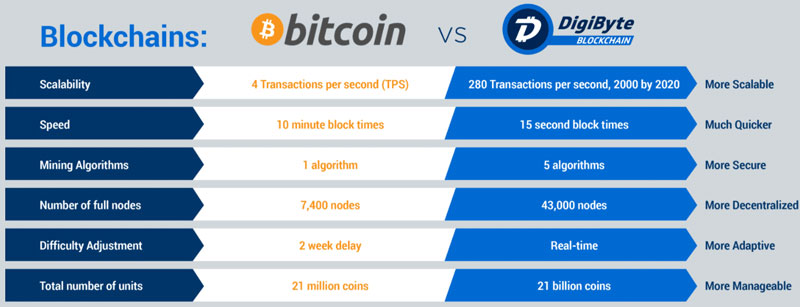
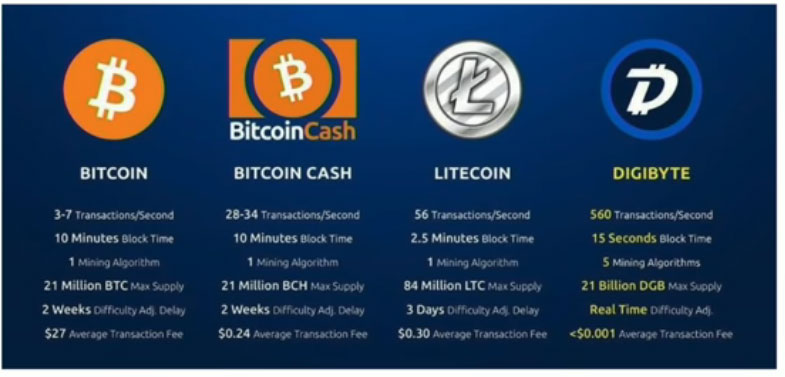
The DigiByte Blockchain technology has quite a bit of variations made from the original Bitcoin source code and whitepaper. We will cover these below like the 21 billion coins issued in 21 years (1% monthly gradual decrease vs the major 4 year), or being 40x faster than Bitcoin with 15-second block times (vs 10 minutes) and doing 560 transactions per second versus only 7 for BTC.
Name: Digibyte
Symbol: $DGB
Date Launch: January 10, 2014
Official Website: digibyte.io
All-Time High Price: $0.128895 DBG/USD exchange rate value on January 6, 2018
Creator: Jared Tate (Josiah Spackman Ambassador and Foundation Member)
Core Team: Gary Mckee, Noah Seidman, GTO90, Yoshi Jager, ploenne, Rudy Bouwman
Whitepaper: No [“we want to be doers. Not white paper pumpers, to under-promise and over-deliver.”]
Features: First altcoin cryptocurrency to adopt SegWit, real-time difficulty adjustment
Functions: Digibyte blockchain has three layers; a core protocol layer, digit asset layer and apps layer
Extras: Block Explorer, BitcoinTalk Forum
Events: DigiByte Global Summit (April 19th, 2019) https://digibytesummit.io/
Social Media Profiles: Twitter, Telegram, Reddit, GitHub
Book: Blockchain 2035: The Digital DNA of Internet 3.0
PR Services: Cassiopeia Services
Support Contact: official website contact form
Let’s review the Digibyte cryptocurrency coin and blockchain technology to see how this unique decentralized communications system works as well as how the promising DigiAssets layer works to help bring issuance of digital assets, tokens, digital identity, smart contracts and more to life.
Digibyte Review: How DGB Coin Works
What is DigiByte?
The DigiByte Blockchain – DigiByte DGB
The Development of DigiByte
The Rest of the Team
The Technology of DigiByte
The 5 Mining Algorithms
Price History: DigiByte’s Spike’s and Crashes
DigiByte’s Future
Reasons to Invest in DigiByte
Purchasing and Storing DigiByte
Purchasing DigiByte
Storing DigiByte
How to Get a DigiByte Wallet
Summary
The cryptocurrency industry kicked off with the launch of Bitcoin over a decade ago, and Bitcoin managed to rule the blockchain until new digital assets called “altcoins” came out. These altcoins have often followed the trajectory of Bitcoin through the years, but there are many assets that have managed to hang in the top assets by market cap as they’ve proven their worth.
What is DigiByte?
Before diving entirely into everything that DigiByte can do, the most important piece of the puzzle is to understand exactly what it is. DigiByte was one of the first altcoins in the entire world, created in 2014. However, it was mostly on its own that year, launching an initial token sale and didn’t have much publicity at the time.
DigiByte has collected many supporters through the last few years, and advocates of the token state that it is more scalable and secure than other cryptocurrencies on the market. Those same supporters believe that it is a solid contender against Bitcoin, Litecoin, and other top options in the market, and already has about 100,000 nodes around the world. However, much like Bitcoin, DigiByte is created with a maximum supply of 21 billion DGB. With this limit, no more DGB can ever be created. The digital asset cryptocurrency DGB has a 1,000:1 ratio to BTC and will be mined in 21 years (2014-2035).
Despite the popularity amongst its users, the adoption of the token has been rather slow, and it is still considered to be obscure, in comparison with the competitors of the token. With the long-time performance of DigiByte, it should come as no surprise that it has also established its own blockchain – DigiByte DGB.
The DigiByte Blockchain – DigiByte DGB
Launching with the DigiByte crypto asset was the blockchain, making it the longest-running blockchain in the entire world. There are many features that it possesses that makes it potentially faster than others, but that year had only a few other public blockchain projects even introduced at the time. The blockchain has an active community, though it may never reach the popularity that Bitcoin did.
Reviews of DigiByte state that the blockchain actually processes at a much faster speed than Bitcoin, and that speed has been rising. Based on projections from the company, the blockchain should be able to handle 2,000 transactions per second by 2020.
The Development of DigiByte
DigiByte was created by a man named Jared Tate in 2013, who launched the genesis block of the cryptocurrency in January 2014. Once the launch commenced, Tate decided to dedicate all of his time to the development of the project, funding the project with donations from the DigiByte foundation. Statements from CoinCentral.com state that it is possible that the team involved with the token hold a lot of DGB themselves, due to the mining processes required for the asset.
Rudy Bouwman is the secretary and vice chairman of the DigiByte Foundation, though he was only appointed to that position in November 2019, according to his LinkedIn profile. Before then, he was the CMO and co-founder of the DigiByte Awareness Team.
The Rest of the Team
While the official website for DigiByte doesn’t state who the team is, but LinkedIn shows a few developers that state that they are involved with the project. Along with Tate and Bouwman, the team seems to be made up of:
Mohamed Rashad, a miner since January 2017
Glenn Grider, a core member in exchange liaison and research since April 2016
Nana Esi Hammah, an economist and outreach associate since May 2018
Michelle Dougherty, a member of the DigiByte Blockchain Awareness since March 2019
Suhas Hegde, a blockchain architect since February 2016
Additional employees are listed on DigiByte for a total of less than 30 people, though their names are presently unavailable.
The Technology of DigiByte
The website for DigiByte is filled with plenty of marketing information, but details on the technical side is a little difficult. The asset is considered to be a UTXO-based cryptocurrency, which means that every new transaction includes a specific identifier on every coin. Anytime a coin enters a user’s wallet, it is categorized as “unspent,” and sending that coin to another person makes it “spent,” inherently stopping the digital currency from being overspent and solving other security issues.
DigiByte’s token is mined in the same was as Bitcoin – with a Proof-of-Work mining algorithm. However, unlike Bitcoin, the platform uses five different mining algorithms – Qubit, Skein, Groestl, Scrypt, and SHA256.
There are three layers associated with the software infrastructure of the DigiByte cryptocurrency. Those three layers include:
Core communications and global network
A public ledger and digital assets
Applications
The 5 Mining Algorithms
By taking on five mining algorithms, the company creates a better opportunity for mining decentralization than what other ASIC-friendly cryptocurrencies do. The SHA256 algorithm is used by Bitcoin, while the Scrypt algorithm is used by Litecoin and Dogecoin. Every 15 to 18 seconds, a new block is mined, using different algorithms, so each one of the five algorithms mine a block every 1.5 minutes.
DigiByte is responsible for introducing Segregated Witness technology, keeping the blockchain small and scalable with limited transaction sizes. Due to these small sizes and five-year track record, the blockchain in the project is the longest in existence, even surpassing Bitcoins’.
Every DigiByte enters circulation with the use of mining, though miners need to use their computing power to process these transactions, adding blocks to the network. A CPU, CPU, or ASIC is needed to do so, which will need specialized mining software and a DigiByte wallet. Consumers can either mine on their own or they can join a mining pool, which is created when multiple miners pool their resources together to share their processing powers. Members of a mining pool split the rewards of their effort equally. Many consumers end up choosing to mine in pools, since solo mining with low hash rates reduces the chance of solving a block.
The different mining algorithms are made to work with different mining hardware. SHA256 and Scrypt are predominantly used by ASIC miners. Skein and Groestl predominantly are used with GPUs instead. However, Qubit works on a combination of different types of hardware. Considering the high cost of specialized mining hardware, it could be less expensive to simply purchase DigiBytes directly, if the user doesn’t already own the computing hardware needed.
With the use of multiple algorithms, the DigiByte miners cannot take 51% control, which means that centralization cannot be achieved, and the network is secured against an attack.
Price History: DigiByte’s Spikes and Crashes
The price of DigiByte has been volatile in recent history, recording relatively constant activity through 2017 with minimal growth. However, there were multiple spikes and crashes through both 2017 and 2018.
The spike in June 2017 coincided with a possible announcement that was set to be released on Twitter. Investors acted quickly to get involved by purchasing DigiByte, which pumped up the price. While the company hinted at the upcoming announcement, the actual release of the announcement didn’t come until a few days later, which stated that the company was launching a new wallet with some new features. However, before the announcement even came out, the price had already dropped below the price of DigiByte before the hint even came out.
The next spike happened around the same time as Bitcoin’s surge, which took Bitcoin to nearly $20,000. From December 2017 to January 2018, the price rose, following a tweet from John McAfee, who said that DigiByte is a company that is worth keeping an eye on. The spike lasted through the start of 2018, but the correction of the cryptocurrency market at the end of January 2018 took down most crypto assets, including DigiByte.
Digibyte price history chart: month by month highs and lows for DGB coin the past two years
Apart from a brief period in Q3, there’s been no real fluctuation for the cryptocurrency in 2018. The rise in price at that time was around the same time that the company announced that their wallets would be available for iOS and Android. At that time, the Apple App Store also started making it possible to make payments in DigiByte.
Through 2019, the cryptocurrency has remained mostly steady with a few spikes – March 2019, April 2019, and between the end of May and beginning of July. However, since mid-June, the value of the cryptocurrency has continued to drop, falling from $0.016274 to $0.0065, as of November 24th, 2019.
DigiByte’s Future
With very little change in the last few years on the cryptocurrency, DigiByte seems to be getting more attention in the gaming industry. In another platform developed by the creators called DigiByte Gaming, gamers are offered the chance to gain DGB as a reward for taking time on the games included.
The CEO of DigiByte – Tate – has committed to pushing for greater focus on the DigiByte Foundation and public outreach. The adoption of DigiByte has been one of the more difficult challenges that the team has faced, though the continued progress of this asset relies on it. Though the token seems to have historically had a solid and loyal following, the token took a dive this year.
The fast transaction speed and scalability of DigiByte makes it ready for the long run in the cryptocurrency market. Predictions by CoinSwitch last year suggest that the total value of DGB will reach $9.20 by 2021.
Digibyte (DGB) History Timeline:
October 2013 = Work on DigiByte begins
January 10, 2014 = DigiByte official launch
February 28, 2014 = DigiShield Hardfork
September 1, 2014 = MultiAlgo Hardfork
December 10, 2014 = MultiShield Hardfork
December 4, 2015 = DigiSpeed Hardfork
April 28, 2017 = SegWit Activated
Sep 19, 2018 = DigiByte Core 6.16.5 Released
April, 2019 = DigiAssets Released
July, 21st 2019 = Odocrypt Hardfork
Digibyte Crypto Exchanges to Trade DGB on:
Bittrex
Cryptopia
HitBTC
Huobi
KuCoin
Litebit
Livecoin
OKEx
Poloniex
Shapeshift
Sistemkoin
Upbit
Yobit
Reasons to Invest in DigiByte
There are many reasons for consumers to invest in the DigiByte crypto asset, starting with the fact that it only takes about 15 seconds to process a transaction, unlike Bitcoin’s 10-minute wait. To add to the security offered by the platform, the creators of DigiByte implemented DigiShield and MultiShield, supporting the longest blockchain in the world.
Now, DigiByte is making the technology available to global payments systems, allowing merchants, consumers, and mainstream societies around the world. With DigiByte Gaming, the asset can even be used in gameplay, giving it long-term potential and the opportunity to expand upon its value. However, as Bitcoin and other cryptocurrencies thrive, they may create competition for DigiByte. There are these Digibyte (DGB) marketing pictures floating around on the internet comparing it to Bitcoin and Litecoin:
and
and
Still, despite the competition, DigiByte remains one of the top 100 cryptocurrencies by market cap, placed directly in the middle.
Purchasing and Storing DigiByte
Right now, DGB is accepted on multiple cryptocurrency markets, including Bittrex, Poloniex, Sistemkoin, HitBTC, Kucoin, Upbit, and YoBit, where it shows high trade volumes. There’s never been an initial coin offering, though the company held a private investment financing round on the project in December 2014 with undisclosed seed capital listed.
Purchasing DigiByte
To purchase DigiByte, consumers need to sign up on an exchange’s website, like Bittrex, Huobi, or Poloniex. However, Binance is another story. Over the last few years, it has become an unfortunate battle, though reports in late 2018 stated that the DigiByte didn’t even need to be listed with Binance. In March of 2019, Tate even stated that the Binance Coin is a “blood sucking token” and “a parosite.”
CoinSwitch advertises that they have a method for consumers to get the best price for their purchases. CoinSwitch is a cryptocurrency conversion platform. Consumers can also use it as a way to exchange other cryptocurrencies for DGB crypto.
Storing DigiByte
DigiByte offers a wallet that is compatible with all operating system, which makes it easy to use it from any compatible device. The wallet from DigiByte must be downloaded from the official website. However, there are also multiple third-party wallets that already support DGB, including Coinomi, Ledger, Trezor, Guarda, Exodus, Satowallet, and others.
How to Get a DigiByte (DGB) Digital Asset Wallet
In order to secure a DigiByte wallet, consumers must download it from their official website. Consumers will need to choose the wallet based on their operating system. Presently, the website has options for:
DigiByte Core Windows (32 and 64 bit)
DigiByte Core Mac OS X
DigiByte Core Linux (32 and 64 bit)
DigiByte Android
DigiByte iPhone & iOS
DigiByte Go Wallet (Chrome Extension)
After downloading the wallet, it will need to be installed on the device, where it can be opened. Consumers are advised to accept the defaults and that the time it takes to sync the wallet might be a little longer. For the best protection, back up the wallet as well.
The website also includes third-party wallets that consumers can download to store their DGB, including Trezor, Ledger, KeepKey, SafePal, Trezor, SecuX, Coinomi, Exodus, ABRA, Jaxx Liberty, OwnBit, EdgeWallet, Atomic, Trust, Satowallet. and Guarda. Consumers that want to see additional wallets can visit DigiByteWallets.com.
Who is Jared Tate?
As mentioned, Jared, a Texas-based computer programmer from Arco, Idaho, is the Digibyte creator and co-author of the Blockchain 2035 book.
Jared has been involved with Bitcoin since 2012, which in the fall of 2013 he found improvements to make in the Bitcoin source code and could not get his changes implemented so we went off and created DGB in 2014 after his bitcoin core protocol improvements were rejected and applied them in the new digital asset, DGB.
Here are a few videos of interviews he has done:
and
and
Summary
Every cryptocurrency is created with a different purpose as each creator interprets a current problem with a way to solve this problem. Digital currencies allow for the possibility of instant transactions and transfers that can cross borders and are even usable for services and physical goods. However, they can also be restricted to specific communities, like social networks and online games. At the end of the day, when there are thousands of crypto coins to choose from, the Digibyte blockchain and DGB cryptocurrency focuses on speed, scale and security and offers a passionate community that in today’s market seems greatly undervalued and will surely benefit from the next bull run more than most of its competitors. We would not be surprised to see $DGB and the Digibyte coin be a top 10-20 token given all of the innovation and advancements they have brought to the ecosystem.
Aziz, Master the Crypto Founder
I’m Aziz, a seasoned cryptocurrency trader who’s really passionate about 2 things; #1) the awesome-revolutionary blockchain technology underlying crypto and #2) helping make bitcoin great ‘again’!
The post Digibyte Cryptocurrency and Blockchain: DGB Coin Analysis appeared first on Master The Crypto.
In a recent tweet, the team at BitTorrent (BTT) has highlighted why the BTFS file system is better than Filecoin (FIL).
The teams behind both projects have been throwing jabs at each other ranging from accusations of plagiarism and going as far as claiming the other is ‘vaporware’.
Filecoin’s (FIL) Mainnet is set to be launched between mid-July and mid-August.
In a recent tweet, the team at BitTorrent (BTT) highlighted why its BTFS file system is better than Filecoin (FIL). The tweet showcased how the BTFS system has more to show than Filecoin that is yet to launch its mainnet after several postponements. The lack of Filecoin having a functional product is the focal point of the debate as to which is better. The full tweet by BitTorrent made 8 comparisons that can be found below.
Why #BTFS is better than #Filecoin? 1⃣ Integrated with $BTT economy 2⃣ #TRON network 3⃣ 100M user base 4⃣ Simple and intuitive Host UI 5⃣ Mainnet launched 6⃣ #BitTorrentSpeed、#DLive 7⃣ Active community 8⃣ Dedicated global professional teams#BTT @justinsuntron @OfficialDLive pic.twitter.com/eY3KSQVE5H
— BitTorrent Inc. (@BitTorrent) May 4, 2020
Previous Tweef Between Filecoin (FIL) and BitTorrent (BTT)
The recent tweet by BitTorrent is a follow up of a Tweef that transpired in mid-April between Justin Sun and Juan Benet of Filecoin (FIL). Benet was the first to point out that BTFS’ new logo looked like it had been plagiarized. His remarks alluded to the fact that Justin Sun and the Tron Foundation have been accused of borrowing ideas from other open-source projects.
Aaaaaahahaha it’s not enough to fork all our code, rebrand it and lie its theirs; copy paste random chunks of our papers, and defraud their investors with a nonsensical mishmash. Tron also can’t even think of an original logo.
Justin Sun was quick to respond to the accusations by asking if the hexagon shape on the new BTFS logo was owned by Benet. Sun went on to accuse Filecoin of copying BitTorrent’s technology. Additionally, he slammed the project as being ‘vaporware’ with no functional product.
Filecoin’s (FIL) Mainnet Launch in 2020
Both the Filecoin and Tron ICOs were carried out in September of 2017. However, Tron has a wide range of achievements under its belt more than Filecoin. As earlier mentioned, the key to the whole discussion is that Tron launched its mainnet in mid-2018 and Filecoin has yet to launch its final version of the platform. At the time of writing this, Filecoin has set its mainnet launch for mid-July to mid-August this year.
(Feature image courtesy of Hermes Rivera on Unsplash.)
Disclaimer: This article is not meant to give financial advice. Any additional opinion herein is purely the author’s and does not represent the opinion of Ethereum World News or any of its other writers. Please carry out your own research before investing in any of the numerous cryptocurrencies available. Thank you.
Unlike the stock markets, the cryptocurrency market never closes and never sleeps, which can be a highly stressful scenario for traders and even casual investors in the industry.
Users familiar with crypto investment will also be familiar with the (joyful or sinking) feeling of waking up in the morning to be greeted by a pleasant or unpleasant surprise when they check their portfolio and see large gains or losses.
As a result of the volatility of the market, trading bots have become increasingly popular among traders by allowing them to remain in control of their trading at all times, with the bot not sleeping even while the trader is. In addition, a correctly specified bot allows trades to be executed faster and more efficiently than the trader would be able to do manually.
The explosion of popularity in cryptocurrency has also resulted in a big increase in the number of crypto trading bots available, either for free from open-source platforms or licensed to users in exchange for flat fees.
However, it is difficult to ascertain which of them work as intended and which of them are an absolute waste of time. This post will consider the background to what exactly trading bots are and whether they work for Bitcoin & Crypto trading (and more importantly, for your Bitcoin trading).
We have rigorously tested each bot on this list, you can click through to each one to view our detailed reports and findings and this post is constantly updated with any new options that come on the market.
Top Trading Bots
If you are in a hurry, here’s our pick of the top 2 bot platforms on the market right now.
In this section we will take a look at some of the popular and publicly-available bots you can use. In most cases these bots will offer more than automated trading. Some of the platforms give clients advanced trading tools, as well as access to numerous crypto exchanges.
Cryptohopper
Cryptohopper is one of the most established players in the auto trading scene for several reasons. Firstly, they run entirely on the cloud, so no installation is required making 24/h trading possible. They also have an incredibly intuitive dashboard, and only require a 5 minute set up to start trading.
Next to this they are the only bot to embed external signalers, allowing new traders to subscribe to a growing list of professional analysts from around the world. Many use machine learning, intelligent algorithms and employ teams of mathematicians to target rising coins. Signals are sent directly to the users bots which buy and sell when they receive them.
Signaler dashboard where you can subscribe
The bot allows you to take advantage of bull markets with a trailing stop-loss, and has full technical analysis features from Stoch and RSI to Bollinger Bands and MACD.
Cryptohopper has a very nice modern dashboard area where you can configure and monitor everything and comes with a config wizard or pre-created templates for the popular exchanges – Binance, Bittrex, Poloniex, GDAX and Kraken.
Traders with more experience can incorporate their favorite technical indicators, triggers and use tools that are handy in bear markets, such as DCA & shorting features.
Unlike many other bots, Cryptohopper does not charge any trading fees, and is one of the few bots to offer a free trial for a month with the ability to upgrade to Bunny ($19 p/m), Hare ($49 p/m) and Kangaroo ($99 p/m).
We have completed an Indepth Review of Cryptohopper here.
Visit Cryptohopper
3Commas
3Commas is a popular trading bot which works with a number of exchanges including Bittrex, BitFinex, Binance, Bitstamp, KuCoin, Poloniex, GDAX, Cryptopia, Huobi and YOBIT. The bot works 24 / 7 with any device as it is a web-based service so you can monitor your trading dashboard on mobile as well as desktop and laptop computers.
It allows you to set stop-loss and take-profit targets and also has a social trading aspect which allows you to copy the actions of it’s most successful traders.
Another interesting feature is it’s ETF-Like crypto portfolio feature which allows you to Create, analyze and back-test a crypto portfolio and Choose from the best performing portfolios created by others.
We have completed an Indepth Review of 3commas here.
Visit 3Commas
Quadency
Quadency is a digital asset management platform that provides automated trading and portfolio management solutions for both retail and institutional traders.
Quadency Review
The platform incorporates a comprehensive range of features designed to streamline the process of trading and investing in cryptocurrencies. These include a variety of trading bots that come pre-configured or can be customized as desired, advanced charting, and portfolio analytics.
These features all combine to enhance the crypto trading experience, and Quadency supports automated trading on Binance, Bittrex, Coinbase Pro, Kucoin, Liquid, and OKEx.
Check out our full Quadency Review here.
Visit Quadency
Coinrule
Coinrule is one of the newest trading bot platforms on the market which has some great features and is suitable for beginners and more advanced traders alike. It supports the most popular exchanges like Binance, BitMEX, Coinbase Pro, and Kraken and can be accessed for free by using a Starter account.
Paid subscriptions range from $29.99 to $249.99 per month with the differing account tiers designed to cater to traders of differing experience and activity levels.
Anyone interested in using the platform can always sign up for a free Starter account and test it out in order to figure out if opting for a paid subscription will be beneficial.
You can check out our full review of Coinrule here.
Visit Coinrule
Exchange Valet
Unlike many of the other trading bots on this list, Exchange Valet is more of a trading toolset and crypto portfolio management platform. Most crypto exchanges don’t give traders a ton of tools to use. Exchange Valet is filling in the gaps with commonly used trading tools like simultaneous stop loss and take profit orders.
If you are used to using a trading platform like MT4 or MT5, the ability to set simultaneous stop loss and take profit orders is taken for granted. Many exchanges don’t support either order type, or allow traders to use both at the same time.
Exchange Valet lets you set both stop loss and take profit orders at the time time, which is extremely useful for active traders.
Let’s say you want to open a position in BTC, but your expectation is that it will rally for another 10%. If you are wrong about the direction of the BTC market, there is no need to stick around and watch your trading capital get eaten up by a nasty downward price movement.
Exchange Valet’s platform would allow you to open up your BTC trade with both a stop loss and take profit order at whatever price level you like. If you are correct, and BTC rallies by 10%, Exchange Valet will lock in that profit by selling the position. If you got it wrong, your stop loss will keep a volatile market from blowing up your trading account.
Handy Portfolio Management Tools Too!
Exchange Valet also allows you to keep an eye on all your positions, and rebalance them almost automatically. The platform will display all of your crypto holdings on a pie chart, and allow you to buy a specific percentage of your portfolio’s total value in a single crypto.
Let’s say you want to hold 40% of your total portfolio’s value in ETH. Exchange Valet will give you a simple input field that will let you buy whatever percentage of any crypto that you like. This is an easy way to make sure you maintain the balance of cryptos that you like, without doing a ton of work.
Exchange Valet also has solid communication tools. All of your orders can be delivered via Telegram (they call it Speedtrade), and other information will be emailed to you if you like. Portfolio info can also be delivered with Telegram, or by using the platform’s proprietary chatbot.
Exchange Valet Lacks Some Features
If you are looking for an automated trading platform, Exchange Valet isn’t going to be a good choice for you. While it does offer super useful trading features, it really isn’t a trading bot. It is also limited to Binance and Bittrex. This may or may not be an issue, but it is something to consider.
Exchange Valet is also costs cryptos to use. The platform offers new users a 14 day free trial, but after that it will cost you $29 USD per month, $75 USD for three months, or $250 USD if you buy a year’s worth of service.
If you are an active trader with a big portfolio these prices could make sense, although there are other platforms that give you more features for a similar price.
Two areas where Exchange Valet shines are security and connectivity. The platform meets ISO 27001, ISO 27017, and ISO 27018 standards for data security. It also offers a lot of information via Telegram, which is great if you want to keep an eye on your portfolio when you aren’t in front of a computer.
Worth Learning More About
If you prefer to trade your own account, Exchange Valet could be a great tool for you. While it does lack algo-based trading features, it does offer traders all the tools they would find on a conventional trading platform.
Exchange Valet takes your security seriously, which is great to see. The communication tools that Exchange Valet built are also useful. If you are looking for a platform that fills in the gaps that exchanges left open, Exchange Valet is worth a deeper look!
Read our full review of Exchange Valet here.
Visit Exchange Valet
CryptoTrader
The CryptoTrader bot is a cloud based trading bot that provides users with fully automated trading solutions while not requiring them to install the bot on their own system. CryptoTrader features a strategies ‘marketplace’ that allows users to buy their favorite trading strategy, or alternatively to sell strategies developed by themselves.
Cryptotrader supports most of the major exchanges for both backtesting and live trading, with the backtesting tool allowing users to review how their strategies would work under different market conditions.
CryptoTrader offers five different subscription plans, with fees ranging from 0.006 BTC to 0.087 BTC per month (Bitcoin is the only payment method accepted). The separate packages include a number of differences, including the number of bots operating on the user’s behalf as well as the maximum equity limit.
Although though some knowledge of coding is beneficial when setting up strategies in the CryptoTrader bot, there are a number of free and paid strategies available for users that are not experienced / interested in coding.
The CryptoTrader bot also has a wide level of interoperability, with the service offering email and text notifications to alert users on important market events or changes in trends.
Read our Indepth Review of CryptoTrader.
Visit CryptoTrader
Haasbot
Created in 2014 by Haasonline, Haasbot trades Bitcoin and many other altcoins,
Although Haasbot is probably the most complete of the trading bots that are currently available, doing much of the labour with relatively minimal input required from the user, in order to provide this service it is pretty expensive, with costs ranging from between 0.04 BTC and 0.07 BTC for a three-month period.
At those prices, it is clear that anybody willing to take a chance on it should be knowledgeable about what they expect to get out of the platform and be committed to doing so.
Haasbot is an outgrowth of HaasOnline Software, which was started by Stephan de Haas in the 1990’s. The same company is also behind HaasOnline Trade Server (HTS), which is a automated system that is designed to trade cryptocurrencies.
The Haasbot platform operates on Windows, MacOS, and Linux, and allows traders to choose from more than 10 different ‘bots’. The more you decide to spend, the more bots you will have access to on the platform.
Given the prices involved in using the bots, it is a good idea to do some research on the returns they have generated in the past.
Read our Indepth Review of HaasBot here.
Visit Haasbot
Zignaly
Zignaly is a trading terminal with cryptocurrency trading bots that lets you trade automatically with help from external crypto signal providers. For the moment the platform costs just $12 per month.
The platform is incredibly easy to use and can be utilized as a passive income machine. Zignaly lets you easily connect with a TradingView account, so you can use it with your favorite indicators. Alternatively, you can use the Zignaly trading terminal to create your full strategy at once.
Because Zignaly is still pre-launch, the number of exchanges that it operates with is limited. The development team says that once the full version is live, KuCoin, Coinbase Pro, Poloniex and Bittrex will be added to the platform. The company also plans to offer its clients unlimited currency pairs without any additional cost.
One of the nicest things about Zignaly, besides the price, is the developers’ commitment to transparency. The full development teams’ info is available online, and anyone who wants to learn more about the founders can find their personal information on their social media profiles.
Read our Indepth Review of Zignaly here.
Visit Zignaly
Apex Trader
Apex Trader is another newer platform which offers and easy intro into trading automatically use bots. The platform features trading bots that can be used to employ a number of trading strategies, and work via API connections to popular cryptocurrency exchanges including Binance, ByBit, Kraken, and KuCoin.
Apex Trader is highly configurable and provides over 100 technical indicators which means that anyone can create their own automated trading strategies and then deploy them to run 24/7 on a wide range of trading pairs.
Apex Trader Homepage
The platform’s free 7 day trial period also allows you to get a feel for Apex before committing to a paid monthly subscription.
We have also reviewed Apex Trader here.
Visit Apex Trader
Cap.Club
Cap.Club is a simple way to gain access to advanced trading features. The platform was designed in Russia, and currently works on Binance and Bittrex. The platform offers traders automated buying and selling algos, as well as advanced order types.
One of the first things that you will probably notice about Cap.Club is the simplicity of both its website and interface. If you are just getting into automated trading, or have little coding knowledge, this simplicity could be a big plus for you.
The platform comes in two versions.
The free version will give you all of the trading strategies that the full platform features, but you will be limited in how many can run at once. The free account is also limited in communication. The full version will send you alerts via both Email and Telegram, but the free one is only going to contact you with Email.
If you want to use the platform for free, it is ready to go. For those that want to upgrade, it currently costs $30 USD per month, or can also be bought on a yearly basis for a discounted price of $300 USD.
Simple to Use, Lots of High-End Features
Don’t let the simplicity of Cap.Club’s interface fool you, it delivers some high-end trading tools. In addition to limit and trailing orders, Cap.Club offers it users three trading programs:
Smart Sell (long)
Smart Buy-Sell (long)
Smart Sell-Buy (short)
These algos seek to make money automatically for Cap.Club’s clients. There aren’t a ton of reviews out there for how effective the algos are, but they are all 100% free to use with the basic package.
The platform that Cap.Club put together offers a lot of value, and also is a nice compromise between an algo-driven trading platform, and a trading platform that gives you some of the normal trading tools that are lacking on most crypto exchanges.
Cap.Club also includes a visual strategy editor with both the free, and premium package. If you understand how trading strategies work, but can’t put them into code, a visual strategy editor could be a good fit for you.
Instead of having to write your own algo in code, you can use a visual strategy editor to lay it out with symbols. Once you have the strategy together, it is simple to run. You may find that your strategy ideas are profitable, and they could help you outperform the market.
Cap.Club Gives You a Lot
The fact that Cap.Club allows you to use its platform for free is great. While you will be limited in how many strategies and APIs you can run at once, it will help you to figure out if the platform makes sense for you.
For frequent traders having some sort way to use limit and trading orders is almost necessary. Buying and selling at market rates isn’t ideal. Trailing stops and take profit orders can help you to ride a winning position, which makes it possible for a single position to make the entire subscription worthwhile.
The big downside to Cap.Club is the fact that it only supports two exchanges.
If you don’t want to trade with Binance or Bittrex, then Cap.Club isn’t going to be of much use to you. That said, it is really easy to set up Cap.Club with Binance and Bittrex, which makes opening a new account at one or both of the exchanges worth thinking about.
Easy Set-Up and Support
Once you open up your Cap.Club account, all you have to do is go to the exchange of your choice, and generate an API. You will get a new API, and a secret code. Just go back to Cap.Club, and enter the info into the fields it provides you with. The process is super simple, and should only take you a few minutes.
Cap.Club also has a deep support section online. If you need help connecting your exchange account to their platform, or figuring out how to use any of the tools, you should be able to find any information you need. The support is included with both account types, which is a great feature.
Overall Cap.Club looks like a capable automated trading platform that also gives traders some useful tools, as long as you use one of its two supported exchanges.
Visit Cap.Club
Signal Groups
Signal is a platform that is made specifically for Binance. Signal does give traders on Binance some badly needed tools, and a high level of connectivity. If you want automated trading, or to use another exchange, this platform isn’t for you.
Much like Exchange Valet, Signal gives traders the tools they would find on a trading platform like MT4. In addition to simultaneous stop loss and take profit orders, it also allows traders to program laddered buying, as well as trailing stops.
Most of the features that Signal offers are extremely useful for traders. While a platform like Signal isn’t really going to be useful for a crypto investor who is looking to HODL for the long-term, the tools that Signal delivers will help traders who are used to fully-featured trading platforms.
Signal is Built for Binance
If you trade on Binance and are looking for advanced trading tools, Signal could be the right platform for the job. As mentioned above, being able to use stop loss and take-profit orders simultaneously is a must for traders.
In addition to adding simultaneous stop loss and take-profit orders, Signal gives you the ability to buy into a position over a period of time. This is called a laddered buy, and it cab be handy if you think there is a big move coming in a token’s price.
Instead of buying your entire position at one, you can automatically set Signal up to do the buying for you. This can also be good for larger traders who want to spread their orders out, and reduce the chance they will influence the market price of a token noticeably.
Signal also offers two interesting tools that some traders might find useful.
The platform allows users to sell existing coins, and also has a ‘targets’ tool. The sell existing coins tool allows Signal users to sell specific coins, and the targets tools lets traders set levels where positions can be sold. Both tools may be handy for advanced traders.
Great Connectivity
Signal offers a simple set of tools, but it can be accessed from almost any device. Many of the other platforms on this list have to be run on a computer, and won’t work on iOS or Android.
Connectivity is one area where Signal shines. You can use the platform from just about any device, including the two most popular mobile operating systems. If you are looking for a fully-featured trading platform for Binance that you can use almost anywhere, Signal is a good fit.
The platform will also notify you via SMS when your orders are executed, which can be handy if you need to stay on top of the market. It also gives you the ability to track your trading performance over time, which can be very handy if you are trading frequently.
Not Built for Everyone
Signal isn’t going to be a good fit for every crypto trader out there. While it does fill in some gaps on Binance, it only works with one exchange, and doesn’t offer any sort of algorithmic trading options. If you are looking for a bot, this isn’t the platform for you.
There isn’t much information on the costs involved with using Signal, and it could be free. There is also the promise of more features in the future, as the website states that “this is just the beginning.”
If Signal is free to use, and the team behind it is planning to add exchanges and features in the future, it is very promising for the platform. As it stands today Signal is a good looking product that has a clean interface, as well as a solid development team behind it.
The platform seems to be geared towards frequent traders, and could be a good fit if you are on Binance, and trade a lot. Even with the more basic trading tools that Signal offers regular traders will probably have a much raiser life.
Read our Full Signal Review here.
Visit Signal
Live Trader
If you are looking for a one stop trading bot platform, Live Trader could be the thing for you. Depending on which plan you decide to sign up for, Live Trader will give you access to 25, 250 or 1000 unique trading bots.
Live Trader also works with some of the largest crypto exchanges out there. You can use Live Trader with Polonix, Bitstamp, Bitfinex, Binance, KuCoin and Kraken. The platform is 100% cloud-hosted, which makes it easy to run on just about any hardware there is.
Connecting Live Trader to your exchange, or exchanges of choice is simple, and Live Trader has lots of support tools online to help its clients get their account set up quickly.
The real advantage that Live Trader offers clients is the sheer number of trading bots, as well as a novel back-testing system. Unlike some platforms that need direct access to an exchange to do backtesting, Live Trader can run advanced backtesting simulations on paper.
Live Trader Offers a Lot
The first thing to notice about Live Trader is the number of exchanges that it will function with. Instead of being limited by your trading bot, Live Trader gives you numerous choices for an exchange. It also allows you to run multiple trading strategies at the same time, depending on which plan you decide to purchase.
While Live Trader is a pay-only service, it does offer a limited free trial so you can learn more about what you would be buying if you sign-up. The basic plan allows you to run one strategy, the mid-level plan gives you five simulations strategies, and the top-level plan that gives you 1000 bots to choose from will let you run 10 of them at once!
If you are wondering about pricing, the base plan costs $15 USD per month, the mid-level plan costs $39 USD per month, and the top-level plan will run you $79 USD per month. Given that Live Trader takes care of all the hosting, the rates it charges aren’t unreasonable.
Geared for Algos
Live Trader is definitely set up for traders that want to use algos. If you are looking for a platform that will give you some advanced order types, and a few basic algos, Live Trader might be overkill. On the other hand, if you are looking for a deep selection of automated trading algos, Live Trader could be a perfect fit.
There are a truly amazing number of automated trading algos on Live Trader. In addition to the algos that Live Trader has available, there is also an algo marketplace you can browse through.
If you would like to develop your own trading tools, Live Trader has a strategy builder that will allow you to construct your own strategies, and back test them on any exchange the platform supports. All of this adds up to a huge selection of algos for automated crypto trading on some of the most popular crypto exchanges out there.
Not a Freebie
Live Trader does deliver a lot of algorithmic trading, but it isn’t cheap. If you are on the fence about how algos might fit into your crypto trading, Live Trader could be a lot to take on at first. The entry-level plan Live Trader isn’t too expensive, and could be a good place to get started with automated crypto trading.
With all the features that Live Trader includes, it is reasonable to expect that the more advanced plans would cost substantially more.
Live Trader lets you trade on numerous exchanges with a multitude of algos at the same time, which isn’t the easiest thing to do on the back-end. All those cloud servers cost money, and doing the same thing on your own machine would get expensive.
Live Trader is a Great Platform for Algo-Driven Trading
There isn’t any getting around the amount of algos that Live Trader lets you access with either the mid or high level subscription. Having 250+ algos to choose from is an amazing tool set for any crypto trader to use.
If you are looking for a platform that delivers loads of algos, works with many of the most popular crypto exchanges, and lets you do extensive off-exchange backtesting, Live Trader is worth learning more about.
All of the plans also have a solid support system backing them up, which you can learn more about on the platform’s website. The homepage also offers a chat window, which is nice to see!
Visit Live Trader
GunBot
GunBot is a well known cryptocurrency trading bot which uses individual strategies that are completely customisable to fit your trading style. It can operate on the following exchanges: Bittrex, Binance, Poloniex, Bitfinex, Cex.io, GDAX, Kraken and Cryptopia. You can run the bot on your own computer or use a VPS and can manually add different coin pairs, pick a strategy and set it to work.
GunBot a versatile trading platform, and it also offers a lot of value for the money. The platform has a few different plans, that range from 0.04 BTC for the Starter Edition to 0.3 BTC for the Ultimate Edition. At current prices, the starter edition would only cost $160 USD, and offers users the option to buy a lifetime license for an additional fee.
The features that GunBot includes in its Starter Edition are worthwhile for the price. Included in the Starter Edition is a copy of GunBot Lite, as well as three algos to choose from. The next two levels add loads of functionality, with the Pro Edition adding backtesting capabilities, and cryptosight as standard features.
GunBot can be used on any of the major platforms, including Linix or VPS. It is estimated that there are more than 6,000 traders that use GunBot on a daily basis, and it has gotten numerous positive
Visit GunBot
Gekko
Gekko is an open-source trading bot and backtesting platform that supports 18 different Bitcoin exchanges. Gekko is entirely free and can be found on the GitHub platform. Gekko is a relatively straightforward trading app to use that includes an interface and basic strategies from the outset, which allows you to be more comfortable with the use of the bot.
Gekko also has a number of plugins available that will allow you to be updated regardless of what level of connectivity you have. Although Gekko is not a high-frequency trading bot (making only a couple of trades per week, depending on configuration), nor a bot which allows you to exploit arbitrage opportunities, its list of supported exchanges and basic strategies means that it is probably a good place to start for anybody interested in utilizing Bitcoin trading bots.
Visit Gekko
Zenbot
Similar to Gekko, Zenbot is also an open-source trading bot for Bitcoin traders. As an open-source project, Zenbot is available for users to download and modify the code as necessary.
However, there have been question marks in the community over the development of Zenbot, with no updates having been made to the platform for a significant number of months. This means that no additional exchanges have been added to the platform for almost one year, meaning that it may have access to less information than some of its competitors. However, on the positive side, Zenbot, unlike Gekko, does offer high-frequency trading as well as supporting multiple cryptocurrencies in addition to Bitcoin.
Visit Zenbot
What are Trading Bots?
In essence, a trading bot is a software program that interacts directly with financial exchanges (often using API’s to obtain and interpret relevant information) and places buy or sell orders on your behalf depending on the interpretation of the market data.
The bots make these decisions by monitoring the market’s price movement and reacting according to a set of predefined and pre-programmed rules. Typically, a trading bot will analyze market actions, such as volume, orders, price, and time, although they can generally be programmed to suit your own tastes and preferences.
Trading bots have been popular for many years in various conventional financial markets. However, trading bots have not been traditionally available to the average investor as they cost a significant amount of money.
For example, a Bloomberg terminal can often cost in excess of $10k. However, due to the transparent nature of blockchain, cryptocurrency exchanges tend to grant their customers direct market access that provides users with the opportunity to analyze the exchange’s electronic order book, which was a type of access that was traditionally exclusively available to brokers and investment houses in conventional financial markets.
With many people trading Bitcoin passively and therefore unable to dedicate large amounts of time to analyze the market, the intention is that Bitcoin bots will allow users to establish more efficient trading without having to keep on top of the market at all times.
Types of Trading Bot Strategies
Although the cryptocurrency market is much less mature than other financial markets, the digital nature of the market has meant that despite the fact that it has had significantly less time to integrate algorithmic trading, the technology has not been slow in catching up on its rivals in terms of providing a trading bot service, allowing for investors to obtain access to a wide range of trading strategies, some of the most popular of which are considered below:
Arbitrage
In the early days of cryptocurrency trading one of the primary strategies that traders used to make profits was arbitrage – i.e. buying assets in one market and then selling them in another for a higher price, thus earning profit on the difference. As cryptocurrency exchanges were decentralized, there were often large differentials between prices offered on various exchanges, meaning that profits could be made through arbitrage.
Although the spread between exchanges are much smaller now, they do still appear from time to time and trading bots can assist users in making the most of these differentials. In addition, arbitrage can also be utilized in traders looking to involve futures contracts in their trading strategies by benefiting from any difference that exists between a futures contract and its underlying asset, by considering futures contracts that are traded on various different exchanges.
Market Making
Trading bots can also allow investors to use the market making strategy. This strategy provides for “continuous buy and sell prices on a variety of spot digital currencies and digital currency derivatives contracts” in an effort to “capture the spread between the buy and sell price”.
In order to carry out the market making strategies, in involves making both buy and sell limit orders near the existing market place. As prices fluctuate, the trading bot will automatically and continuously place limit orders in order to profit from the spread.
Although this may be profitable at certain periods, the intense competition around this strategy can result in it being unprofitable, especially in low liquidity environments.
Do Trading Bots Work?
Trading bots work by reacting to the market. It gathers the data it needs in order to execute a trade based on analysis of the trading platform. However, with cryptocurrency, the trading platform only tells half of the story, with many rises and falls being based on other sources (such as John McAfee’s Twitter or other online rumors!) that cannot be programmed into the bot for analysis.
In addition, as noted above, the spread between the exchanges has flattened somewhat, meaning that the opportunities for inter-exchange arbitrage are much lower than in previous years.
Many trading bots use what is known as an exponential moving average (EMA) as a starting point for analyzing the market. EMA’s track market prices over a set time period, and bots can be programmed to react to what that price does – such as moving beyond certain thresholds.
By programming the bots, traders can set their thresholds to correspond with their risk appetites. However, one of the downsides of EMA is that it is based on past history, which, as all traders will know, is not indicative of future performance, especially in the cryptocurrency industry where volatility is rife. Therefore the question of whether trading bots work is a multi-faceted one in which the problem answer is that they work, but not necessarily for everybody.
Trading bots offer a variety of advantages, including having constant interaction with the market, as well as the not-insubstantial factor of removing the emotion from trading. However, on the other hand, by using the wrong trading strategy or relying on the trading strategy of others, a trading bot could simply end up automating a set of poor market trading decisions.
Reasons to Consider Using a Bot
Cryptos are a great new asset class, but it is hard to create a return from them in the same way that cash or a stock creates value. Most people associate stocks with gains from price appreciation, but many of the best stocks pay out dividends. There isn’t really an analogue for this in the crypto market, unless crypto owners lease out their cryptos to derive an income from their holdings.
From an investment standpoint, passive income is extremely important. As the last year has shown us, we can’t assume that asset prices will show gains year-over-year. One argument for holding stocks through a bear market is that they will continue to pay dividends, which can then be reinvested in the company when the stock prices is depressed.
Cryptos are more like a commodity than a company from an investment standpoint, which leaves investors with something of a problem. There is absolutely no reason to hold on to a commodity in a bear market, as it doesn’t deliver any kind of return aside from price appreciation.
Trading Bots Give Crypto Investors Income Options
If you want to put your crypto portfolio to work for you, trading bots could make sense to use. There are many different kinds of bots out there, and some can take advantage of market movements to create gains automatically.
Instead of relying on dividends, trading bots allow you to leverage your crypto holdings to make an income via trades. This system of income generation may not be quite as secure as compounding dividends, but it is one of the only options available to crypto investors.
The ‘bot’ is important because unlike a human, it is awake and looking for income opportunities 24/7. Of course, there is no such thing as free money.
Any risk that can generate a return has the potential to lose money. It is a good idea to make sure that any automated investment platform you choose to trust with your cryptos can prove that it works with a verifiable transaction history.
Be Realistic About Returns
It is easy to get carried away with dreams of quick money made in the financial markets.
The years that led up to the massive crypto rally of 2017 were amazing, but now the reality of the crypto market is setting in. If you are looking to make the kind of returns that many saw in 2017 with a trading bot, you will probably be disappointed, or go broke.
The simple fact is that in order to create returns, you have to take on risk. The bigger the risk, the greater the possible return. On the other hand, when you take big risks, the possibility that you will face catastrophic losses is very real. There isn’t any algo that can ‘de-risk’ trading, no matter how advanced it is.
If you are looking to make 3-6% per year on your crypto holdings with a trading bot, you will probably find something that works for you. There are many low risk trading strategies that do produce returns, and an algo will make sure that you don’t lose your discipline lunging for the brass ring.
Keep in mind that a portfolio manager than can consistently produce annual returns around 10% will beat 99% of professional money managers. Expecting an algo to do more than that probably isn’t wise.
Conclusion
Trading bots can assist traders in ensuring that they are always interacting with the market, even when they are physically unable to do so. They can assist in removing some of the stress and emotions that are often found in any financial trading markets, not least the cryptocurrency market.
However, trading bots are not for everybody, nor does everybody need one. Casual investors are not the prime target of trading bots, and if your intention is to buy and hold Bitcoin then a trading bot is probably not the correct investment for you.
In addition, if you are not a competent programmer or familiar with the creation of financial strategies, trading bots may also not be for you. However, if you have the requisite knowledge and ability to overcome these obstacles then a trading bot can be a worthwhile tool in monitoring and making gains from the Bitcoin market.
The post Beginner’s Guide to Bitcoin & Crypto Trading Bots appeared first on Blockonomi.
We use cookies on our website to give you the most relevant experience by remembering your preferences and repeat visits. By clicking “Accept”, you consent to the use of ALL the cookies.
This website uses cookies to improve your experience while you navigate through the website. Out of these, the cookies that are categorized as necessary are stored on your browser as they are essential for the working of basic functionalities of the website. We also use third-party cookies that help us analyze and understand how you use this website. These cookies will be stored in your browser only with your consent. You also have the option to opt-out of these cookies. But opting out of some of these cookies may affect your browsing experience.
Necessary cookies are absolutely essential for the website to function properly. These cookies ensure basic functionalities and security features of the website, anonymously.
Cookie
Duration
Description
cookielawinfo-checkbox-analytics
11 months
This cookie is set by GDPR Cookie Consent plugin. The cookie is used to store the user consent for the cookies in the category "Analytics".
cookielawinfo-checkbox-functional
11 months
The cookie is set by GDPR cookie consent to record the user consent for the cookies in the category "Functional".
cookielawinfo-checkbox-necessary
11 months
This cookie is set by GDPR Cookie Consent plugin. The cookies is used to store the user consent for the cookies in the category "Necessary".
cookielawinfo-checkbox-others
11 months
This cookie is set by GDPR Cookie Consent plugin. The cookie is used to store the user consent for the cookies in the category "Other.
cookielawinfo-checkbox-performance
11 months
This cookie is set by GDPR Cookie Consent plugin. The cookie is used to store the user consent for the cookies in the category "Performance".
viewed_cookie_policy
11 months
The cookie is set by the GDPR Cookie Consent plugin and is used to store whether or not user has consented to the use of cookies. It does not store any personal data.
Functional cookies help to perform certain functionalities like sharing the content of the website on social media platforms, collect feedbacks, and other third-party features.
Performance cookies are used to understand and analyze the key performance indexes of the website which helps in delivering a better user experience for the visitors.
Analytical cookies are used to understand how visitors interact with the website. These cookies help provide information on metrics the number of visitors, bounce rate, traffic source, etc.
Advertisement cookies are used to provide visitors with relevant ads and marketing campaigns. These cookies track visitors across websites and collect information to provide customized ads.