Signal, the cross-platform encrypted messaging service is facing criticism this week, after the company Signal Messenger told the public it was integrating the cryptocurrency mobilecoin. Moreover, controversy surrounds the company’s founder and CEO Matthew Rosenfeld, known as ‘Moxie Marlinspike’ over his previous ties with the Mobilecoin project.
The Relationship Between Mobilecoin and Signal
During the last week, Signal Messenger has been under fire for integrating the privacy-centric cryptocurrency mobilecoin (MOB). The subject has been trending on social media and forums as a number of crypto advocates are not pleased with the choice.
According to the MOB project’s website, the entire distributed ledger is “opaque” as “individual transactions are cryptographically protected, and the network uses forward-secrecy.” Since Signal’s announcement MOB has gained over 450% since then and today it’s up 20% during the last 24 hours.
MOB is currently trading for $58 per unit and the trading platform FTX Exchange is the most active market trading it today. Controversy is tied to the relationship Marlinspike allegedly had with Mobilecoin prior to the integration. Word on the street is Marlinspike was simply a MOB advisor but documents indicate the Signal founder may have played a CTO role.
In addition to that controversy, the project has been accused of being centralized, a copy of monero (XMR), and 100% pre-mined as well. A pre-mine is when the network’s entire supply of native tokens is created right away and developers and early investors have access to it all.
“Mobilecoin is 100% premined,” the Reddit user and r/cryptocurrency forum moderator u/samsunggalaxyplayer said. “100% of the supply was created in 16 outputs that can be distributed however the initial founders like. There is extremely limited information about how they will be distributed, though it’s highly likely that the founders will keep some for themselves.”
‘Private Keys Stored on a Secure Enclave,’ Mobilecoin CEO Denies Marlinspike Was a CTO
The Redditor also said that Mobilecoin team members like to “discredit Monero wherever they can.” On Twitter, software developer Pokkst spoke out against the Mobilecoin project as well. A few more things about Mobilecoin,” the developer tweeted. “When Mobilecoin is run with Intel SGX, user’s private keys are transmitted to remote nodes and stored in their secure enclave. Lol. Basically Intelcoin. It’s 100% premined, with a hardcoded 0.01 MOB fee per tx. Currently, that’s $0.66 per [transaction]. All [transaction] fees currently go to Mobilecoin Foundation.”
Pokkst added:
The creator of Signal has a huge stake in Mobilecoin, so Moxie is pumping his bags by using Signal.
Following the Mobilecoin announcement, people who disliked Signal’s integration with MOB started to recommend the encrypted messaging service called Session. The Session project leverages a blockchain and is a Signal fork. Despite the documentation showing Moxie as the CTO, Mobilecoin CEO Joshua Goldbard recently said that “Moxie was never CTO.”
What do you think about the controversy over Signal and the Mobilecoin project? Let us know what you think about this subject in the comments section below.
On April 9, 2021, the Delaware-based company and sponsor of the “Kryptoin Bitcoin ETF Trust” filed an S1 amendment for a bitcoin exchange-traded fund (ETF) with the U.S. Securities and Exchange Commission (SEC). The asset manager re-filed its 2019 ETF application and instead of leveraging NYSE, the company plans to use Cboe BZX.
Kryptoin Joins the List of Bitcoin ETFs Hoping for Approval in 2021
The race for a bitcoin exchange-traded fund (ETF) in the United States has grown thick with competition in recent days. The asset manager Kryptoin has recently revealed it has re-filed with the SEC in order to get an ETF approved. With Kryptoin joining the competition, there are now seven bitcoin-based ETFs hoping to get approved by the U.S. regulator. The list includes Valkyrie, Vaneck, Fidelity, NYDIG, Wisdomtree, First Trust & Skybridge, and Kryptoin.
Kryptoin’s prospectus is not much different than its 2019 filing, except at that time it had chosen to list on NYSE Arca. However, this time around, Kryptoin’s prospectus sent to SEC on Friday named Cboe BZX as the listing exchange. Kryptoin has decided to add its prospectus to the list of bitcoin ETF filings, while both Vaneck and Wisdomtree step up for the SEC review. The company’s product will be named the “Kryptoin Bitcoin ETF Trust,” and the company would like to launch as soon as it is permissible.
The preliminary prospectus subject to completion further notes the “objective is to provide exposure to bitcoin at a price that is reflective of the actual bitcoin market where investors can purchase and sell bitcoin, less the expenses of the Trust’s operations.” Kryptoin adds that the firm will leverage a reference rate in order to determine the value of shares.
The SEC filing states:
In seeking to achieve its investment objective, the Trust will hold bitcoin, and in seeking to ensure that the price of the Trust’s shares is reflective of the actual bitcoin market, the Trust will value its shares daily as determined by the CF Bitcoin US Settlement Price.
Kryptoin CEO Has Experience With the SPDR Gold Shares ETF
There are already two North American bitcoin-based ETFs in Canada, and a few weeks ago in South America Brazil launched its first bitcoin ETF as well. The United States has yet to allow a bitcoin ETF, as the SEC has denied plenty and many have withdrawn their preliminary filings. The SEC has cited issues like price manipulation but since a lot of institutional money has jumped into the crypto ecosystem, many firms have hopes for 2021 approval.
Kryptoin’s ETF is led by Jason Toussaint, a businessman who has a lot of experience with ETFs. Toussaint was previously the CEO of World Gold Trust Services, a sponsor of SPDR Gold Shares ETF (GLD). Kryptoin’s CEO and board member Toussaint has also worked with ETFs and other investments with Morgan Stanley, Northern Trust Asset Management, and JP Morgan Asset Management.
What do you think about Kryptoin’s bitcoin ETF filing and the other ETFs waiting for approval? Let us know what you think about this subject in the comments section below.
Goldman Sachs CEO David Solomon foresees “big evolution” coming to cryptocurrency regulation as demand for bitcoin from clients continues to rise. He says that Goldman will “continue to find ways to serve our clients as we move forward.”
Crypto Regulation Will Experience ‘Big Evolution,’ Says Goldman Sachs’ Chief
David Solomon, the CEO of global investment bank Goldman Sachs, shared his view on cryptocurrency regulation in an interview with CNBC this week.
Regarding the regulation for bitcoin and other cryptocurrencies, the Goldman Sachs executive said he thinks that cryptocurrency “is a space that’s evolving,” predicting:
I think there’ll be a big evolution as to how this evolves in the coming years.
Emphasizing that his company operates within the rules set by regulators, the Goldman Sachs CEO noted: “I’m not going to speculate on where the rules will go for regulated financial institutions, but we’re going to continue to find ways to serve our clients as we move forward.”
Solomon detailed that Goldman Sachs is focused on how to support demand from clients for bitcoin and other cryptocurrencies. “We continue to think about digital currencies and the digitization of money in a very proactive way,” he opined, mentioning specifically that his firm “can help clients facilitate custody positions in digital assets.”
The Goldman Sachs chief reiterated: “As our clients have demand to be involved in this space we can continue to find ways to support our clients … That’s the lens that we’re really looking through.” Solomon clarified:
There are significant regulatory restrictions around us and us acting as a principle around cryptocurrencies like bitcoin.
Goldman Sachs recently brought back its bitcoin trading desk and will be offering a “full spectrum” of bitcoin investments. The firm is seeing huge institutional demand for bitcoin.
Do you agree with Goldman Sachs’ CEO about regulatory evolution coming to the crypto space? Let us know in the comments section below.
In the SEC v. Ripple case, the court has denied the request by the U.S. Securities and Exchange Commission (SEC) for personal financial records of Ripple’s executives that are not connected to XRP. The court says that it “is not convinced” that personal banking records would show the violations as claimed by the SEC.
Another Win for XRP in SEC v Ripple Case
In the lawsuit brought by the U.S. SEC against Ripple Labs, CEO Brad Garlinghouse, and co-founder Christian Larsen over the sale of XRP tokens, the court has denied the SEC’s request to obtain personal financial records of the defendants that are unrelated to XRP. The order was signed by Magistrate Judge Sarah Netburn on Friday.
“The SEC has served the individual defendants with Requests for Production seeking their personal financial records over an eight-year period,” the order explains. It adds that the commission has “also issued third-party subpoenas to several financial institutions at which the individual defendants maintain accounts, seeking similar records.”
The order notes: “Garlinghouse and Larsen move for a protective order to avoid their discovery obligation and to quash the subpoenas served upon SVB Financial Group, First Republic Bank, the Federal Reserve Bank of New York, Silver Lake Bank, Silvergate Bank, and Citibank, N.A. The motion is granted.”
Referencing Section 5 of the Securities Act, which details that all issuers must register non-exempt securities with the SEC, the order states:
The court is not convinced that the personal banking records would show (or even could show) what the SEC claims they would – individual violations of Section 5.
The judge additionally has found that “the SEC has not presented any evidence that individual defendants have hidden transactions or that the documents produce support any inference of hidden transactions.”
Furthermore, the judge explained that the motion for a protective order by Garlinghouse and Larsen is granted because “the court finds that the SEC’s requests for the individual defendants’ personal financial records, apart from those records of XRP transactions that are already promised, are not relevant or proportional to the needs of the case.” The judge further ruled:
The SEC shall withdraw its Requests for Production seeking the individual defendants’ personal financial records and withdraw its third-party subpoenas seeking the same.
“If, as discovery progresses, the SEC uncovers evidence that the individual defendants have not been forthcoming with records of their XRP transactions, it may provide such evidence to the court and renew its application,” the order concludes. The full court filing can be found here.
Ripple recently won discovery from the SEC and the commission has been ordered to produce internal records on bitcoin, ether, and XRP. Meanwhile, a petition has been started asking SEC’s new chairman to drop the Ripple lawsuit and end the war on XRP.
What do you think about the judge ruling in favor of Ripple against the SEC over personal financial records unrelated to XRP? Let us know in the comments section below.
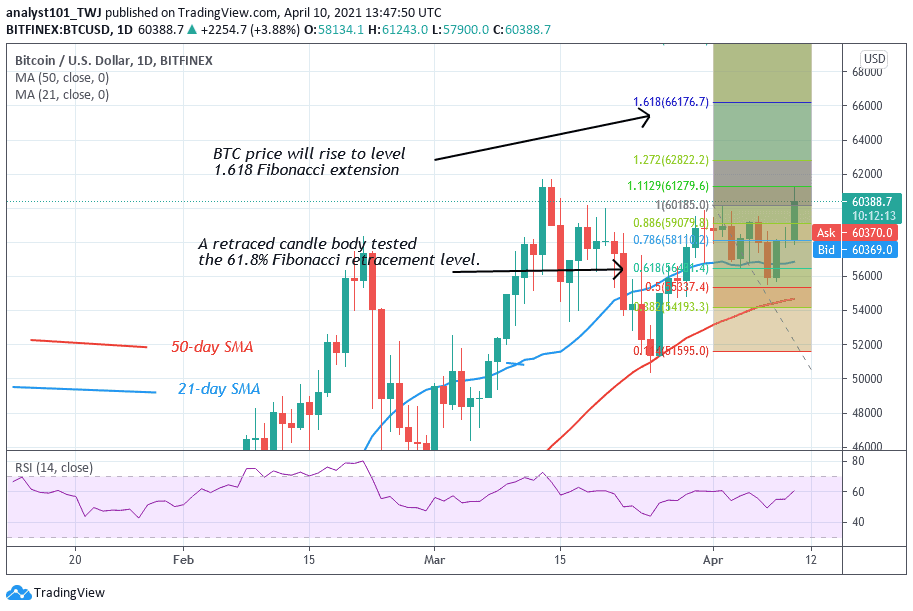
Bitcoin (BTC) Price Prediction – April 10, 2021 BTC/USD made positive moves above the $60,000 overhead resistance as price reached a high of $61,243. Unfortunately, buyers could not sustain the bullish momentum above the overhead resistance. Today, BTC price has fallen below the $60,000 support. A further downward movement of the coin is likely.
Resistance Levels: $58,000, $59,000, $60,000 Support Levels: $40,000, $39,000, $38,000
BTC/USD – Daily Chart
Today, BTC price broke the $60,000 overhead resistance as price reached the high of $61,243. In previous price actions, buyers broke the overhead resistance on two other occasions. On March 14, the bulls broke the psychological price level as price rallied to $61,699 high. On April 2, buyers also made concerted efforts to break the resistance but the market reached a high of $60,190. One common feature in the price action is that buyers failed to sustain the bullish momentum above the overhead resistance. Meanwhile, Bitcoin has fallen to $58,450 low and pulled back. The bottom line is that if the bears break the $58,000 support, the market will further decline to $54,000 low. On the other hand, if the $58,000 supports holds, Bitcoin will resume upside momentum.
HSBC Blacklists Microstrategy’s Stock for Investing In Bitcoin HSBC is an investment banking giant that has classified MicroStrategy as a “virtual currency product.” HSBC has directed users that already own MicroStrategy stock not to buy additional shares. According to reports, buying MicroStrategy stock is no longer possible for HSBC customers on the bank’s online trading platform — HSBC InvestDirect or HIDC. The message from the banking giant includes the following: “HIDC will not participate in facilitating (buy and/or exchange) products relating to virtual currencies, or products related to or referencing to the performance of the virtual currency.” The reason for the blacklisting is that MicroStrategy is a virtual currency product.
BTC/USD – Daily Chart
Bitcoin has fallen after breaking the overhead resistance. Meanwhile, the upside momentum will resume if the BTC price retraces and finds support above the $58,000 support. Nevertheless, the Fibonacci tool has indicated an upward movement of price. On April 2 uptrend, a retraced candle body tested the 61.8% Fibonacci retracement level. This retracement gives the impression that BTC price will rise to level 1.618 Fibonacci extension or the high of $66,425.90.
BTC/USD rises for the third straight bullish day as the technical indicator on the daily chart crosses above 60-level.
BTC/USD Long-term Trend: Bullish (Daily Chart)
Key levels:
Resistance Levels: $65,000, $67,000, $69,000
Support Levels: $55,000, $53,000, $51,000
BTCUSD – Daily Chart
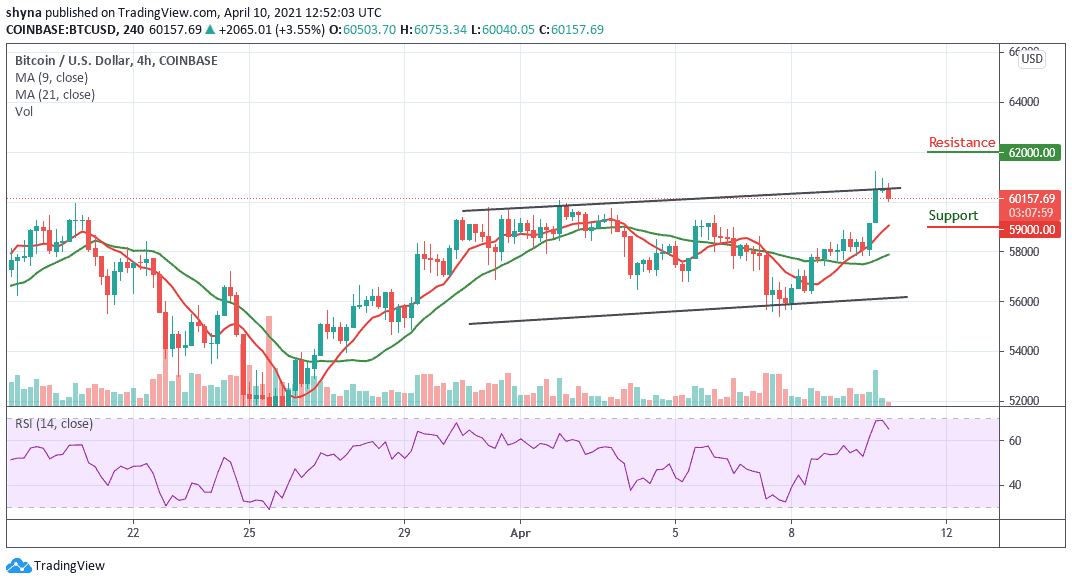
BTC/USD is seen pushing the market price above the potential resistance level as bulls keep the price above the 9-day and 21-day moving averages at the time of writing. However, the first digital asset is now moving with strong bullish momentum after a sustainable break above an important technical level.
What to Expect from Bitcoin (BTC)
Looking at the daily chart, the technical indicator RSI (14) is facing the overbought region as the coin seems to create a new monthly high. Moreover, the price seems to have reached the daily high at $61,218, suggesting that BTC/USD could retreat toward $59,500, before attempting to break higher again. Furthermore, the moving averages continue to edge higher, showing no significant bearish pressure for the time being.
Meanwhile, on the upside, the $62,000 level aligns with the initial resistance. A daily close above this resistance level could lift the price to $65,000, $67,000, and $69,000. In other words, Bitcoin could retreat below the moving averages, currently located at $60,468. However, if it breaks below moving averages, the critical supports are located at $55,000, $53,000, and $51,000 respectively.
BTC/USD Medium – Term Trend: Bullish (4H Chart)
According to the 4-hour chart, BTC/USD is currently in the ascending range of the medium-term outlook as the target market is keeping the support levels of $59,000, $57,000, and $55,000. But the Bitcoin market is gaining momentum around the upper boundary of the channel as the buyers keep the position intact.
BTCUSD – 4 Hour Chart
Looking at the RSI (14) indicator, it shows that BTC price may begin to move down before another rebound could take place. Immediately after the market rebounds, the bulls may hit the resistance level of $62,000, $63,000, and $64,000.
The Bitcoin price is trading nicely above the $58,000 as the coin may need to climb more to continue higher.
BTC/USD Long-term Trend: Bullish (Daily Chart)
Key levels:
Resistance Levels: $62,000, $64,000, $66,000
Support Levels: $54,000, $52,000, $50,000
BTCUSD – Daily Chart
BTC/USD begins the day with a downside movement as the coin touched $57,670 in the early hours of today, but later, the coin is now improving by moving out of the downside to the upside. However, within a few hours of the day, BTC/USD is now moving up from the daily low to $58,869 and now changing hands at $58,300.
Where is BTC Price Going Next?
At the moment, BTC/USD is still finding it difficult to touch the $59,000 resistance as the coin is settling in a tight range between $55,000 and $59,000 around the 9-day and 21-day moving averages. Typically when the new uptrend movements are beginning to form, buyers may use the 21-day moving average as the nearest support level. But in as much as the 9-day MA keeps moving above the 21-day MA, the market may continue to follow the upward movement.
However, if the market decides to go down, we may see a further drop to $54,000, $52,000, and critically $50,000. More so, the resistance levels are located at $62,000, $64,000, and $66,000 respectively. Meanwhile, the signal line of RSI (14) may likely cross above the 60-level to suggest more bullish signals.
BTC/USD Medium – Term Trend: Bearish (4H Chart)
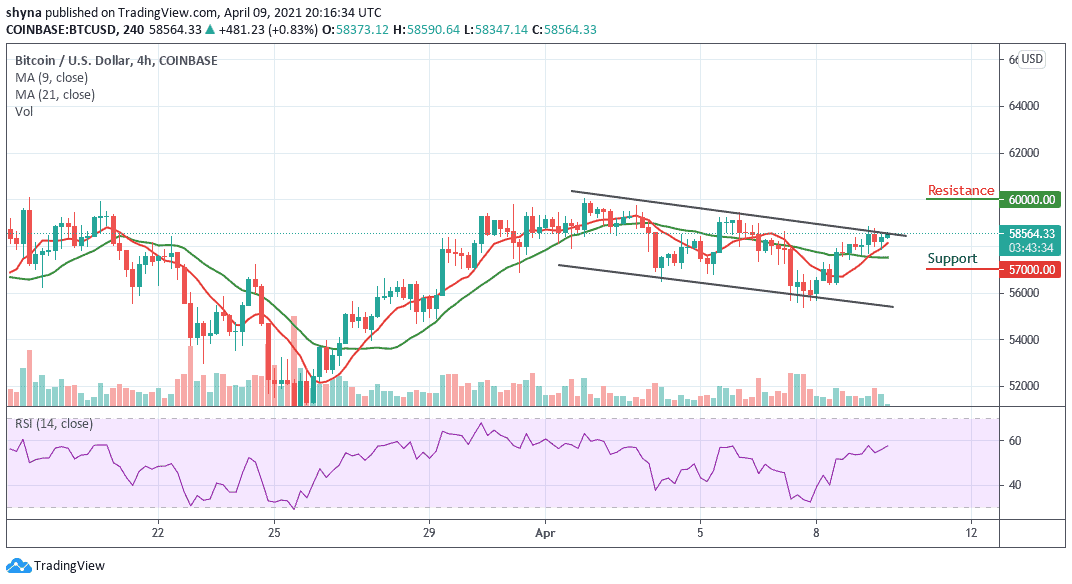
Looking at the 4-hour chart, Bitcoin’s price is currently trading around $9,710 and above the 9-day and 21-day moving averages. The chart also reveals that the bullish supply is coming up slowly in the market, but the bears are also trying to drag the price down. Meanwhile, the $57,000 support and below may come into play if BTC breaks below the moving averages.
BTCUSD – 4 Hour Chart
Nevertheless, as soon as bulls push the coin above the channel, traders can expect more uptrends. Therefore, breaking the mentioned barrier could also allow the bulls to touch the $60,000 and above. However, BTC/USD is consolidating currently and moving sideways on the medium-term outlook as the RSI (14) moves in the same direction.
The Bitcoin price is expected to break out from the current short-term pattern and move towards the $59,500 level.
BTC/USD Long-term Trend: Bullish (Daily Chart)
Key levels:
Resistance Levels: $63,000, $65,000, $67,000
Support Levels: $54,000, $52,000, $50,000
BTCUSD – Daily Chart
BTC/USD is currently trading around $58,328 with a 0.42% gain in the past 24-hour. According to the daily chart, since the beginning of today’s trading, the Bitcoin price fights to stay above the important level of $58,000. More so, for BTC/USD to remain above $57,000 for the past few days, it has made many traders feel that the $55,000 support level could be pretty strong.
Where is BTC Price Going Next?
BTC/USD touches the daily low of $57,670 today, if the number-one crypto breaks below this level, it could test the next support lines at $56,000. Alternatively, Bitcoin has to reclaim the first resistance at $59,500 to head upwards. If successful, the primary cryptocurrency could aim at $60,000, followed by $61,000, and $62,000 resistance levels.
However, the technical indicator RSI (14) is moving in the range as the Bitcoin price is not done with the downside. More so, this means that there may still be a room that could be explored by the bears. If this happens, the critical supports at $54,000, $52,000, and $50,000 may play out.
On the upside, recovery may not come easy. Therefore, traders must be aware that support will have to be sort for above $57,300 while the other seller congestion zones to keep in mind include $63,000, $65,000, and $67,000 resistance levels.
BTC/USD Medium – Term Trend: Bullish (4H Chart)
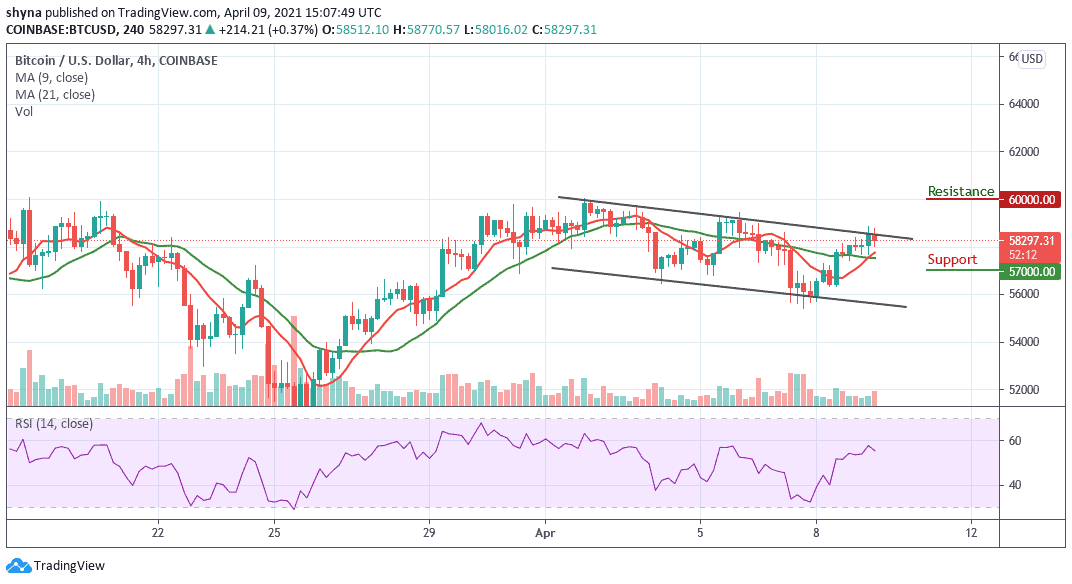
From a technical point of view, on the 4-hour chart, the technical indicator RSI (14) keeps moving below the 55-level and this supports the option of some bullish correction. Meanwhile, adding to the above, there is a little bit of bullish divergence on the RSI (14) as the signal line faces the south.
BTCUSD – 4 Hour Chart
However, if the Bitcoin price breaks below the 9-day and 21-day moving averages, the market price may likely reach the supports at $57,000 and below. On the contrary, if the current market value rises above the upper boundary of the channel, it may likely reach the resistance at $60,000 and below.
Ethereum Price Prediction – April 11 The ETH/USD financial book of records has it that on April 10, the crypto’s price briefly touched past the immediate resistance line of $2,200. But, today currently trades around a high value of $2,000.
ETH/USD – Daily Chart It is been showcased on the ETH/USD daily trading chart that the main resistance point is at the $2,200 mark. Price has continually striving to find support around the $2,000 level. The bullish trend-line has been closer below the current trading zone a bit over the 14-day SMA trend-line slightly pointing towards the north. The 50-day SMA indicator is situated underneath them with a space at $1,600 support line. The Stochastic Oscillators have a long-slanting bent across from the overbought region to near range 40. They have closed the hairs. That appears that the crypto-economy is in a relaxation moving manner.
Will ETH/USD in a near session strongly resist around the $2,200 level? It is more pertinent that the main trading resistance of the $2,200 line will have to play a crucial role in determining the continuation of the ETH/USD market’s northward journey. Meanwhile, a long fluctuation trading situation at that point will cause indecision. As a result, bulls need intensification of building up more efforts towards breaching beyond the resistance trading zone as mentioned earlier.
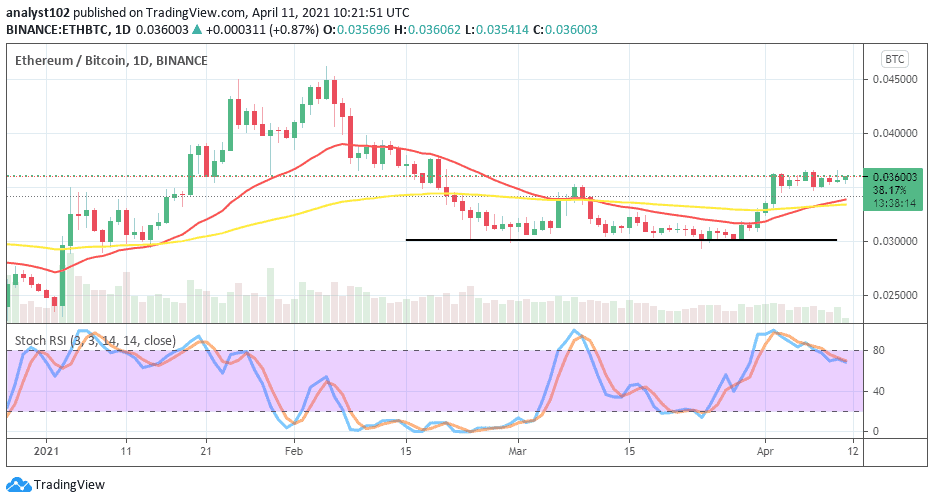
It is at this point not visible that the bears are strongly bracing up to launch a come-back in this crypto-market. However, several failing attempts have been made by the ETH/USD bears to regain control of the market at the key resistance line. Based on that, it would be technically sound that another higher resistance northward away is awaited before considering looking for a decent sell position. ETH/BTC Price Analysis Comparing the capacity of price power between ETH and BTC, it is now seen that the counter crypto has been relatively relaxing in its effort as the base crypto pushes back briefly to the north. The 14-day SMA trend-line has crossed the 50-day SMA trend-line from the below towards the north. But, there is a formation of small higher lows to signify that the current market price trades in a kind of range-bound moving outlook. The Stochastic Oscillators have slantingly bent across from the overbought region to a bit below range 80. That indicates that a degree of consolidation is ongoing in the market. That can in most cases result in seeing the base trading instrument to get an increase at expense of weakness trading stance that the counter trading tool may be putting up in near session.
It’s been around a year since Tether Gold (XAUt), a stablecoin pegged to gold, was launched. Now, Bitfinex plans on adding some more use for Tether Gold, announcing a new perpetual contract for XAUt and Bitcoin. The new product will offer up to 100x in leverage for the users, and will be settled in Bitcoin.
Adding XAUt/BTC Leveraged Perpetual Swaps
Bitfinex itself stands as one of the oldest crypto exchanges out there, having been launched back in 2012. The crypto trading venue is operated and owned by way of iFinex Financial Technologies Limited. 2019 saw the exchange, based in Hong Kong, expand its platform further through Bitfinex Derivatives. This platform was heralded as a token trading platform offering various services to both global liquidity providers and digital currency traders.
Through a press release, the exchange announced that yet another product will be integrated into the derivatives platform at large: A perpetual contract for XAUt and BTC.
The Mandatory Public Statement
This perpetual XAUt/BTC trading pair was set to launch on the 9th of April at 12:00 PM BST, offering up to 100x leverage for anyone keen on the contract. It should be noted, however, that it will exclusively settle in Bitcoin.
Paolo Ardoino stands as Bitfinex Derivatives’ CTO, and gave a public statement about the matter at large. In his statement, he declared that the company fully expects people to take up this perpetual contract in quick fashion, and is convinced that this product will satisfy a sophisticated trader’s needs. This is due to these traders being capable of managing and hedging risks in the process.
Derivatives Aren’t For Everyone
Now, of course, Bitfinex Derivatives can’t just allow any old schmuck access to a perpetual swap contract with 100x leverage. The platform was quick to stipulate that this new contract is only available to verified users and will only be available in jurisdictions that will allow for it, in turn. As such, the exchange was quick to highlight that customers based in the USA aren’t capable of using Bitfinex as a whole, any of its services included.
Time will tell how effective this new product will be, but Bitfinex, and its sister firm Tether, will undoubtedly profit from this new service. As always, the mandatory statement about the risks involved in derivatives trading, especially leveraged derivatives, cannot be overstated enough times. For those that don’t know what they’re doing, derivatives and leverage are a quick way to lose all of your holdings without even realizing it.
The Dubai financial watchdog, the Dubai Financial Services Authority (DFSA) has recently proposed a new policy framework. This framework will target the security tokens sector, one that has been growing rapidly for some time now. Through this framework, the watchdog plans on promoting security token growth, particularly those that have the potential to transform the financial services industry of the city at large.
New Proposal For The Public
Through the publishing of Consultation Paper Number 138, titled “Regulations of Security Tokens” on the 29th of March, 2021, the DFSA is calling for the public to participate in this consultation paper throughout the next 30 days. Within the document stands various provisions that relate to the public offering of security tokens, as well as their various admissions to trading facilities at large. Should this new legislation be implemented, direct payments can be processed in security tokens by companies from various prospective clients.
According to DFSA, the proposals were developed in such a way as to protect the consumers and to facilitate and promote innovation at the same time. Further issues the proposal was aimed to address were to mitigate ML/FT, as well as increasing the overall market integrity, among other things. The DFSA stated that it had made use of the experiences of other regulators, who had taken cautious steps forward in this area and addressed DIFC at the same time. The watchdog also declared that it was eager to hear the comments of the people about this new proposal.
SEC’s Hester Peirce Looking To The Future
Hester Peirce Stands as the Commissioner for the US watchdog, the Securities and Exchange Commission. Peirce had taken part in a fireside chat during the Security Token Summit, which occurred on the 25th of March, 2021. In the discussions, Peirce answered a number of questions regarding digital securities, security tokens, as well as various regulatory guidelines. Furthermore, she voiced her opinion on the looming prospect of replacing traditional equities with digitized versions in the future.
Many Parts Of The Proposal
Now, this proposal paper’s proposed changes have a few interesting additions to it. A few examples would be allowing security token trading facilities to gain direct access to members, retail clients included. Another key point of the proposal is the offering of an enhancement on custody provider requirements, an increase in the disclosure in the prospectus, as well as greater control requirements.
This all comes in a bid to try and address the various risks that decentralized ledger technology (DLT) inherently brings along with it. With this proposal, the DFSA is aiming to address the needed investor protection as well as the risks of misconduct. Further improvements would be on the overall financial stability and market integrity, due to the enhanced measures put in to combat terrorism financing and money laundering.
WAVES It’s no secret that the non-fungible token (NFT) space has been booming, with the early investors seeing massive gains throughout these last few months. The NFT space has also seen widespread mainstream attention primarily thanks to the record-breaking digital art sales going on, with big names like Paris Hilton throwing in their support behind the NFT space.
NFTs Still Big Player In Blockchain
Now, the overall “fad” phase of the NFT space, where everyone started to pile on top of the latest innovation that gained widespread usage, seems to be reaching its close, that doesn’t mean NFTs are over and done with. Waves (WAVES) has seen an increase in growth recently, showing that the crypto space, in general, is still very much hungry for new NFT projects to be released
TradingView revealed recently that the WAVES price has seen a 320% increase in the year of 2021, going from $4.86 on the 4th of January to a whopping $20.82 on the 9th of April. One of the key factors for this large price surge could be pointed to the new record 24-hour trade volumes, standing at $883 million.
Duck Hunters Supercharging WAVES Growth
Now, all of this excitement for WAVES has reached a brand new peak thanks to Duck Hunters, a new NFT game that the protocol released that combines both yield farming and NFT collectibles into one neat package.
Who let the ducks out? #Waves did! The Duck Hunters’ season is now officially on. Collect $EGG tokens for completing tasks & build your own duck empire with #NFT tokens. Check the roadmap with buyback details and beyond. Ducks are coming after you!https://t.co/AF8Ws3QJUW
— Waves Tech (@wavesprotocol) April 9, 2021
The tweet that announced the Duck Hunters game’s launching of Round 1 made it clear that all participants that complete a few social engagements will receive exactly one EGG token after the round has expired. The WAVES token saw itself already start to build up momentum several weeks before Duck Hunters was even launched, having been listed on the Bittrex exchange on the 23rd of March, 2021, with a USDT-WAVES pairing.
Waves Enterprise Primed For Expansion
Directly a day after, on the 24th of March, it was announced that Singapore would be the next target for expansion by Waves Enterprise. This runs in tandem with the protocol’s strategy to start creating a hybrid network that could interface with other public blockchains as well, such as Ethereum.
With NFT functionality incorporated into the WAVES ecosystem, coupled with the DeFi space within it already growing, means that the protocol has grown into a well-rounded hub. It also makes it prime for further growth as the mainstream finance space starts to adopt cryptocurrencies more and more as time goes on, which is only a matter of time.
This guide to smart contract takes a look at what are smart contracts and how they work. The various applications and use cases will also be explored.
Blockchain technology is a crowning jewel created from the advancements of cryptography and computer science. It is fast gaining traction as a revolutionary innovation with the potential of disrupting current systems and a wide-range of industries. One of the most exciting evolution of blockchain is the advancements of smart contract technology. This article will be dedicated to uncovering the concept of smart contracts and how the technology works.
(See more: Guide to Blockchain Protocols: Comparison of Major Protocol Coins)
What is A Smart Contract?
Smart contracts are any contracts that have been pre-programmed with a set of definitive rules and regulations that are self-executing, without the need of any intermediaries. Therefore, with any given inputs, there will be a known output.
Smart contracts are the rough equivalent in the blockchain of an Application Programming Interface (API) in a traditional web environment. An Application Programming Interface (API) is a set of functions and procedures that allow users to interact with an application. It allows applications to communicate with each other. API is mostly used to develop different software applications and features.
In order to better understand the concept of APIs, let’s take a look at a simple analogy. Imagine sitting in a restaurant and looking at the menu. After the waiter records the food items that you’ve ordered, he will send that order to the kitchen. Once your food has been cooked, the waiter will deliver your food to your table. In this case, you are the application user, the kitchen is the computing system (that executes all commands and requests) and the waiter is the API. The waiter is the messenger that takes your order (requests) and tells the kitchen (computing system) on what to do. API therefore facilitates the communication between different software components and applications.
The smart contract is what connects the decentralized blockchain database (which in our example replaces a conventional central database) to the front-end application, which on the blockchain is a decentralized application (dAPP). The dApp uses one or more smart contracts, each enabling different functions or transactions, to communicate with the blockchain. For example, in a financial application one smart contract could allow the user of the dApp to send and receive funds, while another smart contract could schedule a payment plan.
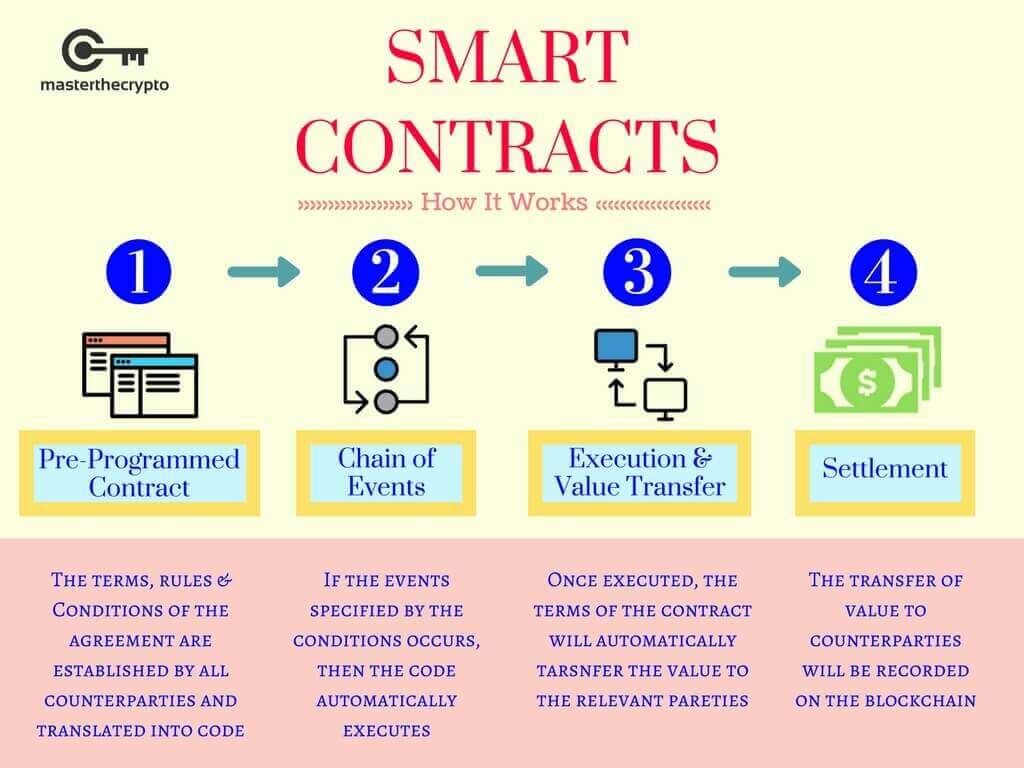
Here is a visualization of an application of smart contracts:
These transformative tools are game-changers for those looking to have a more efficient and credible process for contracts of all kinds.
(Read also: Guide to Blockchain Scalability: Bitcoin Scalability Problem and Effects)
Evolution of Smart Contracts
Nick Szabo – a legend in the field of computer science and cryptography – is often regarded as the inventor of smart contracts. He dreamed up the notion of recording contracts in code way back in 1994. His work laid the foundations for smart contract technology; a software program that appends layers of information onto digital transactions via the blockchain. Smart contracts are self-executing contracts that operate on an if-then premise, enabling transactions to complete once the terms of the contract are met. The terms of the contracts are coded directly into the smart contract. We can illustrate using the purchase of a car; ifthe funds are released via a smart contract, thenthe digital title of the car is turned over to the buyer, also via smart contract.
Ethereum is one of the earliest and most popular blockchain projects that is built specifically to support smart contract functionality. Since then, there is a wide variety of project that focuses on implementing smart contract technology such as NEO, Lisk, and Waves.
Smart contracts allow for much more complex transactions than just the exchange of digital currency for services or products. They can execute many other functions as well. Imagine a blockchain version of a social media site like Facebook or Instagram. The homepage the user interfaces with could be a blockchain-based dApp, while every interaction—every comment, every like and every post—is driven by multiple smart contracts.
(See more: Evolution of Cryptocurrency: Importance of Retail-Driven Crypto Adoption)
Multiple Contracts Can Be Used in Each DApp
Most decentralized applications will use more than one contract to execute its various tasks. Each smart contract must be deployed independently and will have its own blockchain address, where you can go to interact with it. If different smart contracts need to interact with each other – say for instance contract number one needs to communicate with contract number two – contract number one will need to know the address of contract number two. Both contracts – one and two – are “first-class citizens in the network,” even though one depends upon the other.
There are many applications that utilize smart contracts. In fact, most projects use smart contracts to facilitate their Initial Coin Offerings (ICOs). Investors would send their initial investments – usually in the form of Ether (ETH) – to the ICO smart contract address and would automatically receive the ICO native tokens in proportion to their investment. By using smart contracts, ICOs would eliminate the need for using intermediaries to handle and manage the investments, since smart contracts would automate the entire process. Here is how one can participate in an ICO:
There are also blockchain projects that facilitate smart contract functionalities across a range of industries. For instance, social media mavens can use smart contracts in conjunction with BOOSTO to track client deals, store transactions, and literally any if/then scenario where trust and security are required. And for even more added safety and assistance, projects like blockchain-based Hosho will audit your smart contracts to ensure every element is properly and efficiently executed. If a particular dApp requires multiple contracts, it helps to use additional tools to streamline and simplify the process.
(Read also: Crypto ICO vs. Stock IPO: What’s the Difference?)
Advantage of Smart Contracts
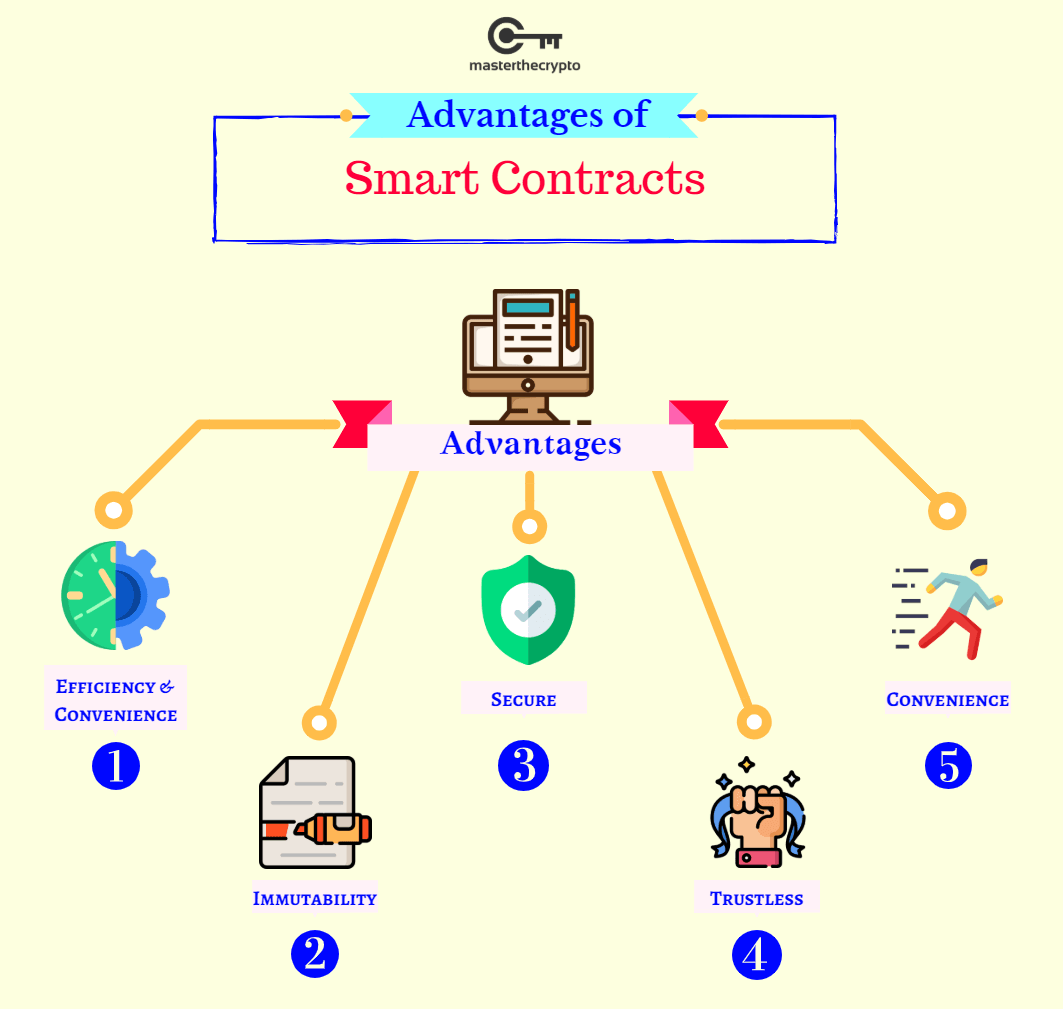
Nick Szabo famously likened smart contracts to vending machines. Just put in your change and in return, you’ll get a can of soda or a candy bar out. No third parties are necessary; ifyou deposit the change, thenthe soda comes out. The efficiency that smart contracts afford is obvious advantages. Let’s take a look at the different advantages that smart contracts facilitate:
Efficiency & Cost Reduction: Smart contracts facilitate direct transactions between two or more parties, without any need for intermediaries. The absence of intermediaries will reduce the costs of execution and streamline the entire process.
Immutability:Since all transactions are recorded on the open-source, public blockchain, all information pertaining to the transaction will be immutable and transparent. This means that transactions cannot be altered or removed; it becomes forever a part of the record of the public blockchain database.
Secure: Blockchain technology uses a decentralized and distributed system, which is much more secure than a centralized system. Since all nodes in the network are required to download the entire database of transactions, no single authority has control over the database. This makes it extremely hard for hackers to infiltrate the network.
Trustless: Smart contracts are made up of coded rules. Therefore, “Code is King”. Users do not need to trust the other party or anyone else since the rules of the smart contracts are transparent on the blockchain and there are no intermediaries that facilitate the transactions. Therefore, transactions will be executed in a trustless environment. Blockchain also allows for transparent and easy verification. Imagine the benefits of running a smart contract-enabled crowdfunding campaign. There would be far less danger of donating to fraudulent campaigns with monies going into an account that is distributed across the network, instead of being handled by one person or group of persons.
Convenience:Software code automates tasks, making formerly complex and time-consuming transactions much quicker to complete. Documents can be digitalized and notarized in an instant.
(See more: A Guide To Fundamental Analysis For Cryptocurrencies)
Possible Use Cases for Smart Contracts
As stated earlier, smart contracts can be used for a broad range of use cases, not just financial transactions. A smart contract can execute a financial or contractual agreement between two parties, or it can simply trigger the execution of functions in a blockchain-based application. Here are few industries that smart contracts can be used to facilitate transactions and business operations:
Healthcare Systems: Smart contracts can be used to securely transfer data, allowing patients to actually have control over their own data. Third parties – such as researchers or biomedical institutions- would have no access unless given express permission by the patient. They could also be used for healthcare management tasks like prescription management, testing results, regulation compliance and ordering healthcare supplies.
Government:Smart contracts would provide a secure system for voting, greatly reducing concerns about voter fraud by providing a much more secure and transparent system. Votes protected by the blockchain ledger would have to be decoded and would require a great deal of computing power to access. Also, the ease of voting via smart contract could greatly improve voter turnout.
Management: The blockchain, with its automated systems, facilitates workflows and provides an immutable ledger as a source of trust. The accuracy and transparency of a blockchain-based system cut time spent waiting for approvals and signatures. Smart contracts streamline procedures and eliminate discrepancies that can lead to issues such as settlement delays and lawsuits.
Real Estate:The real estate industry is inefficient and expensive due to its manual nature and that it greatly relies on third-party brokers to facilitate transactions. With smart contracts, participants can save a huge amount of costs related to listing and brokers’ fees. In late 2017, a house was bought using smart contracts and blockchain technology for the first time in Ukraine. There are estimations that smart contracts will be used by more than 25% of global organizations by 2022. The evolution of these technologies is a dynamic process, and as businesses open themselves up to using smart contracts to enhance operations and change the face of traditional employment, more innovative ways of implementing smart contracts will present themselves.
(You might also be interested in: Guide on Identifying Scam Coins)
—–
This article is contributed by Heidi Yu, a serial entrepreneur, influencer marketing evangelist and AI enthusiast. An MBA graduate from Seattle University, she successfully founded Boostinsider at the end of 2014. As one of the few women leaders in blockchain adaptation, Heidi founded BOOSTO.io, an influencer driven decentralized app store that returns power to creators and makers. Heidi speaks to audiences around the world about the adoption and the benefits of the blockchain.
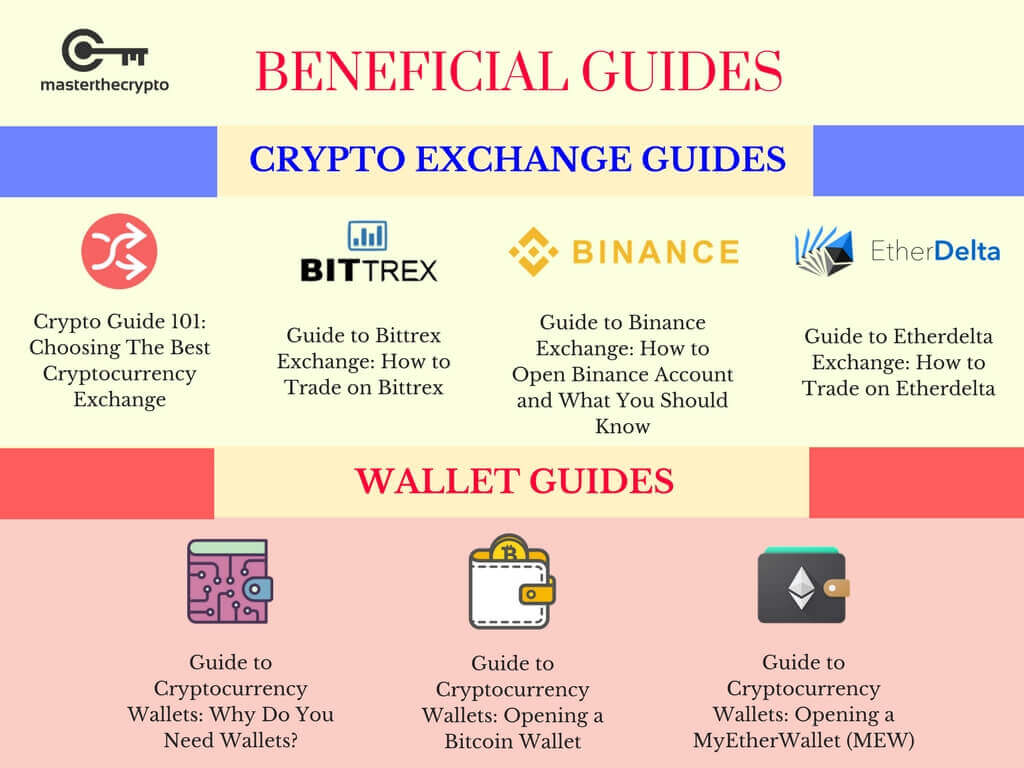
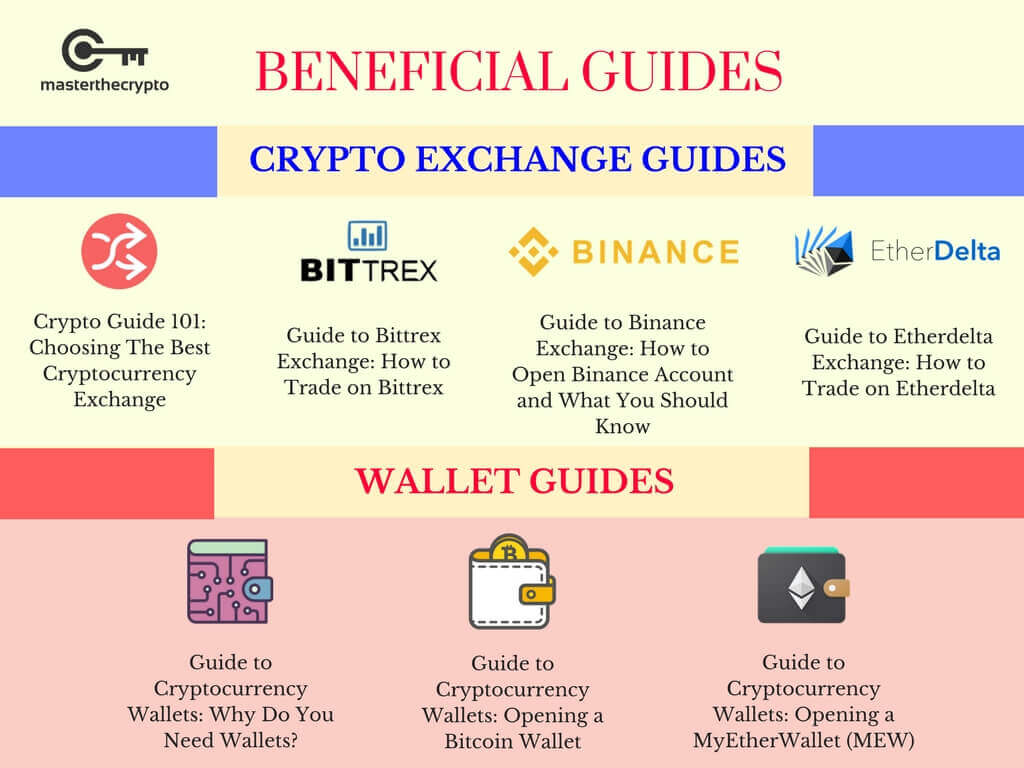
Beneficial Resources To Get You Started
If you’re starting your journey into the complex world of cryptocurrencies, here’s a list of useful resources and guides that will get you on your way:
Trading & Exchange
Crypto Guide 101: Choosing The Best Cryptocurrency Exchange
Guide to Bittrex Exchange: How to Trade on Bittrex
Guide to Binance Exchange: How to Open Binance Account and What You Should Know
Guide to Etherdelta Exchange: How to Trade on Etherdelta
Guide To Cryptocurrency Trading Basics: Introduction to Crypto Technical Analysis
Cryptocurrency Trading: Understanding Cryptocurrency Trading Pairs & How it Works
Crypto Trading Guide: 4 Common Pitfalls Every Crypto Trader Will Experience
Wallets
Guide to Cryptocurrency Wallets: Why Do You Need Wallets?
Guide to Cryptocurrency Wallets: Opening a Bitcoin Wallet
Guide to Cryptocurrency Wallets: Opening a MyEtherWallet (MEW)
Read also: Crypto Trading Guide: 4 Common Pitfalls Every Crypto Trader Will Experience and Guide To Cryptocurrency Trading Basics: Introduction to Crypto Technical Analysis.
Enroll in our Free Cryptocurrency Webinar now to learn everything you need to know about crypto investing.
Get our exclusive e-book which will guide you on the step-by-step process to get started with making money via Cryptocurrency investments!
You can also join our Facebook group at Master The Crypto: Advanced Cryptocurrency Knowledge to ask any questions regarding cryptos!
Aziz, Master the Crypto Founder
I’m Aziz, a seasoned cryptocurrency trader who’s really passionate about 2 things; #1) the awesome-revolutionary blockchain technology underlying crypto and #2) helping make bitcoin great ‘again’!
The post Guide to Smart Contract: What are Smart Contracts? appeared first on Master The Crypto.
This article takes a look at 3 major industries that blockchain technology is changing and how blockchain is shaping industries of the future.
Blockchain & Cryptocurrency
During the last few years, blockchain technology registered on most people’s radar in the form of cryptocurrency. Bitcoin and other cryptocurrencies have never been far from the headlines as financial markets constantly re-evaluate how much value they actually hold in comparison to traditional currencies.
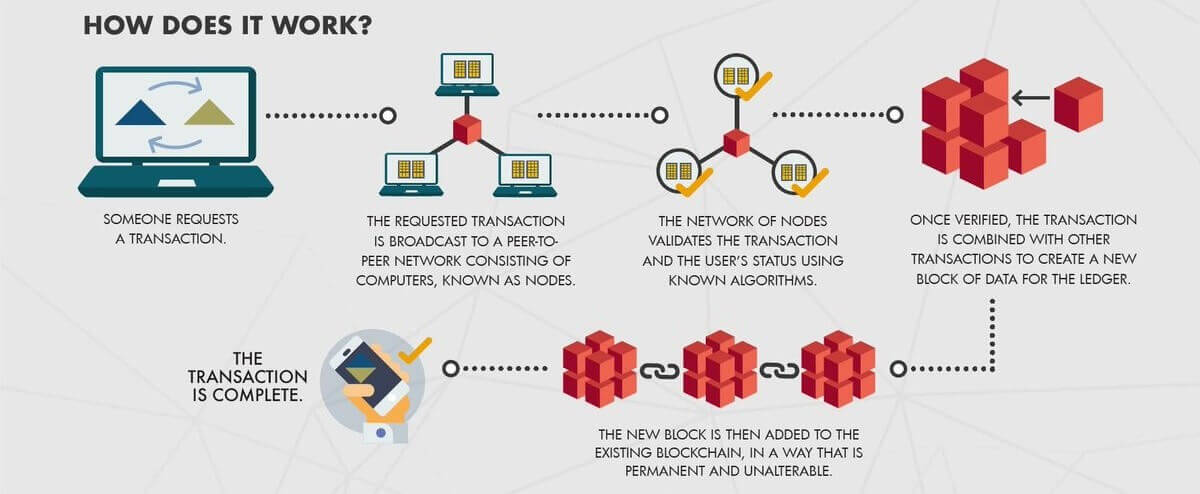
Although cryptocurrencies function by using blockchain technology, these two concepts are not the same thing nor are they synonymous. Blockchain is the underlying technology that powers cryptocurrency, representing a novel solution to secure data in a transparent and secure manner through its decentralized structure. Cryptocurrencies are a manifestation of blockchain technology, with a wide-range of projects extending the use cases of this revolutionary technology through different applications and functionalities.
(Source: Deloitte)
Blockchain holds great potential in redefining systems by incorporating ‘trustlessness’ through a distributed network of computers that work towards a common set of goals, thereby eliminating the need for intermediaries or third parties. This would significantly streamline the data verification process, enabling fast and cheap transactions. More importantly, blockchain holds amazing potential for authenticating transitions without the need of a central authority. This empowerment that blockchain affords is one of the many reasons why industries and companies are jumping into the bandwagon to explore its possibilities.
(Read more: Category of Cryptocurrency Market: Blockchain Platform)
Does it Work?
For any technology to be realistically adopted and embraced, there must be conviction that it could actually work. The most prominent example of blockchain’s effectiveness can be seen through Bitcoin, which is regarded as the ‘founding father’ of cryptocurrencies. Bitcoin is the first decentralized cryptocurrency that was created in 2008, representing a peer-to-peer (P2P) electronic cash system that eliminates banking intermediaries. With Bitcoin, users can send value transactions globally within minutes, while paying an insignificant fee for doing so. The creation of Bitcoin is an important milestone in not only cryptography and computer science, but also the evolution of our financial system. For the first time in human history, we are empowered to participate in a decentralized system that allows us to have total and absolute control over our wealth.
(Source: The Bernie Group)
Though currently the major limitation of blockchain is scalability, a comprehensive amount of innovative and exciting solutions are currently being worked to enable blockchain technology to scale to massive levels.
(See also: Guide to Centralized Cryptocurrencies: What Makes a Coin Centralized?)
Industries that Blockchain Technology is Changing
The first application of blockchain technology is digital cash in the form of Bitcoin. The potential of blockchain technology lies in its versatility for a wide variety of applications and use cases across many different industries. Let’s take a look at 3 industries that blockchain is poised to disrupt:
1. Banking
It is ironic that banks are now starting to embrace blockchain technology, even though cryptocurrencies were first created to eliminate the reliance and trust on financial intermediaries. As much as many would argue, financial institutions will still play a vital part in our monetary system. Banks play intermediary to a bevy of financial services across the world, and blockchain will change the nature of many daily bank operations over the next decade.
By using blockchain, transferring assets between two parties that are located on opposite sides of the world work as if they were right next door to each other.
Blockchain could also help banks move currency internally within their own organizations. Banks could develop their own regulated cryptocurrencies to replace traditional dollars. Bank-centric cryptocurrencies would completely transform the way that the world interacts with money and finance. An example of a cryptocurrency that has been making waves in the banking arena is Ripple (XRP), which has partnered with an impressive number of renowned banks.
However, banking regulation moves slowly and it will probably be some time before financial institutions have the go-ahead to integrate blockchain in their services.
(Read more: Cryptocurrencies: A New Asset Class for Institutional Investors?)
2. Healthcare
Healthcare is an incredibly complex industry comprised of many players along the health services supply chain. Medical information and client records are siloed in individual systems across the healthcare landscape, and accessing those records remains difficult for providers and consumers alike.
Blockchain technology offers the healthcare industry a chance to store all medical information on one comprehensive database. When patients switch doctors or providers, the patient’s entire medical history would be stored in a single, easily accessible system.
Blockchain technology could lead to a medical record storage system so robust that medical history could be passed down to future generations, which could lead to new medical breakthroughs.
(See also: Crypto Beginners Guide: 5 Things Crypto Newbies Should Know)
3. Sharing Economy
The sharing economy – or widely known as the peer-to-peer (P2P) industry – has only begun to be recognized over the last few years, but it is important to include it on this list because of the fundamental changes that it will undergo once fully integrated with blockchain technology.
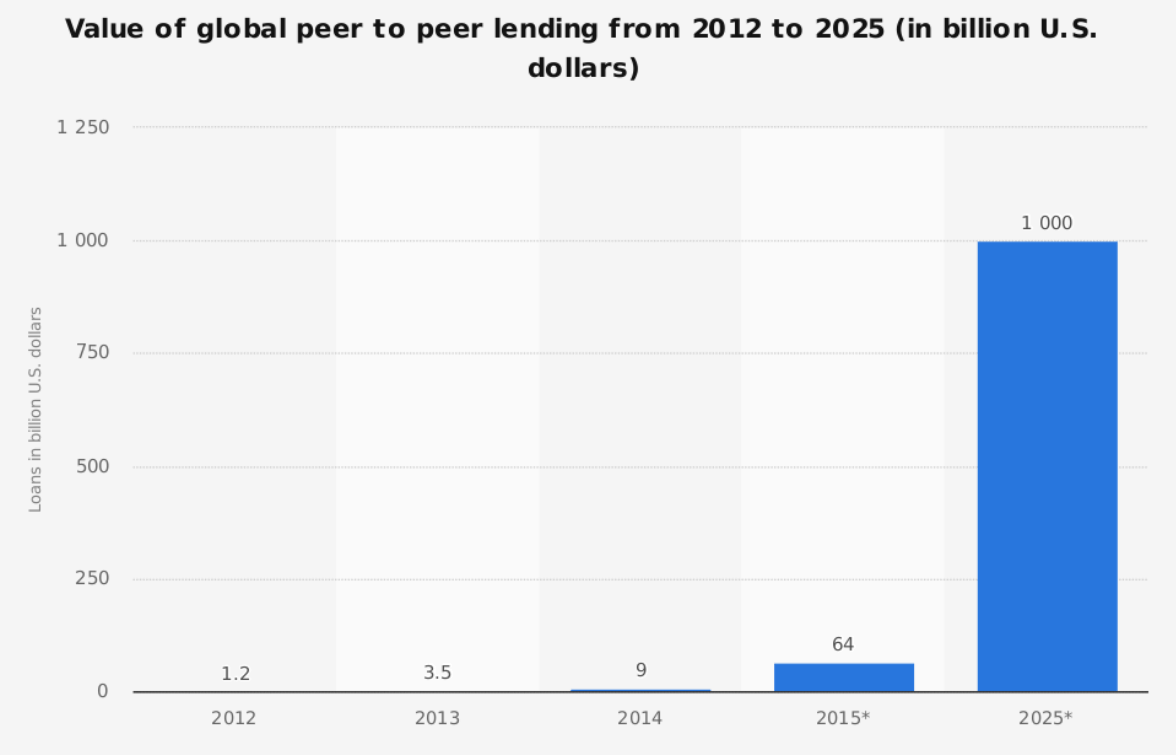
This fledgling industry will grow to monumental portions over the next few years. In 2014, the global P2P lending market – which is just one aspect of the industry – was valued at 3.5 billion U.S. dollars. Statista estimates that this market will be worth close to one trillion U.S. dollars by 2050.
(Source: Statista)
Uber and Airbnb are examples of companies that has consolidated their dominance in the sharing economy. These companies changed their respective sectors by undercutting traditional intermediaries such as taxi services and hotels, thereby streamlining the user experience and garnering huge profits in the process. However, most P2P services still rely on a central authority to facilitate transactions.
When blockchain hits the P2P industry in earnest, these central authorities will be completely removed from the equation. Uber and Airbnb-like services will still exist, but now consumers will have the power to deal directly with each other over a blockchain network.
As the ease of completing transactions with blockchain increases P2P platforms’ versatility, this industry will absorb many more services that were once handled by traditional business models.
(Read also: Guide to Cryptocurrency Liquidity: How to Measure Liquidity & Trade Well)
In a Nutshell
Blockchain is finding new advocates beyond the tech industry every day. But this technology still needs time to be proven and enhanced upon. As it gains traction in a comprehensive range of sectors, blockchain will shift and adapt as we find new uses for it. Many blockchain systems are currently still in their conceptualization phase, and it could be the case that its implementation and execution in the market will undoubtedly look very different from its current status today.
(You might also be interested in: Bitcoin vs Alt Coins Returns: Comparison of Gains Between Bitcoin & Altcoins Investing)
—-
This article is contributed by Manju Mohan has a background in computer science, economics, instructional design, and UX design. She is the CEO and Co-Founder of Ionixx Technologies – a design, web, mobile and blockchain technologies service provider. She holds a Bachelor’s degree in Computer Science and Economics from the University of Western Ontario and a Master’s degree in Instructional Technology from San Francisco State University.
Beneficial Resources To Get You Started
If you’re starting your journey into the complex world of cryptocurrencies, here’s a list of useful resources and guides that will get you on your way:
Trading & Exchange
Crypto Guide 101: Choosing The Best Cryptocurrency Exchange
Guide to Bittrex Exchange: How to Trade on Bittrex
Guide to Binance Exchange: How to Open Binance Account and What You Should Know
Guide to Etherdelta Exchange: How to Trade on Etherdelta
Guide To Cryptocurrency Trading Basics: Introduction to Crypto Technical Analysis
Cryptocurrency Trading: Understanding Cryptocurrency Trading Pairs & How it Works
Crypto Trading Guide: 4 Common Pitfalls Every Crypto Trader Will Experience
Wallets
Guide to Cryptocurrency Wallets: Why Do You Need Wallets?
Guide to Cryptocurrency Wallets: Opening a Bitcoin Wallet
Guide to Cryptocurrency Wallets: Opening a MyEtherWallet (MEW)
Read also: Crypto Trading Guide: 4 Common Pitfalls Every Crypto Trader Will Experience and Guide To Cryptocurrency Trading Basics: Introduction to Crypto Technical Analysis.
Enroll in our Free Cryptocurrency Webinar now to learn everything you need to know about crypto investing.
Get our exclusive e-book which will guide you on the step-by-step process to get started with making money via Cryptocurrency investments!
You can also join our Facebook group at Master The Crypto: Advanced Cryptocurrency Knowledge to ask any questions regarding cryptos!
Aziz, Master the Crypto Founder
I’m Aziz, a seasoned cryptocurrency trader who’s really passionate about 2 things; #1) the awesome-revolutionary blockchain technology underlying crypto and #2) helping make bitcoin great ‘again’!
The post 3 Major Industries That Blockchain Technology is Changing appeared first on Master The Crypto.
This guide looks at the different category of cryptocurrency market, focusing on the fifth category which represents cryptocurrency exchange coins and payment networks. This is the fifth part of the series that breaks down the crypto market into 12 major categories.
This article looks at the fifth category in the Top 100 of the cryptocurrency market, which features the different types of coins that are backed by cryptocurrency exchanges and payment networks.
Due to the sheer number of different cryptocurrencies, exchanging one currency for the other it still cumbersome for many of us. Centralized exchanges cannot be trusted, while the user experience for decentralized exchanges (such as Etherdelta) requires massive amounts of improvement to cater to the mass market. Additionally, cryptocurrencies as a mode of payment has lots of inefficiencies and friction that impairs adoption, since merchants do not want to deal with over-cluttered options of accepting cryptocurrencies for their businesses.
There are coins and projects that are trying to solve these problems, by offering exchange-based and payment network solutions to add much needed liquidity, enhance user experience and remove the friction of using cryptocurrencies. Here is a total of 7 coins within the Top 100 that are focusing on just that:
(Read also: Crypto Trading Guide: 4 Common Pitfalls Every Crypto Trader Will Experience)
Cryptonex (CNX)
Cryptonex is an open source cryptocurrency exchange platform that operates its own native blockchain platform and features its own desktop client. Cryptonex focuses on the secure and instant transfer and exchange of a variety of fiat and cryptocurrency pairs. The project is developed Investment Financial Group, a company focused on software development for financial markets. A great feature of Cryptonex is that it features an all-in-one wallet – which is downloadable in desktop as well as mobile versions – that allows users to trade within their cryptocurrency wallets. Cryptonex also allows for instant transactions with relatively low fees (0.10% trading fees compared to the industry benchmark of 0.25%). In April of 2018, Cryptonex launched a peer-to-peer functionality that allows users to trade privately amongst themselves.
Cryptonex uses the Proof-of-Stake (POS) consensus mechanism that uses the Scrypt algorithm. Since it leverages on POS mining mechanisms, users are promised an annual fixed profit of 12% returns (plus bonus rewards), which is unusually high for a POS coin. This, coupled with the absence of a white paper, has led many in the cryptocurrency community to label Cryptonex as a scam.
(See also: Bitcoin vs Alt Coins Returns: Comparison of Gains Between Bitcoin & Altcoins Investing)
QASH (QASH)
QASH is the native currency for Quoine’s LIQUID platform, a global exchange looking to solve the issues of liquidity within the cryptocurrency space. LIQUID will aggregate all major cryptocurrency exchanges globally to a single trading platform, integrated with prime brokerage services. A unique functionality of the LIQUID platform is its very own globally sourced trading platform called ‘The World Book’, which will compile all orders and prices from all exchanges globally into a single order book. This will facilitate the exchange of any fiat currency preferred by users when trading with cryptocurrencies, no matter where they are or which country they originate from.
QASH is currently an ERC20 token, but is creating its own native blockchain – which is scheduled to be completed on the second quarter of 2019 – to complement their ecosystem of exchanges and services. QASH’s native blockchain will be powered by a Proof-of-Stake (POS) consensus algorithm.
Quoine is the global cryptocurrency company that has the accolade of being the first cryptocurrency firm to be officially licensed by Japan’s Financial Services Agency (SEC equivalent in the USA).
Kyber (KNC)
Kyber Network is a peer-to-peer, decentralized exchange for cryptocurrency trading that utilizes smart contracts and a system of coin reserves to guarantee fast and instant trades. Kyber aims to simplify the token conversion process as easily and seamless as possible, ensuring that anyone can trade cryptocurrencies without hassle. Kyber is an ERC20 token built on the Ethereum protocol. A unique feature of Kyber is their reserve system, which resembles a huge pool of cryptocurrencies and tokens that facilitates instant trading without the need for order books, which is a common feature in both centralized and decentralized exchange. This allows for low trading fees due to lower spreads.
¬The next highly-awaited development in Kyber’s roadmap is the support for cross-chain trading, which will allow users to exchange any coin for another instantly and trustlessly on the blockchain. It must be pointed out that Kyber Network is one of the rare projects (besides OmiseGo) that is officially advised by Vitalik Buterin, the creator of Ethereum.
(Read more: Crypto Beginners Guide: 5 Things Crypto Newbies Should Know)
Request Network (REQ)
Request Network is a decentralized payment system that allows anyone to request and receive cryptocurrency-based payments from individuals or organisations. Request is akin to a decentralized version of Paypal, removing the need for third-parties for a more secure and cost-effective payments solution that is supported by all global currencies. Request is built on the Ethereum blockchain, with an ERC 20-backed native token called REQ.
Request also features a platform for developers to create innovative, decentralized solutions focused on finance and accounting. On the institutional side, Request enables various functionalities for organizational application that include automatic accounting, salary/loan request, Internet-of-Things (IOT) and automated auditing.
Request is backed by a renowned start-up incubator known as Y Combinator, which is consistently ranked as the top US-based accelerator that has produced various highly-successful companies that include Reddit, Dropbox, AirBNB, Coinbase and Stripe, to name a few.
Bitshares (BTS)
Bitshares is a decentralised financial platform providing a high-performance asset exchange for trading cryptocurrencies without the need for any intermediaries or central authority. Bitshares is founded by Dan Larimer, a prominent figure in the blockchain space who invented the Delegated Proof-of-Stake consensus algorithm that is used by Bitshares. The BitShares platform allows users to convert various cryptocurrencies into stable assets by converting them into tokens that are backed by real assets.
The consensus mechanism for Bitshare’s protocol is Delegated Proof-of-Stake (DPOS), which allows for more efficiency and reduced costs as compared to a POW algorithm but requires a higher reliance of trust in the system. Using the DPOS system, Bitshares transactions are near instant with extremely low fees, with an infrastructure that can scale to the capabilities of centralized payment processors such as Visa and Paypal.
Bitshares launched Graphene technology in their version 2.0 update in 2015, which exponentially enhanced Bitshare’s blockchain theoretical capacity to 100,000 transactions per second (TPS).
(See more: Beginner’s Guide to ICO Investing: How to Participate in ICOs
Loopring (LRC)
Loopring is an open-source, decentralized exchange protocol that features an automated trade execution system for exchanging tokens. The Looping platform combines the use of an off-chain order book and on-chain settlement contracts for executing successful trades. Rather than being an actual exchange, Loopring protocol serves as a common building block with open standards, facilitating interoperability between decentralized applications (dApps) that incorporate exchange functionality. Although Loopring is built on the Ethereum blockchain and has its own ERC 20 token (LRC), their underlying protocol is agnostic and can be deployed on blockchains with smart contract functionality.
A unique feature of Loopring is the use of Ring-Matching and Order-Sharing technology for their decentralized protocol.
Ring-Matching: A process by which a series of trades are strung together to fulfill each other’s orders
Order Sharing:Allows the trade to be split into partial orders until the original order amount is completely filled
Basically both are ground-breaking innovations within the decentralized exchange space that aggregates the order books of other exchanges, allowing any exchange – decentralized or centralized – to utilize Loopring’s protocol for order-matching. Users can keep their funds in their private wallet to start trading, since the exchange occurs between users.
(See also: Guide to Valuing Cryptocurrency: How to Value a Cryptocurrency)
0X (ZRX)
0x is an open, permissionless exchange protocol focused on the trading of Ethereum-based (ERC 20) tokens. 0x aims to enhance to significantly enhance the user experience of decentralized exchanges while retaining its security benefits. The core of 0x’s model is the use of off-chain ordering relays in conjunction with on-chain settlements via smart contracts. Therefore, only value transfers – or trades – are executed on-chain while other trading commands (the non-important stuff) are executed off-chain. This results in the reduction of network bloat, enhancing scalability and cutting down of trading costs due to lower gas fees associated with trading operations.
A great feature of 0x is that it allows dApps to be created on its protocol, allowing interoperability between other applications and tokens seamlessly through the use of smart contracts. 0x is widely regarded as a potential lead disruptor in the decentralized exchange space.
(You might also be interested in: Guide To Cryptocurrency Trading Basics: Introduction to Crypto Technical Analysis)
Beneficial Resources To Get You Started
If you’re starting your journey into the complex world of cryptocurrencies, here’s a list of useful resources and guides that will get you on your way:
Trading & Exchange
Crypto Guide 101: Choosing The Best Cryptocurrency Exchange
Guide to Bittrex Exchange: How to Trade on Bittrex
Guide to Binance Exchange: How to Open Binance Account and What You Should Know
Guide to Etherdelta Exchange: How to Trade on Etherdelta
Guide To Cryptocurrency Trading Basics: Introduction to Crypto Technical Analysis
Cryptocurrency Trading: Understanding Cryptocurrency Trading Pairs & How it Works
Crypto Trading Guide: 4 Common Pitfalls Every Crypto Trader Will Experience
Wallets
Guide to Cryptocurrency Wallets: Why Do You Need Wallets?
Guide to Cryptocurrency Wallets: Opening a Bitcoin Wallet
Guide to Cryptocurrency Wallets: Opening a MyEtherWallet (MEW)
Read also: Crypto Trading Guide: 4 Common Pitfalls Every Crypto Trader Will Experience and Guide To Cryptocurrency Trading Basics: Do Charts & Technical Analysis Really Work?
Enroll in our Free Cryptocurrency Webinar now to learn everything you need to know about crypto investing.
Get our exclusive e-book which will guide you on the step-by-step process to get started with making money via Cryptocurrency investments!
You can also join our Facebook group at Master The Crypto: Advanced Cryptocurrency Knowledge to ask any questions regarding cryptos!
Aziz, Master the Crypto Founder
I’m Aziz, a seasoned cryptocurrency trader who’s really passionate about 2 things; #1) the awesome-revolutionary blockchain technology underlying crypto and #2) helping make bitcoin great ‘again’!
The post Category of Cryptocurrency Market: Cryptocurrency Exchange Coins appeared first on Master The Crypto.
We use cookies on our website to give you the most relevant experience by remembering your preferences and repeat visits. By clicking “Accept”, you consent to the use of ALL the cookies.
This website uses cookies to improve your experience while you navigate through the website. Out of these, the cookies that are categorized as necessary are stored on your browser as they are essential for the working of basic functionalities of the website. We also use third-party cookies that help us analyze and understand how you use this website. These cookies will be stored in your browser only with your consent. You also have the option to opt-out of these cookies. But opting out of some of these cookies may affect your browsing experience.
Necessary cookies are absolutely essential for the website to function properly. These cookies ensure basic functionalities and security features of the website, anonymously.
Cookie
Duration
Description
cookielawinfo-checkbox-analytics
11 months
This cookie is set by GDPR Cookie Consent plugin. The cookie is used to store the user consent for the cookies in the category "Analytics".
cookielawinfo-checkbox-functional
11 months
The cookie is set by GDPR cookie consent to record the user consent for the cookies in the category "Functional".
cookielawinfo-checkbox-necessary
11 months
This cookie is set by GDPR Cookie Consent plugin. The cookies is used to store the user consent for the cookies in the category "Necessary".
cookielawinfo-checkbox-others
11 months
This cookie is set by GDPR Cookie Consent plugin. The cookie is used to store the user consent for the cookies in the category "Other.
cookielawinfo-checkbox-performance
11 months
This cookie is set by GDPR Cookie Consent plugin. The cookie is used to store the user consent for the cookies in the category "Performance".
viewed_cookie_policy
11 months
The cookie is set by the GDPR Cookie Consent plugin and is used to store whether or not user has consented to the use of cookies. It does not store any personal data.
Functional cookies help to perform certain functionalities like sharing the content of the website on social media platforms, collect feedbacks, and other third-party features.
Performance cookies are used to understand and analyze the key performance indexes of the website which helps in delivering a better user experience for the visitors.
Analytical cookies are used to understand how visitors interact with the website. These cookies help provide information on metrics the number of visitors, bounce rate, traffic source, etc.
Advertisement cookies are used to provide visitors with relevant ads and marketing campaigns. These cookies track visitors across websites and collect information to provide customized ads.