While going through various cryptocurrency forums or groups, you have probably come across the term cryptocurrency airdrops. So, what is an airdrop and why is there so much buzz around them? A simplified answer to what an airdrop is would be: airdrop coins are free coins. Yes, coins and tokens for your wallet free of any charge. Airdrop coins are released to users’ wallets so that they can then continue to investigate the market and invest. Sounds interesting, right? Stay tuned to learn more details.
Aidrops – a new marketing strategy
Free airdrop coins are not sent to a wallet for no reason. In most cases, coins and tokens are delivered to users who are willing to learn, promote and be a part of a project. A company may also want to reward customers for their loyalty and continuous use of the service they provide, or simply show appreciation to people who are interested in a certain project. In November 2017, for example, Binance made a popular move when it decided to give away 500 TRX to users with a minimum of 0.003BTC in their wallet and some activity in the account. This marketing decision secured Binance a strong public approval worldwide.
There is no better way to catch users’ and potential customers’ attention than giving out freebies. In this case, coins and tokens. Airdrop marketing strategy is very handy at a time when companies such as Facebook have a decision in place not to promote financial products and services such as ICOs, airdrops or cryptocurrency in general. Airdrop marketing strategy is trying to get people to talk about a specific token, coin or a startup, or about a company in general. This way, the company is not only getting people’s attention in the form of click-through conversions or follows, but it also gets active users. People who sign up for an airdrop will most likely continue to follow the project, write some content on a topic related to that and share posts about it on forums and social media and eventually invest.
How airdrops work?
Cryptocurrency airdrop is a process that happens when crypto companies decide to give away certain amount of their coins or tokens. Companies conducting an airdrop can be already established cryptocurrency companies, startups or those getting ready for an ICO and looking to popularize a new or an existing project. For example, some companies that have already established themselves on the market can announce airdrop coins with the goal to increase their sales. There are cases when a company airdrops an equal amount of coins to people who are already doing business with them and have an active wallet. Holders of the coins will then invest more or might buy more before the airdrop to secure a double amount.
Airdrop events come in two main forms: surprise airdrops and announced airdrops. Surprise airdrop is, as its name says, a surprise. In other words, a company will not advertise or promote the event. Coins or tokens are simply released to random wallet addresses. It is essential that your wallet is active, i.e. that you have done some transactions or checked the balance. The sole purpose of this is to send coins to active users who will follow the company with interest or share the news about a surprise airdrop. Again, the company creates a positive reaction among users. Announced airdrops will have an exact date. The event will be published on social media, forums and official website.
Both methods have a set of rules if you want to participate. You will be asked to follow the company on social media or to register your email and sign up. It is essential to remember that coins will not be visible immediately in your wallet. The number of distributed coins is limited, and usually goes by first come first serve basis until all available coins have been handed out. Also, it might take up to 2 months after airdrop is finished for the coins to become visible in your wallet. This brings us to the topic of receiving airdrops. Keep reading and see how that works.
How can you receive airdrops?
The very first step before signing up for an airdrop is to create a wallet. It is highly recommended to create a multi-currency ERC20 wallet and an Ethereum wallet. The next step is to create a Telegram account if you don’t have one, as well as a Twitter account. Some cryptocurrency airdrop events will ask you to join bitcointalk.org. In general, most of the news and questions related to airdrop crypto will be published on some of the aforementioned sites.
It is also recommended to create an email address just for this kind of promotions, as you will get newsletters there and it will therefore much be easier to keep track of everything that way. Once you find an active airdrop, check out all the details, make sure it is not scam (research the company or community pages) and register for an airdrop. You will be asked to do some of the actions such as joining the company’s Telegram group, follow them on Twitter, download their app, enter your wallet address etc. After you finish the required steps, a confirmation email will be sent to you, and the coins or tokens will come in a month or two.
Bitcointalk Home Page
Upcoming airdrops
Just like for ICOs, there are public lists for upcoming airdrops, too. There are also multiple ways to stay on top of the news and learn about these events. The best way is to subscribe and follow some of the websites special dedicated to this particular subject or to follow telegram group Airdropalerts and join forums. When it comes to upcoming airdrops, it is crucial to always keep your safety in mind and to investigate whether the airdrop is a scam or not. If you ever come across airdrops where you’re asked to reveal your sensitive data or make any transfer, most likely you’re dealing with a scam. It is essential not to interact with that kind of site and to protect yourself by omitting your contact details, keys and by not making any transactions with those accounts.
Upcoming Airdrops
Conclusion
Cryptocurrency airdrops are a great way to enter the cryptocurrency world, and for those who are already part of it they are a business opportunity to receive new and exciting coins or tokens. Airdrops are free coins for the public, but what is more important, they are a great marketing strategy. An airdrop event is beneficial both for users, as they will be rewarded for showing interest and engaging with the coin or tokens, and the company because they are creating new clients and making a buzz this way. To be in the loop about airdrop crypto, follow Twitter, Telegram or Reddit groups, read Medium posts or simply sing up for a newsletter. Companies like to airdrop coins to active users, so Twitter activity and an active wallet are good signs the targeted user is a real person, not a bot. But this is just a small fraction of what the cryptocurrency world has to offer. Read our other articles to discover other fascinating features.
The post What are Airdrops? appeared first on Crypto Trading Reviews.
Cryptocurrency traders can choose from a growing number of efficient, automated trading platforms that aim to simplify the entire process and allow anyone to make the most of their trading opportunities.
Coinrule is an emerging, easy to use automated trading solution aiming to be the “Lego tool-box” for both technical and non-technical traders. The platform opens up a world of new trading possibilities for crypto traders used to dealing with more limited trading interfaces, and Coinrule allows anyone to choose from a number of set strategies which can be back-tested before being deployed.
More experienced traders can construct their own unique strategies, and as a result, traders of all levels can actively engage in the always open crypto market and trade 24/7.
The platform supports popular exchanges including Binance, BitMEX, Coinbase Pro, and Kraken and can be accessed for free by using a Starter account.
Paid subscriptions range from $29.99 to $249.99 per month with the differing account tiers designed to cater to traders of differing experience and activity levels.
Visit Coinrule
Overview
Coinrule was founded in March 2018 by current CEO Gabriele Musella, and COO Oleg Giberstein. It was incorporated in the UK and holds the company number 11265766, Coinrule also retains an office at Level 32, 1 Ropemaker St, Citypoint, London EC2 9AW in addition to its registered office address at Fisher Close Flat 6, 2 Fisher Close, London, England, SE16 5AE.
As a result, Coinrule can still be considered as an emerging trading solution and is in the process of developing its community and growing as a cryptocurrency trading solution.
The platform allows anyone to automate their trading in order to maximise their profits or accumulate coins and incorporates standard trading options such as regular market buy and sell orders, as well as stop-loss/take-profit orders, and re-buying orders.
Coinrule can be used from any supported web browser and connects to over 10 leading cryptocurrency exchanges via API key connections with Binance, BitMEX, Bitstamp, Bittrex, Coinbase Pro, Kraken, and Poloniex all being supported.
Anyone signing up is able to take advantage of the free Starter account with a demo exchange feature before deciding whether to opt for one of the paid subscription plans which start from $29.99 per month.
Key Features
Functionality – Coinrule operates as a web-based solution and the team have opted for a clean, simplistic design that appeals to traders of all levels. The platform also allows anyone to deploy trading “rules” without needing to know or use any code.
Technology – The platform works via API integrations with over 10 supported exchanges and the team highlight that all orders are sent to the market with minimum latency time. Orders normally take around 500 Milliseconds to reach the market, and Coinrule also makes use of SMS notifications, and data encryption to enhance its service.
Range of Tools – The platform incorporates an easy to use, modular rule configuration system which works via simple If/Then prompts. Popular trading strategies such as stop-loss, take profit, and buy the dip/breakout can be used to make the most of contrarian, maximization, and accumulation methods.
Range of Plans – The service can be used for free by signing up for a Starter account, while the Hobbyist plan costs $29.99 a month. The Pro plan costs $249.99 a month and provides access to 50 live/demo rules, and unlimited template strategies and integrated exchanges.
Customer Support –The Help Center contains a number of useful guides and resources which are also supplemented by the official blog. The team also tackle common questions in their FAQ section, and can be contacted by live chat, email, or by connecting via Facebook or Twitter.
How to Get Started on CoinRule
To create an account, just click the “Sign Up” tab at the top right of the home page.
1) Create an Account
To register an account, you just need to enter an email address and create a password before agreeing to the Terms of Use. There is also the option to sign up using your Google or Facebook account.
After submitting your details, you will be sent a verification email which contains the code number you need to enter in order to complete the signup process.
2) Connect an Exchange
By clicking on the “Add Exchange” tab you can connect to your preferred exchanges via API keys.
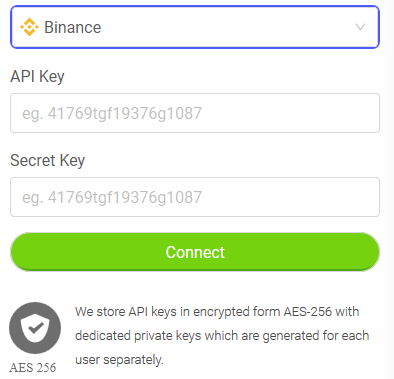
When opting for Binance, you will be prompted to enter your API key details along with your secret key information.
From here you need to login to Binance in order to locate your API keys and this information can be found by clicking on “API Management” and then “Create API”.
You can then name the API key and click “Create New Key”, before confirming your 2FA code and completing the key creation process by following all the instructions in the confirmation email. You will then be able to see the API keys, and you should edit your API key restrictions in order to maximize your security settings.
You can now complete the API integration process by returning to the Coinrule Dashboard and entering the required information.
3) Create Your Rules
Creating strategies on Coinrule is pretty straightforward and you can get started by clicking on the “Create Rule” tab located at the top right of the Dashboard. You can then create easy to setup trading strategies based on “If/Then” parameters which allow you to quickly get going and take advantage of any market movements.
You first need to select an exchange, define the event (e.g. 15% BTC price decrease), and then enter in your buy/sell order. You can also click on the “Timer” tab to configure how you would like to schedule your trades.
Here, the Demo account displays a market buy order for $2500 worth of BTC to be deployed twice should the price of Bitcoin drop by 15%.
A tab at the top right of the page summarizes the rule’s key conditions, and you can double check everything is in order before clicking the “Launch” tab.
You can also opt for a ready-made strategy from the template library, and when you select your preferred strategy, all the details will be automatically entered into the correct sections, and you can simply adjust the settings in order to configure the strategy exactly as you like.
Here with the “Buy The Dips + Stop Loss/Take Profit” Template, the strategy is automatically setup to make purchases in the event that any coin on your integrated exchange account drops by 10%.
It will also then sell the same coin once it has increased by 5% to take profit, while the stop loss feature will also trigger a sale in the event that the price drops by 3%.
The template has also been configured to automatically start immediately, and execute once a day with a maximum total of 10 executions.
Once again, the tab at the top right of the page summarizes all the key conditions, and you can configure the template as you like, and even add further conditions before clicking the “Launch” tab.
Coinrule Pricing
The platform can be used free of charge for an undefined time period, although, the Starter account option is restricted to only 1 Connected Exchange, 2 Demo/Live Rules, and 7 Template Strategies.
The Hobbyist plan costs $29.99 per month (billed as $359 annually) and provides access to 2 Connected Exchanges, 7 Demo/Live Rules, and 30 Template Strategies. Each paid plan also includes access to Advanced Indicators and the Trader Community.
More active traders can also choose from either of the Trader or Pro packages which contain even more features and the Pro package provides access to Unlimited Connected Exchanges, 50 Demo/Live Rules, and Unlimited Template Strategies.
It also allows anyone signing up to take part in one-to-one training sessions, and benefit from an ultra-fast data socket and costs $249.99 a month, billed as $2,999 annually.
Payments are processed by Stripe and you will be required to enter your credit card details to make a one off purchase for one year’s worth of service.
Supported Exchanges
Coinrule currently supports over ten popular cryptocurrency exchanges which can be linked via API integration. These include:
Bitfinex
Binance
Binance US
BitMEX
Bitpanda Pro
Bitstamp
Bittrex
Coinbase Pro
HitBTC
Kraken
Liquid
Poloniex
Is Coinrule Safe?
The team declare that each user has their own dedicated private key which has been generated separately, and these private keys are in turn stored on detached data storage which is encrypted with AES-256. Coinrule also only stores encrypted forms of all API keys using 256bit AES encryption, and the team also use data encryption in transit so all communication between their website <-> application backend <-> database/cache nodes is encrypted using TLS 1.2 or higher.
Coinrule also uses Ukey1 as a secure authentication gateway partner, and as a result the team do not store passwords in their database. Ukey1 also encrypts all personal data and passwords are hashed using advanced algorithms, while the website is further secured by using Cloudflare CDN as to protect against DDoS types of attacks.
In addition, the Coinrule team are transparent in nature, and the key information about themselves and their corporate setup has been made publically available. This helps to develop trust, as users can easily identify exactly who is behind the project, which isn’t always the case with crypto projects. The trading platform was also incorporated in the UK, and operates in accordance with the laws of the United Kingdom within the jurisdiction of England and Wales, meaning that users are protected by the extensive financial and commercial laws within the region.
With regards to payments, Coinrule processes your purchases by using Stripe, and transactions are marked as a Merchant-Initiated Transaction (MIT) by Stripe. As a result, all your payment details are confidentially secured, and neither Coinrule nor Stripe actually have access to your financial data. These factors help Coinrule quite a bit as the platform has only been operating since 2018, and if you run into any issues, you can contact the team directly or just speak to your credit card provider to rectify the situation.
As is always the case when using automated trading platforms and/or software, the most solid approaches always involve maximizing your own personal security in order to protect yourself from any attacks or serious issues. Simple measures such as keeping your login/personal information private will go some way to securing your account, while restricting your exchange account API and disabling withdrawals from within your account will protect you from the most serious security breaches.
When using Coinrule, you are not required to transfer any funds over, and the platform doesn’t have direct access to your crypto holdings. This is true for the the majority of trading bots or portfolio management tools as everything is done via an Application Programming Interface (API) which allows Coinrule to interface with its supported exchanges and collect price and account balance data as well as place buy and sell orders.
The team can improve their security by incorporating 2FA authentication and notifying users of account activity via email/SMS. A mobile app will also allow users to keep track of their accounts while on the go, however, the platform is generally quite solid although Coinrule is still developing its online presence as well as trading community.
How Beginner Friendly is Coinrule?
To be honest, Coinrule is one of the most easy to use automated crypto trading platforms out there. While all trading platforms require some learning and take some time to get used to, Coinrule has been designed with less technical traders in mind, and the clean and simple interface make it easy to keep on top of whatever you are doing.
Rules can be created using “If/Then” parameters which are simple to understand and allow you to quickly get going, while the modular setup allows you to easily make changes and adjustments in order to configure any rule you create or template strategy that you would like to tweak.
The team behind the platform designed it to be a “Lego tool-box” for cryptocurrency trading strategies and automated trading, and rules can be created quickly and back-tested before being launched. As a result, Coinrule should definitely suit less technical traders while still incorporating features that appeal to more technical traders.
These include the ability to intricately create and configure strategies, and readymade templates can be configured to include additional conditions and triggers or to act in a much simpler manner if desired.
The platform also provides access to advanced TA tools and you can set up trading strategies based around RSI or moving averages approaches or follow much broader accumulation, contrarian, or take profit methods. However, the team can expand their service in the future to include more features such as trailing stop losses, additional technical indicators, and a mobile app.
Anyone signing up to a Trader or Pro plan can receive one to one trading lessons, and the team also provide resources which help to explain how to use the platform and how the various aspects of engaging in automated crypto trading.
Anyone interested in using the platform can always sign up for a free Starter account and test it out in order to figure out if opting for a paid subscription will be beneficial.
Conclusion
Coinrule is a somewhat under the radar crypto trading platform which stands out due to its simplicity and ease of use. The “Lego” tool kit ideology has been well implemented as the platform’s clean and simple user interface and modular strategy configuration features make creating, tweaking, and testing strategies a relatively straightforward process for even less experienced traders.
The platform also offers good exchange support and integrates with a range of leading crypto exchanges such as Binance, Coinbase Pro, Kraken, and BitMEX which should appeal to most traders as these exchanges provide good liquidity levels, and a wide range of coins to trade.
However, as easy as it is to use, Coinrule still has room to improve as more advanced users may be interested in deploying a wider range of TA based strategies than the RSI and Moving Averages strategies currently on offer.
Also anyone looking to manually configure their own bots to perform more complex actions may be better served by a more extensive platform, and experienced traders may also be looking to sell their successful strategies, and interact with other users via an internal marketplace, and Coinrule currently doesn’t provide these features.
All in all, Coinrule is an interesting option for anyone looking to quickly get started in the world of automated crypto trading, and the platform is still emerging and developing in terms of it visibility, reputation, and online community.
Anyone who is already active on any of the supported exchanges can always give Coinrule a try in order to improve on the limited trading options many of those exchanges currently offer. As ever, it’s a good idea to try out a free account and get a feel for the platform in order to see if one of the paid subscription plans will suit your particular needs and prove to be beneficial in the long run.
Visit Coinrule
The post CoinRule Review: Automated Crypto Trading Bots Platform appeared first on Blockonomi.
A quick and highly rewarding investment – ICOs (Initial Coin offerings) and token sales are becoming the focus for investors and those looking to invest in blockchain technology and the cryptocurrency market. Market is changing and evolving in such a way that it requires a lot of attention, reading and evaluation before making any significant moves. But what is ICO, and what are the best tips and practices for those looking to learn how to choose the right ICO?
ICO or initial coin offering means someone offers tokens or units of a new cryptocurrency in exchange for funds. The goal of the sale is to gain investments to develop a new cryptocurrency. All those willing to invest will be rewarded. Either with a certain amount of bonus or with the possibility to be ahead of others when it comes to payouts or profit. A number of new startups is growing every day and the market is blooming. It is a clear sign of market demand for new services, cryptocurrency exchanges, regulations, and investors. ICO investment is seen as a lucrative, profitable business for open-minded investors, ready to invest time and money equally not in the right project.
ICO research
Behind every ICO investment, there is always a well done and well-planned research. In most cases, investors in the cryptocurrency market will choose more than one initial coin offering to invest in and allocate funds in different streams, which lowers the risk. ICO tips available on the community pages such as Reddit or Telegram, are a great source of information for investors looking to choose the right ICO. We would argue that the best way how to choose the right ICO is to find a list of new ICOs planned for the following year. Once you have a list of the ICOs, it is crucial to determine the group they belong to. For example, predictions for 2018 say the financial sector and ICO related to it will most likely be a highly rewarded ICO investment.
How to evaluate ICO?
Your potential ICOs have to be evaluated. Each of the possible ICOs should be assessed in the same way and following a few different categories, including who is the team behind, is there any prototype, what is the problem this particular ICO will help resolve, and what is the community opinion (Reddit and Telegram groups).
ICO evaluation starts by reading the whitepaper. The team behind the ICO will publish a whitepaper on the project’s official website, and this is the first step to present the concept. Think of a whitepaper as a business idea. Whitepaper has to show how everything will work, what the problem the team is trying to resolve is, whether or not there are any plans for the future. Investors should be able to understand the technical details same as a nontechnical side. The role of the whitepaper is to help you better understand ICO’s position in the cryptocurrency world, which in turn allows you to conduct a better ICO evaluation. Lack of the whitepaper or a poorly written one means the team does not have a clear vision, and prospective investors should put that particular ICO on hold until more information is provided.
Check out team members
Another way to decide how to choose the right ICO is by checking the team. The team behind the ICO has an enormous impact on the idea, development and, in the end, the success of the ICO itself. Same as the whitepaper, team member’s profile and business achievements can give a lot of valuable information. Team members can be quickly checked on the official website of the company you’re looking to invest in. In fact, if the company does not have team members section, it is not advisable to invest. A good team should have skilled technical members as well as management people. The technical part of the team should have substantial knowledge on the matter and experience in the field. Team members should have clear links to their business profiles, either LinkedIn or GitHub, plus you should check if they are currently working for some other company or projects. If given ICO is not listed on the personal network as a current occupation, this might be a sign team members are not firmly behind the project, and you should reconsider the investment. Besides team members, it is crucial to see who the advisors are, what is their primary interest and how many successful projects of this kind they have been working on. Same as for team members, if advisors have any cryptocurrency, ICO, and blockchain experience it is more than welcome.
Are there any prototypes of the project?
A prototype of the project is a clear sign the team is working seriously on the idea. Prototype or a beta version, as some also call it, increases the chances for a product or an ICO to be fully developed. Users’ feedback and experience are also present, which can also be a valuable source of information. If there is no clear sign of the prototype, investors should look for a reason why this is the case and see if the roadmap has any signals when the prototype will be available.
Why is a clear roadmap important?
The roadmap is a quick and straightforward way to see the ICO development. As its name says, the roadmap shows timeline and progress of the idea. All of the significant steps such as the release of new websites, wallets, forks should be stated. When looking for a roadmap, investors should be careful how detailed the timeline is. In most cases, ICO will have timeline and goals set in the quarters or seasons. But an ICO with a defined schedule and all events listed by the months is more likely to succeed. If, for example, new wallet release is scheduled for June, this gives more trust to investors than if the time is not specified.
Conclusion
ICO investors should be able to see the ICO like a business and treat it as one, too. This means a lot of research and work are needed before making a financial commitment. The first step should be a through market research and shortlisting potential ICOs. Once you have candidates, a more in-depth research should be conducted. Always make sure you check out community pages and team members. A team behind the project should have a clear idea on future development, and for you as the investor all information should be easily accessible. Keep in mind that the cryptocurrency- and ICO-worlds are fast evolving, and being up to date can help you make the right decision. We are here to help you with that, so check out our other articles and see what else you can learn.
The post How to choose the right ICO appeared first on Crypto Trading Reviews.
What Are Bitcoin Futures? How Do Bitcoin Futures Work? What Are the Best Bitcoin Futures Exchanges?
Bitcoin futures are alive and well in 2019. On an average day, investors exchange over $5 billion in bitcoin futures contracts.
But what exactly are bitcoin futures? How do bitcoin futures work? How can I start trading bitcoin futures?
Today, we’re explaining everything you need to know about bitcoin futures trading.
What is a Futures Contract?
A futures contract allows the investor to buy or sell an asset at a certain price on a certain date set at some point in the future. Investors in bitcoin can trade futures contracts in futures marketplaces.
Traditionally, the most active futures markets have involved gold, oil, or various commodities.
The futures contract itself contains details of the asset class being traded. The contract also lists the purchase size, final trading day, maturity date, and the exchange on which the contract is being bought or sold.
Because the futures contract is linked to the value of the asset, the underlying value of the futures contract for a particular instrument is priced according to the actual asset itself.
How Does Futures Trading Work?
A futures trade involves two parties. One party goes long on an asset class while the other goes short. While we have covered in great detail the bitcoin chart analysis, learning how to trade bitcoin futures is a different category to understand as a whole.
The futures contract is created based on demand: the contract is not automatically offered in the marketplace. A futures contract is created when a buyer is matched with a seller.
A short position is used to secure a sell price now in order to protect someone – like a hedger – against declining prices in the future. The short position wins if the price continues to fall.
A long position is used to secure a buy price now to take advantage of rising prices in the future. The long position wins if prices continue to rise.
With both of these positions, the trader has locked into the contract at a specific price point.
Futures contracts start as an agreement between two parties, although the contract will likely change hands multiple times before the contract expires.
When the futures contract expires, the settlement can be either physical (in the case of commodities) or via a cash settlement (in the case of most bitcoin futures exchanges).
When a futures contract is physically settled, the goods are delivered at the agreed-upon price. Typically, futures contracts are used by investors to hedge physical exposure to a particular instrument, or by speculators, neither of whom are looking for physical delivery of the asset.
When a futures contract is cash-settled (also known as financially settled), no physical exchange of goods takes place; instead, an equivalent amount of cash is exchanged. The contract is settled by taking the difference between the price of the contract at the time it was purchased and the price at settlement.
Bitcoin futures trading takes a similar approach. Cash-settled bitcoin futures let traders gain exposure and/or hedge their exposure to the crypto asset without actually having to manage their private keys or create a crypto account to buy bitcoin. Physically-settled bitcoin futures, like the product offered by Bakkt, require physical storage of Bitcoin.
Futures Contracts in Practice
In practice, futures contracts are most often used by hedgers and speculators. An airline might hedge itself against rising oil prices, for example, while a speculator might buy bitcoin futures contracts today anticipating a rise in bitcoin prices moving forward.
Hedgers can go either long or short. A short position is taken to secure a price now to protect the hedger from declining prices in the future, while a long position protects against rising prices in the future.
Speculators go short when they expect prices to fall in the future. They go long when they expect prices will rise in the future.
All airlines, for example, protect themselves against fluctuations in oil prices by buying futures contracts. The airline will buy a futures contract for crude oil today. That contract will have a specified price and delivery date in the future. This insulates the airline from the cost fluctuations of crude oil: the airline is affected by the cost fluctuations of crude oil as a physical commodity, but it has protected itself in the futures market.
A speculator, meanwhile, might buy a bitcoin futures contract today. That futures contract guarantees that the speculator can buy bitcoin one year from now at a price of $8,000. If the price of bitcoin rises to $15,000 by the contract’s expiry, then the speculator has made a significant amount of money. If the price of bitcoin drops to $5,000 by the contract’s expiry, then the speculator has lost money.
Or, let’s consider the case of a bitcoin miner. A bitcoin miner, for example, might sell bitcoin futures as a hedge against price volatility. The bitcoin miner is like a soybean farmer trading soybean futures: the miner will ‘harvest’ BTC at some point and want to sell it. To hedge against the risk of bitcoin’s price falling, the miner could lock into a specific price of BTC for a specific future date.
History of Futures Markets
Futures markets aren’t new; the first futures market, called the Dojima Rice Exchange, was launched in Japan in 1710. Traders would buy or sell futures contracts based on the price of rice.
Some argue that the London Metal Exchange operated similarly back in the 16th century. Others point to the Hammurabi Code from 1750 BC that allowed the sales of goods and assets to be delivered of ran agreed price at a future date.
In any case, futures markets have been around for a while. Bitcoin futures trading, however, is extremely new.
History of Bitcoin Futures
The first bitcoin futures markets launched in December 2017. Officially, Cboe Futures Exchange, LLC (CFE) was the first to list bitcoin futures. The organization’s cross-town competitor, however, CME Group, was the first to announce the launch of bitcoin futures trading, although they didn’t launch their exchange until December 17.
Today, Cboe and CME are the two largest and best-regulated bitcoin futures exchanges, although plenty of other competitors have emerged.
Why did we need bitcoin futures exchanges? Well, just like in commodity markets, investors needed a way to hedge.
Prior to the launch of bitcoin futures trading, miners faced an unknown future and fixed operating costs. Miners were mining bitcoin and holding bitcoin, then spending money on utility bills and operating expenses, but they weren’t sure how much their bitcoin was ultimately going to be worth. Just like airlines, miners needed a way to hedge their bets. That’s why we need bitcoin futures contracts.
Although Cboe and CME Group are the two largest and best-known bitcoin futures exchanges, they’re not the only players in the game.
One bitcoin futures trading exchange traces its history back to 2011. OrderBook.net launched in 2011 (originally known as iCBIT). The exchange lasted until around 2016. At its peak, OrderBook.net sold millions of futures contracts each month. OrderBook.net has since shut down.
More recently, TD Ameritrade has entered the bitcoin futures trading space, for example. Anyone with a TD Ameritrade account can actively trade bitcoin futures. TD Ameritrade offers bitcoin futures trading, although you’ll need to meet certain requirements to qualify (as a minimum account balance of $25,000).
Today, we have dozens of major crypto futures trading platforms. Most of the best-regulated institutional platforms continue to focus on bitcoin and USD futures contracts. However, many other providers now offer futures trading in Ether (ETH), Litecoin (LTC), Bitcoin Cash (BCH), and Ripple (XRP).
Kraken, for example, offers all of the following crypto futures contract pairs: BTC/USD, ETH/USD, LTC/USD, BCH/USD, XRP/USD, and XRP/BTC.
Meanwhile, two unregulated marketplaces, OKEx and BitMEX, each have average daily volumes exceeding $1 billion on average, making them the two largest bitcoin futures exchanges available today.
Three Main Reasons to Trade Crypto Futures
There are three main reasons why a company, an investor, or an institution would trade bitcoin futures:
Hedge Price Risk: Investors holding digital assets can mitigate the risk of a falling price by simultaneously taking a short future position on the asset in question. If the price falls, the short position will mitigate losses by providing additional revenue.
Speculate on Market Direction: Cryptocurrency futures trading allows investors to speculate on whether prices will go up or down. If you believe the price of bitcoin is about to sharply increase, or example, then you can go extra long on bitcoin futures to multiply your returns. If you believe ETH is about to plummet, then you can short ETH futures.
Stabilize Price Fluctuations: Airlines stabilize oil price fluctuations by buying crude oil futures. Some do the same with bitcoin futures. A miner with expected bitcoin flows or an ATM operator with inventory to manage, for example, might smoothen exposure to price fluctuations using bitcoin futures.
Generally, most bitcoin futures traders fall into one of the categories above.
Leverage and Crypto Futures Trading
Leverage plays a crucial role in futures trading. You’ll see many futures exchanges advertise how much leverage they offer. CME and Cboe offer leverage of 3x to 5x, on average, while unregulated exchanges offer leverage of 20x to 100x.
Futures are extremely capital efficient, which means less money is required to open positions than if you were spot trading (1x) or margin trading (3 to 5x).
That’s why many bitcoin futures marketplaces – like Kraken – let you leverage your position up to 50x over, assuming you have sufficient collateral.
Let’s say you have 10 BTC and are scared of declining prices. With spot trading, you need to trust 100% of your money to the spot exchange to sell. With a margin exchange, you’d need to trust 20%. With 50x crypto futures like we see on Kraken, you can trust as low as 2% of your money on the exchange.
Because crypto futures use collateral as low as 2% of the notional amount, crypto futures allow you to take positions with up to 50x leverage, giving traders the flexibility to position themselves in the market while maintaining lower exchange risk than they would have on spot or margin trading platforms.
The Best Bitcoin Futures Exchanges Available Today
Today, Cboe and CME remain the two largest and best-regulated bitcoin futures marketplaces in the world.
Other competitors have also entered the market. You can now trade crypto futures on well-regulated crypto exchanges like Kraken, for example. You can also trade futures on unregulated crypto exchanges like Deribit, BitMEX, and OKCoin.
Chicago Board of Exchange (Cboe)
Cboe was the first regulated marketplace to launch bitcoin futures trading. The company beat its crosstown competitor, CME Group, to launch, even though CME Group announced its futures trading weeks earlier. Key features of bitcoin futures trading on Cboe include:
Listing Date: December 10, 2017
Ticker Symbol: XBT
Contract Unit: Equal to 1 BTC
Description: Cash-settled futures contracts based on the Gemini Exchange auction price for bitcoin in USD.
Pricing: USD
Settlement: The final settlement value will be the auction price for bitcoin in USD determined at 4 pm EST on the final settlement date by the Gemini Exchange.
Trading Hours: 830am to 315pm Monday to Friday
Margin Rates: 40%
Clearing: Options Clearing Corporation
Contract Expirations: Weekly, monthly, quarterly
Chicago Mercantile Exchange (CME) Group
The Chicago Mercantile Exchange (CME) Group launched its bitcoin futures trading marketplace just a week after Cboe. Today, the platform functions in a similar way to Cboe’s offering, although there are small differences between the two options.
Listing Date: December 17, 2017
Ticker Symbol: BTC
Contract Unit: Equal to 5 BTC
Description: Cash-settled based on the CME CF Bitcoin Reference Rate (BRR), which serves as a once-a-day reference rate of the USD price of bitcoin.
Pricing: USD
Settlement: The contract is priced using the CME CF BRR, which has been built around the IOSCO Principles for Financial Benchmarks. BRR takes data from Bitstamp, Coinbase, itBit, and Kraken to calculate pricing.
Trading Hours: Sunday to Friday from 6pm to 5 pm, with one-hour break at 5pm.
Margin Rates: 35%
Clearing: CME ClearPort
Contract Expirations: Every two months
TD Ameritrade
TD Ameritrade recently launched bitcoin futures trading to qualifying users. Anyone with a TD Ameritrade account who meets the qualifications can start trading bitcoin futures from directly within their accounts. TD Ameritrade has partnered with CME Group to offer bitcoin futures trading: you’re trading through your TD Ameritrade account, although all trades are placed over the CME Group marketplace.
To qualify for TD Ameritrade bitcoin futures trading, your account needs to meet the following qualifications:
Margin enabled
Tier 2 spread option approval
Advanced features enabled
Futures trading approval
Account minimum of $25,000
TD Ameritrade’s requirement for trading bitcoin futures is 1.5 times higher than exchange margin requirements. Once approved, you’re ready to start trading bitcoin futures immediately.
Kraken
Kraken has one of the most robust crypto trading platforms available today. Kraken lets you trade a variety of cryptocurrencies in multiple pairs. Key features of Kraken’s crypto futures trading marketplace include:
Multiple Currency Pairs: BTC/USD, ETH/USD, LTC/USD, BCH/USD, XRP/USD, and XRP/BTC.
Leverage: Up to 50x leverage (available across all pairs)
Timeframe: Perpetual, monthly, and quarterly (only perpetual and quarterly timeframes available for XRP/BTC)
Contract Size: 1 USD (1 XRP for the XRP/BTC pair)
Collateral: BTC, ETH, LTC, BCH, or XRP
Type: Inverse (Vanilla for XRP/BTC pair)
Fees: 0.075% taker, 0.02% maker
Settlement: Profit from trading is instantly settled and available. Contracts mature at the expiration date and the open interest is cash-settled in the collateral asset.
One of the biggest advantages of trading crypto futures with Kraken is that you can leverage up to 50x across all pairs.
Bakkt
Bakkt is the newest entrant to the crypto futures trading space. Bakkt is a crypto startup launched by Intercontinental Exchange (ICE), the same company behind the New York Stock Exchange (NYSE). Originally announced in 2018, Bakkt’s launch date was pushed back over a year.
Finally, Bakkt launched in September 2019 with its first product: a bitcoin futures contract aimed at institutional investors who want to make bets on the future price of bitcoin.
One of the biggest differences between Bakkt and its competitors is that Bakkt’s futures contracts are physically settled in ‘real’ bitcoin. Unlike traditional futures contracts on other exchanges, which are simply derivatives of bitcoin, Bakkt uses physical bitcoin.
Other key features of Bakkt include:
Custody: Unlike any other crypto futures marketplace, Bakkt stores physical bitcoin. The company has invested significantly in state-of-the-art physical and cybersecurity, ultimately allowing it to create an institutional-grade custody service suitable for retail and institutional investors alike.
Same Technology as ICE and NYSE: Bakkt may be the most secure crypto exchange available. The exchange is built on the same technology that powers major international exchanges like the ICE and the NYSE.
Physically Delivered Contracts: Unlike all other crypto futures exchanges listed here, Bakkt uses physically-delivered bitcoin futures contracts. Instead of just trading derivatives of bitcoin and settling in cash, Bakkt users settle contracts in real bitcoin.
Compliant: Bakkt is built for compliance from the ground up. Users must complete KYC and AML verification. Bakkt also has on-chain analytics and surveillance for all crypto deposits and withdrawals. Overall, Bakkt is positioning itself as a safe and regulated trading environment.
Today, Bakkt only offers physically-settled BTC/USD futures contracts. Moving forward, however, Bakkt plans to launch additional pairs and offerings.
Interactive Brokers
Interactive Brokers lets you buy long contracts with a 50% margin requirement, which is the best in the market. Although Interactive Brokers charges slightly higher fees than the competition, the platform also accepts a range of different currencies. Plus, Interactive Brokers lets you buy futures contracts on either Cboe or CME.
Key features of Interactive Brokers include:
Accepted currencies: USD, EUR, GBP, AUD, and CAD
Deposit Methods: Bank wires, ACH, BPay, EFT, checks
Fees: $5 fee on CBOE, $10 on CME
The main downside of Interactive Brokers is that shorts need to provide excess margin, which means you need to control more than the nominal value to open a short, removing much of the incentive for a trader to open a short in the first place. The other downside of Interactive Brokers is the high fees of $5 to $10.
TradeStation
TradeStation has some of the cheapest fees in the bitcoin futures trading industry. The main drawback of TradeStation is that you need to put down 66% of your position’s nominal value as a margin requirement, which defeats some of the benefits of futures contract trading.
TradeStation does, however, offer access to both the CME and Cboe bitcoin futures trading markets, and the $1.50 fees are very cheap.
E Trade
E Trade is an American trading giant that recently started offering bitcoin futures contracts to customers through the Optionshouse trading platform. Users can trade both CME and Cboe contracts with an 80% margin required. Trades are collateralized in USD.
E Trade also has reasonable (if slightly high) fees of $2.50.
CryptoFacilities
CryptoFacilities is licensed and regulated by the United Kingdom’s Financial Conduct Authority (FCA), giving it an extra layer of authority over BitMEX, Deribit, and some of the unregulated providers on this list.
CryptoFacilities also has a competitive fee structure for bitcoin futures trades, including $0 maker fees and taker fees as low as 0.0008. One of the unusual things about CryptoFacilities is that the platform only accepts crypto for deposits. However, users are accepted from anywhere in the world (except for the United States and sanctioned countries.
Key features of CryptoFacilities include:
Trading Hours: 24/7
Timeframes: Perpetual, monthly, and quarterly
Leverage: Up to 50x
Crypto Pairs: BTC, ETH, XRP, LTC, and BCH
One of the major advantages of CryptoFacilities is that it offers Ripple (XRP) markets. Trades in the XRP/USD and XRP/BTC pair can be collateralized in XRP itself. This feature makes CryptoFacilities are particularly popular option for investors holding large amounts of Ripple.
BitMEX
BitMEX is an unregulated crypto futures trading marketplace with few rules but lots of liquidity. It’s one of the world’s largest crypto futures marketplaces, dwarfing its better-regulated competitors like Cboe and CME Group. On an average day, BitMEX will see over $2 billion of crypto trades in a 24 hour period.
BitMEX charges a maker fee of 0.025% and a taker fee of 0.075%.
One of the biggest advantages of BitMEX is that the exchange offers leverage up to 100X, much higher than any competitors listed here. Traders can set leverage anywhere from 1 to 100 based on their aversion to risk.
Other key features of BitMEX include:
Trading Hours: 24/7
Timeframes: Perpetual, quarterly, and bi-quartlery
Expiry: Last Friday of the contract month at 8 pm EST
Leverage: 1x to 100x
Crypto Pairs: ADA, BCH, EOS, ETH, LTC, TRON, and XRP
Banned Countries: United States, Canada, Cuba, Crimea, Iran, Syria, and North Korea
Volume: $2 to $4 billion in daily trading volume (2019)
BitMEX uses a 50/50 split between Coinbase and Bitstamp as its underlying bitcoin price index, giving the exchange an extra layer of legitimacy.
OKCoin / OKEx
OKEx is the international arm of the OKCoin exchange, which was founded in 2013. The exchange is registered in Malta but run from Hong Kong, catering mostly to traders in China and other Asian countries.
Today, people tend to use OKCoin and OKEx interchangeably. Whatever you call it, OKCoin/OKEx is frequently the largest bitcoin futures trading marketplace on the internet, although it’s occasionally beat by BitMEX. OKCoin is particularly popular among Asia-based crypto futures traders.
OKCoin offers leverage up to 20X on three different cryptocurrencies. It also offers low fees. Users can go through two different levels of verification based on how much they want to trade and how they want to withdraw their money.
Key features of OKEx include:
Trading Hours: 24/7
Timeframes: Weekly, Bi-Weekly, and Quarterly
Expiry: Friday at noon of the expiration week
Leverage: 10x to 20x
Crypto Pairs: ETH, ETC, BCH, XRP, EOS, and BTG
Volume: $1.5 to $3 billion per day (2019)
Banned Countries: United States, Hong Kong, Cuba, Iran, North Korea, Crimea, Sudan, Malaysia, Syria, Bangladesh, Bolivia, Ecuador, and Kyrgyzstan
Overall, OKCoin offers strong liquidity from an exchange with a less-than-transparent history. Like BitMEX, there are some concerns over dealing with an unregulated exchange. However, OKCoin continues to be popular among Asia-based crypto traders wanting to access futures contracts.
Deribit
Deribit is the newest bitcoin futures contract competitor for BitMEX and OKEx. The Netherlands-based exchange specializes in crypto futures trading.
Key features of Deribit include:
Trading Hours: 24/7
Leverage: Up to 100x
Timeframes: Perpetual and quarterly
Crypto Pairs: BTC and ETH
How Do Bitcoin Futures Affect Bitcoin Trading?
There’s some debate over how bitcoin futures affect bitcoin trading. When bitcoin futures trading was first announced in late 2017, the markets went crazy with anticipation. Long-term bitcoin hodlers saw this as a sign that bitcoin was becoming mainstream. They thought trillions of dollars of institutional capital was about to pour into bitcoin.
Within a week of the launch of the first regulated bitcoin futures trading market, the price of bitcoin went up to its all-time high of $20,000. The price crashed soon after and remains at around $9,000 today.
So how do futures markets affect bitcoin – if at all? Are futures markets good or bad for the world’s largest cryptocurrency?
The answer is complicated.
The general theory argues that the ‘smart’ institutional money will pour into the futures market, and that other markets will follow. We saw this with the initial launch of bitcoin futures. Bitcoin futures prices rose. The market, taking note of the higher futures market prices, followed, causing the market price of bitcoin to rise. People began looking to futures markets as a guide to the future direction of bitcoin – similar to how commodity, oil, and gold futures markets work.
Increased appetite for lower bitcoin prices could see the value of bitcoin futures contracts drop, likely leading to a decline in the price of bitcoin itself.
We see a similar effect on traditional markets. Daily movements in the Dow mini and the S&P 500 futures markets, for example, have a material impact on the direction of the main indexes each day.
Futures markets don’t always control the underlying market, however. News that occurs during the market’s trading hours, for example, can disrupt the trajectory that we were starting to see with futures markets. Which as a noble sidenote, it may be worth learning how to earn bitcoin as an alternative to trading bitcoin futures.
FAQs About Bitcoin Futures Contracts
We get a lot of questions about bitcoin futures contracts. Below, we’re answering some of the most common questions we receive:
Q: How are bitcoin futures contracts related to the underlying market price or spot market of bitcoin?
A: Bitcoin futures marketplaces draw prices from existing crypto exchanges. CME, for example, uses its CME CF Bitcoin Reference Rate (BRR), which draws price data from several major exchanges. This price is used to settle all bitcoin futures contracts.
Q: How are bitcoin futures marketplaces regulated?
A: Bitcoin futures marketplaces in the United States are regulated by the Commodity Futures Trading Commission (CFTC), which is the regulatory body with exclusive jurisdiction over American bitcoin futures markets. Overseas, other regulatory agencies perform similar roles. Some bitcoin futures marketplaces aren’t regulated by any government body.
Q: Do I need a digital wallet to trade bitcoin futures?
A: You do not need a digital wallet to trade bitcoin futures when the futures are cash settled or financially settled (as is the case with CME, Cboe, and most other bitcoin futures exchanges). However, you will need a digital wallet (or at least a brokerage account) if dealing with physically-settled bitcoin futures – like with Bakkt.
Q: Why are Americans banned from certain unregulated futures exchanges?
A: Many of the unregulated futures exchanges above have banned Americans. Exchanges do this to avoid liability issues. Futures trading in America is regulated by the CFTC, and unregulated exchanges are offering services that break CFTC regulations. Getting regulated for each American user is complicated, so most exchanges just ban American users entirely.
Q: How old are bitcoin futures?
A: Regulated bitcoin futures first launched in December 2017 with Cboe and the CME Group. Bitcoin futures, however, date as far back as 2011 on unregulated marketplaces.
Q: What is shorting?
A: Shorting is the practice of placing a short bet without having to first borrow the underlying security. When shorting an asset, you are taking a position that the price will go down.
Q: What is hedging?
A: Hedging is the practice of taking a position on one asset to offset your position in another. Because futures contracts allow for leverage, it’s easy to hedge your position regardless of the number of physical assets you hold.
Q: What is margin?
A: Margin is the amount of money a trader must initially deposit as collateral when taking a futures position. For many heavily-traded contracts, margin amounts are less than 10% of the underlying contract. Regulated exchanges, including the CME Group and Cboe, require margin of 35% to 40%.
Final Word: What’s the Future of Bitcoin Futures Trading?
Bitcoin futures trading activity continued to be strong throughout 2019. CME Group reported an average of about $300 million to $500 million worth of bitcoin futures per day throughout 2019.
CME also claims that bitcoin futures are gaining interest among big investors. Plus, when checking futures trading volume on unregulated exchanges, we see volume of more than $4 billion per day on many days.
Clearly, bitcoin futures trading plays a crucial role in the crypto ecosystem – and it’s not going away anytime soon.
Aziz, Master the Crypto Founder
I’m Aziz, a seasoned cryptocurrency trader who’s really passionate about 2 things; #1) the awesome-revolutionary blockchain technology underlying crypto and #2) helping make bitcoin great ‘again’!
The post Bitcoin Futures Guide: Best Exchanges + How Trading Works appeared first on Master The Crypto.
Tether Stablecoin Guide: How USDT Crypto Token Works
Tether (USDT) stablecoin is one of the cryptocurrency market’s biggest controversial topics in the bitcoin community. Master The Crypto put together a three-part guide for you to review to better understand Tether, how Stablecoins work and the Bitfinex association/price manipulation drama. Let’s begin:
1) what is Tether stablecoin (USDT)
2) how Stablecoins work + stablecoin comparison with Facebook Libra competition
3) the full story of the Tether crypto token and Bitfinex exchange, and what’s next
Live Tether Price: USDT Coin Market Cap
Live Tether Price vs Bitcoin: USDT Stablecoin Market Cap + Trading Volume
#
Coin
Price
Marketcap
Volume (24h)
Supply
Change
Last 24h
1
Bitcoin
BTC
$9,461.34
$174.05 B
$21.76 B
18.41 M
1.18%
3
Tether
USDT
$0.999608
$9.63 B
$20.83 B
9.63 B
0.11%
$0.999608
Tether (USDT)
1h0.00%
24h0.11%
USD
EUR
GBP
Tying Up Tether: Comprehensive USDT Guide and if you should get your hands on the top stablecoin!
Tether, who’s official website is at tether.to, is a stablecoin cryptocurrency by the token symbol of USDT to represent a 1:1 USD-pegged US Dollar token. As the Tether crypto slogans put it, a ‘digital money for a digital age’, with its aim to ‘bring real world currency to the blockchain’, USDT is one of the most highly-debated community topics.
The number of cryptocurrencies has exploded since the advent of Bitcoin back in 2008. With 11 years separating it from its very humble beginnings, there is now an enormous number of digital assets within the market. These different currencies either set themselves apart with unique functions or simply seek to capitalize on the success of these virtual currencies.
While these different assets provide intrinsic value to their multitudes of users and investors, another ‘genre’ of digital currency has managed to grow at an impressive rate too. Being backed by a sovereign currency, Stablecoins have emerged over the past few years as an almost extension to popularly known currencies like the US Dollar, as one example.
It should be said, these stablecoins haven’t exactly managed to explode in the same way as digital assets, but there are some pretty interesting iterations out there that are worth considering. One of these, of course, is Tether (USDT) which is one of the more popularly used stablecoins among those interested in using, holding or even loaning it out. And no matter where you check the price of Tether, whether CoinMarketCap, CryptoCompare or CoinGecko to name a few, you will see USDT in the top 10 if not top 5 by market cap and an alternating trading volume rank with Bitcoin for #1 and #2 for most in the blockchain-based token ecosystem.
But how exactly did Tether get started? What’s the underlying logic behind using it? And how exactly are you supposed to get a hold of it? We’re going to be diving into these questions right here and right now.
Quick Context – About Stablecoins
One of the interesting things about Stablecoins is that they’re not as ‘recent’ as we’d like to think; in fact, some of the first versions of these currencies actually pre-date what we know as being some of the biggest coins in the crypto world.
For example, some of the first stablecoins out there was introduced to the community back in 2014, including Tether which was first released in July 2014 under the name ‘RealCoin’. Also included were BitShares (BitUSD) and Nu (NuBits) which were able to provide users with a liquid virtual asset with a fixed price thanks to the fact that it held a reserve of US Dollars which operated as a kind of crypto collateral.
To simply say ‘crypto collateral’ is to deeply simplify the often complicated system of liquidity that some of these stablecoins have, which can range from a singular reserve of US Dollars, to a mixed range of holdings from US Dollars, to crypto-assets like Pooled Ethereum.
Regardless, stablecoins provide their own unique take on a stable economic system. And the same is true of Tether, which we’ll be diving into now.
Tearing into Tether – An Origin
Tether is interestingly what we would describe as a brainchild of a number of the senior management team behind the cryptocurrency exchange – Bitfinex. While we know this now, the actual management team remained hidden from the general public when it was first introduced back in 2014, having started off as ‘RealCoin’ before being re-branded as ‘Tether’ in November of the same year.
So what exactly is Tether? According to its white paper, Tether operates as a kind of stablecoin that gives users the ability to use the US Dollar on both the Ethereum and Bitcoin blockchains.
“A digital token backed by fiat currency provides individuals and organizations with a robust and decentralized method of exchanging value while using a familiar accounting unit. The innovation of blockchains is an auditable and cryptographically secured global ledger.
Asset-backed token issuers and other market participants can take advantage of blockchain technology, along with embedded consensus systems, to transact in familiar, less volatile currencies and assets.
In order to maintain accountability and to ensure stability in exchange price, we propose a method to maintain a one-to-one reserve ratio between a cryptocurrency token, called tethers, and its associated realworld asset, fiat currency. This method uses the Bitcoin blockchain, proof of reserves, and other audit methods to prove that issued tokens are fully backed and reserved at all times.”
One of the interesting things about Tether comes back to this easy application on both Bitcoin and Ethereum. While its contemporaries exist sometimes within their own blockchain as a self-contained system such as MakerDAO, Tether is different due to the fact that the majority of its virtual tokens exist and routinely operate on Bitcoin and Ethereum’s blockchain’s respectively; amounting to 97 percent of its token movements.
So why is this the case? It’s a popularly used token made accessible to investors and potential buyers by a variety of centralized and decentralized exchanges.
The logic behind this is pretty simple – it provides a good speculative hedge for buyers in case there’s a bearish turn in the main crypto market; for investors, it allows them to fall back to a reserve asset that won’t fluctuate in value if they chose to leave it in there. But this also allows them to easily move from one currency to another.
For cryptocurrency exchanges – the availability of Tether provides an additional layer of liquidity for their exchange, which is especially important as a smaller centralized or decentralized exchange.
What makes this a little strange is the fact that it, from a financial perspective, it doesn’t make that much sense to piggyback off these two blockchain protocols. By contrast, other stablecoins simply develop and launch their own database.
In doing so, they can mitigate any additional costs that may come from dealing with, for example, miners in accordance with the proof of work consensus mechanism used both by Ethereum and Bitcoin.
This 97 percent metric doesn’t really sound like much, but what gives it some really heavy impact is when we take time to consider the fact that Tether’s token, the USDT, is backed on a 1:1 ratio with the dollar. And with 2.2 billion of them in circulation, it means that Tether carries a reserve of at least the same amount.
Why use Tether?
Much as was previously described, there’s a good deal of value in having a digital currency attached (in some way) to a sovereign currency. For coin exchanges and users alike, this specifically includes having some kind of financial hedge in the crypto market.
But the same advantage goes for those companies and retailers looking to accept cryptocurrencies from potential customers. As we’ve seen from the likes of Microsoft and Expedia among others, there’s every motivation to make purchases in crypto, but there are some serious issues that come with trying to do so.
Firstly, there’s a lot of volatility that comes with trying to take payments for products in Bitcoin. Secondly, the third-party payment systems that operate to provide this solution in a more accessible way basically negates the value of taking crypto as a means of payment; so why bother?
Tether aims to bridge this divide between merchants and everyday users by offering the best of both worlds; a digital currency that can piggyback off Bitcoin or Ethereum, which is also backed by a stable(ish) sovereign currency.
For exchanges, having some kind of open door for users interested in buying cryptocurrencies to quickly translate real-world cash into the digital kind is why Tether managed to take off among exchanges as one other example.
The exchanges and companies that strive to offer Tether can actually find themselves a far larger market for those interested in investing, and this may prove advantageous in the near future.
Compared to any other kind of stablecoin, Tether is the most popular kind of token being used within the ecosystem compared to other kinds out there.
So how Does Tether Work?
Tether currently operates on top of the Omni Protocol, which is a commonly used one for those digital assets that sit on top of and use the Bitcoin blockchain. While the underlying premise of Tether (USDT) is that it operates as a digital translation of the US Dollar, it doesn’t exactly function in the same way.
Firstly, while the US Dollar, for all intents and purposes, remains relatively stable while it’s in your pocket. USDT is subject to some level of fluctuation but manages to sit back on or closely orbiting $1.
So how is it that it actually works? Hypothetically, if a user were to directly wire money to a cryptocurrency exchange like Kraken, they will be provided with the same amount in Tether. The same users can then take this amount of USDT and complete transactions for other kinds of cryptocurrencies.
While this used to be the case for all users looking to get hold of Tether, this is not longer the case, due to banking problems that the company suffered over the past few years.
So, this is how it USED to work. How does it work now? While it doesn’t get involved with these kinds of transactions anymore, it still operates on the Omni Protocol, which is a layer-2 solution.
It’s on Tether’s technical stack that we can see the new process; which is that while Tether circulates on Omni, users can obtain their own volumes of Tether through a mixture of Decentralized exchanges, and centralized ones that have managed to become an accepted issuer or custodian for the stablecoin.
For those that are interested in actually obtaining Tether, here are some of the exchanges that currently offer them:
Kraken
Binance
Bithumb Global
Poloniex
Bittrex
KuCoin
Gate.io
Bitsdaq
BTCTurk
UpBit
Max Maicoin
OmgFin
BitoPro
IndoDax
CITEX
WazirX
Kuna Exchange
BitSonic
FTX
PieXGo
Each of these exchanges currently offers Spot Trading of Tether, with others out there that provide users with Futures trading too.
Tether’s Controversies
For these first three years, no-one knew who was behind this project exactly. That was until 2017, when Tether finally and unusually published its own ‘About us’ page between the weeks of the 5th and 17th of December. With this having finally been revealed, it turned out that the major members of this project came from the Bitfinex team; specifically:
JL van der Velde (CEO)
Giancarlo Devasini (CFO)
Philip Potter (CSO)
Stuart Hoegner (general counsel)
Matthew Tremblay (chief compliance officer)
Bitcoin Price Fixing
Now, this could be simply shrugged off as members of a passionate cryptocurrency community looking to level out the playing field for new players in their community. The problem is that there are certainly enough fingers pointing at the Bitfinex team to suggest that there’s more to it than just this.
Being the minds behind a cryptocurrency exchange, AND and easily accessible kind of stablecoin that can be put to use on said exchanges is something that is more of an actual threat than a theoretical one.
This is something that the Bitfinex team certainly acted upon, according to news sources like Bloomberg which reported on it at the time, and the United States Justice Department and its Commodities and Futures Trading Commission back in November 2018.
These concerns, pokes and prods by the CFTC and Justice Department come from the aftermath of the Bitcoin hyper-bull experienced back in 2017. There were pretty serious allegations that Bitfinex, through its direct ties to Tether, were making use of the stablecoin to support or, possibly, fueling the rally within the market in 2017.
Here’s what Bloomberg had to say about the matter during the time:
“Some traders — as well as academics — have alleged that these Tethers are used to buy Bitcoin at crucial moments when the value of the more ubiquitous digital token dips. JL van der Velde, the chief executive officer of Tether Ltd. and Bitfinex, has previously rejected such claims.”
It’s CEO also replied with the following about allegations of Tether’s use in potential price-fixing:
“Tether issuances cannot be used to prop up the price of Bitcoin or any other coin/token on Bitfinex.”
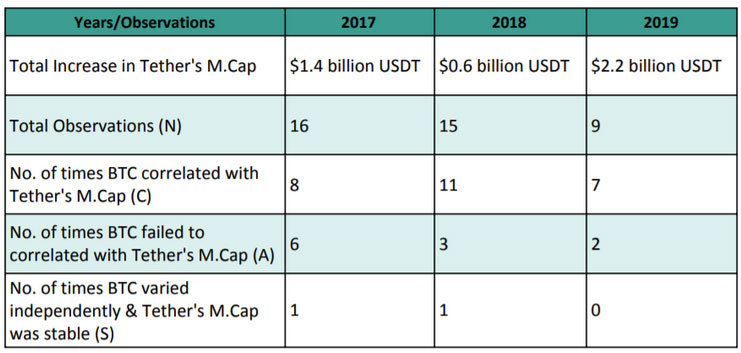
Then there was the June 25, 2018 research report “Is Bitcoin Really Un-Tethered?” by University of Texas at Austin’s Department of Finance John M. Griffin and Ohio State University’s Amin Shams that was recently updated in November 2019 making multiple claims and assumptions towards manipulating the crypto market and the bitcoin price. There is also the new report out by Carol Alexander and Michael Dakos titled, “A Critical Investigation of Cryptocurrency Data and AnalysisA Critical Investigation of Cryptocurrency Data and Analysis” that was released in May 2019.
Here is a chart outlining Tether issuance in 2017, 2018 and 2019 showing the amounts printed along with the number of times bitcoin has correlated with the USDT market cap increases (note that correlation doesn’t always equate to causation):
Much of this riddle is still playing out at the time of this Tether crypto review, but now that we have a leg in the USDT stablecoin world, let’s take a full step in and understand how stablecoins work and compare Tether to other dollar-pegged crypto coins, as well as touch on what the Facebook Libra stablecoin will do towards Tether.
Stablecoins Guide: Ultimate Stablecoin Comparison List
What is a Stablecoin? What Are the Biggest and Most Popular Stablecoins? How Do Stablecoins Work? Find Out Everything You Need to Know About Stablecoins
Stablecoins are digital tokens that peg their value to a specific asset – like the US Dollar. As the crypto industry continues to grow, we’ve seen surging demand for stablecoins.
Despite the surging demand for stablecoins, many people continue to be totally clueless about how stablecoins work. What is a stablecoin? Which stablecoins are the best and most trusted on the market? In this guide, we’re answering all your questions about stablecoins.
What is a Stablecoin?
A stablecoin is a digital token built from the ground up to have a steady value. Many stablecoins are pegged to the US Dollar simply because it is the world’s most widely-used currency. However, we’ve also seen stablecoins pegged to all types of large and small fiat currencies.
Some stablecoins aren’t pegged to any fiat currency, nor are they tied to any national economy. They use smart contracts to balance reserves, for example. The smart contract sells stablecoins when prices are high, then buys stablecoins from the market when prices are low.
Why Do We Need Stablecoins?
Stablecoins were a necessary addition to the crypto community. Stablecoins emerged for a number of important reasons. However, the two most important reasons we needed stablecoins were:
Crypto Volatility
Bitcoin and other cryptocurrencies are notoriously volatile. It’s currently difficult for businesses, merchants, or individuals to accept bitcoin because the value can fluctuate significantly on a day-to-day basis. Let’s say a dealership buys a car from Honda for $20,000, then sells that car for 2 BTC a few days later. As long as 2 BTC is equal to $20,000, the dealership is okay. If the value of BTC drops, however, then the dealership could be out thousands of dollars.
Regulatory Scrutiny of Fiat Currencies
Crypto exchanges that handle ‘real’ USD or other fiat currencies often face greater regulatory scrutiny. Because of this regulatory scrutiny, some exchanges block all fiat trading whatsoever. Fiat-pegged stablecoins allow traders to enjoy the benefits of fiat currency trading without certain regulatory hurdles.
How Do Stablecoins Work?
Today, stablecoins work in different ways to retain a stable value.
Tether, for example, is one of the best-known stablecoins on the market. It’s pegged to the USD at a ratio of 1 US Dollar Tether (USDT) to 1 USD. Tether retains its value by holding a reserve of USD assets.
Originally, Tether claimed to hold every USDT 1:1 with cash reserves. In other words, for every $1 billion of USDT on crypto markets, Tether held $1 billion in liquid cash in its bank account. That claim quickly proved to be false, and Tether now simply claims that the USDT is backed by equivalent “cash and other assets” instead of strictly cash reserves.
Some stablecoins stay stable with built-in algorithms or smart contracts. When the value of the stablecoin drops below a certain amount, the smart contract buys stablecoins from the market, driving up prices. When the value of the stablecoin rises above a certain value, the smart contract sells the stablecoin to reduce market demand.
Other stablecoins use even more complex systems involving a complex set of algorithms, buyback programs, and fiat reserves. As the stablecoin world continues to expand, we’re seeing new and novel stability mechanisms in place.
Benefits of Stablecoins
Some of the benefits of using, holding, or trading stablecoins include:
Better and Easier Mainstream Adoption of Crypto: Try walking down to Subway and telling the sandwich artist you’ll pay 0.0005 BTC for a foot long sub. Good luck. Everyone has now heard of bitcoin, but few people can immediately picture the value of bitcoin like they can picture the value of USD or other major fiat currencies.
You Don’t Pay Rent or Buy Groceries in Bitcoin: The vast majority of the world doesn’t pay rent or buy groceries in bitcoin. Unless something dramatic occurs within the next few years, this system is not going to change in the near future. As long as people pay rent, buy groceries, and manage other daily necessities in major fiat currencies, we’re going to need some type of easy fiat-to-crypto conversion mechanism.
Hedge Markets: Let’s say you’re holding bitcoin. You’re a big believer in the technology – but you also believe a market correction is coming. A smart trader would hedge her position by selling some BTC for an asset with a stable value – like a stablecoin. You sell 1 BTC for $10,000 USD worth of a stablecoin. BTC falls to $5,000 per BTC a few weeks later. Then, you sell your stablecoin back into BTC and end up with 2 BTC instead of 1. Put simply, stablecoins give traders more options and a better ability to hedge markets.
Stability: Thousands of merchants now accept bitcoin and other cryptocurrencies. However, widespread adoption of bitcoin is hindered by bitcoin’s instability. A merchant may not want to accept 1 BTC for a product today when the vendor still works in cash. When volatility is high, it’s difficult to use an asset as a currency.
Buy Stocks with Stablecoins: Some crypto markets have taken things to the next level, allowing you to hold cryptocurrencies, stablecoins, and stocks within one convenient dashboard. These marketplaces rarely let you buy stocks directly for BTC, however, and you may have to transfer money from crypto into a stablecoin first.
Legal and Regulatory Benefits: There are plenty of legal and regulatory benefits to using stablecoins. Namely, stablecoins aren’t necessarily backed by the same trading restrictions as cash reserves. It’s often easier for an exchange to use a proxy currency – like the USDT – instead of directly handling USD cash.
It’s Still Decentralized: Stablecoin critics might claim that stablecoins are just creating a different version of cash. That’s not quite true, however. Many stablecoins track the USD and other fiat currencies; other stablecoins, however, track other assets or no assets whatsoever. A good stablecoin has a decentralized governance system that appeals to crypto advocates.
Blockchain-Based Digital Tokens: Most stablecoins are blockchain-based, which is why they can be easily traded among crypto exchanges. Stablecoin traders get the best of both worlds, enjoying the security and decentralization of blockchain-based tokens along with the stability and familiarity of fiat currencies.
Types of Stablecoins
There are a number of different types of stablecoins available today. Generally, however, stablecoins fall into two broad categories, including collateralized and non-collateralized stablecoins.
Collateralized Stablecoins
Collateralized stablecoins are stablecoins backed by some asset. That asset has value, and each unit of the asset is tied to a specific amount of stablecoin. With USDT, for example, each USDT is backed 1:1 with USD cash. Each unit of Tether is fully collateralized. Other stablecoins are collateralized by cryptocurrencies – not fiat currencies.
Fiat Collateralized: Fiat collateralized stablecoins use fiat currency as collateral. Tether has USD reserves, for example, and allows traders to exchange a USDT 1:1 with a USD. This is why Tether has value. Other fiat-collateralized stablecoins work in a similar way. If there’s $1 million worth of stablecoin in circulation, then there’s $1 million in a vault backing the value of that stablecoin.
Crypto Collateralized: Some stablecoins are baked by cryptocurrency reserves. MakerDAO’s lending platform is backed by ETH, for example, and users are required to lock up 150% ETH to borrow the Dai stablecoin. Because of this, each Dai is collateralized by ETH at a minimum ratio of 150%.
Asset Collateralized: There’s a third type of collateralized stablecoin. Asset collateralized stablecoins aren’t backed by fiat currencies or cryptocurrencies; instead, they’re backed by some other type of asset. They might be backed by gold bars, for example, or stocks and other assets.
Non-Collateralized Stablecoins
Some stablecoins aren’t collateralized at all. There’s nothing specific backing the value of the stablecoin. The stablecoin’s value isn’t pegged to the USD, EUR, BTC, or any other traditional asset; instead, it’s backed by algorithms, smart contracts, or some other unique technology.
These stablecoins may be the most intriguing option available moving forward. They use advanced blockchain technologies and decentralized, automated smart contracts to enforce specific rules. Theoretically, a well-designed non-collateralized stablecoin could hold its value indefinitely regardless of broader crypto or fiat market movements.
Disadvantages of Stablecoins
Stablecoins are far from perfect. Like other emerging technologies, stablecoins have already started to show certain warts. Some stablecoins have crumbled out of the gates. Other stablecoins – even large ones like Tether – continue to face questions over their stability, legitimacy, and transparency.
Some of the disadvantages of stablecoins include:
Fiat Collateralized Stablecoins Work Just Like Banks
Why would a private company hold a reserve of $1 million USD in cash just to support the value of a stablecoin? There’s no incentive to hold this money in cash, and the company is losing money every day due to inflation. To make holding that money worthwhile, the company would have to lend out the cash or invest it.
Put simply, there’s no incentive for anyone to hold cash in a bank reserve just to support a stablecoin. Despite this seemingly obvious conclusion, companies like Tether originally claimed to be doing exactly that. Tether claimed that they held billions of dollars’ worth of USD cash held in a bank to support every USDT stablecoin in circulation. If that was true, then Tether was losing tens of thousands of dollars every day just through inflation.
Tether would alter change its tune, claiming that they hold their USD reserves in “cash and other assets”. Tether now appears to be investing its cash reserves to earn interest. Of course, investing always comes with a certain degree of risk. If Tether makes a bad investment, then the value of the USDT could plummet.
All of this adds up to a simple conclusion: certain fiat collateralized stablecoins are working just like banks. Did we really go through all of the trouble of creating blockchain and cryptocurrencies just to launch a new lending and banking system?
Aren’t We Just Re-Creating Money? What’s the Point?
Between 1879 and 1933, every USD in circulation was backed by a specific amount of gold. In 1933, however, President Franklin Delano Roosevelt took the United States off the gold standard after a series of bank failures during the Great Depression. The price of gold was raised to $35 per ounce, theoretically stabilizing the value of the USD. That price point was held until 1971, when President Nixon announced that the United States would abandon the gold standard. Since then, the US Dollar has not been pegged to the value of gold and vice versa. Critics say stablecoins are just re-creating the gold standard systems of times gone by. Some people say this is a good thing because it gives currency concrete value. Others claim it holds back economic progress.
Stablecoins Haven’t Proven Themselves in True Market Crashes
It’s easy for stablecoins to claim stability during normal market conditions. Yes, markets have gone up and down over the last two years, but we haven’t seen any type of significant crash. Stablecoins only started to become popular after crypto’s rise to $20,000 and subsequent drop to the $5,000 to $10,000 range in late 2017 and early 2018.
Will stablecoins hold their value if bitcoin shoots up to $50,000 or drops to $1,000? Will stablecoins hold their value if the USD plummets and we enter another international recession? These are all good questions that may never be answered.
A ship is safest when it’s in the harbor – but that’s not where a ship is meant to be. A stablecoin is safest in stable market conditions, but we don’t know how it will perform until it faces significant volatility.
Scams and a Lack of Transparency
There’s another problem with the stablecoin industry: it’s faced issues with scams and a lack of transparency – similar to the broader crypto market in general.
No stablecoin has faced as much criticism as Tether. Tether was founded in a haze of secrecy, with its founding team linked to various shady banks and exchanges like Bitfinex. Then, there was the controversy over Tether’s cash reserves, including how much cash Tether was really holding in its reserves.
Part of the problem of Tether was its sudden rise to popularity. All of a sudden, a small group of people had the ability to print $100 million USD out of thin air whenever they felt like it. Tether claimed this money was always backed 1:1 with real USD cash reserves, but audits were rare.
If you had the ability to print $100 million for yourself overnight, wouldn’t you take it? This is one reason why stablecoins may never work without a proper, decentralized regulation system in place.
The Best Stablecoins Are Centralized
Another problem with stablecoins is that the biggest stablecoins are often centralized. They were built by specific exchanges – like Gemini. Or, they’re fully operated and controlled by a centralized entity like Tether.
Yes, people have tried to create decentralized stablecoin systems, and many of these systems show a lot of promise. If we were able to create a decentralized currency like bitcoin that can’t be shut down or controlled by any entity, then why can’t we create a decentralized stablecoin? That’s the optimistic take – and it’s one that could come true.
Top 14 Stablecoins
There are about 20 major stablecoins bought and sold across today’s cryptocurrency exchanges. Tether, with a market capitalization of over $4 billion, is the most popular and widely-traded stablecoin by far.
Other stablecoins, however, have shown increasing promise. They continue to grow. Exchanges are supporting newer stablecoins based on their transparency and legitimacy. Generally, the community trusts companies like Gemini more than it trusts companies like Tether.
With that in mind, here are the top ten stablecoins available today.
Tether (USDT)
$4.01 Billion Market Cap
$18.4 Billion 24h Trading Volume (September 2019)
Pegged to USD
Fiat Collateralized
Operated by Tether
USD Coin (USDC)
$436.28 Million Market Cap
$172.7 Trading Volume (September 2019)
Pegged to USD
Fiat Collateralized
Paxos Standard Token (PAX)
$241 Million Market Cap
$383 Million Trading Volume (September 2019)
Pegged to USD
Fiat Collateralized
Operated by Paxos Trust Company
TrueUSD (TUSD)
$190.94 Million Market Cap
$637 Million Volume (September 2019)
Pegged to USD
Fiat Collateralized
Operated by TrustToken
Dai Stablecoin
$80.05 Million Market Cap
$4.57 Million Trading Volume (September 2019)
Pegged to USD
Crypto Collateralized
Operated by MakerDAO
USDK (USDK)
$28.45 Million Market Cap
$40.1 Million Trading Volume (September 2019)
Pegged to USD
Fiat Collateralized
Operated by OKLink
Stasis EURS (EURS)
$35.46 Million Market Cap
$387,225 Trading Volume (May 2019)
Pegged to EUR
Fiat Collateralized
Operated by Stasis
bitCNY (BITCNY)
$9 Million Market Cap
$151,000,000 Trading Volume (May 2019)
Pegged to CNY
Crypto Collateralized
Operated by Unknown Company
Gemini Dollar (GUSD)
$8.5 Million Market Cap
$2.87 Million Trading Volume (September 2019)
Pegged to USD
Fiat Collateralized
Operated by Gemini
StableUSD (USDS)
$6.4 Million Market Cap
$678,000 Trading Volume (May 2019)
Pegged to USD
Fiat Collateralized
Operated by Stably
USDQ
$5.49 Million Market Cap
$119,000 Trading Volume (September 2019)
Pegged to USD
Fiat collateralized
Operated by Platinum Securities
BitUSD (BITUSD)
$3.87 Million Market Cap
$650,000 Trading Volume (September 2019)
Pegged to USD
Crypto Collateralized
Operated by BitShares
1SG (1SG)
$1.3 Million Market Cap
$3,800,000 Trading Volume (May 2019)
Pegged to SGD
Fiat Collateralized
Operated by Mars Blockchain Group
sUSD (SUSD)
$1.3 Million Market Cap
$115,000 Trading Volume (May 2019)
Pegged to USD
Fiat Collateralized
Operated by Synthetix
Other Stablecoins
The stablecoins listed above are the most popular ones on the market today. They each have a market cap over $500,000. The stablecoins listed below, meanwhile, have smaller market caps but may become more prominent in the future:
Alchemint Standards (SDS)
White Standard (WSD)
NuBits (USNBT)
Constant (CONST)
SDUSD (SDUSD)
USDCoin (USC)
QUSD (QUSD)
StableCoin (SBC)
Facebook’s Upcoming Libra Cryptocurrency is a Stablecoin
Facebook has created enormous buzz after announcing its Libra cryptocurrency. What some don’t realize, however, is that Libra is actually a stablecoin.
Facebook envisions Libra as a complement to the US Dollar. The company plans to back Libra with a basket of currencies and US Treasury securities in an attempt to avoid volatility.
Facebook will also partner with various financial services. Each partner will inject an initial $10 million USD, giving Libra full asset backing on the day it opens.
New Libra currency units will be created on demand. If there is demand for $1 million more of Libra currency units, then partners within the “Libra Association” will need to contribute another $1 million.
Libra will use a distributed ledger – a blockchain – to reconcile payments between service partners.
There’s a huge difference between Libra and a traditional cryptocurrency like bitcoin, however: Libra is not decentralized; instead, it’s a centralized blockchain run by the Libra Association, which functions as a de facto central bank. In contrast, bitcoin uses a permissionless blockchain.
Facebook’s Libra appears well on track to launch in the near future. Facebook has already established the Libra Association in Geneva Switzerland. The Libra Association has 28 founding members, including Mastercard, PayPal, Visa, Spotify, Lyft, Uber, Coinbase, Andreesen Horowitz, Union Square Ventures, eBay, and other major organizations.
Although Libra has faced some criticism for its centralization, it could easily become the world’s largest stablecoin in the very near future. Stay tuned for more information about Libra as it gets closer to launch: the first version of Libra is scheduled to launch in June 2020.
Now, for the third and final part on this tether cryptocurrency guide, let’s review the drama between Bitfinex and Tether and what it means for the price of bitcoin, cryptoasset market manipulation and what is next for Tether (USDT).
Tether and Bitfinex Crisis: Everything You Need to Know
For many people, Tether is a little hard to understand. Is it another currency? Is it supposed to serve as an alternative to the USD? What exactly does it do? To be honest, the reality is worse than the speculations.
Long story short, Tether is a scam, the likes of which have not been seen since Bernie Madoff went to jail. How is this? Well, I’ll prove it to you in this article.
Warning though: this will be a long article, so go get your cup of coffee, tea, or whatever your favorite drink is, and prepare to spend at least 10 minutes reading this (figured it’s better to give you a thorough in-depth insight into everything this is).
If you’re serious about investing in USDT, this is a must-read –so you don’t end up regretting it.
What’s Crypto Best Used For?
While blockchain has more valid and solid use cases, crypto’s best use case lies in its speculative properties. For the most part, people buy cryptos in the hopes that speculation will spike its prices, resulting in profits for the “investors”.
And to facilitate the trade of these tokens, hundreds of exchanges have sprung up all over the world. Buying crypto of your choice is often as simple as depositing some fiat currency and exchanging it for those tokens.
And because regardless of the exchange you choose, because it’s a whole ecosystem, prices are mostly the same –with the exception of fees and so on. Of course, with the crypto community being big on decentralization, the ecosystem isn’t unified, in the same way as the traditional finance system.
Its structure is very similar to Liberty Reserve –a once popular network of peer to peer exchanges around the world. Only this time, it’s different in the sense that there’s a shared ledger that helps them execute the transfer of value between entities around the globe.
That ledger is what is known as blockchain. It’s decentralized, so it’s not owned by anyone entity. However, in spite of this framework, the crypto community still has some links to traditional banking because people need to convert their fiat currencies to cryptos.
As a result, many exchanges have some sort of relationship with banks. This is why bitcoin exchanges struggle with this –they often need to comply with Know Your Customer and Anti-Money Laundering regulations.
Ironically, this goes against the very grain of cryptocurrency –a private, permissionless, trustless and regulation-free currency that’s globally acceptable. This way, there can be the transfer of money between multiple entities without the need for permission, compliance or identity.
Unfortunately, there’s little that can be done about that right now. So, the smart exchanges have adopted an approach that helps them take advantage of these regulations whilst providing their customers with the sorely needed services.
Let’s Talk About Bitfinex
One of the pioneer crypto exchanges, Bitfinex rose to prominence right after the fall of Mt. Gox –the most popular exchange at the time. Of course, this was not without its risks, which is why it became the object of hack attacks in 2016, resulting in the loss of about 120,000 bitcoins (about $70 million in cash value).
To prevent and avoid the same fate as Mt. Gox, Bitfinex, did something called a bail-in. As a result of the growing liability, they essentially created their token and offered it up as “collateral” to depositors to shore up the gap created by the stolen 120,000 bitcoins. So, customers ended up owning Bitfinex equity, thanks to the token.
These tokens were a utility token. So, people were able to trade them on the platform. And customers who wanted to, could trade in theirs for cash -1 BFX = $1USD at the time. The only problem was the company’s liquidity issues –they needed cash as quickly as possible.
Enter the Bitcoin Exchange/Wells Fargo Banking Brouhaha
At this point in Bitfinex’s operations, the company had no permanent location, even though they reportedly operated out of Hong Kong. They had multiple accounts with various banks based in Taiwan.
After the hacking incident, the primary bank –Wells Fargo- stated that they wouldn’t be clearing funds originating from and going to Bitfinex’s accounts that were domiciled with these banks. This basically crippled Bitfinex’s operations as they couldn’t execute transactions, and customers couldn’t move their funds in and out of the exchange.
As a result, they sued wells Fargo –unsuccessfully, we might add- and started utilizing a company they had, that had been quite dormant till that time. That company’s name? Tether.
Interestingly, Bitfinex had always claimed that it had no relationship whatsoever with Tether before the lawsuit. But after the lawsuit, they started using the company for their operations.
Quick Intro to Tether and How it Works
Tether is popular because of its 1:1 currency peg. So, 1USDT=$1 (or euro or GBP). So, this kind of makes it function like a stablecoin. So, unlike bitcoin and other cryptocurrencies that routinely go through price swings, Tether doesn’t –at least that’s the idea.
Bottom line, it functions like an average money market fund where you can park some of your funds without fearing significant risk. However, unlike a money market fund that’s usually backed by certain financial assets, Tether was meant to be backed by the reserve.
In other words, for every 1USDT that you buy, there’s supposedly $1 in the bank somewhere. Interestingly, Tether isn’t the only stablecoin in the market. Others have realized the potential profitability of tether and have jumped on the bandwagon, offering similar services and value.
Tether’s and other stablecoins’ USP include ease of transfer between bitcoin exchanges, safe-ish crypto harbor for parking your money when you’re not trading actively, and stability in value wherever your coins are parked.
The key thing that’s not talked about is its propensity to be used for massive money laundering activities. In fact, there are camps that believe that Tether is being used for money laundering activities.
So, it’s easy to just buy bitcoin, convert it to Tether –while bypassing the KYC process, and never worry about the value of their illegally gotten gains depreciating, no thanks to the 1:1 value peg.
Naturally, this is a very appealing notion to money laundering entities looking for a “safe space” to park their illicit gains. That, plus the fact that there’s no documentation whatsoever in the event of a hack means they cannot be traced.
However, it’s not just the fraudulent that use it. There are proponents of digital privacy, people opposed to financial regulation and compliance, tax evaders, and people who just don’t trust the government. These people make up the bulk of USDT users.
With claims of $1 reserve for every 1USDT, there’s the question of the veracity of these claims. There are strong speculations that Tether’s reserve claims are not true at all; that the firm hasn’t been in control of a significant part of its reserves.
And these folks were right. While Tether sells itself a cryptocurrency that’s backed by traditional currencies held in the reserve, court cases involving them proved that this was not the case. If anything, the bulk of their reserves originated from transactions involving known money-laundering entities such as Crypto Capital Corp and other shady entities.
So, Where Were These Funds Parked?
Between the years 2017 and 2019, avid industry watchers have asked where Tether kept the reserve it claims it has. Well, it appears that that the company largely used shell corps to move their funds around.
And some banks caught on to it, and froze their funds when they realized that the company wasn’t being straightforward with them. At the end of the day, Tether was able to finally get a bank -Puerto Rico-based Noble Bank- that was willing to take its business, and keep their funds for them.
However, this wasn’t without a few issues. For instance, the bank’s board was known to have kicked against Tether banking with them because of their relationship with known NYC-based custodial bank, BNY Mellon.
For those who don’t know BNY Mellon, this is a huge bank whose primary business involves holding assets for externally located banks in the US. So, banks with large assets that want to keep them safe, bank with them.
And as a rule, NYC Mellon has a reputation for notdoing business with money launderers. So, Noble Bank’s primary worry was that NYC Mellon would dump them because of their association with Tether, effectively crippling the bank in the process.
Anyway, after they got through the initial hurdle, Noble Bank then received deposits to the tune of hundreds of millions of dollars from Tether. Naturally, that meant that their balance essentially blew up, causing some analysts to wonder how that happened in such a short period.
To cover their tracks though, Tether warned depositors against disclosing the details of the bank publicly. The goal was to avoid attracting the ire of BNY Mellon. Unfortunately, people are unpredictable, and someone ratted.
Naturally, the entire process ended up destroying Noble bank, and forced tether to look elsewhere for their banking needs. The next recipient of this reserve was Deltec Bank, which received the funds through Crypto Capital Corp.
Let’s Talk About Crypto Capital Corp
This company was a money laundering corporation with a string of crypto businesses as clients. These included Kraken, Quadriga –Canada’s largest bitcoin exchange- and Tether –their biggest client. There are also rumors that they took on Colombian drug cartels as clients.
It was able to function by locating banks with poor compliance structures and lodging the reserve in them through shell companies. Of course, when these banks found out they were being used in money laundering schemes, they close the accounts, and Crypto Capital Corp and its shell companies go elsewhere.
Of course, Tether itself denied any culpability when these issues were raised in court. They acted as though they were astounded at the Crypto Capital Corp’s MO. Whether that was true or not, was beside the point. The real point was that Tether insulated against any charges, because CCC took the fall for their actions.
Worse, CCC was working with partners, Spiral and Reggie Fowler to receive Tether’s depositors’ funds in their accounts. So, the funds didn’t even go through/to Crypto Capital Corp. It went directly to these individuals’ accounts –Reggie Fowler in particular.
So, What Impact Did This Have on Customers?
Well, customers had to follow strict instructions whenever they wanted to deposit money for Tether. First, they would have to contact Crypto Capital Corp, who would then provide them with the account details of a shell corp.
Then, they were told to send the funds with memos that would seem innocuous, and nothing related to crypto. When this is done, the customers would then have to wait until the payment is confirmed.
Once confirmed, they’ll then credit them with their Tether value. The thing about this whole scheme is even though Bitfinex claimed that it had no idea of CCC’s operations and instructions, available evidence showed that this wasn’t true. Instructions like
“[Do not share these instructions] except with your financial institution. Divulging this information could damage not just yourself and Bitfinex, but the entire digital token ecosystem. Accordingly, you are cautioned that there may be severe negative effects associated with this information becoming public.”
Were routinely sent to customers who wanted to buy Tether. This clearly showed that they knew what was happening. Unfortunately, this was the least of their problems. Further evidence showed that Reggie Fowler was actively skimming 10 percent of all deposits. This 10 percent fund was essentially how Reggie Fowler got paid for his “services”.
As usual, Bitfinex claimed ignorance of the scheme. In one of their testimonies in court, Bitfinex stated that,
“Besides a nominal fee for each deposit or withdrawal, Crypto Capital charged no fee for these services to [Bitfinex] because it was able to earn a substantial interest on the funds it held on [our] behalf in its accounts.”
However, this wasn’t true, considering that CCC never chose bankers based on their interest rates. All they were focused on were banks with lax or weak compliance. Bitfinex’s reluctance to know CCC’s workings probably resulted in their routine siphoning of 10 percent cuts.
And even if Bitfinex had been looking, this would have been difficult to notice, given tether’s continually rising balance. People who would have probably noticed would be those looking t pull out a lot of money –more than the inflows- or hackers intent on stealing.
Anyway, after banking regulators caught on to the ruse that Crypto Capital Corp had been using, they quickly froze the accounts of shell corporations linked to the company. These actions resulted in severe liquidity problems –the reason why the company couldn’t pay withdrawals.
And when word got out about their liquidity problems, withdrawals went through the roof –everyone was trying to get their funds out. The inability to transfer those funds out of CCC meant that depositors and investors couldn’t get their monies.
While the liquidity issues started in August 2018, the rumors of Tether’s insolvency didn’t start until October 2018. And the rumors were true. Long story short, the regulators froze that money and probably won’t be giving it back to Bitfinex. For those who were thinking that a repeat of the Mt. Gox settlement with the government would happen, sorry. It probably won’t.
Is there Ever a Scenario in Which Tether Had the Reserves it Claimed it Did?
Probably when they started the project. While there’s no cogent evidence that this was the case, we only have Tether’s claims to go by. Whatever the case, it appears that it may not be backed anymore by any reserve or money laundering entity.
Whenever cryptos become “hot” as Tether has become, it can be very difficult to get those entities trusting them again. It’s highly surprising that they survived the bank run. How did they do that?
They simply lied and found ways to fulfill withdrawal requests until they couldn’t anymore. Frauds are generally like this –they have a loophole that they often have to work hard at covering up.
And when they’re caught, they simply keep spinning the wheels until more suckers get on board. It’s often a highly complicated process that most people can’t fathom. They even went as far as using money mules to fulfill specific withdrawal requests:
“As explained to [New York’s] attorneys by [Bitfinex’] counsel: Bitfinex and Tether have also used a number of other third party “payment processors” to handle client withdrawal requests, including various companies owned by Bitfinex/Tether executives, as well as other “friends” of Bitfinex – meaning, human being friends of Bitfinex employees that were willing to use their bank accounts to transfer money to Bitfinex clients who had requested withdrawals”.
Other methods included using funds belonging to Bitfinex customers to settle these withdrawals. While they were doing this, they stuck to their guns that they still had sufficient reserves to back their token. As a result, they were able to stave off bankruptcy for a while… until the New York Attorney General started investigating them.
They’ve devised other means to keep assuring the government and investors that they’re fine. They went on to claim that they had both short term securities and cash that would cover about 2/3 of all tethers in circulation. According to an affidavit submitted by the company’s lawyers,
“As of the date I am signing this affidavit, Tether has cash and cash equivalents (short term securities) on hand totaling approximately $2.1 billion, representing approximately 74 percent of the current outstanding tethers.”
Why is the Crypto Community Still Supporting Tether?
Well, a key reason is maintaining the market’s status quo. The crypto market is currently at a very delicate point.
A major hit like Tether going down is likely to dissuade investor confidence, resulting in lower prices and trade volumes –unacceptable given the present state of things. Considering that the market is just rallying, it’s easy to see why the community still supports it.
This is why some folks believe that the cryptocurrency industry is a bubble.
What’s the Current State of Things at “Tether HQ”
For starters, Reggie Fowler, a key bad actor has been arrested and is currently facing the wrath of the law. Another bad actor is still at large. Company president, Ivan Manuel Molina Lee has been extradited to Poland from Greece on charges of aiding and abetting money laundering.
Oz Yosef was recently indicted in the state of New York. All of these perpetrators were with Crypto Capital Corp. Bitfinex on the other hand, insists that they didn’t actively play any role in the scam perpetrated by CCC and its multiple shell companies.
As a result, they hope that their seized funds will be returned by the banking regulators.
What’s Next for Tether (USDT) and Stablecoins?
The crypto community needs stablecoins. It is very unlikely to see stablecoins going away anytime soon. However, we expect stablecoins to continue growing and taking advantage of new technology.
In the long run, the stablecoin disadvantages listed above might disappear. That’s the optimistic take. Tether is by far the current bitcoin ‘black hole’ of what-if’s, many wondering how Tether plays out in 2019 and 2020.
The pessimistic take, of course, is that stablecoins could become new versions of what we originally tried to escape from: centralized banks and lending institutions.
Of course, we may not know how valuable stablecoins are until the next market crash in the crypto economy or global economy. Stay tuned to see what the future of stablecoins holds. More updates on Tether and the USDT stablecoin court cases, audits and news announcements will be added soon.
Aziz, Master the Crypto Founder
I’m Aziz, a seasoned cryptocurrency trader who’s really passionate about 2 things; #1) the awesome-revolutionary blockchain technology underlying crypto and #2) helping make bitcoin great ‘again’!
The post Tether Crypto : USDT Stablecoin Comparison + Bitfinex Story appeared first on Master The Crypto.
As the cryptocurrency and blockchain technology industry continues to grow while being endorsed by more celebrities and some of the top S&P 500 companies, there are more choices than ever when it comes to what platform to use.
While the inception and increasing popularity of Decentralized Exchanges (DEX) and protocols have made it easier to navigate the vast catalog of cryptocurrencies by using fewer platforms in terms of listings, the limitations and benefits of both DEXs and Centralized Exchanges (CEX) can make the decision-making more difficult than necessary.
The Orion Protocol is a part of the solution, and it helps make the markets whole again.
This fragmentation not only makes it harder for newcomers who get confused when faced with all the choices available to them but also for existing investors who need to execute more complex trades if looking to get the best deal to maximize their profit.
The option until now has been jumping through hoops: buying specific cryptocurrencies in specific platforms, then having to transfer them to a specific wallet, just to, later on, have to move them back. This fragmentation is not only unnecessary but also inefficient both time and money-wise.
Orion Protocol: Defragmentation by Aggregation
Orion Protocol was specifically designed to solve this issue by aggregating the liquidity of the entirety of the crypto market ecosystem into a single decentralized, secure, and flexible platform built on the most advanced liquidity aggregator developed to date.
While most Decentralized Finance protocols and DEX have been created to fight the monopolies that were forming in the crypto market, those designed to aggregate them have been pretty limited in terms of the offering, with both quickly becoming stagnant and part of the problem they aimed to solve.
Orion Terminal aggregates liquidity from all major exchanges
The Orion Protocol doesn’t aim to compete with existing markets nor facilitate the use of specific projects, it aggregates all of them to complement each other, no matter if it is a DEX, CEX, or swap pool. These benefits all the parties involved, boosting the development and adoption of the crypto ecosystem.
By having all the liquidity of DEX and CEX in a single platform, Orion Protocol allows investors to streamline their investment strategies without having to compromise.
The Orion Protocol DeFi platform was designed to fill the needs of businesses by offering Bussines-to-business (B2B) and Business-to-customer (B2C) solutions, working as a bridge between both the centralized and decentralized worlds of crypto without operating as a centralized authority.
This approach to DeFi resulted in the creation and recent launch of Orion Protocol’s first live product: The Orion Terminal. With this launch, users will be able to start benefiting from the Orion Protocol by giving them the ability to trade, deposit, and withdraw from a single location.
While the Orion Terminal is the protocol’s platform for consumers and pro investors to take advantage of the aggregation of markets, the team is working on launching its B2B solution, the Orion Enterprise Trade Widget, in the near future.
Orion Protocol is also working on the development and launch of its own price oracle, which will allow investors to automate their investment processes by gaining access to live quality data from different sources out of blockchain.
A Chain is Only as Strong as Its Links
While the Orion protocol is chain-agnostic, it has partnered with different blockchains in order to improve its flexibility, use cases, and security. One of such partners is Elron, which provides speed and scalability to the platform by settling all trades on Orion Terminal with order validation logic, trade exchange, and signed order message
Elrond’s high throughput and low latency smart contracts execution platform were some of the reasons why the Orion Protocol team chose it to bring speed, scalability, and low fees to Orion Terminal.
Orion Protocol is planning on introducing new solutions such as Lending, Price Oracle, Liquidity Boost Plugin, and the Orion Enterprise Trade Widget, all of which will operate on the Elrond blockchain, benefiting users and both ecosystems in the process.
Trade across all major exchanges
The governing of the protocol makes use of a proprietary staking mechanism known as “Delegated Proof of Broker”, which fulfills its functions by using a decentralized network of brokers using the ORN token as its fuel.
Orion’s Broker Network includes some of the most relevant in the industry so far, covering the CEXs, DEXs, and Non-Exanche broker niches. The list of brokers includes KuCoin, BitMax, MXC, Injective Protocol, and Chainlink.
Orion Terminal’s mainnet code is constantly being audited by Certik to ensure no vulnerabilities can be exploited by attackers, ensuring the security of the protocol.
How Does Orion Terminal Work?
The Orion Protocol team focused its efforts on 4 major aspects that they believe can make the project fulfill its mission of revolutionizing the crypto market: Liquidity, custody, accessibility, and scalability.
To offer its users as much liquidity as possible, Orion terminal makes use of decentralized liquidity aggregators like 1inch to make it possible to pull liquidity from DEXeswhile using a network of brokers like KuCoin to add liquidity from CEXes to combine the best perks of both worlds.
While most aggregators that pull from centralized exchanges are centralized and custodial solutions, Orion Terminal doesn’t require its users to grant control custody over their assets as using the platform is as simple as connecting their wallet and executing their order.
Decentralized Finance has struggled to gain mass adoption by small investors due to the high costs of Ethereum gas, which has also resulted in dApps depending on small transaction fees to lose popularity. As Orion Terminal is not limited to ERC20 tokens or a specific blockchain, it facilitates adoption by users and projects relying on any blockchain network.
When it comes to scalability, Orion Terminal has been designed to support high demands right from the start without the need of relying on Layer 2 solutions in the future, as has been the case of Uniswap.
By aggregating every order book, Orion Protocol can provide the best price and lowest fees in markets, while experiencing zero spread and slippage, all of this in the convenience of having every exchange market on one platform.
The Past, The Present, and the Future
Orion Protocol was founded back in 2018 by Alexey Alexey Koloskov and Kal Ali after obtaining a $300K seed investment through self-funding as well as help from friends and family. The project would then raise 3,450,000 via an Initial Coin Offering (ICO) in July of 2020, in what would be one of the most successful token sales of the year.
Alexey Koloskov, CEO and Co-Founder of Orion Protocol, counted with experience in both the traditional finance and DeFi worlds, having been the Chief Architect and Creator of the Waves DEX back in 2016.
This experience helped Mr. Kolosov to develop its own non-custodial decentralized trading platform, which would be a singular and non-custodial gateway to crypto: Orion Protocol.
The launch of the Orion Terminal represents the completion of the first objective of the First Quarter of 2021, which will also see the launch of ORN staking features, Orion Oracle, Orion Wallet Swap SDK, Orion Enterprise Trade Widget, Orion Collateral Optimization, and the Orion DEX Kit.
These steps will solidify the groundwork for the future of the project as it aims to expand accessibility to crypto and improve the entire ecosystem, with more DeFi features being planned for the future to extend the available trading strategies investors can make use of.
While DeFi was pretty successful in 2020, with the continued gain of the popularity of cryptocurrency and blockchain technology, the moment is perfect for the ecosystem to continue to develop by taking advantage of the new scalability and efficiency of new chains and projects. Orion Protocol plans to be an integral part of this future, not by competing but by completing.
The post What is a Crypto Aggregator? Taking a Look at Orion Protocol appeared first on Blockonomi.
Robinhood has secured $280 Million Series F funding after an $8.3 Billion valuation.
The funding will drive a push to expand the platform globally.
Robinhood also plans on scaling the platform and offering more products to users.
The team at the popular trading platform of Robinhood has announced that the firm has secured $280 Million series F funding after an $8.3 Billion valuation. The round of funding was lead by Sequoia Capital which is an existing investor of Robinhood. Other existing and new investors that participated in the Series F funding include NEA, Ribbit Capital, 9Yards Capital and Unusual Ventures.
New Funding to Push for Global Expansion
The team went on to elaborate that the funding will be used to scale the platform, build and develop new products and accelerate their expansion. In a recent interview with Fortune, the co-CEO of Robinhood, Vlad Tenev, further elaborated on this goal as follows:
The purpose of the capital raise is to enable us to have flexibility and be strategic, and continue to invest in the platform.
We envision that over the next few years, Robinhood will expand globally and continue rolling out more products.
Stability Concerns Still Linger
Amidst the current stock and crypto market volatility, Robinhood has managed to add more than 3 Million funded accounts so far this year. According to Robinhood, half of their new customers are first-time investors.
However, the stability of the platform has been questioned by not only Millenials who prefer using the platform, but by investors who are waiting for Robinhood to go public through an IPO. During the Coronavirus crash of 2020, the platform suffered an outage on 2nd March. The day proved to be one of the most volatile due to the economic effects of COVID19. Trading functions were fully restored on the 9th of March which is a full week after the event.
Trading has been restored and Robinhood is back up and running again. Thank you for your patience as we resolved this issue.
— Robinhood Help (@AskRobinhood) March 9, 2020
List of Cryptocurrencies Available for Trading on Robinhood
At the time of writing this, Robinhood currently supports trading of the following cryptocurrencies.
Bitcoin (BTC)
Ethereum (ETH)
Litecoin (LTC)
Bitcoin Cash (BCH)
Dogecoin (DOGE)
Ethereum Classic (ETC)
Bitcoin SV (BSV)
(Feature image courtesy of Unsplash.com.)
Disclaimer: This article is not meant to give financial advice. Any additional opinion herein is purely the author’s and does not represent the opinion of Ethereum World News or any of its other writers. Please carry out your own research before investing in any of the numerous cryptocurrencies available. Thank you.
If you’re looking to trade digital currencies from the comfort of your home, you’ll need to ensure that you are using a platform that comes jam-packed with tools, insights, and of course – competitive fees and commissions.
With that said, seasoned traders will often make use of several exchanges to access specific markets and pairs, or take advantage of arbitrage opportunities. Moving from exchange to exchange can, however, be both cumbersome and time-consuming.
With that in mind, Bitsgap makes it possible for you to connect all your exchanges in one place. This comes with a plethora of plus-points – such as being able to execute arbitrage strategies with ease and deploy advanced bots to trade simultaneously across multiple platforms.
As such, Bitsgap has evolved to accommodate the many needs and expectations of cryptocurrency traders.
In this Bitsgap review, we explore everything there is to know about the cross-exchange services offered by the provider.
Visit Bitsgap
Bitsgap at a Glance
Bitsgap is advertised as a new way to trade across multiple exchanges, by finding the best rates and effectively managing your portfolio. The platform allows you to bring all of these elements under one roof, providing access from a single account at the click of a button. It has carefully designed features that will enable you to:
Quickly compare rates from heaps of digital currency markets
Trade and instantly switch between different exchanges
Keep track of your investments
Basic and advanced order types
Take advantage of the price difference between exchanges using arbitrage
Test your strategies out via a demo account facility without risking any capital
Currently, Bitsgap is integrated with 30 exchanges, including Binance, Kraken, Bitfinex, and more. Traders have access to 10,000+ cryptocurrency trading pairs and several technical indicators available to formulate your strategies. The platform offers an optimised and intuitive interface for both beginners and seasoned traders.
Bitsgap All-in-one trading platform
What can you do With Bitsgap?
Below we unravel some of the main features available at Bitsgap.
Trading
The trading section of Bitsgap features a sleek interface that is fully functional. In order to make your trading experience as smooth as possible, Bitsgap offers the following abilities and features:
TradingView charts
Over 100 technical indicators
Customizable chart types
Trade visualization through charts
The trading area features an interactive chart screen, including your recent trades and open orders. You can also manage your balance on each of your linked exchanges, track any open positions and view your trade history.
Trading Screen
The interface allows you to easily switch between different exchanges by clicking on the platform name above the chart screen.
Bitsgap has also set up different trading orders to give you more control over your cryptocurrency trading endeavours.
Stop-Loss and Take-Profit Orders to limit your losses in the event your trade takes a turn for the worse.
Shadow Order that allows you to trade off the exchange’s order book – with orders executed only when your set price is reached. The order will exist solely through the instructions sent via API but will be hidden from other traders.
Stop Limit Orders are executed at a set price, upon which the order is considered as a limit order to buy or sell at the limit price.
Market Orders lets you execute orders instantly at the best market price available.
In addition, Bitsgap also provides a set of analytical trading tools to research the performance of all popular trading pairs. You can integrate the option of setting a time frame, choosing a chart style and work alongside various indicators.
Cryptocurrency Trading Bot
The Bitsgap trading bot is a unique feature that lets you make the most of the highly volatile cryptocurrency marketplace. The bot ensures that your investments are distributed proportionately within your chosen range, so you can make small but frequent profits on every market move. Once the price hits the desired range, orders are executed, and new ones are placed.
The bot will ensure that based on current prices, your buy and sell orders are automatically adjusted to find the best opportunities. The most significant benefit here is that the bot carries out your trades instantaneously.
Cryptocurrency Trading Bot
As such, you stand the chance of benefiting from even the smallest of price movements in the market – while limiting your losses. Your investments are distributed based on the grid strategy, by dividing your price range into multiple levels or grids.
There are two bot strategies available on the Bitsgap platform. Firstly, the ‘Classic’ bot uses the same amount of the base currency equivalent in each grid. This means that at each level it buys and sells the same quantity of the base currency.
The ‘SBOT’ strategy buys and sells different amounts of the base currency at each grid level. However, it ensures an equal investment distribution as well.
In order to be able to use the trading bot service, you need to have a minimum amount of funds available. This amount is determined by:
The minimum order size of the selected pair in the respective exchange
The number of orders placed by the bot
Once you have connected your exchange API to the Bitsgap trading bot, you can choose the bot to work on the trading strategy of your preference. Bitsgap has already set up several pre-defined strategies proven through backtesting.
If you want to test out a new strategy or make sure that everything runs smoothly, the backtest feature can demonstrate how your bot would respond to market changes.
Since the trading bot can be used in combination with the other features, you will not be choosing between the platform’s two different options. Instead, it will increase your chances of profiting, while making the platform more appealing to users who place multiple trades on a daily basis.
Signals
Signals are how Bitsgap keeps you updated on significant market changes. These will notify you of the price anomalies. If there is any significant movement in the value of a cryptocurrency, you will be alerted. It will help you stay on top of all your trading pairs, and swiftly take action if the market goes in or against your favour.
Signals
Bitsgap has assembled data on the trends of different cryptocurrency trading pairs. If any coin starts to show an irregularity out of the ordinary pattern, it will be entered into the signal list. Furthermore, the platform also uses technical indicators to verify whether a rapid move could be considered a trading signal.
Bitsgap’s trading signals are highly useful to help traders set up the right stop-loss and take-profit orders to curb your risk. You can filter what constitutes a signal for you based on signal strength, raise percentage, exchange and the time.
Crypto Arbitrage
Trading across different exchanges might feel like a complicated task. However, it can be highly beneficial in benefiting from arbitrage opportunities.
For instance, let’s say you are buying a cryptocurrency on one exchange where the price is lower. You stand to gain an advantage by selling the same amount of the same cryptocurrency on another exchange where the price is higher.
Arbitrage opportunities
This is known as crypto arbitrage. Usually, it is a set of cryptocurrency trading orders of the same pair that takes place at the same time, but on two different exchanges. While this may sound almost impossible to do manually, Bitsgap makes it look easy by combining the powers of its automated and AI-powered system.
At Bitsgap, the potential of arbitrage is calculated based on your account balance. You also get to choose between crypto to crypto and crypto to fiat arbitrage opportunities.
Taking into account the different fees and commissions charged by competing exchanges, Bitsgap will include this in its estimated profit percentage. This makes the process more efficient, allowing you to proceed with an arbitrage trade if the numbers stack up.
Bitsgap Portfolio
Another area where Bitsgap shines is in its extensive portfolio management feature. Each time you add the API key of an exchange, the trade portfolios become available at your disposal.
Portfolio management
Your Bitsgap portfolio will:
Automatically update all transactions
Perform tracking based on your trading history
Make it easier to access all your crypto assets
Offer a real-time view of trades, performances and balances.
Above all, what is impressive is that you can extract these portfolios into your system. You can customize and filter the reports to view and reflect on your trades on particular exchanges.
Bitsgap Demo Account
It is important to stress the value of using a demo account when trading. As more new traders are venturing into the cryptocurrency trading scene, this particulate is getting more and more paramount.
The Bitsgap demo facility comes pre-loaded with simulated ‘paper money’ and will allow you to trade with zero financial risk.
Through the Bitsgap demo account, you can:
Gain access to 5 leading crypto exchanges
Practice trading with 5 BTC in virtual funds
Experience trading in live market conditions
Test out trading strategies
Try out signals, trading bots and arbitrage.
How Bitsgap Ensures Security
When trusting any service with your money, you have to be extra cautious in ensuring that your capital is in safe hands. Or not, in the case of Bitsgap.
The platform stresses that you and only you have access to your funds. Bitsgap has detailed out how it addresses security concerns in different areas.
Account Access
All login attempts are secured, and in case of an attempt from an unknown device or location, you will instantly receive an email. The system will also authorize a temporary lockout from both your API and account if there are repeated failed login attempts.
Furthermore, you are also encouraged to use 2FA for your Bitsgap account and your associated email ID. This will provide an additional layer of security on your funds and personal data.
Bitsgap Security
API Keys
Your funds are secured in the respective exchange and connected only through your fully-encrypted API keys. These APIs allow Bitsgap to execute trades and gather information on your behalf. Other than that, the API does not yield any personal data.
All forms of information that is passed through are encrypted and protected by a firewall. In simple terms, this means that Bitsgap cannot view or extract sensitive information held by the exchange in question.
You are the one to decide the settings of your API key. If you have enabled withdrawal options, your API key will not be accepted. Your exchange wallet will hold the funds, and you cannot perform any withdrawals or deposits through Bitsgap.
Employee Security
Employees are given access only to their area of expertise. No account information and sensitive data is transmitted outside the company network, or to any third parties.
System and Server
Bitsgap uses RSA 2048 encryption on all its services. Generally, the majority of banks and other financial establishments use 1024-bit encryption, whereas Bitsgap emphasizes that they offer double the protection.
Bitsgap Pricing
Thinking of using Bitsgap? If so, you’ll have several plans to choose from – both free and paid-for.
Bitsgap Pricing
Free Plan at $0
The free plan is, in fact, a trial plan available for usage for 14 days. All standard features are included in this plan, along with a $1,000 monthly trading limit. We highly recommend that you take advantage of this free trial to understand how the platform works before you opt-in for a paid version.
Basic Plan at $19 a Month
The basic account comes with all standard features and allows you to engage in unlimited exchanges. However, there is a trading limit of $25,000.
You also get access to your cross-exchange portfolio, and can set up trading signals and extended order types. The demo trading option is also available together with two active automated trading bots.
Advanced Plan at $44 a Month
This account gives you all perks of the basic plan, with a $100,000 monthly trading limit. There is also a boost in the number of active trading bots from 2 to 5. In addition, you can also benefit from the Bitsgap arbitrage services.
Pro Plan at $110 a Month
The Pro Plan is most suited for traders who are looking for unlimited limits across unlimited exchanges. You can also set up 15 active bots to trade in live market conditions. Pro Plan owners will also receive priority support.
Note: Bistgap does not charge any fees for any trades. All of its services are included in the monthly subscription fee. Any fees on transactions are imposed by the respective exchange you are trading on.
How to Start Using Bitsgap
Your trading journey at Bitsgap begins with three simple steps.
Create your user account
Connect your exchange APIs.
Start trading
The registration process can be completed by entering your email ID and setting your password. You will only be required to confirm your email ID to finish the setup.
Additionally, you can also connect your account to Google or Facebook and gain access through your login credentials accounts of the respective platform.
The APIs can be obtained from your exchange accounts. All trading operations on Bitsgap is processed through your unique API key. It is one of the safest and most reliable ways to use any platform, as it does not authorize anyone else to gain access to your funds or data.
Is Bitsgap Worth Using?
It is worth noticing that Bitsgap has come a long way since its launch. The platform’s number one priority is to ensure that its features are up-to-date with industry standards, if not one step ahead.
Its API feature was taken to bridge the technological gap between exchanges, as well as increase efficiency and security. Where it lacks is in its resource department.
Though there is a dedicated Knowledge Base, it still fails to provide a comprehensive overview of how to use the software. That said, if you genuinely want to try the platform, then the free trial should give you a better understanding of how its features work.
You will need to have accounts set up at each exchange separately, meaning you will need to deposit funds into each platform. Bitsgap is not licensed by any regulatory bodies, so do bear this in mind.
However, there are some areas where Bitsgap truly shines.
Easy setup and integration with exchanges
Fully-automated trading bots
Secure trading with 2048-bit encryption
Extensive portfolio management
Receive trading insights
Availability of pre-defined market strategies
A long list of supported currencies and exchanges
Given that Bitsgap is aiming to make cryptocurrency trading more accessible, it would also be great to have a mobile app to access all services on the go.
Bitsgap: Verdict?
Cryptocurrency trading is now mainstream, meaning that there is a growing demand for technically-adept trading services. If you are looking for a combination of advanced trading tools, technical indicators and ease of use, Bitsgap is worth considering.
Overall, Bitsgap is a safe, secure and fully encrypted platform to trade with. The automated trading algorithm is clearly a standout benefit, which allows you to generate a steady flow of revenue with very little risk.
The platform also gives you several ways to control your trades through a variety of market orders and exit strategies.
Considering how far the platform has come, it is only fair to expect Bitsgap to introduce more resources in the future. All in all, you have very little to risk by trying the platform out via its 14-day free trial.
Visit Bitsgap
The post Bitsgap Review: Cryptocurrency Trading, Arbitrage, Signals & Trading Bots appeared first on Blockonomi.
Bitcoin Scams From the Beginning: Crypto’s Biggest Hacks, Historical Timeline and User Security Guide
Bitcoin, in all of its glory over the past decade since its inception in January 2009, still has many red flags and black holes to overcome such as fraudulent scams and malicious hacks, as well as smart custody solutions.
This bitcoin scams guide is formulated into three major sections for easy extraction and consumption:
the most popular ways scammers, hackers and bad actors steal bitcoin (awareness)
historical timeline of all the crypto scams and bitcoin hacks (knowledge)
the best ways to protect your cryptoassets and how to avoid bitcoin scams (education)
These resourceful reference points of raising awareness, giving knowledge and spreading education will benefit all bitcoin investors, traders and ultimately users who want to learn how to properly protect and safely secure your cryptocurrency holdings from the charlatans and malefactors in the industry.
The truth is these crypto-centric cybercriminals have swindled billions of dollars worth of bitcoin utilizing very skillful tactics and promotional gimmicks to lure unassuming users into nefarious investment opportunities, fake exchanges and wallet providers and a whole host of other methods outlined below.
We will review how common cryptocurrency scamming strategies work such as; suspicious email links for phishing personal data, dodgy downloads installing malware and keyloggers, hackers impersonating celebrities, controversial exchange owners and operators, free crypto twitter giveaways, ransomware extoration blackmail demands, smartphone SIM swapping, booby-trapped pump and dumps, ICO exit scams, multi-level network marketing pyramid schemes, brutual black market mischief, free trial business opportunities, fake cloud mining farms, free matrix doublers and guaranteed income multipliers / return on investment profit offers. Unfortunately, all of these bitcoin scam tactics exist and are hard to ignore as they should be considered immediate threats and risks to your livelihood in 2019 and beyond.
Even bitcoin scams are starting to populate on popular social media networks like Instagram, Youtube and Facebook that all prey on attracting unsuspecting individuals based on supplying false pretenses and taking advantage of people’s trust and negligence (after reading this not anymore!).
It is not easy to recover scammed bitcoin funds or to foolproof yourself so you must adopt the eagle eyes approach and apply hawk-like tendencies across all airwaves online with sufficient due diligence.
As law enforcement agencies play catch-up in learning the ropes of the emerging cryptocurrency sector and blockchain-based dencentralized finance era, new smart custody options will continue to surface, but in the short term it is in everyone’s best interest to learn the tricks of the trade and store your bitcoin wisely.
While most are fixated on the rollercoaster ride of what is the price of bitcoin, neglecting bitcoin’s past history of scams and hacks is not optimal as there are many take-home lessons and learning curves to endure if any cryptoasset user wants to actually ‘become your own bank’ and avoid being duped by con artists.
Truth be told, there is really a very limited number of reasons or instances in which your private key should ever be disclosed to anyone, even if sending them a payment or doing business with them.
Now that you have a 10,000 foot bird’s eye view of what to pay attention to for starters, let’s jump right in and review all the necessary bitcoin scam methods, history and safety tips to optimize your bitcoin future.
A Million Ways To Lose Your Bitcoin, Here’s the Top 15
Before the list of the top 15 ways bitcoin scammers try to steal your crypto funds, we know it can sometimes feel like every day brings a new bitcoin related hack or scam scandal (and in some ways that is not wrong). But far from being an unsafe, wild-west of money, cryptocurrencies in general are becoming safer and more regulated every day.
However, it is vitally important for the public to be aware not just of the benefits of Bitcoin and cryptos as a whole, but the very real risks associated with putting your money into it. This article aims to highlight the different scams, hacks and frauds within the digital financing world. The bitcoin hacks and scams timeline will serve as a continually updated guide for anyone invested in cryptocurrencies or considering the move in the future. By the end, you should have the knowledge needed to identify potential security risks, pick safe protection measures for your needs and personal risk assessment, and be informed of the latest hazards within the market.
51% Attacks Against Blockchains
Understanding a 51% attack is easiest when thinking in terms of stock. If a person, or company, buys 51% of a specific stock, they essentially retain controlling decisions on the board of a company. Now Blockchain is so secure that hacking into a chain itself is nearly impossible. But, if a person or group of people acquires the tools necessary (a lot of GPUs) to take up 51% of the “hash rate,” or mining power, within a chain they essentially retain control over the information in the blocks of the chain going forward until their majority is lost. For those of you who do not know, hash rate is the processing power of a Blockchain that is used to process and verify information in each link. Contributing this mining power towards verifying and processing information earns you more coin and is park of what makes it so impossible to hack directly- because each link could have different users responsible for the information and is dependent on the information that has been confirmed around it.
A person or group with 51% control could rewrite information in the links to steal money by double-spending the same coin, think if you bought a candy bar with a dollar and then used that same dollar to buy a water as well, making previous payments disappear but retaining the benefits of it. Bitcoin is unique in that it is now so big it is feasibly impossible for any one group to get that much control over it. This is a much larger risk with smaller cyptocurrencies.
DNS And Website Redirection Hacks
This type of hacking results in a more sophisticated scam. A DNS hack takes control of a website’s server information then makes it redirect the user to their nearly duplicate website or a nearly duplicate wallet. At this point, you unintentionally become tricked into inputting person login information for the hackers to see, or straight out send funds to the fake wallet for them. By the time the team behind a specific ICO or exchange website has realized what is going on, the hackers could have already collected an enormous amount of funds.
Fake Exchanges
Fake exchanges are most easily reached through a simple search such as “bitcoin exchange.” One of the results on the search page could actually be for a fraudulent exchange website that has been set up in the hopes that people would deposit their funds to the address for the purpose of exchanging with other users. This can result in a kind of exit scam where you immediately notice a problem when you do not see your funds and cannot access them or the creators of the fake website disappear with the funding at a later date.
Ponzi Schemes
Ponzi schemes or pyramid schemes have been around for a long time, crypto has just given it a new face by which to trick impressionable people into what is essentially a get rich quick scheme. Some are obvious in that they promise high returns right away and make it seem easier than it probably will be but others are more nefarious, presenting themselves as more legitimate business opportunities or use influencers to convince you they are worth taking part in. They can also delve into the world of bitcoin mining, a very new avenue by which to trick people. You pay with bitcoin into a website for crypto mining hash rate, only you make money solely from referring new people to the scheme itself instead of from mining. Like all pyramid schemes, they eventually collapse. These, too, can end in an exit scam.
Fake Crypto Projects And ICOs
Much like fake exchanges, fake projects are created to entice people to deposit their cash in exchange for a coin or token that they never intend to grow and that does not retain any value. ICOs specifically are also rather flat projects, backed by flat companies that wind up being entirely faked. The creators are there solely to get your money and may or may not be trying to convince you of its legitimacy. These frauds can also go hand-in-hand with Ponzi schemes.
Site Clones And Phishing Attacks
There is a trend of fakes on this list and how faking something can sometimes be adapted to accomplish the same end. Hackers can create a website clone, essentially replacing the real thing. This clone with then be directed towards a group in social media or sent out via email to people already a part of the real website, hence the term phishing. It’s just another way for a hacker to trick a person into relinquishing personal information that gives them access to your funds.
Fake Forking Scams
Hard forks in blockchain are few and far between because they are generally the result of mistakes and/or differences of opinion that results in a coin to suddenly take two different paths, causing people to pick sides as in the case of BTC and BTH or ETH and ETC. These hard forks can cause confusion with consumers seeking to claim the new version of the digital currency- and here is where hackers are known to take advantage. They claim users can retrieve their forked coins under fake instructions online, requiring users to upload private keys to malicious addresses so their coins can be drained.
Malware
Malware is not a new concept but it is a major one threatening the individual theft of cryptocurrencies, and getting more sophisticated at that. They are designed to sit in your devices until something flags what it was designed to look for. Currently, there is one on the market called Cryptocurrency Clipboard Hijackers that sits in your computer waiting for you to copy and paste a crypto website. This lets the malware know to activate and it replaces the address with a malicious one designed to steal your private keys as soon as you enter them. There are also apps you can download to your phone that have malware inside designed to scan your phone for crypto-related information like crypto apps or private key use and steal that information.
Digital Wallets
Bitcoin and other digital wallets are pieces of software and no piece of software is infallible. There are hackers who will spend however much time it takes combing through a specific piece of software to find it’s weakness(es) in the code, then exploit them to steal as much as they can from users wallets and sometimes even exchange wallets. The latter can be particularly devastating if an exchange makes the poor choice of keeping all or most of the funds they are housing in a “hot wallet,” a wallet that is on a device that connects to the internet. To add to the confusion, there are also digital currency wallet programs designed specifically to steal your funds. You download it, thinking it will be a safe place to store your coins and tokens, only to have the software drain itself to another wallet address.
Fake Support Team Scams
There are scammers that advertise themselves as exchange support or help for concerns related to an exchange that are as easy as a google search away, when a user might google for help and happen upon a link directing them to fake help. These occurrences are even more prevalent for exchanges that have limited personnel with frustrated users not getting help fast enough. What it results in is talking to someone through live chat or on mic who claims to be the help you are looking for, only for them to steal your information.
Pump and Dump Scams
Users have figured out how to create their own schemes, where a group of crypto traders decide to band together on a platform, buy up a lot of a specific crypto, then hype up the crypto in the community. This causes the pricing to go up and a flood of people to purchase, at which point they sell off what they purchased and reap the rewards of their efforts.
Public Wi-Fi Hacks
If it’s not already a part of your daily life, you should never be using public Wi-Fi to access any of your personal information whatsoever. Not only does this leave you up for attack but sometimes hackers might substitute a different network that looks like the one you are trying to connect to and use it to easily steal your information.
SIM Jacking And Cryptojacking
There is a new type of theft called SIM jacking. This is when a hacker uses your phone number to convince a phone company to send them a new SIM card under your number and essentially steals your phone identity in the process which can give someone access to everything connected to your SIM, including all of your accounts. As unbelievable as this might sound, it has happened and is often done by claiming a phone was stolen and getting information transferred over to a new sim and a new phone. SIM jacking is essentially a mistake made by the support team of your cell phone company.
Social Media Giveaway Scams
Amazingly, people still fall for giveaway scams. They started out in emails but have since adapted to social media. Fake profiles are made that put out social media ads claiming to people that they have cryptocurrency related giveaways, hoping if you follow their steps that you will send them money or relinquish your personal information so they can steal it. Sometimes, they will even hack into real accounts and post the fake links to a real account to give it more legitimacy.
Cloud Mining Scams
Often related to Ponzi schemes, cloud mining was briefly gone over already via bitcoin mining under that section. Essentially, it’s when a scammers promises profits for a payment or monthly payment that gives you a buy in to hash rate being used in mining. The reality is you will never see that money again and neither will anyone else you bring to the pyramid before it eventually collapses.
A List of All of the Bitcoin Scams and Crypto Hacks Since the Start of BTC
Does it need more explanation than that? An unofficial, official list of some of the biggest, most unique, and/or first of its kind hacks and losses of funds in bitcoin/cryptocurrency history.
Bitcoin Scams History and Crypto Hacks Timeline From 2011 to 2019
Allinvain Bitcointalk Hack from User’s Compromised Windows Software
The Allinvain Bitcointalk user hack was the first (alleged) recorded theft of bitcoin, occurring June 13, 2011. A Bitcointalk user with a compromised Windows computer had 25,000 BTC, or approx. $500,000, stolen from him. It was also the largest individual bitcoin theft during the early days of the digital currency, with the price of Bitcoin still very much forming. Needless to say, it would be worth significantly more today.
Mt. Gox Theft Using Auditor’s Compromised Computer
Date: June 19, 2011
Amount Stolen: $35,540 USD / 2,000 BTC
Type: Hack of Vulnerable Third Party / Fraudulently Deflated Pricing
On June 19, 2011, Mt. Gox had a major security breach. The hacker allegedly used credentials from the computer of an auditor to steal coins from the exchange, fraudulently selling bitcoin to his own account which inadvertently brought the price down to $.01 per bitcoin. Mt. Gox originally brought in the auditor to verify that they had sufficient bitcoin and cash reserves to cover their holdings. It’s estimated that the hacker was able to make off with 2,000 bitcoins, with another 650 BTC being lost to those who purchased the coin at a deflated price before the security breach was realized. None of the bitcoins were ever recovered and the incident was known as the first hacking breach of a crypto exchange, responsible for the loss of around $35k.
The Bitomart Exchange performed an August 1, 2011 update that resulted in one of the costliest mistakes in crypto history. The update was using AWS Elastic Cloud when the wallet.dat file server was accidentally deleted, with funds completely disappearing in one night. The over $220,000 in lost user funds were impossible to recover and Bitomart sold its debt to Mt. Gox later that month.
MyBitcoin Exchange Hack
Date: August 8, 2011
Amount Stolen: $1.2 million USD / 154,406 BTC
Type: Hack / Theft
MyBitcoin was known a user-friendly wallet platform catering to crypto newbies with an interest in Bitcoin. Unfortunately, MyBitcoin suffered one of the worst attacks in early bitcoin history, losing 154,406 BTC to a hack. The Bitcoin Show host Bruce Wagner was one notable crypto personality who lost some of the over $1 million.
Bitcoinica Hot Wallet Hack
Date: May 6, 2012
Amount Stolen: $93,481.92 USD / 18,548 BTC
Type: Possible Hacking Theft / Suspected Exit Scam Theft
Bitcoinica announced that their hot wallet had been hacked on May 6, 2012. The exchange told users that they had “discovered a suspicious bitcoin transaction that doesn’t seem to be initiated by any one of the company owners.” However, the hot wallet hack was initially suspected to be linked to Bitcoinica owner A. Vinnik, leading some to suspect it was actually an exit scam disguised as a hack. Nearly $100k was stolen.
Bitcoin Savings and Trust Ponzi Scheme
Date: July 2, 2012
Amount Stolen: $1.002 million USD / 150,000 BTC
Type: Pyramid Scheme / Exit Scam
The Bitcoin Savings and Trust Ponzi scheme was the first pyramid scheme or Ponzi scheme in the world of bitcoin. Operating like an ordinary high yield investment program (HYIP), it promised users enormous returns for investing a small amount today. The scam was run by pirateat40, who described the investment opportunity as a “virtual hedge fund”. On July 2, 2012, the virtual hedge fund suddenly closed, disappearing with a suspected 150,000 BTC (over $1 million). The actual number of lost funds has never been confirmed.
Bitfloor Exchange Hack
Date: September 4, 2012
Amount Stolen: $247,200 USD / 24,000 BTC
Type: Hack of Unencrypted Wallet Key Backup
Bitfloor, an early cryptocurrency exchange, announced that it had been hacked on September 4, 2012, leading to a loss of over $240,000 or 24,000 BTC. The attacker allegedly “gained access to an unencrypted backup of the wallet keys”, although Bitfloor claimed the actual keys were stored in an encrypted area.
In 2012, the realization that hackers could build software to steal digital currencies was first conceived and with it, the 2012 Trojan wallet hack and one of the first recorded instances of an ordinary PC Trojan leading to a loss of bitcoins. The Trojan virus was inadvertently installed on users PCs and began looking for private keys and wallet.dat files, stealing them wherever possible. One user on the Bitcointalk forums reported that he lost 2600 BTC during the attack. A total of 3,457 BTC was sent to an anonymous bitcoin wallet address, amounting to a nearly $40,000 loss.
Vircurex Exchange Hack
Date: January 11, 2013
Amount Stolen: $50 million USD total, $23,490.60 USD in bitcoin / 1,666 BTC
Type: Mystery Hack / Theft
Vircurex was a popular early bitcoin exchange and in January 2013, the exchange revealed it had been hacked. “We sadly need to announce that our wallet has been compromised,” Vircurex on January 11, 2013. The hackers targeted the exchange’s massive cash reserves, and Vircurex reportedly lost $50 million during the attack along with 1,666 BTC (worth some $23k). This same exchange also suffered two other hacks later in 2013 but were not officially revealed to the exchange’s customers until 2014. Many users had already withdrawn their funds after the first hack.
BitMarket.eu was a popular Polish bitcoin exchange operating for two years before losing all funds in a self-proclaimed hacking incident. It was later revealed that the founders had setup a bitcoin hedge fund through Bitcoinica and had actually pulled off an exit scam when Bitcoinica was hacked in May 2012. The BitMarket insolvency wasn’t revealed until February 14, 2013, with the stolen coin worth over $470k on that day.
BTCGuild upgraded its client March 10, 2013, in what was supposed to be a smooth process. While the blockchain was being re-indexed during the upgrade, however, the mining pool paid out BTC for difficulty-1 shares. A total of 16 pool users emptied their hot wallets after the mistake, leading to losses of 1,254 BTC, worth over $60,000 at the time.
Just Dice Loss
Date: July 15, 2013
Amount Stolen: $125,463 USD / 1,300 BTC
Date: Loss of Funds / Mistake
Just Dice was one of the most popular gambling platforms when on July 15, 2013, they announced that it had lost over 1,300 BTC in what is now considered one of the stupidest mistakes. A user asked to withdraw his 1,300 BTC in gambling winnings from the site but there wasn’t 1,300 BTC in their hot wallets. Normally, that would mean an administrator withdraws the amount from the cold wallet but that step was overlooked. This resulted in the player spending the fake balance on the platform and eventually losing it anyways. The mistake resulted in an over 125k loss for the company.
GBL Exchange Exit Scam
Date: October 26, 2013
Amount Stolen: $1.929 million, $11,970,880 at peak / 9,640 BTC
Type: Theft / Exit Scam
GBL Exchange was a popular early bitcoin exchange based in China that wound up being a fraud. On October 28 2007, the founders suddenly shut down the operation, disappearing with all user funds. The hackers chose an ideal time for the hack, as the price of bitcoin peaked at $1,242 a month later, sky-rocketing their coins worth from almost $2 million to nearly $12 million.
BIPS Payment Services Hack
Date: November 15, 2013
Amount Stolen: $559,038.55 USD, $1,608,390 USD at peak / 1,295 BTC
Type: Hack / Theft
Crypto payment platform BIPS was hacked on November 15, 2013, as part of a massive DDoS attack. The platform announced the hack on November 19, claiming that over $1 million had been stolen “despite several layers of protection.” Hackers targeted multiple vulnerabilities within the system, eventually allowing them to gain access to several user wallets. The price of bitcoin on the day of the hack put their initial loss at about $560k, but with the year’s peak two weeks away their loss became $1.6 million.
Picostocks Cold Wallet Hack
Date: November 29, 2013
Amount Stolen: $6.652 million USD / 5,875 BTC
Type: Suspected Insider Hack / Theft
Picostocks had a mysterious hack in November 2013, leading to the loss of around $6 million worth of bitcoin. Picostocks claimed that there were no signs of an intrusion into their systems, and that both of their wallets had been located on different computers. “We suspect that these [wallets] have been copied by people who had access to the system in the past and decrypted,” announced Picostocks on Reddit.
Mt. Gox Halts Trading After Biggest Hack In Crypto History
Date: February 7, 2014
Amount Stolen: $466.59 million USD / 650,000 BTC
Type: Hack / Theft
The Mt. Gox hack was the single greatest BTC loss and largest hack up to this point. Approximately 650,000 BTC was stolen from the exchange cold wallets in multiple hacks throughout 2013, slowly draining them of their funds. When Mt. Gox finally checked on the cold wallets in 2014, they found their exchange was totally insolvent. On February 7, 2014, Mt. Gox announced that it was halting all BTC withdrawals from the exchange, claiming there was a “transaction malleability bug in the core bitcoin software.” Users became suspicious when withdrawals remained halted for two weeks, although trading on the exchange continued and the prices dropped “05 lower than anywhere else as a result. On February 24, 2014, Mt. Gox announced that it was suspending all trading activity and went offline completely and permanently. Eventually, the exchange’s “crisis strategy draft” was leaked, revealing that Mt. Gox was completely insolvent and had lost 744,408 BTC of customer funds. 100,000 BTC was recovered but the damage was done and the case is still in courts in Japan.
The Flexcoin hot wallet was hacked in 2014, causing the Canada-based crypto wallet platform to entirely shut down. Flexcoin had dubbed itself “the first bitcoin bank” but quickly lost a majority of customer funds a week after reassuring users they had never stored coins with Mt. Gox during their hack. Some customers were lucky enough to have their funds returned to them from the company’s untouched cold wallets. All in all, Flexcoin lost almost 900 of user’s BTC which was worth nearly $600k at the time.
Cryptsy Exchange Hack
Date: July 2014
Amount Stolen: $9 million USD / 13,000 BTC
Type: Mystery Hack / Theft
Cryptsy was the second largest hack of 2014, after Mt. Gox, but they refused to release further details on the hack itself until 2016. Cryptsy claimed the hack was traced to the developer of an altcoin called Lucky7Coin, who was able to exploit vulnerabilities in Cryptsy servers to steal an enormous amount of user funds. Based on the high and low worth of BTC in July 2014, because we do not have an exact date, it’s safe to assume the exchange lost about $9 million.
Mintpal Exchange Exit Scam
Date: October 8, 2014
Amount Stolen: $1.32 million USD / 3,894 BTC
Type: Theft / Exit Scam
A cryptocurrency exchange called Mintpal completed a successful exit scam in 2014, believed to be perpetrated by Moopay and Moolah executive and founder Alex Green (also known as Ryan kennedy) who is seen by the community as “shady.” Alex Green / Ryan Kennedy fled the crypto scene with nearly 3,900 BTC, worth approximately $1.3 million at the time. As a side note, Alex Green/Ryan Kennedy was convicted of rape in the UK in 2016 and is currently serving an 11 year sentence there. It is unknown where the funds currently are.
Bitstamp Hot Wallet Hack
Date: January 4, 2015
Amount Stolen: $5.226 million / 19,000 BTC
Type: Hack / Theft
Popular bitcoin exchange Bitstamp was hacked in late 2014 / early 2015, with Bitstamp announcing the hack on January 4, 2015. Bitstamp initially suspended withdrawals and trading activity, leading some users to believe the exchange was shutting down the way some other exchanges have had to, but it restored ordinary activity a week later. Although it’s unclear if the two were related, they had received a ransom demand of 75 BTC shortly before with Bitstamp saying “we do not negotiate with terrorists.” On the day they announced that hack, the BTC lost was worth a little over $5.2 million.
Evolution Marketplace Exit Scam
Date: March 18, 2015
Amount Stolen: $11.8 million USD / 43,000 BTC
Type: Theft / Exit Scam
The first signs of trouble appeared on Reddit when a user called NSWGreat published a post called, “EVOLUTION EXIT SCAM” in March 2015, claiming to be a moderator for the site and accusing the admins of “preparing to exit scam with all the funds.” Darknet marketplaces disappearing from the internet overnight is nothing new and Evolution Marketplace was yet another marketplace pulling an exit scam, disappearing with over $11 million worth of crypto funds from users. “I am so sorry, but Verto and Kimble have f***ed us all,” explained the user in the Reddit post.
DAO Hack
Date: June 17, 2016
Amount Stolen: $76.6 million USD / 3.6 million ETH
Type: Hack / Frozen Funds
The DAO hack is one of the most notorious hacks in the history of the crypto community, changing the trajectory of the world’s second largest digital currency, Ethereum. The DAO was launched as a crowdsourced hedge fund, where users would make collective decisions about where to invest. A hacker later exploited a vulnerability within the code and accidentally froze 3.6 million ETH. The DAO debacle would eventually lead to the creation of ETH and ETC, as the two sides disagreed on how to handle the hack (one Blockchain path chose to go back in time and branch off, the other chose to stay on the same path). The freeze resulted in the loss of at least $76 million.
Bitfinex Security Breach
Date: August 2, 2016
Amount Stolen: $71.24 Million USD / 119,756 BTC
Type: Hack / Theft
A Bitfinex security breach in 2016 led to one of the largest hacks in crypto history with a loss of 119,756 BTC or approx. $72 million. The exchange temporarily suspended trading, deposits, and withdrawals and by August 4, confirmed that it had been robbed while telling Reuters the amount lost from its users accounts. Bitfinex remains operational to this day.
Bitcurex Exchange Hack
Date: October 13, 2016
Amount Stolen: $1.476 million USD / 2,300 BTC
Type: Hack of Vulnerable Third Party
Poland-based crypto exchange Bitcurex was hacked on February 17, 2017, leading to the loss of nearly $1.5 million. It had previously been one of the largest crypto exchanges in Europe, especially for Polish users, processing over $50 million in assets over the course of 2016. On October 28, 2016, Bitcurex confirmed the loss and announced it was shutting down. The problem was traced back to a vulnerable third party performing an automated data collection.
Asian-European Currency Ponzi Scheme
Date: April 24, 2017
Amount Stolen: $680 million
Type: Pyramid Scheme
The Asian-European Currency Ponzi scheme operated under the guise of a legally registered company advertising as a get rich quick scheme using multi-level marketing. The scam victimized 47,000 people total before being shut down. On August 10, 2017, the Hainan City Police Department announced that a man titled, “Suspect Xu” had been arrested for perpetrating the scam, along with a number of other executive members of the company. Law enforcement officials seized 4.6 billion RMB from the scammers, or approximately $680 million USD, making it one of the biggest seizures (and crypto scams) in industry history.
Yapizon Exchange Hack
Date: April 26, 2017
Amount Stolen: $16.741 million USD / 3,831 BTC
Type: Hack / Theft
April 26, 2017 saw South Korean exchange Yapizon announce the latest hack, claiming 3,800 BTC in customer funds had been stolen, and lost over $16 million or the “equivalent to 37.08% of total assets.” Instead of shutting down like other smaller exchanges after a similar-scale hack, Yapizon decided to give customers a “haircut,” spreading the burden of losses across the userbase. They have since rebranded as Youbit, but by December 2017, the platform had declared bankruptcy from a second attack. Regardless, the company still appears to be active today and in mid-2018, they re-emerged in an attempt to begin normal operations in the future.
Bithumb Hack and Private Info Leak
Date: June 29, 2017
Amount Stolen: $31 million USD
Type: Hack of Employee CPU / Theft of Korean Won and Personal Information
On June 29, 2017, Bithumb revealed that a hacker had stolen $31 million worth of Korean Won along with the personally identifiable information of 31,000 Bithumb website users, including their names, mobile phone numbers, and email addresses. At the time, Bithumb was the world’s fourth largest bitcoin exchange and the largest exchange in South Korea. The hack was traced back to a single employee’s compromised PC with many users reporting millions of Won disappearing from their personal accounts overnight.
BTC-e Exit Scam
Date: July 25, 2017
Amount Stolen: $180.956 million USD / 66,000 BTC
Type: Theft / Exit Scam
BTC-e suddenly shut down July 25, 2017, with over 66,000 BTC moved to a wallet believed to be owned by Alexander Vinnik, known as the mastermind behind BTC-e. He would later face 21 charges from a US grand jury related to money laundering, computer hacking, and drug trafficking. BTC-e was one of the world’s largest and most reputable cryptocurrency exchanges of the day. It was later revealed that BTC-e’s reputability was largely based on illicit activity, and 95% of bitcoin transactions from ransomware transactions were cashed out through BTC-e. The BTC was worth just over $180 million on the day it shut down and the whole unfortunate affair is remembered as one of the largest exit scams in industry history.
QuadrigaCX Contract Error
Date: June 2, 2017
Amount Lost: $13.16 million USD / 60,000 ETH
Type: Glitch / Locked Funds
Prior to a now infamous loss in 2019, QuadrigaCX made headlines for a contract error that led to the loss of 60,000 ETH. “Earlier this week, we noticed an irregularity with regards to the sweeping process of incoming Ether to the exchange,” explained QuadrigaCX in their official statement after the issue. The end result was just over $13.1 million was lost while swapping ETH/ETC, with the ETH frozen in that splinter contract permanently. QuadrigaCX later resolved the issue and customers were not penalized.
ClassicEtherWallet DNS Hack
Date: June 2017
Amount Lost: $216,216 to 382,000 USD / 1,001 ETH
Type: Social Engineering
ClassicEtherWallet was compromised in June 2017 using a vulnerability traced back to social engineering: the hacker convinced support staff at the web hosting provider to concede control over the official domain to a different owner, allowing the hacker to gain access to customer wallet. A total of 1,001 ETH was quietly drained from user wallets as they helplessly watched. Based on the month of the attack, the losses were somewhere between $200,000 and $300,000.
Parity Wallet Breach
Date: July 19, 2017
Amount Stolen: $34.29 million / 153,000 ETH
Type: Hack / Theft
The Parity Wallet was breached in July 2017, causing several major ICOs to lose millions of dollars in raised capital. Parity Wallet was trusted to provide safe, effective cryptocurrency storage and certain ICOs had tens of millions of dollars stored with them. Hackers exploited a vulnerability in the Parity Wallet code, a bug in a specific multi-signature contract know as wallet.sol, stealing more than $30 million, or around 153,000 ETH. The hack was originally reported to be as much as 500,000 ETH, but 377,000 ETH was retrieved from vulnerable wallets by white hat hackers.
Parity Frozen Wallets Bug
Date: November 6, 2017
Amount Lost: $150.9 million USD / 513,774 ETH
Type: Glitch / Locked Funds
Months after the first major Parity wallet hack, the team announced a second vulnerability had been discovered. Parity, which was the second most popular Ethereum client at the time, had a devastating security bug affecting any Parity wallet deployed after July 20, using the platform’s multi-signature functionality. The security vulnerability was identified by a developer named devopps199, who reported it on Github and it led to 513,774 ETH being frozen, worth just over $150 million USD at the time.
Tether Treasury Attack
Date: November 21, 2017
Amount Stolen: $30.95 million USD / 31 million USDT
Type: Hack / Theft
Hackers attacked the Tether (USDT) treasury in November 2017, stealing over $30 million in funds from the Tether Treasury wallet and sending it to an unauthorized bitcoin address. Because Tether was in full control of USDT, the company took steps to prevent the attackers from trading that USDT onto broader markets, and blocked attempts to sell USDT to other cryptocurrencies or fiat currencies. Today, Tether continues to hold approximately 30% of the total supply of USDT in its Treasury wallet, although it’s not totally clear what happened to the 31 million USDT that went missing in the November 2017 hack.
YouBit Exchange Hack
Date: December 19, 2017
Amount Stolen: $72.21 million USD / 3,816 BTC
Type: Hack / Theft
After rebranding to YouBit, the exchange was hacked once again in December 2017. It’s unclear if the two attacks were linked, however some reports indicated that North Korean hackers were behind the YouBit exchange attack as well as similar attacks on Bithumb. An estimated 3,816 BTC or $72 million was lost.
Exmo Employee Kidnapping
Date: December 26, 2017
Amount Stolen: $1 million, bitcoin was worth $14,029.13 per coin
Type: Kidnapping / Extortion
On December 26, 2017, 40-year old Exmo bitcoin exchange employee Pavel Lerner was kidnapped while leaving his office in Kiev, Ukraine. Lerner was reportedly dragged into a black Mercedes vehicle by men wearing balaclavas. The kidnappers proceeded to demand a $1 million ransom in bitcoin which was eventually paid and Lerner was released. Ukrainian and Russian media reports indicate that Lerner paid the ransom himself, although it’s unclear if the funds were connected to the Exmo exchange in any way. To this day, there’s limited information about the Lerner case available online, although Lerner and Exmo are both alive and well.
AT&T Customer SIM Jacking
Date: January 7, 2018
Amount Stolen: $23.8 million
Type: SIM Jacking / Social Engineering
One of the worst SIM jacking attacks in crypto history allegedly took place on January 7, 2018, when an American entrepreneur lost $23.8 million in digital tokens. Terpin, the accuser, is now seeking $23.8 million in compensation from AT&T along with $200 million in punitive damages, although AT&T is disputing the allegations. “What AT&T did was like a hotel giving a thief with a fake ID a room key and a key to the room safe to steal jewellery in the safe from the rightful owner,” according to Terpin’s complaint.
Bitconnect Pyramid Scheme Pulls An Enormous Exit Scam
Bitconnect was an infamous pyramid scheme targeting gullible members of the bitcoin community. It was promoted by an army of social media influencers who reaped the rewards of being early investors. By January 2018, Bitconnect reached its inevitable conclusion and the value of a single Bitconnect token (BCC) plummeted from $400 to just pennies. Investors who thought they were holding onto token stashes worth millions suddenly found themselves penniless. It was never revealed who was behind Bitconnect and the amount lost is unknown to this day.
Coincheck Exchange Hack
Date: January 26, 2018
Amount Stolen: $505 million USD / 500 million NEM
Type: Hack / Theft
Coincheck crypto exchange platform revealed details of a hack earlier in January on January 26, 2018, explaining that $400 to $530 million worth of NEM tokens had been stolen, making the Coincheck hack the largest hack in crypto history. A total of 500 million NEM tokens went missing during the attack. At the time, Coincheck was one of Japan’s largest cryptocurrency exchanges and NEM was nearing its all-time value high. Withdrawals and some transactions were temporarily frozen. Coincheck received a cryptocurrency exchange license from Japan’s Financial Services Authority this year, indicating it is moving forward with strict regulatory protocols and security systems in place.
BTC Global Ponzi Scheme
Date: March 1, 2018
Amount Stolen: $50 million USD
Type: Ponzi Scheme / Exit Scam
BTC Global followed in the footsteps of obvious crypto Ponzi schemes like RegalCoin and Bitconnect. The scam mostly targeted users in South Africa, and appeared to be run by a mysterious South African currency trader named ‘Steve Twain’. It ran successfully for a few weeks, with users receiving regular pay-outs from Twain’s team, but after attracting $50 million in investments, the self-described ‘master trader’ Steve Twain disappeared from the internet. As of 2019, South African police are still investigating the BTC Global crypto scam.
GainBitcoin India Ponzi Scheme
Date: April 8, 2018
Amount Stolen: $300 million USD
Type: Exit Scam / Pyramid Scheme
GainBitcoin was a pyramid scheme targeted towards gullible crypto traders in South Asia where the founders successfully disappeared with $300 million, making it one of the most profitable exit scams in industry history. Unfortunately for GainBitcoin and its team, they would eventually be identified and arrested in November 2018. The case continues to make its way through courts in India after the founders were arrested at airports while attempting to travel abroad.
Sailesh Bhatt Extortion
Date: April 10, 2018
Amount Stolen: $1.38 million USD / 200 BTC
Type: Abduction / Extortion
A businessman in India named Sailesh Bhatt was allegedly the victim of extortion by local police on February 9, 2018, according to a report filed with different police on April 10, 2018. He claims 10 officers, including a superintendent of police and an inspector, held him captive until he sent 200 BTC (worth over $1 million at the time) to his former business partner. “They beat me up inside a room and threatened to kill me in a fake encounter if I did not have over my bitcoins,” explained Sailesh Bhatt in his statement. To this day, the course continues to make its way through the system, and it’s unclear what really happened to Sailesh Bhatt.
iFan Ponzi Scheme
Date: April 12, 2018
Amount Stolen: $650 million USD
Type: Pyramid Scheme / Exit Scam
iFan was yet another Ponzi scheme run by a company called Modern Tech which guaranteed pay-outs of 48% per month within a four month period. Investors needed to recruit people to the scheme to get paid but iFan started paying users in a value-less digital currency while requiring larger and larger deposits. It was enormously successful and eventually brought the total loss to VND 15 trillion ($650 million USD), largely from Vietnamese investors. Investors are still seeking retribution against the company.
Bitcoin Gold Hacked for $18 Million
Date: May 24, 2018
Amount Stolen: $18 million USD
Type: Hack / 51% attack
Bitcoin Gold experienced a second major attack in its young history in May 2018, when hackers used an enormous amount of hash power to launch a 51% attack on the network, allowing them to double spend Bitcoin Gold and steal $18 million. The coin is still an active project but major crypto exchanges like Bittrex decided to de-list Bitcoin Gold after this security incident. It’s still in the top 30 cryptocurrencies by market cap as of March 2019.
Bancor Hack
Date: July 9, 2018
Amount Stolen: $23.5 million USD
Type: Hack / Theft ICO
Israel and Switzerland-based crypto giant Bancor offers a decentralized exchange platform and raised over $150 million in an ICO in 2017. They then admitted on July 10, 2018, that “a wallet used to upgrade some smart contracts was compromised,” allowing hackers to disappear with $12.5 million in Ether, $1 million in Pundi X’s NPXS tokens, and $10 million in Bancor’s BNT tokens. The exchange was taken offline temporarily to investigate the incident but remains active to this day.
OneCoin Ponzi Scheme
Date: September 5, 2018
Amount Stolen: $400 million USD
Type: Theft / Exit Scam
Multilevel marketing company OneCoin lured gullible investors into depositing money into the scheme which the founders then laundered through several shell companies worldwide. An American scam artist named Mark Scott was officially indicted by a grand jury in August 2018, then arrested on September 5. Scott allegedly used some of the more the suspected $400 million stolen to purchase a massive mansion for himself and his family in Massachusetts.
Norwegian Man Murdered After Cash-for-Crypto Exchange
On October 18, 2018, police in Oslo announced that a 24-year old Norwegian man had been murdered in his apartment after an apparent cash-for-crypto exchange went wrong. Norwegian police traced the crime to a 20-year old Swedish citizen named Makaveli Lindén, who was on the run from Interpol after the incident. Initial reports were wrong, however, and police later revealed that Lindén climbed into the victim’s bedroom through a window later that same night where the victim was stabbed 20 times after a fight. It’s not clear if the robber even knew about the victim’s bitcoin holdings, but it’s believed that the robber discovered the victim’s crypto holdings while conducting a P2P transaction earlier in the day. Makaveli Lindén was arrested in France a few days later.
MapleChange Exit Scam
Date: October 28, 2018
Amount Stolen: $5.9 million USD / 913 BTC
Type: Theft / Exit Scam
The MapleChange team initially announced they had lost 913 BTC in a hack, closing soon after, claiming they were “in the process of a thorough investigation” and that “until the investigation is over, we cannot refund anything.” Today, it’s all but confirmed that MapleChange was an exit scam. Latest information indicates two Romanian brothers were involved and it may never have had anything to do with Canada. Users who lost money in the exit scam have rallied around a Twitter account called MapleChange’d in an attempt to bring the founders to justice but have received no compensation for their losses.
Pure Bit Exit Scam
Date: November 13, 2018
Amount Stolen: $2.653 million USD / 13,000 ETH
Type: Exit Scam / Refund
On November 4, a crypto start up called Pure Bit launched its ICO but on November 13, Pure Bit suddenly disappeared from the internet with 13,000 in ETH worth just over $2.6 million. Authorities were alerted but Pure Bit remerged a week later, releasing a statement claiming that the CEO was “blinded by money” and made an “unforgivable mistake,” with victims receiving a full refund. It’s unclear if Pure Bit and its CEO had a genuine change of conscience, or if South Korean law enforcement was involved but it is now known that Pure Bit was started by a group of scammers.
Gate.io’s censor successfully blocked some transactions from a 51% attack on January 7, 2019 on th Ethereum Classic (ETC) network. Some still got through and ultimately, the hacker disappeared with 40,000 ETC, worth over $200k at the time.
Cryptopia Exchange ERC20 Hack
Date: January 15, 2019
Amount Stolen: $16 million USD
Type: Hack / Theft
Crypto exchange Cryptopia was hacked on January 15, 2019. Based on the nature of the attack, it was assumed that the thieves gained access to 76,000 private keys, using them to extract a total of $16 million in ERC20 tokens from users. The New Zealand-based exchange remained shut down well into March 2019 due to the devastating hack. Cryptopia has since resumed its operation and transitioned 24% of all wallets to new, more secure servers.
On January 26, 2019, LocalBitcoins lost 8 BTC to a hacker, despite a stellar reputation up until that point. Users claimed they were redirected to a login page where they were asked to enter their credentials, all of which were sent to the hacker. After the breach, LocalBitcoins temporarily disabled access to its forums. It’s possible that more than 8 BTC worth over $28k at the time when a user came forward claiming the loss.
QuadrigaCX Declares Bankruptcy After Mysterious Death of Founder
Date: February 1, 2019
Amount Stolen: $140M ~ $200 million USD
Type: Locked Funds / Lost Private Keys
On February 1, 2019, the Canadian crypto QuadrigaCX exchange filed for creditor protection because it was no longer able to access funds. The death of QuadrigaCX founder Gerry Cotten on December 9th caused the liquidity issue as he was reportedly the only person able to access $145 million in digital assets stored by the exchange, with the only known private keys. QuadrigaCX reportedly owes nearly $200 million to its users, with only $286k left. Cotton’s wife claims no knowledge of the private keys or their location, and cybersecurity experts have been unable to break into Cotton’s computer. This loss has led to conspiracy theorists claiming Cotten actually faked his death on Reddit, but Gerald Cotten officially died from complications related to Crohn’s Disease while traveling in India at just 30 years old. Quadriga’s wallets have not moved funds, making the faked death exit scam theory a little silly. Those funds can be seen but may never be recovered again.
Bithumb Inside Job Hack
Date: March 30, 2019
Amount Stolen: $19 million USD / EOS $13.26 and XRP $6.3
Type: Hack / Theorized Inside Job
In late March 2019, Bithumb announced that it had lost 3.07 million EOS (worth about $13 million), but later announced on April 1st that an additional 20.2 million of XRP (worth $6.2 million) was also stolen. Bithumb claimed their security team had spotted an “abnormal withdrawal” on Friday, March 29th which was followed by a suspension of withdrawals and deposits while an investigation was underway. Luckily, the stolen crypto was “owned by the company” and customer funds were safe in a cold wallet. The authorities were notified as a part of their standards and it is believed the funds were already laundered, making any recovery unlikely. Claims of an “inside job” quickly surfaced, but how a single employee would be able to hack and steal $19 million is unknown.
Binance Loses $41 Million In ‘Large Scale’ Hot Wallet Hack
Date: May 7, 2019
Amount Stolen: $41.27 Million USD / 7,040 BTC
Type: Hack / Vague Details
Hackers withdrew 7,040 BTC from Binance’s hot wallet May 7, 2019. Binance is notoriously non-transparent but claims the hackers “used a variety of techniques, including phishing, viruses and other attacks” to attack the exchange and were “able to obtain a large number of user API keys, 2FA codes, and potentially other info” (according to an official press release). Although the information given has been extremely vague, the lost funds account for only about 2% of the exchange’s current BTC holdings, and all other wallets were left secure and unharmed. Withdrawals and deposits were temporarily suspended and all lost crypto is being covered by Binance emergency funds.
Source for Bitcoin Scams/Hacks History guide owes a special thanks to Crypto Theft Incidents Timeline by Kyle G. and the tremendous amount of aggreagated research and curated effort into connecting the dots in the early days of Bitcoin.
A majority of the numbers on loss amounts were calculated using the following pricing indexes in order to give the most accurate, to date, information available (and always in the U.S. Dollar). This left some to deviate slightly from claimed losses in articles or the source list:
Bitcoin (BTC)
Ethereum (ETH)
Stellar (XLM)
NEM (XEM)
Ethereum Classic (ETC)
Tether (USDT)
Now that we have reviewed the most known methods hackers and scammers use to siphon bitcoin from users, covered the entire history of bitcoin scams and hacks, let’s round out this mega-masterpiece in mind with the top ways to add protective practices into securing digital assets and virtual currencies.
Best Ways to Securely Protect Crypto Funds and Avoid Bitcoin Scams
Security is a top priority for any funds, but with normal money there is very little you have to go out of your way for to protect your day-to-day cash – or at least you are so used to what it takes that you don’t even think about most of it anymore. Cryptocurrencies are very new, though, and they require more planning and learning to make something new become habit. So here is a little self-help guide, the means by which to make it happen. Here you can learn how to identify potential threats, choose the right security for your needs, and avoid possibly common missteps in your choice making along the way.
The Right Crypto Service and Exchange
Only use reputable crypto exchanges with strong reputations to store your crypto in. Never long term store any crypto you’re not willing to lose.
Confirm All Websites
Phishing attacks are incredibly sophisticated at times. Hackers can re-imagine entire major exchange websites to convince you they are who they say they are and gain access to your private email to send you the link in an otherwise legitimate looking email. Once you click that link or “sign in” on a fake site, you may have just lost access to all your private cryptocurrency information. This may sound scary and overwhelming but the advice is simple: always check the bottom of a web page for stamps of legitimacy, always make sure you have typed in a website fully and accurately, and never click a link on an email from an unknown address.
Password Storage
There are such a thing as “password managers,” companies that handle the keeping and safety of your password. Cryptocurrency passwords tend to be long, complicated, and difficult to remember. There are many companies that offer the service of password storage, shop around and take your time picking one- but if you are in a bind and need a name, LastPass is a great option. No matter what, do not store your password on your computer.
On the Subject Of Passwords
A good password is always defense number one in cyber security of any kind. So here are some pointers everyone should know on making a good, sound password:
Avoid personally defining subjects and words. Now this includes, but is not limited to, family names, addresses, birthdays, pet names, favorite books or movies, or personal information of any kind. You are not that big of a mystery and someone can figure it out.
Common patterns and sequences such as ‘12345’ or capitalizing every other letter, or using something even more mundane like “password” as your password.
Dictionary words of any kind should not be used. They are too easy for hackers to figure out by running programs written to figure out passwords. Words are too recognizable.
Special characters like are highly recommended (think £, #, @, etc), as are random capitalization, random numbers, and believe it or not- spaces.
Always avoid repeated numbers and letters, especially in a pattern.
Misspelled words (if you use a word at all) and long passwords are the way to go.
Make sure all passwords are unique for every account you have. If a hacker cracks one and they are all the same, they could potentially have access to everything under your name from bank accounts to email addresses.
Never Click Social Media Links
Social media is the perfect place for hackers to tweet or post links or send direct messages to you with link in it that lead to malicious websites. Pretty much anything claiming to have a special deal or something free can be assumed to be untrustworthy. Very few things in life are free, if it sounds too good to be true then it probably is.
Update Everything Regularly
Most of us avoid updating software on our phones and computers like the plague. However, these updates often contain important code changes or additions that continue to protect your electronics. The updates are important, stop avoiding them.
Spread Your Crypto
In line with picking a good crypto exchange, it’s also a good idea to spread your crypto currency around to different locations, especially if you plan on making investments into digital coins a regular occurrence. If your eggs are in different baskets, and one of them gets stolen- most of your crypto is still safe.
Heirs and Wills
Normally, you stick with the tell no one rule when it comes to your private crypto info. There have been instances of crypto being permanently lost when someone unexpectedly dies, however, so it is a safe bet to include the private keys in your will or to somehow share how to access them with your heir.
Avoid Public Wi-Fi
As has already been stated, public Wi-Fi can easily become a trap where you give access to a third-party – whether by a hack through the public network itself or by creating a fake public network that looks like the real one. A standard rule to live by is to never access anything personal using public Wi-Fi, not even once, not even your email.
ICO Scams or Untrustworthy ICOs
This is one of the big ones. Avoiding scams are an important of investment of any kind, so here are some dos and don’ts of ICOs:
Open Cap and Hard Cap- the difference is important. A hard cap is when a limit is set on the amount of tokens created in an ICO. You will want to avoid ICOs with an unlimited cap.
Code Repositories- ICOs with legitimacy will use online platforms like Github to publish the code they already have. If the ICO you are interested in refuses to share their core or repository, it’s a signed that they aren’t developing a real project.
Development Team- Always research the development team. You’ll want to see people with experience and accomplishments within their profession and a history of bringing projects to fruition. If the team information appears fake, it probably is. If the team is unqualified, or worse, if all of the leadership is unqualified then it’s not a good choice. It is also a massive red flag if they do not share any information about the team at all.
White Papers- these detail future team goals with specific timelines, features, project goals, and more. If the Whitepaper does not exist, is poorly written, copied, or incomplete, then it’s a sign the project is at least fraudulent and at worst incompetent.
Roadmap- serving as an explanation on when the ICO plans to meet goals, a lack of a clear roadmap with attainable goals is also a red flag.
Blockchain Tech- are they actually incorporating any Blockchain at all? Distributing tokens not based on Blockchain and not seeming to have any interest in it at all is a sign of a company that is all hype and no substance.
Token Distribution- the public receives token distribution in an ICO but if they vary widely between projects, it may be a sign that they plan on keeping 50% or more of the tokens for the team. This is an indication that the team is trying to pull off an exit scam. Verify their distribution plans before investing into any ICO.
Community Involvement- Blockchain and crypto spaces are built on and known for collaboration. Be on the look-out for ICO projects with community backing and support within the Blockchain world. Those without or lacking in this may have something to hide.
Reviews and Online Talk- it may seem intuitive to check the reviews of anything that is a big or important purchase but what you may not know is to watch for online talk as well. Even a simple google search can sometimes warn you about what is going on and the experiences of other people with any given ICO project. Never just invest in anything because someone tells you to without doing your own research first.
Plagiarism- as part of doing your own research, many ICO projects are actually using plagiarized information. For example, you might realize the team photos were copied from another website or that their white paper is a copy of another company’s whitepaper.
If you follow these really basic rules about investing in ICOs, you should be able to avoid almost any risk of scam whatsoever.
Scammy and Untrustworthy Crypto Exchanges
Like with ICOs, it’s important to know how to pick safe crypto exchanges. Below are some tips for just that:
Transparency- when exchanges are scams, they have very limited transparency in their operations. If they refuse to disclose operations, lack a way to contact them, and you cannot figure out where they are based or came from, it’s the safer bet to avoid them.
Anonymity- In line with transparency, but important enough to be reiterated as a separate point, if team members or management are anonymous, this is not the exchange you want to be a part of- period.
Banking Partners- even legitimate crypto exchanges struggle with finding banking partners, resulting in some sleazy bank partnerships. It’s important to look into them but it’s even more important that the exchange you choose has partnerships at all.
Contact Us- Bad crypto exchanges have limited communication and contacts options, this is a red flag. Watch out for companies only offering a simple form where you fill out information to contact them, this is a sign that they do not want to be contacted or have no intention of reading these forms.
Plagiarism- just like with ICO’s, you want to make sure the project info on the website and the whitepaper is not just a copy of another exchange’s. It usually takes a simple google search.
Maintenance Downtime- to prevent users from making a run with their funds, most scam exchanges shut down slowly, in phases. You’ll want to watch out for signs of this when you are in an exchange. Maintenance is a normal part of upgrades and maintaining safety but withdrawals being temporarily suspended or long maintenance down times are a problem. If the exchange you’re looking at has had frequent down times, this is an indication there will be future problems like an exit scam or that they were never that safe from hacking to begin with.
Not all exchanges operate as scams and they can be more difficult to spot then a faulty ICO, but exchanges with one or more of the above problems can pretty much be put on the do not entire list.
The Dark Web, Bitcoin Adoption, And The SEC
Considering the amount that has been written on the subject, it is no secret by now that Bitcoin’s history is rife with illegal activity. Really that’s true of any cryptocurrency- they are being used to pay for illegal things on the dark web or to launder money.
What’s really important to know about its relevance is that cash is still the main source of money for illegal activity worldwide and Bitcoin’s beginnings as a pathway for illegal means is part of why cryptocurrency has gotten to where it is today. Let me explain that latter point.
The Rise And Fall Of The Silk Road
Back in 2011, Bitcoin could be used to pay for very, very few things. It was more a gimmick than anything else and each coin was worth pennies on the American dollar at most. Then came the launch of the Silk Road in February 2011.
The Silk Road operated on something called the darknet as the first modern day darknet market. For those of you who are not already aware, the darknet is an internet access point operating outside of the mainstream, without regulation, and where all sorts of illegal activity takes place. Its initial purpose was as a means of communication between government military and spy factions on channels the rest of us wouldn’t be able to reach. Think a separate internet highway, only darker and scarier. If our internet is the tip of the iceberg, this internet is everything beneath the water.
On this new darkent market, you could buy and sell drugs, illegal porn, or even hire a hitman. Bitcoin offered an enormously secure, fast, and easy way to transfer money that leaves no paper trail, does not involve personal information, has no regulatory interference of any kind, could not be censored or shut down by governments, whose transitions are irreversible once completed, and would not require meeting in person like cash does. You can see the appeal.
In a coup for the FBI, the Silk Road was shut down in February 2013 and its owner and founder, Ross William Ulbricht, had been arrested. The FBI seized the remaining bitcoin in the exchange and proceeded to auction it off in 2014.
Rising Bitcoin Adoption
While it’s obvious that the Silk Road hurt the reputation of bitcoin, it had the simultaneous effect of increasing its adoption across the board. So much illegal activity had been paid for using it that the value began to increase with the use of the darknet market.
The FBI auctioning off the over 26,000 BTC became a crucial turning point, despite it dropping the value even further than the original Silk Road bust, because that is when a Silicon Valley venture capitalist by the name of Tim Draper came into the picture.
Draper bought up a large portion of the auctioned bitcoin, later lending it to a bitcoin start up in the Bay Area. Thus began the realization that a decentralized currency could have uses other than illegality- its main draw being its censorship-resistance within all countries. The tech world is nothing if not tied with ideas of anarchy, anti-censorship, and/or a lack of government control.
In many ways, none of this would have happened if Bitcoin had not first been adopted by the rise of an illegal darknet marketplace.
Questions Of Regulation
A lack of government clarity on regulations is actually a huge issue for cryptocurrencies. It’s confusing for start-ups, worrisome for old-guard venture capitalists, and it scares off some people from buying into cryptocurrency. While its lack of regulation is what originally gave it its appeal, it would only be able to garner mass adoption with regulations.
Regulations do not just give something structure that everyone is required to follow for no reason, it also gives a market or product protections from theft and the people who partake in it protections. This, when done well, can foster mass popular growth, encourage new business, while also preventing future scams like the ones found on this list while holding people to a legal standard more easily when they do scam you.
However, the SEC has been lacklustre on Bitcoin and other cryptocurrencies because it is unclear whether to label them a security or a currency. It’s been a struggle for countries all over the world.
The Securities and Exchange Commission or SEC has been charged with regulating and caring about the exchange of securities. Bitcoin has never been formally declared a security and as they are not formally declared a currency either, they technically fall outside the jurisdiction of any agency handling either.
Better regulation comes down to these 4 considerations:
Is Bitcoin Money? Sure, it’s designed as a currency but it has properties not fitting with other, more traditional fiat currencies. Currently, regulators continue to say it’s either a money or not a money.
Cryptos- are they commodities or securities? Some cryptos function as securities but the SEC treats all of them as commodities. For example, XRP is a coin with a value tied to the company it comes from- Ripple. That essentially makes it like a stock or security. This means regulators will have to either put them all into one grouping with a new definition despite their differences or take the time to identify each one separately, by the original definitions of what makes something a security or a commodity.
In what jurisdiction should its regulation lie? As a continuation of the previous one, until it’s decided if they are commodities, securities, or some in each category, it will remain unclear who is legally able or obligated to regulate them: CFTC for commodities or SEC for securities.
Who is the responsible party for a crypto? Because many cryptocurrencies are decentralized, they aren’t really controlled by one organization or authority. This translates to many having no single person or power that can be charged or prosecuted in the event of illegal action. For example, Satoshi Nakamoto is the creator of Bitcoin but no one even knows who he is.
When those things can be addressed, only then can there be enough regulation to make it the average safe market. But as we have already gone over, that doesn’t make the market not worth investing in as long as you’re willing to follow some steps to help protect yourself like you would in any other investment case.
Bitcoin Scams and Crypto Hacks Conclusion
Bitcoin now has over 18 million of the 21 total million BTC that will be minted until the last one is issued in 2140, nearly 120 years away and 30 some mining halvings away.
As of April 2019, industry analysts estimated 4-6 million coins having been stolen, lost or forgotten about at some point. This is a startling 20-35% of its total circulating supply. 2018 alone saw a near $1.7 billion worth being stolen as scams were on the rise and these were only the major reported ones in the media. This didn’t deter growth, however, as daily consumers bought into cryptocurrency and tokens at an all-time high, even despite 2017’s massive dive in net value across all coins but especially Bitcoin. When the price of Bitcoin in USD exchange rate value goes up, hackers and schemers are much more prone to seeking all of the vulnerabilities exposed above.
While it is important to remember that even the best cryptocurrency exchanges are not the ideal way to store large amounts of funds all at once, that doesn’t mean everything is inherently unsafe all the time or that you cannot ever use exchanges for their intended purpose. But having a minor dose of paranoia when it comes to opening a bitcoin wallet and storing your cryptocurrency funds safely, it is best to see the history of hacks and scams associated with bitcoin and apply the strategies and awareness mentions above and you will be a smarter, better user moving forward.
With education, knowledge and these tools at your disposal combined with an awareness of what is happening in the current market trends, you can ensure your funds are as a safe as possible at all times – even if the value of Bitcoin goes up and your cryptocurrency investment ROI increases, making it all the more important and significant to safely apply all of the best practices to your storage tactics.
We will regularly be updating this list throughout the year, including adding new malware scripts by name to be concerned about, following up on SIM swapping cases, and any next generation crypto scam tactics used to steal your funds or put your financial wealth in jeopardy.
This chronological list of bitcoin theft and cryptocurrency losses was painstakingly compiled for the end-consumer, you, to be the aware of the threats out there and how to be smart about using bitcoin to store wealth, spend and save. Between the aforementioned hawk and eagle birds flying above, hopefully you can now navigate this bitcoin-dominate blockchain-based financial system with eyes wide open. We encourage you to check back with us at least quarterly for any additions bitcoin scam/hack entries that will serve as a guide going forward.
Aziz, Master the Crypto Founder
I’m Aziz, a seasoned cryptocurrency trader who’s really passionate about 2 things; #1) the awesome-revolutionary blockchain technology underlying crypto and #2) helping make bitcoin great ‘again’!
The post Bitcoin Scams: Bitcoin Hacks, Theft and Exit Scams History appeared first on Master The Crypto.
As all of our readers are probably well aware of, 2018 saw the crypto market face an insane amount of bearish pressure, which resulted in the price of most premier digital assets dropping by over 80%. In this regard, it bears mentioning that last year BTC scaled down to a relative low of $3,000 after having reached its ATH of around $20,000 just a couple of months prior.
With all of this information out there, in this article, we will focus primarily on Litecoin, a top-10 crypto that currently has a total market capitalization of over $3.5 Bln. The project was devised by Charlie Lee, an ex-Google employee, to allow crypto enthusiasts to facilitate their day to day payments using a decentralized digital currency. Additionally, Litecoin’s core framework has been built atop the same blockchain that BTC currently makes use of. However, it is worth mentioning that when it comes to tx capabilities, the processing speeds offered by LTC are substantially higher than those offered by Bitcoin. To put things into perspective, we can see that a standard BTC transaction takes anywhere between 5-12 minutes to process. In the same breath, we can see that Bitcoin payments on an average take just 150 seconds to finalize.
Litecoin’s Core Features Worth Highlighting
Speed: As mentioned previously, one of the most important aspects of Litecoin (that sets it apart from other premier altcoins) is its tx speeds and capabilities.
Total Supply: When compared with Bitcoin, LTCs total token supply is substantially higher. To elaborate on this point, we can see that while there can only ever exist a total of 21 million BTC, Litecoin’s total supply can go up to a whopping 85 million tokens.
Low Processing Charges: While established cryptocurrencies such as BCH, BTC, ETH have relatively high processing fees (on each individual tx) associated with them, LTC’s processing charges are substantially lower.
In addition to the features that have been highlighted above, it is also worth pointing out that throughout 2018, Litecoin was one of the best performing crypto assets in the market. For example, if an investor had purchased LTC at the start of 2017, he/she would have incurred profits of over 8000% by the end of the year.
Top Litecoin Price Predictions:
We will now look at the predictions of various crypto analysts, experts and other finance teams that have been active within this space for quite some time. However, these opinions are solely their own and potential investors should carry out their due diligence before investing heavily in any crypto asset.
(i) John McAfee — Highly Optimistic about Mid-Term Future
McAfee’s reputation within the global crypto ecosystem has reached almost mythic proportions (especially over the past couple of years). Since 2017, the digital security pioneer has made several bold claims in regards to the price of Bitcoin (many of whom have come true). However, in a recent interview with a respected media outlet, he added that Litecoin too has a bright future ahead of itself and that the top-10 altcoin had still not reached its financial apex. In McAfee’s opinion, Litecoin has the potential to surge and reach new heights within the next 12-16 months.
(ii) George Tung — $1,500 by the End of 2019
Respected crypto analyst/investor George Tung recently went on record earlier to say that by the end of 2019, Litecoin’s value could go up to as much as $1500. However, because the digital asset is currently trading close to the $58 mark, it is unlikely that Tung’s predictions will come true unless the market takes a complete 180-degree turn in the coming few months.
(iii) Charlie Lee — Price Will Surge During 2019/2020
Lee’s recent return to Litecoin was viewed by many as being a catalyst that would help spur the price of the digital currency in an upward direction. And even though Lee has vested interests when making price predictions regarding Litecoin, he firmly believes that his brainchild will witness an unprecedented surge by the end of this year or early next year.
(iv) Brian Kelly — $500 Within the Next 3-5 Months
CNBC’s Brian Kelly believes that Litecoin has the potential to scale up to a price point of around $500 soon. Kelly, who is also the head of BK Capital Management (LLC), has been following the digital currency market for quite some time now and is viewed by many investors as being an expert in this field. His optimism stems from the fact that LTC offers users with a host of advantages over Bitcoin — especially in regards to its quicker transaction capabilities and lower processing costs.
(v) Edith Muthoni — $200 by the End of 2019
Edith is a professional investment writer, stock trader, and a personal finance coach. She is currently working as the chief editor of LearnBonds.com, a personal investment site and community with more than 100,000 monthly readers. In a recent interview with Master The Crypto, she told us that the future of Litecoin looks quite good for several reasons. These include:
The coin has been bullish for the better part of the year and over the last nine months, the coin has more than doubled in value. As a result of this, Edith is lead to believe that this bullish trend will continue well into 2020.
A quick look at the price of Litecoin before and after its recent halving process shows us that the premier digital currency has more than stabilized. This, in Muthoni’s opinion, is a clear sign that that the price of Litecoin is all set to scale up both in the short and medium-term.
Lastly, she believes that the move towards fungibility and confidentiality of Litecoin transactions (pioneered by Litecoin founder Charlie lee) will have the biggest impact on the steady rise in the value of Litecoin.
“I expect the price of Litecoin to reach $200 by the end of 2019.”
(vi) Oracletimes — $1,000 by the End of Next Year
The research team over at crypto prediction portal OracleTimes expects the price of Litecoin to scale up to around $1000 sometime during 2020. This projection is based largely on LTCs performance over 2017 — a period during which Litecoin was able to yield better financial returns than Bitcoin. With that being said, many of the conditions surrounding this nascent domain have changed quite considerably since then, so it will be interesting to see how the future of LTC plays out from here on end.
(vii) Steemit — $3,500 by 2020
Steemit’s finance team seems to believe that within the next 14-16 months, the price of Litecoin will surge by nearly 6000% and scale up to a price point of around $3,500. However, this prediction was made over a year ago, a time when Litecoin was trading close to the $150 range.
(viii) WalletInvestor — Worthless in the Long Run
For those of our readers who may not be aware of what WalletInvestor is, it is essentially a technical analysis website that provides its users with value projects related to a host of different digital assets. These predictions are based on many different factors including prior historical trends, presence of market catalysts, etc.
Lastly, WalletInvestors’ research team believes that Litecoin is a pathetic long term investment and that the currency could very well become worthless in the next 5-10 years.
(ix) AtoZForex — Positive Short-Term Outlook
The team at AtoZForex firmly believes that if Litecoin is somehow able to break past the $220 mark in the near future, it would not be surprising to see the currency scale up beyond the $300 threshold.
(x) MonteCarlo Simulator
Monte Carlo simulations show that big things might be in store for Litecoin soon. As per calculations exhibited by the technical analysis tool, there is a chance that Litecoin might surge past beyond the $500 mark over the next couple of years.
(xi) Longforecast — Between $780-$1350 by the End of Next Year
As the name suggests, LongForecast is a website that provides investors with specialized long-term forecasts in relation to many premier digital assets. In regards to Litecoin, the firm believes that by the end of 2020, the premier currency will trade anywhere between $780 and $1374.
(xii) Sean Keefe
Keefe is a Managing Partner at Straight Up Capital — a leading crypto investment fund, investing in decentralized tech, blockchain protocols, & digital and crypto assets. On the subject of LTCs financial future, he told Master The Crypto:
“I think that Litecoin is just okay. I think that Charlie Lee thinks that Litecoin is just okay. Not every new product (or asset) will break the whole market. Litecoin will follow Bitcoin and exist together with Bitcoin and other cryptocurrencies in a larger crypto ecosystem. But Litecoin will never reinvent the wheel. I think the price of Litecoin will correlate with the price of Bitcoin.”
(xiii) Moiseiev Yurii — Positive short-to-mid term outlook
Yurii might not be a household name like McAfee or Lee, but people who are serious about crypto know that he is one of the most well respected independent altcoin analysts in the market today. As per his TradingView portal, Yurii believes that Litecoin is currently experiencing an upward price movement which might see the currency scale up to around the $70 in the near future. However, LTCs key resistance level is at $64.15 while its current trade value lies just under the $58 mark.
(xiv) AlexWinkler — Hopeful about LTCs Future
Winkler is also a popular crypto analyst whose opinions are widely respected by members of the global crypto community. In his estimation, once Litecoin can thrust past the $70 barrier, investors will once again start putting their money into the premier digital asset.
(xv) Jeffrey Liu Xun — Will Depend Largely on Bitcoin’s Performance
During a recent interview, Jeffery Xun — CEO of XanPool, a P2P fiat gateway that is instant and does not require customers to take any custody risks — told MasterTheCrypto.com that Litecoin was doing a lot better than it was just a month back. In regards to the matter, he further highlighted:
“With the LTC halving not having “killed off” LTC, I believe the narrative that LTC is silver to Bitcoin’s Gold is still intact. That said, LTC will pump harder than BTC but will also dump harder. That is purely based on exchange order books being so thin. I believe that the price of LTC dropping so much was primarily due to the large LTC OGs dumping the asset for more Bitcoin. Now the speculation is that most of the OGs of LTC have already liquidated their stack, so I expect some stability in LTC relative to BTC. “
Elaborating his thoughts on the future valuation of Litecoin, Xun added:
“As for an absolute USD price. If Bitcoin dumps, LTC will dump even more. If Bitcoin goes below 6K, I believe we can see new lows in LTC (below 25 USD, perhaps even single-digit levels). If BTC pumps, LTC will be lifted by Bitcoins rising tide.”
(xvi) Coindesk
Coindesk’s research team published an article last year in which they claimed that it would not be surprising to see Litecoin hover above the $240 mark by 2020. However, the fact remains that the top-10 altcoin is currently trading for just under $60 and thus it would be extremely surprising to see the currency surge past the $200 barrier anytime soon.
Some Notable Partnerships Worth Highlighting
Glory: Earlier this year, the Litecoin Foundation announced its partnership with international kickboxing promotion company Glory. The firm is well known and has hosted several premier fighting events since 2012. As per the agreement, kickboxing enthusiasts will now be able to pay for their tickets via Glory’s online merchandising platform.
C&U Entertainment: As one of K-Pop’s biggest promotion agencies, C&U recently signed an agreement with the Litecoin Foundation which will see LTC being promoted/advertised during the multinational’s ongoing tour program. Not only that, the deal also provides crypto enthusiasts with an opportunity to purchase certain tickets using their LTC holdings.
Miami Dolphins: The NFL franchise recently released a statement through which it announced its decision to allow Litecoin enthusiasts (who will be visiting ‘Hard Rock Stadium’ for the teams upcoming games) to purchase tickets for its 50/50 raffle with either Litecoin or Bitcoin.
Aziz, Master the Crypto Founder
I’m Aziz, a seasoned cryptocurrency trader who’s really passionate about 2 things; #1) the awesome-revolutionary blockchain technology underlying crypto and #2) helping make bitcoin great ‘again’!
The post Litecoin Price Prediction: Top Experts LTC Value Forecasts appeared first on Master The Crypto.
The fully-decentralized network of stablecoins, PegNet, announces the launch of the first mobile wallet for Android users to easily convert pegged asset tokens.
PegNet wallet hosts 42 stable pegged asset tokens of the top fiats, cryptocurrencies, and commodities gold and silver
PegNet is the first proof-of-work oracle-based stablecoin network for DeFi
Fixed $0.001 cost for all transactions and conversions within the PegNet system
PegNet community launches the first mobile wallet for users on the android app store. Cryptocurrency users now have the ability to convert pegged stable asset tokens and the native PEG token easier than ever and for next to no cost.
The decentralized stablecoin network is entirely community-built, first launching fair-start proof-of-work CPU mining in August of last year with transactions and conversions going live in October. In less than one year, the PegNet community has developed a robust mining and trading community, earned listings onto multiple exchanges including IDEX and US-based qTrade exchange, and more regularly sees new integrations and collaborations with other DeFi communities and projects. Last week, PegNet announced its mutually-beneficial integration with Chainlink, making it the first POW oracle source for Chainlink.
With the increased demand for stablecoins in the past year combined with the recent draft suggestions from the FSB for classifying and regulating stablecoins worldwide, the PegNet community believes timing is ripe for a fully-decentralized option such as PegNet for cryptocurrency traders and users. PegNet combines the best principles from the decentralized cryptocurrency, Bitcoin, with the best characteristics of centralized stablecoins to create a first-of-its-kind DeFi solution built by the people, for the people. Community member and miner, David Johnston is enthusiastic about the newest PegNet developments saying, “It’s never been easier to move between different assets. With this one mobile wallet you can now convert between crypto, stablecoins, & Gold and Silver with the push of a button.”
About PegNet
PegNet is an open-source, community-built and oracle based stablecoin network for DeFi. A novel innovation that synthetically tokenizes fiat currencies, crypto assets, and commodities. Powered by the Ethereum and Factom protocols, PegNet offers frictionless movement between any of the 46 assets comprised of the top fiat currencies, cryptocurrencies, commodities gold and silver, and the native PEG token in a network that is fully-decentralized, open-source, fully-auditable, trustless and CPU-mineable. PegNet relies on POW miners to report oracle price record data and does not expose users to any of the collateral or reserve-based risks.
PegNet is a fair-start POW project since the genesis block never having had an ICO, IEO, Airdrop, Founder, Founder’s reward, Fund, Foundation, or pre-mine event. To join the community conversation, visit pegnet.org/chat.
We use cookies on our website to give you the most relevant experience by remembering your preferences and repeat visits. By clicking “Accept”, you consent to the use of ALL the cookies.
This website uses cookies to improve your experience while you navigate through the website. Out of these, the cookies that are categorized as necessary are stored on your browser as they are essential for the working of basic functionalities of the website. We also use third-party cookies that help us analyze and understand how you use this website. These cookies will be stored in your browser only with your consent. You also have the option to opt-out of these cookies. But opting out of some of these cookies may affect your browsing experience.
Necessary cookies are absolutely essential for the website to function properly. These cookies ensure basic functionalities and security features of the website, anonymously.
Cookie
Duration
Description
cookielawinfo-checkbox-analytics
11 months
This cookie is set by GDPR Cookie Consent plugin. The cookie is used to store the user consent for the cookies in the category "Analytics".
cookielawinfo-checkbox-functional
11 months
The cookie is set by GDPR cookie consent to record the user consent for the cookies in the category "Functional".
cookielawinfo-checkbox-necessary
11 months
This cookie is set by GDPR Cookie Consent plugin. The cookies is used to store the user consent for the cookies in the category "Necessary".
cookielawinfo-checkbox-others
11 months
This cookie is set by GDPR Cookie Consent plugin. The cookie is used to store the user consent for the cookies in the category "Other.
cookielawinfo-checkbox-performance
11 months
This cookie is set by GDPR Cookie Consent plugin. The cookie is used to store the user consent for the cookies in the category "Performance".
viewed_cookie_policy
11 months
The cookie is set by the GDPR Cookie Consent plugin and is used to store whether or not user has consented to the use of cookies. It does not store any personal data.
Functional cookies help to perform certain functionalities like sharing the content of the website on social media platforms, collect feedbacks, and other third-party features.
Performance cookies are used to understand and analyze the key performance indexes of the website which helps in delivering a better user experience for the visitors.
Analytical cookies are used to understand how visitors interact with the website. These cookies help provide information on metrics the number of visitors, bounce rate, traffic source, etc.
Advertisement cookies are used to provide visitors with relevant ads and marketing campaigns. These cookies track visitors across websites and collect information to provide customized ads.