World’s Wealthiest Annual Ranking Now Lists 12 Crypto Billionaires

The American business magazine Forbes recently published the company’s 2021 documentation of the wealthiest billionaires in the world. According to the list published annually every March, there are now 12 billionaires that work directly within the cryptocurrency industry and the list of crypto billionaires is 3x larger than last year.

Today’s Crypto Billionaires List

Since March 1987, Forbes has been publishing a list of the world’s wealthiest billionaires compiled in a list for the public to view. Back then the Japanese businessman and real-estate mogul Yoshiaki Tsutsumi was the richest person in 1987 with an estimated wealth of around $20 billion. Since then, and every year after, Forbes has deployed around 50 journalists to find and track the globe’s richest people. In 2021, Amazon’s Jeff Bezos is the wealthiest man in the world with an estimated $177 billion. Bezos was the first human on earth to be listed on Forbes as a centibillionaire.

Bezos is followed by the dogecoin (DOGE) fan and Tesla CEO Elon Musk with 151 billion. Then there is Bernard Arnault and his family who own companies like Sephora and Louis Vuitton and they hold around $150 billion in net worth. Those three are followed by Microsoft’s Bill Gates ($124B) and Facebook’s Mark Zuckerberg ($97B). In 2021, Forbe’s list of global billionaires now includes 12 crypto billionaires who are directly associated with the digital currency industry. Elon Musk could be considered a crypto billionaire, but most would say he’s more of a proponent than someone infused within the blockchain industry.


From top to bottom and left to right: Sam Bankman-Fried, Brian Armstrong, the Winklevoss Twins, Chris Larsen, Michael Saylor, Jed McCaleb, Fred Ersham, ChangPeng Zhao (CZ), Barry Silbert, Matthew Roszak, and Tim Draper.

Another person not mentioned among 2021’s crypto billionaires is Satoshi Nakamoto. Using today’s exchange rates, Nakamoto could be worth more than $59 billion. The 12 crypto billionaires noted in this year’s list work with digital currency exchanges or are venture capitalists who invest heavily in crypto startups. Forbes notes that the FTX Exchange CEO, Sam Bankman-Fried is the wealthiest crypto billionaire with $8.7 billion today. The CEO of Coinbase, Brian Armstrong, is the second wealthiest with around $6.5 billion. The next two people are the Winklevoss Twins, founders of the Gemini Exchange with a collective net worth of around $6 billion.

A Few Changes This Year Could Increase the 2022 Crypto Billionaires List

The cofounder of Ripple Labs Chris Larsen holds the fourth position with $3.5 billion in wealth. The CEO of Microstrategy Michael Saylor is noted in the list for having $2.3 billion. Another Ripple cofounder is also mentioned on Forbes’ 2021 billionaire list as Jed McCaleb is estimated to have around $2 billion. The cofounder of Coinbase Fred Ersham has around $1.9 billion and ChangPeng Zhao (CZ) from Binance holds the exact same amount as Ersham.

The last three people on the list include Digital Currency Group’s Barry Silbert ($1.6B), Bloq’s Matthew Roszak ($1.5B), and the well known venture capitalist Tim Draper. Alongside this, there may even be a number of crypto people that are not mentioned on the Forbes billionaire list.

Just recently, in an interview with Angie Lau from Forkast News, Roger Ver touched upon not making the list and said that it might not be accurate. Moreover, Ver explained that when a few companies he’s invested in go public, he plans to have “several billion dollars worth of capital” and $2 billion will be dedicated to the Bitcoin Cash network and spreading adoption.

It will be interesting to see how things look in the 2022 list written and published by the American business magazine especially for the number of crypto people listed. By then the size of the crypto economy may be much larger, a bitcoin exchange-traded fund (ETF) could get approved, and companies like Coinbase going public may happen a lot more often. All three of these factors will produce a lot more crypto billionaires next year if they come to fruition.

What do you think about the 2021 crypto billionaires listed this year? Let us know what you think about this subject in the comments section below.

Go to Source

Sri Lanka’s Crypto Regulation: Central Bank Warns of Cryptocurrency Risks, Unlicensed Exchanges

The Central Bank of Sri Lanka has published a warning notice about the risks associated with cryptocurrency as interest and trading volumes of bitcoin and other cryptocurrencies surge locally and globally.

Sri Lanka’s Central Bank Warns About Bitcoin

The Central Bank of Sri Lanka has published a notice regarding cryptocurrency. “Considering the recent inquiries on virtual currency usage in the international and domestic markets, the Central Bank of Sri Lanka (CBSL) wishes to inform the public of the risks associated with investing in virtual currencies,” the notice published Friday reads.

In describing what cryptocurrency is, the central bank explained that virtual currencies (VCs) “are also commonly referred to as cryptocurrencies,” noting that popular ones include bitcoin, ethereum, and litecoin. The Sri Lankan monetary authority cautioned:

There are no regulatory safeguards relating to the usage, investment or dealing in VCs in Sri Lanka. Therefore, investing or using VCs in Sri Lanka poses significant risks.

The central bank then highlighted some risks it sees as being associated with cryptocurrencies. The first is that “Users/investors will have no regulatory or specific legal recourse in the event of any user or transaction related issues or disputes.”

Next, the central bank says cryptocurrencies are highly volatile “as it is dependent on speculation,” and investors face “a risk of making large losses.” Furthermore, the monetary authority asserted that there is a “High likelihood of VCs being associated in financing terrorist activities and used by criminals to launder criminal proceeds.”

The Sri Lankan central bank also pointed out the potential “Violation of Foreign Exchange Regulations.” It detailed that as cryptocurrencies are traded as assets in exchanges, purchasing them from abroad would lead to a violation of Foreign Exchange Regulations, as they are not identified as a permitted investment category in terms of the Foreign Exchange Act No. 12 of 2017 (FEA). In addition, Electronic Fund Transfer Cards (EFTCs), such as debit cards and credit cards, are also not permitted to be used for payments in foreign currency related to virtual currency transactions in the country. The central bank concluded:

The public is therefore warned of the significant financial, operational, legal, customer protection and security related risks posed by investments in VCs to the users as well as to the economy.

This is not the first time the Central Bank of Sri Lanka has warned people about the risks related to cryptocurrencies. The bank similarly published a crypto warning notice in April 2018.

The central bank also emphasized that it “has not given any license or authorization to any entity or company to operate schemes involving VCs, including cryptocurrencies, and has not authorized any ICOs, mining operations or virtual currency exchanges.”

What do you think about the warning by the Central Bank of Sri Lanka? Let us know in the comments section below.
Go to Source

Rich Dad Poor Dad Author Robert Kiyosaki Predicts Bitcoin Price Will Be $1.2 Million in 5 Years

Robert Kiyosaki, the best-selling author of “Rich Dad Poor Dad,” has predicted that the price of bitcoin will increase to $1.2 million within five years. Kiyosaki revealed that he bought bitcoin at $9,000, adding that he may buy the cryptocurrency again “today or tomorrow just because I’m more bullish on it.”

Robert Kiyosaki Expects Bitcoin’s Price to Surpass $1 Million in 5 Years

Robert Kiyosaki has shared his prediction of how high he thinks bitcoin’s price would be. The Rich Dad Poor Dad author accurately predicted in December last year that the price of the cryptocurrency would reach $50,000 in 2021.

Rich Dad Poor Dad is a 1997 book co-authored by Kiyosaki and Sharon Lechter. It has been on the New York Times Best Seller List for over six years. Over 32 million copies of the book have been sold in over 51 languages across more than 109 countries.

Kiyosaki was asked in an interview with Kitco News last week if it is too late to buy bitcoin at the current price of between $50,000 and $60,000. Noting that “There is always the entry point,” the famous author proceeded to share: “I bought bitcoin at $9,000 and I thought I was being fleeced but the reason I bought it at $9,000 was because Covid shut down the world economy,” he said, adding that “I wish I bought it at 10 cents like a lot of people did.”

He continued, “But now I look like a genius,” given the price of bitcoin is currently around $60,000. He additionally pointed out that money printing by the government, excessive stimulus, and the devaluation of the U.S. dollar are what give bitcoin and gold their appeal. The Rich Dad Poor Dad author elaborated:

I think it’s going to $1.2 million in five more years.

Regarding his bullish BTC price prediction, he was further asked whether he thinks the government would intervene in one form or another. Several notable people believe that the government could take serious measures against cryptocurrency, including outlawing bitcoin, including Bridgewater Associates founder Ray Dalio, The Big Short’s Michael Burry, and Ron Paul.

“I think they [the government] will try,” Kiyosaki replied. “But, the problem is too big,” he exclaimed. “Our pensions are going bust. Baby boomers have no money. They shut down the economy. They’re gonna print … another $1.9 trillion. So, it has never worked. It’s Gresham’s law. Bad money drives out good money. So, when a guy like me gets my hand on bitcoin, I’ll never spend it.” He noted that as a real estate guy, like former President Donald Trump, when he needs money, he would borrow it and spend the “fake money.”

While affirming that he still advocates for bitcoin, Kiyosaki admitted: “I prefer gold and silver because bitcoin is still untested.” Nonetheless, he proceeded to explain: “But I have the wherewithal to withstand the hit if it goes down. But gold and silver are God’s money. I know because I’ve traveled the world looking for this stuff.” Clarifying that he is “not really religious,” the famous author reiterated: “I’m very much in favor of gold and silver because it’s God’s money. God put it here.”

Kiyosaki also revealed that he may buy bitcoin “again today or tomorrow just because I’m more bullish on it.” However, he opined: “I’m not bullish on gold over bitcoin. I’m just bearish on Biden and his communist gang. That’s what I don’t like. I don’t trust the academic elite that’s called Bernanke and Yellen and now we have Powell. These guys are communists. They’ll print money. They’re central bankers.”

What do you think about Robert Kiyosaki’s bitcoin prediction? Let us know in the comments section below.

Go to Source

Investment Manager Guggenheim Warns of Bitcoin Pullback, Calls It ‘Great Entry Point’ for Investors

Guggenheim CIO Scott Minerd has warned crypto investors about bitcoin’s pullback. He said bitcoin “clearly has gotten caught in a speculative bubble that Gamestop got into.” However, he noted that it will be a “great entry point” for long-term investors.

‘Great Entry Point’ for Bitcoin Investors

The chief investment officer (CIO) of Guggenheim Partners, Scott Minerd, talked about bitcoin in an interview with CNN last week. Minerd is also the chairman of Guggenheim Investments, the global asset management and investment advisory division of Guggenheim Partners. Guggenheim Investments has more than $246 billion in total assets across fixed income, equity, and alternative strategies.

Commenting on how fast bitcoin’s market cap has grown, Minerd said, “It clearly has gotten caught in a speculative bubble that Gamestop got into.” The Guggenheim executive elaborated:

When we get a risk-off moment, we could be seeing bitcoin pullback to somewhere between $20k-$30k. But I think for long-term investors, that will be a great entry point.

He then discussed how “Parabolic markets aren’t sustainable,” having previously warned about bitcoin’s parabolic rise. “That’s one of the reasons why I think bitcoin has gotten a bit ahead of itself in its long-term trend … But it’s hard to get short. That’s a dangerous game.” Nonetheless, Minerd noted that there are “a lot of markets that are going parabolic.”

The Guggenheim CIO appeared bullish about bitcoin in December last year, when he predicted that the price of BTC could reach $400K, which he later clarified will happen somewhere in the range of 10 to 20 years.

However, he subsequently focused on the negative aspect of the cryptocurrency, advising investors to sell their coins. Several people immediately pointed out on social media that Guggenheim had not bought BTC at that time.

The asset management firm’s filing with the U.S. Securities and Exchange Commission (SEC) to invest in bitcoin via Grayscale’s bitcoin trust became effective at the end of January. Then in February, Minerd made another bullish statement, stating that the price of BTC could rise up to $600K.

Do you agree with Guggenheim CIO Scott Minerd about bitcoin? Let us know in the comments section below.

Go to Source

Bitcoin (BTC) Price Prediction: BTC/USD Holds as Buyers Recoup Above $59,000 Support

Bitcoin (BTC) Price Prediction – April 11, 2021
Bitcoin price is consolidating below the $60,000 overhead resistance. The price action is now characterized by small body candlesticks namely Doji and Spinning tops. These candlesticks are indicating that buyers and sellers are undecided about the direction of the market.

Resistance Levels: $58,000, $59,000, $60,000
Support Levels: $40,000, $39,000, $38,000

BTC/USD – Daily Chart

Following its failure to break the $60,000 psychological price level and subsequent price fall, BTC/USD is consolidating below the overhead resistance. After rejection at the recent high, BTC price fell to $58,450 support but pulled back. The market pulled back above the $58,000 support. This is a very crucial level as price will resume upside momentum. If the bears have succeeded in breaking below the $58,000 support, the selling pressure would have continued on the downside. Presently, Bitcoin has resumed consolidation above the $59,000 support. The price movement is in a stalemate as the price action is now characterized by small body candlesticks. Meanwhile, Bitcoin is trading at $59,555 at the time of writing.

Bitcoin (BTC) Indicator Reading
Bitcoin is presently below the 80% range of the daily stochastic. It indicates that the crypto is in a bearish momentum. Presently, the downward move has been stalled as price indicates small body indecisive candlesticks. BTC price is at level 55 of the Relative Strength index period14. This indicates that the king coin has enough room to rally on the upside.

BTC/USD – 4 Hour Chart

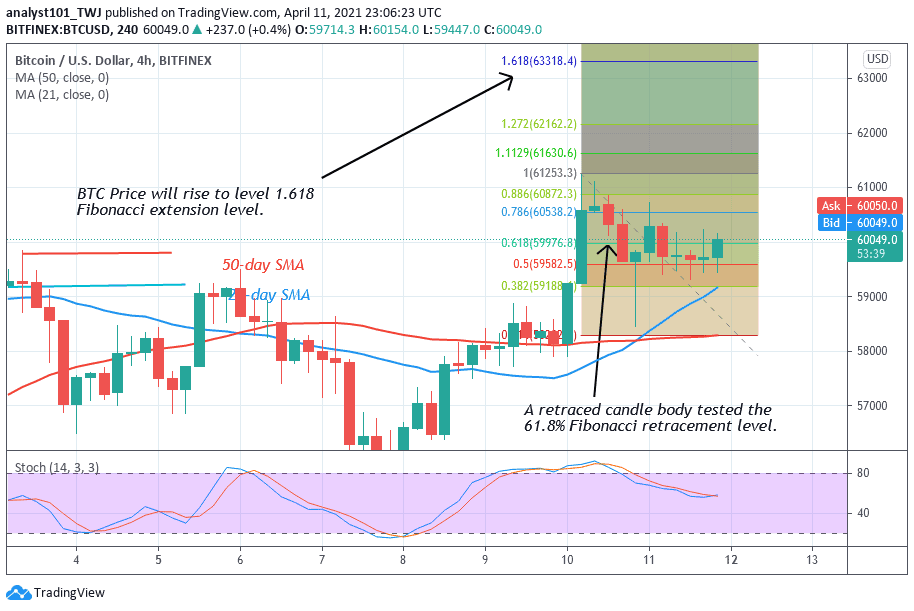
Meanwhile, on April 10 uptrend; a retraced candle body tested the 61.8% Fibonacci retracement level. The retracement implies that Bitcoin will rise to level 1.618 Fibonacci extension. From the price action, the BTC price is still consolidating above the $59,000 support. Buyers will have to break the overhead resistance to attain the Fibonacci level.

Go to Source

Bitcoin Price Prediction: BTC/USD Slides Below $60,000; Price May Likely See Further Downside

Bitcoin (BTC) Price Prediction – April 11

After touching the resistance level of $60,658, BTC/USD retraces and prepares for another move higher.

BTC/USD Long-term Trend: Bullish (Daily Chart)

Key levels:

Resistance Levels: $65,000, $67,000, $69,000

Support Levels: $55,000, $53,000, $51,000

BTCUSD – Daily Chart

BTC/USD is preparing for another high as the price retraces and touches the daily low of $59,177.06. The resistance level at $60,500 has been a tough resistance line that the coin has not been able to cross. Meanwhile, traders are not surprised by the selling pressure as bears are trying to drag the price below the 9-day and 21-day moving averages. However, until bulls break more upsides, the king coin may likely face a little sideways movement for a while.

What to Expect from Bitcoin (BTC)

According to the daily chart, the Bitcoin price is moving down with a loss of 0.49% at its current price of $59,486. However, the coming few days may likely shine a light on Bitcoin’s outlook, as it is currently trading at a pivotal point. Therefore, any decline or rise from the current level could determine the trend of the price movement.

Presently, BTC/USD is currently pushing above the moving averages, with bulls moving to erase the losses that came about at the early hour of today’s trading. However, if the coin remains above the moving averages, it may push the price to the resistance level of $65,000, $67,000, and $69,000 while the supports are located below the moving at $55,000, $53,000, and $51,000 as the technical indicator remains below the 60-level.

BTC/USD Medium – Term Trend: Ranging (4H Chart)

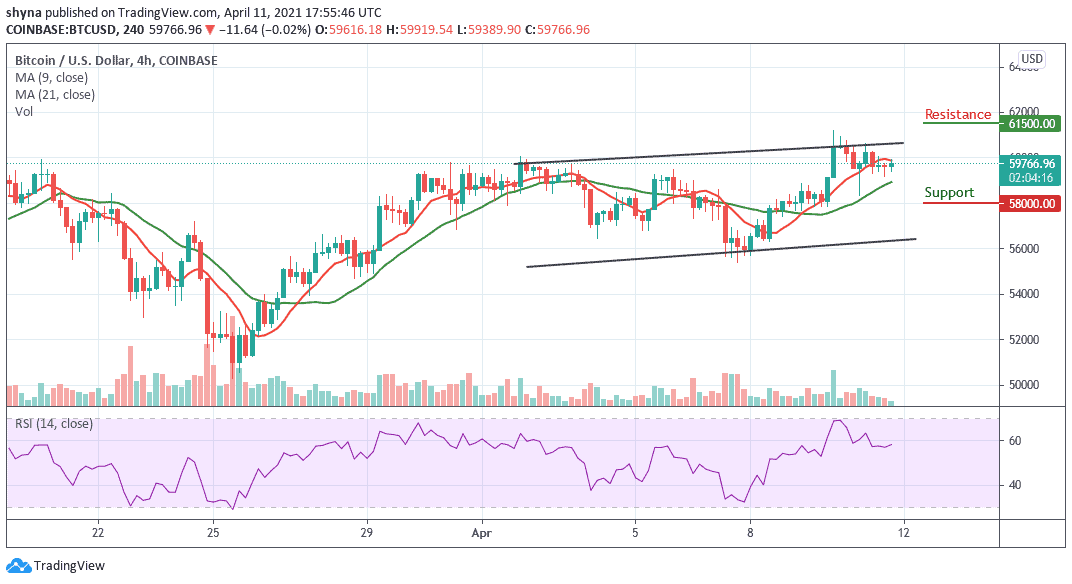
According to the 4-hour chart, the resistance at $60,658 has been too heavy for the bulls to overcome as the price is now struggling in a consolidation mode, which has made the cryptocurrency remain indecisive over the past few hours now. The next key resistance level remains at $61,500 and above.

BTCUSD – 4 Hour Chart

However, the coin is still roaming around $59,766 as bears are pushing the price below the 9-day moving average. Meanwhile, the $58,000 and below may come into play as the technical indicator moves below 60-level.

Go to Source

Binance Coin (BNB) market cap passes Santander and UBS — What’s next?

To date, Binance Coin has rallied 900%, which makes the token’s $64 billion market cap larger than Santander, the Bank of Montreal and UBS.

2021 has been an impressive year for Binance Coin (BNB), which so far has rallied by more than 900%. 

One of the primary drivers of BNB’s growth was continued congestion on the Ethereum network. As this struggle carried on, Binance Smart Chain (BSC) emerged as an alternative, meeting the rapidly growing decentralized finance (DeFi) sector’s demands.

As BNB reached a $64 billion market capitalization, it has surpassed traditional banks, including Santander, the Bank of Montreal, and UBS. Meanwhile, some analysts point to the estimated value and impact of Coinbase’s upcoming direct listing ($100-billion valuation) as a catalyst for the BNB price hike.

A common narrative spun up over the past few weeks is that the direct listing of COIN is also adding value to centralized exchange tokens. Analysts are also speculating that other U.S.-based regulated exchanges like Kraken and Gemini will likely follow Coinbase’s path and attempt to raise funds through a stock offering.

To understand BNB’s potential, one must first understand the differences between equities (stocks). After this is cleared up, it will be possible to analyze the possible drivers of BNB’s appreciation.

BNB does not represent shares of Binance

BNB token provides holders with a discount on trading fees, and it is required for those wishing to participate in Binance Launchpad token sales. As BNB gained liquidity, it also became a base pair for other cryptocurrencies at Binance exchange.

Over time, other uses emerged as the Binance Smart Chain gained traction. For example, BNB can cover network fees and as serve as a utility token in the ecosystem, which includes decentralized apps (dApps) and games.

Periodically Binance burns (destroys) some of the non-circulating BNB tokens based on the exchange’s overall trading volume. This strategy’s efficacy vanished over time as investors understood that these destroyed tokens never entered the circulating supply.

The Binance Smart Chain network uses a Proof of Stake Authority which eliminates the need for miners or expensive transaction fees. The platform kept its compatibility with the Ethereum Virtual Machine (EVM) and has a similar token and smart contract structure.

Many tokenized (or pegged) cryptocurrencies have gained relevance in Binance’s networks, allowing users to bypass miner fees. Another benefit provided by Binance Smart Chain’s BEP-20 model is staking and farming capabilities in its vast network of decentralized applications, including the PancakeSwap DEX and Venus lending platform.

Decentralized Finance Total Value Locked ranking. Source: DeBank

As shown above, Binance Smart Chain has been gaining ground on other DeFi protocols in terms of total value locked. Thus, new use cases for the BNB token emerged to take center stage as farming, liquidity pools, and base pairs utilized the token throughout the network.

Banks are reliable dividend providers, but DeFi could overtake the system

Equity shareholders are entitled to a piece of a listed companies’ net earnings. This amount will vary between each quarter, as the board of directors may opt to repay debt or incorporate some of that money into reserves. However, banks are known cash cows and thus usually a reliable source of dividends payouts.

Santander (SAN) dividends paid over the last 12 months divided by the current stock price yield a 3.7% gain, and Bank of Montreal (BMO) shareholders received a similar yield. Switzerland-based UBS yields went down in 2020, but historically it has averaged 5%.

Bank shareholders effectively have voting rights in shareholders meetings, and minority groups could block measures that would hurt them financially. On the other hand, these equity holders are 100% dependent on the bank’s net income and growth.

BNB, on the other hand, could survive without the direct influence of Binance exchange. In the future, if Binance Smart Chain achieves independent developers and validators, its ecosystem might continue to thrive. In theory, if token loses its dependency as the ecosystem grows, becoming less centralized.

If done correctly, BNB’s market capitalization could surpass that of the entire traditional banking system, but before this can happen these networks and decentralized applications need to gain adoption and prove that they can stand up to the needs of mainstream investors and banking clients.

The views and opinions expressed here are solely those of the author and do not necessarily reflect the views of Cointelegraph. Every investment and trading move involves risk. You should conduct your own research when making a decision.

Go to Source

Why is XRP seeing a monster rally when Ripple is worth just $3B on the secondary market?

Ripple is reportedly trading at a $2 to $3 billion valuation but its XRP holdings are worth around $70 billion.

The equity of Ripple, the company that builds the infrastructure around XRP — the digital asset used by networks like RippleNet to process cross-border payments — is reportedly trading at $2 to $3 billion in the secondary market.

Yet, the XRP holdings of Ripple, are reportedly worth $70 billion, which is many times higher than the valuation of the firm’s equity.

Michael Novogratz, the billionaire cryptocurrency investor and the CEO of Galaxy Digital, said:

“Ripple equity is ‘trading’ in secondary market at $2-3bn valuation. The $XRP on their balance sheet is worth approx $70bn. One price seems wrong. If $XRP price is saying settlement coming, the equity is crazy cheap. If not, the token seems expensive. Thoughts?:

So is XRP undervalued? Not exactly

According to Leonidas Hadjiloizou, a long-time cryptocurrency researcher, XRP that is locked in Ripple’s balance sheet are in escrow are likely not priced into Ripple’s equity.

As such, these holdings are not accessible until they start unlocking, which might not be priced in the value of the firm’s equity.

He said:

“Well, $62 bn of the XRP in Ripple’s balance sheet is locked in escrow. At the same time, Ripple’s XRP sales are the ones under attack from the SEC so the market probably hasn’t priced in Ripple’s XRP holdings since they are in limbo right now.”

In December 2017, the Ripple team explained that the XRP holdings in Ripple’s escrow unlock by one billion XRP per month for 55 subsequent months.

The team said at the time:

“The escrow consists of independent on ledger escrows that release a total of one billion XRP each month over the next 55 months. This provides an upper limit on the amount of new XRP that can be brought into circulation. The amount of XRP actually released into circulation will likely be much less than this.”

Theoretically, the value of Ripple’s equity would be considered undervalued if the amount of XRP on the firm’s balance sheet unlocks and the price of XRP does not drop.

The question on the discrepancy between the value of Ripple’s equity and the amount of its XRP holdings started to emerge as the price of XRP started to rally above $1, despite an ongoing lawsuit with U.S. Securities and Exchange Commission (SEC).

XRP/USD 1-day price chart (Bitstamp). Source: TradingView.com

Since April 1, the price of XRP rallied from $0.57 to as high as $1.49, by around 160%.

What is behind the XRP rally?

Throughout the past two weeks, the main catalysts for the 160% rally came from victories in the company’s legal battle. Ripple lawyers were granted access to internal SEC discussion history regarding cryptocurrencies, and a court denied the SEC the ability to disclose the financial records of two Ripple execs, including CEO Brad Garlinghouse.  

Another reason may be the convergence trade between Bitcoin (BTC) and altcoins, particularly as BTC sees sideways price action, allowing alternative cryptocurrencies to rally and catch up. 

Kelvin Koh, the managing partner at Spartan Group, one of the largest DeFi-focused funds in Asia, said that large quant funds try to trade the convergence between Bitcoin and major altcoins.

Hence, the trend of capital moving into altcoins and back into Bitcoin occurs periodically. Koh wrote:

“The reason this happens periodically is because there are a bunch of quant funds out there that play the convergence trade between $BTC and a handful of liquid alts. Whenever there alts look cheap relative to $BTC, they pile in. When they look expensive, they rotate back to $BTC. No fundamentals involved so don’t try too hard to rationalize the moves. This strategy has proven effective over time and there are enough managers playing this that it becomes self-fulfilling and keep recurring.”

Go to Source

Watch these key technical levels as Bitcoin price nears $61,800 all-time high

Bitcoin broke above $61,000 for the first time since early March and traders are turning bullish.

The price of Bitcoin (BTC) has surpassed $61,000 on April 10 for the first time in nearly a month. Following the breakout, traders are starting to look at new levels of resistance and support in the short-term as optimism returns to the market.

In the near term, besides the all-time high at around $61,800, there are three key Bitcoin price levels to observe: $61,188, $58,387 and $53,000.

BTC_USDT orderbook heatmap (Binance). Source: Material Indicators

As long as the price of Bitcoin stays above $58,387 and keeps attempting to break out above $61,188, it would likely see a new record high in the foreseeable future.

If Bitcoin breaks out to a new record high, traders also anticipate the altcoin market to pullback slightly for the time being, at least until BTC starts to stagnate after reaching a new high.

$58,000 flipping into support is critical for more upside

According to the pseudonymous trader “Rekt capital,” the key for Bitcoin to cleanly reach a new all-time high in the coming days is to solidify $58,000 as a support area.

The $58,000 level is an important area because it marks the peak of the initial BTC rally to the $60,000 resistance level in mid-February, as shown in the graph below.

BTC/USD 1-day price chart (Coinbase). Source: Rekt Capital, TradingView.com

In technical analysis, when the price of an asset stabilizes above the previous peak, it is considered to be a very bullish sign.

The trader noted:

“BTC was able to still keep the red area even though it rejected from orange And in fact, the rejections from orange has been weaker Right now, BTC is pressing beyond orange [$58,000]. Turning orange into a support would bring Bitcoin very close to a new All Time High.”

Raoul Pal, the CEO of Global Macro Investor, emphasized that the macro view of Bitcoin remains positive.

Pal emphasized that Bitcoin broke out of a three-month range, which indicates that BTC’s technical momentum is starting to regain steam. He said:

“Kind of feels like a big deal to see BTC break a 3 month range and a wedge. It should create a powerful move to the upside. (Axis scrunched on chart to hint at the upside for dramatic effect.”

A cryptocurrency derivatives trader “Cactus” also added that on-chain analytics are stronger than ever, considering that large BTC exchange outflows indicate accumulation among high-net-worth investors.

As Bitcoin rallies, beware of altcoin stagnance

Meanwhile, other traders are expecting the altcoin market to take a breather if Bitcoin enters price discovery once again.

Kaleo, a well-known pseudonymous trader, said that there is a high chance altcoins do not rally nearly as much as expected when the volume is sucked up by Bitcoin.

The trader explained:

“For those that are new, be careful being to deep into alts when $BTC is on the brink of price discovery. Profits from alts tend to flow back into Bitcoin. This doesn’t mean the USD price won’t go up, just that there’s a solid chance it won’t go up nearly as much.”

In the short term, Bitcoin would likely outperform altcoins if it continues to rally, and the momentum would only shift to altcoins once BTC consolidates as it finds a new range after breaking new highs. 

Go to Source

Oasis Foundation announces implementation of Tidal DeFi insurance platform

A renewed focus on DeFi could drive traffic for the Oasis Network.

The Oasis Foundation, an offshoot of Oasis Network developers Oasis Labs, announced in a blog post on Friday that decentralized finance (DeFi) insurance and coverage provider Tidal Finance will be implementing a version of their platform on the Oasis Network. 

The blog post noted that insurance will be important for users of the platform as Oasis scales its DeFi offerings, and that by working with Oasis’ “confidential smart contracts” Tidal will be able to deploy new claims methods, such as “anonymous, democratized voting” that preserves voters and user privacy.

The move mirrors similar ones being made in Ethereum’s DeFi ecosystem, where multiple projects are launching new insurance platforms or planning to bake coverage directly into their offerings at the protocol layer.

New Focus?

The privacy-focused blockchain, founded by one of Cointelegraph’s Top 100 in Crypto entrepreneur Dawn Song, has pursued various strategies throughout the years in an effort to attract traffic and adoption. In 2018 the company raised a monster $45 million as the rest of the crypto market stalled, and use cases such as medical records and individuals selling personal data were touted as part of a privacy-preserving computational network. 

By the time the network’s November 19, 2020 mainnet rolled around, they were instead focused on decentralized finance, promising under collateralized loans using real-world credit checks. The mainnet launch was followed by a November 25 token sale, which netted the company an additional $10 million.

The company’s current strategy consists of a patchwork of initiatives focused on big data, data privacy, and decentralized finance. Last year they announced a project with Binance to allow exchanges to confidentially share threat assessment information regarding fraud and hacks, and earlier this year worked with automaker BMW to enable cloistered information storage to protect privacy while sharing data internally.

The partnership with Tidal may signal a renewed focus on DeFi, however. The press release notes that Tidal’s insurance on DeFi pools will be key for Oasis’ “rapidly expanding” DeFi ecosystem, and that multiple “lending protocols and DEXs that will be integrated into the Oasis Network in the coming months.”

In February Oasis’ Anne Fauvre-Willis weighed in on the Gamestop/Robinhood saga, saying the fiasco “clearly highlighted the need to build systems that are decentralized and put users and individuals in control of their own data and finances.”

DeFi has been on a monster tear as of late, having recently eclipsed $100 billion in Total Value Locked.

Go to Source

Bitcoin Price Prediction: BTC/USD Currently Contends with the Northward Breakout of the Key $60,000 Resistance Point

Bitcoin Price Prediction – April 11
The market trading zone of $60,000 has been marked as a very tough resistance line that the BTC/USD value has continued to find difficult to break past northwardly over time. As of writing, price still struggles to trade around the zone mentioned earlier.

BTC/USD Market
Key Levels:
Resistance levels: $65,000, $70,000, $75,000,
Support levels: $50,000, $45,000, $40,000

BTC/USD – Daily Chart
The BTC/USD daily trading chart has it that a strong belief will favor the witness of more ups than downs in the next sessions. As price strives to continue to test and consolidate around the main resistance line of $60,000, the north direction is highly potential to occur after a while. The 50-day SMA indicator is keeping a distance away below both the bullish and the 14-day SMA trendlines. The Stochastic Oscillators have slantingly moved from the overbought region to now cross the hairs between ranges 80 and 40 to the north. That gives an expectation of seeing more ups.

Will the $60,000 resistance level remain tough to be breached northwardly?
The level of the $60,000 trading zone has formed to denote a vital line for the BTC/USD bulls to breach to the north quite a while. The crypto’s value while trying to move past the level has always encountered resistance making it ugly to achieve a good stride away from the point until the present. Therefore, the current trading situation has made it necessary to await a more forceful price action to occur to have a distinct direction of the most valuable crypto trading market.

There has been no safe bearish signal to substantiate a good entry sell position in this particular trading currency pair. However, it will be coming after a sudden breakout of the resistance zone while price gets a reverse but, not during a volatile breakout course. Meanwhile, being as it is, the crypto tends to push around price to feature higher lows more in the next sessions.

BTC/USD 4-hour Chart
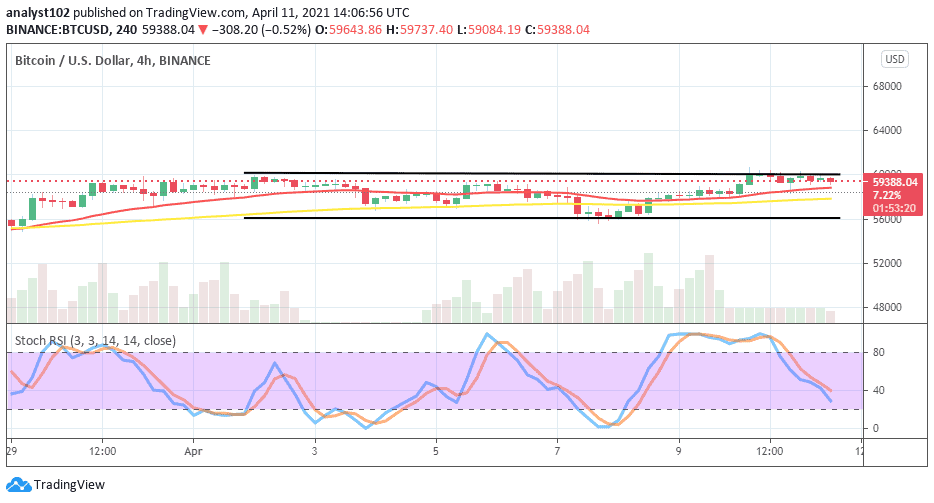
Both the BTC/USD market movers in the medium-term run have been able to change the long-featuring range-bound trend since around some last trading days in March until the present. The range-bound trading zones remain as $60,000 and $56,000; being the upper and the lower range trading levels of the crypto-market. The two SMA trend lines are located in the range trend-lines as they flatly point towards the east direction to affirm the ongoing range moves of the trade. The Stochastic Oscillators slantingly moved from the overbought region to get placed at range 40. They still weakly point to the south and, could mean that price may a bit still come down for a test of support towards the $56,000 lower range line before the return of an upswing.

Go to Source

Bitcoin Price Prediction: BTC/USD May Likely See Further Downside as Price Remains Below $57,000

Bitcoin (BTC) Price Prediction – April 7

The first digital asset has been facing some immense selling pressure as of late, with the support found within the $55,400 level.

BTC/USD Long-term Trend: Bullish (Daily Chart)

Key levels:

Resistance Levels: $62,000, $64,000, $66,000

Support Levels: $52,000, $50,000, $48,000

BTCUSD – Daily Chart

BTC/USD has been struggling to maintain its uptrend, with the selling pressure found below the 9-day and 21-day moving averages which are stopping it from seeing any major gains throughout the past few days. Meanwhile, traders are not surprised by the selling pressure as bears are trying to defend against a break above the cryptocurrency’s all-time highs.

Where is BTC Price Going Next?

At the time of writing, BTC/USD is trading down just under 2.87% at its current price of $56,355. This marks a climb from its daily low of $55,400 set at the bottom of the decline. However, the coming few days may likely place the market price within the negative side as the technical indicator RSI (14) nosedives to the downside. Therefore, any decline from this level could determine the trend of the first digital asset.

Looking at the daily chart, the Bitcoin (BTC) is currently pushing towards the lower boundary of the channel, with bulls moving to erase the losses that came about at the early hour of today’s trading. Furthermore, any bullish movement above the moving averages may push the price to the resistance level of $62,000, $64,000, and $66,000 while the supports are located at $52,000, $50,000, and $48,000.

BTC/USD Medium – Term Trend: Ranging (4H Chart)

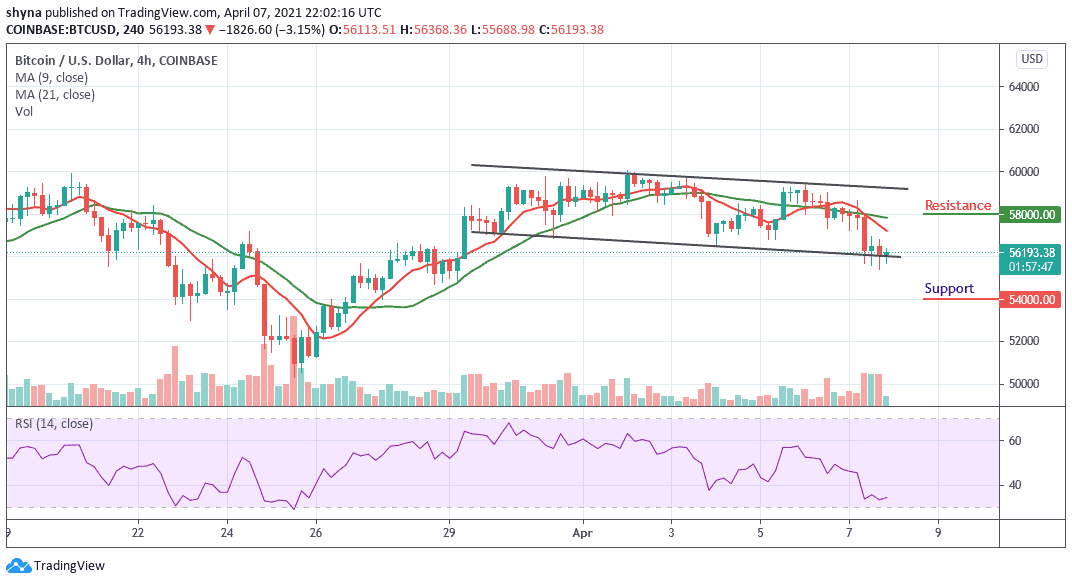
Looking at the 4-hour chart, the resistance at the $56,500 has been too heavy for the bulls to overcome as the price is now struggling in a consolidation mode. This current trading is making the cryptocurrency remain indecisive over the past few hours now while the resistance levels to watch are 58,000 and above.

BTCUSD – 4 Hour Chart

Nevertheless, the coin is still roaming around $56,193 as bears keep the price below the 9-day and 21-day moving averages. Meanwhile, the $54,000 and below may come into play if the technical indicator RSI (14) remains below 35-level.

Go to Source

Report Claims the FBI Uses Bitcoin Mixers During BTC Forfeiture Processing

Over the last eight years, U.S. law enforcement has seized a great number of bitcoins and at one time, the Federal Bureau of Investigation (FBI) held one of the largest bitcoin wallets after the Silk Road takedown. A recently published report shows the FBI has started using cryptocurrency mixing applications in recent times in order to obfuscate transactions from seized bitcoins that stem from a forfeiture.

Do as I Say, Not as I Do

The U.S. government is far from transparent and a newly published report shows just how shady the feds can be these days. The author Joshua Davis explains with great detail that the FBI has been evading “transparency and accountability” specifically when law enforcement has been handling funds from a seizure. For years now, the FBI, the United States Department of Justice (DoJ), and FinCEN have said that the use of bitcoin mixers should be criminalized.

The Feds have prosecuted operators of large centralized bitcoin mixers as well charging the operators with illegal money transmission charges and claiming that mixing facilitates crime. These days, cryptocurrency mixers are less centralized and bitcoiners can leverage bitcoin mixers that are built into a noncustodial wallet. Davis explains how “FinCEN is criminalizing Bitcoin mixers” and that anyone using them could be “accused of violating Anti-Money laundering laws.” The report also details how the FBI is “routinely” using bitcoin mixers and has been for a few years now.

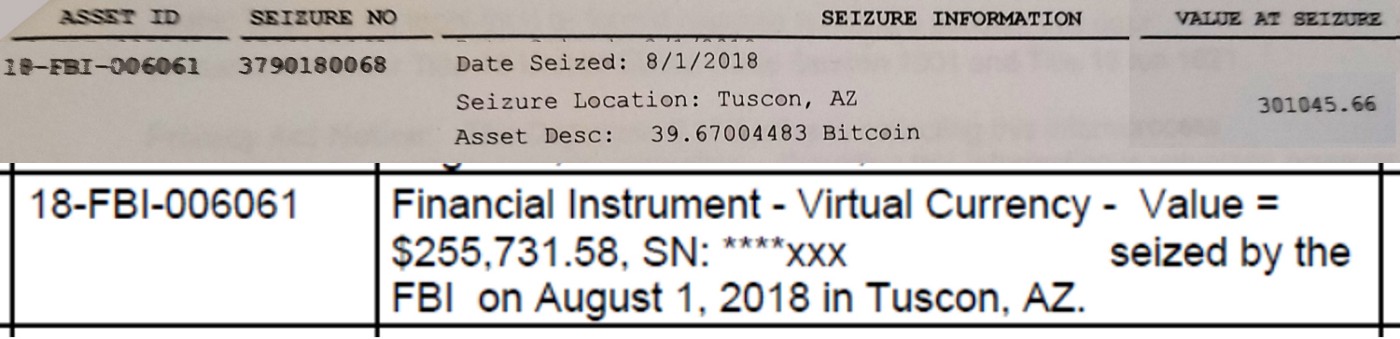
The report shows that the FBI seized 39.67 BTC from a man in Tucson, Arizona, and the case involved unauthorized SIM swaps. According to Davis’ findings, the FBI sent updates to the victims and “made it seem as if the cryptocurrency had been already sold.” However, blockchain data shows this wasn’t the case and the victims were told a “clerical error” was made.

FBI Overpaid Bitcoin Miners by a Factor of 4700%

Interestingly, Davis’ findings indicate the blockchain tells a tale of how the transactions the Feds sent were sent “to themselves,” from an address that sent “more than 800,000 transactions,” and the funds derived from an address that sent more than 43 million BTC. The tell-tale signs of a bitcoin mixer being used to obfuscate bitcoin transactions.

“To be 100% clear the FBI does not need a money transmitter license to act as a lawful Bitcoin tumbler because government agencies are exempt from needing to obtain a Money Services Business (MSB) license,” Davis’ report insists. “Instead what I’d like to humbly point out is that the law requires funds to be “safeguarded against waste, loss, unauthorized use, or misappropriation.” As far as those four things to safeguard against, Davis found that “waste” seemed to have been chosen instead of transparency.

Davis assumes that the FBI could have “overpaid bitcoin miners by a factor of 4700%” and fees would be massive when you multiply that by 2x or 5x. The report concludes that Davis doesn’t have any issues or really anything against the FBI in general, but he doesn’t appreciate the hypocrisy.

“I just hate that feeling when I’m treated like a child who needs to stop complaining and trust the authority figure,” the author wrote. “Yes, we do need to trust authority figures, but those authority figures should earn our trust. Authority figures should also try their best to be as transparent as possible.”

Former U.S. law enforcement agents Shaun Bridges and Carl Force. Findings suggest that the recently seized Silk Road stash of 69,370 bitcoins taken from “Individual X” shows the unknown person was likely Shaun Bridges.

The author also noted how the former U.S. Drug Enforcement Administration agent Carl Force and the former Secret Service agent Shaun Bridges stole money from the Silk Road case. Force was able to steal 1,200 BTC and Bridges was able to snag 3,100 bitcoin. “They would have gotten away with it if they had taken one extra precaution,” Davis said. “Their downfall was failing to use a tool called a bitcoin mixer.”

Moreover, a representative from the FBI emailed the author of the report and he further explained: “The FBI has stated unequivocally in an email that the funds are still held as Bitcoin. They are required by law to hold these funds as bitcoin and not convert these funds to cash.”

What do you think about the FBI using bitcoin mixers to obfuscate transactions? Let us know what you think about this subject in the comments below.

Go to Source

YFX.Com – Defi Trading Platform Support 100X Leverage. No KYC. No Gas Fee

PRESS RELEASE. YFX.COM is the world’s first decentralized cross-chain perpetual contract exchange. While other trading platforms that provide leverage alternatives exist, YFX.COM is trailblazing a decentralized alternative to centralized exchanges and perpetual futures trading without a central intermediary. YFX.COM does this by taking advantage of different protocols across the cryptocurrency landscape.

Through a culmination of blockchain protocols YFX.COM is allowing traders to participate in trading BTC, ETH and other cryptocurrencies with up to 100x leverage. These cryptos are available to be traded across these blockchains currently, Ethereum, Tron, Binance Smart Chain, Heco, OKEx Chain and Polkadot.

Through the advent of QIC-AMM, a state of the art protocol, YFX.COM provides high liquidity with low slippage for users of our ecosystem. QIC is an acronym for Quoted Index Price. QIC pulls quoted prices from centralized exchanges and traders can open and close positions with our first of a kind automatic market maker for derivatives. QIC is calculated through dynamic depth of indices, price quotation and constant integral. The depth of a transaction is correlated to the amount of liquidity of the market maker’s capital pool. This combination of protocols allows for YFX.COM to be the efficient leverage trading platform on the market.

Additionally, YFX.COM is able to achieve all of this without KYC and no gas fees. As many traders know, gas fees have been a major issue lately. Eliminating gas fees gives YFX.COM another major advantage against all competition. It also allows for traders to trade efficiently and secure their profits without major loss from expensive network fees. YFX.COM has achieved nearly zero network fees through use of layer-2 [L2] scaling solution, xDai Chain. xDai Stable Chain is a side chain to Ethereum and is far more efficient than the ETH mainnet currently. The transactions are more convenient and the fees are a fraction of fees on ETH mainnet.

YFX.COM Won First Prize at Tron 2021 Global DeFi Hackathon

Last week YFX.COM also won First Prize in the Tron 2021 Global DeFi Hackathon Developer Contest. This was a great achievement and YFX.COM is thankful for this opportunity put on by the Tron Foundation and Justin Sun. YFX.COM is committed to the blockchain space and looks forward to participating in more events to help advance this industry.

Genesis Mining II

April 6, the YFX.COM Genesis Mining II event began at 20:00 (UTC+8). The event will run through April 16 and is a competition for traders and miners to compete against others and earn YFX.COM tokens in the process [which are not available anywhere on the market]. Through just 12 hours of trading, volume has reached over $1 billion and our liquidity pool is over $10 million U.S. dollars which exceeds Uniswap’s activity.

CertiK Audit Completed

Additionally, CertiK has recently completed their security audit of YFX.COM. Traders and users of our platform can rest assured that the protocols are up to standard as YFX.COM is committed to providing the best product for the userbase.

Website: https://www.yfx.com/

Trading: https://trx.yfx.com/

Twitter: https://twitter.com/YFX_Defi

Telegram: https://t.me/YFX_EN

Discord: https://discord.gg/xwAtjpabC5

Media Contact: Kivi@yfx.com


This is a press release. Readers should do their own due diligence before taking any actions related to the promoted company or any of its affiliates or services. Bitcoin.com is not responsible, directly or indirectly, for any damage or loss caused or alleged to be caused by or in connection with the use of or reliance on any content, goods or services mentioned in the press release.

Go to Source

P2P Bitcoin Trade Volumes Surge in Kenya and Ghana but Nigeria Still Dominates

According to new data, peer-to-peer (P2P) bitcoin trade volumes in Kenya and Ghana surged in Q1 of 2021, with the two countries now ranked second and third respectively. On the other hand, volumes in South Africa, which occupied second place in 2020, dropped marginally. Consequently, South Africa has now been relegated to the fourth position the data shows.

Contrasting Regulatory Regimes

Meanwhile, one report has attributed the surge in Kenya and Ghana’s P2P volumes to the two countries’ tacit endorsement of cryptocurrencies. For instance, the report points to the Central Bank of Ghana’s launch of “a regulatory sandbox that prioritized blockchain-based companies including cryptocurrency startups” as one factor that may have boosted the country’s volumes.

This is in contrast to the situation in South Africa where regulator warnings about cryptocurrency use and investment increased following the collapse of Mirror Trading International, the biggest scam bitcoin in 2020, according to Chainalysis. As explained in the report, crypto dealings in South Africa “have come under increased scrutiny, with tougher regulations including mandatory licenses and taxes triggering investor exits. The report also adds that “bitcoin trading in South Africa has effectively lost its autonomy and this has reduced its market appeal to investors.”

Nigeria P2P Volumes Surge After Central Bank Directive

In the meantime, the data shows that P2P volumes in Nigeria seem to have been boosted by the Central Bank of Nigeria (CBN)’s directive against crypto entities that was issued on February 6. As the Tulip data shows, Nigeria’s P2P bitcoin traded volumes in the past 90 days surged to nearly $100 million. The figure, which is nearly two and half times more than that of second-placed Kenya, suggests more bitcoin users are now using P2P platforms.

Meanwhile, the data appears shows that P2P traded volumes in many other African countries surged after March 2020, when lockdown measures took hold. Since then, many countries on the continent have seen their P2P bitcoin traded volumes grow steadily.

What are your thoughts on the rising P2P BTC traded volumes in Kenya and Ghana? Tell us what you think in the comments section below.

Go to Source

Please enter CoinGecko Free Api Key to get this plugin works.
Exit mobile version