Bitcoin (BTC) Price Prediction: BTC/USD Faces Rejection at $40,000 as Bitcoin Falls

Bitcoin (BTC) Price Prediction – May 28, 2021

Bitcoin falls  and resumes downward after the bulls fail to break the $40,000 resistance. Buyers retested the resistance thrice before succumbing to the selling pressure. The downtrend has been confirmed with the appearance of a Doji Candlestick in the lower time frame. The candlestick indicates that buyers are unable to keep the price higher as sellers continue to push prices downward. Bitcoin has fallen to $36,888 low at the time of writing.

Resistance Levels: $45,000, $46,000, $47,000
Support Levels: $35,000, $34,000, $33,000

BTC/USD – Daily Chart

Following a consistent rejection at the $40,000 resistance and subsequent fall of Bitcoin, it becomes imperative that BTC/USD is likely to revisit the previous low at $30,000. On May 19, Bitcoin has earlier fallen to the $30,000 support but pulled back to the previous highs. In previous price action, BTC’s price has been fluctuating between $32,000 and $40,000. Yesterday, the BTC price turns down from the recent high and the bears are expected to push BTC price to the previous low at $34,000.On the downside, if sellers are successful and the $34,000 support is breached, Bitcoin will further decline to $30,000.

UK Advertising Organization Bans Crypto Exchange Ads as Bitcoin Falls

A foremost advertising industry organization in the United Kingdom has indicated that it will stop an ad campaign telling people “it’s time to buy” Bitcoin. The Advertising Standards Authority (ASA) is a self-regulating ad organization. It has formally stopped advertising campaign by cryptocurrency exchange Luno for being misleading and irresponsible. According to ASA: “The ads must not appear again in the form complained about, noting that ads like this should mention that Bitcoin investment is highly risky due to its extremely volatile nature.

Luno’s ad posters contained an image of Bitcoin saying: “If you’re seeing bitcoin on the underground, it’s time to buy.” ASA indicated that it has received several complaints regarding Luno’s ad. Consumers are stressing that their posters failed to illustrate the risk of Bitcoin investment. “We considered that consumers would interpret the statement ‘it’s time to buy as a call to action and that the simplicity of the statement gave the impression that bitcoin investment was straightforward and accessible,”

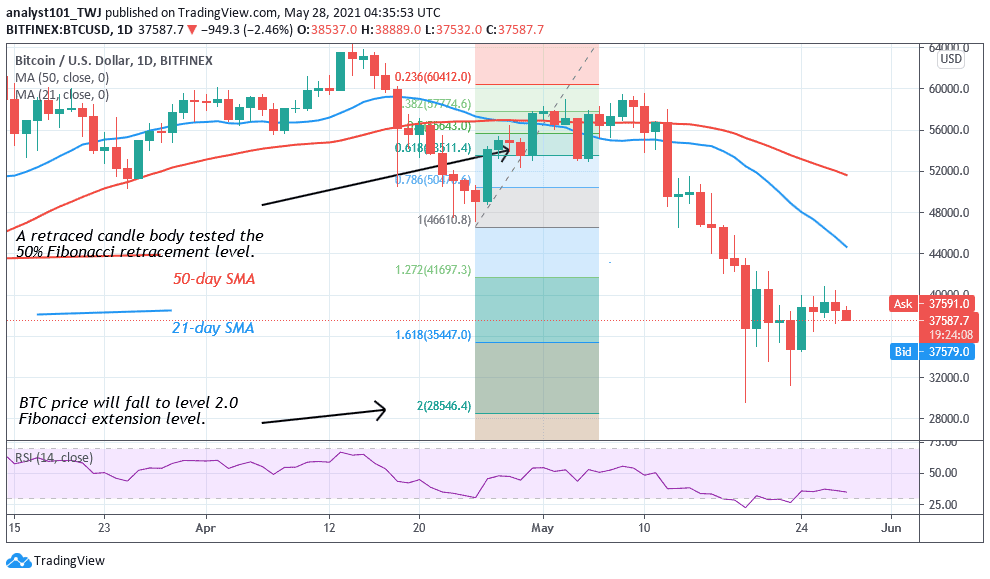
BTC/USD -Daily Chart

Meanwhile, Bitcoin is falling as bulls face rejection at $40,000 high. The king coin is likely to revisit the previous low if the support at $34,000 is breached. The Fibonacci tool analysis has indicated that Bitcoin will fall to the 2.0 Fibonacci extension level or level $28,546.40. On May 19, Bitcoin fell to the $29,000 support and pulled back. Today, a visit to $30,000 support is likely.

Go to Source

Binance NFT Marketplace to Officially Launch on June 24th

  • Binance’s NFT marketplace will be launched on the 24th of June
  • The launce will feature exclusive content from Lewis Capaldi, Trevor Jones, Michael Owen, Alphonso Davies, and eStarPro
  • The launch will also feature NFTs from individual creators from around the world
  • Binance NFT aims at becoming the ‘ultimate destination for NFTs and digital collectibles’

The team at Binance has announced that the platform’s NFT marketplace will launch on the 24th of June this year. The launch will feature exclusive NFTs created by Lewis Capaldi, Trevor Jones, Michael Owen, Alphonso Davies, and eStarPro.

In addition, the team at Binance NFT  also explained that they are in the process of partnering with additional digital artists, musicians, athletes and celebrities to provide exclusive content during the launch of the marketplace and after. The end goal will of Binance NFT is to transform the marketplace into ‘the ultimate destination for NFTs and digital collectibles’.

Binance NFT Launch Will Also Include Content from Talented Creators and Individuals

To note is that the launch of the Binance NFT marketplace on the 24th of next month will also feature artwork and content from talented creators and individuals from across the world.

Artists, creators, and musicians are therefore requested by the team at Binance NFT to join the platform’s Innovative Creators Program that is centered on featuring unique content on the marketplace.

Successful applicants of the program will get a chance at having their creations and collectibles featured on the Binance NFT marketplace during the first month after its launch. Secondly, each creator will receive 99% of the proceeds from their first NFT sale and a 1% royalty payment from subsequent NFT trades. Thirdly, all featured NFTs will get a chance at being featured on Binance’s official social media channels with millions of followers.

How to Apply for the Binance NFT Innovative Creators Program

Applicants who wish to participate in the Binance NFT Innovative Creators Program are requested to send an email to nft@binance.com with the following information.

  • Email subject with the title of ‘Application for Binance NFT Innovative Creators Program
  • A brief self-introduction
  • Links to relevant social media accounts, if any (Instagram, Twitter, Facebook, etc)
  • Description of previous NFT experience, if any
  • Reason for applying to the Binance NFT Innovative Creators Program
  • Samples of previous work can be attached to the email
  • A description of the NFT content you would list if selected or a proposal of what you want to create for the launch

All applications should be submitted by May 31st at 11.59 pm UTC. All successful applicants will be contacted directly by the Binance team.

Go to Source

Cardano (ADA) Launches the First Testnet of the Alonzo Upgrade

  • The team at IOHK has announced the launch of the first Testnet of the Alonzo Upgrade
  • Cardano’s Alonzo testnet will first be available to a small group of SPOs, partners and Plutus Pioneers
  • New users will be onboarded with time as the team integrates new features on the Cardano testnet
  • Once complete, the Alonzo Upgrade is geared towards introducing smart contracts on Cardano

The development team at Input Output HK (IOHK), has announced the launch of the first testnet of Cardano’s Alonzo upgrade that is geared towards introducing smart contracts to the blockchain. Codenamed Alonzo Blue, the testnet is the upgrade’s early alpha network that provides core Alonzo-node networking capability.

For this reason, Alonzo Blue will initially be available to a small group of SPOs (stake pool operators), partners of Cardano and Plutus pioneers. This early group is in the process of being set up to access the Alonzo Blue which will evolve in the next few months to include more users as more functionality is integrated into the testnet.

Alonzo Upgrade Will Introduce Smart Contracts on Cardano

When complete, the Alonzo upgrade will successfully integrate smart contract capabilities on the Cardano mainnet. This will ultimately lead to the evolution of Cardano and allow developers to create decentralized applications for DeFi, Gaming, NFTs and more.

The Alonzo upgrade is estimated to be complete by June or July followed by a four-week freeze on the code before the final launch. The freeze will provide a time window for wallets, exchanges and individual developers to upgrade their code in preparation for the final launch on the Cardano Mainnet. A concrete date and time will be provided by the team at IOHK in the days and weeks ahead.

Smart Contracts Are on the Horizon – Charles Hoskinson

A few hours ago, the founder of Cardano, Charles Hoskinson, reiterated via Twitter that the project was on track towards implemented smart contracts. He also challenged Cardano’s internet trolls to a contest for the best ‘insult’ as seen in the tweet below.

Go to Source

A Look at Why Venezuela Is the Third Country With the Most Crypto Adoption

Venezuela has been listed as the third country with the most cryptocurrency adoption in the world by Chainalysis in its 2020 report. With its citizens coping with crippling inflation and losing purchasing power, the country has taken a turn for these assets to survive. But what are the real numbers behind this crisis that made Venezuelans change their whole way of living?

How Venezuela Adopted Crypto: The Numbers

It is a popularly known fact that Venezuela is one of the countries that have adopted cryptocurrency with the most force in LATAM. This was corroborated by Chainalysis in its latest 2020 Geography of Cryptocurrency Report, where it states that Venezuela is in fact the third country with the most cryptocurrency adoption in all the world. There is no doubt in what caused this: the economic disaster that was the result of years of wrong monetary policies, exchange controls, and corruption.

But how deep is the hole that Venezuelans are living in today? How Venezuela went from one of the richest countries in the region to become an inflationary mess in just a few years? It is difficult to pinpoint the numbers behind this disaster because official institutions have been withholding them for years. But several non-official sources can help us understand the magnitude of this crisis.

Inflation in Venezuela: One of the Highest of the World

While the Venezuelan economy always had a tendency to have important inflationary numbers, it reached a point of no return in 2014, with an annual increase of 69%. From that year, inflation figures worsen with each year, but the Central Bank of Venezuela stopped giving official numbers in 2015, which made it difficult to follow what was really going on in the country. For 2018, the International Monetary Fund estimated that the annual inflation would be 1,000,000%, a number that put Venezuela in one of the worst hyperinflationary escalates at that time.

This made Venezuelans who saved in their local currency reach poverty status in less than a decade and destroyed the national currency as a store of value.

Monetary Policy, Devaluation and Exchange Control

The country had established an exchange control since 2003, with the creation of CADIVI, an institution that dealt with the distribution of dollars to the population and entrepreneurs according to limits dictated by the government. An official price was set by this organization for the U.S. dollar. This created a black market, that offered dollars freely but at a higher exchange rate than the official dollar price. This approach would be proven not viable anymore and the system evolved into a moving band system in 2016.

However, the exchange control and the government’s policy of devaluing its own currency by increasing the price of the dollar/bolivar pair led to a de facto dollarization in the country, relegating the bolivar to a purely transactional currency. The value of the bolivar plunged even more as a consequence, making cash almost useless. To face this whole ordeal, the government took three zeroes out of its currency in 2008 and three zeroes of it again ten years later, in 2018, in a process called currency reconversion. However, this has not resulted in a more solid currency. In fact, only 1 of every 1000 emitted bolivares is in cash, leaving unbanked Venezuelans with almost no choice but to use dollars.

Cryptocurrency Usage Soaring

All of these factors have created a turbulent situation in the country, perfect for the adoption of new assets like cryptocurrencies, that are not linked to the emission policy of local governments and are not affected by other local problems. Numbers from Localbitcoins and Binance have confirmed this tendency, being these two the most used platforms in Venezuela to exchange bolivares or dollars.

While the dollar is now the most used currency in the country for retail purchases, with 67% of the sales being paid with dollars according to a study made by Ecoanalitica, a local firm, cryptocurrency is being more and more popular among a significant part of Venezuelans, that see it as an opportunity to preserve (and even gain) part of their purchasing power.

What do you think about Venezuela being the nation with the third-largest crypto adoption? Let us know what you think about this subject in the comments section below.

Go to Source

Nigeria’s Naira Loses Ground on Forex Black Market Just a Few Days After Devaluation

The Nigerian naira currency lost further ground against major currencies after it depreciated to 493 nairas for one dollar on the black market on May 25, 2021. Before the latest depreciation, the currency had stabilized at around 485 nairas to the dollar. This was shortly after the exchange rate dropped to a three and a half year low rate of 500 nairas for one dollar back in November 2020.

Renewed Pressure on the Naira

As one report explains, the naira’s latest depreciation comes just a week after the Central Bank of Nigeria (CBN) devalued the currency by over 5%. As previously reported by Bitcoin.com News, the CBN recently allowed the naira’s exchange rate to slide from 393 per dollar to around 410 per dollar.

However, the same currency devaluation appears to have prompted the latest depreciation of the naira on the parallel market. Meanwhile, a different report is attributing the renewed pressure on Nigeria’s currency to “black market speculators who have taken advantage of the CBN’s newly adopted exchange rate to buy up and hoard dollars.”

Further Devaluation Expected

In the meantime, the same report also quotes analysts from CSL, a local stockbroking firm, explaining how Nigeria’s forex demand backlog will continue to add pressure to the naira in the short term. The analysts continued:

As such, the CBN will likely devalue the I&E rate by about 5.0 -7.0per cent by year-end to unlock FX liquidity, attract new Foreign Portfolio Investment (FPI) flows and curb the current account imbalances, which is projected to reach US$10.80billion (2.1% of the GDP) in 2021.

Before the naira’s devaluation, multilateral lending institutions like the World Bank and the International Monetary Fund had pushed for the unification of Nigeria’s multiple exchange rates. According to CSL stockbrokers, unifying Nigeria’s exchange rates sets the tone “for further funding from multilateral bodies.”

Starting in 2017, Nigeria began using multiple exchange rates which the CBN continues to defend. While the central bank insists its decision to ration foreign currency is in the country’s best interests, this policy has nevertheless received widespread criticism.

What are your thoughts on the naira’s latest depreciation against major currencies? You can share your thoughts in the comments section below.

Go to Source

Kyrgyzstan Seizes 2,000 Cryptocurrency Mining Devices

Law enforcement authorities in Kyrgyzstan have confiscated thousands of crypto mining machines as part of a new offensive against illegal cryptocurrency mining in the country. Investigators have also identified industrial enterprises that have been supplying the bitcoin farms with electricity.

Security Service Conducts Operation Against Illegal Mining in Kyrgyzstan

The State Committee for National Security (GKNB), Kyrgyzstan’s organized crime-fighting agency, has recently found and raided a number of facilities mining cryptocurrency outside the law. The special operation has been conducted in the capital Bishkek and Chuy Oblast, the country’s northernmost region.

During the offensive against illegal mining activities, law enforcement agents have seized around 2,000 cryptocurrency mining units, GKNB announced, quoted by Sputnik Kyrgyzstan. Pretrial proceedings are underway, the agency’s press service added.

Ala-Too square in Bishkek.

The process of cryptocurrency mining inflicts “colossal damage” on the country’s electricity network, the state committee emphasized. GKNB has also uncovered several large industrial enterprises supplying electrical power to illegal crypto farms.

Most of the raided addresses are in the capital city of the Central Asian republic, Bishkek. Some of the mining devices have been seized from industrial facilities located in the Bishkek Free Economic Zone. The police are currently working to establish all individuals that have been involved in the corruption scheme.

Government in Bishkek Takes Steps to Regulate Crypto Industry

In August 2020, the Ministry of Economics put forward a bill regulating the taxation of bitcoin mining in Kyrgyzstan. According to the proposal, a 15% tax will be imposed on the cost of the electricity consumed to mint digital coins. The legislation obliges mining companies to apply for a registration which is needed to operate legally in the country.

National Bank of the Kyrgyz Republic.

In January of this year, the National Bank of the Kyrgyz Republic announced it’s preparing two draft laws to regulate local cryptocurrency exchanges. According to the bank, the bills are introducing an array of measures aimed at reducing the risks of money laundering and financing of terrorism. The trading platforms were required to report their activities to the government.

Cryptocurrencies have enjoyed growing popularity in Kyrgyzstan over the past year. Decentralized digital money is viewed as a new investment opportunity and also as an alternative solution for cross-border payments. Last October, the country’s central bank suspended SWIFT transfers and banking activities amid raging anti-government protests.

What are your thoughts on the government’s offensive against crypto mining farms in Kyrgyzstan? Let us know in the comments section below.

Go to Source

Crypto Savings Platform Ledn Raises $30 Million in Latest Funding Round

Ledn, a cryptocurrency lending and savings platform based in Canada, has managed to raise $30 million in its latest funding round. The money raised will be used to expand its offer of lending products, and to expand its reach in more countries. Ledn could take advantage of the recent problems that Blockfi, one of its contenders, is facing now to increase its share in the sector.

Ledn Raises $30 Million in Latest Funding

Ledn, a Canada-based cryptocurrency lending platform managed to raise $30 million in its Series A funding round, a more than tenfold increase from its first funding round. The round was led by Kingsway Capital, a London-based investment firm with a focus on digital assets and mobile internet investments.

The round also had participation from other investors: Alan Howard, Hashed, Susquehanna Private Equity Investments LLLP, ParaFi Capital, Alexis Ohanian, and John Pfeffer. According to the press release statement, all of the first backers of the company also chipped in. This is the second successful funding round that Ledn has hosted, with the first one raising $2.7 million last February. Since then, the company has grown enormously with the Bitcoin bull market.

Ledn’s CEO, Adam Reeds, stated that its priority is to occupy markets with big growth potential. Reeds stated:

With this new injection of capital, we will expand on our success in North & South America and grow our global footprint, prioritizing growth markets. Our focus is to build simple and secure solutions that allow clients to participate in the growing digital asset economy in a way that meets their individual needs and our own rigorous standard for security and reliability.

Mauricio Di Bartolomeo, who is Ledn’s CSO, stated the importance of Ledn’s proposal for emerging markets like Venezuela, where he grew up. Di Bartolomeo declared:

Growing up in Venezuela, I saw firsthand how an unregulated system with little to no transparency can impact its people, and that’s why it’s such a core component of how we manage the funds our clients entrust to us.

Ledn’s Focus Markets

The focus that Ledn’s has on emerging markets separates them from most of their competitors. Its focus is to carry these financial opportunities to the unbanked, to onboard them to a new system. This is why Kingsway Capital has put its trust behind Ledn. Manuel Stotz, the founder of Kingsway Capital, declared:

Having spent nearly a decade investing in emerging and frontier markets, we’ve had first-hand experience witnessing the power of disruptive technologies delivered to billions of consumers coming online for the very first time.

The chance of bringing bitcoin (BTC) and stablecoins to these new markets via an established platform is a big opportunity for investors. And with this money influx, Ledn could have the manpower to take on the big players in the business, like Blockfi, which has faced some issues after a series of mistakes that have eroded the trust some customers had in the platform.

What do you think of Ledn’s last funding round? Tell us in the comments section below.

Go to Source

Wisdom Tree files Ether ETF application with SEC

ETF shares would be listed on the Chicago Board Options Exchange’s BZX Exchange.

Following in the footsteps of VanEck earlier this month, Wisdom Tree has filed an application for an Ether (ETH) exchange-traded fund submitted to the United States Securities and Exchange Commission.

According to filings dated May 27, the ETF’s shares would be listed on the Chicago Board Options Exchange’s BZX Exchange.

On May 7, rival ETF issuer, VanEck, also filed an application for an Ether ETF to be traded on the same exchange.

Wisdom Tree’s application comes as the SEC has begun its formal review of Bitcoin (BTC) ETF applications submitted by Fidelity and SkyBridge respectively. The filing is far from Wisdom Tree’s first rodeo, with the issuer having filed numerous applications for Bitcoin ETFs in recent years.

While U.S.-based investors are not yet able to access an Ether ETF, three Ether funds were approved by financial regulators in Canada on April 17.

The funds launched with a bang last month, with Galaxy Digital’s Ether ETF comprising the 11th-most traded asset on the Toronto Stock Exchange after its first day of trading, while the Purpose Ether ETF ranked 20th.

Senior ETF analyst at Bloomberg Eric Balchunas commented, “Sht is gonna get crazy when they approve these things in the US.”

Despite the lack of an Ether ETF in the United States, U.S. institutional appetites for ETH appear to be growing, with inflows to Ethereum investment products outpacing those to BTC products earlier this month.

Shares in Grayscale’s Ethereum Trust have also recently spiked to trade at a double-digit premium over the spot price of its underlying asset, while shares in the firm’s Bitcoin Trust have traded at a discount since March.

Go to Source

Binance Smart Chain’s BurgerSwap drained of $7.2M in exploit

The latest in a recent spate of decentralized finance hacks.

Another decentralized finance protocol was subject to a major exploit on Friday, May 28, after $7.2 million was drained from BurgerSwap (BURGER) on Binance Smart Chain.

Varying amounts of seven different cryptocurrencies were stolen amid the attack, including $3.2 million worth of BURGER tokens, $1.6 million worth of Wrapped BNB (WBNB) and $1.4 million worth of Tether (USDT). The funds were still being sold off at time of publication.

BurgerSwap launched in late 2020 as what was thought to be a clone of the Uniswap decentralized exchange. However, a post-mortem into the exploit revealed that the omission of a crucial line of code differentiated Uniswap from BurgerSwap, and was likely the point of attack for what took place on Friday. This revelation led some social media observers to speculate that BurgerSwap developers were behind the attack themselves.

The BurgerSwap team announced that it was “working on the issue” and that it had suspended the generation of any more tokens to prevent more losses on Friday morning. The team tweeted:

“BurgerSwap just experienced [a] Flash Loan attack. We have suspended Swap and BURGER generation to avoid further loss. Our tech team is working on the issue and will publish the solution later. More details will be published soon. Thanks for your patience.”

Hacks on Binance Smart Chain became more numerous this month, after $200 million was drained from PancakeBunny (BUNNY) on May 20, and $3 million was stolen from Bogged Finance (BOG) on May 24.

Blockchain security and analytics firm CipherTrace recently announced it would expand its services to include Binance Smart Chain in response to the sudden spate of exploits.

Go to Source

Chinese BTC miners equivalent to Quebec’s output on the move: Slush Pool

According to Edward Evenson, who works for Bitcoin miners Slush Pool, Chinese BTC mining machines are on the move.

Edward Evenson, head of business development at Slush Pool owner Braiins, reports that a large number of Chinese BTC mining machines equivalent to Quebec’s entire output will be moving to North America and Europe.

In Twitter thread on May 28, Evenson revealed that some Chinese BTC miners also have their eyes on Europe, and while others have already began moving machines to Kazakhstan:

I’ve had 300-400MW of mining machines contact me to help them distribute their machines across NA and some parts of EU. Some have also begun shipping machines to Kazakhstan.”

To put that in perspective, Jonathan Côté of Hydro-Québec recently told Global News Canada that the 90 mining outfits in Quebec use around 400 megawatts between them.

China’s decision to crack down on crypto mining last week due to environmental concerns (while possibly also aiming to strengthen the digital yuan) has seen a rapid evolution in the Bitcoin mining landscape.

According to estimates from the Cambridge Bitcoin Electricity Consumption Index, or CBECI, China accounted for an estimated 65% of Bitcoin’s global hashrate in April. The ban has since triggered several large Bitcoin mining firms to cease operations in the country such as BTC.TOP — which accounts for an estimated 2.5% of the global hashrate.

Along with a rapid-fire mining hardware sell off that is happening across the nation, Everson also added that the ban has speed up plans for the geographic diversification from Chinese suppliers such as MicroBT and Bitmain, noting that:

“These parties were interested in having more geographically distributed operations for some time. Recent events have simply accelerated the process.”

The recent spotlight on the environmental efficiency of Bitcoin mining appears to be shifting the hold China had over Bitcoin’s hash rate — something that U.S.-based Bitcoin miners have been deliberately seeking to do for quite some time. This also seems likely to increase the energy efficiency of mining practices.

MicroStrategy’s Michael Saylor chimed in on China’s crackdown on CNN earlier today:

“I think there is a dynamic where a lot of hash power will come to the U.S. and will come to other parts of the world.”

Quebec has become a Bitcoin mining hub over the past few years due to its cheap electricity prices, with reportedly “dozens” or large mining operations in the area relying on hydroelectricity.

Côté of Hydro-Québec said mining using the abundant green energy in Quebec rather than China was a big win.

“If these companies are going to be mining using renewable energy here instead of mining in China, which uses mostly coal, we can decarbonize part of that industry by having some of it here,” he added.

Go to Source

‘Crypto will cause the next financial crisis’: Precious metals boss

Metalla Royalty & Streaming CEO Brett Heath has warned that crypto will “lead the charge into the next financial crisis” and questioned the true intrinsic value of Bitcoin.

The CEO of precious metals royalty and streaming company Metalla Royalty & Streaming, Brett Heath has warned that crypto will “lead the charge into the next financial crisis.”

Metalla Royalty & Streaming is a Canadian-based firm founded in 1983 and has a current net worth of almost half a billion dollars. Metalla offers exposure to precious metals through gold and silver royalties and streams.

Speaking to financial news outlet Kitco News on May 28, Heath compared crypto to the tech induced crash of the early 2000s and the 2008 mortgage crisis, noting that:

“When you look back the last few decades and you look at all of the financial crises that happened, you know, they all have a couple of things in common. And one of them is the mass adoption of a new financial product or a new technology that’s not very well understood.”

“If we just rewind to the mortgage crisis of 2008 […] We had the mass adoption of mortgage-backed securities, collateralized debt obligations. And once the public had embraced this, this new financial product then it crashed, It was a huge problem,” he added.

The CEO described cryptocurrencies as a “license for the private sector to print money,” as he questioned the amount of liquidity that has been pumped into the market since the beginning of 2020.

Heath drew a comparison with the United States’ M1 — total liquid money in circulation — noting that since January 2020, the M1 has “increased by four and a half times.” According the Federal Reserve, the M1 went from $4,018 billion in January 2020, to around $18,935 billion as of April 2021. Heath emphasized that:

“That’s an extraordinary increase and it’s such a short period of time. But if you look at cryptocurrency using the total market cap of cryptocurrency, it’s over tenfold.”

Heath appears to hold concerns over systemic risk from mass investment into an asset class that he feels holds “no intrinsic value,” with the end result being a sell-off similar to the tech crisis of the early 2000s:

“When you have that amount of capital wiped out of digital wallets across the globe, you better believe there’s going to be some significant financial repercussions that are felt,” he said.

The precious metals proponent appears unfazed by predictions of Bitcoin surpassing gold as a store of value. He also questioned the notion that Bitcoin’s max supply of 21 million gives it scarcity or value, and pointed to other cryptocurrencies of lesser value that are backed by what he says is better technology:

“What about the other 10,000 cryptocurrency-related tokens and coins that exist today, many of which have better technology, better privacy, and use a ton of a lot less energy?”

“When there’s so much, what’s the value or what’s really that intrinsic value?” he added.

Go to Source

OKex embraces Brazil’s official fast payments system PIX, as CBDC draws nearer

OKEx, Crypto.com, and LocalBitcoins have integrated Brazil’s PIX instant payments system.

Increasing numbers of offshore cryptocurrency exchanges are embracing Brazil’s instant payments infrastructure, PIX.

On May 28, OKEx announced a strategic partnership with local payments firm CuboPay, allowing it to facilitate Tether ($USDT) purchases in exchange for Brazilian real via PIX.

The news follows similar moves from rival exchanges, including Crypto.com peer-to-peer platform Localbitcoins.

The integrations come as the Central Bank of Brazil, or BCB, published preliminary guidelines for a central bank digital currency, or CBDC, on May 25.

The announcement emphasizes that the CBDC will operate “as an extension of the physical currency,” and is intended to improve the retail payment system, foster new business models, and bolster Brazil’s participation in regional and global trade through increasing the efficiency of cross-border transactions.

Research into a CBDC was authorized as part of a broader move from Brazil’s central bank to modernize the country’s payments sector, including the launch of PIX in November 2020. The guidelines were compiled by a working group established to explore a CBDC in August 2020. The BCB has previously indicated it hopes to have developed its CBDC by 2022.

With the president of the Central Bank of Brazil, Roberto Campos Neto, previously emphasizing the role of PIX in supporting its CBDC ambitions through providing “an instant payment system that is efficient and interoperable,” the BCB’s response to PIX being adopted by off-shore cryptocurrency exchanges remains to be seen.

In June 2020, the BCB suspended WhatsApp Pay to investigate risks posed to the competitive environment of its payments sector, with the suspension coming just months after the central bank revealed PIX as a response to the growing popularity of crypto assets.

With WhatsApp Pay having only resumed Brazilian operations earlier this month, a crackdown on the use of PIX to access crypto assets may still be a possibility.

Go to Source

US sanctions agency OFAC to rely more heavily on Chainalysis

Govt agencies want more tools to trace suspect crypto transactions.

The U.S. Office of Foreign Assets Control has requested another subscription to Chainalysis analytics software in order to step up its blockchain transaction surveillance efforts.

In a public notice sent out on May 26, the agency confirmed its intention to subscribe to Chainalysis’s Rumker Training and Support Packages for what it deems as “mission-critical research”, further expanding its arsenal of surveillance tools.

This week’s public notice marks the second such request that the agency has made this month, having made a prior request for Chainalysis blockchain surveillance tools on May 4.

The latest notice stated the Department of Treasury’s Office of Foreign Assets Control requires a commercial online blockchain tracing web-based application tool to equip investigators in its Office of Global Targeting (OGT).

OFAC is a financial intelligence and enforcement agency of the U.S. Treasury Department that administers and enforces economic and trade sanctions in support of U.S. national security and foreign policy objectives.

The primary purpose of the software acquisition is for the U.S. government and foreign partners to collaborate in investigations into money laundering and terrorist financing.

The software would be used to analyze and track virtual currency transactions to harvest information on involved parties that OGT may put on the “Specially Designated Nationals And Blocked Persons List” (SDN) list.

The Chainalysis Rumker software suite includes Observations and Nodes, which help locate where server nodes are running. It also comes with Wasabi Demixing tools which allow the agency to access cryptographic information on previously obfuscated transactions. The notice stated:

“Chainalysis meets OFAC’s requirements by effectively providing the following capabilities: address clustering, transaction flow mapping and graphing, wallet explorer, analysis of user behavior, exchange rate, trade, and market data,”

A report by blockchain analysis firm Elliptic on May 27 has revealed that financial criminals have stepped up their efforts to circumvent state tracking by using mixing services, which let users mix their coins with others in a pool of funds to add a layer of anonymity to transactions.

Other methods include the use of privacy coins such as Monero and privacy wallets, in addition to using unregulated exchanges to avoid know-your-customer requirements.

In March, U.S. crypto exchange Coinbase reported that a number of its transactions were under review by the OFAC for potential violations of U.S. sanctions laws. There were no apparent violations at the time, it added.

In February, Cointelegraph reported that BitPay faced a half a million dollar fine from the OFAC for providing crypto services to sanctioned regions.

Go to Source

Dfinity responds to Internet Computer decentralization and privacy concerns

Dfinity has sought to quell criticism over the decentralization and privacy of its Internet Computer protocol.

Dfinity, the team behind the Internet Computer protocol, or ICP, has fired back at critics of its decentralization and privacy features in an “Ask Me Anything” on Reddit yesterday.

The team sought to assure that the project’s foundation does not have control over the majority of voting power, emphasizing that decentralization is a priority for the network as it moves forward.

The project aims to replace the public internet with a distributed network of data centers, nodes, subnets and users coordinated through the Network Nervous System, or NNS. The NNS decides which nodes can join Dfinity’s network, disciplines misbehaving nodes, and facilitates communications between the ICP’s various components and participants.

However, the NNS has been the subject of criticism, with users expressing concerns regarding the centralization of voting power, the closed-course and patented code underpinning the protocol, a lack of transparency regarding data collection, and the single point of failure created by the NNS’ design.

Some have expressed qualms about NNS voting rights accruing over time, fearing that the system guarantees Dfinity’s foundation and its early backers will maintain centralized control over the network in the future.

Responding to concerns about the project’s lack of decentralization, Dfinity researcher, Jens Camenisch, said: “The end goal is that the Internet Computer is fully decentralized and not controlled by DFINITY or anybody else.”

Dfinity’s director of product, Diego Prats, added that “the Foundation does not have control of the NNS’s majority power,” adding:

“‘With great power comes great responsibility,’ the community needs to step up to that responsibility. I personally believe the community will step up to that role, but it is early and we have many challenges ahead of us.”

Responding to user concerns around being forced to have a singular Internet Identity to use the network, Diego said:

“Internet Identity is not meant to be the exclusive way of having Authentication for apps/canisters on the IC. We built it as a service for app developers so they can use an auth based on open standards […] Developers can use or roll out any they wish or none at all. This is entirely optional for using of the IC.”

Jens notes that while direct connections to the Internet Computer will allow nodes to identify a user’s IP address and see the data that is trying to be sent, connecting to the IC using The Onion Router, or TOR, will enable “TOR level anonymity on the IC.”

Jens later clarified that he was unable to access the IC while using TOR unless using TOR through a private window in the Brave browser.

Critics have also estimated that as much as 74% of the ICP token’s supply could be centralized among “private interests” including the project’s team, investors, and advisors. Nick from the Dfinity Foundation countered the claim, asserting that only 24.72% of supply is held by seed donors.

On May 28, Dfinity founder Dominic Williams posted a blog post outlining the roadmap for the project’s Ethereum integration, noting the project’s intention to work symbiotically with Ethereum rather than to directly compete with it.

Go to Source

NFT volume has more than tripled — even amid price crash — as Meme.com raises $5M

The NFT sector has seen exponential growth, tripling in transactions since January and pushing through the market crash this month.

The popularity of non-fungible tokens, or NFTs, shows little sign of slowing down, despite the extraordinary marketwide crash that wiped more than $1 trillion off the crypto market cap.

According to a report by decentralized app marketplace DappRadar, the average number of NFT sales rose almost 300%, from 21,815 per day in January, to 82,373 in May (so far). This number rose even higher as crypto prices started to plummet on May 12, with sales surging to almost 94,000 NFT transactions a day.

The crypto market crash, which created a widespread panic as almost 1 million leverage trades got liquidated, also resulted in serious congestion and exorbitant transaction fees across the Ethereum network.

These surging gas fees didn’t deter NFT traders, however, with many turning to other marketplaces on alternate blockchains like the Atomic Market on the EOSIO blockchain. Its daily transaction volume of 20,296 accounts is higher than any other NFT marketplace (excluding NBA Top Shot).

Top 5 NFT Marketplace transactions over time. Source: DappRadar

Although the number of trades has increased, the value per trade took a hit immediately as crypto prices started to drop. The first 11 days of May saw an average of $14.9 million traded daily, however, since then, the volume dropped to under $6 million per day. Many NFT owners appear willing to take a loss this month with the average token sale price dropping from $180 to $70.

Retail traders aren’t the only ones pushing through challenging market conditions.

Yesterday, internet trend platform Meme.com announced it had raised $5 million for a new marketplace focusing specifically on meme cryptocurrencies and NFTs. Ultimately, Meme.com developers plan to create a “CoinMarketCap for memetic content” with charts and timelines where users can compare each meme and trend. The company’s Instagram account already has 7.2 million followers

The platform’s investors include Outlier Ventures, Digital Finance Group, Morningstar, Blockhype, Spark Digital Capital, CEO of mobile developer Altitude Games Gabby Dizon, and Polygon co-founder Sandeep Nailwal.

Go to Source

Please enter CoinGecko Free Api Key to get this plugin works.
Exit mobile version