Oasis Foundation announces implementation of Tidal DeFi insurance platform

A renewed focus on DeFi could drive traffic for the Oasis Network.

The Oasis Foundation, an offshoot of Oasis Network developers Oasis Labs, announced in a blog post on Friday that decentralized finance (DeFi) insurance and coverage provider Tidal Finance will be implementing a version of their platform on the Oasis Network. 

The blog post noted that insurance will be important for users of the platform as Oasis scales its DeFi offerings, and that by working with Oasis’ “confidential smart contracts” Tidal will be able to deploy new claims methods, such as “anonymous, democratized voting” that preserves voters and user privacy.

The move mirrors similar ones being made in Ethereum’s DeFi ecosystem, where multiple projects are launching new insurance platforms or planning to bake coverage directly into their offerings at the protocol layer.

New Focus?

The privacy-focused blockchain, founded by one of Cointelegraph’s Top 100 in Crypto entrepreneur Dawn Song, has pursued various strategies throughout the years in an effort to attract traffic and adoption. In 2018 the company raised a monster $45 million as the rest of the crypto market stalled, and use cases such as medical records and individuals selling personal data were touted as part of a privacy-preserving computational network. 

By the time the network’s November 19, 2020 mainnet rolled around, they were instead focused on decentralized finance, promising under collateralized loans using real-world credit checks. The mainnet launch was followed by a November 25 token sale, which netted the company an additional $10 million.

The company’s current strategy consists of a patchwork of initiatives focused on big data, data privacy, and decentralized finance. Last year they announced a project with Binance to allow exchanges to confidentially share threat assessment information regarding fraud and hacks, and earlier this year worked with automaker BMW to enable cloistered information storage to protect privacy while sharing data internally.

The partnership with Tidal may signal a renewed focus on DeFi, however. The press release notes that Tidal’s insurance on DeFi pools will be key for Oasis’ “rapidly expanding” DeFi ecosystem, and that multiple “lending protocols and DEXs that will be integrated into the Oasis Network in the coming months.”

In February Oasis’ Anne Fauvre-Willis weighed in on the Gamestop/Robinhood saga, saying the fiasco “clearly highlighted the need to build systems that are decentralized and put users and individuals in control of their own data and finances.”

DeFi has been on a monster tear as of late, having recently eclipsed $100 billion in Total Value Locked.

Go to Source

Bitcoin Price Prediction: BTC/USD Currently Contends with the Northward Breakout of the Key $60,000 Resistance Point

Bitcoin Price Prediction – April 11
The market trading zone of $60,000 has been marked as a very tough resistance line that the BTC/USD value has continued to find difficult to break past northwardly over time. As of writing, price still struggles to trade around the zone mentioned earlier.

BTC/USD Market
Key Levels:
Resistance levels: $65,000, $70,000, $75,000,
Support levels: $50,000, $45,000, $40,000

BTC/USD – Daily Chart
The BTC/USD daily trading chart has it that a strong belief will favor the witness of more ups than downs in the next sessions. As price strives to continue to test and consolidate around the main resistance line of $60,000, the north direction is highly potential to occur after a while. The 50-day SMA indicator is keeping a distance away below both the bullish and the 14-day SMA trendlines. The Stochastic Oscillators have slantingly moved from the overbought region to now cross the hairs between ranges 80 and 40 to the north. That gives an expectation of seeing more ups.

Will the $60,000 resistance level remain tough to be breached northwardly?
The level of the $60,000 trading zone has formed to denote a vital line for the BTC/USD bulls to breach to the north quite a while. The crypto’s value while trying to move past the level has always encountered resistance making it ugly to achieve a good stride away from the point until the present. Therefore, the current trading situation has made it necessary to await a more forceful price action to occur to have a distinct direction of the most valuable crypto trading market.

There has been no safe bearish signal to substantiate a good entry sell position in this particular trading currency pair. However, it will be coming after a sudden breakout of the resistance zone while price gets a reverse but, not during a volatile breakout course. Meanwhile, being as it is, the crypto tends to push around price to feature higher lows more in the next sessions.

BTC/USD 4-hour Chart
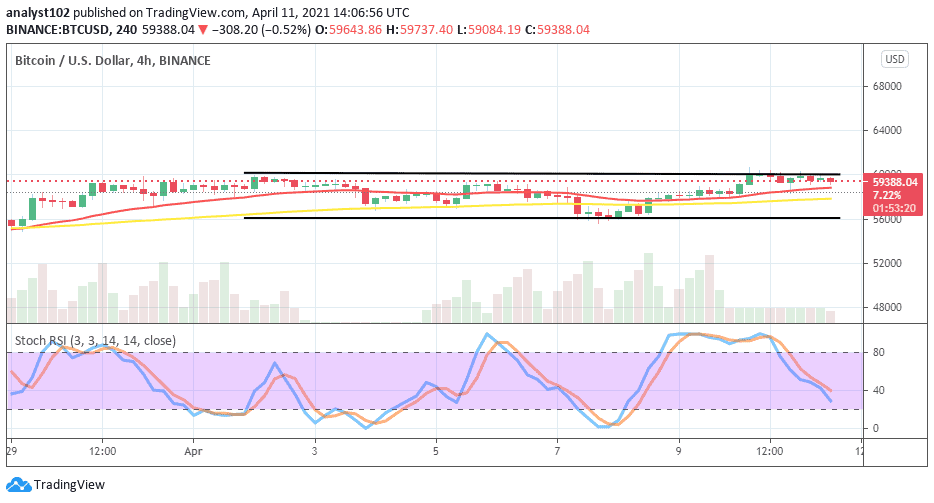
Both the BTC/USD market movers in the medium-term run have been able to change the long-featuring range-bound trend since around some last trading days in March until the present. The range-bound trading zones remain as $60,000 and $56,000; being the upper and the lower range trading levels of the crypto-market. The two SMA trend lines are located in the range trend-lines as they flatly point towards the east direction to affirm the ongoing range moves of the trade. The Stochastic Oscillators slantingly moved from the overbought region to get placed at range 40. They still weakly point to the south and, could mean that price may a bit still come down for a test of support towards the $56,000 lower range line before the return of an upswing.

Go to Source

Bitcoin Price Prediction: BTC/USD May Likely See Further Downside as Price Remains Below $57,000

Bitcoin (BTC) Price Prediction – April 7

The first digital asset has been facing some immense selling pressure as of late, with the support found within the $55,400 level.

BTC/USD Long-term Trend: Bullish (Daily Chart)

Key levels:

Resistance Levels: $62,000, $64,000, $66,000

Support Levels: $52,000, $50,000, $48,000

BTCUSD – Daily Chart

BTC/USD has been struggling to maintain its uptrend, with the selling pressure found below the 9-day and 21-day moving averages which are stopping it from seeing any major gains throughout the past few days. Meanwhile, traders are not surprised by the selling pressure as bears are trying to defend against a break above the cryptocurrency’s all-time highs.

Where is BTC Price Going Next?

At the time of writing, BTC/USD is trading down just under 2.87% at its current price of $56,355. This marks a climb from its daily low of $55,400 set at the bottom of the decline. However, the coming few days may likely place the market price within the negative side as the technical indicator RSI (14) nosedives to the downside. Therefore, any decline from this level could determine the trend of the first digital asset.

Looking at the daily chart, the Bitcoin (BTC) is currently pushing towards the lower boundary of the channel, with bulls moving to erase the losses that came about at the early hour of today’s trading. Furthermore, any bullish movement above the moving averages may push the price to the resistance level of $62,000, $64,000, and $66,000 while the supports are located at $52,000, $50,000, and $48,000.

BTC/USD Medium – Term Trend: Ranging (4H Chart)

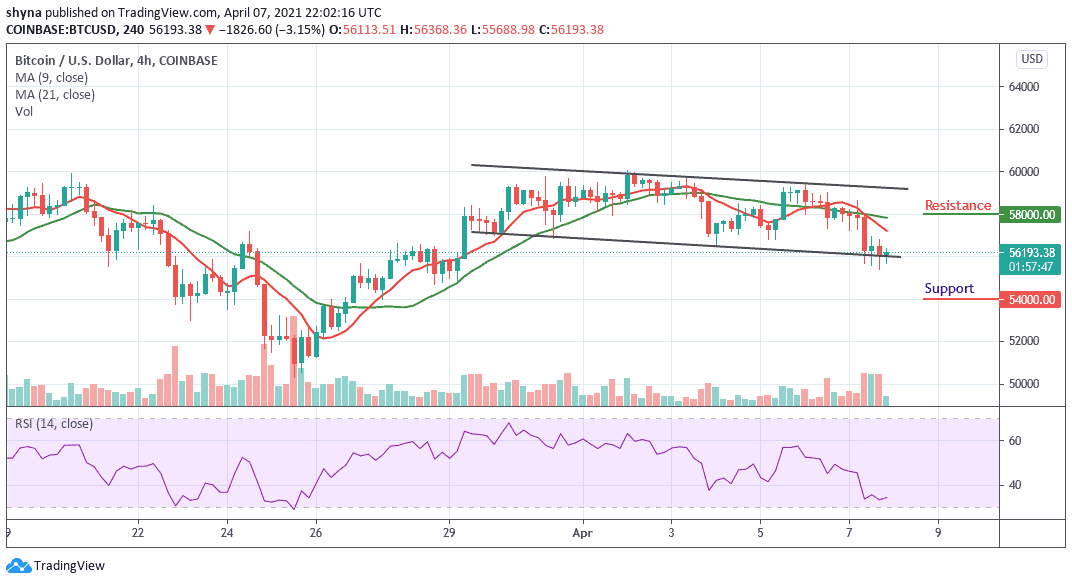
Looking at the 4-hour chart, the resistance at the $56,500 has been too heavy for the bulls to overcome as the price is now struggling in a consolidation mode. This current trading is making the cryptocurrency remain indecisive over the past few hours now while the resistance levels to watch are 58,000 and above.

BTCUSD – 4 Hour Chart

Nevertheless, the coin is still roaming around $56,193 as bears keep the price below the 9-day and 21-day moving averages. Meanwhile, the $54,000 and below may come into play if the technical indicator RSI (14) remains below 35-level.

Go to Source

Report Claims the FBI Uses Bitcoin Mixers During BTC Forfeiture Processing

Over the last eight years, U.S. law enforcement has seized a great number of bitcoins and at one time, the Federal Bureau of Investigation (FBI) held one of the largest bitcoin wallets after the Silk Road takedown. A recently published report shows the FBI has started using cryptocurrency mixing applications in recent times in order to obfuscate transactions from seized bitcoins that stem from a forfeiture.

Do as I Say, Not as I Do

The U.S. government is far from transparent and a newly published report shows just how shady the feds can be these days. The author Joshua Davis explains with great detail that the FBI has been evading “transparency and accountability” specifically when law enforcement has been handling funds from a seizure. For years now, the FBI, the United States Department of Justice (DoJ), and FinCEN have said that the use of bitcoin mixers should be criminalized.

The Feds have prosecuted operators of large centralized bitcoin mixers as well charging the operators with illegal money transmission charges and claiming that mixing facilitates crime. These days, cryptocurrency mixers are less centralized and bitcoiners can leverage bitcoin mixers that are built into a noncustodial wallet. Davis explains how “FinCEN is criminalizing Bitcoin mixers” and that anyone using them could be “accused of violating Anti-Money laundering laws.” The report also details how the FBI is “routinely” using bitcoin mixers and has been for a few years now.

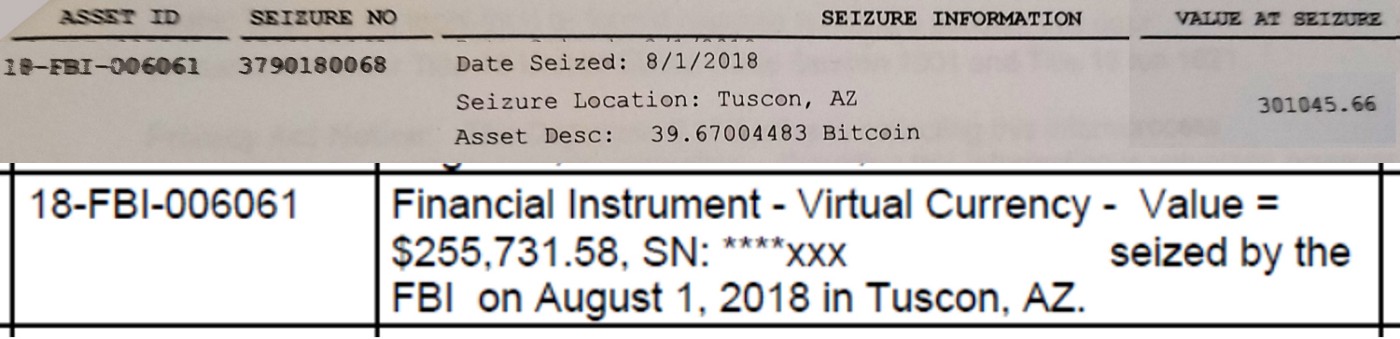
The report shows that the FBI seized 39.67 BTC from a man in Tucson, Arizona, and the case involved unauthorized SIM swaps. According to Davis’ findings, the FBI sent updates to the victims and “made it seem as if the cryptocurrency had been already sold.” However, blockchain data shows this wasn’t the case and the victims were told a “clerical error” was made.

FBI Overpaid Bitcoin Miners by a Factor of 4700%

Interestingly, Davis’ findings indicate the blockchain tells a tale of how the transactions the Feds sent were sent “to themselves,” from an address that sent “more than 800,000 transactions,” and the funds derived from an address that sent more than 43 million BTC. The tell-tale signs of a bitcoin mixer being used to obfuscate bitcoin transactions.

“To be 100% clear the FBI does not need a money transmitter license to act as a lawful Bitcoin tumbler because government agencies are exempt from needing to obtain a Money Services Business (MSB) license,” Davis’ report insists. “Instead what I’d like to humbly point out is that the law requires funds to be “safeguarded against waste, loss, unauthorized use, or misappropriation.” As far as those four things to safeguard against, Davis found that “waste” seemed to have been chosen instead of transparency.

Davis assumes that the FBI could have “overpaid bitcoin miners by a factor of 4700%” and fees would be massive when you multiply that by 2x or 5x. The report concludes that Davis doesn’t have any issues or really anything against the FBI in general, but he doesn’t appreciate the hypocrisy.

“I just hate that feeling when I’m treated like a child who needs to stop complaining and trust the authority figure,” the author wrote. “Yes, we do need to trust authority figures, but those authority figures should earn our trust. Authority figures should also try their best to be as transparent as possible.”

Former U.S. law enforcement agents Shaun Bridges and Carl Force. Findings suggest that the recently seized Silk Road stash of 69,370 bitcoins taken from “Individual X” shows the unknown person was likely Shaun Bridges.

The author also noted how the former U.S. Drug Enforcement Administration agent Carl Force and the former Secret Service agent Shaun Bridges stole money from the Silk Road case. Force was able to steal 1,200 BTC and Bridges was able to snag 3,100 bitcoin. “They would have gotten away with it if they had taken one extra precaution,” Davis said. “Their downfall was failing to use a tool called a bitcoin mixer.”

Moreover, a representative from the FBI emailed the author of the report and he further explained: “The FBI has stated unequivocally in an email that the funds are still held as Bitcoin. They are required by law to hold these funds as bitcoin and not convert these funds to cash.”

What do you think about the FBI using bitcoin mixers to obfuscate transactions? Let us know what you think about this subject in the comments below.

Go to Source

YFX.Com – Defi Trading Platform Support 100X Leverage. No KYC. No Gas Fee

PRESS RELEASE. YFX.COM is the world’s first decentralized cross-chain perpetual contract exchange. While other trading platforms that provide leverage alternatives exist, YFX.COM is trailblazing a decentralized alternative to centralized exchanges and perpetual futures trading without a central intermediary. YFX.COM does this by taking advantage of different protocols across the cryptocurrency landscape.

Through a culmination of blockchain protocols YFX.COM is allowing traders to participate in trading BTC, ETH and other cryptocurrencies with up to 100x leverage. These cryptos are available to be traded across these blockchains currently, Ethereum, Tron, Binance Smart Chain, Heco, OKEx Chain and Polkadot.

Through the advent of QIC-AMM, a state of the art protocol, YFX.COM provides high liquidity with low slippage for users of our ecosystem. QIC is an acronym for Quoted Index Price. QIC pulls quoted prices from centralized exchanges and traders can open and close positions with our first of a kind automatic market maker for derivatives. QIC is calculated through dynamic depth of indices, price quotation and constant integral. The depth of a transaction is correlated to the amount of liquidity of the market maker’s capital pool. This combination of protocols allows for YFX.COM to be the efficient leverage trading platform on the market.

Additionally, YFX.COM is able to achieve all of this without KYC and no gas fees. As many traders know, gas fees have been a major issue lately. Eliminating gas fees gives YFX.COM another major advantage against all competition. It also allows for traders to trade efficiently and secure their profits without major loss from expensive network fees. YFX.COM has achieved nearly zero network fees through use of layer-2 [L2] scaling solution, xDai Chain. xDai Stable Chain is a side chain to Ethereum and is far more efficient than the ETH mainnet currently. The transactions are more convenient and the fees are a fraction of fees on ETH mainnet.

YFX.COM Won First Prize at Tron 2021 Global DeFi Hackathon

Last week YFX.COM also won First Prize in the Tron 2021 Global DeFi Hackathon Developer Contest. This was a great achievement and YFX.COM is thankful for this opportunity put on by the Tron Foundation and Justin Sun. YFX.COM is committed to the blockchain space and looks forward to participating in more events to help advance this industry.

Genesis Mining II

April 6, the YFX.COM Genesis Mining II event began at 20:00 (UTC+8). The event will run through April 16 and is a competition for traders and miners to compete against others and earn YFX.COM tokens in the process [which are not available anywhere on the market]. Through just 12 hours of trading, volume has reached over $1 billion and our liquidity pool is over $10 million U.S. dollars which exceeds Uniswap’s activity.

CertiK Audit Completed

Additionally, CertiK has recently completed their security audit of YFX.COM. Traders and users of our platform can rest assured that the protocols are up to standard as YFX.COM is committed to providing the best product for the userbase.

Website: https://www.yfx.com/

Trading: https://trx.yfx.com/

Twitter: https://twitter.com/YFX_Defi

Telegram: https://t.me/YFX_EN

Discord: https://discord.gg/xwAtjpabC5

Media Contact: Kivi@yfx.com


This is a press release. Readers should do their own due diligence before taking any actions related to the promoted company or any of its affiliates or services. Bitcoin.com is not responsible, directly or indirectly, for any damage or loss caused or alleged to be caused by or in connection with the use of or reliance on any content, goods or services mentioned in the press release.

Go to Source

P2P Bitcoin Trade Volumes Surge in Kenya and Ghana but Nigeria Still Dominates

According to new data, peer-to-peer (P2P) bitcoin trade volumes in Kenya and Ghana surged in Q1 of 2021, with the two countries now ranked second and third respectively. On the other hand, volumes in South Africa, which occupied second place in 2020, dropped marginally. Consequently, South Africa has now been relegated to the fourth position the data shows.

Contrasting Regulatory Regimes

Meanwhile, one report has attributed the surge in Kenya and Ghana’s P2P volumes to the two countries’ tacit endorsement of cryptocurrencies. For instance, the report points to the Central Bank of Ghana’s launch of “a regulatory sandbox that prioritized blockchain-based companies including cryptocurrency startups” as one factor that may have boosted the country’s volumes.

This is in contrast to the situation in South Africa where regulator warnings about cryptocurrency use and investment increased following the collapse of Mirror Trading International, the biggest scam bitcoin in 2020, according to Chainalysis. As explained in the report, crypto dealings in South Africa “have come under increased scrutiny, with tougher regulations including mandatory licenses and taxes triggering investor exits. The report also adds that “bitcoin trading in South Africa has effectively lost its autonomy and this has reduced its market appeal to investors.”

Nigeria P2P Volumes Surge After Central Bank Directive

In the meantime, the data shows that P2P volumes in Nigeria seem to have been boosted by the Central Bank of Nigeria (CBN)’s directive against crypto entities that was issued on February 6. As the Tulip data shows, Nigeria’s P2P bitcoin traded volumes in the past 90 days surged to nearly $100 million. The figure, which is nearly two and half times more than that of second-placed Kenya, suggests more bitcoin users are now using P2P platforms.

Meanwhile, the data appears shows that P2P traded volumes in many other African countries surged after March 2020, when lockdown measures took hold. Since then, many countries on the continent have seen their P2P bitcoin traded volumes grow steadily.

What are your thoughts on the rising P2P BTC traded volumes in Kenya and Ghana? Tell us what you think in the comments section below.

Go to Source

HSBC Changes Crypto Policy, Now Bars Clients From Buying Stock of Companies That Hold Bitcoin

HSBC has reportedly changed its policy regarding cryptocurrency. The bank now prohibits customers from buying the stock of public companies that hold bitcoin, like Microstrategy. All of the companies with bitcoin treasuries could be on the chopping block at HSBC.

HSBC Now Bars Clients From Buying Crypto and Crypto-Related Stocks Like Microstrategy

British bank HSBC has reportedly become more strict with its crypto policy. The bank now prohibits its customers from buying the stock of public companies that are holding bitcoin in its treasury.

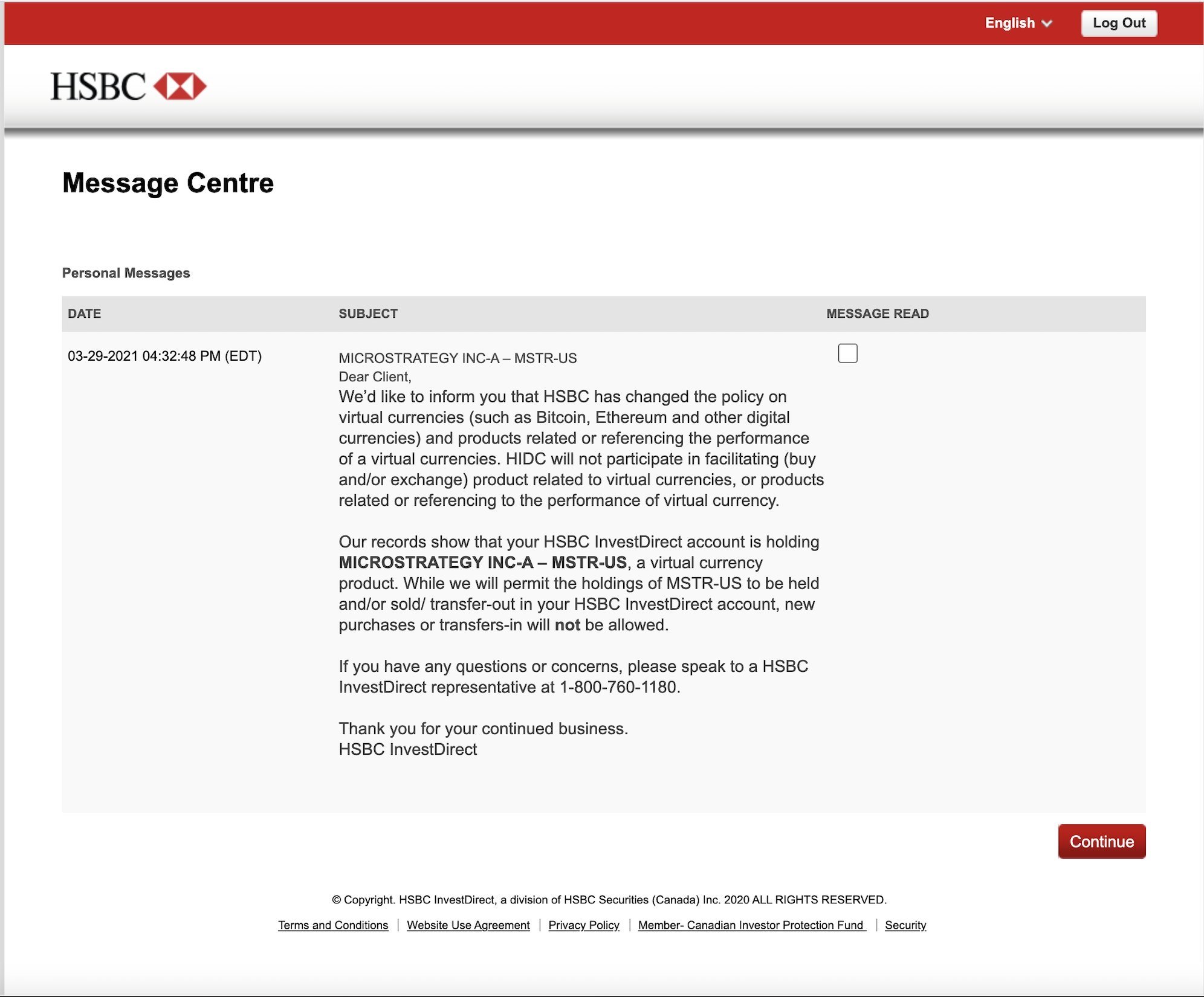
An HSBC customer has shared a message he said he received from the bank, informing him of a policy change regarding cryptocurrencies, naming bitcoin and ethereum as examples. The bank’s new policy applies to “products related or referencing the performance of virtual currencies.” The notice reads:

HIDC [HSBC Invest Direct] will not participate in facilitating (buy and/or exchange) product related to virtual currencies, or products related or referencing to the performance of virtual currency.

The notice singles out one stock in particular. “Our records show that your HSBC Invest Direct account is holding Microstrategy Inc-A — MSTR-US, a virtual currency product.”

While Microstrategy does not offer any crypto services, it has been heavily buying BTC since October last year. The company has amassed almost 100K BTC and has made acquiring the cryptocurrency one of its primary goals.

HSBC’s notice continues:

While we will permit the holdings of MSTR-US to be held and/or sold/ transfer-out in your HSBC Invest Direct account, new purchases or transfers-in will not be allowed.

A notice from HSBC posted on Twitter by @camadamus. Source: @camadamus

The British bank did not specify how much bitcoin a company has to hold in order for its stock to be banned from the bank. Microstrategy has made it a policy to hold 100% of its treasury reserves in BTC.

A rapidly expanding list of companies have said that they are investing in bitcoin but usually in smaller percentages than Microstrategy. This includes Elon Musk’s Tesla which invested $1.5 billion in January. Jack Dorsey’s Square Inc. also put 5% of its total cash reserves in bitcoin. The website bitcointreasuries.org has curated a growing list of companies with bitcoin in their treasuries.

One Twitter user commented on the situation, speculating that HSBC Canada “is probably arbitrarily deciding what % bitcoin reserves is ok for clients to invest in.”

The HSBC customer who received the notice tweeted to Microstrategy CEO Michael Saylor: “You may want to ask your legal team if what HSBC Canada is doing here is legal. It sure does not sound like it is. They won’t allow us to buy Microstrategy.” Referring to all companies with bitcoin investments, he further opined: “All of these companies may be on the chopping block because they hold BTC. This is the opposite of ‘free market.’”

What do you think about HSBC’s new crypto policy? Let us know in the comments section below.

Go to Source

Litecoin Price Prediction: LTC/USD Spikes past the Resistance Level of $240

LTC Price Prediction – April 11
The market worth of LTC/USD has successfully breached to the north above the critical resistance of $240 during yesterday’s trading session. The last time that the crypto attempted was on March 13 when the resistance line was only tested.

LTC/USD Market
Key Levels:
Resistance levels: $280, $300, $320
Support levels: $200, $1800, $160

LTCUSD – Daily Chart
A big bullish candlestick has emerged on the LTC/USD daily trading chart to possibly signal the long-awaited northward-moving continuation. The 14-day SMA trend-line is a bit curved to the north to signify an upward move in motion under the bullish trend-line. The Stochastic Oscillators are moving in a consolidation around range 80. But, now, they are of more crossing the hairs to point to the north. It indicates that more buying pressures will continually be experienced in this crypto-trading activity.

Will there continue to be more ups in the LTC/USD trading operations?
With the emergence of a strong push above the key resistance trading line of $240, the LTC/USD bulls are most likely to get easy pushes further to the north. The big spike bottomed on the support line of $220 to set a buying wall up to a high point of $260. Price is currently trading around the level. More potential featuring ups are expected to build around the long spike in near sessions..

As regards the downward trading move of this crypto-economy, bears will have to wait for a formation of price convergences at a later higher trading zone. The sell-placing order must be exercised while there is a strong bullish reversal candlestick in the forming. It has to be noted that a bearish trading outlook as regards the present northward trend must be treated with utmost carefulness.

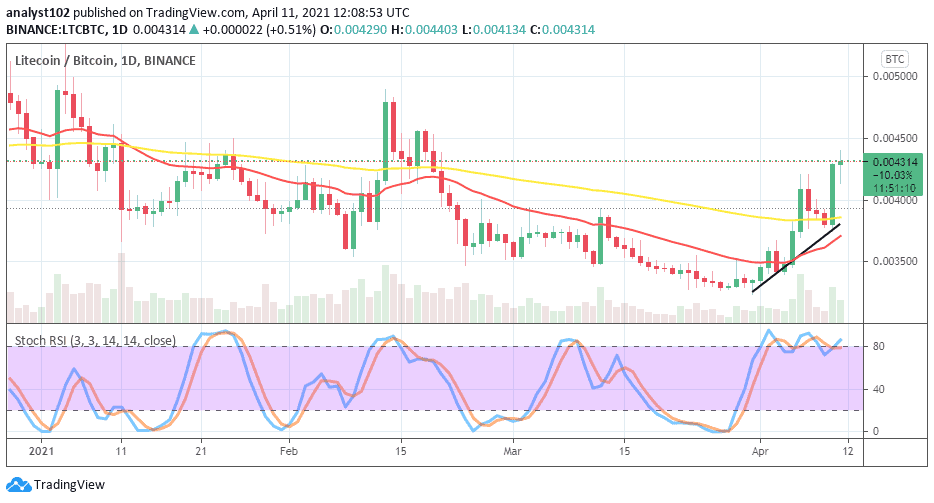
LTC/BTC Price Analysis
Even though some cryptos are pushing against the most valued crypto’s price in comparison, the overall market-trend outlook between LTC and BTC is still relatively bearish. The daily trading chart shows that the base crypto has a very long way to go as regards the purchasing power with the counter crypto. However, Litecoin seems to have begun the journey as it has traded past all the indicators to the north. The 14-day SMA trend-line now points towards the north below the 50-day SMA trend-line. The Stochastic Oscillators are moving in a consolidation manner around range 80 nearing into the overbought region. It has been indicated that the base trading instrument will have a kind of smother run in a near session.

Go to Source

Anchoring the worlds with flexible and high-performance on-chain governance

To fully merge the real and digital worlds, designing governance systems with flexibility at their core is key.

With adoption accelerating, blockchain’s potential to transform life in every way — from how business is conducted to labor division, operating systems and methods of collaboration — comes closer to fruition every day. If blockchain is the foundation to a truly digital model, then governance is the key to linking together the on and off-chain worlds. Governance itself encompasses and dictates the functionality of blockchain, from its organization structure to workflow execution, voting and incentives. 

Conceptually, governance can be understood as on and off-chain; the former being divided into protocol and contract levels. With the blockchain space rapidly diversifying, governance is also rapidly evolving to drive new and novel forms of collaboration, interaction, profit distribution and risk structure, based on each chain’s unique profit value.

Today’s on- and off-chain governance paradigms

Moving forward, I believe there are several premises that must be accounted for when building governance frameworks.

First, the digital world cannot be separated from reality. Like the off-chain world, on-chain governance also includes a two-tier structure, under which governing units serve as capital for users to engage in various democratic processes. Moreover, external on-chain governance components such as, server clusters, nodes and other infrastructures, dictate how capital rights and interests are addressed. On-chain governance dictates the usage of external funds, energy and human resources. It is also constructing new identities, ways of participating and power relations. In short, on-chain governance is both a reflection of today’s paradigm and a looking glass into the future.

Secondly, the on and off-chain worlds are merging as the boundaries between social and corporate governance become increasingly blurred. While blockchain started off as more focused on economic governance, this focus has shifted in recent years with institutions and enterprises experimenting with blockchain to achieve more efficient social governance. As the line between corporate and economic governance thins out, each chain’s future will slowly but surely hinge on the interests and will of their user base, thus significantly bolstering the pressing need for next generation governance at the protocol level.

Thirdly, the market is currently dominated by stake-weighted voting, which gravitates towards greater centralization, dynamic adjustments and third-party proxy agents. Given blockchain’s fundamentally decentralized nature, on-chain governance depends heavily upon a network’s consensus mechanism of choice — which can be understood as the negotiation method by which the interests and rights of community developers, miners and token holders. Within the context of proof-of-work, or PoW, consensus, the emphasis is on workload. It would require a high level of centralized authority and responsibility to validate parties’ work, rather than relying on the code to autonomously validate miners’ work. In that way, PoW is essentially the same as traditional decision-making.

However, under proof-of-stake voting, the following scenarios will enable greater democracy and decentralization:

  • One person, one vote based on identity.
  • Secondary voting based on identity.
  • Hashing power voting.
  • Voting for transaction fees at the account level.
  • Voting of transaction fees at the contract layer.
  • Election Committee.
  • Relative majority voting method.
  • Other pledge-related indicators, including long-term node maintenance, long-term binding validators, long-term coin holders, oracles and clients.
  • Any combination of the above modes.

Fourth, there are still various design issues related to on-chain governance. Under today’s governance systems, power tends to be concentrated in the hands of a few. Moreover, low-voting rates also negatively impact the effectiveness of governance and network security. Thus, future innovations in governance must also address the aforementioned concerns from a design level by offering voting stronger incentives for stakeholders, while also introducing loosely coupled voting to ensure more representative governance.

Overall, the current paradigm illustrates that on-chain governance represents the transformation of the digital world’s economic and social organization. With the advent of the digital age, people’s identities have been increasingly split between various governance entities, rather than resting in the hands of a single one. By introducing new organizational structures and concepts, we can pioneer a completely new incentive mechanism to optimize on- and off-chain governance, beyond what simple corporate structuring can achieve.

Based on these premises, sustainable and effective governance must satisfy the following requirements:

  • A two-way mechanism to interact with the real world.
  • Comprehensive social governance.
  • Movement towards achieving the community’s vision.
  • Effective incentives and punishments through comprehensive mechanisms.
  • Clearly delineated responsibilities and powers for on-chain governance.

Structuring on-chain governance to drive sustainability and adoption

If we understand governance as a key driver for blockchain adoption, networks must approach decisions, such as consensus mechanisms, various participants’ roles — and more — with great care and deliberation. Moreover, to bring together the on and off-chain worlds, on-chain governance must evolve to enable the following:

  • The mapping of real-world legal units or jurisdictions to the chain.
  • A comprehensive identity system which ties network participants’ identity to their social identity.
  • Participation in governance via greater rights with the caveat that such rights can be revoked in.

By leveraging code, on-chain governance enables the elimination of uncertainties to create binding agreements, ensuring that any approved network changes will be implemented. Moreover, on-chain governance also incentivizes greater responsibility, due to blockchain’s inherently transparent nature, thus ensuring a decision-making trail. On top of bolstering community trust and fairness, this transparency also empowers users to make informed choices regarding which platforms they join.

However, as previously mentioned, today’s governance systems still face design issues — namely low turnout rates and the manipulation of voters by powerful token holders. Regarding the latter, there is still the concern that governance systems favor powerful token holders. This results in greater emphasis on profit generation, rather than achieving a public blockchain’s vision.

Thus, I propose the key components for effective governance, namely:

Coordination mechanisms: To ensure sustainability, transaction costs and user usage must be coordinated to minimize conflicts between users and stakeholders. As transaction fees heavily influence a user’s ability to participate in a network, maintaining low and stable costs incentivize their participation, which is key for representative governance and network security. In short, the aforementioned mechanism would allow users — the true holders of the network — to be able to participate.

Coordination between currency holders and governance participants: To realize effective governance and ensure that the chain’s interests are represented, there must be significant overlap. Such measures like economic incentives and elections, or the decoupling of governance rights from tokens, are necessary to create more overlap between these groups.

Coordination of candidates and selected candidates: To ensure network efficiency, elections must also implement screening mechanisms to secure the right number of candidates to meet platform needs. Moreover, platforms must provide a proper balance of economic incentives, powers and responsibilities for long-term and stable governance.

Incentive measures: To reward participation, the following incentives should be provided:

  • User: Ability to use DApp; low-cost network service.
  • Token Holders: GAS or token issuance via voting.
  • Nodes: Receive transaction fees for packaged transactions or network fees for winning elections.

Consequences:

  • Token Holders: Opportunity costs.
  • Nodes: Fines for misbehavior.

Overall, effective governance must fulfill the following conditions — first, decision-making that is based on complete and symmetrical information. Second, there is a cost associated with making and changing choices. Finally, governance must be flexible enough to drive forward organization interest while accounting for individual choice.

Driving flexible, dynamic and sustainable governance to win the future

Based on the aforementioned points, I believe that “elastic manageability”, defined as “an ability to adapt to various social jurisdictions,” is the governance solution for both now and the future. Through elastic manageability, we can coordinate the interests of various parties, balance decentralization and centralization, and establish an effective incentives and consequences system. Through an on-chain identity system and node verification, we can connect the on-chain and off-chain world for true integration.

Under this system, I believe the two key mechanisms are as follows:

  • Coordination mechanisms.
  • Dual-track election mechanisms.

Token holders can vote on the direction for a community-based organization, which is entrusted to act in the platform’s best interests. To incentivize participation and ensure representational change, direct incentives, such as tokens, should be issued based on the token holders’ degree of participation. From my perspective, enabling users to vote for representational institutions and consensus nodes enables a platform to dynamically adjust based on changing community and industry needs.

Moreover, an on-chain identity system is also crucial. As previously noted, the on-chain world cannot be disconnected from the off-chain world. Rather, the sovereign states and legal jurisdictions of the real world must be mapped onto the chain. Governance mechanisms should reflect this through an on-chain social identity system, which reflects users’ on-chain address and transaction records, decentralized identifier documents, and registration jurisdiction. Based on these aspects, users’ off-chain regulations will provide soft guidance for on-chain activity by jurisdiction.

The types of services provided on the public chain could be affected by local regulations. This real world identity mapping, along with dynamic elections, means that token holders are empowered to make decisions and adjust accordingly for future transactions. When processing transactions, different nodes will react differently to different types of transactions, which will affect the types of services processed on the public blockchain to varying degrees.

For example, for a certain type of specific transaction, consensus nodes that exceed the fault tolerance rate cannot pass this type of transaction, due to the influence of the local judicial system. At this time, the judicial influence on this type of specific transaction is reflected in the public chain. Under the framework of dynamic elections, token holders will then make a decision whether to continue to vote for the affected nodes in the next term. Node candidates can also make adjustments according to the voter’s strategy.

Added value through dynamic elections

Through this flexible and dynamic management system, I believe we can fully understand decentralized on-chain business management, node operation management and on-chain voting governance. Local regulations affect the voters’ strategic choices and indirectly affect the behavior of network participants.

Through repeated governance cycles, blockchains eventually move towards developing a balance, which incorporates the interest of all — including real world concerns. This opens up the path for sustainable and responsible growth both in the on- and off-chain world.

The views, thoughts and opinions expressed here are the author’s alone and do not necessarily reflect or represent the views and opinions of Cointelegraph.

Da Hongfei is best known for co-founding the blockchain-based “Smart Economy” network Neo with Erick Zhang in 2014. Da received his education at the South China University of Technology, receiving degrees in technology and English. He worked at a consulting firm until 2013, after which he learned how to code before founding Neo. Along with Zhang, Da also founded OnChain — a commercial blockchain firm that provides services to private companies.

Go to Source

Bitcoin on-chain data suggests no bull market top at $60K, selling activity declining

Bitcoin on-chain data reveals that speculators and long-term holders have become increasingly confident of higher prices as their selling activity has slowed down significantly.

For the very first time in a Bitcoin (BTC) bull market, not only long-term investors but also short-term speculators who usually add to the daily sell pressure toward the end of a market cycle have become increasingly confident of higher prices as they hold on to their Bitcoin.

This only adds to the already existing supply shock. If demand remains strong, this is a recipe for another leg up for the BTC price.

Bitcoin selling activity is declining again

Every Bitcoin bull market usually coincided with an increasing number of short-term speculators coming into the market hoping to turn a quick profit, while long-term speculators start to add sell pressure toward the second half of the market cycle to realize their profits.

One of the best on-chain indicators to see this trend unfold in each cycle is called HODL waves. Hereby, the length at which each BTC address holds Bitcoin before they are sold into the market is clustered into term buckets that are then visualized in different color bands.

Bitcoin: HODL Waves. Source: Glassnode

For example, someone who held on to their Bitcoin for five months would fall into the 3m-6m bucket, the light orange color band. If that person decides to sell, it falls out of that bucket and would show up in the 24h-term bucket, the dark red color band.

This means, the redder the colors are in the HODL waves chart on a respective date, the more short-term turnover of Bitcoins happens. This activity is almost at its lowest during a bear market, and at its highest during a bull market, while the short-term activity tends to peak around a bull market top.

Reflecting realized value in HODL waves is critical

Since the Bitcoin price fluctuates significantly during the market cycles, and HODL waves only account for the absolute number of Bitcoins moved, this chart does not account for the total value realized on a respective day by a Bitcoin seller.

As it becomes increasingly lucrative for hodlers to take profit the higher the price rises, the HODL waves can be weighted by the realized price, which is the price at which each Bitcoin on average was last bought /sold.

This adjustment allows for visualizing the value-driven profit-taking on a daily basis through the value-adjusted colored, term buckets.

Bitcoin cycle tops tend to form around the short-term activity peak

Once HODL waves are weighted by the realized price, the Realized Cap HODL Waves are derived, a concept that was first introduced by on-chain analyst Typerbole. This adjustment reveals that the 1w-1m bucket tops coincide with every single bull market top so far.

Bitcoin: Realized Cap HODL Waves. Source: Glassnode

This indicator does not only suggest that the current selling activity is not at a typical bull market peak yet, it even reveals that for the first time in Bitcoin’s bull market history this trend is declining while the price continues to rise.

Bitcoin: Realized Cap HODL Waves 1d-1m. Source: Glassnode

This is a very unusual trend in a bull market. Assuming that the price peak has not been reached yet, this suggests that profit-seekers, whether they are short- or long-term focused, are starting to hold on to their Bitcoin again, expecting higher prices to come and by that adding to the Bitcoin supply squeeze on exchanges.

Bitcoin selling activity relative to the holding period is quite low

Rafael Schultze-Kraft, Glassnode CTO, takes a similar view by looking at long-term hodlers through Coin Days Destroyed, an indicator that shows the total holding days “destroyed” by holders selling their Bitcoin.

Based on a 3-months moving average of this indicator, the destruction has retraced to a level last seen in the summer of 2019 at times where the price peak was already reached.

If the price was close to a bull market peak, a much higher indicator value would be expected as long-term holders would be taking profit in material size, which is currently not the case.

Bitcoin spending behavior relative to the market cap is low

When taking this concept of Coin Days Destroyed further and looking at it with respect to average value destroyed in perspective to the market capitalization, one arrives at the so-called dormancy flow. This is a concept invented by analyst and trader David Puell.

Bitcoin: Entity-Adjusted Dormancy Flow. Source: Glassnode

The dormancy flow describes the yearly moving average of Bitcoin holders’ spending behavior. It is based on the held value that gets destroyed in perspective to the overall accrued value in the market.

This indicator suggests, the 365-day average spending behavior of Bitcoin measured in USD is very healthy and far below prior bull market spending.

This is Bitcoin rocket fuel

Bitcoin selling activity whether it is from speculators or long-term holders is declining while also the annual spending behavior relative to the market capitalization is surprisingly low. All these on-chain data points suggest that the market is inching to an even deeper supply squeeze. This is one of the best rocket fuels to send the Bitcoin price higher.

However, this is not a guarantee as it requires continuous demand for the price to appreciate in this environment. Therefore, a close eye on high-net-worth individuals and institutions’ demand should be kept, as they have recently been the main driver on the buyer side.

The views and opinions expressed here are solely those of the author and do not necessarily reflect the views of Cointelegraph. Nothing here should be considered investment or trading advice. Every investment and trading move involves risk. The author owns Bitcoin. You should conduct your own research when making a decision and/or consult with a financial advisor.

Go to Source

VC funds bullish on crypto, increase investment in blockchain startups

Funding for crypto and blockchain startups is not slowing in 2021 as VC funds appear keen to enjoy the exponential growth potential.

Venture capital funding for crypto and blockchain startups looks set to break records in 2021. As previously reported by Cointelegraph, crypto firms received more funding in the first quarter of 2021 than the whole of 2020.

Indeed, three companies in the market attracted $1.1 billion from backers in Q1 202 — a third of the total funding for crypto and blockchain firms reported in 2018. With the current bullish enthusiasm in the crypto space, VC funding appetite for blockchain startups might continue throughout the year.

This early-stage funding frenzy also appears to be spreading to the retail side with initial decentralized exchange offerings regularly becoming oversubscribed. As such, the native tokens of IDO launchpads are now some of the best-performing in the cryptocurrency space.

Blockchain private equity funding by the numbers

In Q1 2021, 129 crypto and blockchain startups received about $2.6 billion in funding, according to a Bloomberg report culled from data by business analytics firm CB Insights. This figure is already $300 million more than the total funding for such companies in the whole of 2020.

Crypto wallet provider Blockchain.com, lending outfit BlockFi and blockchain game studio Dapper Labs accounted for almost half of the $2.6 billion funding received by startups in the industry in Q1 2021. At the end of March, Dapper Labs announced a $305-million investment from sports stars and other celebrities amid growth in the sale of NBA Top Shot nonfungible tokens.

VC funding for crypto and blockchain startups in the United States has eclipsed the numbers recorded in other regions since the emergence of the crypto space, according to the recently published “Blockchain Venture Capital Report” by Cointelegraph Research. This trend is despite the lack of regularity clarity for the market in the country.

According to Jehan Chu, founder of Hong Kong-based VC investment firm Kenetic, the regulatory climate in the U.S. has done little to dissuade private equity funding for blockchain startups, telling Cointelegraph:

“Nothing is more compelling than peer pressure from the likes of Michael Saylor, Elon Musk and the stampede of institutional money charging into the market. VCs must have a position or a view on crypto, or risk missing the biggest market opportunity in a generation.”

The potential for outsized returns continues to be a driving force behind increased equity investments in crypto startups both for blockchain and mainstream VC funds. In its recently published “Blockchain Venture Capital Report,” Cointelegraph Research revealed that blockchain private equity has outperformed traditional private equity across one-, three- and five-year horizons.

Indeed, blockchain private equity performance has proven itself to be largely uncorrelated with the mainstream asset class. This trend offers some form of assurance for VC funds looking to diversify their early-stage investment portfolios.

Commenting on the basic investment thesis for VC funds in the blockchain space, Xinshu Dong, a partner at VC firm IOSG Ventures, told Cointelegraph: “Crypto is a very attractive direction with not just unparalleled growth potential but also quite promising validation, especially in the past few months from the buy-in from U.S. institutions.”

Given the marked increase in funding for crypto startups in Q1 2021, the proportion of blockchain-focused VC funding to the overall market might be set for a trend reversal. After almost peaking at 2% during the 2017 bull run, blockchain private equity fell to less than 1% of the global VC market as of the end of 2020.

This decrease can be attributed in part to the trends that emerged post-2018 bear market and the ongoing coronavirus pandemic. According to data from Cointelegraph Research, blockchain-focused VC funding dropped by 13% between 2019 and 2020, while traditional equity funding increased by 18% during the same period.

Driving force behind increased crypto funding in 2021

Since its emergence, the crypto landscape has been likened to the early days of the internet market in the 1990s and early 2000s. Where the internet boom led to the initiation and subsequent rise of sectors like e-commerce and social media, the blockchain space has been touted to drive innovations such as decentralized finance and the decentralized web.

Legacy brands that were dismissive of the promise of the then young internet space saw the rise of e-commerce and online merchants challenge the primacy of these brick-and-mortar firms in the retail arena. Social media also grew to arguably eclipse the reach of print and broadcast media as web-based services disrupted several industries.

With blockchain touted as having similar global business process disruption capabilities, several notable participants in the mainstream arena appear keen to interact with the emerging technology. This appetite for backing players in the novel arena appears even more apparent among VC firms with Dong telling Cointelegraph: “It’s an opportunity of a generation that VCs can hardly miss.”

The token economy associated with blockchain startups also offers early backers the opportunity to acquire cryptocurrencies that could appreciate in value within a short period. Even with vesting schedules that mandate a significant lock-up of these tokens for VC funds, the gains often outsize their initial equity investment.

DeFi interest and early-stage investments

Decentralized finance’s rise to prominence has offered significant expansions to the crypto market through activities like staking and protocol governance. According to Baek Kim, director of investments at VC fund Hashed: “The most important part of the crypto VC investments is that this is also an entry ticket to participate in crypto networks as a shareholder.” He added further:

“Crypto portfolios allow for investors to participate and contribute to the ecosystem in a much more engaging way than the traditional equity investments — through staking, node operations, governance proposals, liquidity bootstrapping and many more. VC participation in crypto and blockchain projects means you can be part of this paradigm shift not just as an investor but as a participant.”

This growing appetite for blockchain startups is not restricted to established players in the still-nascent crypto space. New projects, especially those in the DeFi space, are also enjoying significant interest from private equity firms looking to be early backers of the next DeFi bluechip.

In a conversation with Cointelegraph, Rob Weir, chief operating officer of upcoming DeFi platform Jigstack, attracting investments from VC funds was the easiest part of the private equity funding process. According to Weir, new blockchain projects need to consider issues such as vesting schedules and implications of token-represented equity on future price action for their native “coins.”

Weir said that balancing these key issues is essential for new projects in determining how to allocate tokens to private and public funding, adding: “VCs require a significant amount of token represented equity and consolidate a large portion of what would become selling pressure. If they deliver on their promises then they are well worth the upfront sacrifice.” He further added that “community-oriented raises leave you resource shy and carry other inherent risks.”

Early-stage backing by retail investors is also another growing trend in 2021, especially amid the gains enjoyed by projects bootstrapped on IDO launchpads. Launchpad platforms often utilize a tiered subscription package that allows holders of their native coins to gain access to project token allocations before the public listing.

According to data from cryptocurrency aggregator CryptoDiffer, the top 10 launchpad platforms in the market have recorded average returns on investment ranging between 11.3% and 68.2% thus far in 2021.

Go to Source

How NFTs, DeFi and Web 3.0 are intertwined

Explosive growth in asset tokenization and NFTs is fueling Web 3.0 growth, and testing DeFi resolve.

While blockchain itself provides the technology constructs to facilitate exchange, ownership and trust in the network, it is in the digitization of value elements where asset tokenization is essential. Tokenization is the process of converting the assets and rights to a property into a digital representation, or token, on a blockchain network. 

Distinguishing between cryptocurrency and tokenized assets is important in understanding exchange vehicles, valuation models and fungibility across the various value networks that are emerging and posing interoperability challenges. These are not just technical challenges, but also business challenges around equitable swaps.
Asset tokenization can lead to the creation of a business model that fuels fractional ownership, the ability to own an instance of a large asset. While discussing asset tokenization in a previous article, I also mentioned the value of an instance economy in democratizing finance, commerce and global access, as well as in creating a broader global marketplace at a scale never before seen.

With digital assets and their fungibility in a blockchain ecosystem, there are various drivers of valuation. These include: 1) tokens based on crypto economic models that are driven by supply and demand, and the utility of the network; 2) nonfungible tokens, or NFTs, which have an intrinsic value such as identification, diplomas and healthcare records — essentially, tokens that are simple proof validations of the existence, authenticity and ownership of digital assets; and 3) fungible tokens that are valued on various bases, such as the sum total of economic activity in the network (cryptocurrency), its utility (smart contracts and transaction network processing), assigned values (stable coins and security tokens), and so on.

In this article, I address the complex issue of the hyperbolic and rapid rise of NFTs, after a similarly meteoric rise of decentralized finance, or DeFi, creating amazing innovations — with immense promise of democratization, new business models and global marketplaces with global access — all fueled by the basic premise of decentralization and fundamental constructs of tokenization and wallets. While NFTs may be characterized as one-of-a-kind cryptographic tokens with some intrinsic value to a holder or to a market (art, collectibles), the NFT movement is indicative of a larger token revolution that will not only fuel massive innovation and growth in Web 3.0 protocols but also test the resolve of the DeFi movement, along with its ability to intersect and provide platforms and an exchange vehicle for all token types.

Growth in Web 3.0 protocols

The first two generations of web protocols were largely about disseminating information and connecting people. They fueled a massive growth in information and collaboration, and did wonders for connecting the world. However, those web protocols were never designed to move things of value. Also, as the Web 2.0 era reached its fullest potential, vulnerabilities such as “fake news” and the “batched relay” of the movement of assets via a series of intermediaries emerged. Threats to the commerce and financial infrastructure of the system risk destabilizing it.

Web 3.0 promises to safeguard all things we value: information, truth and digital assets — both fungible and nonfungible. Whereas Web 2.0 was driven by the advent of social, mobile and the cloud, Web 3.0 is largely built on three new layers of technological innovation: edge computing, decentralized data networks and artificial intelligence.

The growth of NFTs has not only empowered the ability for artists, skilled professionals and entrepreneurs to encapsulate innovation in a tokenized form but has also fueled the democratization of the platform as one of the promises of blockchain technology. The underlying infrastructure includes decentralized storage technologies, efficient consensus protocols, off-chain computing, and oracle networks to provide connectivity and validation to existing systems.

Collectively, the Web 3.0 set of technologies envisions a connected, trustless, accountable network for efficiently delivering value, thus crafting an infrastructure for things of worth. NFTs represent both transferable entities and nontransferable tokens that we value. The latter include things such as our identification, healthcare records and passports, things that represent us and allow us to participate in the digital economy with our own unique, digital identities.

As we dare to envision a shift toward a world with decentralized control, governance based on distributed technology that challenges every business model, and governance structure built upon centralized business frameworks, we do have to ponder some things. Not only the shift itself, but the motivation, incentive and monetization elements that fuel and power the economic infrastructure to move things that have value — thereby keeping up with our changing perception and subsequent realization of that value.

Intersecting with finance — DeFi

DeFi is the movement in the blockchain applications space that leverages decentralized network technology to disrupt and force a transformation of old financial products into trustless, transparent protocols, facilitating digital value creation and dissemination with few to no intermediaries. It is widely understood and accepted that — due to new synergies and co-creation via new digital interactions and value-exchange mechanisms — blockchain technology lays the foundation for a trusted digital transactional network that, as a disintermediated platform, fuels the growth of marketplaces and secondary markets.

While DeFi aims to deliver the promise of finance democratization, NFTs test the resolve of DeFi by delivering a competitive yet inclusive asset class, plus avenues to provide a medium of exchange, fungibility by other fungible asset classes, and liquidity to a traditionally illiquid market.

Asset classes resulting from DeFi protocols and NFTs avail themselves of the advantages of fractional ownership of the assets, blurring the lines between asset classes and using constructs like digital wallets as a receptacle for them. This is all supported by underlying layers of Web 3.0 that provide security and availability via decentralization, as well as trust and immutability via consensus, extending these principles to basic computer infrastructure like storage and interconnect.

Commercialization of Web 3.0 protocols, which manifest as fungible utility tokens, further blurs the lines with diverse financial innovation products introduced by DeFi (such as base assets and derivatives), products that are also tokenized. So, while decentralization is the underlying theme — and the wallet and the token are fundamental constructs — these blurring lines are quite profound.

This article does not contain investment advice or recommendations. Every investment and trading move involves risk, and readers should conduct their own research when making a decision.

The views, thoughts and opinions expressed here are the author’s alone and do not necessarily reflect or represent the views and opinions of Cointelegraph.

Nitin Gaur is the founder and director of IBM Digital Asset Labs, where he devises industry standards and use cases and works toward making blockchain for the enterprise a reality. He previously served as chief technology officer of IBM World Wire and of IBM Mobile Payments and Enterprise Mobile Solutions, and he founded IBM Blockchain Labs where he led the effort in establishing the blockchain practice for the enterprise. Nitin is also an IBM Distinguished Engineer and an IBM Master Inventor with a rich patent portfolio. Additionally, he serves as research and portfolio manager for Portal Asset Management, a multi-manager fund specializing in digital assets and DeFi investment strategies.

Go to Source

Ethereum Price Eyes $2,000, VISA Starts USDC Payments, BCH, ANKR, Mar. 29

ETH

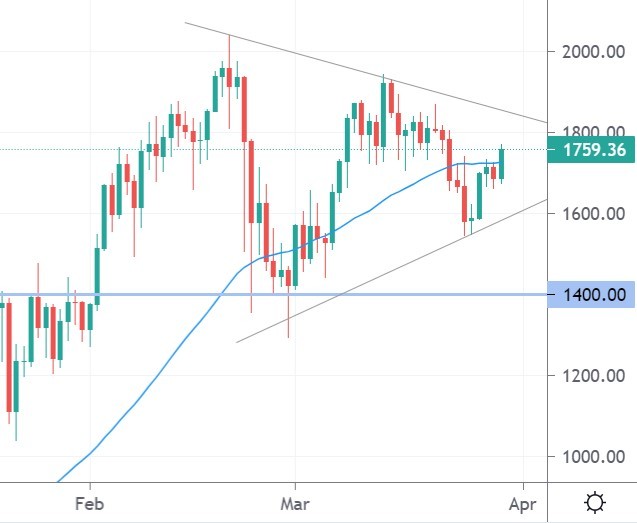
The Ethereum price is consolidating within a triangle pattern and is looking to make another drive towards the highs at $2,000. Bitcoin rallied into the weekend after the selling into a record $6bn options expiry fizzled out, giving a green light for bulls to reappear. 

The move higher comes after the amount of the coin staked reached a new high of 3.6 million ETH. 

Glassnode research noted the recent milestone in a tweet on Sunday, with the current value of the staked coins being over $6 billion. The Ethereum developers asked for fans of the project to stake their coins ahead of the upgrade to the highly-anticipated V2.0 version of the blockchain. 

The upgrade will add many improvements to the performance of the network with the most important being scalability. The coin will switch to a Proof-of-Stake consensus and improvements to the high gas fees and transactions would increase the project’s ability to attract decentralized finance (DeFi) apps. Ethereum was the go-to chain for the DeFi projects but high costs with the rise in ETH has seen others seeking to move in on the market. 

ETH Price Index

ETH is trading below the $1,800 level and a break above that, with channel resistance above, could see the coin move towards $2k once more.

USDC

Payments giant Visa has now processed a USDC payment on the Ethereum network for a new service that they plan to roll out to its partners later in the year. 

According to a press release, Crypto.com sent a USDC transaction to an account at Anchorage custody, which was owned by Visa. The Crypto.com project already issues crypto-based Visa cards and the move could signal a closer tie-up between the two. 

The latest development comes just a couple of months after the news that VISA was creating APIs for banks and financial institutions to purchase cryptos in the same fashion, using Visa and anchorage. As we suggested in the past, big corporations and banks were waiting for custody services to be introduced before they risked their capital. 

USD Coin is an ERC-20 token that was created by Centre and Coinbase with a view to create opportunities such as the Visa payments and the ecosystem should continue to expand as tokens for other fiat currencies are implemented. This is big news for the cryptocurrency industry as crypto-native tokens can build their businesses without having to worry about dealing with fiat settlements on their balance sheet.

USDC has seen its market cap explode higher in the last year with a move from $500 million to the current value above $10 billion. The Visa partnership should grow this even further as the payments processor expands its service later this year. The stablecoin is accepted by the largest crypto wallet providers. 

BCH

Bitcoin Cash could be affected by the Visa news as the cryptocurrency startup Moon, was set to bring the lightning network to all Visa merchants. 

Users can purchase a pre-paid credit card with cryptocurrencies and pay at many large e-commerce stores such as Ebay and Etsy, while any physical merchant that accepts Visa will accept it. 

BCH founder Roger Ver has had his ups and downs with Bitcoin and the Lightning Network as he initially forked the BCH coin from Bitcoin’s network in order to facilitate a solution that was closer to the Whitepaper of BTC. 

On Twitter at the end of 2020, Ver called Lightning Network a “total failure” because of the surge in usage of Wrapped BTC on the Ethereum chain. He said:

Having nearly 100x more #Bitcoin wrapped for use on #Ethereum than in #LightningNetwork shows LN has been a total failure for scaling BTC.

Wrapped Bitcoin has continued to surge and the future is setting up to become a battle with Visa trying to defend its monopoly with Mastercard as the largest payments processor in the world. The Lightning Network was introduced with the idea of adding scalability and fast transactions to BTC.

BCH Price Index

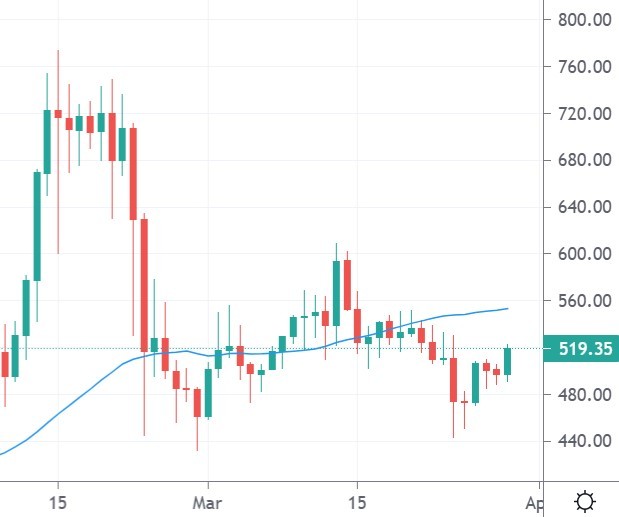
The price of BCH underperformed the rally of Bitcoin over the last year with the coin now trading at $520, which is around twice its 2020 average price. BCH will continue to be a competitor to the Lightning Network for now, and this is likely keeping a lid on the price, although gains are possible from this price level.

ANKR

ANKR capped a strong couple of months with news that the token was the latest to be listed on Coinbase. The cryptocurrency exchange said in a blog article that ANKR, CRV, and STORJ would start trading on March 23rd. 

ANKR is another Ethereum-based token that powers a distributed computing platform, where the aim is to make it easy and affordable for developers to use various blockchains. 

The project also got a boost from the recent news that it was the top validator on the Binance Smart Chain. There is plenty of competition in this space but ANKR has grabbed the early lead. 

ANKR Price Index

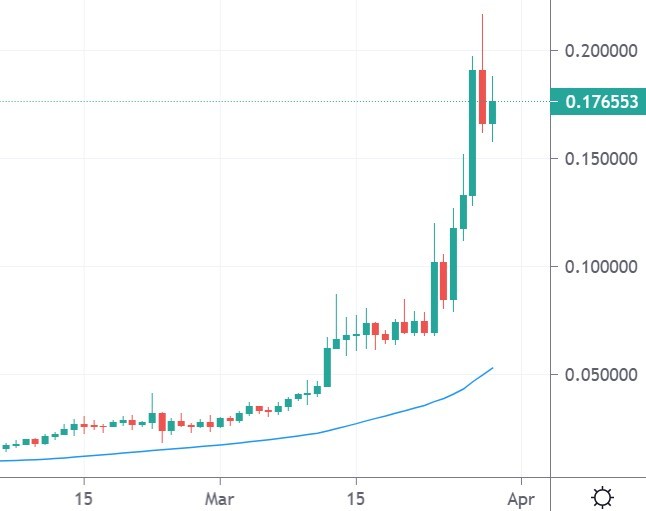
The coin has seen a big surge from just 1 cent in February to a current high above $0.20. 

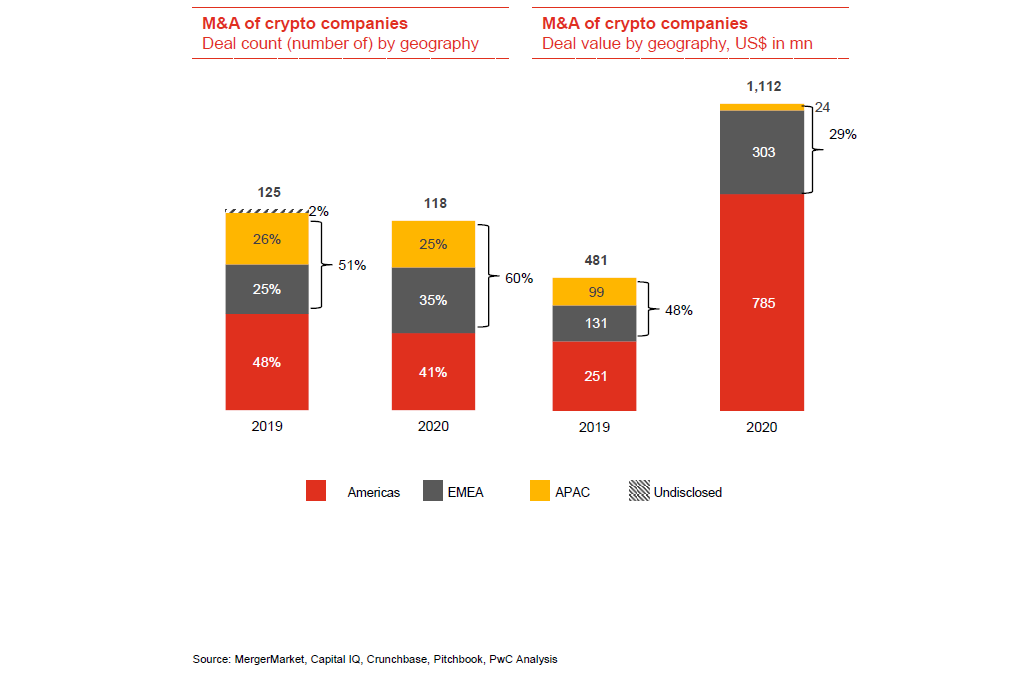
Finally, PwC has reported that cryptocurrency mergers and acquisitions activity had surged in 2020, with total deal volume more than doubling from $481 million in 2019 to $1.1 billion in the following year. 

The average deal size increased from around $19 million to almost $53 million as institutional investors scour the market for opportunities. 

Go to Source

Bitcoin (BTC) Price Prediction: BTC/USD Struggles To Reclaim the $58,000 Support As Bulls Regain Bullish Momentum

Bitcoin (BTC) Price Prediction – April 9, 2021
Since March 14, Bitcoin bulls have been struggling to break the $60,000 psychological price level but to no avail. For the past week, the BTC/USD price has been trading near the resistance zone to break the overhead resistance. It is argued that consolidation near a resistance zone increases the chances of a breakout.

Resistance Levels: $58,000, $59,000, $60,000
Support Levels: $40,000, $39,000, $38,000

BTC/USD – Daily Chart

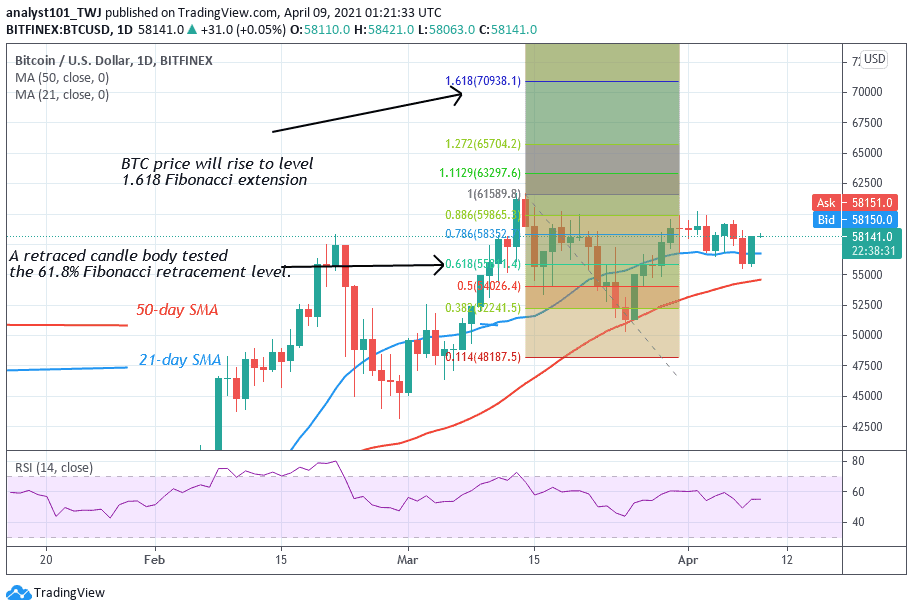
BTC price now fluctuates between $57,000 and $60,000 as buyers attempt to push Bitcoin above the $60,000 overhead resistance. About 48 hours ago, the bears succeeded in sinking Bitcoin to the low of $55,681. Nevertheless, Bitcoin has recovered as bulls buy the dips. Besides, buyers are attempting to break the $58,000 resistance. Today, if buyers reclaim the $58,000 support, the upside momentum will resume. The $60,000 overhead resistance will be retested again. In the previous attempts, buyers breached the overhead resistance but could not sustain the bullish momentum above it. Today, the BTC price is trading at $58,043 at the time of writing.

More Russians Disclose Their Incomes From Cryptocurrency Operations
According to a Consulting firm, such as PwC Russia, Russians have been reporting their income from cryptocurrency operations. The Russian news agency Izvestia indicated that Russians disclose their income from crypto trading for tax purposes. Evgeny Sivoushkov is the director of PwC Russia’s division of individual taxation. The director indicated that interest in disclosing crypto holdings has increased during the ongoing tax declaration period which ends on May 1. According to Sivoushkov,” the new trend was fueled by the adoption of Russia’s crypto law “. According to the new legislation, Russian residents are to pay income tax from cryptocurrency trading. The bill which had its first reading in February required residents to report crypto transactions if their total amount exceeds 600,000 rubles ($7,800) on an annual basis.

BTC/USD – Daily Chart

Meanwhile, buyers are struggling to break above the $58,000 resistance. If successful, a retest at the $60,000 overhead resistance is likely. Secondly, the Fibonacci tool analysis is likely to hold. On March 15, a retraced candle body tested the 61.8% Fibonacci retracement level. This retracement gives the impression that BTC price will rise to level 1.618 Fibonacci extension or the high of $70,938.10.

Go to Source

Bitcoin Price Prediction: BTC/USD Explodes Above $57,000; More Further Upside May Play Out

Bitcoin (BTC) Price Prediction – April 8

BTC/USD remains at the upside as the bulls are holding tight to the market ever since the price action tested the $55,400 support yesterday.

BTC/USD Long-term Trend: Bullish (Daily Chart)

Key levels:

Resistance Levels: $62,000, $64,000, $66,000

Support Levels: $52,000, $50,000, $48,000

BTCUSD – Daily Chart

Earlier today, BTC/USD begins to see some signs of immense strength as buyers propel it up towards $57,500. Meanwhile, the 9-day moving average is still very much above the 21-day moving average, and bulls are now just a stone’s throw away from breaking above this barrier. However, the buyers are in full control of the market today, and there is a strong likelihood that further upside could come about in the next few days.

What to Expect from Bitcoin (BTC)

At the time of writing, Bitcoin (BTC) is trading up 2.58% at its current price of $57,397. Moreover, as the resistance mounts, the movement towards $58,000 may likely come into focus and the next few days may likely reveal where Bitcoin (BTC) and other altcoins will trend for the remaining part of this week.

Moreover, if bulls can cause the price to remain above the 9-day and 21-day moving averages, moving up further could push the price above the upper boundary of the channel to touch the resistance levels of $62,000, $64,000, and $66,000. Fortunately, the technical indicator RSI (14) is still looking towards the upside, suggesting more bullish signals into the market.

BTC/USD Medium – Term Trend: Ranging (4H Chart)

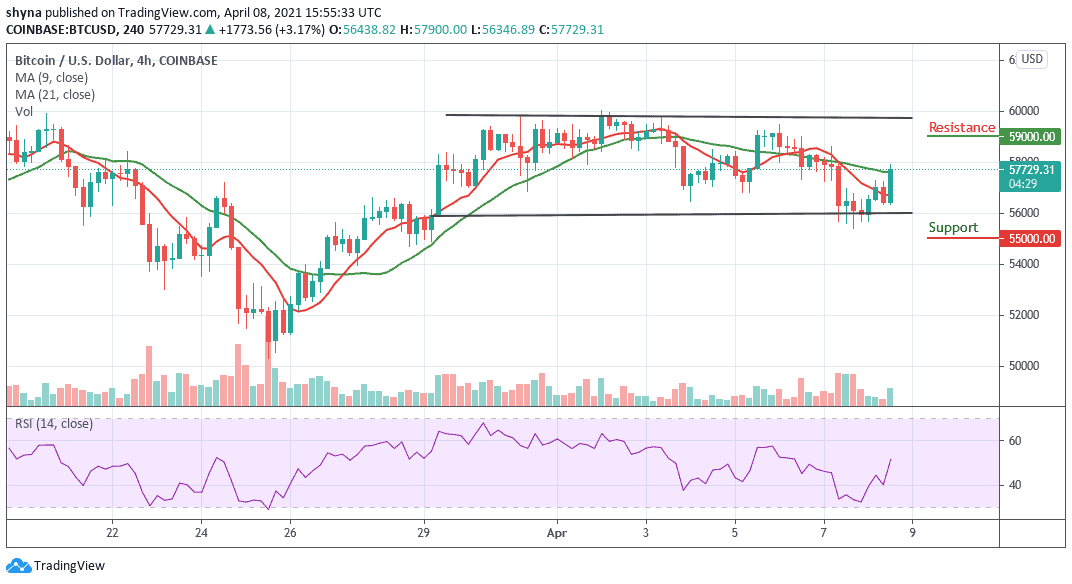
On the 4 hour chart, BTC/USD is trading at $57,729 as all eyes are glued on the $58,000 resistance level. Looking at the chart currently, the coin is seen trading above the 9-day and 21-day moving averages while the existing daily trend is bullish. Therefore, the buyers could remain in the driver’s seat but rapid price actions may need to play out.

BTCUSD – 4 Hour Chart

At the time of writing, the bullish trend line may need to be broken, which is why Bitcoin’s priority still remains the same and the coin may likely retest the support of $55,000 and below. Meanwhile, if the technical indicator RSI (14) continues to follow the upward movement, BTC/USD may likely hit the resistance level of $59,000 and above.

Go to Source

Please enter CoinGecko Free Api Key to get this plugin works.
Exit mobile version