Amundi Puts a European Equity Fund Share Class on Ethereum

TL;DR: Amundi has launched a tokenised share class of its Core STOXX Europe 600 equity index fund on public Ethereum, working with CACEIS. It is a real fund share-class initiative, not a claim that all 600 constituent stocks are individually trading as permissionless tokens around the clock.

One of Europe’s biggest asset managers has moved a conventional index product into the world of tokenised fund units. In a November 2026 announcement, Amundi said a new share class of its Core STOXX Europe 600 strategy had been issued on public Ethereum, using infrastructure developed with CACEIS.

That matters because asset tokenisation is often discussed in abstract terms. Here, the starting point is an existing diversified European equity strategy and a new way of recording or distributing interests in it.

A tokenised fund is not 600 independently tokenised shares

Amundi’s Core STOXX Europe 600 tracks a broad European equity benchmark. What the firm has announced is a tokenised share class of the fund. It has not said that every underlying company has issued new public blockchain shares or that investors can automatically trade each of those stocks at any hour.

The distinction is fundamental. In a fund structure, an investor owns units governed by the fund’s legal terms. The fund, in turn, holds or tracks the underlying basket according to its mandate. Tokenising the unit can change the infrastructure used for issuance, transfer or recordkeeping without changing the basic economic exposure of the underlying investment strategy.

The company says the traditional distribution model remains available. The Ethereum-linked share class is integrated into the existing operating model rather than replacing the fund’s conventional administration overnight.

Why institutions are interested in the infrastructure

Amundi highlights potential benefits including operational efficiency, quicker settlement, transparency and improved distribution. These are plausible advantages of shared digital records, but each depends on regulatory acceptance, custodianship, identity controls and the systems connecting a blockchain to conventional fund administration.

CACEIS’s role is important because a token cannot, by itself, maintain every legal and administrative function expected of a regulated fund. Shareholder rights, transfer restrictions, reconciliation, accounting and redemption procedures still require well-defined responsible parties.

The effort follows earlier Amundi work involving tokenised money-market products and subscriptions using stablecoins. That progression suggests the asset manager is testing multiple financial use cases rather than assuming one technology will immediately replace existing market infrastructure.

NewsBTC recently examined the NYSE’s planned tokenised securities venue and its transfer-agent partners. The US exchange’s programme and Amundi’s European fund are distinct, but both underline the importance of ownership records and operational plumbing. A blockchain timestamp alone does not resolve an investor-rights question.

What would prove this format has traction?

The most useful measurements will be actual eligible investors using the new share class, the cost and speed of subscriptions and redemptions, secondary-transfer rules and how issuers handle corporate actions and compliance. Amundi has not published enough in the cited announcement to quantify all these outcomes.

There is also no reason to equate demand for tokenised fund units with a guaranteed effect on ETH’s market price. Transaction fees and onchain activity are one component of a much larger network economy, and adoption can grow without a direct one-for-one connection to token valuations.

The development is meaningful because it involves an established asset manager applying public blockchain infrastructure to an actual investment product. The next chapter is operational evidence: whether the new representation makes fund ownership simpler, cheaper or more accessible without compromising the protections investors expect.

This article was written by the News Desk and edited by Samuel Rae.

Nasdaq Lists Canary’s Staked INJ ETF, Adding Another Route to Altcoin Exposure

TL;DR: Nasdaq began listing the Canary Staked INJ ETF under ticker INJC on November 5, according to the exchange’s listing notice and Canary Capital. The product seeks Injective token exposure and staking rewards, but fund ownership is not the same as directly holding or controlling INJ.

US exchange-traded cryptocurrency products are extending well beyond Bitcoin and Ether. Nasdaq’s November 4 trader notice confirmed that the Canary Staked INJ ETF would be listed starting Thursday, November 5, under the ticker INJC. Canary Capital’s launch announcement describes the fund’s aim as exposure to INJ, the native token of the Injective network, together with an ability to earn staking rewards.

That gives investors a new route into a smaller cryptocurrency using a familiar brokerage account. It also adds a layer of product structure and fees that should not be confused with direct ownership of tokens in a self-custodied wallet.

Price exposure and staking in one wrapper

Injective operates a proof-of-stake blockchain. In proof-of-stake networks, eligible token holders can participate in network validation, often by delegating tokens to validators, and may receive rewards. A staked fund seeks to reflect some of that economics through its holdings and operations.

Canary says net staking rewards will be reflected in the ETF’s net asset value. The word ‘net’ matters: fund expenses, staking arrangements, validator performance and timing can affect the value delivered to shareholders. Investors should examine the prospectus for the risks, fee structure and precise mechanics rather than treating a possible reward as a fixed interest payment.

Nasdaq’s notice identifies the designated liquidity provider and the start of trading and valuation dissemination. That is concrete evidence of a listed product. It does not by itself establish investor demand, daily liquidity under every market condition or what the shares will trade at relative to their underlying net asset value.

A different form of crypto-market access

Spot Bitcoin ETFs have become widely followed because their fund creations and redemptions provide a visible gauge of flows through conventional investment channels. NewsBTC’s recent analysis of Bitcoin ETF outflows illustrates why even those large products can see very different activity from day to day.

A smaller-token fund adds different considerations. The underlying market may be thinner, its network risks more specialised and its investor base less developed than that of Bitcoin. Product suitability depends on the actual structure and an investor’s ability to withstand volatility, not simply on the convenience of buying a ticker.

There is also a difference between a fund seeking staking economics and an account that allows an investor to select their own validator, manage keys or participate directly in onchain governance. The listed wrapper handles custody and operational choices through fund service providers.

What to monitor after launch

The useful follow-up figures are shares outstanding, assets under management, realised flows, bid-ask spreads, trading volumes, fees and how staking income is accounted for. These will tell readers more than a single day’s INJ price move or the excitement surrounding a new listing.

The wider lesson is that the ETF market is developing more specialised structures. That can expand financial access while moving key operational decisions away from end users. INJC’s listing is a verified milestone. Whether it becomes a durable and liquid product remains to be demonstrated by its trading record.

This article was written by the News Desk and edited by Samuel Rae.

Featured image: Nasdaq stock market display at Times Square (historic illustrative photograph; does NOT show the 2026 Canary staked INJ ETF listing ceremony or live ticker). Photo: bfishadow on Flickr via Wikimedia Commons, licensed under CC BY 2.0.

Chainalysis Begins Restoring Screening Services After Disclosing Exposed Password Hashes

TL;DR: Chainalysis said on November 6 it was restoring KYT and address screening in phases after a cyberattack. The firm earlier disclosed that names, usernames, password hashes and live tokens for users had been exposed. Customers were told to prepare password resets and API-key rotation; investigations data exposure has not been established.

A disruption at one of cryptocurrency’s best-known investigative and compliance providers is also a test of operational resilience for the companies that depend on it. In a security incident notice updated November 6, Chainalysis said it had begun restoring access to its Know Your Transaction, or KYT, and address-screening products through a phased process.

The restoration followed several days of service restrictions and increasingly detailed disclosures about a cyberattack. Because many crypto businesses use screening tools to investigate suspicious transactions or meet compliance obligations, this is a story about both information security and the ability of regulated operations to continue.

The company’s disclosures evolved during the week

Chainalysis initially reported discovering unauthorised activity affecting its internal systems and tools. Its October 30 statement said it had found no evidence at that point of access to certain sensitive materials. But the November 4 update disclosed that user information, including names, usernames, password hashes and live tokens, had been exposed to an attacker.

That sequence is important. Early incident statements often reflect a limited investigation, and later forensic work can establish a wider impact. The responsible reading is the latest dated disclosure, not a permanently frozen version of the first announcement.

The company also reported abnormal activity around KYT and other screening tools, prompting additional products to be taken offline. Chainalysis said it had no evidence of access to investigation content or manipulation of its attribution data at the time of its updates. That is a narrower claim than declaring every possible effect ruled out.

Passwords and API credentials require attention

Chainalysis told customers to submit trusted IP addresses for allowlisting and prepare to reset passwords and rotate API keys as access is restored. A password hash is not the same as a plaintext password, but exposed hashes create security concerns depending on how they were generated and the strength of the underlying credentials. Live tokens can present a separate risk because they may enable access while valid.

For organisations, the operational response should follow the vendor’s direct instructions and their own security teams’ assessment. Users should not click unexpected reset links in unsolicited emails; signing in through a verified service address is safer than relying on a message that could be spoofed.

The wider issue of controls and dependency is also present in NewsBTC’s coverage of Aave’s protective restrictions on new tBTC positions. Different systems and risks are involved, but both illustrate how a provider’s status can affect the options available to dependent services.

Screening outages are a market infrastructure problem

Compliance teams need accurate screening, audit trails and clear decisions about when they can accept funds or process an onboarding request. Temporarily losing a primary tool can complicate those processes even if the underlying blockchain continues operating. Backups, manual escalation and incident playbooks are therefore part of real crypto infrastructure.

Chainalysis said restoration would expand as it validated enhanced security controls. It had not, in the cited November 6 update, confirmed full restoration of every affected product. That distinction should guide reporting and customer decisions.

The key future questions are the complete scope of exposure, remedial actions, the timetable for Reactor and other affected products and independent assurance that compromised credentials have been invalidated. For now, the firm has acknowledged a serious security incident and begun a controlled recovery.

This article was written by the News Desk and edited by Samuel Rae.
Zcash Activates NU7 With 25-Second Block Target and New Fee Reserve

TL;DR: Zcash’s NU7 upgrade activated at mainnet block 3,543,405, reducing target block spacing from 75 to 25 seconds. It also changes how fees contribute to future network security. Faster target blocks do not make every payment final instantly, and node operators need compatible software.

Zcash has crossed an important protocol milestone. The NU7 network upgrade activated in early November at block height 3,543,405, bringing a faster target block interval and changes to the economics of future block rewards. The Zcash Foundation’s Zebra 7 release notes identify the same mainnet activation height and describe the consensus changes required for nodes to follow the chain.

The upgrade is not just a software patch. It changes how Zcash produces blocks and how some transaction fees are handled, while preserving the wider coin-issuance framework.

What moving from 75 to 25 seconds changes

Zcash’s new target is a block every 25 seconds, down from 75 seconds before the upgrade. In theory, that means users and services waiting for several confirmations can receive them sooner. But target spacing is a statistical expectation, not a service-level guarantee: real blocks arrive irregularly, and exchanges or payment processors choose their own confirmation policies.

To prevent a tripling of the number of blocks from mechanically tripling new coin issuance, the upgrade scales the scheduled reward per block and adjusts remaining issuance and halving intervals. The idea is to deliver more frequent blocks while keeping the rate of monetary issuance broadly aligned with the previous schedule.

The node-software detail matters as much as the headline speed. Zebra’s release notes say operators must upgrade to a NU7-compatible client to remain on the consensus chain after the activation point. A user may experience difficulties if a wallet or service depends on an outdated node even when the network itself is operating normally.

A mechanism for later security funding

NU7 also introduces a Network Sustainability Mechanism that directs a portion of transaction fees into a public reserve for future reissuance to miners. Accounts of the upgrade put that reserve contribution at 60% of fees, with the remaining 40% available to miners at the time of collection. The stated design goal is to smooth the eventual decline in subsidy-funded security spending as the network matures.

That is a policy choice within a public cryptocurrency, not free revenue. Money reserved for future rewards is not available in the same way as fees paid immediately to today’s miners. Evaluating the mechanism means examining incentives over time, its interaction with market demand and whether it achieves the intended security effects.

The change also retires support for older version-four transactions, affecting Zcash’s original Sprout pool. This is a reminder that long-running blockchains can carry technical baggage that becomes increasingly difficult to maintain, especially when privacy features and proof systems evolve.

Faster confirmations still need an operational reality check

Zcash offers privacy-preserving transfers, so network improvements should also be assessed against wallet compatibility, scanning performance and the accessibility of shielded payments. The upgrade can improve the underlying capability without ensuring every exchange, mobile wallet or merchant adopts the same features immediately.

NewsBTC previously examined the network’s Zebra synchronisation work ahead of NU7, when the emphasis was on nodes following the chain reliably. Activation does not eliminate those operational responsibilities.

For users and operators, the practical next checks are node versions, observed block times, confirmation requirements and whether particular wallets have published NU7 support notices. The verified milestone is a mainnet rule change; its day-to-day value will emerge through reliability and actual private-payment usage.

This article was written by the News Desk and edited by Samuel Rae.

Featured image: Zcash project emblem (illustrative brand mark for Zcash NU7 network upgrade coverage). Source: Zcash project via Wikimedia Commons (Public Domain simple logo).

Nigeria Sets New Stablecoin Licensing Rules and Capital Requirements

TL;DR: Nigeria’s central bank issued a new framework on November 5 for non-security virtual assets, with separate stablecoin licences tied to naira and foreign-currency tokens. The rules introduce reserve, capital and local-presence obligations and ban certain algorithmic designs. This is a payments-regulation story, not a blanket legalisation of every crypto activity.

Nigeria is moving from broad policy debates over digital assets toward detailed rules for the businesses that issue and move them. In a November 5 circular and accompanying regulations, the Central Bank of Nigeria set out a licensing framework covering stablecoins, payment services, custody, transfers and remittances involving non-security virtual assets.

The framework is relevant well beyond Nigeria because international stablecoin businesses cannot assume that having a foreign issuer or a smart contract operating outside the country puts them outside its reach.

Two stablecoin classes, with different obligations

The central bank differentiates between naira-referenced stablecoins and those referencing foreign currencies. Class 1 covers naira-linked issuers; Class 2 addresses foreign-currency-backed tokens. Reporting on the regulation has highlighted minimum paid-up capital requirements of 10 billion naira for Class 1 and 15 billion naira for Class 2, with the bank retaining power to prescribe higher amounts.

Each token also requires approval. The regulator’s rules set out information that must be provided about reserves, redemption processes, supported networks, governance and risks. This is a significantly more demanding proposition than deploying a dollar-token smart contract and putting a logo on a website.

The rules are designed around backing and redemption, including restrictions on algorithmic arrangements that rely primarily on market mechanisms rather than eligible reserve assets to maintain value. Customers therefore need to consider not only whether a token trades near its peg but whether its issuer can honour redemptions and safeguard assets during stress.

Cross-border operators cannot ignore local rules

According to the circular, the framework applies to regulated activities conducted in or from Nigeria, directed at Nigerian residents, or materially affecting Nigerian payment and financial systems. Physical absence is not necessarily an exemption. That means an international stablecoin platform may have licensing and local-incorporation questions to answer before actively targeting the market.

The central bank also distinguishes its payments and non-security remit from the Nigerian securities regulator’s responsibilities. An investment-like token can trigger separate oversight. The exact legal classification of a digital product matters more than the marketing term ‘crypto’.

The regulatory separation recalls NewsBTC’s examination of Coinbase’s EEA restrictions on particular stablecoins. Both examples show that a token can continue existing on a blockchain while platforms’ ability to offer it to users changes by jurisdiction.

A compliance test for issuers and payments firms

The Nigerian framework covers anti-money-laundering checks, sanctions screening, transaction monitoring, safeguarding and customer disclosures. These duties can be expensive, particularly for smaller firms, but the regulator is explicitly prioritising consumer protection and financial-system integrity alongside innovation.

There are transitional provisions for existing operators; firms should read the official text to establish their own deadline and authorisation obligations rather than assume a news headline provides legal advice. Any commercial forecast about how many licences will be issued is premature.

For users, the real test will be whether licensed products provide dependable redemption, transparent fees and practical access to cross-border payments. For issuers, it will be whether they can meet the reserve and governance requirements while retaining useful economics. Nigeria has supplied a much clearer regulatory framework, but the market’s response still has to be measured through actual compliant launches.

This article was written by the News Desk and edited by Samuel Rae.
Featured image: Central Bank of Nigeria headquarters in Abuja (2023 illustrative photograph of the CBN building). Photo: Umabruka via Wikimedia Commons, licensed under CC BY-SA 4.0.

US sanctions hit 41 companies accused of keeping Prince Group’s scam network running

Treasury says the network concealed ownership and sustained Prince Group operations, while US rules require covered assets to be blocked.

Read the full story on CryptoSlate

Understand the crypto stories that matter and what to watch next. Get The Catalyst in your inbox

Go to Source

Higher wages don’t have to mean higher inflation. That could matter for Bitcoin

Preliminary Q3 productivity outpaced hourly compensation, offering a cost counterpoint while inflation keeps the Fed cautious.

Read the full story on CryptoSlate

Understand the crypto stories that matter and what to watch next. Get The Catalyst in your inbox

Go to Source

EU Deploys Dedicated Crypto Task Force to Block Russian Evasion

Tenth High Level Meeting on Union Restrictive MeasuresThe new crypto task force will be part of a new sanctions office that will coordinate how national authorities apply the rules to avoid circumvention of these measures using digital assets, targeting crypto networks like A7, which provided a digital ruble stablecoin to skirt these restrictions. EU Launches Crypto Task Force to Curb Russian Digital […]
Go to Source

Gnosis Pay Data Breach Exposes Sensitive Customer Records

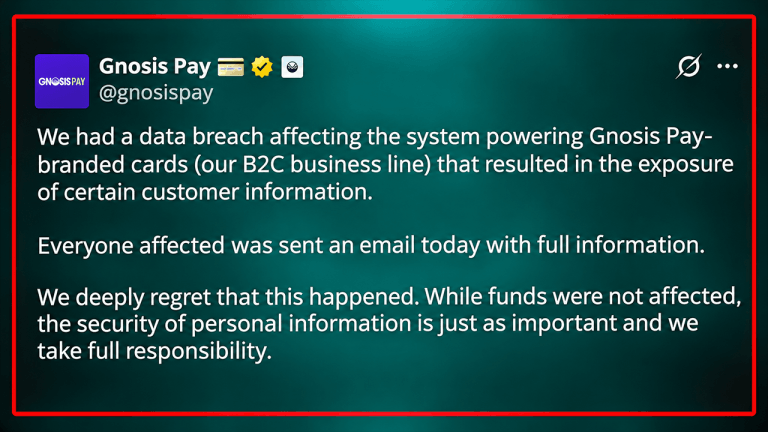
Gnosis Pay confirmed a data breach on Friday, Nov. 6, 2026, after unauthorized access to its legacy consumer card system exposed customer information. One affected user reported that his name, home address, card number, and linked cryptocurrency wallets were compromised, although the company says customer funds remain secure. What Happened to Gnosis Pay? The cryptocurrency […]
Go to Source

Solo Bitcoin Miners Strike Digital Gold as 2026 Jackpot Wins Reach 36 Blocks

A tiny bitcoin mining machine beat astronomical odds during the first week of November, adding another unlikely victory to a year of solo mining jackpots. From compact desktop devices to industrial-scale competitors, 2026 has delivered 36 documented solo-style block discoveries worth millions of dollars. A Tiny Bitcoin Miner Takes on the Giants and Wins Imagine […]
Go to Source

Prediction Markets Favor Another Drop as Year-End Bitcoin Price Forecasts Sour

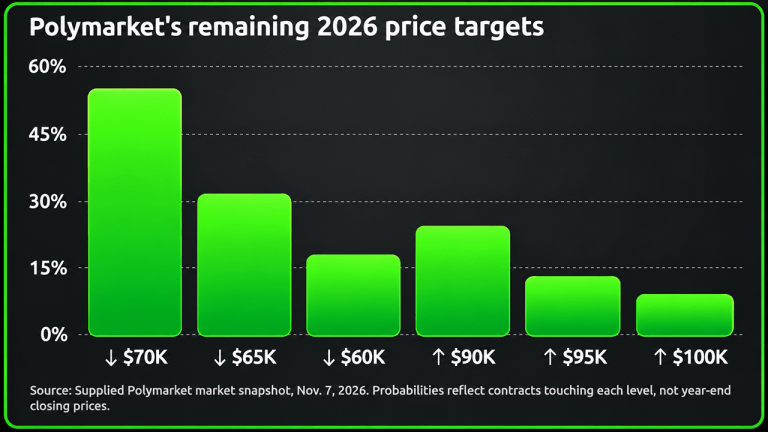
Bitcoin price prediction markets are signaling a difficult finish to 2026, with Polymarket traders assigning a 52% probability to a $70,000 retreat before January and just 9% to a $100,000 comeback, while Kalshi participants concentrate their year-end expectations around $70,000 to $80,000. As of noon Eastern time on Saturday, Nov. 7, 2026, bitcoin’s price traded […]
Go to Source

LeBron James and Luka Doncic Hit AI Betting App With Cease-and-Desist Letters Over ‘Unauthorized Use’ of Likeness

Two NBA superstars have hit an artificial intelligence sports betting app with cease-and-desist letters after an ad used their likenesses without permission.

LeBron James and Luka Doncic sent the letters to PlayVision Inc., the company behind the Bron AI app, reports Front Office Sports.

James, through attorney Lawrence Shire of Grubman Shire Meiselas & Sacks PC, demands the company permanently stop using his name, nickname, likeness, image and persona in any media.

The letter also demands removal of the ad and written notice to all app users that he has no involvement.

Says a spokesperson for James,

“LeBron is in no way affiliated with this unauthorized use of his likeness.”

A representative for Doncic tells Front Office Sports he has also sent a cease-and-desist after his photo appeared in the same ad.

The promotional video, posted November 4th on X, showed a character resembling James in a No. 23 “Bron” jersey using the app.

The character, with a voice sounding like James, says “Dillon Brooks? On Kalshi? Hell nah.”

James has an exclusive endorsement deal with Polymarket.

The letter calls the betting implication a potential violation of NBA rules.

The ad was removed from X after Front Office Sports reported the dispute on November 5th.

The advertisement also features NBA stars Donovan Mitchell and Giannis Antetokounmpo, along with NFL players Christian McCaffrey and Jayden Daniels.

Bron AI is owned by PlayVision Inc., a Y Combinator-backed company founded in 2025.

Follow us on X, Facebook and Telegram

Don’t Miss a Beat – Subscribe to get email alerts delivered directly to your inbox

&nbsp

Disclaimer: Opinions expressed at The Daily Hodl are not investment advice. Investors should do their due diligence before making any high-risk investments in Bitcoin, cryptocurrency or digital assets. Please be advised that your transfers and trades are at your own risk, and any losses you may incur are your responsibility. The Daily Hodl does not recommend the buying or selling of any assets including cryptocurrencies, nor is The Daily Hodl an investment advisor. Please note that The Daily Hodl participates in affiliate marketing.

Generated Image: Midjourney

The post LeBron James and Luka Doncic Hit AI Betting App With Cease-and-Desist Letters Over ‘Unauthorized Use’ of Likeness appeared first on The Daily Hodl.

Go to Source

Bitcoin traders could mistake this Binance data change for a rush to sell

Coin Metrics’ November 4 notice complicates Binance balance signals as traders look for evidence of demand before CPI.

Read the full story on CryptoSlate

Understand the crypto stories that matter and what to watch next. Get The Catalyst in your inbox

Go to Source

Wall Street can stop a tokenized share, but can it stop a stock perp?

Costco recently made news when it strongly objected to a blockchain version of its shares. And while the supermarket giant did raise a set of pretty valid concerns regarding the potential risks of tokenization, the problem was that traders can actually already buy a blockchain-based contract (i.e., token) that follows its stock price. The company…

Read the full story on CryptoSlate

Understand the crypto stories that matter and what to watch next. Get The Catalyst in your inbox

Go to Source

Please enter CoinGecko Free Api Key to get this plugin works.
Exit mobile version