Visa Adds Monad to Stablecoin Settlement Options as Institutions Seek More Rails

Visa’s growing list of blockchain settlement options reportedly has a new entrant: Monad. According to a November 10 report citing the Monad Foundation, participating Visa issuers and acquirers can now use the network for stablecoin settlement. That is a back-office financial infrastructure development, rather than a new consumer-facing Visa card that automatically makes every merchant accept cryptocurrency.

TL;DR: Monad has been added to Visa’s stablecoin settlement options for participating institutional clients, according to a statement from the Monad Foundation reported on November 10. A privacy capability is planned, not yet delivered. The important test will be actual institutional usage and the operational conditions attached to settlement.

What is changing for banks and payment providers?

When a cardholder pays at a shop, the retail transaction and the subsequent movement of funds between financial institutions are separate processes. A settlement service can use digital dollars on a blockchain to transfer value between participating institutions without requiring consumers to interact with a crypto wallet. That is the layer Visa has been expanding.

Visa’s October 15 update on stablecoin-powered money movement showed that parts of its broader digital-dollar strategy were moving from pilots toward live commercial deployment. Monad’s reported addition extends the selection of networks available to eligible partners; it should not be confused with a universal launch in every market or for every Visa transaction.

For an issuer or acquirer, more than one usable settlement rail can provide choices around transaction processing, cost, operational resilience and supported assets. But multiple chains also bring added technical and compliance responsibilities. Connecting a network is the beginning of integration, not proof that it will process meaningful volumes immediately.

Monad is competing on performance, but privacy matters too

Monad is designed for high-throughput smart-contract execution. The latest announcement also points to a proposed privacy feature intended to shield institutional settlement details from general public view while allowing access for authorized reviewers, including auditors and regulators. That capability is described as coming in future months, so it should not be reported as an existing production guarantee.

The distinction is important. Institutions often need to protect commercially sensitive flows, yet they must also meet audit, recordkeeping and sanctions obligations. Privacy without permitted oversight would not meet all of those needs. Future deployment documentation should explain how access controls work and who can inspect what information.

NewsBTC previously examined how Visa’s treasury engine targets institutional settlement. Separately, Reap’s Monad-linked card infrastructure plan illustrates a different use of the same chain: backing consumer card activity, not necessarily settling balances between institutions.

Adoption must be measured in completed settlement

A blockchain being listed among supported options can improve its credibility with enterprise developers, but that does not establish a direct relationship between network adoption and the market price of its native token. Fees, throughput, partner concentration and the way transaction costs are paid all influence the economics.

What matters next is confirmation of which issuers and acquirers are live, which stablecoins and regions are supported, how settlement is reconciled when something fails, and what measurable transaction volume arrives. Those details would turn a promising infrastructure announcement into evidence of commercial activity. Until then, this is a meaningful new option—not an automatic overhaul of how Visa payments work everywhere.

Written by the News Desk and edited by Samuel Rae.

CFTC warns Kalshi of imminent charges over notification of contracts: Politico

The prediction markets operator says the issue involves procedural errors affecting a handful of contracts, many of which weren’t live, according to Politico.

Prediction markets operator Kalshi is being warned of imminent charges from the US Commodity Futures Trading Commission over whether the operator properly notified the agency about new products, Politico reported Tuesday. 

The Commodity Futures Trading Commission is investigating notifications involving dozens of products, the report said, citing a person with direct knowledge of the probe. The agency’s private notification to Kalshi suggests that charges could follow. 

The investigation has been underway for months, the person said. 

Read more

Go to Source

Global banks commit $270M to stablecoin venture targeting 2027 launch

Project Faro, backed by Goldman Sachs, Citigroup and BBVA, has secured $270 million in funding to launch a US dollar stablecoin in the first half of 2027.

A consortium of 21 financial institutions has committed about $270 million in funding to a stablecoin initiative known as Project Faro. The project, backed by big banks, aims to act as a stablecoin issuer and launch a US dollar stablecoin in the first half of 2027.

According to Bloomberg, the funding is intended to cover five years of operations for the new company, which plans to issue stablecoins pegged to the currencies of all G7 countries, with a euro-backed coin expected to follow the dollar launch.

The group first announced the initiative in September. While confirmed details are thin, people familiar with the matter said the company is expected to be incorporated in the US, Bloomberg reported. 

Read more

Go to Source

Trump Media posts $410M profit, but crypto hides an operating loss

The company reported $496.1 million in combined digital-asset, pledged-digital-asset and equity gains, while adjusted EBITDA remained negative.

Read the full story on CryptoSlate

Understand the crypto stories that matter and what to watch next. Get The Catalyst in your inbox

Go to Source

DeepMind says its AI agents ran a four-day cryptography test with about 20 human messages

The known RSA benchmark used less CPU time, with human approval gates, a specialist helper and a large computing budget.

Read the full story on CryptoSlate

Understand the crypto stories that matter and what to watch next. Get The Catalyst in your inbox

Go to Source

Bitcoin’s projected difficulty cut would still leave older S19 rigs short at 5-cent power

A 6.5% cut would improve gross mining revenue at unchanged Bitcoin price, subsidy and fees, while modeled S19 electricity ceilings remain near 4 cents/kWh.

Read the full story on CryptoSlate

Understand the crypto stories that matter and what to watch next. Get The Catalyst in your inbox

Go to Source

AI-assisted firms increase flaw disclosures by 120% with no detected repair slowdown, study finds

A Project Glasswing preprint links AI access to more disclosures while measured fixes kept pace, leaving hidden backlogs and attack prevention unresolved.

Read the full story on CryptoSlate

Understand the crypto stories that matter and what to watch next. Get The Catalyst in your inbox

Go to Source

Slower US inflation leaves Waller’s half-point December hike in play

Core CPI was unchanged at 0.3% for a third month, matching the approximate level in Waller’s conditional December policy discussion before the release.

Read the full story on CryptoSlate

Understand the crypto stories that matter and what to watch next. Get The Catalyst in your inbox

Go to Source

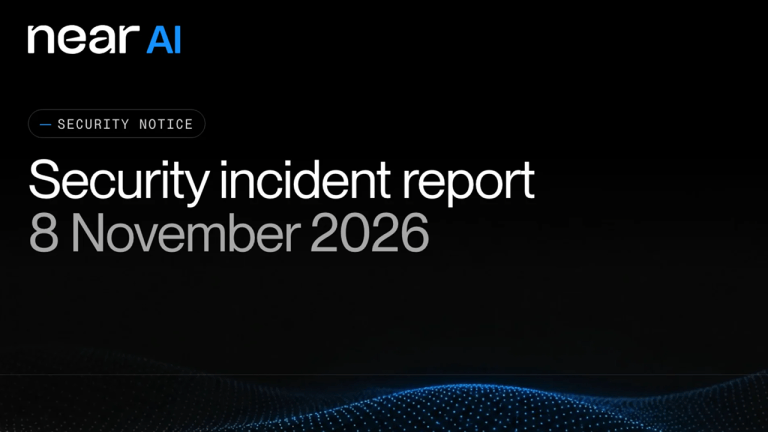
Near AI Confirms Security Breach Affecting 100 Users and 18 Agents

NEAR AI report imageNear AI disclosed a security breach that exposed account information belonging to approximately 100 users and compromised data from 18 legacy artificial intelligence (AI) agents. The Nov. 8, 2026, intrusion exploited a vulnerability in an open-source inference engine, potentially exposing confidential AI requests. SGLang Vulnerability Opens Door to Near AI Infrastructure According to Near AI’s […]
Go to Source

Bitcoin Could Rally Before Rate Cuts Begin, Binance Research Says

Binance Research suggests slowing global monetary tightening could improve bitcoin’s outlook before central banks begin cutting interest rates, while growing use of tokenized equities in decentralized finance (DeFi) points to a new phase of blockchain adoption. Slowing Global Monetary Tightening Could Signal Bitcoin Recovery Bitcoin (BTC) could benefit from an easing in the pace of […]
Go to Source

Wall Street Banks Commit $270M to Stablecoin Challenger Project Faro: Bloomberg

A formidable coalition of 21 financial institutions, including Goldman Sachs, Citigroup, and Bank of America, has committed approximately $270 million to a joint stablecoin venture known internally as Project Faro. According to “people familiar with the matter,” speaking with Bloomberg, the banking consortium is targeting a commercial launch in 2027.   Banking Giants Assemble $270 […]
Go to Source

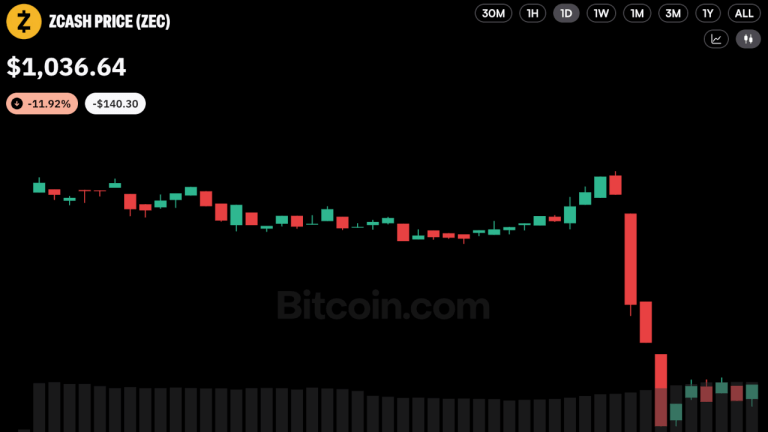
Grayscale Pledges $1M to Zcash Ecosystem as ZEC Plunges Below $1,000

Grayscale paired a $1 million Zcash ecosystem commitment with a new education platform and Wall Street Journal advertisements. The national campaign promoted its Zcash fund alongside grants supporting network development, policy advocacy, and financial privacy education.   Four Zcash Groups Receive Initial Grant Awards Grayscale launched Zcash Invest on Nov. 10 and committed $1 million […]
Go to Source

Morgan Stanley Names 28 Companies Reporting Measurable AI Gains, Including Bank of America, JPMorgan and Visa

An increasing number of S&P 500 companies are seeing significant benefits from artificial intelligence (AI).

Morgan Stanley says 44% of S&P 500 companies now report at least one measurable benefit from AI, up from 32% a year ago, a 12% increase, reports Seeking Alpha.

Morgan Stanley reached that figure after reviewing about 18,000 corporate transcripts.

Direct financial gains such as cost savings or revenue generation are cited by 26% of companies, up from 16%.

Productivity remains the most common benefit, cited by 32% of companies.

Financials lead the pack, with 67% of financial companies reporting tangible AI improvements, ahead of communication services at 61% and information technology at 51%.

Costs are getting more attention too, with 22% of S&P 500 companies now noting AI-related expenses, up from 8% over the past 12 months.

Token, inference and API costs make up the largest share of those expenses at 51%, above general computing and infrastructure.

Morgan Stanley has also named 28 companies that consistently cite quantifiable AI benefits and have at least 10% upside to the bank’s price targets.

The list includes Bank of America, eBay, UnitedHealth Group, Procter & Gamble, Citigroup, JPMorgan Chase, Visa, American Express, GE Aerospace and Blackstone.

Companies in the top 10% for frequently discussing quantifiable AI benefits have seen forward earnings run ahead of the broader S&P 500 on a sector-neutral basis.

Follow us on X, Facebook and Telegram

Don’t Miss a Beat – Subscribe to get email alerts delivered directly to your inbox

&nbsp

Disclaimer: Opinions expressed at The Daily Hodl are not investment advice. Investors should do their due diligence before making any high-risk investments in Bitcoin, cryptocurrency or digital assets. Please be advised that your transfers and trades are at your own risk, and any losses you may incur are your responsibility. The Daily Hodl does not recommend the buying or selling of any assets including cryptocurrencies, nor is The Daily Hodl an investment advisor. Please note that The Daily Hodl participates in affiliate marketing.

Generated Image: Midjourney

The post Morgan Stanley Names 28 Companies Reporting Measurable AI Gains, Including Bank of America, JPMorgan and Visa appeared first on The Daily Hodl.

Go to Source

Please enter CoinGecko Free Api Key to get this plugin works.
Exit mobile version