Bitcoin Premium in South Korea Hits 2% for First Time Since Pre-War Market Shock
Key Takeaways
- The Cryptoquant Korea Premium Index (KPI) hit 1.98% on May 7 as BTC topped $80K across South Korean exchanges.
- Upbit and Bithumb saw BTC swing from -2.27% to premiums amid 2026 war-driven volatility.
- Samsung Electronics and SK Hynix AI demand may keep Cryptoquant KPI swings elevated in 2026.
South Korea’s Kimchi Premium Returns as Bitcoin Climbs Past $80K Again
According to metrics tracked by Cryptoquant, bitcoin prices have swung both below and above the global, or volume-weighted average price (VWAP), since the onset of the U.S.-Iran conflict. The premium in South Korea, often referred to as the Kimchi Premium, is driven by local demand, while the country’s crypto market remains segmented by strict capital controls and residency-based KYC requirements.
Volatility in this case reflects changing relative demand between South Korean spot markets and the broader global market. In 2025, Cryptoquant’s Korea Premium Index (KPI) shows bitcoin traded at a premium for most of the year, aside from a handful of brief exceptions. The premium climbed as high as 8.27% in October, shortly after BTC pushed beyond its $126,000+ all-time high.
2026 has told a different story, particularly since the outbreak of the Middle East conflict. In January, for instance, BTC traded more than 4% higher on South Korean crypto exchanges such as Bithumb and Upbit. Just days into the war, the leading crypto asset still carried a modest premium, but by the first week of March, Cryptoquant’s KPI reading had fallen to a 2.27% discount, and conditions have remained very uneven ever since.
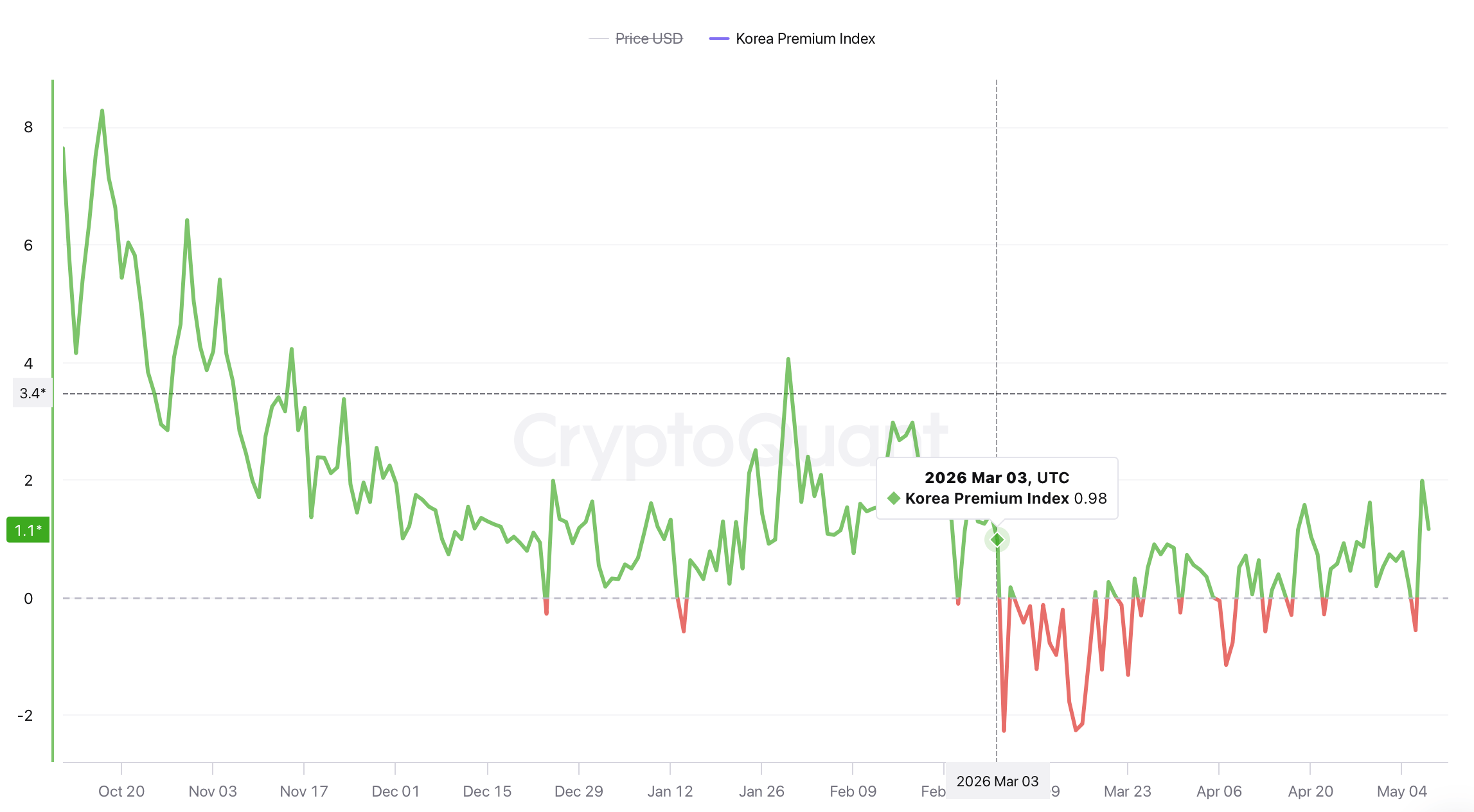
Throughout the remainder of March, pronounced discounts defined much of the month’s trading activity. By March 27 and 28, the premium posted a modest yet meaningful recovery, climbing roughly a percentage point before slipping once again. While April saw some dips, the month was mostly in the green and logging premiums. Fast forward to May 7, and BTC prices in South Korea tapped 1.98%. A height not seen since the day before the war.
South Korean markets, particularly the KOSPI, have also experienced sharp swings during the conflict. While the war delivered a substantial shock to markets in February and March, the fluctuations seen in May reflect a tug-of-war between instability in the Middle East and the accelerating artificial intelligence (AI) hardware cycle driven by companies such as Samsung Electronics and SK Hynix. This dynamic has almost certainly contributed to the KPI’s uneven and highly volatile behavior.
How long the turbulence persists remains anyone’s guess, and as of May 9, the KPI sits at a more modest 0.77% premium when comparing current VWAP metrics against BTC prices on Upbit. For now, South Korea’s crypto market remains one of the clearest real-time gauges of how regional demand can diverge sharply from the broader global market.
About Post Author