Michael Saylor vs Peter Schiff: Bitcoin Outlook Clashes as Schiff Urges Selling MSTR Before Crash
Key Takeaways:
- Peter Schiff and Michael Saylor clash as Schiff questions bitcoin’s 12% long-term return.
- Schiff urges selling Strategy stock (MSTR) after its 68.5% rise, warning of a sharp crash.
- Saylor defends bitcoin, citing a 36% annualized return and long-term strength.
Schiff and Saylor Clash Over Bitcoin Returns and Strategy Valuation
Economist and gold advocate Peter Schiff and Strategy Executive Chairman Michael Saylor shared opposing views on social media platform X on April 5. Schiff criticized bitcoin and Strategy’s stock performance, questioning its sustainability. Saylor defended BTC’s long-term strength, emphasizing broader evaluation periods and structural demand.
Schiff stated: “Despite bitcoin’s mere 12% rise over the past five years, MSTR is up 68.5%, outperforming the NASDAQ. But that’s not due to bitcoin’s performance. It’s due to investors’ willingness to overpay for MSTR so Saylor could keep overpaying for bitcoin. Sell MSTR before it crashes.” The gold bug added in another X post:
“Over the past five years, the price of bitcoin is up by just 12%. Over the same time period, the NASDAQ is up 57.4%, the S&P 500 is up 59.4%, gold is up 163%, and silver is up 181%. If the appeal of bitcoin is its superior long-term performance, why should anyone keep HODLing it?”
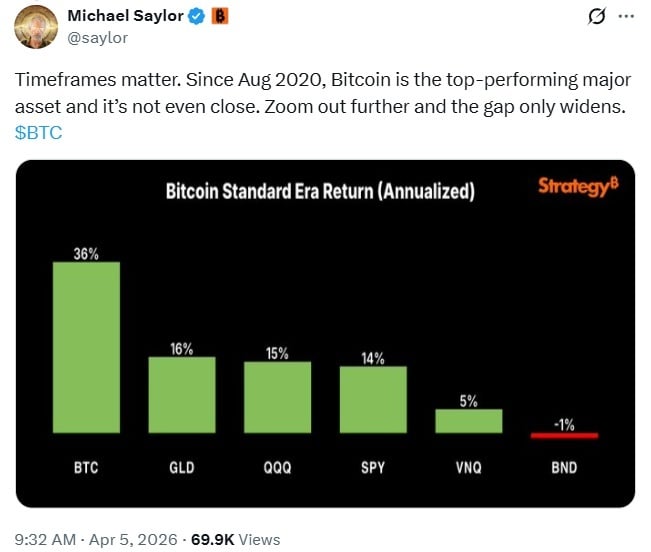
Saylor replied to Schiff by emphasizing that evaluating BTC requires selecting appropriate timeframes, highlighting stronger performance over longer horizons. The chart he shared shows bitcoin leading with a 36% annualized return since August 2020, followed by gold at 16%, QQQ, which tracks the Nasdaq-100 index, at 15%, and SPY, an S&P 500 exchange-traded fund, at 14%. Real estate exposure through VNQ, a real estate investment trust ETF, appears at 5%, while bonds, represented by BND, a total bond market ETF, show a negative 1% return.
Schiff Doubles Down on Strategy Risks as Saylor Signals Institutional Shift
Saylor, on the other hand, detailed on April 4 his broader outlook of BTC’s role in global markets. He stressed:
“ Bitcoin has won. Global consensus is that BTC is digital capital. The four-year cycle is dead. Price is now driven by capital flows.”
“Bank and digital credit will determine bitcoin’s growth trajectory. The biggest risk is bad ideas driving iatrogenic protocol changes,” the Strategy executive chairman said. His remarks reinforce his position that BTC’s valuation is increasingly shaped by institutional adoption and macroeconomic liquidity conditions rather than historical market cycles.
About Post Author