Elon Musk’s Joke Makes Fake Manchester United Token Soar 3,000%

Elon Musk has once again made the crypto market crazy. The Manchester United Fan Token (MUFC) soared 3,000% due to his tweet.

This time the market reacted to the tweet posted by Elon Musk on 17th August. The tweet has got over 870K likes and 120K retweets as of now. He tweeted about buying the Manchester United football club but he later clarified in reply to a comment, “Are you serious?” by replying “No, this is a long-running joke on Twitter. I’m not buying any sports teams.”

This confirms that he has no plans to buy Manchester United or any sports team for that matter right now. But in a further comment to this reply, he added,” Although, if it were any team, it would be Man U. They were my fav team as a kid.”

By the time he clarified, the market had already reacted. MUFC soared 3,000%. Before this rally, the token was a dead coin; the token had almost zero liquidity. Even in the present case, the rally is sustained based on really low liquidity.

Buy Fan Tokens Now

Is MUFC the Official Manchester United Token?

Actually, MUFC is not an official Manchester United crypto token. The token was created by a team of programmers who falsely claimed to the fans of the club that holding MUFC would give buyers influence on the football club’s decisions. The token came into existence in August 2021.

Looking at the low liquidity of the token, it seems that a few speculators must have pumped the token.

In the last 7 days, the lowest price of the token was $0.00001353 and the peak price was $0.007543. Currently, it is trading at $0.000103.

https://coinpaprika.com/coin/mufc-manchester-united-fan-token/

Not only did this MUFC token got pumped up but other assets relating to the club also saw a significant rise in their prices. Manchester United’s stock MANU and the club’s official blockchain and training partner Tezos (XTZ) saw an increase in their prices along with an increase in the price of the official crypto token of the club, CITY. To get info about real Football fan tokens, you can read our piece too.

This episode is quite similar to the other instances of Elon Musk’s tweets influencing the actions of the market and this reasserts the influence of Musk in the crypto market.

Buy Fan Tokens Now

Read More

  • How to Buy Tamadoge – The Meme Coin with Strong Use Cases
  • These are the Best Cryptocurrencies to Buy in 2022
  • These are the Real Football Fan Tokens

Tamadoge – Play to Earn Meme Coin

Our Rating

  • Earn TAMA in Battles With Doge Pets
  • Capped Supply of 2 Bn, Token Burn
  • NFT-Based Metaverse Game
  • Presale Live Now – tamadoge.io

Visit Site


Go to Source

Top Stablecoin Tether (USDT) Slashes Commercial Paper Holdings, Increases Cash and Bank Deposit Reserves

In accordance with promises it made earlier this year, top stablecoin issuer Tether (USDT) has begun to slash its commercial paper holdings.

In the second quarter of 2022, Tether reduced its commercial paper holdings from $20 billion to $8.5 billion, a decrease of more than 58%, according to a new report from the company.

The report was completed with a member firm of BDO, one of the biggest public accounting networks in the world.

Commercial papers are unsecured promissory notes with fixed maturity dates primarily issued by large institutions to obtain funds for their short-term debt obligations.

Tether says it plans to reduce its commercial paper holdings to approximately $200 million by the end of August and to zero by the end of the year. Previously, the stablecoin issuer had said it planned to reduce its commercial paper holdings to zero by October/early November.

Tether also says it increased its holdings of cash and bank deposits by 32% in Q2.

The company’s CTO, Paolo Ardoino, says Tether’s utility is supported by the transparency of its reserves.

“Our commitment to transparency and the community is a long-standing pillar in the underlying ethos of the company and aligns with our responsibility as a market leader. We have once again demonstrated that commitment by aligning with BDO, one of the world’s top accounting firms.”

Don’t Miss a Beat – Subscribe to get crypto email alerts delivered directly to your inbox

Check Price Action

Follow us on Twitter, Facebook and Telegram

Surf The Daily Hodl Mix


Disclaimer: Opinions expressed at The Daily Hodl are not investment advice. Investors should do their due diligence before making any high-risk investments in Bitcoin, cryptocurrency or digital assets. Please be advised that your transfers and trades are at your own risk, and any loses you may incur are your responsibility. The Daily Hodl does not recommend the buying or selling of any cryptocurrencies or digital assets, nor is The Daily Hodl an investment advisor. Please note that The Daily Hodl participates in affiliate marketing.

Featured Image: Shutterstock/JLStock

Go to Source

Web3 games incorporate features to drive female participation

Although there is still an apparent lack of women in the Web3 sector, blockchain-based games geared toward women may help drive inclusivity. A recent report from the Entertainment Software Association found that 48% of gamers in the United States identify as female. It has also been noted that nearly half of all gamers in the world are women. The interest that women have taken in the billion-dollar gaming sector is notable. This, combined with the massive growth being projected by the GameFi industry, is a key reason why a number of Web3 games are being built specifically for female users. 

Beryl Chavez Li, co-founder of Yield Guild Games — a global play-to-earn gaming community — told Cointelegraph that she believes blockchain-based games like Axie Infinity have started to see an uptick in women players. “Although statistics show that play-to-earn games appeal more to male users, we believe that more women will start to take an interest,” she said.

Yat Siu, co-founder and executive chairman of Animoca Brands, further told Cointelegraph that finance and Web3 games are closely related, noting that over time, this will naturally attract all types of people to the space. Yet he believes that women, in particular, will be drawn in given their tendency for greater financial responsibility. “This is particularly evident in developing countries where microfinance and specifically microlending is led predominantly by women,” he remarked.

Web3 games incorporate features to attract women

A number of Web3 games are coming to fruition with the goal of appealing to a predominantly female audience. For example, Fashion League is a free, play-to-earn mobile game that allows users to develop their own fashion empire. Theresia Le Battistini, CEO and founder of Fashion League, told Cointelegraph that the game allows users to create virtual clothing lines that could eventually be sold as nonfungible tokens, or NFTs, while brands can leverage the game to display digital products: “We believe that everything will be gamified in the future, as our statistics have found that the gaming market will exceed $300 billion by 2027. Web3 games need to be inclusive.”

To drive female participation, Le Battistini explained that Fashion League contains certain features that are naturally appealing to women. “The aesthetics of the game are important, along with the fact that it will first be accessible on mobile devices. Women like to play games on mobile, as there is a low barrier to entry,” she explained. Recent statistics show that 62% of people install a game on their phone within a week of owning it. Moreover, these findings note that the current mobile gaming gender split is 51% for women and 49% for men. Regarding aesthetics, a report from The Female Quotient found this to be the most important factor i attracting women to the Web3 space.

Fashion League avatars. Source: Fashion League

Chavez Li, who serves on Fashion League’s advisory board, further pointed out that many Web3 games focus on first- and third-person shooter games, yet lack creativity. She noted that Fashion League encourages individuals to create digital items, which can eventually evolve into sellable NFTs. “We are enabling the creator economy through a fun game. The more users play, the more points they can earn. In-game cash can then be exchanged for tokens that can be converted to fiat,” she said. Chavez Li also mentioned that players can compete and interact with each other during events like fashion shows, adding a layer of socialization to the game.

In addition to Fashion League, Mishi McDuff, founder of digital fashion brand Blueberry, told Cointelegraph that the company launched a 3D boutique shopping experience on the gaming platform Roblox. Known as “BlueberryXWorld,” McDuff explained that the Web3 game was designed to create a fun and safe environment for gamers to explore their digital identity:

“Avatars can browse Blueberry’s two-story boutique and try on clothing and accessories. The clean lines and silhouettes of the collections are juxtaposed with flints of attitude such as miniskirts, crop tops and party girl metallics, along with fun accessories such as cat backpacks. In addition, a variety of hairstyles are available for further customization.”

Like Fashion League, BlueberryXWorld was created entirely by female designers and developers. While McDuff noted that the game can be enjoyed by everyone, she believes that this element ensures female creators are able to have their perspectives heard. She elaborated: “In most traditional games, you see women represented in such an unrealistic way: no cellulite, no stretch marks, no body fat. Our avatars have love handles, stretch marks, and all the other things that make us human.”

McDuff also pointed out that community is an underlying principle of the game, which she believes will greatly appeal to women: “Players can stop by the cafe to grab a drink and chat with one another. Women have always had a knack for building strong, close-knit communities, so it will be no surprise to see this in Web3.”

BlueberryXWorld avatars. Source: Blueberry

Lenny Pettersson, chief operating officer of Antler Interactive — a Sweden-based mobile game studio — and acting CEO of “My Neighbor Alice,” told Cointelegraph that some of the most important features behind the Web3 game focus on player collaboration and in-game connections. Pettersson explained that the game allows users to gather resources to shape an archipelago together. Pettersson shared that player collaboration has already become apparent in the game’s Discord channel, noting that players write messages and post screenshots to the channel indicating where to find the best places to fish, for example.

Given this type of community involvement, Pettersson explained that much of the inspiration behind My Neighbor Alice has been drawn from traditional games that have been popular among a female target audience. For example, he noted that the art style plays a big part here. “A colorful and playful art style resembling a fairytale is intentional.”

Imagery from My Neighbor Alice. Source: My Neighbor Alice

While aesthetics, customization and community building are all important features for attracting women to Web3, better representation is also critical. Marcus Bläsche, CEO and co-founder of Rumble Kong League (RKL) — a game that combines basketball, play-to-earn and NFTs — told Cointelegraph that basketball and Web3, unfortunately, both share the challenge of thunderrepresentation of female users. To combat this, Bläsche explained that RKL recently partnered with Round 21, a woman-led Web3 native sports lifestyle brand with an emphasis on collaboration and community.

Related: 

Rookie Avatar. Source: Rumble Kong League

Will games increase women’s participation in Web3?

All things considered, it’s still difficult to determine if Web3 games geared toward women will actually result in increased participation. For instance, Pettersson believes this is a tough question to answer as of now. Yet, he noted that it would be sufficient to say that high-quality Web3 games geared toward women will have an impact on bringing more women into the sector: “The first “Web2” games were specifically designed and oriented toward boys and men. Over the decades more and more games were designed for girls and women.”

Related: 

Go to Source

Terra Classic Price Prediction for the 20TH of August: LUNC/USD May Be Stabilizing


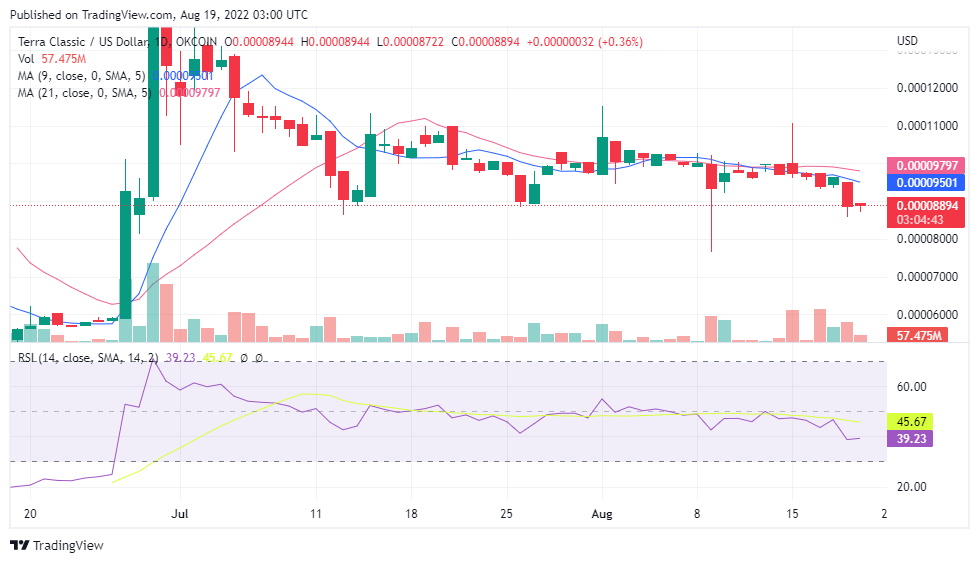
Towards the end of June, LUNC/USD bulls aggressively took the market. The bears were like relegated for those three days. The price increased from $0.00005913 to $0.00014359. The Relative Strength Index for that time showed the line retracing a downward position after it had entered the overbought region. The (then) sudden rise in the value of Terra Classic after it crashed was due to cooperative efforts by organizations to revive it. This increased the number of people in possession of the coin after many holders have sold out. At the present, the price of Terra Classic is correcting to the support level of $0.00008894.

Terra Classic Price Statistic Data:

  • LUNC/USD price now: $0.00008894
  • LUNC/USD market cap: $588,196,172
  • LUNC/USD circulating supply: 6,579,000,000 LUNC
  • LUNC/USD total supply: 6,906,229,037,364 LUNC
  • LUNC/USD coin market ranking: #213

Key Levels

  • Resistance: $0.000014805, $0.000010994, $0.000010033
  • Support: $0.00008894, $0.00005810 $0.00005642


Buy Terra Classic Now

Your capital is at risk

Terra Classic Analysis: LUNC/USD Bulls Need to Be Encouraged

By all indications, the market is trending down. Although looking at the 21-day moving average and the 9-day moving average, the market appeared to be ranging sideways between the 1st of August and to 15th of August. It looks like the market was undecided as to which direction to take. But when we consider the slight sloppiness of the two moving averages, we can say that the price is falling slowly. More efforts are needed to encourage bulls into the market to salvage the value of the coin at this challenging time.

Terra Classic Analysis: Information From the Indicators

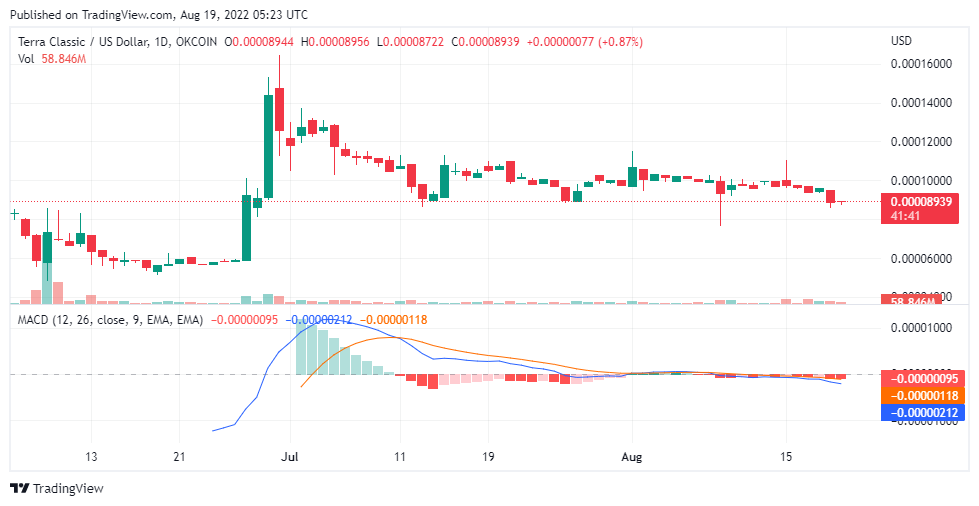
The fast and slow lines in the Relative Strength Index (RSI) are measuring in the lower region. The RSI line is measuring 39%, while the signal line measures 46%. This is a downtrend. According to MACD, the bearish histograms are not so strong. They are performing not too far from point zero of the histogram. The two lines are very close to each other. The market is ranging. Bulls are needed in this market otherwise the price will continue to range or fall more (though very slowly).

Terra Classic Analysis: LUNC/USD 4-Hour Chart Point of View

On today’s 4-hour chart, there has been a lot of market indecision or deadlock between the forces of demand and supply. But, in the third session, the bulls took the market. Mostly, in the market, we can see that there seems to be a general lack of interest resulting in very flat candlestick patterns on the chart.

Related

  • How to Buy Tamadoge
  • Visit Tamadoge Website

Tamadoge – Play to Earn Meme Coin

Our Rating

  • Earn TAMA in Battles With Doge Pets
  • Capped Supply of 2 Bn, Token Burn
  • NFT-Based Metaverse Game
  • Presale Live Now – tamadoge.io

Visit Site

Go to Source

Ethereum is under attack as U.S. sanctions apply at a protocol level

The hope of a decentralized, open, free internet is in jeopardy right now. This is not hyperbole, FUD, or clickbait. Ethermine, the largest Ethereum mining pool, no longer produces blocks containing Tornado Cash transactions. This is likely due to OFAC sanctions and is an example of censorship at the protocol level.

Crypto analyst, Takens Theorem, discovered that Ethermine has stopped processing Tornado Cash transactions and presented the chart below. CryptoSlate reviewed on-chain data and confirmed that Ethermine had not produced a block that included a Tornado Cash transaction during the timeframe shown below.

We have to go back roughly ten days to find a block produced by Ethermine that includes a Tornado Cash transaction. Block 15306892 was created on August 9th and was mined by Ethermine. The block had a 10 ETH transaction processed through the Tornado Cash router.

A review of the most recent Tornado Cash Router transactions showed that it was dominated by Hiveon, P2Pool, 2Miners, and others.

Why does this matter?

Why does this matter? Recently, the U.S., via OFAC, sanctioned the use of Tornado Cash, making it illegal for any U.S. entity to interact with the protocol.

Following this sanction, Circle “blacklisted” USDC on the Ethereum network so that any holder who had interacted with Tornado Cash would no longer be able to interact with the smart contract. This move essentially froze all $USDC that had passed through Tornado Cash.

Next, DeFi protocols such as Aave, Uniswap, Balancer, and others introduced an API from TRM Labs, which disabled the front end of their dApps, essentially banning addresses sanctioned by OFAC.

Aave reportedly restored access to addresses that had been “dusted” with 0.1 ETH by a hacktivist attempting to highlight one of the critical issues with adhering to the sanctions. According to OFAC, any address that interacted with Tornado Cash was now under sanction from the U.S. Thus, when the hacktivist sent 0.1 ETH to several influential people in the crypto space, it showcased that the sanctions could easily be exploited.

While it is arguably good that Aave has restored access to those high-profile people who were targeted, the question remains, “what will happen to users who are targeted by such an attack in future?”

If I don’t like my boss, so I send him 0.1 ETH through Tornado Cash, will he also now be banned from Aave? If so, how will Aave prove that his claim is legitimate? Banned users can still either fork the protocol or interact via CLI, but this is out of the reach of most users.

The choice by Ethermine to stop producing blocks that include Tornado Cash transactions is a step beyond any of the above. Selecting which transactions to process goes against the core principles of the Ethereum blockchain. The network is supposed to be open-source, free, decentralized, and inclusive.

Censorship at a protocol level

While other miners are still processing the transactions at present, if others follow Ethermine’s lead, there is a possible world where Tornado Cash no longer has miners willing to process its transactions.

Vitalik Buterin was so outraged at the thought validators may comply with OFAC sanctions after The Merge that he declared any validators complying with the sanctions should have their ETH staked burned. He agreed with the sentiment that actions that do not include Tornado Cash transactions should be considered “an attack on Ethereum and burn their stake via social consensus.”

When discussing the possibility of proof-of-stake validators ignoring Tornado Cash transactions, Igor Mandrigin, CTO of web3 infrastructure company Gateway.fm, told CryptoSlate,

“It is not impossible technically to not propose blocks with TC, ignore from the transaction pool… but the fewer validators are under US regulations, the better ofc.”

Within a day of the above conversation, we now see a real-world example of proof-of-work validators ignoring Tornado Cash blocks.

Ethermine is not a U.S.-based company and therefore does not fall under the jurisdiction of the OFAC sanctions. However, miners that use the Ethermine pool could be situated within the U.S. If Ethermine mines a block that includes a Tornado Cash transaction, it could be considered interacting with Tornado Cash, thereby breaking the sanctions.

Initial community reaction

In response to the news, Martin Koppelmann, Co-Founder of Gnosis, disagreed with a comment suggesting “it does not matter.”

Co-Founder of Paradigm, Matt Huang, recently reiterated the importance of the blockchain ecosystem to remain “neutral and resist censorship.”

Harsh Rajat, Founder of Ethereum Push Notification Service, shared similar concerns telling CryptoSlate,

“Regulations to ban an open source tech is similar to bringing charges against ford for inventing cars. It’s saddening to see that projects that are good are forced to comply with regulations owing to fear of getting targetted or because the regulations are written in such a way. Though, even more tragic is the way someone did a knee jerk reaction and bought in laws that simply can’t be applied to web3. “

Regarding a solution, Rajat stated, “simply put, we need to stop bad actors but not the inventions that help us progress forward.”

No entity within the Ethereum ecosystem should be able to decide what is included in blocks and what is not. While the news is startling, it is not yet a crisis. No other mining pools appear to be following Ethermine’s lead, and Ethereum validators such as Coinbase have categorically stated they will not censor transactions after The Merge.

However, this is a dangerous road to be traveling along. This is not the direction toward a free and fair decentralized internet; it is several steps backward and potentially the path to an even darker future.

The Tornado Cash code itself does nothing illegal and is fully open-sourced. We do not imprison gun manufacturers when they are used against innocent people. The government does not assume blame when a criminal uses cash for an illegal transaction. By the same arguments, the code written by the Tornado Cash team is not responsible for those who launder money through the protocol.

Tornado Cash has legitimate uses and is a privacy tool at its core. In my opinion (Akiba), the authorities should investigate and trace how the money got to Tornado Cash and what it was used for after, as that’s where the illegal activity can be found.

There is a possibility that it is merely a coincidence that no Tornado Cash transactions have been included in Ethermine blocks. However, given it produces around one-third of the network’s hashrate, it is unlikely.

CryptoSlate reached out to Ethermine for comment but has received no response. A moderator on the Discord forum told CryptoSlate that “Ethermine/BitFly is a registered GmbH so they’re beholden to Austrian laws, so the possibility exists that it’s a compliance move. I could not say for certain however and I’ll defer to the admin team.”

Original research and findings by Oluwapelumi Adejumo.

Go to Source

Research: What happens to our assets in a stagflationary environment? Will smart money eventually move into BTC?

Inflation has become one of the most pressing global economic issues today. Rising prices have drastically reduced both the overall wealth and the purchasing power of a huge chunk of the developed world.

And while inflation certainly is one of the biggest drivers of economic crisis, a bigger danger looms around the corner — stagflation.

Stagflation and its effect on the market

First coined in 1965, the term stagflation describes an economic cycle with a persistently high inflation rate combined with high unemployment and stagnant demand in a country’s economy. The term was popularized in the 1970s as the U.S. entered into a prolonged oil crisis.

Since the 1970s, stagflation has been a repeating occurrence in the developed world. Many economists and analysts believe that the U.S. is about to enter a period of stagflation in 2022, as inflation and a rising unemployment rate become increasingly hard to tackle.

One of the ways stagflation can be measured is through real rates — interest rates adjusted for inflation. Looking at real rates shows the real yield and real returns on assets, revealing the real direction of the economy.

According to the U.S. Bureau of Labor Statistics, the consumer price index (CPI) recorded an inflation rate of 8.5% in July. The July CPI posted an increase of just 1.3% from its May numbers, prompting many policymakers to dismiss the severity of the current inflation rate.

However, real rates paint a much different picture.

The 10-year U.S. Treasury yield currently stands at 2.8%. With inflation at 8.5%, the real yield on owning U.S. Treasury bills is 5.7%.

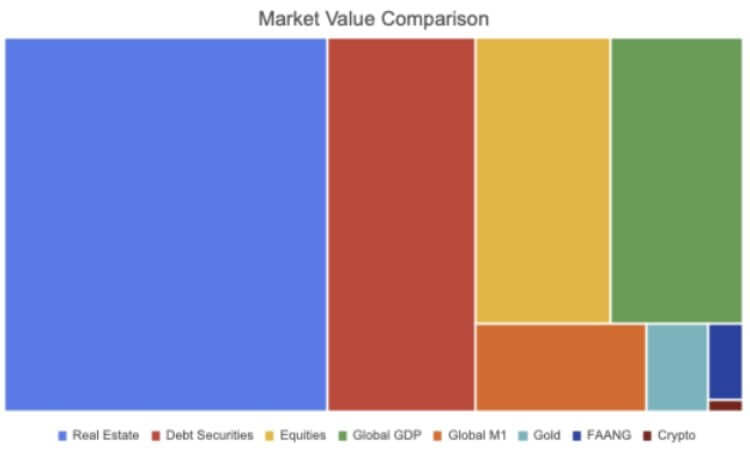
As of 2021, the size of the global bond market is estimated to be around $119 trillion. According to the Securities Industry and Financial Markets Association (SIFMA), around $46 trillion of that comes from the U.S. market. All of the fixed-income market SFIMA tracks, which include mortgage-backed securities (MBS), corporate bonds, municipal securities, federal agency securities, asset-backed securities (ABS), and money markets, currently have negative returns when adjusted for inflation.

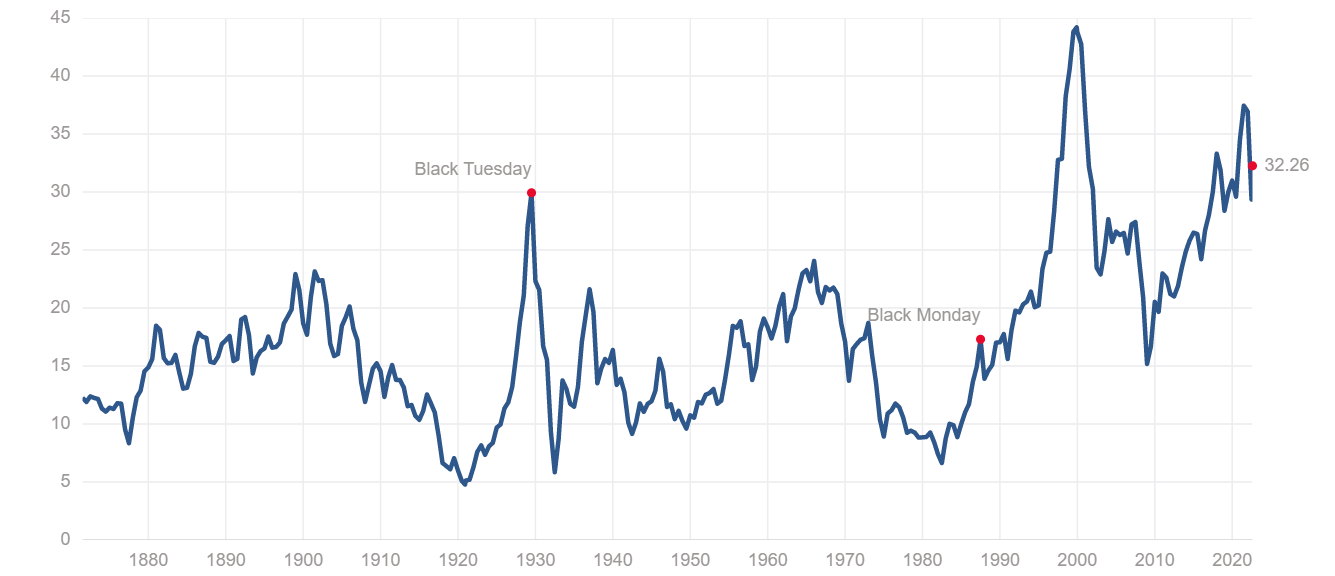
The S&P 500 index also falls in the same category. The Shiller price-to-earnings (P/E) ratio puts the S&P index in the hugely overvalued category. The ratio shows the S&P index’s inflation-adjusted earnings for the previous 10 years and is used to measure the stock market’s overall performance. The current Shiller P/E ratio of 32.26 is considerably higher than the levels recorded ahead of the financial crisis in 2008 and is on par with the Great Depression in the late 1920s.

Graph showing the Shiller P/E ratio from 1880 to 2022

The real estate market has also found itself struggling. In 2020, the value of the global real estate market reached $326.5 trillion — a 5% increase from its 2019 value and a record high.

An increasing population that’s fueling a housing shortage was expected to push this number even higher this year. In the U.S., interest rates have been pegged to nearly zero since the 2008 financial crisis, making mortgages cheap and increasing housing sales across the country.

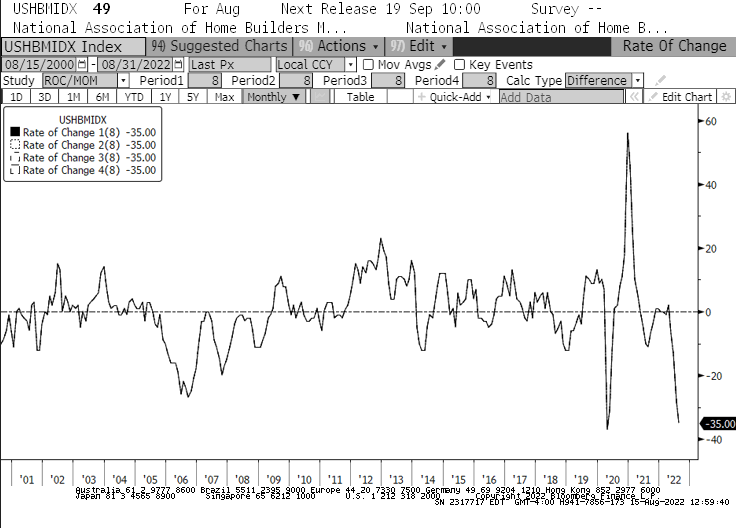
The rise in interest rates we’ve seen since the beginning of the year is set to change this. From January, the National Association of Home Builders (NAHB) housing market index saw its fastest -35 decline in history. The drop recorded in the index was faster than in 2008 when the housing bubble suddenly burst. This is also the longest monthly decline the NAHB index has seen, as August marked its 8th consecutive month of decline for the first time since 2007.

Graph showing the U.S. NAHB Housing Market Index from 2001 to 2022

With almost every segment of the market posting declines, we could see a significant number of institutions and asset managers reconsidering their portfolios. Overvalued property, overbought equities, and negative real yield bonds are all heading into a stagflationary period that could last up to several years.

Large institutions, asset managers, and hedge funds could all be forced to make a tough choice — stay in the market, weather the storm, and risk both short and long-term losses, or rebalance their portfolios with diverse assets that have a better chance of growing in a stagflationary market.

Chart comparing the value of various markets

Even if just some institutional players decide to take the latter route, we could see an increasing amount of money flowing into Bitcoin (BTC). The crypto industry has seen unprecedented growth in institutional adoption, with assets other than just Bitcoin becoming an integral part of many large investment portfolios.

However, as the largest and most liquid crypto asset, Bitcoin could be the target of the majority of those investments.

Go to Source

Uniswap Censors 253 Crypto Addresses Blacklisted for Crime, Sanction Associations

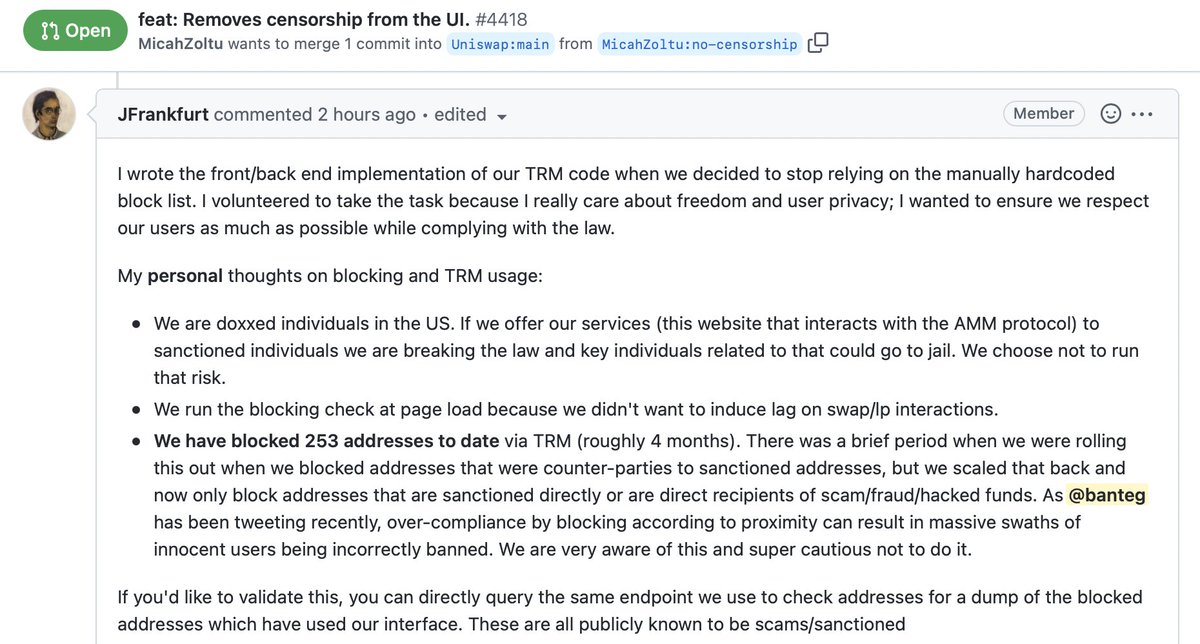
According to a recently published report, the decentralized exchange (dex) Uniswap has blocked roughly 253 cryptocurrency addresses allegedly tied to crimes or government sanctions. The information was discovered by the software developer Banteg who analyzed and saved the shared logs from Uniswap’s server.

30 out of the 253 Blocked Addresses Are ENS Domain Names, Uniswap Labels 7 Types of Risk Factor Categories

On August 19, the software developer and Yearn Finance contributor Banteg published a Twitter thread that claims the dex Uniswap blocks 253 crypto addresses. “Uniswap has provided an unusual level of transparency,” Banteg said in regard to “frontend censoring via TRM Labs.” Uniswap partnered with TRM Labs in mid-April and the firm blacklists crypto addresses that may be associated with sanctions and crypto crimes.

Github repo screenshot shared by Banteg on August 19, 2022.

The same month, reports appeared that indicated a few innocent Uniswap users were affected by the TRM Labs-gated front end. At the time, no one was sure about exactly how many crypto addresses were blacklisted by Uniswap’s TRM Labs-gated front end. Banteg says there are 253 addresses and 30 addresses are ENS domain names. The developer also noted that there are seven different types of risk factor categories and two risk levels.

“Both ownership and being a counterparty of a ‘bad’ address are checked and can contribute to blocking,” Banteg wrote. According to Banteg, the data “wasn’t meant to be public” but the developer noted that people could still have an “exclusive look at the very first [TRM Labs] leak, courtesy of Uniswap.”

Smart Contracts and Code Are Defi, Not the Web Platforms That Host Them

The news follows the recent U.S. government ban of Tornado Cash, the ethereum mixing protocol that leverages Coinjoin and ZKsnark technology. After Tornado Cash was banned an open source developer was arrested, Github code was erased, Tornado Cash Github codebase contributors were suspended, and the project’s Discord server was deleted.

However, the non-profit that focuses on policy issues facing crypto assets, Coin Center, believes the U.S. Treasury Department’s Office of Foreign Asset Control (OFAC) “overstepped its legal authority.” Coin Center is researching the legalities of the Tornado Cash ban and plans to “engage” with OFAC to discuss the matter.

While Uniswap has been updating its TRM Labs-gated front end, there’s likely a whole lot more crypto companies and decentralized finance (defi) protocols following the same measures. For instance, on August 8, Banteg revealed that the Centre Consortium, the stablecoin issuer operated by Circle Financial and Coinbase Global, blacklisted 75,000 USDC that belonged to Tornado Cash users.

“I think this is the first case when a pool has been frozen and not an individual account,” Banteg said at the time.

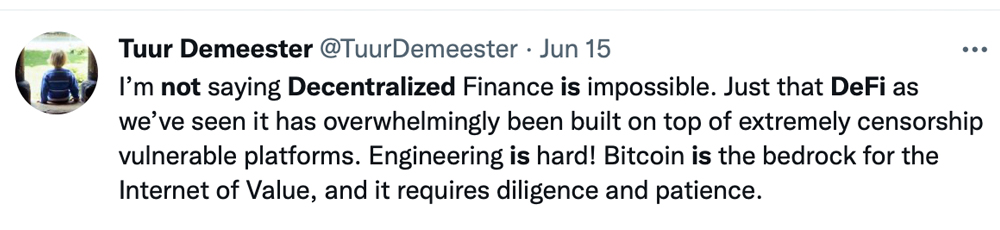
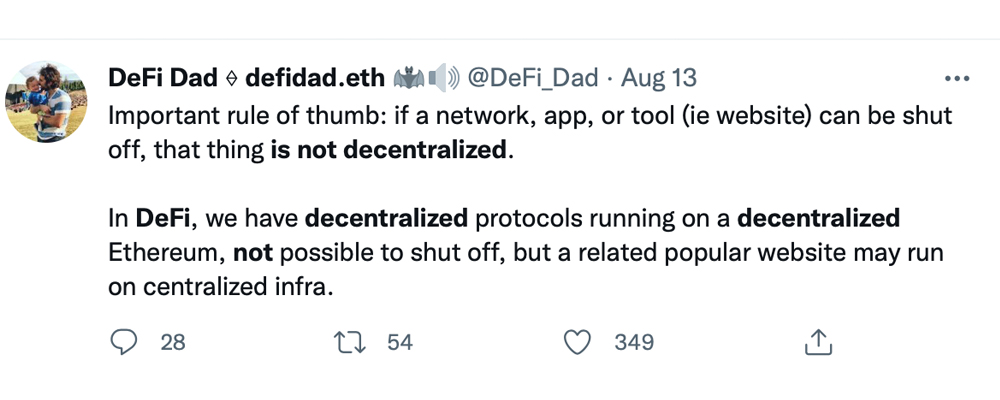
The issues surrounding Tornado Cash and the precautions taken by defi teams like Uniswap, expose the underlying weakness in so-called ‘decentralized finance’ protocols and whether or not they truly are decentralized.

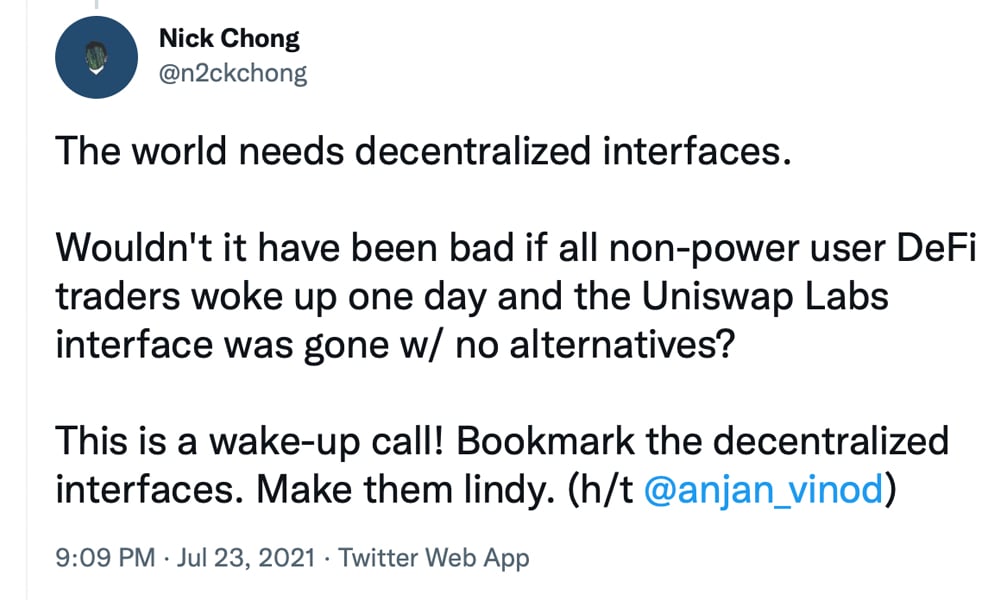
Even before Tornado Cash was banned by the U.S. government, Tornado Cash developers blacklisted an OFAC-listed ethereum address using a Chainalysis oracle contract. Moreover, in July 2021, users criticized Uniswap for blocking over 100 tokens from the main interface.

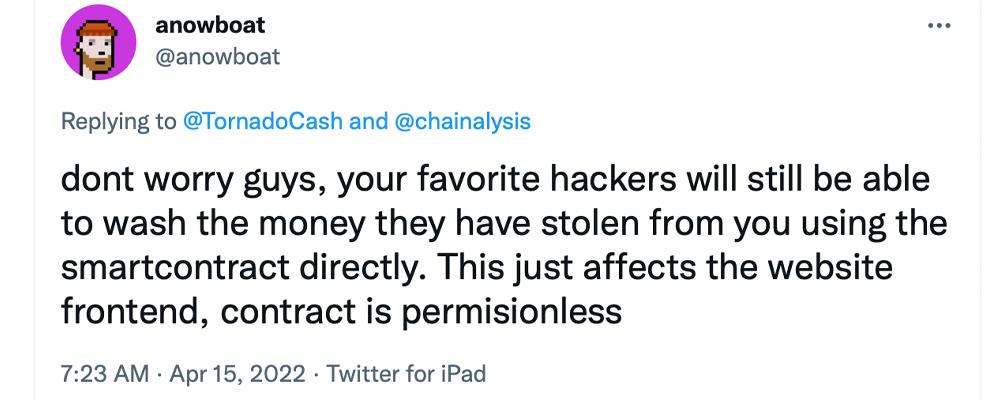
During both these instances, crypto users discussed how they could simply leverage Tornado Cash code or Uniswap’s smart contracts and mirror sites to bypass these types of restrictions. The fact is that Uniswap is a company registered in the U.S. and the frontend, or website, is owned by the U.S. entity. In time, people may want to clarify that defi web portals are not decentralized, and the only things that could be classified as such would be the smart contracts and code.

Tags in this story
Banteg, blacklisted 75000 USDC, Centre Consortium, Code, CoinJoin, Crimes, crypto crimes, Decentralized, DeFi, OFAC, OFAC ban, Sanctions, Smart Contracts, so called defi, Tornado cash, TRM labs, TRM Labs-gated front end, uniswap, Uniswap addresses, Uniswap frontend, US government ban, ZKsnarks

What do you think about the dex Uniswap blocking 253 crypto addresses? Let us know what you think about this subject in the comments section below.

Jamie Redman

Jamie Redman is the News Lead at Bitcoin.com News and a financial tech journalist living in Florida. Redman has been an active member of the cryptocurrency community since 2011. He has a passion for Bitcoin, open-source code, and decentralized applications. Since September 2015, Redman has written more than 5,700 articles for Bitcoin.com News about the disruptive protocols emerging today.

Image Credits: Shutterstock, Pixabay, Wiki Commons

Disclaimer: This article is for informational purposes only. It is not a direct offer or solicitation of an offer to buy or sell, or a recommendation or endorsement of any products, services, or companies. Bitcoin.com does not provide investment, tax, legal, or accounting advice. Neither the company nor the author is responsible, directly or indirectly, for any damage or loss caused or alleged to be caused by or in connection with the use of or reliance on any content, goods or services mentioned in this article.

Read disclaimer

Go to Source

Biggest Movers: SHIB Rebounds on Saturday, as ATOM Moves Away From 3-Week Low

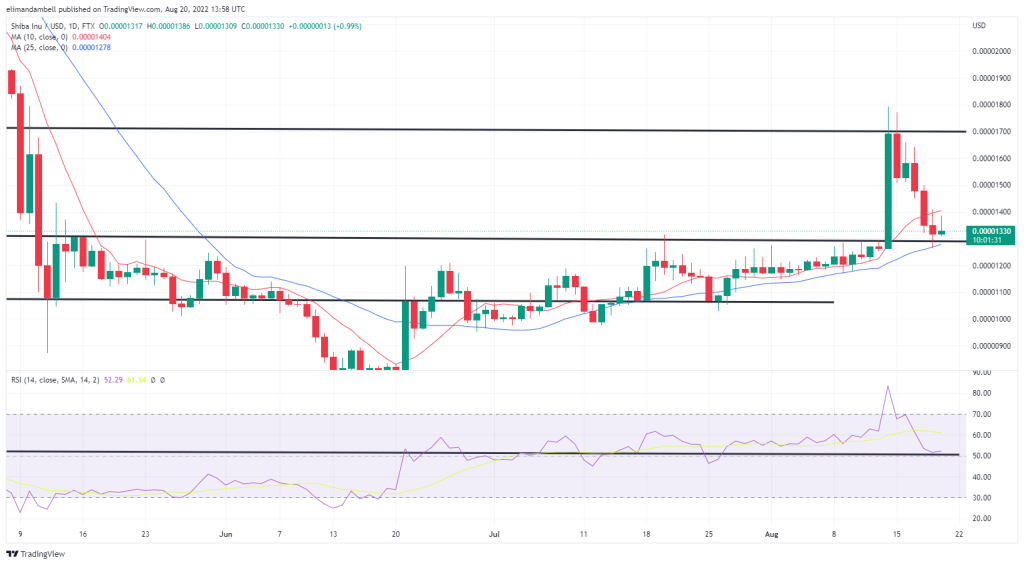
Following three consecutive days of declines, shiba inu rebounded on Saturday, as the meme coin appears to have found a support point. Cosmos was also higher, in what has mostly been a bearish start to the weekend. As of writing, the global crypto market cap is down 1.31%.

Shiba Inu (SHIB)

Shiba inu (SHIB) was back in the green on Saturday, as the token rallied following three straight days of declines.

The world’s twelfth-largest cryptocurrency rose to an intraday peak of $0.00001397 to start the weekend.

This came less than a day after prices of the meme coin were at a low of $0.00001270, which was below a key support point.

SHIB/USD – Daily Chart

Looking at the chart, this price floor was the $0.00001290 mark, however bulls resisted any further declines, pushing SHIB/USD back into the $0.00001300 region.

As of writing, the 14-day relative strength index (RSI) is tracking at 52.13, which is marginally above a floor of 51.44.

Should the index continue to climb, and move towards a ceiling of 58, then we may see SHIB move closer to $0.00001500.

Cosmos (ATOM)

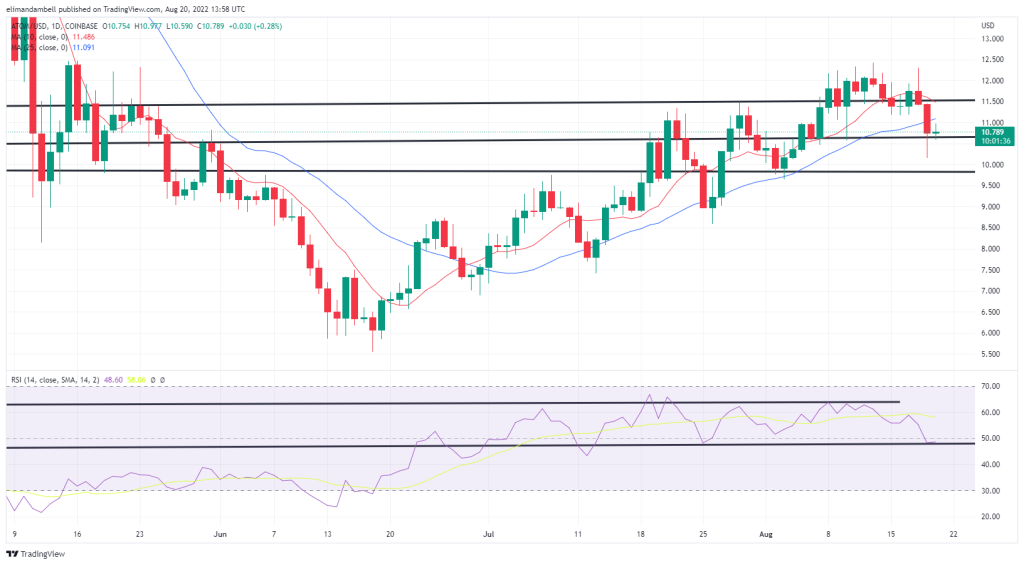
Cosmos (ATOM) was also trading slightly higher to start the weekend, as it too recovered from a recent losing streak.

Saturday saw ATOM/USD race to a high of $11.02, which is over $1.00 higher than yesterday’s bottom below $10.20.

Yesterday’s bearish pressure was not enough to send ATOM below $10.00, with bulls returning to the market, after a brief move below a key support point.

ATOM/USD – Daily Chart

The floor at $10.65 was marginally broken on Friday, however sentiment has since shifted, with some now anticipating a move nearer to a ceiling of $11.55.

As with SHIB, should ATOM bulls want to extend today’s rally, the RSI will need to significantly rise.

Currently the index is tracking at a floor of 48.05, however it would need to move towards a ceiling of 53 for prices to reach the potential target.

Register your email here to get weekly price analysis updates sent to your inbox:

Tags in this story

Do you expect cosmos to hit $11.55 this weekend? Let us know your thoughts in the comments.

Eliman Dambell

Eliman brings a eclectic point of view to market analysis, having worked as a brokerage director, retail trading educator, and market commentator in Crypto, Stocks and FX.

Image Credits: Shutterstock, Pixabay, Wiki Commons

Disclaimer: This article is for informational purposes only. It is not a direct offer or solicitation of an offer to buy or sell, or a recommendation or endorsement of any products, services, or companies. Bitcoin.com does not provide investment, tax, legal, or accounting advice. Neither the company nor the author is responsible, directly or indirectly, for any damage or loss caused or alleged to be caused by or in connection with the use of or reliance on any content, goods or services mentioned in this article.

Read disclaimer

Go to Source

Bitcoin, Ethereum Technical Analysis: BTC, ETH Extend Recent Declines During Saturday’s Session

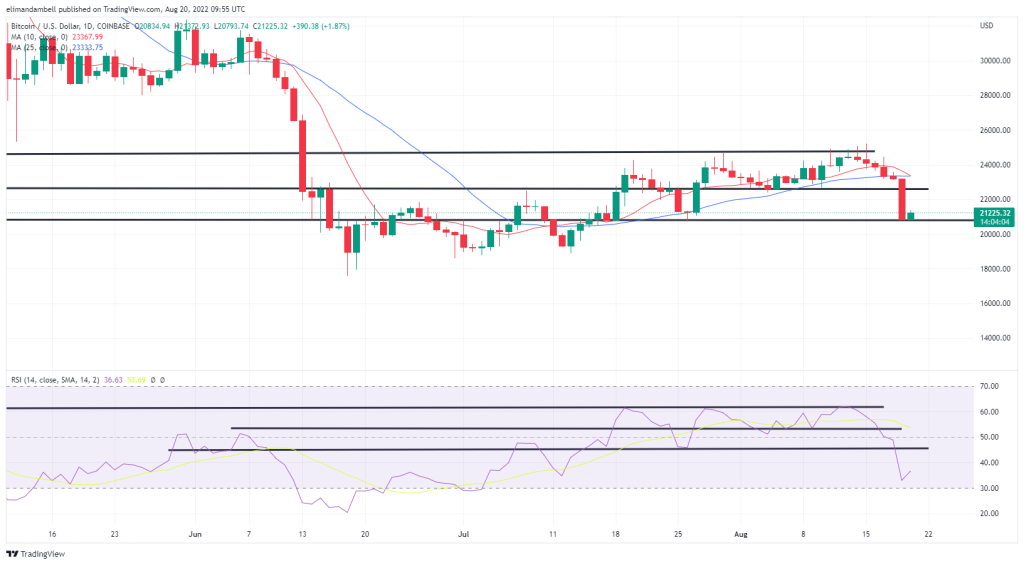
This week’s sell-off in cryptocurrency markets worsened on Saturday, with bitcoin falling below $21,000 for the first time in nearly a month. Ethereum also continued its descent in today’s session, as the price of the token dropped under the $1,700 level to start the weekend.

Bitcoin

Bitcoin (BTC) continued to reside in the red to start the weekend, as prices of the world’s largest cryptocurrency fell below $22,000.

Saturday saw BTC/USD fall to an intraday low of $20,868.85, with the token edging closer to a key support level.

This floor has been at the $20,800 point, which was last hit on July 16, when prices were trading below $20,500.

BTC/USD – Daily Chart

As a result of these declines, the 14-day relative strength index (RSI) dropped to a low of 32.97, which is its lowest point since July 12.

Bitcoin prices have since rebounded, and as of writing are back above $21,000. BTC is currently trading at $21,191.27.

Taking a closer look at the chart, it can be seen that the 10-day (red) moving average (MA), is nearing a downward cross with the 25-day (blue) MA.

Should this trend continue, this could signal further declines, with BTC likely falling below $20,000.

Ethereum

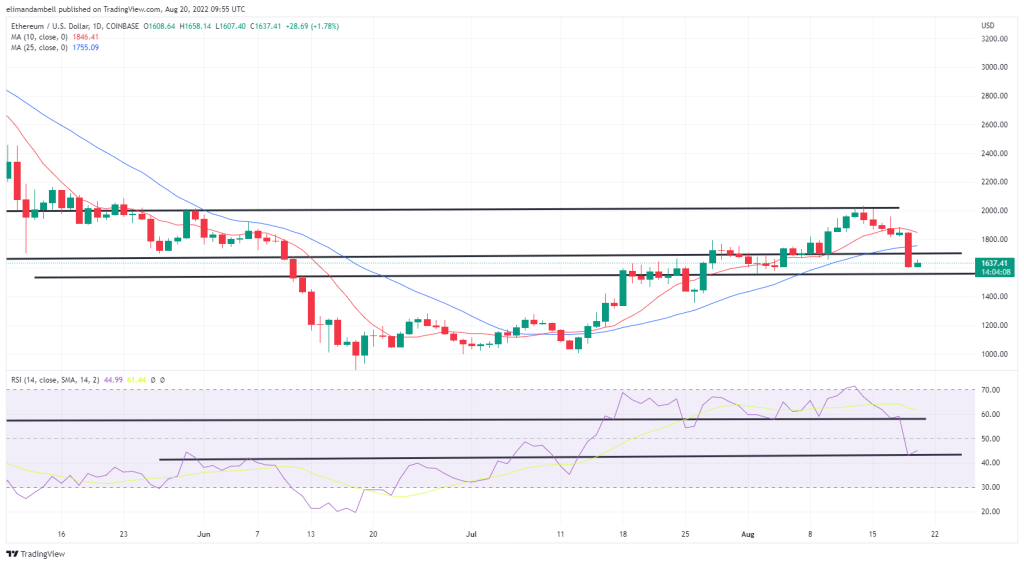
After a strong start to the week, ethereum (ETH) has begun the weekend trading over $400 away from Monday’s peak above $2,000.

ETH/USD, which dropped to a bottom of $1,695.15 on Friday, fell even lower in today’s session, hitting a low of $1,611.34.

This is the lowest level ethereum has traded at in the last sixteen days, after falling below the $1,600 level on August 4.

ETH/USD – Daily Chart

Honing in on the chart, it appears as if ETH bears are attempting to take prices towards a support point of $1,565.

However, bulls have so far resisted this possibility, pushing back from earlier lows, with the token currently trading at $1,636.11.

The rebound came as the RSI hit a floor of 43.00, and as of writing RSI is tracking at 44.90. Should this head back towards 50, we may see the token rise back above $1,700.

Register your email here to get weekly price analysis updates sent to your inbox:

Tags in this story

Do you expect ethereum to climb back above $1,700 this weekend? Leave your thoughts in the comments below.

Eliman Dambell

Eliman brings a eclectic point of view to market analysis, having worked as a brokerage director, retail trading educator, and market commentator in Crypto, Stocks and FX.

Image Credits: Shutterstock, Pixabay, Wiki Commons

Disclaimer: This article is for informational purposes only. It is not a direct offer or solicitation of an offer to buy or sell, or a recommendation or endorsement of any products, services, or companies. Bitcoin.com does not provide investment, tax, legal, or accounting advice. Neither the company nor the author is responsible, directly or indirectly, for any damage or loss caused or alleged to be caused by or in connection with the use of or reliance on any content, goods or services mentioned in this article.

Read disclaimer

Go to Source

Crypto Analyst Michaël van de Poppe Outlines What’s Next for Cosmos, Aave, Elrond and Two Ethereum Rivals

A popular analyst is digging into the charts to update his price targets for a handful of leading crypto assets.

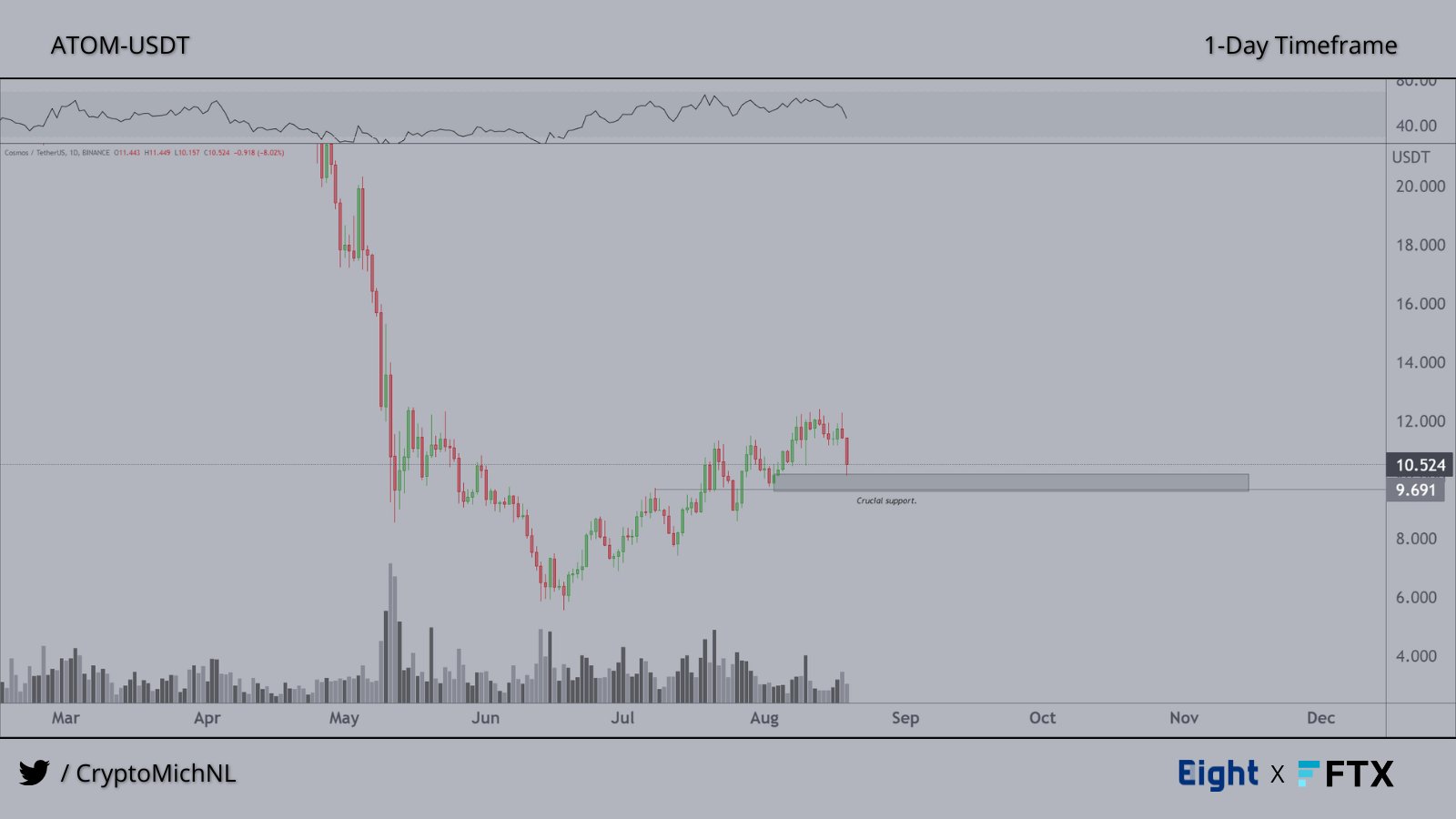
Michaël van de Poppe first tells his 622,600 Twitter followers that he’s keeping a close eye on support levels for scalability and interoperability ecosystem Cosmos (ATOM), which recently gave up gains from the latest leg of an extended rally dating back to mid-June.

“At massive levels of support here, which is reasonable for long entries.

If this one is lost, I’m looking at $8 next.

Holding here = potential trigger towards $18-20 in the coming month.”

Source: Michaël van de Poppe/Twitter

At time of writing, Cosmos is down 8.59% over the past 24 hours and priced at $10.83.

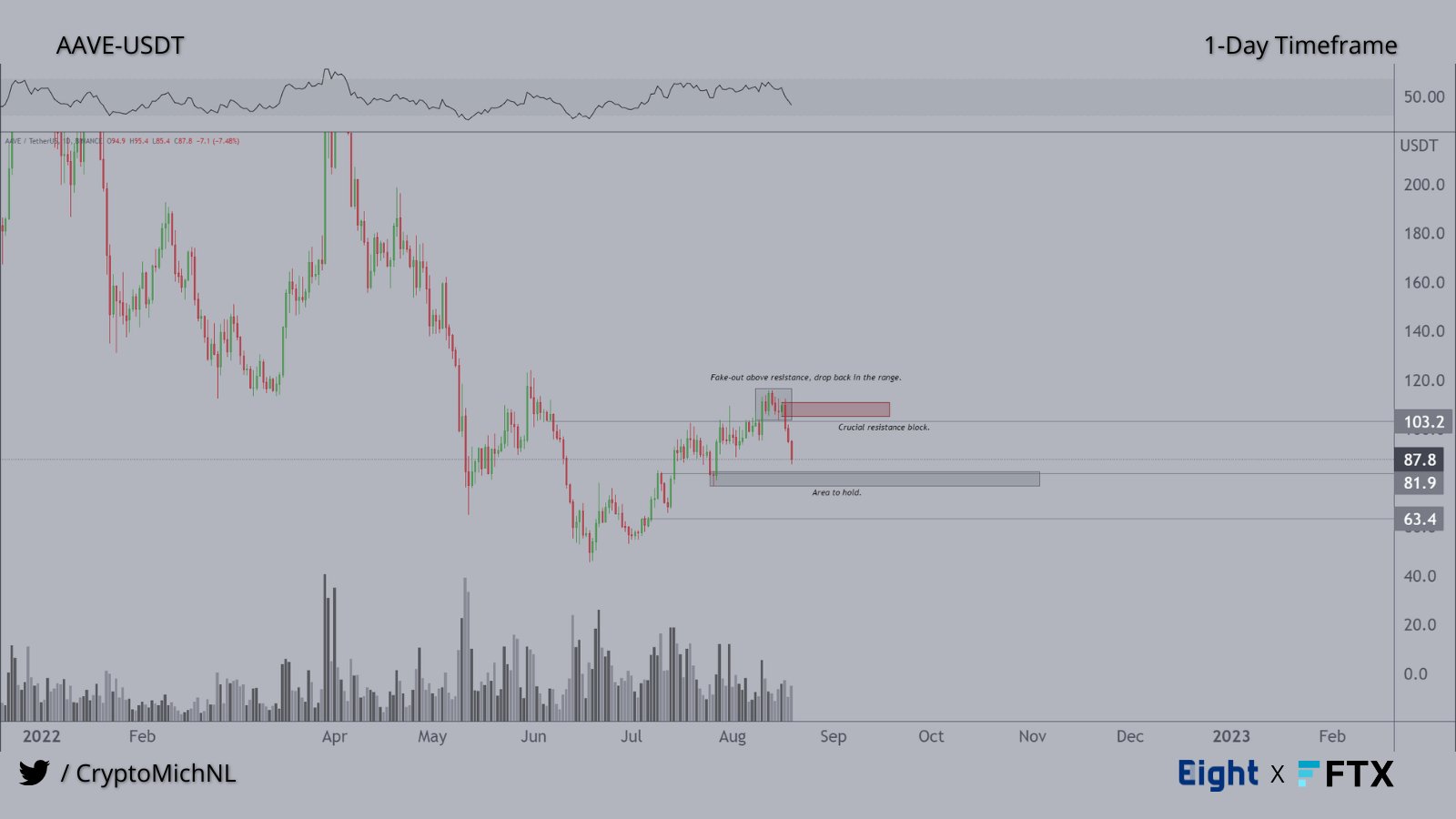
Moving on to crypto lending and borrowing protocol Aave (AAVE), the crypto strategist says that in light of the recent marketwide corrective, he sees the altcoin as a candidate for range trading with support at $80 and resistance at $103.

“This one is trending down as the entire market is correcting.

Fake-out above resistance and drop beneath $103 caused an acceleration of the correction.

Looking at $80-82 for support. Looking at $103 for crucial resistance. Range-bound plays.”

Source: Michaël van de Poppe/Twitter

Aave has been sliding into the red all week, currently down nearly 15% on the day and trading for $84.31.

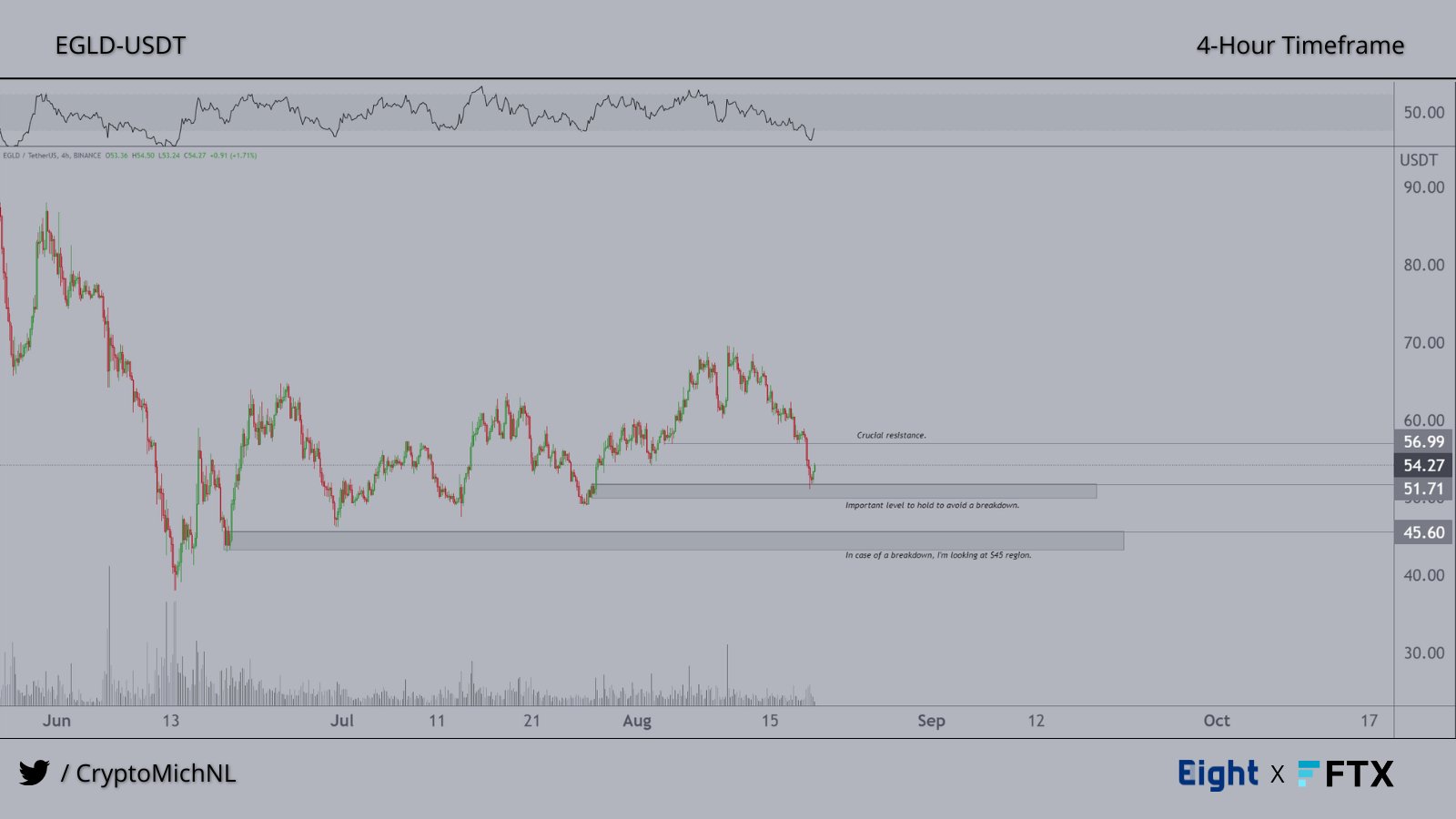
Also on Van de Poppe’s watchlist is enterprise-grade blockchain platform Elrond (EGLD), which has been steadily dropping since August 10th. The analyst is setting two levels of support: one at $50 and then $44 if the first capitulates.

“An important level of support and confluence on multiple timeframes.

Gap has been filled, which was practically the last one. Arguments for a bottom around the markets could be there.

Resistance at $57. Break there = new highs. Support: $50 and $44.”

Source: Michaël van de Poppe/Twitter

Elrond is down 8.79% and changing hands for $52.37. The altcoin was trading above $69 just a week ago.

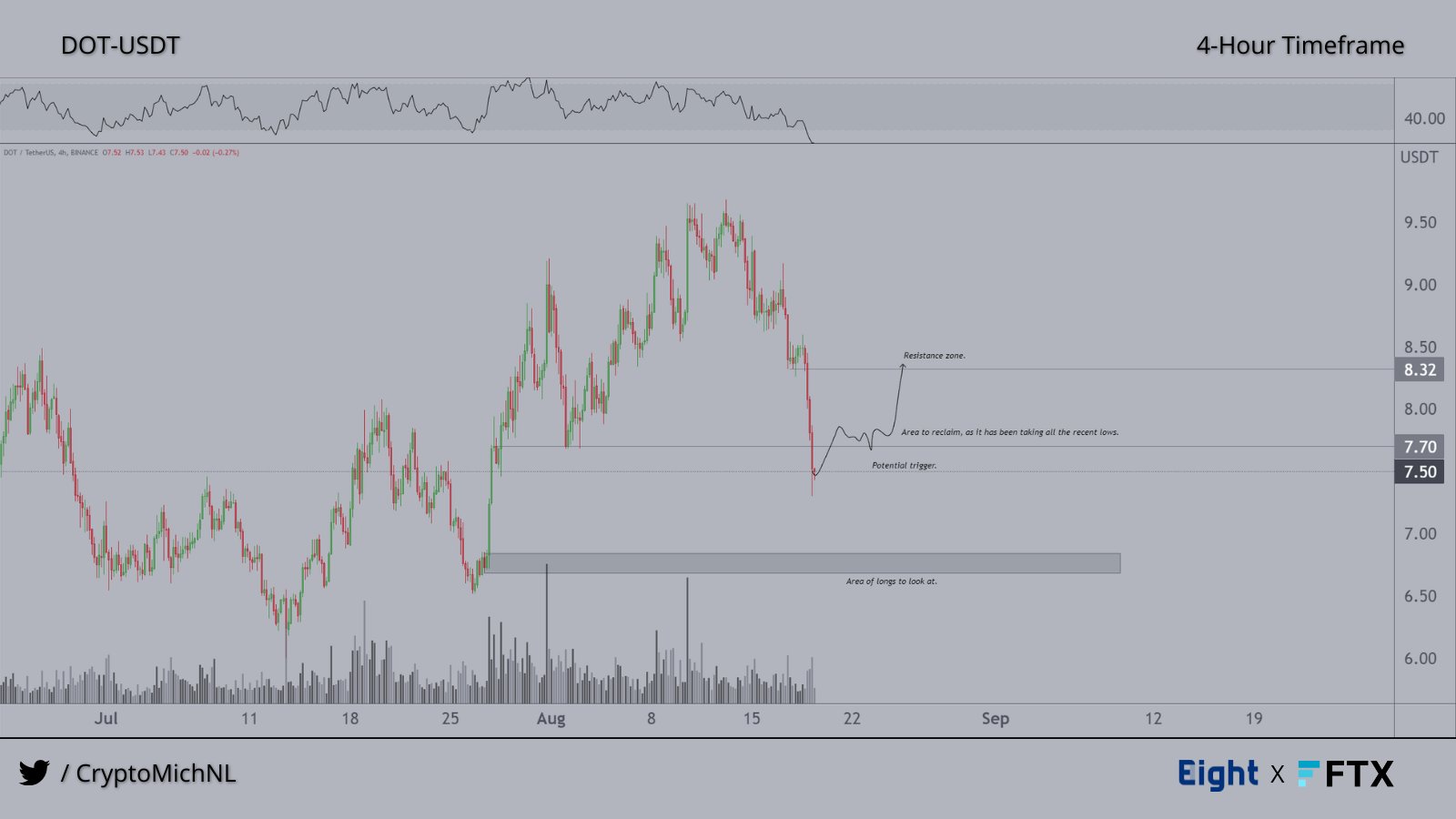
Regarding cross-chain interoperability protocol Polkadot (DOT), the crypto analyst thinks that a rally to $8.40 is possible if $7.70 is recaptured. However, Van de Poppe cautions about the potential for DOT to lose support at $7.

“Looking for a trigger on this one if we reclaim $7.70, as then a retest at $8.40 is likely.

Otherwise, the patience game happens, and you’ll have to see whether sub-$7 is a trigger for longs.”

Source: Michaël van de Poppe/Twitter

Polkadot’s price mirrors the overall crypto market slump to end the week, with DOT currently in the red by nearly 12.5% and valued at $7.35.

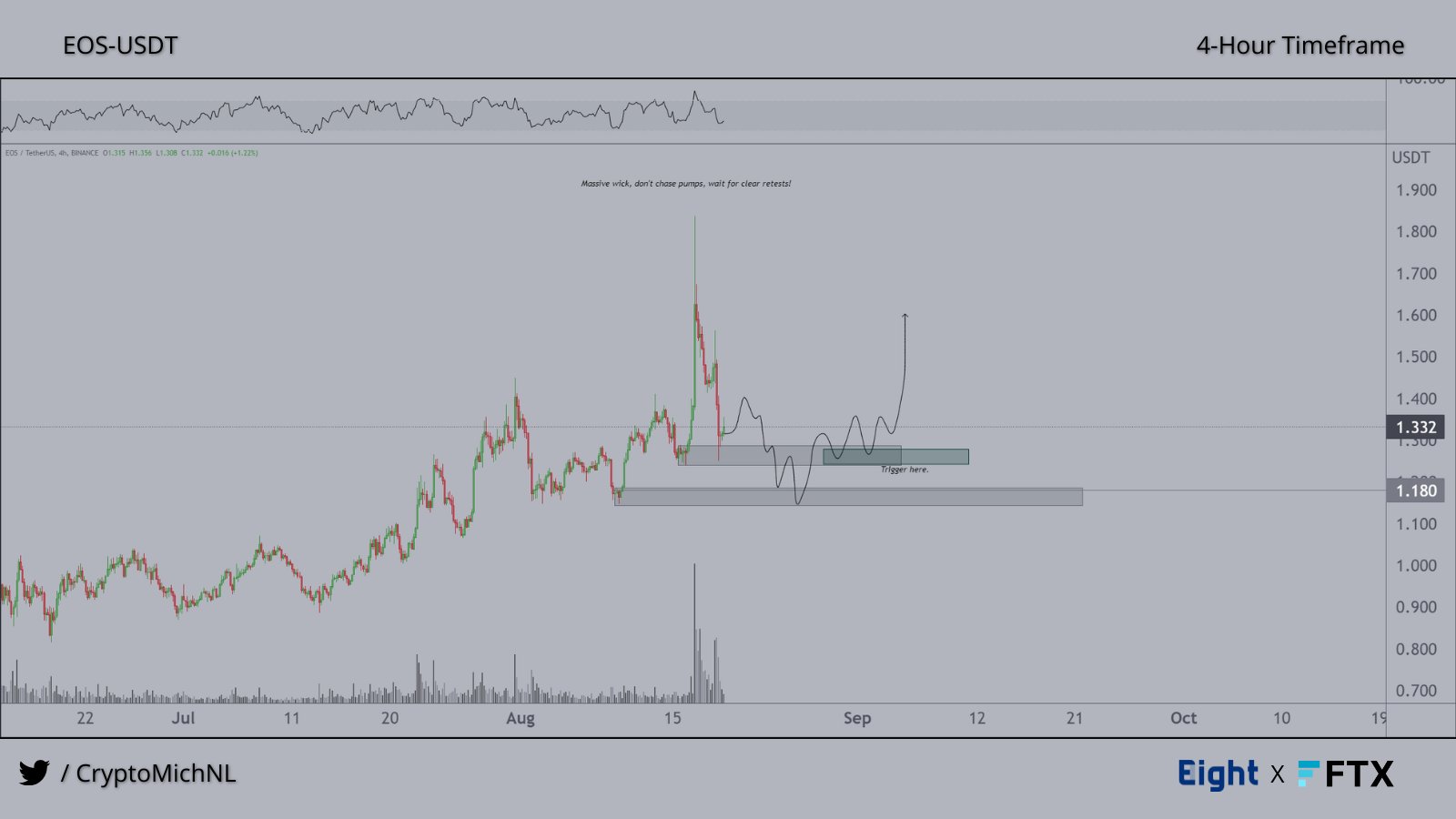
Last on Van de Poppe’s radar is EOS (EOS), an open-source and decentralized platform whose smart contract capabilities make it a direct competitor to Ethereum (ETH).

In response to the altcoin’s mid-week rally in defiance of broader market trends which was soon followed by a sharp corrective move, the trader advises his followers to not go running after coins that are already pumping.

“Looking at the structure, you should learn a lesson from this recent move of EOS. Avoid chasing pumps!

In this case, I’d be looking at confirmation if we dip to $1.18 and reclaim $1.30 afterward for longs. The same goes for reclaiming the $1.40 area.”

Source: Michaël van de Poppe/Twitter

Back on Tuesday, EOS leaped by 27.9% from $1.29 to $1.65, but has since worked its way back down. At time of writing, EOS is down 16.24% and changing hands for $1.27.

Don’t Miss a Beat – Subscribe to get crypto email alerts delivered directly to your inbox

Check Price Action

Follow us on Twitter, Facebook and Telegram

Surf The Daily Hodl Mix


Disclaimer: Opinions expressed at The Daily Hodl are not investment advice. Investors should do their due diligence before making any high-risk investments in Bitcoin, cryptocurrency or digital assets. Please be advised that your transfers and trades are at your own risk, and any loses you may incur are your responsibility. The Daily Hodl does not recommend the buying or selling of any cryptocurrencies or digital assets, nor is The Daily Hodl an investment advisor. Please note that The Daily Hodl participates in affiliate marketing.

Generated Image: StableDiffusion

Go to Source

Crypto Trader Who Predicted Bitcoin Collapse This Year Issues New BTC Warning

The crypto trader and analyst who accurately predicted that Bitcoin (BTC) would crash below $23,000 months prior is issuing a fresh warning on the flagship digital asset.

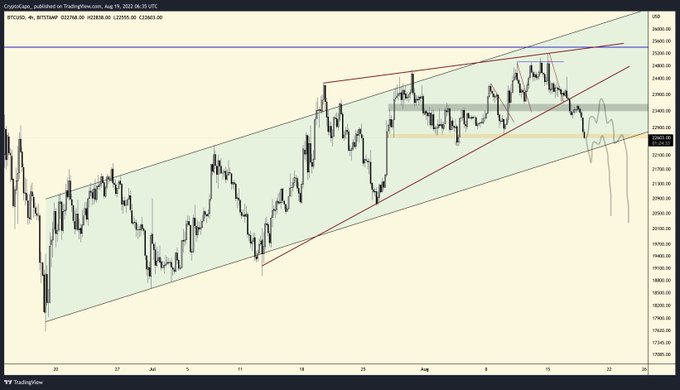
Pseudonymous crypto strategist Capo tells his 480,200 Twitter followers that it’s “just a matter of time” before Bitcoin falls to new lows.

In an update to an earlier analysis where he had laid out two differing scenarios for Bitcoin, Capo says that the flagship crypto asset has taken the bearish option that could lead to the price dropping below $21,000. The alternative scenario involved Bitcoin turning bullish over the short term.

“BTC. Second option playing out. Any test of $23,500 as resistance is a good sell opportunity. Consolidation below $22,500 (clean break + use the level as resistance) would be very bearish = $21,000 or lower. New lows are just a matter of time.”

Source: CryptoCapo/Twitter

Bitcoin is trading at $21,158 at time of writing, down over 7% on the day.

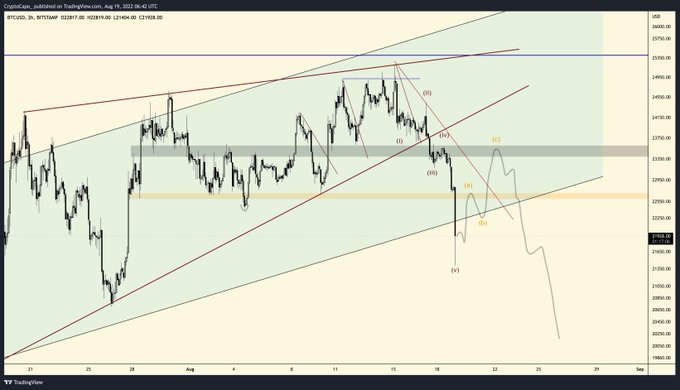
According to Capo, Bitcoin is currently in the fifth wave of the main downward trend but could correct to the upside in a three-wave pattern to the $23,500 level. The Elliott Wave theory states that the main trend of asset prices moves in a five-wave pattern (i, ii, iii, iv, v) while they undergo a correction in a three-wave pattern (a, b, c).

The crypto strategist says that $23,500 would act as strong resistance pushing Bitcoin towards the $20,000 key area.

“Option for the $23,500 test as resistance.”

Source: CryptoCapo/Twitter

In March when Bitcoin was trading at around the $40,000 mark, the widely followed crypto analyst predicted that the flagship crypto asset would fall to under $23,000. Bitcoin went on to hit a 2022 low of under $18,000 in June.

Don’t Miss a Beat – Subscribe to get crypto email alerts delivered directly to your inbox

Check Price Action

Follow us on Twitter, Facebook and Telegram

Surf The Daily Hodl Mix


Disclaimer: Opinions expressed at The Daily Hodl are not investment advice. Investors should do their due diligence before making any high-risk investments in Bitcoin, cryptocurrency or digital assets. Please be advised that your transfers and trades are at your own risk, and any loses you may incur are your responsibility. The Daily Hodl does not recommend the buying or selling of any cryptocurrencies or digital assets, nor is The Daily Hodl an investment advisor. Please note that The Daily Hodl participates in affiliate marketing.

Featured Image: Shutterstock/Tithi Luadthong/Edilus

Go to Source

Who accepts Ethereum as payment?

Taking payment in Ethereum brings in a gamut of advantages for both users and entrepreneurs.

Transitioning to a blockchain-based ecosystem brings in a string of advantages for users as well as entrepreneurs. Here is a drop-down detailing why accepting payment in Ethereum works well for the customers of an enterprise:

Additional payment option

In a world that is fast adopting cryptocurrencies, providing customers with an additional payment option gives businesses an advantage over their competitors. Cryptocurrency gateways enable merchants to accept digital payments and receive the amount in fiat.

Transparency

A decentralized ecosystem is inherently transparent, giving customers more confidence while making the purchase. Crypto transactions get executed on a blockchain where they are written irrevocably, without any prejudice of a centralized authority.

Less fraud

Ethereum transactions in such purchases get routed through a smart contract, making fraudulent activities less likely. When smart contracts are audited, scamsters have negligible chances of succeeding.

Quick transactions 

Global transactions in Ethereum are considerably quicker, compared to conventional international payments. Crypto transactions get executed in minutes, while fiat transactions routed through banks might take days to reflect in the account.

Enterprises too have a set of strong reasons to begin accepting ETH.

Finality

Finality refers to a transaction’s status when it is part of a block that cannot change. In Ethereum, conventionally working on proof-of-work (PoW) consensus algorithm, the average time for achieving finality is six minutes (25 confirmations) while the average time to mine a single block is 15 seconds.

This is considerably lower than Bitcoin (BTC), the largest cryptocurrency, which takes 60 minutes (six confirmations) to attain finality with the average time of 10 seconds to mine a block. When the Merge (the implementation of Ethereum’s consensus layer) is complete, the time it takes for an ETH transaction to reach finality will further decrease.

Data coordination 

Ethereum has a decentralized architecture designed to allocate information and trust without prejudice, eliminating any need for a central entity to coordinate data. The decentralized system seamlessly manages the system and processes transactions.

Incentive layer 

The ecosystem facilitates the development of mechanisms that reward supportive activities like verification and availability, while punishing activities that negatively affect the blockchain and surrounding mechanism. Incentives to promote honest behavior help to meet security requirements.

Tokenization 

Any asset that has been registered in a digital format can be tokenized on Ethereum. Tokenization helps fractionalize previously cumbersome assets such as real estate, which had become simply too expensive and unravel new economic models such as crowdsourced data management.

Decentralized domain 

Merchants with no prior exposure to crypto assets could find it overwhelming to send and receive cryptocurrencies. Crypto wallet addresses are a long string of digits and letters. Moreover, one requires a different address to collect each cryptocurrency payment.

Thanks to the Ethereum Name Service (ENS), users can create a universal nickname for all their public addresses. Rather than using an unreadable array of keys for receiving crypto payments, they could have a single ENS domain, like ‘Joseph.eth.’

Go to Source
Are non-KYC crypto exchanges as safe as their KYC-compliant peers?

Many see implementing Know Your Customer (KYC) tools in crypto as a deterrent to the Bitcoin (BTC) Standard, which has predominantly promoted anonymized peer-to-peer transactions. However, regulators stay put on promoting KYC and anti-money laundering (AML) implementations as a means to ensure investors’ safety and protection against financial fraud. 

While most crypto exchanges have begun implementing regulatory recommendations to remain at the forefront of crypto’s mainstream adoption, investors still have the choice to opt for crypto exchanges that promote greater anonymity by not imposing KYC processes. But does opting for the latter as an investor mean compromising on safety?

A matter of trust

Anonymity goes both ways in most cases. Owners of crypto exchanges running non-KYC (or non-compliant) operations often choose to remain anonymous to avoid legal scrutiny. As a result, investors must have a high level of trust in the people responsible for running the exchange.

On the other hand, decentralized exchanges such as dYdX use trustless protocols for establishing a community-controlled trading platform. This, in turn, instills trust within investors despite no mandate of KYC on the platform.

Therefore, monitoring the platform’s track record and the people running it becomes paramount when trading on non-KYC platforms.

Blockchain remembers forever

While the suits backing traditional finance portray crypto as tools of money laundering, illicit cryptocurrency transactions have consistently declined year-over-year. Despite the ease of using cryptocurrencies without KYC verification, a Chainalysis study confirmed that only 0.15% of all crypto transactions in 2021 were linked to illicit activities.

Moreover, immutable blockchain records allow authorities to retrace owners of the transactions, further deterring bad actors from using crypto — both KYC and non-KYC platforms — to fund their practices.

The permanent nature of blockchain has allowed authorities across the world to hunt down scammers, fraudsters and launderers of crimes they committed years ago.

Not your keys, not your coins

One of the biggest concerns when operating with crypto exchanges is the lack of control over the assets. Cryptocurrencies stored over crypto exchanges mean handing over the private keys to the exchange.

Using unvetted crypto exchanges that market no KYC requirements exposes investors to the risks of permanently losing their funds. While both types of exchanges — compliant and non-compliant to KYC — require investors to hand over their crypto assets to third parties, KYC-compliant exchanges instill greater trust among investors and regulators.

The answer to the question ‘Are non-KYC crypto exchanges safe?’ lies in understanding the abovementioned nuances. KYC or not, crypto investors remain equally vulnerable to the risks related to external factors such as the intent of the owner and shady business practices, in addition to getting no backing from the government.

Additionally, investing with a non-KYC crypto exchange comes with limitations on the trading value, available tokens and other services offered by the provider.

Go to Source

Holo (HOTUSD) Price May Penetrate $0.0020 Support Level, Tamadoge Obeying Bulls’ Command


The bears’ momentum is increasing in Holo market

HOTUSD Price Analysis – August 20

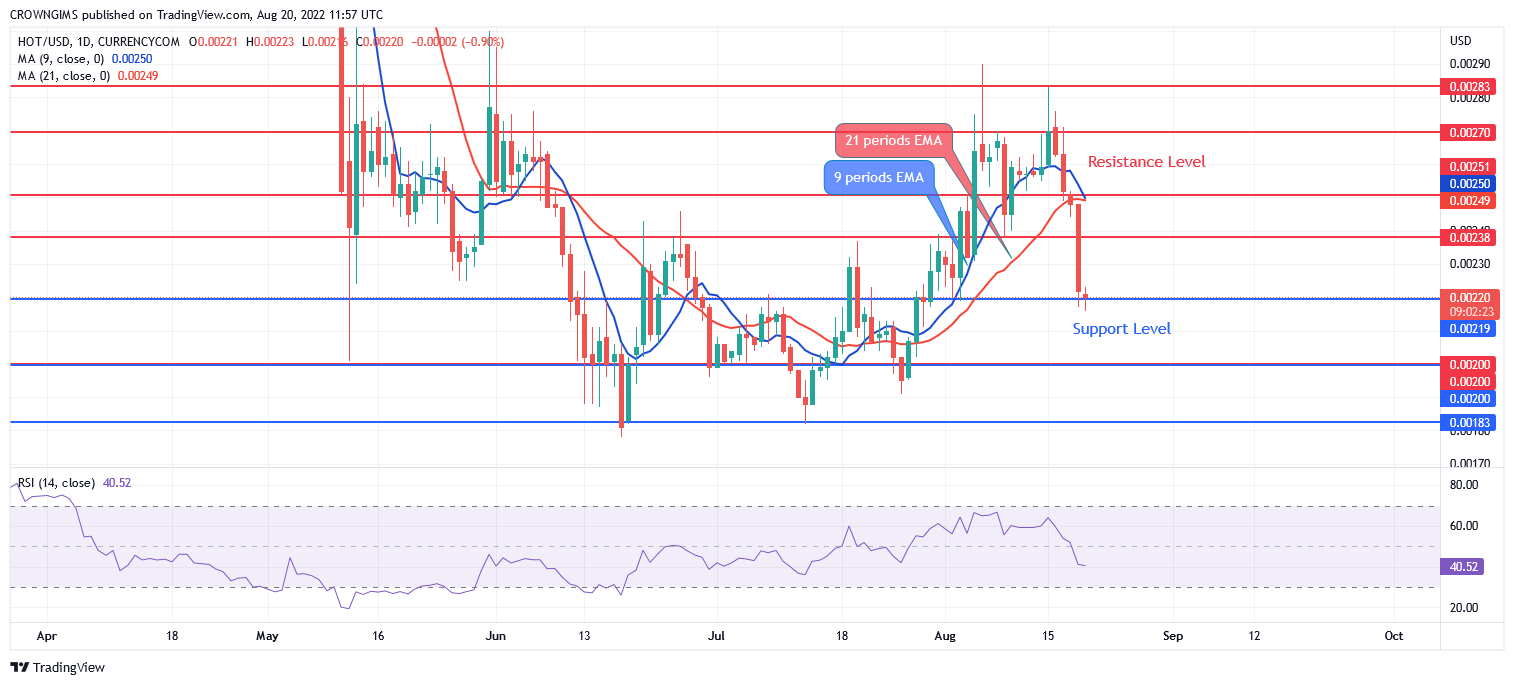
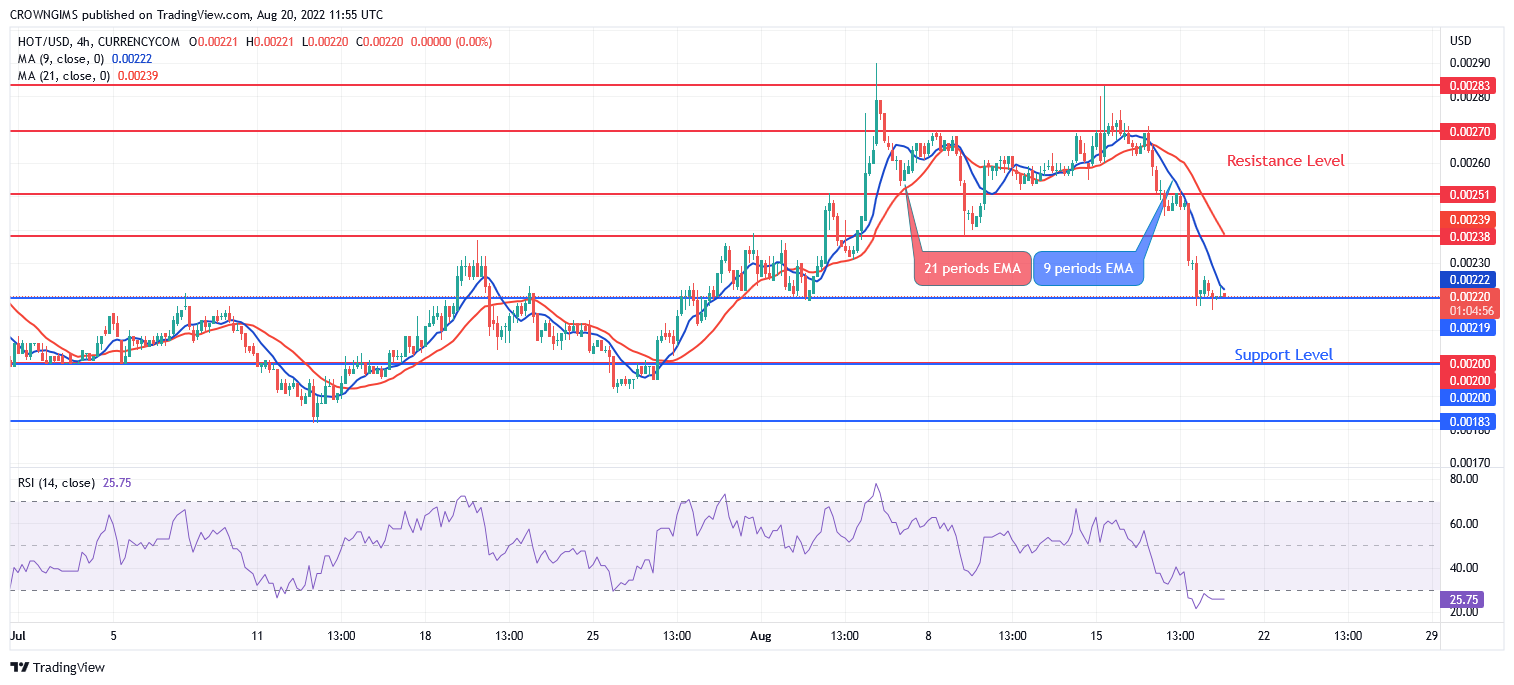
Further increase in the bears’ momentum will make the Holo to break down the support level of $0.0021; below it are $0.0020 and $0.0018 support levels. Should the $0.0021 support level holds, the price may reverse and face the resistance level at $0.0023, $0.0025 and $0.0027

Key levels:

Resistance levels: $0.0023, $0.0025, $0.0027

Support levels: $0.0021, $0.0020, $0.0018


HOTUSD Long-term Trend: Bearish

HOTUSD is bearish on the daily chart. The bulls took over the market on July 28 when the price reached the low of $0.0020 price level. A bullish engulfing candle pattern formed at the just mentioned level. The price obeyed this bullish command, the price incline towards the resistance level of $0.0028. The bulls could not break up the level.  The bears took over with the formation of bearish engulfing candles.  Price decline and the support level of $0.0022 is tested.

The fast Moving Average (9 periods) has crossed the slow Moving Average (21 periods EMA) downside and the price is trading below the two EMAs as a sign of bearish movement. Further increase in the bears’ momentum will make the price to break down the support level of $0.0021; below it are $0.0020 and $0.0018 support levels. Should the $0.0021 support level holds, the price may reverse and face the resistance level at $0.0023, $0.0025 and $0.0027. The relative strength index period 14 is pointing down at 40 levels to indicate a sell signal.

Buy Holo Now

 Your capital is at risk

 HOTUSD medium-term Trend: Bearish, Tamadoge Obeying Bulls’ Command

HOTUSD is bearish in the 4-hour chart. It seems the price action on 4-hour chart has formed a double top chart pattern at $0.0028 level. The price decline from the high of $0.0028 to the support level of $0.0022. The price is trying to break down the just mentioned level.

The currency has crossed over the 9 periods EMA and 21periods EMA downside and the former EMA is below the laterr EMA which indicates that the bears are in control of the market. The relative strength index period 14 is at 25 levels and the signal lines pointing down to indicate sell signal.

The Tamadoge presale is now live, and it is being conducted in multiple stages. The later presale rounds could see TAMA making notable gains as the demand for the token continues to grow. The third phase of the presale is nearing completion. The price of each TAMA token during the presale is currently set at 66.67 USDC. Currently, more than $4.3 million has been raised from the presale.

Related

  • How to Buy Tamadoge
  • Visit Tamadoge Website

Tamadoge – Play to Earn Meme Coin

Our Rating

  • Earn TAMA in Battles With Doge Pets
  • Capped Supply of 2 Bn, Token Burn
  • NFT-Based Metaverse Game
  • Presale Live Now – tamadoge.io

Visit Site

Go to Source

LEO Reverses Trend After Significant Gain, TAMA Aims for Better Performance


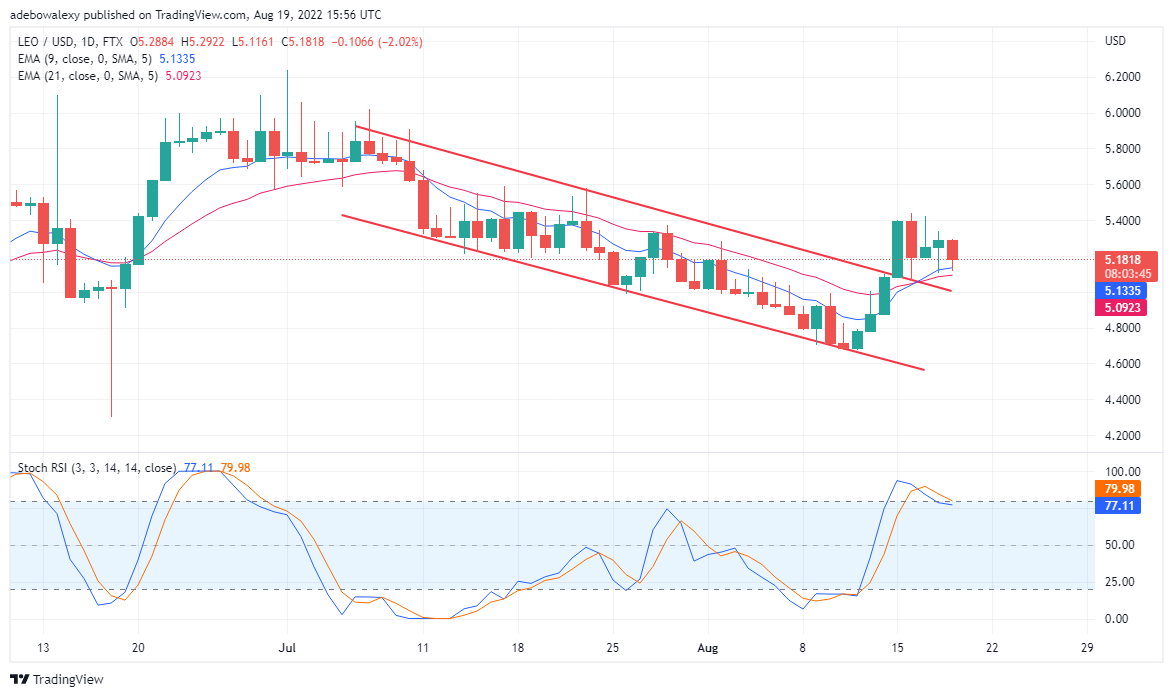
LEO has rallied significantly within the past few days, yet it is still within the reach of further upside gain. Precisely, this crypto has moved from around $4.700 to $5.400. However, there has been a price correction of nearly 31.4% downwards, nevertheless, after plus and minuses  the recorded gain since the initial stage till now is still significant. However, we need to take a close examination of what this market holds for traders that are entering this market.

LEO’s Forecast Statistics Data:
LEOs Current Price: $5.1818
LEOs Market Capitalization: $4.97 billion
LEOs Systemic Supply: 953.95 million
LEOs Overall Supply: 985.2 million
LEOs Coinmarketcap Position: #19

Key Levels:
Resistance: $5.1000, $5.2000, $5.4000
Support: $5.1818, $5.0900, $4.9000

LEO/USD Price Corrects, as Tamadoge Makes Plans To Start Well

LEO/USD price had rallied significantly before it bounced off $5.4000 and made a minor correction. However, attempts were made by the bulls to take UNUS SED LEO price higher, but they were too exhausted at this point. Furthermore, on this chart, it could be seen that the 9/22 days EMA is still under the price action. Also, these lines are very close to each other and additional buying pressure will push prices higher, as these lines will cross each other once more.

Although the Stochastic RSI indicator curves point downwards to indicate a minor correction, currently they are bending towards each other. An eventual crossing of these lines will initiate an upward reversal. Consequently, LEO bulls may regain strength and take the price higher. Traders can place buy orders for around $5.2200.

LEO Price Analysis: LEO/USD Appears to have commenced an Uptrend

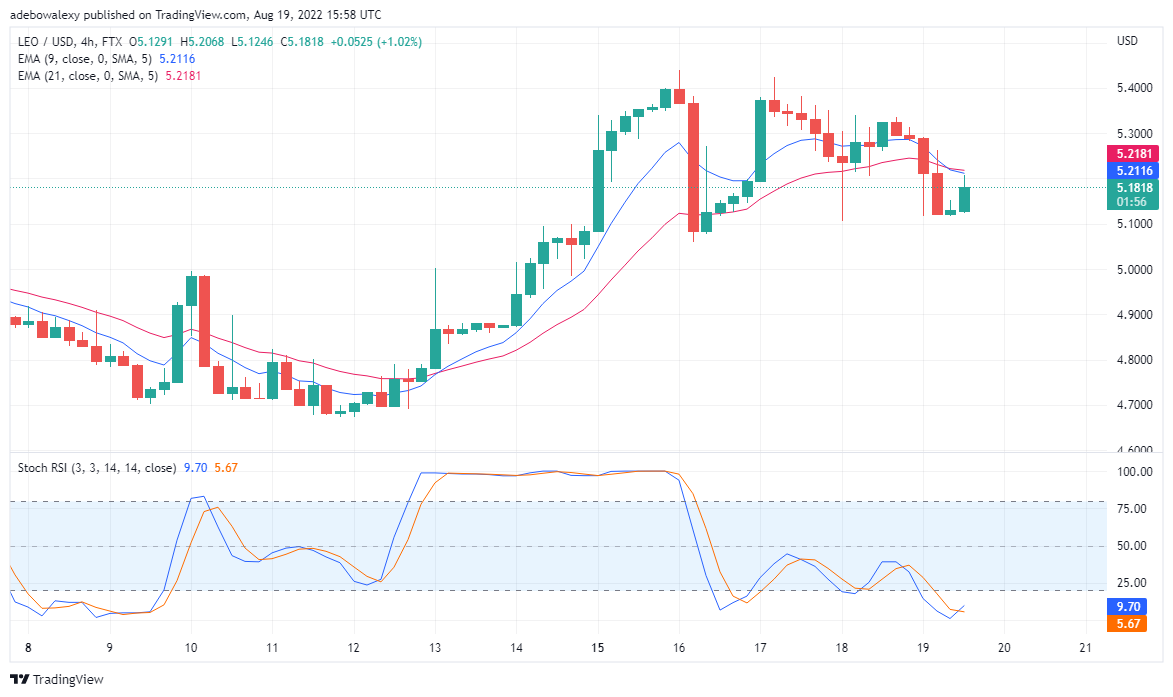
On the LEO/USD 4-hour chart, it can be perceived that price action is bullish. The last two candles on this UNUS SED LEO chart portray Bullishness in the market. In addition, the Stochastic RSI indicator is telling that price movement is also gathering strength gradually. This is because the lines of this Indicator have reached the oversold area and have made an upside facing cross. Consequently, this indicates that the price is set to rise further higher.

Buy LEO Now

Your capital is at risk.

Nevertheless, should selling pressure increase at this point, this may create a setback for the upcoming trend. Furthermore, it is logical to anticipate that more selling may occur here as some traders may want to take profit from here. Therefore it will be safe to place a stop at around $4.850, so if a downtrend resumes one will exit with significant profit.

Tamadoge is also securing strategic listings on centralized and decentralized exchanges as part of its roadmap. The first listing has already been secured on LBank. LBank is a centralized exchange, and the Tamadoge team is optimistic that TAMA could be paired with ETH to support the project’s rapid growth as it faces improved liquidity.

Related

  • How to Buy Tamadoge
  • Visit Tamadoge Website

Tamadoge – Play to Earn Meme Coin

Our Rating

  • Earn TAMA in Battles With Doge Pets
  • Capped Supply of 2 Bn, Token Burn
  • NFT-Based Metaverse Game
  • Presale Live Now – tamadoge.io

Visit Site

Go to Source
Please enter CoinGecko Free Api Key to get this plugin works.
Exit mobile version