DeFi Altcoin Defies Crypto Downturn, Surges Over 202% in 24 Hours Days After Binance Listing

A low-cap decentralized finance (DeFi) altcoin has skyrocketed by more than 130% in the past 24 hours after being listed by top crypto exchange Binance.

On Thursday, Binance rolled out support for Stargate Finance (STG), an Ethereum-based DeFi protocol that enables the transfer of virtual assets across different blockchains.

The exchange listed the token in its “Innovation Zone,” a dedicated trading space for assets that could be more prone to rapid price swings.

Stargate Finance aims to make the process of swapping crypto assets across blockchains simpler and more efficient by eliminating the need to use wrapped tokens. Wrapped tokens represent digital assets on blockchain networks they are traditionally not compatible with.

STG, the project’s native governance token, skyrocketed to $1.03 up from around $0.33 in a 24-hour span for gains of over 202%. However, the 224th-ranked crypto asset by market cap still remains down more than 78% from its all-time high of $4.27, which it hit in April.

At time of writing, STG is trading for $0.87.

Binance isn’t the first major exchange to list STG this month. Earlier in August, Coinbase officially rolled out trading services for Stargate Finance after adding the project to its listing roadmap in late July.

Coinbase created the listing roadmap earlier this year to increase transparency and reduce the possibility of frontrunning their listing announcements.

Don’t Miss a Beat – Subscribe to get crypto email alerts delivered directly to your inbox

Check Price Action

Follow us on Twitter, Facebook and Telegram

Surf The Daily Hodl Mix


Disclaimer: Opinions expressed at The Daily Hodl are not investment advice. Investors should do their due diligence before making any high-risk investments in Bitcoin, cryptocurrency or digital assets. Please be advised that your transfers and trades are at your own risk, and any loses you may incur are your responsibility. The Daily Hodl does not recommend the buying or selling of any cryptocurrencies or digital assets, nor is The Daily Hodl an investment advisor. Please note that The Daily Hodl participates in affiliate marketing.

Featured Image: Shutterstock/JLStock/Sensvector

Go to Source

Why You Can Trust The Top-Rated BTC Casinos in Canada

Casinos have been given a bad rap over the years due to the dubiousness of many land-based platforms, but BTC casinos are trying to earn trust.

Without a doubt, this is something BTC casinos in Canada have achieved. Therefore, it is now up to these platforms to undo the damage done by some illegal casinos.

Furthermore, Bitcoin (BTC) use in casinos has shifted bettors towards buying cryptocurrency in Canada. These platforms have provided a profitable means of playing casino games far better than other establishments. Unfortunately, the skepticism of many Canadian bettors has hindered them from benefiting from these Bitcoin-operated sites.

Canadian gamblers do not easily place their trust in any gambling platform despite being viewed as one of the nicest people in the world.  These bookies must meet specific requirements for bettors to stay to gain this trust. Therefore, this article will give punters reasons why the top BTC casinos in Canada are trustworthy. 

RELATED ARTICLES

Why Gamble with Bitcoin

The BTC currency is a global means of processing transactions, with Canadians using it regardless of location. It is the first cryptocurrency, meaning it is popular amongst crypto enthusiasts. In addition, it is the most owned and traded coin, making it the most valuable in the crypto market. Therefore some reasons to gamble with Bitcoin are listed below.

● Readily Available

With Bitcoin (BTC) being the most popular cryptocurrency, it is therefore readily available for Canadians to hold or purchase. There are numerous ways of getting Bitcoin, through a peer-to-peer sale or a crypto exchange platform. Furthermore, with a crypto wallet, they can hold the coin for an extended time.

● Accepted on a Global Level 

Canadians who own BTC can fund their casino profile from many parts of the world. Furthermore, unlike fiat currency, Bitcoin is not limited or controlled by any governing bodies or institutions. Therefore, gamblers who find it difficult to fund their accounts overseas can circumvent this issue.

● Transactions are Not Time-Consuming

Registered customers of BTC casinos in Canada can testify to the speed of the Bitcoin currency. Compared to fiat currency-operated casino bookies, Bitcoin transactions are quick and less time-consuming. In addition, transactions are confirmed quickly, with it being able to process multiple transactions in a second. 

● A Cost-effective Means of Gambling

With the absence of any financial institution imposing heavy levies on transactions, gambling with BTC has proven to be very cost-effective. For example, in Canada today, the government is entitled to a specific amount for many online transactions. Furthermore, with fiat currency-operated casinos also working with third-party financial institutions for their payments, it increases the charges imposed on bettors.

Why You Can Trust the BTC Casinos in Canada

The quality BTC casinos in Canada have gone out of their way to ensure they gain the trust of Canadian punters. These platforms possess many features a legit gambling platform should have, making them a trustworthy establishment for bettors. Therefore we’ve discussed a few reasons bettors can place their trust in BTC casinos in Canada.

● Licensing and Regulators are of Premium Quality

BTC Casinos in Canada operate with the best in licensing on their platforms. Furthermore, an excellent and trustworthy casino is determined by its license type. A gaming license helps to show bettors that these sites are regulated.  Therefore they provide a fair and transparent betting platform for Canadians. 

The licensing helps to show that this site has met the required standard it is supposed to have. Also, it proves that the casino is legitimate because it operates under a country’s jurisdiction. There are many premium quality licenses BTC casinos in Canada work with, such as the Kahnawake Gaming License, Ontario gaming, and lottery license, Malta Gambling Authority License, and the Curacao eGaming license. 

● Games are of Industry Standard 

A good and trusted BTC casino would not work with low-quality game providers or sub-standard slot machines. The quality of the game offered to Canadian bettors will help them determine if a site can be trusted or not. Therefore many BTC casinos in Canada thrill their customers with a large assortment of top-quality games, which gives Canadians an enjoyable gambling experience. 

BTC casinos provide so many gambling options for Canadians. These bettors have access to games like live poker, roulette, blackjack, dice, craps, baccarat, and others. Furthermore, slot gambling lovers are not left out with over 50 plus slot games, and all with a high RTP.

● Their Platforms are Secure and Encrypted

In crypto-based casino establishments, the security of their platform and customers is of utmost priority. Since these casinos operate with Bitcoin, it uses blockchain technology to process transactions. 

Furthermore, to avoid being hacked, BTC casinos in Canada regularly run tests on their sites’ security systems to ensure that there are no loopholes hackers could use. In addition, it also has an added level of security with these casinos using 128-bit SSL encryption on their sites.

● Reliable Customer Support 

When gambling, no matter the means used, be it online casinos or land-based casinos, you may undoubtedly experience challenges in which you might need help. Therefore, a good and reliable customer support system shows that these bookies value their customers. In addition, multiple selections of means bettors can use to prove that bettors can trust BTC casinos in Canada. 

A 24/7 live chat option is the crucial feature Canadians should look for in a bookies site. With this feature, you are constantly communicating with a customer care representative who can help you in the nick of time. In addition, other options like phone calls, email, and social media handles should also be made available to gamblers. 

● Terms and Conditions are Crystal Clear

Most casinos are not transparent in their terms and conditions section. Many hide specific rules that could prove detrimental to customers. BTC casinos in Canada’s Ts and Cs are understandable and easy to grasp.

Disclaimer: information contained herein is provided without considering your personal circumstances, therefore should not be construed as financial advice, investment recommendation or an offer of, or solicitation for, any transactions in cryptocurrencies.

Go to Source
BTC Awaits Possible Breakout while Tamadoge Remains at the Upside


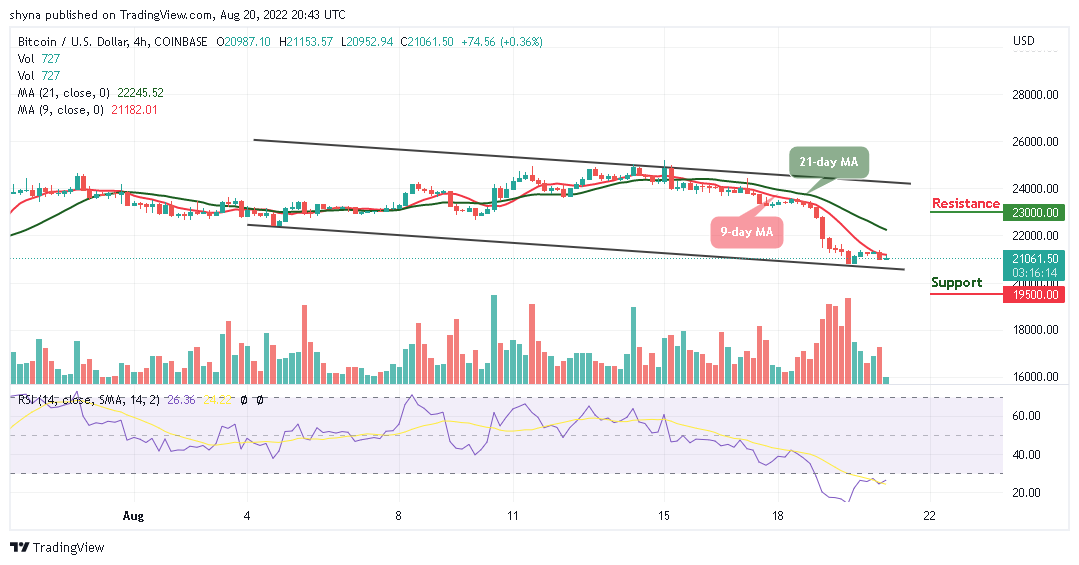
After touching the low of $20,782, BTC is currently trading at $21,067 as the coin seems to be preparing for another upward movement.

Bitcoin Prediction Statistics Data:

  • Bitcoin price now – $21,067
  • Bitcoin market cap – $404billion
  • Bitcoin circulating supply – 19.1 million
  • Bitcoin total supply – 19.1 million
  • Bitcoin Coinmarketcap ranking – #1

BTC/USD Long-term Trend: Ranging (Daily Chart)

Key levels:

Resistance Levels: $28,000, $30,000, $32,000

Support Levels: $15,000, $13,000, $11,000

Buy Bitcoin Now

Your capital is at risk

BTC/USD is trading below the 9-day and 21-day moving averages at $21,067 as the coin prepares to establish a bullish movement. At the time of writing, the first digital coin is likely to extend towards the resistance level of $22,000 if the bulls put more pressure on the market.

BTC Ready for A Cross Above $21k as Tamadoge Appears Bullish

The Bitcoin price is heading towards the upside, trying to create a bullish movement. Any further bullish movement above the 9-day and 21-day moving averages could locate the potential resistance levels at $28,000, $30,000, and $31,000. Nevertheless, if BTC/USD soars and crosses the upper boundary of the channel, this could be a sign of sustainability and may result in a bullish continuation.

However, if the Bitcoin price fails to move up; traders may see another price cut towards the lower boundary of the channel; a further low could bring the price to the support levels at $15,000, $13,000, and $11,000 respectively. But as it stands, the Bitcoin price is likely to rise as the technical indicator Relative Strength Index (14) moves to cross above the 35-level.

BTC/USD Medium-term Trend: Ranging (4H Chart)

According to the 4-hour chart, the market is following a sideways movement below the 9-day and 21-day moving averages as the bulls are coming back into the market to push the king coin to the upside. If not, the support level of $19,500 and below may come into play.

However, if the bulls push the market above the moving averages, traders may expect a retest of the $22,000 resistance level, and breaking this level may further push the price towards the resistance level of $23,000 and above as the technical indicator Relative Strength Index (14) prepares to leave the oversold region.

BTCUSD – 4-Hour Chart

The Tamadoge team is celebrating the notable success of the presale by launching a $100,000 giveaway. There are multiple ways that people can participate in the prize pool. However, the requirement for those who want to participate in the prize pool is to hold a minimum of $100 worth of TAMA tokens on the day of the draw.

Tamadoge – Play to Earn Meme Coin

Our Rating

  • Earn TAMA in Battles With Doge Pets
  • Capped Supply of 2 Bn, Token Burn
  • NFT-Based Metaverse Game
  • Presale Live Now – tamadoge.io

Visit Site

Related:

  • How to Buy Tamadoge
  • Visit Tamadoge Website

Go to Source

Largest Ethereum miner, Ethermine, stops processing sanctioned transactions

The hope of a decentralized, open, free internet is in jeopardy right now. This is not hyperbole, FUD, or clickbait. Ethermine, the largest Ethereum mining pool, no longer produces blocks containing Tornado Cash transactions. This is likely due to OFAC sanctions and is an example of censorship at the protocol level.

Crypto analyst, Takens Theorem, discovered that Ethermine has stopped processing Tornado Cash transactions and presented the chart below. CryptoSlate reviewed on-chain data and confirmed that Ethermine had not produced a block that included a Tornado Cash transaction during the timeframe shown below.

We have to go back roughly ten days to find a block produced by Ethermine that includes a Tornado Cash transaction. Block 15306892 was created on August 9th and was mined by Ethermine. The block had a 10 ETH transaction processed through the Tornado Cash router.

A review of the most recent Tornado Cash Router transactions showed that it was dominated by Hiveon, P2Pool, 2Miners, and others.

Why does this matter?

Why does this matter? Recently, the U.S., via OFAC, sanctioned the use of Tornado Cash, making it illegal for any U.S. entity to interact with the protocol.

Following this sanction, Circle “blacklisted” USDC on the Ethereum network so that any holder who had interacted with Tornado Cash would no longer be able to interact with the smart contract. This move essentially froze all $USDC that had passed through Tornado Cash.

Next, DeFi protocols such as Aave, Uniswap, Balancer, and others introduced an API from TRM Labs, which disabled the front end of their dApps, essentially banning addresses sanctioned by OFAC.

Aave reportedly restored access to addresses that had been “dusted” with 0.1 ETH by a hacktivist attempting to highlight one of the critical issues with adhering to the sanctions. According to OFAC, any address that interacted with Tornado Cash was now under sanction from the U.S. Thus, when the hacktivist sent 0.1 ETH to several influential people in the crypto space, it showcased that the sanctions could easily be exploited.

While it is arguably good that Aave has restored access to those high-profile people who were targeted, the question remains, “what will happen to users who are targeted by such an attack in future?”

If I don’t like my boss, so I send him 0.1 ETH through Tornado Cash, will he also now be banned from Aave? If so, how will Aave prove that his claim is legitimate? Banned users can still either fork the protocol or interact via CLI, but this is out of the reach of most users.

The choice by Ethermine to stop producing blocks that include Tornado Cash transactions is a step beyond any of the above. Selecting which transactions to process goes against the core principles of the Ethereum blockchain. The network is supposed to be open-source, free, decentralized, and inclusive.

Censorship at a protocol level

While other miners are still processing the transactions at present, if others follow Ethermine’s lead, there is a possible world where Tornado Cash no longer has miners willing to process its transactions.

Vitalik Buterin was so outraged at the thought validators may comply with OFAC sanctions after The Merge that he declared any validators complying with the sanctions should have their ETH staked burned. He agreed with the sentiment that actions that do not include Tornado Cash transactions should be considered “an attack on Ethereum and burn their stake via social consensus.”

When discussing the possibility of proof-of-stake validators ignoring Tornado Cash transactions, Igor Mandrigin, CTO of web3 infrastructure company Gateway.fm, told CryptoSlate,

“It is not impossible technically to not propose blocks with TC, ignore from the transaction pool… but the fewer validators are under US regulations, the better ofc.”

Within a day of the above conversation, we now see a real-world example of proof-of-work validators ignoring Tornado Cash blocks.

Ethermine is not a U.S.-based company and therefore does not fall under the jurisdiction of the OFAC sanctions. However, miners that use the Ethermine pool could be situated within the U.S. If Ethermine mines a block that includes a Tornado Cash transaction, it could be considered interacting with Tornado Cash, thereby breaking the sanctions.

Initial community reaction

In response to the news, Martin Koppelmann, Co-Founder of Gnosis, disagreed with a comment suggesting “it does not matter.”

Co-Founder of Paradigm, Matt Huang, recently reiterated the importance of the blockchain ecosystem to remain “neutral and resist censorship.”

Harsh Rajat, Founder of Ethereum Push Notification Service, shared similar concerns telling CryptoSlate,

“Regulations to ban an open source tech is similar to bringing charges against ford for inventing cars. It’s saddening to see that projects that are good are forced to comply with regulations owing to fear of getting targetted or because the regulations are written in such a way. Though, even more tragic is the way someone did a knee jerk reaction and bought in laws that simply can’t be applied to web3. “

Regarding a solution, Rajat stated, “simply put, we need to stop bad actors but not the inventions that help us progress forward.”

No entity within the Ethereum ecosystem should be able to decide what is included in blocks and what is not. While the news is startling, it is not yet a crisis. No other mining pools appear to be following Ethermine’s lead, and Ethereum validators such as Coinbase have categorically stated they will not censor transactions after The Merge.

However, this is a dangerous road to be traveling along. This is not the direction toward a free and fair decentralized internet; it is several steps backward and potentially the path to an even darker future.

The Tornado Cash code itself does nothing illegal and is fully open-sourced. We do not imprison gun manufacturers when they are used against innocent people. The government does not assume blame when a criminal uses cash for an illegal transaction. By the same arguments, the code written by the Tornado Cash team is not responsible for those who launder money through the protocol.

Tornado Cash has legitimate uses and is a privacy tool at its core. In my opinion (Akiba), the authorities should investigate and trace how the money got to Tornado Cash and what it was used for after, as that’s where the illegal activity can be found.

There is a possibility that it is merely a coincidence that no Tornado Cash transactions have been included in Ethermine blocks. However, given it produces around one-third of the network’s hashrate, it is unlikely.

CryptoSlate reached out to Ethermine for comment but has received no response. A moderator on the Discord forum told CryptoSlate that “Ethermine/BitFly is a registered GmbH so they’re beholden to Austrian laws, so the possibility exists that it’s a compliance move. I could not say for certain however and I’ll defer to the admin team.”

Original research and findings by Oluwapelumi Adejumo.

UPDATE: Headline revised to improve clarity.

Go to Source

Leading Japanese Online Broker SBI to Pull Out of Russia’s Crypto Mining Sector

SBI Holdings, the largest online brokerage in Japan, is shutting down its crypto mining business in the Russian Federation. Amid mounting uncertainty over the future of such investments due to the ongoing conflict in Ukraine, as well as decreased mining profits, the financial firm said it plans to sell its equipment and withdraw.

Japan’s SBI Broker to Complete Withdrawal From Russian Mining Industry

Access to low-cost power and suitable climatic conditions made Russia an attractive destination for cryptocurrency miners when China cracked down on the industry in May of 2021. However, sanctions imposed over Moscow’s decision to attack Ukraine this year have hit bitcoin mining, among other Russian industries.

One of the largest mining data-center operators with significant presence in Russia, Switzerland-based Bitriver, was targeted by the U.S. Treasury Department this spring. Then the U.S. company Compass Mining sought to liquidate $30 million in mining hardware installed in Siberia in order to avoid Western sanctions.

Russia’s invasion of Ukraine has created uncertainty over the prospects of the mining business in the energy-rich region, while the crypto market’s downturn has made it less profitable to mint digital currencies, a representative of SBI, the biggest online broker in Japan, told Bloomberg. Chief Financial Officer Hideyuki Katsuchi unveiled that the company plans to sell its equipment and withdraw from Russia.

SBI entered the digital asset space earlier than other Japanese financial firms, but this year’s negative developments have led to a pre-tax loss of 9.7 billion yen ($72 million) from its crypto business in the second quarter, when the group also registered a 2.4 billion yen net loss (over $15.8 million), a first in a decade.

The Japanese brokerage suspended its mining activities in Siberia shortly after the war in Ukraine broke out, but it is yet to decide by when it will complete the withdrawal from Siberia, Katsuchi noted. The financial company has no other crypto business in Russia, the executive pointed out, but it intends to continue operating its Moscow-based commercial banking unit, SBI Bank. The move comes after in July, U.S. diplomats reportedly urged authorities in Tokyo to pressure Japanese crypto exchanges and miners to sever ties with Russia.

In April, the International Monetary Fund (IMF) warned in a report that crypto mining may offer Russia and other sanctioned nations, like Iran for example, a way to circumvent economic and financial restrictions imposed by the U.S. and its allies. These countries can use their energy resources to power mining facilities and generate revenue from the extraction of cryptocurrencies and transaction fees.

According to a recent study, electricity consumption in Russia’s crypto mining sector has been constantly rising in the past few years, registering an almost 20-fold increase over the five-year period since 2017. Siberia’s Irkutsk, offering some of the lowest electricity rates in the country, is one of the most attractive regions for miners, alongside the capital Moscow where they can take advantage of well-developed energy and other infrastructure.

Tags in this story
conflict, Crypto, crypto miners, crypto mining, Cryptocurrencies, Cryptocurrency, cryptocurrency miners, cryptocurrency mining, Japan, japanese, Mining Operations, restrictions, Russia, russian, Sanctions, SBI, SBI Holdings, U.S., Ukraine, United States, War

Do you know of other Japanese companies ending their crypto mining operations in Russia? Tell us in the comments section below.

Lubomir Tassev

Lubomir Tassev is a journalist from tech-savvy Eastern Europe who likes Hitchens’s quote: “Being a writer is what I am, rather than what I do.” Besides crypto, blockchain and fintech, international politics and economics are two other sources of inspiration.

Image Credits: Shutterstock, Pixabay, Wiki Commons, T. Schneider

Disclaimer: This article is for informational purposes only. It is not a direct offer or solicitation of an offer to buy or sell, or a recommendation or endorsement of any products, services, or companies. Bitcoin.com does not provide investment, tax, legal, or accounting advice. Neither the company nor the author is responsible, directly or indirectly, for any damage or loss caused or alleged to be caused by or in connection with the use of or reliance on any content, goods or services mentioned in this article.

Read disclaimer

Go to Source
Yuga Labs Officially Releases IP Rights Tied to Cryptopunks, Meebits NFTs — Galaxy Digital Report Criticizes BAYC License

Yuga Labs, the company behind the Bored Ape Yacht Club (BAYC) non-fungible token (NFT) collection, has officially released the intellectual property (IP) rights tied to the Cryptopunks and Meebits NFTs. The company acquired the IP rights to the NFT collections in mid-March 2022, and owners can use their NFTs for commercial or personal purposes.

Yuga Labs Releases Intellectual Property Licenses to Cryptopunks and Meebits Owners

On March 12, 2022, Bitcoin.com News reported on the Cryptopunks and Meebits non-fungible token (NFT) collections being acquired by Yuga Labs. The firm Yuga Labs is the company behind the blue-chip NFT collection Bored Ape Yacht Club (BAYC), and when the startup acquired Meebits and Cryptopunks, it promised to release the IP rights in the same way as it did with BAYC NFTs. Bored Apes, Cryptopunks, and Meebits are popular NFT collections today and they command some of the highest NFT floor values.

“[Cryptopunks are] 10,000 unique collectible characters with proof of ownership stored on the Ethereum blockchain,” according to the Larva Labs hosted website larvalabs.com/cryptopunks. “The project that inspired the modern Cryptoart movement.”

BAYC’s floor value today is 69.42 ETH, Cryptopunks’ floor is roughly 65.5 ETH, and the cheapest Meebits today is much lower than the Cryptopunks and BAYC collections with a 3.3 ETH floor value. People have used their Bored Apes for commercial and personal use. For instance, Snoop Dogg and Eminem leveraged their BAYC NFT avatars to make a video for the duo’s single called “From the D 2 The LBC,” which was nominated for a VMA.

Similarly, with the Meebits and Cryptopunks NFT collections, owners have the IP rights to use the NFTs for commercial or personal use cases.

Meebits for instance, are already utilized in a number of virtual worlds, applications, and games. Cryptopunks NFTs were recently used by the luxury jewelry and specialty retailer Tiffany & Co. to sell jeweled pendants tied to the NFTs. When Yuga Labs released the IP rights, the co-founders Gordon Goner and Gargamel explained that the company “delivered on a promise” they made to Cryptopunks and Meebits holders.

“IP rights for your NFT. This massive step forward unlocks endless possibilities for creativity and ingenuity, which Meebs and Punks aren’t lacking in the slightest,” the co-founders said in a statement sent to Bitcoin.com News. “We believe that this type of freedom is a critical part of web3, and truly celebrates the founding principles of Yuga Labs: ownership, decentralization, and innovation.”

In addition to Yuga Labs, the official Cryptopunks Twitter page tweeted about the IP rights release. The Twitter account @cryptopunksnfts said:

Punks, the IP rights agreement for the CryptoPunks collection is now live and can be found at https://licenseterms.cryptopunks.app. This moment is something we’ve promised from day one and we’re looking forward to seeing what the community builds, using the terms as guidance.

Galaxy Digital Research Report Says the Yuga Labs License Covering BAYC, MAYC, and BAKC NFTs Contains Critical Contradictions

Meanwhile, following the IP rights release on August 15, a newly published Galaxy Digital NFT research report called “A Survey of NFT Licenses: Facts & Fictions” criticizes Yuga Labs’ IP license assigned to BAYC, Mutant Ape Yacht Club (MAYC), and Bored Ape Kennel Club (BAKC) NFTs.

“The license provided by Yuga to holders of BAYC, MAYC, and BAKC NFTs contains critical contradictions which reinforce our finding that license agreements struggle with properly transferring IP to NFT holders,” the Galaxy report says.

Meebits are a collection of 20,000 unique 3D NFT characters and were made by the same team who created Cryptopunks.

Although, the Galaxy Digital researchers Alex Thorn, Michael Marcantonio, and Gabe Parker detail that the new IP licenses for the Meebits and Cryptopunks NFT collections are clearer.

“While the BAYC license is unclear and potentially misleading, newer licenses from Yuga Labs including the new Cryptopunks and Meebits licenses are significantly more professional and explicit in the ownership and license terms,” Galaxy Digital’s researchers detail in Friday’s blog post. “At this point, given the disparity between Yuga’s BAYC license and its newer licenses, it’s unclear whether Yuga Labs intends to confer identical commercial use rights to holders of Apes and Punks.”

Tags in this story
Alex Thorn, BAKC NFTs, BAYC, Bore Apes, Bored Ape Yacht Club, Bored Apes, cryptopunks, Gabe Parker, Galaxy, Galaxy Digital, Galaxy Digital Research, Intellectual Property, ip, IP license, License, license agreements, MAYC, Meebits, Meebs and Punks, Michael Marcantonio, nft, NFT collections, NFTs, Yuga, Yuga Labs

What do you think about Yuga Labs releasing the IP rights to the Cryptopunks and Meebits NFT collections? What do you think about Galaxy Digital’s report concerning BAYC’s IP license? Let us know what you think about this subject in the comments section below.

Jamie Redman

Jamie Redman is the News Lead at Bitcoin.com News and a financial tech journalist living in Florida. Redman has been an active member of the cryptocurrency community since 2011. He has a passion for Bitcoin, open-source code, and decentralized applications. Since September 2015, Redman has written more than 5,700 articles for Bitcoin.com News about the disruptive protocols emerging today.

Image Credits: Shutterstock, Pixabay, Wiki Commons, Editorial photo credit: mundissima / Shutterstock.com

Disclaimer: This article is for informational purposes only. It is not a direct offer or solicitation of an offer to buy or sell, or a recommendation or endorsement of any products, services, or companies. Bitcoin.com does not provide investment, tax, legal, or accounting advice. Neither the company nor the author is responsible, directly or indirectly, for any damage or loss caused or alleged to be caused by or in connection with the use of or reliance on any content, goods or services mentioned in this article.

Read disclaimer

Go to Source
Tether Hires BDO Italia for Monthly Assurance Reports, USDT’s Quarterly Attestation Shows a 58% Decrease in Commercial Paper

This week, the stablecoin issuer Tether Holdings Limited revealed an update to its assurance and attestation process and detailed that the company has been working with accounting firm BDO Italia. The accounting firm will conduct monthly tether assurance reports based on the stablecoin issuer’s reserves. The following day, Tether published its quarterly assurance opinion completed by BDO and it notes that the company has seen a 58% decrease in commercial paper reserves.

Tether Hires BDO Italia, Company Publishes Quarterly Consolidated Reserves Report

Tether Holdings Limited, the company behind the largest stablecoin by market capitalization tether (USDT), announced on Thursday that BDO Italia will be conducting monthly USDT assurance reports. In the past, Tether’s assurance reports were written by the firm MHA Cayman, an auditor formally known as Moore Cayman. Tether’s announcement on August 18 notes that it has worked with the top five ranked accounting firm in terms of revenue, BDO Italia, since July 2022 for the firm’s quarterly attestation.

After the announcement noting Tether will leverage BDO for assurance reports, Tether and BDO published the stablecoin’s quarterly consolidated reserves report. BDO’s report breaks down Tether Holdings Limited’s assets as of June 30, 2022. “As of June 30th, the CCR and BDO confirmed a more than 58% decrease in Tether’s commercial paper holdings over the prior quarter from $20B to $8.5B, which is on track with Tether’s commitment to the community,” Tether detailed in a blog post published on August 19. Tether’s consolidated reserves report summary continues:

As previously announced, the exposure to commercial papers will be down to 200m by the end of August 2022 and to zero before the end of the year. During the same period, Tether has increased its holdings of cash and bank deposits by 32%.

A Myriad of Stablecoins Falter in 2022, the Number of Tether in Circulation Drops by 18.31% in 130 Days

Tether’s recent report follows the issues with myriad stablecoin assets in 2022. On August 17 and 18, the Stable Universe Limited issued HUSD temporarily depegged from its U.S. dollar parity, slipping to $0.827 per unit on Thursday. HUSD’s peg has since been restored, but a few days before the depegging incident, AUSD, a Polkadot-based stablecoin, dropped 98% in value on August 14. AUSD managed to rebound and reach $0.85 on August 19, but the stablecoin is currently trading for $0.8167 per unit. In addition to AUSD, the largest stablecoin depegging event in 2022 derived from Terra’s UST implosion.

The once-stable coin, Terra’s UST, which is now known as terrausd classic (USTC), is currently trading for $0.0237 per unit. This year, stablecoins like Waves’ neutrino usd (USDN), Abracadabra’s magic internet money (MIM), and Tron’s USDD token saw their values slip below the $1 parity. The dominant stablecoins USDT and USDC have not seen such issues in terms of slipping below peg, however, the number of tethers in circulation has dropped considerably since April 11. On that day, there were approximately 82,694,361,442 tethers in circulation after the dollar-pegged crypto saw a 3% increase in growth the month prior.

Today, the number of tether in circulation, according to coingecko.com statistics, indicates that there’s currently 67,549,562,651 tether today. The data shows that over the last 130 days, the number of tether in circulation has dropped by 18.31%.

Tether CTO Says Team Aims to Maintain Its Role as the Crypto Economy’s Leading Stablecoin

The 67.54 billion USDT represents 6.266% of the entire $1.07 trillion crypto market economy on August 19. Moreover, while there was $104.78 billion in global cryptocurrency trade volume during the last day, USDT captured $60.19 billion, which equates to 57.87% of today’s crypto trade volume. The chief technology officer at Tether Holdings Limited, Paolo Ardoino, explained on Friday that aligning with BDO shows the company’s commitment to the stablecoin ecosystem.

“We are fully committed to maintaining our role as the leading stablecoin in the market,” Ardoino said in a statement. “The utility of Tether continues to be supported by the transparency of its reserves and has been a leading source of stability allowing us to build a tool for the global economy. Our commitment to transparency and the community is a long-standing pillar in the underlying ethos of the company and aligns with our responsibility as a market leader.”

USDC also leverages a top five accounting services firm, in terms of revenue, Grant Thornton LLP, in order to provide monthly attestations. The Centre consortium, which is made up of Circle Financial and Coinbase Global, is usd coin’s (USDC) custodian and stablecoin issuer. In addition to Tether’s quarterly attestation that looks at reserves held on June 30, Centre and Grant Thornton published a USDC reserves attestation for June 2022 as well.

Tags in this story
AUSD, BDO Italia, Circle, consolidated reserves report, depegging incident, dollar-pegged crypto, Grant Thornton LLP, HUSD, MIM, Paolo Ardoino, stablecoin assets, stablecoins fluctuate, Terra’s UST implosion, Tether, USDC, USDC monthly attestations, USDD, USDN, USDT

What do you think about Tether Holdings Limited teaming up with the accounting firm BDO Italia? What do you think about Tether’s latest quarterly assurance report which shows a decrease in commercial paper holdings? Let us know what you think about this subject in the comments section below.

Jamie Redman

Jamie Redman is the News Lead at Bitcoin.com News and a financial tech journalist living in Florida. Redman has been an active member of the cryptocurrency community since 2011. He has a passion for Bitcoin, open-source code, and decentralized applications. Since September 2015, Redman has written more than 5,700 articles for Bitcoin.com News about the disruptive protocols emerging today.

Image Credits: Shutterstock, Pixabay, Wiki Commons

Disclaimer: This article is for informational purposes only. It is not a direct offer or solicitation of an offer to buy or sell, or a recommendation or endorsement of any products, services, or companies. Bitcoin.com does not provide investment, tax, legal, or accounting advice. Neither the company nor the author is responsible, directly or indirectly, for any damage or loss caused or alleged to be caused by or in connection with the use of or reliance on any content, goods or services mentioned in this article.

Read disclaimer

Go to Source

Livepeer Price Prediction for the 20th of August: LPT/USD Bullish Activities After Strong Bearish Market


From 17th to 18th of August, aggressive selling pressure pervaded the LPT/USD market. Today we see the bulls trying to recover their ground in the market. They were strong enough to resist any further bearish moves. They have kept the market at around $10.0000. There is the possibility that the market may soon seek an upward retracement.

Livepeer Price Statistic Data:

  • LPT/USD price now: $9.72
  • LPT/USD market cap: $237,531,383
  • LPT/USD circulating supply: 24,445,868LPT
  • LPT/USD total supply: 25,866,594LPT
  • LPT/USD coin market ranking: #126

Key Levels

  • Resistance: $9.89123591, $12.49372717, $12.343541780
  • Support: $9.63877186, $10.78816945, $8.22983288

Buy Livepeer Now

Your capital is at risk

Livepeer Analysis: Information From the Indicators

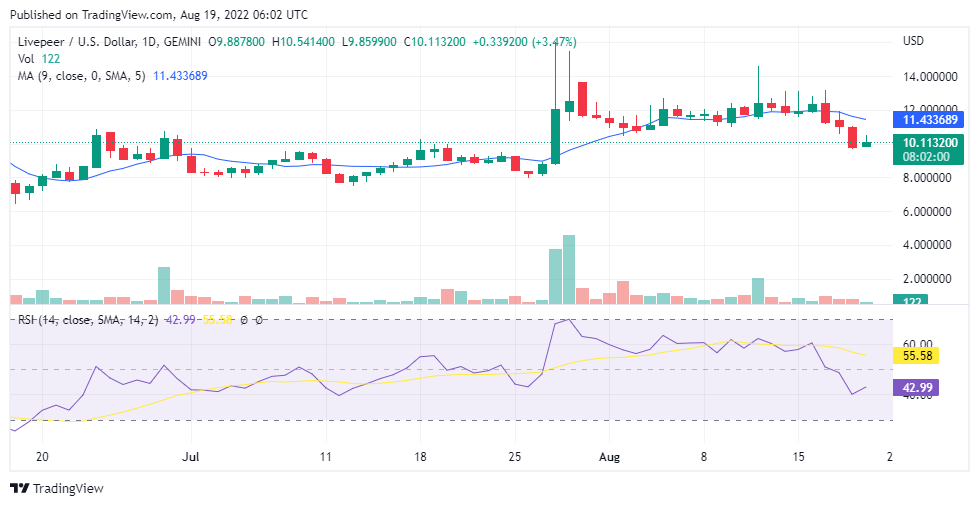
Generally, both the demand and supply in the market are not strong. After the July 28th strong bullish move, the price consolidated at around $11.00000. The 9-day moving average, at some point, conformed to the movement of price action on the chart. But, from the 17th of August, bears gained enough strength to begin to push the price below the 9-day moving average. The Relative Strength Index line is retracing an upward position and now measures 42.99% which is an indication of a downtrend. The RSI signal line is also falling and has now reached 55.58%. There is the possibility that the price will soon rise because of today’s market behaviour.

Livepeer Analysis: LPT/USD 4-Hour Chart Point of View

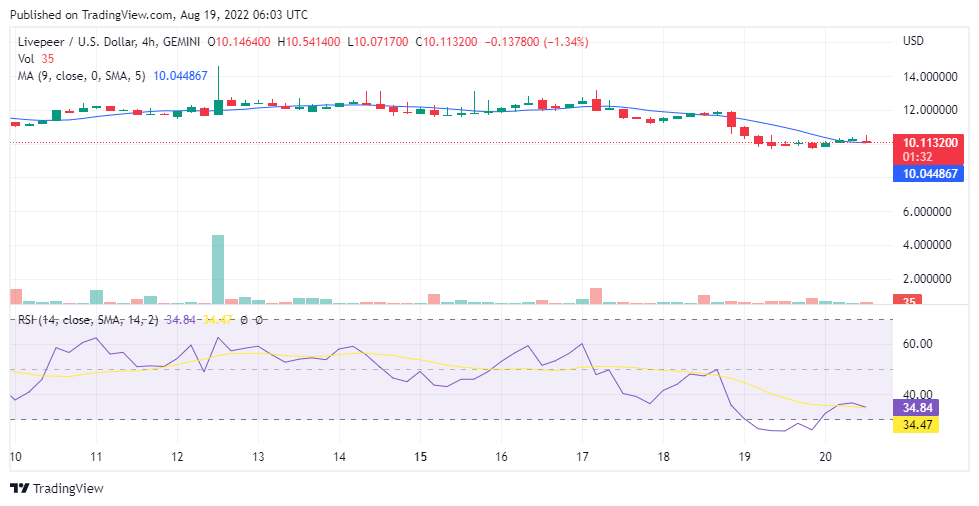
In the 4-hour chart of today, the first and second session was bullish. But in the third session, the bears took the market. The RSI line is going to the threshold of the oversold region. The signal line is not far, and both lines measure in almost compliance with each other. They both measures 34%. Once the price crosses the boundary, the price of the market will correct itself to an upper position.

Related

  • How to Buy Tamadoge
  • Visit Tamadoge Website

Tamadoge – Play to Earn Meme Coin

Our Rating

  • Earn TAMA in Battles With Doge Pets
  • Capped Supply of 2 Bn, Token Burn
  • NFT-Based Metaverse Game
  • Presale Live Now – tamadoge.io

Visit Site

Go to Source

Binance Coin Price Prediction for Today, August 20: BNB Shifts Downward

Binance Coin Price Prediction – August 20
It currently portrays that the Binance Coin market valuation shifts downward, succumbing to a slight pressure imposed on it by the purchasing force of the US Dollar. There have been products of $240.11 and $336.28 as the low and high-value points in the last thirty days of operations. As of the time of this analytics write-up, price trades at $287.41 at an average of 2.87% positive.

Binance Coin Price Statistics:
BNB price now – $287.41
BNB market cap – $46.3 billion
BNB circulating supply – 161.3 million
BNB total supply – 161.3 million
Coinmarketcap ranking – #5

Binance Coin Market
Key Levels:
Resistance levels: $300, $325, $350
Support levels: $225, $200, $175
BNB /USD – Daily Chart
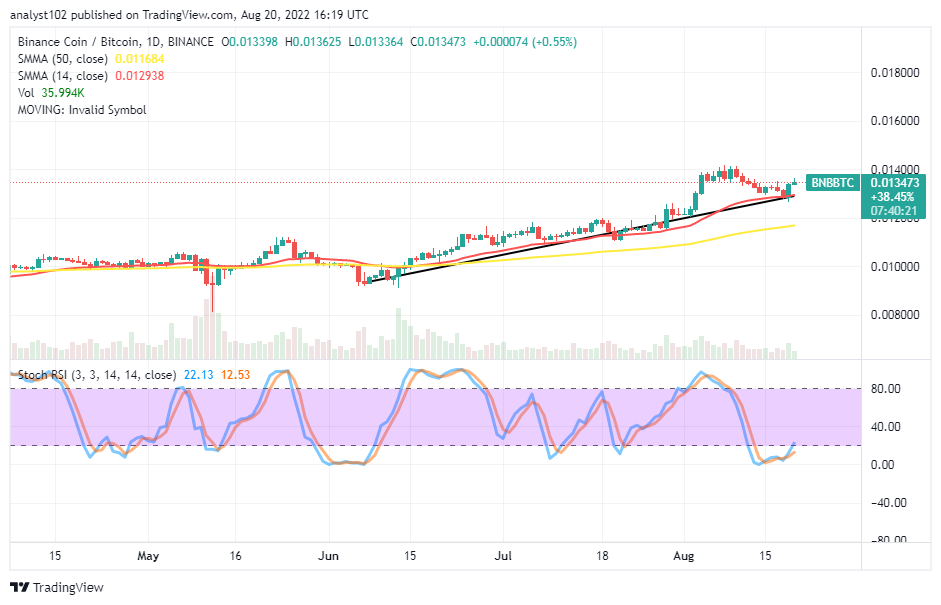
The daily chart reveals that the Binance Coin market shifts downward against the valuation of the US Dollar, briefly breaching past the trend lines of the SMAs to the south side in the process. The 14-day SMA indicator has placed at $297.80 tightly over the $293.90 value line of the 50-day SMA indicator. The bullish trend line drew northward to get at a psychological mark around $271.70, suggesting it to be where forces to the downside may tend to get weakened. The Stochastic Oscillators have penetrated the oversold region, showing the degree of falling at 4.58 and 1.53 range points within.

Buy Binance Coin Now

Your capital is at risk.

Will a further breakdown in the BNB/USD trade at $250 set in a new bearish cycle afterward?

A sustainable breakdown in the BNB/USD market operation at $250 may potentially pave new ways for nudging into a bearish trading cycle in another round as the crypto economy shifts downward from a peak point closely below the $350 resistance level. Long-position takers may begin to build up energy as there has been a slight formation of a bullish candlestick to get a decent buying order entry point.

On the downside of the technical analysis, it is unclear to get a profitable selling order than a buying order presently. A bullish candlestick is in the making to confirm the invalidation of re-launching of sell positions. However, if the candlestick turns out to be a bearish outlook type, the bullish trend may risk being breached furthermore in the south direction. Based on those assumptions, short-position placers have to put their shorting exercise on hold for a while.

BNB/BTC Price Analysis

Binance Coin has been seemingly trying to push back against the trending ability of Bitcoin since yesterday’s sessions. In the recent past operations, the pairing trading crypto made a reversal motion to find support around the smaller SMA trend line. The 14-day SMA indicator is above the 50-day SMA indicator. The bullish trend line drew northward around the smaller SMA, marking the logical bottom points where the price has been finding support up to the upside direction. The Stochastic Oscillator has crossed northbound in the oversold region, pointing to the upside below the 20 range line.

Tamadoge – Play to Earn Meme Coin

Our Rating

  • Earn TAMA in Battles With Doge Pets
  • Capped Supply of 2 Bn, Token Burn
  • NFT-Based Metaverse Game
  • Presale Live Now – tamadoge.io

Visit Site


Read more:

  • How to buy Binance Coin
  • How to buy cryptocurrency

Go to Source

One Indicator Is Likely To Determine Whether Bitcoin Stays in a Bear Market, Says Crypto Analyst Benjamin Cowen

Popular crypto analyst Benjamin Cowen thinks one indicator is likely to determine whether Bitcoin (BTC) stays in a bear market.

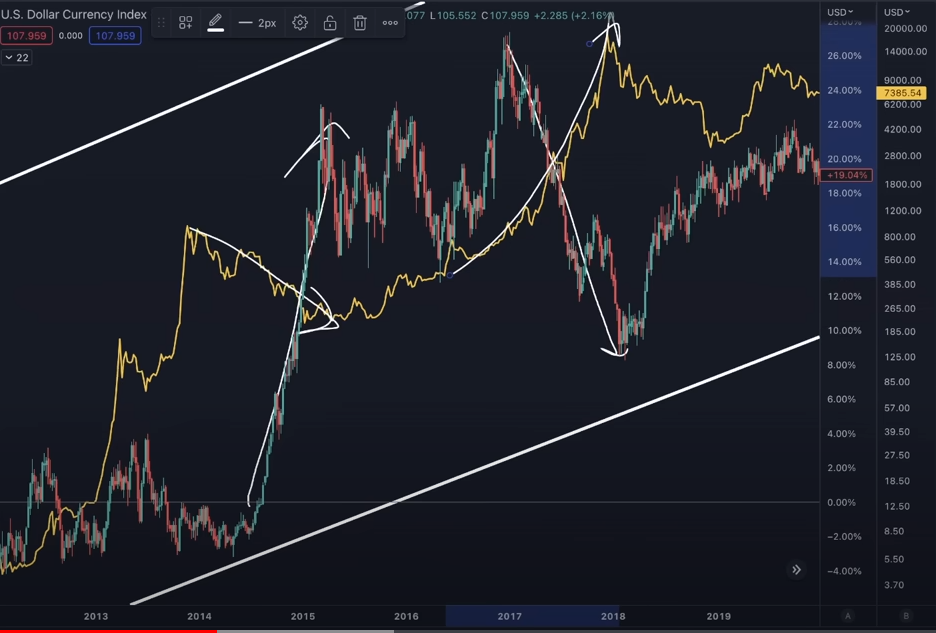
In a new strategy session, Cowen tells his 764,000 YouTube subscribers that Bitcoin has historically been inversely correlated with the US Dollar Index (DXY).

The DXY measures the value of the dollar against a basket of six foreign currencies.

Says Cowen,

“Now a lot of times, when you see the dollar going up, it’s sort of like a wrecking ball: it makes most other things go down. Generally, you could view it as people fleeing into the relative safety of the US dollar.”

Cowen says the Dollar Index has been in a general macro uptrend since 2008. He notes Bitcoin bear markets have tended to correlate with the Dollar Index’s sharp moves to the upside and vice versa.

“The general relationship, as we’ve discussed, is that as long as the dollar is going up, we would expect Bitcoin to more or less stay either in a bear market or the very early stages of its accumulation phase.”

Source: Benjamin Cowen/YouTube

Bitcoin is trading at $21,114.98 at time of writing. The top-ranked crypto asset by market cap is down more than 16% in the past five days. Meanwhile, the DXY is up around 2.3% this week.

[embedded content]

I

Don’t Miss a Beat – Subscribe to get crypto email alerts delivered directly to your inbox

Check Price Action

Follow us on Twitter, Facebook and Telegram

Surf The Daily Hodl Mix


Disclaimer: Opinions expressed at The Daily Hodl are not investment advice. Investors should do their due diligence before making any high-risk investments in Bitcoin, cryptocurrency or digital assets. Please be advised that your transfers and trades are at your own risk, and any loses you may incur are your responsibility. The Daily Hodl does not recommend the buying or selling of any cryptocurrencies or digital assets, nor is The Daily Hodl an investment advisor. Please note that The Daily Hodl participates in affiliate marketing.

Featured Image: Shutterstock/JLStock/Nikelser Kate

Go to Source

Financial Regulator Slaps Crypto Exchange FTX US With Cease-and-Desist Letter Over ‘False’ Statements

The Federal Deposit Insurance Corporation (FDIC) is hitting crypto exchange giant FTX.US with a cease-and-desist order over allegedly making false statements.

According to a new press release issued by the financial regulator, FTX.US has supposedly made statements that make it appear as if the products they offer are FDIC-insured.

The FDIC says that FTX.US president Brett Harrison made the misleading statements in July over his Twitter account when he said that “direct deposits from employers to FTX.US are stored in individual FDIC-insured bank accounts in the users’ names” and “stocks are held in FDIC-insured and SIPC-insured brokerage accounts.”

Says the FDIC,

“These statements appear to contain false and misleading representations that uninsured products are insured by the FDIC, as well as false and misleading statements about the extent of the manner of protection provided by the FDIC deposit insurance and misuse of the FDIC name.

These false and misleading statements represent or imply that FTX.US is FDIC-insured, that funds deposited with FTX.US are placed, and at all times remain, in accounts at unnamed FDIC-insured banks, that brokerage accounts at FTX.US are FDIC-insured, and that FDIC insurance is available for cryptocurrency or stocks.

In fact, FTX.US is not FDIC-insured, the FDIC does not insure any brokerage accounts, and FDIC insurance does not cover stocks or cryptocurrency.”

FDIC deposit insurance refers to the protection granted to customers in the unlikely scenario that an FDIC-insured institution fails.

The regulatory body is demanding that FTX.US takes corrective actions, such as removing all false statements that imply they are insured by the FDIC, never making such statements again and proving within 15 days that they met these requirements.

Four other crypto-related firms received similar letters from the FDIC, including Cryptonews.com, Cryptosec.info, SmartAssess.com and FDICCrypto.com.

Don’t Miss a Beat – Subscribe to get crypto email alerts delivered directly to your inbox

Check Price Action

Follow us on Twitter, Facebook and Telegram

Surf The Daily Hodl Mix


Disclaimer: Opinions expressed at The Daily Hodl are not investment advice. Investors should do their due diligence before making any high-risk investments in Bitcoin, cryptocurrency or digital assets. Please be advised that your transfers and trades are at your own risk, and any loses you may incur are your responsibility. The Daily Hodl does not recommend the buying or selling of any cryptocurrencies or digital assets, nor is The Daily Hodl an investment advisor. Please note that The Daily Hodl participates in affiliate marketing.

Featured Image: Shutterstock/JLStock

Go to Source
DeFi needs to start creating real-world value if it wants to survive

The total value locked in decentralized finance (DeFi) projects is hovering around $62 billion as of mid-August, down from a peak of over $250 billion in December 2021. Capital is fleeing the crypto space amid war, soaring inflation and whatever other surprises 2022 may still have in store for us.

However, unlike previous crypto bull runs, it was not just retail interest that drew in this capital in the first place. Rather, major institutional players, which have recently opened up to crypto, quickly developed an appetite for the yields DeFi is known for. But now that winter is upon us, the pitfalls of high-yield platforms have become more apparent.

Value can’t come out of thin air

In some sense, value is always somewhat subjective, defined by one’s personal considerations and goals. A photo from a family collection means more to a member of that family than to a random outsider. Accordingly, a farmer would be quite willing to pay for a shipment of seeds, as those are crucial for their business, but a city dweller would likely prefer to pay up for the end product.

Still, even the simple examples above show how value often relies on real-world circumstances and processes. In the case of the farmer, it is also quite quantifiable, thanks to the free market bringing entire industries, governments and consumers together into a sophisticated and — more or less — functional system. Value defined in money creates value defined in the yield, whether it’s crops or fruits, and the great economic life cycle continues as these products make their way through the market.

“Yield” is a word dear to the blockchain industry, especially its DeFi sector, which has seen its total value locked shed billions of dollars in value since May amid the ongoing bear run. Still a largely nascent industry, crypto as a whole does not have nearly as much exposure to the real-world economy, especially when it comes to anything beyond speculative trading. And as lucrative as DeFi’s yields might seem, the question is always where they come from.

Related: Terra contagion leads to 80%+ decline in DeFi protocols associated with UST

The sad tale of Anchor’s demise is a perfect example of how unsustainable the business models behind DeFi protocols can be. Its yields of almost 20% officially came from on-chain lending, but it received a cash infusion to keep operating — a clear sign that lending was not enough to keep the returns going. Given Anchor’s prominence as a pull factor for the entire Terra blockchain, you can credit its questionable yields with bringing the entire ecosystem down.

Equally telling is the fact that on-chain loans tend to remain on-chain within the largely siloed blockchain ecosystem. An on-chain protocol can only lend you an on-chain token, and as we know, on-chain assets are not very integrated into the real-world economy. So, whether you are going after an arbitrage opportunity or staking your loan into another yield protocol, your loan — as opposed to traditional finance lending — creates little in terms of real-world value. And healthy yields never come out of thin air.

There is life off-chain

This lack of real-world value to underpin the yields and the entire offering is a major Achilles’ heel for the crypto scene. Many have compared Bitcoin (BTC) to digital gold, but gold has use cases besides sitting in a bank safe, from the jewelry industry to electronics. And while it can never replicate Bitcoin’s wild shot for the moon, its use cases will keep gold afloat even when its veneer as an inflation hedge fades.

The crypto space must seek to give up its inside-baseball mentality and look beyond on-chain activities to seek to establish a larger foothold in the real-world economy and processes. The blockchain industry must experiment with use cases geared toward competing with financial and other services in traditional markets besides advancing the blockchain space as such.

Some of the largest names in the DeFi space have already seen the writing on the wall. DeFi’s titans are already seeking exposure to real-world assets, transitioning to a business model with a more clear-cut risk-reward ratio and healthier yields produced by business-to-business lending. The entire blockchain industry should follow in this direction.

Related: Do Kwon reportedly hires lawyers in S. Korea to prepare for Terra investigation

This quest for real-world use cases should go beyond the core set of financial services. It should power a vast array of services, from decentralized data storage and identity solutions to the Internet of Things and mobility applications. The machine world is an especially interesting use case, as machines running 24/7 present a great source of liquidity brought about by real-world value. This liquidity could unlock a whole array of new DeFi business models and offer an opportunity for some of the existing protocols to switch to healthier yields.

The time of uninhibited yields shooting for the moon may be over, but there are plenty of interest-generating real-world activities waiting to be brought on-chain. All of them offer more familiar business models, allowing projects to up their risk management gain while also offering investors returns based on actual tangible outcomes. Blockchain adoption should be about more than just trading Bitcoin from your bank account — it’s a process that can and should transform entire industries and business models.

By carving itself a presence across multiple real-economy industries and sectors, the blockchain space has more than just healthier yields to win. In the long run, and with enough effort and polish, this is ultimately about turning the dream of Web3 into a self-fulfilling prophecy. A blockchain-based internet must begin with a host of decentralized apps and services slowly but surely taking over their centralized competitors, and the bear market at hand is just the time to start building them.

Till Wendler is a co-founder of peaq. He worked previously as the head of operations at Advanced Blockchain AG between 2017 and 2020 and also served as the CEO at Axiomity AG, a blockchain services company.

The views, thoughts, and opinions expressed here are the author’s alone and do not necessarily reflect or represent the views and opinions of Cointelegraph.

Go to Source

3 reasons why the Bitcoin price bottom is not in

Bitcoin (BTC) recovered modestly on Aug. 20 but remained on course to log its worst weekly performance in the last two months.

Bitcoin hash ribbons flash bottom signal

On the daily chart, BTC’s price climbed 2.58% to $21,372 per token but was still down by nearly 14.5% week-to-date, its worst weekly returns since mid August. Nonetheless, some on-chain indicators suggest that Bitcoin’s correction phase could be coming to an end.

That includes Hash Ribbons, a metric that tracks Bitcoin’s hash rate to determine whether miners are in accumulation or capitulation mode. As of Aug. 20, the metric is showing that the miners’ capitulation is over for the first time since August 2021, which could result in the price momentum switching from negative to positive.

Bitcoin Hash Ribbon. Source: Glassnode

Nonetheless, Bitcoin has been unable to shrug off a flurry of prevailing negative indicators, ranging from negative technical setups to its continued exposure to macro risks. Therefore, despite optimistic on-chain metrics, a bearish continuation cannot be ruled out. 

Here are three reasons why Bitcoin’s market bottom may not be in yet.

BTC price rising wedge breaks down

Bitcoin’s price decline this week has triggered a rising wedge breakdown, suggesting more losses for the crypto in the coming weeks.

Rising wedges are bearish reversal patterns that form after the price rises inside a contracting, ascending channel but resolve after the price breaks out of it to the downside, which could result in a drop to as low as the maximum wedge’s height.

BTC/USD daily price chart featuring “rising wedge” breakdown setup. Source: TradingView

Applying the technical principles on the BTC chart above presents $17,600 as the rising wedge breakdown target. In other words, the Bitcoin price could fall by approximately 25% by September.

Bitcoin bulls are misjudging the Fed

Bitcoin had surged by approximately 45% during its rising wedge formation, after bottoming out locally at around $17,500 in June.

Interestingly, the period of Bitcoin’s upside moves coincided with investors’ growing expectations that inflation has peaked—and that the Federal Reserve would start cutting interest rates as soon as March 2023.

The expectations emerged from the Fed Chairman Jerome Powell’s FOMC statement from July 27. 

Powell:

“As the stance of monetary policy tightens further, it likely will become appropriate to slow the pace of increases while we assess how our cumulative policy adjustments are affecting the economy and inflation.”

Nonetheless, the most recent Fed dot plot shows that most officials anticipate the rates to reach 3.75% by the end of 2023 before sliding back down to 3.4% in 2024. Therefore, the prospects of rate cuts remain speculative.

Implied Fed funds target rate. Source: Federal Reserve

St Louis Fed president James Bullard also noted that he would support a third consecutive 75 basis point raise at the central bank’s policy meeting in September. The statement falls in line with the Fed’s commitment to bring inflation down to 2% from its current 8.5% level.

Related: Options data shows Bitcoin’s short-term uptrend is at risk if BTC falls below $23K

In other words, Bitcoin and other risk-on assets, which fell into a bear market territory when the Fed began an aggressive tightening cycle in March, should remain under pressure for the next few years.

If history is any indicator…

The ongoing Bitcoin price recovery risks turning into a false bullish signal given the asset’s similar rebounds during previous bear markets.

BTC/USD weekly price chart. Source: TradingView

BTC’s price rebounded by nearly 100%—from around $6,000 to over $11,500—during the 2018 bear market cycle, only to wipe-off the gains entirely and drop toward $3,200. Notably, similar rebounds and corrections also took place in 2019 and 2022.

The views and opinions expressed here are solely those of the author and do not necessarily reflect the views of Cointelegraph.com. Every investment and trading move involves risk, you should conduct your own research when making a decision.

Go to Source

Potential BAYC NFT Liquidations Could Cause An Overall NFT Market Downturn

  • Bored Ape NFT liquidation cascade is inevitable according to Web3 launchpad founder “DoubleQ”
  • Many BAYC holders who deposited on BendDAO in exchange for $ETH are at risk of being liquidated.
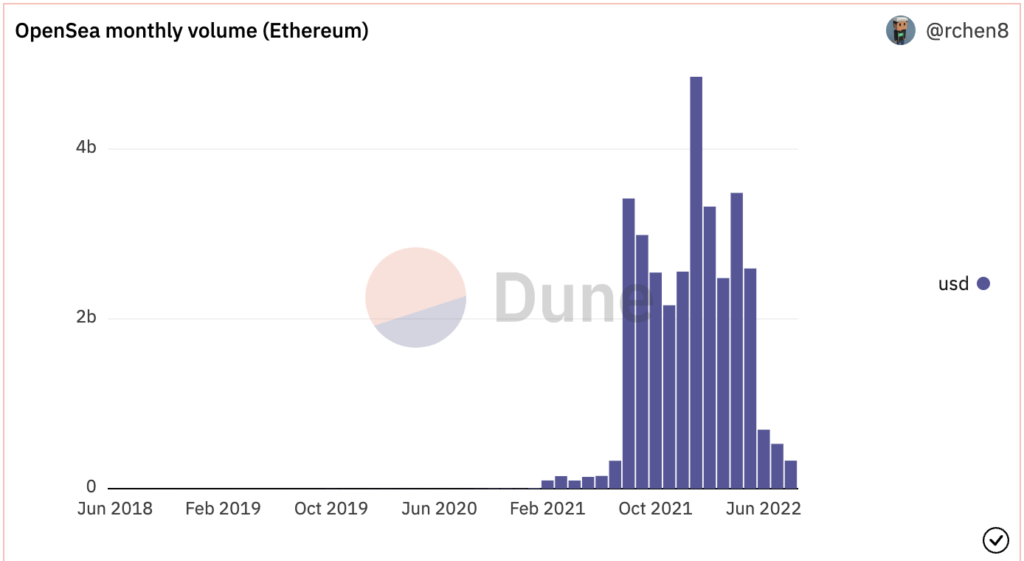
  • OpenSea NFT volume is currently at its lowest point in the last 12 months.

The Bored Ape NFT holders are anything but bored right now as a potential cascade of liquidations looms over on NFT liquidity Pool BendDAO.

BAYC holders that deposited their NFTs on BendDAO in exchange for $ETH, are now at risk of being liquidated with a health factor of 1.01 as per data collected from BendDAO.

“DoubleQ,” the founder of Web3 launchpad DoubleStudio, claims on Twitter that this BAYC loan liquidation has the potential to nuke the entire NFT Market.

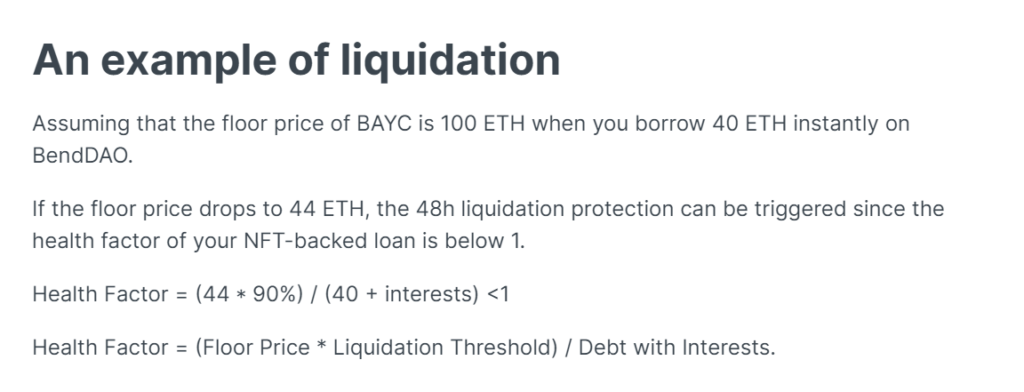
BendDao is an NFT lending protocol that offers 30%-40% of the NFT’s floor price as loans. This is usually used by market participants who need liquidity in ETH but do not want to sell their blue chip NFTs. However, in cases where the health factor is lower than 1, NFTs will get liquidated, as explained by the below example.

There are currently 20 BAYC, under 1.1 health factors and more and 1.2, which could set a liquidation of approximately $55m worth of NFTs.

Opensea NFT volume is currently at the lowest point it has ever been in the last 12 months, meaning there will not be enough volume to save these NFTs from liquidations. Borrowers will have 48 hours to repay the loans or their collateral will be liquidated.

DoubleQ, believes the following could be an excellent opportunity to buy the NFTs at a cheaper rate by either :

-bidding on loans and flipping them after

-waiting for the mass liquidations to have the best entry point to these NFTs.

Go to Source

Dogecash Moves Up; Hold or Sell?


As the cryptocurrency industry sails on in a continuous state of confusion and fear, the speculation of a long crypto winter and an overall bearish sentiment in global markets have been putting off a lot of investors. The top cryptocurrencies that seem to be following a stagnant price pattern are being traded at lower volumes.

However, the one category of cryptocurrencies that seems to be unbothered by the condition of the market is memecoins. While these may have been severely criticized in the past for lack of utility and other similar reasons, the interest in memecoins has not dropped. In fact, there are several instances of quick 2x spikes even in this market condition.

Surely, a majority of memecoins have vanished, thanks to the bear market. But Dogecash, one of the tokens that managed to survive, has been gaining traction for its quick spike in prices as the token moved from around $0.015 to more than $0.035 till last week within this month alone.

The token has, however, corrected to lower price levels at the time of writing.

What is Dogecash?

Created as an apparent superior to its predecessor Dogecoin, Dogecash was created to function as a payments system for the users. The project is an approach towards a transparent, community-governed cryptocurrency that could be utilised by various institutions and platforms.

The developer team consists of a group of individuals of which, only some have revealed identities. Claiming to be a platform that can provide the best services available in the market, Dogecash managed to target a considerable amount of cryptocurrency investors and was successful in making them a part of their community.

With around 59,000 wallets created and affiliations with several organizations, Dogecash has positioned itself as a long-standing cryptocurrency project that managed to survive amidst the crashes in the market. The prime features of the project include:

  • A self-governance structure
  • A strong privacy protocol
  • Environment-friendly approach
  • User rewarding Economy

The codebase for the contract code was built by referring to PIVX, which is a decentralized, MIT-licensed open source blockchain project. Due to this, DOGEC; the native token of the Dogecash ecosystem is a POS/master node token that rewards active holders of the project.

For the same reason, it boasts of a minimal consumption of energy, as opposed to high energy consuming proof-of-work tokens like Bitcoin.

Is There a Potential for Further Growth?

Dogecash has been a project that has been around for more than 3 years now. During this time, it has made heavy contributions to the community in the form of airdrops or rewards. The project also gained popularity due to its philanthropic efforts for several animal-based charity organizations.

While these definitely sound great, it cannot be denied that the token has been in a stagnant state of growth in terms of community strength or infrastructure. Since 2018, there have been several meme-based projects that have been released which offer the same functionality and are devoid of any major utility.

Thus, while the project may be facing some volatility and price hikes lately, it is highly likely that the price may stay at the same levels or stoop lower with time.

Is There an Alternative?

Sure enough, a memecoin status sets the stage for immense popularity. But it is futile in the long term if the project does not feature strong fundamentals or utility. However, Tamadoge, one of the latest cryptocurrency projects to be introduced this year has been seeking traction for having both the features mentioned above.

The project is the latest entrant to the famous Doge-ecosystem, which attracted a huge community of memecoin-fans. At the same time, it’s a P2E platform that is set to feature several NFT-based blockchain games that shall be integrated with the metaverse, making it a project that boasts of a strong use case.

Check out Tamadoge Project

Currently nearing the end of its presale phase, the Tamadoge ecosystem has already managed to sell more than $2 million worth of TAMA tokens. Expected to launch sometime in the Q4 of 2022, the project is being trusted by a majority of the cryptocurrency masses, thanks to its fully audited contract code and verified team.

The project has already managed to create a strong and vast community since its introduction and states it is set to become one of the top-grossing memecoins post-launch. You can read the full roadmap and whitepaper at buy.tamadoge.io.

Read More

  • How to Buy Tamadoge
  • These are the Best Cryptocurrencies to Buy in 2022

Tamadoge – Play to Earn Meme Coin

Our Rating

  • Earn TAMA in Battles With Doge Pets
  • Capped Supply of 2 Bn, Token Burn
  • NFT-Based Metaverse Game
  • Presale Live Now – tamadoge.io

Visit Site

Go to Source

Please enter CoinGecko Free Api Key to get this plugin works.
Exit mobile version