Will Bitcoin Price Reach $30K in August? Maybe Time Buy Bitcoin Along With Tamadoge

Bitcoin has been consolidating between the $21K to $24K range over the past few weeks. The consolidation comes in the backdrop of market recovery from a bear market that has persisted for most of the year.

However, despite Bitcoin’s growth, new projects threaten to displace it. One of these new projects is Tamadoge (TAMA) which has witnessed significant demand despite being in the presale stage.

Will Bitcoin pump to $30K in August?

Bitcoin has been recording a slight rally over the past few weeks. Bitcoin’s gains have been attributed to the market recovering after the devastating effects caused by the Terra Luna crash in May.

The broader crypto market is rallying because of the anticipation of the Ethereum Merge. Bitcoin is also reacting to the Merge news, having recovered its footing past $231K. As the Merge news continues to attract interest across the market, Bitcoin, alongside other tokens, including low cap cryptos, could deliver significant gains.

However, Bitcoin’s dominance in the crypto market as the most preferred cryptocurrency for payments could be threatened with the Merge, with Ethereum proponents saying that Ether will become ultrasound money. The recent bear market has also dampened investor faith in Bitcoin being a hedge against inflation.

Buy Crypto Now

Your capital is at risk.

These contributing factors could see Bitcoin failing to achieve $30K this month despite attempting an uptrend. While Bitcoin is one of the safest choices in the market, adding other coins such as Tamadoge (TAMA) to your portfolio could see a trader deliver strong returns in the coming months.

Time to buy Tamadoge

Tamadoge (TAMA) is one of the newest cryptocurrencies in the market. TAMA is both a meme coin and a play-to-earn token that seeks to generate utility from the market that could see it achieve notable highs.

While Tamadoge is tapping into the potential and interest in meme coins, it has set itself apart from the other meme coins by having features such as a maximum supply of only 2 billion tokens. This is quite different from the other meme coins with an extensive supply, which reduces them to penny cryptocurrencies because the high supply cannot meet the existing demand in the market.

Another feature of Tamadoge is that it has ventured into the P2E ecosystem. P2E is one of the largest sectors across the cryptocurrency market. Some of the earliest blockchain projects like Axie Infinity and The Sandbox have witnessed notable growth in user base, and their projects have become renowned across the market.

The Tamadoge P2E ecosystem allows players to battle with their doge bets, and as they win in these battles, they receive rewards in the form of TAMA tokens. The doge pets will be in the form of Tamadoge NFTs.

TAMA, the native token of the Tamadoge ecosystem, has also seen growing interest during the presale. The TAMA presale has so far raised $5.5 million. The Tamadoge Telegram group has also continued to grow, with the group now surpassing 26,000 users.

After the presale is complete, Tamadoge plans to list the token on centralized exchanges (CEXs) and decentralized exchanges (DEXs). The listing could pump liquidity into TAMA, with the token achieving new highs in the coming days.

Read more:

  • How to buy Cryptocurrencies
  • How to buy Bitcoin

Go to Source

FDIC has issued desist messages to five companies, including FTX US

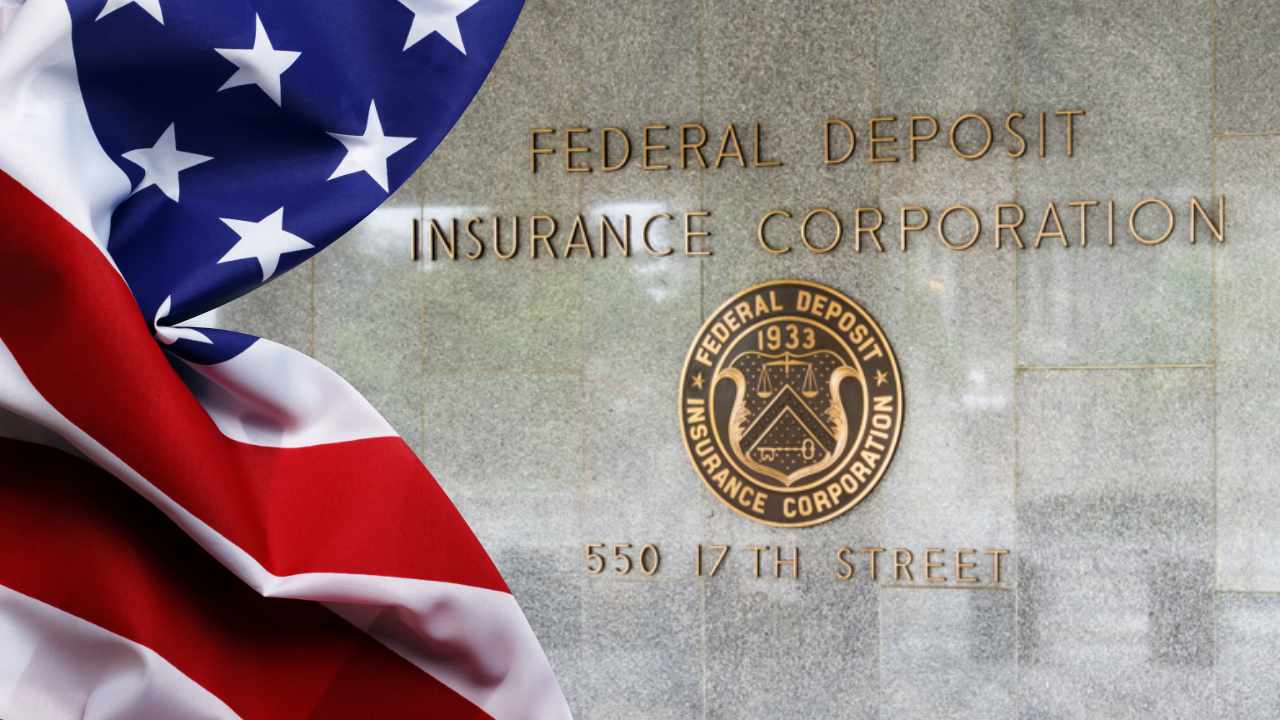
Five businesses have received desist notes from the Federal Deposit Insurance Corporation for supposedly making misleading statements about insurance linked to digital currencies. The corporation published a media update on Friday revealing cease and desist order for crypto trading FTX US, as well as webpages Cryptosec, Cryptonews, FDICCrypto, and SmartAssets. In the texts approved on Thursday, the government department claims that such institutions misled the general public regarding specific cryptocurrency-related goods being covered by FDIC.

The FDIC stated that these depictions regarding specific crypto-related goods being FDIC-insured or equities held in investment transactions being FDIC-insured are incorrect or deceptive. According to the controller, these businesses must take appropriate remedial action to rectify the falsified or deceptive declarations on their webpage, and community media account holders.

Buy Crypto Now

Your capital is at risk.

Not the first time

The FDIC has already been outspoken about the absence of liability insurance for organizations other than banks, including crypto-focused businesses. The authority published a notice last July informing banking institutions in the US that they should evaluate and mitigate risk when entering into third-party partnerships with virtual currency providers. The corporation reaffirmed that while transactions covered by insurance banks are shielded against insolvency for approximately $250,000, crypto companies are not.

The FDIC is accused of taking an excessively harsh treatment of digital resources, even disheartening banking institutions from interacting with virtual currency providers. According to Cointelegraph, Pennsylvania’s senate candidate Pat Toomey, who still represents Senate Banking Committee, informed the FDIC manager and continued to act as chairman Martin Gruenberg of accusations created by a complainant. Toomey stated in the memo that he believes the FDIC is acting incorrectly to discourage banking institutions from venturing with legitimately cryptocurrency-related businesses.

Read more:

  • How to buy Cryptocurrencies
  • How to buy Bitcoin

Go to Source

Macro Guru Raoul Pal Details ‘Very Bullish’ Outlook on Ethereum and Crypto Markets As Merge Approaches

Former Goldman Sachs executive Raoul Pal says he’s very bullish on Ethereum (ETH) and the crypto markets despite the uncertain price action unfolding in recent months.

In a new interview with crypto analyst Scott Melker, Pal says that crypto hedge funds who took big losses during the recent market turmoil are underweight ETH as The Merge – Ethereum’s transition to a proof-of-stake consensus mechanism – approaches.

The Real Vision founder says that markets take the path of most pain, and for ETH right now, that means upward.

“I think everybody’s underweight The Merge still. People will get into the merge or post-merge, we’ll get this spike [and] we’ll probably get a pullback. A lot of people will say ‘See it’s going back to the low.’ My guess is it corrects sideways, does something, goes back into the range for a bit and then we explode higher. 

So I’m very bullish right now. Short term, we’re getting close to overbought, but I think we just had a correction, and my guess is we go again. What’s fascinating is to see the forwards market and the futures markets is everybody’s hedging ETH merge risk so that buying ETH and selling futures now, somebody’s going to lift that hedge off at some point. 

I find that setup really interesting, and know that crypto hedge funds are all underweight because they all got beaten up so badly. So they’ve been buying calls as the way of having something over The Merge so they don’t beaten up by their investors. So when you see that kind of setup, the path of pain is still higher.”

The macro guru says that crypto’s relative underperformance this year can be attributed to an unexpected tightening in central bank liquidity, which he has previously predicted will change.

“From my perspective… I think the macro is the big thing that actually caught most of us by surprise. Not that the macro caught us by surprise, but the impact it has on crypto. Firstly, when you have negative real wages, people have less money to dollar cost average. It’s still a retail investment market. So then the other thing is central bank liquidity being withdrawn, and if you look at the year-on-year charts of M2 against Bitcoin, they’re basically the same thing. It tells you that as money is coming out of the system, there’s less money around.”

[embedded content]

I

Don’t Miss a Beat – Subscribe to get crypto email alerts delivered directly to your inbox

Check Price Action

Follow us on Twitter, Facebook and Telegram

Surf The Daily Hodl Mix


Disclaimer: Opinions expressed at The Daily Hodl are not investment advice. Investors should do their due diligence before making any high-risk investments in Bitcoin, cryptocurrency or digital assets. Please be advised that your transfers and trades are at your own risk, and any loses you may incur are your responsibility. The Daily Hodl does not recommend the buying or selling of any cryptocurrencies or digital assets, nor is The Daily Hodl an investment advisor. Please note that The Daily Hodl participates in affiliate marketing.

Featured Image: Shutterstock/Digital Store

Go to Source

Can Web3 be hacked? Is the decentralized internet safer?

Web3 came into existence posed as a blockchain-powered disruption to the current state of the internet. Yet, as a nascent technology, a fog of assumptions plagues discussions about the real capabilities of Web3 and its role in our day-to-day lives.

Considering the promise of a decentralized internet using public blockchains, a complete transition to Web3 would require scrutiny across several factors. Out of the lot, security stands as one of the most crucial features as, in a Web3-powered world, tools and applications hosted over the blockchains go mainstream.

Smart contract vulnerabilities

While the blockchains that host Web3 applications remain impenetrable from being hostage to attackers, hackers target the vulnerabilities within the project’s smart contracts. Smart contract attacks on decentralized finance (DeFi) platforms have surged, with a recent study revealing that approximately $1.6 billion in cryptocurrencies was stolen in the first quarter of 2022 alone.

Although DeFi is a subset of the Web3 spectrum, it reflects the biggest vulnerability within the ecosystem. As a result, Web3 entrepreneurs need to redirect their marketing budget to the development of the core system.

As seen throughout the year, vulnerabilities that allow hackers to drain vast amounts of assets result in impermanent losses for the investors and may cause an indirect collapse of related ecosystems.

Insider threats

In addition to external hacks, bad actors within the system may dupe the project and its investors. Fail-safe mechanisms with watered-down access to employees are required to avoid internal attacks.

On Aug. 14, trading and liquidity automated market maker (AMM) Velodrome Finance recovered $350,000 from one of its team members, Gabagool. One of Velodrome’s high-worth wallets was drained off $350,000. A following internal investigation revealed the attacker’s identification, allowing the company to recover the entire loot.

Fortifying Web3

Over six months of the bear market coupled with countless hacks have forced crypto investors to realign their investments with ecosystems that reflect safety. As a result, Web3 entrepreneurs are expected to take measures that ensure the long-term success of their offerings.

One way to minimize the risks of an attack is to conduct bug bounty initiatives. Bug bounties attract whitehat hackers, who try to identify vulnerabilities from a hacker’s perspective. Developers are rewarded financially for finding and fixing valid bugs in the system.

In addition, entrepreneurs must set up multisig wallets for storing funds and avoid centralized control over the wallets. Such measures, when implemented across the system, reflect a greater decentralization and insulation from orchestrated attacks.

Go to Source

CEO of United Texas Bank wishes to restrict the issuing of US dollar-backed altcoins to banks


Scott Beck, CEO of the United Texas Bank, urged representatives of the government’s blockchain advisory committee to suggest a policy that would leave stablecoins to financial institutions rather than virtual currency firms.

Beck proposed restricting the disbursement of US dollar-backed altcoins to registered banks instead of lending institutions such as Circle just at Texas Work Group on cryptocurrency issues last Friday in the city of Austin. According to the Chief operating officer of UTB, a study from November carried out by the President’s workgroup on capital markets stated that stablecoin firms must be subjected to the exact requirements as insurance covers deposit accounts such as government and federal level authorized banks.

According to Beck, financial institutions are the appropriate economic actors to release and handle crypto assets if tokens are described as money. Banking institutions have the knowledge and legal structure to handle money because, unlike the current stablecoin stakeholders, banks are closely controlled on both the federal and state levels.

Buy Crypto Now

Your capital is at risk.

He said that introducing stablecoin actions into the financial system and restricting non-banks from releasing cryptocurrency will improve consumer protection and attract more money and resources to this business activity.

Set on his idea

In answer to a query from working team participant and MoneyGram chief counsel Robert Villasenor, he asserted that stablecoin financial institutions such as Circle held assets at organizations other than banking institutions, successfully sucking funds out of the financial system. He went on to say that specific cryptocurrencies were highly susceptible to runs, which could endanger the economic system if the market reached a certain magnitude, and that keeping the disbursement to banking institutions guaranteed that the ‘Know Your Customer’ regulations were adhered to.

Beck’s suggestion was criticized as anti-competitive by Lee Bratcher, head of state of Texas Blockchain’s Council, who was present at the trial. The financial institution CEO responded that the main difference between certified banks and privately held businesses issuing crypto assets is that the money behind the currencies for the former might stay at the Fed, guaranteeing the money will be FDIC registered.

Circle’s USDC virtual currency is said to be 100% supported by money or cash counterparts such as deposit accounts, treasury notes, or corporate debt. In March, the virtual currency creditor declared that central bank BNY Mellon was in charge of custodying their USDC resources; at the moment of publication, over 52 billion cryptocurrencies were in circulation.

Following the adoption of the House Bill in 1576, the TWG on BM was formally established in September last year. As stated on the company’s website, its goal is to establish a blueprint for the growth of the crypto market in Texas and suggest laws and government investment opportunities related to blockchain.

Read more:

  • How to buy Cryptocurrencies
  • How to buy Bitcoin

Go to Source

Reports Say FTX Warns Customers Not to Interact With Aztec Network, CEO Sam Bankman-Fried Responds

According to reports on social media, a number of users have complained that FTX has blocked a transaction that was associated with the Aztec Network’s zkmoney privacy technology. Following the accusations, FTX CEO Sam Bankman-Fried explained that transactions are monitored for AML compliance but it “does not mean any accounts were frozen.”

Journalist Wu Blockchain Says an FTX User’s Account Was Frozen After the User Transacted With the Aztec Network’s Privacy Enhancing ZK-Rollups

On August 18, the China-based journalist, Colin Wu ‘Blockchain,’ published a tweet that said a user who transacted with Aztec Network’s zkmoney tech, had their account frozen. Aztec Network is a privacy and scaling network, and similar to Optimism and Arbitrum it uses ZK-rollups, but Aztec Network’s zkmoney tech is privacy enhancing. Aztec’s technology uses a zk-SNARK scheme called “Plonk,” a general-purpose zero-knowledge proof mechanism.

So while the average Ethereum network fee is 0.0014 ether or $2.29 using today’s ETH exchange rates, to send ether via the Aztec Network will cost only $0.40 per transfer. “Recently, FTX froze a user account who sent coins to [Aztec Network’s] zkmoney,” Wu Blockchain tweeted on Thursday. “According to FTX, Aztec Connect – Aztec network / zk money has been identified as a mixing service, which is a high-risk activity prohibited by FTX.”

The journalist added:

FTX said Industry-leading third-party transaction monitoring tools ensure users do not interact with high-risk addresses, it is recommended not to use the mixing service in the future, otherwise, it may endanger the FTX account.

FTX CEO Sam Bankman-Fried Responds, Aztec Network Insists ‘Privacy Is Legitimate’

Following the tweet, FTX CEO Sam Bankman-Fried responded to Wu Blockchain’s statement and explained that while FTX monitors transactions, it doesnt mean the exchange has frozen any accounts. “To be clear — this is getting garbled,” Bankman-Fried said. “We are constantly monitoring transactions for AML compliance, and do enhanced due diligence on certain transactions, but that does not mean that any accounts were frozen.” Additionally, the official Aztec Network Twitter page tweeted about the issue.

“We are aware of reports that FTX is warning users not to interact with Aztec,” the team said. “As a result, we want to underscore our current and ongoing risk-reduction framework: 1) Implement practical deterrents 2) Measure their effectiveness — Privacy is legitimate.” Aztec Network continued:

We want to start by reiterating our mission — Empowering individuals with on-chain privacy. Our belief is that privacy is a fundamental precursor to — Discretion, Security, [and] Creativity — In other words, normalcy. As a result, our approach has always been one of practical deterrence: Ensuring users have access to privacy on-chain while deterring money-laundering and illicit activity.

The Aztec Network news follows the ongoing complaints about Tornado Cash being banned by the U.S. government. Furthermore, reports show the decentralized exchange (dex) platform Uniswap has blocked 253 Ethereum-based addresses from the frontend using TRM Labs technology. Further, 12 days ago, the software developer Banteg reported that Centre Consortium blacklisted 75,000 USDC tied to the Tornado Cash pool.

Tags in this story
AML, Aztec Privacy, Aztec Scaling, aztec.network, Colin ‘Wu’ Blockchain, Compliance, Crypto-privacy, frozen, ftx, FTX account, FTX CEO, FTX Exchange, illicit activity, Plonk, Privacy, privacy crypto, Sam Bankman-Fried, third-party transaction, Wu Blockchain, ZK rollups, zkmoney tech

What do you think about the reports that allege FTX froze an account from someone who used the Aztec Network? Let us know what you think about this subject in the comments section below.

Jamie Redman

Jamie Redman is the News Lead at Bitcoin.com News and a financial tech journalist living in Florida. Redman has been an active member of the cryptocurrency community since 2011. He has a passion for Bitcoin, open-source code, and decentralized applications. Since September 2015, Redman has written more than 5,700 articles for Bitcoin.com News about the disruptive protocols emerging today.

Image Credits: Shutterstock, Pixabay, Wiki Commons

Disclaimer: This article is for informational purposes only. It is not a direct offer or solicitation of an offer to buy or sell, or a recommendation or endorsement of any products, services, or companies. Bitcoin.com does not provide investment, tax, legal, or accounting advice. Neither the company nor the author is responsible, directly or indirectly, for any damage or loss caused or alleged to be caused by or in connection with the use of or reliance on any content, goods or services mentioned in this article.

Read disclaimer

Go to Source

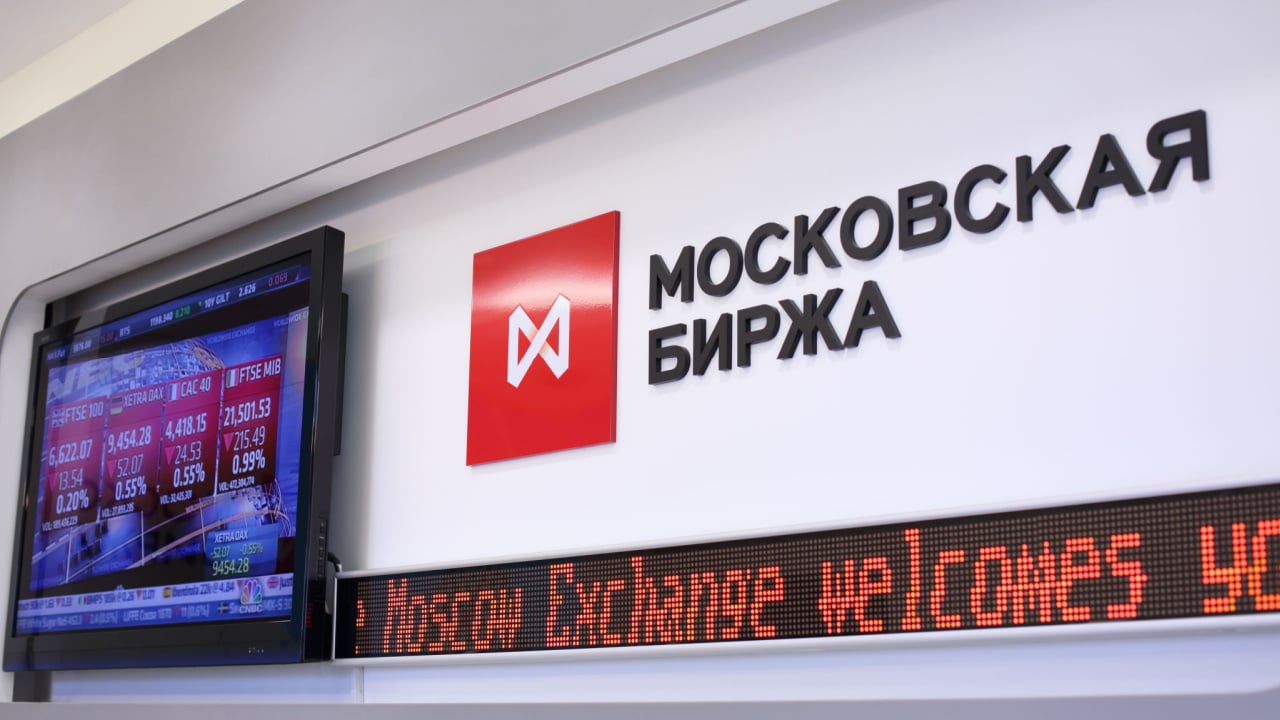
Moscow Exchange Prepares to List Digital Financial Assets by Year End

Russia’s largest market for equities, bonds, and derivatives, the Moscow Exchange, intends to launch a product based on digital financial assets by the end of the year, an executive has revealed. The trading platform is already working with a partner to organize the placement of digital tokens.

Russia’s Top Exchange to Facilitate Trading of Financial Instruments Based on Digital Assets

Releasing a product based on digital financial assets (DFAs) is in the plans for 2022, a high-ranking representative of the Moscow Exchange (MOEX) has indicated in a recent interview. The announcement comes after a turbulent period for Russia’s leading stock market when it had to deal with market volatility, sanctions pressure, and cyberattacks earlier this year.

Alongside ‘digital rights,’ DFAs is currently the main legal term in Russian law that applies to various digital assets, including cryptocurrencies according to some statements by Russian officials, but primarily those that have a specific issuer.

MOEX is now working with one of its partners to realize a project to place digital tokens, Managing Director for Information Technology and Member of the Board of the Moscow Exchange Andrey Burilov told the Tass news agency. He noted this is a company from the real economy and elaborated:

The main point here is to link the company’s fixed assets with the investment market using digital technologies.

Digitizing commodities creates added value for market participants, Burilov emphasized. MOEX aims to utilize DFAs in order to offer its customers another investment tool which offers a fundamentally new way to ensure information security.

Burilov also remarked that the main difficulty in terms of implementation is that this is a completely new product for the market, from regulation to software. Another challenge is its integration into the existing systems of the exchange and its clients, he pointed out.

In early July, the head of the Financial Market Committee at the lower house of parliament stated that a Russian digital asset exchange would be in the best position to process crypto transactions in the country. Anatoly Aksakov also suggested that the crypto trading platform may be established at the Moscow Exchange.

Tags in this story
Crypto, Cryptocurrencies, Cryptocurrency, DFAs, Digital Assets, digital financial assets, digital rights, Digital Tokens, Exchange, financial instrument, moex, moscow exchange, Product, Russia, russian, trading platform

Do you think MOEX will fulfill its plan to start trading digital financial assets by the end of the year? Tell us in the comments section below.

Lubomir Tassev

Lubomir Tassev is a journalist from tech-savvy Eastern Europe who likes Hitchens’s quote: “Being a writer is what I am, rather than what I do.” Besides crypto, blockchain and fintech, international politics and economics are two other sources of inspiration.

Image Credits: Shutterstock, Pixabay, Wiki Commons, Pavel L Photo and Video

Disclaimer: This article is for informational purposes only. It is not a direct offer or solicitation of an offer to buy or sell, or a recommendation or endorsement of any products, services, or companies. Bitcoin.com does not provide investment, tax, legal, or accounting advice. Neither the company nor the author is responsible, directly or indirectly, for any damage or loss caused or alleged to be caused by or in connection with the use of or reliance on any content, goods or services mentioned in this article.

Read disclaimer

Go to Source

Binance Coin at  Verge of an Uptrend; As Tamadoge Prepares a Bullish Market


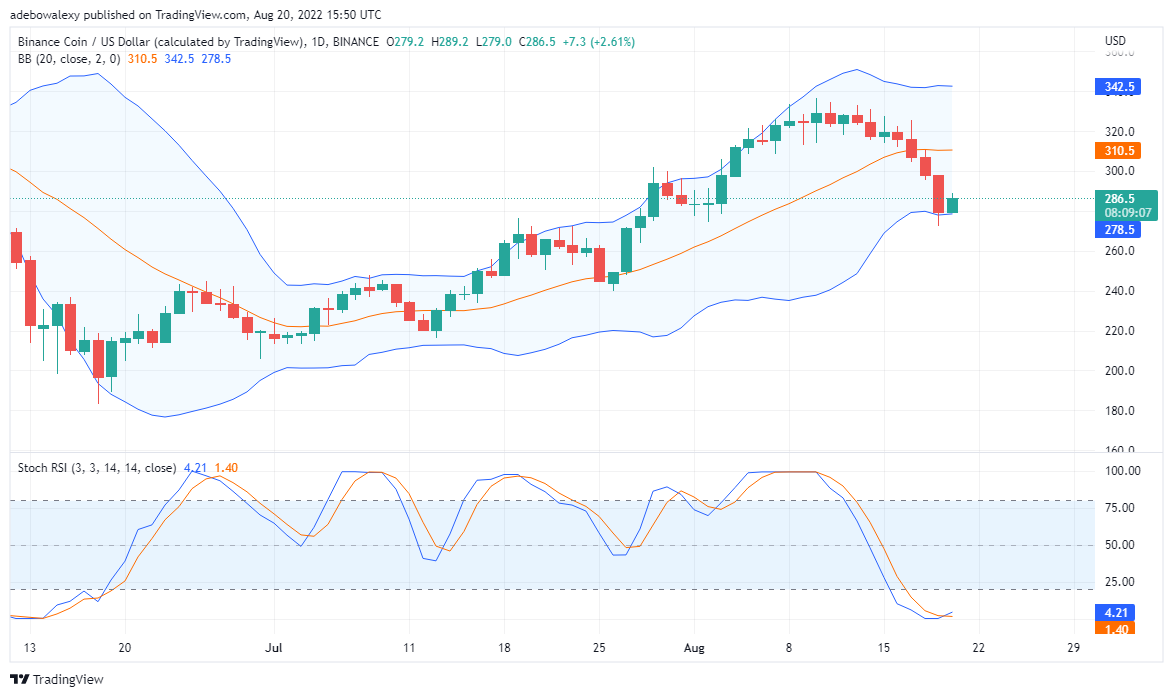
Binance coin traded in s smooth curved path, from its point of rejection at a higher resistance till it touches the lower limit. Furthermore, it seems as if BNB/USD price has rebounded off the lower limit, And may have begun retracing higher resistance.

Binance Coin Forecast Statistics Data:
BNB current price: $286.5
BNB market cap: $45.9 billion
BNB circulating supply:161.3 million
BNB total supply: 161.3 million
BNB Coinmarketcap ranking: #5

In this forecast we shall be critically examining the BNB/USD and BNB/BTC markets, trying to find what trading opportunities lies in there. We shall also try to figure out the best way we could approach this market, to make profits and minimize losses.

Major Price Marks:
Resistance levels: $26.5, $307, $328.5
Support levels: $316, $298, $278.9

Binance Coin Bulls May Be Recovering; When Tamadoge Set to Show Impressive Market Performance

Following a soft rejection at a higher resistance, BNB/USD price action has retracted its path back to lower support. Consequently, this lower support was found at the lower band of the BB (Bollinger band) Indicator. And, by close examination, it appears as if Price’s action has taken another soft rebound off this support towards the upside. This is because the Stochastic RSI lines crossed each other Just when this last bullish candlestick appeared. Furthermore, there must have been a gradual build-up to this. Perhaps the bulls may have been gathering strength gradually.

Additionally, the crossing of the SRSI may indicate that enough strength has been gathered by the bull for an upside correction. Consequently, this signifies that we might be at the start of an uptrend. Traders should place and set up their orders. An entry can be placed around $305, as the price seems set to rise from this point.

Binance Coin Price Analysis:  BNB/BTC Retraces Higher Price Levels

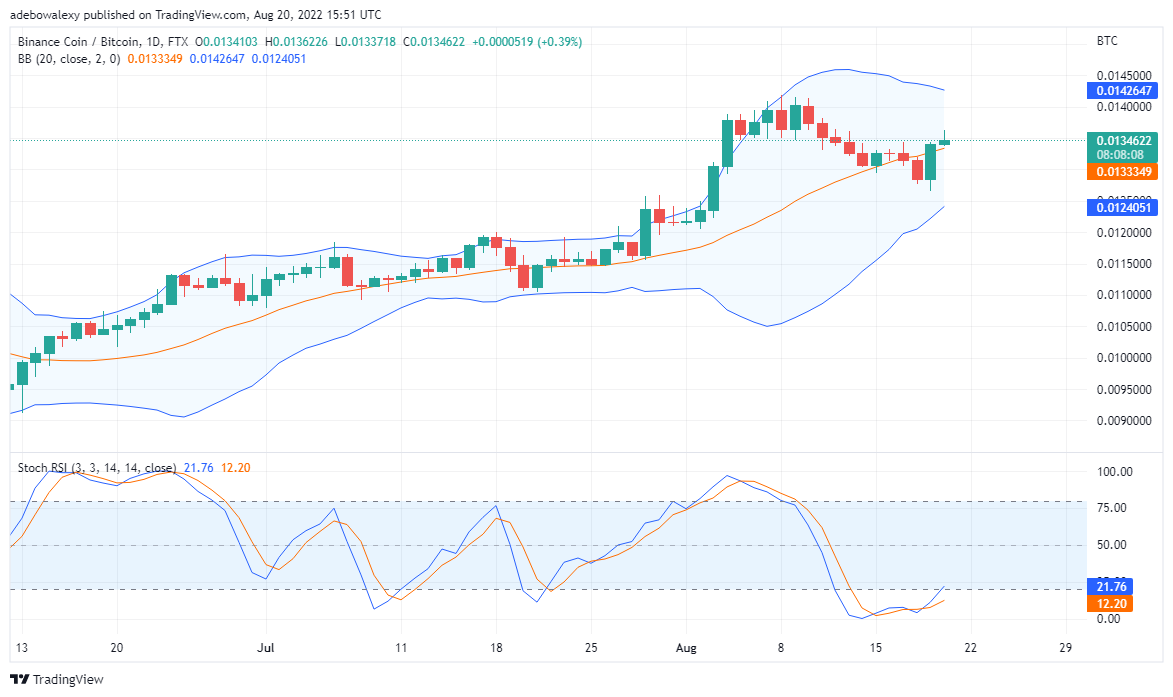
BNB/BTC chart portrays a reversal around the middle line of the BB Indicator. Progressively, price movements have been able to cross the upper part of the middle band of the Bollinger indicator. This could be pointing to the price development from the BNB/USD market. Perhaps, this confirms that price has commenced an uptrend in that market.

Buy Binance Now

Your capital is at risk

Furthermore, the SRSI indicator further, portrays the uptrend as we can see that the lines of this Indicator are already trending upwards. Consequently, this is showing that the upward retracement is gathering strength even here. So in this market, we can anticipate value getting to around 0.014500.

Tamadoge is also securing strategic listings on centralized and decentralized exchanges as part of its roadmap. The first listing has already been secured on LBank. LBank is a centralized exchange, and the Tamadoge team is optimistic that TAMA could be paired with ETH to support the project’s rapid growth as it faces improved liquidity.

Related

  • How to Buy Tamadoge
  • Visit Tamadoge Website

Tamadoge – Play to Earn Meme Coin

Our Rating

  • Earn TAMA in Battles With Doge Pets
  • Capped Supply of 2 Bn, Token Burn
  • NFT-Based Metaverse Game
  • Presale Live Now – tamadoge.io

Visit Site

Go to Source

BitMEX Founder Arthur Hayes Says ‘Ugly’ Ethereum (ETH) Price Action Should Be Ignored – Here’s Why

Prominent crypto capitalist Arthur Hayes says Ethereum’s ugly price action as of late might be a prime opportunity for ETH bulls.

The founder of crypto derivatives exchange BitMEX tells his 288,700 Twitter followers that Ethereum’s 22% decline in one week from a high of $2,030 should be considered as noise by long-term investors.

“Ouchie. Time to do some thinking. Are you trading a medium to long-term fundamental thesis? Or are you trading short-term price action? The short-term price action is ugly. Assuming you are long, it could mean you read the market wrong. Is it time to cover, sit tight or add more? That all depends on your nerve and how well you can read the chart.

If you are trading a fundamental thesis, has your thesis been invalidated by the price action? Have any [tenets] of your thesis changed which is the cause of the price action? Unless the price action is driven by a change in one of the tenets of your thesis, then the price action should be ignored. And depending on your capital position, it might be prudent to add more to your position.” 

At time of writing, ETH is swapping hands for $1,591, a 1% increase on the day.

Hayes says he remains bullish on ETH despite its recent drop because he believes The Merge – Ethereum’s highly anticipated transition to proof of stake – is still on track.

“If you tell me the ETH merge ain’t happening, or something occurred which severely diminishes it’s probability of success, then I would be worried about my long position. With that in mind, it might be time to go shopping.” 

A few days ago, Hayes predicted a sharp corrective move for Ethereum leading up to The Merge. He also noted that the dip will likely be temporary as Ethereum reaps the benefits of the upgrade.

“That said, it’s possible the price of ETH dips slightly heading into and right after the merge. Those who cut partially or fully would initially feel great about their decision. However, as the deflation kicks in, and due to the reflexive relationship between a high and rising ETH price and usage of the network, the price could keep gradually grinding higher. At that point, you would have to decide when to get back into your position.”

Don’t Miss a Beat – Subscribe to get crypto email alerts delivered directly to your inbox

Check Price Action

Follow us on Twitter, Facebook and Telegram

Surf The Daily Hodl Mix


Disclaimer: Opinions expressed at The Daily Hodl are not investment advice. Investors should do their due diligence before making any high-risk investments in Bitcoin, cryptocurrency or digital assets. Please be advised that your transfers and trades are at your own risk, and any loses you may incur are your responsibility. The Daily Hodl does not recommend the buying or selling of any cryptocurrencies or digital assets, nor is The Daily Hodl an investment advisor. Please note that The Daily Hodl participates in affiliate marketing.

Featured Image: Shutterstock/Joy Chakma

Go to Source

Lucky Block’s Value Analysis: LBLOCK Price Isn’t Going Down


LBLOCK: 21st of August

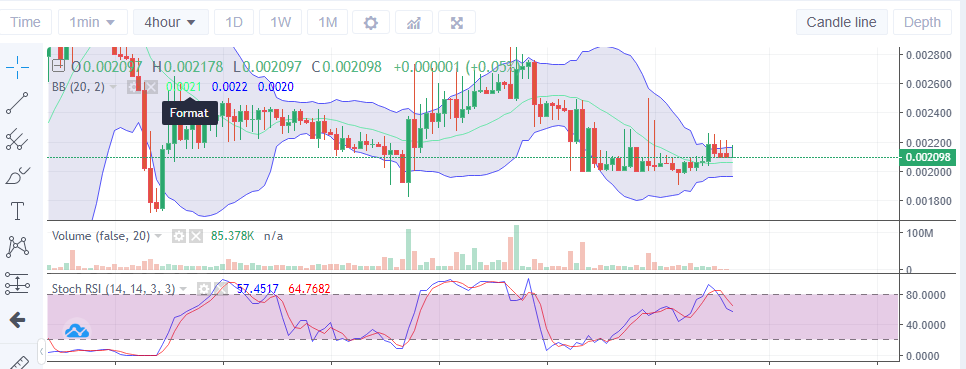
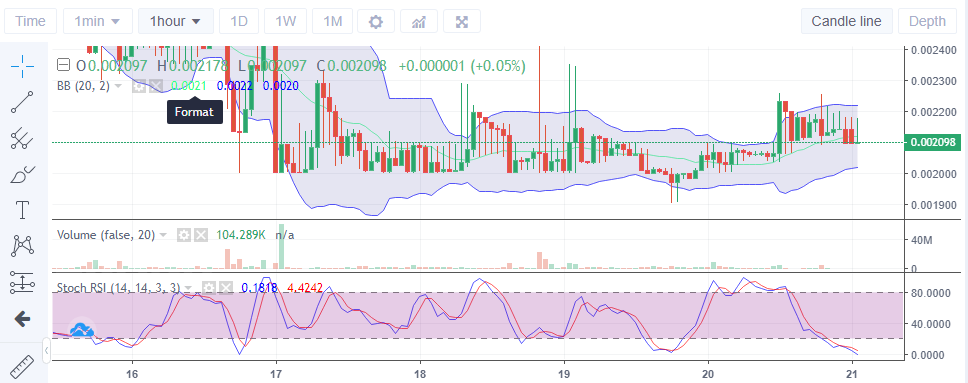
Lucky Block is putting up some interesting displays, refusing to downtrend after hitting a strong resistance. From our last post, it could be seen that LBLOCK has claimed a more elevated base of $0.002098, from the past one of $0.002080. However, this crypto seems not tired just yet as it looks set to take its worth even higher.

Lucky Block Value Now: $0.002098
Lucky Block Market Capitalization: $7.7 million
Lucky Block Moving Supply: ——
Lucky Block Entire Supply: 3.6 billion
Lucky Block’s Rank on Coinmarketcap: #3383

Crucial Price Mark:
Ceiling Marks: $0.002057, $0.002098, $0.002183
Floor Marks: $0.002094, $0.002057, $0.002028


LBLOCK Value Forecast: LBLOCK/USD Prepares to Trend Higher

Even after Lucky Block has faced rejection at an upper limit, the LBLOCK/USD  4-hours chart portrays that the price is not ready to fall. The 4-hour chart displays the appearance of an invert and a Bullish hammer candlestick. This is portraying that bulls are prepared to raise prices higher. Also, it can be viewed that price activity remains above the Moving Average curve of the Bollinger band, this indicates that an uptrend will still occur. Moving on, the faster Stochastic RSI indicator thread is now making a turn for a cross. This portrays s that the buyers are steadily gathering strength. So, from here, we may project that the price may eventually get to above $0.002310.

Lucky Blocks Value Forecast: LBLOCK/USD Targets  Higher Resistance

The LBLOCK/USD one-hour trading chart reveals the build-up to the upcoming uptrend. On this chart, we can see that an inverted hammer candlestick has just appeared and this is indicating a bullish reversal. Therefore, this indicates that an upside correction is already on its way. Also, it can be perceived that the Stochastic indicator has already gotten to the highly sold region. Summing up the candlestick formation and the Stochastic Indicator reading, Traders can enter this market with a buy stop, with entry near $0.002120 and a target above $0.002350.

Lucky Block (LBLOCK V2): Gate.io listing has been set to be done on 25th August.

You can purchase Lucky Block here. Buy LBLOCK

Related

  • How to Buy Tamadoge
  • Visit Tamadoge Website

Tamadoge – Play to Earn Meme Coin

Our Rating

  • Earn TAMA in Battles With Doge Pets
  • Capped Supply of 2 Bn, Token Burn
  • NFT-Based Metaverse Game
  • Presale Live Now – tamadoge.io

Visit Site

Go to Source

Celsius Slips By 31% – Here’s Everything You Should Know


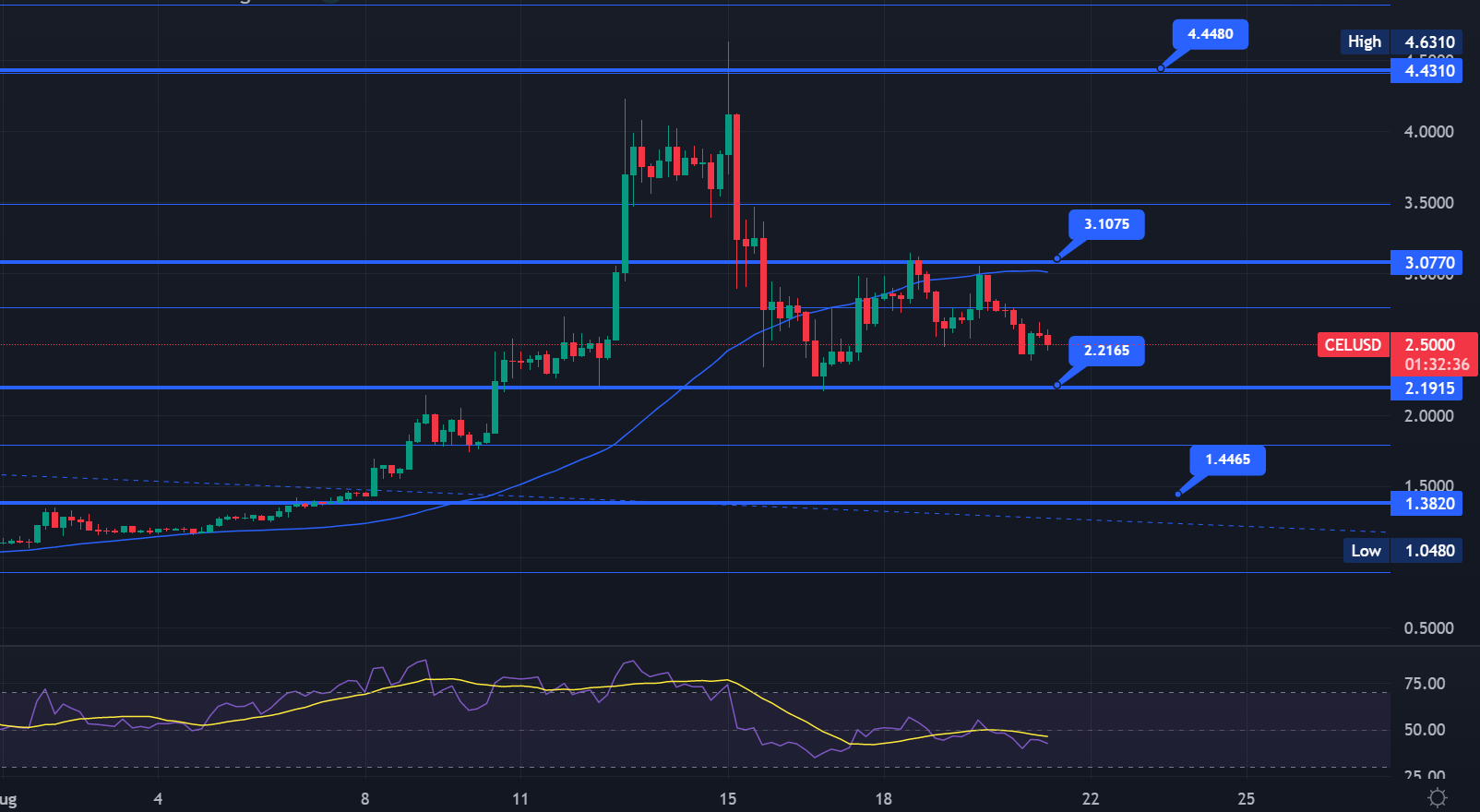
Celsius slips by 31% and fails to extend its previous bullish rally. CELL fell below the $2.70 mark as the crypto market experienced a massive sell-off, sending many crypto coins down. The Celsius coin increased by 14% last week due to a favorable court decision.

A US bankruptcy court decision allowed financially troubled Celsius to sell newly mined bitcoin, causing CEL to ride the classic roller coaster once more. However, the company’s token has increased by 20% due to this news. However, the gains were only temporary, as the severe crypto market sell-off pushed many coins into negative territory.

Buy Cryptocurrencies Now

Your capital is at risk.

Celsius Price Review & Tokenomics

Celsius (CEL) currently trades at $2.69 with a 24-hour trading volume of $26 million. The 24-hour change in Celsius is a 10.95% decrease. Celsius is now ranked #67 in the market, with a live market capitalization of $641 million. It has a capacity of 696 CEL coins, but only 239 million are currently in circulation.

Celsius’s (CEL) price has risen from $0.28 to nearly $4 in the two months since its asset freeze was announced on June 14. Despite the recent drop in the dollar value, the value of the CEL token has remained relatively stable. Despite its outstanding performance, the Celsius (CEL) coin has yet to surpass the all-time high of $8.02 set in June 2021.

Customers’ Recovery

According to Thomas Braziel, cryptocurrency founder of 507 Capital, customers of the bankrupt cryptocurrency lender Celsius Network are likely to lose all of their money. On CoinDesk’s “First Mover” show, Braziel stated that the average recovery for clients could be between 50 and 60 cents on the dollar.

Celsius announced in June that it had ceased withdrawals due to a liquidity issue. It later declared bankruptcy in July. During its initial court hearing, the corporation presented a restructuring strategy centered on its mining operations.

It’s unclear whether this effort will aid or hinder the company’s recovery. If the price of bitcoin continues to rise, the company’s assets may be able to survive. It’s unclear whether the company’s retail customers would be willing to get their money back.

Bearish Crypto Market

The price of the cryptocurrency has continued to fall. Geopolitical tensions, which reduced investor risk appetite, were the sole cause of this. As popular cryptocurrencies such as Bitcoin, Ethereum, Polygon, Shiba Inu, Dogecoin, and Polkadot lost users, the market capitalization of all cryptocurrencies fell.

Because of an unexpected crypto sell-off in early European trade, the price of bitcoin fell to around $22,000 on Friday, its lowest level in more than three weeks. As a result, it was assumed that the bleak cryptocurrency market was one of the primary reasons for the Celsius (CEL) coin’s decline.

Celsius Slips by 31% – Quick Technical Outlook

The CEL/USD has dropped to $2.50 in the 4-hour timeframe after reaching a high of $3.10. The 50-day EMA is expected to provide significant resistance at $2.50, and a break above this level could extend the uptrend to $3.10. If the CEL breaks above $3.10, it will be exposed to the $3.50 and $4.43 levels.

CEL Price Chart – Source: Tradingview

The leading technical indicators, such as the RSI and MACD, are in the sell zone. The most recent MACD histogram, on the other hand, indicates that CEL is about to enter the oversold zone. This could eventually result in profit taking by sellers, causing CEL to bounce off.

Celsius Price Prediction – Daily Technical Levels

Support   Resistance

1.4952      2.7088

0.7888     3.2160

0.2817      3.9223

Pivot Point: 2.0024

On the downside, a breakout of the $2.21 level could push the price down to the $1.76 support level. A further bearish bias, on the other hand, may allow for more selling until $1.45.

Consider remaining bearish under $2.75 today until $2.22, and continuing to hold a sell trade if the $2.22 level is broken. Good luck!

Read more:

  • Best Metaverse Projects of 2022
  • How to buy Cryptocurrencies

Tamadoge – Play to Earn Meme Coin

Our Rating

  • Earn TAMA in Battles With Doge Pets
  • Capped Supply of 2 Bn, Token Burn
  • NFT-Based Metaverse Game
  • Presale Live Now – tamadoge.io

Visit Site

Go to Source

FTX revenue reportedly grew 1000% in one year, leaked documents reveal

FTX was among the many crypto exchanges with a front-row seat to witness the crypto hype of 2021, back when Bitcoin (BTC) and other cryptocurrencies hit their all-time highs. Driven by massive customer onboarding, partnerships, sponsorships and other factors, FTX’s revenue reportedly grew 1000% in 2021 — revealed internal documents.

Audited financials of FY 2020-2021 show FTX witnessing a 1000% increase in revenue — growing from $90 million in 2020 to $1.2 billion in 2021, claimed CNBC alleging access to the documents.

The revenue breakdown discloses a 1842.85% increase in operating income for FTX, from $14 million to $272 million in one year. The crypto exchange amassed $388 million in net income, a 2182.35% increase from last year’s $17 million.

FTX has reportedly made $270 million in the first quarter of 2022. However, the exchange’s track record during the crypto winter is yet to be revealed. Despite the stellar first quarter performance, the ongoing crypto winter has most likely impacted the growth trajectory owing to numerous market crashes.

The report further claims that FTX possessed $2.5 billion in cash by the end of 2021 with a profit margin of 27%.

FTX has not yet responded to Cointelegraph’s request for comment.

Related: FTX US among 5 companies to receive cease and desist letters from FDIC

Binance CEO Changpeng ‘CZ’ Zhao recently raised concerns about jitters, a phenomenon wherein an existing trade order gets postponed to allow the completion of newer trades.

While CZ did not explicitly target any particular exchange during the discussion, the crypto community on Twitter assumed it was aimed at FTX. “All of you guys knew and didn’t say anything. We need to fight the bad players,” he added.

Go to Source

US Authorities Warn of ‘Pig Butchering’ Crypto Scam Becoming Alarmingly Popular

U.S. authorities have warned about the rising popularity of a crypto scam known as “pig butchering.” The Federal Bureau of Investigation (FBI) explained: “The fraud is named for the way scammers feed their victims with promises of romance and riches before cutting them off and taking all their money.”

‘Pig Butchering’ Crypto Scam on the Rise

U.S. authorities have been warning about a type of cryptocurrency scam called “pig butchering” that has been growing in popularity at an alarming rate.

Lakewood Police Public Information Officer John Romero detailed:

The term pig butchering basically comes from a farmer fattening up the pig before they slaughter it. And in this case, it’s the suspect who was fattening up their victim.

The police officer explained that the pig butchering scam usually starts on social media or dating sites like Linkedin and Tinder, where the scammer finds and convinces the victim to hand over some funds. The scammer then puts the money into a crypto account which appears to grow in value, making the victim want to add more funds to the account. The scammer then disappears with a large amount of the victim’s cryptocurrency.

According to one victim of the pig butchering scam, initially, he was able to make a few withdrawals from the crypto account without a problem. Everything looked legit until he received a message telling him he had to pay more than $204K in deposits to be able to access his account.

U.S. Secret Service Special Agent Shawn Bradstreet commented:

Once they [the victims] see how easy it is to invest, they see a rise in their screen account and then they end up investing their entire life savings in a matter of days.

He added: “The counterfeit sites used can look legitimate, but the money is going straight to the criminals.”

The Singapore-based Global Anti-Scam Organization is a non-profit staffed 24 hours a day to help victims of pig butchering. Grace Yuen, a Massachusetts-based spokesperson for the organization, described:

We are seeing an influx of victims from the Bay Area … The scam continues to get more advanced, where fake platforms are made, impersonating legitimate crypto-trading sites.

The Federal Bureau of Investigation (FBI) detailed in April: “The fraud is named for the way scammers feed their victims with promises of romance and riches before cutting them off and taking all their money.” The law enforcement agency added:

It’s run by a fraud ring of cryptocurrency scammers who mine dating apps and other social media for victims and the scam is becoming alarmingly popular.

The Nasdaq-listed crypto exchange Coinbase also warned about Sha Zhu Pan (pig butchering) investment scams last week. “Coinbase has seen a concerning increase in fraudulent cryptocurrency investment platforms that are sourcing victims through connections on dating apps and social media. We are encouraging our users to be vigilant against this type of social engineering scam,” the exchange wrote.

Tags in this story

What do you think about the pig butchering cryptocurrency scam? Let us know in the comments section below.

Kevin Helms

A student of Austrian Economics, Kevin found Bitcoin in 2011 and has been an evangelist ever since. His interests lie in Bitcoin security, open-source systems, network effects and the intersection between economics and cryptography.

Image Credits: Shutterstock, Pixabay, Wiki Commons

Disclaimer: This article is for informational purposes only. It is not a direct offer or solicitation of an offer to buy or sell, or a recommendation or endorsement of any products, services, or companies. Bitcoin.com does not provide investment, tax, legal, or accounting advice. Neither the company nor the author is responsible, directly or indirectly, for any damage or loss caused or alleged to be caused by or in connection with the use of or reliance on any content, goods or services mentioned in this article.

Read disclaimer

Go to Source

FDIC Issues Crypto-Related Cease and Desist Orders to 5 Companies Including FTX US Exchange

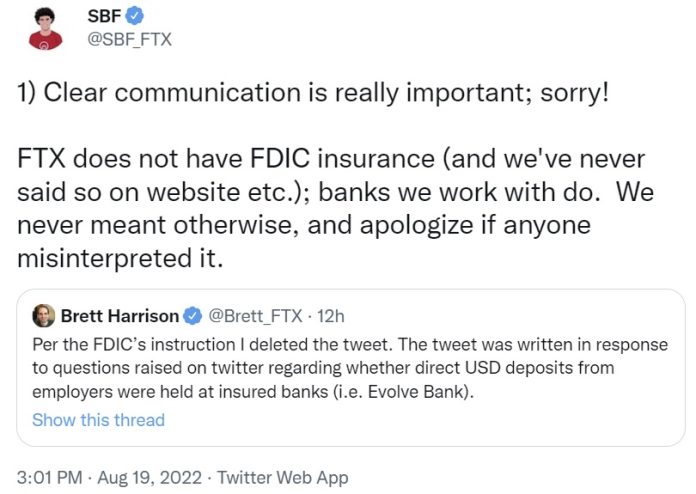
The Federal Deposit Insurance Corporation (FDIC) has sent a cease and desist letter to five companies, including crypto exchange FTX US. CEO Sam Bankman-Fried explained that FTX does not have FDIC insurance, stating: “We never meant otherwise, and apologize if anyone misinterpreted it … to be clear FTX US isn’t FDIC insured.”

FDIC Orders 5 Firms to Cease and Desist

The Federal Deposit Insurance Corporation (FDIC) issued crypto-related cease and desist orders to five companies Friday. The agency regulates and insures the deposits of FDIC-insured community banks and other financial institutions.

The letters demand that the five companies and their officers “cease and desist from making false and misleading statements about FDIC deposit insurance.” They must also “take immediate corrective action to address these false or misleading statements.”

The five companies are FTX US, Cryptonews.com, Cryptosec.info, Smartasset.com, and FDICCrypto.com.

The FDIC detailed:

Each of these companies made false representations — including on their websites and social media accounts — stating or suggesting that certain crypto–related products are FDIC–insured or that stocks held in brokerage accounts are FDIC–insured.

According to the FDIC, Cryptonews.com has reviews on its website claiming that Coinbase, Etoro, and Gemini crypto trading platforms are FDIC insured. Cryptosec.info and Smartasset.com provide a list of FDIC-insured crypto exchanges that includes Crypto.com, Luno, Robinhood, and Voyager. Meanwhile, FDICCrypto.com blatantly registered a website with FDIC in its domain name.

FTX US Ordered to Cease and Desist

FTX US is one of the crypto firms that received a cease and desist letter from the FDIC.

Although FTX and FTX US are two separate trading platforms, they are both founded by Sam Bankman-Fried, who is currently the CEO of both companies. Global exchange FTX does not allow U.S. residents to trade on its platform.

Bankman-Fried apologized for the confusion regarding FDIC insurance on Twitter. “Clear communication is really important; sorry!” he tweeted. “FTX does not have FDIC insurance (and we’ve never said so on website etc.); banks we work with do. We never meant otherwise, and apologize if anyone misinterpreted it.” In a follow-up tweet, he stressed: “To be clear, FTX US isn’t FDIC insured.”

This was not the first time the FDIC has taken action against crypto companies. The regulator and the Federal Reserve Board issued a letter to Voyager Digital last month demanding the crypto lender cease and desist from making false or misleading representations of deposit insurance status. Voyager filed for bankruptcy protection last month.

Tags in this story

What do you think about the FDIC issuing crypto-related cease and desist orders to five companies? Let us know in the comments section below.

Kevin Helms

A student of Austrian Economics, Kevin found Bitcoin in 2011 and has been an evangelist ever since. His interests lie in Bitcoin security, open-source systems, network effects and the intersection between economics and cryptography.

Image Credits: Shutterstock, Pixabay, Wiki Commons

Disclaimer: This article is for informational purposes only. It is not a direct offer or solicitation of an offer to buy or sell, or a recommendation or endorsement of any products, services, or companies. Bitcoin.com does not provide investment, tax, legal, or accounting advice. Neither the company nor the author is responsible, directly or indirectly, for any damage or loss caused or alleged to be caused by or in connection with the use of or reliance on any content, goods or services mentioned in this article.

Read disclaimer

Go to Source

Everything You Need to Know about Binance’s Biggest Gainer: Stargate Finance (STG)


Stargate Finance is a community-driven company that is constructing the first completely composable native asset bridge as well as the first decentralized application (dApp) to be developed on LayerZero.

After Ethereum’s success, a number of other alternative chains and second-layer rollups appeared on the market in order to satisfy the growing need for chain roaming yield farmers.

Every ecosystem is betting its long-term success on a distinct combination of blockchain architectural trade-offs including decentralization, security, and scalability.

As the number of competing DeFi ecosystems increased, a consistent flow of users found ways to execute cross chains in an effort to increase their overall output.

The goal of Stargate is to make transferring liquidity across chains a quick and easy process that only has to be done once. Stargate enables instantaneous trades between any asset on any network and any asset on any other chain with just a single click.

Consider the scenario in where a user wants to trade DAI on Ethereum for AAVE on Polygon on a decentralized exchange (DEX) that is not based on Stargate.

Users are able to swap DAI on Ethereum for AAVE on Polygon in a single transaction from the source chain using SushiSwap, which is built on Stargate.

This can be done without ever having to leave the Sushi user interface. Users are able to offer more assets for future gas payments on the destination chain while simultaneously paying the gas fees for both the source chain and the destination chain in a single transaction.

More on Stargate Finance (STG)

Stargate is a community-driven organization that is constructing the first completely composable native asset bridge as well as the first decentralized application (dApp) to be developed on LayerZero. It is a system for the transmission of liquidity that is totally customizable and plays an essential role in Omnichain DeFi.

Users and decentralized applications (dApps) may utilize Stargate to move native assets between chains, and they can also use it to access the unified liquidity pools provided by the protocols with instant guaranteed finality.

Stargate owners are required to connect their wallets to the Ethereum Mainnet, visit a DEX, swap DAI for USDC because Polygon does not support DAI, find a first-generation bridge to swap USDC for a wrapped version (USDC-wrap), connect to Polygon on Metamask, bridge, and pay a fee, find an AMM on the BNB Chain with a pairwise pool of USDC-wrap to swap for AAVE, and pay a fee. After then, they must repeat the process in order to get back to Mainnet.

Stargate, which is built on LayerZero’s generic communications protocol, is intended to make cross-chain composability easy while maintaining a high level of security.

Bridges that are composable across several chains may be quickly integrated with any decentralized application (dApp) running on any chain. The customer is shielded from the process of bridging in order to save them the effort, danger, and anxiety associated with doing the task on their own.

Buy STG on Binance

Your capital is at Risk

How to Use Stargate?

Users of DeFi can conduct several transactions on Stargate for the purpose of exchanging native assets. Users have the ability to swap, for instance, USDC on Ethereum for USDT on BNB.

A holder’s chosen yield aggregator may be assembled into Stargate so that assets can be deployed across chains, which opens the door to further APY opportunities. These cross-chain swaps are supported by the Stargate unified liquidity pools, which are controlled by the community.

What Makes Stargate Unique?

The bridging trilemma was successfully solved for the first time by the Stargate Bridge. Existing bridges are forced to make concessions with regard to the following fundamental bridge characteristics:

  • Users and apps may be assured that a transaction they successfully execute on the source chain will reach at its intended destination chain in real time thanks to instant guaranteed finality.
  • Wrapped assets necessitate additional swaps and charges to get the necessary object, therefore users and programs prefer to swap in native assets instead.
  • More liquidity is created for users and apps that rely on the bridge by providing them with access to a unified liquidity pool that serves several chains.

Following are the features that make Stargate unique:

Easy Transferability

Users are able to move native assets between chains at a 1:1 ratio by utilizing Stargate’s unified liquidity pools. It is guaranteed that a transfer that is made on the source chain will reach its intended destination.

Liquidity

The addition of liquidity to the Omnichain protocol of Stargate and the receipt of stablecoin rewards on each transfer of Stargate. In addition to this, liquidity providers have the ability to farm their LP tokens for STG token rewards.

Can be Easily Farmed

Stargate liquidity providers are able to farm their LP tokens so that they can receive STG prizes in exchange. To participate in the Stargate community, one must first get a STG by their own efforts.

Easy Stake

Owners of STG tokens have the ability to lock their STG tokens in exchange for veSTG, which is Stargate’s governance token. The more value individuals derive from using veSTG, the longer they are willing to stake their STG tokens.

Buy STG on Binance

Your capital is at Risk

What Is The Stargate Whitelist Partner Program All About?

Partners who utilize Stargate in production and have a significant transaction volume are eligible to apply to become members of the whitelist partner program offered by Stargate.

For every transaction that is carried out via the Stargate protocol, partners will be given 0.3 bps. These are going to be settled in stablecoin on a monthly basis. The base fee that the Treasury uses will have the 0.3 bps subtracted from it.

Prices for Readjusting the Stargate

Keeping in mind that Instant Guaranteed Finality (IGF) using native assets is one of the primary characteristics of Stargate, the performance of Stargate requires destination chains to keep sufficient reserve balances on hand to handle incoming swap transactions. This is because IGF is one of the primary characteristics of Stargate.

The balances start off at the ideal goal balance when the protocol begins, but successive swap transactions reduce certain balances on destination chains while increasing others on source chains.

Stargate includes rebalancing fees in its design, and these fees are calculated based on the current balance of any possible transaction as well as the size of the transaction.

The purpose of these fees is to encourage users to carry out swaps that “refill” native asset balances and to discourage users from engaging in transactions that could completely deplete the reserve balance.

The Possibility of Composition across All Chains

Stargate enables instantaneous trades between any asset on any network and any asset on any other chain with just a single click. On a DEX that is not based on Stargate, for instance, a user may seek to trade DAI on Ethereum for AAVE on Polygon in order to complete a transaction.

They are required to connect their wallet to the Ethereum Mainnet, go to a DEX, swap DAI for USDC because there is no DAI on Polygon, find a first-generation bridge to swap USDC for a wrapped version of USDC (USDC-wrap), connect to Polygon on Metamask, bridge, and pay a fee.

They are also required to find an AMM on BNB Chain with a pairwise pool of USDC-wrap to swap for AAVE and pay a fee after that, they must repeat the process in order to get back to Mainnet.

Demand-Based Cross-Chain Liquidity

With the debut of SushiSwap, Sushi has become the first decentralized exchange (DEX) to utilize Stargate to access a single pool of liquidity from any chain, at any given moment. Simplifying the lives of consumers and developers alike may be accomplished by abstracting away complexity.

Stargate gives developers access to enormous pools of capital-efficient liquidity without the burden of monitoring LP emissions. Additionally, it speeds up core development cycles while providing customers with access to local assets.

Through the automation of cross-chain inventory management and the provision of access to liquid inventory on demand, Stargate does away with the requirement for decentralized applications (dApps) fund or maintain emissions in order to incentivize LPs across multiple networks.

Decrypting Omnichain Using Web3

Stargate broadens the functionality of all decentralized applications (dApps) by providing a re-usable bridge that enhances the user experience without needing any modifications to the code that is already in place.

Although Stargate is used for swaps in Sushi, the implementation of Omnichain composability has significantly improved several other often used functions.

In addition, decentralized applications (dApps) are fighting with one another to be the first in their respective categories to provide their customers the added benefits of developing on Stargate with the help of an advanced algorithm.

In addition to providing other services, the first Omnichain AMMs, wallets, yield aggregators, and lending decentralized applications (dApps) will provide access to a single pool of liquidity that is scattered over several chains.

Binance Includes Stargate Finance

Decentralized finance (DeFi) is an industry that Stargate Finance, a blockchain project, is a part of. Stargate Finance is a very modest blockchain project. It promotes itself as the first and only bridge that addresses the three primary difficulties that are associated with constructing bridges.

These difficulties are connected to the concepts of instant assured finality, uniform liquidity, and native assets. It possesses capabilities that make it possible for users to wrap all currently available DeFi apps.

Additionally, users and decentralized applications (dApps) are able to move native assets seamlessly between chains while simultaneously accessing unified liquidity pools with instant assured finality. According to the official website for Stargate, the game has a total value locked (TVL) of more over $448 million.

The Stargate Finance platform uses its own token, which is denoted as STG. It is the governance token that contributes to the successful operation of the Decentralized Autonomous Organization (DAO). Stargate liquidity providers are able to get STG incentives in return for LP tokens that they offer to the network.

On Friday, following an announcement made by Binance that it will list STG, the coin’s price skyrocketed, reaching new all-time highs. This implies that the currency will be available to purchase for the millions of consumers that use Binance.

Historically speaking, the value of cryptocurrencies has a tendency to increase once they have been listed on major exchanges such as Coinbase and Robinhood. These gains, however, typically only last for a short period of time since investors begin to swiftly take profit.

After OmniBTC was linked with Layer Zero Labs and the platform, Stargate Finance saw a rise in value as well. Users will be able to effortlessly OmniSwap across EVM chains as a result of this.

Buy STG on Binance

Your capital is at Risk

Where Does Stargate Finance’s Price Go from Here

A quick look of the price chart for STG on TradingVeiw.com reveals that Stargate Finance’s price has recently been moving in a direction consistent with a declining trend. This week, it reached an all-time low of $0.33 as a result of its decrease. After the Binance listing took place on Friday, it skyrocketed to new heights.

As it went higher, it was able to break through a key point of resistance located at $0.5452, which was the day’s high point. This occurred on June 28. It also climbed above the moving averages of the previous 25 and 50 days.

As a result, and as was said previously, the pumps that take place after a listing are often just transitory. As a consequence of this, there is a considerable likelihood that the coin will decline, and it may possibly fall lower than the support level of $0.50.

Read More

  • Best Web3 Cryptos
  • How to Buy Binance Coin

Tamadoge – Play to Earn Meme Coin

Our Rating

  • Earn TAMA in Battles With Doge Pets
  • Capped Supply of 2 Bn, Token Burn
  • NFT-Based Metaverse Game
  • Presale Live Now – tamadoge.io
Visit Site

Go to Source

Please enter CoinGecko Free Api Key to get this plugin works.
Exit mobile version